Verbal Fluency Tasks (VFTs) demand the retrieval of a specific type of words during a limited time interval. All of these tasks involve executive and semantic processes (Ruff, Light, Parker, & Levin, Reference Ruff, Light, Parker and Levin1997), because controlled retrieval is a key and constant mechanism between them (Henry & Crawford, Reference Henry and Crawford2004). These tasks usually require that the words match a phonological criterion, or belong to a specific category or a certain grammatical type (Piatt, Fields, Paolo, & Tröster, Reference Piatt, Fields, Paolo and Tröster2004). The phonological VFT demands the highest executive effort, since the storage of concepts follows arbitrary phonological criteria (Pulvermüller, Reference Pulvermüller2002), there is a decrease in the facilitation of spreading-activation processes and their search strategy is more demanding. Semantic VFTs require lower search executive activity due to the extended activation of concepts evoked by their proximity and the amount of shared traits, as occurs between “gorilla” and “chimpanzee”, for example (Goñi et al., Reference Goñi, Arrondo, Sepulcre, Martincorena, de Mendizábal, Corominas-Murtra and Villoslada2011). Among grammatical VFTs, Action Fluency (verb naming) can be highlighted. Action Fluency evaluates a single executive component (Östberg et al., Reference Östberg, Crinelli, Danielsson, Wahlund, Bogdanovic and Fernaeus2007) which is not limited to the basic executive functions proposed by Miyake et al. (Reference Miyake, Friedman, Emerson, Witzki, Howerter and Wager2000).
The most active brain area during the performance of a VFT is the left inferior prefrontal gyrus (IPFG), which comprises Brodmann Areas (BA) 44, 45 and 47 (Cattaneo, Pisoni, & Papagno, Reference Cattaneo, Pisoni and Papagno2011). In phonological VFTs, activation usually extends to the medial prefrontal gyrus (MPFG, BA 46 and 9) (Costafreda et al., Reference Costafreda, Fu, Lee, Everitt, Brammer and David2006). IPFG activity transcends from the kind of words demanded and is associated with controlled retrieval mechanisms and selection of semantic representations, both mechanisms of selective search of semantic representations (Badre & Wagner, Reference Badre and Wagner2007). In semantic VFTs, brain activity was recorded in the lingual gyrus and in portions of the temporal lobe (Abrahams et al., Reference Abrahams, Goldstein, Simmons, Brammer, Williams, Giampietro and Leigh2003) and in Action VFTs, activity was found in the basal ganglia (Östberg, Fernaeus, Hellström, Bogdanovic, & Wahlund, Reference Östberg, Fernaeus, Hellström, Bogdanovic and Wahlund2005).
Semantic, phonological and action VFTs are based on evoking common entities: they demand concepts that share a high number of traits among members of the same category (Semenza, Reference Semenza2006). However, unique entities, such as names of cities, are words that have an arbitrary relationship between their lexical label and their attributes and are connected together using non-semantic keys (Lyons, Hanley, & Kay, Reference Lyons, Hanley and Kay2002). It has been shown that geographical names are arranged according to spatial proximity patterns that respect the real-world distances (Crutch & Warrington, Reference Crutch and Warrington2003, Reference Crutch and Warrington2010). These authors aurally presented sets of geographical locations, which were either near or far to each other in the real world to aphasic patients. Afterwards, participants had to write down the stimuli they had heard. Results showed that participants made more errors in writing geographical locations of the same proximity cluster (e.g. Sweden, Finland, Denmark and Norway) than when they were distant locations (Spain, Brazil, India and South Africa). These findings have led to the proposal that geographical names make up a specific module within conceptual knowledge, which is supported by a combination of verbal, visual and specifically spatial information. Furthermore, experience and knowledge of the geographical routes and maps have a significant influence on their spatial structure (Crutch & Warrington, Reference Crutch and Warrington2010).
Spatial cognition is a set of subsystems that integrate spatial memory, navigation and imaging (Hayes, Nadel, & Ryan, Reference Hayes, Nadel and Ryan2007). It involves a network of posterior and medial regions of the parietal cortex, the lingual gyrus, the hippocampus, the parahippocampal gyrus, the entorhinal cortex, the striate cortex and the cerebellum (Hafting, Fyhn, Molden, Moser, & Moser, Reference Hafting, Fyhn, Molden, Moser and Moser2005). The prefrontal cortex has a mediating role in the connection between temporal cortical and hippocampal areas with the striated subcortical nuclei (Hayes et al., Reference Hayes, Nadel and Ryan2007). The literature suggests a distinction between egocentric (Klatzky, Reference Klatzky, Freksa and Habel1998) and allocentric (Burgess, Reference Burgess2006) representations. The first type contains auto-referential spatial information that favors location and orientation. The latter relate to spatial memory linked to geographic coordinates, like those provided in a map, for example. These representations are believed to interact dynamically. The parahippocampal gyrus is crucial in allocentric processing, in searching and locating objects in places that have been previously mapped and in the connections between allocentric and egocentric coding. Brain activation in these processes is significantly lateralized and moderated by sex. For men, a greater activation of the right hemisphere is expected, while activation in women tends to be bilateral (Weiss et al., Reference Weiss, Siedentopf, Hofer, Deisenhammer, Hoptman, Kremser and Delazer2003).
The aim of this study was to examine brain activity using fMRI during the performance of a VFT retrieving geographical words, specifically, the names of cities and towns in the Republic of Argentina. A phonological restriction was added (that names should end in a consonant letter) to follow restrictions used in other research on verbal fluency (Marino & Alderete, Reference Marino and Alderete2010). An increased hemodynamic response was hypothesized in brain regions associated with spatial cognition (medial and subcortical temporal regions) and controlled retrieval (left MPFG and IPFG). The finding of evidence in favor of this hypothesis would enhance the value of VFTs as simple measures that enable exploration of cognitive functions (in this study, specifically those related to spatial cognition).
Methods
Participants
Participants were 22 students and college graduates (12 women) from Universidad Nacional de Córdoba and Universidad Católica de Córdoba, both in Argentina. They were aged between 18 and 31 years (M = 22.5, SD = 2.1), all of them were right-handed (Edinburgh Inventory, M = 6.2, SD = 1.0, with 7 being the extreme value for the dominant right and 0 for the left), and Spanish native speakers who participated voluntarily. The Córdoba Private Institute of Neurosciences Clinical protocol was applied (Marino, Fernández, & Alderete, Reference Marino, Fernández and Alderete2001) to detect any history of clinical or psychiatric disorders. Having any psychopathological diagnosis was an exclusion criterion for participation in the study. In the final analysis, data from five males was excluded because of the occurrence of technical artifacts during registration. The study was approved by the ethics committee of the Institute of Computed Tomography (OULTON Foundation) and each participant gave a written informed consent.
Image Acquisition
The images were obtained using a Philips Achieva (1.5 T) scanner belonging to the Córdoba Computed Tomography Centre - Oulton Foundation. For structural imaging, a 232 X 222 reconstruction matrix was used, with a volumetric T1 sequence of the following parameters: slice thickness 1 mm, gap 0 mm, TR/TE 500/50, voxel size: 1 X 1 X 1. The field of view had the following parameters: FOV RL (mm) 257 FOV AP (mm) 256 FOV FH (mm) 176. In functional imaging, a 64 X 64 reconstruction matrix was used, with T2 * ‘single-shot’ echo-planar sequences of the following parameters: slice thickness 4 mm, 0 mm gap, TR/TE 2000/50, voxel size: 3.59 X 3.59 X 4. The dynamics duration was 2000msec, yielding 20 ‘slices’ per volume. Each feed lasted 140 seconds, yielding 70 dynamics. The field of view had the following parameters: FOV RL (mm) 230 FOV AP (mm) 230 FOV FH (mm) 107.
The post-processing of the images was performed offline using MATLAB 7.10.0 and Statistical Parametrical Mapping (SPM) 8.0. In the first level of analysis, realignment, estimation and reordering of the slices were performed. Functional images were aligned in relation to one of the structural images (yielding two per participant). Co-registration and normalization were performed entering the average functional image and the functional batch co-registered over the EPI template provided in SPM. The smoothing was performed using a FWHM equal to 777. In the second level analysis, a high-pass filter was set at 80 mhz. The xjView 8.11 toolbox Footnote 1 was used to generate explicit masks of the Regions of Interest (ROI), which were introduced into the second-level analysis.
Procedure
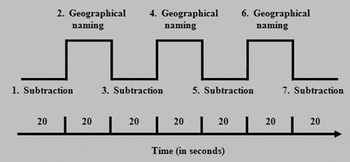
Participants performed the VFT and a simple arithmetic subtraction task aloud (‘overt’ paradigm), in order to respect the conditions in which VFTs are usually applied in clinical situations. During the geographical words tasks, participants were asked to name cities and towns in Argentina that ended with a consonant letter. Restricting geographic locations to the Argentinean territory was performed with the aim of ensuring personal experience and semantic knowledge of the participants on the evoked concepts, both key components to perform geographical navigation and to activate spatial cognition processes. In these trials, the experimenter would say the word ‘cities’ aloud. In the contrast condition, the evaluator would mention the word ‘subtraction’ and the participants would have to subtract numbers aloud one by one starting at 500. Participants were previously informed that the ‘Cities’ and ‘Subtraction’ tasks would alternate over a period of 2 min. 20 s, with each test lasting 20 s. in duration (see Figure 1). The VFT duration was similar to that used in clinical settings (1 min.), and it was considered that the duration was sufficient to obtain a VFT-reliable hemodynamic response (Phelps, Hyder, Blamire, & Shulman, Reference Phelps, Hyder, Blamire and Shulman1997).
Experimental sequence used. Each participant completed four simple arithmetic subtraction trials (eighty seconds in total) and three geographical word naming trials (sixty seconds in total) in alternation. Each trial lasted twenty seconds.

When participants entered the resonator, they were given 5 min. of relaxation and adaptation, while maintaining permanent auditory contact with the technical evaluation team. Two structural images were acquired, and then the functional sequence began with the ‘subtraction’ task. The retrievals were recorded and those that yielded a score greater than z = –1 were considered to be valid, taking into account the available scales in a reference population for the same tests (Marino & Alderete, Reference Marino and Alderete2010).
Statistical Analysis
The first level t contrasts of each participant between geographical word naming vs. contrast condition (simple arithmetic subtraction) were admitted to the second level, and the activation between the two conditions for all participants was compared through a one-sample t test. Since both conditions were performed aloud (‘overt’ paradigm), the artifact produced by speech in the hemodynamic response generated no significant differences in statistical tests performed. The gender variable was controlled by introducing it as a covariable in the second level analysis. Five partial ROI contrasts were performed using explicit masks over the areas related to spatial cognition and semantic executive control: parahippocampal gyrus, entering 900 voxels into the analysis, hippocampus, entering 93 voxels; posterior cingulate cortex (PCC), entering 141 voxels; lingual gyrus, entering 196 voxels, and left PFMG, entering 229 voxels. By reducing the amount of t-tests by decreasing the number of voxels in the analysis, a more restrictive correction of the possibility of committing a type I error was established, i.e. the Family Wise Error (FWE) method, with an acceptable value of Cronbach’s alpha < .05, with no cluster threshold (Poldrack et al., Reference Poldrack, Fletcher, Henson, Worsley, Brett and Nichols2008).
Subsequently, a whole brain scan was carried out, with an uncorrected value of Cronbach’s alpha < .001, with a correction per cluster > 5. Coordinates were obtained in a brain space developed by the Montreal National Institute (MNI) and were transformed to Talairach space using the method proposed by Andreas Meyer-Lindenberg Footnote 2 . Significant activation peaks were labeled using the Talairach Client software, using a 2mm radius to obtain the label and the corresponding BA.
Results
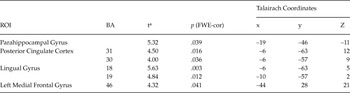
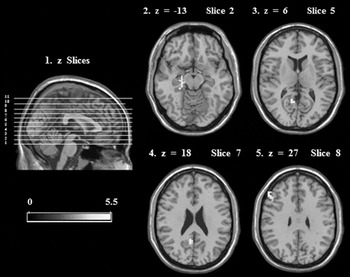
Table 1 shows the peaks of activation corresponding to the contrast between the geographical word naming VFT and subtraction condition for the defined ROI (see also Figure 2 for more references). Six activation peaks greater than the standard error were obtained. No activations were observed in the hippocampus or in the right hemisphere for the parahippocampal rotation, the PCC or the lingual gyrus.
Activations found in the Regions of Interest in the geographical word naming VFT with phonological restriction

Notes: p (FWE-cor) = p value with Family Wise Error correction; BA = Brodmann area.
a t = One-sample t-test, degrees of freedom (df) = 15.
FWE correction p < .05.
Contrast between activations recorded in the ROI during geographical word naming VFT vs. simple arithmetic subtraction task. Images generated by overlaying of templates from the MRIcro software (Rorden & Brett, Reference Rorden and Brett2000). p value <.05, FWE correction, with t ranging from 0 to 5.5. Image 1: location of the axial slices of the images 2, 3, 4 and 5. Image 2: Parahippocampal Gyrus. Image 3: Lingual Gyrus. Figure 4: Posterior Cingulate Cortex. Figure 5: Left Medial Prefrontal Gyrus.

The whole brain scan was performed using a different significance level (p < .001, uncorrected, with cluster-correction < 5) to the analyzes conducted for the ROI, since many more voxels were entered into the analysis (28156 voxels). The same activations as those for the ROI analyzes were found in the parahippocampal gyrus and the left PFMG (with significance level p < .001 uncorrected for both activations). A different activation in the PCC (BA 30) to that recorded in ROI analyzes was observed, with Talairach coordinates x = –10, y = –63, z = 9, value t(15) = 5.05 p < .001, uncorrected. The established significance level in the ROI analyzes was stricter and therefore did not reach significance. Activation was observed in the cerebellum, with Talairach coordinates x = –22, y = –39, z = –22, value t(15) = 5.29 p < .001 uncorrected.
Discussion
The aim of this study was to determine whether brain activation associated with evoked geographical names corresponded to areas related to spatial cognition and to the controlled retrieval of words. As anticipated, there were activations in the left PFMG, an area associated with word retrieval, and in the left lingual gyrus, the left parahippocampal gyrus and the left PCC, areas related to spatial cognition. In the whole brain scan, with a looser significance level, there was a distinct peak in the PCC and activation in the cerebellum. These results support the value of geographical word naming VFTs in the assessment of spatial cognition.
In the VFTs, it is likely that an activation of the inferior and medial region of the prefrontal gyrus (PFG) occurs, which is lateralized to the left hemisphere in right-handed participants with dominance of language on the left side (Cattaneo et al., Reference Cattaneo, Pisoni and Papagno2011). Furthermore, when the required control effort is high, it is more likely that activation occurs more ventrally (Costafreda et al., Reference Costafreda, Fu, Lee, Everitt, Brammer and David2006). The medial region has been linked to phonological retrieval criteria (Costafreda et al., Reference Costafreda, Fu, Lee, Everitt, Brammer and David2006). Functional connectivity studies have also confirmed this fact. During the VFTs, this brain region is the first to be activated (Vitali et al., Reference Vitali, Abutalebi, Tettamanti, Rowe, Scifo, Fazio and Perani2005). It then sends the retrieval request to specific posterior areas related to concept storage, according to the type word that needs to be retrieved. The present study replicates these data since significant activity was observed in the medial region of the PFG. In the task, the phonological restriction that geographical names must end with a consonant letter was present.
The results found in the parahippocampal gyrus can relate to the activation observed when a person is exposed to information on places such as rooms, maps, cities and landscapes (Aguirre, Detre, Alsop, & D’Esposito, Reference Aguirre, Detre, Alsop and D’Esposito1996). Unlike activation of the hippocampus, which was not significant this study and has been linked to spatial cognition of specific locations (Hafting et al., Reference Hafting, Fyhn, Molden, Moser and Moser2005), parahippocampal gyrus activation has been associated with a more global mapping of spatial situation (Burgess, Reference Burgess2006). These results can be explained taking into account the spatial reference used in this study. In seeking evoked places, a vast territory was explored, which may resemble the exploration carried out when observing a map. Hippocampal activation requires spatial navigation through more specific locations that can be explored through directional movements made by the person.
The lingual gyrus and PCC collaborate with the parahippocampal gyrus in spatial navigation. Lingual gyrus activation is associated to visual processing, particularly letters, and is linked to the parahippocampus (Hirshorn & Thompson-Schill, Reference Hirshorn and Thompson-Schill2006). The parahippocampal gyrus encodes allocentric information and processes travelling of spatial routes, and the lingual gyrus recognizes and identifies reference points and their intersections (Grön, Wunderlich, Spitzer, Tomczak, & Riepe, Reference Grön, Wunderlich, Spitzer, Tomczak and Riepe2000). The PCC has also been linked with episodic memory retrieval (Fransson & Marrelec, Reference Fransson and Marrelec2008), which may be related to the evocation of places with a high personal experience and could explain the activity recorded in this cortical region. The task demanded the retrieval of Argentinean cities and it is reasonable to think that most of the participants had had personal episodic experiences and would undoubtedly possess a declarative knowledge of them.
The introduction of gender as a covariable was motivated by some controversial findings. For example, Grön et al. (Reference Grön, Wunderlich, Spitzer, Tomczak and Riepe2000) found bilateral activations in spatial navigation tasks in men and women in the lingual gyrus, PCC and medial occipital regions, and exclusively in men, activation in the left parahippocampus and hippocampus, and in women in the prefrontal cortex and right parietal regions. In turn, in visuospatial mental rotation tasks, Weiss et al. (Reference Weiss, Siedentopf, Hofer, Deisenhammer, Hoptman, Kremser and Delazer2003) observed that men tended to activate bilateral inferior parietal regions while women activated more bilateral superior parietal regions. In the present study, activation found in the parahippocampal gyrus, a critical region in spatial cognition studies, was not significant without entering the gender covariate into the analysis. To make a direct gender comparison, this VFT could be applied to separate groups of men and women. In the performed analyzes, data from five men could not be included and, therefore no comparison could be made with such a small sample.
The results obtained support the proposed hypotheses, but the study has limitations that must be overcome in future research. It is possible that the phonological restriction of the task could have reduced the activation of brain areas more specifically related to spatial processing and increased those areas that mediate semantic control. Additional studies should be conducted without that restriction. Once a geographic cluster is activated, and because only some place-names end in a consonant, there is an increase in the performance of switchings between geographical locations in search of places that meet the phonological criteria. This, in addition to incorporating a greater phonological awareness and control in the retrieval process, which may be related to the activation observed in the medial PFG and not in the lower PFG, undoubtedly reduces spatial processing.
On the other hand, to increase spatial navigation, it seems desirable to develop new tasks that manipulate personal experience and encyclopedic knowledge in geographical name retrieval. For example, asking the participant to retrieve names of cities close to the place of residence or places without experience of which they may or may not have encyclopedic knowledge. It could be expected that places with less personal experience and encyclopedic knowledge would reduce spatial navigation processes and the activations in brain areas related to these processes. Additionally, the type of spatial information required could be controlled, varying between allocentric and egocentric information. In this study, a vast territory was provided as spatial reference, which inhibited personal location in space and produced the evocation of allocentric representations, concerning distances between a point of origin and a reference direction (Klatzky, Reference Klatzky, Freksa and Habel1998). It would be interesting to compare these results with those obtained with the evocation of egocentric representations in VFT that refer to the distance between an object and the person (Klatzky, Reference Klatzky, Freksa and Habel1998). To this end, navigation could be restricted to a location that allows for self-referential orientation of the person, such as a previously mapped room.
In conclusion, we found significant brain activity in areas related to spatial cognition and controlled retrieval of words in a new geographical word naming VFT. The aloud evocation of geographical concepts is related to brain processes that mediate spatial navigation, retrieval of highly experienced episodic memories and travelling areas in a global manner, like a map. The activity recorded in the MPFG supports the requirement of the test and the implications of the controlled retrieval mechanism. The data are relevant to the development of a cognitive browser with various VFTs, which are simple, low cost neuropsychological tasks that, depending on the specific requirements, involve different executive, semantic, emotional and spatial cognition processes.