INTRODUCTION
Africa has been hit by a wave of religious revivalism, the implications of which social scientists and politicians are still struggling to understand. The challenges of economic crisis and structural adjustment programmes that gripped the continent from the late 1970s have been accompanied by a dramatic proliferation of ‘fundamentalist’ religious movements, both Christian and Islamic. In the past three decades, Christian revivalism has grown from a handful of charismatic churches to over 10,000 pentecostalist churches and groups across Africa (Gifford Reference Gifford1998; Ojo Reference Ojo2005: 397). This religious awakening has fostered an expansion of global religious networks linking African churches to pentecostalist groups in the United States and Europe. Over the same period, reformist Islamic movements have begun to develop mass followings in East and West Africa (Loimeier Reference Loimeier2005; Menkhaus Reference Menkhaus2002; Villalon Reference Villalon1999), amid growing cultural and financial linkages between African Islamic activists and Saudi Arabia, the Gulf States, Libya and Iran. With the rise of international concern about the ‘clash of civilisations’, these developments have raised new questions about the relationship between globalisation, religion and politics in Africa.
Much less attention has been devoted to the economic dimensions of this process, which have significant, but distinct, implications for our understanding of political change in contemporary Africa. As David Maxwell (Reference Maxwell1998: 350) noted in an incisive article on pentecostalism in Zimbabwe: ‘the debate, deriving from Max Weber … over how much the Protestant ethic influenced, and was influenced by, the spirit of capitalism … hardly engages at all with the third wave of Pentecostalist Protestantism’. He points out that studies of pentecostalism have tended to focus on their contribution to democracy or civil society, while ignoring the critical economic dimension of their influence on social and political mobilisation: ‘The growing influence of what is known as the “prosperity gospel” has implications for both the formation of capitalist attitudes and activities, and for shaping political activism.’ A recent issue of The Review of African Political Economy on religion in contemporary Africa hints at the role of new religious movements in class formation and challenges to failed authority, and finds evidence of protestant as well as patrimonial and occultist ethics in various parts of Africa (see articles by Hasu Reference Hasu2006; Ifeka Reference Ifeka2006; Love Reference Love2006; Obadare Reference Obadare2006). Studies of West Africa have noted a significant economic dimension in recent Islamic movements, which encourage new ethics of frugality and educational attainment in the face of economic crisis and state withdrawal (Babou Reference Babou2002; Labazee Reference Labazée, Ellis and Fauré1995; Villalon Reference Villalon1999). Already in the mid 1990s, Pascale Labazée (Reference Labazée, Ellis and Fauré1995: 150) noted that the new anti-Sufi Islamic movements in Nigeria, Niger and Senegal propagated an ethic of parsimony which is distinct from the redistributive ethic of Sufism, and addresses the needs of lower-middle-class groups and small traders struggling with falling real incomes and narrow trading margins. Ellis and ter Haar (Reference Ellis and ter Haar2004b: 11) have remarked in passing that Christian and Islamic religious networks also play a central role in the expansion of global remittances to Africa. Despite these various indications of the economic significance of contemporary African religious movements, the implications of these processes for emerging forms of governance on the continent have not been systematically explored.
The result has been a lack of serious attention to the remarkable coincidence between the withdrawal of the state, the proliferation of religious movements, and the dramatic expansion of the informal economy. Weakened states and crumbling formal institutions have triggered an explosion of informal economic activity across Africa. By the turn of the millennium, World Bank and ILO sources put Africa's informal economy at 42% of GDP, 78% of the non-agricultural labour force, and 93% of new employment, giving Africa the dubious distinction of being the most informalised region in the world (Schneider Reference Schneider2002; ILO 2002). This not only makes informal actors an important political constituency in the era of democratisation, but raises important questions about the alternative forms of governance through which this enormous informal economy fills the regulatory gaps left by contracting, and in some cases collapsing, states. As Linda Weiss (Reference Weiss1987) pointed out in another context, informal economies are not sites of atomistic entrepreneurship; they require networks of social relations for mobilising labour, credit and trust. While ethnicity has played a prominent role in organising African informal economies, religion has, historically and in contemporary times, also been a critical factor in the organisation of reliable economic networks outside the framework of the state.
This paper explores the role of religious movements in informal economic governance in two different regions of Nigeria. The analysis focuses on an informal textile cluster in the Muslim Yoruba city of Ilorin in south-western Nigeria, and informal shoe and garment manufacturing clusters in the Christian Igbo city of Aba in south-eastern Nigeria. Located on opposite sides of the country's major religious as well as ethnic divides, these informal enterprise clusters provide an opportunity to examine how religious movements shape economic strategies and processes of class and identity formation outside the bounds of state regulation. The empirical material presented here is a product of field research conducted in Aba in 1999–2000, with subsequent visits in 2001 and 2005; and in Ilorin in 2004–5. Statistical information is based on a survey of 132 shoe and garment producers and 60 weavers, supplemented by more than 80 in-depth interviews with informal producers, leaders of informal enterprise associations, and local government officials.
The paper begins with a brief examination of the literature on the economic role of religious movements in Africa, with attention to debates about the implications of religious revivalism for promoting or transforming patrimonialism and magical forms of accumulation. Focusing on the role of religious movements from the late colonial period as well as in contemporary times, I then trace the implications of conversion to new religious sects for shaping alternative ethics of economic conduct, new increasingly global business and marketing networks, and new social tensions. I argue, against some of the prevailing literature, that religious movements in contemporary Africa are not primarily a return to occultist or patrimonial impulses, but have also fostered productive economic tendencies within society. While patrimonial strategies and occultist behaviour exist, religious conversion among Nigerian informal artisans reveals a strong modernising and anti-patrimonial ethic based on social advancement through education, skills and legitimate rather than illicit access to the power and resources of the state. While a progressive trajectory of religious governance is emerging within the informal economy, this is being stunted rather than unleashed by the relentless pressures of liberalisation, globalisation and the realities of democratisation in conditions of economic austerity. In short, neo-liberal economic and political reforms, rather than African culture, are undermining the spirit of capitalism in African societies.
UNVEILING THE INVISIBLE: RELIGIOUS NETWORKS AND ECONOMIC CHANGE IN AFRICA
Even a cursory look at the informal economy in contemporary Africa makes it clear that religion plays a significant role in the emergence of new forms of economic order in the context of state decline. Somalia has played host to an ‘economy without a state’ for nearly two decades, heavily supported by flows of remittances, trade and investment through Islamic hawala networks centred in Dubai (Lindley Reference Lindley2005; Little Reference Little2003). In similar fashion, the Islamic trading networks of the Mouride brotherhoods of Senegal and the Hausa of Nigeria have responded to economic crisis at home by globalising their activities, creating transnational trading linkages that stretch to North America, Europe, the Gulf States and East Asia, as well as informal remittance flows that are now outstripping the value of foreign aid in the countries concerned (Babou Reference Babou2002; Dahou & Fouchard forthcoming; Ebin Reference Ebin, Grégoire and Labazée1993; Meagher Reference Meagher2003). A recent IFAD report (2007) shows that remittance flows to Africa exceed US$38 billion, much of it through informal channels, amounting to nearly twice the value of current aid flows to the continent. Globalising pentecostal Christian networks also play an increasing role in generating new economic opportunities outside the framework of the state. From Zimbabwe to Ghana, growing linkages between African churches and pentecostal communities in the USA and UK have supported social welfare networks as well as access to resources, visas, and educational opportunities (Dahou & Fouchard forthcoming; Gifford Reference Gifford1998; Marshall Reference Marshall1998; Mary Reference Mary2002). As Ellis and ter Haar (Reference Ellis and ter Haar1998: 193) recognise, ‘religious movements are rarely devoid of political implications and … when they do emerge in a country where the state is unable to fulfil its expected functions in regard to the law and public order, religion can take on a specific importance’.
Evidence of the positive effects of African informal economic and religious networks on entrepreneurship and accumulation challenges contemporary representations of African informal economies as shadowy forms of governance steeped in patrimonialism, corruption and superstitious belief. The recent expansion of informal economies and religious movements has triggered alarm among many social scientists of contemporary Africa, who appear to share a Weberian mistrust of particularistic ties and networks which are seen as destructive of rational economic and political order. In the political economy of informal governance, efforts to grasp the regulatory implications of globalisation, economic informalisation and religious revivalism have tended to focus more on witchcraft and human sacrifice than on more conventional religious movements. References to ‘occult economies’, ‘shadow governances’ and a cultural fascination with ‘the invisible’ associate African spiritual impulses with an anti-Weberian ethic that undermines rather than promotes productive economic change (Bayart Reference Bayart, Bayart, Ellis and Hibou1999, Reference Bayart2005; Chabal & Daloz Reference Chabal and Daloz1999, Reference Chabal and Daloz2006; Comaroff & Comaroff Reference Comaroff and Comaroff1999; Ellis & ter Haar Reference Ellis and ter Haar2004a). According to Jean and John Comaroff (Reference Comaroff and Comaroff1999: 289), religious revival in Africa and African diaspora societies involves
an expansion both in techniques of producing value and in the meaning of wealth itself. It is an expansion that often breaks the conventional bounds of legality, making crime, as well as magic, a mode of production open to those who lack other resources. This is why violence, as an instrument of income redistribution, is such a ubiquitous feature of postcolonial economies, in Africa and beyond.
Similarly, Ellis and ter Haar (Reference Ellis and ter Haar2004a) link the production of wealth in contemporary Africa with occult practices, while Jean-Francois Bayart (Reference Bayart, Bayart, Ellis and Hibou1999: 34) argues that, far from fostering the spirit of capitalism, ‘the “social capital” of Africa appears to display a marked affinity with the spirit of criminality’.
While efforts are made to emphasise the modernity of these spiritual tendencies as responses to global capitalism rather than a reversion to primordial practices, such representations of indigenous mechanisms of economic governance tend to crowd out more progressive and mundane religious responses to global capitalism and economic hardship. As Terence Ranger (Reference Ranger2004) observes in a review of Ellis and ter Haar's Worlds of Power, ‘an account which has too much to say about witchcraft, or about human sacrifice, or trade in body parts and Satanism cannot help but be an unrepresentative and distorting account’. Such accounts have tended to distract attention from more constructive tendencies of African religious movements, involving new forms of solidarity, entrepreneurial networks and productive institutional innovation, which play at least as prominent a role as witchcraft in contemporary spiritual responses to liberalisation across the continent.
For a more balanced account, one must look beyond the literature on the political economy of informal governance, to a more varied literature on the role of new Christian and Islamic movements in the ravaged regulatory terrain of contemporary African societies. Studies of Islamic as well as Christian religious networks highlight their role in introducing strict moral norms, a range of efficient commercial institutions, and a tendency to operate across communal and class boundaries, contributing to processes of accumulation and social cohesion in a context of intense hardship and social disruption. Studies of Nigeria, Tanzania and Zimbabwe emphasise the role of pentecostal movements in fostering new ethics of piety, frugality and responsibility that ‘provide a pattern for coming to terms with, and benefiting from, modernities’ dominant values and institutions' (Maxwell Reference Maxwell1998: 351). Far from fostering a slide into the occult, pentecostal churches focus on disembedding believers from the spiritual and economic pressures of communal obligations, and re-embedding them in an ethic described by Ruth Marshall (Reference Marshall1998: 282) as ‘a doctrine of morally-controlled materialism’. In a compelling account of Zimbabwe's Assemblies of God Church (ZAOGA), David Maxwell (Reference Maxwell1998: 353) details the specific institutional processes through which believers are ‘re-socialised’ into a church society that emphasises literacy, moral probity and industriousness, reintegrating the volatile category of urban youth into productive forms of social engagement: ‘This re-socialisation makes the born-again believer more industrious and socially mobile than many of their unsaved neighbours … ’. Through the ‘doctrine of talents’, the church also promotes a local culture of small-scale entrepreneurship among women through a skills-training and credit system reminiscent of indigenous apprenticeship systems of West Africa. Matthews Ojo (Reference Ojo2005) and others note the role of West African pentecostal churches in setting up social welfare networks, sponsoring educational or business activities, and linking church members into international networks of solidarity and advancement (Fouchard et al. Reference Fouchard, Mary and Otayek2005; Gifford Reference Gifford1998).
The available evidence indicates that reformist Islamic movements have a similar orientation to personal advancement and ‘the remoralisation of public life’ (Fouchard et al. Reference Fouchard, Mary and Otayek2005: 344). In Senegal, Villalon (Reference Villalon1999) explores the role of new Islamic movements in constructively channelling the social and political energies of disaffected urban youth. Similarly, the reformist Izala movement of northern Nigeria promoted an ethic of frugality and economic advancement through an emphasis on education, modesty and minimal ceremonial expenditure, which appealed strongly to northern Nigerian artisans, small traders and aspiring middle classes hard-hit by the depredations of structural adjustment (Kane Reference Kane2003; Labazee Reference Labazée, Ellis and Fauré1995). In Somalia, Islamic courts played a central role in the rebuilding of law and order before the Ethiopian invasion, and were widely supported by a local business community anxious for a return to security and predictability (Bradbury et al. Reference Bradbury, Menkhaus and Marchal2001; Menkhaus Reference Menkhaus2007). In addition to their emphasis on the moral reintegration and rebuilding of society, Islamic and Christian movements alike also involve a critique of corruption, and a focus on economic advancement outside prevailing patronage systems (Fouchard et al. Reference Fouchard, Mary and Otayek2005: 344; Maxwell Reference Maxwell1998: 365).
Far from being uniquely modern developments, the moralising and enterprise-promoting tendencies of African religious movements are part of a longer history in which religious conversion and renewal have facilitated processes of popular resistance, economic development and class formation. Religious conversion has long been associated with creating suitable conditions for accumulation and the formation of more commercially oriented groups. In pre-colonial West Africa, historians have traced the contribution of oracular religions and secret societies to the development of inter-regional markets and long-distance trading networks in areas dominated by stateless societies, while conversion to Islam played a key part in creating a social and economic framework for cross-cultural trade and accumulation in areas with more centralised forms of political authority (Austen Reference Austen1987; Lovejoy Reference Lovejoy1980; Northrup Reference Northrup1978). The colonial period was associated with a range of new religious movements linked to the rise of new ethics of production and accumulation, such as the Mouride brotherhoods in Senegal in the late nineteenth century (Cruise O'Brien Reference Cruise O'Brien1975), the conversion of Zambian villagers to Jehovah's Witness (Long Reference Long1968), and Islamic conversion among Giriama palm producers in coastal Kenya (Parkin Reference Parkin1972). In each case, religious conversion provided the ‘religious justification, spiritual protection and practical assistance’ for converts to disentangle themselves from the demands of kin, and join new moral communities dedicated to accumulation through commercial farming, shopkeeping and trade (Meagher Reference Meagher2005; Platteau Reference Platteau2000). Neatly capturing the implications of these processes in colonial Africa, and casting new light on contemporary religious dynamics, the eminent economist Jean-Philippe Platteau (Reference Platteau2000: 226) observed that:
In these new spiritual communities, emphasis is placed on virtues of self-restraint and consumption moderation (such as abstaining from drinking alcohol and gambling) and on the need to concomitantly do away with traditional feasts where lavish expenditures on food, drinks, and other goods are typically incurred … In most cases, it is conversion to Islam or Christianity that provides the necessary escape from community loyalty with all its attendant social obligations.
Far from representing a resurgence of superstition and witchcraft, indigenous as well as imported religious movements in many parts of pre-colonial, colonial and contemporary Africa demonstrate processes of social and economic realignment that are more Weberian than occult.
This is not to suggest that religious movements are the solution to the ‘crisis of governance’ in contemporary Africa – far from it. Even sympathetic studies have revealed growing problems of authoritarianism and patrimonial tendencies in both pentecostal and Islamic movements (Gifford Reference Gifford2004; Loimeier Reference Loimeier2005; Marshall Reference Marshall and Gifford1995; Maxwell Reference Maxwell1998). In a detailed analysis of pentecostal churches in Ghana, Paul Gifford (Reference Gifford2004: 188) argues that the prevailing moral message is neo-patrimonial and inimical to effective political engagement: ‘Some churches are moving to structure themselves along the lines of the unchallengeable Big Man rather than accountable leadership and popular participation.’ Similarly, the leadership of new Islamic movements in Senegal and northern Nigeria has shown a disturbing tendency to become tools of elite politics, and to favour personal enrichment over social transformation (Adeboye Reference Adeboye2005; Dahou & Fouchard forthcoming; Obadare Reference Obadare2006). Moreover, religiously motivated violence, challenges to state secularism and increases in witchcraft and occultist practices remain real, though by no means dominant, tendencies of contemporary religious movements.
In order to understand the implications of these conflicting processes of popular empowerment, patrimonial authoritarianism and occultism, we need to move beyond tendencies towards what Ruth Marshall calls ‘political reductionism’ and ‘symbolic expansionism’, in which the institutional impact and agency of believers are either ignored or replaced by a hermeneutics of the occult. Marshall emphasises the importance of a more institutionally fine-grained focus, not only on leaders and their interaction with the state, but on the ‘implicit politics’ of believers and the impact of conversion on social practice and political values: ‘We need to ask what sort of representations of power, what sort of articulation of “civic virtue” are being constructed by the people, and to try to see what they might tell us about the possibility of instituting the form of society which we might represent as democratic’ (Marshall Reference Marshall and Gifford1995: 243). While Ellis and ter Haar (Reference Ellis and ter Haar2007: 395) voice a similar concern to take the religious ideas of Africans seriously, representing the views of believers demands a focus on particular groups in particular places – wealthy business people, civil servants, or informal artisans in national or regional contexts – rather than on generic Africans. Trying to decipher how new religious engagement influences the values of actual believers offers an opportunity to look beyond the more dramatic representations of African religious responses to neo-liberalism, characterised as ‘post-political’, and devoid of ‘an ideological agenda, a social vision, a political program’ (Comaroff & Comaroff Reference Comaroff and Comaroff1999: 292). Not that the focus on the ‘implicit politics’ of believers is meant to suggest an absence of spiritual motivation in religious practice; it aims only to examine how the spiritual impulses generated by the punishing economic circumstances of globalisation and liberalisation have reshaped underlying values and forms of agency, for good or for ill.
There are two issues to be investigated here. The first relates to deciphering the way in which participation in new religious movements shapes economic and political ethics among informal economic actors, and the second involves considering whether these movements have the power to effect lasting institutional change, rather than succumbing to marginalisation, violence or hijack by more powerful social forces, including opportunistic religious leaders, political elites and global political forces. In other words, understanding the political implications of religious movements in a context of rapid informalisation requires a focus first on how religious change influences processes of class formation and social ethics at the popular level, and second, on the capacity of these changes to transform wider power relations within society.
RELIGION AND ENTREPRENEURSHIP IN NIGERIAN INFORMAL ENTERPRISE
At the level of the informal economy, the influence of religious movements in Nigeria reveals a long history of economically productive tendencies operating under the surface of the state. Prospects for the institutionalisation of these processes seem less encouraging, given the feeble influence of the struggling masses on wider structures of power and authority. As indicated, the role of religious movements will be investigated in the context of three enterprise clusters: a weaving cluster in the Yoruba Muslim town of Ilorin in south-western Nigeria, and two clusters producing shoes and garments, respectively, in the Igbo Christian town of Aba in south-eastern Nigeria.Footnote 1 These informal enterprise clusters were originally selected for their economic dynamism and apparently ethnic basis of organisation. The role of religion in their development and contemporary expansion was largely unanticipated.
Despite being made up of very small informal firms – averaging fewer than ten workers in the Yoruba weaving cluster and fewer than five in the two Igbo clusters – these activities have expanded dramatically since the onset of Nigeria's structural adjustment programme in 1986 (Meagher Reference Meagher2007b). In towns with a population of about 1 million inhabitants, the Ilorin weaving cluster employed over 10,000 weavers in the 1990s, and the Aba shoe and garment clusters employed 46,000 and 12,000 people, respectively, by the year 2000, with a combined annual turnover on the order of US$200 million in the Aba clusters alone. Yet the vast majority of the firms remain informal; they are unregistered, evade key taxes, and contravene basic labour, factory and zoning regulations. The rapid expansion of these informal enterprise clusters in the context of formal economic collapse and pervasive hardship suggests a potential for economic dynamism independent of the state that has raised new questions about the wider political and economic implications of informal economic governance in Africa.
Religion in the Ilorin weaving cluster
In the early development of these informal enterprise clusters, the effective coordination of expanding economic activities outside the framework of the state has repeatedly drawn on religious frameworks to embed commercial norms and relations of trust among producers and traders across a growing range of ethnic communities. In fact, in both the Yoruba and the Igbo cases, religion was central to the very formation of a cohesive ethnic identity among participating producers. The Yoruba weaving cluster, which developed about a century before colonialism, included weavers of a variety of ethnic origins, including Yoruba, Fulani, Nupe, Hausa and Igbirra, who became welded together under a Yoruba Muslim identity based on use of the Yoruba language, the practice of Islam, and submission to the authority of the Emir of Ilorin (Meagher Reference Meagher2007b). Similarly, the two Igbo enterprise clusters, which emerged in Aba in the late colonial period, owed much of their success to efficient ‘pan-Igbo’ institutions of apprenticeship, credit and trade that arose from common adherence to pre-colonial oracular religions, particularly the Aro oracle, which imposed widespread regulatory authority across an otherwise stateless array of politically autonomous communities (Meagher Reference Meagher2006; Northrup Reference Northrup1978). As Axel Harneit-Sievers (Reference Harneit-Sievers2006: 58) observed in his masterful history of Igbo society, oracular religions ‘played a role in the establishment and upkeep of networks that brought together the local elites of other politically autonomous communities over considerable areas’.
Religion has continued to shape processes of social and economic change within these informal enterprise clusters, particularly after the coming of colonialism. In particular, religious movements played a central role in challenging, or restructuring, the economic dominance of founding communities within the clusters. In the case of the Ilorin weaving cluster, the activity was founded by migrants from the weaving towns of the collapsing Oyo Empire in the early nineteenth century. These weaving groups shifted to Ilorin, which was the rising Yoruba power of the time. While weavers from other Yoruba as well as non-Yoruba ethnic communities were integrated into the Ilorin weaving cluster over time, those from old Oyo weaving town lineages maintained a position of dominance in the activity. Their advantage was initially a product of accumulated skills, contacts and capital, but was increasingly due to their dominant position in the weavers guild, which was lineage-based, and accorded leadership to those from old Oyo weaving lineages. However, colonialism precipitated dramatic changes in the weaving business, demanding new kinds of political and economic connections, new forms of access to labour, new language and educational skills, and adaptation to new materials and changing market conditions. Resistance to Western education among the Muslim establishment of the area, reinforced by the policies of indirect rule (Ilorin was politically part of northern Nigeria where mission-based education was discouraged), constrained the capacity of weavers to adapt to some of the new market opportunities created by colonialism.
During the late colonial period, new Islamic movements created a means of addressing some of these pressures. Key among them were the expansion of the Quadiriyya and Tijjaniyya Sufi brotherhoods into mass organisations during the 1950s, and the rise of modernising Islamic organisations such as Ansar Ud Deen, which came to Ilorin in the late colonial period (Loimeier Reference Loimeier2005). While Quadiriyya was the brotherhood of the political establishment, and was preferred by the more established weavers, especially those in the guild leadership, Tijjaniyya brotherhoods appealed to those seeking advancement through commercial rather than political channels. In addition to promoting an ethic of piety, parsimony and discipline, Tijjaniyya encouraged a more accommodating attitude to Western education. The popularised form of Tijjaniyya – known in Nigeria as Tijjaniyya-Ibrahimiyya – spread rapidly in Muslim commercial centres such as Kano, and was popular among weavers of a modernising orientation who were impatient with the constraints of the weavers' guild. As Loimeier (Reference Loimeier2005: 354) observed, Tijjaniyya ‘became a network for traders and entrepreneurs that saw their affiliation with the Tijaniyya-Ibrahimiya as a channel to further their economic activities as a member of a transnational religious network that could provide important political and economic contacts, as well as spiritual protection’. Others with modernising tendencies also gravitated toward Ansar Ud Deen, though this society had a more middle-class orientation, and only attracted a minority of weavers. At the time of my research in 2004–5, nearly one third of weavers belonged to Tijjaniyya or Ansar Ud Deen, with the vast majority in Tijjaniyya. Tijjaniyya members were significantly over-represented in primary and secondary education relative to members of more mainstream Islamic groups, particularly among those born after the 1950s. Interestingly, Tijjaniyya members were also less likely to know their ancestral origins than other weavers.
Religion in the Aba shoe and garment clusters
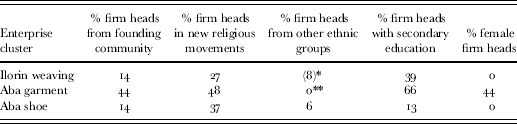
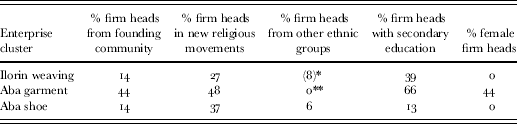
The Aba enterprise clusters revealed interesting variations in the relationship between founding artisanal groups and new religious movements. The Aba garment cluster was founded in the late colonial period by migrants from the relatively prosperous farming and trading communities of the former colonial district of Bende, in eastern Igboland. Bende indigenes had no pre-colonial specialisation in weaving or tailoring, but during the colonial period became involved in cotton production and in itinerant tailoring, bringing them into contact with the colonial garment industry. The comparative prosperity of Bende indigenes facilitated their entry into small-scale garment production, a mechanised activity with comparatively high capital costs. These factors also supported a strong orientation towards educational achievement within the garment cluster, despite its informal sector status. In 2000, two thirds of garment producers had secondary education, compared with just over one third in the Ilorin weaving cluster (Meagher Reference Meagher2007b).
In contrast to the Ilorin weaving cluster, the prominence of the founding artisanal community within the garment cluster was supported rather than undermined by the first wave of evangelical Christianity in the 1970s, and by the subsequent wave of pentecostal Christianity in the 1990s. This coincided with a period of expansion in the garment cluster, accompanied by the entry of a wider range of other Igbo communities. Garment producers of Bende origins gravitated towards the new churches, which encouraged an emphasis on skills, education and frugality, which were conducive to maintaining Bende advantage in the activity. Religious conversion also created a mechanism of solidarity for assimilating skill-oriented producers from other Igbo communities into networks of solidarity and accumulation within the activity. At the time of my research, 70% of garment producers from Bende communities, and just under 50% of producers in the garment cluster as a whole, belonged to evangelical and pentecostal churches. The leader of the Bende-dominated informal garment producers' association was an evangelical pastor, and many others were pastors or evangelical church elders. Membership in evangelical and pentecostal churches provided a skill-oriented framework for occupational solidarity, communal integration and accumulation. When interviewing a non-Bende producer of men's suits who had been in the informal garment cluster since the 1970s, I asked him if his lack of Bende origins was an impediment to advancement within the business. He answered: ‘No, so many of them are in my church.’ He himself was a Jehovah Witness who had served three apprenticeships in garment production in order to refine his skills sufficiently.
Aba's informal shoe manufacturing cluster has a very different social and religious history. It developed as the specialisation of migrants from the former colonial district of Mbaise, a poor, particularly land-scarce area located in central Igboland. Mbaise migrants turned to informal shoe production owing to its extremely low capital and skill threshold. This initially involved the use of simple hand tools for the production of crude sandals. Mbaise shoe producers had no artisanal history of shoe production or leather working, and concentrated initially on producing sandals from old tyres. Over time, however, skills, equipment and materials became more sophisticated, leading to the production of contemporary ‘fashion shoes’. As informal shoe production expanded during the 1970s, Mbaise dominance of the business was rapidly eroded by entrants from other Igbo and even neighbouring non-Igbo communities, owing to the low capital and skill levels of the majority of Mbaise producers. Despite being the founding artisanal group, Mbaise producers rapidly dwindled to a small proportion of informal producers owing to their lack of competitive advantage, though some established Mbaise producers managed to maintain a presence in the leadership of the shoe producers' associations. Regarded as a ‘poor man's business’, informal shoe production tended to attract entrants who lacked the resources or training to enter something better. Despite the entry of producers from more economically advantaged communities, shoe production was associated with significantly lower levels of education than are observed in the garment cluster, and even in the Ilorin weaving cluster. Barely 13% of informal shoe producers had secondary school education.
Owing to the poor social backgrounds of informal shoe producers, and their low levels of education and skills, conversion to evangelical Christianity was much less common, particularly in the first wave of evangelical movements in the 1970s. Most shoe producers lacked the economic security to risk alienating the political and religious establishment of their home villages, and also lacked the requisite levels of literacy and skill to advance themselves through evangelical Christian channels. Among the original Mbaise producers, and shoe producers as a whole, the vast majority remained members of the older established churches (Catholic, Anglican, Presbyterian, Methodist), even after the second wave of Christian revivalism in the 1990s. Even economically successful shoe producers tended to cultivate status within the religious and political establishment of their home villages, rather than to gravitate towards new religious movements. In contrast to the garment cluster, the most successful group of shoe producers was dominated by those from trading rather than artisanal backgrounds. Economic success was based on a trading ethic of profit and turnover rather than on a small industrialist ethic of skills, education and reliability characteristic of high performing garment producers. As a result, patrimonial rather than skill-based forms of accumulation and class formation predominated in the shoe cluster. Membership in new churches arose largely in the 1990s, involving producers from more artisanally skilled and educated backgrounds who were forced into the activity by economic hardship, or who joined prosperity churches in the hope of linking into new networks of assistance.
By the end of the twentieth century, new religious movements had considerably altered the social organisation of all three informal enterprise clusters. As Table 1 shows, founding communal identities had dwindled in importance, and new religious movements provided important mechanisms for occupational solidarity and economic advancement, particularly in the weaving and garment clusters. Moreover, in both Muslim and Christian areas, religious movements tended to act as modernising forces, encouraging educational attainment, as well as facilitating relations of trust and solidarity, not only with other sub-ethnic communities, but with members of other ethnic groups. The one thing religious change does not appear to have affected is the gender division of labour, which continued to exclude women from operating firms in both the weaving and the shoe clusters, and which had always allowed significant female participation in the garment cluster.
Changing social profiles in informal enterprise clusters in the new millennium
Notes:
* One-third of weavers no longer knew their ethnic origins, and even those indicating non-Yoruba origins had been assimilated into a Yoruba identity.
** There were a small number of non-Igbo southern minorities in the garment cluster, but none came up in the sample.
Source: Fieldwork.
STRUCTURAL ADJUSTMENT, INFORMALITY AND NEW RELIGIOUS MOVEMENTS
While the role of new religious movements, both Muslim and Christian, has followed a fairly clear modernising logic within these informal enterprise clusters, their impact on informal enterprise performance and class formation has been significantly altered by the pressures of economic restructuring and democratisation. Tendencies towards the development of cohesive forces for popular entrepreneurship have become increasingly fractious and fragmented in the face of efforts from above to hijack religious movements for new purposes. In the process, productive processes of class formation from below have been disrupted from above, with increasingly problematic economic and political consequences.
The onset of Nigeria's structural adjustment programme in 1986 subjected informal producers to intense economic pressure. Between 1985 and 1999, the Nigerian currency lost 99% of its value, and urban dwellers faced an average annual inflation rate of more than 200% (Meagher forthcoming). Massive public and private sector retrenchment generated serious unemployment, leading to a flood of entrants into all manner of informal activities. In Ilorin, more than half of existing weaving enterprises have started up since the onset of structural adjustment, while in the two Aba clusters, the overwhelming majority of producers have entered under structural adjustment – with the result that more than half of them were under thirty years of age in 1999. The competitive pressures unleashed by rapid entry, often by young, undercapitalised and inadequately trained producers from an increasingly wide variety of communal and socio-economic backgrounds, have created new tensions of identity, generation and occupational ethics. This has been accompanied by an explosion of religious revivalism, injecting a diversity of Christian and Islamic movements into the mix. Amid this economic and religious ferment, the three clusters have responded in distinctive ways.
Patrimonialism, modernisation and Islamic radicalism: what weavers want
The latest wave of Islamic reformism that has gripped Nigeria since the 1980s has had comparatively little effect on the Ilorin weaving cluster, for a variety of reasons. The new revivalist phase involves a range of anti-Sufi, fundamentalist movements, including Izala, the so-called Shi'ite movements, and the forms of ‘political Islam’ behind the imposition of shari'a law in many of the northern Nigerian states (Kane Reference Kane2003; Loimeier Reference Loimeier2005). While these movements have had a powerful impact in northern Nigeria, they have comparatively little political or religious appeal to Muslims in the Yoruba south-west. Yoruba communities, and even families, are often religiously mixed, and more belligerent forms of Islam are perceived as unnecessarily divisive. The new Islamic movements that have generated a following in the south-west, such as NASFATFootnote 2 or Quareeb,Footnote 3 are largely Yoruba middle-class movements which emphasise melding modernisation with Islamic lifestyles, rather than the creation of an Islamic state. Their orientation towards high levels of education, the use of English, modern media technology and an economic concern with employment in the modern sector creates a milieu that would tend to embarrass rather than to captivate artisans. Only two weavers out of a sample of over fifty were members of any of these new organisations. One, who had secondary school education and used weaving to supplement his civil service salary, was a member of Quareeb, while the other, a trader who seemed to spend little time on weaving, belonged to a more marginal Islamic society.
Given its comparative lack of appeal, the new wave of Islamic reformism has had little effect on Muslim–Christian relations in the weaving cluster. Owing to the tendency to take on apprentices and labour from surrounding Christian Yoruba and minority weaving communities, 40% of weavers employed some Christian workers, and a tiny percentage even employed women workers. Moreover, in the context of weakening markets, one area of expanding demand was the production of banners and ceremonial wear for church celebrations. Sixty-seven percent of weavers engaged in weaving contracts for churches. From the point of view of weavers, the pentecostal revival was more a bonus than a threat.
The real struggles unleashed within the weaving cluster took place along the lines of the earlier processes of class formation set in motion in the 1950s by the rise of Tijjaniyya brotherhoods. While markets for Ilorin weaving initially expanded under structural adjustment, when imported cloth became too expensive, demand has fallen dramatically since the late 1990s owing to economic hardship, the liberalisation of textile imports, and intense competition triggered by unemployment and rapid entry into the weaving business (Meagher Reference Meagher2007b). These pressures have exposed emerging faultlines between the more conservative weavers who dominate the weavers' guild and represent the weaving profession to the state, and more progressive weavers who tend to be younger, and to favour innovation, education and the development of new markets rather than advancement through patronage ties.
This struggle has expressed itself in two ways. The first and most dramatic has been a split in the weavers' guild between the old guard and a group of younger modernisers. In the old guard, power is concentrated among senior, less educated weavers of Oyo weaving town origins, with predominantly mainstream religious affiliations. The young modernisers involve slightly younger weavers (in the gerontocratic context of Yoruba society, ‘young’ means under fifty), with limited education, more diverse origins, and a more economically responsive and innovative approach to weaving which has allowed them to outperform their seniors. The split in the weavers' guild took place in the early 1990s, in the context of a dispute over the relocation of the main weaving market. Two important points for the purposes of this discussion are that both groups appear to be dominated by weavers who have been three or more generations in the business, and that membership in Tijjaniyya is not important in either group. The central point of contention appears to be a struggle for control over the traditional weaving markets in the context of intense competition and collapsing demand. Weavers have conventionally sold their wares in two or three specialised periodic markets for indigenous cloth, located in the towns of Ede, Ibadan and now Oyo, some distance from Ilorin. In the past, Ilorin cloth was also traded to Ghana, Sierra Leone and other parts of West Africa, but war and economic hardship have all but wiped out this longer-distance trade, narrowing the main marketing networks to those centred on the periodic weavers' markets.
The old guard have tended to address their economic difficulties by asserting their authority over the terms on which weavers can enter the market, and by lobbying local politicians for contracts and assistance. They themselves recognise that they are only showing an interest in political links because demand for weaving is low, but the more they rely on politicians to solve their problems, the less they can afford to criticise them. They also reproach the young modernisers for exacerbating their misfortunes by disturbing conventional marketing channels and refusing to attend the annual prayers organised by the weavers' guild, which has broken the solidarity of weavers. While the old guard rely on traditional patronage politics to address their problems, the young modernisers have grown disillusioned with local patronage arrangements, which only seem to take an interest in weavers at election time. The younger weavers complain that local politicians refuse to see them when their representatives want to discuss the problems in the weaving business, but will come at election time to ‘dash’ them N10,000 for ‘soft drinks’ and ask for their vote. Efforts to link up with Ilorin indigenes in high federal government posts, or to attract the ear of the state through gifts or participation in trade fairs, have all failed to turn markets around or to attract state attention to their occupational concerns. A spokesman for the association of the young modernisers declared that, after repeated efforts and discussions about what could be done about the decline of the weaving business, they resolved that the only thing they could do was pray.
A second, less visible, process is unfolding at the level of those who avoid political channels and concentrate on gaining access to new markets. While the traditional marketing outlets are suffering from overcompetition and declining demand, new marketing channels have opened up over the past decade or so that demand new production and marketing skills. One of these new channels involves the global trade in Ilorin cloth to members of the West African and black diaspora in the USA and the UK. This channel demands higher-quality production, rapid changes in fashion, and doing business with middle-class operators who take cloth overseas, rather than operating through the local cloth marketing system. Because many of these overseas traders are Yoruba, many weavers have managed to link up with this trade on at least an occasional basis. Indeed 64% of weavers had at least some customers who engaged in this overseas trade. However, it is worth noting that nearly 80% of Tijjaniyya members engaged in this trade, compared to less than 60% of other weavers, and that among those who did engage in this circuit, Tijjaniyya members had considerably higher annual incomes than other weavers.
A second new channel involved trading to boutiques in Lagos and Port Harcourt that catered to high society Nigerian customers. These establishments are often run by wealthy business people and ‘people in high places’ – it was even said that the wives of some Yoruba governors sell Ilorin cloth through high-value channels. Even more than the overseas markets, these high society markets demand high-quality materials, fine craftsmanship, and reliable delivery. As one weaver explained, the main worry of those competing in this market channel is not how to reduce the price so that people will buy, as is the case in the regular cloth markets, but how to increase quality and variety to satisfy a higher class of customer. One informant maintained that the difference between those who sell to boutiques in Lagos and Port Harcourt and those who sell in the traditional cloth markets is education. Those who sell to boutiques have to deal with customers who may not speak Yoruba, or may not wish to. But this same informant sold primarily to boutiques himself, and only had a primary school education, although he spoke excellent English, which was unusual among weavers. He was distinctive in that he was young, came from a weaving family with a strong emphasis on craftsmanship, placed a high value on education and on thorough training in weaving and marketing skills, and belonged to the Tijjaniyya brotherhood. This is only anecdotal – only a couple of traders in the sample traded to Lagos – but it does suggest that Tijjaniyya continues to foster the kinds of ‘protestant’ virtues that facilitate economic efficiency and the formation of reliable commercial networks in ways that tend to circumvent, rather than depend on, patrimonial ties.
Unfortunately, the global ‘War on Terror’ has begun to undermine the global markets for Ilorin cloth. Weavers and cloth traders noted that demand from overseas markets has been negatively affected since 11 September 2001. Nigerian as well as ‘white’ people who used to come to buy Ilorin cloth for export now come much less, and some have stopped altogether. A trader in the Ibadan cloth market was told by her overseas customers that they faced greater problems getting visas to come to Nigeria.
Pentecostalism and vigilantism: gaining the ear of the state
In contrast to the experience of Ilorin weavers, informal enterprise in Aba has been dramatically affected by the second wave of religious revivalism in the 1980s and 1990s. The rapid proliferation of pentecostal churches has been so marked in Abia State, in which Aba is located, that the state licence plates bear the slogan ‘God's Own State’. This pentecostal enthusiasm is also reflected at the level of informal enterprise. In a sample of 132 producers across the two clusters, 27 different denominations were represented, involving 21 evangelical sects, 5 mainstream churches, and 1 Muslim convert (he said Christianity had become too much of a racket, and he felt it was better to save his money and become a Muslim). As this anecdote suggests, the spread of pentecostal conversion did not negatively affect relations between Christians and Muslims at the popular level. Hausa Muslim embroiderers, who were particularly skilled, were routinely hired by informal garment firms. Many shoe producers specialised in a type of shoe bought only by Muslim traders from the north, and one shoe producer claimed that he would rather give credit to Hausa (Muslim) customers than to Igbos, because the Hausa were more reliable in repaying.
As previously indicated, the impact of Christian revivalism was particularly pronounced among garment producers. Despite the rise of ‘prosperity’ churches in the 1990s, pentecostalism in the garment cluster continued to reflect an adherence to the earlier messages of holiness and salvation associated with the preceding wave of evangelical Christianity. As Maxwell (Reference Maxwell1998) and Marshall (Reference Marshall, Ranger and Vaughan1993) remind us, the earlier form of Christian revivalism was originally a movement of artisans and other toiling classes. As in the Muslim weaving cluster, the earlier phase of religious revival remained relevant among garment producers even after the rise of new movements oriented to the less ascetic concerns of middle-class and elite constituencies. The ‘other-worldly’ message of strict pentecostal churches, calling for asceticism, strict personal ethics and prayer, not only strengthened the economic ethic that drove accumulation within the garment cluster; it also helped producers to cope with the economic depredations of structural adjustment.
As of the year 2000, roughly half of garment producers were members of pentecostal churches, rising to nearly two thirds in the most successful quartile. The majority of evangelical garment producers adhered to ascetic movements that required a complete break with tradition, which effectively disembedded them from conventional relations of solidarity. This facilitated a conservation of resources by encouraging modesty in dress as well as abstention from drinking and costly forms of socialising common in Igbo society. More strikingly, adherents were also forbidden to participate in their hometown association, which is viewed as a cultural obligation among the Igbo. The objective was to dissociate themselves from ‘sinners’ who engaged in drinking and idol worship associated with hometown socialising and ceremonial practices. In the process, producers liberated themselves from the increasingly costly levies and contributions required by their hometown associations in a time of declining state funding and increased local political mobilisation. They also cut themselves off from the fallback of communal assistance, something only the more skilled and industrious producers could risk. Concerns about demons, exorcism and spiritual reprisals should be understood in the context of the severe communal pressures brought to bear on those who attempted such a radical break. For those with the requisite levels of skill, discipline and commitment, pentecostalism provided practical and spiritual solutions to individual and social problems, contributing to ‘the creation of new identities and the articulation of strategies for survival and mobility’ (Marshall Reference Marshall, Ranger and Vaughan1993: 216).
By fostering an ethic of accumulation through skills and hard work, pentecostalism represented an anti-patrimonial strategy of economic advancement. Disillusioned with the unreliability and corruption of patrimonial networks, converts focused on ‘blasting away not only old values, but old networks’ (Mayer Reference Mayer1961). At the time of my research, the garment cluster had close communal ties with the Abia State governor, who happened to come from one of the most influential Bende communities in the cluster. Some of the older garment producers even knew the governor as a boy, and had close ties with some of his senior relatives. Yet adherence to the pentecostalist injunction to withdraw from participation in their hometown associations was strongest among the most established Bende garment producers, severing their strongest claim to patrimonial assistance. The president of Aba Garment explained that informal linkages through influential townsmen had not proven particularly helpful for solving their real problems, and access to such people was unreliable.Footnote 4 Far from cosying up to government officials, the informal garment producers' association tended to adopt an arms-length relationship with local and state governments, and had even taken the federal government to court over a case of official harassment.
Instead, garment producers concentrated on building new networks through business contacts, religious connections, and the pursuit of direct access to formal institutional channels. Church-based links offered access to more productive and trustworthy labour, to business contacts who observed strict moral codes, and to flows of resources and information through regional and global pentecostal networks. The garment producers' association also attempted to forge direct institutional links with relevant organs of the state, rather than cultivating patrimonial channels of access. Through the garment association, garment producers were members of the Nigerian Association of Small-Scale Industrialists (NASSI), and in 2000 were making efforts to register their association with the Federal Government so that they could lobby directly for controls on Asian textile imports. However, these strategies had limited success in linking informal garment producers into new networks of power, even after the expansion of the pentecostal movement to attract middle-class and elite participants. Even in the church, strategic resources and contacts tended to be monopolised by more powerful classes, while efforts to link up directly with the formal sector and the state failed as the result of the informal status and political marginality of producers in the garment cluster. Despite their commitment to ‘the spirit of capitalism’, informal garment producers are languishing in the face of state neglect, Asian import competition and infrastructural collapse.
In the shoe cluster, the new wave of pentecostalism has had a rather different impact. Despite a continued bias in favour of the established churches, there has been a more significant wave of conversion to pentecostalism since the 1990s. As indicated above, 37% of shoe producers had converted to pentecostal churches by 2000. This considerable level of pentecostal participation was a product of fairly recent conversions, and the entry into the shoe cluster of producers from a more diverse range of communities and backgrounds. However, pentecostal converts in the shoe cluster tended to adopt the more ‘entrepreneurial’ forms of networking characteristic of the ‘prosperity’ churches, rather than the ascetic forms of withdrawal from society characteristic of the earlier wave of Christian revivalism (Ojo Reference Ojo2005: 400). Only 10% of producers in the shoe cluster belonged to church groups that required withdrawal from their hometown association. These ascetic Christians were concentrated among more educated entrants and those from artisanal communities, most of whom had been forced into the shoe cluster by adversity, and were not particularly successful producers owing to their lack of capital. The majority of pentecostal shoe producers converted in order to expand their social networks rather than to transform them. Efforts in the 1990s to make Nigerian pentecostal churches more ‘elite friendly’ (Adeboye Reference Adeboye2005: 448), and to forge links with Christian elites within the state, made these churches more attractive to shoe producers, who saw conversion as a way to form supportive ties with wealthier and better-placed members of society. This tendency to see conversion as a means of cultivating additional networks of assistance led to the phenomenon known in Aba as ‘change your church’, which was twice as common in the shoe cluster as it was in the garment cluster. Changing one's church refers both to conversion, and to the tendency to shift from one pentecostal church to another looking for the most conducive environment.
Both in their preference for the established churches, and in their practice of pentecostal conversion, shoe producers revealed an orientation towards patrimonial strategies of economic advancement. Given their more marginalised social and economic backgrounds, low levels of education and poor skills, the majority of shoe producers lacked the social and human capital to adopt a strategy of dissolving old networks and building new ones. The strategies of shoe producers and of their enterprise associations focused on embedding themselves more deeply in patrimonial networks in Aba and in their home communities. Among the most successful shoe producers, none had converted to pentecostal churches, all were members of their hometown associations, and there was a strong preference for membership in a range of social clubs which helped to link them to the patronage of people of wealth and power through social events and ceremonies to which dignitaries and patrons were invited – precisely the sorts of dissipation of resources that the successful garment producers avoided. The shoe cluster associations (there were six of them) all cultivated links with the local and state governments, and engaged in favours and kickbacks that assisted accumulation among executives, but did little to advance the cluster as a whole (Meagher Reference Meagher2006).
Ultimately, it was the shoe producers rather than the garment producers who managed to capture the attention of the state. Despite the powerful social impact of new religious movements in the garment cluster, and the efforts of the garment association to forge direct economic and political links with relevant government institutions, garment producers have remained marginalised and ignored by the state. In the shoe cluster, religious entrepreneurship and the cultivation of patrimonial ties have brought them occasional crumbs from the state, though these tend to be monopolised at the top. It was only when the shoe producers formed a notorious vigilante group known as the Bakassi Boys in the late 1990s that they actually attracted any real state attention (HRW/CLEEN 2002; Ukiwo Reference Ukiwo2002). Suddenly, the shoe producers controlled something with the power to wield public authority beyond the sphere of the poor and the powerless. While the objective of the vigilante group was initially to make Aba safe for visiting traders from other parts of Nigeria and beyond who came to buy shoes and other goods in Aba, it was rapidly hijacked by the Abia State governor for attacks on local Muslims in early 2000 as a reprisal for the killing of Igbos in anti-shari'a riots in northern Nigeria (Meagher Reference Meagher2007a). These attacks not only ran against the grain of local relations between Christians and Muslims in Aba, but undermined accumulation in both the shoe and the garment clusters by scaring away valuable Muslim customers and workers for almost a year afterwards. Once the activities of the vigilante group moved away from prevailing notions of justice and accountability, references to occult powers and protective charms were increasingly used to justify violations of conventional norms of law and order. Occult idioms were thus used to override popular ethics, rather than representing them, but local people were also adept at turning occult idioms back on the vigilantes and their advocates by demanding empirical demonstrations of their supernatural powers when abuses of authority became excessive (ibid.). Clearly, productive, patrimonial and occult ethics all played a role in the spiritual impulses of these informal producers, but in complex and textured ways not reducible to cultural propensities or literal interpretations.
* * *
Within the context of Nigerian informal enterprise, there is clear evidence that both Islamic and Christian religious movements have given rise to distinctly Weberian ‘modernising tendencies’, rather than being reducible to ‘occult economies’ or born-again patrimonialism (Kane Reference Kane2003: 245; Ojo Reference Ojo2005: 397). But if they are to promote development and democracy, modernising tendencies among the poor and the powerless must be supported by more powerful social groups or by the state. The opposite appears to be happening in Nigeria. Middle-class forces have increasingly captured new religious movements in both Christianity and Islam for their own economic and social objectives, limiting the potential of these movements for the economic and political empowerment of the informalised masses. Entrepreneurial religious leaders and political elites have also begun to instrumentalise these movements in the service of pantomimes of democratisation, cultivating links between new religious leaders and politicians to mobilise electoral support or to shift the balance in elite power struggles. Even global forces have actively engaged in capturing or thwarting religious networks for their own political ends. In this tangle of political machinations, the fragile process of entrepreneurial class formation within the informal economy has been all but lost.
Evidence from the Nigerian informal economy suggests that serious consideration of how religious revivalism is shaping economic ethics and political possibilities in Africa demands an awareness not only of new forms of agency from below, but of existing modes of domination. The modernising entrepreneurial ethic of Tijjaniyya and ascetic evangelical protestantism has been increasingly marginalised by state neglect, and by the economic and political instrumentalisation of new Christian and Islamic movements, encouraging a rising tendency towards patrimonial forms of religious engagement, even among informal artisans. As Terence Ranger (Reference Ranger1985) reminded us over two decades ago, religious movements are not just political movements in disguise – something that some recent commentators seem to have forgotten. Ranger cites John Waliggo's (cited ibid.: 52) comment that African popular movements have historically represented a longing for change in a situation in which ‘few can really trigger change’. While they may give rise to new forms of social identification and political consciousness, religious movements have a class as well as a cultural dimension, and they are about powerlessness as much as new forms of power.
In contemporary times as well, much depends on the way in which the specific ‘implicit politics’ of popular religious activism links up with more powerful social forces. This is especially true of movements that emerged from the poor and aspiring middle classes in developing countries, whose longing for change continues to outstrip their power to demand it. As Ruth Marshall (Reference Marshall, Ranger and Vaughan1993: 242) observed in her analysis of Nigerian pentecostalism, ‘what sort of lasting social and political impact such a challenge may have is as yet unclear, and depends … to a large extent on the way the movement becomes politicised, if at all’. While processes of politicisation are very much in evidence in Nigerian Christian and Islamic movements, their current trajectory is not encouraging from the perspective of popular economic and political transformation. The problem, however, does not lie in the cultural orientation of indigenous religious expression, but in its instrumentalisation by more powerful social, political and global forces.