Introduction
Research into the role of language in politics and government has tended to focus on the ways in which politicians' discourse constructs a recognisable communicative style. This research has focused on the ways in which types of governance are accomplished (e.g. Wodak Reference Wodak1989; O'Connor, Taha, & Sheehan Reference O'Connor, Taha and Sheehan2008). It has also considered how different types of discourse become associated with, and construct, the identities of particular parties or individuals. This work is exemplified by Fairclough's (Reference Fairclough2000) analysis of New Labour discourse, as well as Pearce's (Reference Pearce2001) analysis of the language of the former British Prime Minister, Tony Blair. Pearce demonstrates how, in using the ‘discourses of ordinary life’, Blair is able to present himself as a ‘normal person’. His analysis focuses on the relative informality of Blair's language, the ‘personalising’ of the discourse content, and the use of specific personal pronouns. Pearce (Reference Pearce2005) extends this analysis with an examination of UK party political broadcasts between 1966 and 1997. His work shows an increase in the ‘informalization’ of political talk more generally, as evidenced by the presence of clause structures, lexical forms, and pronoun types more typical of ‘conversation’, and the increased occurrence of mental verbs and adverbial expressions in party political broadcasts. Further to this, drawing upon Clarke, Sanders, & Stuart (Reference Clarke, Sanders; and Stewart2004), Fetzer & Bull (Reference Fetzer and Bull2012) analyse the semantics of the verb phrase in political speeches and demonstrate that there are two important dimensions for politicians to articulate: competence (the ability to ‘get things done’) and responsiveness (the ability to ‘emote’ or connect to an audience).
More recently, there has been increasing interest in the role phonetic variation plays in constructing social meanings in political talk. This work has considered variation between standard and vernacular forms of language in political speeches (Moosmüller Reference Moosmüller and Wodak1989), and perceptions of politicians' language varieties (Purnell, Raimy, & Salmons Reference Purnell, Raimy and Salmons2009; Soukup Reference Soukup2011). Increasingly, research is focusing on the fluidity of social meanings associated with political talk. This growing body of research is congruent with more general advances in scholarship on the social meanings of linguistic variation (Eckert Reference Eckert2012). This research explores how linguistic features are used to articulate particular stances or alignments which, when used frequently enough, become indexically linked to more enduring social qualities or identities (Ochs Reference Ochs, Duranti and Goodwin1992; Silverstein Reference Silverstein2003; Eckert Reference Eckert2008; Moore & Podesva Reference Moore and Podesva2009). For instance, Hall-Lew, Coppack, & Starr (Reference Hall-Lew, Coppock and Starr2010) examine whether there is a link between the articulation of the second vowel in the word Iraq and political identity in the US. They find that pronouncing the second vowel in Iraq as [ɑː] correlates with a liberal political stance and, consequently, with party political identity. This remains true when other social factors such as region, Southern (American) accent, gender, ethnicity, and age are controlled for in the analysis.
Similarly, Podesva, Reynolds, Callier, & Baptiste (Reference Podesva, Reynolds, Callier and Baptiste2015) consider how the social associations of word-medial and word-final released /t/ affect its use in the talk of a number of American politicians. As with other research on /t/, they are able to identify some generic meanings associated with ‘articulateness’, such as ‘learnedness’ (Bucholtz Reference Bucholtz, Ahlers, Bilmes, Chen, Oliver, Warner and Wertheim1999; Benor Reference Benor2004), and being ‘professional’ or ‘competent’ (Podesva, Roberts, & Campbell-Kibler Reference Podesva, Roberts;, Campbell-Kibler, Cameron and Kulick2006). Their perception research, however, suggests that the social meanings of released /t/ are determined on the basis of how particular politicians ‘usually’ talk. For instance, contrary to other findings, Barack Obama is rated as more intelligent in guises where he does not release /t/ because the (predominantly Democrat) listeners sampled consider this to more closely approximate how he usually talks.
Third wave variationist research has highlighted the importance of attending to multiple levels of linguistic and semiotic context. This is because, at any interactional moment, the social and linguistic co-text (or the broader ‘style’ of an interaction) may determine how and what a particular linguistic feature is able to mean (Moore & Podesva Reference Moore and Podesva2009; Kirkham Reference Kirkham2015). Styles may also be linguistically layered by virtue of the fact that they occur across linguistic levels, ‘such that syntax, phonology, and discourse work synergistically rather than independently of each other’ (Moore & Podesva Reference Moore and Podesva2009:449). Consequently, in this article, we focus on combining techniques from the discourse analysis of political language and the sociophonetic analysis of speech, in order to better explain the social meanings associated with a linguistic variable found in the speech of a British politician. In doing so, we demonstrate how two seemingly diverse traditions of linguistic analysis can be successfully combined. Our work also contributes to the growing body of literature on phonetic variation in the speech of British politicians (e.g. Hall-Lew, Friskney, & Scobbie Reference Hall-Lew, Friskney and Scobbie2013).
Our analysis focuses on the speech of Ed Miliband, the leader of the British Labour Party between 2010 and 2015. We focus on Miliband's use of word-medial and word-final /t/. Our research is motivated by the volume of media attention (described below) focused on Miliband's use of this variable, and the metalinguistic commentary that links the glottal variant of this variable to a ‘New Labour’ identity. In the following sections, we first outline the variable, providing examples of metalinguistic commentary about it, before going on to examine how this feature patterns in Miliband's speech in two speeches that he gave in 2011. Our results show some small differences in the distribution of glottal variants in these two speeches, but much larger differences in the realisation of particular words that have been previously identified as salient in ‘New Labour’ discourse. We explain these differences on the basis of the different audiences at which they are aimed. We use subject type and transitivity analysis to demonstrate the differing relationships that Miliband has with the two audiences. We suggest that Miliband's use of a glottal variant in his production of particular words reflects his alignment with his audience, which, in turn, provides clues to the social meanings associated with this variant.
Glottal variants of /t/ and British politics
For British English, accounts of the variability in word-medial and word-final /t/ have tended to focus on the occurrence of glottal variants, particularly the use of glottal stops (often termed ‘/t/-glottalling’). Several studies have reported that /t/-glottalling has spread rapidly in urban centres across the UK over the last century (Foulkes & Docherty Reference Foulkes and Docherty1999:11), with research illustrating the use of this variant in Newcastle (J. Milroy, L. Milroy, Hartley, & Walshaw Reference Milroy, Milroy, Hartley and Walshaw1994), Ipswich (Straw & Patrick Reference Straw and Patrick2007), Manchester (Drummond Reference Drummond2011), Edinburgh (Schleef Reference Schleef2013a), and London (Schleef Reference Schleef2013a). Some studies in particular show increased rates of glottal variants in younger speakers, suggesting that it may be a change-in-progress (Williams & Kerswill Reference Williams, Kerswill, Foulkes and Docherty1999; Marshall Reference Marshall2001). Fabricius (Reference Fabricius2000) has argued that the increase in /t/-glottalling has led to the loss of some of its stigmatised status, as evidenced by its frequency in her corpus of students from Cambridge University who attended public school, but she notes that it remains ‘highly stigmatised in more formal speech styles’ (Fabricius Reference Fabricius2000:141). It is important to note, however, that there are differences according to phonetic environment. Fabricius (Reference Fabricius2000:18) notes that ‘[g]lottalling in certain word-internal syllable-final environments is accepted as being RP [Received Pronunciation] (football, Gatwick), as is glottalling before syllabic /n/ (cotton, mutton), while intervocalically (as in water) and before syllabic /l/ (as in bottle), t-glottalling remains outside RP’ (see also Wells Reference Wells1997). Fabricius also found /t/-glottalling in word-final contexts to be most acceptable in preconsonantal contexts in ‘modern RP’, but more stigmatised in prepausal and prevocalic contexts.
The intermediate status of /t/-glottaling in RP speech may help to explain the extreme reactions to the perceived use of this form in the speech of individuals in the public domain. Extracts (1)–(5) below are examples of metalinguistic commentary on this variant from political columns in the British press between 2010 and 2014.
(1) Is this the glottal stop election? My husband shouts: ‘No’ a lo’ o’ bo'le’ at the television whenever Ed Balls [Labour MP] or George Osborne [Conservative MP] come on. He calms down when Vince Cable [Liberal Democrat MP] starts speaking. (http://new.spectator.co.uk/2010/04/mind-your-language-9/; accessed October 2, 2015)
(2) Blinking meaningfully, deploying the glottal stop that is the ex officio mark of the modern Labour leader, and pausing for effect when he came to the important bits, Ed Miliband yesterday delivered what was, in practice, his first party conference speech. (http://www.telegraph.co.uk/comment/columnists/matthewd_ancona/8165141/Ed-Miliband-is-simply-Gordon-2.0.html; accessed October 2, 2015)
(3) Their [i.e. young people's] slovenly way of speaking seems to be spreading. Addressing a room full of social workers yesterday, Ed Miliband swallowed so many glottal stops he began to sound like Ali G, innit. (http://www.dailymail.co.uk/debate/article-2026382/If-David-Cameron-wants-Wyatt-Earp-Met-chief-call.html; accessed October 2, 2015)
(4) Btw, please could you have a word with Ed Miliband about his glottal stops, a habit that he seems to have inherited from Tony Blair in an attempt to ‘get down with the kids’ or maybe the common people, but which only succeeds in making him look and sound like a complete prat. (http://www.thisislondon.co.uk/standard/article-23978523-ghetto-grammar-robs-the-young-of-a-proper-voice.do; accessed September 16, 2011)
(5) Ed Miliband: an ordinree guy who just needs a li'l help from his friends. (http://www.theguardian.com/politics/2014/sep/23/ed-miliband-labour-party-conference-speech-sketch; accessed October 2, 2015)
Extract (1) suggests that the tendency to use /t/-glottalling is age-related and considered to cross party lines: note that Balls (aged forty-three) and Osbourne (aged thirty-nine) are reported to use glottal stops, whereas Cable (aged sixty-six) is not. However, extracts (2)–(5) suggest that Ed Miliband is particularly noted as a user of glottal stops. Extract (4) reveals how this usage has also been affiliated with his party predecessor, former Labour Party leader and ex-Prime Minister, Tony Blair. /t/-glottalling was also noted by Fairclough (Reference Fairclough2000:101–105) in his analysis of Blair's discursive style. He considers Blair's use of the variant to contribute to the New Labour tendency to personalise public discourse with the effect that ‘even when Blair is being most public and political, the anchorage to the ‘normal person’ is still there’. Note that a similar observation is made by the media commentator in (4), who evaluates Blair's and Miliband's use of glottal /t/ as an attempt to ‘get down with the kids’ and the ‘common people’.
In order to understand the significance of the comparison between Blair and Miliband, it is important to understand the context in which New Labour emerged and the ways in which these two politicians are positioned relative to this political context. The term New Labour was first used when Blair was campaigning for government in the lead-up to the 1997 election, which he won. He subsequently served as Prime Minister until 2007. As Fairclough (Reference Fairclough2000:4) has observed, ‘New Labour claims to be a “new politics”’; the term refers to a shift from the left to the centre in the party's policies. Ed Miliband was elected as an MP in 2005 and stood in the Labour Party leadership election after the 2010 general election. The final vote was very close between Ed Miliband and his brother, David Miliband, who also stood for leadership. David won the majority of votes from Labour Party MPs and MEPs and individual members of the party, but the support of members of the trade unions and affiliated organisations in Labour's electoral college meant that Ed Miliband went on to win the leadership contest. He became Leader of the Labour Party in 2010, but resigned in May 2015 after Labour failed to win the 2015 general election. We return to the significance of the distribution of support for his leadership campaign below.
In the next section, we outline the data and methods that we used to analyse Ed Miliband's use of glottal /t/. We then discuss the distribution of /t/ variants in two of Miliband's speeches, focusing on particular lexical items that show marked patterns of variation. We employ a subject type and transitivity analysis to demonstrate the differing relationships that Miliband has with the two audiences, before examining the co-occurrence of glottal stops and pronoun-based verb process types. We conclude by discussing the implications of these analyses for understanding the social meanings of phonetic variation in political talk.
Data and methods
Our data come from two speeches made by Miliband in the same month in 2011, in the second year of his leadership. The first speech was given to the Trade Union Congress (TUC) on September 11, 2011. The TUC describes itself as ‘the voice of Britain at work’Footnote 1 and it represents fifty-four trade unions. The policy making body of the TUC meets for four days each year during September and it was at this event that Miliband gave the speech analysed here. The second speech comes from the Labour Party Conference (LPC) and was delivered just over two weeks after the TUC speech on September 27, 2011. The LPC is held annually and is described as ‘the sovereign body in the party's policy-making process’ where ‘[d]elegates are nominated to represent all sections of the Labour Party and ensure that from the grass roots up, a full spectrum of views and opinions are heard, from the trade unions and socialist societies to local constituencies’.Footnote 2
The speeches were transcribed orthographically in ELAN and the realisation of each token of word-medial and word-final /t/ was coded. A number of variants were identified, which included alveolar [t] and glottal [ʔ], as well as a small number of ‘other’ tokens, which included tapped, deleted, voiced, and fricated realisations. These ‘other’ tokens were very few in number (6.9% of the tokens in the LPC speech and 4.3% of tokens in the TUC speech), thus yielding too few tokens to form a separate category in the quantitative analysis. As a consequence, we focus only on variation between alveolar and glottal realisations of /t/ in the analysis that follows. Following previous research on this variable, we use auditory analysis for characterising phonetic variants (e.g. Milroy et al. Reference Milroy, Milroy, Hartley and Walshaw1994; Fabricius Reference Fabricius2000; Straw & Patrick Reference Straw and Patrick2007; Drummond Reference Drummond2011; Schleef Reference Schleef2013a), but further details on the acoustic characteristics of oral versus glottal stops can be found in Docherty & Foulkes (Reference Docherty, Foulkes, Hardcastle and Beck2005) and Ashby & Przedlacka (Reference Ashby and Przedlacka2014).
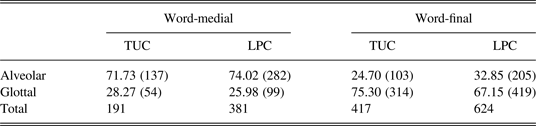
Coding of variants was based on auditory phonetic transcription carried out by a paid student research assistant. The research assistant had prior training in phonetics but was blind to the purposes of the project. The first author then checked the coding of every token in the dataset. There was disagreement on 1.86% of tokens, which were independently coded by another phonetician who was not involved in the study in order to reach agreement. In total we report an analysis of 1,613 tokens of /t/, with 572 word-medial tokens and 1,041 word-final tokens (see Table 1 for a detailed breakdown). Our analysis coded for word-position (medial/final), preceding and following context, number of syllables in the word, grammatical category, syllable affiliation (medial tokens only), and lexical frequency. Coding for preceding and following context was initially recorded in maximum detail and then collapsed into broader categories in order to yield sufficient token counts per category. Preceding phonetic context was a vowel or consonant. Following phonetic context was a vowel, approximant/nasal, obstruent consonant, syllabic consonant (medial tokens only), or pause (final tokens only). Syllable affiliation for medial tokens was either onset (e.g. water) or coda (e.g. football). We obtained lexical frequencies from the SUBTLEX-UK database, which is reported to be more accurate for British English than other word frequency databases (van Heuven, Mandera, Keuleers, & Brysbaert Reference van Heuven, Mandera, Keuleers and Brysbaert2014), and we used the log Zipf frequency measure as a standardised measure of lexical frequency (van Heuven et al. Reference van Heuven, Mandera, Keuleers and Brysbaert2014:1179).
Distribution of alveolar and glottal variants of word-medial and word-final /t/ in two of Ed Miliband's speeches from 2011. Numbers indicate percentages with raw token counts in brackets. N = 1,613 (572 word-medial; 1,041 word-final).

Exploratory data analysis and extensive visualisation revealed a high degree of collinearity between predictor variables. For example, we found that syllable affiliation, following context, speech, and word were highly correlated in the word-medial data (we return to this particular point later as this turns out to be an important result in itself). Therefore, we use conditional inference trees (Breiman Reference Breiman2001) to analyse the data, which are well suited to unbalanced and complex data sets (see Tagliamonte & Baayen Reference Tagliamonte and Baayen2012 for an overview and application to sociolinguistic data). A conditional inference tree tests the null hypothesis of independence between each predictor and the outcome variable. If the null hypothesis is rejected then the model selects the predictor variable that is most strongly associated with the outcome variable. A binary split is then performed on this predictor and the aforementioned procedure repeats recursively until no further splits in the data are found (Baayen Reference Baayen, Podesva and Sharma2012: 364). The model can be represented graphically, as in Figures 1 and 2 (see following section), which represents a hierarchical arrangement of the predictors in terms of their relative importance from top to bottom, as well as the interaction between predictors in predicting the outcome variable. We report separate models for word-medial and word-final /t/ and the predictors in each model include speech (LPC/TUC), syllable affiliation (medial tokens only), preceding phonetic context, following phonetic context, grammatical category, number of syllables in word, and word frequency. We account for word-level effects by exploring the distribution of words within nodes of the tree, which represent interactions between predictors. We demonstrate that this is a useful method for identifying interesting lexical effects in these data.
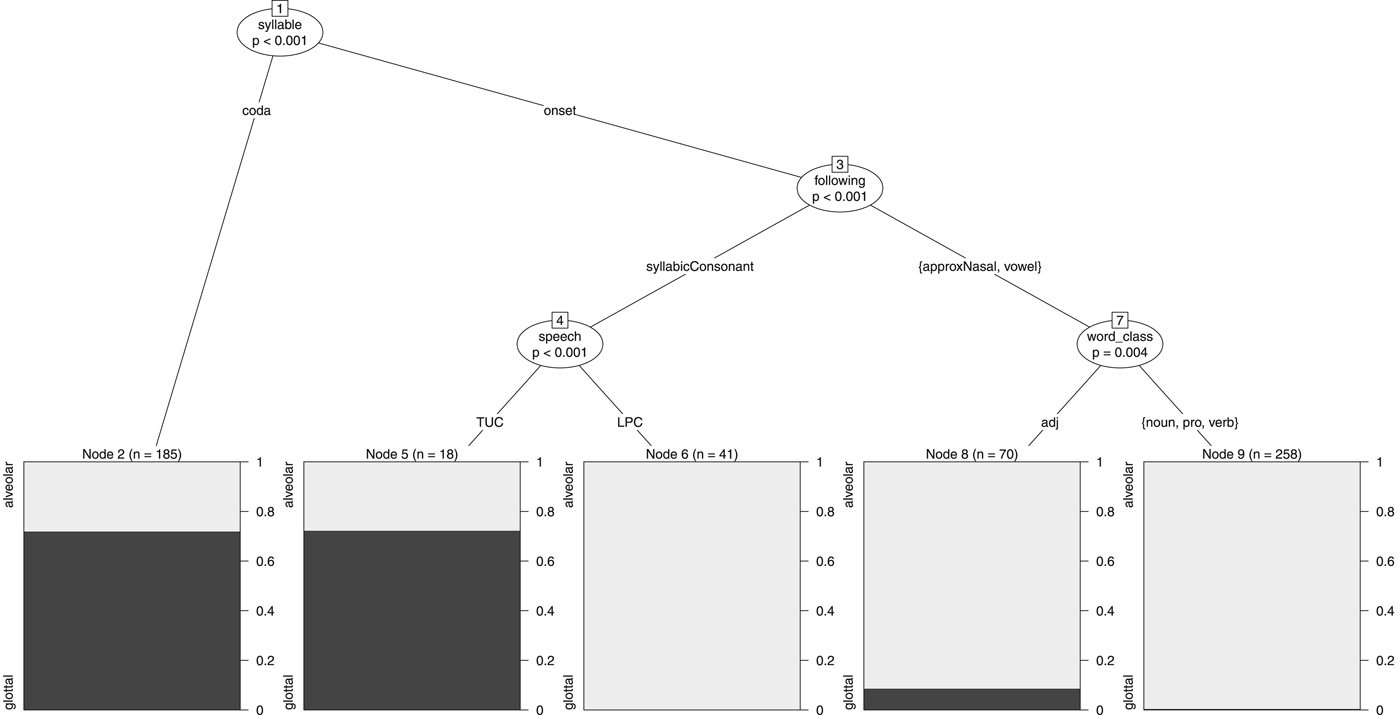
Conditional inference tree for word-medial /t/. In the bar plots the dark grey segments indicate the proportion of glottal realisations and the light grey segments indicate the proportion of alveolar realisations. N = 572.
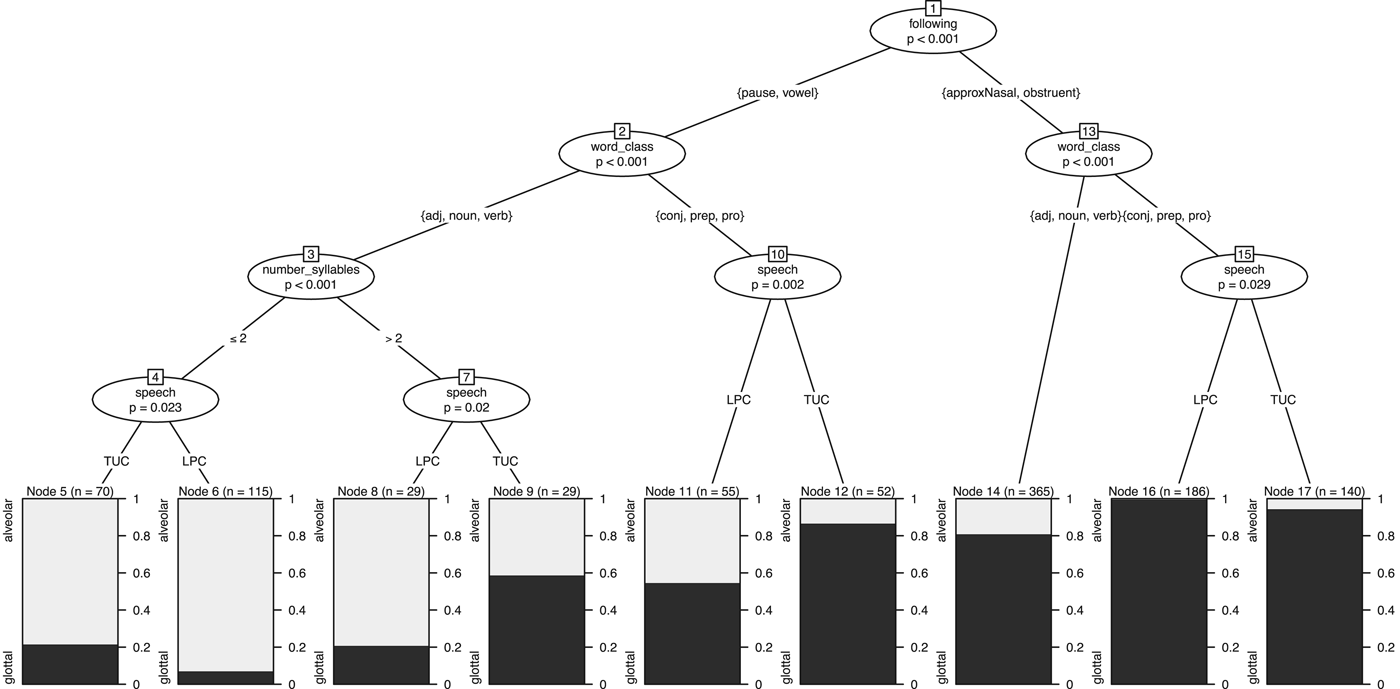
Conditional inference tree for word-final /t/. In the bar plots the dark grey segments indicate the proportion of glottal realisations and the light grey segments indicate the proportion of alveolar realisations. N = 1,041.
Glottal stops in two political speeches
Quantitative analysis
Tables 1 shows the distribution of word-medial and word-final /t/ in the TUC and LPC speeches. This shows that glottal realisations are far more frequent in word-final position.
There are some relatively small quantitative differences between the two speeches, but it is important to consider whether there are stronger differences when linguistic context effects across the two speeches are accounted for. A conditional inference tree for the word-medial data can be found in Figure 1. The index of concordance for this model is C = 0.923, which exceeds the ‘good performance’ threshold of C ≥ 0.8 (Tagliamonte & Baayen Reference Tagliamonte and Baayen2012:156), indicating that the model discriminates between different variants of /t/ very well. The bar plots indicate the proportion of alveolar/glottal realisations in each node, with alveolar realisations in light grey and glottal realisations in dark grey. Significant predictors are syllable affiliation, following context, speech, and word class, whereas lexical frequency, preceding context, and number of syllables in word are not significant predictors. The tree shows that syllable affiliation is the most important predictor, with /t/ in syllable codas typically being glottalled with much higher frequency than in onsets, thus supporting previous claims about RP (Fabricius Reference Fabricius2000:18). There is also a small effect of more glottals in adjectival words with an onset /t/ when followed by a vowel, approximant or nasal (node 8). Within onset /t/ followed by a syllabic consonant (node 4), there is a sizeable proportion of glottal realisations, but all of these occur in the TUC speech (node 5), with none in the LPC speech (node 6). Of these eighteen TUC tokens, eleven are the word Britain or Britain's and all of them feature a glottal realisation of /t/. By comparison, all thirty-five tokens of Britain words in the LPC speech are produced with an alveolar stop. Wells (Reference Wells1997) and Fabricius (Reference Fabricius2000) report that /t/-glottalling before syllabic nasals is not unusual within RP; nonetheless, what is striking here is the completely categorical variation between the two speeches in Britain words. Notably, the /t/ in British was categorically realised as an alveolar stop in both speeches, suggesting that glottal variants are restricted to the more common syllabic nasal environment in RP. This suggests that the primary differences between the LPC and TUC speeches in word-medial /t/ may reside in the production of the word Britain, with a categorical distinction evident between the two speeches. We return to the significance of this result below.
The conditional inference tree for word-final /t/ is displayed in Figure 2. The index of concordance for this model is C = 0.882, which again represents good performance, albeit slightly less so than the word-medial model. Significant predictors are following context, word class, speech, and number of syllables in word, whereas preceding context and lexical frequency are not significant predictors. The most important predictor is following context, with following consonants (approximants, nasals, obstruents) typically patterning more frequently with glottals, and a following pause or vowel typically predicting more alveolar realisations (see also Fabricius Reference Fabricius2000:141; Straw & Patrick Reference Straw and Patrick2007:390; Schleef Reference Schleef2013a:210). We find a significant amount of glottalling in following pause and vowel contexts when the word is a conjunction, preposition, or pronoun word (node 10). This appears to be a result of Miliband producing more glottals in the word that (as well as but and it) in the TUC speech compared to the LPC speech. Speech is the lowest-level predictor in the model, which suggests that its significance lies in its interaction with a complex series of other predictors. A comparison of the LPC/TUC bar plots under the ‘speech’ nodes labelled 4, 7, 10, and 15 shows that there are generally more glottal realisations in the TUC speech, except for in node 15, where there are very marginally more glottals in the LPC speech.
There is a striking difference in node 7, which represents tokens of /t/ followed by a pause or vowel in words that are an adjective, noun or verb with more than two syllables. There are fourteen unique word types in this category for the TUC speech and twelve for the LPC speech, but the word government is by far the most frequent, making up 12/29 of these tokens in TUC and 16/29 in LPC. In terms of the realisation of /t/ in these occurrences of government, 8/12 (66.67%) tokens in the TUC speech are produced as glottal stops, compared to only 4/16 (25%) in the LPC speech. However, tokens of government also occur in other following contexts, not just before pauses and vowels. If we examine the production of /t/ in government in all contexts, we find that 23/28 (82.14%) tokens in the TUC speech are glottalled, compared to 10/27 (37.04%) in the LPC speech. In both cases, we see that glottal stops in the word government are far more frequent in the TUC speech, yet Figure 2 shows this is not due to phonetic context effects alone, as this difference is still evidenced in directly comparable environments.
The above analysis suggests that the words Britain and government represent the most salient points of difference in terms of /t/ realisation between the two speeches, with some other systematic differences occurring in words such as that, but, and it. In the word Britain, Miliband categorically produces glottal variants in the TUC speech and alveolar variants in the LPC speech. In the word government, Miliband produces mainly glottal variants in the TUC speech (82.14%) and mainly alveolar variants in the LPC speech (62.96%). Fairclough (Reference Fairclough2000:17–18) suggests that there are certain words that are ‘typical’ markers of New Labour discourse, and he lists the most frequent content words found in his corpus of New Labour texts (including fifty-three speeches from Tony Blair given between 1997 and 1999, and other written Labour Party documents). Fairclough cites fifteen New Labour keywords, and Britain is included in this list. Government is not one of the words on this list, but one would expect it to be an important word in political speeches, given that the purpose of politicians is to govern (note that there are no significant frequency differences for this word between the two speeches). As such, government is part of the broader political discourse in which New Labour words are embedded and is thus likely to take on special significance within the context of political talk. It is for this reason that we might expect distinctive patterns of /t/ usage between the two speeches. In exploring why Miliband might take particular care in articulating ‘New Labour’ words such as Britain, and politically salient words such as government, it is important to consider Miliband's relationship with his two audiences.
The effects of audience and speech topic on /t/ realisation in discourse
The distribution of the Labour Party leadership vote in 2010 was widely reported, and it is well known that Miliband's success was a consequence of trade union support and that he did not have the majority of support from the rest of the Labour Party. This means that his speeches are delivered to audiences that have demonstrably aligned themselves in different ways with the Labour leader. There are also differences in the wider audiences reached by these two speeches. While the LPC speech took place at the Labour Party Conference and its primary audience was Labour Party members, the speech was also reported in the national media. As a consequence, Miliband's wider audience for this speech included the electorate more generally. This means it was an opportunity for Miliband to communicate with an electorate that, one year prior to his speech, had signalled their dissatisfaction with New Labour. Consequently, one of Miliband's main tasks was to convince the electorate that, under his leadership, Labour would be different from how it was under the previous leadership. That this is one of Miliband's tasks is evident in the way he explicitly disassociates himself from previous Labour Party leaders Tony Blair and Gordon Brown in the content of his speech, as shown in extract (6) from the LPC speech (phonetic realisation has been provided for each token of /t/, with [t] denoting an alveolar stop and [ʔ] denoting a glottal stop; the extract also shows the following phonetic context for each token of /t/, where C = consonant; V = vowel; and P = pause).
(6) 1 You know, I'm not[ʔ]C Tony Blair. [CHEERING AND APPLAUSE 4
2 seconds] I'm not[ʔ]C Gordon Brown either. Great[ʔ]C men who, in
3 their different[ʔ]C ways, achieved great[ʔ]C things for our
4 country[t]P. But[ʔ]V I'm my own man and I'm going to do
5 things my own way. [APPLAUSE 16 seconds] That[t]V is what[t]V
6 it[ʔ]C means to lead. And I know this. Nobody ever changed
7 things on the basis of consensus, or wanting[t]V to be
8 liked, or not[ʔ]C taking risks, or keeping your head down.
9 It's[t]C a lesson for me and it's[ʔ]C a lesson for my
10 party[t]V too.
In lines 1–4, Miliband explicitly states that he is not Blair or Brown and that he is his ‘own man’. Note that all of the word-medial and word-final /t/s are realised as glottals in this segment discussing Blair and Brown, with the exception of the word country (line 4), which is categorically pronounced with [t] in Miliband's speeches (as would be expected in RP). After the lengthy applause in line 5, Miliband sets out what he sees as the ways in which he needs to lead, and the lessons he must take forward as he does so. Note here, where he turns from talking about Blair and Brown to his own ambitions, there are some notable [t] variants. These occur word-medially in the content words wanting (line 7) and party (line 10). While this is expected, given the finding that there is more [t] in syllable onsets than codas (see Figure 1), there are also instances of [t] in lexically frequent function words, such as that (line 5), what (line 5), and it's (line 9). Note that these words are typically glottalled in the TUC speech, which suggests that the discourse-level use of individual tokens patterns with overall statistical distributions.
It is tempting to see the variation in extract (6) as reflective of Miliband's overt orientation away from Blair and Brown (and Blair, in particular), which also reflects the stance of the immediate audience (as noted by the cheering and applause in lines 1 and 5). However, it is difficult to assert this with any certainty given the difficulties in separating the topic effects (whether Miliband is talking about Blair and Brown, or about his own ambitions) from the linguistic predictors on /t/ realisation. This is because most of the instances of [t] which occur in line 4 onwards occur in prevocalic environments, which strongly predict alveolar variants. There is one exception to this—the token of it's in line 9, which is realised as [t], despite it appearing in a syllable coda, which is a very common environment for glottal realisations (see Figure 1). Likewise, the glottal tokens in lines 1–4 all occur in contexts that predict glottals; that is to say, they occur in preconsonantal environments.
However, an example from the TUC speech is suggestive of independent topic/linguistic context effects in Miliband's speech. Given the union support Miliband received in the leadership election, there is less reason for him to prove his status with the TUC audience, who have already endorsed him as an ‘attractive’ kind of Labour leader. Consequently, in this speech, Miliband spends much of his time constructing and reinforcing what has already been a demonstrably positive alignment between himself and this audience. This is shown in extract (7), which also shows phonetic realisation and linguistic context, as in (6), with the additional category of N = syllabic nasal.
(7) 1 You know what[ʔ]C the challenge of the new economy is.
2 To recognize that[ʔ]C Britain[ʔ]N needs to raise its[ʔ]C
3 game if we are to meet[ʔ]C the challenges of the future
4 and to get[ʔ]C private[ʔ]C sector employers in the new
5 economy to recognize you are relevant[t]C to that[ʔ]C
6 future. Unions can offer businesses the prospect of
7 better[t]V employee relations higher productivity[t]V.
8 Of course the right[ʔ]C to industrial action will be
9 necessary and is important[ʔ]V as a last resort[t]P,
10 but[ʔ]V in truth strikes are always a consequence
11 of failure, failure we cannot[ʔ]V afford as a nation.
12 Instead your real role is as partners[ʔ]C in the new
13 economy.
Miliband speaks explicitly to the TUC audience in this extract, claiming to know their opinions (line 1) and stressing what he sees as their function—partnership with Miliband's Labour Party (see lines 12–13). Notice that, throughout this extract, Miliband uses glottal stops readily and often in linguistic contexts that would not necessarily predict their use. See, for instance, the use of word-final prevocalic glottals in lines 9–11, and the instance of the word-medial glottal in Britain in line 2. In fact, in seventeen tokens, there are only four [t]s in this extract (compare this to (6), where there are six [t]s in fifteen tokens, and only one glottal in a prevocalic environment). Given the differing alignments in the two speeches, it is possible that the instances of marked stylistic work highlighted by (6) and (7) may be contributing to the overall distributional differences in how /t/ is produced between the two speeches.
Although we are wary of reading too much into these small numbers of tokens, the differences between (6) and (7) suggest that Miliband varies in how he uses glottal stops in these two speeches. More specifically, his use seems to be more variable than the linguistic context alone would predict in the TUC speech than in the LPC speech, which is also reflected in our statistical models in Figures 1 and 2. We now turn to an analysis of the discourse structure of these speeches in the next section. This allows us to more fully consider whether the subtle differences in glottal usage in the two speeches really do coincide with differences in Miliband's orientation to his audience, as evidenced through a more comprehensive exploration of his discourse style.
Subject type and transitivity analysis
In their research into the ways in which political leaders ‘do’ leadership, Fetzer & Bull (Reference Fetzer and Bull2012:132) claim that ‘the semantics of the verb phrase is at the heart of doing leadership’ and that this is accomplished ‘through four principal verb forms (event, communication, intention, and subjectification)’. Event verbs are those which focus on material action, communication verbs focus on verbal action, intention verbs reveal the speaker's objectives, and subjectification verbs reveal a speaker's mental processes or emotional state. Their research demonstrates that event and subjectification verbs are the most frequent types in political speeches and that they reflect two dimensions that are important for politicians to articulate: their competence (articulated via event verbs) and their responsiveness (articulated via subjectification verbs).
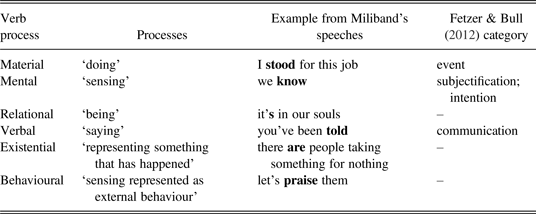
The verbal categories used by Fetzer & Bull (Reference Fetzer and Bull2012) broadly mirror those proposed by Halliday (Reference Halliday1985) in his model of systemic functional grammar, which are listed in Table 2. Given that Halliday's categories of verb processes are well established and frequently used in stylistic analysis, we adopt these in our account of the verbs used by Miliband. Although Fetzer & Bull (Reference Fetzer and Bull2012) distinguish between mental verbs of ‘sensing’ (subjectification) and those of ‘intent’ (intentional), the latter are much less frequent than the former. Consequently, we considered there to be no great disadvantage in collapsing these two categories as in Halliday's account.
Verb process types according to Halliday (Reference Halliday1985) and their corresponding categories in Fetzer & Bull (Reference Fetzer and Bull2012).
Verb process types in the two speeches
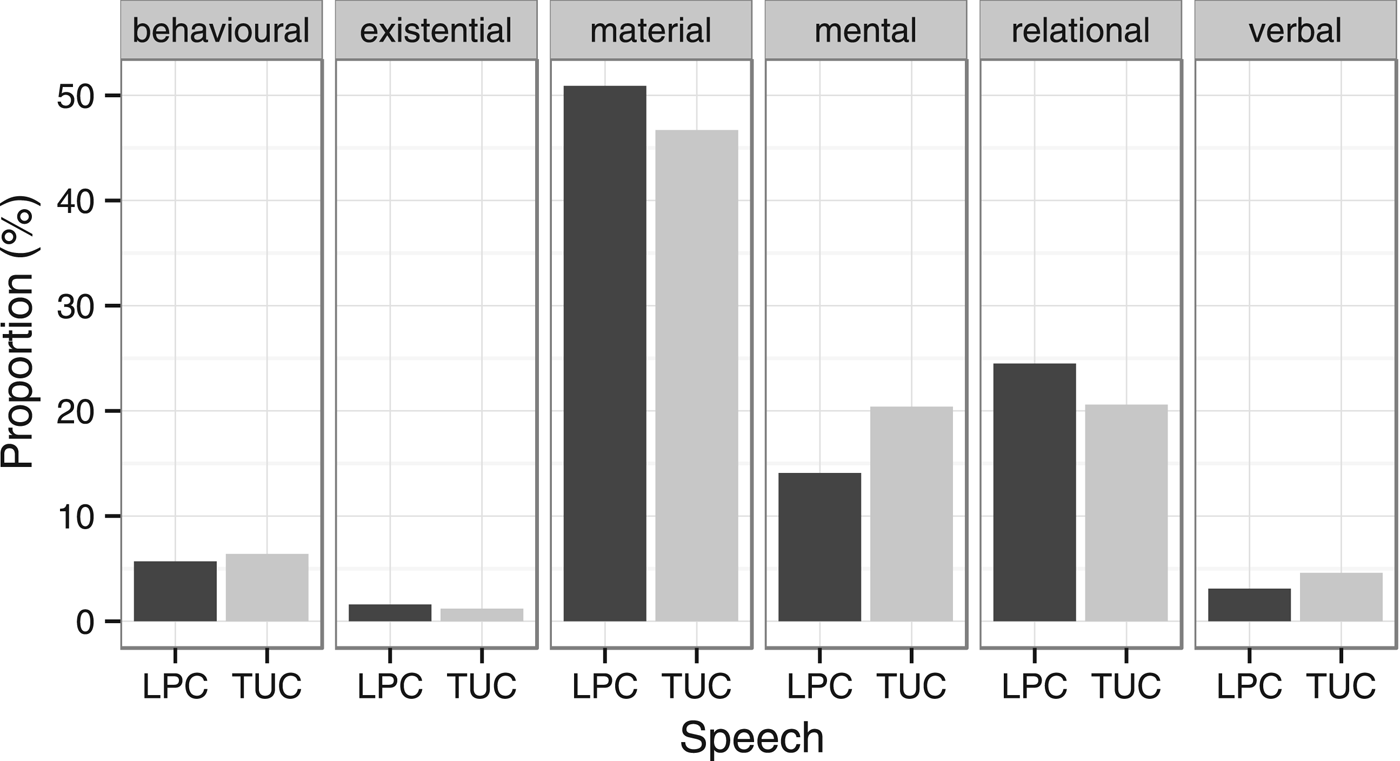
Figure 3 shows the distribution of 1,504 verb processes across the different types found in the two speeches. There is little difference in how these process types are distributed across the two speeches, but the patterns reflect the findings of Fetzer & Bull (Reference Fetzer and Bull2012), in that they highlight the importance of material verb processes (or event verbs) and mental verb processes (or subjectification verbs). Note that Fetzer & Bull do not analyse relational verbs, which are also relatively frequent in Miliband's speeches.
Distribution of verb process types across LPC and TUC speeches. N = 941 (LPC); N = 563 (TUC).
Analysing verb processes in isolation, however, does not allow us to consider who certain semantic processes are attributed to. For instance, there is a difference between a material process that denotes the action of the speaker and one that denotes the action of another, or implicates another in collective action. Some of the studies already cited have highlighted the importance of the pronoun types used by politicians and what this can reveal about the politicians' relationships vis-à-vis their audiences. Fetzer & Bull (Reference Fetzer and Bull2012:132), for example, note that politicians may use the first person plural pronoun we as a means of ‘indexing a social group on whose behalf they are speaking, thereby expressing solidarity as well as group identity, while at the same time laying claim to leadership’. Similarly, Fairclough (Reference Fairclough2000:35) has observed that ‘[i]n New Labour discourse we is used in two main ways: sometimes it is used ‘exclusively’ to refer to the Government (‘we are committed to one-nation politics’), and sometimes it is used ‘inclusively’ to refer to Britain, or the British people as a whole (‘we must be the best’).’ Of course, in both instances, we is used as a means of indexing collectivity and connectivity (Wales Reference Wales1996:62). Pearce (Reference Pearce2001) also comments on the use of second person pronoun you, which may refer to an individual or a collective. In present-day British English, it is also commonly used as a generic pronoun form, similar to the traditional use of one. Pearce (Reference Pearce2001:219) comments on this use in particular, noting the ‘generic’ flavour of you in Blair's discourse, where it is used to communicate ‘“common sense” values and notions' (see also Wales Reference Wales1996:179–84). Of course, in these instances, like we, you reflects an attempt to signify something shared between the speaker and the audience. Accordingly, the following section examines how verb processes pattern with we and you pronouns. We also examine exactly who we and you refer to in Miliband's discourse in order to understand exactly who it is that Miliband is aligning with.
The subject type we and its referents
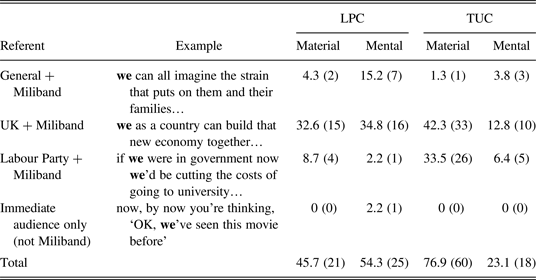
There are 101 occurrences of we in the LPC speech and material processes occur far more frequently with this subject pronoun (59.41%, N = 60) than do other processes (the next most frequent is mental processes at 17.82%, N = 18). In the TUC speech, there are sixty-seven tokens of we and there is a more even distribution of mental (37.31%, N = 25) and material (31.34%, N = 21) process types (the only other category with a sizeable proportion is relational processes at 16.42%, N = 11). As material and mental processes are the dominant types in both speeches, Table 3 shows how these two processes align with we referents, alongside some illustrative examples.
Distribution of material and mental verb process types according to the referent of the subject type we. Numbers indicate percentages with raw token counts in brackets. N = 124.
In the TUC speech, we occurs slightly more frequently with mental processes. In these instances, we most commonly refers to the ‘UK + Miliband’. Note, however, that this use is only slightly more frequent than we with the same referent, but with a material process. This suggests that Miliband balances a shared alignment towards actions, with a shared articulation of the thoughts, feelings, and the cognitive experiences typical of mental processes. These examples often show proposals for future actions that unite Miliband with all British people (‘we as a country can build that new economy together…’) and shared collaborative sensory experience of the action required (‘but the challenge we face is even greater’). Note also, in this speech, that Miliband has a relatively high proportion of we with mental processes, where we is general in reference (that is to say, there is no obviously identifiable referent for the collective indexed by the pronoun). Fairclough (Reference Fairclough1989:179) and Wales (Reference Wales1996:62) comment upon how politicians often use this kind of we in order to construct unity between a political party and a nation. As the example in Table 3 illustrates, in these instances, Miliband's use of we also assumes a direct alignment between his views and a broad constituency of listeners.
In the LPC speech, the most frequent use of we is with material processes, where, like the TUC speech, we refers to ‘UK + Miliband’. But unlike the TUC speech, there is not a correspondingly high use of mental processes in this context. The material processes with we corresponding to ‘UK + Miliband’ tend to be one of two types. They either discuss actions imposed on, or required of, the people of the UK (with whom Miliband aligns himself) by the Conservative and Liberal Democrat coalition government (‘but in our economy too often you've been told the fast buck is how we'll get on’), or they discuss remedial future actions that would improve the status quo (‘we must challenge irresponsible predatory practices wherever we find them’). The next most frequent use of we in this speech is also with material processes, but where the referent is ‘Labour Party + Miliband’. In these cases, the material processes tend to emphasise the future actions that Miliband would take were he in government (‘if we were in government now we'd be cutting the costs of going to university…’). In all of these examples, the emphasis is on Miliband aligning himself and, by implication, the UK and the Labour Party, with positive actions that seek to repair the negative actions imposed by his political rivals.
The subject type you and its referents
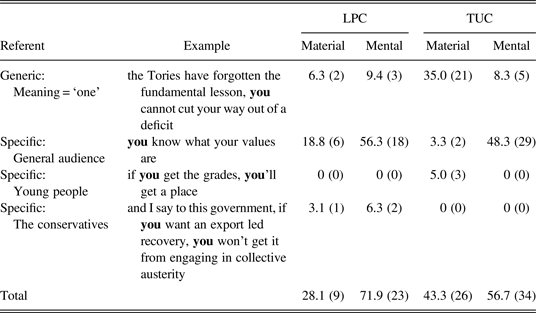
Turning now to you, in both speeches, the preferred process type with this pronoun is mental (54.8%, N = 23 in the TUC speech; 46.6%, N = 34 in the LPC speech), for example, ‘have you noticed how uncomfortable David Cameron is?’. However, there is an increased tendency to use you with material process types (for example, ‘the energy companies have gone unchallenged while you've been ripped off’) in the LPC speech (35.6%, N = 26) than in the TUC speech (21.4%, N = 9).
Table 4 shows that the most frequent use of you in both speeches is with mental processes where you is specific and refers to the general audience being addressed. As shown by the example in Table 4, these constructions are used to tell the audience what they are thinking or feeling. In claiming to know what people think and feel, Miliband is showing what Fetzer & Bull (Reference Fetzer and Bull2012) refer to as ‘responsiveness’. The second most frequent use of you in the TUC speech is with material processes, where you is specific and refers to the general audience being addressed. Typically, these examples serve to allow Miliband to acknowledge the positive actions of the trade unions, which have supported him personally and, he claims, the UK more generally, especially in the face of Conservative and Liberal Democrat policy (e.g. ‘the people who look after the sick who teach our children and who through their hard work create the wealth of this country, they are the backbone of Britain and you represent them’).
Distribution of material and mental verb process types according to the referent of the subject type you. Numbers indicate percentages with raw token counts in brackets. N = 92.
The second most frequent use of you in the LPC speech is also with material processes, but where you refers to a generic referent. Recall earlier that Pearce (Reference Pearce2001:219) considered this use of you to be typical of Labour Party discourse that stressed ‘“common sense” values and notions'. In the LPC speech, many of these instances of you refer to scenarios in which the Conservative and Liberal Democrat government have failed the public. Miliband paints a picture where the public are unable to take action against these injustices (for example, ‘if you lose your job and your income, you're not going to be able to afford the repayments. That's what's happening’). In these scenarios, generic you is used to demonstrate the wide-reaching and negative effects of the actions of Miliband's political rivals, and the ways in which they force the public into having to take undesirable actions, or make them impotent to act at all. This use of you is proportionally less frequent in the TUC speech, suggesting that there is less need for this kind of covert reference to shared values and notions in this context.
This analysis suggests that Miliband constructs his discourse differently in the TUC and LPC speeches. In the TUC speech, Miliband balances material and mental processes. He uses both of these processes with we and you subject pronouns, which shows alignment with his audience in terms of actions, and thoughts, feelings, and sensory experiences. As mentioned earlier, votes from members of the unions secured Miliband's leadership victory. To maintain their support, Miliband needed to demonstrate that he continued to share their goals and viewpoints, and his linguistic strategies may work to facilitate this outcome. In his LPC speech, Miliband has proportionally more material processes. His only substantive use of mental processes co-occur with a specific you subject type, where you refers to the speech's general audience. It seems that specific you in this context serves to suggest that Miliband understands the thoughts, feelings, and sensory experiences of his audience, without necessarily implying that these are shared by him (as might be implied by co-occurrence of we + mental verb processes). Fetzer & Bull (Reference Fetzer and Bull2012:142) have argued that the most effective leaders foreground competence with event verbs (encoded by material processes in our analysis), and responsiveness with subjectification verbs (encoded by mental processes in our analysis). In the LPC speech, Miliband achieves this by signalling his involvement with others (via you + mental processes), without emphasising alignment between himself and his audience (as is achieved via we + mental processes in the TUC speech).
The differences between the two speeches seem to correspond with the different relationships that Miliband had with the TUC and with the Labour Party more broadly. We now combine this analysis with our findings on Miliband's use of glottal /t/ to demonstrate how phonetics and discourse work synergistically to create alignments in his speech.
Discourse style and glottal stops
We showed earlier that there were general differences between the two speeches in terms of /t/ realisation, but that the words Britain and government were particularly strong axes of variation, with more glottals in these words in the TUC speech. Extracts (8)–(13) exemplify how Miliband uses these words in the discourse contexts that were identified as typical of the two speeches. As with previous extracts, phonetic realisation has been provided for each token of /t/, with [t] denoting an alveolar stop and [ʔ] denoting a glottal stop; the extracts also show the following phonetic context for each token of /t/, where C = consonant, V = vowel, N = syllabic nasal, and P = pause. The pronoun referents are also given in angled brackets. Extracts (8)–(11) show examples from the TUC speech.
(8) we + material process (TUC)
In government[ʔ]C, we <Miliband + LP> worked with trade unions to reform public sector pensions. We <Miliband + LP> sat[ʔ]C down and we <LP> negotiated [t]V.
(9) you + material process (TUC)
I'm proud to be here because of who you <specific = general audience> represent[t]P, the hard working men and women of Britain[ʔ]N, the people who look after the sick, who teach our children, and who through their hard work create[t]C the wealth of this country[t]C. They are the backbone of Britain[ʔ]N and you < specific = general audience> represent[ʔ]C them.
(10) we + mental process (TUC)
we <Miliband +UK> all recognise that[ʔ]C not every penny the last government[ʔ]C spent[ʔ]C was spent[t]C wisely.
(11) you + mental process (TUC)
you <generic> need a government[ʔ]C that[ʔ]C will make sure that[ʔ]C good regulation en- enables companies to build and win new markets[t]C.
These examples provide further evidence that, in the TUC speech, Miliband's talk suggests connectivity with the audience both in terms of completed material actions (extracts (8) and (9)) and thoughts, feelings, and sensory experiences (extracts (10) and (11)). In (8), we refers to the Labour Party, but note how Miliband explicitly references that the Labour Party worked with his audience—the trade unions. Here Miliband reflects upon the historic unity of these two groups and the concrete action that this unity achieved. Similarly, in (9), Miliband praises more positive concrete action achieved by trade union members. By praising the trade unions in this way, Miliband endorses their position. In (10), Miliband links his view to that of the rest of the UK (including his immediate audience) to reflect upon the failings of the previous Labour government, and, in (11), he outlines a plan for what the UK (including his immediate audience) would need from the next Labour government. In both of these examples, Miliband attempt to shows that he not only understands, but shares, the thoughts and beliefs of his audience.
As the previous discussion illustrated, the use of we and you is much more restricted in the LPC speech. We is more likely to co-occur with material processes than with mental processes. This can be seen in (12), where Miliband explains what concrete action he will undertake in the future.
(12) we + material process (LPC)
let[ʔ]C me tell you, if this government[t]C fails to deal with the deficit[t]V in this parliament[t]P, we <Miliband + LP> will deal with it[t]V in the next. It's why we <Miliband + LP> will set[ʔ]C new fiscal rules to bind the next labour government[t]P.
The aim here seems to be to convince his audience of the Labour Party's competence and ability to act (communicated by the future epistemic will), rather than to demonstrate alignment over beliefs or feelings. As discussed above, where mental processes do occur in the LPC speech, they tend to be used in conjunction with you as a specific second person pronoun. As (13) shows, this works to suggest that Miliband can empathise with his audience about their ‘tough life’, without having to imply shared values.
(13) you + mental process (LPC)
Now you <specific = general audience> know that[ʔ]C Britain[t]N needs to change. Every day of your life seems like a tough fight[t]P, to make ends meet[t]P, to do the best by your kids, to look after your mum and dad, and it[ʔ]C will be a tough fight[t]C to change Britain[t]N.
Putting all of this together, extracts (8)–(11) suggest that words like Britain and government pronounced with [ʔ] occur in the TUC speech in contexts where Miliband works to express alignment with his audience in terms of material action and thoughts/moral viewpoints. They occur in statements that stress a history of collaborative action and a future of shared morals. Note, also, that there are glottal pronunciations in words other than Britain and government in these extracts. In the TUC speech, then, glottal pronunciations of /t/ seem to occur in contexts where Miliband is attempting to construct a collaborative and familiar persona.
By contrast, extracts (12) and (13) shows that, in the LPC speech, words like Britain and government pronounced with [t] tend to occur in contexts where Miliband is working to establish credibility with his audience, without having to necessarily imply shared values. Note too, that, as with the TUC examples, there are other tokens of [t] in these extracts that occur alongside those in the words Britain and government. In this speech, then, it seems that the [t] pronunciations appear in contexts where Miliband is attempting to articulate a credible and responsive persona. We discuss the significance of this phonetic patterning below.
Interpreting social meanings in political talk
We have shown that variants of /t/, verb processes and pronouns seem to work together to create distinct social personae in Ed Miliband's discourse. Earlier, we cited Fetzer & Bull's (Reference Fetzer and Bull2012) claim that there are two important dimensions for politicians to articulate: competence (the ability to ‘get things done’) and responsiveness (the ability to ‘emote’ or connect to an audience). In the LPC speech Miliband signals involvement with his audience via you + mental processes, and he attempts to establish his credibility in getting things done via we + material processes. In the TUC speech, however, Miliband more explicitly emphasises alignment with his audience via we + mental processes, which signals an attempt to connect with the audience both in terms of completed material actions, and in thoughts, feelings, and sensory experiences. Here, we argue that Miliband is attempting to more explicitly align with an audience that has already largely voted for him as leader, in contrast to the LPC speech where he has to convince the audience that he is up to the job.
We have demonstrated that variants of /t/ in particular words pattern with these different discourse styles: there are significantly more glottals in words such as Britain and government in the TUC speech than in the LPC speech. This begs the question of why different variants of /t/ might be implicated in these rather different discourse styles. In these data, increased use of [ʔ] in a salient ‘New Labour’ word, as well as in government and highly frequent function words, corresponds with discourse that highlights shared alignment to both action and sensory experience. Previous research on /t/-glottalling in Britain suggests that glottal variants may be a symbol of solidarity or familiarity, whereas alveolar variants may be a symbol of credibility and responsiveness (Williams & Kerswill Reference Williams, Kerswill, Foulkes and Docherty1999; Milroy Reference Milroy, Cain and Russom2007). Similarly, perceptual research suggests that younger speakers perceive glottal variants as more friendly, whereas alveolar variants are considered more articulate, reliable, and posh (Schleef Reference Schleef2013b). There is a clear link between Miliband's audience alignment in the LPC speech, which is very much focused on demonstrating competence, and his use of alveolar variants of /t/, which may also be indexing characteristics such as articulateness and reliability. Conversely, Miliband's attempt to forge a more intimate connection in the TUC speech allows him to construct a more collaborative and familiar persona. Therefore, the glottal variant's associations of solidarity and friendliness may form part of this style.
The connection between glottal variants and urban youth styles is undoubtedly one of the reasons that Miliband and other politicians have been widely mocked for using this variant (as shown in extracts (1)–(5)). However, we suggest that Miliband's glottal stop usage can be viewed as selectively invoking meanings from a rich indexical field (Eckert Reference Eckert2008) in order to create context-specific personae. Schleef (Reference Schleef2013b) makes the point that glottal stops often have a more diverse indexical field than is sometimes assumed and our results also support this proposal. We do not doubt the association between glottal stops and urban youth styles, but it seems more likely that Miliband is exploiting indexical associations of a different order, such as solidarity and belonging, without necessarily invoking youth or urbanness per se.
These results also show that political speeches are complex sites for identity negotiation, which may impact upon a variant's indexical field. Fetzer & Bull (Reference Fetzer and Bull2012:132) have observed that ‘although political speeches are often classified as a monologic genre, they may also be understood as interactive events' and the variability we have found in /t/-glottalling and discourse structure in the TUC and LPC speeches clearly demonstrates how fluid language practices may be around these speech events. Miliband is essentially engaged in the same speech event in the two environments we analysed and his linguistic behaviour reflects subtle differences in how he constructs a political persona, rather than any direct association with more abstract notions of formality or youth language.
In this article, we have combined two forms of linguistic analysis (discourse analysis and sociophonetics) in order to more fully understand the social context of language use and the meanings associated with individual linguistic variables. Although our work has focused on political discourse, this analysis serves to more broadly demonstrate that the social meanings associated with language use are constructed across different linguistic levels (Moore & Podesva Reference Moore and Podesva2009). In doing so, we have shown that understanding how a linguistic feature like /t/-glottalling becomes socially meaningful requires attention to its linguistic co-text in interaction, as well as the social and historical processes in which speech events are embedded.