Introduction
Internationally, suicide accounts for over 115 000 deaths among older adults per year, indicating an overall mortality rate of 27.5 per 100 000 people (He et al., Reference He, Ouyang, Qiu, Li, Li and Xiao2021). Considering that the world's geriatric population is projected to double by 2050 (World Health Organization, 2021), understanding risk and protective factors associated with late-life suicide is an imperative public health agenda. Among several psychosocial protective factors identified against suicide attempts and completion rates (Chang, Chan, & Yip, Reference Chang, Chan and Yip2017; Fässberg et al., Reference Fässberg, Orden, Duberstein, Erlangsen, Lapierre, Bodner and Waern2012), religion is one of the strongest (Lawrence, Oquendo, & Stanley, Reference Lawrence, Oquendo and Stanley2016). In one widely cited large-scale population study, US females who attend religious services weekly were five-times less likely to die from suicide compared to those who do not attend at all (VanderWeele, Li, Tsai, & Kawachi, Reference VanderWeele, Li, Tsai and Kawachi2016). However, the current understanding of how and why religion may play a protective role against late-life suicidality is limited by several factors. First, religion is multifaceted and includes aspects of identity such as religious affiliation, attitudes such as importance of religion, behaviors such as service attendance, and cognitive beliefs such as belief or faith in God (Hill & Pargament, Reference Hill and Pargament2003). Yet, many existing studies have assessed just one of these dimensions or aggregated multiple facets of religion into a single proxy (Lawrence et al., Reference Lawrence, Oquendo and Stanley2016). Second, suicidality tends to fluctuate over time, however the majority of studies in this area have been cross-sectional (Chen, Koh, Kawachi, Botticelli, & VanderWeele, Reference Chen, Koh, Kawachi, Botticelli and VanderWeele2020). Third, there is a scarcity of studies on religion and suicide among clinical samples, and the relevance of religion to individuals with high risk for suicide (e.g. older adults with mood disorders) is unclear.
Which dimensions of religion might protect against suicide among older adults? A substantial body of research suggests that religious service attendance is associated with less likelihood of attempting suicide (Lawrence et al., Reference Lawrence, Oquendo and Stanley2016; Rasic, Kisely, & Langille, Reference Rasic, Kisely and Langille2011) and completing suicide (Wu, Wang, & Jia, Reference Wu, Wang and Jia2015). These findings appear to suggest that socially-contextualized behavioral aspects of religion may be particularly protective against development of suicidal behaviors in the general population (Chen et al., Reference Chen, Koh, Kawachi, Botticelli and VanderWeele2020). On the other hand, religious affiliation does not seem to be associated with suicidality (Kuo, Gallo, & Tien, Reference Kuo, Gallo and Tien2001; Lawrence et al., Reference Lawrence, Oquendo and Stanley2016), indicating that religious identity alone – without attitudinal, behavioral, or cognitive facets of religion – may not protect against suicide (Chen et al., Reference Chen, Koh, Kawachi, Botticelli and VanderWeele2020; Lawrence et al., Reference Lawrence, Oquendo and Stanley2016). With regards to intrapsychic cognitive facets of religion such as belief or faith in God, a growing body of research has shown inverse correlations with depression and hopelessness (Murphy et al., Reference Murphy, Ciarrocchi, Piedmont, Cheston, Peyrot and Fitchett2000), and perhaps for these reasons, better prognosis among those seeking psychiatric treatment (Murphy & Fitchett, Reference Murphy and Fitchett2009; Rosmarin et al., Reference Rosmarin, Bigda-Peyton, Kertz, Smith, Rauch and Björgvinsson2013). However, the relevance of religious beliefs to suicidality is understudied, despite the widespread prevalence of such beliefs across the United States, even among many individuals who do not affiliate with a religious group (Fahmy, Reference Fahmy2018).
The present study examined the relevance of various aspects of religion – identity (affiliation and importance), behaviors (service attendance), and cognitions (belief and faith in God) – to suicidality, in the context of a longitudinal study with geriatric patients diagnosed with mood disorders. Given the naturalistic design of this study (i.e. differing number of measurements and intervals), available data (i.e. variability in the number of measurements completed by participants), and the episodic nature of depression and suicidality (Pemberton & Tyszkiewicz, Reference Pemberton and Tyszkiewicz2016), we utilized summary statistics to capture the ebb and flow of depressive symptoms and suicidality over the entire course of the study as our primary outcome variables. Specifically, we identified maximum levels of suicidality and depression, average levels of suicidality and depression, and the number of depressive and suicidal episodes experienced by each participant. This approach enabled us to evaluate whether (and which) religious factors may predict the course of mood disorders, and/or whether religion has predictive power during clinically significant (e.g. depressed) as well as euthymic stages of mood disorders. We also identified participants who did and did not experience significant suicidality over the course of the study, and calculated odds ratios to examine effects of religion. This enabled us to evaluate the potential ‘real-world’ relevance of religion in suicide prevention in our sample, since suicide completion typically occurs during severe episodes of depression and suicidal thought (Hawton, i Comabella, Haw, & Saunders, Reference Hawton, i Comabella, Haw and Saunders2013). Based on previous literature, we expected that religious factors would be associated with lower mean and maximum levels of depression and suicidality, fewer episodes of depression and suicidality, and less likelihood of experiencing significant suicidality during the study. Additionally, given that service attendance, belief, and faith in God commonly occur among those who do not affiliate with a religious group, we conducted exploratory analyses to identify if relationships between these factors and depression/suicidality might differ based on participants' religious affiliation. No specific hypotheses were proposed with regards to these latter analyses due to their exploratory nature.
Methods
Procedures & participants
Data for the present study were culled from ongoing longitudinal investigations examining the course of mood disorders among older adults, conducted between February, 2008 and November, 2020 within McLean Hospital's Geriatric Psychiatry Research Program. Participants were recruited from McLean Hospital units, local psychiatrists and other physicians, as well as from the general community. Participants met all of the following inclusion criteria: Ages of 55 to 85 years old; English speaking; able to provide informed consent; without any current substance dependence or serious medical illness. Depression and suicidality were assessed longitudinally, on a quarterly basis (every three months). The average participant was enrolled in the study for 727 days (s.d. = 78.5) and completed 7.31 measurements (s.d. = 4.80) with a mean of 120.28 days (s.d. = 5.31) between measurements. Given that spirituality/religion tends to be largely stable in mid and late adulthood (Argue, Johnson, & White, Reference Argue, Johnson and White1999; Button, Stallings, Rhee, Corley, & Hewitt, Reference Button, Stallings, Rhee, Corley and Hewitt2011; Uecker, Regnerus, & Vaaler, Reference Uecker, Regnerus and Vaaler2007), these factors were assessed at a single time-point for each participant, most frequently at the first measurement. Clinical diagnoses were confirmed by a board-certified geriatric psychiatrist as well as a structured diagnostic assessment (Structured Clinical Interview for DSM-IV Axis I Disorders – CATIE Version (Stroup et al., Reference Stroup, McEvoy, Swartz, Byerly, Glick, Canive and Lieberman2003) and/or Mini-International Neuropsychiatric Interview (Sheehan et al., Reference Sheehan, Lecrubier, Sheehan, Amorim, Janavs, Weiller and Dunbar1998), which was administered at the first clinical visit. All patients provided informed consent prior to initiation of study procedures, and study procedures were approved by the Mass-General Brigham Institutional Review Board.
Our sample consisted of 80 older adults with mood disorders, ranging in age from 55 to 85 years (M = 67.51, s.d. = 6.82) of which 45% identified as male, 54% as female, and 1% as other gender. In terms of race and ethnicity, the vast majority of the sample (98%) identified as White, of which 1% were Hispanic, and small numbers identified as African American (1%) and Asian/Pacific Islander (1%). Twenty-three percent (23%) reported single marital status, whereas 39% were married, 11% widowed, 1% separated, and 26% divorced. The sample was highly educated as a whole, with a mean of 16.40 years of education (s.d. = 2.82). In terms of clinical characteristics, 41% of participants had symptoms meeting criteria for major depressive disorder, 58% for bipolar disorders, and 1% for schizoaffective disorder. Mean age of onset for diagnoses was 23.44 years (s.d. = 15.35), and 66% reported prior psychotherapeutic treatment. Lifetime clinical severity in the sample was high; 64% reported a prior psychiatric hospitalization, and 30% prior electroconvulsive therapy (ECT). Overall mean levels of depressive symptoms over the course of the present study were mild, as assessed by both the MADRS (M = 14.93, s.d. = 9.25) and GDS (M = 5.66, s.d. = 4.02). However, 91% of patients reported at least one clinically significant episode of depression (based on self-report measures) during the study. Furthermore, depressive symptoms were characterized by significant variability such that 30% of MADRS measurements (n = 187) were in the moderate-severe range, and 33% of GDS assessments (n = 205) were moderate-severe. Overall levels of suicidality in the sample were relatively small as measured by the MADRS (M = 0.66, s.d. = 0.92). However, 20% of measurements over the course of the study (24% of participants) indicated significant suicidality (at a level greater than ‘only fleeting suicidal thoughts’) with the average participant experiencing 0.70 such episodes (s.d. = 1.61).
With regards to religion, most patients (76%) reported a religious affiliation, and 53% reported that religion was at least ‘fairly’ important in their lives (10% fairly, 15% moderately, 28% very), however, a sizable minority reported religion was only ‘slightly’ (19%) or ‘not at all’ important (29%). The majority of participants reported attending services either ‘never’ (46%), ‘once per week’ (20%), or ‘once per year’ (13%) with the remaining reporting ‘a few times per year’ (8%), ‘a few times per month’ (8%), or ‘More than once a week’ (5%). Similarly, the majority of participants reported believing in God ‘not at all’ (30%) or ‘very much’ (41%) with the remaining reporting to a slight (8%), fair (8%), or moderate extent (14%).
Measures
Montgomery-Åsberg depression rating scale
The Montgomery-Åsberg Depression Rating Scale (MADRS; Williams & Kobak, Reference Williams and Kobak2008) is a clinical observation/interview assessment of severity and frequency of clinical depressive symptoms within the past week. Items are scored using anchors ranging on a continuous scale from 0 (symptoms absent) to 6 (continuous and/or debilitating), in respect to 10 common symptoms of depression (apparent sadness, reported sadness, inner tension, reduced sleep, reduced appetite, concentration difficulties, lassitude, inability to feel/reduced interest, pessimistic thoughts, and suicidal thoughts). Total scores on the MADRS thus range from 0 to 60, with higher scores indicating more significant depressive symptoms. A cut-off score of >6 were utilized for defining a depressive episode as suggested by Herrmann, Black, Lawrence, Szekely, and Szalai (Reference Herrmann, Black, Lawrence, Szekely and Szalai1998). The MADRS was completed by trained research assistants, under the supervision of a board-certified geriatric psychiatrist, and internal consistency in the current sample was high (α = 0.90).
Geriatric depression scale
The Geriatric Depression Scale (D'Ath, Katona, Mullan, Evans, & Katona, Reference D'Ath, Katona, Mullan, Evans and Katona1994) is a 15-item self-report measure, which was designed specifically to assess for depressive symptoms in geriatric populations. Subjects are asked to endorse either present (‘Yes’ = 1) or absent (‘No’ = 0) in response to a list of common symptoms of depression (including several reverse-score items) within the past week; example items include ‘Are you in good spirits most of the time?’, ‘Do you often feel helpless?’, and ‘Do you feel full of energy?’ Total scores range from 0 to 15 with higher scores indicating greater depression severity. A cutoff score of >9 was used for defining depressive episodes, based on Laudisio et al. (Reference Laudisio, Antonelli Incalzi, Gemma, Marzetti, Pozzi, Padua and Zuccala2018). Internal consistency of the GDS in the current sample was high (α = 0.91), and correlations between MADRS and GDS scores in our sample were high [r(597) = 0.81, p < 0.001]. However, these measures exhibited only a ‘fair’ level of concordance with regards to clinical severity (k = 0.36, s.e. = 0.03, T = 15.63, p < 0.001) with the GDS generally indicating a larger proportion of both non-depressed and severely depressed classifications.
Suicidality
Suicidality was assessed in this study using item #10 from the MADRS. Given that our sample consisted of individuals with mood disorders, many of whom had a significant clinical history including prior psychiatric hospitalization (64% of subjects) and ECT (30% of subjects), we utilized a conservative cut-off of >2, representing anything greater than ‘only fleeting suicidal thoughts’ to identify clinically significant episodes of suicidality.
General religion
We utilized a series of individual items to assess various general dimensions of religious life, including religious affiliation, importance of religion, frequency of religious service attendance, and belief in God. Importance of religion and spirituality, and extent of belief in God were assessed using a 5-point Likert-Type scale, ranging from 0 ‘Not at all’, to 4 ‘Very’. Religious service attendance was assessed using a 6-point scale ranging from 1 ‘Rarely or Never’, to 6 ‘More than once a week/day’.
Faith in God
We included the Brief Trust in God Scale, a psychometrically valid and reliable 3-item measure of faith in God (Rosmarin, Pirutinsky, & Pargament, Reference Rosmarin, Pirutinsky and Pargament2011b). This measure assesses the extent to which one has faith in a God who loves, cares, and shows kindness. Internal consistency for this measure in the current sample was high (α = 0.93).
Analytic plan
We began by computing mean and maximum levels of depressive symptoms and suicidality for each participant over the course of the entire study, as well as the number of measurements for each participant that reached clinical thresholds (episodes of depression or significant suicidality). This enabled us to examine religious predictors of within-subject variance in depression and suicidality over time. Next, since religion can covary with demographic variables that are also relevant to depression and suicidality (e.g. age, gender, race, and education (Oquendo & Bernanke, Reference Oquendo and Bernanke2017), we conducted preliminary analyses to identify potentially confounding relationships, and controlled for significant covariates. We also controlled for the total number of measurements, since the number of episodes reaching certain clinical criteria might have been dependent on the number of measurements taken from a particular participant (e.g. participants may have been less likely to complete evaluations during periods of more severe depression and/or suicidality). For our main study analyses, we examined relationships between religious factors, depression and suicidality using bivariate partial correlations. We then computed odds ratios examining effects of religious variables on the occurrence of suicidality at any point during the study period. Finally, we utilized multivariate linear regression in exploratory analyses to evaluate the moderation effects of religious affiliation on relationships between service attendance, belief, and faith in God, with depression/suicidality.
Results
Age, gender, race/ethnicity, marital status, and education were all not significantly related to mean level of depression [all rs: (−0.20, −0.02); f's: (0.13, 1.61); ps: (0.054, 0.89)], highest level of depression [all rs: (−0.15, −0.04); f's: (0.03, 0.46); ps: (0.11, 0.98)], mean level of suicidality [all rs: (−0.07, −0.03); f's: (0.22, 1.33); ps: (0.25, 0.81)], or highest level of suicidality [all rs: (−0.15, 0.04); f's: (0.37, 1.00); ps: (0.32, 0.74)]. Accordingly, these variables were not controlled in tests of our study hypotheses, however, sensitivity analyses controlling for these factors yielded nearly identical results.
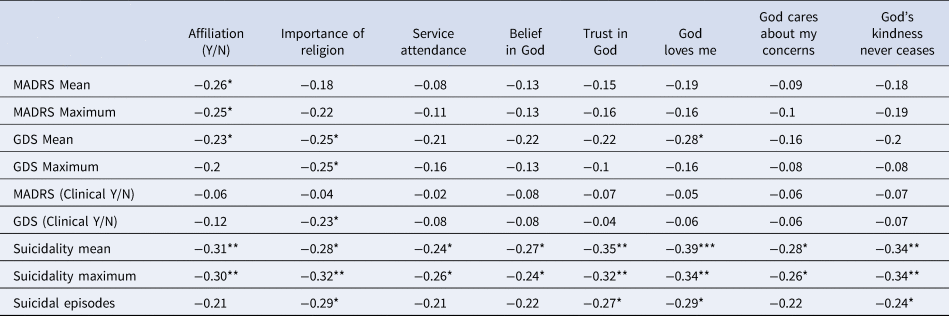
Correlations for all study variables are reported in Table 1. Religious affiliation, religious service attendance, importance of religion, belief in God, and faith in God were all significantly correlated with lower levels of mean suicidality, maximum suicidality, and the number of suicidal episodes over the course of the study. Post-hoc analyses on individual items comprising the brief trust in God scale revealed that all three items (i.e. faith in God's love, care, and kindness) were significant predictors of less suicidality with medium effect sizes (5.7–15.2% variance explained). Regarding depression, associations with religion were negative across the board, though most were not significant. However, religious affiliation was significantly associated with lower mean and maximum depression as measured by the MADRS, and lower mean depression as measured by the GDS. Similarly, the importance of religion significantly predicted lower mean and maximum depression, and significantly lower likelihood of clinical severity of depression as measured by the GDS. Religious service attendance, belief in God, and trust in God did not correlate with depressive symptoms.
Correlations between religion, depression, and suicidality over time among geriatric patients with mood disorders

Note. n for analyses ranged from 71–80.
*p < 0.05; **p < 0.01; ***p < 0.001; # Partial correlation controlling for total number of measurements.
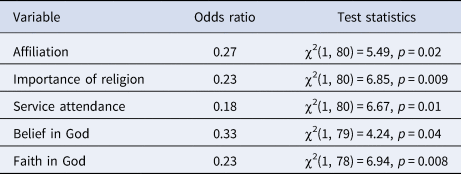
Odd ratios for effects of religious variables on the occurrence of suicidality at any point during the study are reported in Table 2. Results were consistent with bivariate partial correlations. Religious affiliation (affiliated v. unaffiliated, OR 0.27), the importance of religion (top v. bottom item scores in mean split, OR 0.23), service attendance (weekly or greater v. less frequently, OR 0.18), belief in God (any belief v. none, OR 0.33), and faith in God (top v. bottom scale scores in mean split, OR 0.23) were all significant predictors of less suicidality over the course of the study (ps ranging from 0.04–0.008).
Effects of religion on suicidality among geriatric patients with mood disorders

Note. Religious affiliation represents affiliated v. unaffiliated; Importance of religion represents top v. bottom scores of a mean-split for this item (see text); Service attendance represents ≥1x/wk v. less frequently; Belief in God represents any level of belief v. no belief at all; Faith in God represents top v. bottom scores of a mean-split for the scale (see text); Suicidality represents the occurrence of significant suicidal thoughts at any point during the study.
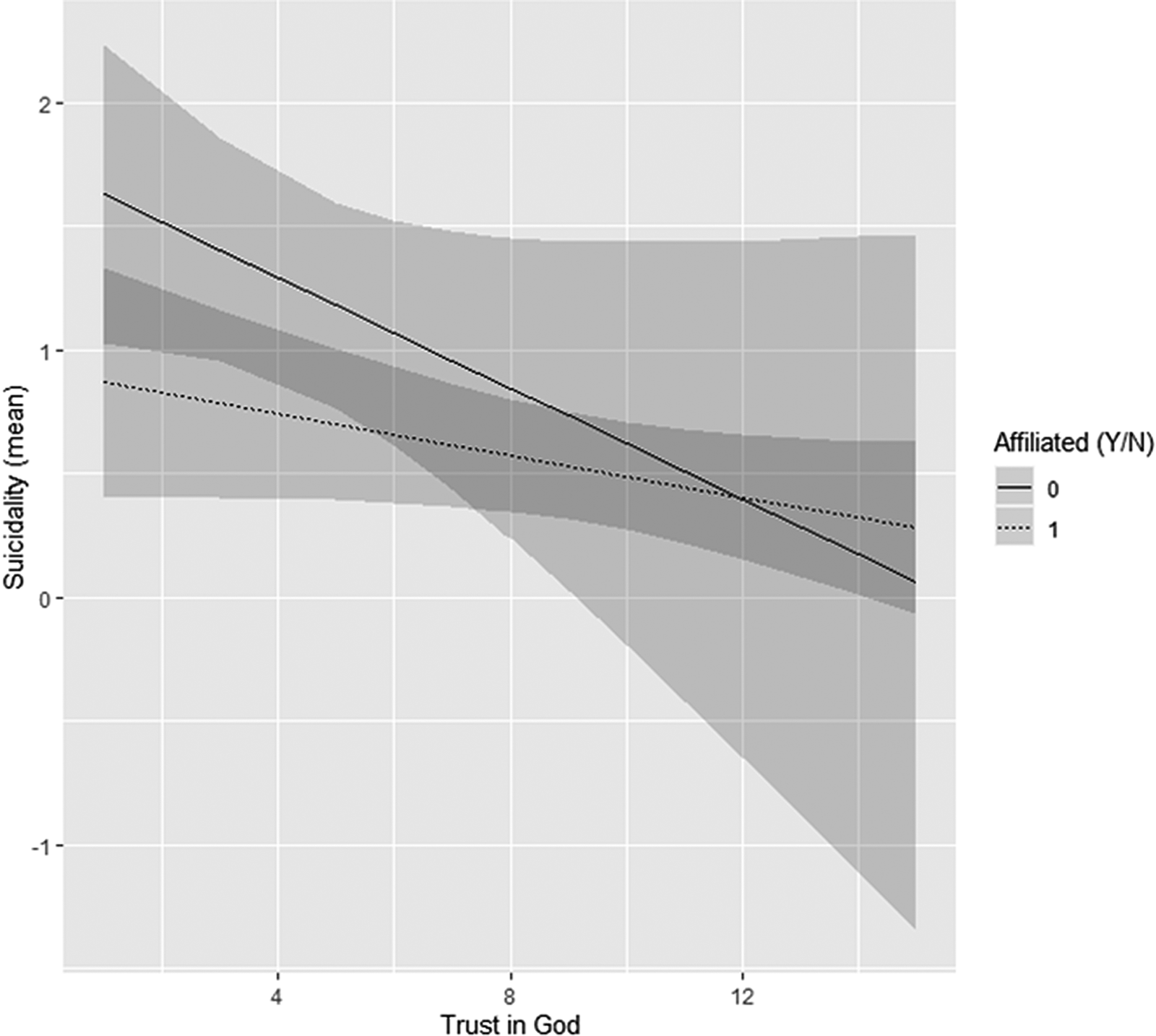
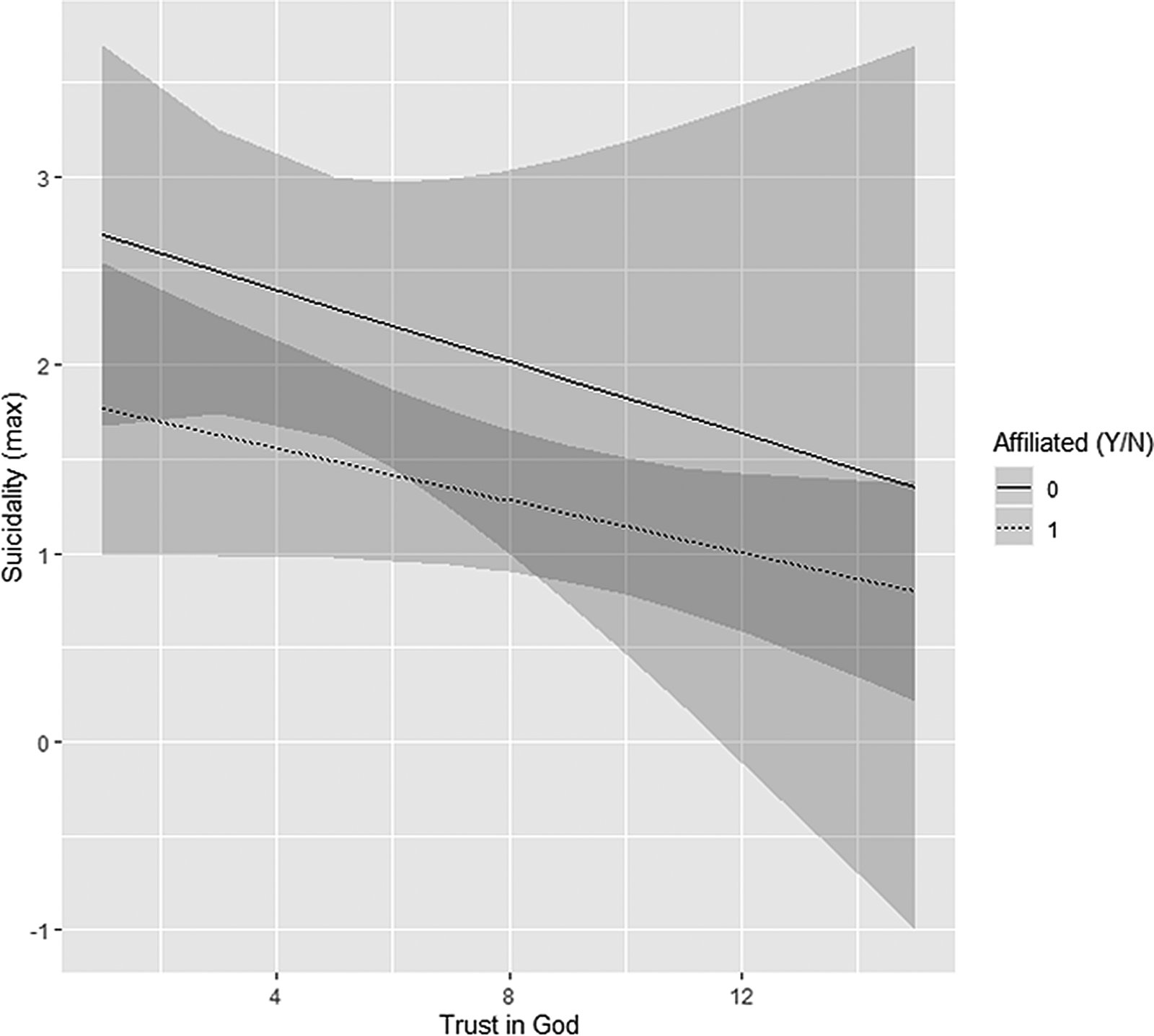
The results above were followed up with exploratory analyses to identify whether religious service attendance, belief, and faith in God predicted less suicidality only for subjects who affiliated with a religious group, or if such effects extended to the unaffiliated. Results indicated that religious affiliation did not significantly moderate the relationships between mean suicidality and service attendance (ΔR 2 = 0.04, p = 0.06), belief in God (ΔR2 = 0.04, p = 0.06), or faith in God (ΔR 2 = 0.01, p = 0.32; Fig. 1). The same pattern of results emerged for maximum suicidality: Service attendance (ΔR 2 = 0.008, p = 0.42), belief in God (ΔR 2 = 0.02, p = 0.24), and faith in God (ΔR 2 = 0.001, p = 0.82; Fig. 2). Similarly, the relationships between the number of suicidal episodes and service attendance (ΔR 2 = 0.02, p = 0.15), belief in God (ΔR 2 = 0.03, p = 0.12), and faith in God (ΔR 2 = 0.02, p = 0.23) were not significantly moderated by religious affiliation.
Relationship between faith in God and mean suicidality among affiliated and unaffiliated geriatric patients with mood disorders.
Note. Figures were generated using sjPlot (Lüdecke, Reference Lüdecke2021) and lines represent predicted values of mean suicidality for each group (affiliated v. unaffiliated) at each level of faith in God. 95% CI for each prediction is represented by the shaded regions.

Relationship between faith in God and maximum suicidality among affiliated and unaffiliated geriatric patients with mood disorders.
Note. Figures were generated using sjPlot (Lüdecke, 2021) and lines represent predicted values of maximum suicidality for each group (affiliated v. unaffiliated) at each level of faith in God. 95% CI for each prediction are represented by the shaded regions.

Discussion
In this longitudinal study among geriatric patients with mood disorders, religious factors were consistently and inversely correlated with the course of suicidality. Specifically, religious affiliation, the importance of religion, service attendance, belief and faith in God predicted lower levels of mean suicidality, and lower maximum levels of suicidality over time (average of >7 assessments over a period of ~2 years). Further, the odds of experiencing any significant suicidality over the course of the study were substantially lower based on these facets of religion (ORs ranging from 0.18 to 0.33). These results support and extend the existing literature, by suggesting that religion may be a protective factor against suicidality among geriatric patients with mood disorders. Notably, our measure of faith assessed for beliefs about God's love, care, and kindness (Rosmarin et al., Reference Rosmarin, Pirutinsky and Pargament2011b). Such religious beliefs may decrease hopelessness (Murphy et al., Reference Murphy, Ciarrocchi, Piedmont, Cheston, Peyrot and Fitchett2000) and increase tolerance of uncertainty (Rosmarin et al., Reference Rosmarin, Pirutinsky, Auerbach, Björgvinsson, Bigda-Peyton, Andersson and Krumrei2011a), which can in turn facilitate adaptive coping with adverse life circumstances (Bosworth, Park, McQuoid, Hays, & Steffens, Reference Bosworth, Park, McQuoid, Hays and Steffens2003). Faith in a loving God can also engender optimism and enhance confidence that treatment will be effective, thereby easing recovery from acute symptoms of depression (Rosmarin et al., Reference Rosmarin, Bigda-Peyton, Kertz, Smith, Rauch and Björgvinsson2013). Notably, most of our sample (64%) had previously been through psychiatric hospitalization. Our findings suggest that faith is potentially an important cognitive resource that has clinical relevance for high-risk individuals, even during periods of acute psychiatric distress.
We observed that effects of service attendance, belief and faith in God on suicidality were evident among individuals who did and did not report a religious affiliation (i.e. patients who were religiously unaffiliated). These findings are consistent with an emerging tendency for spirituality to have broad relevance outside of the confines of traditional religious communities. Most psychiatric patients in general, and the majority of geriatric psychiatric patients in particular (Stanley et al., Reference Stanley, Bush, Camp, Jameson, Phillips, Barber and Cully2011), profess a desire to address spirituality in the context of their treatment, including over one third of individuals who do not identify with any religion (Rosmarin, Forester, Shassian, Webb, & Björgvinsson, Reference Rosmarin, Forester, Shassian, Webb and Björgvinsson2015). Similarly, in one recent large-scale study of spiritually-integrated psychotherapy, the statistical majority of self-referred patients had no religious affiliation (Rosmarin, Salcone, Harper, & Forester, Reference Rosmarin, Salcone, Harper and Forester2021). These trends may be explained as follows: Religious affiliation has declined significantly in recent years; 17% of modern Americans (where the study was conducted) describe their religion as ‘nothing in particular’ today v. 12% in 2009 (Smith, Schiller, & Nolan, Reference Smith, Schiller and Nolan2019). Yet, religious activity remains very common; among Americans with no religion, 72% believe in God and 38% pray on a monthly or more frequent basis (Pew Research Center, n.d.). In this vein, attending services or believing in a loving, caring and kind God is not necessarily a ‘religious’ phenomenon in the modern day. Rather, basic expressions of faith are a common aspect that is important to most of humanity – one with clinical relevance.
Regarding depressive symptoms, religious identity (religious affiliation and importance of religion) was associated with less depression with small effect sizes (up to 6.8% variance accounted for). Behavioral (service attendance) and cognitive (belief/faith in God) aspects of religious life were also negatively correlated with depression, but the results were not statistically significant. On the one hand, these results contrast with a large volume of literature suggesting that religion can buffer against incidence and severity of depression (Bonelli, Dew, Koenig, Rosmarin, & Vasegh, Reference Bonelli, Dew, Koenig, Rosmarin and Vasegh2012; Mosqueiro, de Rezende Pinto, & Moreira-Almeida, Reference Mosqueiro, de Rezende Pinto, Moreira-Almeida, Rosmarin and Koenig2020). On the other hand, the bulk of previous research on religion and depression has been conducted in the general population with cross-sectional designs, and effect sizes tend to be modest (Braam & Koenig, Reference Braam and Koenig2019). Notably, emerging research on religion and depression within clinical populations suggests that positive aspects of religion (such as those examined in our study) are not significantly associated with less depressive symptomatology, especially for those receiving acute psychiatric treatment (Cruz et al., Reference Cruz, Pincus, Welsh, Greenwald, Lasky and Kilbourne2010; Dew et al., Reference Dew, Daniel, Goldston, McCall, Kuchibhatla, Schleifer and Koenig2010; Rosmarin, Malloy, & Forester, Reference Rosmarin, Malloy and Forester2014). One simple explanation for these macro-level trends could be as follows: Despite its modest protective effects at the population level, many religious individuals may develop depression over the lifespan and a subset of these individuals experience severe symptoms. For these individuals, religion may not be a sufficient resource to protect against worsening of affective symptoms over time. In these regards, religious factors may have more relevance to suicide prevention than treatment of severe depression.
Our sample was limited in diversity regarding race/ethnicity (98% identified as White), and level of education (M = 16.4 years), though salience of religious factors tends to be even greater among minorities (Nguyen, Reference Nguyen2020) and those without a college education (Abdala et al., Reference Abdala, Meira, Rodrigo, Fróes, Ferreira, Abdala and Koenig2021). Therefore, our largely White and highly educated sample facilitated a conservative test of our hypotheses. Another limitation is related to the heterogeneity of clinical history and symptomatology among patients, though this rendered our findings more broadly generalizable to geriatric psychiatric patients with various forms of mood disorders. Relatedly, a high percentage of patients reported hospitalization and ECT, which may reflect the study setting (McLean Hospital), though the elevated risk in our sample does enhance the importance of our findings, which focus on suicidality. Another limitation pertained to variability in the number and frequency of assessments among patients, however this increased the ecological validity of our findings. As well, our sample was relatively small (n = 80), though our analyses were adequately powered especially given that medium effect sizes were observed for key findings. We also did not obtain information regarding the duration of mood disorders among participants, and we only assessed for religion at a single timepoint, which precluded examining potential changes in religious beliefs/practices over time. While religion tends to be stable especially during late adulthood as cited above (Argue et al., Reference Argue, Johnson and White1999; Button et al., Reference Button, Stallings, Rhee, Corley and Hewitt2011; Uecker et al., Reference Uecker, Regnerus and Vaaler2007), it is possible that religion may ebb and flow in response to life events or the length (or course) of mood disorders. It is further possible that there could be bidirectional or complex relationships between religion, depression, suicidality. Finally, we did not assess for moral objections to suicide, which could be a key mediating factor explaining our observed effects. With that said, the possibility that religion is tied to suicide, whether mediated by other factors or not, remains of clinical and theoretical importance. Future research with larger and more diverse samples of geriatric psychiatry patients should utilize multiple assessments of religion, suicide, mood factors, and morality, and employ advanced statistical methodologies (e.g. structural equation modeling, multilevel modeling), to better understand these connections.
Conflict of interest
The authors have no conflicts of interest to disclose and jointly affirm that this manuscript is an honest, accurate, and transparent account of the study being reported, that no important aspects of the study have been omitted, and that any discrepancies from the study as planned have been explained.
Financial support
Financial support was received from McLean Hospital development fund #401712 as well as the National Institute on Aging, Roger's Family Foundation, Spier Family Foundation, Biogen, and Eisai.