Introduction
In the year following treatment for deliberate self-harm (DSH), a fifth repeat the act and more than one in 50 die by suicide (Owens et al. Reference Owens, Horrocks and House2002). Alcohol misuse is an important risk factor for DSH (Kolves et al. Reference Kolves, Varnik, Tooding and Wasserman2006). Almost half of those presenting to services after an episode of DSH have consumed alcohol in the period prior to the act (Hawton et al. Reference Hawton, Fagg and McKeown1989; Touquet et al. Reference Touquet, Csipke, Holloway, Brown, Patel, Seddon, Gulati, Moore, Batrick and Crawford2008), and the proportion who misuse alcohol seems to be increasing (Hawton et al. Reference Hawton, Harriss, Hall, Simkin, Bale and Bond2003). In the period following an episode of DSH, concurrent alcohol misuse is associated with higher rates of completed suicide and higher rates of repetition of self-harm (Suokas & Lonnqvist, Reference Suokas and Lonnqvist1995; Cooper et al. Reference Cooper, Kapur, Webb, Lawlor, Guthrie, Mackway-Jones and Appleby2005). Qualitative data collected from people who previously self-harmed but no longer do so have shown that many attribute their recovery to tackling their misuse of alcohol (Sinclair & Green, Reference Sinclair and Green2005). Although numerous studies have examined the impact of interventions aimed at reducing repetition of DSH, uncertainty remains about which forms of treatment are effective (Hawton et al. Reference Hawton, Arensman, Townsend, Bremner, Feldman, Goldney, Gunnell, Hazell, van Heeringen, House, Owens, Sakinofsky and Traskman-Bendz1998).
Brief interventions aimed at helping people who misuse alcohol to reduce their level of consumption have repeatedly been shown to be effective (Wallace et al. Reference Wallace, Cutler and Haines1988; WHO Brief Interventions Study Group, 1996; Wilk et al. Reference Wilk, Jensen and Havighurst1997). The offer of brief intervention for alcohol misuse may also result in reductions in service utilization, accidental injury and violence (Agosti, Reference Agosti1995; Crawford et al. Reference Crawford, Patton, Touquet, Drummond, Byford, Barrett, Reece, Brown and Henry2004).
Despite evidence suggesting that brief intervention for alcohol misuse is effective, its impact among people who deliberately self-harm has not been examined. In this exploratory study we examined the impact of brief intervention for alcohol misuse among people who presented to an Emergency Department (ED) following an episode of DSH. We aimed to examine the level of uptake of the offer of brief intervention and to explore the impact of this offer on repetition of DSH.
Method
Study design
We carried out a single-blind, parallel-group, pragmatic randomized controlled trial. The study was conducted at an ED in central London that serves a population of 450 000 residents who are, on average, younger, more mobile and more ethnically diverse than those in other parts of the UK (Office of National Statistics, 2003). All those who presented to the ED following an episode of DSH, were aged over 18 years and were misusing alcohol according to the Paddington Alcohol Test (PAT; Patton et al. Reference Patton, Hilton, Crawford and Touquet2004) were potentially eligible to participate in the study. We excluded those who were unable or unwilling to provide verbal consent to participate (because they were unable to communicate in English or had impaired consciousness), those with no fixed address in greater London, those already in contact with alcohol misuse services, and those who made a specific request for help with an alcohol problem at the time of their assessment. Recruitment of study participants took place over a 27-month period, from November 2005 to January 2008.
According to the PAT, a person is misusing alcohol if, on a weekly basis, they consume more than eight units of alcohol in a drinking session (for men), or six units (for women), or if they believe that their attendance in the ED is related to their use of alcohol. All those identified as misusing alcohol were informed of this and those meeting study inclusion criteria were given written and verbal information about the study and asked if they would be willing to participate. Those who were eligible to participate and provided verbal consent to take part in the study were randomized to control or experimental treatment using pre-prepared sealed opaque envelopes containing either:
(1) Experimental treatment: an appointment card asking the patient to reattend the ED for an appointment with an Alcohol Nurse Specialist (ANS) together with a health information leaflet on alcohol and heath.
(2) Control treatment: a blank piece of card of the same size and weight as an appointment card together with a health information leaflet on alcohol and heath.
We used simple randomization with an experimental to control treatment ratio of 1:1. Sealed envelopes were used rather than remote randomization to simplify procedures for ED staff and to avoid the additional use of telephones in this busy emergency setting. Envelopes were prepared in advance by an independent team using random number tables. Each envelope was marked with an identifying number and regular checks were made to ensure that eligible participants were allocated according to the sequence on the randomization list. Those who declined to take part in the study were managed in the usual way. This may include further advice in ED or referral to the ANS. Study participants were followed up at 3 and 6 months. We gave participants the option of a telephone-based or a face-to-face interview. Those who failed to respond to attempts to contact them in person were mailed a copy of our outcome measures and a pre-paid return envelope. Participants were offered a £15 shopping voucher for their help with collecting these data.
Intervention
Those randomized to experimental treatment were given an appointment card that detailed the time and place of an appointment with an ANS. The ANS was employed 5 days a week, so it was usually possible to provide an appointment on the same day as the person's initial attendance in the ED. The appointment was never more than 50 h after their initial presentation, unless a later appointment was specifically requested by the patient. The appointment with the ANS consisted of approximately 30 min of assessment and discussion of current and previous drinking based on the FRAMES approach (Miller & Sanchez, Reference Miller, Sanchez and Howard1993). FRAMES is an acronym comprising six key features of brief intervention for excessive drinking that have been found to be effective across a range of different settings: Feedback about the adverse effects of excessive alcohol consumption, an emphasis on Responsibility for change lying with the individual, provision of Advice about reducing alcohol consumption, a Menu of options for further intervention if this is required, an Empathic stance towards the patient, and the enhancement of Self-efficacy (Moyer et al. Reference Moyer, Finney and Swearingen2002). Following the appointment, the ANS had the option of referring the patient on for further help, such as individual alcohol counselling or detoxification services. During these sessions the ANS took a patient-centred and non-confrontational approach (Miller & Rollnick, Reference Miller and Rollnick2002). During the course of the assessment patients may resolve ambivalence regarding their drinking and determine appropriate action. However, in cases where the patient did not display insight into the consequences of their use of alcohol, the ANS may offer feedback about safe levels of drinking and suggest a range of strategies aimed at reducing levels of consumption. All study participants also received a copy of a health information leaflet ‘Think About Drink’ that contains information about the health-damaging effects of excessive alcohol consumption, details of benchmarks for recommended limits and contact details for national alcohol helplines.
Outcome measures
At baseline, basic demographic and clinical details were noted and the results of PAT screening conducted by front-line clinical staff were extracted from handwritten and computerized hospital records. The PAT provides information about the most a person drinks during a drinking day, and whether they believe their attendance in the ED is related to their use of alcohol. At 3 and 6 months we collected data on the number of subsequent episode(s) of DSH, level of alcohol consumption using the Alcohol Use Disorders Identification Test (AUDIT; Babor et al. Reference Babor, de la Fuente, Saunders and Grant1989) and general mental health using the 12-item General Health Questionnaire (GHQ; Goldberg & Williams, Reference Goldberg and Williams1991). We used a cut-off score of ⩾3 on the GHQ to indicate the presence of ‘probable mental disorder’ (Goldberg & Williams, Reference Goldberg and Williams1991). Satisfaction with care was assessed using the three-item Client Satisfaction Questionnaire (Attkisson & Greenfield, Reference Attkisson, Greenfield and Maruish1994). Because of concerns that people with personality disorder, who are over-represented among those who self-harm, may not benefit from brief interventions, we collected data on personality disorder using the eight-item Standardised Assessment of Personality – Abbreviated Scale (SAPAS; Moran et al. Reference Moran, Leese, Lee, Walters, Thornicroft and Mann2003). We used the recommended cut-off score of ⩾3 to indicate the presence of ‘probable personality disorder’.
Following completion of collection of secondary outcomes data, we examined hospital records at the ED and four adjacent hospitals to quantify our primary outcome: whether participants attended an ED following DSH in the 6 months following randomization. All follow-up data were collected and managed by a researcher who was masked to allocation status.
Statistical analysis
Baseline data on alcohol consumption, measured using the PAT, and other routine data were used to ascertain whether the study groups differed. Differences in our primary outcome measure, whether participants reattended an ED following an episode of DSH, were compared among those receiving experimental and control treatment using χ2 tests. Logistic regression analysis was then used to take account of any differences in baseline alcohol consumption or other potential confounding factors. Differences in secondary outcome measures were examined using appropriate univariate and multivariate techniques. Data were analysed using SPSS version 16.0 (SPSS Inc., USA). Our primary analysis was conducted using an intention-to-treat principle, and secondary analysis compared other outcomes among those who received the brief intervention with those who did not. Ethical approval was granted by the relevant National Health Service (NHS) ethics committee prior to the start of data collection (COREC reference no. 05/Q0403/121).
Results
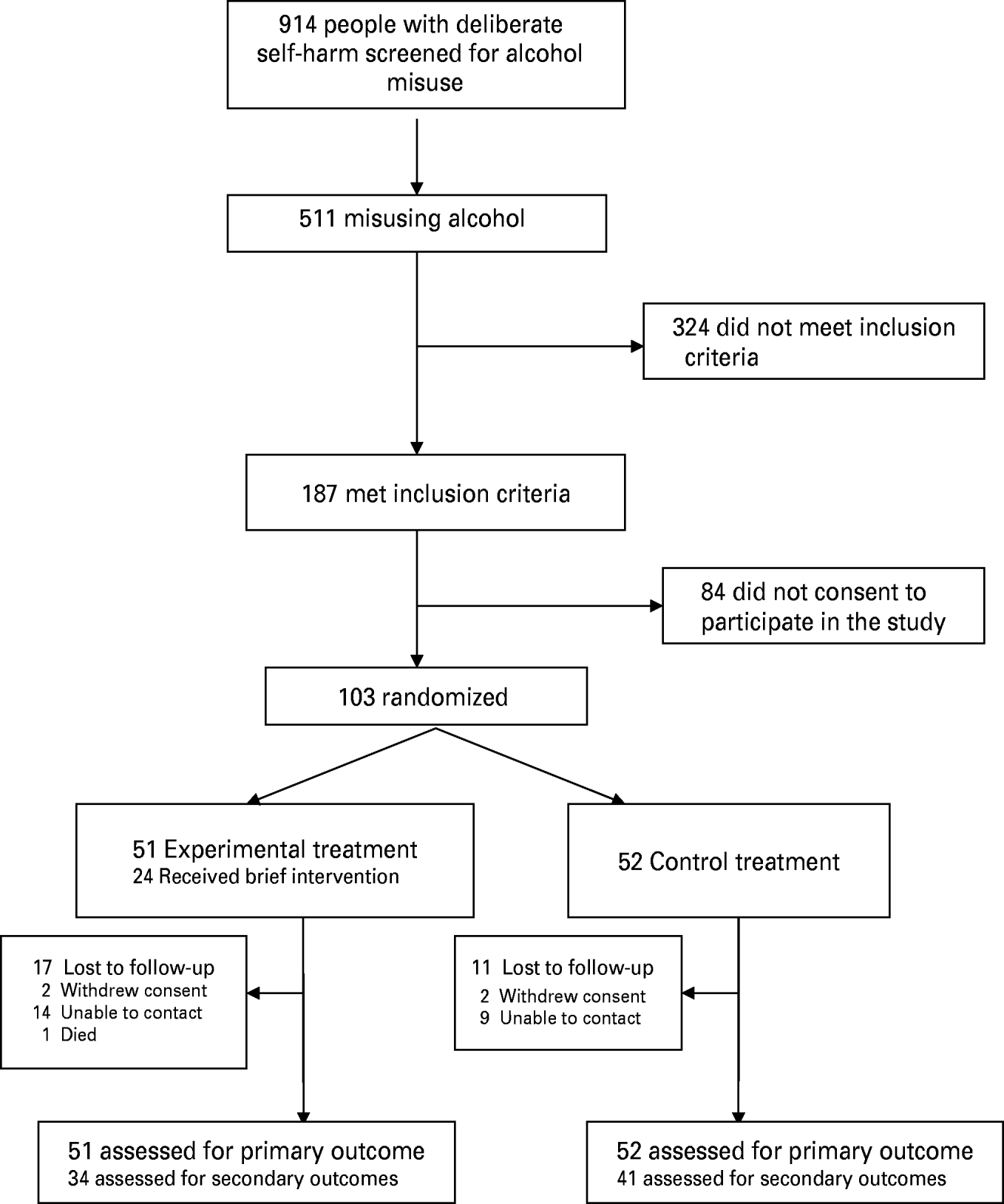
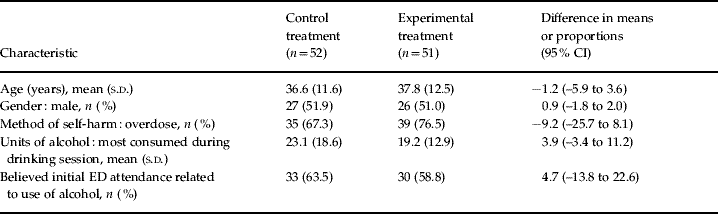
One hundred and three people were recruited over a 26-month period (see Fig. 1). Among the 324 who were potentially eligible to participate but were excluded, 115 took self-discharge prior to completion of assessment, 65 lived outside London or were of no fixed abode, 32 were already receiving treatment from alcohol services, 25 were under 18 years of age, 19 were referred directly to the ANS by the ED team, 15 requested help with their use of alcohol, 13 had insufficient spoken English to complete the baseline assessment and 40 were excluded for other reasons such as impaired level of consciousness. The mean age of participants was 37.2 years (s.d.=12.0, range 18–65). Fifty-three participants (51.5%) were male. Participants reported drinking up to a mean of 21 units of alcohol per drinking session (s.d.=16.0), and 63 (61.2%) stated that their attendance in the department was related to alcohol. Regarding the method of self-harm, 74 people (71.8%) attended the ED following an overdose, 22 (21.4%) following an episode of self-cutting, three (1.5%) for other methods of self-harm (self-burning and electrocution) and four involved more than one method. Fifty-one participants were randomized to experimental treatment and 52 to control treatment. Baseline characteristics of those randomized to each arm of the trial are presented in Table 1. Personality status was assessed among 75 (72.8%) participants, of whom 67 (89.3%) met the threshold for probable personality disorder using the SAPAS.
Study flowchart.

Comparison of baseline characteristics of 103 participants randomized to experimental or control treatment

ED, Emergency Department; CI, confidence interval; s.d., standard deviation.
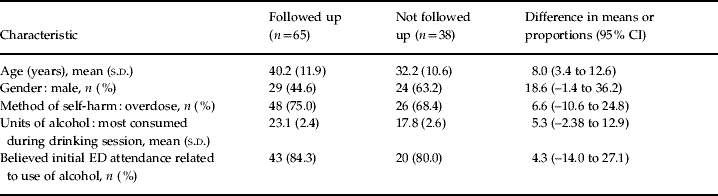
Follow-up data were obtained on the primary outcome measure for all 103 participants. Some data on secondary outcomes were obtained from 75 (72.8%) of the study participants. The rate of follow-up was 65.0% at 3 months and 63.1% at 6 months. Characteristics of those who were and were not followed up at 6 months are presented in Table 2. Participants who were able to provide data on secondary outcomes were older than those who were unable to provide these data.
Comparison of baseline characteristics of participants who did and not provide follow-up data on secondary outcomes at 6 months

ED, Emergency Department; CI, confidence interval; s.d., standard deviation.
Primary and secondary outcomes
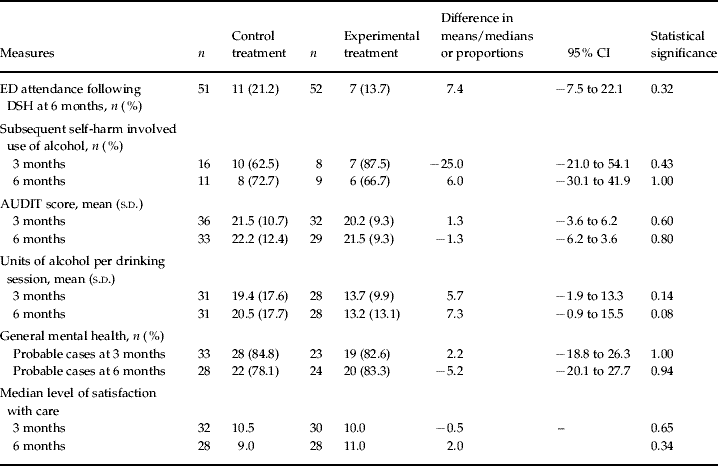
Study outcomes among those who received experimental and control treatment are presented in Table 3. The odds of attending an ED after a further episode of DSH among those who received experimental treatment compared to those who received control treatment was 0.59 [95% confidence interval (CI) 0.21–1.67]. The likelihood of repetition of DSH was strongly associated with baseline alcohol consumption such that the odds ratio associated with each unit increase in number of units consumed per drinking session was 1.03 (95% CI 1.00–1.06). The odds ratio associated with the offer of brief intervention, when adjusted for baseline alcohol consumption, was 1.00 (95% CI 0.32–3.15). Adjusting for other baseline variables, the odds of repetition of self-harm among those referred to brief intervention was 1.15 (95% CI 0.34–3.97).
Outcome measures at follow-up

ED, Emergency Department; DSH, deliberate self-harm; AUDIT, Alcohol Use Disorders Identification Test; CI, confidence interval; s.d., standard deviation.
Those randomized to referral for brief intervention reported consuming an average of seven fewer units of alcohol per drinking day at 6 months. This trend, towards reduced alcohol consumption among those referred for brief intervention, persisted when baseline alcohol consumption was taken into account (β=−0.24, p=0.06).
Twenty-four (47.1%) of the 51 randomized to experimental treatment attended an appointment with an ANS. The odds of presenting to an ED with repetition of DSH among those who attended an appointment with an ANS compared to those who did not was 0.93 (95% CI 0.27–3.14).
Discussion
Over half of all those who presented to this ED following an episode of DSH during the course of the study were misusing alcohol according to the PAT. Of these, most saw a link between their use of alcohol and their self-harm and most accepted the offer of brief intervention. Although there was a trend towards those who were offered brief intervention consuming less alcohol at 6 months, we did not find evidence of reductions in the likelihood of repetition of self-harm once differences in baseline alcohol consumption were taken into account.
Strengths and limitations of the study design
The main strengths of the study were that it was randomized and that researchers collecting follow-up data were masked to allocation status. We used a pragmatic approach to identifying alcohol misuse and offering a brief intervention that was delivered by front-line clinicians rather than researchers. We were able to collect data on our primary outcome from all those who took part in the study and obtained some data on secondary outcomes at either the 3- or 6-month follow-up on 73% of the sample. The main limitation of the study was the small sample size. Although the study helped us to explore the possible impact of brief intervention for alcohol misuse, it was not sufficiently large to be able to make definitive claims about the impact of this intervention. We estimate that, with a rate of repetition of DSH of 17.5% at 6 months, a sample of over 1400 participants would be required to have 80% power to detect a clinically significant reduction in the repetition of self-harm of 30%, using a 5% level of statistical significance. Although we followed up the study sample long enough to capture the period when repetition of DSH is most likely to occur (Owens et al. Reference Owens, Horrocks and House2002), we cannot rule out the possibility that any benefits associated with the offer of brief intervention for alcohol misuse take a longer period of time to assert their impact on the likelihood of further DSH. Nor can we exclude the possibility that other approaches that have been used to help people reduce their alcohol consumption may have had an impact on the likelihood of repetition of DSH (Conroy et al. Reference Conroy, Brower, Marshall, Crawford, Tyrer and Silk2008).
Comparison of findings in relation to those of previous studies
We used the same approach to identifying and treating alcohol misuse in this study that we used in a previous trial examining brief intervention for alcohol misuse among those with a broad range of presenting conditions (Crawford et al. Reference Crawford, Patton, Touquet, Drummond, Byford, Barrett, Reece, Brown and Henry2004). People presenting to emergency medical services following an episode of DSH were more than twice as likely to have alcohol misuse as those presenting with these other common conditions (55.9% v. 22.3%). Although a similar proportion of people presenting with self-harm were willing to accept the offer of help, the proportion who attended an appointment with an ANS was higher (47.1% v. 29.3%). However, this may reflect the extension in working hours of the ANS in the department following the completion of our previous project. Previous research has demonstrated that the level of attendance at ANS appointments is higher when a person is offered a same-day appointment (Williams et al. Reference Williams, Brown, Patton, Crawford and Touquet2005).
The trend towards reduced number of units of alcohol consumed per drinking day in the experimental arm of the trial that we found is similar in magnitude to that reported among people who present to an ED with a broader range of other common conditions (Crawford et al. Reference Crawford, Patton, Touquet, Drummond, Byford, Barrett, Reece, Brown and Henry2004). Nonetheless, we did not find evidence that the offer of brief intervention led to a reduction in the likelihood of repetition of DSH. Although we cannot rule out the possibility that this finding is the result of a type II error, the adjusted odds ratio of 1.0, together with apparent absence of any impact on the likelihood of alcohol being used at the time of an episode of self-harm among those randomized to experimental treatment, suggests that this form of brief intervention does not have an impact on the likelihood of repetition of DSH. Although evidence from previous studies suggests that brief intervention in the ED can lead to reductions in accidents and injuries (Agosti, Reference Agosti1995; Mello et al. Reference Mello, Nirenberg, Longabaugh, Woolard, Minugh, Becker, Baird and Stein2005), they may not have the same impact on self-inflicted harm.
Up to 50% of people who present to ED following DSH have a personality disorder (Haw et al. Reference Haw, Hawton, Houston and Townsend2001). We found that almost 90% of people who took part in this study had ‘probable personality disorder’. This may reflect differences in the way that personality disorder was assessed in these two studies. However, previous research has shown high levels of personality disorder among people with co-morbid mental health and substance misuse problems (Bowden-Jones et al. Reference Bowden-Jones, Iqbal, Tyrer, Seivewright, Cooper, Judd and Weaver2004) and it seems likely that the combination of alcohol misuse and DSH raises the possibility that the person has underlying personality-related problems. There is a consensus among users and providers of mental health services that people with personality disorder may not benefit from brief interventions (Crawford et al. Reference Crawford, Price, Rutter, Moran, Tyrer, Bateman, Fonagy, Gibson and Weaver2008). In a previous trial examining the impact of a brief psychological intervention following DSH, poorer outcomes were reported among those who had co-morbid personality disorder (Tyrer et al. Reference Tyrer, Tom, Byford, Schmidt, Jones, Davidson, Knapp, MacLeod and Catalan2004). Although integrated treatment programmes for people with personality disorder have been shown to lead to reductions in self-harm and substance misuse (Linehan et al. Reference Linehan, Schmidt, Dimeff, Craft, Kanter and Comtois1999), these data support the view that brief intervention for people with such complex problems may not be effective.
Our data provide further evidence to highlight the importance of alcohol misuse as a risk factor for repetition of DSH (Suokas & Lonnqvist, Reference Suokas and Lonnqvist1995). Further research is required to develop strategies that can help to reduce levels of suicidal behaviour in this high-risk group. We consider that qualitative research examining the views of people who self-harm about interventions for alcohol misuse could help in developing more effective interventions that could then be tested in future trials.
Conclusions
Findings from this study confirm high levels of alcohol misuse among people who present to emergency services following DSH. Although those who were offered brief intervention may have reduced the amount of alcohol they consumed, we did not find evidence that this reduced the likelihood of repetition of DSH.
Acknowledgements
This study was funded by St Mary's Paddington Charitable Trust. We gratefully acknowledge the work and cooperation of all our ED staff, especially our nursing staff and senior house officers of Teams 39 and 40, for recruiting study participants and collecting baseline data.
Declaration of Interest
None.