1. Introduction
Three fourfold models for classing nouns (nāma) are found in texts traditionally attributed to the fifth-century scholar-monk Buddhaghosa. Although brief references are scattered in literature,Footnote 1 a systematic analysis of these models has not to my knowledge yet been undertaken. Two partial exceptions are Pind (Reference Pind1992: 65–6) and Collins (Reference Collins1993: 385–6). Pind considers these models as instances of the “grammatical vocabulary that is specific to the Aṭṭhakathās”. Collins discusses what I label below as model 2 in the context of exploring the name of the first king in the Aggaññasutta, mahāsammata, a name that is given as a noun example to illustrate one noun category in said model. While they offer valuable insights, neither contribution provides a full discussion of these models.
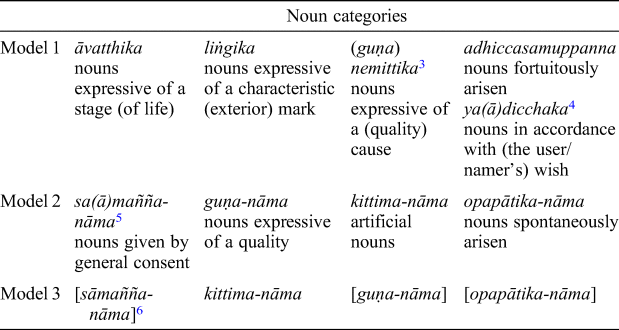
As illustrated in Table 1, the first model (model 1) uses a distinctive set of noun categories. The other two models (models 2 and 3) share the same noun categories. There are several occurrences of each model in the texts ascribed to Buddhaghosa.
The three models for classifying nounsFootnote 2

For each model, I aim to show three things: first, its occurrences have a distinctive distribution; second, it is possible to identify the original occurrence from which the others were derived; and third, studying the relation between the original occurrences and their respective contexts reveals that each model's original occurrence serves a specific purpose.
Building on these observations, I then argue that Buddhagosa (here understood as a label for the author/s of the early stratum of commentaries) inherited these models from unspecified sources and repurposed them to tackle contextual exegetical needs. I also propose that Buddhaghosa's reuse of these inherited models is consistent with his view that Pali is a natural or perfect language, namely, the only language that has a direct or intrinsic connection to reality. Further, I focus on the names designating the noun categories and suggest that the original author/s of the models developed them by combining influences stemming from both the Pali canon and Sanskrit grammatical sources.
Before we begin, it is opportune to gain clarity on the term nāma. The translation “noun” is an approximation. The term nāma designates one of the four word-classes according to a fourfold classification often found in Sanskrit and Pali texts, the remaining classes being ākhyāta “verbs”, upasarga (P. upasagga) “preverb/prepositions”, and nipāta “particles”. This fourfold classification is already found in texts as early as the Nirukta and the Prātiśākhyas. The term nāma has a semantic range that is broader than “noun”, for it refers to what in Western grammatical terminology would be called nouns, both common and proper, adjectives, pronouns, and participles. Therefore, nāma is sometimes rendered with “nominals”. For the sake of simplicity, however, I will use the word “noun”.Footnote 7
This article is divided into three main parts. First (§§2–4), for each model, I describe the noun categories and show the distribution of the occurrences of the models. I then determine each model's original occurrence and identify its purpose through studying how it relates to its context. Second (§5), I examine the three models in relation to each other. And third (§6), I explore the names designating the noun categories for what they reveal about the origins of the models.
2. Model 1: Noun categories
1. āvatthika: “nouns expressive of a stage [of life]” designate their referent in relation to its life-stages. Noun examples are vaccha “calf”, damma “young bull”, and balivadda “full grown bull”.Footnote 8
2. liṅgika: “nouns expressive of a characteristic [exterior] mark” designate their referent in relation to a characteristic, yet external, feature. The noun examples are words of the kind “x-in”, “provided with x”, where “x” refers to a visible external mark, such as the umbrella (chatta) carried by the umbrella-bearer (chattin), or the tuft of hair (sikha) of the “topknot-wearer” (sikhin).
3. (guṇa)nemittika: “nouns expressive of a (quality) cause” designate their referent in relation to one of its defining qualities (guṇa). Such qualities are the cause ([*nimitta>] nemittika) or reason (kāraṇa: Vism 198,9,11, 212,16–17/HOS 162,2,33, 175,12–13)Footnote 9 why a given name is ascribed to a given referent. The noun examples are words denoting Buddhistic religious qualities: tevijja “possessed of the three knowledges” and chaḷabhiñña “possessed of the six direct-knowledges”. This category also includes the term bhagavan, the epithet of the Buddha.
4. adhiccasamuppanna/yadicchaka: “nouns fortuitously arisen/nouns in accordance with [the user/namer's] wish” designate their referent in relation to the user/namer's wish. Two names are given to this noun category. As shown below (§6), adhiccasamuppanna is likely to be a borrowing from the Pali canon, while yadicchaka seems to have its origins in Sanskrit grammatical sources.
This noun category is accompanied by the following terse definition:
[Nouns] fortuitously arisen, such as “Splendour/Glory-increaser”, “Wealth-increaser”, are used without taking into consideration the [nouns’] etymological meaning.Footnote 10 (Sirivaḍḍhako Dhanavaḍḍhako ti evamādi vacanatthaṃ anapekkhitvā pavattaṃ adhiccasamuppannaṃ.)
The point seems to be this: proper names such as “Splendour/Glory increaser” and “Wealth-increaser” are chosen by a user/namer because of their auspicious meaning, whether or not their etymological or literal meaning conforms to their referent. In other words, individuals so named do not necessarily increase splendour/glory or wealth, either their own or that of others.
§2.1. Model 1: Distribution, original occurrence, and purpose
All occurrences of model 1 show a clear distribution: they occur within a passage that describes the Buddha's epithet bhagavan.Footnote 11 Gaining clarity on the purpose served by model 1 requires an understanding of the relation between the model's original occurrence and its context.
Vism can be identified as the original occurrence of model 1, for two reasons. First, the Vism is regarded by both tradition and modern scholars as the earliest text among those that feature model 1. Second, the passage describing Bhagavan, within which model 1 occurs, forms a self-contained passage in the other texts, but it constitutes an integral part of the Vism section, a section that explains the nine main epithets of the Buddha (Vism 198,1–213,9 /HOS 162–73 [§§ 2–67]).
Considering the original occurrence of model 1 in the Vism in relation to its immediate context (namely, the passage describing bhagavan) shows that Buddhaghosa did not invent this model but inherited it from previous unspecified sources. Buddhaghosa mentions model 1 in the context of recording various interpretations of the epithet bhagavan.Footnote 12 Buddhaghosa records the interpretation advanced by the ancients (§53 porāṇā), by Sariputta (§55 as recorded in the Nidd), by the Nidd (§56), and by the etymologists and grammarians (§§57–8). It is fairly clear that model 1 (§54) is one of these interpretations drawn from previous sources.
However, Buddhaghosa modified this inherited model by making two adjustments. First, he expanded the model to include the epithet bhagavan within the nemittika noun category. This is consistent with the fact that when the model is introduced (§54) no mention is made of bhagavan. But it is due to Buddhaghosa's own addition that bhagavan is classified explicitly as a nemittika noun (§55 “Here, then, bhagavan is a noun expressive of a cause” idaṃ pana Bhagavā ti nāmaṃ nemittikaṃ).
Second, Buddhaghosa tacitly revised the purport of the original nemittika noun category through describing the epithet bhagavan as denoting a quality-cause (§56 [yaṃ]guṇanemittikañ). The addition of the word guṇa to the inherited term nemittika is, I believe, significant. In doing so, Buddhaghosa repurposed the inherited model in accordance with the larger Vism section of which the passage describing bhagavan constitutes an organic part. This section details the meditative practice of recollecting the Buddha (buddhānussati), a practice which consists of focusing on the Buddha's qualities or guṇas through visualizing the reasons (kāraṇa) why the Buddha is called “x”, “x” being the Buddha's nine main epithets.Footnote 13
What, then, is the purpose of model 1? Buddhaghosa repurposed a pre-existing model to show that the epithet bhagavan is superior to the other kind of nouns in that it expresses the Buddha's unique qualities. In doing so, Buddhaghosa adjusted the inherited model in accordance with the overall purport of the Vism section, namely, to detail the meditative practice of recollecting the Buddha's qualities as encoded in his epithets.
§3. Model 2: Noun categories
1. sāmañña-nāma: “nouns given by general consent” designate their referent through general agreement. Only one noun example is supplied in all texts, mahāsammata, the name of the first king in the Aggaññasutta's narrative of the origins of the world.
In his perceptive discussion of model 2, Collins (Reference Collins1993: 385–6) argues that sāmañña-nāma means “‘general term/description’ as opposed to ‘specific (proper) name’”. He further explains that although the name mahāsammata “denotes a specific individual in each cosmic age, the name is a ‘general name’ referring to his role rather than being a ‘made-up’ name for a person such as Tissa or Phussa. It is like ‘President of the United States’ rather than (in 1993) ‘Bill Clinton’”.
The translation “nouns given by general consent”, however, seems to be supported by the explanations of this noun category given in the texts. In Dhs-a 390,29–33 (≈ Paṭis-a 306,21–25 ≈ Moh 110,26–28), the name of the first king “Great Assent” (mahāsammato) is explained etymologically as meaning that which has been assented to (sammannitvā) by many people (mahājanena).Footnote 14 Both mahāsammato and sammannitvā are derived from sam√man “assent, agree upon”. This explanation builds on the citation from the Aggaññasutta which similarly explains the name mahāsammata as being derived from “assented to by many people” (mahājanasammato).
The Sadd likewise explains samañña as arising from many people's agreement:
“samaññā-nāma” is [like] the noun of the king Mahāsammato (“Great Assent”): it has been agreed upon (sammannitvā), i.e. established, by many people (mahājanena) among those of the first ages. To explain, “samaññā-nāma” is a name that is used by designation, i.e. by common assent among the people (Sadd 879,7–9: paṭhamakappikesu mahājanena sammannitvā ṭhapitattā Mahāsammato ti rañño nāmaṃ samaññānāmaṃ [v.r. sāmaññanāmaṃ < 880,10] nāma, tathā hi taṃ samaññāya janasammutiyā pavattaṃ nāman ti samaññānāmaṃ [v.r. sāmaññanāmaṃ < 880,10]).Footnote 15
2. guṇa-nāma: “nouns expressive of a quality”. As is explained below (§5), it seems that this category presupposes and elaborates on the category (guṇa)nemittika in model 1.
3. kittima-nāma: “artificial nouns” designate proper names that are assigned to a newborn child by a namer, such as by parents and relatives.
4. opapātika-nāma: “spontaneously arisen nouns” designate natural phenomena, like the moon, sun, and earth. Such nouns are said to spontaneously drop (√pat = opapātika) from one aeon to the next one, i.e. they remain the same across eons.
§3.1. Model 2: Distribution, original occurrence, and purpose
The two earliest occurrences of model 2 (Dhs-a 390,27–391,15 ≈ Paṭis-a 306,20–307,16) show the same distribution: they relate to and provide an explanation of the term nāma.Footnote 16 In Dhs-a, model 2 relates to nāma mentioned in the Dhs root-text (226,23). In Paṭis-a, model 2 relates to nāma which is introduced by Paṭis-a to explain the term byañjananiruttābhilāpā “enunciation of word-language” (Ñāṇamoli's translation, Reference Ñāṇamoli2009 [1982]: 88 §427) mentioned in the Paṭis root-text (90,10).
Given that Mahānāma's Paṭis-a is unanimously regarded as posterior to the Dhs-a, it can safely be concluded that the original occurrence of model 2 is in Dhs-a. Considering the relation between model 2 in Dhs-a and the context in which it occurs allows us to gain clarity on the purpose served by the model's original occurrence.
Dhs-a explains nāma (Dhs 226,23) as meaning the four kinds of nouns, and proceeds to illustrate them by introducing model 2. It seems that Dhs-a uses model 2 to emphasize that nāma here refers to the totality of nouns. This interpretation is consistent with the fact that the pervasive nature of nouns is emphasized both in the Dhs root-text and in a Dhs-a passage that follows immediately the mention of model 2. I consider both these passages below.
Explaining a dyad (duka) listed in the initial Suttānta-mātikā,Footnote 17 the Dhs root-text states that all dhammas are “ways of locutions” (adhivacanapathā):
What dhammas are locutions (adhivacana)? That label, conventional name, designation, common usage, name, appellation, naming, expression, phrasing, utterance of this or that dhamma. These dhammas are locutions. All [the other] dhammas are ways of locutions (Dhs 226,21–25: katame dhammā adhivacanā? ya tesaṃ tesaṃ dhammānaṃ saṅkhā samaññā paññatti vohāro nāmaṃ nāmakammaṃ nāmadheyyaṃ nirutti vyañjanaṃ abhilāpo – ime dhamma adhivacanā. Sabb'eva dhammā adhivacanapathā [emphasis added]).
This passage distinguishes between two kinds of dhammas: those that are verbal locutions (adhivacana), such as label, conventional name, etc., and all the other dhammas, which are ways of locutions (adhivacanapathā). The point of the passage seems this: all dhammas can be expressed linguistically through the verbal locution dhammas, i.e. all dhammas are nameable.
The pervasive and universal nature of nouns is further reinforced in Dhs-a (391,25–31), a passage which immediately follows the mention of model 2:
There is no living being or thing (saṅkhāra) that is devoid of a name. In forests or mountains, etc., even trees are the business (bhāra) of the countryfolk. For when they are asked “what is the name of this tree”, they reply with the names known to them: “Cutch” or “Palash”. That [tree] of which they do not know the name, that too they say it is called “the nameless one”. This [nameless], too, becomes just the name of that [tree]. This same principle also applies to the fish or turtles, etc., in the ocean.
(Satto pi saṅkhāro pi nāmato muttako nāma natthi. Aṭavīpabbatādīsu rukkhā pi jānapadānaṃ bhāro. Te hi “ayaṃ rukkho kiṃ nāmā” ti puṭṭhā “khadiro palāso” ti attanā jānanakanāmaṃFootnote 18 kathenti. Yassa nāmaṃ na jānanti tam pi “anāmako nāmā ti” vadanti. Tam pi tassa nāmadheyyam eva hutvā tiṭṭhati. Samudde macchakacchapādīsu pi es’ eva nayo.)
Names (nāma) are ubiquitous. Even a tree or a sea creature whose name is unknown receives the surrogate name “the nameless one” (anāmaka).
Thus, the original occurrence of model 2 in Dhs-a relates to the exegetical need to explain that, in the associated Dhs root-text, the term nāma refers to the totality of nouns.
§4. Model 3: Distribution, original occurrence, and purpose
Model 3 employs the same noun categories as model 2. The two occurrences of model 3 (Dhs-a 392,2–27 ≈ DN-a 977,13–33) show the same distribution. They relate to and provide an explanation of the term nāma as part of the dyad nāma-rūpa “name-form”, which is mentioned in the respective root-text (Dhs 226,36; DN III 212,9).
The purpose of model 3 can be appreciated by considering the relation between the occurrence of model 3 in Dhs-a and the associated passage in the Dhs root-text.Footnote 19
The relevant Dhs passage is itself an explanation of the ninth dyad “name-form” listed in the initial Suttānta-mātikā (Dhs 7,14: nāmañ ca rūpañ ca). Dhs explains that the term nāma here refers to the names of the four formless aggregates and that of the unconditioned state (= nibbana):
Thus, what is Noun? Feeling-aggregate, perception-aggregate, formation-aggregate, consciousness-aggregate and the unconditioned state – this is called nāma (Dhs 226,36–38 [§1309]: Tattha katamaṃ nāmaṃ? Vedanākkhandho saññākkhandho saṅkhārakkhandho viññāṇakkhandho – asaṅkhatā ca dhātu – idaṃ vuccati nāmaṃ [emphasis added]).
Commenting directly on this passage, model 3 in Dhs-a states that the nouns designating the four formless aggregates and that of nibbana are opapāttika or spontaneously arisen. In contradistinction to the other three kinds of nouns featuring in model 3 (nouns given by general consent [sāmañña-nāma]; artificial nouns [kittima-nāma]; and nouns expressive of a quality [guṇa-nāma]), such nouns resemble nouns designating natural phenomena in that like “earth” and “moon” they arise spontaneously, independently of a name-giver.
Thus, model 3 in Dhs-a relates to the exegetical need to highlight the special status that nāma has in the Dhs root-text, where nāma refers specifically to the names of the four formless aggregates and nibbana.Footnote 20
§5. The three models in relation to each other
In the above sections, the three models have been considered individually. This section considers them in relation to each other. I first examine the relation between models 2 and 3, then how both relate to model 1.
While models 2 and 3 employ the same four noun categories, they exhibit several noteworthy differences:
a) Model 2 mentions all the names of the noun categories: nouns given by general consent (sāmañña-nāma); nouns expressive of a quality (guṇa-nāma) artificial nouns (kittima-nāma); and nouns spontaneously arisen (opapātika-nāma). By contrast, model 3 mentions explicitly only kittima-nāma.
b) Model 2 gives roughly the same attention to each noun category. By contrast, model 3 mentions the first three categories in passing (only c. 5 lines of text in the PTS edition vs. c. 15 ½ lines in model 2) and focuses on opapātika nouns (12 lines vs. 5 lines in model 2).
c) In the context of discussing opapātika nouns, model 2 only mentions nouns referring to natural phenomena such as “earth” and “moon”. In addition to such names, model 3 also mentions the names of the four formless aggregates (vedanā “feeling”; saññā “perception”; saṅkhāra “formations”; viññāṇa “consciousness”) and the name nibbāna.
d) Models 2 and 3 highlight different features as the defining characteristic of opapātika nouns. Model 2 states that such nouns do not change across time: they drop in (ni√pat = opapātika) spontaneously from one eon to the next. Model 3 repeats this statement but takes the defining characteristic of opapātika nouns as arising independently of any name-giver – as they arise, the object-referents make their own names (Dhs-a 392,9 = DN-a 977,19: attano nāmaṁ karontāva uppajjanti).
e) The order of the two intermediate noun categories is inverted in model 2 (guṇa-nāma; kittima-nāma) and in model 3 (kittima-nāma; guṇa-nāma).
Differences (a)–(d) are consistent with the different purposes served by the original occurrences of the two models. Specifically, the distinctive features that characterize model 3 in opposition to model 2 are amenable to the specific purpose served by model 3. Unlike model 2, model 3 does not aim to provide a full description of the four kinds of nouns. Rather, in direct relation to the Dhs root-text, model 3 in Dhs-a aims to show that the names of certain dhammas enjoy a special status, namely, they arise independently of a name-giver.
Recognition of the marked degree in which model 3 in Dhs-a is shaped by its relation to the Dhs-a root-text suggests that Buddhaghosa did not invent model 3 but – as he did with model 1 – adapted a pre-existing model to the exegetical needs of the context. It is unclear whether model 2 can be regarded as the source of model 3, or whether each model derived from two prototypes. Difference (e) suggests that the latter scenario is more plausible.
I now turn to how models 2 and 3 relate to model 1. Model 1, on the one hand, and models 2 and 3, on the other, form two distinct kinds of classificatory models. While three of their respective noun categories bear no relation to each other, both kinds of models may, however, share one noun category: guṇa-nemittika nouns in model 1 seem to relate to guṇa-nāma nouns in models 2 and 3. Such a relationship is twofold: first, the term guṇa occurs in both names. Second, and more importantly, model 1 and model 2 use similar noun examples (no noun examples are provided in model 3). Model 1 exemplifies guṇa-nemittika nouns with tevijja “possessed of the three knowledges”, chaḷabhiñña “possessed of the six direct-knowledges”, and bhagavan (which, as we saw in §2.1, is Buddhaghosa's own addition). Model 2 states that: “several hundred names of the Lord, such as ‘bhagavan’, ‘arahant’, ‘perfectly enlightened one’, etc., are precisely nouns expressive of a quality” (Bhagavā arahaṃ sammāsambuddho ti ādīni pi Tathāgatassa anekāni nāmasatāni guṇanāmān’ eva). It is conceivable that guṇa-nāma in model 2 presupposes and builds on guṇa-nemittika in model 1.
§6. The sources of the models: Pali canon and Sanskrit grammar
Studying the relation between the original occurrence of each model and its respective context allowed us to conclude that Buddhaghosa did not invent models 1 and 3. (Lack of probative evidence does not permit us to draw the same conclusion about model 2, though it is likely that this model too pre-dates Buddhaghosa.) Rather, Buddhaghosa inherited and repurposed pre-existing models to fit specific exegetical needs. What are the sources of these models? No direct evidence about these sources or their authors is available. Indirect evidence, however, can be obtained through examining the names of the noun categories. This examination will show that the authors of these models combined influences from both the Pali canon and Sanskrit grammatical sources.
In model 1, the names guṇa-nemittika and yadicchaka are reminiscent of guṇa-śabda and yadṛcchā-śabda, two noun categories found in a Sanskritic fourfold classification that is first attested in Patañjali's Mahābhāṣya:
Words are used in four ways: words signifying universals, signifying qualities, signifying activities and signifying just whatever one might wish to have (trans. Dasgupta Reference Dasgupta1991: 91; MBh [on śivasūtra 2] I 19,20–2: catuṣṭayī śabdānāṃ pravṛttiḥ | jātiśabdā guṇaśabdāḥ kriyāśabdā yadṛcchāśabdāś caturthāḥ).Footnote 21
The similarity between guṇa-nemittika and guṇa-śabda should not, however, be overemphasized. As we saw, the word guṇa in guṇa-nemittika seems to have been added by Buddhaghosa in order to reconcile the inherited noun category with the practice of recollecting the Buddha's qualities (guṇas) as outlined in the Vism.
The influence of the Sanskritic model on yadicchaka is somewhat clearer. The word yadicchaka is said to be the name by which the adhiccasamuppanna category is known in common usage (lokiyavohāra) (see Appendix 1.1, §54). These two names, designating the same noun category, have a different origin. While, as I show below, adhiccasamuppanna is derived from the Pali canon, yadicchaka is likely to have been borrowed from Sanskrit grammatical sources. The latter point is supported by two observations. First, the word loka, which is related to lokiyavohāra, seems to refer to grammar in the same explanation of the epithet bhagavan in the Vism (Vism 212,15/HOS 175,10 §64).Footnote 22 Second, yadicchaka unambiguously corresponds to the Sanskritic category yādṛcchaka in a passage in the Sadd.Footnote 23
The word adhiccasamuppanna comes from the Pali canon, where it designates the heretic view of “fortuitous origination” (D I 28,20–302) according to which the self and the world are neither self-created, nor created by others (D III 138,1–2: asayaṃkāro aparaṃkāro adhiccasamuppanno attā ca loko ca). The semantic similarity between the term's canonical occurrences and the sense ascribed to it in model 1 is highlighted by the commentarial explanations, which gloss adhiccasamuppanna as “to originate without a cause” (akāraṇa-samuppanna DN-a 118,7 [on DN I 28,21]) or “to originate by chance” (yadicchāya Ud-a 345,6 [on Ud 69,30]).
The names āvatthika and liṅgika, too, are reminiscent of Sanskrit grammatical sources. The Sanskrit word avasthā is used in grammar in a sense that is partly comparable to āvatthika. Bhartṛhari (fifth century) employs avasthā-viśeṣa “specific stages” to refer to the different stages of milk, each of which is designated with a distinct name, such as “curds” (maṇḍaka) etc. (Vākyapādīya 1.94; see Ogawa Reference Ogawa and Balcerowicz2010: 404). Madhva (thirteenth century) uses avasthā to refer to the life stages of the individual named Devadatta, to make the point that this name remains the same, no matter whether the referent Devadatta is a child, a boy, or a youth.Footnote 24
Further, consider the two following Mahābhāṣya passages. The first mentions the word liṅga together with three words that are used as noun examples to illustrate the liṅgika noun category in model 1:
So among the people, one would speak to Devadatta as follows: here, shave away your hair, or here get your locks tangled, or here have only one tuft of hair at the middle of the head. So whatever mark is suggested the person appears there with that mark (trans. Dasgupta Reference Dasgupta1991: 77; MBh (on śivasūtra 2) I.17,18–20: loke kaścit devadattam āha | iha muṇḍo bhava | iha jaṭī bhava | iha śikhī bhaveti | yalliṅgo yatrocyate talliṅgas tatropatiṣṭhate [emphasis added]).
In accordance with different marks (liṅga), Devadatta is addressed with different appellatives as “the shaven-headed one” (muṇḍa), “the matted-haired one” (jaṭin), or “the topknotted one” (śikhin).
The second passage mentions the same words that are used as noun examples to illustrate the āvatthika and liṅgika categories in model 1:
Thus the same Devadatta with a shaven head, or with a tuft of hair, or with long-plaited hair does not lose his own name. So also are the calf, the heifer and the bull the same though they differ in age as too young, young and old (trans. Dasgupta Reference Dasgupta1991: 164; MBh (on A 1.1.6) I.42, 2–4: tat yathā | devadattaḥ muṇḍī api jaṭī api śikhī api svām ākhyām na jahāti | tathā bālaḥ yuvā vṛddhaḥ vatsaḥ damyaḥ balīvardaḥ iti [emphasis added]).
Despite his changing hairstyle, the individual Devadatta remains the same, like a bull remains the same, despite its different life-stages.
The influence of Sanskrit grammatical sources on the names used in models 2 and 3 is less clear. The name kittima-nāma may be reminiscent of grammar, whereas sāmañña and opapātika are derived from the Pali canon.
The name kittima-nāma, which designates proper names that are artificially made by a namer, may be partly reminiscent of Sanskrit kṛtrima, which is used in grammar to designate grammatical technical terms (Abhyankar Reference Abhyankar1986: 127; see Candotti's (Reference Candotti2005: 72–80) detailed discussion).
While its genesis and derivation are complex, sāmañña is, in my view, best explained in relation to the Pali canonical occurrences of the term samaññā “name, designation”. Particularly relevant are a few occurrences in Sn and MN, where samaññā (of which sāmañña is a derivative) signifies conventional designation.Footnote 25 The meaning that the word has in these canonical occurrences would seem to fit well with the sense that sāmañña has in Buddhaghosa's model 2, namely, “[nouns] given by general consent”.
The word opapātika is used in the canon to designate spontaneous birth, one of the four modes of birth (the other three modes being birth from the womb, eggs, and moisture (MN I 73,3–15)). This mode of birth pertains to “gods and denizens of hell and certain human beings and some beings in the lower worlds” (trans. Bodhi Reference Bodhi1995: 169; MN I 73,13–15: devā nerayikā ekacce ca manussā ekacce ca vinipātikā). The non-returners, too, are said to be spontaneously reborn in the Brahma-world, whence they never return and where they attain parinibbāna.Footnote 26 This canonical sense of opapātika readily lends itself to signify nouns which are spontaneously originated without the intervention of a name-giver.Footnote 27
To conclude, an examination of the names designating the noun categories suggests that the authors of the model combined Pali and Sanskrit grammatical influences. Three names seem to have been borrowed directly from the Pali canon: adhiccasamuppanna, sāmañña, and opapātika. There is a clear semantic continuity between the canonical usage of these terms and their meaning in the models. Noteworthy similarities are also found with Sanskrit grammatical texts, especially the Mahābhāṣya. Although such similarities cannot be random, it is not possible to identify a direct Sanskrit grammatical source. The only possible exception seems to be the name yadicchaka, which is likely to have been modelled on the Sanskrit noun category yadṛcchā-śabda.
§7. Conclusion
The above investigation has tried to show that:
a) The three fourfold models for classing nouns found in the texts ascribed to Buddhaghosa have a distinctive distribution.
b) Studying the relation between each model's original occurrence and its respective context reveals that each original occurrence serves a specific purpose.
c) Buddhaghosa did not invent these models but repurposed pre-existing models to tackle specific exegetical needs.
d) Buddhaghosa's reuse of the inherited models is consistent with his view expressed elsewhere that Pali is a sacred, perfect language.
e) Studying the terms designating the models’ name categories suggests that the unknown authors of the models combined influences from the Pali canon and Sanskrit grammatical sources.
(a) The occurrences of the three models have a distinctive distribution. Model 1 occurs within a passage that describes the Buddha's epithet bhagavan. Model 2 occurs in association with the term nāma. And model 3 occurs in association with the term nāma as part of the dyad nāma-rūpa “name and form”, one of the five aggregates.
(b) For each model it is possible to identify the original occurrence from which the others were derived. The relation that each model's original occurrence entertains with its context allows us to determine that each original occurrence serves a specific contextual purpose.
The original occurrence of model 1 in Vism emphasizes the special status of the Buddha's epithet bhagavan. Unlike the other kinds of nouns, bhagavan has a direct connection with its referent, for it expresses the Buddha's unique qualities. Model 1 describes bhagavan as a noun expressive of a (quality)cause ([guṇa]nemittika). In doing so, model 1 co-ordinates with the Vism section in which it occurs, a section that details the practice of recollecting the Buddha through meditating on the Buddha's qualities (guṇa) that are encoded in his main epithets.
The original occurrence of model 2 in Dhs-a emphasizes that the term nāma, found in the associated Dhs root-text, refers to the totality of nouns. In co-ordination with both the Dhs root-text and a contiguous passage in Dhs-a, model 2 reinforces the idea that names are a universal and pervasive phenomenon.
The original occurrence of model 3 in Dhs-a shows that the names of certain dhammas mentioned in the associated Dh-s root-text enjoy a special status: the names of the four formless aggregates (vedanā “feeling”; saññā “perception”; saṅkhāra “formation”; and viññāṇa “consciousness”) and the name nibbāna differ from the other kinds of nouns in that they arise independently of any name-giver.
(c) Buddhaghosa did not invent the models, but repurposed pre-existing models to fit specific exegetical needs. This is especially clear for models 1 and 3.
With respect to model 1, Buddhaghosa added the word guṇa to the inherited nemittika noun category. He then allocated the Buddha's epithet bhagavan to the newly obtained guṇa-nemittika noun category. By tweaking the inherited model in this way, Buddhaghosa adapted it to the overarching purpose of the Vism section, namely, to describe the practice of recollecting the Buddha's qualities (guṇa) as encoded in his nine main epithets.
With respect to model 3, Buddhaghosa modified the pre-existing model to emphasize the unique status of the names of certain dhammas mentioned in the associated Dhs root-text. The names of these dhammas arose spontaneously, independent of any name-giver (opapātika).
(d) The way that Buddhaghosa readapts the inherited models 1 and 3 is consistent with his view that Pali is a perfect language. Both models 1 and 3 are united by the need to show that two kinds of nouns have a direct and real connection to their referents. In model 1, the epithet bhagavan differs from the other kinds of nouns in that it is intrinsically connected to the Buddha's qualities it describes. Similarly, in model 3, the names of certain dhammas are unique in that they are autonomously generated by the phenomena they come to designate. The special status ascribed to both kinds of nouns is consistent with Buddhaghosa's belief that Pali is a “naturally-given” language, that is, Pali is “the root language of all beings” (mūlabhāsa), a natural or perfect language which has an intrinsic connection to reality (Collins Reference Collins1998: 49).
(e) The terms designating the models’ noun categories seem to have been inherited from both the Pali canon and Sanskrit grammatical sources. Specifically, adhiccasamuppanna in model 1 and sāmañña and opapātika in models 2 and 3 occur in the Pali canon with a meaning that is consistent with the one they have in the models. The name yadicchaka in model 1 is likely to have been modelled on the Sanskrit noun category yadṛcchā-śabda. Further, some of the noun examples given in the models are reminiscent of passages in Patañjali's Mahābhāṣya.
In conclusion we may ask: does the above investigation shed new light on the early history of Pali grammatical and linguistic speculations?
Ole Pind (Reference Pind2012: 61–2; 65–6) notes that the terms designating the models’ noun categories belong to a group of grammatical technical terms found in texts ascribed to Buddhaghosa which have no parallel in Sanskrit grammar. Pind observes that these models may represent the attempt to establish a distinct Pali canonical exegesis. In light of the above investigation, Pind's observations can be refined in two respects.
First, it is worth stressing that Buddhaghosa did not invent the models but inherited them from previous sources. In the context of model 1, the term porāṇas “the ancients” is mentioned (see below Appendix 1.1 §54). Pind (Reference Pind1989: 36) notes that porāṇas sometimes refers to the authors of the lost aṭṭhakathās, the ancient Sinhala commentaries. It remains unclear, however, whether such porāṇas can be identified as the authors of model 1 or not. At any rate, no mention of porāṇas is given in the context of models 2 and 3. An exploration of the names designating the noun categories indicates that the unknown authors of the models borrowed terms and ideas both from the Pali canon and, it seems, from Sanskrit grammatical sources.
Second, Buddhaghosa not only inherited pre-existing models, but adapted them to fit contextual exegetical needs. Such an adaptation seems to be consistent with his view, expressed elsewhere, that Pali is a sacred language.
The general point exemplified by the study of the models is this: studying Buddhaghosa's technical terms and grammatical ideas requires being fully cognizant of the complexity and multilayered nature of the evidence. Not only did Buddhaghosa inherit earlier interpretive classificatory models, but such models themselves combined inputs from different traditions, namely, Pali canon and Sanskrit grammar. Moreover, Buddhaghosa adapted such inherited grammatical technical terms and ideas to meet exegetical needs as well as to reflect his attitude towards the Pali language.
Appendix 1
This contains the text and translation of the original occurrence of each of the three models.

Appendix 1.2. Model 2: Dhs-a (390,27–391,15)

Appendix 1.3. Model 3: Dhs-a (392,2–27)

Appendix 2
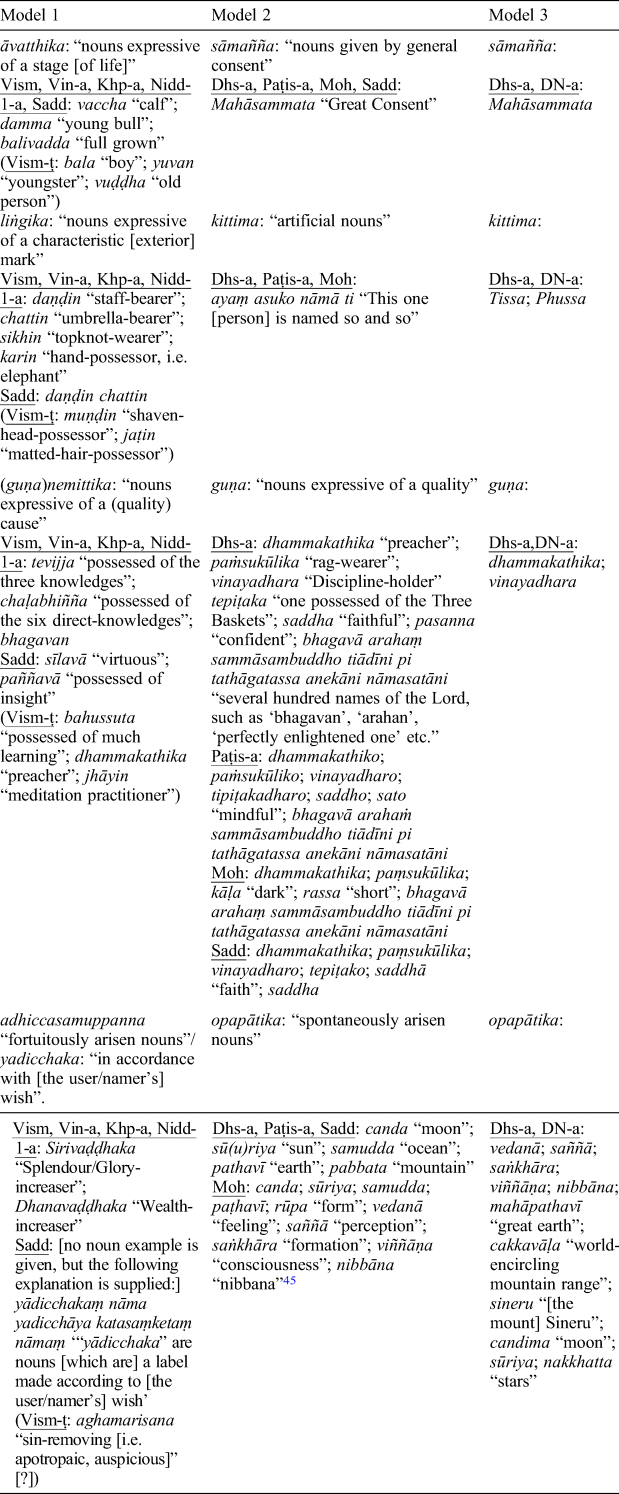
Table 2 presents all the noun examples supplied in the three models. In addition to the texts listed in note 2 above, I also give the noun examples for model 1 given in Vism-ṭ. (The order of the two intermediate categories of model 3 is swapped, to better show their relation to the corresponding categories in model 2.)

Abbreviations
- CPD
= Critical Pali Dictionary, available online at https://cpd.uni-koeln.de/.
- CTS4
= Chaṭṭha Saṅgātana Tipiṭaka, https://www.tipitaka.org/chattha.
- Dhs-a
= Dhammasaṅganī-aṭṭhakathā = Atthasālinī (As).
- DN-a
= Dīghanikaya-aṭṭḥakathā = Sumaṅgalavilāsinī (Sv).
- DOP
= Cone, M. A Dictionary of Pali. Part I a–kh (2001); Part II g–n (2010); Part III p–bh (2020). Bristol: The Pali Text Society.
- HOS
= Visuddhimagga of Buddhaghosācarya, edited by H.C. Warren, revised by D. Kosambi (Harvard Oriental Series vol. 41.). London: Harvard University Press.
- Khp-a
= Khuddakapāṭha-aṭṭḥakathā = Paramatthajotikā I (Pj I).
- MBh
= Kielhorn (ed.) (1880–85). The Vyākaraṇamahābhāṣya of Patañjali, 3 vols. Bombay [cited with reference to volume, page, and line. I did not have access to the third edition revised and furnished with additional readings, references and select critical notes by K.V. Abhyankar. Volumes I, II, III. Pune: Bhandarkar Institute Press, Bhandarkar Oriental Research Institute, 1962–72].
- Moh
= Mohavicchedanī.
- PED
= The Pali Text Society's Pali–English Dictionary https://dsal.uchicago.edu/dictionaries/pali/
- PW
= Böhtlingk and Roth, Grosses Petersburger Wörterbuch, https://www.sanskrit-lexicon.uni-koeln.de/scans/PWGScan/2020/web/index.php
- Nidd-1
= Mahāniddesa.
- Nidd-1-a
= Mahāniddesa-aṭṭhakathā = Saddhammapajjotikā.
- Paṭis
= Paṭisambhidāmagga
- Paṭis-a
= Paṭisambhidāmagga-aṭṭhakathā = Saddhammapakāsinī.
- Sadd
= Saddanīti
- Sarvadarśana-saṃgraha
= Śrīmatsāyaṇamādhavācāryapraṇītaḥ Sarvadarśanasaṃgrahaḥ mahāmahopādhyāya-abhyaṅkaropāhvavāsudevaśāstriviracitayā darśanāṅkurābhidhayā vyākhyayā sametaḥ. (924). Mumbai: Nirṇayasāgara.
- SN-a
= Saṃyuttanikāya-aṭṭhakathā = Sāratthappakāsinī (Spk).
- Vin-a
= Vinaya-aṭṭḥakathā = Samantapāsādikā (Sp).
- Vism
= Visuddhimagga.
- Vism-ṭ
= Visuddhimagga-ṭīkā.