




No CrossRef data available.
Fundamental Regularities in the Second Consonant Shift
Published online by Cambridge University Press: 12 April 2006
Abstract
Recent studies, by us and others, have argued that the Second Consonant Shift began medially after stressed short vowels, triggered by a segmental interpretation of aspiration in interaction with Germanic syllable weight requirements. The most striking empirical support came from the dialect of Wermelskirchen, where shift of fortis stops is attested only following short vowels. But is Wermelskirchen an isolated dialect or part of a general pattern? We review selected dialect data supporting this new account of the shift and show the Wermelskirchen evidence to be cut from a broader regional fabric that is marked also by biases in place of articulation among stops and, to some extent, their following vowels. We take these data to reflect the archaic nature of the modern distributions, concluding that the apparent idiosyncrasies obscure an original, fundamental regularity whose structural motivations come into clearer focus under the principles of Evolutionary Phonology.An earlier version of this paper was presented at the 11th Germanic Linguistics Annual Conference (GLAC-11), University of California–Davis, in April 2005. In addition to members of that audience and two readers for this journal, we have had the privilege of valuable discussions on this topic and comments on earlier drafts from the following colleagues, none of whom necessarily agrees with all of our points: Juliette Blevins, Markus Denkler, David Fertig, Patrick Honeybone, Robert B. Howell, Thomas Klein, Mark Louden, Jürgen Macha, Monica Macaulay, Klaus J. Mattheier, Donka Minkova, Richard Page, and Laura Smith. We also thank Garry Davis for sharing a copy of the handout from his 2003 presentation with us.
Information
- Type
- ARTICLES
- Information
- Copyright
- © 2006 Society for Germanic Linguistics
1. Introduction.
Davis and Iverson (1995) propose an analysis of the Second (or High German) Consonant Shift that interweaves two quite traditional principles of Germanic historical phonology: Braune's understanding of the role played in the shift by aspiration, and Prokosch's ideas on syllable weight. These lead to the novel conclusion that the change began medially after stressed short vowels and generalized from there. Critical empirical support for this conditioning came from a description of a single Rhenish dialect, that of Wermelskirchen, published 100 years ago (Hasenclever 1905). Here the shift is consistently attested only following short vowels, impressively leaving consonantal alternations in paradigms according to vowel length, as in the principal parts of strong verbs (for example,

‘shoot’;

‘eat’).
1We follow original orthography throughout. Hasenclever uses a macron for vowel length and reserves a colon for the Rhenish “two peaked” accent.
In what follows, we first review our understanding of how the Second Consonant Shift unfolded (section 1). In section 2, we present a set of data from dialects in the broader region around Wermelskirchen that lends further support to the characterization of the origin of the shift as laid out in Davis and Iverson 1995, and Davis, Iverson, and Salmons 1999. This support includes a “short-vowel bias” (the propensity for shift to be favored after short vowels in open syllables) and “long-vowel resistance” (the propensity for shift to be disfavored after long vowels), as well as a “place bias” (a preference for shifting t more broadly than p and k) and the possibility that following front vowels favored shift. In section 3, we turn to the key question posed above, namely, how these patterns point toward the ancient date of the shift in this region. In section 4, we examine this analysis in terms of the historically-based framework of Evolutionary Phonology (Blevins 2004). In section 5, we conclude with some synthetic observations.
2. Background.
Grimm's Second Sound Shift is a celebrated set of obstruent changes dated to around 700 C.E., defining the traditional division of major German dialects. The shift consisted chiefly in the affrication of voiceless stops, with subsequent fricativization in some environments. As alluded to above, this core aspect of the shift has been argued to have begun in medial position following short stressed vowels (Davis and Iverson 1995).
2We largely leave aside a number of other recent approaches to the sound shift, including Vennemann 1984, 1985, Lange 1998, 2001, and Venema 1997, as these have been already reviewed in detail by Schwerdt (2000) and critiqued by Davis (2003). These accounts depart from traditional phonetic understandings of the shift (Vennemann, and to a lesser extent Lange), or treat aspects less directly relevant to its origins (Venema). More approximate to our own views is the insightful body of work by Honeybone (2005, forthcoming, with references to earlier research), to which the interested reader is referred.

is a medial geminate alveolar fricative which eventually merges with [ss], -hh- is a medial geminate velar fricative [xx], and ch- is an initial velar affricate [kx].

The shift was asymmetric with respect to place of articulation—as the most commonly and widely affected were the coronal stops, less the labials, least the velars. Some evidence suggests that these asymmetries are reflected in the chronology of the shift, too, changing first coronals, then labials, last velars (Franz 1883; see also Sonderegger 2003:261–262). In the dialect distribution table in 2 (see page 49), adapted from Davis, Iverson, and Salmons 1999, stops above the line are unshifted (Old Saxon; most labials and velars in Middle and Rhenish Franconian), while those below are shifted. Major exceptions to these general patterns are initial labials in South Rhenish Franconian and velars across Franconian (generally, except postvocalically), Bavarian, Alemannic, Langobardian, apart from unshifted initial and geminate labials and velars.

Davis, Iverson, and Salmons (1999) connect this place bias in the shift with structural differences in the feature representation of place-unmarked stops (coronals), partially marked anterior stops (labials) and fully marked posterior stops (velars). Following Avery and Rice 1989 and Rice 1994, a node Peripheral is posited in the feature geometry subordinate to Place; coronals are unspecified for all Place nodes, labials are marked just for Peripheral, and velars contain Peripheral along with the subordinate articulator Dorsal, as shown in 1.

With this descriptive apparatus to distinguish the three major places of articulation, Davis, Iverson, and Salmons (1999; see also Iverson and Salmons 2003a) conclude that the long-recognized asymmetries in the extent of the Second Sound Shift are a reflection of geography as well as differences in representational markedness. In brief, the Second Sound Shift affected /t/ more broadly and with greater regularity in post-consonantal and word-initial positions than it did /p/, and /p/ more than /k/, because this ranking mirrors the markedness of these stops relative to each other. That is, a stop's resistance to the Second Sound Shift correlates directly with the complexity of its representation.3
As Patrick Honeybone reminds us, this pattern is not universal in the phenom-enon of affrication, even across Germanic. As shown in his work on “Liverpool Affrico-Spirantization,” there is a bias toward coronals, but /k/ is affected more than /p/.
For explication of the connection between representational content and resistance versus susceptibility to the shift, as well as the relationship of the /p t k/ shift to the Medienverschiebung, compare Davis, Iverson, and Salmons 1999 and Iverson and Salmons 2003a.
Overall then, the obstruents most likely to undergo the Second Sound Shift are those at the coronal place of articulation. In fact, Germanic /t/ is the most widely shifted fortis stop, Germanic /θ/ shifted to /d/ (labial and velar fricatives did not shift), and Germanic lenis /d/ shifted to /t/ throughout most of the region (/b/ and /g/ generally did not shift, except in the far south). But it is the broad susceptibility of Germanic fortis /p t k/ medially that reveals the essence of the shift. As Davis and Iverson (1995) develop it, the alternative perception of aspirated onset stops as heterosyllabic clusters of stop plus /h/ creates stressed syllables that consist of precisely two moras, which is the familiar Germanic pattern of Prokosch's Law (see also the Syllable Weight Law, Vennemann 1988). In an early Germanic word such as +ó·phan ‘open’, this principle is violated inasmuch as the stressed vowel is short, and in an open syllable. Following an insightful observation by Braune (1874:1, Braune/Eggers 1987:87), however, this word and others like it could satisfy the prosodic template of Prokosch's Law simply by factoring out, or segmentalizing, the aspiration which inheres in the Germanic fortis stop (Iverson and Salmons 1995, 2003b), so that the word then syllabifies as +óp·han. Phonetically indistinguishable from a medial aspirated stop, this prosodic interpretation rearranging VChV to VC·hV opens the way to what Davis and Iverson (1995) consider the next stage in the Second Sound Shift, namely, the assimilation of segmentalized /h/ to the place of articulation of the preceding stop, that is, /p·h t·h k·h/ > [p·f t·s k·x]. For Germanic +ó.phan moving through prosodic rearrangement to +óp·han, this results in +óp·fan, later simplifying to Old High German offan (Modern German offen). The key element is that in its beginnings the shift arose only in short-vowel open syllable words, such as +ó.phan, not long-vowel words, such as +slā.phan ‘to sleep’, or short-vowel closed syllable words, such as +skep·phjan ‘to create’, or long-vowel closed syllable words, such as +ūph ‘up’ (Modern German schlafen, schöpfen, auf, respectively). Davis and Iverson (1995:119) conclude that the validation of the Second Sound Shift in such words as well must have been an analogical rather than a prosodically motivated development, as schematized in 2.

Though perhaps still somewhat controversial, the core idea that the Second Sound Shift began after short stressed vowels is strikingly confirmed by speech patterns still in evidence at the turn of the twentieth century in the North-Rhenish village of Wermelskirchen, as reported by Hasenclever (1905:42–44). Wermelskirchen is located just north of the Benrath Line between Düsseldorf and Cologne, the northern border of the Second Sound Shift and thus the traditional dividing line between Middle and Low German. Hasenclever notes that in this dialect, the shift took place only after etymologically short vowels, specifically, not “im Anlaut, in der Gemination und nach Konsonanten [… oder] nach ursprünglich langem Vokal” [in word-initial position, in gemination and in post-consonantal position after originally long vowels]. Accordingly, as already adumbrated in the introduction, short-vowel stems with Germanic /t/ undergo the shift, but long-vowel stems do not:

‘to know’ (see ‘wit’),

‘to eat’, but

‘to throw’ (see ‘smite’),

‘street’. Germanic /p/ and /k/ generally follow the same pattern:

‘open’,

‘spoon’, but

‘sharp’,

‘pepper’;

‘to break’,

‘week’, but

‘to seek’,

‘to shriek’.
However, the shift of Germanic /k/ generally did not take place after originally short /a/, as in

‘to make’, dāk ‘roof’,

‘weak’,

‘things’ (Hasenclever 1905:44). (Note that the open syllable lengthening of the stem vowel to /ā/ is a later development). Parallel to the lesser shifting of /k/ in initial and postconsonantal environments in other dialects, we see these unshifted relics with /ak/ as the last bit of resistance to the original form of the shift, which affected—following short stressed vowels—first /t/, then /p/, and last /k/. Even in Wermelskirchen, though, the shift had already generalized to affect post-short vowel stops also when they were final in the word (as seen in uninflected nouns such as nos ‘nut’ or res ‘rip, tear’), thus obfuscating the earlier prosodic motivations.
4As Hasenclever notes (1905:42) and David Fertig (personal communication) independently points out, preterit singular forms such as

‘shot’ originally had a long vowel (and presumably unshifted obstruent), but appear to have analogized to the vowel quantity and consonantism of the preterit plural.
As noted at the outset, short and long vowels alternate in the strong verb system of ablaut, with the result that shifted and unshifted stops co-occur in the same paradigms, as in the principal parts (infinitive, 3.sg. preterit, past participle) of the verbs

‘to shoot’

‘to eat’;

‘to break’;

‘to strike’. In all, the Wermelskirchen data are persuasive confirmation that the Second Sound Shift was first restricted to positions following a short stressed vowel. In addition, the limited class of exceptions to the shift in Wermelskirchen—those involving sequences of the etymologically short vowel /a/ followed by /k/—point toward the shift having first affected /t/, then /p/, last /k/. The temporal implementation of the shift thus appears to reflect the distributional bias outlined in tables 1 and 2. As reported in Davis, Iverson, and Salmons 1999, the most probable chronology seems to be that /t/ shifted in the south in the early 7th century, /p/ around 700, and /k/ in the 8th century (see Haubrichs 1987 and Buchmüller-Pfaff 1990, among others, for arguments in support of these dates based on onomastic evidence). In the remainder of the present paper, we turn to other dialect evidence that has come into focus recently, and which supports this contention while further confirming the prosodic conditioning in the origin of the Second Sound Shift.
3. The Broader Empirical Background.
Our own earlier work has taken the striking residues found specifically in Wermelskirchen as definitive support for this new view of the shift. But the famous Rhenish Fan area provides further suggestive evidence in harmony with that analysis, three elements of which we explore now in the wider regional context: the short-vowel bias along with long-vowel resistance to shift, the place bias, and the facilitating role played by front vowels in the shift.
Far from being unique among German dialects, a short-vowel bias in the shift in modern dialects has been well known from the earliest descriptions, though the survival of paradigmatic alternation seems to be restricted to Wermelskirchen. In her recent book, Schwerdt (2000) has called fresh attention to those early studies, as has Davis (2003).5
Schwerdt (2000:312) in particular sees these data as central to the areal development of the shift, an issue we leave aside here: “Die Beantwortung der Frage, wo die 2. Lautverschiebung entstanden und ob sie sich ausgebreitet hat, hängt entscheidend davon ab, wie man die unverschobenen Belege des Mittelfränkischen erklärt.” [The answer to the question of where the Second Sound Shift originated and whether it spread depends crucially on how one explains the unshifted attested forms of Middle Franconian.]
While we—like Chambers and Trudgill—regard this as a tendency and not as an inviolable “law,” another notable change in the sound pattern of early Continental West Germanic shows a parallel distribution. Thus, umlaut, too, leaves traces of its original environment at the outer edges of the territorial domain in western Netherlandic, where only “primary umlaut” of short a is attested, while in central dialect areas the change generalized to include all back vowels, albeit again leaving some umlautless residues on its southern periphery (see Buccini 1992; Iverson and Salmons 1996).
Let us turn now to a key set of unshifted forms, those following an original long vowel. Wahlenberg (1871:9) describes the area of Krefeld and Ürdingen as having shifted t initially and finally, but not after long vowels (Môt ‘Maß [measure]’) or in verbal forms with inflectional t in stems with -t (he étt ‘he eats’), whereas t “wird häufig nach kurzen Vokalen […] verschoben” [t is often shifted after short vowels]. In these areas, the shift appears to have generalized to /t/ irrespective of its position in the word, except that the original restriction blocking the shift after long vowels remained in force. Engels (1904:8) sees a regional trend in this development, while Leihener (1908:xlviii) cites shifted forms from north of the Ürdingen Line “nur nach alter Kürze” [only after original short vowels]:

‘tin’,

‘kitchen’. Thus, in Cronenberg, he records (1908:xxi) mostly unshifted forms such as

‘nut’,

‘open’,

‘pond’, but the exceptional, shifted forms all have short vowels:

‘pepper’,

‘to cook’,

‘certain’, etc.; and Ramisch (1908:16) presents examples of the short-vowel bias in the shift in Lower Rhenish dialects, for example, kats ‘cat’.
Drawing on a broader description of the dialects in an area north of Cologne stretching west of the Rhine from Neuß, Greferath (1922:20–22) establishes a similar bias: Germanic /t/ is unshifted initially and is normally retained after long vowel, and a couple of old geminates remain as t (

‘setzen [to set]’) as well, though most become [ts]. But Germanic /t/ becomes s in

‘besser [better]’, jos ‘Guss [downpour]’, res ‘Riss [tear]’,

‘Verdruss [annoyance]’, and in

‘Weizen [wheat]’ and wīs ‘weiß [white]’. While Germanic /k/ remained unshifted almost everywhere, the exceptions all show original short vowels:

‘frech [fresh]’,

‘sicher [certain]’,

‘Küche [kitchen]’,

‘Storch [stork]’, and the diminutive -

(which may be a dialect loan).
6A number of other examples are pronominal forms —eχ ‘ich [I]’, deχ ‘dich [thou, OBLIQUE]’, meχ ‘mich [me]’, zeχ ‘sich [self]’—widely thought to be borrowed from the south (see, for instance, Schirmunski 1962:287). A few others are generally problematic cases, such as the decades

‘dreißig [thirty]’, etc.) or the suffix -lich

‘-like’, where the chronology of vowel quantity is problematic.

‘Pfeffer [pepper]’ and

‘treffen [to meet]’, with variation in

‘Kupfer [copper]’ and

‘Begriff [concept]’.
7As a reader suggests, these forms, all from nonbasic vocabulary, might well represent loanwords here.
Lerchner (1971:245) gives an extended list of forms with unshifted fortis stops after long vowel that occur further south, albeit presenting them in the form of their shifted Standard German equivalents. Some examples are listed in 3, with the consonantism underlined that Lerchner identifies for these dialects as shown in their unshifted English cognates or etymological sources.

In contrast to Wermelskirchen, as Thomas Klein points out (personal communication), Lerchner's citations include numerous cases where long vowel resistance correlates not with etymological vowel quantity, but with quantity after later changes, such as +sap versus attested sāp. See below for a brief description of how these might have arisen.
In fact, the general pattern was described as early as Wahlenberg (1871:12, also quoted in Lerchner 1971:245):
Sicherer ist der für die Verschiebung ungünstige Einfluß eines vorhergehenden langen Vokals in Folge dessen die Tenuis bei hinzutretender vokalischer Flexion oder Ableitung in den Anlaut der nächsten Silbe tritt.
[More certain is the inhibitory influence on the shift of a preceding long vowel, in consequence of which, when suffixed by a vocalic inflectional or derivational ending, the fortis stop organizes into the onset of the following syllable.]
Such data for long-vowel resistance to the shift are reviewed in more detail in work from Wahlenberg 1871 and Engels 1904 through Lerchner 1971, and are most recently the focus of Davis 2003, which also takes this evidence to indicate that the shift likely came to long-vowel words relatively late. All this, then, is testimony to the resistance that a preceding long vowel presented to the shift, resistance that constituted a general areal characteristic in these fringe regions.
Engels (1904:12–13) also cites examples of alternations in vowel length, but draws on parallel words from across neighboring dialects, for example shifted

versus unshifted

‘to shove’. Such doublets can only have come about if speakers in the borderlands were cognizant of a strong association between consonant shift and length of preceding vowel. In particular, we suppose that the native correlation between short vowel plus shifted consonant and long vowel plus unshifted consonant may have extended into the adaptation of forms from neighboring dialects, such that the preference would have been to adopt forms conforming to this distribution, even where vowel quantity is no longer the original. While it remains obscure exactly how such patterns emerged—whether through dialect mixture, analogical restoration, hypercorrection, or misanalysis—they underscore the tenacity of a connection between vowel length and shift even centuries after the shift was phonetically and phonologically complete. As noted already, Hasenclever's (1905) description of the village of Wermelskirchen uncovers a vowel length-based pattern of consonantal alternation within paradigms in the same dialect.
Traditional explanations for these data focus on syllable structure (Lessiak 1933), Rhenish accentuation (Lerchner, but rejected convincingly by Venema 1997) or appeal to lack of aspiration in particular positions, and so on. Most typically, they have been seen as analogical patterns, a view which Lerchner (1971:265) exemplifies in characterizing Wermelskirchen as a “bemerkenswerte[s] Ausgleichs-modell” [noteworthy model of analogy]. But Wermelskirchen cannot be simply assumed without further argument to be the result of analogy. In particular, it is far from obvious how such a fundamentally regular, but complex system might have emerged under any view of the shift that does not rely directly on prosodic motivations from the beginning, with or without dialect mixture. That is, a dialect without shift might conceivably have mixed with one that had undergone the shift to produce the variety that is Wermelskirchen, but the question then is why were shifted sounds survivors of the mixture just in case they followed an etymologically short vowel? If the purported mixture is of a dialect that had shifted generally and one that had not shifted at all, then this result is unexplained. Of course, if the mix were between a (perhaps partially) shifted (or even a fully unshifted) dialect and one that did not shift except after short vowels, then the Wermelskirchen model—evincing shift only after short vowels—is already in place. In other words, as far as we can see, there is no plausible explanation involving analogy around vowel length here without positing a triggering role in the shift for short vowels from the very beginning.
In short, we find that the broader areal distributions of short-vowel bias and long-vowel resistance in the Rhineland offer important evidence for the antiquity of the Wermelskirchen pattern. While particular lexical items—a handful of highly frequent monosyllabic words (such as wat ‘what’ and dat ‘that’), placenames, and other patterns that have been the focus of most recent work—are all virtually by definition subject to the external pressures of borrowing, hypercorrection, and other forces, the correlation between vowel length and shift crosses the most important isoglosses in German dialectology and encompasses a diverse set of lexical items, quite often specifically from core vocabulary; this can only be read as a residue of earlier phonological patterns.
While specialists have long been aware of these data and recent work has renewed that tradition, what has not, to our knowledge, been appreciated until now is the importance of the cline of variation they present: To the north of the traditional isoglosses, we find unexpected shifted forms, and these show short-vowel bias. In other words, at its outermost northward edge, the shift is found only after short vowels. And within the shift area, unshifted residues correlate with preceding long vowel. The details are highly variable in particular dialects, and surely reflect later reinterpretations by generations of learners under various social pressures, but the distributional evidence strongly suggests that the Second Sound Shift did indeed begin after short vowels.
To illustrate this graphically, an overview of the geography of short-vowel bias, as derived from the various sources treated above, is presented in map 1. The dots and shaded area all represent dialects where unexpected shift is attested in words with short vowels (Neuß, Krefeld, Cronenberg, Wermelskirchen, etc.). While the list is not exhaustive, the dialects included here cut across a remarkable set of isoglosses—ranging north and south of the Benrath and Ürdingen Lines, spanning both sides of the Rhine, and including a set of traditional dialect areas: Lower and Upper Bergisch, Ripuarian, and Lower Franconian.

Map 1. Short-vowel bias in the Rhenish Fan.Dots and shaded area represent attested but unexpected shift after short vowels. The immediately relevant isoglosses are as follows: Line 1 is the ik/ich or Ürdingen Line, 2 is the maken/machen or Benrath Line, and 3 is the dorp/dorf Line or Eifelschranke. The base map is taken from Venema 1997, and this version was prepared by Felecia A. Lucht for the Cambridge History of the Germanic Languages.
Taken together, short-vowel bias and long-vowel resistance provide a more reliable glimpse into the original phonology of the shift than do the vicissitudes of the lexicon: As Lerchner and Venema have shown, individual lexical items show profound variability, in particular, sensitivity to dialect borrowing and social pressures, whereas the survival of abstract phonotactic patterns—short vowel plus unexpected shifted obstruents in some set of words and/or long vowel plus unexpected unshifted obstruents in some other set of words—is highly unlikely to have been determined by those external pressures. Indeed, these patterns probably represent the residue left after lexically-oriented changes have run their course.
On the second issue, that of place bias, Davis, Iverson, and Salmons (1999) and Iverson and Salmons (2003a) lay out how the place of articulation of stops correlates with the unfolding of the shift. Coronals shifted first and most widely, labials less, and dorsals least. This is familiar from standard works in German linguistic history and dialectology, and it is already discernable in 2 above, where some general dialect areas (Middle Franconian, Rhenish-Franconian) show shift of t initially, medially, and finally, but shift of p and k only intervocalically.
Once again, 19th century scholars presented the relevant data, in particular describing dialects that appear to have generalized the coronal shift in even more extreme forms: Wahlenberg (1871:9–18) describes the city of Neuß as shifting t in essentially all positions and no other consonant anywhere, save for k after vowels. Other dialects are described as having shifted t in all positions except after long (or lengthened vowels), shifting even post-consonantally. Modern philological work has brought more direct evidence that these patterns are very old, indeed, in the Middle Franconian region. Bergmann (1966:317–320), for instance, finds 8th century glosses showing general shift of t, but shift of p and k only as postvocalic singletons, corresponding to modern dialect patterns, and Klein (2000:14–15) reports similar patterns in the earliest sources.10
Bergmann does note some exceptions (1966:126,128,165), involving especially postvocalic k. A number of these could suggest long-vowel resistance to shift— bruok ‘britches’, lok ‘leek’ (which reflects a historical long vowel and original diphthong, see Old Saxon lōk and OHG louh, etc.)—but the full dataset is not presented, so no firmer conclusions can be drawn.
The third and final point, briefly, is that there is a modicum of evidence suggesting that shift may have begun preferentially before front vowels. Wahlenberg (1871:8–9) divides the transitional dialects at the northern edge of the shift into a set of Zwitterstufen. Near the first (that is, northernmost) of these, Ratingen, he notes that in some areas (Ürdingen, Krefeld) “t beginnt, besonders vor ä, e, i in z überzugehen” [t begins to shift over to z, especially before ä, e, i].
According to Wahlenberg (1871:9), Kaiserwerth shows shift of k postvocalically preferentially after short i, e, ö. Here we find place bias and prosodic conditioning interacting within a single dialect. Front vowels famously trigger palatalization and affrication processes of various sorts, including in Germanic and Romance, for familiar articulatory reasons. The effect particularly on [t] before a following [i] is apparent in the affrication now in vogue in urban Danish (Tivoli with [ts], etc.) or Quebec French (petit as [

]), an assibilation process that is repeated in many languages (see Kim 2001a,b). If the shift had been connected in any way to processes of palatalization (like those found farther to the west) or assibilation, as suggested in some recent work, these front-vowel patterns would provide a crucial tie-in.
To summarize this section, then, dialects in the northern parts of the Rhenish fan and north of there show rather systematic variation in terms of where the consonant shift does and does not take place. First, many dialects attest residues of the short-vowel bias and long-vowel resistance, factors that were treated as being at the core of the shift by Davis and Iverson (1995). Second, the familiar place bias—where coronal t shifts more broadly than labial p and velar k—proves particularly robust in this region. Finally, a limited set of data points to more shift adjacent to front vowels than to back ones.
4. The Significance of these Data.
While the facts just reviewed are obviously supportive of our analysis of the shift, the mere stating of them does not itself guarantee the correctness of our position, nor does it establish the archaic nature of the vowel quantity and consonant shift correlations. In personal communications during the publication of Davis, Iverson and Salmons 1999, in particular, Thomas Klein suggested that some readers might argue that the Wermelskirchen pattern was likely to reflect relatively recent innovations, given the late settlement of the Bergisch dialect area and general patterns of innovation there, like the numerous fundamental restructurings of the vowel system.11
For an excellent overview of settlement history of this region, see Klein (2000:30–40).
Lessiak (1933:170–171) already countered the notion of the cited villages as Mischdialekte because Wermelskirchen shows shift sensitive to the original, not contemporary structures, many of which have undergone systematic changes since Old High German.
12Schwerdt (2000:313) seems likewise skeptical about sociolinguistic accounts of such forms.

‘to drink’, see OHG sūfan, German saufen) or in the comparative of adjectives (

‘larger’) retain unshifted consonants. Subsequently shortened original geminates did not shift, either, which resulted in more contemporary short vowel+fortis stop sequences (

‘to set’). This opacity to the original form of the shift ensures that it predates (and expires before) the dialectal vowel and consonant shortenings. The patterns probably stretch back to the 11th century in Middle Franconian, and open syllable lengthening appears to be well attested in the Mittelfränkische Reimbibel, often dated to the early 12th (see Klein 2000:19). Thus, the Wermelskirchen relationships of shifted and unshifted forms could not have been created by speakers after other changes obscured the original connection between short vowel and shift.
In sum, the broad swath of vowel length patterns, running east to west with related variants attested both north (exceptional shift after short vowel) and south (exceptional retention after long) of the key dialect boundaries, points toward an earlier general distribution of just the type Hasenclever found surviving in Wermelskirchen. Even beyond Wermelskirchen, such fundamentally consistent patterns call for a coherent account. In view of the prima facie implausibility of dialect borrowing, influence from the reference standard, hypercorrection, and so forth, we conclude that the observed distributions are connected to the early unfolding of the shift, with the first segment to be affected being t following short stressed vowel (or in some areas, before i and perhaps other front vowels). This genesis of the shift then generalized in closely related, but not necessarily identical ways across the dialects.
5. Change, Chance, Choice.
A new approach to phonological patterning—based in part on provocative work by John Ohala, and a tradition reaching back to Baudouin de Courtenay—has recently been synthesized by Blevins (2004) under the rubric of Evolutionary Phonology. This theory explains synchronic phonological structuring as the direct result of natural sound change rather than due to the interaction of variably ranked markedness constraints, as in optimality theory, or to the primary operation of quasi-innate phonological rules, as in derivational theory. Instead, patterns are discerned based on the learner's ambient input (unsurprisingly); but the fact that these generally are characterizable in terms of “natural” phonological rules or processes (such as, syllable-final obstruent devoicing) rather than “unnatural” ones (such as final voicing) is a consequence of how sound change works in the context of human physiology and perceptual psychology. Still, both natural and unnatural patterns (which may arise through the sequenced interplay of natural ones) are learnable, but the unnatural patterns are less common, sometimes dramatically so (for example, final voicing). In short, Evolutionary Phonology presents a reasoned alternative to the common-place view that synchronic phonological patterns emerge out of (in some sense) mental limitations on articulation. Instead, extant sound patterns are rooted in the dynamic of sound change, itself determined more by the vicissitudes of perception than production.
Sound change, on this model, comes about as listeners either misperceive or reinterpret the phonological structure of speakers' utterances. And though these data are not reviewed in Blevins' book, the Second Sound Shift, as we understand it, fits squarely into the paradigm of Evolutionary Phonology, which posits three perceptual mechanisms that trigger sound change per se: CHANGE, CHANCE, and CHOICE.
Change takes place when listeners misperceive what a speaker actually says, as illustrated by the production of [anpa], with alveolar nasal, being misheard as [ampa], with bilabial nasal, “due to the intrinsic weakness of place cues for the nasal in contrast to those of the following pre-vocalic stop” (Blevins 2004:33). This is the basis for the widespread rule of nasal place assimilation in synchronic grammars. Change probably played a determinative role in the affrication of aspirated stops in the unfolding of the Second Sound Shift as well, as stop+/h/ pronunciations, as in pre-OHG +óp·han came to be misperceived as stop+fricative (

). The fricative perception effect was even more likely in /t/+/h/ clusters, where the more confined release of the alveolar stop results in greater acoustic turbulence to leave the probable impression that a voiceless fricative had been produced, hence changing the perception from /t/+/h/ to /t/+/s/. The likelihood that this fricativization of /h/ began following /t/, then spread to /p/ and /k/, of course, conforms to the pattern of extant dialect data reviewed in the previous sections, according to which Germanic /t/ shifted more frequently, in more dialects, and in more positions than did /p/, which in turn shifted more than did /k/.
Chance occurs when “the phonetic signal is accurately perceived by the listener, but is intrinsically phonologically ambiguous, and the listener associates a phonological form with the utterance which differs from the phonological form in the speaker's grammar” (p. 32). Blevins illustrates this tenet with the phonological ambiguity of a phonetically laryngealized vowel surrounded by glottal stops, [

], which is produced from underlying plain vowel+glottal stop,

, but which the listener interprets phonologically as glottal stop+vowel,

. Other phonological ambiguities are even more transparent, for example, the acoustic equivalence of phonetically aspirated medial stops, such as [ph] in Germanic +ó·phan, and bisegmental sequences of unaspirated stop+/h/, such as intersyllabic /p·h/ in pre-OHG +óp·han. This is the very ambiguity of analysis—/Ch/ versus /Ch/—that Braune (1874) identified as the structural trigger of the Second Sound Shift.
Choice, Blevins elaborates, arises out of variation. In the continuum between “hypoarticulation” (fast or casual speech) and “hyperarticulation” (slow or careful speech), different phonetic manifestations of the same phonological structure occur, with the possibility then that listeners form their remote representation based on an utterance, which deviates considerably from the phonemic representation of the speaker who produced it. An example of choice in some future state of English might be the phonological emergence of initial /ft/ clusters in the systems of listeners who hear, and phonologize, casual speech pronunciations of words like photography as

, based on the phonetic variant [

] rather than careful speech [

] (Iverson and Lee 2004). In the early moments of the Second Sound Shift, by a similar token, it can be expected that pronunciations such as +óp·han existed in careful speech alongside more casual, assimilated renditions, such as +óp·fan (or

), the latter then forming the listeners' perceptual basis for a new phonologization with /pf/ (later /ff/).
Change, chance, and choice thus figure into each step of the unfolding of the Second Sound Shift described in section 2. Grounded in this way in misperception and variation, the shift was catalyzed by the inherent ambiguity between medial aspirated stops and heterosyllabic sequences of stop+/h/, as surmised by Braune himself some 130 years ago. The fact that this ambiguity appears to have been exploited first in medial position following short stressed vowels is due to another natural development, however, namely, the affinity between syllable stress and syllable weight, which has come to be called Prokosch's Law. The basis for this prosodic association is also a natural product of the interplay between production and perception in that dynamic stress of the sort that occurs in Germanic languages is expressed, in part, through increased duration, that is, a stressed syllable is phonetically longer than an unstressed one in Germanic (and probably most languages). A phonologically short CV syllable, when stressed, will be longer than its unstressed counterpart, and thus heavier. In terms of the principle of chance in Evolutionary Phonology, this increased duration could easily be perceived as a structural rather than derivative property of the language, a requirement that stressed syllables be heavy. This directly motivates either open syllable lengthening (which indeed took place some centuries later in most of Germanic) or, in the case of early Old High German, attraction of a following perceptually bifurcated stop into the coda of an otherwise light stressed syllable. In this way, Prokosch's Law represents the natural evolution of the connection between phonetically increased duration in stressed syllables and the phonological perception that stressed syllables must be heavy, which in turn set off the cascade of events collectively known as the Second Sound Shift.
6. Summary and Conclusion.
The patterns at the base of the Second Sound Shift have important ramifications for sound change, as the apparent “irregularities” actually reflect profound structural regularities and fundamental unities in how the shift began and how it evolved. First, the view developed by Davis and Iverson (1995) puts vowel length at the epicenter of the shift, with affrication and then spirantization beginning after short stressed vowels in open syllables before these changes occurred following long vowels. We have presented data from a range of dialects throughout the region strikingly supportive of that view. To the north of the basic border of shift (the Benrath and Ürdingen Lines), we find exceptional shifted forms, typically after short vowel. To the south, we find exceptional unshifted forms, typically after long vowel. We interpret this as evidence that the first stirrings of shift (those found north of the shift proper) took place after short vowels, while shift after long vowels came later, leaving unshifted residues within the shift area.
Moreover, the quantity-sensitive variability of the shift as revealed in Wermelskirchen reflects original, etymological quantity, before any of the many vowel changes took place that the dialect has undergone since. Based on the contemporary dialect distributions and the relative chronology of other changes, these patterns are thus clearly old, presumably medieval, and do not lend themselves in any apparent way to the forces of analogy.
Still, Wermelskirchen itself cannot be construed to preserve the original form of the Second Sound Shift, because, on our view, this dialect shows generalization of the initial prosodic conditions that triggered the shift. In particular, the shift environment in Wermelskirchen has extended to word-final position. Further, shift here affects all places of articulation and is not triggered preferentially by a following front vowel. An astute reviewer asks whether there should not be a dialect in existence that does preserve the original state of affairs. We do not know precisely what that state might have been, nor is it likely that it would be intact a millennium and a half after the fact. Ultimately, the view of sound change motivated by change, chance, and choice, as conceived within the framework of Evolutionary Phonology (together with our own views of the ingenerate motivation and the life cycle of sound change, as laid out in Iverson and Salmons 2003a and elsewhere) would suggest that a constellation of factors promoted the initial rise of affrication, with Prokoschian syllable weight considerations, place-based shift resistance, and the crosslinguistically richly attested assibilation of coronal stops before front (and especially front high) vowels each contributing to the changes, out of which what we today know as the Second Sound Shift crystallized over time.
Indeed, other evidence adduced here would support the view that place bias, front-vowel bias, and syllable weight considerations had independent effects across various dialects: While Wermelskirchen speakers came to make generalizations around syllable weight, other speakers in the region did so around place of articulation (dialects where t shifted broadly, while p and k did not), and yet others may have assibilated or affricated t before i or e initially. This variation is hardly surprising in the famously complex sociolinguistic setting of the diverse (pre-)Old High German dialects of this period, in fact.
Factors such as hypercorrection and dialect borrowing surely played some roles in the present day distribution of reflexes of the Second Consonant Shift, too, perhaps along with lexical diffusion, avoidance of homonymy, and so on (all reviewed in Schwerdt 2000 and elsewhere). But as argued in recent work on another intricate historical phenomenon in Germanic—umlaut (Iverson and Salmons, forthcoming)—descriptions of complex phonological developments as rooted in regular sound change are inherently preferable to, and more rigorous and insightful than, ones that assume fitfulness from the outset. The basic patterns reviewed here in connection with the Second Sound Shift are thus not irregularities at all, we suggest; rather, they are an open window onto the earliest form of the shift.
References
Avery Peter, and
Keren Rice.
1989.
Segment structure and coronal underspecification.
Phonology
6.
179–
200.Google Scholar
Bàrtoli Matteo.
1925.
Introduzione alla Neolinguistica.
Genève:
Olschki.
Bergmann Rolf.
1966.
Mittelfränkische Glossen: Studien zur ihrer Ermittlung und sprachgeographischen Einordnung.
(Rheinisches Archiv, 61.)
Bonn:
Ludwig Röhrscheid.
Blevins Juliette.
2004.
Evolutionary phonology.
Cambridge:
Cambridge University Press.
Braune Wilhelm.
1874.
Zur Kenntnis des Fränkischen und zur hochdeutschen Lautverschiebung.
Beiträge zur Geschichte der deutschen Sprache und Literatur
(PBB)
1.
1–
56.Google Scholar
Braune/Eggers = Braune Wilhelm.
1987.
Althochdeutsche Grammatik.
14th ed. by
Hans Eggers.
(Sammlung kurzer Grammatiken germanischer Dialekte, A.5.)
Tübingen:
Max Niemeyer.
Buchmüller-Pfaff Monika.
1990.
Siedlungsnamen zwischen Spätantike und frühem Mittelalter.
Die -(i)acum-Namen der römischen Provinz Belgica Prima.
Tübingen:
Max Niemeyer.
Buccini Anthony F.
1992.
The development of umlaut and the dialectal position of Dutch in Germanic.
Doctoral dissertation,
Cornell University.
Chambers Jack K., and
Peter Trudgill.
1981.
Dialectology.
Cambridge:
Cambridge University Press.
Davis Garry W.
2003.
The spread of the OHG consonant shift.
Paper presented at the Ninth Germanic Linguistics Annual Conference (GLAC-9),
Buffalo, New York.
Davis Garry W., and
Gregory K. Iverson.
1995.
The High German consonant shift as feature spreading.
American Journal of Germanic Languages and Literatures
7.
111–
127.Google Scholar
Davis Garry W.,
Gregory K. Iverson, and
Joseph C. Salmons.
1999.
Peripherality and markedness in the spread of the High German consonant shift.
Beiträge zur Geschichte der deutschen Sprache und Literatur (PBB)
121.
177–
200.Google Scholar
Engels Peter.
1904.
Zur Grenze der Lautverschiebung zwischen Mittel- und Niederfranken.
Doctoral dissertation,
Universität Münster.
Münster:
R. Noske.
Franz Wilhelm.
1883.
Die lateinisch-romanischen Elemente im Althochdeutschen.
Doctoral dissertation,
Strasbourg:
Trübner.
Greferath Theodor.
1922.
Studien zu den Mundarten zwischen Köln, Jülich, M.-Gladbach und Neuá.
(Deutsche Dialektgeographie, 11b.)
Marburg:
Elwert.
Hasenclever Max.
1905.
Der Dialekt der Gemeinde Wermelskirchen.
Marburg:
Elwert.
Haubrichs Wolfgang.
1987.
Lautverschiebung in Lothringen. Zur althochdeutschen Integration vorgermanischer Toponyme der historischen Sprachlandschaft zwischen Mosel und Saar.
Althochdeutsch,
vol. 2: Wörter und Namen, ed. by
Rolf Bergmann et al.,
1350–
1400.
Heidelberg:
Winter.
Honeybone Patrick.
2005.
Sharing makes us stronger: Process inhibition and segmental structure.
Headhood, elements, specification, and contrastivity, ed. by
Philip Carr,
Jacques Durand, and
Colin J. Ewen,
167–
192.
Amsterdam:
John Benjamins.
Honeybone Patrick.
Forthcoming.
Germanic obstruent lenition: Some mutual implications of theoretical and historical phonology.
Iverson Gregory K., and
Ahrong Lee.
2004.
Perceived syllable structure in the adaptation of loanwords in Korean.
Proceedings of the 2004 Linguistic Society of Korea International Conference
(vol. 1, Forum Lectures and Workshops),
117–
136.
Seoul:
Hansin Publishing Co.
Iverson Gregory K., and
Joseph C. Salmons.
1995.
Aspiration and laryngeal representation in Germanic.
Phonology
12.
369–
396.Google Scholar
Iverson Gregory K., and
Joseph C. Salmons.
1996.
The primacy of primary umlaut.
Beiträge zur Geschichte der deutschen Sprache und Literatur
(PBB)
118.
69–
86.Google Scholar
Iverson Gregory K., and
Joseph C. Salmons.
2003a.
The ingenerate motivation of sound change.
Motives for language change, ed. by
Raymond Hickey,
199–
212.
Cambridge:
Cambridge University Press.
Iverson Gregory K., and
Joseph Salmons.
2003b.
Laryngeal enhancement in early Germanic.
Phonology
20.
43–
72.Google Scholar
Iverson Gregory K., and
Joseph C. Salmons.
Forthcoming (in a Festschrift). Copying, blurring, and the morphological roles of Germanic umlaut.
Amsterdam:
John Benjamins.
Kim Hyunsoon.
2001a.
The place of articulation of the Korean plain affricate in intervocalic position: An articulatory and acoustic study.
Journal of the International Phonetic Association
31.
229–
257.Google Scholar
Kim Hyunsoon.
2001b.
A phonetically based account of phonological stop assibilation.
Phonology
18.
81–
108.Google Scholar
Klein Thomas.
2000.
Rheinische und westfälische Sprachgeschichte bis 1300.
Rheinisch-Westfälische Sprachgeschichte, ed. by
Jürgen Macha,
Elmar Neuss, and
Robert Peters,
with assistance from Stephan Elspass,
3–
48.
Köln:
Böhlau.
Lange Klaus-Peter.
1998.
Die fränkischen Lautverschiebungen im niederländisch-ripuarischen Gebiet.
NOWELE
34.
43–
74.Google Scholar
Lange Klaus-Peter.
2001.
Die westfränkische Lautverschiebung nach dem Zeugnis der französischen Etymologie.
Folia Linguistica Historica
22.
281–
309.Google Scholar
Leihener Erich.
1908.
Cronenberger Wörterbuch (mit ortsgeschichtlicher, grammatischer und dialektgeographischer Einleitung).
(Deutsche Dialektgeographie, Heft 2.)
Marburg:
Elwert.
Lerchner Gotthard.
1971.
Zur II. Lautverschiebung im Rheinisch-Westmitteldeutschen.
(Mitteldeutsche Studien, 30.)
Halle:
Niemeyer.
Lessiak Primus.
1933.
Beiträge zur Geschichte des deutschen Konsonantismus.
Brünn:
Rohrer.
Ramisch Jacob.
1908.
Studien zur niederrheinischen Dialektgeographie.
(Deutsche Dialektgeographie, Heft 1.)
Marburg:
Elwert.
Rice Keren.
1994.
Peripheral in consonants.
Canadian Journal of Linguistics
39.
191–
216.Google Scholar
Schirmunski Viktor M.
1962.
Deutsche Mundartforschung: Vergleichende Laut- und Formenlehre der deutschen Mundarten.
Berlin:
Akademie Verlag.
Schwerdt Judith.
2000.
Die 2. Lautverschiebung: Wege zu ihrer Erforschung.
Heidelberg:
Carl Winter.
Sonderegger Stefan
2003.
Althochdeutsche Sprache und Literatur.
3rd ed.
Berlin:
Walter de Gruyter.
Venema Johannes.
1997.
Zum Stand der zweiten Lautverschiebung im Rheinland: Diatopische, diachrone und diastratische Untersuchungen am Beispiel der dentalen Tenuis (voralthochdeutsch /t/).
(Mainzer Studien zur Sprach- und Volkforschung, 22.)
Stuttgart:
Franz Steiner.
Vennemann Theo.
1984.
Hochgermanisch und Niedergermanisch: Die Verzweigungstheorie der germanisch-deutschen Lautverschiebung.
Beiträge zur Geschichte der deutschen Sprache und Literatur (PBB)
106.
1–
45.Google Scholar
Vennemann Theo.
1985.
The bifurcation theory of the Germanic and German consonant shifts: Synopsis and some further thoughts.
Papers from the Sixth International Conference on Historical Linguistics, ed. by
Jacek Fisiak,
527–
547.
Amsterdam:
John Benjamins.
Vennemann Theo.
1988.
Preference laws for syllable structure and the explanation of sound change. With special reference to German, Germanic, Italian, and Latin.
Berlin:
Mouton de Gruyter.
Wahlenberg Friedrich W.
1871.
Die niederrheinische (nord-rheinfränckische) Mundart und ihre Lautverschiebungsstufe.
Programm des Katholischen Gymnasiums an der Apostelkirche zu Köln
4,
1–
18.
Cologne.Google Scholar
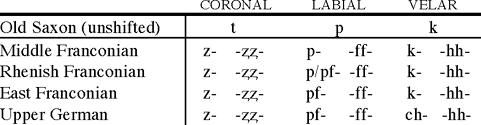
Table 1. Overview of the Second Sound Shift's effect on Germanic voiceless (fortis) stops.
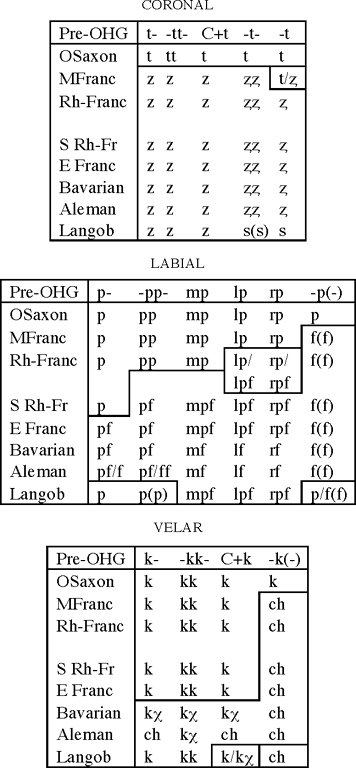
Table 2. Distribution of Germanic fortis stops by place and position (after Sonderegger 2003:263).
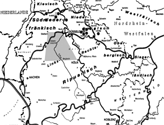
Map 1. Short-vowel bias in the Rhenish Fan.Dots and shaded area represent attested but unexpected shift after short vowels. The immediately relevant isoglosses are as follows: Line 1 is the ik/ich or Ürdingen Line, 2 is the maken/machen or Benrath Line, and 3 is the dorp/dorf Line or Eifelschranke. The base map is taken from Venema 1997, and this version was prepared by Felecia A. Lucht for the Cambridge History of the Germanic Languages.
 You have
Access
- 26
- Cited by