Bovine milk contains around 3–5% fat which is mainly (±98%) composed of triglycerides (Jensen, Reference Jensen2002). Triglycerides are composed of three fatty acids (FA) esterified to a glycerol backbone. More than 400 different FA have been found in milk (Jensen, Reference Jensen2002). Most of these FA occur in trace amounts and only about twelve of them are present in concentrations higher than 1% of milk fat (Walstra et al. Reference Walstra, Wouters and Geurts2006). The FA composition of milk is important because it influences the nutritional value (Mensink et al. Reference Mensink, Zock, Kester and Katan2003) and product properties (Walstra et al. Reference Walstra, Wouters and Geurts2006) of fat based dairy products. Therefore, changing FA composition could result in milk fat with additional value for the dairy industry. Furthermore, the FA composition in milk is also of interest because it might be used as an indicator of the metabolic status of a cow (Stoop et al. Reference Stoop, Bovenhuis, Heck and van Arendonk2009) or as an indicator of rumen bacterial metabolism (Vlaeminck et al. Reference Vlaeminck, Fievez, Cabrita, Fonseca and Dewhurst2006), including enteric methane production (Dijkstra et al. Reference Dijkstra, Van Zijderveld, Apajalahti, Bannink, Gerrits, Newbold, Perdok and Berends2011).
Although much is known about pathways involved in the synthesis of the different FA in milk, the origin of some FA is still under debate. This is especially true for some minor FA that have not been studied in much detail before. Knowledge about the origin of FA in milk is important because this can be used to improve FA composition of milk. For example, because it is known that C18:2 cis-9, trans-11 (CLA) in milk mainly originates from the action of desaturase (SCD1) on C18:1 trans-11, feeding strategies to increase CLA in milk could aim at increasing the amount of C18:1 trans-11 available to the mammary gland or at increasing desaturase activity in the mammary gland. Furthermore, to assess the value of a FA as an indicator for rumen bacterial metabolism it is important to know whether this FA originates directly from rumen bacteria or is synthesised in the mammary gland.
To gain insight into the origin of FA in milk it is possible to analyse milk FA composition data with statistical techniques. It has been shown in previous studies that metabolic pathways of fatty acid synthesis can be elucidated with clustering techniques (Massart-Leën & Massart, Reference Massart-Leën and Massart1981) and principal component analysis (Fievez et al. Reference Fievez, Vlaeminck, Dhanoa and Dewhurst2003). In these studies, correlations between fatty acids were used to investigate the origin of branched-chain fatty acids in goat milk (Massart-Leën & Massart, Reference Massart-Leën and Massart1981) and the origin of heptadecenoic and conjugated linoleic acids in bovine milk (Fievez et al. Reference Fievez, Vlaeminck, Dhanoa and Dewhurst2003). These studies have focused on a limited number of different FA and used a low number of animals. Furthermore, the design of these studies did not enable the determination of genetic correlations between FA. Studying genetic correlations and correlations due to environmental factors like herd provides insight into how fatty acid synthesis is affected by genetic and nutritional factors. The aim of this study is to look for patterns in genetic and herd parameters of 39 different FA including odd and branched-chain FA in milk samples of 1912 Dutch Holstein-Friesian heifers, to investigate the origin of different FA milk.
Materials and Methods
Animals
Morning milk samples were collected from 1912 first-lactation Holstein-Friesian cows from 398 commercial herds in the Netherlands. From February to March 2005, a 0·5 l milk sample was collected from each cow at one morning milking, preserved with 0·03% w/w sodium azide and stored frozen (−40°C) until FA analysis. At least three cows per herd were sampled, and cows were milked twice a day. Cows descended from one of fifty young bulls (848 cows), from one of five proven bulls (873 cows randomly distributed across herds), or from other proven bulls (191 cows). Each cow was over 87·5% Holstein-Friesian and was in lactation between Day 66 and Day 247.
Sample analysis
Milk FA composition was measured by gas chromatography at the COKZ laboratory (Netherlands Controlling Authority for Milk and Milk Products, Leusden, the Netherlands) as described by Rutten et al. (Reference Rutten, Bovenhuis, Hettinga, van Valenberg and van Arendonk2009). FA were expressed as weight-proportion of total fat weight. The branched-chain FA C15:0 iso could not be quantified due to overlap with another FA peak in the chromatogram and was therefore not reported. The cis double bond of C10:1 and C12:1 could not be ascertained at the carbon 9 position and therefore these FA were reported as C10:1 and C12:1. For C5:0, C7:0 and C9:0 the concentration could not be quantified in a number of samples (n=262, 310 and 110 respectively). If a concentration was not determined it was treated as a missing value in the statistical analyses. Fatty acids were grouped into 5 groups based on general knowledge about their synthesis; (1) even-chain saturated FA (C4:0–C16:0), (2) odd-chain saturated FA (C5:0–C17:0), (3) branched-chain FA, (4) C18 FA including C20:0 and (5) cis 9-unsaturated FA. Results on 16 of the major FA have been published previously (Schennink et al. Reference Schennink, Heck, Bovenhuis, Visker, van Valenberg and van Arendonk2008; Stoop et al. Reference Stoop, van Arendonk, Heck, van Valenberg and Bovenhuis2008). Here we will additionally report parameters for 23 FA that occur in lower concentrations.
Statistical analysis
Variance components were estimated using an Animal Model in ASReml (Gilmour et al. Reference Gilmour, Gogel, Cullis, Welham and Thompson2002):

where y was the dependent variable; μ was the general mean; dim was the covariate describing the effect of days in milk modelled with a Wilmink curve (Wilmink, Reference Wilmink1987); afc was the covariate describing the effect of age at first calving, a linear and a quadratic term were fitted; season was the fixed effect of the class of calving season (June to August 2004, September to November 2004, or December 2004 to February 2005); scode was the fixed effect of the difference in genetic level between groups of proven bull daughters and young bull daughters; herd was the random effect of groups of animals sampled in the same herd; A n was the random additive genetic effect of animal n; and e was the random residual effect. Hrd is distributed as N(0, Iσherd2 ), where I is the identity matrix and σherd2 is the herd variance; Animal is distributed as N(0, AσA2), where A is the additive genetic relationship matrix and σA2 is the additive genetic variance; and e is distributed as N(0, Iσe2), where I is the identity matrix and σe2 is the residual variance. The additive genetic relationship was built using the pedigree of the cows which was supplied by CRV (Cooperative cattle improvement organization, Arnhem, The Netherlands) and the pedigree consisted of 26 300 animals.
Proportion of variance due to herd reflects the relative importance of herd effects such as feed, hygiene, and management, and was estimated as:

where σherd2=herd variation, σA2=additive genetic variation and σe2=the residual variation.
Proportion of the variance due to genetic effects was estimated as:

Note that % genetic differs from the intraherd heritability as defined by Stoop et al. (Reference Stoop, van Arendonk, Heck, van Valenberg and Bovenhuis2008) and Schennink et al. (Reference Schennink, Stoop, Visker, Heck, Bovenhuis, van der Poel, van Valenberg and van Arendonk2007, Reference Schennink, Heck, Bovenhuis, Visker, van Valenberg and van Arendonk2008).
Herd correlations were estimated using bivariate analyses and model 1 as:

Where σherd1, herd2=herd covariance between trait 1 and trait 2, and σ2herd1 and σ2herd2=herd variance of trait 1 and 2, respectively.
Genetic correlations were estimated using bivariate analyses and model 1 as:

where σA1, A2=additive genetic covariance between trait 1 and trait 2, and σ2A1 and σ2A2=additive genetic variance of trait 1 and 2, respectively.
A principal component analysis PROC VARCLUS, in combination with PROC TREE in SAS 9.1, (SAS Institute, USA) was used to graphically visualize genetic and herd correlations among FA.
Results and Discussion
Means and coefficients of variation
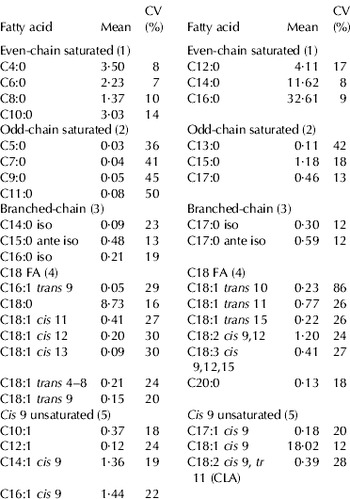
Mean and coefficients of variation of the different FA, expressed as weight percentage of the total FA are presented in Table 1. The thirty-nine different FA together comprise 97% of total FA. The other 3% consists of a large number (>100) of FA that occur in very low concentrations and that were not identified. Samples were obtained between February and March when cows received an indoor ration, which is dominated by grass silage and maize silage. The concentrations of the different FA are in line with previously reported concentrations of FA in bovine milk on non-pasture diets (Jensen, Reference Jensen2002; Vlaeminck et al. Reference Vlaeminck, Fievez, Cabrita, Fonseca and Dewhurst2006; Moate et al. Reference Moate, Chalupa, Boston and Lean2007). The FA C4:0, C6:0 and C14:0 and C16:0 have the lowest CV (7–9%) and C18:1 trans-10 has the highest CV (86%). The high CV for C18:1 trans-10 is caused by a small number of milk samples (n=12) with extreme high concentrations of this FA (between 1 and 5%). If these 12 samples are excluded, the CV for C18:1 trans-10 is 42%. Such extremely high concentrations of this specific FA have been reported frequently in conditions causing milk fat depression (Baumgard et al. Reference Baumgard, Sangster and Bauman2001; Loor et al. Reference Loor, Ferlay, Ollier, Doreau and Chilliard2005; Boeckaert et al. Reference Boeckaert, Vlaeminck, Dijkstra, Issa-Zacharia, Van Nespen, Van Straalen and Fievez2008).
Mean and coefficients of variation for 39 FA (g/100 g fat) in milk samples of 1912 Holstein–Friesian cows

When summer months are included and the diet may include fresh grass the variation between weeks of taking milk samples is much larger for several fatty acids including C18:1 trans-11 and C18:2 cis-9, trans-11 (Heck et al. Reference Heck, van Valenberg, Dijkstra and van Hooijdonk2009). Therefore, herd variation may have been larger when samples throughout the year would have been obtained.
Even-chain de novo synthesised saturated fatty acids
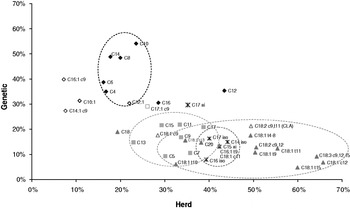
Figure 1 shows the proportion of total variation explained by genetic and herd effects for the different FA. Differences among herds most likely represent differences in feeding regimes among herds, but effects of other management factors cannot be excluded (Stoop et al. Reference Stoop, van Arendonk, Heck, van Valenberg and Bovenhuis2008). In general, FA in the same groups (group 1–5) are to a similar extent affected by genetic and herd effects as illustrated by a comparable position in Fig. 1 (dotted circles).
Genetic and herd effects for FA composition (w/w%) in milk samples of 1912 Holstein Friesian cows. ◆, even-chain saturated FA (1); ▪, odd-chain saturated FA (2); *, branched-chain (3); ▴, C18 FA (4); ◇, ▵, □, cis 9 unsaturated FA (5); genetic=(σ 2A/(σ 2A+σ2herd +σ 2e))*100%, SE between 0·05 and 0·12. Herd=(σ2herd/(σ 2A+σ2herd+σ 2e))*100%, SE approximately 0·03.

Figure 1 shows that genetic effects for the even-chain de novo synthesised FA are relatively high and herd effects are relatively low compared with all other FA. It was expected that genetic effects are higher for de novo synthesised FA than for blood derived FA because their synthesis is highly dependent on the activity of different enzymes within the mammary gland and less dependent on the composition of the fat in the diet. Acetate and β-hydroxybutyrate, which originate from ruminal or hindgut fermentation, are the main precursors for de novo synthesis of FA in the bovine mammary gland. It is, however, unlikely that acetate and butyrate (the main precursor of β-hydroxybutyrate) will be in short supply and limit de novo fatty acid synthesis and reduce milk fat content (Bauman & Griinari, Reference Bauman and Griinari2000). However, the diet might contain specific FA or promote the formation of specific FA (e.g. C18:2 trans-10, cis-12) that inhibit de novo FA synthesis (Baumgard et al. Reference Baumgard, Sangster and Bauman2001). This could explain why the concentration of the even-chain de novo synthesised FA is also partly affected by herd.
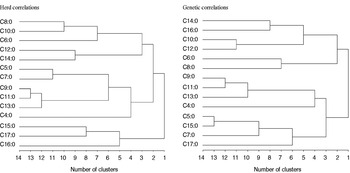
Table 1 shows that C6:0, C8:0, C10:0, C12:0 and C14:0 have a high positive genetic and herd correlation. The herd and genetic correlations (Fig. 2) showed tight clustering between the FA that are only two carbon units apart. This might be related to the elongation with two carbon units during de novo synthesis of FA. These high and positive genetic and herd correlations between de novo synthesised FA that are two carbon units apart are an important observation because they indicate that it might be difficult to increase the relative portion of, for example, C12:0 without increasing the relative proportion of C10:0 and C14:0 in milk fat in particular by selective breeding. However, specific addition of C12:0 or C14:0 to the diet of cows has been shown to result in an increase of these FA in the secreted milk, without increasing the content of other de novo synthesised even-chain FA (Van Zijderveld et al. Reference Van Zijderveld, Fonken, Dijkstra, Gerrits, Perdok, Fokkink and Newbold2011).
Cluster tree based on principal component analysis of herd and genetic correlations among the odd and even-chain saturated de novo synthesised FA.

Our results show that C4:0, C12:0 and C16:0 differ from the general pattern of the other FA in the group of de novo synthesised even-chain FA.
C4:0
Based on herd and genetic clustering butyric acid (C4:0) differs from other de novo synthesised FA. Butyric acid does not require acetate for its production as it can be produced directly from β-hydroxybutyrate derived from the blood (Craninx et al. Reference Craninx, Steen, Van Laar, Van Nespen, Martin-Tereso, De Baets and Fievez2008). Changes in C4:0 concentration in milk upon a change in the diet have also been observed to differ from other FA shorter than 16 carbon atoms. For example, an increased concentrate:roughage ratio or the addition of DHA to the diet significantly decreased the concentration of saturated FA up to 14 carbon atoms, but not that of C4:0 (Bargo et al. Reference Bargo, Delahoy, Schroeder and Muller2006; Boeckaert et al. Reference Boeckaert, Vlaeminck, Dijkstra, Issa-Zacharia, Van Nespen, Van Straalen and Fievez2008). A further indication is that C4:0 concentration in milk tends to be negatively associated with enteric methane production in dairy cattle, whereas de novo synthesised C8:0 and C10:0 were positively associated with enteric methane production (Dijkstra et al. Reference Dijkstra, Van Zijderveld, Apajalahti, Bannink, Gerrits, Newbold, Perdok and Berends2011). Furthermore, C4:0 is also unique because it is, unlike all other FA, esterified almost exclusively at the sn-3 position of the triacyl glycerol (Jensen, Reference Jensen2002). Although the exact mechanism is not known, these unique features in its synthesis might be related to the observed herd and genetic correlations with C4:0 and the other FA.
C12:0
Lauric acid (C12:0) deviates from the general pattern of the even-chain de novo synthesised FA because it has a much higher herd effect (Fig. 1). This may be explained by the presence of considerable quantities of C12:0 in concentrates fed to Dutch dairy cows. In the Netherlands, concentrates are an important ingredient with on average 31% of DM in the diet in the winter (Van Bruggen, Reference Van Bruggen2007). Ingredients like palm kernel expeller and extracted coconut are included in various Dutch concentrates and these ingredients contain a large amount of C12:0 (47 and 48% of the total FA, respectively, CVB, 2007). The quantity and composition of the concentrates used by different farmers varies considerably explaining the relatively large herd effect for C12:0. It has been shown in previous studies that addition of C12:0 or C14:0 to the diet of cows will result in an increase of these FA in the secreted milk (Dohme et al. Reference Dohme, Machmuller, Sutter and Kreuzer2004; Odongo et al. Reference Odongo, Or-Rashid, Kebreab, France and McBride2007; Van Zijderveld et al. Reference Van Zijderveld, Fonken, Dijkstra, Gerrits, Perdok, Fokkink and Newbold2011). The assumption that short chain FA like C12:0 are completely synthesised de novo (Garnsworthy et al. Reference Garnsworthy, Masson, Lock and Mottram2006; Craninx et al. Reference Craninx, Steen, Van Laar, Van Nespen, Martin-Tereso, De Baets and Fievez2008; Moate et al. Reference Moate, Chalupa, Boston and Lean2008) is therefore unlikely to be valid for all the animals in the farms selected in the present study. This implies that feeding other FA that are considered to be fully synthesised de novo (e.g. C8:0, C10:0) might also result in an increase of these FA in milk. Feed ingredients rich in C12:0 like palm kernel expeller and extracted coconut also contain relatively large amounts of C14:0, which helps to explain the high correlation between C12:0 and C14:0. However, the basal level of C12:0 in milk fat is much smaller than that of C14:0, whilst the proportion of C12:0 in the fat fraction of these feed ingredients is much higher than that of C14:0. Thus, addition of these feed ingredients will change proportions of C12:0 in milk fat relatively far more than that of C14:0 and this helps to explain the more pronounced herd effect of milk fat C12:0 compared with C14:0.
C16:0
Palmitic acid (C16:0) has a lower genetic effect and a higher herd effect compared with other even-chain de novo synthesised FA. Furthermore, it shows a negative genetic correlation to most other even-chain de novo synthesised FA (Supplementary information available at Cambridge Journals Online http://journals.cambridge.org). For example, the genetic correlation between C16:0 and C14:0 was −0·87 while the herd correlation was +0·12. This might be related to the origin of C16:0 in milk. C16:0 is considered to be partly synthesised de novo and partly derived from the blood (Garnsworthy et al. Reference Garnsworthy, Masson, Lock and Mottram2006; Craninx et al. Reference Craninx, Steen, Van Laar, Van Nespen, Martin-Tereso, De Baets and Fievez2008; Moate et al. Reference Moate, Chalupa, Boston and Lean2008). This clear difference in herd and genetic correlations between C16:0 and C14:0 is important when it is desirable to change the concentrations of these FA in milk. The very high negative genetic correlation indicates that it will be difficult to decrease the concentration of both FA simultaneously by means of selective breeding. However, the low positive herd correlation suggest that C14:0 and C16:0 are almost independent and that by choosing the right feeding strategy it is possible to decrease both C14:0 and C16:0 in milk. Decreasing the relative proportion of C14:0 and C16:0 in milk fat simultaneously could be beneficial because both FA together comprise a main part (44%) of milk fat and, when replacing an isoenergetic amount of carbohydrate, increase plasma LDL cholesterol concentrations in humans (Mensink et al. Reference Mensink, Zock, Kester and Katan2003). However C14:0 and C16:0 also increased HDL concentrations so that total:HDL ratio (possibly a more accurate predictor of CVD risk) was not significantly increased by either 14:0 or 16:0.
Odd-chain fatty acids
Figure 1 shows that odd chain FA are influenced to the same extent by genetics and herd. The very high positive genetic correlations (Supplementary information) among odd-chain FA also suggest that all odd-chain FA have a common origin. Genetic and herd clustering (Fig. 2) show that even and odd-chain saturated FA are separate groups. This agrees with the assumption that odd-chain FA are synthesised de novo but with propionate instead of acetate as a precursor (Massart-Leeën et al. Reference Massart-Leën, Roets, Peeters and Verbeke1983). Herd clustering showed that C15:0, C17:0 and C16:0 cluster together. C15:0, C17:0 and C16:0 are known to be both synthesised de novo and blood derived (Barber et al. Reference Barber, Clegg, Travers and Vernon1997; Vlaeminck et al. Reference Vlaeminck, Fievez, Cabrita, Fonseca and Dewhurst2006; Craninx et al. Reference Craninx, Steen, Van Laar, Van Nespen, Martin-Tereso, De Baets and Fievez2008). These results suggest that it is likely that the odd-chain FA C5:0–C13:0 and a part of C15:0 and C17:0 are synthesised de novo and the other part of C15:0 and C17:0 is blood derived. This information is important when odd-chain FA are used as indicators of rumen bacteria. Although C5:0–C13:0 are not synthesised by the rumen bacteria they may be used as an indicator of the proportion of propionate available to the mammary gland.
Branched-chain fatty acids
Figure 1 shows that, except for C17:0 anteiso, all branched chain FA are influenced to the same extent by genetics and herd. The branched-chain FA have low genetic effect and a moderate herd effect. Branched-chain FA in milk are considered to originate for a large part from de novo production by rumen bacteria (Vlaeminck et al. Reference Vlaeminck, Fievez, Cabrita, Fonseca and Dewhurst2006). When these FA are for the major part synthesised by the rumen bacteria it is expected that genetic background of the cow is less important than the feed of the cow.
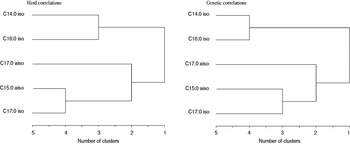
Herd clustering (Fig. 3) showed that the even branched-chain FA C14:0 iso and C16:0 iso cluster together. Some of the predominant cellulolytic rumen bacteria contain relative high levels of C14:0 iso and C16:0 iso (Vlaeminck et al. Reference Vlaeminck, Fievez, Cabrita, Fonseca and Dewhurst2006). Therefore, feeding conditions that promote these kinds of bacteria could result in an increase of both FA in milk.
Cluster tree based on principal component analysis of herd and genetic correlations among the branched-chain FA.

C17:0 anteiso differs from the general pattern of branched-chain FA showing a higher genetic effect (Fig. 1) and forming a separate group both in the genetic and herd clustering. This might indicate that this FA has an origin different from the other branched-chain FA. In evaluating the effect of addition of rapeseed oil, soybean oil or linseed oil on milk FA profile and SCD activity, Jacobs et al. (Reference Jacobs, Van Baal, Smits, Taweel, Hendriks, van Vuuren and Dijkstra2011) did not observe differences in C17:0 anteiso content, whereas C14:0 iso, C15:0 iso and C16:0 iso were significantly affected by type of supplement, all in the same direction. Also, Cabrita et al. (Reference Cabrita, Fonseca, Dewhurst and Gomes2003) observed that C17:0 anteiso was not correlated with C15:0 iso and C15:0 anteiso. Furthermore, it has been reported by Vlaeminck et al. (Reference Vlaeminck, Fievez, Cabrita, Fonseca and Dewhurst2006) that the secretion of this FA into the milk was higher compared with its duodenal absorption. Therefore, we hypothesize that C17:0 anteiso can also be synthesised de novo. This agrees with the high genetic effect observed in our study. If C17:0 anteiso can be synthesised de novo this should be taken into account when it is used as an indicator of rumen bacteria.
C18 fatty acids
Figure 1 shows the C18 FA are, except from C18:0, influenced to the same extent by genetic and herd effects. The C18 FA have a low genetic and a high herd effect. FA with a chain length of 18 carbon units or longer are considered to be blood derived as they cannot be synthesised de novo by the cow. These C18 FA mainly originate from the feed of the cow. The FA in dairy cattle diets are predominantly polyunsaturated FA (mainly C18:2 cis-9,12 and C18:3 cis-9,12,15) (Jenkins et al. Reference Jenkins, Wallace, Moate and Mosley2008). These unsaturated FA are for a large part biohydrogenated by the rumen bacteria to saturated C18:0 and during this process several intermediates, mainly trans FA, are formed (Jenkins et al. Reference Jenkins, Wallace, Moate and Mosley2008). A small proportion of the feed polyunsaturated FA and a small proportion of the biohydrogenation intermediates are not completely biohydrogenated to C18:0 and are secreted into milk.
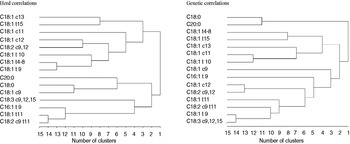
In general our results agree with this view of the dietary origin of the C18 FA. Genetic effects are low and herd effects are high which is expected for FA that mainly originate from the feed. Grass and maize silage are the main forages for Dutch dairy cattle in the winter period (Van Bruggen, Reference Van Bruggen2007). The relative contribution of these silages to the diet of Dutch cows varies greatly for different farms. The major FA in grass silage is C18:3 cis-9,12,15 whereas in maize silage C18:2 cis-9,12 is the most abundant FA (Shingfield et al. Reference Shingfield, Reynolds, Lupoli, Toivonen, Yurawecz, Delmonte, Griinari, Grandison and Beever2005; Kliem et al. Reference Kliem, Morgan, Humphries, Shingfield and Givens2008). Indeed, Kliem et al. (Reference Kliem, Morgan, Humphries, Shingfield and Givens2008) showed that replacing grass silage with maize silage up to inclusion levels seen with the vast majority of farmers in the Netherlands, decreased the milk fat proportions of C16:1 trans 9, C18:1 trans 11, CLA and C18:3 cis 9,12,15 but increased that of C18:2 cis 9,12. Herd clustering (Fig. 4) showed that C18:3 cis-9,12,15 cluster together with a different group of FA than C18:2 cis-9,12. Possibly, C18:3 cis-9,12,15 and FA that cluster in this group (C16:1 trans-9, C18:1 trans-11 and CLA) are the FA that are associated with the feeding of grass silage while C18:2 cis-9,12 and FA that cluster in this group are associated with the feeding of maize silage. Herd clustering shows that C16:1 trans-9 clustered together with C18:1 trans-11 and CLA. This suggests that C16:1 trans-9 is formed during rumen conditions which also promotes the concentration of C18:1 trans-11 and CLA in milk. Potentially, C16:1 trans-9 in milk could also originate from β-oxidation of C18:1 trans-11 (Luna et al. Reference Luna, Rodriguez-Pino and de la Fuente2009). This could be another explanation for the high herd correlation between C16:1 trans-9 and C18:1 trans-11 in milk.
Cluster tree based on principal component analysis of herd and genetic correlations among the C18FA.

Some results differ from the general pattern in the group of C18 FA. Genetic correlations among the C18 FA were all positive except for C18:0 and C20:0, which were negatively correlated to most other FA and strongly positive (+0·91) with each other. This high genetic correlation might be related to a possible origin of C20:0 in milk. C20:0 in milk fat is believed to be formed by the action of elongase enzymes on C18:0 (Leonard et al. Reference Leonard, Pereira, Sprecher and Huang2004; Moate et al. Reference Moate, Chalupa, Boston and Lean2008). However, until now there has been no evidence for this hypothesis about the origin of C20:0 in milk. The very high genetic correlation between C18:0 and C20:0 reported in this study suggest that C20:0 may indeed be formed by the action of elongase enzymes on C18:0. It has not been reported that chain elongation occurs in the mammary gland of the cow. However, if milk fat C20:0 is synthesised by elongation of C18:0 at a different site (i.e. adipose tissue) in the lactating dairy cow it could still be secreted in the milk after mobilisation of body fat.
Conclusions
Studying variation in milk fatty acids due to the genetic and herd parameters has highlighted new insights in the possible origin of FA in milk. This research has demonstrated that it is likely that C12:0 is not completely synthesised de novo in the mammary gland of Dutch cattle but that it is also partly blood derived. In addition it is possible that C20:0 in milk is formed from the action of elongase enzymes on C18:0. This research also shows that it is likely that the odd-chain FA C5:0–C13:0 and a part of C15:0 and C17:0 are synthesised de novo and the other part of C15:0 and C17:0 is blood derived. Statistical analysis of milk FA composition data cannot provide definite answers about the origin of FA in milk. However, it does help to form hypotheses that can be tested in further, more controlled, studies. Furthermore, this work gives an overview of the opportunities to change the concentration of individual FA both by breeding and feeding. It is clearly shown that the extent to which the individual FA can be changed varies greatly and is dependent on the origin of the different FA in milk.
This study is part of the Milk Genomics Initiative, funded by Wageningen University, the Dutch Dairy Association (NZO), Holland Genetics (HG) and the Dutch Technology Foundation STW. The authors thank the owners of the herds for their help in collecting the data.