




No CrossRef data available.
Several Roads Lead to International Norms, but Few Via International Socialization: A Case Study of the European Commission
Published online by Cambridge University Press: 18 October 2005
Abstract
Can an international organization socialize those who work within it? The European Commission of the European Union is a crucial case because it is an autonomous international organization with a vocation to defend supranational norms. If this body cannot socialize its members, which international organization can? I develop theoretical expectations about how time, organizational structure, alternative processes of preference formation, and national socialization affect international socialization. To test these expectations for the European Commission, I use two surveys of top permanent Commission officials, conducted in 1996 and 2002. The analysis shows that support for supranational norms is relatively high, but that this is more because of national socialization than socialization in the Commission. National norms, originating in prior experiences in national ministries, loyalty to national political parties, or experience with one's country's organization of authority, decisively shape top officials' views on supranational norms. There are, then, several roads to international norms.For comments and advice, I am grateful to Jeffrey Checkel, Gary Marks, Donald Searing, and the editors and two anonymous reviewers for International Organization. An earlier draft was presented at the Center for European Studies of the University of North Carolina at Chapel Hill. This project received funding from the Center for European Studies, University of North Carolina at Chapel Hill, and from two grants by the Canadian Social Sciences and Humanities Research Council (1996–99, 1999–2002). Gina Cosentino, Erica Edwards, Michael Harvey, and Moira Nelson provided research assistance.
Information
- Type
- Research Article
- Information
- Copyright
- © 2005 The IO Foundation and Cambridge University Press
To what extent can an international organization socialize those who work within it? In order for international institutions in Europe to socialize states and state agents into international norms, they must themselves emanate these norms. But can one simply presume that the people who work within international organizations share international norms, and if so, what are the causal mechanisms?
The Commission of the European Union (hereafter the European Commission) is a crucial case for examining socialization within an international organization. Crucial cases “offer valuable tests because they are strongly expected to confirm or disconfirm prior hypotheses.”1
See McKeown 2004, 141; and Eckstein 1975.
How can one make sense of top Commission officials' support for, or opposition to, the European Commission's core norms? Support in itself does not, of course, mean that officials have been socialized in the Commission. What are the scope conditions for international socialization? When does international socialization work, and when does it not? When do alternative processes of preference formation predominate? Can international officials learn international norms outside the international organization?
In this article, I set out a theory of preference formation in international organizations. I frame expectations concerning when international socialization may work, what shape it may take, and when it may be trumped by other processes or contexts. In the language of this special issue, I am concerned with specifying the scope conditions of international socialization. I build primarily on work in comparative and U.S. politics and political psychology, as well as recent work on socialization in international organizations, to develop a theory applicable in international contexts. The first section describes the European Commission and the norms it embodies. I then lay out hypotheses about when, how, where, and to what extent international socialization works. Finally, I evaluate the validity of these hypotheses against evidence from two surveys of senior Commission officials.
My conclusion is that, while support for international norms is high, this is not primarily because of socialization in the European Commission. Top officials sustain Commission norms when national experiences motivate them to do so—when national political socialization predisposes them to embrace supranationalism, or when supranationalism appears to benefit their country. Like Beyers' national bureaucrats in EU Council working groups,2
Beyers, this volume.
The Engine of Europe
The role of the European Commission is described precisely in the Treaty of the European Union and is reinforced by the Commission's house rules. The Commission has a constitutional obligation to set the legislative agenda in the European Union (EU).3
Article 211, Treaty of the European Union.
This monopoly has grown with the steady expansion of the Treaty's so-called pillar I from primarily internal market issues to political regulation, and the transfer of some pillar II and III issues, including aspects of asylum, immigration, and foreign policy, to pillar I. At the same time, the Commission's monopoly has been eroded by informal rules that give the European Parliament and the European Council certain rights to table initiatives.
Article 213.2, Treaty of the European Union.
Ibid.
It is with the career civil servants, and more precisely the most senior officials among them, that I am concerned. They are the men and women who soldier on as political Colleges—led by Delors, Santer, Prodi, or Barroso—come and go. In addition to being bound by the Treaty, they are expected to adhere to the European Commission's internal staff regulations, which instruct that “an official shall carry out his duties and conduct himself solely with the interests of the Communities in mind; he shall neither seek nor take instructions from any government, authority, organisation or person outside his institution…. He shall carry out the duties assigned to him objectively, impartially and in keeping with his duty of loyalty to the Communities.”7
Article 11, Staff regulations of Officials of the European Communities (May, 2004). Available from http://europe.eu.int/comm/dgs/personnel_administration, accessed on 23 August 2005.
Constitutional rules and house rules create clear expectations—norms—that are expressly designed to guide Commission officials, whether as political appointees or as permanent career officials. They prescribe the Commission and its employees to (1) put the Union interest first (supranationalism),8
As Haas points out, supranationality is an elusive concept. He defines supranationality as a hybrid between federalism and intergovernmentalism, whereby more power is given to the central agency than is customary for conventional international organizations, but less than to a federal government. See Haas 1958, 34; see also Lindberg and Scheingold 1970, 14–21. The defining feature of supranationalism is that decisions are binding on member states. Supranationalism approaches federalism when decisions are made by independent European organizations, such as the European Court, European Parliament, or the European Commission.
The draft constitutional treaty of the European Union, signed on 29 October 2004 by the members of the European Council in Rome, restates these norms: (1) Supranationalism: Article 25.1: “The European Commission shall promote the general European interest and take appropriate initiatives to that end.” (2) Agenda setting: Article 25.2: “Except where the Constitution provides otherwise, Union legislative acts can be adopted only on the basis of a Commission proposal.” (3) Impartiality and autonomy: Article 25.4: “In carrying out its responsibilities, the Commission shall be completely independent. In the discharge of their duties, the European Commissioners and the Commissioners shall neither seek nor take instructions from any government or other body.” The treaty is available at 〈http://europa.eu.int/futurum/constitution/〉. Accessed 22 June 2005.
These norms have deep roots. The Commission's founding father, Jean Monnet, saw the Commission as a small, organizationally flexible and adaptive, multinational nucleus of individuals at the European level, akin to the Planning Commission (Commissariat de plan) he had set up after World War II in France to devise the first five-year national economic plan. Liberated from national interests, its role was to develop ideas freely, to stimulate and persuade. The Commission's autonomy, pro-European bias, and exclusive power of initiative were crucial to this conception, and Monnet persuaded national leaders to anchor these principles in the Treaty. The notion that the European Commission is, and should be, the engine of Europe was born.10
See Duchêne 1994; and Pollack 2003.
How widespread is support for these pro-European norms in the Commission itself? Do the people who work in the Commission support supranationalism, Commission agenda setting, and autonomy? Does this support arise because the Commission socializes those who work in it?
Shaping Preferences in International Organizations
Most research on international socialization examines states or state governments rather than individuals.12
In this analysis, I focus on individuals within an international organization.13See Checkel 2003; Checkel, this volume; and Johnston 2001.
Socialization refers to the process of inducting individuals into the norms and rules of a given community.14
See Checkel, this volume; Conover 1991; and Hooghe 2002.
Socialization demands that individuals change their preferences in accordance with organizational norms. This poses a challenge for analysis because preferences cannot be observed from behavior. Preferences need to be researched directly, for example in structured interviews, to yield information that is independent from behavior. This research strategy is time-consuming, and even then, uncertainty lingers about the veracity of stated preferences. Respondents may lie, or they may not be able to express their true preferences.16
Deception and attitude softness can be problematic among ordinary citizens, as public opinion research has demonstrated. Zaller 1992. Attitude softness, however, is rarely an issue for elites whose views tend to be more crystallized on political objects. Jennings 1992. There is no fire-proof method for distinguishing true from deceptive preferences. I cannot discount the possibility that some respondents concealed their true preferences, though the circumstances of the interview (anonymity, voluntary participation, nonsensitive character of the questions), and the senior status of the respondents (considerable discretion, weak peer control) are reassuring.
In international relations, rationalists tend to take preferences as exogenous, while constructivists endogenize them. However, as Fearon and Wendt remind us, it is unwise to exaggerate the difference. Whether one endogenizes preferences is an analytical choice dictated by one's research question. See Fearon and Wendt 2003, 64. Preferences are the first step, and behavior the second step, in the two-step dance that is international cooperation. Legro 1996.
International socialization is present to the degree that individuals in an international organization support its mission as a result of experiences in the organization. One must diagnose a change in a person's mental state to show that norms have been internalized—Type II socialization, in Checkel's terms.18
Checkel, this volume.
- How do organizational experiences shape preferences over time? Is induction into organizational norms easier and faster for newcomers than for long-time members? Are younger recruits more likely to be socialized than older ones? How, in other words, does the rate of socialization vary over time?
- How does organizational fragmentation affect socialization? Socialization theory predicts that cohesive organizations are better at socializing agents than fragmented organizations.
- How does international socialization interact with national socialization? Individuals in international organizations usually come from diverse national backgrounds. When do national backgrounds reinforce, and when do they weaken, international socialization?
- Can one splice the effects of socialization from alternative processes that induce support for organizational norms? To accurately assess whether support is due to socialization, one must control for self-selection, selective recruitment, and utility maximization.
- Does the effectiveness of socialization vary across beliefs? An organization's mission usually consists of multiple norms. Are some norms more open to socialization than others?
How Do Organizational Experiences Shape Preferences over Time?
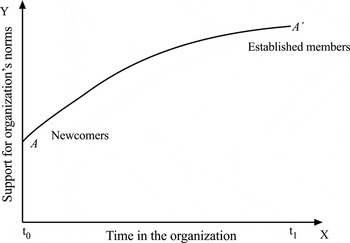
Inculcating values is a gradual process: the longer one's involvement in an organization, the more one's beliefs can be expected to approximate that organization's norms.19
While socialization usually requires long-term exposure, some individuals need less time than others. Thus the rate at which individuals internalize individual norms varies.Effect of novelty
Initial experiences are more influential than subsequent ones. People in a new situation (that is, newcomers) are likely to be disoriented and eager to conform. They are more susceptible to efforts of persuasion, and more disposed to copy what others do.20
See Johnston 2001; also Checkel 2003.

Mapping socialization
Primacy
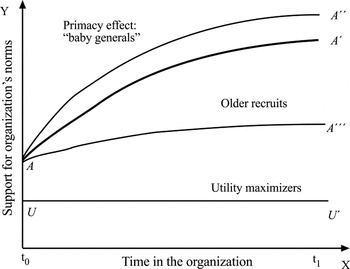
Socialization varies inversely with a person's age and experience. This is the primacy effect. Psychologists theorize that new experiences stick best when a person has few relevant prior experiences.22
There is debate about the optimal age for socialization and the extent to which older people become impervious to socialization. But even those who argue that core predispositions continue to crystallize well past adolescence accept that change takes place ever more slowly with age.23 One should therefore find that young recruits and people with minimal relevant prior experience—blank slates, or “baby generals” as Gheciu calls them—are more susceptible to socialization than seasoned members.24Gheciu, this volume. Novice and primacy effects are sometimes conflated, but they are analytically different. While the primacy effect is a function of age, the novice effect is a function of time spent in an organization.

Socialization, utility, self-selection
These considerations temper one's expectations about the strength of socialization in international organizations. Few officials join international organizations as young adults, top functions are often filled through lateral appointments of national diplomats or experts, and personnel turnover tends to be high. To the extent that recruits are older, experienced, or mobile, I hypothesize that the socialization curve will be flattened or truncated.
How Does Organizational Fragmentation Affect Socialization?
Organizations are rarely unitary. Compartmentalization multiplies opportunities for socialization, but it also produces diversity within an organization. Compartmentalization intensifies ties within organizational subunits while loosening those among them. Because members' experiences are usually more intense in organizational subunits, socialization is likely to be more effective there.
However, different subunits within an organization may socialize different norms, some of which may reinforce the international organization's mission, and others not. The socialization curve will be steeper when socialization in the unit reinforces the norms of the organization as a whole, and flatter when it does not.
Fragmentation is a trademark of many organizations, both international and national, especially when political leadership is weak or divided. In his seminal article on the Cuban Missile Crisis, Allison emphasizes how weak presidential leadership fostered bureaucratic fragmentation. When a bureaucracy is divided, he argues, bureaucrats are inclined to identify with their department's interest over and above that of the administration as a whole.25
How Does International Socialization Interact with National Socialization?
Most individuals are members of several organizations and are therefore exposed to competing norms, but the extent to which exposure leads to socialization depends on the boundedness of the organization. An organization is bounded to the extent that it controls its members,26
and in the last analysis, its members' life chances. Boundedness requires authority—over the mission of the organization, how it is to be pursued, and who should pursue it.The relative boundedness of international organizations is usually constrained by national institutions. National institutions tend to have deeper historical roots, a more coherent mission, more extensive resources, and more cohesive membership than international organizations. The institutions of one's country of birth also tend to be most influential in pre-adulthood.27
See Jennings and Stoker 2001; and Sears and Levy 2003.
One should not assume that national institutions always dilute international norms. National institutions may actually deepen multilateral or supranational values. National and international socialization may produce the same outcome, and only an analysis sensitive to alternative contexts can disentangle these.
How might national context predispose individuals in one direction or another with respect to international norms? Countries vary widely in the degree to which they centralize or decentralize authority. Notwithstanding the United States and Switzerland, citizens of federal societies may have fewer inhibitions concerning supranationalism and multilevel governance.
Political parties constitute a second context for political socialization, and this is especially so with respect to the EU. European integration has become an issue that divides political parties and electorates.29
See Evans 2002; and Marks and Steenbergen 2004.
Can One Distinguish Socialization from Self-Selection and Selective Recruitment?
Socialization is only one of several processes that connect individuals to groups. Even if those who work in an organization support its norms, this may not be because of socialization. The alternatives are threefold. Members may share an organization's norms because those who choose to join the organization are already supportive (self-selection), because the organization screens recruits for their views (selective recruitment), or because self-interest induces employees to share the organization's norms (utility maximization).
Self-selection and selective recruitment precede socialization; they do not say anything about whether people are socialized once they join the organization. Hence, they do not affect the shape of the socialization curve, but they do affect the point of departure—in Figure 2, they shift the intercept of the socialization curve north along the y axis.30
The distinction between self-selection and selective recruitment, on the one hand, and socialization, on the other, is hard to pin down empirically. What would be useful is data that allow a) comparison of the preferences of self-selected individuals with those of potential candidates who chose not to apply, and b) comparison of the preferences of selected applicants with those of rejected applicants.
Can One Distinguish Socialization from Utility Maximization?
Socialization theory states that individuals acquire preferences by internalizing norms embodied in the groups or institutions in which they live or work, or which are otherwise important to them. This view emphasizes affective group ties (identities) and long-standing personal dispositions. What motivates individuals is, in March and Olsen's words, “a logic of appropriateness.”31
March and Olsen 1989, 160.
Ibid.
In many activities, individuals are motivated by some combination of identity and utility.33
See Chong 2000; Hooghe 2002; and Searing 1994.
Splicing socialization from utility maximization demands careful surgery. Socialization, in contrast to utility maximization, is all about the temporal effects of group influence. The socialization curves in Figure 2 are time-sensitive in that they tap cumulative experience in an organization. Utility maximization is time- insensitive: what matters are the incentives and disincentives that confront a person at a given moment (UU′ in Figure 2).34
Over the long haul, it is often a combination of utility and socialization that brings an individual to support organizational norms. Initially, when a person joins an organization, incentives, persuasion, and mimicking may all nudge them toward particular preferences, so that it is impossible to distinguish socialization from utility. In the long run, individuals may internalize norms. The litmus test is whether preferences change in tandem with changing material incentives. If they do, utility maximization guides preference formation; if they do not, it is socialization. I thank Don Searing for raising the issue of changing processes of preference formation over time. See also Johnston, this volume.
Socialization theory hypothesizes that individuals have a psychological need to minimize inconsistent beliefs. Cognitive dissonance reduction, the psychological mechanism whereby individuals seek to reduce dissonance among various beliefs, decreases information costs and thus preempts rational calculation.35
See Chong 2000; and Simon 1985.
Large and diffuse norms
Socialization is more likely for norms that concern large or diffuse values in life.36
See Goren 2001; Huddy 2003; and Taber 2003.
Elster 1990, 40.
Material stakes
Utility maximization prevails when norms are perceived to have material consequences that can be estimated with some accuracy, are large enough to matter, and when a person's choice will probably affect the outcome.38
See Elster 1990; Sears and Funk 1991; and Young et al. 1991.
See Chong 2000; Crano 1997; Sears 1993; and Taber 2003, 447–48.
International norms that affect career chances or material outcomes, such as norms concerning tasks, work practices, and constituency relations, are more open to utility maximization. International norms that concern diffuse values, such as norms on international cooperation, multilateralism, supranationalism and intergovernmentalism, are more readily socialized.
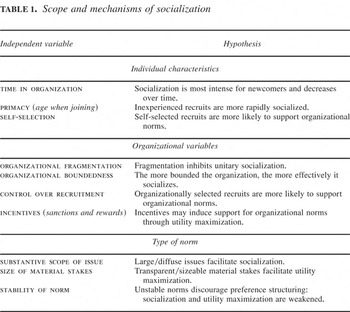
I have theorized how individual characteristics, organizational variables, and type of norm affect socialization. Table 1 summarizes these. I now examine whether and how the European Commission socializes those who work in it.
Scope and mechanisms of socialization

Socialization in the European Commission
I draw on two surveys of senior permanent civil servants in the European Commission: director-generals, deputy director-generals, directors, senior advisors, and heads of cabinet. The first survey consists of semi-structured personal interviews averaging eighty minutes in length, which I conducted between July 1995 and February 1997. The same individuals answered thirty-six questions concerning their attitudes on EU and Commission-related topics. From September 2001 through February 2002, I mailed to all senior Commission officials a structured questionnaire replicating most of the 1995–97 questions. I also conducted short personal interviews with fifteen respondents in February 2002. Here I analyze responses to the two sets of closed-ended mail questionnaires, illustrated with direct quotations from transcribed interviews.40
The value of closed-ended mail questionnaires for elite research is debated. Politically sophisticated actors tend to dislike closed-ended questions because it forces them to condense complex beliefs into blunt agree/disagree statements, while an interview allows them to be more subtle. In his elite study, Putnam reprints a letter from a British parliamentarian who makes this point. See Putnam 1973, 19. Likewise, I received a questionnaire from one official on which he had scribbled dense critical comments next to virtually every question but refused to take position on a single item! In their study of foreign policy makers, Hollis and Smith argue for taking accounts by elite actors seriously: “Our actors interpret information, monitor their performance, reassess their goals. The leading idea is that of reasoned judgment, not of manipulation” (emphasis in the original). See Hollis and Smith 1986, 283, quoted in Searing 1991, fn.17. How can one make closed-ended questionnaires serve this purpose? A first step is to draw heavily on previous research. Where feasible, I replicated content and format from Searing's study of British parliamentarians and Putnam's study of political elites. See Searing 1994; and Putnam 1973, respectively. This has the added value of comparability. Furthermore, I systematically pretested the questionnaire. Finally, I triangulated statistical analysis of the closed-ended elite questionnaires with qualitative reading of in-depth interviews. Personal interviews with 137 senior Commission officials produced 180 hours of taped interviews, so respondents had plenty of time to explicate their views (in French or English). Closed-ended questionnaires were handed out after the interview. The idea is to maximize the distinctive advantage of closed-ended questionnaires—an objective, quantifiable basis for systematic comparison—while minimizing their disadvantages.
The higher response rate for the first survey (51 percent against 40 percent) reflects the fact that the personal interview had allowed me to establish rapport with the respondent. When necessary, I followed up by phone, e-mail, or fax. In 2001–2002, the procedure was more distant. A research assistant mailed questionnaires (in French and English) to 230 officials, but struggled to meet our target response rate. I wound up traveling to Brussels to set up fifteen short appointments, in which I asked respondents to fill out the questionnaire in my presence. I took care not to influence the process to ensure comparability with the mailed-in responses. The flying visit provided me with an opportunity for brief personal interviews. Facts and figures on response rate, sample bias, and interview strategy for the first survey are available in Hooghe 2002, and from my Web site at 〈http://www.unc.edu/∼hooghe/〉.
It is useful to establish a baseline for comparison. How do the views of top Commission officials on European integration compare with those of other actors? One knows an increasing amount about preferences by EU actors, including the Council of Ministers,42
Beyers, this volume.
Lewis, this volume.
Marks, Hooghe, Nelson, and Edwards forthcoming.
Fortunately, there are some common points for comparison. An oft-repeated Eurobarometer question asks citizens how they want to distribute authority between the EU and national governments on thirteen individual policies. The same question was included in the 1996 national elite survey on attitudes concerning European integration, the only systematic survey of national elites to date in the fifteen pre-enlargement EU member states.50
The public opinion data are from Eurobarometer 54.1 of fall 2000. Hartung 2001. The national elite data were collected in 1996 by EOS Gallup-Europe, which drew a representative sample from a database of 22,000 individuals from five elite sectors: elected politicians (national and European parliamentarians), senior national civil servants, business and trade union leaders, media leaders (including heads of broadcast and print media), and cultural elites (persons playing a leading role in the academic, cultural, or religious life). The survey was conducted by telephone (N = 3778). See Spence 1996.
Question 30 in Eurobarometer 54.1 reads: “For each of the following areas, do you think that decisions should be made by the [nationality] government, or made jointly within the European Union? 1 = nationality, 2 = jointly within the European Union, 3 = don't know.” Hartung 2001. The question formulation for national elites and Commission officials differs somewhat from that for public opinion, in that it allows respondents to indicate support or opposition on a scale from 1 to 10. For comparability, elite data must therefore be transformed into a dichotomous variable. See Hooghe 2003.
Top Commission officials appear significantly more pro-European than either national elites or public opinion across the thirteen policies for which we have comparable data.52
Hooghe 2003. The thirteen policies are currency, humanitarian aid/Third World, foreign policy, immigration and asylum, environment, agriculture, defense, research and development, regional policy, employment, social inclusion, health policy, and education. Of the twenty-six one-way analysis-of-variance means tests for group differences—thirteen are between Commission officials and public opinion, and thirteen are between Commission officials and national elites—twenty are significant at the .001 level, one at the .01 level, one at the .05 level, and only four are insignificant (p > .05). The results are robust across the Bonferroni and Tukey methods.
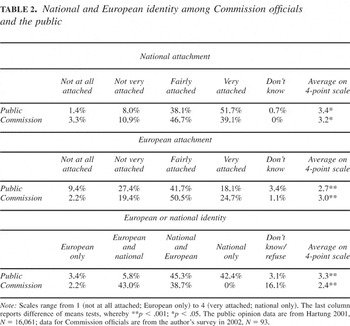
This pro-European bias is reflected in perceptions of identity (see Table 2). When Eurobarometer asks citizens to signal how much they are attached to their country and how much to Europe, European attachment is no match for national attachment, as the averages in the last column show. National attachment has a significantly smaller lead among top Commission officials. Top Commission officials are also much less likely to characterize their identity as exclusively national than are ordinary citizens. Forty-three percent of citizens describe themselves as “national only,” but not a single official in the sample is so inclined.53
The question is: “In the near future, do you see yourself as (1) [nationality] only, (2) [nationality] and European, (3) European and [nationality], or (4) European only?” Note that 16 percent of top officials (against 3.1 percent of the public) refused to choose one or the other option. Follow-up questions show that some officials object to having to rank European and national identity.
National and European identity among Commission officials and the public

To summarize, Commission officials are more likely to identify with Europe and are more in favor of shifting policy to the European level than national elites or citizens. There is, then, considerable support among top Commission officials for the Commission norm of supranationalism. Is this because the Commission has socialized its officials, or for other reasons?
What Explains Commission Officials' Views on Supranationalism?
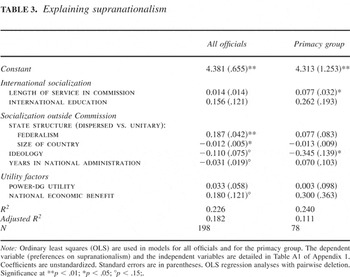
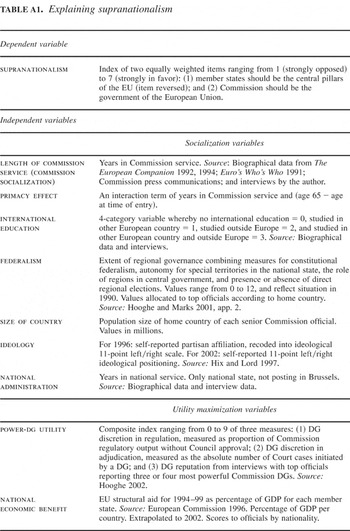
Table 3 presents a multivariate ordinary least squares (OLS) regression explaining top officials' preferences on supranationalism, which is measured by two items tapping whether member states or supranational institutions should be central pillars of EU governance (see Appendix 1 for wording and statistics).
Explaining supranationalism

To estimate accurately the effect of international and Commission socialization, one must control for socialization outside the Commission and for utility. Table 3 reports that Commission socialization (measured as length of service in the Commission) and international socialization (measured as having studied abroad) are not significant.54
The argument for including international education is that it reinforces transnational norms, as students abroad are exposed to different ways of thinking and living. This happens during young adulthood when the primacy effect is powerful. Foreign students also experience firsthand that expatriates have limited citizenship rights compared to nationals at home, and I expect this to strengthen support for supranational institutions that could create overarching rights.
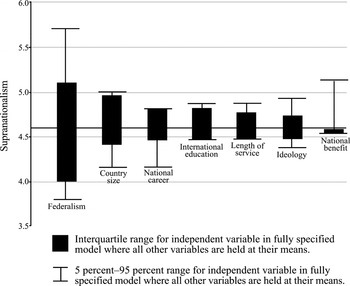
Figure 3 illustrates the relative effect of these variables. The solid boxes encompass the interquartile range and the whiskers indicate the 5th to the 95th percentiles, holding all other independent and control variables at their means. For example, an individual at the 5th percentile on federalism has a score of 3.8 on supranationalism on a 1–7 scale, and an individual at the 95th percentile scores 5.7. The variables toward the left of Figure 3 have the largest effect across their interquartile range. The three most powerful variables relate to socialization outside, rather than within, the Commission. International education and length of service in the Commission are considerably weaker, as is utility maximization. I now take a closer look.

Effects of independent variables
How Do Commission Experiences Shape Preferences Over Time?
The effect of Commission socialization is modest: an additional year of service increases supranational support by 0.014 on a seven-point scale. At this rate, and controlling for the factors in Table 3, it would take seventy-one years to see someone who begins to work in the Commission as a neutral (four on our seven-point scale) change into a mild supranationalist at five.
But this conclusion does not hold for all Commission officials. The effect of Commission socialization is considerably stronger for the seventy-eight officials who joined the organization before their thirtieth birthday—the primacy group (see Table 3, second column).55
Severe multicollinearity precludes testing the primacy effect in a single equation with overall Commission socialization (length of service).
There is no support for the hypothesis that newcomers are more susceptible to socialization, or that the rate of socialization decreases with years of exposure.56
I tested this in several ways. I defined newcomers as those with up to two, up to three, up to five or up to seven years of service. Under no conditions is the difference between their rate of socialization and that of seasoned officials significant. I also tested several nonlinear permutations of length of service; none is superior to linearity.
Newcomers in the European Commission try hard to understand the rules and norms in their new organization. However, understanding rules is one thing, being persuaded by them is another. As one recently appointed Italian top official put it: “This is a huge organization, and when you arrive the first thing you do is to try to understand what is going on in the house. Of course, I do have, let's say, my own prejudices in this area and I did give some messages, but in the beginning most of the effort is in understanding.” An Austrian top civil servant, six months on the job, echoed this. When asked whether she had the sense, in the first few weeks, that she would be able to pursue her goals, she replied: “My main interest was to fully capture what was going on and how it functioned—taking stock of things and how things were done.” The prevailing attitude among newcomers appears to be to wait and see, and not, as one might expect, mimicking behavioral norms of the group.
Socialization is not helped by the fact that Commission rules and norms are often difficult to grasp. Several Commission officials whom I interviewed vividly recalled their bewilderment in coming to grips with the complex interplay between multicultural attitudes and national particularities, the charged politicking in an apparent bureaucratic organization, the paper bureaucracy which all condone but few take seriously, and the paradox of widespread informal networking in a formalistic hierarchy. This complexity undercuts normative transparency and inhibits socialization. Learning to circumvent formal norms is essential to survival. An official who worked his way up in the Commission to the absolute top summarizes the duplicitous character of work norms:
The Commission only works when hierarchy is put aside. While we respect the hierarchy in formal terms, we know that, to get this job done, we need to ask the question: “Who do we need to do it?”… We are task-oriented, person oriented. That requires a great deal of flexibility and adaptability. It's not possible to operate, except through an at best token acceptance of procedures and hierarchies. The only way to make this thing work effectively within the deadlines set by politics is by relying on key people committed to the same goal. In a private organization, you have blanket indoctrination of everyone concerned into the goals of whatever you are producing, whether it is a production program or the launching of a new product or a new financial exercise, every single person goes through something akin to a propaganda exercise. This does not happen in the Commission. You have to form informal coalitions … allies in the cause of a particular advancement of the policy from here to there.”
Does Organizational Fragmentation Affect Socialization?
It is conventional wisdom that bureaucratic fragmentation in the Commission encourages local cultures,57
See Page 1997; and Shore 2000.
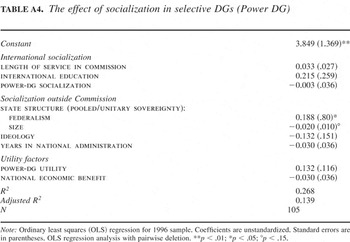
If the Commission is as fragmented as many observers and some policymakers claim it is, directorates with extensive supranational competences and discretionary budgets should be more effective in instilling supranational norms. This is not the case.60
For the 1996 sample, I calculate for each official the number of years he spent in departments with extensive legal competences or a significant discretionary budget, and I call this variable power- dg/socialization. I also calculate the alternative utility hypothesis, i.e., officials who happen to work in a supranational department have career reasons to favor supranationalism, which is labeled power- dg utility. As the OLS regression in Table A in Appendix 2 illustrates, neither hypothesis bites.
The explanation appears to be mobility. Mobility hinders identification with a particular unit. In the mid- to late 1990s, the average time a top official spent in a particular top position was less than five years. Consider these statistics: of the people I interviewed in 1996, more than half had left the European Commission by September 2001, and 25 percent had changed departments. With a turnover rate among top officials of 75 percent over five years, there is not much time to mold individual preferences according to particular departmental cultures. After the Santer Commission resigned in 1999 over allegations of fraud, mismanagement, and nepotism, the newly appointed commissioner for personnel, Neil Kinnock, required top officials to change posts every five to seven years.61
Kinnock made these measures public in a press statement on 29 September 1999. Strictly speaking, the new rules make rotation mandatory only for director-generals, but in practice, directors have also been forced to rotate. Author's interview with a member of the Kinnock cabinet, February 2002.
High rates of interdepartmental mobility should privilege overarching Commission norms. Interdepartmental coordination, which compels top officials to clear their departmental policies with other departments, should reinforce this. The apex of this elaborate coordination network consists of weekly meetings of director-generals, where interdepartmental Commission business is settled.
Limits to the Commission's Boundedness: National Socialization
Table 3 strongly supports the contention that national socialization may be more effective than international socialization in shaping international officials' preferences. National socialization appears double-edged, as noted by authors in this issue. On the one hand, national socialization depresses support for supranationalism among former national civil servants. On the other, national socialization engenders support for international norms. The best predictor of top officials' support for supranationalism is whether they come from a federal country. Core beliefs about national governance shape preferences on European governance. Federalism divides sovereignty, and this notion underpins multilevel governance.62
See Hooghe and Marks 2003; Keohane 2002; and Risse 2001.
Contexts outside the Commission are powerful. The European Commission cannot afford to be a bounded institution. Shared authority is a vital feature of EU decision making. In few, if any, policy areas can one institution, national or European, take authoritative decisions unilaterally.63
See Hooghe and Marks 2001; and Pollack 2000.
The pull of national contexts is consistent with the socialization literature. Unlike international organizations, national institutions—from families to schools to governments—draw full advantage from the primacy effect. European children grow up in national contexts, and such contexts leave imprints that are hard to dislodge later in life.
It is instructive to compare national civil servants with European Commission officials. National civil servants work for powerful national governments that represent imagined communities having concrete expression in national systems of welfare or education, as well as bloc votes in the EU Council of Ministers. The notion of national public interest has a tangible core.64
European public interest is shallower. While the EU has acquired some trappings of nationhood—an anthem, a flag, a public holiday, a European driver's license, a European passport, a European currency, membership of international organizations—these symbols register weakly in people's minds. Few outside the European institutions know that 9 May is Europe's “Independence Day.” The Euro is the single exception in terms of capturing public attention, but its virtue is contested.65For many Europeans, it is associated with economic hardship, as its popular German nickname, Euro-Teuro (expensive Euro) illustrates.
See Abélès and Bellier 1996; and Shore 2000.
There is a clear difference between national administrations and the Commission. National administrations have a broad consensus on objectives. All civil servants are interested in pulling the same cart, and they know in which direction and when to pull the cart. They may disagree about marginal adjustments or speed, but they basically all agree on where they want to go and what the national interest is. To use the word “national interest” gives immediately away why this cannot be the case inside the Commission. Even though we are supposed to work for the common interest of the Community, nobody forgets his background, his nationality. Much of the conflict between national interests has been transferred to the Commission. Some [officials] are almost unashamed of it; they go straight for it and make it no secret. Others—and I think this is also a question of how long you have been in the Commission—work much more for the common benefit. They tend to take a rational-reasoned balanced Community approach, whereas others choose a national-interest approach. So, national tensions are transferred to the Commission, and that makes it impossible to have everybody agree ex ante on common objectives. There are no common objectives…. This is still a relatively young, expanding and maturing institution, which has not yet found its own identity.
What Is the Role of Self-Selection and Selective Recruitment?
Socialization is only one of several processes by which members of an organization may come to support organizational norms. In this section, I discuss how self-selection and selective recruitment shape supranational preferences. In the next section, I demonstrate that material incentives help account for the views of top Commission officials.
One knows that top Commission officials, including recent recruits, are more in favor of shifting powers to the EU than either national elites or public opinion. This may, in part, result from self-selection. As the so-called engine of European integration, it is likely that the Commission appeals to “believers.”
Evidence from interviews suggests that self-selection plays a role, but the effect may be more limited than is often assumed. When top officials are asked why they joined the Commission, about one-quarter talk about European integration as an ideal, which guarantees, or partially guarantees, peace, democracy, order, or good governance. As an older Dutch official explains, “I am a child of the war. People of my generation would do anything to avoid a third world war. We did not have a sophisticated notion of an institutionalized Europe, but we were deeply European because we never wanted to repeat that experience.” Officials from Spain, Portugal, and Greece often mention that European integration helped consolidate their young democracies.
However, most officials cite more pragmatic reasons for joining the Commission, including building a career (39 percent); national connections (21 percent, for example, their government asked them to apply); connections in the policy community (21 percent, for example, they were approached when serving as national experts in Council or Commission working groups); party-political connections (8 percent); or the desire for a policy challenge (11 percent).67
The percentages add up to more than 100 percent, because some officials mentioned two reasons.
There is also limited evidence of pro-European selective recruitment. Formal recruitment rules allow the Commission to select officials on the basis of their preferences if it so wishes. The most supranational Commission president over the past three decades, Delors, took these rules to heart: he searched for officials who would press forward his supranational agenda. According to Ross, “Delors, with Pascal's [Lamy, Delors' chef de cabinet] advice, had very carefully replaced a considerable number of high Commission officials, directors-general and division heads, in critical areas.”68
Ross 1995, 67.
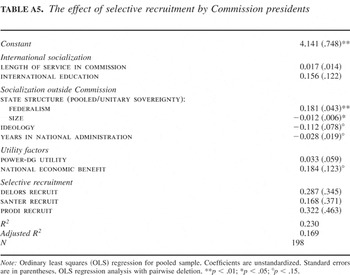
I seek to capture the effect of selective recruitment by respective Commission presidents by means of three dummies—one each for individuals appointed to top positions under Jacques Delors (1986–94), Jacques Santer (1995–98), and Romano Prodi (1999–2002). The OLS regression in Table A5 in Appendix 2 shows that none of these effects is significant.
Can One Distinguish Socialization from Utility Maximization?
I have theorized that the effect of socialization depends on what is being socialized. The more a Commission norm invokes diffuse or large values, the greater the scope for socialization. Utility maximization, by contrast, should be stronger for norms that regulate tasks, work practices, and constituency relations—norms, in other words, with immediate career implications.
In the introduction, I identified three norms that characterize the Commission's mission: supranationalism; Commission agenda setting; and autonomy from national influence. How do the effects of socialization and utility vary across these?
Supranationalism is a prime example of a diffuse norm. It is nearly impossible for top officials to anticipate how a more supranational European Union may affect them professionally. Supranationalism has ambiguous career implications. On the one hand, more supranationalism means more policy tasks and resources. But on the other, it implies upgrading the College of Commissioners to the government of Europe, and this would imply downgrading permanent officials to mere civil servants. So one would expect socialization to be strong, and personal career utility to be weak, in shaping officials' norms regarding supranationalism.
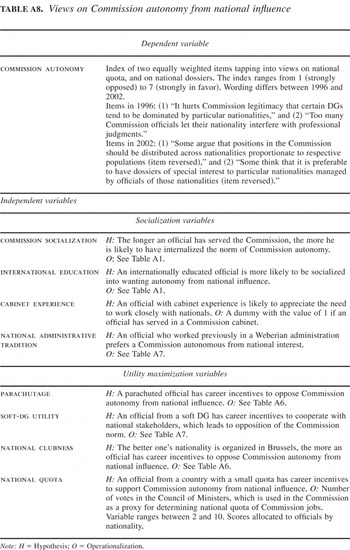
Contrast this with the norm prescribing autonomy from national pressures. This is a norm with transparent implications for top officials' careers. Should the Commission's personnel system be strictly Weberian and reward merit over and above nationality, or should it reflect national quotas? National quotas punish qualified candidates having the “wrong” nationality. That is to say, officials from smaller countries are disadvantaged because small countries have relatively few top slots to fill, and so are officials who have not cultivated strong national connections that could catapult them into national slots. Contrast the fate of two respected directors, one Dane and one Greek, interviewed in 1996. The Dane's ambition to reach the summit—director-general—was dashed when a younger compatriot with better political connections was promoted to the top slot reserved for Denmark. The Greek director rated his chances for promotion as virtually nil because the two Greek top-rank posts had recently been taken up. Fast-forward to 2002, when the Danish official had taken early retirement, while his Greek colleague was just promoted. What had happened? The Commission resignation crisis in 1999 changed the prospects for the Greek director when one of the two top Greeks was sacked under a cloud of negligence and alleged fraud. So, unexpectedly, a window of opportunity opened briefly and then closed again. A merit-based promotion system, on the other hand, disadvantages candidates from recent member states, who usually have less experience with the Commission's way of working. One would therefore expect support for the norm of Commission autonomy to vary in tune with utility considerations, such as the strength of national or political connections, the size of a country's quota, or the timing of a country's membership, while socialization is expected to be weak.
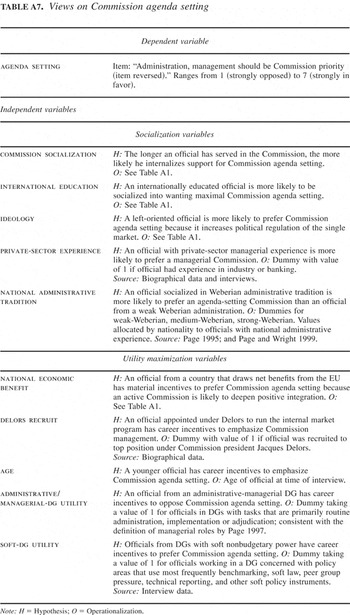
Finally, one would expect support for the norm of Commission agenda setting to be influenced by both socialization and utility. This norm is diffuse in that it embodies Monnet's vision of the Commission as the engine of Europe; consequently, it should be amenable to socialization. But the norm also has calculable implications for officials' careers, in that it privileges a particular type of Commission activity (creating new policies) above another (administering existing policies); therefore, one would expect that utility calculations, informed by whether they are vested in one or the other kind of activity, to matter as well.
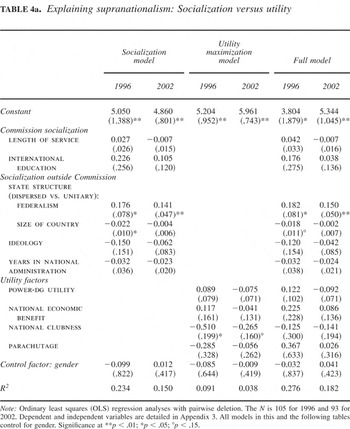
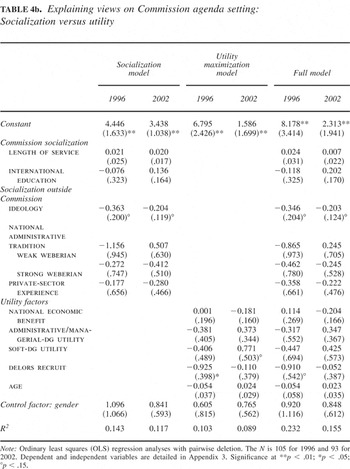
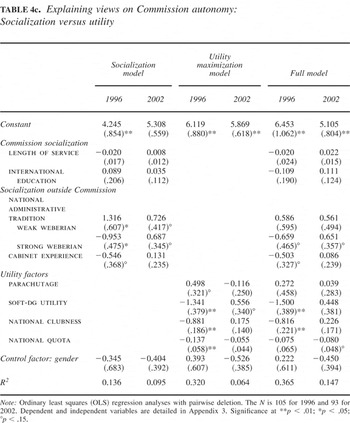
Tables 4a, 4b, and 4c allow one to evaluate the relative effects of socialization and utility on these norms. Table 4a presents OLS models explaining variation among Commission officials on the norm of supranationalism; Table 4b provides the same for Commission agenda setting; and Table 4c presents models explaining variation on the norm of autonomy from national influence. Each table reports three explanatory models for two time points, 1996 and 2002.70
Appendix 3 hypothesizes causal effects and operationalizes variables.
Explaining supranationalism: Socialization versus utility

Explaining views on Commission agenda setting: Socialization versus utility

Explaining views on Commission autonomy: Socialization versus utility

The coefficients of determination (R2) at the bottom of each table estimate the proportion of variance explained by each model. Socialization has the greatest causal weight for supranationalism (Table 4a); socialization is about evenly balanced with utility maximization for Commission agenda setting (Table 4b); and in Table 4c, socialization is dwarfed by utility maximization for the norm of autonomy from national influences. These results are consistent across time points, with the exception of 2002 for the autonomy norm.
Furthermore, the results in Tables 4a, 4b, and 4c highlight a point made above: socialization requires stable norms; utility maximization requires transparent incentives. Commission norms became less stable and less transparent after the resignation of the Santer Commission in 1999, which happened in the face of allegations of fraud, mismanagement, and nepotism. The result is that top officials' views in 2002 are markedly less structured than in 1996. The 2002 data capture an organization in turmoil. The crisis shattered consensus in the Commission around the agenda-setting norm, which prescribes that the European Commission's primary role is to initiate, not administer, EU policies (see Table 4b). In 1999, a new Commission team under Romano Prodi began rewriting internal work practices to encourage “sound management,” and thus shifted the focus from policy creation to management. The crisis also forced the organization to face up to a duplicitous personnel policy whereby the norm of autonomy from national influences (see Table 4c) was contradicted by the practice of national quotas in top appointments.71
See Peterson 1999; and Ross 1995.
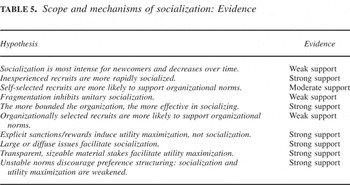
Table 5 summarizes, then, how this empirical study of socialization in the Commission bears on the theory.
Scope and mechanisms of socialization: Evidence

Conclusion
International socialization is hardly a panacea for those interested in diffusing international norms. The European Commission is surely among the most favorable sites for socialization of international norms. Yet the evidence suggests that Commission and international socialization is considerably weaker than socialization outside the Commission.
Why is international socialization weak? One reason is that international organizations rarely benefit from the primacy effect—the opportunity to influence members in their young adult years. The European Commission is an unusual international organization in that 35 percent of its top employees began to work in the Commission in their twenties. Commission socialization is almost exclusively concentrated in this group. It is extremely difficult—nigh impossible—for an international organization to substantially shift the views of mature recruits.
A second reason for the weakness of international socialization is that international organizations lack control over their members' life chances. Socialization flourishes in homogeneous, bounded environments; it is suppressed when an organization is fragmented and vulnerable to external influences. The European Commission is unusual in that it has more control over its members than all but a few international organizations. It has formal autonomy in recruiting and promoting its personnel. It has the authority to impose mobility on its officials to discourage divergent bureaucratic subcultures. It has extensive supranational powers and the constitutional writ to insulate its work from national and other influences. This is fertile ground for instilling Commission norms. However, the European Commission coexists with national institutions. The Commission sets the agenda, but it must engage the Council of Ministers, individual governments, and the European Parliament in order to legislate. Openness comes at a price: it diminishes the Commission's control over its officials, and induces these people to tap additional loyalties. Hence, even in an international organization as powerful as the Commission, one finds that national norms, originating in prior experiences in national ministries, loyalty to national political parties, or diffuse national political socialization, decisively shape top officials' views on European norms.
One might turn the question around: Why is support for international norms so strong? One conclusion of this study is that there is no intrinsic contradiction between national and international norms. The most powerful influences on pro-European support among top officials are national or subnational. National and subnational socialization can, and do, produce support for international norms.
Supranationalism can also be generated by utilitarian incentives. One knows that material incentives can nudge state actors toward, or away from, international norms,72
See Schimmelfennig, this volume; and Kelley 2004.
Finally, there is some circumstantial evidence that self-selection nudges up support for Commission norms. Indeed, individuals who choose to work in an international organization are likely to be favorably disposed to the organization's norms.
There are, then, multiple paths through which preferences may be molded to reflect international norms. International socialization, in the sense of inducting international norms within the organization itself, is one of them. But in the crucial case of the European Commission, international socialization is by no means the most powerful.
Appendix 1
Explaining supranationalism

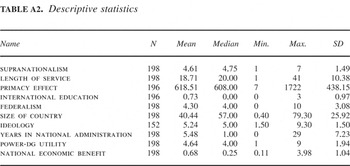
Descriptive statistics

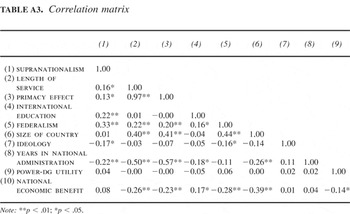
Correlation matrix

Appendix 2
The effect of socialization in selective DGs (Power DG)

The effect of selective recruitment by Commission presidents

Appendix 3
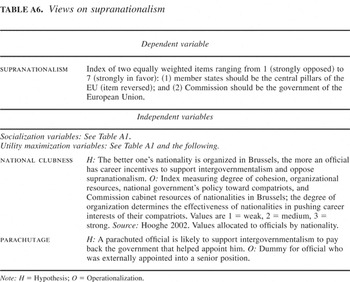
Views on supranationalism

Views on Commission agenda setting

Views on Commission autonomy from national influence

References
REFERENCES
Abélès, Marc, and
Irène Bellier.
1996.
La Commission européenne: du compromis culturel à la
culture politique du compromis.
Revue Française de Science Politique
46 (3):431–56.CrossRefGoogle Scholar
Allison, Graham T.
1971.
Essence of Decision: Explaining the Cuban Missile Crisis.
Boston:
Little, Brown.
Beck, Paul, and
M. Kent Jennings.
1991.
Family Traditions, Political Periods, and the Development of
Partisan Orientation.
Journal of Politics
53 (3):742–63.CrossRefGoogle Scholar
Caporaso, James.
2000.
Changes in the Westphalian Order: Territory, Public Authority, and
Sovereignty.
International Studies Review
2 (2):1–28.CrossRefGoogle Scholar
Checkel, Jeffrey.
2003.
‘Going Native’ in Europe? Theorizing Social Interaction
in European Institutions.
Comparative Political Studies
36 (1):209–31.CrossRefGoogle Scholar
Chong, Dennis.
2000.
Rational Lives: Norms and Values in Politics and Society.
Chicago:
University of Chicago Press.
Citrin, Jack,
Donald P. Green,
Christopher Muste, and
Cara Wong.
1997.
Public Opinion Toward Immigration Reform: The Role of Economic
Motivations.
Journal of Politics
59 (3):858–81.CrossRefGoogle Scholar
Conover, Pamela Johnston.
1991.
Political Socialization: Where's the Politics? In
Political Science: Looking to the Future, Vol. 3, edited by
William Crotty,
125–52.
Evanston, Ill.:
Northwestern University Press.
Coombes, David.
1970.
Politics and Bureaucracy of the European Community: A Portrait of
the Commission of the E.E.C.
London:
Allen and Unwin.
Cram, Laura.
1994.
The European Commission as a Multi-Organization: Social Policy and
IT Policy in the EU.
Journal of European Public Policy
1 (2):195–217.CrossRefGoogle Scholar
Crano, William D.
1997.
Vested Interest, Symbolic Politics, and Attitude-Behavior
Consistency.
Journal of Personality and Social Psychology
72 (3):485–91.CrossRefGoogle Scholar
Dod's European Companion.
1992, 1994.
London:
Dod's Politial Publishing.
Druckman, Daniel.
1994.
Nationalism, Patriotism, and Group Loyalty: A Social Psychological
Perspective.
Mershon International Studies Review
38 (1):43–68.CrossRefGoogle Scholar
Duchêne, François.
1994.
Jean Monnet: The First Statesman of Interdependence.
New York:
Norton.
Eckstein, Harry.
1975.
Case Study and Theory in Political Science. In
Handbook of Political Science, Vol. 7, edited by
Fred I. Greenstein and
Nelson W. Polsby,
79–137.
Reading, Mass.:
Addison-Wesley.
Egeberg, Morten.
1999.
Transcending Intergovernmentalism? Identity and Role Perceptions of
National Officials in EU Decision-Making.
Journal of European Public Policy
6 (3):456–74.CrossRefGoogle Scholar
Elster, Jon.
1990.
When Rationality Fails. In
The Limits of Rationality, edited by
Karen Schweers Cook and
Margaret Levi,
19–51.
Chicago:
University of Chicago Press.
Evans, Geoffrey.
2002.
European Integration, Party Politics and Voting in the 2001
Election.
British Elections and Parties Review
12:95–110.CrossRefGoogle Scholar
European Commission.
1996.
First Report on Economic and Social Cohesion 1996.
DG XVI, 144, Table 24.
Brussels:
European Commission.
European Convention.
2003.
Draft Treaty Establishing a Constitution for Europe.
CONV 850/03.
Brussels:
European Parliament.
Euro's Who's Who: Who's Who in the European
Communities and in the Other European Organizations.
1991.
Brussels:
Editions Delta.
Fearon, James, and
Alexander Wendt.
2003.
Rationalism versus Constructivism: A Skeptical View. In
Handbook of International Relations, edited by
Walter Carlsnaes,
Thomas Risse, and
Beth A. Simmons,
52–72.
London:
Sage.
Finnemore, Martha.
1996.
National Interests in International Society.
Ithaca, N.Y.:
Cornell University Press.
Gabel, Matthew, and
Chris Anderson.
2002.
The Structure of Citizen Attitudes and the European Political
Space.
Comparative Political Studies
35 (8):893–913.CrossRefGoogle Scholar
Goren, Paul.
2001.
Core Principles and Policy Reasoning in Mass Publics: A Test of Two
Theories.
British Journal of Political Science
31 (1):159–77.CrossRefGoogle Scholar
Haas, Ernst.
1958.
The Uniting of Europe: Political, Social and Economic Forces,
1950–1957.
Stanford, Calif.:
Stanford University Press.
Hartung, Harald.
2001.
Eurobarometer 54.1: Building Europe and the European Union: The
European Parliament, Public Safety, and Defense Policy,
November–December 2000.
Brussels:
European Opinion Research Group EEIG.
Hemmer, Christopher, and
Peter Katzenstein.
2002.
Why Is There No NATO in Asia? Collective Identity, Regionalism, and
the Origins of Multilateralism.
International Organization
56 (3):575–607.CrossRefGoogle Scholar
Hix, Simon, and
Christopher Lord.
1997.
Political Parties in the European Union.
London:
MacMillan.
Hooghe, Liesbet, and
Gary Marks.
2001.
Multi-Level Governance and European Integration.
Lanham, Md.:
Rowman & Littlefield.
Hooghe, Liesbet.
2002.
The European Commission and the Integration of Europe: Images of
Governance.
Cambridge:
Cambridge University Press.
Hooghe, Liesbet, and
Gary Marks.
2003.
Europe Divided? Elites vs. Public Opinion on European
Integration.
European Union Politics
4 (3):281–305.CrossRefGoogle Scholar
Hooghe, Liesbet.
2003.
Unraveling the Central State, but How? Types of Multi-Level
Governance.
American Political Science Review
97 (2):233–43.Google Scholar
Huddy, Leonie.
2003.
Group Identity and Political Cohesion. In
Oxford Handbook of Political Psychology, edited by
David O. Sears,
Leonie Huddy, and
Robert Jervis,
511–58.
Oxford:
Oxford University Press.
Hug, Simon, and
Thomas König.
2002.
In View of Ratification: Governmental Preferences and Domestic
Constraints at the Amsterdam Intergovernmental Conference.
International Organization
56 (4):447–76.CrossRefGoogle Scholar
Jennings, M. Kent.
1992.
Ideological Thinking among Mass Publics and Political Elites.
Public Opinion Quarterly
56 (4):419–41.CrossRefGoogle Scholar
Jennings, M. Kent, and
Laura Stoker.
2001.
The Persistence of the Past: The Class of 1965 Turns Fifty.
Berkeley:
Institute of Governmental Studies, University of California at
Berkeley.
Johnston, Alastair Iain.
2001.
Treating International Institutions as Social Environments.
International Studies Quarterly
45 (4):487–515.CrossRefGoogle Scholar
Kelly, Judith.
2004.
International Actors on the Domestic Scene: Membership
Conditionality and Socialization by International Institutions.
International Organization
58 (3):425–57.CrossRefGoogle Scholar
Keohane, Robert O.
2002.
Ironies of Sovereignty: The European Union and the United
States.
Journal of Common Market Studies
40 (4):743–65.CrossRefGoogle Scholar
Legro, Jeffrey.
1996.
Culture and Preferences in the International Cooperation
Two-Step.
American Political Science Review
90 (1):118–37.CrossRefGoogle Scholar
Lindberg, Leon N., and
Stuart A. Scheingold.
1970.
Europe's Would-Be Polity: Patterns of Change in the European
Community.
Englewood Cliffs, N.J.:
Prentice-Hall.
Linden, Ronald H., ed.
2002.
Norms and Nannies: The Impact of International Organizations on the
Central and East European States.
Lanham, Md.:
Rowman & Littlefield.
March, James G., and
Johan P. Olsen.
1989.
Rediscovering Institutions: The Organizational Basis of
Politics.
New York:
Free Press.
Marks, Gary, and
Marco Steenbergen, eds.
2004.
European Integration and Political Conflict.
Cambridge:
Cambridge University Press.
Marks, Gary,
Liesbet Hooghe,
Moira Nelson, and
Erica Edwards.
2006.
Party Competition and European Integration in East and West:
Different Structure, Same Causality.
Comparative Political Studies
39.Google Scholar
McKeown, Timothy.
2004.
Case Studies and the Limits of the Quantitative Worldview.
In
Rethinking Social Inquiry: Diverse Tools, Shared Standards,
edited by
Henry E. Brady and
David Collier,
139–67.
Lanham, Md.:
Rowman & Littlefield.
Nordlinger, Eric.
1981.
On the Autonomy of the Democratic State.
Cambridge:
Cambridge University Press.
Page, Edward.
1995.
Administering Europe. In
Governing the New Europe, edited by
Jack Hayward and
Edward Page,
257–85.
Durham, N.C.:
Duke University Press.
Page, Edward.
1997.
People Who Run Europe.
Oxford:
Clarendon/Oxford University Press.
Page, Edward C., and
Vincent Wright, eds.
1999.
Bureaucratic Elites in Western European States: A Comparative
Analysis of Top Officials.
Oxford:
Oxford University Press.
Peterson, John.
1999.
The Santer Era: The European Commission in Normative, Historical and
Theoretical Perspective.
Journal of European Public Policy
6 (1):46–55.CrossRefGoogle Scholar
Pollack, Mark.
2000.
The End of Creeping Competence? EU Policy-Making Since
Maastricht.
Journal of Common Market Studies
38 (3):519–38.CrossRefGoogle Scholar
Pollack, Mark.
2003.
The Engines of European Integration: Delegation, Agency, and Agenda
Setting in the EU.
Oxford:
Oxford University Press.
Putnam, Robert.
1973.
The Beliefs of Politicians: Ideology, Conflict and Democracy in
Britain and Italy.
New Haven, Conn.:
Yale University Press.
Risse, Thomas.
2000.
‘Let's Argue!’: Communicative Action in World
Politics.
International Organization
54 (1):1–39.CrossRefGoogle Scholar
Risse, Thomas.
2001.
A European Identity? Europeanization and the Evolution of
Nation-State Identities. In
Transforming Europe: Europeanization and Domestic Change,
edited by
Maria Green Cowles,
James Caporaso, and
Thomas Risse,
198–216.
Ithaca, N.Y.:
Cornell University Press.
Risse, Thomas,
Stephen Ropp, and
Kathryn Sikkink, eds.
1999.
The Power of Human Rights: International Norms and Domestic
Change.
Cambridge:
Cambridge University Press.
Ross, George.
1995.
Jacques Delors and European Integration.
New York:
Oxford University Press.
Searing, Donald.
1986.
A Theory of Political Socialization: Institutional Support and
Deradicalization in Britain.
British Journal of Political Science
16 (3):341–76.CrossRefGoogle Scholar
Searing, Donald.
1991.
Roles, Rules and Rationality in the New Institutionalism.
American Political Science Review
32 (1):47–68.CrossRefGoogle Scholar
Searing, Donald.
1994.
Westminster's World: Understanding Political Roles.
Cambridge:
Cambridge University Press.
Searing, Donald,
Gerald Wright, and
George Rabinowitz.
1976.
The Primacy Principle: Attitude Change and Political
Socialization.
British Journal of Political Science
6 (1):83–113.CrossRefGoogle Scholar
Sears, David O.
1993.
Symbolic Politics: A Socio-Psychological Theory. In
Explorations in Political Psychology, edited by
Shanto Iyengar and
William J. McGuire,
113–49.
Durham, N.C.:
Duke University Press.
Sears, David O., and
Carolyn Funk.
1991.
The Role of Self-Interest in Social and Political Attitudes.
Advances in Experimental Social Psychology
24 (1):1–91.CrossRefGoogle Scholar
Sears, David O., and
Carolyn Funk.
1999.
Evidence of the Long-Term Persistence of Adults' Political
Predispositions.
Journal of Politics
61 (1):1–28.CrossRefGoogle Scholar
Sears, David O., and
Sheri Levy.
2003.
Childhood and Adult Political Development. In
Oxford Handbook of Political Psychology, edited by
David O. Sears,
Leonie Huddy, and
Robert Jervis,
60–109.
Oxford:
Oxford University Press.
Sears, David O., and
Nicholas A. Valentino.
1997.
Politics Matters: Political Events as Catalysts for Preadult
Socialization.
American Political Science Review
91 (1):45–65.CrossRefGoogle Scholar
Shore, Cris.
2000.
Building Europe: The Cultural Politics of European
Integration.
London:
Routledge.
Simon, Herbert A.
1985.
Human Nature in Politics: The Dialogue of Psychology with Political
Science.
American Political Science Review
79 (2):293–304.CrossRefGoogle Scholar
Spence, Jacqueline M.
1996.
The European Union ‘A View from the Top’: Top Decision
Makers and the European Union.
Prepared for EOS Gallup Europe's European Omnibus
Survey.
Brussels:
EOS Gallup Europe.
Available at:
〈http://europa.eu.int/comm/public_opinion/archives/top/top_en.htm〉.
Accessed 22 June 2005.
Taber, Charles S.
2003.
Information Processing and Public Opinion. In
Oxford Handbook of Political Psychology, edited by
David O. Sears,
Leonie Huddy, and
Robert Jervis,
433–76.
Oxford:
Oxford University Press.
Thomassen, Jacques,
Abdul Noury, and
Erik Voeten.
2004.
Political Competition in the European Parliament: Evidence from
Roll Call and Survey Analyses. In
European Integration and Political Conflict, edited by
Gary Marks and
Marco Steenbergen,
141–64.
Cambridge:
Cambridge University Press.
Van der Eijk, Cees, and
Mark N. Franklin.
2004.
Potential for Contestation on European Matters at National
Elections in Europe. In
European Integration and Political Conflict, edited by
Gary Marks and
Marco Steenbergen,
32–50.
Cambridge:
Cambridge University Press.
Wessels, Bernhard.
2004.
Contestation Potential of Interest Groups in the EU: Emergence,
Structure, and Political Alliances. In
European Integration and Political Conflict, edited by
Gary Marks and
Marco Steenbergen,
195–215.
Cambridge:
Cambridge University Press.
Young, Jason,
Cynthia J. Thomsen,
Eugene Borgida,
John L. Sullivan, and
John H. Aldrich.
1991.
When Self-Interest Makes a Difference: The Role of Construct
Accessibility in Political Reasoning.
Journal of Experimental Social Psychology
27:271–96.CrossRefGoogle Scholar
Zaller, John.
1992.
The Nature and Origins of Mass Opinion.
Cambridge:
Cambridge University Press.
Mapping socialization
Socialization, utility, self-selection
Scope and mechanisms of socialization
National and European identity among Commission officials and the public
Explaining supranationalism
Effects of independent variables
Explaining supranationalism: Socialization versus utility
Explaining views on Commission agenda setting: Socialization versus utility
Explaining views on Commission autonomy: Socialization versus utility
Scope and mechanisms of socialization: Evidence
Explaining supranationalism
Descriptive statistics
Correlation matrix
The effect of socialization in selective DGs (Power DG)
The effect of selective recruitment by Commission presidents
Views on supranationalism
Views on Commission agenda setting
Views on Commission autonomy from national influence
 You have
Access
- 214
- Cited by