1. INTRODUCTION
Function is a key term in engineering (e.g., Chandrasekaran & Josephson, Reference Chandrasekaran and Josephson2000; Stone & Chakrabarti, Reference Stone and Chakrabarti2005). Functional representation, modeling, and reasoning play a prominent role in domains such as engineering designing, reverse engineering explanation, malfunction analysis, and knowledge management. However, despite the centrality of the term function, a systematic, rigorous analysis of the utility of function and the different conceptualizations thereof has not been given in engineering. As Maier and Fadel (Reference Maier and Fadel2009, p. 17) observed, “there is no theory to guide us as to the proper use of function in design … function has in effect been accepted as the de facto fundamental concept in design without theoretical justification.” In this paper, we address this challenge and provide such a theoretical justification.
Function is not a unitary term in engineering; different methods for representing and modeling function have been proposed in the literature, each with its own interpretations of function (Erden et al., Reference Erden, Komoto, Van Beek, D'Amelio, Echavarria and Tomiyama2008). Three “archetypical” notions of function have been identified from the functional modeling and representation literature (Vermaas, Reference Vermaas2009):
• behavior function: function as the desired behavior of a technical artifact
• effect function: function as the desired effect of behavior of a technical artifact
• purpose function: function as the purpose for which a technical artifact is designed
In a 2013 AI EDAM Special Issue on “Functional Description in Engineering” that represents the state of the art in thinking about the side-by-side usage of different meanings of function, some contributions suggested that the use of different notions of function in engineering design is due to or can be explained in terms of the task-dependent utility of specific notions of function (Chakrabarti et al., Reference Chakrabarti, Srinivasan, Ranjan and Lindemann2013; Goel, Reference Goel2013; Vermaas, Reference Vermaas2013; Vermaas & Eckert, Reference Vermaas and Eckert2013). However, these suggestions were not supported by detailed comparisons of the utility of different notions of function for specific tasks. How then can the coexistent usage of different notions of function be explained and validated in terms of their task-related utility? In order to validate the use of different notions of function, one needs to compare the utility of different notions of function with respect to specific tasks or goals. Yet, such an all-important investigation has not been advanced in the engineering design literature to date. We offer such an investigation by assessing the utility of descriptions of behavior, effect, and purpose functions in the engineering design contexts of malfunction explanation, innovative design, redesign, and routine design. We build our assessment in terms of functional modeling and representation approaches, and empirical examples detailed in these approaches, as advanced in the engineering literature. From this literature, we derive constraints that functional descriptions should meet in order to be useful for the above-mentioned tasks and assess which notion of function satisfies these constraints best.Footnote 1
Our results indicate, given the constraints we charted, that effect function descriptions are the most useful in the context of malfunction explanation; behavior functions are optimally suited in redesign and routine design contexts; and behavior, effect, and purpose functions are all useful in innovative design, relative to different constraints.
This research contributes in important ways to current thinking about the utility of functional descriptions in engineering design, at both theoretical and methodological levels. First, at a theoretical level, the current absence of detailed investigations of the utility of different notions of function is harmful for it “invalidates” current discussions and investigations concerning the usage of different notions of function in engineering design. Broadly speaking, two positions have emerged: proposals for a single, commonly shared notion of function and proposals for relating different notions of function (cf. 2013 AI EDAM Special Issue on “Functional Description in Engineering”; cf. Kitamura et al., Reference Kitamura, Takafuji and Mizoguchi2007; Ookubo et al., Reference Ookubo, Koji, Sasajima, Kitamura and Mizoguchi2007; Erden et al., Reference Erden, Komoto, Van Beek, D'Amelio, Echavarria and Tomiyama2008). However, without a systematic comparison of the utility of different notions of function for specific objectives or tasks, these positions lack evidential support. If one does not know whether the utility of specific notions of function is task dependent or one specific notion of function is optimal across the board, one lacks validation for either position. In other words, it is currently unclear whether to prefer a single overarching framework for function or coexisting frameworks for function. The research presented here provides a handle on this issue and clearly favors coexistence of concepts of function.Footnote 2
Second, our investigation extends the approach of Chakrabarti et al. (Reference Chakrabarti, Srinivasan, Ranjan and Lindemann2013), which is aimed at validating the coexistence of different concepts of function. The approach of Chakrabarti et al. (Reference Chakrabarti, Srinivasan, Ranjan and Lindemann2013) attempts to justify the usage of multiple notions of function in terms of a general, generic model of designing, which does not discriminate between the diverse contexts that we distinguish. Our investigations thus add content to and make precise the claim of Chakrabarti et al. (Reference Chakrabarti, Srinivasan, Ranjan and Lindemann2013) that different notions of function are required, by showing for which specific tasks specific concepts of function are useful.
Third, at a methodological level, this research gives “direction” or focus to frameworks that aim to relate different meanings of function, for instance, by translating and/or converting functional descriptions across functional modeling and representation frameworks (cf. Kitamura et al., Reference Kitamura, Takafuji and Mizoguchi2007; Ookubo et al., Reference Ookubo, Koji, Sasajima, Kitamura and Mizoguchi2007; van Eck, Reference van Eck2011; Eisenbart et al., Reference Eisenbart, Gericke and Blessing2013). To date, such efforts have been done, for instance, relating behavior and effect functions, without taking the task-dependent utility of specific notions of function into account. By taking such task dependency into account one can identify “sensible” translation/conversion contexts, that is, ones in which source and target functional descriptions are used for similar objectives and are also valid for achieving these objectives, and rule out translation/conversion contexts which are irrelevant, for example, ones in which different functional descriptions are used for unrelated objectives.
Fourth, research on functional descriptions mainly takes place in academia, not in industry (cf. Tomiyama et al., Reference Tomiyama, van Beek, Cabrera, Komoto and D'Amelio2013). One reason for this might have to do with the ambiguous nature of function as discussed in the literature. Exporting different notions of function (and modeling techniques based on them) to industry prima facie seems unattractive to industry (cf. Vermaas & Eckert, Reference Vermaas and Eckert2013), unless it can be shown that each of the different notions have clear advantages in specific engineering design settings. The research presented here is intended as a first preliminary step in this direction.
The paper is structured as follows. In the next section we briefly describe functional ambiguity in the current engineering design literature. In Section 3 we consider malfunction explanations. In Section 4 we discuss innovative designing. We detail the engineering redesign and routine design contexts in Section 5. We summarize our findings, identify further research issues, discuss methodological implications for the exchange of functional descriptions across function-based design methods, and draw conclusions in Section 6.
2. FUNCTIONAL AMBIGUITY IN ENGINEERING DESIGN REASONING
Function is a key term in engineering (e.g., Chandrasekaran & Josephson, Reference Chandrasekaran and Josephson2000; Kitamura et al., Reference Kitamura, Koji and Mizoguchi2005; Stone & Chakrabarti, Reference Stone and Chakrabarti2005). Descriptions of functions figure prominently, for instance, in design methods (Otto & Wood, Reference Otto and Wood1998; Stone & Wood, Reference Stone and Wood2000; Chakrabarti & Bligh, Reference Chakrabarti and Bligh2001; Otto & Wood, Reference Otto and Wood2001; Albers et al., Reference Albers, Braun, Clarkson, Enkler and Wynn2009, Reference Albers, Braun, Sadowski, Wyatt, Wynn and Clarkson2010; Eisenbart et al., Reference Eisenbart, Gericke and Blessing2013), reverse engineering analyses (Otto & Wood, Reference Otto and Wood1998, Reference Otto and Wood2001), and diagnostic reasoning methods (Hawkins & Woollons, Reference Hawkins and Woollons1998; Price, Reference Price1998; Bell et al., Reference Bell, Snooke and Price2007).
Despite the centrality of the term, function has no uniform meaning in engineering: different approaches advance different concepts (Erden et al., Reference Erden, Komoto, Van Beek, D'Amelio, Echavarria and Tomiyama2008), and some researchers use the term with more than one meaning simultaneously (Chakrabarti, Reference Chakrabarti1998; Chandrasekaran & Josephson, Reference Chandrasekaran and Josephson2000; Deng, Reference Deng2002; Srinivasan & Chakrabarti, Reference Srinivasan and Chakrabarti2009; Srinivasan et al., Reference Srinivasan, Chakrabarti and Lindemann2012).
Vermaas (Reference Vermaas2009, Reference Vermaas2011) regimented three archetypical engineering concepts of function: behavior function: function as the desired behavior of a technical artifact; effect function: function as the desired effect of behavior of a technical artifact; and purpose function: function as the purpose for which a technical artifact is designed.
The concept of behavior function is advanced in several engineering design methods (Pahl & Beitz, Reference Pahl and Beitz1988; Stone & Wood, Reference Stone and Wood2000; Chakrabarti & Bligh, Reference Chakrabarti and Bligh2001; Otto & Wood, Reference Otto and Wood2001; Albers et al., Reference Albers, Braun, Clarkson, Enkler and Wynn2009, Reference Albers, Braun, Sadowski, Wyatt, Wynn and Clarkson2010). In these methods, a function is described as a conversion of flows of materials, energy, and signals, where input flows and output flows in the conversion (are assumed to) match in terms of physical conservation laws (cf. Otto & Wood, Reference Otto and Wood2001). The function “convert electricity to torque” of an electric screwdriver's motor, for instance, is represented as a conversion of an input flow of “electricity” into corresponding output flows of “torque,” “heat,” and “noise” (cf. Stone & Wood, Reference Stone and Wood2000, p. 364). Because these descriptions of functions are specified such that input and output flows match in terms of physical conservation laws, they are taken to refer to specific physical behaviors of technical artifacts (cf. Otto & Wood, Reference Otto and Wood2001; Vermaas, Reference Vermaas2009; van Eck, Reference van Eck2011).
Effect function descriptions are also used in design methods (Lind, Reference Lind1994; Deng, Reference Deng2002), as well as in knowledge management methods (Kitamura et al., Reference Kitamura, Koji and Mizoguchi2005) and diagnostic reasoning approaches (Bell et al., Reference Bell, Snooke and Price2007). There, functional descriptions refer to only the technologically relevant effects of the physical behaviors of technical artifacts: the requirements are dropped that descriptions of these effects meet conservation laws and that matching input and output flows are specified (Vermaas, Reference Vermaas2009; van Eck, Reference van Eck2011). The function of an electric screwdriver's motor is then described simply as “produce torque,” leaving it unmentioned what the physical antecedents are of this effect.
Purpose function descriptions are also employed in engineering design (Gero, Reference Gero1990; Chakrabarti, Reference Chakrabarti1998; Deng, Reference Deng2002). Such descriptions refer to states of affairs in the world, intended by designers, which are to be created by the physical behaviors and effects of the technical artifact concerned (Vermaas, Reference Vermaas2009; van Eck, Reference van Eck2011). The function of an electric screwdriver's motor is then described as “apply torque to screws” or “drive in/remove screws.” (In methodologies that advance effect and/or purpose functions, the concept of behavior is typically introduced as well, and through descriptions of the behavior of technical artifacts, the physical conservation laws are taken into account.)
To give another example, the behavior function of a hairdryer is described as “to convert electrical current and air into a draft of hot air, noise, and thermal radiation,” where the amount of input air matches the amount of (hot) output air and where the input energy of the electrical current matches the energy of the output hot air and of the noise and radiation produced by the hairdryer. The description of the effect function of a hairdryer, in which the requirements are dropped that descriptions of these effects meet conservation laws and that matching input and output flows are specified, is then “creating a draft of hot air,” leaving it unmentioned what physically the origins are of the air and of its thermal energy. Finally, the purpose function of a hairdryer is then described as “to dry hair,” referring to an intended state of affairs (Vermaas et al., Reference Vermaas, Van Eck and Kroes2013).
These three notions of technical function provide the backdrop for our analysis of the utility of functional descriptions. The first context in which we assess the utility of function and the three archetypical conceptualizations thereof, is the explanation-seeking context in which an artifact does not manifest a function that it is expected to serve.
3. MALFUNCTION EXPLANATION
When an artifact does not serve or fulfill a function that we expect it to do, explanation-seeking questions of the following format arise:
Why does artifact x not serve the expected function to ϕ? For instance, why does my heating device not fulfill the expected function to increase its surface temperature or why does my electric screwdriver fail to drive screws?Footnote 3
These questions are contrastive: they contrast the actual situation with an ideal and expected one. Explanations that answer contrastive questions have a different format than explanations that answer questions about plain (noncontrastive) facts, such as explanations of why an artifact has a certain capacity (e.g., a heating device's capacity to increase its surface temperature).
An explanation of a contrast (e.g., why does the heater fail to increase its surface temperature) picks out only those causes that make a difference to the occurrence of the phenomenon to be explained, in this case a particular malfunction, rather than also specify all features that both normal functioning and malfunctioning technical artifacts have in common (van Eck & Weber, Reference van Eck and Weber2014).Footnote 4 For instance, the mechanism of an electric screwdriver, by which it fulfills its function of driving screws, has a substantial number of elements in common with mechanisms underlying a specific malfunction of this type of screwdriver, say, the complete failure to drive screws or the driving of screws without sufficient torque. It might be the case that, say, the conversion of electricity into torque is suboptimal in the malfunctioning screwdriver, whereas most other operations are similar in both normally functioning screwdrivers and in the dysfunctional one. In both cases, components generate electricity, transport electricity, and insulate heat and noise. Only the suboptimal electricity into torque conversion then marks a relevant contrast between functioning and malfunctioning artifacts. In this example, it is the cause that makes a difference to the malfunction.
This brief description of the structure of malfunction explanation signals the need for a tool to highlight and specify those contrastive factors that mark the difference between malfunctioning artifacts and normally functioning ones. Function ascriptions are clearly a useful tool for this task: specifying the difference between normal and impaired function (explaining what has gone wrong) can be done by claiming that a component or submechanism malfunctions.
A relevant follow-up question is what notion of function is best suited in the context of malfunction explanation? We derive two constraints from the functional modeling literature that functional descriptions should meet in order to be useful in this context, and assess which notion of function satisfies these constraints best. These constraints are (1) the ability to black box irrelevant details and make salient relevant details of technical systems, and (2) the ability to identify contrastive difference makers (i.e., malfunctioning components or submechanisms; see Sembugamoorthy & Chandrasekaran, Reference Sembugamoorthy, Chandrasekran, Kolodner and Riesbeck1986; Hawkins & Woollons, Reference Hawkins and Woollons1998; Price, Reference Price1998; Van der Vegte et al., Reference Van der Vegte, Kitamura, Koji and Mizoguchi2004; Bell et al., Reference Bell, Snooke and Price2007).
Both constraints are endorsed in the literature on fault analysis, and the first one is also clearly exemplified by our description of the structure of a malfunction explanation. Explanations for specific malfunctions cite contrastive difference makers that mark the contrast between malfunction and normal function, possibly enriched with some local details that enable understanding how specific features make a difference to a specific malfunction (see footnote 4).Footnote 5 Details that underlie normal function but do not increase an explanation's explanatory traction for a specific malfunction should be left out.Footnote 6
We illustrate these constraints by way of empirical examples derived from an engineering methodology for malfunction analysis of technical artifacts, called Functional Interpretation Language (FIL), developed by Bell et al. (Reference Bell, Snooke and Price2005, Reference Bell, Snooke and Price2007), and asses the utility of behavior, effect, and purpose functions in terms of these constraints. We choose to focus on the FIL methodology because it gives a clear exposition of these constraints, and as we will argue, the format in which it represents functions marks a clear advantage over other representational formats.
The FIL methodology was developed and is used in industry for a variety of diagnostic reasoning tasks, in particular failure mode and effect analysis. In short, in failure mode and effect analyses, the effects of a malfunctioning component on the overall behavior of an artifact are analyzed, by comparing the overall behavior of artifacts working correctly with the overall behavior of ones that do not, due to a component failure/malfunction (e.g., Hawkins & Woollons, Reference Hawkins and Woollons1998; Price, Reference Price1998; Bell et al., Reference Bell, Snooke and Price2007).
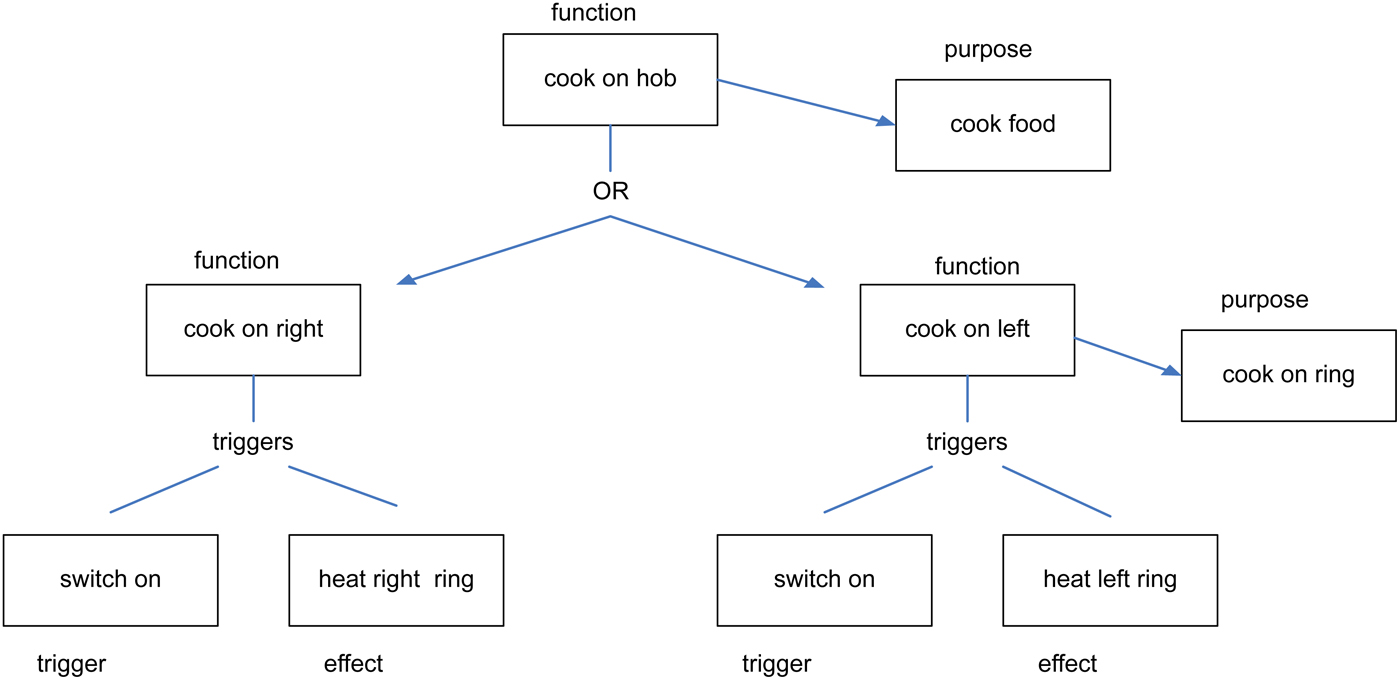
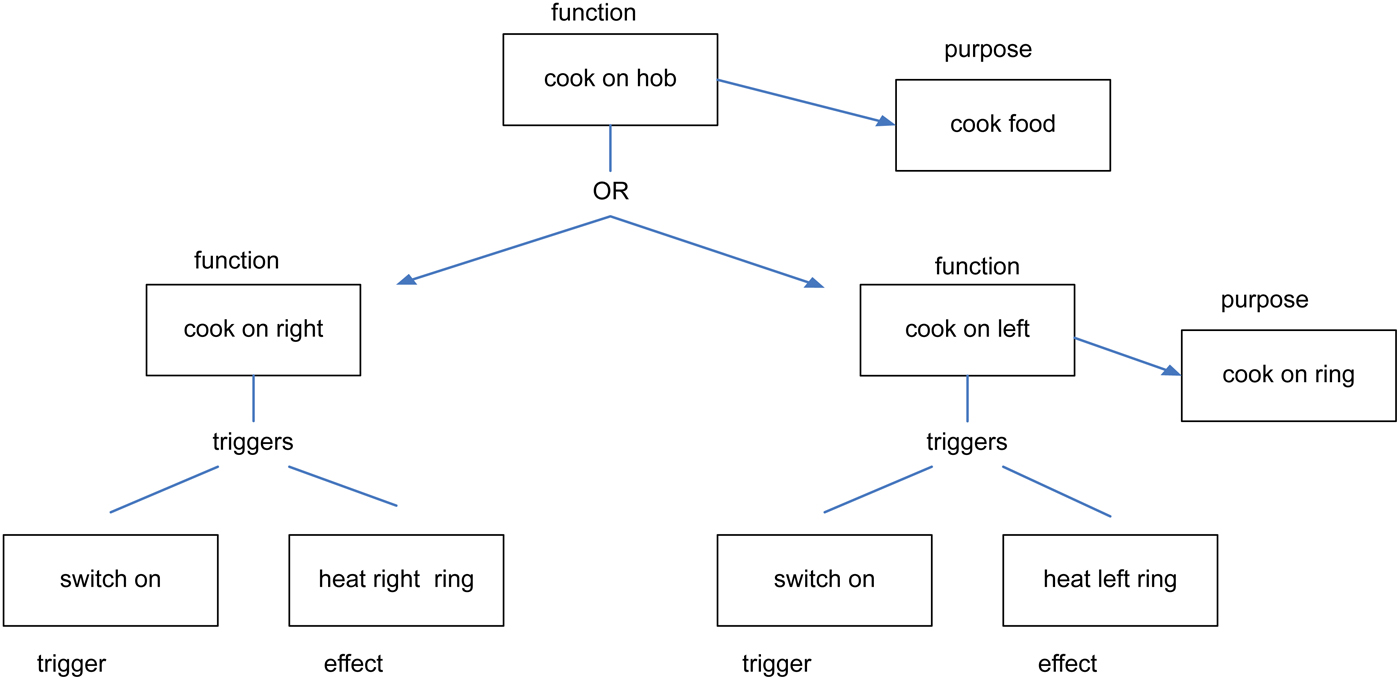
In FIL, functions have the meaning of effect functions and are represented in terms of three elements: the trigger of a function, its associated and expected effect, and the purpose that the function is to fulfill. Triggers describe input states that actuate physical behaviors that result in certain (expected) effects. Therefore, triggers are the input conditions for effects, that is, functions, to be achieved.Footnote 7 Purposes describe desired states of affairs in the world that are achieved when a trigger results in an expected effect (Bell et al., Reference Bell, Snooke and Price2007, p. 400). For instance, with FIL, the function of a cooking ring of a cooking hob is described in terms of the trigger “switch on,” the effect “heat ring,” and the purpose “cook on ring.”Footnote 8 This description is a summary of some salient features of (manipulating) such artifacts; throwing the switch will, if the system functions properly, result in the heating of the ring(s), which in turn supports the preparation of food.
According to Bell et al. (Reference Bell, Snooke and Price2007), such trigger and effect representations serve two explanatory ends in malfunction analyses: first, they highlight relevant behavioral features (i.e., effects) and simultaneously provide the means to ignore less relevant or irrelevant behavioral features (i.e., physical behaviors underlying these effects) of a given artifact; and second, they support assessing which components are malfunctioning (pp. 400–401).
For instance, the trigger–effect representation “switch on”–“heat ring” highlights the input condition of a switch being thrown, and the resulting desired effect of heat, yet ignores the structural and behavioral specifics of the switch and ring, as well as the energy conversions (e.g., electricity conversions into thermal energy) that are needed to achieve this effect. Such representations only highlight those features that are considered explanatorily relevant to assess malfunctioning systems and omit reference to physical behaviors/energy conversions by which desired effects are achieved.
There is another way in which the use of trigger–effect descriptions is considered an explanatory asset in highlighting explanatorily relevant features in malfunction explanation: comparing normally functioning technical systems with malfunctioning ones in order to identify malfunctioning components or submechanisms (Bell et al., Reference Bell, Snooke and Price2007). Trigger-effect descriptions support assessing whether the expected effects obtain, and if not, which and how components are malfunctioning (Bell et al., Reference Bell, Snooke and Price2007). A normally functioning technical system, say, the cooking hob, has both a trigger and an effect occurring; a switch is thrown and a ring is heated. Trigger–effect descriptions support analysis of two varieties of malfunction. First, a trigger may occur, but fail to result in the intended effect. For instance, the switch is on, yet the ring fails to heat. Second, a trigger may not be occurring, yet the effect is nevertheless present. For instance, the switch is not on, but the ring is nevertheless heated (see Bell et al., Reference Bell, Snooke and Price2007). Such analyses of the actual states of triggers and effects allow one to focus on the most likely causes of failure (Bell et al., Reference Bell, Snooke and Price2007). If the switch is on and the ring fails to heat, the first likely cause to investigate may be whether the electrical circuitry connected to the ring is damaged. If the switch is not on and the ring is heated, a first likely cause to investigate may be whether the “on/off” display of the switch is damaged (we see, as mentioned in footnote 6, that structural knowledge of a system serves as backdrop for malfunction assessment).
The effect functional decomposition model in Figure 1 is an example of the sort of models used for malfunction explanation. In such assessments, elaborate details on structural and behavioral specifics of technical artifacts (e.g., all the details of the hob's electrical circuit) are considered unwanted. Functional descriptions pick out only the salient and relevant details for malfunction assessment. [Of course, after a likely cause (or causes) of a particular malfunction has been identified, it may become useful for an analyst to investigate a malfunctioning component or submechanism in more detail, such as for repair or redesign purposes; see Section 4. More detailed behavioral models of components and their behaviors are used in FIL for this task, but only after a first round functional analysis of malfunction. Such behavioral analyses may reveal multiple features underlying a component malfunction, like multiple faults in a cooking hob's electrical circuit.]
Effect functional decomposition of a two-ring cooking hob. The example is drawn from Bell et al. (Reference Bell, Snooke and Price2007). The diagrammatic representation is adapted from “Functional Decomposition for Interpretation of Model Based Simulation,” by J. Bell, N. Snooke, and C. Price, Reference Bell, Snooke and Price2005, in Proc. 19th Int. Workshop on Qualitative Reasoning, QR-05 (Hofbaur, M., Ed.), pp. 192–198, Graz, Austria: Technical University of Graz. Copyright 2005 by Technical University of Graz. Adapted with permission.
Thus, here we have a case in which function ascriptions and malfunction claims are clearly relevant. Functional descriptions in FIL highlight the salient features of normally functioning artifacts, suppressing reference to irrelevant behavioral and/or structural details (constraint 1), and pinpoint where the specific faults occur in malfunctioning artifacts (constraint 2). Functional descriptions here thus satisfy the two constraints on malfunction explanation that we introduced earlier.
Two follow-up questions present themselves: which notion of function is best suited for malfunction analysis; and which representational format is to be preferred for the best suited concept of function? We take these questions in turn. As mentioned, descriptions of functions in FIL refer to desired effects of behaviors. Given that function descriptions should enable us to black box or suppress reference to irrelevant behavioral and structural details (constraint 1), the choice for effect function descriptions is the optimal one. Effect function descriptions are best equipped to highlight the relevant difference makers with respect to malfunctioning artifacts, because more elaborate behavior function descriptions include irrelevant details such as the thermal energy generated when lamps are lit and/or the acoustic energy produced by power screwdrivers. Behavior function descriptions are thus less suited to black box irrelevant details and make salient relevant details of technical systems (constraint 1). Because of excess detail, behavior function descriptions are also less suited to identify contrastive difference makers (i.e., malfunctioning components or submechanisms; constraint 2).
Purpose function descriptions, in turn, refer to desired states of affairs in the world. Such descriptions provide a useful yardstick to assess whether desired states of affairs obtain, and if that is not the case, signal a malfunction of some sort, yet have no utility in describing internal difference-making factors (i.e., faults in artifact mechanisms) because they refer to states of affairs external to artifacts. Descriptions of purpose functions thus fail to meet both constraints, because a precondition for meeting the two constraints is that functional descriptions are device-centric ones (cf. Chandrasekaran & Josephson, Reference Chandrasekaran and Josephson2000). Hence, in the context of malfunction explanation, when the two constraints are in place, the notion of effect function is most useful.
Given this result, which representational format is optimal to represent effect functions? In light of the two constraints in the context of malfunction explanation, the trigger–effect format for representing functions as endorsed in FIL (Bell et al., Reference Bell, Snooke and Price2007) seems preferable to the more often used verb–noun format for representing functions (cf. Sembugamoorthy & Chandrasekaran, Reference Sembugamoorthy, Chandrasekran, Kolodner and Riesbeck1986; Hawkins & Woollons, Reference Hawkins and Woollons1998; Price, Reference Price1998; Van der Vegte et al., Reference Van der Vegte, Kitamura, Koji and Mizoguchi2004). Trigger–effect descriptions allow a more unambiguous localization of malfunctioning components or submechanisms (constraint 2) than verb–noun descriptions. For instance, trigger–effect descriptions such “switch on”–“heat ring” contain “pointers” to likely malfunctioning components: if the switch is on and the ring fails to heat, a first likely cause to investigate may be whether the electrical circuitry connected to the ring is damaged; if the switch is not on and the ring is heated, a first likely cause to investigate may be whether the “on/off” display of the switch is damaged. Verb–noun descriptions such as “heat ring” or “fail to heat ring,” in which reference to triggering conditions is omitted, do not enable localization in such precise fashion. Such omission of triggering conditions makes verb–noun descriptions also less apt to satisfy constraint 1; by such omissions, too much information is black boxed, and hence salient details relevant for explaining malfunctions are neglected.
The superior utility of trigger–effect descriptions compared with verb–noun descriptions becomes even clearer when considering more complex cases of malfunction. Consider the functional analysis of an automobile's warning system (Bell et al., Reference Bell, Snooke and Price2007, p. 404). This system has, among others, the following functions represented in trigger–effect format: “smoke detection”–“siren sound activated,” “smoke detection”–“strobe light activated,” “alarm button pressed”–“siren sound activated,” and “alarm button pressed”–“strobe light activated.” In this case, different effects share the same triggers. Such trigger–effect descriptions again allow a more unambiguous localization of malfunctioning components or submechanisms (constraint 2) than verb–noun descriptions. For instance, in Price's (Reference Price1998) functional labeling approach for malfunction assessment, descriptions of functions only refer to effects, omitting reference to their triggers (cf. Price, Reference Price1998; Bell et al., Reference Bell, Snooke and Price2007). Applied to the above example, the functional labeling approach would only give function descriptions like “siren sound activated” and “strobe light activated.” First, such a representational format would fail to distinguish between the two varieties of malfunction. For instance, the situation in which a trigger does not occur, yet the effect is nevertheless present, say, the strobe light is activated without smoke being detected by the system, is not expressible in verb–noun format. Hence, the verb–noun format here fails to give “pointers” to possible causes underlying this malfunction, such as a rupture in the smoke detection component. Second, more generally, the omission of reference to triggering conditions makes the localization of faults less precise and effective. Omitting reference to triggers such as smoke detectors and alarm buttons makes it much more difficult to localize faults in malfunctioning systems, such as ruptured smoke detection components. Again, such omission of triggering conditions makes verb–noun descriptions also less apt to satisfy constraint 1, because too much information relevant for explaining malfunctions is black boxed and neglected.
We now move on to three design cases and assess the utility of behavior, effect, and purpose function in each of these contexts: innovative design, redesign, and routine design. We start by describing Vermaas' (Reference Vermaas2009, Reference Vermaas2011) analysis according to which each of the three function concepts is useful for fulfilling the methodological “bridging” role of relating descriptions of purposes to descriptions of the structures of technical artifacts, and that this role does not single out a specific optimal meaning. We show instead, by way of empirical examples and constraints derived from the functional modeling and representation literature, that specific meanings of function are only useful to fulfill this bridging role in innovative designing relative to specific design constraints that do or do not apply. In other words, claims about the utility of concepts of function should take into account additional constraints that functional descriptions should be able to meet.
4. INNOVATIVE ENGINEERING DESIGN
4.1. Bridging purpose and structure descriptions
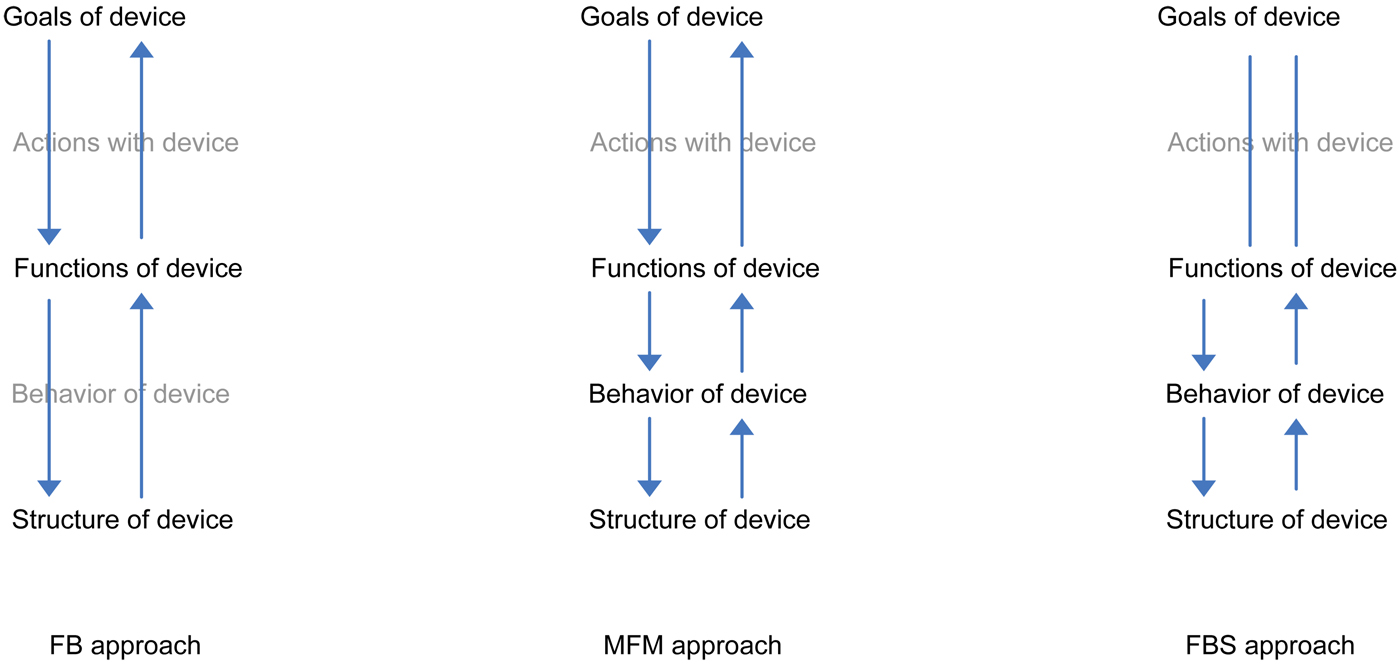
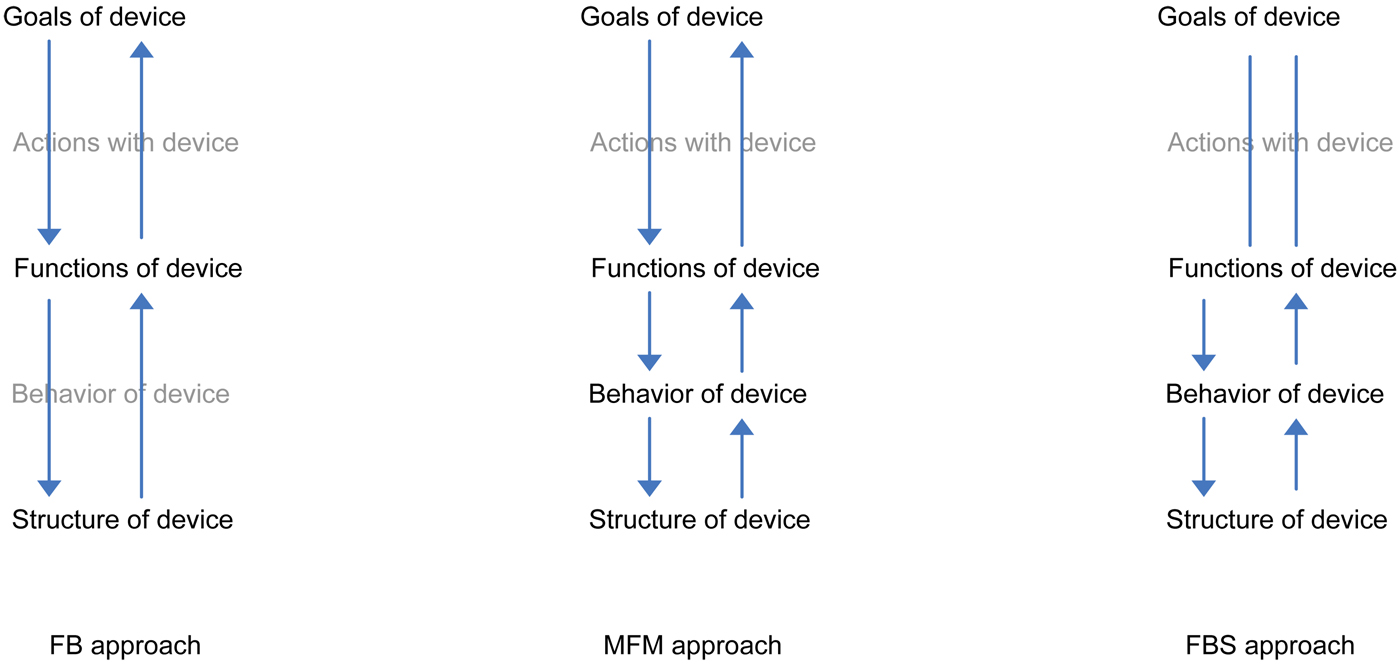
Vermaas (Reference Vermaas2009, Reference Vermaas2011) argued that different notions of function are useful to fulfill the methodological “bridging” role of relating purpose to structure in engineering design. Vermaas (Reference Vermaas2009) illustrated this point in terms of three (well-known) design approaches, in each of which a different notion of function is invoked to relate purpose to structure descriptions of technical artifacts: the functional basis method (Stone & Wood, Reference Stone and Wood2000); the function–behavior–structure method (Gero, Reference Gero1990); and the multilevel flow method (Lind, Reference Lind1994).
In the functional basis method (Stone & Wood, Reference Stone and Wood2000), designers reason in one step from purposes, which are defined in terms of customer needs, to functions and then in one step from functions to structure (design solutions). Because functions in the functional basis method, as detailed in Section 1, are behavior functions, designers thus reason with this method from purposes to desired behaviors and then structures.
In the function–behavior–structure method of Gero (Reference Gero1990), designers reason directly from function to behavior and then structure. However, as detailed in Section 1, functions in Gero's (Reference Gero1990) framework are purpose functions. In this method, while using a different notion of function than in the functional basis method, the end result is the same: designers also reason from purposes to behaviors and then structures.
In the multilevel flow method of Lind (Reference Lind1994), designers reason from purposes to functions, then to behaviors, and finally to structures. In Lind's method, as detailed in Section 1, functions are effect functions. Here the end result is different from the functional basis and function–behavior–structure method: designers relate purposes to behavior and structure descriptions of technical artifacts via effect function descriptions. These three reasoning schemes are illustrated in Figure 2.
Design reasoning in the functional basis, multilevel flow, and function–behavior–structure method (Vermaas, Reference Vermaas2010). Concepts depicted in gray are ones that are “bypassed”/not referred to in the listed methods. We here follow Vermaas’ (Reference Vermaas2010) graphical illustration and usage of concepts: “Goals” mean the same as the term “purposes” we use in the text; “functions” have the meaning of “behavior,” “effect,” or “purpose” function, depending on the approach and design reasoning scheme used in it. Adapted from “Technical Functions: Towards Accepting Different Engineering Meanings With One Overall Account,” by P.E. Vermaas, Reference Vermaas2010, in Proc. 8th Int. Symp. Tools and Methods of Competitive Engineering, TMCE 2010 (Horvath, I., Mandorli, F., & Rusák, Z., Eds.), Vol, 1, pp. 183–194, Delft: Delft University of Technology. Copyright 2010 by TMCE, Delft University of Technology. Adapted with permission.
The upshot of Vermaas (Reference Vermaas2009, Reference Vermaas2011) with these examples is that descriptions of behavior functions, effect functions, and purpose functions are all useful for fulfilling the methodological “bridging” role of relating purpose descriptions to descriptions of the structures of technical artifacts: “this methodological role of functional descriptions is not singling out one specific meaning for function, but undermines this meaning” (Vermaas, Reference Vermaas2011, p. 7; this bridging can proceed directly from purpose to structure via function, or indirectly from purpose to behavior via function and then to structure).
We agree that the utility of functional descriptions in design, inter alia, relates to the methodological role such descriptions can fulfill in relating purpose to structure descriptions. However, there is a further important follow-up question: are each of the three concept of function equally suitable for fulfilling the bridging role, or rather, is some concept better suited than others for this role? We address this question in the next subsection in the context of innovative designing. Our results show that the utility of function concepts for this role does not hold simpliciter. The utility of function concepts for this role, rather, is conditional on further constraints that apply.
4.2. Innovative engineering design
There is considerable debate as to what “innovative designing” is precisely (cf. Brown & Chandrasekaran, Reference Brown and Chandrasekaran1986; Gero, Reference Gero1990; Stone & Wood, Reference Stone and Wood2000; Chakrabarti & Bligh, Reference Chakrabarti and Bligh2001). Rather than engaging in this debate, we focus on three often emphasized constraints in the functional modeling and representation literature that functional descriptions should meet in order to be useful in the context of innovative design, and assess which notion of function satisfies these constraints best (cf. Umeda et al., Reference Umeda, Ishii, Yoshioka, Shimomura and Tomiyama1996; Ckakrabarti, Reference Chakrabarti1998; Stone & Wood, Reference Stone and Wood2000; Chakrabarti & Bligh, Reference Chakrabarti and Bligh2001; Deng, Reference Deng2002; Kitamura et al., Reference Kitamura, Koji and Mizoguchi2005; Bryant et al., Reference Bryant, McAdams, Stone, Kurtoglu and Campbell2006, Reference Bryant, Stone, Greer, McAdams, Kurtoglu and Campbell2007). These constraints are (1) behavior selection, selecting behaviors that are assumed to realize certain functions; (2) behavior verification, assessment of whether selected behaviors realize certain functions; and (3) the use of archived information on structure–function connections in designing.
With respect to the first constraint, the relevance of functional parlance in behavior selection can be expressed somewhat more formally as follows: in order for purpose g to be achieved, we need a behavior b such that it fulfills function f. In the case of the second constraint of behavior verification: behavior b is suitable to achieve purpose g if it fulfills function f.
When either one or both of these constraints apply, we argue, only the notion of effect function is suitable. Descriptions of behavior functions (referring to desired behaviors) already refer to selected behaviors rather than enabling the selection of behaviors from a range of alternatives. Behavior function descriptions thus fail to meet constraint 1. For instance, the behavior function “convert electricity to torque” of a power screwdriver that is represented as a conversion of an input flow of “electricity” into corresponding output flows of “torque,” “heat,” and “noise” is a specific description of a specific behavior. Such a description thus does not enable the selection of a behavior from a range of alternatives because it already refers to a specific behavior. The effect function “produce torque,” in contrast, does allow considering behavior alternatives: it can be achieved by electricity-into-torque conversions, pneumatic energy-into-torque conversions,and human force-into-torque conversions. Similarly, purpose function descriptions do not refer to the behaviors or effects by which desired states of affairs are brought about, and thus also have little use in behavior selection. For instance, the purpose function description “drive in/remove screws” in itself does not specify any possible behaviors or behavioral effects, namely, rotational energy/torque, by which this state of affairs could be achieved. It does not contain cues to possible behaviors as in the case of effect functions above. By implication, both notions of behavior and purpose function are also of little help in assessing whether selected behaviors realize certain functions (constraint 2). In the case of behavior functions, behavior verification becomes trivial because behavior and function are the same. If behavior b is present, so is function f. In the case of purpose functions, there is no reference to behaviors or behavioral effects and thus no information to assess whether or not a particular behavior realizes a function or not.
Effect function descriptions, however, are clearly useful for meeting these two constraints: given a specified desired effect of behavior, for example, “produce torque,” one can search for behaviors that bring this effect about, for example, “electricity-into-torque conversions,” “pneumatic energy-into-torque conversions,” and “human force-into-torque conversions” (constraint 1), and descriptions of effects of behaviors provide an evaluative yardstick to assess whether they are realized by the behaviors selected (constraint 2). For instance, in the above example, when “torque” is present, one knows that the behavior selected (“electricity-into-torque conversion,” “pneumatic energy-into-torque conversion,” or “human force-into-torque conversion”) is present as well.
Thus, when functional descriptions should satisfy constraints 1 and 2, behavior and purpose function descriptions cannot fulfill the methodological role of relating purpose descriptions to structure descriptions of technical artifacts. Only effect function descriptions are useful in this context. The further question of which representational format to prefer for describing effect functions seems to depend on the representational format in which to be selected and verified behaviors are specified. Both behavior and function representations should meet, in order to avoid interpretation difficulties, a further constraint of representational consistency; to support unambiguous selection and verification, function and behavior are better represented in the same format, be it in verb–noun fashion, operation-on-flow style, or otherwise (and if the representational formats would differ, then unambiguous “interpretation rules” better accompany the representations).
Are behavior and purpose function descriptions useful for fulfilling the methodological bridging role when different constraints apply? When the third constraint of using archived information on structure–function connections in designing is operative, behavior and purpose function descriptions also may fulfill this role. Let us elaborate.
Frequently, knowledge bases are employed in designing in which known (and adequate) function–structure connections are laid down (Umeda et al., Reference Umeda, Ishii, Yoshioka, Shimomura and Tomiyama1996; Deng, Reference Deng2002; Bryant et al., Reference Bryant, McAdams, Stone, Kurtoglu and Campbell2006, Reference Bryant, Stone, Greer, McAdams, Kurtoglu and Campbell2007; van Eck, Reference van Eck2010). When designs are constructed exclusively in terms of the information archived in knowledge bases, descriptions of behavior and purpose functions are useful to relate purpose descriptions to structure descriptions of technical artifacts. In such cases, it may be assumed that the constraints of behavior selection and verification have already been satisfied prior to the inclusion of descriptions of behavior function–structure and purpose function–structure connections in knowledge bases. We may assume that prior to archiving, it is established which effects are brought about by the to be archived behavior functions and by which effects desired states of affairs can be realized. If these assumptions hold, then behavior functions and purpose functions can also fulfill the role of relating purpose to structure in engineering design. [The function–behavior–structure framework (Gero, Reference Gero1990) invokes such knowledge bases, and the functional basis method has been extended with a knowledge base in which known and adequate function–structure connections are archived, including algorithms to select the most optimal component configurations for a given overall function (Bryant et al., Reference Bryant, McAdams, Stone, Kurtoglu and Campbell2006, Reference Bryant, Stone, Greer, McAdams, Kurtoglu and Campbell2007). Again, different representational formats seem suited for describing functions (and structures), as long as the constraint of representational consistency is met (which specific format to prefer, depends on further constraints). For instance, if a designer explicitly wants to model temporally ordered operations of artifact mechanisms, operation on flow representations seem better suited than verb–noun or trigger–effect descriptions.]
The claim that each of the three archetypical notions of function has utility in relating purpose and structure descriptions (Vermaas, Reference Vermaas2011) thus is supported by the above examples. However, this utility is conditional on specific design constraints that apply. Not every concept of function will do in every context.
This utility of behavior and purpose function descriptions in the context of innovative design directly relates to the mentioned dispute on what “innovative designing” precisely amounts to. According to some designers, the hallmark of innovative designing is specifying functional descriptions to arrive at novel solutions by explicitly not considering design solutions for functions in the phase of function specification (e.g., Stone & Wood, Reference Stone and Wood2000). Given this perspective, and assuming that the constraints of behavior selection and verification are operative, behavior and purpose functions then have little utility in innovative design. If, rather, the perspective is adopted that innovative designs can be arrived at via novel combinations of archived function–structure connections (Gero, Reference Gero1990; Chakrabarti & Bligh, Reference Chakrabarti and Bligh2001), behavior and purpose function descriptions are useful. Our analysis thus also charts the relevance of specific conceptualizations of function with respect to different perspectives on innovative design one may adopt.
What is the relevance of function and the three archetypical notions in other engineering design contexts? We first address this issue in the context of redesign in the next section. Then we consider routine design.
5. ENGINEERING REDESIGN AND ROUTINE DESIGN
5.1. Redesign
We here assess the relevance of function in terms of Otto and Wood's (Reference Otto and Wood1998, Reference Otto and Wood2001) method for reverse engineering and redesign. By assessing this method, we show that function ascriptions are relevant for constructing comparative analyses. These comparative analyses play an important role in the redesign (and improvement) of existing technical artifacts. We then address the question which notion of function is optimal for this task. We chart the relevance of different notions of function in terms of the following constraints, derived from the literature, that often apply in (reverse engineering and) redesign contexts: the (1) specification of temporal and spatial organization of artifact mechanisms, and (2) completeness, the richness or level of detail with which mechanistic organization of artifacts is specified (cf. Stone & Wood, Reference Stone and Wood2000; Chakrabarti & Bligh, Reference Chakrabarti and Bligh2001; Otto & Wood, Reference Otto and Wood2001; Bohm & Stone, Reference Bohm and Stone2004; Bryant et al., Reference Bryant, McAdams, Stone, Kurtoglu and Campbell2006, Reference Bryant, Stone, Greer, McAdams, Kurtoglu and Campbell2007; Sen et al., Reference Sen, Summers and Mocko2011; Sen & Summers, Reference Sen and Summers2013).
In this reverse engineering and redesign method (Otto & Wood, Reference Otto and Wood1998, Reference Otto and Wood2001), a reverse engineering phase, in which reverse engineering explanations are developed for existing artifacts, precedes and drives a subsequent redesign phase of those artifacts. In the reverse engineering phase, an artifact is first broken down component-by-component, and hypotheses are formulated concerning the functions of those components. In this method, as detailed in Section 2, functions are behavior functions and represented by conversions of flows of materials, energy, and signals. After this analysis, a different reverse engineering analysis commences in which components are removed, one at a time, and the effects are assessed of removing single components on the overall functioning of the artifact. Such single component removals are used to detail the functions of the (removed) components further. The idea behind this latter analysis is to compare the results from the first and second reverse engineering analyses in order to gain potentially more nuanced understanding of the functions of the components of the (reverse engineered) artifact. Using these two reverse engineering analyses, a model of the artifact is then constructed in which the functions of the components are specified and interconnected by their input and output flows of materials, energy, and signals (Otto & Wood, Reference Otto and Wood1998, Reference Otto and Wood2001; cf. Bohm & Stone, Reference Bohm and Stone2004; Bryant et al., Reference Bryant, McAdams, Stone, Kurtoglu and Campbell2006, Reference Bryant, Stone, Greer, McAdams, Kurtoglu and Campbell2007).
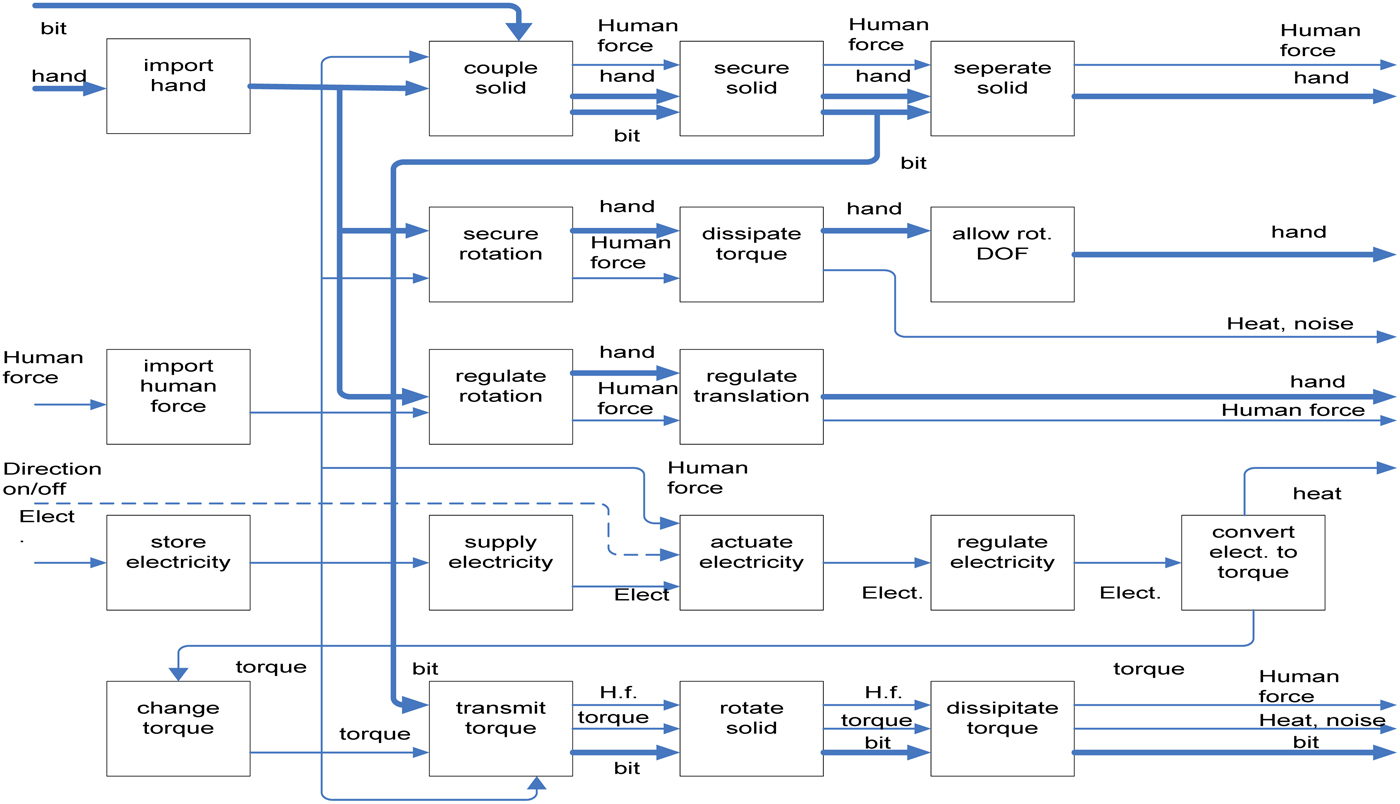
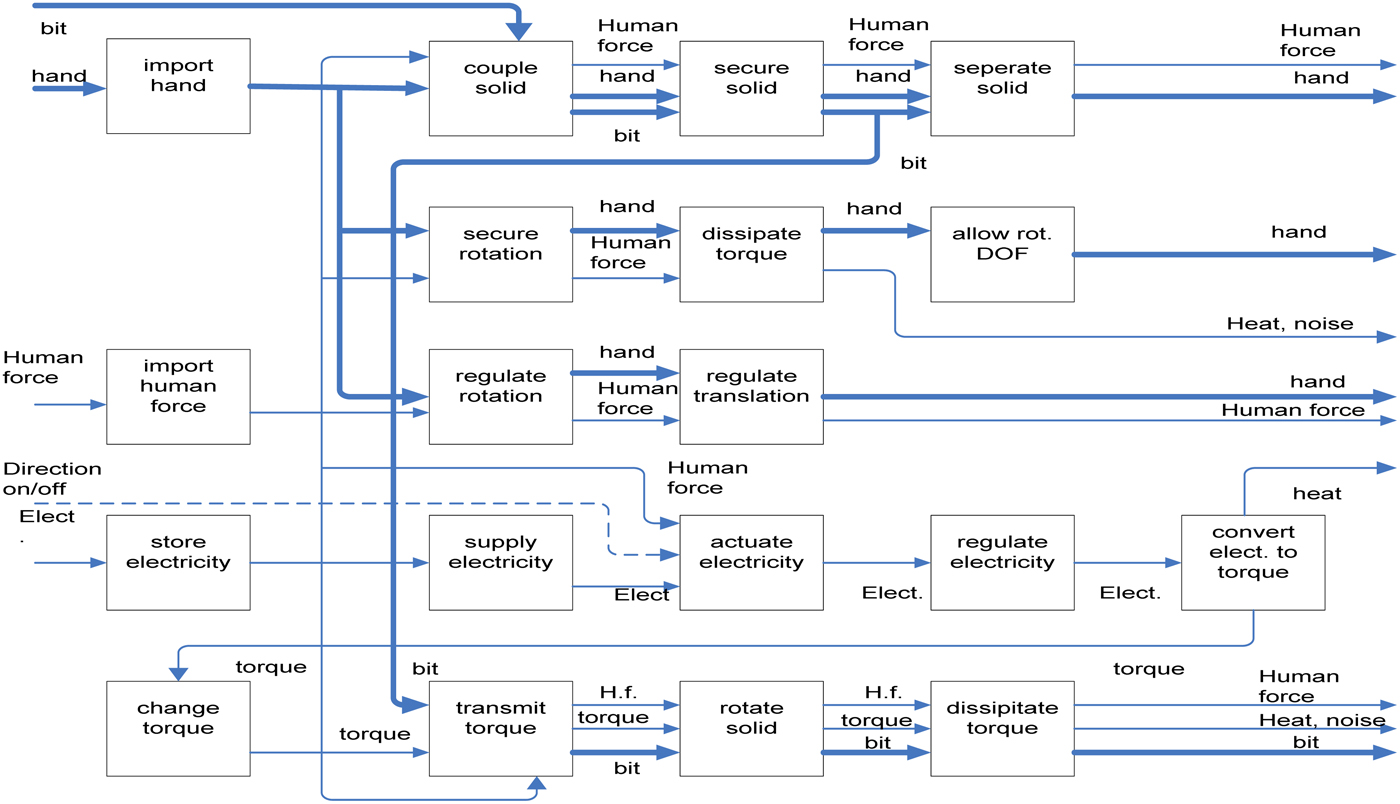
An example of a reverse engineered electrical screwdriver is given in Figure 3. These models of reverse engineered technical artifacts are used to construct what we here call comparative analyses. These comparative analyses play an important role in (re)designing improved versions of reverse engineered artifacts. Models of reverse engineered technical artifacts are used in this method to identify components that function suboptimally and thereby cause artifacts to manifest their overall functions in suboptimal fashion. Consider, for instance, an electric wok whose function to “deliver a uniform temperature distribution across the bowl” failed to be achieved because the electric heating elements of the wok, such as a bimetallic temperature controller, were housed in too narrow a circular channel (Otto & Wood, Reference Otto and Wood1998, p. 235). Redesign efforts were subsequently directed toward a design with improved functionality of the heating elements, inter alia resulting in a design with a thicker bowl and different shape than in the reverse engineered electric wok. (This redesign step involves a lot of mathematical modeling, use of physical and technological principles, and/or prototype building; Otto & Wood, Reference Otto and Wood1998, Reference Otto and Wood2001. These details need not concern us here.)Footnote 9
Behavior functional decomposition of an electric power screwdriver. Thin arrows represent energy flows: thick arrows represent material flows, and dashed arrows represent signal flows. Adapted from “Development of a Functional Basis for Design,” by R.B. Stone and K.L. Wood, 2000, Journal of Mechanical Design 122, p. 364, fig. 4. Copyright 2000 by ASME. Adapted with permission.
Here, function ascriptions are relevant to compare reverse engineered artifacts with novel designs with respect to functional performance. More formally, functional parlance is useful in redesign for making the claim that a novel component b functions better than component a; or if component a is replaced by component b, the function that a has will be fulfilled in a better way by b. In our wok example, the thicker and differently shaped bowl fulfills its function better than did the old bowl; or a halogen heat lamp fulfills the function of “converting electricity to radiation” in a better way than the wok's heating coil (cf. Otto & Wood, Reference Otto and Wood1998, p. 236).
Function ascriptions are relevant in redesign to make such claims about improved performance of a given component in comparison to other ones. Such claims are normative and cannot be made without invoking function ascriptions. Both the old heating coil and the new halogen heat lamp have the capacity to convert electricity to radiation, and both the old and the new bowl have the capacity to conduct heat. To compare and distinguish these components in terms of performance, statements about mere capacities are not helpful because these do not highlight differences in performance; rather, statements like component b functions better than a need to be invoked to express such facts.
Which concept of function is best suited to make such comparisons about performance? We again derive two constraints from the functional modeling literature that functional descriptions should meet in order to be useful in this context, and assess which notion of function satisfies these constraints best. As mentioned, these constraints are the specification of temporal and spatial organization of artifact mechanisms, and completeness, the richness or level of detail with which mechanistic organization of artifacts is specified.
In the reverse engineering and redesign method (Otto & Wood, Reference Otto and Wood1998, Reference Otto and Wood2001), as detailed in Section 1, functions are behavior functions. Is behavior function the best concept for redesign tasks? Given that redesign starts with a reverse engineering phase, the choice to employ behavior functions is the optimal one because behavior function descriptions meet the constraints of specifying mechanistic organization (constraint 1) with a suitable level of detail (constraint 2) better than effect and purpose function descriptions do.
Specifications of behavior functions (and components that fulfill them) give a more comprehensive picture of the temporal organization of behaviors of artifact mechanisms (constraint 1) than effect function descriptions do, because behavior function descriptions detail both the input and the output of functions as well as the connectivity between functions in terms of their input and output. Ipso facto, they give a comprehensive picture of the spatial organization of components that fulfill these functions (cf. the reverse engineered artifacts stored in the design repository and the bills of materials-models in the Otto and Wood method). The specification of temporal organization is often implicit or absent when using effect function descriptions, because input–output connections between functions are either (which is often the case) not specified or in course-grained fashion. When they are not specified, effect function descriptions fail to meet constraint 1 (organization) and 2 (completeness). When temporal information is specified in abstract fashion, constraint 1 is satisfied, but constraint 2 is not. A comparison of the models in Figures 1 and 3 is instructive in this regard. Behavior function descriptions are thus better suited than effect function descriptions to depict the temporal and spatial organization of mechanisms by which artifacts operate; that is, they meet constraints 1 and 2 better and thus are better suited for the reverse engineering phase that precedes the redesign phase. Purpose function descriptions fail to meet both constraints (and thus are irrelevant for reverse engineering) because they describe state of affairs in the world to be realized by the behaviors of artifacts; that is, they simply do not describe internal behaviors of artifact mechanisms.Footnote 10
For the subsequent comparative analyses, behavior function descriptions are the most useful for similar reasons. First, these contain the most detail (constraint 2) and thus the most information to assess the performance of components and make comparisons between components. For instance, the novel halogen heat lamp fulfills the function of “converting electricity to radiation” in a better way than the wok's heating coil because the halogen lamp produces less heat or noise, or both. Effect function descriptions such as “produce radiation” contain less relevant comparative information. Second, in replacing components, one needs to take the structural configuration of the reverse engineered artifact into account, that is, how the to be replaced component is organized with other components, in order to ensure that the novel component can be placed in this configuration (constraint 1). Descriptions of behavior functions, and temporally ordered sequences thereof, such as specified in reverse engineering models in which the behavior functions of the components are specified and interconnected by their input and output flows of materials, energy, and signals, provide the most elaborate information on structural configurations. Again, descriptions of purpose functions do not meet either constraint.
Concerning to be preferred representational formats for behavior functions in this context, representational consistency again is a relevant constraint; the format should be such that, in order to avoid interpretation difficulties, function and component descriptions have a compatible format.
We now consider the utility of function in our final context of routine design.
5.2. Routine design
We assess the relevance of function in terms of a method for routine design developed by Chakrabarti and Bligh (Reference Chakrabarti and Bligh2001). Routine designing is characterized by engineers as the designing of novel artifacts by using knowledge, often laid down in knowledge bases, of how existing structures realize specific functions (e.g., Chakrabarti & Bligh, Reference Chakrabarti and Bligh2001; Deng, Reference Deng2002; Kitamura & Mizoguchi, Reference Kitamura and Mizoguchi2003, Reference Kitamura and Mizoguchi2004). By assessing this method, we show that function ascriptions are relevant for relating function to structure descriptions. We then address the question which notion of function is optimal for this task. We assess the relevance of different notions of function in terms of the following constraints, derived from the literature, that often apply in routine design contexts: using (1) archived information on structure–function connections, and the (2) specification of temporal and spatial organization of artifact mechanisms (cf. Stone & Wood, Reference Stone and Wood2000; Chakrabarti & Bligh, Reference Chakrabarti and Bligh2001; Otto & Wood, Reference Otto and Wood2001; Kitamura & Mizoguchi, Reference Kitamura and Mizoguchi2003; Bohm & Stone, Reference Bohm and Stone2004; Kitamura & Mizoguchi, Reference Kitamura and Mizoguchi2004; Bryant et al., Reference Bryant, McAdams, Stone, Kurtoglu and Campbell2006, Reference Bryant, Stone, Greer, McAdams, Kurtoglu and Campbell2007; Albers et al., Reference Albers, Braun, Clarkson, Enkler and Wynn2009, Reference Albers, Braun, Sadowski, Wyatt, Wynn and Clarkson2010).
In the Chakrabarti and Bligh method, designing starts with a specification of an overall function that a to be developed artifact needs to achieve. Then a subfunction of this overall function is specified, after which a knowledge base is employed to select a structure that can achieve this subfunction. This selection is made from a set of structures each of which can realize this subfunction, and one of these structures is selected as a design solution for this subfunction. The process continues by specifying a different subfunction of the overall function and then, again, selecting a structure for achieving this subfunction from a set of structures, each of which can achieve this particular subfunction. This process continues until all the subfunctions of the overall function, and thereby the overall function, are solved. The end result is specified in a model in which subfunctions and their design solutions/structures are described.Footnote 11
In the Chakrabarti and Bligh (Reference Chakrabarti and Bligh2001) method, as detailed in Section 1, functions are behavior functions. In this method, designers thus reason directly from desired behaviors to structures. Is this the optimal concept of function to relate function to structure?
Given the first constraint of using archived information on structure–function connections, paired with the assumption that the constraints of behavior selection and verification are not operative in the context of using archived knowledge on function–structure relations, this knowledge usage is indiscriminate between behavior, effect, and purpose functions (see Section 4.2). Every archetypical concept of function will do. Nevertheless, Chakrabarti and Bligh (Reference Chakrabarti and Bligh2001) observe that their method also makes clear when archived knowledge on function–structure relations is insufficient to solve a given subfunction, and thus that new knowledge of this sort is required. In this context, we submit, function ascriptions are especially relevant. They support claims of the sort: function f has yet to be achieved by some structure s.
Given this further (sub)task of component exploration and selection, the second constraint of specifying the temporal and spatial organization of artifact mechanisms (also) becomes operative, as in the redesign case. As in the case of replacing components, here one also needs to take the structural configuration of a design into account when exploring potential components and adding (newly selected) components to it, that is, exploring how the to be added component is to be organized with other components of the design, in order to ensure that the to be added component can be placed in this configuration. Descriptions of behavior functions, and sequences thereof in models in which the behavior functions of the components are specified and interconnected by their input and output of materials, energy, and signals, provide the most elaborate information on structural configurations. Hence, the notion of behavior function is the most useful for this task.
6. IMPLICATIONS AND CONCLUSIONS
We started the paper with the observation that despite the status of technical function as a key concept in engineering design, a systematic, rigorous analysis of the utility of function and the different conceptualizations thereof is missing in the engineering design literature. In effect, both proposals for a single, commonly shared notion of function and ones for relating different notions of function lack evidential and theoretical support. In this paper, we addressed this challenge and provided validation for the coexistent usage of different notions of function. We investigated the utility of function, and the different meanings of behavior, effect, and purpose function thereof, in the following engineering design contexts: malfunction explanation, innovative design, redesign, and routine design. This paper showed, by way of empirical examples and constraints derived from the functional modeling and representation literature, that the utility of meanings of function is highly task dependent. We charted the relevance of function concepts relative to these constraints in the above mentioned design contexts.
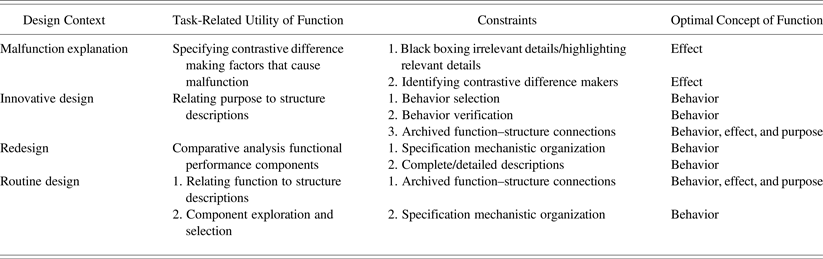
Table 1 provides a brief summary of our main findings. These results directly impact the debate on whether or not to accept ambiguity of functional descriptions in engineering design. Because there are obvious disadvantages to using multiple concepts of function side-by-side (interpretation, communication, and translation problems in design knowledge exchange and collaborative designing), accepting ambiguity of functional descriptions should have a solid theoretical underpinning. To date, this underpinning has been absent in the engineering design literature. This paper addressed this gap and provided theoretical justification for accepting ambiguity of functional descriptions and, hence, for methods to translate and/or convert functional descriptions across engineering design frameworks. There is not one single concept of function that is optimal across the board. It depends on engineering context and constraints, which notion of function is optimal. We therefore defend the practice of using different concepts of function side-by-side.
Design task-related utility of concepts of function

We see our research as complementary to ongoing efforts that aim to specify constraints that specific functional descriptions should meet [e.g., such as Sen et al. (Reference Sen, Summers and Mocko2011) and Sen and Summers' (Reference Sen and Summers2013) work on the valid modeling of behavior functions in terms of complying with physical conservation laws and topological constraints]. Such research is highly relevant but should be complemented with efforts that assess different notions of function and descriptions thereof in terms of their ability to meet specific constraints in specific contexts. This paper offered relevant insights into this second project. Much more work remains to be done in this area. We charted the relevance of function concepts in four engineering settings, yet much more remain to be explored. In this sense, this paper offers a methodological agenda for future work on the utility of functional descriptions. Contexts and research questions that come to mind are the utility of function and its different meanings in the context of analogy-based design, where functional, behavioral, and structural knowledge of previous designs is employed to construct new designs by modifying functional, behavioral, and structural features of previous designs (cf. Goel & Bhatta, Reference Goel and Bhatta2004). Moreover, analogical reasoning, presumably, plays a role in some form or other in each of the design contexts we considered. How function relates to and is useful for analogical reasoning in different engineering design contexts is an avenue for further research.
Another research issue that emerges concerns the potential utility of descriptions of behavior and purpose functions in other innovative design phases than the one in which function has the methodological role of relating purpose descriptions to structure descriptions of technical artifacts. As we saw, in design contexts in which the constraints of behavior selection and verification need to be satisfied, only effect functions descriptions fulfill this role adequately. Behavior and purpose function descriptions are only useful when these constraints are not in place and solely archived knowledge on function–structure connections is invoked in designing. Therefore, the question emerges whether behavior and purpose function descriptions are relevant in other phases of designing.
We see another role that is relevant for descriptions of purpose and behavior functions in innovative design. The achievement of purposes (desired states of affairs) often involves the achievement of other ones (Pollock, Reference Pollock2006). Sets of descriptions of purpose functions, specified in, for instance, functional decomposition models, are useful tools to specify the purposes that artifacts need to achieve. These descriptions can subsequently be used to select and specify the effects of behaviors that artifacts need to display, in combination with actions of users, in order to achieve these purposes. Rather than relating purpose to structure, descriptions of purpose functions then fulfill the role of focusing the specification of effects of behaviors that artifacts need to display. Effect function descriptions are then, as analyzed in this paper, invoked for the selection and verification of behaviors that can realize these effects. After behavior selection and verification, sets of descriptions of behavior functions, specified in, for instance, functional decomposition models, can then be invoked to specify the behaviors that artifacts need to have to realize their effects. Rather than relating purpose to structure, descriptions of behavior functions then have a descriptive role (cf. van Eck, Reference van Eck2011). Such use of multiple notions of function in a single design process or method has also been adopted by some designers (Chakrabarti, Reference Chakrabarti1998; Deng, Reference Deng2002; Srinivasan & Chakrabarti, Reference Srinivasan and Chakrabarti2009; Srinivasan et al., Reference Srinivasan, Chakrabarti and Lindemann2012).
In addition to providing theoretical justification for engineering methods to translate and/or convert functional descriptions across functional modeling and representation frameworks, this paper highlights constraints on the reuse of functional descriptions across function-based design methods and suggests that more research is needed in that direction.
To date, such efforts have been done, for instance, relating behavior and effect functions, without taking the task-dependent utility of specific notions of function into account (cf. van Eck, Reference van Eck2011). By taking such task dependency into account, one can identify “sensible” translation/conversion contexts (i.e., ones in which source and target functional descriptions are used for similar objectives and are also valid for achieving these objectives) and rule out translation/conversion contexts that are irrelevant, for example, ones in which different functional descriptions are used for unrelated objectives. When translating functional descriptions from a source to a target framework, it is crucial to know how functional descriptions are employed in a source framework for assessing how and if they can be reused in a target framework. For instance, that descriptions of behavior functions that are used in a source method to compare the functional performance of components or to focus the search for and selection of novel components cannot be simply reused in a target design method as functional descriptions for which standard components/design solutions are taken to exist. Similarly, descriptions of effect functions that in a source framework are invoked for behavior selection and verification cannot simply be reused in a target method as descriptions of functions for which behaviors (and structures) are already assumed to be available. Potential confusion and impaired knowledge reuse can be avoided by explicitly taking the contexts into account in which functional descriptions are invoked in source design methods.
Finally, research on functional descriptions mainly takes place in academia, not in industry (cf. Tomiyama et al., Reference Tomiyama, van Beek, Cabrera, Komoto and D'Amelio2013). One reason for this might have to do with the ambiguous nature of function as discussed in the literature. Exporting different notions of function (and modeling techniques based on them) to industry prima facie seems unattractive to industry (cf. Vermaas & Eckert, Reference Vermaas and Eckert2013), unless it can be shown that each of the different notions has clear advantages in specific engineering design settings. We hope that our investigation provides a first step in making functional descriptions attractive to industry by detailing tasks for which specific meanings of function are suitable. Clearly, a lot of focused research efforts are still needed in this area.
ACKNOWLEDGMENTS
We thank our reviewers for very helpful comments and Editor-in-Chief Yan Jin for encouragement and support. Thanks are also due to Claudia Eckert and Joachim Frans for their valuable comments on a predecessor version.
Dingmar van Eck is a postdoctoral researcher in philosophy of science at the Centre for Logic and Philosophy of Science, Ghent University. He earned his PhD with a dissertation on functional modeling and explanation in engineering science. Most of Dr. van Eck's current research is on scientific explanation in the life sciences and engineering sciences. His articles have appeared in numerous journals.
Erik Weber is a Professor in philosophy of science in the Department of Philosophy and Moral Science and Director of the Centre for Logic and Philosophy of Science at Ghent University. Most of Dr. Weber's research relates to general theories of causation and explanation or to problems relating to causation and explanation in specific scientific disciplines (mathematics, physics, engineering sciences, psychology, and the social sciences). His articles have appeared in numerous journals, and he recently published a book on scientific explanation.