

The newlywed adjustment period is an important time of change that establishes the foundation for satisfaction and stability within the marriage. For example, Burns (Reference Burns1984) found 15% of divorced women felt their relationship started to break down within the first 3 months of marriage. Huston, Niehuis, and Smith (Reference Huston, Niehuis and Smith2001) identified ‘early exiters’ as being those couples who divorce within the first 6 years of marriage. While Huston et al. identify ambivalence as an important characteristic of these ‘early exiters’, the marital adjustment literature consistently reports that the areas of money, time spent together, and the sexual relationship are problematic for many newlywed couples (e.g., Burns, Reference Burns1984; Center for Marriage and Family, 2000; Risch, Riley, & Lawler, Reference Risch, Riley and Lawler2003; Schramm, Marshall, Harris, & Lee, Reference Schramm, Marshall, Harris and Lee2005). Although the existing literature identifies these areas as being problematic, there is a lack of attention given to how these content areas influence marital outcomes during the early years of marriage. One possible way is through the frequency of disagreements, including the extent to which this frequency changes over time. Disagreements, in general, are associated with lower relationship satisfaction and higher marital instability (Dew, Britt, & Huston, Reference Dew, Britt and Huston2012; Gudmunson, Beutler, Israelsen, McCoy, & Hill, Reference Gudmunson, Beutler, Israelsen, McCoy and Hill2007), and conflict about each of these three areas (money, time, and sex) has been shown to influence relationship outcomes. The current study explored among recently married couples how the frequency of disagreements about money, time spent together, and sex predict frequency of these same conflict topics 5 years later, whether disagreements in one area influence disagreements in another area, and how the frequency of disagreements in these areas influence perceptions of marital outcomes; specifically, marital satisfaction and instability.
Areas of Conflict Within the Marriage
Sharing financial responsibility, spending time together, and having a mutually satisfying sexual relationship promote stability of and overall satisfaction in marital relations. However, conflict in these same areas can be detrimental to the relationship.
Married couples are shown to have higher income and more wealth than singles (Sanders & Porterfield, Reference Sanders and Porterfield2010), and having higher levels of assets are positively associated with wives’ reports of marital satisfaction (Dew, Reference Dew2009). More importantly, couples self-reporting ‘great’ marriages have been shown to share in the decision-making process, share responsibility, have financial equity, and have little or no debt, all of which require trust in and communication between partners (Skogrand, Johnson, Horrocks, & DeFrain, Reference Skogrand, Johnson, Horrocks and DeFrain2011). Unfortunately, disagreements about money appear to be particularly detrimental to marital satisfaction and stability. Conflict about money is predictive of other negative marital interactions (Stanley, Markman, & Whitton, Reference Stanley, Markman and Whitton2002). When compared to other types of conflict, conflict about money is also associated with longer lasting, more recurrent, and more negative conflict, and husbands express more anger than wives (Papp, Cummings, & Goeke-Morey, Reference Papp, Cummings and Goeke-Morey2009). Furthermore, Britt and Huston (Reference Britt and Huston2012) found couples (as reported by wives only) who argue frequently about money early in their marriages are two and a half times more likely to report less relationship satisfaction and three times more likely to divorce than couples who do not report frequent disagreements about money. While Britt and Huston's findings are true for wives, they did not examine husbands’ reports. As such, it is important to examine how conflict about money influences marital outcomes for both recently married husbands and wives.
Spending time together can provide great benefits to a marital relationship. Couples engaging in high levels of couple time, such as frequent date nights, experience higher ratings of relationship satisfaction and lower ratings of divorce proneness (Wilcox & Dew, Reference Wilcox and Dew2012). Positive time together promotes communication, sexual satisfaction, and commitment. However, spending less time together is related to greater likelihood of divorce, at least among wives (Terling-Watt, Reference Terling-Watt2001). In addition, husbands and wives who divorce, as compared to those who remain married, report higher levels of disagreements about time spent together, including efforts to balance work and family demands (Schramm et al., Reference Schramm, Marshall, Harris and Lee2005). Research conducted by Dew et al. (Reference Dew, Britt and Huston2012) among couples married for an average of 15 years shows disagreements about time together, as reported by both husbands and wives, are associated negatively with wives’ reports of concurrent relationship satisfaction. Husbands’ reports of disagreements about time together are associated negatively with husbands’ reports of concurrent relationship satisfaction, although wives’ reports of disagreements are unrelated to husbands’ reports of relationship satisfaction. This same study found disagreements about time together are unrelated to the risk of divorce for either partner, although spending less time together is associated with higher levels of perceived concurrent marital instability. In summary, spending quality time together can provide benefits to the overall quality of the relationship, just as disagreements about time together can promote lower ratings of satisfaction and doubts about the stability of the relationship. However, Dew et al.’s study examined well-established couples, so it is uncertain this same pattern of results will be found for recently married couples.
Sexual satisfaction is a prominent factor in overall marital happiness and functioning and is positively related to reports of marital satisfaction (Litzinger & Gordon, Reference Litzinger and Gordon2005; Rehman et al., Reference Rehman, Janssen, Newhouse, Heiman, Holtzworth-Munroe, Fallis and Rafaeli2011). Litzinger and Gordon also noted that sexual satisfaction works independently and concurrently with communication about sex to influence marital satisfaction. Just as the sexual relationship may enhance marital satisfaction, having problems with the sexual relationship may harm adjustment to marriage and the overall relationship (Schramm et al., Reference Schramm, Marshall, Harris and Lee2005). Disagreements about sex are one of the most difficult topics for couples to discuss (Sanford, Reference Sanford2003), which may promote more negative interactions when discussing the sexual relationship and consequently greater marital distress. Terling-Watt (Reference Terling-Watt2001), for example, found that more frequent disagreements about sex are related to increased desire for divorce among wives but not husbands, and such disagreements are more frequent for men and women who divorce than for those who do not divorce. Dew et al. (Reference Dew, Britt and Huston2012) also found wives’ reports of frequency of disagreements about sex are related to lower relationship satisfaction concurrently for both husbands and wives. However, husbands’ reports of frequency of disagreements are not related to wives’ reports of relationship satisfaction, although they are negatively related to husbands’ own reports of relationship satisfaction. Having less frequent disagreements about sex may indicate that the relationship is positive, especially from the wife's perception (McCabe, Reference McCabe2006). Although newlywed couples have a reputation of having more frequent sexual activity than couples married longer, negotiating the sexual relationship can still be a problematic aspect of marital adjustment (Schramm et al., Reference Schramm, Marshall, Harris and Lee2005). Therefore, it is important to examine how frequency of disagreements in this area influences marital outcomes among recently married couples.
Money, time spent together, and the sexual relationship have the potential to enhance marital relationships, yet existing research notes the harm disagreements have on marital outcomes (e.g., Dew et al., Reference Dew, Britt and Huston2012; Terling-Watt, Reference Terling-Watt2001). This harm may be different depending on which topic is being discussed, particularly among recently married couples still adjusting to one another. As noted, some topics (e.g., sex) are more difficult to discuss than are other topics, which may promote poorer communication patterns between couples as they are discussing these topics (Sanford, Reference Sanford2003; Williamson, Hanna, Lavner, Bradbury, & Karney, Reference Williamson, Hanna, Lavner, Bradbury and Karney2013). These communication patterns may influence how couples handle other disagreements and couple interactions, which may result in couples spending less time together (Gudmunson et al., Reference Gudmunson, Beutler, Israelsen, McCoy and Hill2007). This notion that disagreements about finances influence time spent together demonstrates a potential spillover effect from one disagreement topic to another. Therefore, it may be beneficial to explore not only how the frequency of disagreements early in marriage influences marital outcomes, but also whether one or more of these conflict areas predict frequency of disagreements in other conflict areas, denoting possible spillover effects.
Understanding Spillover and Crossover
Spillover and its related concept of crossover are important considerations when examining married couples due to the interdependent nature of relationships, as indicated by family systems theory. Anderson and Sabatelli (Reference Anderson and Sabatelli2011) described this interdependence in family systems as actions, decisions, and behaviours of one member influencing all other members of that system. This interdependence can be illustrated as couples merge two independent financial systems into one interdependent system (Archuleta, Reference Archuleta2013; Marshall & Skogrand, Reference Marshall and Skogrand2004). Although couples may share this common event, this event may influence each partner differently (Boss, Reference Boss2002). As such, it is important to examine both spouses simultaneously, such as within an actor-partner interdependence model (APIM; Kashy & Kenny, Reference Kashy, Kenny, Reis and Judd2000), when examining disagreements among recently married couples.
Spillover (also referred to as stress spillover; Neff & Karney, Reference Neff and Karney2004) has been defined as a transfer of the same individual's moods, emotions, and/or behaviour from one setting to another setting (e.g., from work to home; Katz & Gottman, Reference Katz, Gottman, McHale and Cowan1996). Much of the existing literature on spillover focuses on work-family spillover (e.g., Leiter & Durup, Reference Leiter and Durup1996; Mitchell, Eby, & Lorys, Reference Mitchell, Eby, Lorys and Mills2015) or marital functioning spilling over into parenting (e.g., Katz & Gottman, Reference Katz, Gottman, McHale and Cowan1996; Pedro, Riberio, & Shelton, Reference Pedro, Ribeiro and Shelton2012). However, Neff and Karney (Reference Neff and Karney2004) found for wives, but not husbands, that spillover from a global assessment of stressful life circumstances (e.g., work, family/friends, finances) is negatively related to marital outcomes (e.g., relationship satisfaction). Additionally, Neff and Karney's study found this same assessment of stressful life circumstances can apply to marital processes, which they identified as perceptions of marital problems or blaming, but may also apply to marital discord (Karney, Story, & Bradbury, Reference Karney, Story, Bradbury, Revenson, Kayser and Bodenmann2005), because of the emotions and behaviours involved with conflict (Katz & Gottman, Reference Katz, Gottman, McHale and Cowan1996). Dew et al.’s (Reference Dew, Britt and Huston2012) study among well-established married couples found respondents’ reports of disagreements, including disagreements about money, time spent together, and sex, are associated negatively with their own reports of marital satisfaction (Dew et al., Reference Dew, Britt and Huston2012), denoting a spillover effect from marital processes to marital outcomes. Because of this finding and Gudmunson et al.’s (Reference Gudmunson, Beutler, Israelsen, McCoy and Hill2007) finding that disagreements about finances are associated with spending less time together, it also remains possible that disagreements in one area may spillover into conflicts about other areas.
Unlike spillover, which is the transfer of emotions by the same person from one setting or topic area to another, crossover is the transmission of one person's mood or affect to another person's mood or affect (e.g., from one partner to his/her spouse; Montgomery, Peeters, Schaufeli, & Panagopoulou, Reference Montgomery, Peeters, Schaufeli and Panagopoulou2008). In the work-family literature, this process is demonstrated by a person under stress in the work domain contributing to additional stress felt by the spouse at home (Montgomery et al., Reference Montgomery, Peeters, Schaufeli and Panagopoulou2008). For example, if an employee is upset because of unreasonable job demands and her job stress increases the stress felt by her husband while they are spending time at home, crossover has occurred. It is also possible that crossover within different disagreement topics may alter the spouse's perception of marital well-being. For example, when one partner is feeling stress about money, this stress may cross over to the other spouse feeling lower relationship satisfaction and/or greater marital instability. Dew et al.’s (Reference Dew, Britt and Huston2012) study also found notable evidence of crossover, such as wives’ reports of frequency of disagreements about money and sex, which are associated negatively with husbands’ reports of marital satisfaction. Furthermore, husbands’ reports of frequency of disagreements about money and time spent together are associated negatively with wives’ reports of marital satisfaction. While these two findings suggest potential crossover from disagreements to marital outcomes, it is important to examine whether a similar pattern of results will be found among recently married couples.
Aims of the Current Study
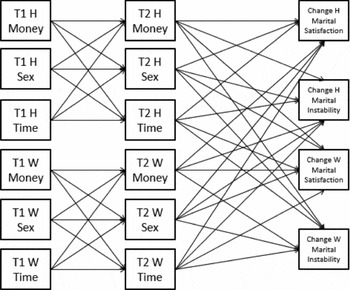
Using an APIM (Kashy & Kenny, Reference Kashy, Kenny, Reis and Judd2000; Figure 1), which allows for an examination of both spouses simultaneously and to explore potential spillover and crossover effects, we addressed the following three research questions: (1) How does the frequency of disagreements about money, time spent together, and the sexual relationship relate to the frequency of these same disagreement topics 5 years later? It is hypothesised that frequency of disagreements in each topic early in marriage will be related to an increase in frequency of disagreements in that same topic area 5 years later. This pattern is expected for both husbands and wives. (2) Does the frequency of disagreements in one area relate to the frequency of other disagreement areas, representing a potential spillover effect? For example, might frequency of disagreements about money be related to the frequency of disagreements about time spent together or the sexual relationship 5 years later? (3) How do husbands’ and wives’ reports of frequency of disagreements influence their own (actor's) marital outcomes (e.g., spillover effect), as well as their partner's marital outcomes (e.g., crossover effect)? It is expected that the frequency of disagreements will predict lower marital satisfaction and higher marital instability. Due to the interdependence of relationships (Anderson & Sabatelli, Reference Anderson and Sabatelli2011; Archuleta, Reference Archuleta2013), both actor and partner effects are expected.
Hypothesised actor-partner interdependence model with proposed pathways (N = 796 couples).

Existing literature has included a variety of demographic control variables, including age, education, race, marital length, number of previous marriages, and number of children (e.g., Dew et al., Reference Dew, Britt and Huston2012). Marrying at a younger age, having been married previously, and having less education are all related to higher levels of marital instability (Marquardt, Wilcox, Blankenhorn, Lerman, & Malone-Colon, Reference Marquardt, Wilcox, Blankenhorn, Lerman and Malone-Colon2012; Pew Research Center, 2010). Couples with children argue more frequently when compared to couples without children in the home (Skinner, Bahr, Crane, & Call, Reference Skinner, Bahr, Crane and Call2002), and wives spend a larger proportion of their income on children (Pahl, Reference Pahl2008), which may provide grounds for additional disagreements about money. Due to potential issues of multicollinearity, the current study included wives’ age and education, both partners’ number of previous marriages, race, length of marriage, and number of children as demographic control variables. Because earlier work from Conger and colleagues (Conger et al., Reference Conger, Conger, Elder, Lorenz, Simons and Whitbeck1992; Conger, Rueter, & Elder, Reference Conger, Rueter and Elder1999) illustrated the distinct influence of economic conditions on marital functioning and outcomes, it was determined that financial influences also needed to be controlled. One approach is to use couple-level measures of debt, assets, and income as a proxy for economic conditions (Britt & Huston, Reference Britt and Huston2012; Dew & Dakin, Reference Dew and Dakin2011), which helps to ensure disagreements about money were not solely due to these conditions (Dew & Dakin, Reference Dew and Dakin2011). Wives’ reports of frequency of sexual activity and time spent in shared activities were also included as additional control variables.
Method
The National Survey of Families and Households (NSFH; Sweet, Bumpass, & Call, Reference Sweet, Bumpass and Call1988) is a three-wave longitudinal study that includes a combination of both relational and financial variables among a nationally representative sample of individuals and couples living in the United States. The current study used a subsample of these couples early in marriage from the first two waves of data, which were collected in 1987–1988 (Wave 1) and 1992–1994 (Wave 2).
Sample
At Wave 1, the NSFH study included responses from 13,007 participants. When possible, spouses or partners were also interviewed as part of the larger research study, resulting in data collected on more than 5,000 couple dyads. Although cohabiting couples were an important emphasis of the larger study, the current study focused on a subset of married couples only, who had been married for less than 5 years (61 months) at Wave 1. Initially, 1,256 married couples met the criteria for inclusion. However, some couples were removed from analysis due to incomplete data, most notably uncertainty regarding continued marital status to the same spouse since Wave 1 (n = 288), and couples who divorced between waves (n = 172). As a result of these removed cases, the current study focused on 796 married couples, in which both spouses participated at Waves 1 and 2, measuring a 5-year span. As compared to couples removed from the study, included couples tended to be older, have been married for a longer period of time, have more education, income, assets, and consumer debt, have higher relationship satisfaction and less marital instability, have more frequent sexual activity and time together in shared activities, and less frequent disagreements about money, time spent together, and the sexual relationship, and fewer cohabited before marriage. At Wave 1, the average age was 28 years (SD = 5.74) for husbands and 26 years (SD = 5.13) for wives. The average length of marriage was 28 months (SD = 15.43). Over 90% of both husbands and wives were in their first marriage. The majority of participants were European American (75% for husbands, 80% for wives; other ethnicities included African American, 8%; Latino, ~5%; and Asian American, ~1%). In terms of education, less than 10% of the participants had not completed at least high school, with 59% of husbands and 57% of wives having attended at least one year of college.
Measures
Marital outcome variables
Two marital outcomes for each partner were examined in this study: (1) change from Wave 1 to Wave 2 in perceptions of marital satisfaction, and (2) change from Wave 1 to Wave 2 in perceptions of marital instability. Wave 1 marital satisfaction consisted of a single question: ‘How satisfied are you with the current relationship?’ A seven-item Likert response format was used (1 = very unhappy; 7 = very happy), with higher scores representing higher levels of marital satisfaction. At Wave 2, this original question, along with five additional questions, were included in the survey to create a six-item relationship satisfaction scale. However, to maintain a direct comparison of change, only responses to the original satisfaction question were included at Wave 2.
Change from Wave 1 to Wave 2 in perceptions of marital instability was measured for each partner with the same two questions at both waves: ‘Have you thought your relationship was in trouble during the last year?’ with responses being either no (1) or yes (5). The second question asked what the chances of separation were. Possible responses were on a 5-point Likert-type scale that ranged from 1 (very low) to 5 (very high). Scores were averaged with higher scores representing higher levels of perceived marital instability.
A review of both skewness statistics and histograms (available upon request) noted skewed distributions for the marital satisfaction (right skewed towards greater marital satisfaction) and marital instability (left skewed towards lower marital instability) variables at both waves. Marital satisfaction scores were squared to remove the skewness and marital instability scores were logged to normalise their distributions, following Tukey's (Reference Tukey1977) guidelines.
Predictor variables
The predictor variables for this study consisted of the frequency of three commonly identified disagreement areas during marital adjustment: money, time spent together, and the sexual relationship, which were measured for both partners at Waves 1 and 2. This frequency of disagreements came from a single question: ‘The following is a list on which couples often have disagreements. How often, if at all, in the last year have you had open disagreements about each of the following [money, sex, and spending time together]?’ Each participant selected a response, based on his/her perception of the frequency of these disagreements, from a range of 1 (never) to 6 (almost every day), with higher scores representing higher frequency of disagreements.
Control variables
The demographic control variables used for this study, all measured at Wave 1, consisted of the age and education for wives, husbands’ and wives’ number of previous marriages, race (measured as both partners being white [1] or non-white [0]), length of marriage in months, and number of children in the home. Based on prior work (Britt & Huston, Reference Britt and Huston2012; Dew & Dakin, Reference Dew and Dakin2011), a proxy for financial conditions included couple-level measures of consumer debts (six items; e.g., credit card debt), non-consumer debts (five items; e.g., mortgage), assets (six items; e.g., value of home), and household income, all measured at Wave 1. Debts, assets, and income were measured in U.S. dollars, averaged, and logged to normalise distributions. Additionally, husbands and wives responded to two additional questions that measured the amount of sexual activity by the couple and the amount of time spent in shared activities or talking. However, due to husbands’ and wives’ responses being highly correlated, only wives’ responses were included in the final analysis to avoid potential multicollinearity issues. Sexual frequency was logged and time spent in shared activities was squared to normalise distributions.
Analytic Approach
All frequencies, descriptive statistics, and paired sample t tests were examined using SPSS Version 21. An APIM (Kashy & Kenny, Reference Kashy, Kenny, Reis and Judd2000) was used to examine both spouses simultaneously in the same model. As explained by Cook and Kenny (Reference Cook and Kenny2005), the APIM approach assumes non-independence of observation, indicating spouses’ scores are linked and highly correlated to one another and need to be nested dyadically, rather than examined individually in separate models. An APIM approach also assumes that one partner's outcomes are influenced by his or her own behaviours and perceptions (e.g., actor /spillover effects; Cook & Kenny, Reference Cook and Kenny2005) as well as those of the partner's behaviours and perceptions (e.g., partner/crossover effects; Campbell, Simpson, Boldry, & Rubin, Reference Campbell, Simpson, Boldry and Rubin2010; Cook & Kenny, Reference Cook and Kenny2005). In the current study, actor/spillover effects were examined only on the frequency of disagreements at Wave 1 predicting the frequency of disagreements at Wave 2 (corresponding to RQ #2), while both actor/spillover and partner/crossover effects were examined on marital outcomes at Wave 2, as predicted by the frequency of disagreements at Wave 2 (corresponding to RQ #3). A path model was fit using MPlus Version 6.0 (Muthen & Muthen, Reference Muthen and Muthen1998–Reference Muthen and Muthen2011; Figure 1); Full Information Maximum Likelihood (FIML) was used to manage missing data (missing data ranged from 0% on some measures, such as number of children, to 50.5% on other measures, such as couple's non-consumer debt). Model fit was assessed with indices of chi square divided by degrees of freedom ratio, comparative fit index (CFI), and the root mean square error of approximation (RMSEA). The chi square statistic has been found to be sensitive to sample size, so examining the chi square divided by degrees of freedom ratio (χ2/df) was used to measure model fit with larger sample sizes (Bollen, Reference Bollen1989; Wheaton, Muthen, Alwin, & Summers, Reference Wheaton, Muthen, Alwin, Summers and Heise1977). Bollen (Reference Bollen1989) noted that good model fit is indicative of a ratio value below 5, although a value below 3 is preferable. Heck and Thomas (Reference Heck and Thomas2009) noted that good model fit occurs when the CFI has values at or above .90. Hu and Bentler (Reference Hu and Bentler1999) suggested a non-significant RMSEA value below .06 demonstrates good model fit, although Heck and Thomas noted that good model fit occurs when the RMSEA value is below .05.
Several procedural items need to be noted here. In the statistical model, all Wave 1 demographic, financial wellbeing and other control variables predicted both spouses’ Wave 1 reports of marital satisfaction and marital instability. Change in the frequency of disagreements was created by predicting Wave 2 frequency in each of the topic areas by their Wave 1 counterparts. Likewise, change in the marital outcome variables were created by predicting Wave 2 variables by their Wave 1 counterparts. Modelling change as the Wave 2 variables predicted by their Wave 1 counterparts accounts for measurement error and, therefore, does not result in loss of information. Finally, frequency in the three disagreement areas were examined for spillover effects, whereas the influence of the frequency of disagreements on marital outcomes was examined for both spillover and crossover effects.
Results
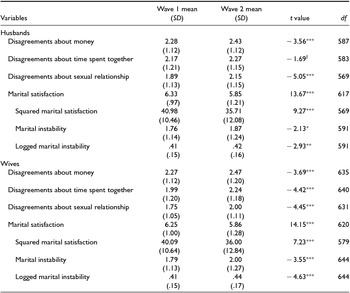
Descriptive statistics for the disagreement and marital outcome variables are shown in Table 1; descriptive statistics for demographic and financial variables are shown in Table 2. The frequency of disagreements about money, time spent together, and the sexual relationship started at relatively low levels, but increased modestly between Waves 1 and 2. Despite the modest increases, the overall frequency of disagreements corresponded to several times per month. Marital satisfaction was high at Wave 1, but decreased slightly for both husbands and wives. The level of marital instability was quite low at Wave 1, but these scores increased slightly at Wave 2. Paired sample t tests revealed that the increase in the frequency of disagreements from Wave 1 to Wave 2 was statistically significant with the exception of husbands’ reports on the frequency of disagreements about time spent together, which remained stable. These same t tests revealed statistically significant decreases in marital satisfaction and increases in marital instability (see Table 1).
Means and Standard Deviations for Disagreement and Marital Outcome Variables with Mean Comparisons between Wave 1 and Wave 2

Note: ϯ p < .10; *p < .05; **p < .01; ***p < .001.
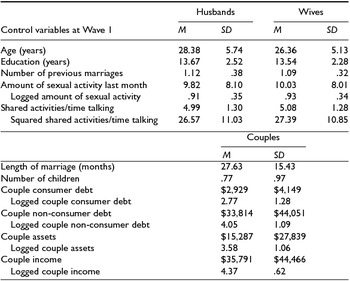
Means and Standard Deviations for Demographic and Financial Control Variables at Wave 1

Note: Dollars reported are in U.S. dollars.
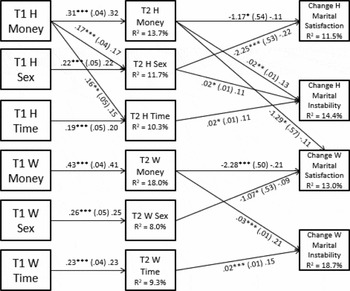
To address the study research questions, a path model was fit using MPlus Version 6.0 (Muthen & Muthen, Reference Muthen and Muthen1998–Reference Muthen and Muthen2011). The hypothesised model with all disagreements and marital outcome variables fit the data well (χ2/df = 2.79; CFI = .94; RMSEA = .05, p = ns). Figure 2 provides unstandardised and standardised beta coefficients, standard errors, and R 2 values for the hypothesised model.
Fitted actor-partner interdependence model (N = 796 couples).

Frequency of Disagreements From Wave 1 to Wave 2
For the first research question, it was hypothesised that the frequency of disagreements in one area at Wave 1 would be related to an increase in the frequency of disagreements in that same area at Wave 2. This hypothesis was supported. Path analyses (Figure 2) revealed a positive association between Wave 1 frequency and Wave 2 frequency for all three disagreements topics, indicating stability over time. Multivariate analyses revealed that the increase in the frequency of disagreements was statistically significant for all three areas of disagreement. It was further hypothesised that this increased pattern of frequency of disagreements would be true for husbands and wives, which also was supported fully.
Spillover in Frequency of Disagreements From Wave 1 to Wave 2
For the second research question, it was suggested the frequency of disagreements in one area might predict an increase in the frequency of other disagreement topics, representing a potential spillover from one topic to another. This speculation was only supported partially. The frequency in disagreements about money, as reported by husbands at Wave 1, was related positively to husbands’ reports of frequency of disagreements for time spent together and the sexual relationship (Figure 2). However, no example of spillover was found for wives’ reports of frequency of disagreements.
Frequency of Disagreements and Marital Outcomes for Both Actor and Partner
For the third research question, it was expected that higher frequency of disagreements about money, time spent together, and the sexual relationship would predict actor reports of decreased marital satisfaction and increased marital instability. It was also expected that this same relationship would hold true when examining the crossover effects on the partners’ reports of marital outcomes.
Although univariate analyses (mean comparisons) revealed a decrease in marital satisfaction and an increase in marital instability for both husbands’ and wives’ marital satisfaction (Table 2), multivariate analyses demonstrated that marital satisfaction remained stable for husbands and wives across this 5-year period. Marital instability, on the other hand, increased over the 5 years for both husbands and wives. Husbands’ and wives’ reports of frequency of disagreements about money and the sexual relationship, but not about time spent together, were associated negatively with their own marital satisfaction. Furthermore, husbands’ reports of frequency of disagreements about money were associated significantly and negatively with wives’ reports of marital satisfaction (Figure 2). Therefore, this hypothesis is not supported in that marital satisfaction did not decrease over 5 years, although the frequency of disagreements is related negatively to marital satisfaction.
As can be seen in Figure 2, husbands’ reports of frequency of disagreements about money, time spent together, and the sexual relationship all demonstrate a significant and positive association with husbands’ reports of marital instability (fully confirming husbands’ actor effects). Wives’ reports of frequency of disagreements about money and time spent together, but not the sexual relationship, demonstrate a significant and positive association with wives’ reports of marital instability (partially confirming wives’ actor effects). The only crossover effect found in the current study is that husbands’ reports of frequency of disagreements about money were related significantly and negatively to wives’ marital satisfaction (providing partial support for husbands-to-wives’ partner effects).
Discussion
In the current study, three areas of disagreement (money, time spent together, and the sexual relationship) identified as being problematic early in marriage were examined. Our findings show that frequency of these disagreement areas increases modestly over 5 early years of marriage and influences reports of marital outcomes. Although an increase in the frequency of these disagreements is not surprising (Johnson, Amoloza, & Booth, Reference Johnson, Amoloza and Booth1992), the results of this current study both support and extend existing research on disagreements within the early years of marriage. An examination of the frequency of disagreements at multiple time points helps to extend Dew's (Reference Dew2008) study of couples early in marriage by showing that the frequency of disagreements about money harms marital satisfaction for both husbands and wives, and by including the frequency of disagreements about time spent together and the sexual relationship, revealing additional harmful influences on marital outcomes. Further, the current study used an APIM approach (Kashy & Kenny, Reference Kashy, Kenny, Reis and Judd2000) to examine both actor and partner reports of spillover and crossover effects of disagreements and marital outcomes among recently married couples, which revealed similar and different patterns of results for husbands and wives.
Frequency of Same Disagreement Topics
The first research question sought to understand how frequency of disagreements about money, time spent together, and the sexual relationship were related to the frequency of disagreements in these same areas 5 years later. Our results show that the frequency of disagreements in these topics early in marriage is related positively to the frequency of disagreements in these same areas 5 years later. This pattern was reflective of both husbands’ and wives’ reports. Some research indicates that marital problems, including money, time spent together, and the sexual relationship, remain stable over 4 early years of marriage (Lavner, Karney, & Bradbury, Reference Lavner, Karney and Bradbury2014). The current study found a statistically significant increase (both through univariate and multivariate tests) in the frequency of these three disagreement areas. However, Lavner et al.’s (Reference Lavner, Karney and Bradbury2014) study examined the frequency of problems in these areas, without identifying specifically what these problems were, such as disagreements. Having problems may not be the same as disagreeing with one's spouse.
Another interesting finding from the current study adds to the findings of Hatch and Bulcroft (Reference Hatch and Bulcroft2004), who showed that the frequency of disagreements decline the longer couples are married. They found couples married 30 years or more have lower frequency of disagreements than couples married 20 to 30 years, who also have fewer disagreements than couples married 10 to 20 years, who further have fewer disagreements than couples married 10 years or less. However, their study examined differences cross-sectionally, which did not allow for an examination of patterns of change in the frequency of disagreements by these same couples. The current study found, at least among recently married couples, that disagreements about money, time spent together, and the sexual relationship increase slightly over 5 early years of marriage. It is likely that couples married longer do have less frequent disagreements, but these patterns of change need to be examined longitudinally to better understand the nature of these changes.
Spillover Into Different Disagreement Topics
The second research question explored whether frequency of disagreements in one conflict area spill over into other conflict topics 5 years later. Based on the definition of spillover provided by Katz and Gottman (Reference Katz, Gottman, McHale and Cowan1996) and the nature of conflict already identified by existing literature (e.g., increased negativity; Papp et al., Reference Papp, Cummings and Goeke-Morey2009; Stanley et al., Reference Stanley, Markman and Whitton2002), the results of the current study show that the frequency of disagreements about money are also related positively to the frequency of disagreements about time spent together and the sexual relationship for husbands during the early years of marriage. One possible explanation for this finding may be the perception of breadwinner status within these relationships.
Gender role expectations are becoming more egalitarian as many couples operate dual-income households. However, being the main breadwinner or provider for the family has, in the past, traditionally fallen on men (Springer, Reference Springer2010), regardless of whether the wife is employed. Springer notes that not achieving the breadwinning ideal may be emasculating for men, which may also be stress inducing. Crowley (Reference Crowley1998) found men who perceive themselves as being inadequate as breadwinners report more depressive symptoms, more marital conflict, and more negativity than men who perceive themselves as being adequate breadwinners. Furthermore, Papp et al. (Reference Papp, Cummings and Goeke-Morey2009) noted that money problems may be associated with self-esteem problems, particularly for men, as well as reflect deep meanings held and values associated with money (Shapiro, Reference Shapiro2007). Research has shown stress-inducing situations and depressive symptoms promote general conflict in marital relationships (e.g., Conger et al., Reference Conger, Elder, Lorenz, Conger, Simons, Whitbeck, Huck and Melby1990; Gudmunson et al., Reference Gudmunson, Beutler, Israelsen, McCoy and Hill2007), which may help to explain some of the spillover effects from money to time spent together and the sexual relationship found for husbands, but not for wives. Wives may consider other areas, such as division of household labour or childcare, to be more influential, although the current study did not examine these topics. Future research might consider these and other conflict topics that may be more concerning for women.
Frequency of Disagreements and Marital Outcomes
The third research question explored how the frequency of disagreements about money, time spent together, and the sexual relationship demonstrated potential spillover (own/actor reports) and crossover (partner reports) effects on marital outcomes. Overall, several patterns emerged for these actor and partner effects. For actor effects, the frequency of disagreements about money and the sexual relationship is associated negatively with marital satisfaction for both husbands and wives. Frequency of all three disagreement topics are associated positively with marital instability for husbands, whereas frequency of disagreements about money and time spent together are associated positively with marital instability for wives. For partner effects, only husbands’ reports of frequency of disagreements about money are associated negatively with wives’ marital satisfaction.
Disagreements About Money and Marital Outcomes
Frequency of disagreements about money is related to both actor and partner reports of marital satisfaction and marital instability. These findings are consistent with Dew (Reference Dew2008), who found that increases in the frequency of disagreements about money are negatively associated with marital satisfaction for couples early in marriage, and with Britt and Huston (Reference Britt and Huston2012), who found that wives who report arguing frequently about money early in marriage are two and a half times more likely to report lower marital satisfaction and three times more likely to divorce than those who do not argue frequently about money early in marriage.
In the current study, husbands’ reports of disagreements about money directly and negatively predict wives’ marital satisfaction, demonstrating an important crossover effect. This crossover effect may have been due to conditions not addressed in the current study. For example, which spouse brings up an issue, husbands’ acceptance of influence from their wives, or types of conflict tactics used may influence the frequency of these disagreements. If a husband accuses his wife of spending money excessively, the wife may respond defensively (Gottman & Silver, Reference Gottman and Silver1999). Furthermore, if a wife brings up money difficulties because she desires change in her husband, the husband may not accept her influence (prompting potential power struggles) or may react with his own defensive conflict tactics (Gottman & Silver, Reference Gottman and Silver1999). These accusations, power struggles, or defensive tactics may prompt poorer marital satisfaction on the part of the wife.
We did not find a direct relationship between wives’ reports of disagreements about money and husbands’ reports of marital satisfaction or marital instability. This finding does not support Dew et al.’s (Reference Dew, Britt and Huston2012) study in which a direct relationship was found between wives’ reports of disagreements about money and husbands’ reports of marital satisfaction. However, Kiecolt-Glaser and Newton (Reference Kiecolt-Glaser and Newton2001) noted wives are often more aware of the emotional quality of the relationship. They further noted that wives are often more sensitive to marital distress. This awareness and sensitivity to potential problems in the relationship may begin early in marriage and may be reflective of disagreements about money. Additionally, husbands may assume financial management when things are going well, but may turn over the negative aspects of financial management (e.g., debt collection) to their wives when things are not going well, further prompting potential power struggles (Thorne, Reference Thorne2010) and perceptions of problems within the relationship (Kiecolt-Glaser & Newton, Reference Kiecolt-Glaser and Newton2001).
Disagreements About Time Spent Together and Marital Outcomes
Disagreements about time spent together also showed actor effects, but only for marital instability. The lack of influence of increased disagreements about time together on marital satisfaction does not support Dew et al.’s (Reference Dew, Britt and Huston2012) study in which disagreements about time are related negatively to own reports of marital satisfaction for both husbands and wives (e.g., actor effect). However, it needs to be clarified that Dew et al.’s study did not examine couples only in the early years of marriage, so the length of marriage may moderate this association. These differences are important also when one considers how time spent together in activities, such as date nights, can reduce divorce and enhance the relationship overall because these activities promote higher levels of communication, sexual satisfaction, and commitment (Wilcox & Dew, Reference Wilcox and Dew2012). If couples are disagreeing about how to spend time or the amount of time spent together, however, these relationship enhancements may not be taking place, while at the same time doubts about the relationship may be increasing.
Disagreements About the Sexual Relationship and Marital Outcomes
Finally, increased disagreements about the sexual relationship are associated with actor effects, but not partner effects, for marital satisfaction and marital instability. The results of the current study provide some support for Rehman et al. (Reference Rehman, Janssen, Newhouse, Heiman, Holtzworth-Munroe, Fallis and Rafaeli2011), who found the use of negative behaviours during sexual conflict harm wives’ reports of marital satisfaction. However, they did not find the same association for husbands’ reports of marital satisfaction. In the current study, behaviours used during conflict were not measured, yet it was found that frequency of disagreements is related negatively to marital satisfaction and positively to marital instability. It may be that the behaviours or tactics used during disagreements mediate this relationship. Rehman et al. did not indicate whether they tested for mediation, but such an approach may be beneficial for future studies. Additionally, it may benefit future research on sexual disagreements to measure the level of meaning and importance of the sexual relationship, as well as the difficulty of discussing this topic.
Meaningful amounts of variance were explained in the marital outcomes, ranging from 11.5% for husbands’ reports of marital satisfaction to 18.7% for wives’ reports of marital instability. Much research has identified how couples disagree is an important factor in the relationship between disagreements and marital outcomes (e.g., Conger et al., Reference Conger, Elder, Lorenz, Conger, Simons, Whitbeck, Huck and Melby1990; Gottman & Silver, Reference Gottman and Silver1999). However, the results of this current study found that even the frequency of disagreements may be an important factor, independent of how couples disagree.
Limitations, Future Directions, and Conclusions
This study has several limitations. One limitation is the data were collected in 1987–1988 and 1992–1994, representing those from the latter part of the Baby Boomer generation. The dated nature of this data warrants caution regarding the generalisability of the current results to contemporary couples. Couples today tend to delay marriage and cohabit before marriage (Marquardt et al., Reference Marquardt, Wilcox, Blankenhorn, Lerman and Malone-Colon2012) and bring more debt into marriage (Marshall & Skogrand, Reference Marshall and Skogrand2004; Schramm et al., Reference Schramm, Marshall, Harris and Lee2005). All of these factors may influence differently the marital adjustment process of contemporary couples. Despite these concerns, the results of the current study still represent issues applicable to contemporary couples. For example, disagreements about money are still a commonly cited problem for recently married couples (e.g., Schramm et al., Reference Schramm, Marshall, Harris and Lee2005), and frequency of disagreements still has the potential to influence marital outcomes (e.g., Britt & Huston, Reference Britt and Huston2012; Dew et al., Reference Dew, Britt and Huston2012). Despite its dated nature, the NSFH contains data from a nationally representative sample and includes key information from both partners (permitting an examination of actor and partner effects) on important financial and relational variables, which current longitudinal datasets lack. However, nationally representative data representing contemporary couples are needed to better understand the marital adjustment process among today's couples.
Another limitation is that several variables used in this current study were single-item questions (e.g., frequency of disagreements and marital satisfaction). Using multiple items to assess each of these constructs would increase confidence in the validity of their measurement. Additionally, multiple questions eliciting information about shared values associated with money, time spent together, and the sexual relationship; which spouse brought up conflictive issues; the difficulty of topics discussed; and conflict tactics used during disagreement may provide additional insights on how these disagreements influence marriage.
The current study did not address values, communication, or conflict tactics specifically, yet existing research demonstrates the need for it. Rick, Small, and Finkel (Reference Rick, Small and Finkel2011) noted that differences in values of money may be associated with greater marital issues, such as greater conflict. It may be that non-shared values about time spent together and the sexual relationship may demonstrate similar outcomes. Existing research shows that tactics used to negotiate disagreements matter (e.g., Dew & Dakin, Reference Dew and Dakin2011; Gottman & Silver, Reference Gottman and Silver1999). The current study examined only the frequency of disagreements and found that frequency of disagreements does influence marital outcomes for both husbands and wives. However, an examination of conflict tactics may be beneficial in identifying mediating influences. Dew and Dakin (Reference Dew and Dakin2011) examined the use of negative (e.g., heated discussion and violence) and positive (e.g., calm discussion) conflict tactics when disagreements about finances arise that result in increased negativity and decreased positivity. Future studies might include an examination of Gottman's ‘Four Horsemen of the Apocalypse’ (e.g., criticism, contempt, defensiveness, stonewalling; Gottman & Silver, Reference Gottman and Silver1999) as part of the examination of negative conflict tactics used by couples, particularly as they relate to potential spillover and/or crossover effects into other areas of disagreement or on marital outcomes.
As disagreements about time spent together is related only to marital instability, additional follow-up questions might include how often couples generally spend time together, what types of activities they engage in, and the satisfaction with this time spent together. This additional information may provide added insights into explaining how time spent together can improve multiple aspects of relationship outcomes (marital satisfaction and marital instability; Wilcox & Dew, Reference Wilcox and Dew2012).
Finally, the current study examined only disagreements about money, time spent together, and the sexual relationship, as they have been identified as being problematic for newlywed couples (Center for Marriage and Family, 2000; Schramm et al., Reference Schramm, Marshall, Harris and Lee2005). However, other disagreement topics may need to be explored for potential spillover and crossover effects. Disagreements about household labour and childcare may be more important topics for wives, which may warrant future exploration. It is also important to note that the current study focused on recently married couples who remained married across the 5 years examined. Cohabiting couples and married couples who were divorced were excluded. Thus, the findings for spillover and crossover may be more conservative estimates of the associations among the variables than if cohabiting and/or divorced couples had been included. Some research suggests nearly 90% of cohabiting relationships end within 5 years (Lichter, Qian, & Mellott, Reference Lichter, Qian and Mellott2006). Furthermore, cohabiting and divorced couples have been shown to experience higher frequency of conflict than couples who remain married (Britt & Huston, Reference Britt and Huston2012; Hardie & Lucas, Reference Hardie and Lucas2010). Future studies will want to include a more diverse range of disagreement topics and a more diverse sample of couples.
Taken together, the current study supports and extends the existing literature on conflict and marital outcomes. This study used an APIM approach (Kashy & Kenny, Reference Kashy, Kenny, Reis and Judd2000) and showed a combination of spillover effects in frequency of disagreement topics, and distinct spillover and crossover effects from frequency of disagreements on marital satisfaction and marital instability. The knowledge gained from this study may open important doors for researchers and premarital educators as they seek to help newlywed couples adjust to the first years of marriage that set the stage for subsequent marital outcomes. Two common areas taught during premarital education programs are communication and conflict management skills (Markman, Stanley, & Blumberg, Reference Markman, Stanley and Blumberg2010; Olson & Olson, Reference Olson, Olson, Berger and Hannah1999). Knowing that frequency of disagreements has potential to harm marital outcomes may help educators as they discuss and teach these skills. Additionally, recognising that some topics, such as money, have the potential to spill over into other topic areas may be beneficial to discuss and to provide an opportunity for premarital educators to incorporate financial management skills and to discuss financial goals and values, if not already included, within premarital education programs (Archuleta, Reference Archuleta2013; Dew & Dakin, Reference Dew and Dakin2011). As Risch et al. (Reference Risch, Riley and Lawler2003) noted, the best time for couples to learn about and to deal with financial issues is before marriage. The same might be said of time spent together and the sexual relationship. Work and life demands, and the ever-changing nature of the sexual relationship will require couples to learn to balance these demands and to negotiate the time spent together and how this time is used to promote the relationship. Thus, marriage educators should be encouraged to help couples develop strategies to deal with issues regarding finances, time spent together, and the sexual relationship early in their relationships to establish a foundation that will serve them well in the future.
Supplementary material
To view supplementary material for this article, please visit http://dx.doi.org/10.1017/jrr.2016.8