Introduction
The sectoral transition from agriculture to manufacturing is associated with a wide array of social, political, and economic processes. Internal migration, the movement of people from the old to new centers of economic activity, is one of the most important. Internal migration is a cause and response to sectoral shift. The rise of manufacturing creates a “pull effect” by attracting agricultural workers with the promise of higher wages and economic opportunity. Changing conditions in agricultural markets can also create a “push effect”: declining landownership or a decrease in demand for agricultural labor causes workers to seek economic opportunity elsewhere. Because agricultural areas are more spread out and manufacturing is often located in denser, higher-population areas, this shift of population is often referred to as “rural-to-urban” migration (Michaels et al. Reference Michaels, Ferdinand and Redding2012).
Existing scholarship has mainly focused on rural-rural migration in the nineteenth-century United States. Steckel (Reference Steckel1989) analyzed a linked dataset showing that rural-rural migration was most common, and Ferrie (Reference Ferrie1996, Reference Ferrie1997, Reference Ferrie2003) largely confirmed this hypothesis. Hall and Ruggles (Reference Hall and Ruggles2004) also found extensive evidence of rural-rural (and specifically farm-to-farm) migration and further argued that westward migration—movement to the Midwest and later Western states—was the most significant pattern of nineteenth-century population movement. While the “new urban historians” of the 1960s and 1970s emphasized urban growth through rural-urban and urban-urban migration in the Northeast, they generally wrote case studies of specific cities that were more difficult to generalize.
In this article, we consider the proposed links between internal migration, urbanization, and industrialization with a new dataset and with new methodologies. We confine most of our analysis to New England because it was the first region to industrialize, and we use the Linked Representative Samples series developed by IPUMS to evaluate our hypotheses. The IPUMS samples allow us to analyze migration determinants and patterns between 1850 and 1880. The samples cover three windows of time in which individuals could migrate: 1850–80, 1860–80, and 1870–80.
In addition to using the data to shed new light on older questions about migration and structural change, we make two additional contributions to the literature. First, we argue that the definition of “urban” plays an important role in understanding nineteenth-century internal migration patterns in New England. The definition of “urban” used by earlier studies was often based on density requirements in New England towns that, when relaxed, open up additional areas to an “urban” classification. While classified as “rural” in earlier studies, these areas had a high concentration of manufacturing employment and were a major destination for migrants from traditionally rural areas as well from other smaller, manufacturing-based towns.
Second, partly due to the confusion caused by different definitions of “urban,” we eschew the rural/urban classification and examine instead the extent to which migration was related to the transition out of agricultural employment. Because a key role of internal migration, historically, is to redistribute workers to the new centers of economic activity, we evaluate whether migrants (including farmers) were increasingly taking up employment in manufacturing.
Looking ahead to the main results, we find substantially greater amounts of rural-urban and urban-urban migration than has been discussed by previous studies. Further, rural-urban migration was common among agricultural workers and farmers, many of whom changed to manufacturing occupations upon arrival at their new destinations. We show that these migration patterns should be added, alongside migration to the frontier, as topics of future research.
The article is organized as follows. After an overview of internal migration in the United States, we discuss the dataset used in the analysis. We then turn to a discussion of our main research question—the relationship between internal migration and occupational change in the Northeast. Finally, we reevaluate some key hypotheses from the literature regarding rural-urban migration using our data as well as our definition of “urban.”
Overview: Internal Migration in the United States
While research on internal migration in the nineteenth-century United States is extensive, studies from the last 30 years using quantitative data sources have focused on rural-rural migration and the significance of the frontier. We briefly discuss this strand of research before discussing the research on the links between internal migration and industrialization.
The significance of the frontier and the strength of agrarian values is a long-standing thesis in nineteenth-century American history, first articulated by Frederick Jackson Turner in 1893. Turner’s original argument was that the frontier attracted a substantial amount of people and helped cultivate individualist and agrarian values in American political economy. Later, Turner developed this argument into the “safety valve” thesis, asserting that movement from Eastern areas to the frontier helped release political tensions and helped workers escape a life of urban industrial labor (Turner Reference Turner1920). The presence of the frontier and the amount of rural-rural migration are unique aspects of US history.
More recent scholarship based on digitized data sources has supported Turner’s claim about the significance of westward population movement (Hall and Ruggles Reference Hall and Ruggles2004). According to these sources, the frontier also offered higher degrees of social and economic mobility than could be found in Eastern cities (Ferrie Reference Ferrie1997; Long and Ferrie Reference Long and Ferrie2013; Stewart Reference Stewart2006, Reference Stewart2009). Additionally, Hall and Ruggles found that rural-to-rural (and specifically farm-to-farm) migration was the dominant migration pattern during the nineteenth century. The definition of “rural” used in these studies is based on any town with less than 2,500 people, which is a standard definition used by the US Census and in the rest of the historical literature.
Rural-rural migration in nineteenth-century US history has also been the topic of relatively recent microlevel data analyses. Analyzing datasets that linked people across census years, Steckel (Reference Steckel1987, Reference Steckel1989) and Ferrie (Reference Ferrie2003) looked mainly at the 1850–60 and 1860–70 periods. They found substantial amounts of rural-rural migration, and they argued that the small amount of rural-urban migration that did occur was dominated by blue- and white-collar workers, while unskilled worker status was not correlated with rural-urban migration. Salisbury (Reference Salisbury2014) found that migration was efficient and based on the perceived economic gains (i.e., occupational upgrading). Salisbury found that occupational upgrading could occur with migration to rural or urban areas. Similar to Hall and Ruggles (Reference Hall and Ruggles2004), all these studies defined “rural” as any place or town with less than 2,500 residents, which was the standard classification system used in the US Census.
While rural-rural migration has been the focal point of the recent literature, rural-urban and urban-urban migration have been less-studied, particularly in relation to industrialization. An exception is Field (Reference Field1978), who argued that there was a strong link between internal migration and industrialization. Their argument was premised on the fact that early-nineteenth-century New England was facing a decline in agriculture relative to the Midwest. A perfectly fluid national labor market had failed to develop, and even with the love of the frontier and strength of agrarianism, there was an oversupply of workers in the East. Thus, workers increasingly migrated to manufacturing centers. The well-known “Yankee farm girls” were the one of the first examples (Dublin Reference Dublin1981), but they were followed, Field argued, by young men displaced by poor agricultural conditions. These arguments were supported by aggregate census data showing a substantial amount of Massachusetts residents around 1860 who were born in another part of New England.
While not directly related to Field’s thesis, the “new urban historians” of the 1960s and 1970s also found a central place for large and small cities, linking them to industrialization in the Northeast. These historians conducted case studies of growing urban areas such as Buffalo, New York and Lynn, Massachusetts, among others. The research on Buffalo and Lynn (Dublin Reference Dublin1986; Glasco Reference Glasco, Tamata and Maris1978; Katz et al. Reference Katz, Doucet and Stern1978) found more rural-urban and urban-urban migration than was suggested by the previously mentioned studies using linked data. While these historians often found more skilled than unskilled migrants to urban areas (in support of Steckel and Ferrie), one of their broader arguments was that urban areas offered significant amounts of upward mobility—presumably attracting workers from all classes and skill levels. Herscovici (Reference Herscovici1998) analyzed migration out of Newburyport, Massachusetts—the setting of Thernstrom’s classic Poverty and Progress (1964)—and found evidence of upward mobility as well, especially for those who migrated.
In summary, there is ample historical evidence to assert that rural-urban and urban-urban migration was tied to industrialization. However, much of the recent quantitative and microlevel evidence has focused on the importance of rural-rural migration and the significance of the frontier. In this article, we will use quantitative evidence to reassess the rural-urban migration thesis and therefore turn the attention back to questions about urban migration and growth.
Data Description and Summary Statistics
We use the Linked Representative Samples series from IPUMS, the final version of which was released in 2010 (Ruggles et al. Reference Ruggles, Sarah, Ronald, Josiah, Erin, Jose and Matthew2020). To construct the samples, individuals were linked from the complete-count digitized version of the 1880 US Census files to the 1 percent digitized samples of the 1850 through 1930 censuses. For example, James Ashby was found in the 1880 digitized census files and then a record of James Ashby was also found in the 1870 digitized sample. The links were made using a machine learning technique based on an individual’s (e.g., James Ashby’s) reported birth year, place of birth, first and last name, and race in both census years. There are samples for males, females, and couples. We use the primary links (i.e., an individual for which a successful link between the two census years is made) in the “male” series and ignore secondary links—other people in James Ashby’s household in either 1870 or 1880, although these can be useful for assessing intergenerational mobility (Griffiths et al. Reference Griffiths, Lambert, Zijdeman, van Leeuwen and Mass2018). We use only the 1850–80, 1860–80, and the 1870–80 samples because of our interest in the initial decades of urban growth and its relationship to industrialization.
The sample sizes are 7,390 (1850–80), 11,293 (1860–80), and 20,782 (1870–80). The sample sizes compare favorably to the samples used in previous research, which often used only a few thousand observations at most. Variables of interest include age, head of household status, marital status, birthplace (to identify native-born individuals and foreigners), literacy, and occupation. These variables exist in both the initial year (1850, 1860, or 1870) as well as in 1880. The value of real estate owned is also used, but this information was not recorded in the 1880 census, so we only have it for the initial years of each dataset. Geographic indicators of state, county, city, and minor civil division are also included and will be used in the analysis.
Some minor additional cleaning of the IPUMS samples is necessary. First, 14 heads of household are reported as under 18, unmarried, and childless, and a few are reported as young as 3 years old; we excluded these observations from our sample. Second, head of household status and marital status are almost perfectly correlated in these samples, so the marital status variable will be dropped in the regression analysis that follows.
Finally, there is an inconsistency with the real estate wealth variable, “realprop_1.” It appears that when the linked samples were constructed, missing values were correctly coded as zero (i.e., $0 worth of real estate) for the 1850–80 links, but missing values were coded as “999,999” for the 1860–80 and 1870–80 links. We recoded the “999,999” values as zero to create reliable real estate wealth estimates across 1850 to 1870.Footnote 1
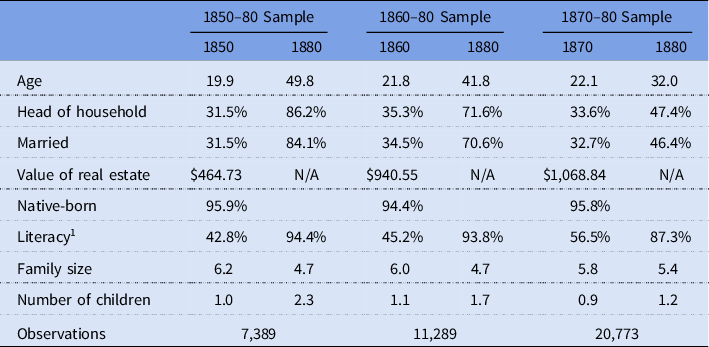
Summary statistics for the three samples are shown in table 1a. Across the initial years (1850–70), average age, head of household status, native-born, and number of children stayed relatively constant. Literacy, defined as the percentage of the sample able to both read and write, increased slightly across the initial years (between 1850 and 1880 it increased from 42.8 percent to 56.5 percent). Family size declined slightly from 6.2 to 5.8 between 1850 and 1870. These statistics suggest that the samples are mostly consistent in the “starting” years. In the final year (1880), there is some unevenness across samples, reflecting the fact that people are at different stages of their life 10, 20, and 30 years after the initial observation. For example, there are relatively more children and a higher percentage of head of household status, but smaller family size, in the 1850–80 sample. Notably, the literacy rate declines from 94.4 percent in the 1850–80 cohort to 87.3 percent in the 1870–80 cohort, but this most likely reflects the age differences in these cohorts.
Sample means

Source: IPUMS, “Linked Representative Samples” (Ruggles et al. Reference Ruggles, Sarah, Ronald, Josiah, Erin, Jose and Matthew2020). Real estate wealth is not available for 1880.
1 Literacy (measured here as a 0,1 variable) is defined as the percentage of the sample being able to both read and write.
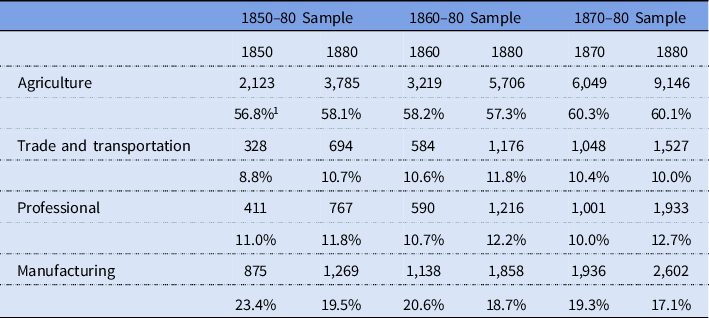
Occupational counts by sample

Sources: IPUMS, “Linked Representative Samples” (Ruggles et al. Reference Ruggles, Sarah, Ronald, Josiah, Erin, Jose and Matthew2020).
1 Percentages refer to a percent of column total, e.g., 56.8 percent of occupations reported in 1850 in the 1850–80 samples were agricultural.
Notes. “Agriculture” includes agricultural laborers, dairy workers, farmers, and gardeners, among others. “Trade and transportation” includes bankers and brokers, teamsters, railroad employees, sailors, and merchant traders, among others. “Professional” is termed “Professional and Personal Services” and includes teachers, clergy, architects, doctors, engineers (civil), journalists, lawyers, and musicians, among others. “Manufacturing” includes workers in various industries as well as butchers, machinists, and plumbers, among others. For a full list of occupations based on this classification scheme, see https://usa.ipums.org/usa/volii/occ1880.shtml
Overall, the datasets are overrepresentative of native-born persons (refer to table 1a). In the 1870–80 sample, only 3.4 percent of linked individuals are foreign-born, while we know from the 1870 census that about 14.4 percent of the population was foreign-born (13.3 percent in 1880). One possible explanation is “name commonness”—individuals were more likely to be successfully linked if they had a less common name, but foreign-born individuals, conditional on birthplace (which is one of the linkage parameters) were more likely to have the same last name.Footnote 2
Occupations also appear skewed by sector and most likely reflect the overrepresentation of native-born individuals in the sample (see table 1b). In the 1850–80 sample, the occupational distribution in 1850 was about 57%, 9%, 11%, 23% between the agriculture, trade and transportation, professional, and manufacturing sectors respectively, whereas in 1880 it was about 58%, 11%, 12%, and 19% across these sectors respectively. Sectors were determined by occupational codes provided by IPUMS and are based on extensive historical research. Further, coarseness of the classification between these four sectors means that the amount of such errors is small (the four-sector classification broadened to eight sectors in the 1910 samples). Also, although the distributions stayed approximately the same, this does not reflect a lack of occupational change: about 30 percent of the 1850–80 sample employed in both periods changed occupations between these four categories.
Definitions of “Migration” and “Rural/urban”
Our migration variable comes pre-coded from IPUMS and ranges from 1 to 5; it is based on whether a primary link is observed in a different place in 1880 than they were in either 1850, 1860, or 1870. The variable codes an interstate migrant as “5” and an intrastate (different county) migrant as “4.” Together, these two groups compose our subsample of migrants. A code of “3” is applied to a small set of people who are reported as having changed county of residence but where that county had a boundary change; these cases are termed ambiguous by IPUMS and we choose not to classify them as migrants.Footnote 3 The remaining individuals (with codes “1” and “2”) stayed in the same county and are not classified as a migrant.Footnote 4
The structure of the linked census data cannot account for return migration—people who moved between, say, 1850 and 1880 but then moved back home by 1880. These people would be recorded by IPUMS as nonmigrants, even if they were moving back home to retire or after accumulating savings from working elsewhere. There is also no indicator of recent moves, or of multiple moves. While these are downsides of the data, we note that the average age in 1880 in our sample is 38—still relatively young and therefore less “at risk” of return migration events based on retirement.
Another issue with our definition of “migrant” is the possibility of multiple migrations: Someone observed to have made a move between 1850 and 1880 may have made several moves during that time, and thus the origin of the final observed migration event is unclear. For example, a worker who changed their occupation could have made a rural-urban move followed by an urban-urban one, and it is not clear whether occupations were changed at the first urban location or the second. There is a greater probability of these situations in the 1850–80 and 1860–80 datasets because of the longer time frame. In our analysis, we can account for longer time frames for migration events by controlling for which sample the migration event is observed.
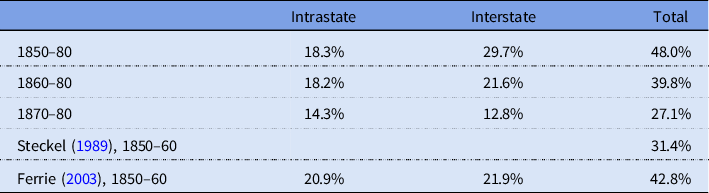
Table 2 summarizes the migration rates derived from the IPUMS data and from previous research. The migration rate for the 1850–80 sample is 48 percent (18.3 percent in-state, 29.7 percent out-of-state) and 27.1 percent in the 1870–80 sample. As expected, the migration rate declines as the time frame narrows from 30 to 10 years. Compared to previous studies of internal migration in the nineteenth-century United States, these statistics are roughly consistent. In Ferrie’s (1996, 2003) linked dataset, the implied 10-year migration rate (1850–60) is 42.8 percent, higher than 27.1 percent but having a similar composition between interstate and intrastate migration. Steckel (Reference Steckel1989) found a more modest 10-year rate (1850–60) of 31.4 percent, which is less than Ferrie’s and closer to our 10-year migration rate. It is possible, of course, that migration rates were higher in 1850 than in 1870, explaining the higher 10-year rates of both Steckel and Ferrie. At any rate, these statistics support the claim that Americans were highly mobile in the nineteenth century.
Interstate and intrastate (between county) migration rates by sample

Sources: IPUMS, “Linked Representative Samples” (Ruggles et al. Reference Ruggles, Sarah, Ronald, Josiah, Erin, Jose and Matthew2020); author’s calculations from table 1 of Ferrie (Reference Ferrie2003) and table 1 of Steckel (Reference Steckel1989). Migration rate in Steckel (Reference Steckel1989) calculated as 496 total moves reported (lower panel, second column) divided by a total sample of 1,581 (lower panel, first column).
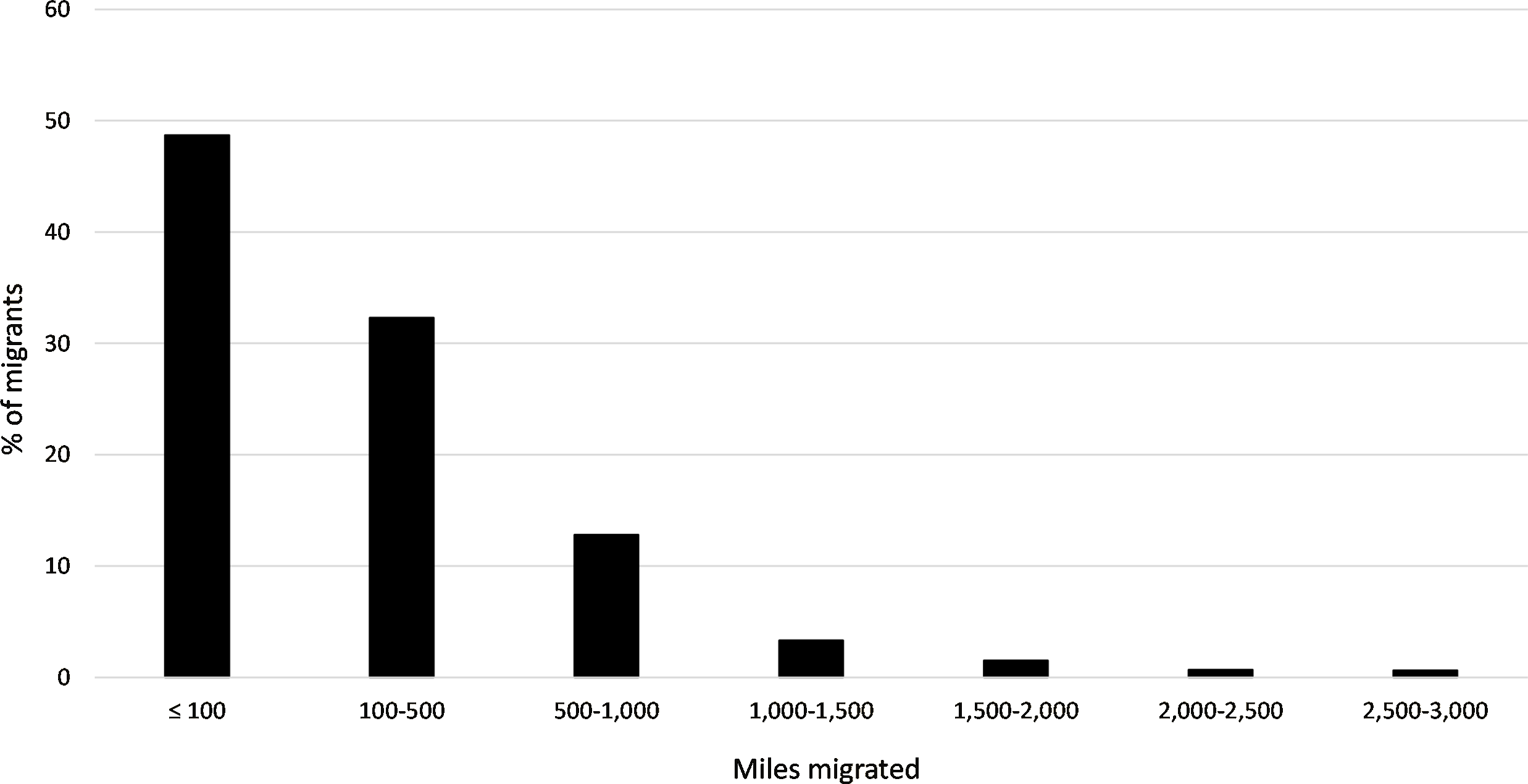
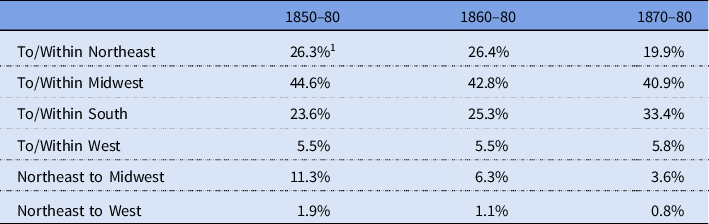
Figure 1 shows that migration counts were inversely related to distance (migration distance is recorded by IPUMS in the variable “milemig,” using National Historical Geographical Information System’s county centroids), confirming one of the well-known laws of internal migration (Zipf Reference Zipf1946). Finally, table 3 shows that 44.6 percent of migrants moved to the Midwest in the 1850–80 dataset, and 11.3 percent of all migrants specifically migrated from Northeast to Midwest. The estimate of Northeast-Midwest migration is very close to Hall and Ruggles’s (Reference Hall and Ruggles2004, figure 5: 838) estimates of Northeast-Midwest migration of around 10–12 percent between 1850 and 1880 (Hall and Ruggles define the Midwest as “North Central,” but both terms refer to the same region). As can be seen in table 3, these statistics are consistent across the 1860–80 and 1870–80 samples.
Migration frequency rates by distance migrated (in miles), 1850–80.

Migration shares by region and sample

Source: IPUMS, “Linked Representative Samples” (Ruggles et al. Reference Ruggles, Sarah, Ronald, Josiah, Erin, Jose and Matthew2020).
1 Indicates the percentage of all migrants that traveled to/within the Northeast, etc.
We now turn to the classification of rural and urban areas in our dataset. The definition of “urban” applied by IPUMS to all their historical samples is based on the 1930–40 US Census Bureau’s definition, which uses a 2,500-person per place requirement that excludes parts of New England towns that are not “thickly settled.” Thus, two individuals could have been living in the same New England town, but one could have been classified as in an “urban” area and the other in a “rural” area if the latter was in a less-dense part of the town. Fortunately, IPUMS provides the variable “NENGPOP” that indicates the size of the population of the New England town of residence and allows us to simply classify as “urban” any resident of a town with more than 2,500 people in it, regardless of whether that person resided in a thickly settled part of the town.
We take the 2,500-person definition of an urban place as our starting point for analysis. It is one of the most common in the historical literature and is used to describe basic trends in urbanization in the nineteenth-century United States, as well as microlevel studies of rural-urban migration (Boustan et al. Reference Boustan, Devin and Owen2013; Ferrie Reference Ferrie2003; Steckel Reference Steckel1987, Reference Steckel1989). It has also been employed in quantitative studies of rural-urban migration in eighteenth- and nineteenth-century England (Long Reference Long2005; Williamson Reference Williamson1988a, 1998b). Other historical studies of urbanization in the United States have defined “urban” as places with varying cutoffs of 5,000, 10,000, or more people in them (Guest Reference Guest2005; Herscovici Reference Herscovici1998). The “new urban historians” also generally focused on areas with higher populations such as Boston, New York City, and Philadelphia, although they were also interested in burgeoning industrial towns like Lynn, Buffalo, Newburyport, and Lowell, which were initially much smaller. It is important to note that many of the studies that used higher population size cutoffs were also interested in socioeconomic mobility, rather than trying to simply count or track urbanization trends over time.
The starting point of a 2,500-person definition of “urban” still leaves us with two major variations that depend on the decision on how to classify New England towns. There is the narrower classification used by IPUMS that is based on the 1930–40 US Census Bureau definition that excludes certain parts of New England towns, and a broader classification based on the 2,500-person criterion. We now discuss three issues created by these two schemes: first, how the two classification schemes affect estimates of urbanization; second, which definition is most often employed in the literature on internal migration in the nineteenth-century United States; and third, which one is more appropriate for understanding the New England economy.
First, the two schemes create a substantial difference in the estimate of urbanization in New England. According to the narrow 1930–40 US Census Bureau definition, in 1850, 30 percent of the New England population resided in urban areas. According to the broader definition of “urban,” that percentage rises to about 51 percent. By 1880, the narrow and broad definitions of “urban” in New England produce urbanization estimates of 38.8 percent and 68.4 percent, respectively.
Second, in the literature, there is ambiguity about the definition of “urban” used. Ferrie (Reference Ferrie1996, Reference Ferrie2003) appears to use the narrow definition based on the 1930–40 US Census Bureau definition (see footnote 1 of Ferrie [Reference Ferrie2003] and the urbanization rate in 1850 presented in figure 1), as did Hall and Ruggles (Reference Hall and Ruggles2004)—although the latter also classified residents in terms of “farm/nonfarm” status. In Steckel (Reference Steckel1987, Reference Steckel1989) the definition of “urban” is unclear, but they also appear to use the narrow definition. For example, refer to the high estimates of rural-rural migration implied by Steckel (Reference Steckel1989) and reported in table 1 of this article.
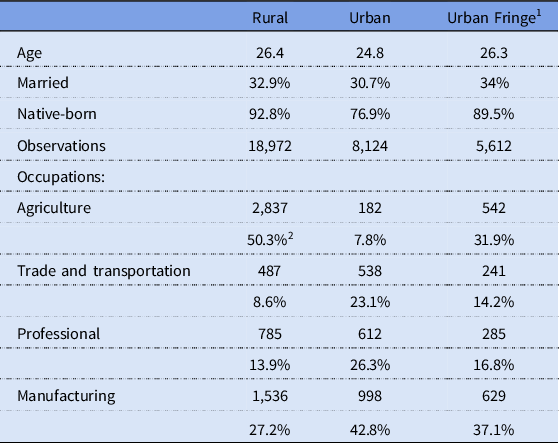
Third and finally, using the broader classification of “urban” is more appropriate for understanding the New England economy because it allows us to include smaller manufacturing towns that were common in this region (see table 4). The first two columns compare traditionally urban and rural areas and highlight their similarities (age, marital status) and differences (nativity, occupational distribution) and serve as a point of reference.
Characteristics of rural, urban and urban fringe, New England, 1850

Source: One percent digitized sample of the 1850 US Census (Ruggles et al. Reference Ruggles, Sarah, Ronald, Josiah, Erin, Jose and Matthew2020).
1 See text for discussion of definition. Refers to areas in New England townships with greater than 2,500 people but with low population density.
2 Percentages reported refer to a percent of column total, e.g., 50.3 percent of occupations reported in rural areas of New England were agricultural, whereas 7.8 percent of occupations in urban New England were agricultural, etc.
The third column of table 4 is based on asking the following question: If we broaden the definition of urban so that some places that used to be considered rural are now considered urban, what do those places look like? We refer to these areas as urban “fringe” because of their geography—they are located in places that satisfy the 2,500-person requirement for being urban, but where the population is less densely settled than a traditionally urban area.
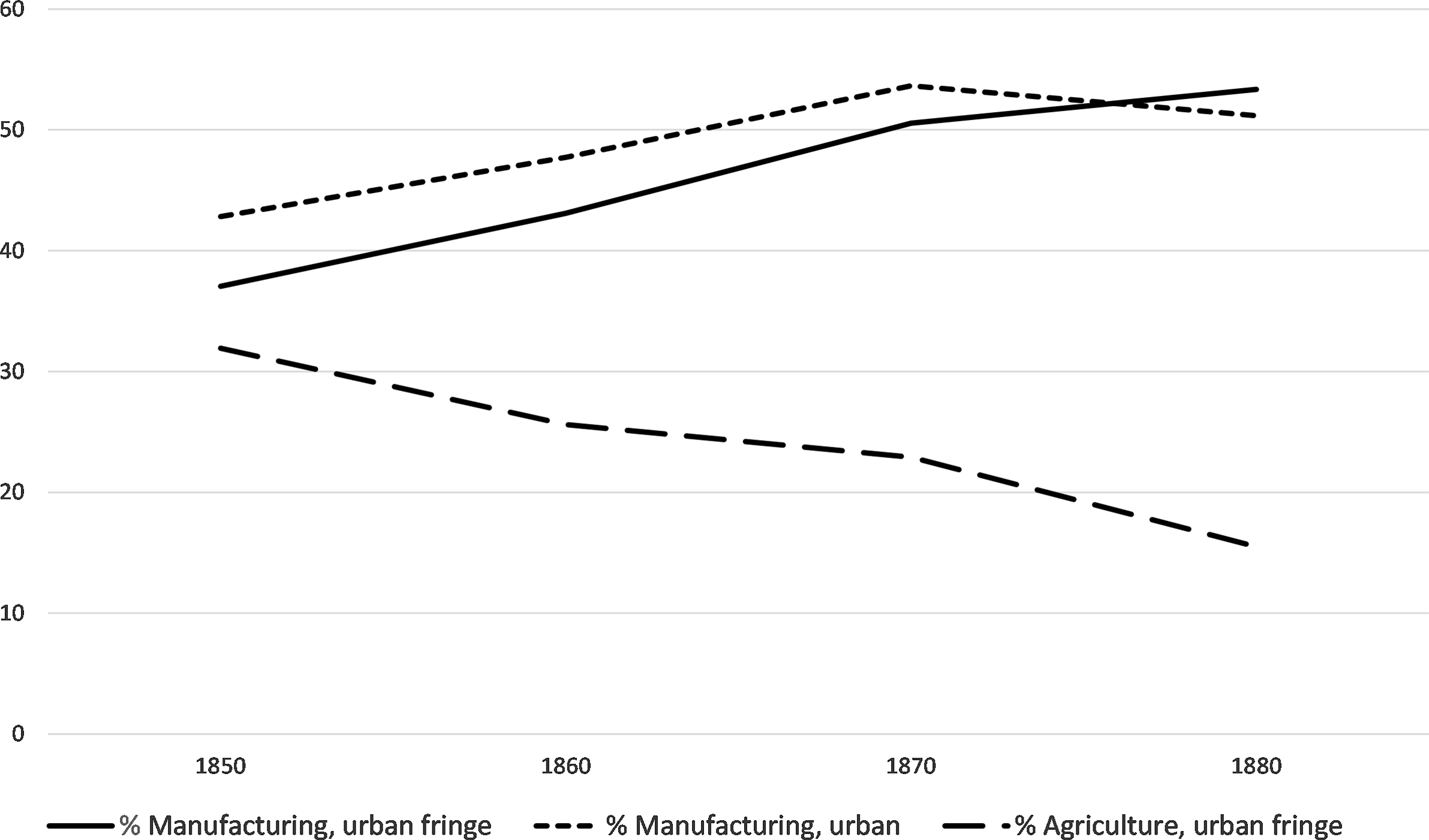
The third column of table 4 shows that in terms of occupational distribution, the urban fringe is closer to an urban area, with more manufacturing workers. The urban fringe had substantially more people employed in manufacturing than rural areas (37.1 percent vs. 27.2 percent). While the urban fringe also had more agricultural employment than urban areas, there is a 20 percent difference in agricultural employment between rural and urban fringe areas, and most of the agricultural employment in these areas was related to distribution of agricultural products. Furthermore, the importance of the urban fringe to manufacturing increased over time (see figure 2). By 1880, the urban fringe had a greater percentage of their workers in manufacturing than traditional urban areas, and this shift was mainly driven by a decline of agricultural employment in urban fringe areas.
Sectoral shift in urban and urban fringe, New England, 1850–80.

Table 4 and figure 2 show that urban “fringe” areas were likely the smaller manufacturing towns that attracted native-born rural migrants in the nineteenth century, and that they should therefore not necessarily be classified as “rural.” To substantiate this point, we find that according to the narrow classification, 1,063 of migrants to New England went to rural areas and 513 went to urban areas. Using the broader classification, 574 went to rural areas and 1,002 went to urban areas. The urban fringe was the destination among 31 percent of migrants to New England (1,002 minus 513, or 489 of 1,576) and were an important component of the sectoral shift to manufacturing.
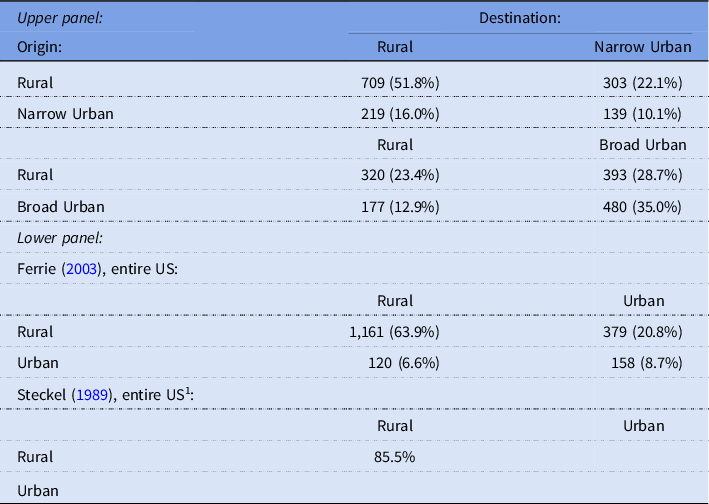
Table 5 presents the rural/urban migration matrix for within-New England migration based on the two rural/urban classifications. These statistics show that estimates of urban-urban migration increase the most from the narrow to the broad definition. Estimates of rural-urban migration also increase substantially. Estimates of rural-rural migration decline accordingly.
Rural/urban migration counts within New England according to different definitions of “urban,” 1850–80

Source: IPUMS, “Linked Representative Samples” (Ruggles et al. Reference Ruggles, Sarah, Ronald, Josiah, Erin, Jose and Matthew2020); author’s calculations from table 1 of Ferrie (Reference Ferrie2003) and table 1 of Steckel (Reference Steckel1989). “Narrow” definition of urban excludes parts of New England that are not “thickly settled”; “Broad” relaxes this restriction and uses the 2,500-person criterion for urban classification.
1 Only rural-rural migration rates are implied from the data in table 1 of Steckel (Reference Steckel1989): 424 total rural-rural moves (upper panel, second column of their table) divided by 496 total moves (lower panel, second column) in their entire sample.
The lower panel of table 5 reports the rural/urban migration patterns from Ferrie (Reference Ferrie2003) and Steckel (Reference Steckel1989). One caveat is that these statistics represent the entire United States instead of just New England. However, given their similarity to the migration patterns generated by the traditional rural/urban classifications in the upper part of the panel, they further support for our claim that their analysis relied on the narrower definition of “urban.”
In summary, using a broader definition of “urban” that is more appropriate to the sectoral composition of the New England economy, we find substantially more amounts of rural-urban and urban-urban migration. Our initial findings raise the importance of urban areas and rural-to-urban migration. These statistics fit into a narrative where rural-urban migration was significant to industrialization and where interurban mobility among the industrial workforce was substantial.
Urban Migration and Occupational Change
The purpose of this section is to reevaluate hypotheses regarding internal migration, considering the broader definition of “urban” outlined in the preceding text. One claim made in the literature is that migrants to urban areas, even in the Northeast, came predominantly from white-collar occupations. This thesis gives the impression that agricultural workers must have migrated to the frontier or to other rural parts of the Northeast. We consider whether this “white-collar to urban” hypothesis is still supported if we take account of the smaller manufacturing centers that were sprouting up across New England in the early-to-mid-1800s.
Second, the study of rural-urban migration is often the objective of analysis without an explicit connection to the shift from agriculture to manufacturing. This has created a puzzle because the observed lack of rural-urban migration begs the question of where the manufacturing labor force came from. Of course, as many others have observed, a large influx of Irish immigrants in the 1840s and 1850s provided a significant source of industrial labor. But native-born workers were also drawn to manufacturing, as this section will show.
Using our broader definition of “urban,” we find that about 28 percent of migrants to New England’s urban areas were originally employed in agricultural occupations, second only to manufacturing occupations, which composed about 39 percent of New England’s migrants to urban areas. Sixteen percent came from professional occupations. Most of the migrants from manufacturing occupations came from other urban areas (i.e., they were urban-urban migrants), while the agricultural migrants primarily came from rural areas (i.e., they were rural-urban migrants). Combined with the results from table 5, these statistics provide weight to the idea that agricultural workers were indeed a significant component of rural-urban migration, and that the interurban migration of manufacturing workers was also significant, as the new urban historians argued (Thernstrom and Knights Reference Thernstrom and Knights1970).
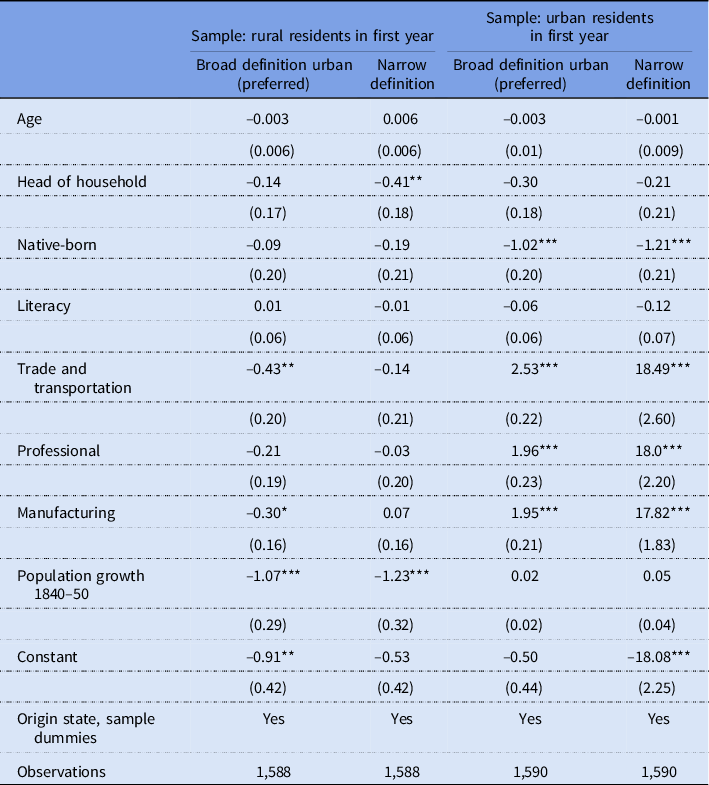
To test the significance of these statistics, we first develop a binomial logistic model that estimates the factors underlying rural-urban and urban-urban migration patterns. Our sample is all migrants to New England, which allows us to compare the factors driving this particular migration patterns, relative to migrating in general.
Equation 1:
 $${{{{{\rm{Urban}}\_{\rm{migratio}}{{\rm{n}}_{{\rm{it}}}} = {\rm{ }}{\beta _0} + {\rm{ }}{\beta _{\rm{1}}}^*{{\rm{X}}_{{\rm{it}}}} + {\rm{ }}{\tau _{\rm{1}}}^*{\rm{186}}0\_{\rm{188}}0{\rm{sampl}}{{\rm{e}}_{\rm{t}}} + {\rm{ }}{\tau _{\rm{2}}} }}}}^*{\rm{187}}0\_{\rm{188}}0{\rm{sampl}}{{\rm{e}}_{\rm{t}}} \\+ {\rm{ }}{\delta _{\rm{1}}}^*{\rm{stat}}{{\rm{e}}_{\rm{i}}} + {\rm{ }}{\gamma _{\rm{1}}}^*{\rm{pop}}\_{\rm{growth}}\_{\rm{count}}{{\rm{y}}_{\rm{i}}} + {\rm{ }}{\varepsilon _{{\rm{it}}}}$$
The variable “X” refers to individual-level controls: age, head of household status, native/foreign born, family size, number of children, and literacy. The variables “1860_1880” and “1870_1880” indicate the sample from which the migration event is taken (1850–80 is the reference sample). The variable “state” refers to the origin state of the migrant. The variable “pop growth county” measures the population growth between 1840 and 1850 in the origin county, drawn from US Census abstracts. Our hypothesis is that higher population growth is a sign of higher economic development and will reduce migration rates, while lower population growth will “push” workers to search for economic opportunities elsewhere.
Results are reported in table 6; they highlight some important contrasts between rural-urban and urban-urban migrants. The statistical significance and negative sign of the nonagricultural occupation coefficients in column 1 implies that agricultural workers were more likely to make a rural-urban move than other occupations. However, column 3 shows that nonagricultural occupations were much more likely than agricultural workers to make urban-urban moves. Thus, agricultural workers were correlated with rural-urban migration, while the interurban movement of workers was correlated with nonagricultural occupations. The coefficients in front of the other covariates are generally not statistically significant, but we do note that native-born status was strongly negatively related to urban-urban migration while head of household status was only negatively related to rural-urban migration under the narrow definition of “urban.”
Predictors of migration to urban New England, 1850–80

Source: IPUMS, “Linked Representative Samples” (Ruggles et al. Reference Ruggles, Sarah, Ronald, Josiah, Erin, Jose and Matthew2020).
Notes: Columns 1 and 2 compare the predictors of rural-urban migration relative to rural-rural migration. Columns 3 and 4 compare the predictors of urban-urban migration relative to urban-rural migration. Robust standard errors reported in parentheses. ***, **, * indicate significance at the 99%, 95%, and 90% confidence levels, respectively. Positive coefficients indicate increased odds associated with the variable; negative coefficients indicate decreased odds. “Narrow” definition of urban excludes parts of New England that are not “thickly settled”; “Broad” relaxes this restriction and uses the 2,500-person criterion for urban classification.
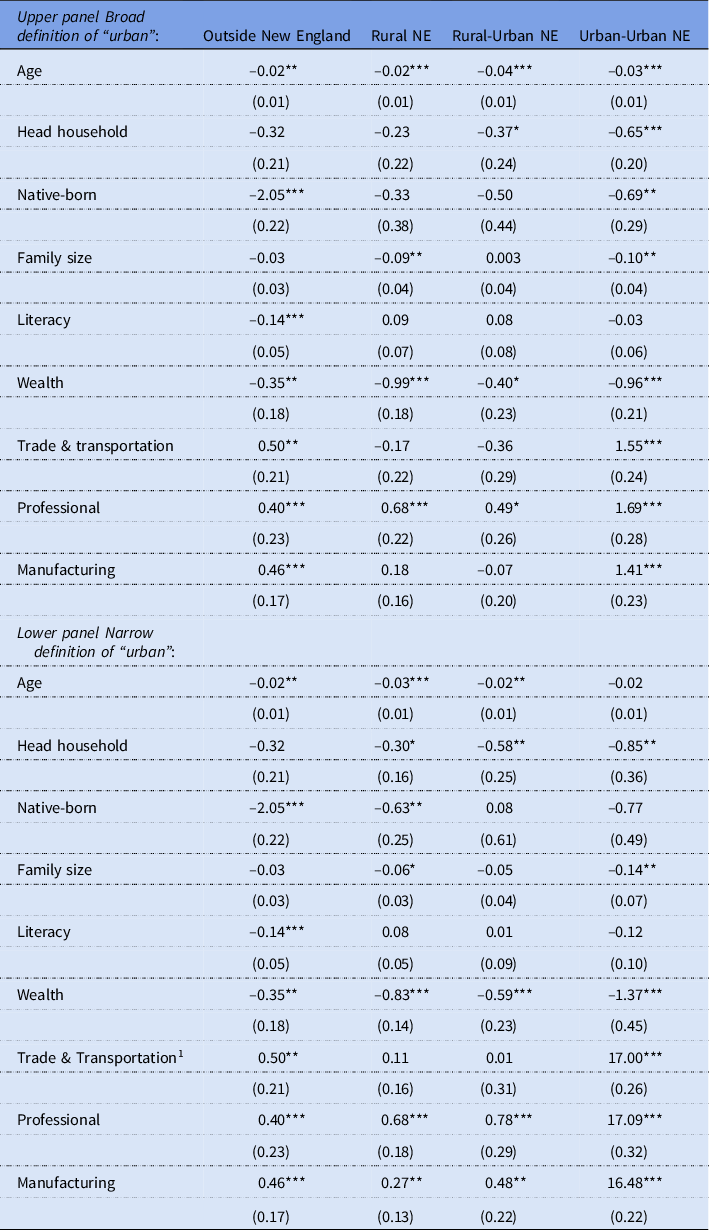
The binomial approach evaluates the factors behind specific patterns of urban migration, conditional on the migration decision. What are the determinants to migrate in the first place? We estimate a multinomial logistic regression, which can allow for several different choices in the dependent variable and estimates the factors determining the probability of each of these choices relative to the baseline decision of not migrating (i.e., “persist”). The underlying sample is all residents of New England in the first period (i.e., 1850, 1860, or 1870). Migration choices are “migrate from rural to urban New England,” “migrate from urban to urban New England,” “migrate to rural New England,” and “migrate outside of New England.” The baseline from which these probabilities are all estimated is “persist,” which means that the interpretation of the correlations is different from those in table 6—here, they measure the change in probability of the outcome relative to the decision not to migrate. The dependent variable in equation 1 is modified to account for these additional choices, and property ownership is included because it is often found to be a major factor in people’s decisions to not migrate in the nineteenth century.
The upper panel of table 7 shows that, relative to persisters, age is negatively correlated with migrating across all choices. Head of household status is also negatively related, but it is only statistically significant in the rural-urban and urban-urban choices. Native-born status is negatively related to migration and is statistically significant in both the “outside New England” and “urban-urban” migration choices. As for occupation, professional workers are most likely to migrate in general, although the correlation is highest when comparing persisters to urban-urban migrants. Owning property is negatively related to any kind of migration, as expected. The lower panel shows some differences when a narrower definition of “urban” is adopted. There is a weaker relationship between nativity and urban migration and a stronger relationship between nonagricultural occupation and urban-urban migration.
Multinomial logit analysis of the decision to migrate (baseline migration decision = 0 if persist)

Source: IPUMS, “Linked Representative Samples” (Ruggles et al. Reference Ruggles, Sarah, Ronald, Josiah, Erin, Jose and Matthew2020).
Notes: Robust standard errors calculated but not reported. ***, **, * indicate significance at the 99 percent, 95 percent, and 90 percent confidence levels, respectively. Positive coefficients indicate increased odds associated with the variable; negative coefficients indicate decreased odds. “Narrow” definition of urban excludes parts of New England that are not “thickly settled”; “Broad” relaxes this restriction and uses the 2,500-person criterion for urban classification.
1 Baseline occupational category is agriculture.
2= 0 if no real estate owned, = 1 otherwise.
Overall, these statistics are consistent with Field (Reference Field1978)’s hypothesis about the migration of agricultural workers from rural to urban areas of New England. They are also consistent with the new urban historians who found a significant amount of urban-urban migration that was concentrated among a “floating proletariat” of foreign-born workers (Thernstrom Reference Thernstrom1964; Thernstrom and Knights Reference Thernstrom and Knights1970). When we define urban areas more broadly, taking account of the smaller manufacturing centers that were developing across New England, we obtain a richer account of internal migration and sectoral shift in New England that is still nevertheless consistent with the historical literature on urbanization.
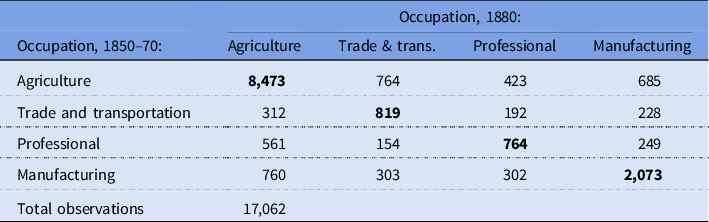
We now turn to the closely related question of whether rural-urban migration was associated with an occupational shift from agriculture to manufacturing. Out of the 17,062 workers reported as employed in the initial (1850, 1860, or 1870) and final year (1880) of the dataset, most workers stayed within their original sector see table 8). However, 4.5 percent changed from an agricultural to a manufacturing occupation, representing about 14 percent of all workers that changed occupations. We also know from the sample that in New England between 1850 and 1880, about 16 percent of agricultural migrants to New England stayed in agriculture, while twice as many changed their occupation to manufacturing.
Occupational counts, 1850–80

Source: IPUMS, “Linked Representative Samples” (Ruggles et al. 2019).
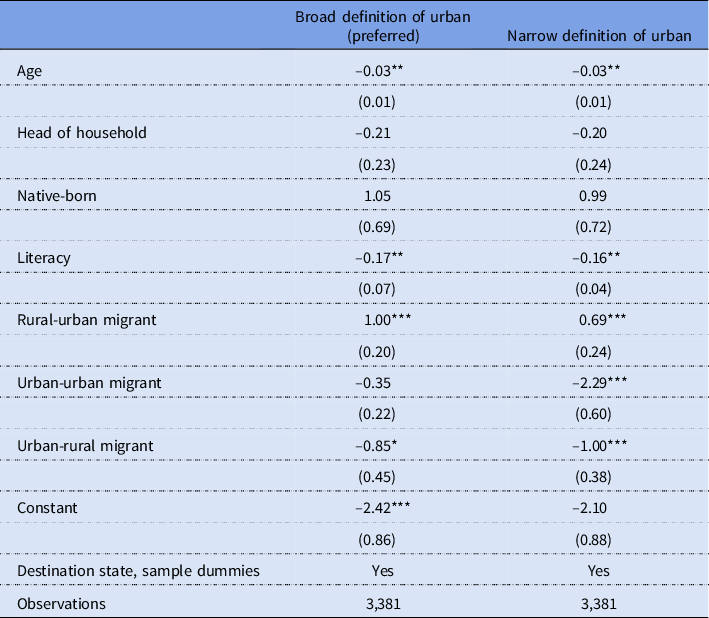
To evaluate the extent to which occupational change was related to migration, we employ a logistic regression where the dependent variable equals 1 if a person was recorded as changing their occupation from agriculture to manufacturing. Thus, the sample consists of all agricultural workers in the first period. Individual-level controls are included for age, head of household status, native/foreign born, family size, number of children, and literacy. We also include dummy variables for the three intervals in which individuals could migrate (1860–80, 1870–80), using the 1850–80 sample as our baseline. We also include state-of-residence dummy variables to account for destination characteristics influencing whether an agricultural worker changed their occupation.
Equation 2:
 $${\rm{Agric}}\_{\rm{Manu}}{{\rm{f}}_{{\rm{it}}}} = {\rm{ }}{\beta _0} + {\rm{ }}{\beta _{\rm{1}}}{^*}{{\rm{X}}_{{\rm{it}}}} + {\rm{ }}{\tau _{\rm{1}}}{^*}{\rm{186}}0\_{\rm{188}}0{\rm{sampl}}{{\rm{e}}_{\rm{t}}} \\+ {\rm{ }}{\tau _{\rm{2}}}{^*}{\rm{187}}0\_{\rm{188}}0{\rm{sampl}}{{\rm{e}}_{\rm{t}}} + {\rm{ }}{\delta _{\rm{1}}}{^*}{\rm{stat}}{{\rm{e}}_{\rm{i}}} + {\rm{ }}{\varepsilon _{{\rm{it}}}}$$
Refer to the estimates in table 9, which show the results for both definitions of urban. Rural-urban migration was positively related to an agricultural worker changing to a manufacturing occupation, supporting the claim that rural-urban migration was related to sectoral change. The coefficient is higher for our preferred definition of urban. Among the other covariates, age was negatively related to the shift from agriculture to manufacturing, suggesting that it happened among younger workers. Literacy was also negatively related, meaning that more literate agricultural workers were less likely to shift to manufacturing.
Predictors of changing from agricultural to manufacturing occupation in New England, 1850–80

Source: IPUMS, “Linked Representative Samples” (Ruggles et al. Reference Ruggles, Sarah, Ronald, Josiah, Erin, Jose and Matthew2020).
Notes: Sample consists of individuals who were agricultural workers in the first year. Robust standard errors reported in parentheses. ***, **, * indicate significance at the 99 percent, 95 percent, and 90 percent confidence levels, respectively. Positive coefficients indicate increased odds associated with the variable; negative coefficients indicate decreased odds. “Narrow” definition of urban excludes parts of New England that are not “thickly settled”; “Broad” relaxes this restriction and uses the 2,500-person criterion for urban classification.
Conclusion
This article is an attempt to shift the discussion of internal migration in the nineteenth-century United States back to urban areas as sources of economic and structural change. Most of the recent literature has focused on rural-rural migration patterns during this period. This literature has employed a narrow definition of “urban” that leaves out New England towns that satisfy the 2,500-person population requirement but not the density requirement. We show that these areas had a surprisingly high amount and growing pace of manufacturing activity and that they look economically similar to traditional urban areas. Thus, a broader definition that eschews the density requirement but keeps the population requirement is consistent with both the historical literature and our understanding of what urban areas generally represent in developing economies.
Another claim from the literature concerns the occupational makeup of rural-urban migrants, arguing that most of the rural-urban migration that did occur was dominated by skilled trades and white-collar workers. This hypothesis gives the impression that agricultural workers in rural areas were either drawn to other rural areas or to the frontier—not to urban areas. We showed that this claim is not valid for New England—many workers migrated to urban areas and made the shift from agricultural to manufacturing employment upon doing so.
The “white collar to urban” claims were based on a narrow definition of urban. They were also based on a comparison of rural-urban migrants to persisters. As our analysis showed, a better approach is to compare rural-urban migrants to other kinds of migrant. White-collar workers were more inclined to migrate in general, but there was a statistically significant negative relationship between nonagricultural occupation and rural-urban migration, relative to other potential migration patterns.
While these results are somewhat novel, they are not out of place with the historical literature. An older thesis regarding rural-urban migration and sectoral shift receives new support from our findings (Field Reference Field1978). And many of the new urban historians found substantial amounts of urban-urban migration, especially among nonnative born workers, as well as migration to burgeoning manufacturing centers in New England (Dublin Reference Dublin1986; Thernstrom Reference Thernstrom1964; Thernstrom and Knights Reference Thernstrom and Knights1970). Our analysis shows that a more fluid conception of “urban,” along with a closer attention paid to the relationship between migration and occupational change, can shed new light on important questions in the history of internal migration in the United States.