Introduction
Inter-vivos financial transfers from older parents to their adult children or their grandchildren are widespread in the United States.Footnote 1 For example, among parents aged 51 or more years, about 35 per cent gave a financial transfer to their children or grandchildren over two years (Hurd, Smith and Zissimopoulos 2006).Footnote 2 These transfers are not solely for educational expenses. Indeed, many older parents whose children are beyond school-attending ages give financial transfers at high rates: among those aged 76–80 years, the rate was 27 per cent over two years. Transfers by children to their parents are much less frequent: just 4.9 per cent of parents aged 51 or more years reported receiving a financial transfer from their children.Footnote 3 Much older parents, who might be financially needy, receive transfers only infrequently from their children: among those aged 80 or more years, just 6.3 per cent reported such a transfer over two years. A general conclusion (which is also reached from European data), is that financial transfers are predominantly from the older generation to younger generations, including grandchildren.Footnote 4
The leading hypothesis to explain financial gifts is the altruistic motive. Its main assumption is that the giver cares about the wellbeing of a particular person (Barro Reference Barro1974; Becker Reference Becker1974, Reference Becker1981). An additional assumption, which is well founded in economic theory, is that a given level of financial transfer can increase the wellbeing of a poor person more than the wellbeing of a wealthy person. With this addition, an implication of altruistic giving is that financial transfers will be targeted more frequently on the poor. The patterns of transfers to children support this altruistic motive: in multi-child families, the frequency of giving is greater to the least well-off children. The altruistic motive is also supported by data on financial transfers from middle-aged children to their elderly parents: the frequency of giving is greater when the parents are less well-to-do (McGarry and Schoeni Reference McGarry and Schoeni1995, Reference McGarry and Schoeni1997).
Other hypotheses to explain financial gifts involve some type of reciprocity, which can be explicit, as with actual gifts or giving attention, or implicit, as when efforts are made to establish or strengthen social networks. The latter type of reciprocity is difficult to study among families with children: all have presumptive social networks. Financial transfer behaviour by the childless is both simpler and more complex. Lacking children, it may be that the childless simply make fewer transfers, but because they have to shift the target of their giving away from children and there are multiple potential targets of approximately equal attractiveness, their decisions are more complex. Even the basic facts of which targets are chosen, and how those targets vary with observable characteristics are not known.
The primary aim of this paper is to document the facts about financial transfers by the childless and to study the patterns of the transfers. An additional aim is to find whether the patterns reveal anything about the motivations for the transfers. Should that be the case, the results would provide a basis for forecasting how financial transfers will change with the increasing childlessness that is observed in both the United States and many European countries.
Outline of the theoretical model
People realise utility through their own consumption and, less tangibly, through gifts that promote the consumption of others they care about – children, parents, other relatives and friends, and unknown others (through donations). Such gifts may take the form of bequests or inter-vivos transfers. The utility realised through gifts may not come from the gift itself but from some favourable return, often of a personal nature: transfers may engender a sense of obligation in the recipient and may strengthen the ties that bind family and friends. Particularly in the case of children, they may reflect the giver's desire to see the recipient achieve a higher economic status. As such, they may be investments that will pay off after the giver has died, thus allowing the giver an effect beyond his or her lifetime. In the case of transfers from children to parents, the transfers may reflect a sense of gratitude or obligation for the many years of support and care given by the parents. In the case of transfers from parents to children, they may reflect gratitude for contemporaneous (reciprocal?) attention.
The utility realised from a gift will depend not only on the amount of the gift but also on various other factors such as the nature of the gift, the nature of the bond with the recipient, the wealth of the recipient, and the wealth of the giver. For example, other things being equal, most givers are likely to realise greater utility from an inter-vivos transfer than from a bequest, because they have a better chance of seeing concrete results, and greater utility is likely from a gift to children with lower rather than higher wealth, because a low-wealth child will value the gift more than a high-wealth child. A utility model that incorporates these ideas would allow for altruistic transfers; that is, transfers for which there is no expectation of a reciprocal benefit. Donations to charities are examples, but gifts to children, relatives and friends could also be altruistic. The model would also have a provision for strategic transfers that are given with some expectation of reciprocity. The return could be material, such as an expectation of an inheritance from parents or support from children, or instrumental and affective, such as social contacts or the maintenance of family connections.
Parents have supported their children during their childhood years and material support often continues throughout the parents' lives. The clear implication is that children are typically the primary desired target of inter-vivos transfers by parents. Stated differently, as in the thought experiment of adding a child to a childless couple, the couple would then preferentially target transfers to the child. Because of a constraint on lifetime resources, the imagined couple would then have to reduce financial transfers to other potential targets, such as other relatives or charities, or reduce spending on other consumption items (which are held constant for this comparison). However, transfers that offer a possible reciprocal benefit could be substitutes for transfers to a child or children. For example, if parents have close ties with their children, they have less need of close ties with other relatives or friends. If the need for familial and social connections can be satisfied by connections with children, the substitution effect would further reduce transfers to relatives and friends beyond the reduction operating through the budget constraint.
Bequests operate differently because there is no opportunity for a reciprocal benefit at a later date. Furthermore, transfers during the lifetime are intended transfers, whereas bequests may be entirely unintended: people do not know when they will die, and not wanting to spend completely their assets in case they survive to advanced old age, they will die with bequests whether intended or unintended. Thus, we cannot tell from the magnitude of bequests whether they are intended. Nonetheless, we can deduce something about intended bequests from the variation in bequests according to their targets. As far as the targets of bequests are concerned, about 90 per cent of the assets of parents are bequeathed to their children (Hurd and Smith Reference Hurd and Smith2002), confirming the lifelong pattern of parents transferring economic resources to their children. This pattern does not necessarily mean that bequests are intended: for a bequest to be (partially) intended, the amount of the bequest should be larger than it would be otherwise. To discover if this is the case, we can compare the magnitude of bequests by the childless with the magnitude of those made by parents.
Under the altruistic bequest motive, total bequests by a parent should vary with the number of children, not just by whether someone has children or not. The reason is that the total utility for the giver is greater when a given amount is split between two children than when it is all given to one child. The greater utility is the result of the declining marginal utility of consumption. To illustrate, suppose a parent gave $100,000 to one child. According to the principle of declining marginal utility, the child would value the first $50,000 more than the second $50,000. If the parent gave $50,000 to each of two children, however, each child would value the $50,000 at a relatively high level. Thus, the total utility achieved by giving two children $50,000 each would be greater than that achieved by giving one child $100,000. Under altruism, the greater total utility would lead to greater total bequests. In this hypothetical example, we might see a desired bequest of $90,000 to one child and desired bequests of $55,000 to each of two children. In general, we expect total bequests to be positively related to the number of children even when holding economic resources constant.
Summary and predictions
According to the utility maximisation theory of spending, transfers benefit the giver and in this respect are similar to other types of spending. The theory also predicts that transfers of all types, again like spending, will increase with the economic resources of the giver. There are, however, important differences between transfers and spending. The characteristics of a potential recipient influence the utility derived from a transfer, and different types of transfers are likely to satisfy different needs of the giver. These distinctions are important when comparing transfers by parents with those by the childless. Both may give to charities, their own parents and to relatives, but only parents can give to their children. Because parents favour their children, they will make smaller transfers to other recipients, such as their own parents, siblings, family members and charities, simply because they will have fewereconomic resources after the transfers to their children. Some types of transfers may be further reduced through a substitution effect: if transfers to children act to maintain and increase family bonds, parents may feel less need to spend on family bonds by transfers to parents, siblings or other relatives. In terms of formal economic theory, there would be an income-compensated substitution effect: transfers to children would reduce transfers to the extended family members beyond the reduction predicted by the budget constraint effect.Footnote 5
While transfers to children may substitute for transfers to the extended family, transfers to children are unlikely to substitute for transfers to charities or similar organisations. We would expect such transfers to be motivated by, for example, religious feelings, concern for the less fortunate or for the environment. It is difficult to see how giving to one's own children would satisfy those needs. This reasoning implies that the income-compensated substitution effect of transfers by parents to their children on transfers to charities would be zero, and that any effect would be through the budget constraint. An important prediction of this reasoning is that, relative to the childless, parents give somewhat less to charities (reflecting their diminished budget), and considerably less to the extended family (reflecting both the reduced budget and the substitution effect). Such a pattern would be consistent with the idea that transfers satisfy different needs of the giver and that these depend on the target of the transfer.
Data and methods
The US Health and Retirement Study (HRS) surveys a panel of over 20,000 Americans aged 51 or more years and their spouses every two years.Footnote 6 The survey includes complete measures of income and wealth, as well as extensive health measures. The first wave of the HRS was fielded in 1992 but because of differences in the questions about financial transfers prior to 1996, only data from the 1996 through 2004 survey waves have been analysed.
Analysed types of financial transfers
Five classes of inter-vivos financial transfers have been analysed, as well as the subjective probability of a bequest. The five types are:
• Inter-vivos transfers to children. The HRS asked, ‘Including help with education but not shared housing or shared food (or any deed to a house), in the last two years did you give financial help totalling $500 or more to any of your children (or grandchildren)?’ Follow-up questions determined the amount given to each child, within bracketed ranges. These questions were asked in all waves analysed for this paper.
• Inter-vivos transfers to parents and parents-in-law. The HRS asked, ‘Not counting any shared housing or shared food, did you give financial help to your parents amounting to $500 or more in the last two years?’ Follow-up questions established the amount, within bracketed ranges. These questions were asked in 1996 1998 and 2000.
• Inter-vivos transfers to friends and/or relatives. The HRS asked, ‘Did you give financial help totalling $500 or more in the last two years to friends or relatives other than children, grandchildren, or parents?’ A follow-up question asked how much altogether, and if there was no response, subsequent questions established the amount within bracketed ranges. These questions were asked in all waves.
• Donations. The HRS asked, ‘In [the last calendar year] did you donate money, property, or possessions totalling $500 or more to religious or other charitable organisations?’ A follow-up question asked for the total amount. These questions were asked in all waves.
• Subjective probability of a bequest. The HRS asked, ‘Including property and other valuables that you might own, what are the chances that you and your husband (wife) will leave an inheritance totalling $10,000 or more?’ Target totals of $0, $10,000 and $100,000 were asked in all years.
The analysis strategy
Because this paper is a study of the transfer behaviour of childless people, the focus will be almost exclusively on a comparison of their transfers with those by parents: without such a comparison we would not know what is ‘normal’ (of course we cannot compare transfers to children). We simply note that parents make inter-vivos transfers to children at a high rate: about 35 per cent of parents give financial transfers to a child over two-years (Hurd, Smith and Zissimopoulos 2006). Omitting inter-vivos transfers to children, we analyse transfers in the order given above. For each type, we compare the probability of a transfer by those that have children with the probability of one by the childless. We then compare the average amounts of the transfers (conditional on a transfer, i.e. ignoring those who transfer nothing). These comparisons help determine which recipients are substituted when there are no children. Finally, we compare the subjective probability of a bequest by those with children to the probability of one by those without children. This seeks to establish whether bequests are intended or accidental.
Separate analyses were performed for single persons (never married, divorced or widowed) and for couples including those living with a partner. These are required because we would like to study transfers conditional on age and economic resources. But the ‘age’ of a couple is not comparable with the age of a single person. Economic resources are not comparable across marital status because of returns-to-scale in consumption: a couple needs to spend more than a single person but not twice as much to achieve the same level of material wellbeing. Without knowing returns-to-scale, we do not know the level of economic resources that will make a couple as well off as a single person.
Simple comparative analysis
Economic status
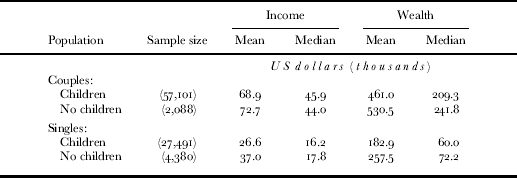
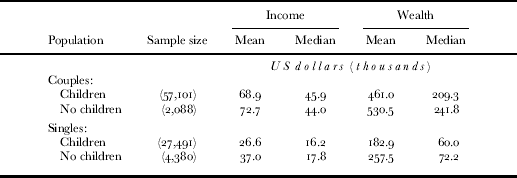
A couple's income differed little by whether or not they had children, but those without children had more wealth (see Table 1). The wealth difference is even more striking when comparing single people with and without children. Mean income was also substantially higher among single people without children than among those with. Presumably, some of the wealth difference is the result of the expenditure of resources in raising children – an expenditure that could be viewed as an investment, given the potential for material and other support to aged parents by children. (Note also the lower economic status of single people compared with couples – even on a per-person basis.) The difference in income and wealth as a function of parental status mean that we must control for them; otherwise we would attribute part of the difference in transfer behaviour to parental status rather than to income or wealth.
Income and wealth of couples and single persons, United States 2004
Source: Pooled US Health and Retirement Survey (HRS) data 1996–2004 (five waves).
Propensities for inter-vivos transfers to parents and parents-in-law
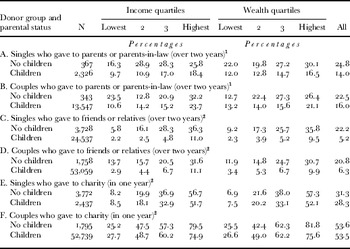
The following analysis is limited to those having a living parent or parent-in-law. Among single people, the childless with living parents or (in the event of a previous marriage) parents-in-law were substantially more likely to have given to them than single people with children (see Table 2). In some income/wealth quartiles, the propensity among the childless was twice as high.Footnote 7 Among couples, the patterns and overall level of transfers were similar to those for single people (compare Blocks A and B of Table 2). Differences between the childless and those having children with respect to transfers to parents were somewhat smaller for couples than for single people (compare the figures in the right-hand columns). The effect of higher economic status is a little stronger for couples. For both childless couples and those with children, there was a relationship between economic resources and the propensity to give, but it was not strong. A likely reason is that HRS respondents with low income and/or wealth were likely to have parents with low income and/or wealth. Thus, the need for transfer declined with greater income/wealth even as the resources available increased. The total effect is that the transfer propensity was not highly sensitive to the respondents' resources.
The prevalence of financial transfers over two years, by whether donors had children or not and the identity of the receiver, United States 1996–2000/4

Data source: Pooled US HRS data. 1. 1996–2000 (three waves). 2. 1996–2004 (five waves).
Propensities for inter-vivos transfers to friends and/or relatives
Childless single people were much more likely to have given to friends or relatives than single parents (Table 2, Block C). Except in the highest income and wealth quartiles, there was very little transfer to friends or relatives by parents. Perhaps having children substituted for the desire to maintain extended family connections by transfers – or maybe raising children pre-empted the resources (such as time) needed to maintain the connections that merit transfers. But for both the childless and those with children, the propensity to give increased sharply across income and wealth quartiles. That is, giving to friends or relatives was a strongly superior good. The results for couples were similar to those for single people (compare Blocks C and D of Table 2). The likelihood of inter-vivos transfers by couples to friends or relatives was low, particularly in the lower income and wealth quartiles. The childless were much more likely to have given to friends or relatives. Such giving is again correctly described as a superior good, though the gradients of transfer probability with economic status were less steep than among single people.
The propensity to donate to charities
Among single people with and without children, the propensity to give to charities increased sharply with income and wealth, from less than 10 per cent in the lowest quartiles to more than 50 per cent in the highest (Table 2, Block E). The income gradient was much steeper than for giving to parents, and somewhat steeper than for giving to friends and relatives. One reason could be that the recipient's need is not related to the giver's wealth, as is the case for inter-vivos transfers to parents and, to a lesser extent, to friends and relatives. Except in the lowest quartile, the propensity to make donations was a little higher among the childless than among parents. Couples were overall much more likely to give to charities (compare Blocks E and F of Table 2), but they had higher income and wealth (recall Table 1). As with single people, the propensity to give increased sharply with income or wealth. Differences between childless couples and parents were generally small, and there was no consistent pattern.
Analyses that control for age
The preceding analyses held income, wealth and marital status constant, but there may be other determinants that should be controlled. In particular, other things being equal, the propensity to engage in inter-vivos transfers may vary with age. For example, someone who feels closer to the end-of-life may be more willing to give away wealth that he or she may not have the time to consume, and age may be correlated with wealth. To control for age, a logistic estimation of probabilities was undertaken. The propensity to give was estimated as a function of income quartile, wealth quartile, age group and whether the individual had children. Separate analyses were run for single people and couples. In the case of couples, ‘age’ was taken as the age of a randomly-selected spouse, provided both were age-eligible.Footnote 8 If only one spouse was eligible, the age of the couple was that spouse's age. The results reported are relative odds (or odds ratios): the odds that a person with some particular set of characteristics gave relative to the odds that a reference person gave.Footnote 9 The reference person was childless, aged in the fifties, and in the lowest income and wealth quartiles.
Propensities for inter-vivos transfers to parents and parents-in-law
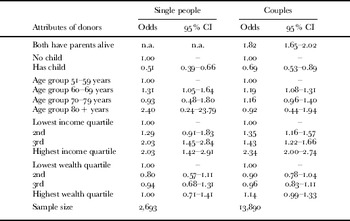
Among single people, the probability that a parent made inter-vivos transfers to his or her own parents after controlling for age, income and wealth was only about one-half (0.51) the probability that a childless person did so (Table 3). Single people aged in the sixties were 31 per cent more likely to give to their own parents than single people aged in the fifties. Those in the upper income quartiles were twice as likely to give as those in the lowest quartile, but there was not a strong correlation between giving to parents and wealth. The results for couples were similar. As with single people, having a child reduced the likelihood of inter-vivos transfers to parents and parents-in-law. Income but not wealth was associated with an increased likelihood of giving. If both partners had a living parent, the probability that the couple gave to a parent was 82 per cent higher than if only one had a living parent.
Logistic estimation: relative odds of giving to parents or parents-in-law

Notes: CI: confidence interval. n.a. not applicable. From pooled HRS data 1996–2000 (three waves).
Amounts of inter-vivos transfers to parents and parents-in-law
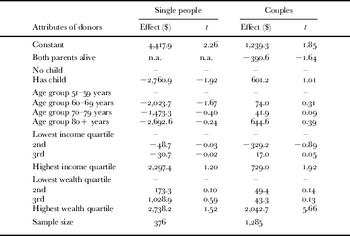
An analysis of the amounts given to parents by single people, or single people who gave anything, revealed sizeable transfers by those in the highest income and wealth quartiles, even though the estimates are not statistically significant (Table 4). The only variable even marginally associated with the amount given was having a child. Single people with a child gave $2,761 less to their parents over the course of two years than those without one. Among couples, as with single people, the relationships between the variables of interest and the amounts transferred to parents by givers were generally not statistically significant (see Table 4). The sole large effect, and a significant one, is that being in the highest wealth quartile raised the conditional amount given by $2,043 over being in the lowest quartile. The unconditional amount given; that is, the total given by all couples to their parents; was also likely to be higher for the highest wealth quartile, because the conditional amounts were larger for the highest quartile than for the lowest, and because the probabilities were similar between the two. The association of conditional giving with having a child was not statistically significant.
Amount given to parents conditional on giving

Notes: n.a. not applicable. Based on pooled HRS data 1996–2000 (three waves).
Propensities for inter-vivos transfers to friends and relatives
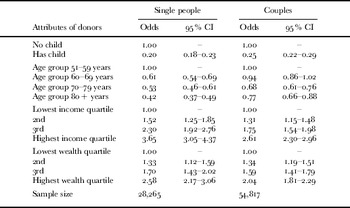
Among single people, having a child reduced the probability of transfers to friends and relatives by a factor of five (Table 5). The probability of having given was lower at older ages. For example, single people aged in the seventies were only about one-half as likely to have given as those aged in the fifties. The likelihood of transfers to friends and relatives strongly increased with income and wealth. The patterns of transfers by couples to friends or relatives were similar. The likelihood of giving was low if the couple had a child. The probability was lower at older ages, and went up with increasing income or wealth.
Logistic estimation: relative odds of giving to friends or relatives

Source: Based on pooled HRS data 1996–2004 (five waves).
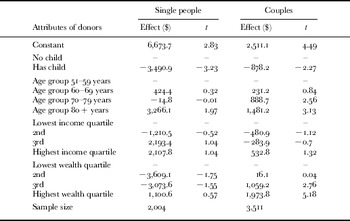
Amounts of inter-vivos transfers to friends or relatives conditional on giving
Not only did having a child reduce the probability that a single person made an inter-vivos transfer over two years to a friend or relative, but for those who had given, the amount was less, by $3,491 (Table 6). The differences by income or wealth were not large enough or sufficiently consistent to yield significant associations, nor were differences with age statistically significant, except that givers aged in the eighties transferred $3,266 more than givers aged in the fifties. Couples who made inter-vivos transfers to friends or relatives also gave less if they had a child, but the $900 difference was smaller than for single people. In contrast to single people, couples aged in the seventies who gave transferred greater amounts relative to those aged in the fifties, though the difference was not large compared with the $1,481 extra given by those aged in the eighties. The amounts transferred increased with the givers' higher wealth, though not with their higher income.
Amount given to friends or relatives conditional on giving

Source: Based on pooled HRS data 1996–2004 (five waves).
The propensity to donate to charities
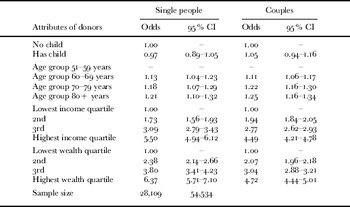
In contrast to the preceding analyses, among single people having a child is the only tested variable that was not related to the probability of donating to charities (Table 7). This absence of a relationship is similar to the results without age controls (Table 2, Block E), where the propensities for parents and the childless are similar. As for age, those over 60 were more likely to give to charities than those aged in the fifties. This is consistent with the life-cycle model of consumption, which holds that, other things being equal, older people should spend more because of the higher likelihood of dying (with wealth). The donation propensities increased very strongly with income and wealth: those in the highest wealth quartile were over six times as likely to give as those in the lowest. The donation propensity patterns for couples were very similar to those for single people.
Logistic estimation: relative odds of giving to charities

Source: Based on pooled HRS data 1996–2004 (five waves).
Amounts given to charities
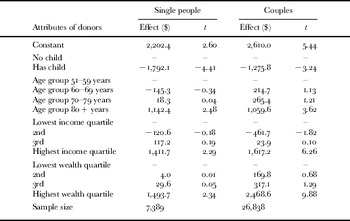
Among single people, although having a child was not related to the probability of donating to charities, single parents who donated gave $1,792 less per year than childless single people who gave (Table 8). Given the constant of $2,202, this leads to the prediction that single people aged in the fifties and in the lowest income and wealth quartiles donated only $410 ($2,202–1,792) per year. Because the probabilities were about the same for parents and couples, while the conditional amounts were smaller for parents, the unconditional amount (the average amount given by all single parents) should also be smaller. Amounts donated, conditional on giving, were also higher for single people aged in the eighties than for those aged in the fifties, and for single people in the highest income and wealth quartiles than for those in the lowest. These differences were between $1,142 and $1,494. The patterns for donating to charities by couples were similar to those for single people, but the amounts differed. In particular, donations by couples in the highest wealth quartile who gave were $2,469 higher per year than by those in the lowest quartile.
Amount given to charities conditional on giving

Source: Based on pooled HRS data 1996–2004 (five waves).
Subjective probability of a bequest
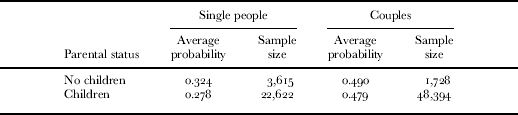
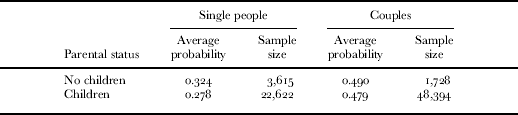
An analysis of the relationships between transfers to others and parenthood, age and other covariates is incomplete without consideration of bequests. So far we have seen an apparent substitution of children for other transfer targets; that is, parents gave less to recipients other than children, which suggests that some of the money that the childless transferred outside their immediate family was, in the parents' case, being given to their children. Did this behaviour change when the transfer was a bequest rather than an inter-vivos gift? Did the availability of children result in larger bequests? As shown in Table 9, childless single people were slightly more likely than single parents to declare that they will grant a bequest of at least $100,000. For couples, the probabilities were essentially the same, and similar results were obtained when controlling for income and wealth in a regression analysis (not tabulated). Neither did the results change materially when the threshold was changed to $10,000, or even $0 (the probability of leaving any bequest). Furthermore, there was no consistent pattern when the number of children was taken into account. As might be expected, the self-reported probability of a bequest increased strongly with wealth. The implication of these is that having children did not motivate bequests. The childless were about as likely to bequeath something, or some large amount, as parents were. This result is consistent with the actual wealth change as people age that is shown by panel data: among retired single people or couples, the rate of wealth decline does not differ by whether the wealth holders are parents (Hurd Reference Hurd1990).
Average subjective probability of a bequest of $100,000 or more
Source: Based on pooled HRS data 1996–2004 (five waves).
Summary and conclusions
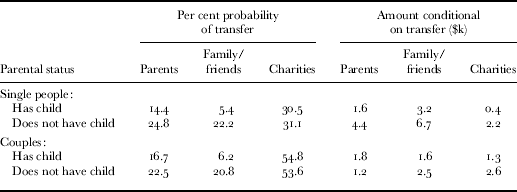
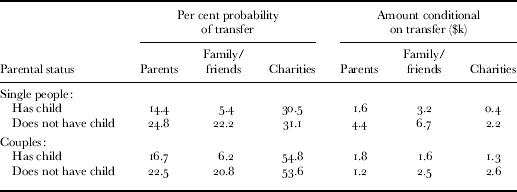
The principal interest of this paper has been in the difference between parents and the childless in monetary gifts to people other than their children. During 1996–2004 in the United States, overall, parents tended to give less to other people than the childless. This can be seen directly from the results on the prevalence of giving and on the amount given conditional on giving. From those estimates (which control for income, wealth and age), among single people, parents gave about $2,215 less per year to their own parents, to relatives and friends and to charities than did the childless. Among couples, parents gave about $1,158 less per year. However, we have found some variation depending on the nature and target of the gift, as summarised in Table 10. Both the probability of a transfer and the conditional amounts were calculated from the results shown in Tables 3–8, and so hold constant income, wealth and age.
Summary of effects of parental status on transfer probabilities and amounts
Source: Author's calculations from various waves of HRS 1996–2004.
Note: Two-year probabilites and amounts except for charity which are one-year probabilites and amounts.
The previous discussion emphasised both the lack of substitution between giving to children and to charities and the demonstrated substitution between giving to children, on the one hand, and giving to parents, family and friends on the other. Table 10 suggests that there was another differential substitution. Having children reduced the prevalence of giving to parents, but not by as much as the reduction in giving to family and friends. These results can be explained in a utility framework (in which people gain utility from altruistic transfers) from the satisfaction of obligations through transfers, and because social and/or family ties can be maintained by financial transfers. Altruistic transfers, which are made with no expectation of reciprocity, are of two broad types: personal, where the giver knows the receiver and cares about the receiver's wellbeing; and impersonal, such as donations to charities. It is likely there is little substitution between personal and impersonal transfers, although they would interact through the budget constraint. A sense of obligation comes from past material, time or emotional transfers and is targeted at an individual. Thus, a sense of obligation to parents is not reduced by giving to charities or by transfers to children. The desire for social and/or family ties can be at least partially satisfied by many different people including children, parents, family and friends, although they are not perfect substitutes for each other.
Having children reduces the need to satisfy the desire for family and social ties through links to family and friends including parents. At the extreme, being parous would eliminate transfers that are surrogates for that state. But for parents there remain obligations that require transfers. In this extreme scenario, transfers to family and friends would fall to zero but transfers to parents would not. Transfers to charities would decline as a consequence of the budget constraint but in total would be less affected. This is the pattern of the prevalence of transfers shown in Table 10. Giving to charities was unaffected by children; giving to parents declined by six to 10 percentage points; and giving to family and friends declined by 14 to 17 percentage points. The lower conditional amounts most likely reflect the reduction in resources resulting from transfers to children. When coupled with demographic trends, these findings have implications for total transfers. If, as expected, childlessness continues to increase, total transfers by people aged 50 or more years to their parents and to other relatives or friends will increase, as will their donations to charities. An increase in childlessness, however, should not materially affect transfers through bequests.
Acknowledgements
Financial support from the US National Institute on Aging and the US National Institute of Child Health and Human Development under grant R01AG024047 is gratefully acknowledged.