As a comic book artist who combines surrealistic and realistic imagery, I am often forced to use different types of photographs. Some of them are just typical references for artists—anatomy, poses, gesture, facial expressions. I prefer, however, to use old photographs from family archives, documentary books, and vintage postcards, in addition to numerous photographs found on the web. I enjoy putting together and mixing various kinds of visuals because every element has its own ghost from the past and the sum of these ghosts, including some added from my imagination, gives me a sense of fullness in my graphic stories.
The Duck Affair, as I called the beginning of our discussion about afterlives of photographs, is not a typical story about using old photos in my work. The Duck is a short, six-page story that combines Polish history (the Warsaw Uprising during World War II) and folktale—about the Golden Duck, drawn in 2000. I was going to create some tragic type of comic—combining realistic and cartoon elements with a funny and terrible story, the same quantity of sugar and salt. However, after finishing the fifth page, which was to be the last, I knew the story was incomplete.Footnote 1
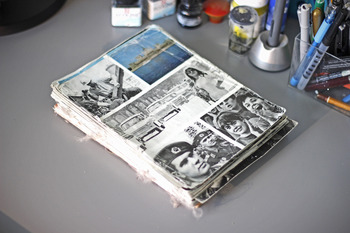
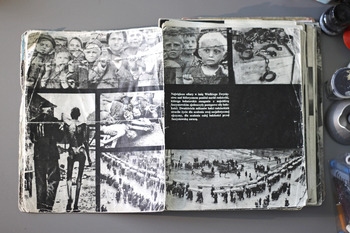
This is when I decided to turn to the black and white photographs in my mother’s old history book. The book is old and in very bad condition, missing the covers, title page, and editorial notes and endnotes too. (I suppose that it is a reprint from some Russian book because the authors’ names in every chapter are Russian). All photographs from The Duck have been in my mind from the very beginning because of my mother. She is a history teacher, and I saw that book many times in my childhood, together with popular Russian and Polish war movies broadcast on television. The book is special—it contains color photographs of a happy, post-war socialist society, with smiling faces of young people and black and white pictures of tragic World War II events. The contrast between them, always very striking to me, created an eerie mood.
I have added layers with my cartoon heroes to tell the truth: their names were taken from Roman Bratny’s novel Kolumbowie, rocznik 20.Footnote 2 This was in the pre-internet era and I was interested only in the photographs from that book, not the text.
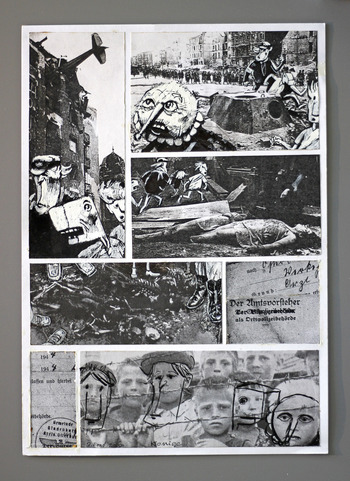
The last page of the comic, which is at the center of our discussion here, is probably the strongest graphic page I have ever made. The chronology of photographs and places where they were taken was not important. My aim was to give the impression that the last page was beyond time and, paradoxically, that the characters were part of the scene the same way horrified audiences are part of a cinematic experience. The photographs had to give strong visual sign like a symbol—there is, there was a really cruel and horrible world outside the comic, outside the minds of my comic heroes. Even though it was made more than sixteen years ago, I still feel the last panel is one of the best I have ever created. It is very simple and minimalistic, a copy of a photograph with children behind the barbed wire fence of a concentration camp, and I had drawn my heroes only with black ink and nib.
My mother’s old history book.

Black and white photos of WWII.

The last page.

Many of the artistic decisions I made while working on the last page were not fully conscious choices. The intuitive play of imagination and the cultural associations streaming through my mind were important. The primary inspiration behind my creative process, however, was all the iconic photographs that I had seen over the years.
At the same time, in this particular work, the documentary aspect of photographs is not that important. The photographs provide a strong realistic backdrop to the events, devoid of color. The fact that they are photocopies gives a high contrast effect. The added cartoon protagonists bring in a new layer of meaning, and show how photographs might start another life in a different setting.
I never doubted that such images have an afterlife, but the question that I have often asked myself is whether the artists can treat tragic events in this way, whether they can interpose humorous elements onto pictures of death, destruction, and the silent emptiness of war. Is it acceptable for artists to reinterpret views of sadness this way?
In my opinion, some creative fields are predisposed for reinterpretation, especially comics and graphic novels. Comics are the most contemporary and independent storytelling genre and, what is also very important, the cheapest as well. As an independent and free genre, comics are not at the center of critics’ attention, like film or literature, so comic artists have more freedom to do more cutting-edge projects. They are not only creating art. They are telling stories through art—so many graphic elements are useful—including photographs.
Telling stories through art.

It is better to see something once than to hear it a hundred times, an old proverb says, and this is very much the case here. Adding and combining photographs with other elements, including old documents, typography, and outline drawings. Putting them together on one page makes a new composition, something like collage, but the main task is to tell a new story and create the possibility for new interpretations. Does this give photographs a new life? I think so.
There are many photographs in my family archive and I used to use them often in various projects, but the people in them are not anonymous—I know or I knew most of them and have a range of personal memories associated with them. One summer I collected all my uncle’s photographs. Most of them show funerals, weddings, First Holy Communions, and other family celebrations. I had used some of them as inspirations for my comic album Glinno (2004), a mix of horror and drama that takes place in the village of Glinno. Among these pictures, I found one with an anonymous half-naked young woman. I was not able to establish her identity and I decided to use the picture as the music album cover D4D—Who’s Afraid Of? (2010). The band announced that they would look for the woman, but to date they have not found her.
In 2006, I drew a short comic album called Martial Law, about a boy who is searching for his father, shot dead by the Polish Army during one tragic night in the city of Lubin. Because the story is inspired by true events, I spent a lot of time researching documentary photos on the web. I found on www.lubin82.pl a very dramatic picture of a group of men carrying a wounded man—the father of the aforementioned boy—and I remembered it. I was very surprised when a while ago this image appeared in a newspaper: an art director used this particular photograph in a vodka advertising campaign. The article reported that the art director mistakenly thought the men were carrying a drunk friend home after a big party.
My emotions and my family history filter the way I see images. Sometimes this is very helpful, sometimes it is not. What happens, however, if I throw out all this emotional baggage and replace my photos with anonymous photos found at a flea market?
I think about that every time I see piles of old photographs sold at the annual St. Dominic’s Fair in Gdansk. There are many boxes overflowing with vintage photographs and the salesmen usually cannot tell me anything about their origins. They are pieces of paper that were once inscribed with personal memories and emotions that remain unknown to me or to anyone else. The meaning of these photos is gone with their owners. Now they are only empty, nostalgic images from the past. Paper is not a particularly durable material, but even a thin piece of it lives longer than humans. Are the photographs able to tell me something interesting without their owners, like who is in the picture, why is she or he sad or laughing, or who wrote the names or places on the back of photograph? Maybe if the photo studio where the picture was taken still exists, who was the photographer? It is very easy to become a detective with only one clue—a small piece of paper with a drawing created by light. The etymology of the word photograph means exactly that and from here it is very close to the word graphics. So historians and documentarists can do their own investigations digging in the past, but artists should do something else: open photographs for the future, combining facts with imagination and creating new stories. For me, vintage photographs resemble a locked old suitcase. The key is in my mind and it is up to me how to use it. I believe there are many untold stories yet.
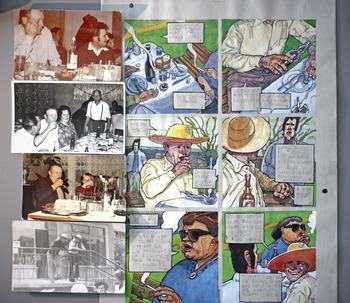
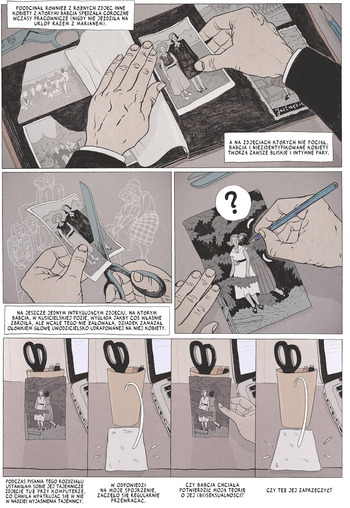
Old family photographs provided the basis for many panels of the graphic memoir, Totally Not Nostalgia, which I recently worked on with the writer Wanda Hagedorn. Wanda moved from Poland to Australia in the late 1980s and a few years ago decided to write a memoir about her family, childhood, and adolescence in Poland. Since 2014, we have been working together on a graphic album that is over 200 pages long. It is almost done. One of the episodes in Wanda’s story is about Marian—her grandmother Helena’s second husband. The events took place in the late 1970s, when Poland was behind the Iron Curtain. Wanda’s grandmother appears on many photographs together with another woman in poses that may suggest that she was a lesbian. The relationship between them was very close, and Wanda suspects that Helena was living a second secret life. This is not obvious of course, rather only a hypothesis. The most interesting thing is what Marian did with Helena’s friends in the photographs: he destroyed them. He cut them out with scissors, scratched or covered over them with pen. Years later Wanda still wonders why Marian did this. Can inflicting damage on the pictures erase the past? Is it some kind of voodoo magic where instead of a doll the images of Helena’s girlfriends are substituted? It could have been just a fit of jealously, an impulsive act lacking profound meaning. It is only possible here to summarize that these modified old photographs are an inspiration for another story in a graphic novel. So they are still alive.
I do not want to analyze war photography here. I am not a photographer, I am using it only as components of and inspiration for my stories. Is it a sin to treat pictures of civilian victims, the dead bodies of innocent people, like that, especially in comics? It is very possible also that I would not be able to do a story like The Duck today. Since 2000, I have seen many war documentaries, including Night Will Fall (2014)—a film based on footage from 1945, and I have read many war stories. I have also became a father. All of this has changed my way of thinking about human tragedies. I began to identify more with them, I began to realize that the dividing line between past and present is not as sharp I had thought: the past is not a fairy tale, or if it is, at least the present is not.
For The Duck story, I chose attractive photographs with striking visual elements: the composition should be appropriate; there should be some free space around interesting objects (which allows me to add my protagonists later). I chose the first picture, because it shows a plane stuck in the ruined building, the second picture because it shows a tank below, on street level. As Susan Sontag says in her Regarding the Pain of Others: “The landscape of devastation is still a landscape. There is beauty in ruins.”Footnote 3
Until the emails from Ewa Stańczyk and Harriet Murav, which informed me about the author of these photographs (pointed out by Peter Pastor), I thought they were anonymous. The photographer is Evgenii Khaldei and two of the photos were taken in Budapest (the plane and dead women on the street). I suppose that Evgenii Khaldei, who was a Red Army professional photographer, had a special style, also important in the art of comics. He could show a whole situation in one single shot, like in his best-known picture showing the Reichstag in Berlin with a Soviet solider raising the flag. That photograph uses art techniques resembling those used in etching or drawing. The photograph is staged, like Raising the Flag on Iwo Jima by Joe Rosenthal. A large flag was prepared especially for the shot, and everything was arranged the day after the capture of the Reichstag, because of the need for daylight.
Destroying photos/erasing the past.

If a documentary photographer can do things like that—to give future generations a constructed representation of historical events, I feel authorized to change those symbols too, adding another meaning and taking them further. They can be brought together in a one page composition and be combined with other pop culture elements, like speech bubbles and cartoon heroes. Are there any differences between soldiers posing with a flag and a comic character drawn inside the panel? Maybe they are not as significant as we think.
“The problem is not that people remember through photographs but that they remember only the photograph,” Susan Sontag writes in Regarding the Pain of Others, and I am the best example of this.Footnote 4 There is no time for searching all photography credits, contexts, and history today. The briefest caption under the photograph of a dead boy on a beach is enough for most people, and dozens of other photos are waiting to be seen. Maybe the boy from that photo will be revived in some comic stories in the future? Maybe the others will?
I would illustrate one more story at the end. There is a Polish hip-hop duet from Szczecin, called Łona & Webber. In their last album, there is one song that tells a very interesting story. Two posters with photographs are on the wall of a store, side by side with books and music. One represents a portrait of Witold Gombrowicz, one of the best Polish writers who died in 1969. The second poster is with Azealia Banks—an American female rapper. They are staring into each other’s eyes like lovers. This is a pop-cultured romance. Łona, who is a rapper and author of the lyrics, gives us a great illustration of the postmodern afterlife of a photograph.