



1. Introduction
Despite the scarcity of massive stars with respect to their less-massive counterparts, their influence on the chemo-dynamical evolution of galaxies is substantial (e.g., Matteucci Reference Matteucci2008; Eldridge et al. 2022). However, comparisons between observational data and theoretical predictions of massive stars have raised long-standing and new discrepancies that challenge our understanding of these objects (Langer Reference Langer1992; Langer Reference Langer2012). These discrepancies involve, among others, the initial surface rotation and the efficiency of internal angular momentum transport (e.g., Rosen et al. Reference Rosen, Krumholz and Ramirez-Ruiz2012; Martinet et al. Reference Martinet, Meynet and Ekström2021); the mass-loss rates (e.g., Vink et al. Reference Vink, Brott and Gräfener2010; de Burgos et al. 2024b); the efficiency of internal mixing processes (e.g., Schootemeijer et al. Reference Schootemeijer, Langer, Grin and Wang2019; Johnston Reference Johnston2021); all of which influence how much time massive stars spend in each evolutionary stage. Furthermore, a large fraction of massive stars are predicted to interact with a companion during their evolution (Sana et al. Reference Sana, de Mink and de Koter2012), creating new evolutionary paths.
Given this scenario, a main limitation in trying to narrow down existing uncertainties is the use of incomplete or small samples. Instead, large spectroscopic datasets offer a unique opportunity to improve the situation by studying statistically significant and homogeneous samples. In addition, young open stellar clusters and associations serve as ideal laboratories for testing our knowledge. This is mainly because member stars should share similar properties, including distance, chemical composition, and age.
In this work, we combined both approaches. We highlight and contrast recent findings from the quantitative spectroscopic analysis of hundreds of luminous OB stars, with preliminary results from studying the almost-complete population of luminous massive stars in the Per OB1 association, which is among the closest ( $\approx$2.5 kpc) and youngest (10 – 20 Myr) known associations in the Milky Way that encompass more massive stars at different evolutionary stages. The data were obtained from the IACOB high-resolution spectroscopic database (Simón-Díaz et al. 2020), which collects one of the largest samples of galactic massive O- and B-type stars existing to date, allowing us to empirically study the physical, chemical, kinematical, and binary properties of our massive neighbors.
2. IACOB high-resolution spectroscopic database
IACOB is an ambitious project that aims to provide a thorough homogeneous empirical characterization of a statistically significant volume-limited sample of galactic massive stars, covering the OB-star domain (see, e.g., Holgado et al. Reference Holgado, Simón-Daz and Barbá2018; de Burgos et al. Reference de Burgos, Simón-Daz and Urbaneja2023). More specifically, its goals include the determination of the whole set of stellar and wind parameters and surface abundances, the characterization of the stellar variability, and the identification and study of binary or multiple systems. The spectroscopic database gathers multi-epoch optical high-resolution and high signal-to-noise spectra from three fiber-fed echelle spectrographs: FIES (Telting et al. Reference Telting, Avila and Buchhave2014), HERMES (Raskin et al. Reference Raskin, van Winckel and Hensberge2011), and FEROS (Kaufer et al. Reference Kaufer, Wolf and Andersen1997). To date, IACOB includes more than 70% of all-sky OB stars brighter than  $B_{mag}$ = 11.
3. Results from the IACOB sample of luminous OB stars
The quantitative spectroscopic analysis of  $\approx$900 luminous OB stars allowed us to address some key properties of massive stars that can be contrasted with those of Per OB1. In this work, we presented three of them (for further details and properties, see de Burgos et al. 2024a; de Burgos et al. 2024b).
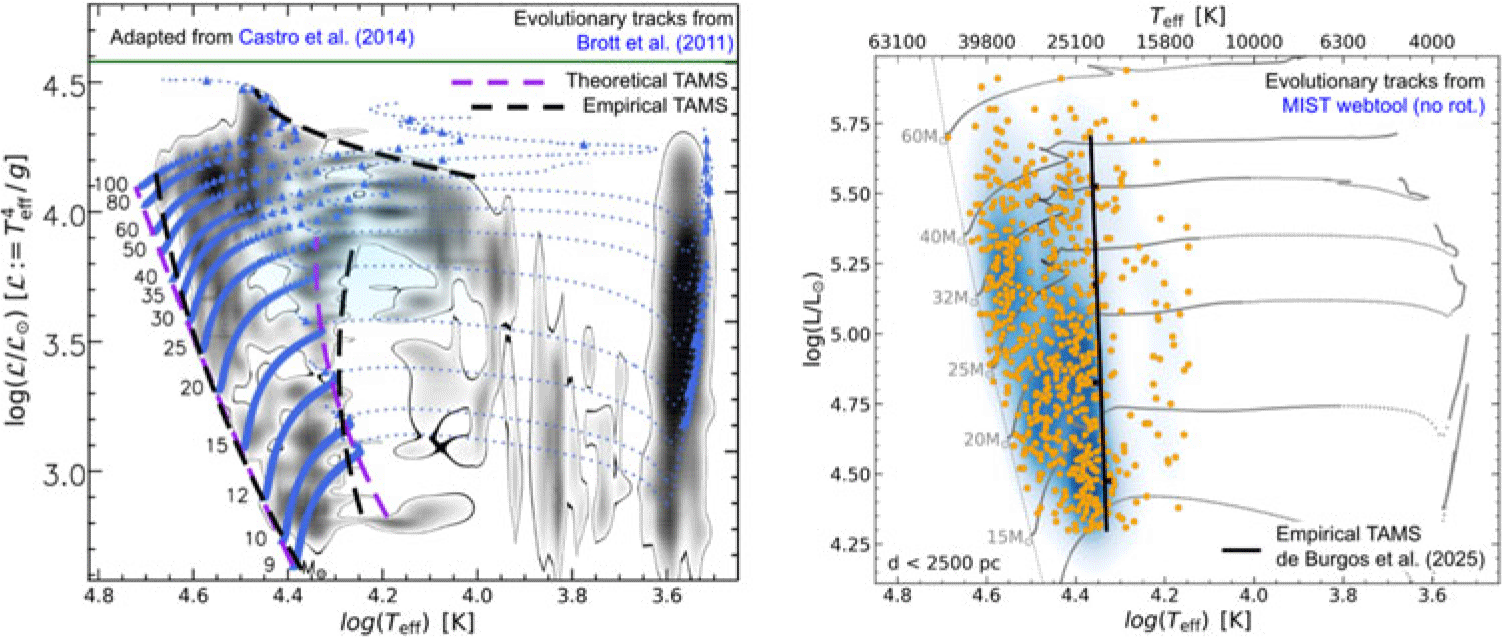
The first is the location of the terminal-age main sequence (TAMS) in the Hertzsprung–Russell diagram (HRD), which is inferred from the drop in the relative number of stars below a given effective temperature. This drop, produced by stars rapidly evolving beyond the main sequence, is shown with a black line in the right panel of Fig. 1. This result is a significant improvement with respect to the previous reference study by Castro et al. (Reference Castro, Fossati and Langer2014) (see left panel of Fig. 1), who used an inhomogeneous compilation of spectroscopic observations and results from the literature and did not include the use of distances to place the stars in the HRD.
Left panel: Adapted spectroscopic HRD from Castro et al. (Reference Castro, Fossati and Langer2014). Right panel: HRD obtained from the results of de Burgos et al. (Reference de Burgos, Simón-Daz and Urbaneja2025). In both panels the empirical TAMS is indicated with black lines. The source for the evolutionary tracks is indicated in each panel.

A second main property is the distribution of projected rotational velocities ( $v\sin i$), which shows that the majority of objects rotate with
 $v\sin i$
 $\lt$100 km s
 $^{-1}$. This may be a strong indicator that massive stars could enter the main sequence phase with a slow to mild rotation, implying a slow surface braking throughout their main-sequence evolution. This scenario is also compatible with an efficient angular momentum transport from the core to the surface that compensates for surface braking. The same behavior is also observed for the tail of fast-rotating objects with
 $v\sin i$
 $\gt$100 km s
 $^{-1}$, which could have their origin in binary interaction as suggested in different studies (see, e.g., de Mink et al. Reference de Mink, Langer and Izzard2013; Holgado et al. Reference Holgado, Simón-Daz, Herrero and Barbá2022). We also found that the well-known lack of fast-rotating stars below a certain effective temperature (e.g., Howarth et al. Reference Howarth, Siebert and Hussain1997; Brott et al. Reference Brott, de Mink and Cantiello2011) may now be explained by the fact that stars either reach the TAMS or their critical rotation (
 $v_{\rm crit}$), but is not due to enhanced mass-loss rates at the wind bi-stability region as previously thought (see de Burgos et al. 2024b; de Burgos et al. Reference de Burgos, Simón-Daz and Urbaneja2025).
A third property of relevance is the distribution of detected single-line spectroscopic binaries (SB1) in the HRD. By limiting the IACOB sample to objects with 3 or more available spectra, we found that the percentage of SB1 systems decreases by  $\approx$25% when crossing the TAMS. We consider that this feature further delineates the updated location of the TAMS shown in Fig. 1. We note that for the SB1 detection, the intrinsic variability of the stars with the luminosity and effective temperature was taken into consideration to avoid false detections.
4. Preliminary results from the Per OB1 luminous massive stars
Our study of the Per OB1 association is a follow-up of the earlier study by de Burgos et al. (Reference de Burgos, Simon-Daz and Lennon2020), which focused on the membership to the association of 88 O- to M-type luminous massive stars using Gaia DR2 parallaxes and proper motions, and high-precision radial velocity measurements. At present, we reached  $\approx$150 objects, and we incorporated Gaia DR3 astrometry and additional multi-epoch spectra. All stars have been selected to be located within four degrees from the center of the association, near the h and
 $\xi$ Persei double cluster.
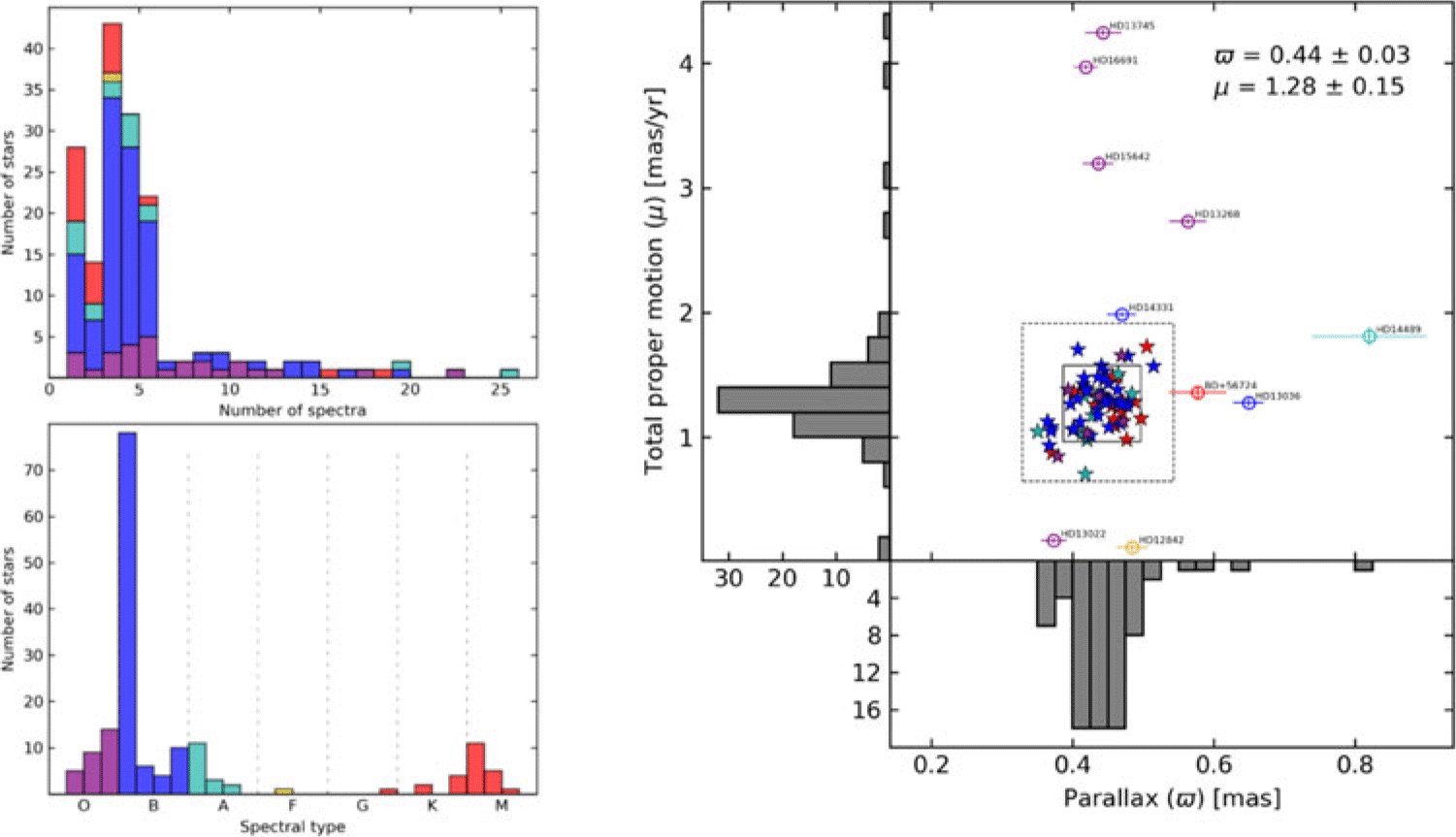
Figure 2 shows a summary of some properties of the sample. On average, we have access to three spectra per object, and a total of nearly 700 spectra (see top-left panel). The distribution of stars by spectral type indicates that the majority of objects are B-type stars (bottom-left panel). A qualitative analysis of the distribution in the total proper motion - parallax plane (see the right panel) shows that the majority of stars are within 2- $\sigma$ from the average of member stars found in de Burgos et al. (Reference de Burgos, Simon-Daz and Lennon2020). Despite the fact that the membership status of the newly observed stars has not yet been assessed, these results suggest that most of these stars likely belong to the association. Regarding the stars that lie outside of 3-
 $\sigma$ in parallax, two were already not considered members in de Burgos et al. (Reference de Burgos, Simon-Daz and Lennon2020), whereas the rest require further investigation. Interestingly, the group of O-type stars (in pink) with significantly larger total proper motions were already identified as runaway objects from their properties. A possible explanation is that these objects were dynamically ejected after interacting with a companion.
Summary of the properties of the observed luminous massive stars in Per OB1. Bottom-left panel: Histogram of observed stars against their spectral types, separated using different colors. Top-left panel: Histogram of the number of available spectra, separating the stars by spectral types as in the bottom-left panel. Right panel: Parallaxes and proper motions of the stars. The solid and dashed boxes corresponds to 2- and 3- $\sigma$ from the mean values, respectively.

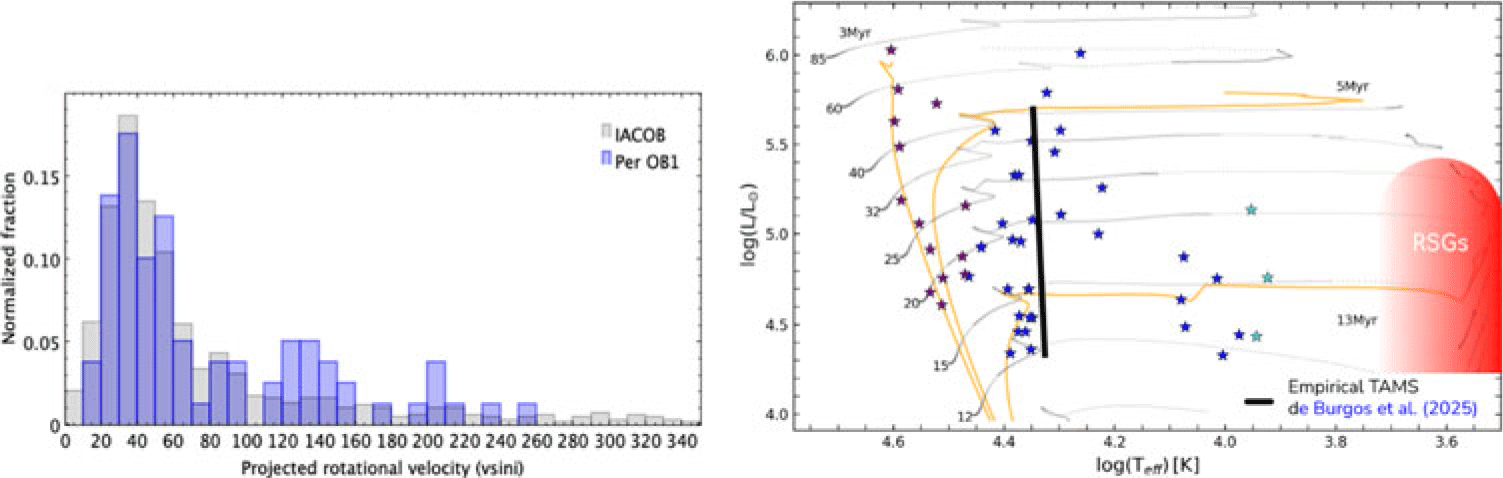
We compared the distribution of  $v\sin i$ values in Per OB1 with that of the IACOB sample (see de Burgos et al. 2024a). For that, we limited the comparison to luminous B-type stars, which represent the majority of massive stars in Per OB1. The comparison is shown in the left panel of Fig. 3, where we normalized the histogram with the total number of objects. We found that both distributions are very similar, although there are fewer very fast-rotating objects in Per OB1, which instead has a larger number of objects with
 $v\sin i$
 $\approx$130 km s
 $^{-1}$. As pointed out before, this could indicate that massive stars enter the main sequence with a slow or mild rotation. However, we note that other associations in the Milky Way show a different behavior (see, e.g., Galán et al. 2025).
Properties of Per OB1. Left panel: Distribution of  $v\sin i$ limited to luminous B-type stars in Per OB1 and the IACOB sample. Right panel: HRD of a sub-sample of analyzed stars by means of quantitative spectroscopic analysis. The empirical TAMS from de Burgos et al. (Reference de Burgos, Simón-Daz and Urbaneja2025) is shown with a solid black line.

The availability of Gaia DR3 distances allowed us to derive luminosities for the stars in Per OB1. Combined with the effective temperatures derived from the quantitative spectroscopic analysis, we were able to create a first HRD that includes  $\approx$50 stars with reliable parameters. The HRD is shown in the right panel of Fig. 3, which inspection reveals some interesting properties. Regarding the distribution of stars, we found that most O-type stars (in pink) lie near the 3 Myr isochrone. Many of these objects are embedded in the young Heart Nebula (IC 1805), which explains their age. However, some other stars are located elsewhere, meaning that they have likely experienced a rejuvenation. We also found that below the 20
 $M_\odot$ evolutionary track, all objects are located on the hot side of the TAMS or near
 $log\,T_{\rm eff},\approx$4.0 dex. The latter group could mix some objects leaving the main sequence with others following a blueward evolution, for example via blue-loops. However, we note that, at least for Geneva models, blue-loops are not predicted for those masses (see Martinet et al. Reference Martinet, Meynet and Ekström2021). Nevertheless, the presence of these objects is hardly compatible with those above the 25
 $M_\odot$ evolutionary track if one assumes single coeval evolution. In that regard, it can also be that the latter group includes mass gainers that resulted from binary interactions (see Schneider et al. Reference Schneider, Podsiadlowski and Laplace2024). Interestingly, we also found that the evolutionary masses of the stars near
 $log\,T_{\rm eff},\approx$4.0 dex are significantly lower compared to those derived from the spectroscopic HRD (see Langer 2014), which could be an indicator that these objects have lost a significant fraction of their mass during their evolution. Therefore, it becomes clear that additional information, including the surface chemical abundances or the presence of companions, is required to clarify their evolutionary nature.
5. Conclusion and future plans
In the era of large-scale surveys, spectroscopic databases such as IACOB allow us to compare results from analyzing large samples of massive stars with those extracted from studying young clusters and associations. In this regard, the Perseus OB1 association, in the Milky Way, is a region of great interest given the large number of objects at different evolutionary stages it includes and its relative proximity.
The improved completeness with respect to de Burgos et al. (Reference de Burgos, Simon-Daz and Lennon2020) allows us to attempt a comprehensive study of the complete population of luminous massive stars in Per OB1. The quantitative spectroscopic preliminary analysis of half of the sample reveals a complex scenario in which additional information of membership, proper motions and radial velocities, binary status, surface-chemical and pulsational properties will further contribute to the interpretation of the results. Ultimately, our project aims to use Per OB1 as a testbed for improving our understanding of massive stars, narrowing down the existing discrepancies between observational data and theoretical predictions of massive stars.
 σ
 vsini


