Guilt has been defined as a prosocial emotion that motivates social actions such as reparation or amends, but also as promoting maladaptive reactions (Tangney & Dearing, Reference Tangney and Dearing2002). Although recent theories try to depict guilt as a discrete and clearly identifiable emotion, many studies have found that different causes, contexts, and relationships elicit complex and diverse guilt experiences (Tangney, Stuewig, & Mashek, Reference Tangney, Stuewig and Mashek2007; Tracy & Robins, Reference Tracy and Robins2006). This has meant that guilt is generally perceived by people together with other moral and non-moral emotions, such as shame and embarrassment (Orth, Berking, & Burkhardt, Reference Orth, Berking and Burkhardt2006; Rüsch et al., Reference Rüsch, Corrigan, Bohus, Jacob, Brueck and Lieb2007; Fontaine, Luyten, De Boeck, & Corveleyn, Reference Fontaine, Luyten, Boeck and Corveleyn2001; Fontaine et al., Reference Fontaine, Luyten, Boeck, Corveleyn, Fernandez, Herrera, Ittzés and Tomcsányi2006). The result is a complex emotional experience — a blend of unpleasant feelings (Izard, Reference Izard2009) — that people commonly label as ‘guilt’. Differences regarding relationships involved in the guilt-inducing event evoke experiences of guilt that differ in degree of intensity and emotional composition (Baumeister, Stillwell, & Heatherton, Reference Baumeister, Stillwell and Heatherton1995).
As guilt is generally described as an unpleasant emotion, people usually want to resolve their guilty feelings as fast as possible (Anolli & Pascucci, Reference Anolli and Pascucci2005). Taking into account that: (a) the variability in the antecedents that give meaning to the perceived guilt likewise activate different motivational approaches and coping strategies, and (b) among the antecedents of guilt, the degree of closeness with the victim of the wrongdoing plays a relevant role (Baumeister, Stillwell, & Heatherton, Reference Baumeister, Stillwell and Heatherton1994), we expect that the degree of closeness between the person who feels guilty and the victim influences both the composition and intensity of the experience of guilt, and the coping strategy which is preferred by the transgressor in order to reduce his/her unpleasant feelings.
Interpersonal Relationships as Elicitors of Guilt
Many research studies portray guilt as a social and moral emotion that emerges from the acknowledgment of one's own responsibility in harming another person by breaking a social norm (Tangney et al., Reference Tangney, Stuewig and Mashek2007). In line with the appraisal-based model of self-conscious emotions (Tracy & Robins, Reference Tracy and Robins2006), guilt is associated with internal, controllable and unstable attributions, which indicate clear responsibility taken by the guilty person with reference to a specific event.
Although guilt is often considered to be a situation-independent construct (e.g., Tangney et al., Reference Tangney, Stuewig and Mashek2007), which can be activated or not depending on specific appraisal, recent evidence seems to challenge this view. Fontaine and colleagues (Reference Fontaine, Luyten, Boeck, Corveleyn, Fernandez, Herrera, Ittzés and Tomcsányi2006) for example, emphasised that the general defining and differentiating characteristics of the emotional processes related to guilt can be derived from the situational structure; in particular, as regards the intrapersonal–interpersonal dimension. Baumeister et al. (Reference Baumeister, Stillwell and Heatherton1995) showed the relevance of the relational bond in the experience of guilt, describing the interpersonal functions with valued others. The authors described guilt as a relational emotion that may affect behaviour in order to promote and maintain, in particular, communal interpersonal relationships. Silfver (Reference Silfver2007) coded autobiographical narratives of guilt experiences on the basis of their main theme (interpersonal situations, achievement situations, norm violations, and victimisations, that is, situations in which the respondent was a victim of emotional, physical, or sexual abuse) and found that guilt is more frequently associated with interpersonal situations, although situations concerning victimisation seem to have the most negative consequences for the individual. Further examples come from the clinical domain, where context-specific feelings of guilt have been investigated in association with psychological trauma and symptoms of depression (Kubany et al., Reference Kubany, Hill, Owens, Iannce-Spencer, McCaig, Tremayne and Williams2004; Lee, Scragg, & Turner, Reference Lee, Scragg and Turner2001). Although the degree of closeness with the other person involved seems to make a difference to the resulting experience of guilt, little is known about how relationship closeness affects intensity and composition of the guilt experience. How do feelings of guilt change according to the bond between the transgressor and the victim? And more importantly, what are the motivational consequences of this differentiation?
Coping Strategies of Guilt
A considerable number of studies (see, e.g., Roseman, Wiest, & Schwartz, Reference Roseman, Wiest and Schwartz1994; Scherer & Wallbott, Reference Scherer and Wallbott1994; Orth et al., Reference Orth, Berking and Burkhardt2006; Nelissen & Zeelenberg, Reference Nelissen and Zeelenberg2009) suggest that excessive self-awareness, as well as negative self-evaluation or self-criticism, can be associated with reports of guilt (e.g., Gilbert, Pehl, & Allan, Reference Gilbert, Pehl and Allan1994; Lindsay-Hartz, De Rivera, & Mascalo, Reference Lindsay-Hartz, Rivera, Mascalo, Tangney and Fischer1995; Tangney, Miller, Flicker, & Barlow, Reference Tangney, Miller, Flicker and Barlow1996). In fact, there are situations in which guilt can lead to maladaptive, or rather, dysfunctional actions and/or thoughts; for example, when there are no possibilities to repair the situation or apologise (an example of this is survivor guilt where guilty feelings are evoked by the death of a beloved one; see Weiss, Reference Weiss, Weiss and Sampson1986); when the guilty person falls into enduring rumination, resulting in self-punishment or symbolic restitutions with the aim of magically undoing the wrong (Luyten, Fontaine, & Corveleyn, Reference Luyten, Fontaine and Corveleyn2002; Nelissen & Zeelenberg, Reference Nelissen and Zeelenberg2009); or when the transgressor plays a role with particular moral expectations (Nencini & Meneghini, Reference Nencini and Meneghini2013).
Beyond this, there is now a substantial consensus that guilt is an adaptive emotion that promotes reparative behaviours (Amodio, Devine, & Harmon-Jones, Reference Amodio, Devine and Harmon-Jones2007; Tangney & Dearing, Reference Tangney and Dearing2002; Wicker, Payne, & Morgan, Reference Wicker, Payne and Morgan1983). However, the origin of these reparative actions is still controversial. Some scholars have focused on the punishment function of guilt, which motivates learning from past experiences and reduces transgressive behaviours (Monteith, Reference Monteith1993; Monteith, Ashburn-Nardo, Voils, & Czopp, Reference Monteith, Ashburn-Nardo, Voils and Czopp2002). Other authors have focused on the active, other-oriented responses elicited by guilt, which leads to approach motivation (Amodio, Devine, & Harmon-Jones, Reference Amodio, Devine and Harmon-Jones2007). The latter perspective has been investigated by two lines of research: first, guilt has been seen as interpersonal glue, the function of which is to make people behave properly towards relevant others, thus maintaining positive, satisfactory relationships (Baumeister et al., Reference Baumeister, Stillwell and Heatherton1995; Leith & Baumeister, Reference Leith and Baumeister1998); second, guilt has been analysed for its prosocial and adaptive effects, often in contrast with shame, which is thought to be more maladaptive (Luyten et al., Reference Luyten, Fontaine and Corveleyn2002; Orth et al., Reference Orth, Berking and Burkhardt2006).
From this perspective, although authors seem to share, at least on a general level, a common view on the possible strategies connected to guilt management, it is still unclear why one strategy is chosen over another in that particular situation and what is the connection between various strategies and the interpersonal intimacy between the transgressor and the victim of a moral transgression?
Bybee, Merisca, and Velasco (Reference Bybee, Merisca, Velasco and Bybee1998), for example, have shown that the initial emotional reaction and the means to cope with guilt can be differentiated. Using narrative data, they found that feeling guilty does not necessarily lead to prosocial or reparative behavior, but that there are different possible strategies which can be used to manage the emotion. The authors divided these strategies into three different categories: reconciliatory reactions, intropunitive responses, and rationalisations.
By means of a cross-cultural study in three countries, Fontaine et al. (Reference Fontaine, Luyten, Boeck, Corveleyn, Fernandez, Herrera, Ittzés and Tomcsányi2006) suggested two forms of guilt: other-oriented guilt that motivates reparation; and self-oriented, ruminative guilt. They selected five a priori action tendencies, two positive (reparation and self-improvement) and three negative (self-reproach, rumination and disappearance), and analysed them in relation to different scenarios of guilt and other emotions. Results showed that the various possible consequences of guilt are related to different approaches and definitions of guilt in the different situations. In another study, Silfver (Reference Silfver2007) used narrative data to code coping strategies according to three categories: reparative behaviour, chronic rumination, and defences. She found that context was relevant to discriminate between coping strategies; maladaptive chronic rumination was more likely in situations in which the individual's responsibility for the situation was ambiguous; in particular, in interpersonal situations of guilt.
However, the relationship between intensity of complex guilt experiences evoked in different interpersonal contexts and coping strategies remains still unclear and needs to be investigated in more depth.
The Research
Overall, past research suggests that the self/other-oriented motivation is strongly related to the contextual features that elicit guilt (Nencini & Meneghini, Reference Nencini and Meneghini2013). In particular, the preference of a specific coping strategy will depend on the intensity of the whole experience (which includes guilt and the other associated emotion) and thus on the relationship that connects the transgressor to the victim (Leith & Baumeister, Reference Leith and Baumeister1998). Specifically, we expect that (1) guilt positively correlates with other moral emotions (e.g., shame, embarrassment) and other unpleasant emotions associated with a negative evaluation of one's own behavior (e.g. worry, anger, sorrow and anxiety); (2) the interpersonal bond between the perpetuator and the victim reflects different intensities of the global experience of guilt: contexts that involve more distant relationships will elicit less guilt than contexts in which the wrongdoing implies harm to a closer relationship and violates a relational norm; and finally, (3) the variability in experiences of guilt affects the type of strategy used to cope with unpleasant feelings: less intense guilt experiences (more frequent in events involving distant others) are associated with low internal attribution and will generate avoidance motivation or passive, self-protecting strategies, while experiences involving high intensities of guilt associated with high internal attribution (more frequent in situations involving close others) will generate adaptive, other-oriented, coping strategies aimed at repairing the wrong action.
Method
Participants
The study involved one hundred and seventy-two individuals (64 men and 108 women), whose age ranged from 16 to 64 (M = 34, SD = 12). Participants were students of the University of Verona and their relatives. Participation in the research was completely voluntary and confidentiality was guaranteed: they were instructed to fill in the questionnaire alone and to enclose it in an envelope. Respondents were also informed that all the envelopes would later be mixed before being opened by the experimenters.
Materials
An ad hoc scenario-based instrument was constructed (see below for how the scenarios were created) with the aim of assessing how different intensities of guilt are experienced and managed in plausible everyday life situations.
We decided to use a purpose-made scenario-based questionnaire instead of a pre-existing scale for three reasons. First, definitions of guilt mainly depend on the tool used to measure it, thus leading to confirmation of a hypothesis rather than encouraging the exploration of new ideas. Second, one of the most used guilt scales (i.e., the Test Of Self-Conscious Affect; Tangney, Wagner, & Gramzow, Reference Tangney, Wagner and Gramzow1989) has been criticised because it only measures the adaptive aspects of guilt, omitting possible maladaptive or dysfunctional elements (e.g., ruminative thinking in situations in which it is not possible to repair; Luyten et al., Reference Luyten, Fontaine and Corveleyn2002). Third, we wanted to create scenarios that represented some prototypical situations resembling everyday life situations of guilt in the cultural context of Italy.
In order to include a representative sample of guilt inducing situations, we ran a brief pre-test in which we asked some students and their relatives to describe personal experiences of guilt. One hundred and fifty-one people (72 men and 79 women), voluntarily took part in the study. Participants were instructed to narrate in detail one event in which they had experienced guilt about something they had done and were then asked to rate their emotional intensity through a list of 10 emotions. Reports were fully transcribed and content analysed.
Each narrative was then coded on the basis of the type of relationship between the victim of the wrongdoing and the narrator. Interpersonal relationships were summarised in five categories: family, partners, close friends, strangers, and oneself (i.e., situations in which an implicit other is involved; e.g., when guilt is experienced for not achieving an expected result).
Based on these data, we created five scenarios each one representing a recurrent or prototypical situation that involved one of the five types of interpersonal relationships (strangers, oneself, friends, partners, parents).
Procedure
Participants were asked to imagine themselves in each of the five different guilt inducing scenarios. For each one, they rated their experience in terms of 10 emotions (including guilt) and the degree of responsibility they would take (internal attribution) on a 5-point scale (from 0 to 4). Participants were also invited to think of a way of reducing or resolving their guilt and to briefly write it down (coping strategies).
Results
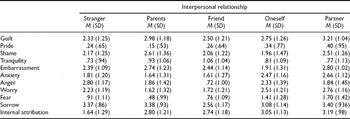
On the whole, all five scenarios worked well in that they were largely perceived as guilt-evoking: in 85% of the cases, participants reported that they would have felt at least moderately guilty (i.e., scores equal or greater than 2, on a 0–4 scale; M = 2.77). An ANOVA confirmed the second expectation, that is, that guilt intensity significantly differed across types of relationship, F(4, 797) = 14.52, p < .001: situations involving strangers or friends elicited less guilt than those in which closer others (parents or partners) were harmed. Scenarios with no explicit others (oneself) were evaluated with medium intensity of guilt (see Table 1).
Mean and Standard Deviation for Each Emotion and for Internal Attributions

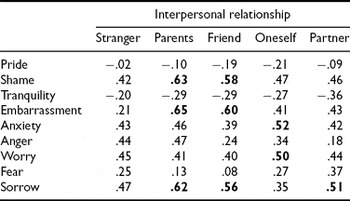
As expected, for all the scenarios, guilt was significantly correlated with shame, embarrassment, anxiety, anger, worry and sorrow (see Table 2). In scenarios involving close relationships (parents or partners), the largest effect size correlations were observed (according to Cohen's [Reference Cohen1988] interpretation, r > .50).
Correlations Between Guilt and Other Emotions in the Five Interpersonal Scenarios

Note: Large effect size correlations are shown in bold type.
Internal attribution was globally high (M = 2,69, 0–4 scale) and the correlation with guilt was also significant, r = .65, p < .001.
Intensity of guilt and correlated emotions varied across the different situations: breaking a moral norm with a stranger elicited the lowest intensity of guilt, F(4, 792) = 15.54, MSE = 1.40, p < .001, and the lowest levels of internal attribution, F(4, 792) = 47.75, MSE = 1.26, p < .001. Situations involving close relationships (partner and parents) induced higher feelings of guilt, shame, F(4, 792) = 6.16, MSE = 1.75, p < .001, and embarrassment, F(4, 792) = 15.11, MSE = 1.32, p < .001, than scenarios including friends or oneself, which resulted in the lowest intensity of sorrow, F(4, 792) = 22.24, MSE = 0.94, p < .001, anxiety, F(4, 792) = 27.69, MSE = 1.46, p < .001, and anger, F(4, 792) = 62.30, MSE = 1.64, p < .001.
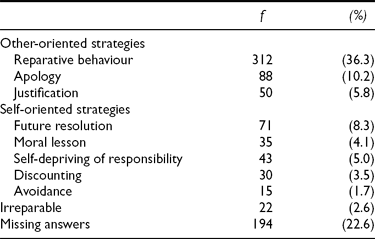
Following the standard procedures for content analysis (Krippendorff, Reference Krippendorff1980), accounts of coping strategies were then coded by two independent coders in order to extract recurrent or common typologies (Cohen's kappa across the five situations ranged from .32 to .66, mean equal to .46). The coding process led to the establishment of nine categories, that is, (1) reparative behaviour, (2) discounting, (3) apologising, (4) avoiding, (5) depriving of responsibility, (6) future resolutions, (7) moral lesson, (8) self-justification, and (9) none — guilt cannot be repaired. Frequencies for each type of coping strategy across the five situations are shown in Table 3.
Frequencies of Type of Coping Strategies in the Different Situations of Guilt
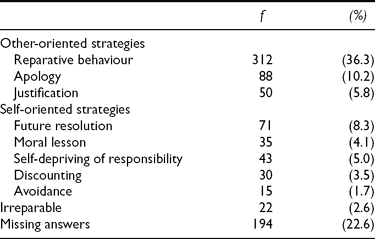
Reparative behaviours and apologies were the most frequently reported strategies throughout all the scenarios. Nevertheless, in order to verify if the variability in experiences of guilt affects the type of strategy used to cope with it, a log-linear analysis on the distribution of coping strategies per scenarios was run. The analysis revealed a significant interaction effect between type of strategy and intensity of guilt manipulated by means of the type of relationship, χ2(32, N = 666) = 230.29, p < .001. Specifically, strategies of avoidance, λ = 1.05, p < .001, self-deprivation of responsibility, λ = .69, p < .05, or discounting, λ = .65, p <. 10, were more frequently reported in low-guilt inducing situations (involving strangers), while apologies were preferred in high-guilt inducing scenarios involving close relationships, such as parents, λ = .83, p < .05, and partners, λ = 1.95, p < .001. When the person harmed was a friend, depriving of responsibility, λ = .59, p < .05, or assuring not to do it in the future were the most frequently chosen strategies, λ = .64, p < .001. Finally, feeling guilt aimed at oneself (as in failure to achieve a self-set goal) was managed by means of future resolution, λ = .61, p < .05, moral lessons, λ = .81, p < .05, and, most of all, self-justification, λ = 1.29, p < .001.
The resultant typology of strategy was connected to specific emotional intensities correlated to guilt: reparative behaviours and apologies (other-oriented strategies) were associated with higher intensity of sorrow compared to other strategies, F(8, 647) = 6.20, MSE = 0.97, p < .001, while avoiding the problem or removal of responsibility were associated with low emotional activation, that is, low intensities of guilt, F(8, 647) = 7.65, MSE = 1.12, p < .001, shame, F(8, 647) = 6.40, MSE = 1.68, p < .001, anger, F(8, 647) = 4.13, MSE = 2.07, p < .001, and sorrow. On the contrary, when individuals expressed high intensity of guilt and correlated emotions, they considered the situation as irreparable. In these cases, participants perceived that there was no strategy to solve the wrongdoing and so guilt could not be repaired.
Finally, the choice of a specific strategy seemed to be connected not only to the type of relationship involved in the wrongdoing, but also to the degree of responsibility taken by oneself. A 5 (type of relationship) × 2 (high vs. low responsibility taking) × 2 (other-oriented vs. self-oriented strategy) log-linear model revealed significant bivariate interaction effects: although ‘other-oriented’ strategies were much more frequent than ‘self-oriented’ ones, higher internal attribution was significantly associated with ‘self-oriented’ strategies of coping with guilt, while low responsibility taking was likely to motivate ‘other-oriented’ strategies, χ2(1, N = 619) = 8.24, p < .001. The trivariate interactions were not significant.
Discussion
Experiences of guilt are complex emotional feelings that embrace other moral and non-moral emotions. When a situation elicits an experience of guilt, a number of different covarying emotions are activated at the same time, such as shame, sorrow, anxiety, embarrassment, and anger. Thus, the whole inner experience is characterised by the intensity of guilt, but at the same time, by the composition and intensities of the involved emotions in specific contexts. Consistent with what has been shown before, our data show that guilt generally motivates reparation or amendment. Furthermore, our results show that complex experiences of guilt are related to the emotional intensity evoked by the degree of closeness with the person harmed and the degree of responsibility that an individual takes on him or herself. Overall, the closer the relationship with the victim, the more serious the moral harm is considered and, therefore, the experience of guilt is more intense (also involving the other negative moral emotions, e.g., shame and embarrassment). These results are in line with the theoretical position which sees guilt as an emotion that is functional to maintain positive interpersonal relationships (Baumeister et al., Reference Baumeister, Stillwell and Heatherton1994; Baumeister et al., Reference Baumeister, Stillwell and Heatherton1995). The elements that are salient in a particular situation (who is the harmed person, who is responsible for the wrongdoing, which emotions are elicited) seem to guide the choice of the strategy useful to reach the goal, i.e., successful maintenance of social bonds.
Therefore guilt may be considered as an interpersonal glue (Amodio et al., Reference Amodio, Devine and Harmon-Jones2007; Baumeister et al., Reference Baumeister, Stillwell and Heatherton1995; Leith & Baumeister, Reference Leith and Baumeister1998), especially when the harmed person is closely related to the wrongdoer.
Different patterns or constellations of guilt result in varying interpretative frameworks of a situation, thus motivating individuals towards different strategies and actions. In general, as shown in the literature, guilt motivates reparation, both through active behaviour or excuses (Orth et al., Reference Orth, Berking and Burkhardt2006; Tangney & Dearing, Reference Tangney and Dearing2002) and our data confirm this pattern. However, we also found evidence of a relationship between coping strategies of guilt on the one hand, and responsibility taking and emotional intensity on the other, which suggests that the intensity of the whole experience of guilt made some strategies more functional than others: global low intensities of feelings of guilt are likely to favour self-oriented strategies, which are probably more useful in terms of protecting oneself by detaching the self from the offending action than repairing the harm or trying to restore the relationship with more distant other. On the other hand, a perceived high intensity of all the emotions involved in the experience of guilt corresponds to an excessively strong feeling that consequently cannot be repaired, maybe because the wrongdoing is considered too serious. Medium intensities of the whole guilt experience are managed making use of adaptive strategies, which aim at preserving positive social relationships without excessive efforts for the self.
These results show a link that was partially ignored in previous studies (e.g., Bybee et al., Reference Bybee, Merisca, Velasco and Bybee1998; Fontaine et al., Reference Fontaine, Luyten, Boeck, Corveleyn, Fernandez, Herrera, Ittzés and Tomcsányi2006; Silfver, Reference Silfver2007): self and other-oriented strategies are chosen on the base of the intensity of the feeling of guilt experienced, which in turn is related to the degree of closeness with the victim.
Limitations
The correlational nature of our design, together with the use of fictitious scenarios, clearly affects the external validity of our conclusions. Further studies in real-life situations or in different experimental settings could extend our findings by investigating the actual behavior of individuals experiencing moral transgressions.
Future Directions
The present research contributes to deepen the debate on the adaptive or maladaptive consequences of a wrong action. When an individual does something that causes harm to another person, a great deal of emotions are experienced: the more one cares about the relationship, the more intensely one feels emotions connected with guilt, and the more likely actions allowing reparation and positive relationship maintenance will be selected. Otherwise, if the transgressor is not particularly interested in the consequences to the relationship of his/her actions, or if she/he does not consider herself/himself responsible for what happened, a low intensity of guilt will be elicited and the person will mainly be concerned about resolving the accident as quickly as possible. As the victim is aware that the other person is guilty, the transgressor cannot just do anything, so he/she may resort to a strategy that can solve the situation with little effort and, at the same time, protect the self. This opens to a deeper investigation of the role played by emotional regulation in the choice of a functional, or effective strategy to cope with guilt. Individuals who are better able to regulate feelings of guilt may more frequently use adaptive strategies, while those who are either overwhelmed by the emotion or emotionally more detached may resort to non-functional strategies. Further studies should account for this point.
A further development of the present research might explore other cultural contexts in order to test whether the intensities of the feelings experienced by the wrongdoer, as well as his/her intention to repair the relationships or protect him/herself and the choice of strategy are related at the same intensity within people belonging to different cultures.