Introduction
Climate change poses an existential threat to global economies, ecosystems, and societies, demanding urgent action to curb carbon emissions, particularly from the corporate sector, which accounts for a substantial proportion of global emissions (IPCC, 2024; World Economic Forum, 2024). The Intergovernmental Panel on Climate Change emphasizes that limiting global warming to 1.5°C requires rapid and deep emission reductions. Yet, despite increasing global climate commitments, such as those under the Paris Agreement and national net-zero pledges, many firms fail to achieve measurable improvements in carbon performance, often due to internal governance dynamics rather than solely technical or operational challenges. Global climate disclosure frameworks, such as recommendations of the Task Force on Climate-related Financial Disclosures (TCFD, 2017) and the IFRS S2 Climate-related Disclosures (ISSB, 2023), underscore the critical role of board and executive oversight in driving climate strategies, risk management, and performance. Regulatory developments in jurisdictions like the EU, UK, and Australia further impose mandatory climate disclosure regimes, placing accountability on senior leadership to deliver tangible emission reductions. These pressures highlight a practical need to understand how internal leadership dynamics shape carbon performance.
One increasingly important yet underexplored internal governance mechanism is the CEO internal alliance, defined as the proportion of top non-CEO executives and board directors appointed during the current CEO’s tenure (Khanna, Kim, & Lu, Reference Khanna, Kim and Lu2015; Li, Lu, & Phillips, Reference Li, Lu and Phillips2019; Sun, Reference Sun2023; Xu, Rao, Cheng, & Wang, Reference Xu, Rao, Cheng and Wang2020). This construct reflects the CEO’s ability to shape the firm’s leadership structure and consolidate influence over strategic decision-making. Grounded in agency theory, this measure captures the degree to which CEOs can insulate themselves from independent oversight by surrounding themselves with loyal appointees (Jensen & Meckling, Reference Jensen and Meckling1976). Unlike traditional board characteristics or CEO traits, CEO internal alliances operationalize power consolidation through interpersonal appointments, a channel particularly salient in contexts involving long-term, non-financial goals such as emission reduction.
Despite the growing emphasis on corporate governance in environmental sustainability, studies on the role of CEO internal alliances in carbon performance remain scarce. Much of the existing literature has focused on external governance forces, including environmental regulations (Bai & Ru, Reference Bai and Ru2024; Brown, Martinsson, & Thomann, Reference Brown, Martinsson and Thomann2022; Ivanov, Kruttli, & Watugala, Reference Ivanov, Kruttli and Watugala2023; Jacob & Zerwer, Reference Jacob and Zerwer2024; Ramadorai & Zeni, Reference Ramadorai and Zeni2024), disclosure mandates (Downar, Ernstberger, Reichelstein, Schwenen, & Zaklan, Reference Downar, Ernstberger, Reichelstein, Schwenen and Zaklan2021; Tomar, Reference Tomar2023), media scrutiny (Schmidt, Ivanova, & Schäfer, Reference Schmidt, Ivanova and Schäfer2013), normative expectations (Luo & Tang, Reference Luo and Tang2022), and stakeholder pressure (Azar, Duro, Kadach, & Ormazabal, Reference Azar, Duro, Kadach and Ormazabal2021; Ben‐Amar, Herrera, & Martinez, Reference Ben‐Amar, Herrera and Martinez2023; Chen, Liang, & Wu, Reference Chen, Liang and Wu2023; Choi & Luo, Reference Choi and Luo2021; Flammer, Toffel, & Viswanathan, Reference Flammer, Toffel and Viswanathan2021; Ilhan, Krueger, Sautner, & Starks, Reference Ilhan, Krueger, Sautner and Starks2023). Meanwhile, research on internal governance has largely emphasized structural variables, such as board characteristics (e.g., Barroso, Duan, Guo, & Kowalewski, Reference Barroso, Duan, Guo and Kowalewski2024; Goud, Reference Goud2022; Haque, Reference Haque2017; Liao, Luo, & Tang, Reference Liao, Luo and Tang2015; Luo & Tang, Reference Luo and Tang2021), or CEO traits (e.g., Homroy, Reference Homroy2023; Hubbard, Christensen, & Graffin, Reference Hubbard, Christensen and Graffin2017; Lewis, Walls, & Dowell, Reference Lewis, Walls and Dowell2014; Li, Lin, Peng, & Du, Reference Li, Lin, Peng and Du2023; Luo, Wu, & Zhang, Reference Luo, Wu and Zhang2021; O’Sullivan, Zolotoy, & Fan, Reference O’Sullivan, Zolotoy and Fan2021). These studies often treat CEOs as isolated decision-makers or focus on static governance structures, overlooking the dynamic interpersonal relationships shaped by appointment patterns. CEO internal alliances, by contrast, capture the CEO’s influence through loyalty and alignment within the leadership team, which can critically affect resource allocation and strategic priorities for carbon performance.
Our study addresses this gap by examining how CEO internal alliances influence corporate carbon performance globally, offering insights into how internal governance dynamics, particularly interpersonal alignment and loyalty within the leadership team, shape environmental outcomes. By focusing on this relational dimension of internal governance, our study extends existing literature and provides a novel perspective on the drivers of corporate sustainability.
To theorize the relationship between CEO internal alliances and corporate carbon performance, we adopt a dual-theoretical framework integrating agency theory and the resource-based view (RBV). From an agency perspective, appointment-based CEO internal alliances can undermine internal oversight and reduce the effectiveness of monitoring (Khanna et al., Reference Khanna, Kim and Lu2015; Landier, Sauvagnat, Sraer, & Thesmar, Reference Landier, Sauvagnat, Sraer and Thesmar2013). Such alliances may discourage dissent and critical evaluation of the CEO’s decisions (Acharya, Myers, & Rajan, Reference Acharya, Myers and Rajan2011; Cohen, Frazzini, & Malloy, Reference Cohen, Frazzini and Malloy2012; Khedmati, Sualihu, & Yawson, Reference Khedmati, Sualihu and Yawson2020), enabling short-termism, entrenchment, and symbolic environmental gestures rather than substantive climate action (Agha, Pham, & Yu, Reference Agha, Pham and Yu2021; Sun, Reference Sun2023). These governance frictions are particularly salient in the carbon domain, where long-term investments are difficult to assess in the short run, amplifying the importance of robust internal accountability (Baker & Adu-Bonnah, Reference Baker and Adu-Bonnah2008; He, Luo, Shamsuddin, & Tang, Reference He, Luo, Shamsuddin and Tang2022; Zhou, Luo, & Tang, Reference Zhou, Luo and Tang2025). Accordingly, agency theory predicts a negative association between CEO internal alliance and carbon performance.
In contrast, the RBV views CEO internal alliances as a potential strategic resource that can enhance organizational capability and execution (Barney, Reference Barney1991; Barney & Zajac, Reference Barney and Zajac1994; Li & Zhang, Reference Li and Zhang2007; Luo & Tang, Reference Luo and Tang2021). A cohesive and loyal top management team that shares the CEO’s long-term vision, especially regarding climate priorities, can improve internal coordination, faster strategic execution, and reinforce commitment to decarbonization goals (Bhuiyan, Sangchan, & Costa, Reference Bhuiyan, Sangchan and Costa2022; Faleye, Kovacs, & Venkateswaran, Reference Faleye, Kovacs and Venkateswaran2014; Hoitash & Mkrtchyan, Reference Hoitash and Mkrtchyan2022; Westphal, Reference Westphal1999). These internal relational assets are often tacit, socially embedded, and hard to replicate, thereby contributing to competitive advantage in managing complex decarbonization efforts (Cai & Lontzek, Reference Cai and Lontzek2019). Under this view, CEO internal alliances may enable firms to respond more effectively to the uncertainty and cross-functional challenges associated with climate initiatives, thus predicting a positive association with carbon performance. Building on these competing perspectives, we treat the impact of CEO internal alliance on carbon performance as an empirical question, testing its net effect and investigating the conditions under which it may serve as either an asset or a liability for corporate climate outcomes.
To test these competing hypotheses, we employ a sample comprising 31,019 firm-year observations across 36 countries from 2002 to 2023. Our findings reveal that stronger CEO internal alliances are associated with higher carbon emissions, indicative of poorer carbon performance. This finding lends support to the agency theory perspective, implying that the potential benefits of internal coordination may be outweighed by reduced internal oversight and accountability in the context of carbon-related decisions. These results highlight that CEO internal alliances, while potentially valuable in other domains, may be linked to weaker environmental outcomes, particularly in settings where external monitoring is limited. We confirm the robustness of our main results through a comprehensive set of additional analyses. To address potential endogeneity concerns, we employ a two-step Heckman selection model, two-stage least squares instrumental variable estimation, entropy balancing, and propensity score matching. We further validate our findings by employing alternative measures of CEO internal alliance and carbon performance, alternative model specifications, and additional control variables. Furthermore, we disentangle the influence of CEO alliances across different relational domains: between alliances with subordinate executives and with board members. Across all these robustness checks, the results remain consistent with our main findings, reinforcing the reliability of our empirical conclusions.
To further examine how CEO internal alliances affect corporate carbon performance, we conduct a mechanism analysis focused on two channels: agency costs and reductions in environmental investment and innovation. Consistent with agency theory, we find that firms with stronger CEO alliances exhibit higher expense ratios, indicative of increased discretionary spending and weaker financial discipline. These elevated agency costs are, in turn, associated with poorer carbon performance. We also find that CEO internal alliances are negatively associated with carbon abatement investment and green innovation, two critical levers for emissions reduction, both of which are positively related to carbon performance. These results suggest that CEO internal alliances may undermine firms’ climate efforts by increasing agency costs and reducing strategic investments in environmental initiatives. Together, the findings provide empirical support for the agency-based explanation.
To better understand the conditions under which CEO internal alliances affect firms’ climate performance, we conduct a series of heterogeneity analyses examining both external institutional factors and internal leadership characteristics. First, we consider how country-level governance systems moderate the relationship between CEO alliances and carbon outcomes, focusing on legal origin, environmental policy stringency, media freedom, and regulatory quality. This allows us to assess how institutional environments condition the effectiveness of internal governance in shaping firms’ environmental strategies. From an agency theory perspective, weak external governance environments lack sufficient monitoring to counterbalance internal power consolidation, heightening the risks of managerial entrenchment and self-serving behavior (Desender, Lópezpuertas‐Lamy, Pattitoni, & Petracci, Reference Desender, Lópezpuertas‐Lamy, Pattitoni and Petracci2020; Hillier, Pindado, Queiroz, & Torre, Reference Hillier, Pindado, Queiroz and Torre2011; Jain & Jamali, Reference Jain and Jamali2016). Consistent with this view, we find that the negative association between CEO internal alliance and carbon performance is concentrated in countries with weaker governance institutions, specifically, countries with less stringent environmental regulations, limited media freedom, and low regulatory quality. These institutional settings typically feature weaker investor protection and lax enforcement, allowing managerial discretion to go unchecked. In contrast, the adverse effect of CEO internal alliances disappears in countries with stronger legal enforcement and market-based governance, where independent oversight constrains managerial discretion.
We then examine firm-level heterogeneity by exploring CEO and board demographic traits that influence internal oversight and value alignment. The negative impact of CEO internal alliances on carbon performance is more pronounced in firms with fewer female directors, suggesting that weaker board diversity may undermine effective monitoring and accountability. In contrast, this adverse effect is mitigated when CEOs share the same nationality as the firm’s home country, potentially reflecting a stronger sense of accountability to local stakeholders or greater alignment with national environmental norms and expectations. Additionally, the negative effect of CEO internal alliances is stronger among younger CEOs, who are more likely to pursue short-term, opportunistic strategies at the expense of environmental performance. Together, these findings highlight that the impact of CEO internal alliance is not uniform but context-dependent, shaped by both the external institutional environment and the composition of the firm’s leadership team.
Finally, we examine the 2015 Paris Climate Agreement as a turning point that strengthened global and national commitments to climate action. This landmark event elevated regulatory attention to decarbonization and imposed greater climate-related accountability on firms. We find that the negative association between CEO alliances and carbon outcomes diminishes following the Agreement’s implementation, particularly in the immediate post-2015 period. However, this mitigating effect weakens after the US withdrawal from the Agreement in 2017, highlighting the importance of sustained policy commitment. Overall, these results underscore the Paris Agreement’s significance in reinforcing institutional constraints that curb managerial discretion and promote long-term climate accountability.
Our study contributes to the literature in the following ways. First, we advance research on corporate carbon performance by shifting the focus from predominantly external governance mechanisms, such as culture, regulatory pressure, institutional environments, and stakeholder activism (e.g., Azar et al., Reference Azar, Duro, Kadach and Ormazabal2021; Bai & Ru, Reference Bai and Ru2024; Ben‐Amar et al., Reference Ben‐Amar, Herrera and Martinez2023; Choi & Luo, Reference Choi and Luo2021; Cohen, Kadach, & Ormazabal, Reference Cohen, Kadach and Ormazabal2023; Downar et al., Reference Downar, Ernstberger, Reichelstein, Schwenen and Zaklan2021; Flammer et al., Reference Flammer, Toffel and Viswanathan2021; Ilhan et al., Reference Ilhan, Krueger, Sautner and Starks2023; Luo & Tang, Reference Luo and Tang2022; Ramadorai & Zeni, Reference Ramadorai and Zeni2024; Tomar, Reference Tomar2023), to internal governance dynamics, particularly within the CEO-centric top leadership team. While prior studies have explored internal governance largely through board attributes (e.g., Barroso et al., Reference Barroso, Duan, Guo and Kowalewski2024; Goud, Reference Goud2022; Haque, Reference Haque2017; Liao et al., Reference Liao, Luo and Tang2015; Luo & Tang, Reference Luo and Tang2021) or CEO or managerial characteristics in isolation (e.g., tenure, ideology, compensation) (e.g., Adu, Flynn, & Grey, Reference Adu, Flynn and Grey2022; Hossain, Saadi, & Amin, Reference Hossain, Saadi and Amin2023; Li et al., Reference Li, Lin, Peng and Du2023; Luo, Zhang, & Zheng, Reference Luo, Zhang and Zheng2025), they often overlook the relational configuration of executive teams, specifically the CEO’s internal alliances, as a source of governance influence. By conceptualizing and empirically examining appointment-based CEO internal alliances, we demonstrate how these informal yet potent relational structures shape firms’ climate strategies beyond what static demographic attributes can explain. Our findings provide new insights into the internal drivers of corporate (in)action on climate change, highlighting the importance of leadership structures in enabling or impeding decarbonization efforts.
Furthermore, our study highlights the interactive effects of internal and external governance mechanisms, an area that remains underexplored in prior research. While much of the literature treats governance dimensions in isolation, we demonstrate that the influence of CEO internal alliances is highly contingent on institutional contexts and firm-level leadership characteristics. By revealing how external institutional forces and internal leadership traits jointly shape carbon performance, we offer a more integrated and contingent view of corporate climate governance. This perspective contributes to a more holistic understanding of when and how internal power dynamics within the executive team interact with broader governance systems to influence sustainability outcomes.
Second, we extend the literature on CEO internal alliances by moving beyond their financial implications to examine their influence on non-financial outcomes, specifically, carbon performance. Existing studies have primarily linked CEO internal alliances to financial outcomes, such as corporate financial fraud (Khanna et al., Reference Khanna, Kim and Lu2015), investment decisions (Agha et al., Reference Agha, Pham and Yu2021), stock crash risk (Xu et al., Reference Xu, Rao, Cheng and Wang2020), and firm risk (Sun, Reference Sun2023). However, far less is known about how such internal alliances influence firms’ environmental and sustainability-related decisions. Unlike financial outcomes, carbon performance is less immediately observable, subject to weaker market discipline, and often involves long-term, uncertain returns, making it especially vulnerable to managerial discretion and internal governance dynamics. By drawing on both agency theory and the RBV, we develop a nuanced theoretical framework to explain why CEO internal alliances may exert distinctive and potentially more pronounced effects on environmental performance. In doing so, our study broadens the scope of CEO alliance research and deepens the understanding of how internal power structures shape corporate sustainability behavior.
Theoretical Background and Hypotheses Development
Conceptualization of Appointment-based CEO Internal Alliance
A central construct in this study is the appointment-based CEO internal alliance, which captures the CEO’s influence over the firm’s leadership structure. Defined as the proportion of top non-CEO executives and board directors appointed during the CEO’s tenure, this metric reflects the degree to which the CEO has shaped both the strategic and operational domains of the firm (Khanna et al., Reference Khanna, Kim and Lu2015; Li et al., Reference Li, Lu and Phillips2019; Sun, Reference Sun2023; Xu et al., Reference Xu, Rao, Cheng and Wang2020). Our conceptualization builds on prior research and addresses a key gap in the corporate governance literature by focusing on relational power consolidation rather than formal governance positions.
The CEO plays a pivotal role in firm governance by linking strategic oversight (the board) and operational execution (the executive team). We include two groups in our alliance construct: (1) top subordinate executives, such as CFOs, COOs, and Chief Sustainability Officers, who execute corporate strategy, and (2) board directors, who provide oversight and risk monitoring. While their roles differ, both groups significantly shape strategic outcomes and are susceptible to CEO influence through the appointment process (Mekhaimer, Abakah, Ibrahim, & Hussainey, Reference Mekhaimer, Abakah, Ibrahim and Hussainey2022; Wang, Devine, Molina-Sieiro, & Holmes, Reference Wang, Devine, Molina-Sieiro and Holmes2024).
CEOs are typically involved in selecting top executives and often influence board appointments via nominating committees (Xu et al., Reference Xu, Rao, Cheng and Wang2020). Executives appointed under a CEO’s tenure tend to align with their strategic vision, facilitating coordination but potentially entrenching the CEO’s authority (Agha et al., Reference Agha, Pham and Yu2021). Similarly, directors appointed during the CEO’s term are more likely to exhibit loyalty, reducing board independence and altering the intensity of oversight (Coles, Daniel, & Naveen, Reference Coles, Daniel and Naveen2014; Lim, Do, & Vu, Reference Lim, Do and Vu2020; Zaman, Atawnah, Baghdadi, & Liu, Reference Zaman, Atawnah, Baghdadi and Liu2021). Including both groups allows us to assess the CEO’s influence across the dual pillars of governance: operational management and board oversight.
CEO internal alliances often form through both deliberate selection and natural succession planning. As CEOs reshape leadership teams over time, they gradually consolidate support through appointments that reinforce loyalty, shared values, and trust (Cai, Nguyen, & Walkling, Reference Cai, Nguyen and Walkling2021; Westphal & Zajac, Reference Westphal and Zajac1995). These alliances differ from traditional static governance constructs such as board independence or CEO duality. Instead, they represent dynamic, relational power structures that evolve during a CEO’s tenure and reflect deeper interpersonal networks and strategic alignment (Jiraporn & Lee, Reference Jiraporn and Lee2018; Ke, Li, Ling, & Zhang, Reference Ke, Li, Ling and Zhang2019).
Such alliances have significant implications for corporate decision-making, particularly in areas requiring long-term vision and complex execution, such as carbon reduction. On one hand, appointment-based alignment may enhance coordination and accelerate strategy execution, enabling the CEO to mobilize organizational resources more effectively toward sustainability goals. On the other hand, excessive alignment can weaken internal checks, promote groupthink, and insulate the CEO from critical challenges, thereby reducing the scrutiny of long-term, uncertain investments such as those targeting carbon reduction. In this context, CEO internal alliances may either facilitate climate action or hinder it, depending on whether cohesion translates into proactive sustainability or reduced accountability. Thus, our construct captures both the potential benefits and risks of internal leadership alignment for environmental performance.
Hypotheses Development
This study adopts a dual theoretical framework, agency theory and the RBV, to predict the relationship between CEO internal alliances and corporate carbon performance. These perspectives offer contrasting predictions: agency theory suggests that CEO internal alliances weaken governance and hinder climate outcomes, while RBV posits that such alliances enhance organizational capabilities and promote sustainability. By integrating both, we offer a comprehensive understanding of how internal leadership dynamics influence climate strategy execution.
Agency Theory Perspective
Agency theory posits that the separation of ownership and control gives rise to inherent conflicts of interest between managers (agents) and shareholders (principals), particularly when oversight is weak (Jensen & Meckling, Reference Jensen and Meckling1976). CEOs may pursue personal or short-term interests at the expense of long-term firm value creation. These risks are magnified when internal checks and balances are weakened.
We argue that CEO internal alliances, comprising executives and directors appointed during the CEO’s tenure, exacerbate agency problems by diminishing independent oversight and concentrating influence (Coles et al., Reference Coles, Daniel and Naveen2014; Fracassi & Tate, Reference Fracassi and Tate2012; Li, Reference Li2025; Lim et al., Reference Lim, Do and Vu2020). Such appointees are more likely to align with the CEO’s strategic vision and are less inclined to challenge decisions, resulting in reduced scrutiny and increased managerial discretion. This erosion of governance integrity has been empirically linked to adverse outcomes. For example, Khanna et al. (Reference Khanna, Kim and Lu2015) document that appointment-based CEO connectedness increases the likelihood of fraud and decreases the likelihood of detection. Similarly, Xu et al. (Reference Xu, Rao, Cheng and Wang2020) show that such alliances heighten stock price crash risk, while Baghdadi, Nguyen, and Podolski (Reference Baghdadi, Nguyen and Podolski2020) and Sun (Reference Sun2023) find increased firm risk-taking under similar conditions.
This weakened oversight is especially problematic for climate-related investments as strong CEO internal alliances may prioritize short-term financial gains over long-term climate investments, which are typically long-term, uncertain, and require substantial upfront commitment (He et al., Reference He, Luo, Shamsuddin and Tang2022; Zhou et al., Reference Zhou, Luo and Tang2025). Agha et al. (Reference Agha, Pham and Yu2021) find that connected executives avoid risky, long-term investments when career concerns are low or when their incentives are not aligned with long-term value creation, a tendency that may lead to underfunding or delaying carbon abatement initiatives. Moreover, these adverse effects can be compounded in weak external governance environments, such as jurisdictions with lax environmental enforcement, low stakeholder pressure, or limited media scrutiny, where shirking on climate action entails few consequences (Acharya et al., Reference Acharya, Myers and Rajan2011; Fracassi & Tate, Reference Fracassi and Tate2012). In such contexts, internal governance plays a critical role in climate accountability.
Taken together, we expect that CEO internal alliances undermine firms’ commitment to long-term carbon reduction by enabling managerial entrenchment and deprioritizing climate investments. Accordingly, we hypothesize:
Hypothesis 1a (H1a): CEO internal alliance is negatively associated with corporate carbon performance.
Resource-Based View Perspective
In contrast, the RBV posits that a firm’s sustainable competitive advantage derives from its ability to mobilize valuable, rare, inimitable, and non-substitutable resources (Barney, Reference Barney1991; Hart, Reference Hart1995). CEO internal alliance can serve as a relational resource, enhancing strategic alignment, coordination, and execution of climate strategies (Aragon-Correa & Sharma, Reference Aragon-Correa and Sharma2003). These alliances facilitate climate strategy formulation and effective implementation, which are critical for achieving carbon performance goals.
First, strong internal alliances enhance strategic alignment and reduce internal friction – two conditions that increase the credibility and feasibility of climate strategies (Cai & Lontzek, Reference Cai and Lontzek2019). Ateş, Tarakci, Porck, van Knippenberg, and Groenen (Reference Ateş, Tarakci, Porck, van Knippenberg and Groenen2020) demonstrate that leadership alignment fosters strategic consensus, strengthening organizational commitment to long-term initiatives. These alliances also promote information sharing and knowledge integration, both of which are critical in the formulation of climate strategies under evolving regulatory and stakeholder demands. Ke et al. (Reference Ke, Li, Ling and Zhang2019) show that connected executives improve forecast accuracy, suggesting deeper shared understanding and coordination.
Second, internal alliances can be strategically assembled to enhance firm capabilities relevant to environmental management. Cai et al. (Reference Cai, Nguyen and Walkling2021) reveal that firms often appoint connected directors to strengthen expertise and diversify skills in complex settings, implying that CEOs may intentionally align team composition with sustainability goals. This alignment not only builds internal capacity for carbon management but also lowers the costs of implementing change.
Third, and crucially, CEO internal alliances can facilitate the effective execution of climate strategies. Bhuiyan et al. (Reference Bhuiyan, Sangchan and Costa2022) show that closer CEO-director relationships improve communication and reduce information asymmetry, enhancing earnings predictability. Balsam and Kwack (Reference Balsam and Kwack2022) document that social connectedness among executives improves coordination, reducing information risks and enhancing strategic outcomes, while Jiang and Li (Reference Jiang and Li2009) highlight how internal collaboration drives innovation. Jandik and Salikhova (Reference Jandik and Salikhova2025) find similar results in the context of internal capital allocation. These findings suggest that connected leadership teams are more capable of overcoming organizational silos, allocating resources efficiently, and responding to emerging sustainability challenges. These dynamics are particularly relevant for implementing decarbonization strategies, which require coordination across departments and consistent execution over time.
In sum, from the RBV perspective, CEO internal alliances can serve as strategic governance resources that enhance organizational capability to pursue and implement carbon reduction initiatives. Therefore, we propose the following alternative hypothesis:
Hypothesis 1b (H1b): CEO internal alliance is positively associated with corporate carbon performance.
Research Design
Empirical Model
We employ the following regression model to empirically examine the relationship between the internal CEO alliance and carbon performance:
 \begin{equation}Carbo{n_{it}}\, = {\beta _0}\, + \,{\beta _1}\;FT{A_{it\,}} + \,{\beta _k}\;CONTROL{S_{it}}\, + \,Firm\,FE\, + \,Year\,FE\, + \,\,{\varepsilon _{it}}\,\end{equation}
where i indexes the firm and t indexes the year. The dependent variable, Carbon, represents the natural logarithm of total Scope 1 and Scope 2 CO2 and CO2 equivalent emissions in tonnes, sourced from the Refinitiv ESG database. Specifically, Scope 1 emissions fall within the direct operational control of the company, while Scope 2 emissions arise from the firm’s energy procurement activities. As both Scope 1 and Scope 2 emissions are measured in CO₂ equivalents, capturing all greenhouse gases driving anthropogenic climate change (Wagner & Fischer‐Kreer, Reference Wagner and Fischer‐Kreer2024), our focus enables a comprehensive evaluation of managerial impact on carbon reduction (e.g., Azar et al., Reference Azar, Duro, Kadach and Ormazabal2021). This is particularly relevant as CEOs and their internal alliances can significantly influence both emission categories through managerial decisions.Footnote 1
Our key independent variable, FTA, is defined as the fraction of the top four subordinate executives and board directors appointed during the tenure of the CEO for firm i in year t. Data on executive and director appointment dates and roles were sourced from the BoardEx database, which provides detailed biographical and governance information on corporate leaders. For each firm-year observation, we identify: (1) the top four non-CEO executives, ranked by total annual compensation, and (2) all board directors currently serving the firm. We then compute the proportion of these individuals whose appointment dates postdate the CEO’s official start date, indicating that they were appointed during the CEO’s tenure.Footnote 2
The FTA variable spans from zero to one, where a higher value indicates a more robust appointment-driven coalition among the CEO, board directors, and subordinate executives. A positive and significant coefficient on FTA supports H1a, indicating that CEO internal alliances are associated with higher carbon emissions, consistent with the view that such alliances weaken governance and favor short-term gains. Conversely, a negative and significant coefficient would support H1b, suggesting that internal alliances enhance carbon performance by fostering collaboration and long-term strategic investment in environmental initiatives.
We include diverse control variables to consider factors influencing firms’ carbon performance. Firm size (Size) is controlled for, given the tendency for larger firms to produce more carbon emissions, thereby negatively affecting their carbon performance (Wagner & Fischer‐Kreer, Reference Wagner and Fischer‐Kreer2024). Firms’ profitability (ROA) is considered as profitable companies often have the resources to invest in environmental sustainability initiatives, contributing to improved environmental performance (de Villiers, Naiker, & van Staden, Reference de Villiers, Naiker and van Staden2011; Hasan & Chen, Reference Hasan and Chen2025). Leverage (Lev) is included, acknowledging that financial constraints may hinder a firm’s climate protection efforts (Benlemlih & Yavaş, Reference Benlemlih and Yavaş2024). High-growth firms, proxied by sales growth (Growth) and Tobin’s Q (TQ), along with firms possessing financial slack, as indicated by cash holdings (Cash), have a strong commitment to reducing carbon emissions. In contrast, the levels of tangible assets (Tangible) are viewed as a constraint on firms’ ability to decrease carbon emissions (Benlemlih & Yavaş, Reference Benlemlih and Yavaş2024). The number of employees (Employees) is controlled for, given that firms with more employees are likely to contribute more to carbon emissions (Haque, Reference Haque2017). Finally, corporate governance factors related to board independence (B_Ind), board size (B_Size), and CEO duality (Duality) are included, recognizing their potential influence on a firm’s carbon performance (de Villiers et al., Reference de Villiers, Naiker and van Staden2011).
To account for potential confounding effects stemming from national context, our model integrates several time-varying country-level variables that capture key aspects of a country’s socioeconomic and institutional environment. Specifically, we control for a country’s level of socioeconomic development using indicators such as gross domestic product per capita (GDP) and population size (Population), both of which may influence firms’ operational scale, regulatory exposure, and environmental strategies. Furthermore, we include the media freedom score (MFS) to reflect the strength of external monitoring mechanisms at the national level. Media play a critical role in shaping public opinion, enforcing normative pressure, and holding firms accountable for their environmental performance (El Ghoul, Guedhami, Nash, & Patel, Reference El Ghoul, Guedhami, Nash and Patel2019; Kanagaretnam, Lee, Lim, & Lobo, Reference Kanagaretnam, Lee, Lim and Lobo2018). As such, MFS serves as a proxy for the broader institutional governance landscape, capturing how national-level scrutiny may influence corporate sustainability practices, including emissions management.
We also incorporate firm and year fixed effects into all regression models. Year fixed effects control for time-specific shocks or macroeconomic conditions that may affect all firms in a given year, thus accounting for potential time trends. Firm fixed effects control for time-invariant, firm-specific characteristics, such as business model, production technology, or historical emissions behavior, that may systematically influence carbon emissions. To ensure the robustness of our findings, we use alternative fixed effects specifications, including industry and country fixed effects. To mitigate potential correlation among observations within firms, we apply standard error clustering at the firm level.
Sample and Data
We sourced CO2 emission data from the Refinitiv ESG database, CEO, subordinate executive, and board director-related information from the BoardEx database, and financial data from the Refinitiv Datastream database. Our sample started in 2002 because Refinitiv began providing ESG-related data (e.g., CO2 emissions) at that time. Employing a data filtering process, we remove observations with missing values for relevant variables. Additionally, we retain observations only if there are at least ten firms per country (Dyck, Lins, Roth, Towner, & Wagner, Reference Dyck, Lins, Roth, Towner and Wagner2023), exclude firms with negative cash dividend values, and exclude firms with net profits exceeding their sales. Following these screening steps, our final sample consists of 31,019 firm-year observations spanning 36 countries from 2002 to 2023, representing 3,887 distinct firms.
Table 1 presents a snapshot of the sample distribution across countries. The US holds the largest representation, followed by the UK and Japan. Notably, the Philippines exhibits the highest FTA at 0.839, signifying that 83.9% of subordinate executives and directors are appointed by the CEO. On the other end of the spectrum, the Netherlands has the lowest FTA in our sample, with 53.9% of appointments linked to the CEO’s nomination.
Sample distribution

Note: This table reports the distribution of the sample across countries.
Empirical Results
Descriptive Statistics and pairwise correlations
Panel A of Table 2 displays descriptive statistics for the main variables. To address concerns about outliers in empirical tests, we winsorize all the continuous variables at the top and bottom 1% of the sample distribution. The mean value of Carbon is 10.141, signifying that the average total carbon emissions in our sample firms amount to 2.89 million tonnes. The standard deviation of Carbon is 5.412, indicating substantial variability in carbon emissions across the sample firms. These descriptive statistics align with findings from previous research (Wagner & Fischer‐Kreer, Reference Wagner and Fischer‐Kreer2024). The average value for FTA is 0.662, suggesting that approximately 66.2% of subordinate executives and directors in the sample firms are appointed during the CEO’s tenure. The standard deviation of FTA is 0.328, highlighting considerable diversity in these internal associations among sample firms.
Descriptive statistics and correlation matrix

Notes: Panel A presents descriptive statistics for the sample. Panel B displays the correlation matrix for all variables in the baseline regression. Variable definitions are provided in Appendix A.
***, **, and * indicate significance at the 1%, 5%, and 10% levels, respectively (two-tailed).
The average firm in the sample has a natural logarithm of total assets of 15.751, a leverage ratio of 36.1%, and achieves ROA of 4.4%. At the country level, the average logged population is 9.193, and the mean GDP per capita is 28.853. Firms hold cash amounting to 12.2% of total assets and exhibit an average sales growth of 9.8%. The average firm has a logged employee count of 9.234, and tangible assets comprise 56.3% of total assets. Tobin’s Q averages 2.002, reflecting firms’ market valuation relative to asset replacement cost. Regarding governance characteristics, the average (log) board size is 0.955, with independent directors constituting 58.8% of the board. CEO duality is observed in 27.2% of firms. At the country level, the average logged population is 9.193, and the mean GDP per capita is 28.853. The Media Freedom Score averages 0.859, capturing variation in external governance environments.
To address potential concerns about multicollinearity among the explanatory variables, we report both pairwise correlations and Variance Inflation Factors (VIFs). Panel B of Table 2 presents the correlation matrix for all variables in Model (1). All pairwise correlations are below 0.5, suggesting that no strong linear relationship exists among the independent variables. In addition, the VIFs for all explanatory variables are well below the commonly accepted threshold of 10, indicating that multicollinearity is unlikely to pose a serious threat to the validity of our regression estimates.
Baseline Regression Results
We present the results from our baseline regression analysis in Table 3. Column (1) reports the model including only the variable of interest, FTA, and the dependent variable, Carbon. The estimated coefficient of FTA is 0.378, which is statistically significant, indicating a positive association between CEO internal alliance and firm-level carbon emissions. In column (2), we incorporate firm-level control variables into the model. The coefficient of FTA is 0.339 and remains statistically significant at the 5% level, suggesting that the relationship persists even after accounting for key firm characteristics. Column (3) further introduces country-level controls. The coefficient of FTA is 0.326 and maintains statistical significance at the 5% level, reinforcing the robustness of the observed relationship. These results support H1a, suggesting that stronger internal alliances formed by the CEO are associated with increased carbon emissions, reflecting a deterioration in firms’ carbon performance. One possible interpretation is that such internal alliances may enable CEOs to consolidate influence and mute dissent from other executives or board members, thereby deprioritizing long-term environmental considerations in strategic decision-making. The magnitude of the effect is also economically meaningful. A one-standard-deviation increase in FTA leads to a 1.98% rise in carbon emissions relative to its standard deviation (0.326 × 0.328/5.412), translating to approximately 326,000 tonnes of additional carbon dioxide emissions. In column (4), we re-estimate the baseline regression using industry and country fixed effects as a robustness check. The results remain consistent, lending further credibility to our findings and suggesting that the positive association between CEO internal alliances and carbon emissions is not driven by unobserved industry- or country-specific factors.Footnote 3
CEO internal alliance and carbon performance

Notes: This table presents estimates from regressions examining the relationship between CEO internal alliances and carbon performance. t-statistics reported in parentheses are adjusted for clustering by firm. Variable definitions are provided in Appendix A.
***, **, and * indicate significance at the 1%, 5%, and 10% levels, respectively (two-tailed).
Robustness Tests
Addressing selection bias
The sample used in our analysis is restricted to firms that disclose carbon emissions data in the Refinitiv ESG database. This may introduce sample selection bias, as firms that voluntarily report emissions may systematically differ from non-reporting firms, potentially due to strong stakeholder orientation, greater transparency, or lower agency concerns (Gull, Ahsan, Boubaker, & Roberto, Reference Gull, Ahsan, Boubaker and Roberto2025). To address this issue, we employ a two-step Heckman selection model. In the first stage, we estimate the likelihood of carbon emissions disclosure using a probit model. The model includes the same explanatory variables as Model (1), along with an exclusion restriction: Industry_Carbon, defined as the proportion of firms in the same industry and country that disclose carbon emissions in a given year. This variable captures peer pressure and industry norms influencing disclosure behavior, yet it is unlikely to directly affect a firm’s actual emission levels, making it an appropriate exclusion restriction. As shown in column (1) of Table 4, Industry_Carbon is positive and statistically significant in the first-stage regression, confirming its relevance and supporting the notion that firms in disclosure-intensive industries are more likely to report emissions.
Heckman correction for sample selection bias

Notes: This table reports the results of a Heckman two-step selection model estimating the effect of CEO internal alliances on firms’ carbon performance. The first stage models the likelihood of carbon emissions disclosure using a probit regression, while the second stage estimates the main regression including the inverse Mills ratio (IMR) to correct for potential sample selection bias. t-statistics reported in parentheses are adjusted for clustering by firm. Variable definitions are provided in Appendix A.
***, **, and * indicate significance at the 1%, 5%, and 10% levels, respectively (two-tailed).
In the second stage, we regress Carbon on FTA and the baseline control variables, including the inverse Mills ratio (IMR) to correct for potential selection bias. The results show that the coefficient on FTA remains positive and statistically significant (0.349, p < 0.05). The IMR is also significant, indicating the presence of selection bias and justifying the Heckman correction. Importantly, the FTA coefficient in the Heckman model is closely aligned with that from the baseline regression (0.326, p < 0.05), differing by only 7% in magnitude and identical statistical significance. This similarity suggests that while selection bias is statistically present, it does not materially alter our findings. Thus, the observed positive association between CEO internal alliances and carbon emissions remains robust even after correcting for potential selection effects, further reinforcing support for H1a.
Instrumental variable approach
The relationship between CEO internal alliances (FTA) and carbon performance may be subject to endogeneity arising from reverse causality or omitted variable bias. For example, firms with poor carbon performance may strengthen CEO internal alliances to consolidate control and manage stakeholder perceptions. Alternatively, unobserved firm-level characteristics such as corporate culture may simultaneously influence both the formation of internal alliances and a firm’s environmental outcomes. To mitigate these concerns, we implement a two-stage least squares instrumental variable (2SLS-IV) regression, following Khanna et al. (Reference Khanna, Kim and Lu2015).
We use two instruments: TEnd and Turnover.Footnote 4 The first instrument, TEnd, captures the cumulative number of subordinate executives and directors whose tenures expire during the CEO’s term. This measure is relevant because tenure expirations create exogenous opportunities for CEOs to reshape the top management team and board, directly affecting internal alliance formation. These tenure expirations are typically determined by pre-existing contracts or board policies, and thus are unlikely to be influenced by current firm-level carbon performance. This approach is supported by Khanna et al. (Reference Khanna, Kim and Lu2015), who highlight tenure-driven opportunities for coalition building, as well as Finkelstein and Hambrick (Reference Finkelstein and Hambrick1996), who emphasize the CEO’s influence through appointment power. Hermalin and Weisbach (Reference Hermalin and Weisbach2003) similarly argue that director turnover driven by institutional or contractual rules is exogenous to firm-specific outcomes.
The second instrument, Turnover, measures the average turnover rate of executives and directors in the same industry and country. It captures exogenous variation in the external environment that affects CEO appointment opportunities but is plausibly unrelated to firm-specific environmental behavior. A high turnover environment increases the likelihood of CEO-aligned appointments by expanding the pool of available candidates, thereby facilitating the formation of internal alliances. This mechanism is consistent with findings from DiPrete, Eirich, and Pittinsky (Reference DiPrete, Eirich and Pittinsky2010), Khanna et al. (Reference Khanna, Kim and Lu2015), and Shen and Cannella (Reference Shen and Cannella2002), who show that such turnover is primarily driven by macroeconomic and institutional factors rather than firm-specific performance.Footnote 5
Table 5 reports the outcomes of the 2SLS-IV estimation. In the first-stage regression (column 1), both TEnd and Turnover are positively and significantly associated with FTA (0.004 and 0.339, respectively; p < 0.01), indicating their substantial explanatory power for FTA.Footnote 6 In the second stage (column 2), the predicted value of FTA remains positively and significantly associated with carbon emissions, consistent with our baseline results. This confirms that the observed relationship between CEO internal alliances and carbon performance is not driven by endogeneity, reinforcing our inference that stronger internal alliances are associated with poorer carbon performance.
Instrumental variable approach

Notes: This table presents estimates from regressions examining the relationship between CEO internal alliances and carbon performance, utilizing an instrumental variable approach. t-statistics reported in parentheses are adjusted for clustering by firm. Variable definitions are provided in Appendix A.
***, **, and * indicate significance at the 1%, 5%, and 10% levels, respectively (two-tailed).
Entropy balanced matching and propensity score matching
In our sample, firms may have distinct attributes that could simultaneously influence carbon emissions. To address this issue, similar to the approach by El Ghoul et al. (Reference El Ghoul, Guedhami, Saadi and Sassi2025), we adopt the propensity score matching (PSM) method. This method controls for observable variations in firm characteristics between those with considerable and modest CEO alliances. The sample is segmented into two categories: (1) firms with FTA exceeding the median (referred to as the treatment group) and (2) firms with FTA below the median (labelled as the control group). Every treatment firm is then matched to a control firm exhibiting the nearest propensity to be part of the treatment group, allowing for a maximum deviation of 1% and ensuring non-replacement. This propensity score is derived from a Probit model incorporating all the firm-level controls specified in Model (1). The outcome of this matching process yields 24,656 matched firm-years. Univariate comparisons for the propensity score matched sample are displayed in Panel A of Table 6. Following the matching process, the differences between the treatment and control groups become statistically insignificant, signifying a well-balanced matched sample.
Propensity score matching and entropy balancing matching

Notes: Panel A provides a univariate comparison of the variables following a propensity score matching procedure. Panel B outlines the covariates after applying the entropy balancing matching procedure. Panel C presents estimates from regressions examining the relationship between CEO internal alliances and carbon performance, using the propensity score matched and entropy balancing matched samples, respectively. t-statistics reported in parentheses in Panel C are adjusted for clustering by firm. Variable definitions are provided in Appendix A.
***, **, and * indicate significance at the 1%, 5%, and 10% levels, respectively (two-tailed).
Next, we employ entropy balanced matching (EBM) to establish an appropriately balanced control sample. EBM allows us to reweight the control group to align with covariate moments in the treatment group while preserving the full sample (Hainmueller, Reference Hainmueller2012). Balancing three moments of control variables utilized from the baseline regression across observations above and below the median, Table 6, Panel B, illustrates the post-matching covariate balance, demonstrating the absence of significant differences between the treatment and control groups. We re-estimate Equation (1) using the matched samples generated by EBM and PSM. The results, detailed in Panel C, reveal FTA’s positive and noteworthy influence on carbon emissions, aligning with our main results.
Alternative measures
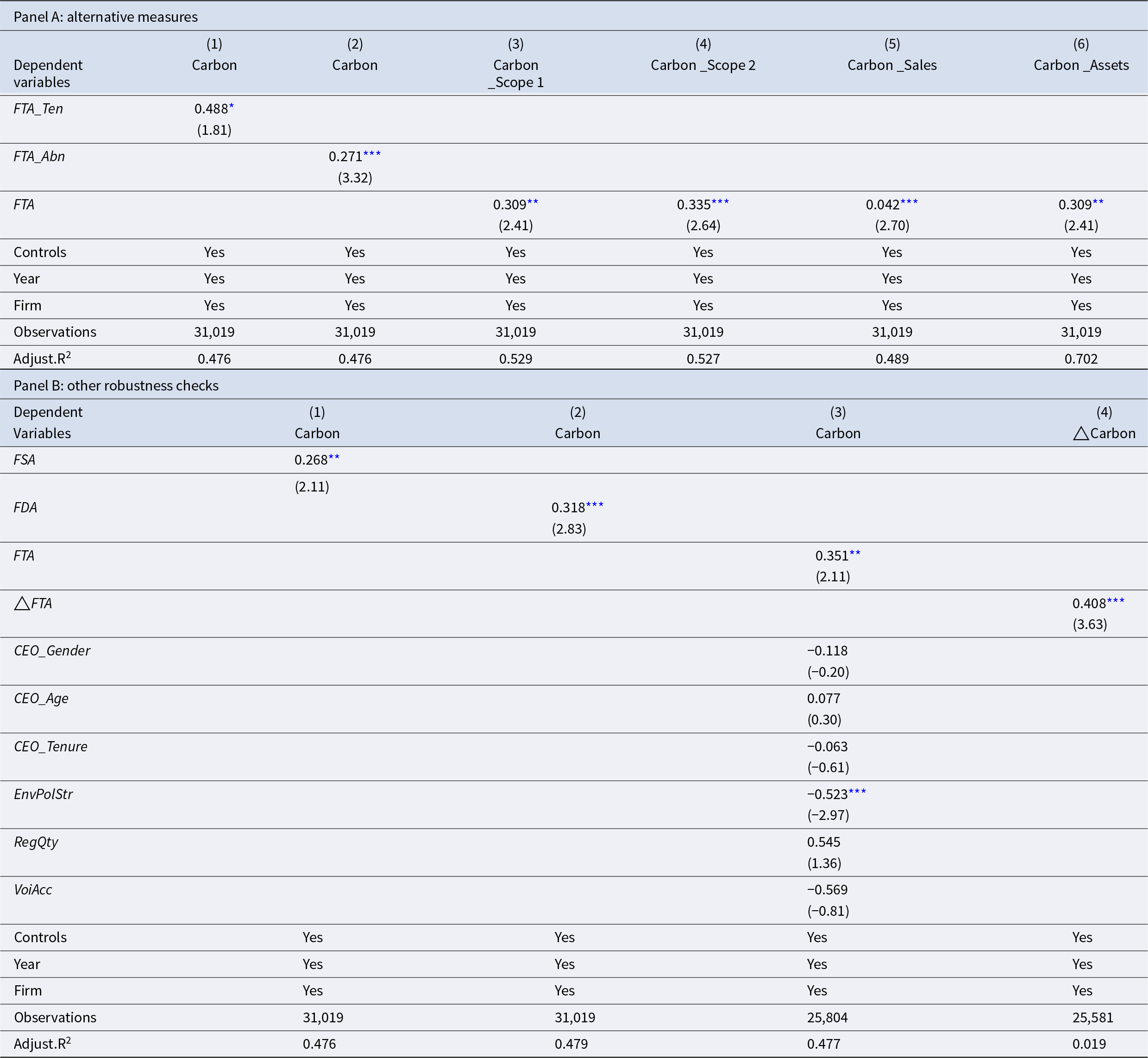
Following previous studies (Coles et al., Reference Coles, Daniel and Naveen2014; Khanna et al., Reference Khanna, Kim and Lu2015; Xu et al., Reference Xu, Rao, Cheng and Wang2020), we construct two alternative measures for the CEO internal alliance: tenure-weighted and abnormal fractions, denoted as FTA_Ten and FTA_Abn. FTA_Ten is computed by assigning weights to each subordinate executive and director appointed during the CEO’s tenure based on their individual tenures. The weight for each individual is determined by dividing their tenure by the sum of the tenure of all CEO-appointed subordinate executives and directors. FTA_Abn is constructed by calculating the difference between the actual FTA value and its predicted value from a regression model that associates FTA with CEO tenure and other relevant factors.Footnote 7 FTA_Abn captures the abnormal fraction of appointed executives and directors, isolating the portion of FTA that is not explained by observable firm characteristics and governance factors. The results in columns (1) and (2) of Panel A in Table 7 indicate that both coefficients for FTA_Ten and FTA_Abn are significantly positive. This suggests that our baseline findings remain unaffected by using alternative measures for CEO internal alliances.
Robustness tests

Notes: Panel A presents estimates from regressions examining the relationship between CEO internal alliances and carbon performance, utilizing alternative measures for both variables. Panel B displays regression estimates distinguishing between subordinate executives and directors, and from alternative model specifications. t-statistics reported in parentheses are adjusted for clustering by firm. Variable definitions are provided in Appendix A.
***, **, and * indicate significance at the 1%, 5%, and 10% levels, respectively (two-tailed).
We also employ a range of alternative measures for carbon performance. Specifically, we use the natural logarithms of Scope 1 emissions (Caron_Scope 1) and Scope 2 emissions (Carbon_Scope 2), as well as two intensity-based metrics: total CO2 and CO2 equivalent emissions scaled by sales revenue (Carbon_Sales) and by total assets (Carbon_Assets) (Gull et al., Reference Gull, Ahsan, Boubaker and Roberto2025). These alternative proxies allow us to test whether the observed relationship between CEO internal alliances and carbon performance is sensitive to how emissions are measured. As reported in columns (3)–(6) of Panel A, the coefficient on FTA remains consistently positive and statistically significant across all specifications. This reinforces the robustness of our primary findings and suggests that the detrimental effect of CEO internal alliances on carbon performance persists regardless of the emissions metric employed.
Subordinate executives vs. directors
In this section, we differentiate the effects of CEO–executive (FSA) and CEO–director (FDA) alliances on firms’ carbon performance, recognizing the varied responsibilities of subordinate executives and directors within a firm (Khanna et al., Reference Khanna, Kim and Lu2015; Xu et al., Reference Xu, Rao, Cheng and Wang2020). FSA and FDA represent the fractions of newly appointed subordinate executives and directors during the CEO’s tenure. The regression results in columns (1) and (2) of Table 7, Panel B, show that both coefficients for FSA and FDA are positive and statistically significant at the 5% level, underscoring that the formation of different types of alliances by CEOs substantially contributes to firms’ carbon emissions. These findings reveal a consistent negative association between CEO alliances and carbon performance, irrespective of whether the alliances involve subordinate executives or directors.
Alternative model specifications
In the baseline regression model, we incorporate controls for firm and country characteristics that might influence carbon performance. To further assess the robustness of our findings, we extend the model in two ways. First, we incorporate additional CEO-specific characteristics that may confound the relationship between CEO internal alliances and carbon emissions. Specifically, Model (1) includes controls for CEO gender (CEO_Gender), age (CEO_Age), and tenure (CEO_Tenure) (Xu et al., Reference Xu, Rao, Cheng and Wang2020). CEO_Gender is a dummy variable (1 for male, 0 for female). CEO_Age is calculated as the natural logarithm of the CEO’s age. CEO_Tenure captures the number of years the individual has served as a CEO. These controls help account for variation in personal leadership styles, experience, and risk preferences that may influence corporate sustainability behavior.
Second, we include three additional country-level institutional governance indicators to capture the broader institutional context within which firms operate. Environmental Policy Stringency (EnvPolStr), developed by the OECD, reflects the rigor of national environmental regulations that may incentivize firms to adopt more sustainable practices, even under strong internal CEO alliances. Regulatory quality (RegQty), sourced from Kaufmann, Kraay, and Mastruzzi (Reference Kaufmann, Kraay and Mastruzzi2011), measures the government’s capacity to implement effective, transparent policies that support long-term corporate accountability. Voice and accountability (VoiAcc), also from Kaufmann et al. (Reference Kaufmann, Kraay and Mastruzzi2011), capture the extent of public oversight through freedoms of expression, association, and media, thereby reinforcing external pressure on firms to improve carbon performance.
Including these governance indicators allows us to better isolate the effect of CEO internal alliances from the influence of institutional structures. As shown in column (3) of Panel B, the coefficient of FTA remains positive and statistically significant (0.351, p < 0.05), even after accounting for CEO characteristics and national-level governance factors, aligning with our main results. This suggests that the observed relationship between CEO internal alliances and carbon emissions is robust to the inclusion of both CEO-level and institutional-level controls. Moreover, we re-estimate the model using the changes specification, and the results remain qualitatively similar (see column (4) of Panel B, Table 7), further reinforcing the robustness of our findings.
Mechanism Analysis
To further explore how CEO internal alliances influence corporate carbon performance, we investigate two underlying mechanisms: agency costs and reductions in environmental investment and innovation. Theoretical perspectives grounded in agency theory suggest that when CEOs consolidate internal power, they may pursue personal or short-term objectives at the expense of shareholder and stakeholder interests. This can manifest in inefficient resource allocation, undermining firms’ commitment to long-term environmental goals. To test this agency-cost channel, we use the operating expenses to sales ratio (Expense Ratio) as a proxy for agency costs (Ibrahim & Samad, Reference Ibrahim and Samad2011; Singh & Davidson III, Reference Singh and Davidson III2003). We estimate the following simultaneous equations to assess whether CEO internal alliances increase agency costs, and whether such costs are associated with poorer carbon performance (Majeed, Xie, Ahsan, & Tauni, Reference Majeed, Xie, Ahsan and Tauni2024):
 \begin{equation}Expense\,Rati{o_{it}}\, = {\beta _0}\, + \,{\beta _1}\;FT{A_{it\,}} + \,{\beta _k}\;CONTROL{S_{it}}\, + \,Firm\,FE\, + \,Year\,FE\, + \,\,{\varepsilon _{it}}\,\,{ }\end{equation}
 \begin{equation}Carbo{n_{it}} = {\beta _0} + {\beta _1}\;Expense\,{ }Rati{o_{it}} + {\beta _k}\;CONTROL{S_{it}} + { }Firm\;FE{ } + { }Year\;FE{ } + {\varepsilon _{it}}\end{equation}
Results in column (1) of Table 8 show that FTA are positively and significantly associated with the Expense Ratio (0.019, p < 0.01), suggesting that stronger internal alliances increase agency costs. Column (2) shows that higher agency costs, as proxied by the Expense Ratio, are in turn associated with worse carbon performance (0.205, p < 0.05). These findings are consistent with the agency theory view that entrenched CEOs may divert resources away from long-term sustainability objectives toward less productive uses. Robustness checks using the asset utilization ratio (measured as sales to total assets) as an alternative proxy for agency costs yield consistent results (untabulated), further validating this channel.
Mechanism analysis

Notes: This table displays the mechanism analysis results that show how CEO internal alliances influence corporate carbon performance. t-statistics reported in parentheses are adjusted for clustering by firm. Variable definitions are provided in Appendix A.
*** and ** indicate significance at the 1% and 5% levels, respectively (two-tailed).
Building on our theoretical argument that CEO internal alliances may also suppress dissenting views and discourage strategic investments in long-term environmental outcomes, we next examine the investment and innovation pathway. Specifically, we assess whether FTA weakens firms’ efforts to invest in carbon abatement and environmental innovation, two critical levers for emissions reduction. We substitute the Expense Ratio in Models (2) and (3) with carbon abatement investment (CAI) and environmental innovation score (EnvIS), respectively. CAI, sourced from CDP and scaled by total assetsFootnote 8, captures a firm’s investments in emissions reduction initiatives (He et al., Reference He, Luo, Shamsuddin and Tang2022). EnvIS, obtained from the Refinitiv ESG database, reflects the firm’s R&D commitment and implementation of eco-efficient technologies.
Columns (3) and (5) of Table 8 show that FTA is significantly negatively associated with both CAI (−9.58, p < 0.05) and EnvIS (−1.759, p < 0.05), indicating that CEOs with strong internal alliances are less likely to allocate resources to environmental initiatives. Columns (4) and (6) further demonstrate that reductions in CAI and EnvIS are both significantly associated with higher carbon emissions (−0.034 and −0.186, respectively; both p < 0.05). Together, these results highlight two interrelated channels through which CEO internal alliances undermine carbon performance: by heightening agency costs and by constraining investment and innovation in sustainability initiatives. This evidence lends empirical support to the agency-based theoretical framework underlying H1a.
Heterogeneity Analyses
Our contrasting theoretical predictions highlight the inherently contingent nature of CEO internal alliance as a governance mechanism, and its effects on carbon performance are likely to vary across institutional and firm-specific contexts. Accordingly, we examine whether the relationship between CEO internal alliances and carbon performance is moderated by external governance strength, board characteristics, and CEO attributes.
Country-Level External Governance Mechanisms
In this section, we investigate whether the impact of CEO internal alliances on carbon performance varies across different external governance environments. Governance is inherently contextual, and prior research highlights that internal mechanisms are shaped and constrained by the broader institutional setting (La Porta, Lopez-de-Silanes, & Shleifer, Reference La Porta, Lopez-de-Silanes and Shleifer2008). We expect that in countries with strong external governance, manifested through robust legal systems, stringent environmental policies, active media scrutiny, and effective regulatory enforcement, the negative association between CEO internal alliance and carbon performance are weakened or rendered insignificant. In contrast, in weaker governance environments, where monitoring is limited and managerial discretion is less constrained, CEO alliances are more likely to facilitate self-serving behavior that undermines climate performance.
We operationalize the four key dimensions of country-level external governance to capture the broader institutional environment in which firms operate: legal origin, environmental policy stringency, media freedom, and regulatory quality.Footnote 9 Each dimension reflects a distinct external channel that can shape the effectiveness of internal governance and influence firms’ environmental behavior. First, legal origin distinguishes between common law and civil law systems. Common law systems generally afford stronger investor protections and legal enforcement mechanisms, thus exerting greater external pressure on managerial actions (La Porta, Lopez-De-Silanes, Shleifer, & Vishny, Reference La Porta, Lopez-De-Silanes, Shleifer and Vishny1998; Shleifer & Vishny, Reference Shleifer and Vishny1997; Wurgler, Reference Wurgler2000). Second, environmental policy stringency captures the extent to which governments impose binding environmental regulations. Third, media freedom reflects the ability of an independent press to investigate and publicize corporate environmental misconduct, thereby increasing reputational costs (El Ghoul et al., Reference El Ghoul, Guedhami, Nash and Patel2019). Finally, regulatory quality gauges the competence of public institutions in enforcing rules and ensuring compliance (Chen, Luo, & Tsang, Reference Chen, Luo and Tsang2024). Together, these four dimensions offer a holistic view of external governance, encompassing legal, political, informational, and institutional channels through which external actors influence corporate climate accountability.
To test the moderating effects of these external governance mechanisms, we divide the full sample into two subgroups along each dimension. Firms are grouped by legal origin (common vs. civil law) and by above- or below-median levels for Environmental Policy Stringency (EnvPolStr), median freedom (MFS), and regulatory quality (RegQty). We then re-estimate Model (1) separately for each subgroup and compare the coefficients on FTA.
The empirical results support our expectations. Columns (1) and (2) of Table 9 reveal that the positive association between FTA and carbon emissions is significant only in civil law countries (0.583, p < 0.05), while the effect is statistically insignificant in common law countries. This pattern suggests that the institutional features of market-oriented systems, characteristic of common law regimes, more effectively constrain managerial discretion and mitigate the adverse consequences of internal CEO alliances. The moderating effect of institutional context extends to environmental policy stringency. As shown in columns (3) and (4), FTA is significantly associated with higher emissions in countries with less stringent environmental regulations (0.443, p < 0.05), but this relationship weakens in jurisdictions with stricter environmental oversight, indicating that robust policy frameworks can partially neutralize the negative externalities of entrenched CEO power.
Heterogeneity analysis: country characteristics

Notes: This table presents estimates from regressions examining the relationship between CEO internal alliances and carbon performance on country characteristics. t-statistics reported in parentheses are adjusted for clustering by firm. Variable definitions are provided in Appendix A.
** indicates significance at the 5%, level (two-tailed).
A similar dynamic emerges in the context of media freedom. Columns (5) and (6) show that the positive relationship between FTA and emissions is pronounced in countries with low media freedom (0.388, p < 0.05), but becomes statistically insignificant in environments where independent media are more active. This implies that a free press can serve as an external monitoring mechanism, limiting opportunistic managerial behavior. Finally, columns (7) and (8) demonstrate that the detrimental effects of internal CEO alliances are concentrated in countries with weak regulatory quality (0.530, p < 0.01), and are substantially diminished in high-regulatory-quality contexts. The statistical significance of the differences in coefficients across all subgroup comparisons is confirmed by Wald tests, reinforcing the conclusion that stronger external governance environments can counterbalance the internal governance deficits associated with CEO alliances.
Collectively, these findings indicate that the detrimental impact of CEO internal alliances on carbon performance is amplified in weak institutional environments, characterized by limited legal enforcement, lax environmental regulation, restricted media freedom, and low regulatory quality. contexts, reduced external oversight allows managerial alliances to pursue self-serving objectives with minimal accountability. By contrast, strong external governance mechanisms constrain opportunistic behavior, thereby mitigating the negative environmental impact of internal CEO alliances. These results highlight the critical moderating role of institutional strength in shaping the environmental consequences of internal governance structures.
Board Characteristics
The gender composition of the board holds significance in corporate governance, with female directors contributing unique aspects of human and relational capital (Liao et al., Reference Liao, Luo and Tang2015). Women on boards exhibit heightened commitment, involvement, and diligence, fostering greater board effectiveness (Huse & Solberg, Reference Huse and Solberg2006). Notably, female directors and executives demonstrate a greater environmental concern and engagement in pro-environmental activities than their male counterparts (Byron & Post, Reference Byron and Post2016; Liao et al., Reference Liao, Luo and Tang2015; Liu, Reference Liu2018). Haque (Reference Haque2017) finds the positive impact of board gender diversity on carbon reduction initiatives. Consequently, we anticipate that the inverse connection between CEO internal alliances and carbon performance will be lessened by the presence of board gender diversity.
We classify our sample into two groups based on whether the percentage of female directors on the board is above or below the sample median. We then re-estimate Model (1) for the two groups, presenting the results in columns (1) and (2) of Table 10. In the group with fewer female directors, the coefficient of FTA is significantly positive at the 5% level. However, in the group with more female directors, this coefficient is statistically insignificant. The Wald test reveals that the difference between the two coefficients is statistically significant (p = 0.02). These results support our prediction, demonstrating that the adverse association between CEO internal alliances and carbon performance is mitigated by the presence of board gender diversity. This aligns with previous research indicating that women in leadership roles demonstrate a higher level of environmental awareness when contrasted with their male counterparts.
Heterogeneity analysis: Board characteristics

Notes: This table presents estimates from regressions examining the relationship between CEO internal alliances and carbon performance on board characteristics. t-statistics reported in parentheses are adjusted for clustering by firm. Variable definitions are provided in Appendix A.
** indicates significance at the 5% level (two-tailed).
CEO Characteristics
Psychological theories suggest individuals often form strong emotional attachments to their hometowns, fostering care for local communities (Dahl & Sorenson, Reference Dahl and Sorenson2010). A desire to maintain a positive reputation is particularly salient in one’s place of origin, where social ties enhance the visibility and impact of prosocial behavior (Relph, Reference Relph1976). Research indicates that individuals tend to engage in eco-friendly behavior in locations they feel connected to (Hernandez, Martin, Ruiz, & Del Carmen Hidalgo, Reference Hernandez, Martin, Ruiz and Del Carmen Hidalgo2010; Vaske & Kobrin, Reference Vaske and Kobrin2001). Li, Xu, and Zhu (Reference Li, Xu and Zhu2025) show that CEOs express greater concern about pollution when it affects their hometowns, prompting efforts to reduce emissions in nearby areas. In light of these insights, we posit that the adverse relationship between CEO internal alliances and carbon performance may be mitigated when the CEO’s hometown is in the same country as the firm.
We divide the sample depending on whether the CEO shares the same nationality as the firm’s home country, using nationality as a proxy for hometown. Model (1) is re-estimated for both groups, with results reported in columns (1) and (2) of Table 11. The coefficient for FTA is significantly positive for the different nationality group but not significant for the same nationality group. A Wald test confirms the difference is statistically significant (p = 0.00). The outcomes indicate that the negative association between CEO internal alliances and carbon performance is alleviated when CEOs share a national background with the firm, possibly due to a stronger sense of local accountability.
Heterogeneity analysis: CEO characteristics

Notes: This table presents estimates from regressions examining the relationship between CEO internal alliances and carbon performance on CEO characteristics. t-statistics reported in parentheses are adjusted for clustering by firm. Variable definitions are provided in Appendix A.
** indicates significance at the 5% level (two-tailed).
Gibbons and Murphy (Reference Gibbons and Murphy1992) propose that a worker’s current output shapes the labor market’s perception of their ability, influencing future wages. Consequently, younger CEOs aiming for early compensation increases have strong financial incentives for delivering superior financial performance (Andreou, Louca, & Petrou, Reference Andreou, Louca and Petrou2017). Yim (Reference Yim2013) shows that younger CEOs are more acquisition-prone and financially rewarded for such activity, while Boschen, Duru, Gordon, and Smith (Reference Boschen, Duru, Gordon and Smith2003) highlight how excess performance raises cumulative CEO wealth. In alignment with agency theory (Jensen & Meckling, Reference Jensen and Meckling1976), we propose that younger CEOs may prioritize short-term gains over long-term investments, including carbon reduction, to maximize immediate personal rewards. We thus expect a stronger negative relationship between CEO internal alliances and carbon performance among firms led by younger CEOs.
We split the sample at the median CEO age. Firms with CEOs older than the median comprise the older group, and the rest form the younger group. Model (1) is re-estimated for both groups, with results presented in columns (3) and (4) of Table 11. The coefficient of FTA is positive and significant at the 5% level for younger CEOs, but it is insignificant for older CEOs. The Wald test reveals a significant difference between these coefficients (p = 0.00). These findings support the view that the detrimental effect of CEO internal alliances on carbon performance is more pronounced under younger leadership, consistent with a preference for short-term rewards over long-term sustainability.
Impact of the 2015 Paris Climate Agreement
We investigate the impact of the 2015 Paris Climate Agreement, established at COP21, as a pivotal event amplifying the global discourse on climate issues and elevating national-level regulatory governance concerning climate change and decarbonization efforts. Marking a defining moment in global collaboration on climate change, the Paris Agreement urges national governments to participate actively in the global initiative to combat climate change. With the agreement, firms incur heightened regulatory costs, and consequently, we anticipate an increase in national governance efforts to address carbon emission issues. Our empirical analysis surrounding this event captures the overall effect, encapsulating the shift in regulatory governance in response to this significant climate change-related event. Specifically, we introduce a dummy variable, Paris, and assign a value of 1 for firm-year observations after 2015 and 0 otherwise. In column (1) of Table 12, we observe a negative and significant coefficient on FTA × Paris, indicating a notable decline in carbon emissions in the post-Paris Agreement period.
Impact of the 2015 Paris Climate Agreement

Notes: This table presents estimates from regressions examining the impact of the 2015 Paris Climate Agreement on the relationship between CEO internal alliances and carbon performance. t-statistics reported in parentheses are adjusted for clustering by firm. Variable definitions are provided in Appendix A.
***, **, and * indicate significance at the 1%, 5%, and 10% levels, respectively (two-tailed).
Following the US’s withdrawal from the Paris Agreement after the 2017 election of President Trump, we refine our analysis by excluding the US sample, while our results remain consistent in column (2). Additionally, we conduct a nested study focusing on US firms, examining the periods before and after the withdrawal. To achieve this, we introduce two dummy variables: Paris 2015–2016, representing the period between 2015 and 2016 before the withdrawal, and Paris 2017, representing the period from 2017 onward after the withdrawal. Our analysis reveals that the positive impact of the Paris Agreement on carbon emissions for US firms is primarily concentrated between 2015 and 2016 (see column (3)). However, following the US’s exit from the Paris Agreement under the Trump administration, this positive influence diminishes. These findings underscore the significant role of the Paris Agreement in reshaping national regulatory governance concerning future climate-related policies. It effectively mitigates the adverse effects of CEO alliances on long-term decarbonization efforts.
Discussion
This study investigates how CEO internal alliances, defined as interpersonal ties formed through CEO-driven appointments of executives and directors, influence corporate carbon performance across diverse institutional environments. Drawing on agency theory and the RBV, we find that stronger internal alliances are associated with poorer carbon performance. This negative effect is more pronounced in countries with weaker external governance mechanisms, such as less stringent environmental regulations, limited media freedom, and low regulatory quality. These findings underscore the importance of internal leadership structures in shaping corporate environmental strategy and highlight their contingent effects across institutional contexts.
Theoretical Contributions
Our findings offer several contributions to the literature on corporate governance and environmental strategy. First, by integrating agency theory and RBV, we provide a more balanced framework for understanding how internal CEO alliances affect sustainability outcomes. While the RBV suggests that aligned leadership teams can enhance coordination and build firm-specific capabilities (Barney, Reference Barney1991), agency theory highlights the risks of reduced monitoring and increased entrenchment when CEOs gain excessive control over appointments (Jensen & Meckling, Reference Jensen and Meckling1976). Our evidence supports the agency perspective: internal alliances appear to function primarily as a channel of CEO entrenchment, impairing carbon performance. This finding contributes to emerging views of internal leadership structures as double-edged swords that can either enhance or erode organizational performance, depending on the governance context (Ateş et al., Reference Ateş, Tarakci, Porck, van Knippenberg and Groenen2020; Ke et al., Reference Ke, Li, Ling and Zhang2019; Khanna et al., Reference Khanna, Kim and Lu2015).
Second, we contribute to cross-national governance scholarship by showing that the institutional environment moderates the relationship between internal alliances and environmental outcomes. The adverse effect of internal alliances is amplified in settings with weaker external governance, such as civil law countries or those with low media freedom. These results suggest that internal leadership resources may backfire when not complemented by robust institutional constraints, echoing calls for more context-sensitive applications of governance theories in global settings (Aguilera, Williams, Conley, & Rupp, Reference Aguilera, Williams, Conley and Rupp2006; Peng, Wang, & Jiang, Reference Peng, Wang and Jiang2008). In doing so, we integrate micro-level leadership structures with macro-level institutional features, addressing a key gap in the climate governance literature (Luo & Tang, Reference Luo and Tang2022; Ramadorai & Zeni, Reference Ramadorai and Zeni2024).
Finally, we extend the literature on CEO internal alliances by shifting the outcome lens from traditional financial metrics, such as firm value, investment efficiency, or fraud, to non-financial outcomes like carbon performance. As carbon disclosure and decarbonization become increasingly important measures of long-term corporate accountability (IPCC, 2024; ISSB, 2023; TCFD, 2017; World Economic Forum, 2024), understanding how internal power structures influence environmental behavior is a timely and important research direction.
Managerial Implications
The findings have direct implications for corporate governance, stakeholders, and public policy. For boards and nomination committees, our study highlights the risks of allowing CEOs unchecked influence over executive and director appointments. While internal alignment may facilitate communication and cohesion, it also poses threats to independence and oversight. Boards should consider institutional safeguards, such as independent nomination committees, staggered appointments, or external validation of board selections, to limit the formation of self-reinforcing alliances. In particular, gender diversity emerges as an important moderating factor, as our analysis shows that diverse boards help attenuate the negative effects of CEO alliances on environmental performance.
Second, our results offer actionable insights for investors and other stakeholders. Internal governance dynamics, particularly the presence of CEO-centric alliances, can serve as early warning signals of weak environmental commitment or symbolic ESG behavior. Incorporating measures of CEO–executive or CEO–board alignment into sustainability risk models can enhance the predictive accuracy of long-term carbon performance.
Third, the study carries broader implications for policymakers, especially in countries with weaker regulatory frameworks or limited media scrutiny. Our findings suggest that internal entrenchment is particularly harmful when external governance is weak. Regulatory interventions that promote transparency in nomination processes, mandate disclosures on internal governance structures, and enhance civil society and media oversight could mitigate the risks posed by CEO alliances. In this regard, strong institutions act as external checks on internal concentration of power, reinforcing firms’ alignment with climate objectives.
Limitations and Future Research
Several limitations warrant consideration. First, our measurement of CEO internal alliances, which is based on appointment-based connectedness, may not fully capture informal or evolving influence dynamics, such as ideological alignment, interpersonal trust, or coalition behaviors (Brass, Galaskiewicz, Greve, & Tsai, Reference Brass, Galaskiewicz, Greve and Tsai2004). Future research may employ network-based or survey-based methods to capture these more tacit dimensions of internal power structures. Second, although we incorporate multiple dimensions of external governance, other country-specific institutional factors such as political ideology, ESG reporting mandates, or stakeholder activism were not explicitly modeled. Future research could examine how these elements condition the effects of CEO alliances. Third, our analysis centers on carbon performance. Internal governance structures may influence other environmental domains, such as biodiversity loss, water use, or circular economy practices, differently. Expanding the dependent variable space would help generalize and qualify the findings further. Lastly, while our sample covers 36 countries, institutional heterogeneity remains a limitation. Micro-level analyses within countries, such as provincial governance differences in China or shareholder activism in the US, could offer more granular insights into the governance-sustainability interface.
Future research may extend our study in several directions. First, scholars could examine how informal CEO influence, such as shared educational or professional backgrounds with board members, affects firm-level environmental decisions. Second, qualitative case studies exploring the internal decision-making processes in firms with high CEO centrality could enrich our understanding of how alliances operate behind formal structures. Third, comparative studies in emerging versus developed markets could test whether the governance mechanisms we identify generalize across different institutional logics. Lastly, future work could explore the interplay between internal CEO alliances and external activist pressures, such as investor-led climate campaigns, to understand whether such alliances buffer or amplify external demands.
Data availability statement
The data that support the findings of this study are available from the corresponding author, J. H., upon reasonable request.
Acknowledgements
We are grateful to Jun Xia (Senior Editor) and two anonymous referees for their valuable comments and guidance, which have substantially improved this paper. We also thank Mostafa Hasan, Christo Karuna, Zhongtian Li (discussant), Lutfur Rahman, Abul Shamsuddin, Sue Wright, Sammy Ying, seminar participants at the University of Newcastle, and participants at the 2024 Accounting and Finance Association of Australia and New Zealand annual conference for their helpful comments and suggestions.
Funding statement
This work was supported by the National Natural Science Foundation of China (grant number 72362011) and Hainan Provincial Natural Science Foundation of China (grant number 725RC726).
Appendix A. Variable definitions

Qi Fang (fang_hn_qi@163.com) is a PhD candidate in Business School at Sun Yat-sen University. His research interests are in green accounting, corporate governance, and CSR. He has published in peer-reviewed academic journals including Energy Economics. His research often examines the challenges of balancing profitability with environmental and social objectives, offering insights for policymakers and business leaders. His interdisciplinary approach integrates finance, strategy, and environmental studies, providing a comprehensive perspective on governance and sustainability.
Xiaomeng Charlene Chen (charlene.chen@mq.edu.au) is a senior lecturer at Macquarie University. Her research examines how corporate governance and social responsibility can be strengthened through stakeholder engagement and regulatory oversight. She earned her PhD from Macquarie University, and her work has appeared in leading journals including the Journal of Business Ethics, Auditing: A Journal of Practice & Theory, and the Journal of Business Finance & Accounting. Her research advances understanding of governance mechanisms in fostering ethical corporate conduct.
Jun Hu (jnuhujun@163.com) is a professor at the International Business School, Hainan University, China. With a strong background in corporate finance and governance, he has published extensively in top-tier academic journals, including Journal of Business Ethics, Journal of Business Research, and Journal of Banking and Finance. His research focuses on corporate governance mechanisms, financial decision-making, and institutional investors, particularly in emerging economies. His work has significantly contributed to understanding how governance structures influence firm performance and financial markets.
Le Luo (le.luo@mq.edu.au) is an associate professor at Macquarie University, specializing in corporate sustainability and carbon accounting. Her recent research projects examine how businesses and capital market participants adapt to new environmental regulations and standards and encourage and assist businesses with carbon disclosure, assurance, management, and performance. With significant contributions to her field, she has authored over 40 papers in prestigious journals such as the Review of Accounting Studies, European Accounting Review, Journal of Banking and Finance, among others.