Introduction
To achieve long-term population suppression of certain nonnative arthropod pests and weeds, their arthropod natural enemies may be introduced from their area of origin (Heimpel and Mills Reference Heimpel and Mills2017). This biological control practice requires translocation of species among countries, often over large geographic, usually continental, scales. Typically, these translocated species have co-evolved with the target species (referred to hereafter as ‘importation’ or ‘classical’ biological control), but this can also include the translocation of nonnative species to target native pests, typically in greenhouses (referred to hereafter as ‘augmentative’ biological control).
Some countries, including Canada, regulate the intentional importation and release of arthropod biological control agents (BCAs) that are sourced outside of their borders. This regulation typically includes a formal process of scientific and administrative review that ultimately decides if a nonnative BCA is suitable for release into that country (Mason et al. Reference Mason, De Clerck-Floate, Gallant, Floate, Gillespie and Bourchier2017a, Reference Mason, Everatt, Loomans and Collatz2017b, Reference Mason, De Clerck-Floate, Catton, Gallant, Vankosky and Martel2024; Barratt et al. Reference Barratt, Colmenarez, Day, Ivey, Klapwijk, Loomans and Mason2021). However, most countries do not have similar formal scientific review processes for releases of BCAs carried out at subnational scales, where a BCA is ‘redistributed’ from one region to another within national borders.
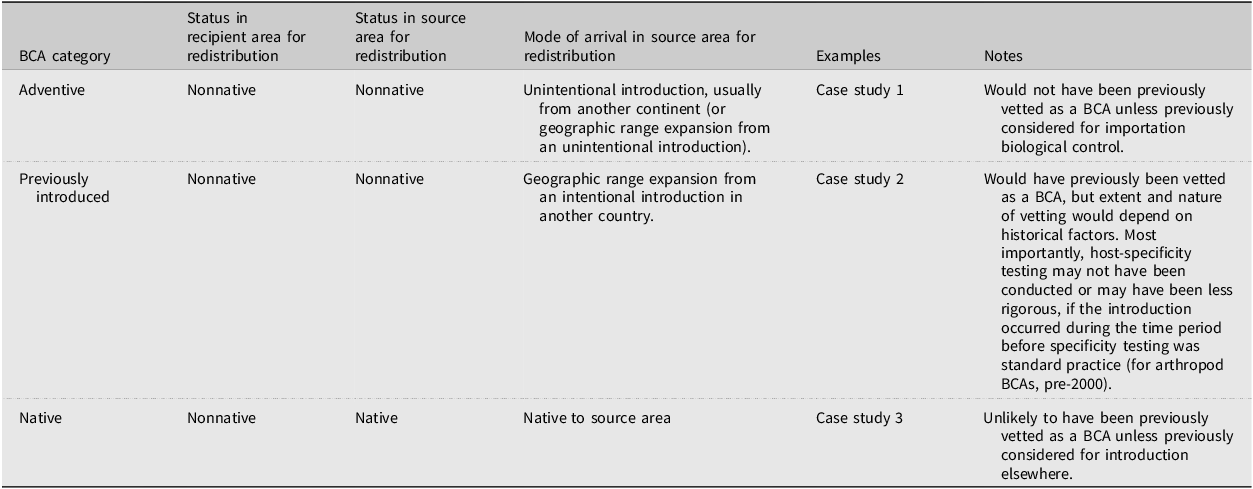
Historically and in recent years, nonnative BCAs have been discovered to have established outside of their historical geographic range (Pratt and Center Reference Pratt and Center2012; Weber et al. Reference Weber, Hajek, Hoelmer, Schaffner, Mason, Stouthamer and Mason2021). Importantly, these establishments occurred without documented intentional introductions ever having taken place. These introductions are often referred to in the biological control literature as ‘adventive’. (See Table 1 for detailed definition). Most commonly, populations of adventive BCAs in new countries arise from: (1) accidental human-assisted long-distance dispersal (sometimes associated with transport of their host or prey) and (2) natural range expansions. However, the possibility that some adventive populations result from illegal intentional introductions cannot be excluded (e.g., Mahr et al. Reference Mahr, Bruzzese, Groves, Williams and Corey1998; O’Hara Reference O’Hara2006). Once these adventive BCA populations are discovered, there may be interest in redistributing the BCA to other regions of the same country where their pest host is present. We refer to this process as ‘redistribution biological control’. When done with adventive BCAs, the key difference between redistribution biological control and importation biological control is that for the former, BCAs are not sourced from their native range; rather, they are sourced from a region where both the pest and BCA are nonnative.
Definitions of the main categories of biological control agents (BCAs) discussed in the present paper, in terms of their status in the recipient and source areas for the redistribution and their mode of arrival in the source area.

Table 1. Long description
A table categorizing biological control agents (BCAs) based on their status in recipient and source areas and mode of arrival. The table has 4 rows and 5 columns. Column headers are BCA category, Status in recipient area for redistribution, Status in source area for redistribution, Mode of arrival in source area for redistribution, Examples, and Notes. Row 1: BCA category, Adventive; Status in recipient area for redistribution, Nonnative; Status in source area for redistribution, Nonnative; Mode of arrival in source area for redistribution, Unintentional introduction, usually from another continent (or geographic range expansion from an unintentional introduction); Examples, Case study 1; Notes, Would not have been previously vetted as a BCA unless previously considered for importation biological control. Row 2: BCA category, Previously introduced; Status in recipient area for redistribution, Nonnative; Status in source area for redistribution, Nonnative; Mode of arrival in source area for redistribution, Geographic range expansion from an intentional introduction in another country; Examples, Case study 2; Notes, Would have previously been vetted as a BCA, but extent and nature of vetting would depend on historical factors. Most importantly, host-specificity testing may not have been conducted or may have been less rigorous, if the introduction occurred during the time period before specificity testing was standard practice (for arthropod BCAs, pre-2000). Row 3: BCA category, Native; Status in recipient area for redistribution, Nonnative; Status in source area for redistribution, Native; Mode of arrival in source area for redistribution, Native to source area; Examples, Case study 3; Notes, Unlikely to have been previously vetted as a BCA unless previously considered for introduction elsewhere.
Redistribution can expedite the spread of BCAs across large contiguous geographic regions or can overcome subnational geographic barriers such as mountains, bodies of water, or unfavourable ecozones (Fig. 1). Relocation of previously introduced imported BCAs has been a common practice in the history of biological control and can expedite impact (MacQuarrie et al. Reference MacQuarrie, Lyons, Seehausen and Smith2016). Redistributions of native and adventive BCAs have also been implemented (MacQuarrie et al. Reference MacQuarrie, Lyons, Seehausen and Smith2016). Adventive BCAs can also be used for augmentative biological control, often in commercial settings (Rossi-Stacconi et al. Reference Rossi-Stacconi, Abram, Anfora, Beers, Biondi and Borowiec2025) where they are sold as living (i.e., nonformulated) cultures. We argue that new opportunities for redistributions of BCAs and, in particular, of adventive BCAs may arise with further introductions of invasive arthropod pests due to accelerating international trade and climate change (Hulme Reference Hulme2021). These opportunities could be constrained, however, by a lack of clear guidelines for the intentional redistribution of nonnative species within countries.
Three hypothetical examples of within-Canada redistributions of biological control agents (BCAs) from their source area (S), where both the pest and the BCA are present, to the recipient area (R), where the pest occurs but the BCA does not. Provincial and territorial borders are shown in black, and terrestrial ecozones (Wiken Reference Wiken1986) are differentiated by colour. Redistribution from S 1 to R 1 involves different ecozones and is intended to overcome geographic barriers and large distances that would prevent natural spread of a BCA to R 1. Redistribution from S 2 to R 2 is within the same ecozone and, in the absence of significant geographic barriers, is intended to expedite the spread of a BCA across large distances. Redistribution from S 3 to R 3 is over relatively short distances within the same ecozone but is intended to overcome a significant geographic barrier (ocean) that would prevent the dispersal of a BCA.

Globally, there appear to be no standard science-based guidelines for redistributing adventive BCAs within national borders. Therefore, adventive BCAs may be redistributed within countries without scientific evaluation. This could lead to potential undesirable outcomes, including: (1) negative environmental or economic impacts from redistributed BCAs (e.g., Harmonia axyridis (Pallas) (Coleoptera: Coccinellidae); Vincent and Pickering Reference Vincent, Pickering, Mason and Gillespie2013); and (2) negative perceptions of the redistribution actions and biological control in general by the public and the scientific community from a lack of ‘social licence’ for redistributions. A lack of standard guidelines could also result in lost opportunities offered by adventive BCAs to improve pest control within national borders and to reduce reliance on other more costly or environmentally harmful management tactics (sensu Abram et al. Reference Abram, Franklin, Brodeur, Cory, McConkey, Wyckhuys and Heimpel2024). Accordingly, there has been a recent call for the development of science-based guidelines for redistributions and augmentative use of adventive arthropod pest BCAs (Rossi-Stacconi et al. Reference Rossi-Stacconi, Abram, Anfora, Beers, Biondi and Borowiec2025).
As the second largest country in the world by area, Canada is ecologically and climatically diverse, with geographic barriers that limit the distribution and dispersal of some species. Canada has also implemented many historical and contemporary biological control projects (Mason and Huber Reference Mason and Huber2001; Mason and Gillespie Reference Mason and Gillespie2013; Vankosky and Martel Reference Vankosky and Martel2024) and hosts a number of adventive arthropod BCAs (e.g., Moffat and Smith Reference Moffat and Smith2015; Mason et al. Reference Mason, De Clerck-Floate, Gallant, Floate, Gillespie and Bourchier2017a; Abram et al. Reference Abram, Talamas, Acheampong, Mason and Gariepy2019, Reference Abram, McPherson, Kula, Hueppelsheuser, Thiessen and Perlman2020; Nelson et al. Reference Nelson, Earley, Marshall, Barreto, Cock and Williams2023). In Canada, federal legislation governs the importation and release of nonnative species from outside of Canada. Under this legislation, Canada’s national plant protection organisation, the Canadian Food Inspection Agency, regulates the importation of nonnative BCAs but does not regulate redistribution of BCAs already present within the country (Mason et al. Reference Mason, De Clerck-Floate, Catton, Gallant, Vankosky and Martel2024). The lack of a standard process for redistributing BCAs may have limited the practice of redistribution biological control in Canada. Here, we provide a scientific basis to support these decisions and outline the primary considerations and best practices for subnational redistributions of BCAs, focusing on adventive arthropod natural enemies (parasitoids and predators) of arthropod pests of agriculture and forestry in Canada. Using case studies, we illustrate how these considerations may also be applied to redistributions of previously introduced BCAs whose populations have subsequently spread into Canada from the United States of America, as well as redistribution of native BCA species. (See Table 1 for definitions). Finally, we discuss additional considerations, future challenges, and recommendations for redistributions of BCAs.
Primary considerations for redistributions of adventive biological control agents of arthropod pests within Canada
Basic considerations
The considerations required to justify a redistribution biological control programme are similar to those used to justify an importation biological control programme. The most important consideration is whether there is a justifiable reason to move the BCA to the recipient region. This requires a clear understanding of the target organism’s pest status (i.e., is the target a significant economic or ecological problem?). If the target species is indeed a significant pest, then the next consideration is whether the pest is an appropriate target for biological control (e.g., in the proposed region for redistribution, are there other mitigation strategies or existing natural enemies that provide adequate biological control?). Another essential criterion is whether the BCA proposed for relocation can be authoritatively identified and distinguished from similar (e.g., congeneric) species. Doing so may require the integration of traditional and newer systematics approaches (e.g., Sosa-Calvo et al. Reference Sosa-Calvo, Forshage and Buffington2024) and collaboration with systematics experts.
If these traditional criteria are met, several factors unique to redistribution biological control come into play. Primary among these is defining what barrier(s) preventing natural dispersal the redistribution would overcome. These could be obvious barriers of geography or climate (e.g., mountain ranges, bodies of water, climatically unsuitable regions) or less obvious barriers of time or space that the BCA on its own may not be able to overcome or may overcome too slowly to mitigate the impacts of a critical arthropod pest. For barriers of geography, climate, time, or space, practitioners must consider how to facilitate the spread of the BCA over the barrier or to expedite the establishment of the agent in regions where it might spread on its own.
Redistribution can also be challenging because of jurisdictionally variable legislation, regulation, or policy frameworks. In the case of Canada, subnational governments (e.g., provinces, municipalities) often do not have specific legislation or regulations that have direct bearing on BCA redistribution. They may also lack a designated process to conduct scientific reviews. In other cases, legislation or regulations may exist, but how these apply to redistributions may not always be clear and may not have ever been considered by subnational legislators or regulators. Because biological control practitioners will likely lack expertise in this area, it is prudent to seek the opinion of stakeholders and to engage with governments to determine whether there may be other legislation that may be directly or indirectly relevant. Even in the absence of legislation or other formal consultation requirements, engagement with stakeholders and governments can demonstrate due diligence and create social licence for BCA redistributions (see Discussion: Public perception and social licence section).
Specificity of the biological control agent
The primary scientific consideration for whether an adventive BCA should be redistributed is its specificity to the target arthropod pest. Specificity determines whether the BCA may have any negative impacts on native flora and fauna. However, the host specificity of adventive arthropod natural enemies may not always be known because formal evaluations of their host range may not have been conducted before their introduction. Their host specificity could range from narrow (i.e., specialist) to relatively broad (i.e., oligophagous to polyphagous). Therefore, as with importation biological control, BCAs’ host ranges must be evaluated before redistributing them to the recipient region to ensure that species that are insufficiently host-specific are not redistributed.
Some adventive BCAs, however, may have been previously subjected to host range testing as part of an importation biological control programme (see Recent redistributions of adventive, previously introduced and native biological control agents in Canada section). This is perhaps even expected, because any adventive BCA must live in close association with the pest in its home range and is likely to have been identified as a potential BCA during the process of exploration for natural enemies. Therefore, when adventive BCA populations are discovered, traditional laboratory host range-testing data may be available to inform decisions about host specificity. In cases where testing has been done for a different jurisdiction, it is important to consider how relevant and comprehensive the available host range data are with respect to the recipient region’s biodiversity.
The presence of adventive BCAs presents an opportunity to gather additional host-specificity data for species native to the region where they have established. This is because these agents are exposed to a new community of potential host species under natural conditions. These ‘ecological host range’ data can be gathered observationally (Haye et al. Reference Haye, Moraglio, Tortorici, Marazzi, Gariepy and Tavella2024), experimentally (Abram et al. Reference Abram, Moon, Fraser, Thiessen and Gariepy2026), or using other approaches (e.g., citizen science data; Makovetski et al. Reference Makovetski, Smith and Abram2025). If sufficiently comprehensive, the data may reveal important ecological filters (e.g., phenology, spatial refuges, etc.) that restrict the agent’s host range under natural conditions (Haye et al. Reference Haye, Moraglio, Tortorici, Marazzi, Gariepy and Tavella2024; Abram et al. Reference Abram, Moon, Fraser, Thiessen and Gariepy2026). The data can also complement host range data that are already available from the BCA’s native range.
Whether host-specificity data are gathered in the laboratory, the field, or both, the resulting information should be considered through the lens of phylogeny. To inform potential redistributions, practitioners must consider the phylogenetic breadth of the nontarget host species that were tested and how much it overlaps with the communities in the recipient region. This is because host-specificity testing done in the context of importation biological control may have focused on species from a different subnational region and may not be relevant. Therefore, to assess the relevance of any prior host range testing to the recipient region’s biodiversity, an important early step in a redistribution programme for a BCA is to compile a list of organisms closely related to the target pest in the recipient region. This could include hyperparasitoids or competitors that could act as sources of biotic resistance (Schulz et al. Reference Schulz, Lucardi and Marsico2019) through direct or indirect trophic interactions. Once compiled, practitioners can assess the quality of available host-specificity data against the list of possible species that could affect, or could be affected by, the redistributed BCA. This can also provide a basis for postrelease monitoring that includes potential nontarget effects of the BCA redistribution.
In some cases, additional laboratory nontarget host range testing or ecological host range studies may be appropriate to address uncertainties in the phylogenetic breadth of the BCA’s host range. Additional studies may be warranted if there are nontarget arthropod species closely related to the target pest in the recipient region that are ecologically similar (e.g., same feeding niche), are of conservation importance (e.g., threatened or endangered), or are economically important. Species in the area of origin that are closely related to the BCA and are considered to be potential agents for biological control of other organisms (e.g., invasive weeds) in the recipient region should also be further investigated.
The impact of the biological control agent on pest populations
Adventive BCAs that are more effective at suppressing populations of the target pests are better candidates for redistribution than are those that show limited evidence of impact. Evidence of efficacy in suppressing target pest populations can be gathered in the native range of the BCA and also in the geographic range where it is adventive. Unfortunately, even for adventive BCAs that are established in multiple regions around the world, rigorous data on target-species suppression in the field can be challenging to collect and can take years to obtain. In addition, unlike prerelease assessment of specificity, no experimental laboratory paradigms can accurately predict BCA efficacy. Measures of BCA impact such as percent parasitism under field conditions can be estimated and are more often available in the literature, but these are flawed metrics compared to more robust life table analyses or time series-based measures of population dynamics (Van Driesche Reference Van Driesche1983; Van Driesche et al. Reference Van Driesche, Cock, Winston, Reardon and Weeks2018). Over time, however, higher-quality studies of the impact of adventive BCAs may be conducted (e.g., Mele et al. Reference Mele, Mills, Canella, Mirandola, Ceccato and Tirello2026). In the absence of reliable estimates, other sources of information can be used to make inferences about the potential for the redistributed BCA to suppress the target pest. These alternative approaches include using predictive modelling or inferences based on the historical success of biological control using taxonomically related agents (Schaffner et al. Reference Schaffner, Steinbach, Sun, Skjøth, de Weger and Lommen2020; Heimpel et al. Reference Heimpel, Abram, Causton, Celis, Coll and Hardy2024). Because efficacy is difficult and time-consuming to assess before a biological control release, we recommend that demonstrating efficacy should not be a requirement before redistributions are done. Where possible, other lines of evidence such as relative percent parasitism values from the region where it has previously established could be used provisionally. We do, however, recommend developing a postrelease monitoring plan to document the impact of the redistributed BCA in the recipient region. Doing so is an important component of supporting the rationale for a redistribution in the first place and will produce data to inform potential future redistributions. An additional component would be to make a formal, quantitative assessment of risks and benefits of the redistribution. Heimpel et al. (Reference Heimpel, Abram, Causton, Celis, Coll and Hardy2024) propose a model for this approach applied to imported BCAs that could be adapted for redistribution biological control programmes.
Climatic differences
Differences in climate between the source and recipient regions for the redistribution should be a key consideration because the climate of the recipient region likely will be one of the main factors determining the potential for the redistributed BCA to establish, increase in abundance, and spread (Stiling Reference Stiling1993). Climate does not vary at a predictable scale – regions separated by vast distances can have very similar climates, and regions that are relatively close spatially can have vastly different climates if, for example, they are separated by important geographic barriers like mountain ranges (Czokajlo et al. Reference Czokajlo, Looney, Nottingham, Diehl, Abram and Northfield2025). For this reason, a useful framework to think about differences between source and recipient areas for biological control redistributions is designations such as terrestrial ecozones (Cock et al. Reference Cock, Kuhlmann, Schaffner, Bigler, Babendreier, Bigler, Babendreier and Kuhlmann2006), which are based on broad suites of biotic and abiotic characteristics (Wiken Reference Wiken1986; Government of Canada 2024a). Other factors such as winter severity (Government of Canada 2024b), plant hardiness zones (McKenney et al. Reference McKenney, Pedlar, Lawrence, DeBoer and MacDonald2025), and local and regional microclimate variation could also be important to consider in order to estimate the climate suitability of the recipient region.
Recent redistributions of adventive, previously introduced, and native biological contriol agents in Canada
The considerations outlined in the previous section focus on redistributions of adventive BCAs. These, however, are not the only category of BCAs that might be considered for redistribution. Many of the considerations also apply to introduced BCAs that have spread into Canada from the United States of America or to BCA species that are native to some areas of Canada but not others and might be redistributed when their prey or host becomes invasive in a new area of the country (Table 1).
To illustrate how these considerations apply to redistributions of the three categories of BCAs, three detailed case studies of recent and ongoing redistributions of adventive, previously introduced, and native BCAs in Canada are presented using the list of criteria set out in the Primary considerations for redistributions of adventive biological control agents of arthropod pests within Canada section. Lessons learned from these three recent redistributions, which vary considerably in their ecological, social, and economic contexts, were incorporated into the recommendations for future redistributions that we present in the present paper.
Case study 1: The redistribution of Ganaspis kimorum (Hymenoptera: Figitidae) for biological control of Drosophila suzukii (Diptera: Drosophilidae) in Ontario
Background
Spotted-wing drosophila, Drosophila suzukii (Matsumura) (Diptera: Drosophilidae), is one of the world’s most serious pests of soft-skinned fruit (Tait et al. Reference Tait, Mermer, Stockton, Lee, Avosani and Abrieux2021). It was first detected in Canada in 2009. A multi-national effort took place to identify candidate importation BCAs from the pest’s native Asian range (Wang et al. Reference Wang, Lee, Daane, Buffington and Hoelmer2020). The most promising candidate was the larval parasitoid Ganaspis kimorum Buffington (Hymenoptera: Figitidae), formerly G1 Ganaspis brasiliensis (Ihering) (Sosa-Calvo et al. Reference Sosa-Calvo, Forshage and Buffington2024; Stahl et al. Reference Stahl, Wang, Abram, Biondi, Buffington and Hoelmer2024a). In 2019, when G. kimorum was being evaluated for introduction into the United States of America and Europe (Switzerland and Italy), unintentionally introduced populations were discovered to be already well established in British Columbia, Canada, and an adjacent area of Washington state, United States of America (Abram et al. Reference Abram, McPherson, Kula, Hueppelsheuser, Thiessen and Perlman2020, Reference Abram, Franklin, Hueppelsheuser, Carrillo, Grove and Eraso2022; Beers et al. Reference Beers, Beal, Smytheman, Abram, Schmidt-Jeffris and Moretti2022). Unintentionally introduced populations of G. kimorum were not found in eastern Canada, where D. suzukii is also a serious pest (Gariepy et al. Reference Gariepy, Abram, Adams, Beal, Beers and Beetle2024). This raised the possibility of redistributing adventive populations of G. kimorum from British Columbia to Ontario, Canada.
Basic considerations
Drosophila suzukii is a serious pest of several fruit crops in Ontario. It requires repeated applications of broad-spectrum insecticides to manage populations and reduce damage in commercial production. Introduction of parasitoids that could increase the mortality of immature stages of D. suzukii in both crop and noncrop environments could help reduce landscape-wide pest pressure, but no specialised native natural enemies were present in Ontario. Although another unintentionally introduced larval parasitoid from Asia, Leptopilina japonica Novković and Kimura (Hymenoptera: Figitidae), was discovered in Ontario (Gariepy et al. Reference Gariepy, Abram, Adams, Beal, Beers and Beetle2024), G. kimorum and L. japonica may exert complementary biological control via niche partitioning at the host plant and individual berry level (Wang et al. Reference Wang, Hogg, Hougardy, Nance and Daane2019; Abram et al. Reference Abram, Franklin, Hueppelsheuser, Carrillo, Grove and Eraso2022; Earley et al. Reference Earley, Abram, Lalonde and Moffat2023), as was noted during exploratory research in South Korea, the area of origin (Daane et al. Reference Daane, Wang, Biondi, Miller, Miller and Riedl2016).
More than 3000 km of distance and several geographical and ecological barriers lie between the south coast of British Columbia and Ontario, so natural spread during any reasonable time frame was unlikely. Intentional biological control releases of G. kimorum in American states adjacent to Ontario began in 2022 (Gariepy et al. Reference Gariepy, Abram, Adams, Beal, Beers and Beetle2024), but it was unclear whether the quarantine laboratory population being used would be well adapted to the local context or how long it would take to spread naturally. Whole-genome sequencing (Hopper et al. Reference Hopper, Wang, Kenis, Seehausen, Abram and Daane2024), DNA barcoding (Beers et al. Reference Beers, Beal, Smytheman, Abram, Schmidt-Jeffris and Moretti2022), morphological characteristics, interbreeding experiments (Sosa-Calvo et al. Reference Sosa-Calvo, Forshage and Buffington2024; Stahl et al. Reference Stahl, Lisi, Samarin, Wang, Beers and Daane2024b), and molecular diagnostics (Gariepy et al. Reference Gariepy, Abram, Adams, Beal, Beers and Beetle2024) confirmed that the adventive population in British Columbia was G. kimorum and not other members of its species complex that may have differing degrees of specificity. Laboratory interbreeding trials showed that the intentionally introduced populations of G. kimorum are reproductively compatible with the adventive populations of G. kimorum in the Pacific Northwest of North America (Stahl et al. Reference Stahl, Lisi, Samarin, Wang, Beers and Daane2024b).
Consultation with growers, stakeholders, and provincial government officials in Ontario was initiated in 2022 to gauge interest and to determine potential concerns and barriers to redistribution of G. kimorum. All parties were consulted and presented with a redistribution proposal in 2023 that outlined the scientific rationale for introducing G. kimorum: the proposal was met with support for the redistribution. In addition, peer review of the redistribution document by a variety of experts and stakeholders in pest management and insect conservation was conducted to gather additional feedback and incorporate suggestions. Outreach presentations were developed to communicate the goals and safety of the releases to growers. Redistribution advocates in Ontario developed collaborations with growers at six different berry farms in southwestern Ontario and arranged for research releases in untreated vegetation corridors next to their berry crops, primarily in different wild hosts that were fruiting across the field season, to provide consistent access to ripening fruits harbouring D. suzukii larvae.
Specificity of the biological control agent
Several laboratory studies showed that G. kimorum is highly specific to D. suzukii, although it may also be able to develop on the closely related Drosophila melanogaster Meigen (Stahl et al. Reference Stahl, Wang, Abram, Biondi, Buffington and Hoelmer2024a). However, in field cage conditions that incorporated slightly more ecological realism, emergence of G. kimorum from D. melanogaster was rare (Seehausen et al. Reference Seehausen, Valenti, Fontes, Meier, Marazzi, Mazzi and Kenis2022). This is probably because D. suzukii is the only species outside of Asia that exploits ripening (rather than rotting) fruit and G. kimorum is not attracted to rotting fruit (Giorgini et al. Reference Giorgini, Stacconi, Pace, Tortorici, Cascone and Formisano2024). The nontarget Drosophilidae fauna of Ontario does not contain any unique or endangered species, and the species that are most closely related to D. suzukii are invasive or cosm.,opolitan nuisance pests (Supplementary material, File S1).
Impact of the biological control agent on pest populations
In some host plants, the percentage of D. suzukii parasitised by G. kimorum can be considerable, with the average percentage of parasitised larvae ranging from 18% to 40% in some collections done in Asia (Stahl et al. Reference Stahl, Wang, Abram, Biondi, Buffington and Hoelmer2024a) and with some point estimates of percent parasitism by G. kimorum exceeding 55% in British Columbia (Abram et al. Reference Abram, Franklin, Hueppelsheuser, Carrillo, Grove and Eraso2022). The true population-level impact of G. kimorum on D. suzukii remains unclear but is a topic of active investigation using several different methodological approaches (Stahl et al. Reference Stahl, Wang, Abram, Biondi, Buffington and Hoelmer2024a).
Climatic differences
Initial releases of G. kimorum have taken place in southwestern Ontario. This region is climatically similar to south-coastal British Columbia (Government of Canada 2024b), and therefore the source and recipient regions do not dramatically differ in terms of average winter temperatures. However, most other regions of Ontario experience significantly harsher winters than south-coastal British Columbia does (Government of Canada 2024b; McKenney et al. Reference McKenney, Pedlar, Lawrence, DeBoer and MacDonald2025), which could limit the establishment and spread of G. kimorum.
Current status and postrelease monitoring
Releases of G. kimorum in Ontario began in 2024 and continued in 2025, with more than 58 000 individuals released to date (approximately 18 000 in 2024 and 40 000 in 2025). It is not yet known if these populations have established; however, within-season establishment was confirmed through collection and rearing of ripening fruit following the releases. Establishment of G. kimorum in the release areas in Ontario is being monitored through weekly or bi-weekly fruit collections at the release sites (Abram et al. Reference Abram, McPherson, Kula, Hueppelsheuser, Thiessen and Perlman2020). Field-collected fruits are brought back to the laboratory and are reared to obtain and identify emerging parasitoids; these data are used to evaluate parasitism and parasitoid species composition (Gariepy et al. Reference Gariepy, Abram, Adams, Beal, Beers and Beetle2024). This was done in 2024 and 2025 and will continue for several years following the release to track the establishment and parasitoid species composition over time. Once establishment of G. kimorum has been confirmed, food web studies will be developed to evaluate the impact of G. kimorum on D. suzukii and on nontarget drosophilids (Abram et al. Reference Abram, Moon, Fraser, Thiessen and Gariepy2026).
Case study 2: The redistribution of Istocheta aldrichi (Diptera: Tachinidae) for biological control of Popillia japonica (Coleoptera: Scarabaeidae) in British Columbia
Background
The detection of the polyphagous pest, Popillia japonica Newman (Coleoptera: Scarabaeidae), in Vancouver, British Columbia in 2017 was seen as an economic risk to the region’s agricultural and ornamental plant sectors. An eradication programme incorporating surveillance, biosanitary procedures, and insecticides made progress in reducing populations of the pest; however, additional ‘pockets’ of infestation continued to appear in nearby municipalities surrounding Vancouver. Popillia japonica has been a pest in eastern North America for more than 100 years and has been the target of repeated control efforts. These efforts include the intentional introductions to the United States of America in the 1920s from Japan of the parasitoid fly, Istocheta aldrichi (Mesnil) (Diptera: Tachinidae). This parasitoid established and eventually spread to Quebec and Ontario, Canada. Following the detection of P. japonica in British Columbia, I. aldrichi was selected as a candidate BCA for redistribution to that province.
Consultations with provincial, federal, and municipal stakeholders in British Columbia began in 2018. A redistribution proposal was drafted, and in 2022, it was submitted to a multi-agency committee (British Columbia Plant Protection Advisory Committee) that coordinated peer review by a variety of experts and stakeholders in pest management and insect conservation. The redistribution document was revised accordingly and was used as a supporting document for subsequent consultation with municipalities. Outreach materials were developed to communicate the goals and safety of the releases.
Basic considerations
Biological control was considered as an additional tool to complement other tactics being used to reduce P. japonica populations, which were predicted to reach economically damaging levels in the absence of any interventions. The P. japonica population in Vancouver had no known specialised natural enemies (P. Abram, unpublished data). As populations of P. japonica spread and cause economic damage, reductions in P. japonica abundance from I. aldrichi have the potential to reduce the need for insecticide use. Because more than 3500 km of distance and significant geographic barriers (e.g., the Rocky Mountains) separate the Vancouver population of P. japonica from the closest known I. aldrichi population in Ontario, I. aldrichi is unlikely to spread naturally to Vancouver in any reasonable time frame. The identity of I. aldrichi collected from the source regions (Ontario and Quebec) was verified by a taxonomic expert (O’Hara Reference O’Hara2014). No legislation governs the release of nonnative species in British Columbia.
Specificity of the biological control agent
Laboratory host range testing was not a regulatory requirement before 2000 and therefore was not done for I. aldrichi. However, the long history of I. aldrichi as a BCA provided opportunities to leverage ecological host range data to infer its specificity. The original explorations done in Asia in the early 1900s showed that I. aldrichi was only associated with P. japonica, despite parasitoids from several other species of closely related Scarabaeidae (including several congeneric species) having been collected and reared (Fleming Reference Fleming1968). In addition, no other insects have been recorded as hosts of I. aldrichi despite its presence in the United States of America since the 1920s (Arnaud Reference Arnaud1978). More recent explorations of the host specificity of I. aldrichi from online crowd-sourced natural history data (Makovetski et al. Reference Makovetski, Smith and Abram2025) and museum specimens (Abram, Miall, and Gariepy, unpublished data) further support the hypothesis that I. aldrichi is highly specific to P. japonica. Also, British Columbia is not home to any species of native Rutelinae, the subfamily to which P. japonica belongs, which reduces the likelihood of nontarget effects. Nontarget risk generally decreases with decreasing phylogenetic relatedness to the target pest (Kuhlmann et al. Reference Kuhlmann, Schaffner, Mason, Bigler, Babendreier and Kuhlmann2006; Heimpel et al. Reference Heimpel, Abram and Brodeur2021); this also increased the confidence that a redistribution of I. aldrichi to British Columbia would be unlikely to have impacts on native nontarget Scarabaeidae.
Impact of the biological control agent on pest populations
Strong host–parasitoid population cycles and relatively low P. japonica densities in Japan indicate that I. aldrichi helps regulate P. japonica in its native range (Clausen et al. Reference Clausen, King and Teranishi1927). Evidence from the United States of America collected before 2020 suggested that I. aldrichi may not be an effective BCA of P. japonica, but more recent evidence suggests that it may contribute to suppressing P. japonica populations in Quebec (Gagnon et al. Reference Gagnon, Doyon, Legault and Brodeur2023; Lasnier et al. Reference Lasnier, de Coussergues, Baril and Vincent2025). In addition, the impact measurements used in these studies (percent parasitism; Gagnon et al. Reference Gagnon, Doyon, Legault and Brodeur2023; Lasnier et al. Reference Lasnier, de Coussergues, Baril and Vincent2025) underestimate true generational parasitism in this host–parasitoid association because parasitised P. japonica hosts die sooner than healthy, nonparasitised P. japonica (Clausen et al. Reference Clausen, King and Teranishi1927).
Climatic differences
British Columbia’s Lower Mainland region (including Vancouver) experiences considerably milder winters than do the areas of eastern North America where I. aldrichi is established. Istocheta aldrichi requires cool temperatures to complete its diapause (Simões and Grenier Reference Simões and Grenier1999). Istocheta aldrichi puparia buried under the soil in British Columbia completed their diapause, and adults successfully emerged after one winter (Makovetski and Abram Reference Makovetski and Abram2024).
Current status and postrelease monitoring
Populations of I. aldrichi were released in Port Coquitlam, British Columbia in 2023, and were established as of 2025 (Makovetski and Abram Reference Makovetski and Abram2024; Abram Reference Abram2026). Postrelease monitoring is being done using a network of hundreds of traps set up around release sites, which are used to trap P. japonica. Because I. aldrichi lays its eggs on the exterior of its hosts, the presence of the parasitoid can be evaluated by inspecting trapped P. japonica. Using this same technique, postrelease monitoring of potential nontarget effects is being done using crowd-sourced observations of adult scarab beetles in the region on iNaturalist (sensu Makovetski et al. Reference Makovetski, Smith and Abram2025; Walmsley Reference Walmsley2026).
Case study 3: The redistribution of Laricobius nigrinus (Coleoptera: Derodontidae) for biological control of hemlock woolly adelgid (Hemiptera: Adelgidae) in Nova Scotia
Background
Hemlock woolly adelgid, Adelges tsugae Annand (Hemiptera: Adelgidae), is a serious pest of eastern hemlock, Tsuga canadensis (Linnaeus) Carrière (Pinaceae), an ecologically and culturally significant tree with a Canadian distribution from Nova Scotia to Ontario. The invasive strain of A. tsugae, introduced from Japan, has spread across much of the eastern United States of America since its initial detection in Virginia in 1951. Feeding by A. tsugae leads to hemlock decline and mortality within 3–15 years, with cascading effects on biodiversity and ecosystems (Orwig et al. Reference Orwig, Foster and Mausel2002; Tingley et al. Reference Tingley, Orwig, Field and Motzkin2002; Brantley et al. Reference Brantley, Ford and Vose2013). In 2017, A. tsugae was detected in Nova Scotia, Canada, where it had widespread impacts (Chavardès et al. Reference Chavardès, Edge, Heartz, Knockwood, Young and MacKinnon2025). Hemlock is a significant component of the Wabanaki–Acadian forest, especially along lake shorelines and riparian habitats and in the remaining old-growth stands. Much of eastern hemlock’s range in Canada is at risk of A. tsugae invasion (Emilson and Stastny Reference Emilson and Stastny2019; Cornelsen et al. Reference Cornelsen, MacQuarrie and Lee2024). Chemical control with neonicotinoids (more than 50 000 trees to date) carries environmental risks and is prohibitive at larger scales and for many private woodlots (66% of hemlock stands), prompting calls for additional management tactics.
Basic considerations
The invasive status of A. tsugae in North America is somewhat unique, because a distinct, native western strain of A. tsugae occurs in the continent’s Pacific Northwest region. There, it feeds on native western and mountain hemlocks but appears to be regulated by co-evolved natural enemies (Kohler et al. Reference Kohler, Stiefel, Wallin and Ross2008; Crandall et al. Reference Crandall, Lombardo and Elkinton2022). Adelges tsugae has a complex life cycle, with two generations per year and asexual reproduction. This means that populations can quickly recover from mortality; for this reason, multiple predators that target both generations are hypothesised to be necessary for population regulation (Cheah et al. Reference Cheah, Montgomery, Salom, Parker, Costa and Skinner2004; Mayfield et al. Reference Mayfield III, Bittner, Dietschler, Elkinton, Havill and Keena2023).
Laricobius nigrinus Fender (Coleoptera: Derodontidae) was chosen for redistribution to Nova Scotia, adapting protocols for direct releases of adults (Salom et al. Reference Salom, Kok, Lamb and Jubb2012). Native to the Pacific Northwest, this beetle feeds on the spring generation of A. tsugae. The beetle has been released since 2003 in the United States of America and has established in 13 states (Mausel et al. Reference Mausel, Salom, Kok and Davis2010; Crandall et al. Reference Crandall, Chandler, Dietschler, Andersen and Elkinton2023). The releases are one component of a long-term, landscape-scale management strategy for A. tsugae in the United States of America, with the introduction of other predator species also planned (Mayfield et al. Reference Mayfield III, Bittner, Dietschler, Elkinton, Havill and Keena2023).
By 2021, the demand for a long-term management strategy for A. tsugae in Nova Scotia had led to stakeholder consultations on a redistribution proposal that adapted operational experience from similar ecoregions and weighed relative risks (including inaction) and potential benefits. Nova Scotia’s legislation allows the release of species indigenous to Canada with approval under the province’s Biodiversity Act (Authority of the Speaker of the House of Assembly, Halifax 2021). First Nations, conservation authorities, and municipalities were also consulted.
Specificity of the biological contral agent
Host-specificity testing of L. nigrinus was conducted by exposing it to several Adelgidae species (Adelges spp., Pineus spp.) and ecologically similar aphids and scale insects (Aphididae, Diaspididae) in the laboratory (Zilahi-Balogh et al. Reference Zilahi-Balogh, Kok and Salom2002). Choice and no-choice oviposition tests and feeding bioassays showed that several nontarget species were accepted as prey; however, with the exception of Adelges abietis (Linnaeus), no-choice feeding rates were lower than on A. tsugae (Zilahi-Balogh et al. Reference Zilahi-Balogh, Kok and Salom2002). Oviposition was greatest on A. tsugae, and no oviposition occurred on aphid hosts. Although feeding on some hosts occurred, development was not completed on any nontarget species (Zilahi-Balogh et al. Reference Zilahi-Balogh, Kok and Salom2002).
Of the nine species of adelgids that occur in Nova Scotia (Maw et al. Reference Maw, Foottit, Hamilton and Scudder2000), the nonnative Adelges abietis (Linnaeus), A. piceae (Ratzeburg), and the native Pineus strobi (Hartig) were included in the original host-specificity tests (Zilahi-Balogh et al. Reference Zilahi-Balogh, Kok and Salom2002). Of the other native species, Pineus coloradensis (Gillette) and P. pinifoliae (Fitch) (all Hemiptera: Adelgidae) are forest pests (Maw et al. Reference Maw, Foottit, Hamilton and Scudder2000). The native Pineus floccus (Patch) and Adelges lariciatus (Patch) (Hemiptera: Adelgidae) are not listed as species of concern (Maw et al. Reference Maw, Foottit, Hamilton and Scudder2000), although A. lariciatus is reported as prey of L. nigrinus (Leschen Reference Leschen2011). None of the nine species in Nova Scotia occurs on hemlock, but all are associated with tree species that commonly co-occur with hemlock. Despite over two decades of releases in the United States of America, there are no published reports of nontarget predation by L. nigrinus; however, rigorous ecological host range studies that would document nontarget predation have not yet been done.
There may be a risk of indirect effects of introduced A. tsugae predators on the widespread but uncommon harvester butterfly, Feniseca tarquinius (Fabricius) (Lepidoptera: Lycaenidae), North America’s only carnivorous butterfly (Mathew et al. Reference Mathew, Travassos, Canfield, Murawski, Kitching and Pierce2008). Its larvae feed on the native woolly alder aphid, Prociphilus tessellatus (Fitch) (Hemiptera: Aphididae). Prociphilus tessellatus has not been exposed to L. nigrinus in laboratory tests; however, only its eggs are present during L. nigrinus foraging. A separate assessment of the congeneric BCA, Laricobius osakensisMontgomery and Shiyake, showed that significantly fewer eggs of P. tessellatus were consumed than those of A. tsugae (Vieira et al. Reference Vieira, McAvoy, Chantos, Lamb, Salom and Kok2011).
Interbreeding (hybridisation) between L. nigrinus and congeneric native species is an additional risk of its introduction. Hybridisation between L. nigrinus and its native, eastern sister species, L. rubidus LeConte, has been documented in several studies. This hybridisation is limited by the predators’ foraging affinities to tree species and has been reported to stabilise at levels ranging from 2% (Jubb et al. Reference Jubb, Heminger, Mayfield III, Wiggins and Grant2020) to 10–15% (Mayfield et al. Reference Mayfield III, Reynolds, Coots, Havill, Brownie and Tait2015). Broader ecological consequences of hybridisation are not fully understood, but L. rubidus densities on white pine (Pinaceae), the plant host of its weevil prey, Pissodes strobi (Peck) (Coleoptera: Curculionidae), are apparently unaffected at release sites (Fischer et al. Reference Fischer, Havill, Brewster, Davis, Salom and Kok2015). Risk of hybridisation with L. erichsonii Rosenhauer remains to be examined, and the abundance of this nonnative species in Nova Scotia is unknown (Majka Reference Majka2007).
Impact of the biological control agent on pest populations
The spring generation of A. tsugae can be suppressed by 40% to 60% due to predation by L. nigrinus, based on caging trials done with infested branches in the United States of America (Mausel et al. Reference Mausel, Salom, Kok and Fidgen2008; Mayfield et al. Reference Mayfield III, Reynolds, Coots, Havill, Brownie and Tait2015). Data from open, field predation trials are not available, and evidence of suppression of A. tsugae by L. nigrinus alone is equivocal. This is because the effects of its predation in the spring generation are offset in the second generation when lower competition for feeding sites increases A. tsugae survival (Crandall et al. Reference Crandall, Jubb, Mayfield, Thompson, McAvoy, Salom and Elkinton2020), limiting L. nigrinus’s population-level impact. As a consequence, benefits for hemlock health may be short-lived (Preston et al. Reference Preston, Dietschler, Whitmore and Salom2023). Redistribution of multiple BCA species targeting both generations may be necessary to achieve A. tsugae population regulation (Mayfield et al. Reference Mayfield III, Bittner, Dietschler, Elkinton, Havill and Keena2023).
Climatic differences
As a winter-active species, L. nigrinus faces a colder climate in Nova Scotia than in coastal British Columbia (plant hardiness zones 6A to 5B versus 9B to 7, respectively) but has successfully established in plant hardiness zones 5A to 5B (e.g., Maine; Crandall et al. Reference Crandall, Chandler, Dietschler, Andersen and Elkinton2023). However, extreme cold that can decimate its prey (which nonetheless rebounds rapidly; MacQuarrie et al. Reference MacQuarrie, Derry, Gray, Mielewczyk, Crossland and Ogden2024) may jeopardise persistence of L. nigrinus.
Current status and postrelease monitoring
Redistribution of L. nigrinus to public forests in southwest Nova Scotia began in 2023 (four sites; 3818 beetles) and continued in 2024 (eight sites; 7072 beetles); establishment was confirmed in 2024 and 2025, respectively. In 2025, redistribution occurred in an additional 10 sites (9323 beetles). Beat-sheet sampling of lower canopy, followed by molecular identification, has been used to detect establishment and spread of L. nigrinus, as well as the native L. rubidus and their hybrids. This has been complemented by passive funnel traps for collecting larvae and environmental DNA (eDNA). The combined approaches enable monitoring of direct and possibly indirect effects of predation by L. nigrinus and its hybrids on nontarget prey species that feed on other tree species.
Opportunities for future redistributions of biological control agents within Canada
There are several adventive arthropod pest BCAs in Canada that are present in some regions where their pest host occurs but not others. These provide potential future opportunities for BCA redistributions. Illustrative examples are listed in Table 2. Some of these BCAs are good candidates for redistribution, some others are less promising, and additional research would be required to inform whether yet others should be redistributed.
Examples of biological control agents (BCAs) that could hypothetically be candidates for redistribution among Canadian regions, with illustrative (noncomprehensive) considerations.

Table 2. Long description
The table presents data on biological control agents, their target pests, origins, proposed actions, and considerations. It has 10 rows and 5 columns. The columns are labeled Biological control agent, Target pest, Origin, proposed action, and Considerations.
BCAs that have already been demonstrated to be host-specific and effective are the best candidates for redistribution. Tetrastichus julis (Walker) and T. setifer Thomson (Hymenoptera: Eulophidae) are examples of host-specific BCAs that have been redistributed into new regions of Canada, where they have been highly effective for control of cereal leaf beetle, Oulema melanopus Linnaeus (Coleoptera: Chrysomelidae), and lily leaf beetle, Lilioceris lilii (Scopoli) (Coleoptera: Chrysomelidae), respectively. Tetrastichus setifer has been released at various locations in Alberta, Saskatchewan, Manitoba, Ontario, Quebec, and Nova Scotia (Cappuccino et al. Reference Cappuccino, Haye, Tewksbury, Casagrande, Mason and Gillespie2013; Miall et al. Reference Miall, Mason, Brauner, Haye, Cappuccino, Vankosky and Martel2024). Tetrastichus julis has been redistributed into British Columbia, Alberta, Saskatchewan, and Manitoba (Catton et al. Reference Catton, Cárcamo, Saguez, Baute, Smith, Skuse, Vankosky and Martel2024).
Laboratory host range data and ecological host range studies are lacking for some other previously introduced BCAs, meaning that more research would likely need to be done before they could be considered for redistribution. Ageniaspis fuscicollis Dalman (Hymenoptera: Encyrtidae) was a well-executed introduction that resulted in good impact on the target apple ermine moth, Yponomeuta malinellus Zeller (Lepidoptera: Yponomeutidae); however, host range studies were not required at the time releases were implemented in 1995–1998 (Cossentine and Kuhlmann Reference Cossentine, Kuhlmann, Vincent, Goettel and Lazarovitz2007). Similarly, Triarthria setipennis (Fallén) (Diptera: Tachinidae) releases into British Columbia, Newfoundland, and Ontario for biological control of the European earwig, Forficula auricularia Linnaeus (Dermaptera: Forficulidae), were made (1960s to 1991) before host range studies were required (Kuhlmann et al. Reference Kuhlmann, Sarazin, O’Hara, Mason and Huber2001). The biology of T. setipennis is well documented (Kuhlmann Reference Kuhlmann1995); however, a recent host range study (Maczeya et al. Reference Maczeya, Edgington, Moore and Haye2016) was inconclusive.
The risks versus benefits of other species (e.g., Peristenus digoneutis Loan (Hymenoptera: Braconidae), Leucotaraxis spp. (Diptera: Chamaemyiidae)) require careful consideration, and their redistribution may not be advisable because they are oligophagous and their fundamental or ecological host range (or both) includes several native nontarget species. Peristenus digoneutis Loan (Hymenoptera: Braconidae) is well established in eastern North America and has become the dominant parasitoid of the first and second generations of Lygus lineolaris (Palisot) (Hemiptera: Miridae) (Broadbent et al. Reference Broadbent, Haye, Gariepy, Olfert, Kuhlmann, Mason and Gillespie2013; Dumont et al. Reference Dumont, Mason, Lachance, Lucas, Cárcamo, Vankosky and Martel2024). The original introduction targeted Ly. lineolaris, a native species, and the nonnative Adelphocoris lineolatus (Goeze) (Hemiptera: Miridae) (Day et al. Reference Day, Marsh, Fuester, Hoyer and Dysart1992). No-choice laboratory tests suggested that native Lygus spp. were equally likely to be hosts as the target, Ly. lineolaris (Mason et al. Reference Mason, Broadbent, Whistlecraft and Gillespie2011). That native Lygus spp. may be at risk and that native Peristenus spp. may be displaced are two issues of concern, although laboratory studies suggest these risks are low (Cárcamo et al. Reference Cárcamo, Floate, Ibarra-Galvis, Wilches, Labrie and Schwinghamer2026). Leucotaraxis argenticollis (Zetterstedt) and Le. piniperda (Malloch) (Diptera: Chamaemyiidae) present the challenge of prey-associated differentiation, whereby feeding on a specific host associated with a different tree species leads to apparent specialisation, producing genetically distinct geographic strains or host races (Havill et al. Reference Havill, Bittner, Andersen, Dietschler, Elkinton and Gaimari2023). Host range testing of Le. argenticollis and Le. piniperda collected from Adelges tsugae Annand (Hemiptera: Adelgidae) on western hemlock, Tsuga heterophylla (Rafinesque-Schmaltz) Sargent (Pinaceae), determined that these predators could complete development on other Adelgidae (e.g., spruce- and pine-associated A. cooleyi (Gillette), A. piceae (Ratzeburg), and Pineus strobi (Hartig)), but that survival was higher on A. tsugae (Grubin et al. Reference Grubin, Ross and Wallin2011). It is not clear whether or to what extent the western strains would hybridise with the eastern strains postrelease (Havill et al. Reference Havill, Bittner, Andersen, Dietschler, Elkinton and Gaimari2023).
Redistributions of other adventive species in Canada may not be advisable if their importation into the country was previously denied by the formal federal regulatory process based on scientific and regulatory review. Regulatory approval to import and release exotic populations of Trichomalus perfectus (Walker) (Hymenoptera: Pteromalidae) was denied because of concerns of potential impacts on nontarget Ceutorhynchus weevil species (Coleoptera: Curculionidae), including native species and candidate weed biocontrol agents. It was recommended that any redistribution studies should focus on the adventive populations already present in Ontario and Quebec. Trichomalus perfectus is oligophagous, attacking Ceutorhynchus spp. feeding on seeds in siliques of Brassicaceae (Haye et al. Reference Haye, Mason, Gillespie, Miall, Gibson and Diaconu2015). Trichomalus perfectus has been reared from field collections of the native species Ceutorhynchus americanus Buchanan, C. omissus Fall, and C. neglectus Blatchley (Gariepy et al. Reference Gariepy, Abram, Adams, Beal, Beers and Beetle2024); therefore, redistribution would need to consider potential impacts on these hosts. In the case of Trissolcus japonicus (Ashmead) (Hymenoptera: Scelionidae), which was also previously denied for importation and release based on its insufficiently narrow host range, a redistribution would likely be unnecessary because adventive populations have established everywhere that the target pest occurs in any significant abundance. However, T. japonicus could be considered for augmentative biological control of its target pest inside greenhouses in regions where it is already well established outdoors (P.K. Abram, unpublished data).
Discussion
Several additional issues related to redistribution biological control are also important to consider. Population genetics and evolution of redistributed BCAs, social licence, and public perception are relevant for future relocation programmes. Furthermore, the use of adventive BCAs in augmentative biological control may involve their redistribution to new regions of Canada. Finally, we discuss some potential future challenges for redistribution biological control.
Population genetics and evolution
As scientific understanding of the importance of population genetics and evolution in invasion biology advances and is applied to biological control (Szűcs et al. Reference Szűcs, Vercken, Bitume and Hufbauer2019), it may be useful to consider how the genetic history of the adventive BCA population that is being considered for redistribution may affect the agent’s efficacy and specificity. Historically, importation biological control programmes aimed to achieve high levels of genetic diversity by sourcing agents from multiple populations in different environments to increase the adaptability and probability of establishment of BCAs in a new location (Van Den Bosch Reference Van Den Bosch1971). However, this approach can inadvertently result in the introduction of biotypes or cryptic species that vary in specificity or biological control efficacy. For this reason, a more cautious approach has been employed in recent years to screen and import agents from one or a few source populations, which likely have reduced genetic variation but which ensure a high level of host specificity is maintained (Szűcs et al. 2019). Unlike imported BCAs, adventive BCAs are essentially unplanned ‘invasions’; therefore, their genetic diversity is unknown at the time of introduction and likely depends on the number and size of the source population(s) and whether the established population is the result of a single or multiple introductions (e.g., Braman et al. Reference Braman, Lambert, Özsoy, Hollstien, Sheehy and McKinnon2021; Abram et al. Reference Abram, Haye, Clarke, Grove, Thiessen and Gariepy2023b). These adventive BCA populations may differ in key biological characteristics (e.g., genetics, physiology, behaviour) from those that are intentionally sourced and tested for specificity in their native range as part of a planned importation and release programme (Suarez and Tsutsui Reference Suarez and Tsutsui2008; Estoup et al. Reference Estoup, Ravigné, Hufbauer, Vitalis, Gautier and Facon2016). For BCAs of arthropods, however, there is not yet any evidence of among-population differences in host range, although there is evidence of subtle differences in host preferences among populations of some BCAs (Wright and Bennett Reference Wright and Bennett2018; Hopper et al. Reference Hopper, Oppenheim, Kuhn, Lanier, Hoelmer and Heimpel2019; Hopper and Leung Reference Hopper and Leung2026).
As with intentionally introduced BCAs, the genetics of source populations of adventive BCAs might change or adapt rapidly in the new environment, depending on the forces – selection, genetic drift, gene flow, and inbreeding – that shape these populations, and might positively or negatively affect the agent’s efficacy (Wright and Bennett Reference Wright and Bennett2018). One possibility is that adventive BCAs could be shaped by positive selection, leading to local adaptation to the environment (see Dalin et al. Reference Dalin, Bean, Dudley, Carney, Eberts and Gardner2010; Bean et al. Reference Bean, Dalin and Dudley2012). Another possibility is that hybridisation or genetic admixture among adventive populations could lead to positive adaptations producing more efficacious agents (Lombaert et al. Reference Lombaert, Guillemaud, Cornuet, Malausa, Facon and Estoup2010). This may be more likely for adventive BCAs than for intentionally introduced BCAs because of the higher potential for multiple introductions from different source areas (e.g., Abram et al. Reference Abram, Nelson, Marshall, Gariepy, Haye and Zhang2023a). On the other hand, similar to what may often occur for intentionally introduced BCAs, population bottlenecks during founder events and subsequent inbreeding depression within adventive populations could lead to maladapted populations, possibly reducing the efficacy of the BCA relative to populations sourced from the native range.
With numerous scenarios for evolutionary change, predicting the outcome of adventive BCA redistribution is difficult. However, the biological characteristics that favoured their unassisted establishment outside of a traditional importation and release programme may also favour their capacity for successful redistribution to new locations. This is in contrast to intentionally released agents in importation biological control programmes, where agent colonies may be subject to genetic bottlenecks following several generations of laboratory rearing that can result in random genetic drift due to fluctuating population size and selection pressures that prioritise high production and ultimately lead to the agents’ decreased fitness in real-world applications outside of favourable laboratory conditions (Mackauer Reference Mackauer1976; Hopper et al. Reference Hopper, Roush and Powell1993). In fact, it may be that adventive BCA populations are the best adapted populations for establishment in a new environment, although this hypothesis has not yet been tested.
Public perception and social licence
It is important to consider not only the scientific evidence supporting a BCA redistribution but also how that evidence will be perceived and accepted within the social context where the redistribution is to be implemented. This is especially important, given that redistributions may be done without a process for formal scientific and regulatory review. Invasion biology is a complex field from both the scientific and human social perspectives, dealing with self-replicating and self-dispersing organisms (Kapitza et al. Reference Kapitza, Zimmermann, Martín-López and von Wehrden2019; Bortolus and Schwindt Reference Bortolus and Schwindt2022; Intemann Reference Intemann2023; Haubrock et al. Reference Haubrock, Parker, Błońska, Briski, Everts and Fernandez2025). Given that redistributed BCAs share these attributes, parties that deliberately release these agents must have social licence to maintain support from policymakers. The public perception of importation biological control in North America generally overvalues risk and undervalues benefits (reviewed by Catton Reference Catton and Mason2021). In addition, the public has low awareness of the scientific and regulatory rigour of modern biological control (Looney et al. Reference Looney, Andreas and Donovan2025).
One often-used way to combat negative perceptions of biological control is to provide additional information to stakeholders. However, providing information does not build trust in science on its own (Philipp-Muller et al. Reference Philipp-Muller, Lee and Petty2022). Humans perform social evaluations when developing trust, including with scientists (Gligorić et al. Reference Gligorić, van Kleef and Rutjens2024). Trust is generally built through clear demonstrations of shared values, honesty, and credibility, thoughtful consideration of options, respectful two-way communication, and acknowledgement of stakeholder agency (Horton et al. Reference Horton, Lane and Peterson2025). Scientists in particular must be perceived as knowledgeable, competent, unbiased, and having good intentions to be trusted (Gligorić et al. Reference Gligorić, van Kleef and Rutjens2024). A more recently identified component of building trust is that scientists demonstrate intellectual humility – awareness and acknowledgment of the limits of their knowledge (Porter et al. Reference Porter, Elnakouri, Meyers, Shibayama, Jayawickreme and Grossmann2022, Reference Porter, Bowes, Koetke and Lehmann2026; Koetke et al. Reference Koetke, Schumann, Bowes and Vaupotič2025; Rios et al. Reference Rios, Roth and Coleman2025). Finding the right balance of intellectual humility and confidence for controversial sciences is crucial because too much humility can backfire by creating doubt in the confidence of the science (Koetke et al. Reference Koetke, Schumann, Bowes and Vaupotič2025). Decision-makers are also often averse to the uncertainty that underlies much of ecological research (Harwood and Stokes Reference Harwood and Stokes2003). Conversely, exaggeration of the positives (i.e., ‘hype’) can break trust when the science does not live up to expectations (Intemann Reference Intemann2022). Documenting the rationale for BCA redistributions, pro-actively engaging stakeholders and giving them opportunities to express their concerns, and soliciting scientific reviews for BCA redistributions can help demonstrate intellectual humility, due diligence, and competence and can lead to better outcomes for BCA redistribution programmes.
Use of adventive biological control agents in augmentative biological control
After adventive BCAs establish, there may be interest in using them for augmentative biological control wherein colonies are established to mass-produce the agent for sale for short- to medium-term pest suppression (Gillespie et al. Reference Gillespie, Shipp, Raworth, Foottit, Mason and Huber2001; Rossi-Stacconi et al. Reference Rossi-Stacconi, Abram, Anfora, Beers, Biondi and Borowiec2025). Their use as augmentative BCAs may result in them being moved to new areas of the country, which could be seen as a ‘redistribution’, depending on whether the agents might establish in the broader environment in the recipient region. Accordingly, there have recently been calls for science-based recommendations to guide the augmentative use of adventive BCAs (Rossi-Stacconi et al. Reference Rossi-Stacconi, Abram, Anfora, Beers, Biondi and Borowiec2025).
Many of the considerations for the augmentative use of adventive BCAs are the same as those described in the Primary considerations for redistributions of adventive biological control agents of arthropod pests within Canada section of the present paper. However, costs of developing and producing augmentative BCAs are borne by private industry, where all steps of the process are viewed through an economic lens. Commercial insectaries may operate on a small scale with low profit margins. The challenges they face include the cost of mass production, producing high-quality agents, and the size and seasonality of the market. Research shows that augmentative BCAs are most effective in confined environments, with the largest market being their use in greenhouses (van Lenteren Reference van Lenteren2012; Naranjo et al. Reference Naranjo, Ellsworth and Frisvold2015).
Within this context, two considerations pertain to the potential augmentative use of adventive or native BCAs. The first is whether the BCA establishes only temporary populations in the target environment (e.g., greenhouse, cattle feedlot, field crop) or whether releases result in permanent populations beyond the confines of the target environment. The second consideration pertains to the specificity of the BCA: where the BCA is already present in the broader environment, whether the augmentative releases are likely to cause localised, transient harm to nontarget species must be considered (Stahl et al. Reference Stahl, Babendreier and Haye2018; Rossi-Stacconi et al. Reference Rossi-Stacconi, Abram, Anfora, Beers, Biondi and Borowiec2025). Below are two brief examples in which BCAs that are native or adventive in Canada were studied for their potential use in augmentative biological control, with some relevant considerations.
Trichomalopsis sarcophagae (Gahan) (Hymenoptera: Pteromalidae) is a native species from western North America and a common parasitoid of the house fly, Musca domestica Linnaeus, and stable fly, Stomoxys calcitrans (Linnaeus) (Diptera: Muscidae), in Alberta, Canada (Gibson and Floate Reference Gibson and Floate2001). It was examined for commercialisation as an augmentative agent, particularly for use in more northerly climates (Floate Reference Floate2003; Floate and Skovgård Reference Floate and Skovgård2004). However, production of T. sarcophagae by small startup insectaries in British Columbia, Canada, proved to be nonviable.
Jaliscoa hunteri (Crawford) (Hymenoptera: Pteromalidae) was found to be adventive in Canada, reared from Anthonomus eugenii Cano (Coleoptera: Curculionidae) from a commercial greenhouse in southern Ontario (Labbé et al. Reference Labbé, Hilker, Gagnier, McCreary, Gibson and Fernández-Triana2018, Reference Labbé, Fernández, Leo, Basso, Scott-Dupree, McCreary, Longpré, Vankosky and Martel2024). The possibility of using J. hunteri as an augmentative BCA for A. eugenii in Canada was considered, especially given the possibility of its cost-effective mass production with an alternative host, Callosobruchus maculatus (Fabricius) (Coleoptera: Bruchidae) (Vásquez et al. Reference Vásquez, Dean, Schuster and Van Etten2005). Because J. hunteri is a polyphagous parasitoid widely distributed in northern South America, Mexico, and the southeastern United States of America (Gibson Reference Gibson2013; UCD Community 2023), there may also be potential for its use against other invasive weevils, such as the newly invasive pest Anthonomus rubi (Herbst) (Coleoptera: Curculionidae) in fruit crops (e.g., strawberries) grown in greenhouses and polytunnels in British Columbia. Permanent outdoor establishment of this parasitoid in Canada, although not yet documented, would not be a desirable outcome of releases. Therefore, if J. hunteri were to be considered for within-season augmentative biological control of invasive weevils, further research would be needed to test whether J. hunteri: (1) has the potential to help effectively manage these other pest species; (2) would not be able to overwinter in Canada; and (3) could not have significant (within-season) impacts on populations of nontarget species known to be present in the vicinity of proposed Canadian release sites.
Future challenges for redistribution biological control
The number of opportunities for redistribution biological control is expected to increase as introductions of invasive pests and their natural enemies continue. International trade is intensifying propagule pressure and establishment of nonnative species in new regions (Seebens et al. Reference Seebens, Blackburn, Dyer, Genovesi, Hulme and Jeschke2018), and climate change is facilitating shifts in their distributions and impacts (Walther et al. Reference Walther, Roques, Hulme, Sykes, Pyšek, Kühn and Zobel2009; Simler-Williamson et al. Reference Simler-Williamson, Rizzo and Cobb2019). Multiple regions invaded by the same pest are becoming increasingly common, creating demand to expedite the adoption of existing management strategies in natural and managed systems. Although their control can present unique, region-specific challenges (Stastny et al. Reference Stastny, Corley and Allison2025), shared pests also highlight regional differences and similarities that can identify redistribution opportunities for their associated natural enemies.
Although the proposed benefits of a redistribution are never guaranteed, the information gained from a region in which an adventive BCA may be mitigating a pest’s impacts is especially valuable for predicting the potential risks and benefits in the recipient region. However, each of these pest contexts remains dynamic under global change. As the biotic, environmental, and cultural contexts of a pest problem in each region evolve over time, the balance of the realised and the predicted or assumed risks and benefits may also shift and should be re-evaluated (Stastny et al. Reference Stastny, Corley and Allison2025). For example, changes in the societal and regulatory support of specific management tactics, including biological control introductions, may shift the demand or uptake for redistribution and the perception of its benefits. Long-term monitoring of redistributed BCAs is key to assess the impact on target pests and to validate prerelease hypotheses about potential effects on nontarget species.
One final challenge for redistribution biological control is an apparent decline in importation biological control research, capacity, and application (Messing and Brodeur Reference Messing and Brodeur2018; Van Driesche et al. Reference Van Driesche, Winston and Duan2020). Knowledge about adventive BCAs that informs the potential for their redistribution is often gathered in the context of the early stages of importation biological control programmes. The prior knowledge that was gathered to inform importation biological control can allow redistribution programmes for adventive BCAs to be fast-tracked, executed over a relatively short timespan (<5 years; e.g., case study 1 and case study 2), and respond to invasive pest problems in a more timely manner than if the research effort was starting from the foundation. Therefore, continued support for importation biological control is critical to optimise opportunities that may arise for redistribution biological control.
Recommendations for best practices
The recommendations presented here for subnational redistributions of BCAs to be used in the mitigation of arthropod pests are intended to outline a clear, voluntary process for making science-based decisions and should support more biological control successes in the future. The recommendations are proposed for what a best practice process might consist of, drawing on examples from the Canadian experience (summarised in Fig. 2).
Recommended generic process for redistributions of biological control agents. Double-headed arrows indicate a reciprocal process; dotted lines indicate that a step may only be done in some cases. Bolded letters in parentheses to the top left of each step indicate whether information for that step originates from the source region for the redistribution (S), the recipient region (R), or both (S&R).

Figure 2. Long description
The flowchart outlines the steps and decision points for redistributing biological control agents. The process begins with determining if there is a need to redistribute. If yes, it checks if there is sufficient information to support redistribution. If no, it proceeds to post-release monitoring. If sufficient information is available, it engages relevant stakeholders. If more research is needed, it fills knowledge gaps. Once research is complete, it develops documentation outlining the rationale for redistribution. This is followed by a scientific expert review of the redistribution document. If approved, it proceeds to recommended redistribution. If not, it returns to post-release monitoring. Redistribution releases are monitored, and if successful, it is recommended for redistribution.
It is recommended:
-
1. That the rationale for biological control redistributions be clearly documented by the proponents. This may be done in a document with content similar to a ‘petition’ or ‘release permit application’ (Mason et al. Reference Mason, De Clerck-Floate, Gallant, Floate, Gillespie and Bourchier2017a). Documentation creates a permanent record of what science was done and why, and of the plans for postrelease monitoring. An example of a proposed redistribution document is provided in Supplementary material, File S1.
-
2. That the documentation be peer-reviewed by scientific experts. The appropriate body to coordinate these reviews and the process for selecting reviewers depend on the jurisdictional context. In Canada, the Agriculture and Agri-Food Canada Biological Control Working Group, a group of researchers and regulators from several Government of Canada departments and agencies, has drafted guidance specific to redistributions of BCAs within Canada (Supplementary material, File S2). The documentation and associated peer reviews can supplement subnational (e.g., provincial) permitting processes, for example, when the scientific expertise required to perform scientific reviews within the permitting institutions is lacking.
-
3. That stakeholder engagement play a role in every step of the process of proposed redistributions. Information exchange with stakeholders helps to build the justification for why a redistribution would be beneficial, what jurisdictional boundaries related to proposed release sites might be relevant, and what potential concerns about environmental risks need to be addressed in the documentation. Once the rationale is drafted and peer-reviewed, it can feed back into stakeholder engagement to help demonstrate the scientific legitimacy of the release and to show that due diligence was practised.
Although based on the Canadian geographic and regulatory context, these guidelines may inform processes for redistributing BCAs in other jurisdictions. In addition, even though the scope of this paper has focused on BCAs of arthropod pests, the framework could be extended to adventive BCAs of invasive plants after a detailed review of potential opportunities, as well as contextual differences with arthropod biological control.
Supplementary material
The supplementary material for this article can be found at https://doi.org/10.4039/tce.2026.10079.
Acknowledgements
The authors thank the members of the Agriculture and Agri-Food Canada Biological Control Working Group for discussions that helped in the preparation of this manuscript. They also thank Christopher MacQuarrie and Rosemarie De Clerck-Floate for their critical comments on previous versions of the manuscript.
Funding statement
This work was supported by funding from Agriculture and Agri-Food Canada (projects J-003401 and J-002839).
Competing interests
The authors declare that they have no competing interests.