Introduction
In 1909, the United States Department of Agriculture issued a report asserting that the consumer is “entitled to know the character of the product he buys.”Footnote 1 For this reason, the report provided a legally binding definition of wine as “the product made from the normal alcoholic fermentation of the juice of sound ripe grapes.” It continued: “the addition of water or sugar, or both, to the must prior to fermentation is considered improper, and a product so treated should not be called ‘wine’ without further characterizing it.”Footnote 2 Today this report appears uncontroversial, crafting a neutral definition of its subject matter grounded in standards of purity put forth by the Department of Agriculture in the early twentieth century.Footnote 3 Yet, for winemakers in Ohio and Missouri—producers that dominated American wine production during the mid-nineteenth century—this ruling was evidently discriminatory. Rather than the product of objective analysis, the decision was instead considered the result of manipulation by California producers to secure a definition of wine that suited their practices and discriminated against all the competing industries east of the Rockies.
Ohio and Missouri wine producers routinely practiced “amelioration”: the addition of sugar and water in order to produce a palatable wine. They claimed that this practice was not a form of adulteration or fraud but rather a valuable technique for making wines from the naturally acidic but flavorful local grape varieties.Footnote 4 These winemakers sought to protect amelioration by establishing the regulatory designation of “Ohio and Missouri Wine,” which would permit certain forms of manipulation necessitated by the unique characteristics of regional climate and geography. If unsuccessful, they claimed that the Department of Agriculture’s “universal” wine standards would severely damage Midwestern producers’ livelihoods and limit their capacity to innovate.Footnote 5 If successful, they would turn the techno-legal taxonomies of food regulatory law from obstacles into brands utilized to protect or enhance market value. In other words, they would turn food standards into a form of intellectual property.Footnote 6
More specifically, Ohio and Missouri winemakers sought to use food regulatory law as a geographical indication: a form of intellectual property designed to protect the names of goods wherein the quality of that good is attributable to its geographical origin.Footnote 7 Except, rather than acknowledging the unique terroir of Ohio and Missouri wines, this new regulatory category was necessitated because of the wine’s lack of quality. In other words, Ohio and Missouri wines were uniquely terrible, and as such, needed a special legal category that allowed them to chemically manipulate their wine in ways otherwise denied by the Pure Food and Drug Act. For a wine to be called an Ohio or Missouri wine, it had to reflect its makers’ commitment to the region and native grapes, whose acidic, foxy, and unpalatable flavors generated the need to ameliorate them.
This chapter in American history is important because it provides critical context for understanding how California winemakers became dominant players in the contemporary American wine industry. They earned their success not simply by offering a superior product but also by effectively maneuvering at the level of national policy and regulation. The arguments marshalled by Californians and other producers allied against the Ohio and Missouri wine interests highlight the complex economic and scientific stakes of the legal standardization process. At one level, their argument was relatively straightforward: National standards had to be established and enforced both as a mechanism for protecting the consumer and to ensure that the market for wine was uniform across state jurisdictions. At another level, this claim strategically tapped into deeper concerns about the production of legal standards and its relation to scientific knowledge and systems of classification. If the Department of Agriculture adopted the approach of creating different legal standards based on scientifically valid differences in regional soil, climate, and variety, it risked opening itself up to a potential fragmentation of legal standards based on any number of differences in product. This result would render the consumer’s capacity to compare goods within one particular market increasingly difficult, because the Midwestern producers essentially claimed that their wine and those wines produced in California were ontologically different things.Footnote 8
Because of these complexities, the conflict over wine regulation provides insights into a tumultuous and formative era for the regulation of food and drugs in the United States. Debates about the regulation of Ohio and Missouri wines serve as a microcosm for a range of broader disputes enacted across state and federal levels about the nature and suitability of American food regulation, the place of science and analytic chemistry in determining food standards, and the degree to which regulation might be tolerated even as it depressed or altered the competitive practices of a growing industrial food economy.Footnote 9 These debates required governmental and corporate actors to utilize a range of rhetorical strategies in order to shape the production and implementation of food regulation, moving from the staid language of analytic chemistry as presented in Department of Agriculture Enological Reports to the inflammatory rhetoric of trade war leveraged by various producers against the California wine industry.Footnote 10 One need only look to contemporary conflicts around the regulatory definition of milk and meat to understand how the issues present in this historical account continue today.Footnote 11
By attending to food standards as intellectual property, I emphasize that, although the subject of these debates was wine—its production, composition, and sale—the product label constituted the primary object of regulation.Footnote 12 Ohio and Missouri wine producers carefully constructed, arranged, and designed their wine labels based on the countervailing demands of effective advertising and branding logics on one hand and legal regulation on the other. These labels were carefully read by regulators (if not by consumers) in relation to the chemical analysis of products to determine whether or not “deceptions had been practiced.” Regulators’ fear of impurity at the chemical level was mirrored in an equal concern with semiotic “impurity” in the label, in which various product claims (grape variety, location of origin, brand, production style) lacked a uniformity that would make them properly legible to consumers. The wine label posed a threat to regulators as it displayed the degree to which the ideal jurisdictional separation of trademark, mislabeling, and food regulatory law failed to operate or was subject to manipulation by savvy wine producers: scientific impurities matched by the ever-present specter of legal impurity.
This article tracks the history of Ohio and Missouri wine regulation through three distinct phases in the early twentieth century. The first phase involved the emergence of wine regulation following the passage of the Pure Food and Drug Act of 1906 and continues to the point at which Ohio and Missouri wines were given a unique legal classification in the Department of Agriculture’s Food Inspection Decision 120 (1910). This decision was promptly challenged, and the hearings following its implementation led to a second phase beginning with the passage of Food Inspection Decision 156 (1914). This decision determined that any amount of wine amelioration was impermissible, a ruling that posed a significant threat to Ohio and Missouri wine interests. The third phase involved lobbying efforts by both Midwestern and California producers to establish a stable definition of wine in the Revenue Act of 1916. The congressional debates surrounding the bill restaged many of the arguments presented over the previous ten years but further highlighted the opinion of some that California wine interests were unilaterally shaping federal wine standards.
Pure Food Law and the Legal Classification of Ohio and Missouri Wines
The Missouri and Ohio wine industries emerged as two of the leading areas in early American viticulture.Footnote 13 Ohio producers, following pioneer Nicholas Longworth, developed wine from local American varieties and built a robust wine culture centered on Cincinnati, considered to be the “Rhineland of America.”Footnote 14 Wine production along the banks of the Missouri River soon followed, maturing in the mid-1800s under the guidance of German immigrant George Husmann.Footnote 15 These early innovators exemplified those vignerons, described by historian Erica Hannickel, who believed in the promotion of American terroir as a mechanism for broader national and international legitimation.Footnote 16 They invested in the development of new techniques of cultivation and winemaking while also establishing an American market for wine consumption by turning unused land into scenic vineyards suitable for upper-class tourists and simultaneously selling home-consumed wine to the influx of European immigrants entering the country between 1830 and 1860.Footnote 17
Both states also depended on this (largely German) immigrant population as a resource for both labor and winemaking techniques to develop their local practices.Footnote 18
The Ohio wine industry established its reputation with the native Catawba grape, which produced a white sparkling wine that sold successfully beyond the local Cincinnati market. Nicholas Longworth aimed to develop this dry sparkling wine as “a pure article having the peculiar flavor of our native grape,” even as he employed the traditional French méthode champenoise (with a dose of sugar added after first fermentation) in its production.Footnote 19 Meanwhile, the Missouri industry experimented with a wider range of native grapes including the Isabella, Norton, and Concord. The Norton in particular—a black grape that yielded a dark and astringent wine—caught on in American markets alongside the popular Catawba, which was also grown across the Missouri Valley. Missouri winemakers prospered well into the 1860s by selling wine, as well as cuttings, across the state and into Illinois and Kansas.Footnote 20
Although these Midwestern environments were suitable for winemaking—as evidenced by the widespread growth of wild native Vitis labrusca vines—the humidity and variability of climate made grapes susceptible to rot, mildew, and poor growing seasons resulting from spring frosts or summer sunburn.Footnote 21 Ohio and Missouri winemakers adapted by introducing techniques to counteract the naturally occurring defects in their harvests. Longworth improved his Catawba wines by adding large quantities of sweeter scuppernong juice from North Carolina.Footnote 22 Meanwhile, Husmann embraced the methods of Ludwig Gall who pioneered a method of amelioration known as “gallization.” This technique involved the addition of water to reduce the wine’s acidity and sugar, thus raising its alcohol content during fermentation. This practice differed from “chaptalization,” which solely involved the addition of sugar to grape musts in order to increase a wine’s alcohol content. Because gallization could significantly increase yield, it was thought by many European vignerons to be a form of cheating.Footnote 23 However, historian Thomas Pinney writes that Husmann understood these modifications not as adulterations, much less as deceptive practices, but rather as “enhancements of otherwise deficient material.… What would you rather have [Husmann] asked: a ‘natural’ wine that was simply undrinkable, or an ‘artificial’ wine that was at least tolerable?”Footnote 24 Husmann considered gallization a tool for creating a balanced wine no different from traditional techniques like pruning, harvesting, and aging.Footnote 25
Ohio and Missouri producers acknowledged and defended wine amelioration for improving quality without sacrificing purity or authenticity. Because techniques like gallization were developed in Germany and designed to correct deficiencies caused by northern climates, the practice could be interpreted as both scientifically progressive and historically grounded in German wine traditions.Footnote 26 Even as these winemakers developed relationships with agents and wholesalers who made Ohio and Missouri wine available in cities across the country, they still had to convince consumers that Midwestern wines were of commensurate quality to both the California wine industry (which produced wines from the Mediterranean Vitis vinifera) and the European imports.Footnote 27 Pinney recounts a telling story in which Nicholas Longworth overcame consumer preference for European wine by changing domestic wine labels. Longworth claimed, “Some of our best judges of Hock have not been able to drink our still Catawba, but when old Hock labels have been put on our bottles, have not only been able to relish it, but led to pronounce it the best Hock wine they ever drank.” Pinney reports that “Longworth had counterfeit German labels prepared with such mock designations as ‘Ganz Vorzüglicher’ (wholly superior) and ‘Versichert’ (guaranteed).”Footnote 28
By the start of the twentieth century, Ohio and Missouri wine production had been dwarfed by the cheaper and more consistent wines coming from California: a state that claimed over sixty percent of wine’s domestic market share by 1909.Footnote 29 The California wine industry—partly due to the efforts of Missourian George Husmann who traveled to California to share his expertise—flourished by taking advantage of the turmoil caused by the phylloxera crisis that decimated the nineteenth century European wine industry. As the phylloxera louse was destroying millions of acres of European Vitis vinifera vineyards, California was growing vinifera grapes relatively untouched by the outbreak. These European style wines, originally developed by the Franciscan Missions, proved extremely profitable across the country and competed with Midwestern and European wines. In comparison to Ohio and Missouri varieties, California wines tasted more like those immigrants may have been familiar with from home while also costing less than the imports.Footnote 30 Further, California wine merchants banded together to form the California Wine Association (CWA), thereby making them more adept at reaching a variety of markets and exerting their influence unilaterally over the nation’s wine trade.Footnote 31
The CWA also adeptly utilized wine labels as a method of differentiating their product and effectively competing with imports sold by eastern wine merchants. Instead of simply selling California wine to be mixed into undifferentiated blends, the CWA created an integrated enterprise with cellars in San Francisco, where the wines were bottled and sold under the Calwa brand. This brand was marked with state symbols, including the iconic California bear riding in a ship bearing the seal of California.Footnote 32 California wine interests thus capitalized on broader industry trends toward the adoption of unified brand and labelling strategies in a rapidly growing and increasingly geographically expansive consumer marketplace.Footnote 33
Even as the CWA rose to international prominence, a few key producers like Missouri’s Stone Hill and Ohio’s Sweet Valley Wine Company remained competitive, and as such played an important role in their states’ economy and local politics. These producers were soon to find themselves at the center of heated national debates about the nature and definition of wine that drew them in direct battle with these powerful California wine interests. This conflict between Midwestern and California wines also evoked questions about the nature and qualities of American terroir and its relation to wine labelling.Footnote 34
The ensuing wine debates were enabled by a broader nationwide movement for pure food that culminated in the passage of the 1906 Pure Food and Drug Act. This groundbreaking legislation authorized the government to set enforceable standards to prevent adulteration or misbranding of any article of food or drug.Footnote 35 It was the product of years of advocacy by a wide constellation of actors, including progressive reformers, temperance advocates, physicians, and journalists. These figures witnessed the growth of an increasingly industrialized food industry—of which the “beef trusts” of Chicago were exemplars—that was unscrupulous in its business practices and had introduced scientific improvements (preservatives, canning, transport, and storage) perceived to be radically changing the nature and quality of food.Footnote 36 An 1879 House Committee report claimed the following:
The rapid advance of chemical science has opened a wide doorway for compounding mixtures so nearly resembling nature’s products that the senses are impotent to detect the difference.… Not only are substances of less value commingled with those of greater, but such as are injurious to health, and we have no doubt often destructive of life, are freely used in manufacturing.Footnote 37
The legitimacy of these concerns were disputed (particularly questions about how widespread adulteration was and which types of modification posed a health threat); nonetheless, they succeeded in generating significant public attention.Footnote 38 The resulting Pure Food and Drug Act granted the Department of Chemistry (operating within the United States Department of Agriculture) the power to police the food industry by inspecting products and subjecting them to chemical analysis to determine if they were adulterated or mislabeled.Footnote 39
Whereas the enforcement of food standards sometimes involved keeping unsafe goods off the market, more often it required careful attention to how products were labeled. If, as Lawrence Busch writes, “standards are where language and world meet,” the primary site where this meeting occurs is on the product label.Footnote 40 The legal determination of adulteration could thus only be made in relation to the name under which a product was being marketed and could be rectified not only by transforming production practices but also by changing the manner in which products were identified and labeled. Even Harvey Washington Wiley—the head of the Department of Chemistry and key figure in the passage of the Pure Food and Drug Act—admitted that it was often “entirely sufficient to place upon a food label the nature of any substance which has been added … and leave to the consumer himself and his physician the determination of whether or not that substance is injurious to him.”Footnote 41
Before these developments, the Department of Agriculture had already printed and released circulars that established standards of purity for food products, including “Fermented Fruit Juices.”Footnote 42 Although not legally binding, these standards guided state and federal officials as they prepared reports and conducted experiments.Footnote 43 The definitions proffered by these publications created a bureaucratic foundation upon which the future enforcement of the Pure Food and Drug Act depended. Any deviation beyond their specifications and limits rendered a particular food item “inferior or abnormal.”Footnote 44 The circulars defined wine as “the product made by the normal alcoholic fermentation of the juice of sound, ripe grapes, and the usual cellar treatment,” and specified a permissible range of alcohol content (not less than seven nor more than sixteen percent alcohol), quantity of sodium chloride and potassium sulfate, and level of acidity.
Another circular issued in 1906 introduced variants on this general wine definition, including a category for “modified wine, ameliorated wine, corrected wine,” which was defined as the “product made by the alcoholic fermentation with the usual cellar treatment, of a mixture of the juice of sound, ripe grapes with sugar (sucrose).”Footnote 45 The inclusion of ameliorated wine highlighted two important features of this emerging legal regime: First, adulterations that were not harmful to the consumer were permissible; and second, impure foods were allowed as long as they were correctly labeled. In other words, as Harvey Washington Wiley claimed, “A pure food is what it is represented to be. It has nothing to do with its wholesomeness at all.”Footnote 46 The primary object of these reforms then was not about the regulation of the substance of foods in isolation but was rather about, in the words of Jason Pickavance, “establishing a correspondence between words and things.”Footnote 47 The whole system of policing and analysis initiated by the Pure Food and Drug Act was at its foundation a “machinery for identification”: a means by which the government could ensure that labels “should truly represent their products” in the absence of the consumers’ independent ability to evaluate products themselves.Footnote 48
These national standards were soon to be challenged as to their applicability across local markets and varying conditions of production and manufacture. On June 30, 1909, a hearing was held by the secretary of agriculture and the Board of Food and Drug Inspection on the labelling of Ohio and Missouri wines. This hearing involved evaluating how to apply the extant wine standards to the practices of Ohio and Missouri winemakers, all of whom ameliorated their wines without stating the nature and extent of that amelioration on their labels. This hearing resulted in Food Inspection Decision (FID) 109, which confirmed the definition of wine established in the circulars and further clarified that “the addition of water or sugar, or both to the must prior to fermentation is considered improper, and a product so treated should not be called ‘wine’ without further characterizing it.”Footnote 49 The decision did allow for wines to be made with the addition of sugar to the must (both to sweeten the wine and increase the alcohol content via fermentation) as long as they were labelled “sugar wine”; however, the decision did not carve out an exception for wines ameliorated with both sugar and water, the practice central to Ohio and Missouri wine production.
This decision was soon superseded by Food Inspection Decision 120. The Department of Agriculture delivered this decision after Ohio and Missouri winemakers protested FID 109 for discriminating against their long-standing wine amelioration practices.Footnote 50 These winemakers requested that a regulatory exception be made for Ohio and Missouri wines manufactured with the addition of sugar and water provided that they were “labelled, under the Food and Drugs Act, as ‘Ohio Wine,’ or ‘Missouri Wine,’ respectively, without further qualification.”Footnote 51 Although the decision clarified that the previous decision’s definition of wine was correct, it nonetheless continued as follows:
It has been found that it is impracticable on account of natural conditions of soil and climate, to produce a merchantable wine in the States of Ohio and Missouri without the addition of a sugar solution to the grape must before fermentation. This condition has recognition in the laws of the State of Ohio, by which wine is defined to mean the fermented juice of undried grapes, and it is provided that the addition, within certain limits, of pure white or crystallized sugar to perfect the wine or the use of the necessary things to clarify and refine the wine, which are not injurious to health, shall not be construed as adulterations and that the resultant product may be sold under the name “wine.”Footnote 52
These state-sanctioned wine production practices were permitted because some of the leading European wine-producing countries followed similar practices in order to “remedy the natural deficiency in sugar or alcohol, or an excess of acidity” in problematic vintages.Footnote 53
Methods of wine amelioration were indeed widely practiced across Europe, albeit subject to varying levels of regulation. Chaptalization had developed in the eighteenth century specifically to allow for the international transport of French wine that might otherwise spoil. As a method of preservation, chaptalization achieved a level of respectability that kept it from being regulated as a form of adulteration, even as other practices like “plastering” and “watering down” faced varying degrees of governmental scrutiny.Footnote 54 Meanwhile, gallization—the method directly adopted by George Husmann in Missouri—was invented in nineteenth century Germany to rectify a crisis in the Mosel Valley in which vintners faced difficult climate conditions in nine of the ten years leading up to 1854.Footnote 55 Although gallization was rendered illegal in 1879, it was later made permissible again in order to correct “natural deficiencies.”Footnote 56 A memorandum explaining FID 120 also compared its labelling decision to wine laws in other European countries including Switzerland (which permit amelioration under the designation of “sugar wine” and “gallised wine”), Hungary (which permit the addition of sugar during the vintage period in poor years), and others.Footnote 57
The updated decision determined that local producers would be in compliance with federal labelling standards, as long as these ameliorated wines were labelled “Ohio Wine” or “Missouri Wine.” Having linked Ohio and Missouri winemaking to traditional European practices, FID 120 claimed, “It is conceived that there is no difference in principle to the adding of sugar to must in poor years to improve the quality of the wine than in the adding of sugar to the must every year for the same purpose in localities where the grapes are always deficient.”Footnote 58 In other words, because of the natural deficiencies of soil and climate in the Midwest, Ohio and Missouri wines gained a unique legal status separate from wines as a general class of goods. Ohio and Missouri wines were wines that, of necessity, had to be chemically adjusted for quality. Natural or true Missouri or Ohio wine was adulterated wine.
This legal production of and protection for Ohio and Missouri wines is striking because the United States has historically been insensitive to legal protections for the labelling of products sourced from one specific locale—a variety of regulations generally clustered under the category of geographical indications of origin (or GIs).Footnote 59 At this time in the early twentieth century, there were few protections in place for GIs anywhere in the world. Even France had not yet fully established their system for protecting French wines—appellations d’origine contrôlées—although they had passed a law to combat fraudulently labelled wines. Nonetheless, the idea of terroir, through which an essential quality of a product can be attributed to the land on which it was made, was already available as a rational for establishing and protecting the brand value of uniquely sourced wines.Footnote 60 This rationale identified what Justin Hughes calls a “land/qualities nexus,” through which the unique qualities of a product are specifically attributable to its place of origin (the qualities of soil, climate, elevation, and quasi-magical intangibles that may not be easily scientifically identified) and so could not possibly be replicated elsewhere.Footnote 61
Although the United States was not actively engaged in creating GI protections for its products, its status as an importer (and imitator) of European wines was nonetheless critically important to the history and development of these regulations. Kolleen Guy and Alice Trubek argue that terroir—used to explain agriculture for centuries—only became the foundation for a formal system of regulatory classifications when French products like champagne became valuable brands on an international market. By the mid-nineteenth century, champagne had become one of France’s most profitable exports, even as domestic consumption remained largely unchanged. It was by valorizing the important combination of soil and grapes responsible for producing champagne that vignerons could protect their global reputation and defend against upstart competitors in burgeoning markets like the United States.Footnote 62 This context suggests that wine producers in the United States would have been well aware of GI protections as a legal strategy for the protection of regional product value, particularly considering they sought to capture that value through brand imitation and counterfeit production.Footnote 63
Recent scholars have also noted that GI protections were not solely grounded in terroir as a “land/quality” nexus but also designed to recognize the cultural, social, and political values and practices contributing to a products’ overall regional “brand” identity.Footnote 64 For instance, as early as the 1855 classification of Bordeaux wines, there were indications that this developing GI system did not necessarily exclude other forms of manipulation and human intervention that might work in tandem with products’ natural attributes in order to produce their essential qualities. The French regulatory body, the Institut National des Appellations d’Origine, determined not just the boundaries for different wine-producing regions but also the conditions of production by mandating the varietals to be used, the natural alcohol content to be produced during vinification, the amount (if any) of irrigation deemed permissible, etc.Footnote 65 The Department of Agriculture’s classification of Ohio and Missouri wines was no different. Even though the land/quality nexus in this instance produced a net negative value (making highly acidic wines with low alcohol content subject to frequent mildew and rot), these natural properties, offset by “traditional” regional production practices, produced a reputation for Ohio and Missouri wines that warranted its own labelling practices and legal protections.
As a result, Food Inspection Decision 120—a standard produced within the context of an emerging federal regulatory apparatus—resulted in the quasi-proprietarian protection of Ohio and Missouri wine. This effect indicates an interesting and underappreciated symmetry between food regulation and geographical indications. Both regimes produce taxonomic distinctions. Although regulatory classifications assign responsibility, and GI classifications protect value, the way that each legal form “cuts” the world into classificatory systems is the same, particularly as they meet at the medium of the label. As such, food regulatory systems can be productive of value just as GI systems might result in the assignment of responsibility (for instance, if a particular GI-protected good was found to be contaminated and thus could be traced to the source). This quality might be considered foundational to intellectual property law, in which the allocation of responsibility exists as the inversion of the monopoly rights granted to owners.
Food Inspection Decision 120 was quickly challenged by a range of different actors. First, William Alwood, a chemist in the Department of Agriculture, published a multiyear enological study on the chemical composition of American grapes grown in Ohio, New York, and Virginia. The study focused on these regions in order to position grapes grown in the “Central States” alongside other productive areas further east. In doing so, the Department of Agriculture sought to better understand the natural variability associated with “American grapes” and to contrast them with the “distinctly European varieties grown so largely in California.”Footnote 66 Further, this study was explicitly conducted in order to investigate the claims of grape growers and winemakers in and around the Ohio region who insisted upon the need to add water and sugar to wines made in these areas.Footnote 67 After evaluating a range of varieties and locations across three vintages (1908–1910), the results were unequivocal. Even in bad growing seasons—in which growers experienced widespread crop failure due to severe late spring frosts—the investigation determined that American varieties nonetheless displayed “remarkably good qualities” and contained a sufficiently high sugar content to produce marketable wines.Footnote 68
Second, representatives of other wine-growing regions objected to the exceptions being carved out for Ohio and Missouri producers who had chosen to grow grapes in an area with distinct geographical and climatological disadvantages. Representatives for the California winemakers were granted an informal hearing on September 3, 1913, during which they requested that FID 120 “should be repealed or modified on the ground that the decision is contrary to the spirit and letter of the Food and Drugs Act since it permits products to be labelled and sold as wine which are not entitled to the name.”Footnote 69 Further, they claimed the following:
The decision admits unlimited stretching by the addition of both sugar and water in the shape of sugar solution, the alcoholic content being entirely under the control of the manufacturer.… With only a small amount of grape juice or mash with which to start, a manufacturer with a sugar barrel on one side and a water hose on the other and a supply of cream of tartar (grape tartrate) in his cellar, can make more so-called “wine” than all the vineyards in the country can produce.Footnote 70
Third, the American Wine Growers’ Association, which represented growers across California, New York, New Jersey, Virginia, and North Carolina, also expressed its opposition “to adulteration in any form.” This claim was strengthened by the fact that it represented growers from “vastly different climatic conditions” that produced “grapes differing widely in character and in composition.”Footnote 71
Complaints like these led to another set of hearings eventually leading to the passage of Federal Inspection Decision 156 on June 24, 1914. This decision claimed that, “as a result of investigations carried on by this Department and of the evidence submitted at a public hearing given on November 5, 1913, the Department of Agriculture has concluded that gross deceptions have been practiced under Food Inspection Decision 120.” Thus, Food Inspection Decisions 109 and 120 were abrogated and wine was returned to its nationally unified standard, once again rendering impermissible the modifications practiced by Ohio and Missouri producers.Footnote 72
Food Inspection Decision 156 and the Legal Production of Deceptive Wine
Before Food Inspection Decision 156 was released, public hearings indicated that the regulatory tides might quickly turn against Ohio and Missouri winemakers. In early 1914, the Department of Agriculture received ample correspondence from Midwestern winemakers and their opponents continuing the debate about the nature of American wine, the importance of place, and the suitability of extant federal wine regulation and labelling. At the heart of this conflict was how the law could meaningfully distinguish between permissible types of modification on one hand and similar practices of modification deemed inherently deceptive or dishonest on the other.
The most vocal advocate for Missouri wine was George Stark, owner of the Stone Hill Wine Company, which had been one of the largest wineries in the country in the late 1800s.Footnote 73 Stark lobbied federal regulators at the Department of Chemistry and local representatives in his capacity as a major wine producer as well as President of the Mississippi Valley Wine Growers and Grape Growers Association. Stark’s efforts were notable for the way in which they simultaneously assured regulators that Missouri and Ohio wine practices were similar enough to others’ practices that they should be considered legitimate, while at the same time seeking recognition for their specific local needs. Stark argued that Missouri and Ohio wine producers were both similar and different: similar enough to be considered legal by national (and international) definitions of wine; different enough to warrant unique protections necessitated by local conditions.
Stark wrote to Carl Alsberg, chief of the Bureau of Chemistry, asking that Missouri producers be given “fair consideration” because they developed a flourishing industry years before California wines had ever been put on the market. Stark also sent Alsberg copies of the Swiss and Canadian food laws. Like Germany, these countries allowed the addition of water and sugar to correct the acidity of the must “just as we have to do in the Middle States of the United States where we are exposed to cold winters.”Footnote 74
Stark’s strategy to draw from international wine regulations was savvy because wine producers outside the United States had recently expressed interest in harmonizing industry standards to facilitate trade. In February 1914, the International Committee of the Commerce of wines, ciders, ardent spirits, and liquors wrote to the Secretary of State claiming that “when a wine is, in the country of production, recognized of good quality, it ought to be judged the same in all countries.”Footnote 75 To this end, it suggested unifying international methods of chemical analysis for food products, including wine. The communique suggested that Stark might not just find favorable models for U.S. wine regulation overseas but also allies in countries that imported wine to American markets. Shortly before the issuance of FID 156, Stark pushed the Department of Agriculture to recognize that the proposed regulations would negatively affect international producers. “We now inquire wether [sic] or not you are going to exclude German, Swiss, and other foreign wines where the addition of sugar and water to wine is permitted, or whether you are going to compel these wines to be labeled ‘Imitation Wines.’”Footnote 76 Further, Alsberg faced concerns directly from the German ambassador that American regulations would affect his country’s wine exports. In response, Alsberg confirmed that the proposed wine law might “be construed as adverse to the importation of wines from Germany to which both sugar and water have been added.” Nonetheless, he believed that these facts did not warrant changing the impending regulations because “the addition of water to wine in Germany is greatly limited and properly controlled, and probably within the limits, which can be detected by analysis with present-day methods.”Footnote 77
Thus, Food Inspection Decision 156 was released in June 1914, reestablishing a definition of wine that forbid amelioration.Footnote 78 In response, George Stark lobbied federal officials with increasing agitation, probing the language and logic of the ruling in order to determine the boundaries of permissible behaviour. Because the decision defined wine as “the normal alcoholic fermentation of the juice of fresh, sound, ripe grapes, with the usual cellar treatment,” Stark pressed the Secretary of Agriculture to clearly define its terms. “Does ‘cellar treatment’ permit the correcting of wine by adding sugar and water in such quantities as is necessary to produce a wholesome and marketable product? If you do not permit it, then give us your reason why not.”Footnote 79 He also asked why the decision permitted the addition of acids to wines—“an article which the Californians only, as far as we know, wish to use”—even as other countries expressly forbid it.
The National Wine Growers Association—an Ohio-based advocacy group—also expressed reservations about FID 156. It raised several complaints, arguing first that the proposed alternative of “plastering” the wine (which involved the permissible addition of sulphates to increase fermentation and preservation) would destroy the flavor and value of the wines. Second, it contended that infractions would be “difficult, if not impossible, to detect” and so eastern wine makers “will be forced to ignore the provisions of said decision.” Third, looking at Decisions 109, 120, and 156 in succession, the association claimed that the decisions were “so inconsistent with each other that they show on their face that there is no definite standard for wine in this country.” Finally, the association protested the decision as unreasonable and unjust, “and one that is contrary to the law of the land and which tends to create a standard that is neither legal nor natural for the United States.” Footnote 80
The myriad complaints against FID 156 all sought to demonstrate that the appearance of scientifically grounded uniformity and standardization imposed by the ruling concealed a wide variety of “natural” differences in wine production that the bureau had failed to adequately account for. In this respect, the scientific neutrality wielded by the Bureau of Chemistry in fact operated as a form of geographic discrimination, advantaging either Californian or international producers and unnecessarily handicapping Ohio and Missouri industries. These arguments failed to sway administrators at the federal level, but this was not necessarily because the arguments were specious. Rather, amelioration was understood as part of a larger array of deceptive practices undertaken by Ohio and Missouri producers that systematically and routinely misrepresented their product either through the manipulation of the wine or the deceptive labelling of their products.
Before the release of the first wine decision in 1909, the Ohio-based Sweet Valley Wine Company—a major producer in Sandusky—routinely produced adulterated and mislabelled goods. Shipments from Sweet Valley had been seized as early as August 1907 (and repeatedly over the next four years), in which wine bottles were labelled and branded “as to cause the purchaser to believe that the package contained Riesling wine of a select quality, while the said article was a compound of wine and a fermented solution of commercial dextrose.” The label further contained a misleading list of ingredients.Footnote 81 This “wine stretching” was just one violation among many. In October 1907, Sweet Valley labelled a wine with a picture of a German village and packaged it in a bottle with the shape and appearance of a traditional “Hochheimer wine,” thereby suggesting German origin.Footnote 82 Similarly, Sweet Valley marketed a scuppernong wine that the Bureau of Chemistry called a “fictitious product made up in part at least from base wines, with the addition of sugar and flavouring matter.”Footnote 83
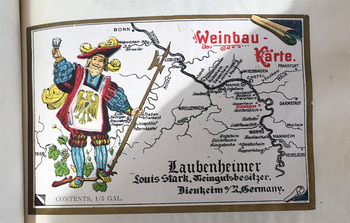
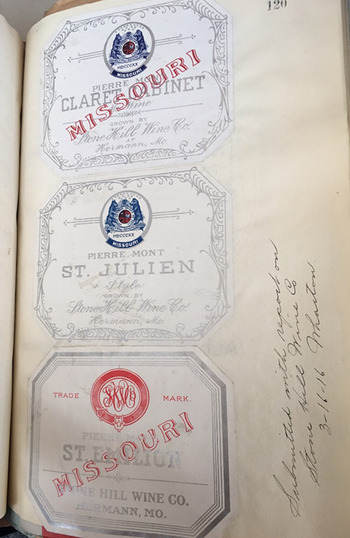
Ohio winemakers were not alone in these practices. Evidence from the federal inspections of major producers in Missouri—including H. Sohns & Brothers and Stone Hill Winery—confirms that these mislabelling practices were as widespread as amelioration. Stone Hill practiced a wide range of labelling techniques similar to those identified at Sweet Valley. For instance, the Bureau of Chemistry’s inspection report includes copies of Stone Hill labels that called their Missouri wines “Claret Cabinet,” “St. Julien,” and “St. Emilion” style with the graphic design and typography modelled after the labels of major French producers. So too did Stone Hill produce a “Laubenheimer” wine that included an image of the Rhine Valley on it with no indication of the wine’s true geographical origin.Footnote 84
Label from United States Bureau of Agriculture, Department of Chemistry, Inspection of Food and Drug Factories: Stone Hill Wine Company, Hermann, MO.

Label from United States Bureau of Agriculture, Department of Chemistry, Inspection of Food and Drug Factories: Stone Hill Wine Company, Hermann, MO.

Later, the Virginia-based Garrett & Company sued Sweet Valley for unfair competition based on its use of labelling that was confusingly similar to their “Virginia Dare” trade name.Footnote 85 In a series of letters addressed to the Bureau of Chemistry and fellow members of the wine trade, this Virginia winemaker claimed that Ohio producers’ practice of amelioration should be considered inseparable from these other practices of misbranding designed to deceive the consumer. For example, Ohio producers sold pomace wine (wine made by adding sugar and water to the pomace of grapes from which the juice had already been expressed) “masquerading under such names as Scuppernong, Blackberry, and any LABEL that would help its sale.”Footnote 86 The company further argued that Ohio producers’ challenges to the extant food decisions explicitly revealed their duplicity because in doing so, they were “making the most amazing admission, which should damn their goods eternally in the minds of all reputable dealers. Their argument seems to be ‘It’s all right to steal if you don’t get caught.’” How, Garrett & Company argued, could the industry let these deceptive practices persist, particularly when they were already under threat of condemnation from the rising Temperance movement?Footnote 87
Garrett & Company’s letter to the Bureau of Chemistry similarly conflated amelioration with consumer deception and the production of low-quality imitation wine. It claimed that the enforcement of basic wine standards—for instance through the seizure of mislabelled scuppernong wine from Ohio manufacturers—was creating spillover effects into other areas for misrepresentation and fraud.
Finding … that the public was growing wise to the fact that under the brand Scuppernong the wines were liable to seizure, various producers in Ohio began to turn out imitations of our trade mark brand … and these goods apparently of the same quality which had been forfeited by the Department then appeared on the market under the brands, “Virginia Bell,” “Carolina Belle,” “Puritan Belle,” “Southern Belle,” “Virgianna,” “Virginette,” “Vanity Fair” and even “California Blair,” the last we believe being a California product.Footnote 88
This argument parallels those made about standards for other food and beverage commodities, in which some producers claimed that standardization was a prerequisite to honest competition between brands.Footnote 89 This criticism generated counterarguments that some degree of amelioration was necessary and that customers knew exactly what they were buying (or not buying) when they purchased cheap Ohio and Missouri wine. A wholesale liquor dealer responded to Garrett & Company’s attacks on Midwestern industries by writing, “We have bought these Ohio goods cheap, and we have sold them cheap. We don’t suppose there is any retailer in the Country that thinks he is getting pure wine when he buys it.”Footnote 90
Failing to find allies across all sectors of the wine industry and rebuffed by the Bureau of Chemistry, Midwestern winemakers turned next to their state representatives in Congress. In the process, they constructed a new argument tailored to this audience of politicians. Rather than arguing that these neutral definitions unwittingly discriminated against Missouri and Ohio wines, they claimed instead that these regulations were specifically preferential to the natural conditions of California wines. Masquerading as a “universal” definition of wine, Food Inspection Decision 156 in fact defined California wine.
The Revenue Bill and the Question of Who/Where Defines Wine?
George Stark harangued the Department of Agriculture from the time of the decision’s release in June 1914. On August 7, he diversified his attack. Stark first wrote to Missouri Representative Champ Clark, claiming that the Bureau of Chemistry’s decision was harming Missouri producers to the benefit of the dominant California wine industry. Stark claimed that because the decision went beyond simply defining wine but also specified the methods by which wines could be corrected, it “makes a sweeping decision against us, and altogether in favour of the Californians.… The Californians got everything they asked for, and we got nothing.”Footnote 91 In doing so, Stark reconfigured a debate about the nature of wine into a debate about an ongoing trade war between states.Footnote 92
By allowing the addition of sugar and tartaric acid while prohibiting water, FID 156 permitted the types of modification necessary to produce quality California wines while forbidding methods used in Ohio and Missouri wine production. To emphasize this imbalance, Stark wrote to Representative Clark that the addition of sugar could not cover up the excessive acidity of their wines “any more than we can make lemon juice taste sweet by adding sugar.… The only way to reduce the acid is by diluting it with water, in the way you do in making lemonade.” Further, Stark reiterated, Ohio and Missouri wines “made for over sixty-seven years just as they are made today”—were popular with consumers. “As long as our customers and the drinking public is satisfied with our wines, and even like same better than the California wines, why then should the Department of Agriculture interfere?”Footnote 93
Stark also sent a letter to a number of congressmen informing them that FID 156 “to our members and others, is a matter of life and death.”Footnote 94 Again, he blamed the decision on the “California wine trust” whose actions were all the more unjust because the Missouri wine producers were investing in grapes of American origin. “Grapes … cultivated from varieties of originally wild American grapes [which are] very robust and vigorous; can stand the coldest winters and hottest summers that contain an excess of fruit acid, and an abundance of aroma, color and gluten, however are deficient in sugar.” By contrast, the California grapes all originated from Spain, Italy, Algeria, and the South of France and produced pleasant if insipid sweet wines with little acid. In this way, FID 156 was “in all its respects favourable to the California wine industry and unfavourable to the wine-growers east of the Rocky Mountains.”Footnote 95 Stark’s letter also suggested that the influence of Californian producers was evident across other federal regulations, including a tariff bill that gave rebates to producers of a sweet wine only made in California.Footnote 96 Stark interpreted these regulations as evidence that the Department of Agriculture was taking sides in “a trade war between the California still wine-growers and the eastern wine-growers,” and in doing so was “destroying with a single stroke of the pen, the entire wine industry east of the Rocky Mountains.”Footnote 97
Stark also saw federal preference given to California for agricultural funding, which he interpreted as the result of a well-organized and multipronged state lobbying effort.Footnote 98 This level of success in securing federal backing was part of an extensive and focused strategy to intercalate state interests into federal law. Stark wrote the following:
Californians are working in classified groups and have been doing so in the past. When the big California “Wine Trust” has put in its licks, then the next Congress is confronted by the small wine growers League of California; when they have gained their point, then the next Congress is besieged by the grape growers Union; then comes along the California “Associated” Raisins Co. who control 95% of the raisin output. It’s a great system they work under, but they usually get what they go after.Footnote 99
This system disadvantaged Missouri and Ohio producers who did not have the money and influence necessary to make themselves heard at the federal level.
Stark’s pleas were not unsuccessful. In February 1915, Ohio Senator Atlee Pomerene wrote to the Secretary of Agriculture conveying the protests against FID 156 that he had received from his state’s wine interests. Like Stark, Pomerene positioned the recent federal decision within the larger regulatory landscape, which favored California over Ohio and Missouri. He mentioned that the Sweet Wine Fortification Act, recently passed in 1914, already allowed the addition of limited quantities of water to sweet wine, and he saw no reason why traditional wines should be treated differently.Footnote 100 The secretary’s response only confirmed Stark’s charge of discrimination: The permitted addition of water to sweet wine was precisely because “the viscous California variety of grapes would otherwise clog the rolls and pipes during the pulping process.”Footnote 101 Although the secretary explained that the addition of water was needed simply “for mechanical purposes,” Midwestern producers saw explicit evidence of bias.
The fallout from FID 156 necessitated the creation of a binding definition of wine that could secure assent greater than that attained by the technicians at the Department of Agriculture. The Revenue Bill of 1916 provided just such an opportunity. This bill sought to define “what wines are and what wines are not” in such a manner that the subsequent definition would be binding under food law as well as internal revenue law.Footnote 102 Unsurprisingly, California Representative William Kent was the first to propose a definition; however, rather than securing state advantage by codifying FID 156, Kent instead struck a surprisingly conciliatory tone. In a letter to the secretary of agriculture, Kent wrote that he had exhaustively studied the “wine question.” While admitting that his “sympathies are naturally with the California wine growers who are making wines from European grapes on European principles,” he nonetheless reiterated many of the concerns expressed by Stark: European grapes could not be grown in eastern climates; American varieties were deficient in sugar and high in acid; and the addition of sugar and water was sometimes necessary and did not always indicate deceptive practices.Footnote 103
Kent thus proposed an amendment to the revenue bill that allowed for wine to be produced with the addition of sugar and water provided that this process was conducted under supervision, the resulting wine’s volume was not increased more than twenty-five percent, and its chemical values fell between predetermined standards for acidity and alcohol content.Footnote 104 Although crafted as a compromise, Kent’s amendment nonetheless included a crucial modification: It delineated the legal production and regulation not of all wines as a single category but rather “all wines or artificial wines.”Footnote 105 The inclusion of this language meant that even as the amendment rendered certain processes of amelioration legal, it nonetheless classified Ohio and Missouri wines differently: not as pure or natural products like those made in California but rather as something fabricated.
Rather than having a salutary effect, the Department of Agriculture recognized that Kent’s amendment might only complicate matters. The amendment would overturn FID 156, thereby forcing the department to create new labelling regulations determining whether the products of eastern wine makers were, “wines merely, ‘artificial’ wines, or … some significant and appropriate qualifying word less strong than ‘artificial.’”Footnote 106 The myriad options for terminology—for instance, natural wine, pure wine, artificial wine, imitation wine, ameliorated wine—coupled with the fact that these wines, even if properly labelled, would still constitute adulterated products as defined by the Pure Food and Drugs Act, made the Department less than enthusiastic about the proposed changes.Footnote 107
Further, subsequent debate about the revenue bill demonstrated that many of eastern winemakers were also not happy with the resulting language. Thomas Lannen, an attorney for the Mississippi Valley Wine Growers and Grape Growers Association, wrote that “as the bill left the House it was essentially a California bill, and the East was not properly recognized in that bill.”Footnote 108 He argued that the Californians, in their lobbying efforts, were “trying to create the impression that these ameliorated wines, which are the standard native wines of all the states east of the Rocky Mountains, are vile concoctions, produced by a few crooked wine makers who want the right to put adulterated wine upon the market.”Footnote 109 Instead, Lannen advocated for a Senate amendment that proposed a labelling and classification strategy similar to the one previously established by FID 120. This amendment established a three-tiered labelling structure, with the first being “Natural Wine”; the second being wine subject to some necessary amelioration labelled simply as “wine” but qualified by the name of the locality where produced (for instance, “Tennessee Wine,” “Missouri Wine,” “Ohio Wine,” etc.); and the third being wine that needed to be ameliorated due to a particularly bad season or other natural cause (and which would be labelled as “Ameliorated Wine”). This labelling system disarticulated “‘artificial” amelioration and adulteration from the “natural” amelioration necessary in particular states, “the theory being that such wines are the standard native wines of those states … and have been for over half a century.”Footnote 110
Eastern winemakers deemed it insufficient for Congress to legalize ameliorated wine if that legalization rendered only Californian wines “pure” or “natural” while configuring Ohio and Missouri wines as deviations from the norm, be they imitation, artificial, or adulterated. This debate made clear that Congress’s attempt to establish neutral standards were inevitably discriminatory if they failed to recognize the differential effects place had on the production of wine across the United States. As Lannen wrote, ameliorated Ohio and Missouri wines may not have been “natural” wines but they were still “standard.” The eastern winemakers simply asked that the government, recognize “our standard native wines that have been standardized by custom and trade practice for over half a century—long before the California wine industry was established.”Footnote 111
Similar arguments were presented during Senate hearings on the Revenue Bill of 1916.Footnote 112 This testimony marshalled scientific, economic, and cultural evidence demonstrating that the eastern winemakers’ unique practices necessitated localized definitions recognizing human intervention—that is, amelioration—as central to the crafting of quality wine. Ottmar Stark—George Stark’s son—argued the following:
Wine is seldom, if ever, a natural product.… On the contrary, the making of wine is an art and the wine is the product of that art rather than a natural product. That the nature of the wine and the value of the wine is controlled by and depends upon the skill employed in its production admits of no argument. What the wine maker aims to produce is a product that the consumer will like. The more pleasing that product is to the consumer the greater its value.… That product may be obtained by a process of blending, or, as in the Mississippi Valley wines and in the eastern wines, it may be the result of both correcting and blending.Footnote 113
This recognition of human manipulation was not antithetical to a notion of place; it was necessitated by the unique qualities—or limitations—of the Mississippi Valley and the American varietals native to that area. If ameliorated Ohio and Missouri wines were not considered wine, “then wine can not be produced in those States; or, in other words, to deny that it is wine is to deny that wine can be produced in the Mississippi Valley. Such a contention would seem to be absurd.” Further, if standards of purity were enforced, only wines that were “unpalatable, unmerchantable, and worthless” could be called wine under legal standards. “And will anyone contend for a moment that such a worthless product should be held to be a wine to the exclusion of all others?”Footnote 114
The revenue bill that was passed by Congress in 1916 permitted amelioration within certain prescribed limits under supervision and only to correct “natural deficiencies.”Footnote 115 Despite the careful circumscription of permitted amelioration, this ruling was undoubtedly favorable to the needs of Midwestern producers. It considered ameliorated wine to be “natural wine” within the meaning of the act, and it allowed this wine to be labelled, transported, and sold as “wine,” qualified by the name of the locality where it was produced. The resulting regulations avoided the fragmentation of standards that might have resulted had they chosen to define California wines as fundamentally different from Ohio and Missouri wines. Instead, Congress opted to universally permit limited forms of modification and enforced the use of locality names primarily as a means of tracing responsibility (rather than, as in a true GI system, as a unique source of value). Nonetheless, Congress’s acceptance of some forms of modification was fundamentally shaped by arguments insisting on the central role of place in American wine production.
Conclusion
In his statement on the revenue bill, Thomas Lannen included a postscript titled “Sunshine vs. Frost.”Footnote 116 In it, Lannen wrote that Californians condemned amelioration “on the theory that God gave them the sunshine and that they do not have to ameliorate, and can make so-called natural wines, and that they are entitled to a natural advantage.” To the contrary, Lannen wrote that the wine produced in California had its own imbalances—too sweet with too little acid—that were every bit as damaging as those of eastern wines. He continued:
It is fallacious to argue that all virtue lies in sunshine. There is also virtue in frost.… Even were it possible to grow [California] grapes in our climates, and their fruits, and supplant our native varieties by them, it would not be advisable to do so, for the very reason that we would be surrendering quality fruit for fruit that is as deficient in quality as it is perfect in appearance and other respects. Our native varieties of grapes will not grow in California, nor will their grapes grow here.Footnote 117
Lannen claimed that a truly neutral and universally applicable system of regulation should treat differences not as deviations from an arbitrarily established norm but rather as themselves valuable distinctions that diversify and strengthen the American wine market. This recognition of chemical difference at the level of wine mirrored the well-established appreciation of geographical difference across the diverse ecosystems and environments of the American countryside.
Lannen’s comments also carried a resonant and none-too-subtle subtext: Californian wines—grown under the hot sun from “grapes imported from the warm climates of Southern Europe”—did not represent American national identity as did the genuine American grape varieties and terroir of the (Germanic, Northern European) Midwest. Why enact standards that would benefit inferior grapes that could not even “survive our cold winters?” Thus, Lannen asked Congress to produce standards that recognized the value of Midwestern wines whose qualities stood as proxies for the values of an unfolding American culture and identity.Footnote 118
Although subsequent federal regulation did not fully adopt Lannen’s suggestions, Congress nonetheless acceded to the necessity for some winemakers to ameliorate their product, redefining this form of manipulation from a “deceptive practice” to a legitimate strategy for improving wines. However, the beneficial effects of this regulation on the Ohio and Missouri wine industries failed to materialize when Prohibition began in 1920.Footnote 119 Whereas wine production was never the central focus of temperance reform in Missouri—most activists having set their sights on liquor producers, brewers, and saloons—Prohibition nonetheless decimated an industry that was already in a precarious economic situation.Footnote 120 After fighting for years to get recognition for Missouri and Ohio winemaking practices in federal regulation, Ottmar Stark found himself ripping up all of Stone Hill’s grapevines on the eve of Prohibition, definitively marking the end of an era of Midwestern wine production.Footnote 121
As short-lived as the Ohio and Missouri wine debate was—occurring at a time when California wine was already ascendant and unceremoniously rendered irrelevant by Prohibition—it provides a uniquely illustrative snapshot of an important moment in the history of food and beverage regulation. The debate represents a conflict in which food standards—far from being anodyne matters of solely bureaucratic import—instead involved a complex balancing of values and concerns with significant emotional valence and economic consequence. Even under the cover of Department of Chemistry enological reports and annual revenue bills, disputes around Ohio and Missouri wine standards activated deep tensions about the relationship between agricultural industry and national identity, refracted through complex contestations over the nature and meaning of wine and its connection to American terroir. This narrative also demonstrates that debates about the protection of geographical indications—usually considered solely a European matter—were not completely foreign to the United States in the late nineteenth and early twentieth century even if they were occurring in the adjacent legal area of food standards. Instead, wine producers across California and the Midwest were actively involved in establishing the unique qualities of American wine as a matter of industry building and equally as a matter of national pride.
Into the late twentieth and early twenty-first century, Ohio and Missouri wines continue to play an important if underappreciated role in American wine history. Shortly after the Bureau of Alcohol, Tobacco, and Firearms established the American Viticultural Area (AVA) system—the American equivalent of the French appellations d’origine contrôlée—in 1978, the Augusta AVA in Missouri was the first region federally approved, predating the Napa Valley AVA by eight months.Footnote 122 This level of protection can only be granted if the region demonstrates key criteria such as name recognition, historic evidence of wine production, clear boundaries, and physiographic uniqueness of the area. It appears then that even as the Midwestern wine industry lay fallow for years following Prohibition, American wine regulation was destined to once again recognize and legally protect the value, or lack thereof, of Ohio and Missouri wines.