


INTRODUCTION
Over the last two decades there has arguably been a renewed interest in addressing the perceived problems with large concentrations of poverty and minority ethnoracial groups in the cities of Western Europe and the Anglo-American world. One of the major targets for such efforts has been the large concentrations of poverty and ethnoracial minority groups that are, in a number of cases, the direct result of the manner in which public housing was built in the early postwar era. The main concern that has persisted is that the stark spatial separation of poor and ethnoracial minority households within urban environments sets up the possibility that segregated households are isolated from life-enhancing opportunities such as good quality education and other public services as well as employment opportunities (Mayer and Jencks, Reference Mayer and Jencks1989; Wilson Reference Wilson1987). The spatial isolation of the urban low-skilled workforce from the areas of cities experiencing growth in low-skilled jobs is well documented in the “spatial mismatch” literature (Ihlanfeldt and Sjoquist, Reference Ihlanfeldt and Sjoquist1998), but that spatial segregation and isolation of low-income households can isolate residents from high-quality public services (e.g., schools, social services, public health services) is also a significant concern. This is particularly problematic in jurisdictions where municipal governments have a high level of responsibility for redistributive social services and where there is heavy reliance on own-source revenues (e.g., property taxes) for the funding of locally provided public goods and infrastructure, such as the United States. In such places, the result has been the creation of substantial intrametropolitan fiscal disparities and a highly uneven distribution of public goods and services (Orfield Reference Orfield1997, Reference Orfield2002). Ultimately, there is good evidence that concentrated poverty can undermine life chances as measured by various indicators, including, for example, adult employment outcomes, incarceration rates, welfare dependency, educational outcomes, and teen pregnancies (Bauder Reference Bauder2001; Massey et al., Reference Massey, Gross and Eggers1991; Newburger et al., Reference Newburger, Birch and Wachter2011; Wilson Reference Wilson1987).
Because neighborhoods also provide benefits in terms of identity and belonging (Kearns and Parkinson, Reference Kearns and Parkinson2001), severe concentrations of poverty can lead to damaging stigmatization and discrimination of residents living in such neighborhoods. In Reference Massey1996, Massey ominously predicted that “the juxtaposition of geographically concentrated wealth and poverty [in urban areas] will cause an acute sense of relative deprivation among the poor and heightened fears among the rich, resulting in rising social tension and a growing conflict between haves and have-nots” (p. 395). A similar hypothetical future of Canadian cities has been described by Bunting and Filion (Reference Bunting and Filion2001). In Canada, the United Kingdom, and Europe, the problems of the spatial concentration of marginalized groups in public housing developments is portrayed as a class issue much more than a racial issue as it is in the United States (naively so) (Silver Reference Silver2011). In the United States, however, the proposed and attempted solutions, at least on their face, have been targeted at economic issues for adults and educational issues for children.
One antidote to concentrated neighborhood poverty in a number of public policy initiatives in the United States, Canada, the United Kingdom, and Australia has been to develop policies and programs that introduce “social mix” into existing public housing developments characterized by high levels of concentrated poverty or, in more limited cases (notably the “Moving To Opportunity” or MTO initiative in the United States), to assist residents of public housing developments characterized by concentrated poverty to move to neighborhoods with much lower concentrations of poverty (i.e., less than 10% of the population below the poverty line) (DeSouza-Briggs et al., Reference DeSouza-Briggs, Popkin and Goering2010). Significant efforts to de-concentrate poverty through socially mixed redevelopment have been undertaken in the United Kingdom, the Netherlands, Australia, and Canada. In this paper, I use the example of Toronto's Regent Park, a large public housing development near downtown, to investigate the issue of destigmatization of social housing.
Although the efforts to introduce social mix into public housing developments are primarily designed to alter some of the social dynamics of places with high levels of concentrated poverty and ethnoracial minority groups that are believed to magnify the disadvantages of poverty and marginalization (e.g., by diversifying social networks that may lead to job prospects; by reducing the level of social problems public schools must deal with, etc.), in this paper, I argue that this is also a destigmatization strategy, but not necessarily the same kind of destigmatization strategy that has been described in the literature previously (Lamont Reference Lamont, Hall and Lamont2009). Specifically, Lamont (Reference Lamont, Hall and Lamont2009) describes destigmatization strategies as the ways in which ordinary members of stigmatized groups respond to exclusion by challenging stereotypes that feed and justify discriminatory behavior, and rebutting their inferior status (Lamont and Mizrachi, Reference Lamont and MizrachiForthcoming). The focus of this paper, however, is to theorize and develop a research agenda for describing and understanding the gap between a quasi-state agency's efforts to destigmatize public housing sites and residents (“place destigmatization”) and the everyday destigmatization practices and experiences of those residents (“personal destigmatization”). It is significant that the case described in this paper differs from the destigmatization strategy literature in two ways. First, it is a formal, quasi-state institution that is engaged in the destigmatization, and second, the target is to destigmatize the place, as a partial means to destigmatize the people who are residents of the area. In other words, this case could be described as an example of “institutional, place-level destigmatization.”
In this paper I argue that because initiatives to introduce social mix into public housing developments can do little to directly alter the material conditions of low-income households living in concentrated public housing, the bulk of the efforts are to provide secondary improvements to residents' quality of life and life chances at the level of places and networks. In other words, the initiatives seek to destigmatize: 1) the people who live in such places (the public housing residents) by altering the way that they are perceived by outside groups, as well as to integrate them into social networks that may grant them access to resources that may have knock-on material effects, like access to job-finding networks (Granovetter Reference Granovetter1973); and 2) the places where they live, which can be the cause of direct discrimination (e.g., literally discrimination by address) and the cause of attenuated life chances due to endemic crime, poverty, hopelessness, joblessness, and more generally class and racial subordination. Expressed in Lamont's (Reference Lamont, Hall and Lamont2009) terms, socially mixed redevelopment seeks to increase the porousness of social boundaries, through spatial proximity and network integration. In addition, it seeks to reduce the salience of one of the stigma-bearing attributes of residents—that they live in concentrated public housing (and are marked by this fact), and all of its attendant social meanings associated with various forms of social deviance. Our ability to gauge the “success” of socially mixed housing in terms of these outcomes, however, depends on understanding the nature of interaction between dominant (middle-class) and subordinate (public housing) residents in the newly built, socially mixed neighborhoods, and the perceptions the groups have of one another. These are two things that have been under-examined in most previous empirical research, because the benchmark that was imposed for success in the social mix was the creation of new, close, and familiar relationships between social housing tenants and homeowners who had been introduced into the areas (Arthurson Reference Arthurson2008; Joseph Reference Joseph2006; Kleinhans Reference Kleinhans2004). The fact is, however, that the mere coexistence of these groups in the same neighborhood constitutes social mix, which needs to be separated from its outcomes, and I take the perspective that those outcomes should be examined more inductively than they have been in previous research that employed this benchmark.
In the following section, I provide some background on the state of knowledge of socially mixed public housing developments and the putative mechanisms by which social mix is presumed to benefit public housing residents (subordinate groups). Then, I describe how concepts related to destigmatization and boundaries can be used to problematize the issue of social mix in public housing aided by Lefebvre's (Reference Lefebvre1991) theory of the trialectics of space. In the penultimate section I describe the main features of an example of socially mixed public housing redevelopment, Toronto's Regent Park public housing development, and posit some of the ways that social mix may play out in that community, with the aid of the theoretical background and with an emphasis on the role of public spaces in the dynamics of socially mixed public housing redevelopment. Finally, I suggest a partial empirical strategy for investigating the nature of interaction in the public spaces of socially mixed communities.
Before moving to the next section, however, it is important to note that the term “social mix” is arguably used in a vague way to mean social mix across a number of different axes of social differentiation, including possibly socioeconomic status, ethnoracial minority status and housing tenure (i.e., owner-occupier, market tenant or social housing tenant). Because of differences in the way that socioeconomic status interacts with ethnoracial minority status in Canada and the United States, the case example in this paper needs to be interpreted differently from much of the U.S.-based literature in this area. In the Canadian context, the only thing that housing agencies can control explicitly is “tenure mix”—the mix between social housing tenants on the one hand and condominium owner-occupiers or tenants on the other. The primary objective of social mix, then, is the integration of households of different tenures, which is a proxy for socioeconomic status (i.e., income, education), but not ethnoracial minority status. The same is true in the United Kingdom, where the more precise term tenure mix is more common than social mix in the policy discourse. In the United States, because race and socioeconomic status are so tightly linked, socially mixed housing redevelopment arguably has a dual purpose of racial desegregation. In Canada, although poverty is highly racialized as well, integration of ethnoracial minority groups is not an explicit goal of socially mixed housing development. Indeed, the overall context of ethnoracial diversity in Canada, which is based mainly on relatively recent immigration from various regions of the world, and includes immigrants from across the socioeconomic spectrum, is such that the in-migrants (generally condominium purchasers) to socially mixed public housing redevelopment sites in Canada could include many ethnoracial minority households, and these residents may even be from the same ethnoracial groups that comprise the social housing tenants.
WHAT'S KNOWN ABOUT SOCIALLY MIXED PUBLIC HOUSING AND ITS EFFECTS?
Research on the negative aspects of concentrated urban poverty can be traced back to nineteenth-century public health reformers like Edwin Chadwick in the United Kingdom and Rudolf Virchow of Prussia. Both were primarily concerned with the potential for concentrations of poverty and unsanitary conditions to breed disease that could be spread to the upper classes (Porter Reference Porter1996). In a North American context, the more recent concern has been less about the effect of concentrated urban poverty on infectious disease than it has been about its effects on other social ills: crime, deviance, economic development, social capital, etc. (Gans Reference Gans1961; Wilson Reference Wilson1987). These concerns have given rise to a succession of slum clearance and urban renewal initiatives over the past century (the original Regent Park was a slum clearance effort in the 1940s and 1950s), and the most recent manifestation of these is the notion of socially mixed neighborhoods (Cole and Goodchild, Reference Cole and Goodchild2001; Gwyther Reference Gwyther2009; Sarkissian Reference Sarkissian1976). The notion of social mix has become popular in current policy in Anglo-American countries such as Australia, the United Kingdom, the Netherlands, and the United States (Arthurson Reference Arthurson2008; Cole and Goodchild, Reference Cole and Goodchild2001; Joseph Reference Joseph2006; Kleinhans Reference Kleinhans2004). Indeed, the benefits of social mix have even become a plank in urban policy for the Organization for Economic Cooperation and Development (Bradford Reference Bradford, Mahon and McBride2009) and with numerous city governments (e.g., Toronto, Glasgow) and a number of governmental agencies (e.g., HUD, the EU's Quartiers en Crise initiative).
Two recent reviews are instructive for understanding the most important factors driving socially mixed public housing redevelopment efforts seen in the United States (Joseph Reference Joseph2006), the United Kingdom, and the Netherlands (Kleinhans Reference Kleinhans2004). Collectively, these two reviews identify five key knowledge gaps on the impacts of socially mixed public housing redevelopment. Specifically, Joseph (Reference Joseph2006) and Kleinhans (Reference Kleinhans2004) argue that there is a dearth of knowledge about the impact of planned social mix in public housing developments on: 1) social networks and “social capital”; 2) social control; 3) culture and behavior/role modelling; 4) the political economy of place; and 5) residential attitudes towards and experiences of social mix.
Social Networks and Social Capital
According to Joseph (Reference Joseph2006), the proponents of socially mixed neighborhoods assert that “by attracting higher-income residents back to the inner city …” such developments “… can facilitate the re-establishment of effective social networks and social capital for low-income residents” (p. 213). This notion draws on seminal ideas such as those of Granovetter (Reference Granovetter1973), who suggests that building broad networks of “weak ties,” or “bridging social capital” in contemporary terms (Putnam Reference Putnam2000), provides people access to information and opportunities most important for upward mobility, especially employment—access that is not necessarily available within their networks of close association or “strong ties.” The empirical evidence on the strength of weak ties bears this out, showing that social networks are important for employment and that the social networks of low-income individuals are more localized than those of people with higher incomes (Joseph Reference Joseph2006). It is therefore presumed by proponents of socially mixed communities that, as Joseph (Reference Joseph2006) writes, mixed-income neighborhoods may be able to “build weak ties with affluent neighbors and thereby improve their access to employment networks and other resources” (p. 213). But there is no evidence that these kinds of relations will develop in a short time through planned social mix. Indeed, there is good evidence that as telecommunications improve and people become more mobile, the notion that people can achieve in Webber's (Reference Webber and Wingo1963) coinage “community without propinquity” is increasingly true (Wellman Reference Wellman2001), although the digital divide may impede lower-income households from creating such networks. At the same time, as Joseph (Reference Joseph2006) argues, studies of the impact of the physical environment on social relationships show that “opportunities for contact, proximity to others, and appropriate space in which to interact are key factors that can promote and shape social interactions” (p. 213). But there is no evidence that these kinds of interactions take place in socially mixed redevelopment contexts. In fact, there is some evidence to suggest it only happens where there is real or perceived homogeneity among residents (Joseph Reference Joseph2006). Additionally, there are important questions about the role of space and scale in creating interaction (generally interaction will only happen among people at the building level, and not the neighborhood level)—there must be actual sites where people of different social strata interact (Kleinhans Reference Kleinhans2004). I will return to this shortly.
Social Control
As Joseph (Reference Joseph2006) puts it, the main argument for this theme “posits that the presence of higher income residents—particularly homeowners—will lead to higher levels of accountability to norms and rules through increased informal social control and thus to increased order and safety for all residents” (p. 222). This kind of social control requires reciprocal relationships among community members and collective surveillance to be successful (Sampson and Groves, Reference Sampson and Groves1989). There is evidence that higher-income, residentially stable neighborhoods have lower levels of social disorganization, higher levels of “collective efficacy” and lower crime levels (Sampson et al., Reference Sampson, Raudenbush and Earls1997). It is presumed that the more influential neighborhood residents would be more likely to take action to maintain social control, to the benefit of all residents. However, the evidence of this phenomenon is indirect, and there is no evidence of such actions taking place in any example of planned, socially mixed housing developments. Moreover, it is plausible that social control exercised by new, higher-income residents over social housing residents could escalate and become a source of conflict rather than cohesion, especially if the definition of what makes a good neighborhood varies across social groups.
Culture and Behavior/Role-Modelling
One of the more widely espoused theories underlying the benefits of creating socially mixed communities is that it will create a new local culture of acceptable norms of behavior. In Joseph's (Reference Joseph2006) words, it is believed that “the presence of higher-income residents in mixed-income developments will lead other families to adopt more socially acceptable and constructive behavior, including seeking regular work, showing respect for property, and abiding by other social norms” (p. 214). The notion that social mix can lead to conformity to more middle-class norms comes from the controversial research on the “culture of poverty” (Lewis Reference Lewis1966), a term to which some object, arguing that rather than being culturally rooted, such behaviors are adaptations to marginal positions in society (Joseph Reference Joseph2006; Lamont and Small, Reference Lamont, Small, Harris and Lin2008). Kleinhans (Reference Kleinhans2004) traces the intellectual roots of role-modelling to Wilson (Reference Wilson1987). Regardless of its roots, proponents of social mix appear to believe strongly in the culture and behavior/role-modelling concept. Interestingly, the research evidence suggests that if role-modelling does occur in socially mixed social housing developments, it is usually not from adult to adult, but by adults from higher socioeconomic strata role-modelling for lower socioeconomic status children (Joseph Reference Joseph2006; Kleinhans Reference Kleinhans2004). Joseph (Reference Joseph2006) further argues that role-modelling can be distal, through the act of observing others in the behaviors, or more proximal, through the provision of advice, guidance, and accountability by adults for children.
Political Economy of Place
According to Joseph (Reference Joseph2006) on the “political economy of place” theme, the infusion of higher-income residents “will generate new market demand and political pressure to which external political and economic actors are more likely to respond, thereby leading to higher-quality goods and services available to a cross-section of residents in the community” (p. 215). This proposition is related to Kleinhans's (Reference Kleinhans2004) emphasis on the reputation of the community with insiders and outsiders; if it is better, then this will affect investment and mobility patterns (higher-income people who move in will stay if the services and the reputation remain high). But this presumes that the needs of all residents are similar, and the insertion of upper-income households may dilute the voting power of lower-income residents, leading to the election of local representatives who are more concerned with the need of newer upper-income residents.
Attitudes and Experiences of Social Mix
Finally, most proponents of social mix are optimistic that interactions will be neighborly and peaceful, but it is also possible that the infusion of higher-income households will lead, as Kleinhans (Reference Kleinhans2004) describes, to conflict in the form of “disputes or hostile attitudes between residents” (p. 379). According the Kleinhans (Reference Kleinhans2004), the literature suggests that both higher-income and lower-income residents are ambivalent about social mix, depending upon how closely (i.e., geographically) groups live to one another. At the same time, however, Kleinhans (Reference Kleinhans2004) claims that “there is also evidence that social mix is a relatively insignificant factor in neighborhood satisfaction” (p. 380). Despite all of this, if groups involved have a strongly negative attitude to one another, then it could severely compromise the possibility of success of the mixed-income development.
There is limited evidence of effect for each of these five themes. Studies by Kleit (Reference Kleit2005) and Rosenbaum et al. (Reference Rosenbaum, Stroh and Flynn1998) investigated patterns of social interaction in mixed-income developments. Both studies found evidence of neighboring relationships across income levels, but Joseph (Reference Joseph2006) cautions that there were specific contextual features that were critical to this finding, including shared social characteristics (ethnicity, language, marital status), links through children, and use of shared public facilities. Similarly, a study of a Homeownership Opportunities for People Everywhere (HOPE) VI mixed-income redevelopment site in Boston (Tach Reference Tach2009) showed that the bulk of activity in establishing and maintaining social ties was conducted by the public housing residents. Indeed, Tach writes, the home owners introduced into the community “actively resisted the formation of social ties with their neighbors and adopted daily routines that minimized their own and their children's contact with neighbors and neighborhood space” (p. 291). Apart from these three studies, the evidence suggests that few changes to residents' social networks occur, and there is little evidence of any significant levels of interaction between social housing tenants and upper-income home owners in such developments.
According to Joseph (Reference Joseph2006) the evidence is inconclusive about the effect of social mix on social control. Rosenbaum et al. (Reference Rosenbaum, Stroh and Flynn1998) found differences in income groups concerning the support for rules, but in a study of eight HOPE VI sites, Buron et al. (Reference Buron, Popkin, Levy, Harris and Khadduri2002) found that perceived levels of social control were the same for residents of all kinds of housing, except that residents of public housing reported less graffiti than in other kinds of housing. Other factors, such as capable property management, may be more important (Joseph Reference Joseph2006). Other evidence suggests that the influence of new residents may reduce social control. Tach (Reference Tach2009) found that new upper-income residents undermined social control by refusing to intervene to maintain order and neglecting to call police when they witnessed criminal activity.
There is virtually no evidence in the literature of the existence of role-modelling behavior as a result of the introduction of social mix to public housing developments. This may be because, as both Kleinhans (Reference Kleinhans2004) and Joseph (Reference Joseph2006) point out, it is almost impossible to measure role-modelling empirically.
The proposition that the infusion of higher-income residents into public housing developments helps to leverage better public and private services and other resources also has little empirical evidence to support it. This too is difficult to measure, although residents' self-reports may be valuable because arguably the perception (even if it is biased) is important to help maintain stability in the neighborhood and community support for the mixed-income initiative. Conceptually, it is reasonable to think that market forces would respond to the infusion of higher-income households and attempt to meet their needs, and these same households would wield a high level of political influence over the quality and quantity of services provided, given the participation of public bodies in promoting the concept of socially mixed communities. That said, it is possible that the introduction of social mix to a neighborhood could attract more, higher quality services, but one of the cautionary tales of the gentrification literature is that such services are seldom targeted at lower-income individuals, and usually include high-end grocery stores, cafés, and luxury-goods retailers. At the same time, services aimed at traditional residents (e.g., ethnic grocery stores, discount services, and retailers) are less viable with a smaller customer base and rising pressure on commercial rents (Smith Reference Smith1996).
In addition to social interaction patterns, it appears that the only other proposition advanced by Kleinhans (Reference Kleinhans2004) and Joseph (Reference Joseph2006) that is empirically measurable is the residents' (and possibly also outsiders') perceptions of social mix. Not surprisingly, the evidence suggests that people are generally positive about the concept of social mix, although it may be somewhat dependent on the management of the community (Page and Boughton, Reference Page and Boughton1997). Additionally, however, some previous studies have found that conflicts, racism, and classism still exist, and for lower-income residents who stay in situ there are studies which have shown that residents experience feelings of loss for their old, familiar neighborhood. This is a common sentiment in other examples of community disruption (Brown-Saracino Reference Brown-Saracino2009; Fullilove Reference Fullilove2004).
In short, there is a significant knowledge gap in the effects of socially mixed communities on outcomes for marginalized groups. There do appear to be questions concerning: a) social interaction between residents of different social classes and ethnoracial groups; b) the role of context, specific sites for interaction, and the geographic scale of housing mix; and c) perceptions of both higher- and lower-income residents of the positive and negative aspects of socially mixed redevelopment. It follows that new research is needed that is not so strongly loaded with the kinds of expectations that are generated in each of the five research themes described above. In other words, we need a more inductive approach, guided by theory, to better understand what kinds of interactions do take place across classes in socially mixed redeveloped public housing, what effects they have, and by what process such effects occur. Moreover, we need to better comprehend how the specific context of the place, including attributes of the built environment, affect the processes of interaction and its effects. In the next section I describe the theoretical orientation used to guide such an examination, and illustrate this through the case study of Toronto's Regent Park.
THEORIZING SOCIAL MIX AS A PLACE-LEVEL DESTIGMATIZATION STRATEGY
Henri Lefebvre's work on the “production of space” (Lefebvre Reference Lefebvre1991) is useful for investigating socially mixed public housing as a destigmatization strategy because it provides a framework for understanding how urban design and the built form can be stigmatizing symbols of marginalized groups, and that these symbols are partly a direct reflection of the built form of housing and neighborhoods, and are also actively manipulated by both institutional actors and individuals. Moreover, Lefebvre's perspective focuses on understanding these forces through the everyday practices of the people occupying spaces. Lefebvre's work has been deeply influential on the “theoretical turn,” leading to the development of a post-positivist human geography since the early 1970s (Giddens Reference Giddens1984; Gregory Reference Gregory1994; Harvey Reference Harvey1973, Reference Harvey1989; Lefebvre Reference Lefebvre1991; Smith Reference Smith1990; Soja Reference Soja1989). Smith (Reference Smith1990), for example, draws on Lefebvre (Reference Lefebvre1974) and refers to the need to explore “deep space,” which he describes as “the space of everyday life in all its scales from the global to the local and the architectural in which … different layers of life and social landscape are sedimented onto and into one another” (p. 161). Gregory (Reference Gregory1994) importantly argues that “[T]he production of space is not an incidental by-product of social life but a moment intrinsic to its conduct and its constitution” (p. 414). At the tautological level, therefore, the production of space is a fundamental starting point.
Lefebvre (Reference Lefebvre1991) offers a useful triad of modalities for understanding ways in which social life is spatially constituted. The primacy of material practices is central to his project to theorize the production of space, but so too is the fundamental connection between materiality on the one hand and consciousness and action on the other. Soja (Reference Soja1989) claims that “Lefebvre explicitly accepted Marx's argument about the primacy of material life in the production of consciousness and action” (p. 48). Lefebvre insists that human activity is fundamentally comprised of material spatial practices, on the one hand, and representational practices (which are further divided into representations of space and spaces of representation), on the other. For Lefebvre, these practices are fundamental to the constitution of social life and human consciousness. Lefevbre's model of the “trialectics of space” asserts that social life can be usefully conceptualized as consisting of three basic dimensions, following from the idea of the primacy of material and representational practices. These three dimensions are discussed in the following three subsections.
Spatial Practices
This is a notion, as Lefebvre (Reference Lefebvre1991) writes, that “embraces production and reproduction, and the particular locations and spatial sets characteristic of each social formation. Spatial practice ensures continuity and some degree of cohesion. In terms of social space, and of each member of a given society's relationship to that space, this cohesion implies a guaranteed level of competence and performance” (p. 33). Gregory (Reference Gregory1994) describes spatial practices as “the time-space routines and the spatial circuits—through which social life is produced and reproduced” (p. 403). Harvey (Reference Harvey1989) emphasizes that these are material spatial practices. This part of the triad is also known as experienced space (p. 219).
Representations of Space
In Lefebvre's (Reference Lefebvre1991) words, representations of space “are tied to the relations of production and to the ‘order’ which those relations impose, and hence to knowledge, to signs … [and] … to codes” (p. 33). Harvey (Reference Harvey1989) describes representations of space as “all of the signs and significations, codes and knowledge, that allow [such] material practices to be talked about and understood, no matter whether in terms of everyday common-sense or through the sometimes arcane jargon of the academic disciplines that deal with spatial practices (engineering, architecture, geography, planning, social ecology, and the like)” (p. 218). This is also known as perceived space.
Spaces of Representation
This phrase, as Lefebvre (Reference Lefebvre1991) describes, refers to “space as directly lived through its associated images and symbols, and hence the space of ‘inhabitants’ and ‘users’ … [T]his is the dominated—and hence passively experienced—space which the imagination seeks to change and appropriate. It overlays physical space, making symbolic use of its objects” (p. 39). Gregory (Reference Gregory1994) refers to spaces of representation as “counterspaces, spatial representations that … imaginatively challenge the dominant spatial practices and spatialities (pp. 403–404). Harvey calls them “mental inventions … that imagine new meanings or possibilities for spatial practices” (Reference Harvey1989, pp. 218–219). This is also known as imagined space.
Although Lefevbre's model is being used in a less revolutionary way than he probably intended, it is valuable to the study of socially mixed public housing redevelopment because it underscores the fact that such transformations of the materiality of built environment are also significant social transformations. Moreover, these transformations must be understood through a grounded understanding of the spatial experience of everyday life. In other words, Lefebvre's material spatial practices (often called “the experienced”) are critical to understanding such a substantial change to the space of residents affected by something like the demolition and redevelopment of their neighborhood. Equally important are representational practices, which Lefebvre separates into two types: representations of space (the “perceived”) and spaces of representation (the “imagined”). This distinction is analogous to the distinction between the destigmatization strategies of the various proponents of socially mixed public housing redevelopment in Toronto's Regent Park (including various quasi-state and nongovernmental agencies) and those that residents themselves may be engaged in. This focus on the everyday and both the material and representational practices of residents as well as authorities responsible for the redevelopment is an important frame of reference for future research. First, it demands a more inductive approach to analyses of the patterns that emerge from the creation of socially mixed communities from public housing, offering the potential of more understanding. Rather than imposing a benchmark, for example, of the formation of cross-class, strong, familiar social ties, and testing for its existence, a more inductive approach would seek to understand what kinds of relationships are formed (and are not formed) and why. Second, Lefebvre's approach addresses the very important issue of the spatialization of material and representational practices, which may have a significant effect on what kinds of relationships are formed, how, and with what impact. These issues are explored through the development of a research agenda for the study of Regent Park in Toronto.
THE REDEVELOPMENT OF TORONTO'S REGENT PARK
Built over fifty years ago, Regent Park is one of the oldest and largest concentrated public housing communities in Canada. The community occupies a sixty-nine-acre site just east of the downtown core of Toronto; at the start of redevelopment, it was home to 7,500 people living in 2,087 social housing units. This social housing development sits within the City of Toronto, the fifth largest urban municipality in North America (after Mexico City, New York, Los Angeles, and Chicago) and the continent's ninth largest metropolitan area (Toronto Community Housing 2011).
The original designers of Regent's Park—which was initially a slum-clearance initiative begun the 1940s—sought to create a garden city, a place where buildings sit in parklike settings, street automobile traffic has been removed, and the community is set apart from surrounding areas. Regent Park, however, has come to be known for its deteriorating buildings, poorly planned public spaces, and its concentration of some of the ills of urban life: poverty, violence, drug use, along with poor health and educational outcomes.
Regent Park is extremely racially, ethnically and culturally diverse: more than half of its residents are recent immigrants. The top “visible minority” groups (the term used by Statistics Canada) in Regent Park in 2001 were Black, South Asian, Chinese, Southeast Asian, and Latin American (Sahak Reference Sahak2008). Over 50% of the Regent Park population is aged eighteen and younger (compared to a Toronto-wide average of 30%). The average income for Regent Park residents is approximately half the Toronto average. A majority of families in Regent Park are low-income (72%), compared to the Toronto average of 20% (Toronto Community Housing 2011). Over thirty languages are spoken in the community, eight of which are common enough for Toronto Community Housing (a nonprofit corporation owned by the City of Toronto that owns and manages Regent Park), to translate all of its public relations material into those languages.
Over the next several years (possibly as long as fifteen years), the Toronto Community Housing will demolish and rebuild the entire community in six phases. The site is divided into six land parcels; the demolition and reconstruction of each parcel represents a phase in the redevelopment. About 70% of the existing rent-geared-to-income (RGI) units will be replaced on the site, and the remainder will be replaced in nearby locations. As a whole, the original site is expected to grow to 5,100 units of mixed-income housing, including rent-geared-to-income social housing units, below-market rental units, and privately owned condominiums. In the new Regent Park, there will be a mix of RGI and condominium units; some speculate that this mix may be 40% RGI and 60% condominium (Toronto Community Housing 2011).
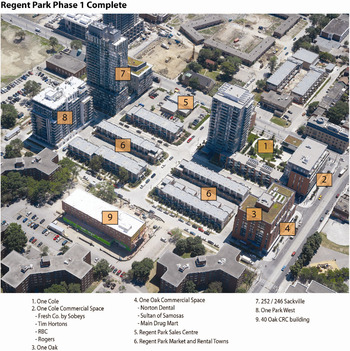
The nature of the physical transformation of Regent Park is important to understand as there is a significant interest in the contemporary literature of architecture and geography on the role of public spaces in the dynamics of recognition of marginalized groups (Low and Smith, Reference Low and Smith2006; Sarkis Reference Sarkis1997). Moreover, Lefebvre's (Reference Lefebvre1991) emphasis on representations of space by institutional actors (the “imagined”) provides the basis for understanding how places can become marked by stigma, and how efforts to “normalize the built environment” (as public housing redevelopment is often described) are really concerned with destigmatizing places. In 2006–2007, three buildings in the southwest corner of the site (which contains 418 units) were demolished and the residents re-housed to other social housing units near the site. This part of the site is known as Phase 1 of the redevelopment (see Fig. 1). Consequently, in addition to “re-balancing” (as social mix has been called) the social composition in Regent Park, the community will be physically redeveloped, with the destruction of all on-site buildings, the rerouting of streets through the area, and the introduction of mixed land uses (i.e., commercial, retail, and other nonresidential land uses). It is hoped that the new design will improve safety, “normalize” the neighborhood's physical appearance within the larger urban context (Rybczynski Reference Rybczynski1993), and stimulate vibrant urban diversity, commercial activity, and social interaction. The physical redevelopment plans for Regent Park are based on the design philosophy promoted by “The New Urbanism,” a U.S.-based planning and design movement. The New Urbanism arose in response to Modernist postwar architecture and planning, and the sprawl it produced. It is hoped that New Urbanist design prescriptions will correct the design flaws of large postwar public housing complexes (Newman and Franck, Reference Newman and Franck1982; O'Neill Reference O'Neill1999; Rybczynski Reference Rybczynski1993). There are three important elements to the physical aspects of the redesign. First, arguably to reduce stigma attached to the appearance of public housing, New Urbanism–guided redevelopments will attempt to make market and public units visually similar (see Fig. 1). Second, common spaces in public housing complexes have been singled out in the literature as “indefensible” sites that encourage crime and discourage a sense of community ownership (Jacobs Reference Jacobs1961; Newman Reference Newman1972). New Urbanism is a model for reconfiguring buildings, streets, and open spaces to distinguish between public and private space and foster a sense of ownership and safety through “eyes on the street”. Third, critics have noted that the lack of streets in public housing “superblocks” (like Regent Park's original design) makes them difficult to navigate, unsafe, and isolating for residents, while setting the area apart from the rest of the city. New Urbanist guidelines promote integration of the urban street grid with short blocks, bicycle paths, good lighting, and benches. Alleys are used to put vehicle storage behind buildings and create high quality pedestrian environments on streets uninterrupted by driveways and garages. New Urbanism also promotes mixed land uses, so that residents can walk to stores, services, and recreation. In combination, these elements are intended to increase the use of streets by residents and encourage social interaction and community formation (Bohl Reference Bohl2000).
Photograph of Regent Park Phase One Redevelopment. Photo shows completed Phase 1 Buildings at Regent Park, Toronto. High-rise condominium buildings (e.g., One Cole, One Park West) and high-rise social housing rental buildings (e.g., 252 and 246 Sackville) have similar architectural styles and building materials, arguably providing normalization of the built environment and place-level destigmatization. One Cole and One Oak commercial spaces are places where interaction between condominium residents and social housing tenants could be expected to take place.
A RESEARCH AGENDA TO INVESTIGATE PUBLIC SPACES, SOCIAL MIX, AND DESTIGMATIZATION
There are several important transformations that will occur on the Regent Park site that have potential implications for destigmatization. The first is a possible rescripting of social narratives of the place. By this I mean that at one scale, the meanings attached to the neighborhood's name will likely be transformed over time. At the risk of oversimplification, Regent Park is infamous for a variety of social problems, some of which have been described above. For many Canadians, Regent Park is arguably the nearest thing they have to the distorted, sensationalized, and racialized portrayal of public housing seen in numerous American television programs and on U.S.-based newscasts, both of which are readily available to Canadian households. With the introduction of more affluent households and the dilution of such social problems, there is a high likelihood that Regent Park will not carry such strong connotations as a stigmatized place (with stigmatized residents) in the future. But as the term “re-scaling” suggests, it is also possible that the place-based stigma attached to public housing residents will simply be attached to place at a different scale—the building level.
Consequently, it is likely that public housing residents will engage in a significant amount of “boundary work” (Lamont Reference Lamont2000; Tissot Reference Tissot2011) in the newly constructed communities, which may be a major component of the destigmatization strategies they will employ. How this plays out remains to be seen, but there are a couple of other subtle features of the redeveloped neighborhood that are necessary to describe in order to be able to discuss a research design for understanding destigmatization strategies surrounding the new Regent Park.
The next important aspect of the design of the new Regent Park for place-level destigmatization strategies is the addition of commercial, retail, and service-based land uses, as well as a plan for a major central park and a large aquatic centre. These changes will contribute to normalizing the built environment and altering the representational spaces of Regent Park. As both Joseph (Reference Joseph2006) and Kleinhans (Reference Kleinhans2004) have noted, social interaction among disparate groups, if it is going to happen, must have some site where this can take place; the most likely sites are public and commercial spaces. This is an important advance in the research on social mix, because in the literature on the topic, it has been lamented that there is relatively little socializing between public housing tenants and homeowners in socially mixed redevelopments. Similarly, proponents of social mix are vague about the kind of interaction that is expected, but suggested possibilities range from tenants and homeowners enjoying barbeques and other social gatherings together all the way to peaceful but indifferent co-location. Social mix research is hampered by the arbitrary application of benchmarks indicating strong ties between groups involved in social mix (notably tenants and condominium residents). But I suggest that if the benchmark of successful social mix is intimate, familiar socializing across class and ethnocultural lines, then too high a bar has been set, a proposition that is reinforced by Kefalas's (Reference Kefalas2003) research showing boundary work conducted by homeowners and tenants in Chicago's Beltway neighborhood. Instead, it is the types of interaction in public and commercial spaces, people's experiences and reactions to such interactions in the short term, and the ability of these interactions to develop into collective narratives in the long term, where the success of social mix will be seen (Bouchard Reference Bouchard, Hall and Lamont2009; Small Reference Small2004).
In general, it should be expected that the physical layout, built form, and relative proximity to commercial, transit, and other nodes of activity of a socially mixed redevelopment will significantly condition the type and extent of interaction between different social groups, including both insiders and outsiders to the community. Regent Park is a dense, high-rise environment (see Fig. 1). There is no tenure mix within buildings—each building is either 100% condominium or 100% social housing (which may include a mix of people receiving subsidies and people paying rents slightly below market rates). When the normalization of the built environment is complete (including restoration of a typical street pattern and construction of social housing and condominium buildings that have the same architectural features, building materials, and overall appearance), Regent Park will be visually integrated into adjacent neighborhoods. Moreover, Regent Park's proximity to Toronto's central business district (about fifteen blocks) means that nonresidents will visit new amenities within the porous boundaries of the community (the aquatic center, the recreation center, the grocery store, etc.); the social distance between residents of Regent Park and outside areas may also be reduced.
In other cases, like selected HOPE VI developments in the United States (Joseph Reference Joseph2006) and redevelopment sites in Australia (Arthurson Reference Arthurson2008), the housing was more ground oriented, consisting of single-family dwellings, townhouses, and some low-rise apartments. In such cases, the expectation of more familiar intergroup interaction may be more plausible. This underscores the important point that material spatial practices (i.e., Lefebvre's domain of the “experienced”) matter a great deal to the kinds of social interaction that can be expected and the kinds of experiences both tenants and condo residents will have. In the case of Regent Park, in the plans for Phase One and Two there are five key sites where interaction between people of different classes is likely to take place: a planned new central park, aquatic centre, bank, grocery store, and coffee shop. However, the specific dynamics of that interaction and people's experience of that interaction is extremely important to investigate.
Research that seeks to understand the dynamics of social mix would do well to take a more inductive and spatialized approach that focuses on actual everyday spaces of interaction and the outcomes of such interactions, with attention to Lefebvre's trialectics of space. In Regent Park, this means investigating the experience of social mix among condominium owners (or tenants), public housing tenants, and users of public and commercial services in the newly developed neighborhood using naturalistic observation of patterns of usage of the spaces, as well as interviews and surveys. While residential-based interviews and surveys can be conducted with commonly used recruitment and research strategies, nonresident users of the commercial and public services can be recruited using time-location sampling (or venue sampling) at appropriate sites. Time-location sampling (or venue sampling) is a probabilistic sampling methodology used to recruit respondents at venues and times where they would reasonably be expected to gather and to ask them about their experiences within the place or space (Aldana and Qunitero, Reference Aldana and Qunitero2008; Muhib et al., Reference Muhib, Lin, Stueve, Miller, Ford, Johnson and Smith2001). In the case of Regent Park, time-location sampling will be employed to interview users of public spaces at the five public locations described above to understand how such spaces shape community life, how interactions between social groups occur, and how users experience social inclusion/exclusion and attitudes of (in)tolerance in these particular environments. These locations are key sites for the enactment of social mixing. Participants are expected to include people living outside the Regent Park site (these spaces were all designed to promote use by nonresidents). While the topics to be addressed in such interviews may be idiosyncratic to the sites under study, some topics will be of relatively widespread interest. Drawing upon previous studies by Rosenbaum et al. (Reference Rosenbaum, Stroh and Flynn1998) and Kleit (Reference Kleit2005), such topics may include: residents' perceptions of social mix and the role of public spaces in facilitating positive social mix; attitudes of (in)tolerance for other socioeconomic and ethnocultural groups; experiences of discrimination and social inclusion/exclusion (e.g., the stigma consciousness questionnaire discussed by Pinel Reference Pinel1999); perceptions of safety; management safety efforts; police effectiveness; overall satisfaction; neighboring behaviors (watching children, having a meal, talking ten minutes, lending items, greeting on street) the question of with whom these behaviors occur; social network within the neighborhood; and group membership in the neighborhood. Attention to these topics will go a long way toward defining the reasons for the particular boundary work that occurs, the degree of boundary porousness and its form(s) (e.g., between groups within the community or between the community and other areas of the city), and the processes by which these outcomes have occurred. This would be a significant advance over the literature that simply tests for the existence of close, familiar social ties across social groups.
DISCUSSION
The negative consequences of concentrated poverty are well established; consequently, the promise of more socially mixed neighborhoods is compelling. One fairly limited but widely used means to reduce poverty concentration and achieve mixed neighborhoods is socially mixed redevelopment of public housing, but the dynamics are complex and under-examined. The evidence suggests, however, that a) relatively little social mix occurs in such initiatives—at least there is little intimate, familiar social interaction between people of different tenures, and by extension, of different socioeconomic status (SES) and racial and ethnic groups; and b) the impact of redeveloping public housing into socially mixed neighborhoods has limited impact on the well-being of social housing tenants.
Moreover, the evidence suggests that few of the putative mechanisms for the beneficial aspects of social mix actually occur in socially mixed public housing redevelopment initiatives. But these are all very individually based outcomes and processes, and the approach to studying them is a-spatial. This paper has attempted to take the first steps to remedy this individualistic, a-spatial focus. There are two important aspects to the spatiality of socially mixed housing redevelopment, namely, an appreciation of the importance of the sites and context in which mix takes place, and an overarching concern with place destigmatization. These emphases require different theoretical and methodological approaches.
Lefebvre's trialectics of space, which focuses on material spatial practices and representational practices provides a helpful frame for thinking about socially mixed housing redevelopment as a place destigmatization strategy. Ultimately, place destigmatization—the representational practices that Lefebvre (Reference Lefebvre1991) calls spaces of representation and representational spaces—will be shaped by the nature of interaction that occurs and this, in turn, will be an outgrowth of material spatial practices and the built form. Changes in material spatial practices that reduce physical distance between groups and spaces of representation and representational spaces that reduce social distance between groups will necessitate boundary work by a variety of affected social groups. What remains an empirical question, however, is the extent to which specific patterns of interaction in specific spaces will result in more porous boundaries and changes in either personal or place destigmatization. Regent Park's built form, which consists primarily of apartment towers, leads one to predict social mix will take place primarily in public spaces, requiring innovative empirical strategies to investigate; a description of such strategies has been given.
The study of social mix should be freed from the assumption that success equals intimate, familiar interaction, and instead admit the possibility that incidental, informal interaction, especially in public spaces, could be a successful outcome. Even this may be too high a bar. In most communities, and for many people, the success of a mixed neighborhood may ultimately be little more than harmonious co-location. The appropriate definition of success needs to be a matter of open dialogue, rather than the arbitrary imposition of a benchmark.
Social mix has not met the high bar of intimate, familiar social interaction in most examples studied in the research literature; in fact, the evidence suggests that the very mechanisms designed to produce positive impacts on social housing residents have failed. It follows, of course, that if these mechanisms are not in operation, then they cannot be an appropriate benchmark for success. Yet place destigmatization can be a significant, positive outcome of socially mixed public housing redevelopment, even in the absence of close, familiar relationships across housing tenures or other social groups.
Ultimately, the spatialized, place destigmatization approach to socially mixed public housing redevelopment requires a different research strategy than has been practiced previously. Although the expected outcomes of socially mixed housing redevelopment may be more contingent than previously believed, there are significant benefits to place destigmatization even if intervention itself cannot aspire to much more than the mixing of housing tenures (owners and social housing tenants). Future research must look past tenure differences to address other salient factors including income, race, and ethnicity while taking account of each group's experiences of tolerance, marginalization, and stigma in the context of changing material spatial practices and acknowledging differences within groups in redeveloped communities as well as distinctions between redeveloped neighborhoods and other neighborhoods in our cities.



