A bilingual is anyone who can communicate in two languages by speaking, writing, listening, or reading, regardless of whether proficiency is nativelike. Bilinguals outnumber unilinguals worldwide (De Bot & Kroll, Reference De Bot, Kroll and Schmitt2002); however, a simple dichotomy may not be tenable in many Asian countries where English is often the lingua franca but family language is very important. For example, bilinguals in Singapore often acquire and use one language at home (Mandarin, Malay, or Tamil) but rely on English for education and subsequent employment. Even for early bilinguals, those who learn their family language and English simultaneously before the age of 6, one language is usually dominant. This kind of language history is widespread in Asia, and makes speech–language assessments complex. In particular, it raises the question of how much knowledge of a language is required before a person can be classified as a balanced bilingual, and treated accordingly.
Even though bilinguals may be proficient in two languages, their competence may not be equivalent across domains (home vs. classroom/workplace; Grosjean, Reference Grosjean1985). Moreover, language use and the nature of bilingualism often change across the lifespan if the acquisition of one language is interrupted and insufficient, or if the learning of one language is more structured and formal because it involves reading and writing as well as speaking and listening (Albert & Obler, Reference Albert and Obler1978; Bialystok, McBride-Chang, & Luk, Reference Bialystok, McBride-Chang and Luk2005; Hamers & Blanc, Reference Hamers and Blanc2000). In fact, receptive bilingualism (understanding but not speaking/writing a parent's language) is likely to be much more common than academic proficiency in any linguistic setting where the home language receives little emphasis in school (see Bialystok, Reference Bialystok2007; De Houwer, Reference De Houwer2007). The acquisition and maintenance of a bilingual's two languages also depends on other interrelated factors such as language practice, language choice, and language attitudes (Hakuta & D'Andrea, Reference Hakuta and D'Andrea1992). Factors such as these, coupled with exposure to two cultures in many countries, influence bilingual children's cognitive development (Kroll & De Groot, 1997) as well as their linguistic abilities and code mixing (Genesee, Paradis, & Crago, Reference Genesee, Paradis and Crago2004).
The complex patterns of language acquisition have made it hard to ascertain which language is the dominant one. Several methods for determining language dominance in bilinguals have been proposed (Flege, Mackay, & Piske, 2002; see also Grosjean, Reference Grosjean1982). However, these have been designed mainly for migrant populations who use a native or first language (L1), and then acquire a second language (L2) after immigrating to the L2-speaking country as adults, usually after 15 years of age. This renders them unsuitable for establishing language dominance in multilingual multicultural countries such as Singapore, Malaysia, Taiwan, China, and India, where the distinction between L1 and L2 is less clearcut and varies from one family to another. To our knowledge, a classification system for language dominance in a multilingual Asian context has not been systematically investigated before, and hence, the focus of this methodological study.
Language dominance is easily confused with language proficiency. Birdsong (Reference Birdsong2006b) suggests that dominance, in psycholinguistic terms, usually indicates a difference in processing ability between L1 and L2, whereas proficiency is viewed in terms of the mastery of syntax, vocabulary, and pronunciation of a language. Even though “levels of proficiency and degrees of dominance tend to correlate” (Birdsong, Reference Birdsong2006b, p. 47), bilinguals can have almost nativelike proficiency in both languages but still consider one language to be better than the other. Alternatively, they may be dominant in one language (L1 or L2) but not necessarily be highly proficient in that language.
Despite the considerable overlap between language dominance and language proficiency, for clinical practice it may be more relevant to measure dominance. For example, it has been previously suggested that the severity and type of stuttering behaviors may be different across a bilingual's two languages, and that this may be influenced by language dominance (e.g., Howell et al., Reference Howell, Ruffle, Fernandez-Zuniga, Gutierrez, Fernandez and O'Brian2004; Jankelowitz & Bortz, Reference Jankelowitz and Bortz1996; Jayaram, Reference Jayaram1983). Speech–language pathologists routinely work with a range of bilingual clients (e.g., Bernstein Ratner, Reference Bernstein Ratner and Goldstein2004; Finn & Cordes, Reference Finn and Cordes1997). If language dominance affects the presentation of a speech or language disorder, SLPs may either underestimate or overestimate the overall severity of any disorder if they perform their assessments in one language only. Accordingly, it is important to determine which language (if any) is dominant to assess the nature of any disorder. It would also be essential to know whether therapy that is delivered in either the dominant or less dominant language yields better treatment outcomes.
In determining language dominance, however, it is not clear which parameters are important in a particular setting. The array of parameters for late bilinguals (i.e., those acquiring L2 after 10 years of age; Perani et al., Reference Perani, Eraldo, Galles, Dupoux, Dehaene and Bettinardi1998) include age of acquisition (AoA) and age of first exposure (AoE), function and frequency of language use, the manner, environment, and years of language instruction and exposure, stability of language acquisition, age of arrival (AOA), and length of residence (LOR) in the L2-speaking country, language modes, and the level of language proficiency for understanding, speaking, reading, and writing (Flege et al., Reference Flege, Mackay and Piske2002; Grosjean, Reference Grosjean1998; Langdon, Wiig, & Nielsen, Reference Langdon, Wiig and Nielsen2005; Obler, Zatorre, Galloway, & Vaid, Reference Obler, Zatorre, Galloway, Vaid and Wei2000). These variables frequently correlate with key theoretical concepts in L2 language processing and representation (Chen & Leung, Reference Chen and Leung1989; Li, Sepanski, & Zhao, Reference Li, Sepanski and Zhao2006), but they are not always meaningful as determiners of language dominance in early bilinguals. A priori, it may be reasonable to speculate that variables such as AoE, years of language instruction, and language exposure may not be good predictors of dominance for bilinguals in Asian countries such as Singapore, who are exposed to both languages before 5 years of age. Further parameters like AOA and LOR are not applicable to this bilingual population.
Children in Singapore are usually exposed to at least two of the four official languages, English, Mandarin, Malay, and Tamil, in the home through local television and radio broadcasts and other public services (e.g., transport, shopping centers). Depending on their ethnic background, they are expected to become bilingual and literate in English (main medium of instruction) and in Mandarin, Malay, or Tamil during their primary education, which occurs from 6 to 12 years of age. This bilingualism continues through secondary education and into adulthood, but pupils vary considerably in their use and level of proficiency in each language. Even though the majority of Singaporeans function at the bilingual end of the Grosjean's (Reference Grosjean and Nicol2001) continuum, some may acquire balanced abilities in both languages, whereas others develop dominance in one language, or in particular modalities. For many bilingual Singaporeans, however, a common pattern is to use Mandarin for speaking but to read and write more in English. Whether AoE, years of formal instruction, and the number of years of language exposure, parameters that have been found to influence language proficiency and dominance in bilinguals from non-Asian settings, can effectively discriminate the dominant language in bilinguals in Singapore, or are associated with self-rated proficiency in all four language modalities has not been formally investigated. One might expect, for example, an inconsistent pattern in the relationship between the three parameters and the self-rated proficiency for individual language modalities because levels of proficiency may be modality specific. As a result of the unique language background of bilingual Singaporeans, variables such as the function, frequency, and environment of language use, and the level of language proficiency for all four language modalities may be more applicable to this bilingual population than other variables for determining language dominance.
For studies that have relied exclusively on self-report, the selection and weighting of variables for deciding dominance in bilinguals who speak non-Asian languages varies considerably, and seem somewhat arbitrary. Cutler, Mehler, Norris, and Segui (Reference Cutler, Mehler, Norris and Segui1992) and Golato (Reference Golato2002) asked their French–English participants to state the language they would choose to keep if they were in a hypothetical situation where they could keep only one language. More conventionally, Altarriba (Reference Altarriba2003) classified her Spanish–English speakers as balanced bilinguals only when there were no significant differences in their self-reported ability to understand, write, and converse in the two languages. Tokowicz, Michael, and Kroll (Reference Tokowicz, Michael and Kroll2004) used a similar procedure for their Spanish–English bilinguals but then reassigned four participants to the L2-dominant group because they were living in an L2 environment.
In addition to using single self-report measures to classify language dominance, other investigators have adopted a combination of two or more parameters including objective measures of proficiency. However, there is little agreement about how to combine measures, or how to interpret the scores from the different tests for the purpose of language dominance classification. In one of the five studies conducted by Flege et al. (Reference Flege, Mackay and Piske2002), self-report and objective tests were used (self-ratings of proficiency and a sentence repetition task) to divide participants into one of three groups: Italian dominant, English dominant, and balanced bilinguals. The resulting classifications were then compared with the data obtained for AOA, LOR, language use, and two other objective measures (sentence translation and strength of foreign accent). Self-rating ratios were calculated from the bilinguals' ability to speak and understand Italian compared to English (verbal self-rating ratios), and read and write Italian compared to English (written self-rating ratios). Sentence duration ratios were also derived by dividing the mean duration of repeated English sentences (milliseconds) by that of Italian sentences. These three ratios were then ranked-ordered and averaged so that each bilingual received an average rank score. The authors then assigned equal numbers of bilinguals in each group: the 18 bilinguals with the highest and lowest ranks were classified Italian dominant and English dominant, respectively, whereas the remaining 18 were considered balanced bilinguals.
Flege et al.'s (Reference Flege, Mackay and Piske2002) rationale for dividing the 54 participants into equal-size groups is unclear, but their use of multiple measures for language dominance classification is commendable. The main problem is how to decide on the combination of tests to use for assessing dominance in Asian bilinguals. It is difficult to generate equivalent objective tests in different languages (Grosjean, Reference Grosjean1998), and especially challenging when the two languages are structurally dissimilar. For example, English and Mandarin are sharply contrasted in terms of orthography, phonology, and morphology. There is also a range of objective assessments and little consensus about which is best: standardized or nonstandardized assessments of language ability (e.g., Bialystok & Miller, Reference Bialystok and Miller1999; Jared & Kroll, Reference Jared and Kroll2001), scores from a standardized examination such as TOEFL (e.g., Golestania et al., Reference Golestania, Alario, Meriaux, Bihan, Dehaene and Pallier2006), and various laboratory tests of speed, fluency, and automaticity (e.g., Flege et al., Reference Flege, Mackay and Piske2002). Therefore, a more acceptable approach might be to first determine language dominance using self-report ratings (Langdon et al., Reference Langdon, Wiig and Nielsen2005), and then use the results of objective tests to substantiate rather than as a determiner of language dominance (Grosjean, Reference Grosjean1998).
There is a growing body of research that shows that self-assessments of proficiency are valid and reliable measures of language skills, and are correlated highly with ratings by experienced judges and standardized test (Grosjean, Reference Grosjean1982; Langdon et al., Reference Langdon, Wiig and Nielsen2005; Oscarson, Reference Oscarson1989). In a recent survey of 41 published studies in the bilingual or L2 literature, Li et al. (Reference Li, Sepanski and Zhao2006) showed that self-assessments in understanding, speaking, reading, and writing ability were among the 10 most frequently asked questions in language history questionnaires used in bilingual research. However, Grosjean (Reference Grosjean1982) argued that language dominance assessments should not only consist of proficiency measurements of bilingual's ability to understand, speak, read, and write a language, but also include an examination of how a bilingual uses the two languages. In particular, he emphasized the need to consider the frequency and domain of language use. Frequency and domain of language use are important variables as they are related to language proficiency. Bilinguals commonly experience changes in their language environment, and so their needs for particular language skills will change accordingly, as will their proficiency in each language. Previous researchers have used self-report measures to determine language dominance, but prior to this study, none have used data from all three of the key variables: language proficiency, frequency of language use, and domain of language use.
One complication that will arise whenever two or more measurements are employed is that the results derived from different tests do not always converge (e.g., Chincotta & Underwood, Reference Chincotta and Underwood1999; Jared & Kroll, Reference Jared and Kroll2001; Langdon et al., Reference Langdon, Wiig and Nielsen2005). For example, Langdon et al. (Reference Langdon, Wiig and Nielsen2005) discovered that only 8 of the 25 bilinguals received the same bilingual group classification across their two objective assessments, word listing by domain (WLD) and the Alzheimer's quick test: assessment of parietal function (AQT). A planned deliverable for this study was to develop a way of handling potentially conflicting classification results systematically by using a predetermined set of criteria.
The use of objective tests as a means of validating self-report measures of language dominance may not be easily adopted in Asian countries such as Singapore where a perennial problem is the lack of culturally specific, standardized objective assessments. Therefore, an alternative method of validating our self-report tool was required. In their recent study, Li et al. (Reference Li, Sepanski and Zhao2006) used a discriminant analysis to show that their method of measuring overall L2 proficiency could correctly classify their bilingual participants into three L2 proficiency groups: low, medium, and high. This same statistical procedure would also be valuable for validating the accuracy of our self-report classification tool.
To summarize, the main aim of this study was to develop systematic guidelines for interpreting a self-report classification tool comprising ratings of language proficiency, and frequency and domain of language usage. The tool was validated using a discriminate analysis and a simple measure of proficiency such as receptive vocabulary. The second aim was to explore the relationship between the three principal parameters referred to in the literature on bilinguals from non-Asian settings, AoE, years of formal instruction, and years of exposure, and their utility for distinguishing between bilinguals with different dominance patterns and proficiency self-ratings.
METHOD
Participants
One hundred ninety-eight bilingual English–Mandarin-speaking undergraduates from the National University of Singapore (NUS) volunteered to participate in the study. These bilinguals were (a) of Chinese descent, (b) born in Singapore, and (c) reported having English and Mandarin as L1 and/or L2, and exposure to both languages before 7 years of age. Thirty participants were excluded on the basis of incomplete questionnaires or failure to meet the above inclusion criteria. The mean age of the remaining 168 participants was 20.1 years (range = 18– 24 years). There were 116 women and 52 men in the group.
Materials
Language dominance was determined by examining participants' responses to a self-report classification tool (see Appendix A) before validation using the discriminant analysis and an objective measure of receptive vocabulary in both languages. The tool is essentially a questionnaire that was adapted from the History of Bilingualism (HOB) questionnaire (Paradis, Reference Paradis1987) and the Language Background Questionnaire (LBQ) by Rickard Liow and Poon (Reference Rickard Liow and Poon1998). It was chosen over more recent tools (e.g., Li et al., Reference Li, Sepanski and Zhao2006) because the questions are less biased toward measuring L2 proficiency. The questionnaire asks participants to provide information about age of first exposure for all languages in their repertoire across the four language modalities: understanding, speaking, reading, and writing. Specific questions for each modality include ranking current proficiency of each language using a 7-point self-rating scale (Kohnert, Hernandez, & Bates, Reference Kohnert, Hernandez and Bates1998) where 1 = very few words and 7 = native speaker, ranking of the language they use most often at home, work, and socially, quantification of how frequently they use each language, and also information about school examination grades.
Single-word receptive vocabulary in English and Mandarin was assessed using the Multilingual British Picture Vocabulary Scale (MBPVS). This test was developed from the long form of the MBPVS (Dunn, Dunn, Whetton, & Pintillie, Reference Dunn, Dunn, Whetton and Pintillie1982; Rickard Liow, Hong, & Tng, Reference Rickard Liow, Hong and Tng1992) with the publisher's permission. It is similar to the Peabody Picture Vocabulary Test (PPVT) and requires participants to listen to a spoken target word and then choose the matching picture from a panel of four options. The original BPVS comprises 150 items rank ordered for difficulty for English–L1 speakers. The adapted MBPVS comprises 75 items for each of the English and Mandarin versions with even-numbered target items (2, 4, 6, to 150) in English and the odd-numbered items (1, 3, 5, to 149) in Mandarin. This procedure ensures sampling across a range of difficulty, but the two versions are not equivalent in terms of difficulty because targets words in different languages have different frequencies and conceptual transparency (e.g., Bates et al., Reference Bates, D'Amico, Jacobsen, Székely, Andonova and Devescovi2003; Szekely et al., Reference Szekely, D'Amico, Devescovi, Federmeier, Herron and Iyer2005; Szekely et al., Reference Szekely, D'Amico, Devescovi, Federmeier, Herron and Iyer2003, Reference Szekely, Jacobsen, D'Amico, Devescovi, Andonova and Herron2004). For example, the word “pediatrics” would be low frequency for English, but the literal translation in Mandarin is easy because  means “child study.” Although there can be no absolute or parallel measure of vocabulary proficiency for Mandarin and English (or other language combinations), the participants raw scores relative to their peers could be used to validate the discriminant analysis classification results determined by self-report.
Procedure. In groups of about 20, participants completed the self-report classification tool before the two MBPVS vocabulary testing sessions. Different target items and picture stimuli are assessed by the MBPVS English and Mandarin, so the tests were administered on the same day but in counterbalanced order such that half of the participants received testing in Mandarin first followed by English, and vice versa. The forced-choice (1-from-4) picture plates were presented using an overhead projector, whereas the prerecorded target words were presented free field to participants using a TCD-PROII DAT Recorder with Altec Lansing 220 speakers. Prerecorded target stimuli were used to ensure that the presentation of the target words was standardized across data collection sessions. Participants recorded their responses using a separate response sheet for each language.
Categorizing language dominance using the self-report classification tool
As demonstrated in the introduction, there are three variables that are most relevant to Asian bilingual populations who acquire both languages early and uniformly: (a) language proficiency, (b) frequency of language use, and (c) domain of language use. Thus, the classification as Mandarin dominant or English dominant required all three self-report criteria (details below) to be met; failure to satisfy all three criteria was taken to imply balanced bilingualism.
Language proficiency. Langdon et al. (Reference Langdon, Wiig and Nielsen2005) divided the maximum total rating score that a bilingual could achieve into four preset score ranges where each range of scores indicated a different competence level: rating scores between 15 and 20 = competence, 10 and 14 = relative competence, 5 and 9 = partial competence, and 1 and 4 = inadequate competence. Using this approach, a difference in overall ratings of one or more competence levels (e.g., “relative” vs. “partial” competence) between the languages would indicate language dominance (see also Macnamara, Reference Macnamara1967). The use of a ratio or a range of scores may not be a good discriminator for ratings by many Asian bilinguals, including our Singaporeans, because proficiency varies within and between the languages across the four modalities (speaking, listening, reading, and writing). It is possible for bilinguals in Singapore to develop uneven skills for reading and for writing. For example, there is also less opportunity for Mandarin-dominant bilinguals to maintain their proficiency in Mandarin writing when they work or study in an environment where English is the main written form used. For these reasons, a more conservative decision making process was developed based on three criteria: (a) the difference in the total rating score between English and Mandarin > 0; (b) the difference in the score between English and Mandarin for understanding, speaking, or reading modalities > +1 or < −1; and (c) the difference in the score between English and Mandarin for understanding, speaking, or writing modalities > +1 or < −1. A language was interpreted as dominant if it was similarly classified (e.g., English dominant or Mandarin dominant) for two out of the three language proficiency criteria. For example, assuming a bilingual had a difference in total rating score between English and Mandarin of +4, and that the difference in scores between English and Mandarin were 0, +1, +1, and +2 for understanding, speaking, reading, and writing, respectively, then that bilingual would satisfy the criteria for English dominant because both criteria (a) and (c) have been fulfilled. In this sample case, a difference in scores between English and Mandarin in the positive direction (e.g., +1) indicated English dominance whereas a score difference in the negative direction indicated Mandarin dominance.
Frequency of language use. Frequency of use as an important determiner of language dominance is supported by White and Genesee's (1966) finding that it is possible for late learners of a language to achieve nativelike competency in that language, and also by the research showing bilinguals lose dominance in a language when it is not used, or is used less frequently (Grosjean, Reference Grosjean1998). In Singapore, many Mandarin-dominant participants were expected to use written English in their educational and work environments. Thus, in addition to fulfilling the proficiency ratings criteria, the dominant language had to be spoken and heard daily, and used for either reading or writing weekly (see Paradis, Reference Paradis1987).
Domain of language use. Three main domains of language use were identified: home, school/work, and social (see Fishman, Reference Fishman and Li2000, for others). In Singapore, English is the official language used at school and at the workplace, so the dominant language was identified if it was also used in at least two out of the three possible environments.
RESULTS
Classification and profile of participants
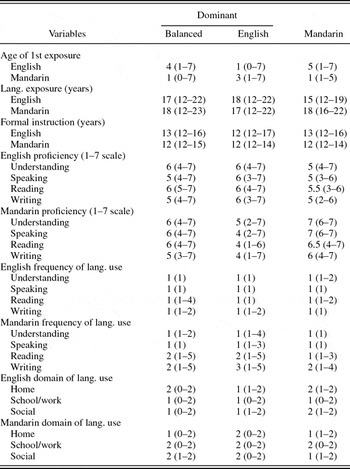
The characteristics of the participants categorized by the classification tool using self-ratings of language proficiency, and frequency and domain of language use are shown in Table 1. Note that the scaling method means that the number of years of exposure to English and Mandarin is negatively correlated with the AoE for a particular language. That is, the smaller the number is given for AoE, the higher number is given for years of exposure.
Participant characteristics according to language dominance group

Note: Median scores (range) except for frequency and domain of language use that are mode scores (range). For frequency of language use, 1 = every day, 2 = every week, 3 = every month, 4 = every year, 5 = less than once a year. For domain of language use, 1 = use most, 2 = use to a lesser extent, 0 = do not use.
Using the self-report tool described above, the 168 participants were divided into one of three groups. Seventy-three participants were classified as balanced bilinguals, 77 as English-dominant bilinguals, and 18 as Mandarin-dominant bilinguals. Both the balanced and Mandarin-dominant group reported an earlier exposure to Mandarin than to English, whereas the English-dominant group was exposed to English before Mandarin (see Table 1). A similar number of years of exposure to both languages was recorded for the English-dominant group as well as the balanced bilinguals. In contrast, the Mandarin-dominant bilinguals reported a longer exposure to Mandarin than to English. As expected for Singapore, years of formal instruction was similar across the three bilingual groups for both languages.
The group median self-rated proficiency scores across the four language modalities for English and Mandarin were noted to be comparable for the balanced bilinguals. In contrast, the group median self-rated proficiency scores for all four language modalities for both the English-dominant and Mandarin-dominant participants were higher in their respective dominant languages. To determine whether the three groups differed with respect to their language proficiency scores, a Kruskal–Wallis test was performed because normality assumptions were violated. Post hoc testing, using the Mann–Whitney test, with Bonferroni adjustments for Type 1 error were performed (Keppel & Wickens, Reference Keppel and Wickens2004). An α level of .05 was predetermined for all statistical tests.
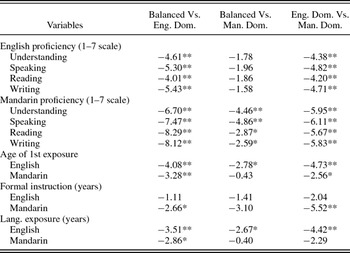
The Kruskal–Wallis test revealed significant differences in median scores between the English-dominant, Mandarin-dominant, and balanced bilinguals for all language modalities for both English (p < .01) as well as Mandarin (p < .01). Post hoc Mann–Whitney tests revealed that the English-dominant bilinguals had significantly higher self-rated English proficiency scores for understanding, speaking, reading, and writing than the Mandarin-dominant bilinguals (p < .01). Likewise, the Mandarin proficiency scores across all four modalities were found to be significantly higher for the Mandarin-dominant group than the English-dominant group (p < .01). Compared to the English-dominant bilinguals, the balanced bilingual group had lower English proficiency scores but higher Mandarin proficiency scores across all modalities (p < .01). However, although the Mandarin-dominant bilinguals had significantly higher Mandarin proficiency scores than the balanced bilinguals (p < .01), the difference in their English proficiency scores was not found to be significantly different (p > .05). This finding was noted for all four language modalities. The Mann–Whitney test results for the group comparison of language proficiency scores are presented in Table 2.
Results of Mann–Whitney test scores for group comparisons

Note: Values represent Z scores. Bonferroni adjustments were made to the alpha levels.
*p < .05. **p < .01.
Mode values were used to analyze the data for frequency and domain of language use as the data were categorical in nature. All three bilingual groups had similar group modes for frequency of English language use (i.e., 1 = use every day). This was found across all four language modalities. Although the bilingual groups had maintained daily usage for understanding and speaking Mandarin (mode = 1), the group modes for reading and writing Mandarin were more variable (see Table 1). This finding is consistent with the greater emphasis for reading and writing in English at school and at work. In terms of domain of language use, the group mode for the English-dominant group was found to be 1 (used most) in the home, work/school, and social environments. This indicated that as a group, the English-dominant bilinguals reported greater usage of English than Mandarin in the three specified domains. Conversely, the Mandarin-dominant and the balanced bilinguals reported greater usage of Mandarin or English in two of the three domains: the Mandarin-dominant bilinguals used more Mandarin in the home and socially, whereas the balanced group was found to use more English in the work/school and social environments. Again, this may be attributed to the greater reliance on English compared to Mandarin at work and at school.
The group differences for frequency and domain of language use were not statistically analyzed across bilingual groups as the data was categorical in nature.
Validation of self-report classification tool
The accuracy of this classification tool in determining language dominance was then tested using a discriminant analysis (DA; Garson, Reference Garson2006). In this analysis, the grouping variable was language dominance (English dominant, Mandarin dominant, balanced), whereas the independent variables were the raw scores for language proficiency, frequency of language use, and domain of language use in both languages.
The results of the discriminant analysis revealed an overall correct classification rate of 88%. Based on our large sample size of 168 participants, this accuracy rate was high and significant when compared to the random probability of 33% (p < .001). Sixty-one of the 73 balanced bilinguals (83.6%) received the same bilingual classification as predicted by the DA and our self-report tool. Of the 12 balanced bilinguals who received different classifications, 1 participant was categorized as English dominant and 11 were classified as Mandarin dominant. The predicted group membership for 69 of the 77 English-dominant bilinguals (89.6%) matched the classification according to our self-report tool. The remaining 8 English-dominant participants were recategorized as balanced bilinguals in the DA. Finally, only 1 of the 18 Mandarin-dominant bilinguals received a different predicted group membership in the DA. This participant was likewise categorized as a balanced bilingual. For this group, the classification accuracy was 94.4%. Despite these misclassifications, the accuracy rate for each bilingual group remained high and significant when compared to the random probability of 33% (p < .001). This suggested that our classification tool was able to identify above the level of chance and with a high level of accuracy the dominant language in bilingual Singaporeans.
Further, to see if the scores from the English and Mandarin MBPVS supported this dominance classification, the vocabulary scores were examined for both languages, and across the three bilingual groups in separate analyses. For the comparison of MBPVS scores in English and Mandarin for each bilingual group the dependent variable was mean percentage accuracy scores. A paired t test was used to analyze the difference in scores between languages. However, where the use of parametric tests was contraindicated, a Wilcoxon signed-rank test was computed instead. To analyze MBPVS scores across bilingual groups, the same statistical procedures as described previously for the between group analysis of language proficiency scores were used. However, in the analysis of MBPVS scores, the dependent variable measured for the between group analyses was median percentage accuracy scores.
The balanced bilinguals displayed almost identical scores on the MBPVS across the two languages (M = 88.4%, SD = 4.78 for the English, and M = 88.2%, SD = 4.6 for Mandarin) but the scores for the English-dominant bilinguals were significantly higher on the English MBPVS (M = 91.30%, SD = 3.29) than on the Mandarin MBPVS (M = 82.12, SD = 6.56). The difference in mean MBPVS scores for this group reached significance, t (74) = 10.61, p < .025 (one tailed). Finally, the Mandarin-dominant group also produced significantly higher scores on the Mandarin MBPVS (M = 88.56, SD = 3.70) compared to the English MBPVS (M = 84.12, SD = 3.24; Wilcoxon signed-rank test = 2.64, p = .008).
To determine whether the three groups would have distinguishable test scores, performance on the English and Mandarin MBPVS was compared across groups. A Kruskal–Wallis test revealed significant differences in median scores between the English-dominant, Mandarin-dominant, and balanced bilinguals for both the English MBPVS, χ2 (2, N = 168) = 38.35, p < .001, and the Mandarin MBPVS, χ2 (2, N = 168) = 37.22, p < .001. Post hoc Mann–Whitney tests revealed significant group differences in the English MBPVS scores for all three comparisons: English-dominant bilinguals (Mdn = 92.00) achieved significantly higher scores than both the balanced bilinguals (Z = .4.11, p < .001) and Mandarin-dominant bilinguals (Z = 5.45, p < .001); the balanced bilinguals (Mdn = 89.33) were found to perform significantly better (Z = 3.43, p = .003) than the Mandarin-dominant group (Mdn = 84.00). However, for Mandarin MBPVS scores, only the English-dominant bilinguals (Mdn = 82.67) produced scores that were significantly different from the Mandarin-dominant (Z = 3.75; p = .003) and balanced bilinguals (Z = −5.71, p = .003). That is, there was no difference in Mandarin vocabulary scores between the Mandarin-dominant group (Mdn = 88.00) and the balanced bilinguals (Mdn = 89.33).
Distinguishing language dominance using AoE, years of language instruction, and exposure
To study the usefulness of AoE, years of language instruction, and years of language exposure in distinguishing the language dominance groups, the same statistical procedures as described above for the between group analysis of MBPVS scores were applied. The results of the Kruskal–Wallis test showed that there were significant group differences for years of English exposure, χ2 (2, N = 168) = 25.83, p < .001, years of Mandarin exposure, χ2 (2, N = 168) = 10.29, p = .006, years of formal Mandarin instruction, χ2 (2, N = 168) = 28.05, p < .001, AoE English, χ2 (2, N = 168) = 31.17, p < .001, and AoE Mandarin, χ2 (2, N = 168) = 13.69, p = .001, but not for years of formal English instruction.
Post hoc testing using a Mann–Whitney test showed that the three bilingual groups only differed significantly from each other in terms of number of years of English exposure and AoE English (see Table 2). The English-dominant bilinguals had a higher number of years of English exposure (Mdn = 18) than the balanced bilinguals (Mdn = 17), who also had more years of English exposure than the Mandarin-dominant bilinguals (Mdn = 15). This same pattern was also noted for AoE English but in the reverse order (Mdn = 1 for English-dominant bilinguals, Mdn = 4 for balanced bilinguals, and Mdn = 5 for Mandarin-dominant bilinguals).
The scores for AoE Mandarin and years of formal Mandarin instruction were significantly different in only two group comparisons. For AoE Mandarin, the English-dominant group (Mdn = 3) showed a significantly later age of acquisition than the balanced group (Mdn = 1) and Mandarin-dominant group (Mdn = 1), whereas the difference in median age between the balanced and Mandarin-dominant bilinguals was not statistically significant. The same trend was observed for years of formal Mandarin instruction despite the median score being the same (Mdn = 13) for all three groups of bilinguals.
With respect to the number of years of Mandarin exposure, only one group comparison was noted to be significant. Balanced bilinguals were found to have a significantly longer period of Mandarin exposure (Mdn = 17) than the English-dominant bilinguals (Mdn = 18). However, the scores of both these groups were not significantly different from that obtained by the Mandarin-dominant bilinguals (Mdn = 18).
Relationship between AoE, years of language instruction, years of language exposure, and self-ratings of language proficiency
To explore the relationships between AoE, years of language instruction, and years of language exposure, and the self-reported proficiency ratings for understanding, speaking, reading, and writing in each language, separate Spearman's rank-order correlation analyses were performed for the variables in each bilingual group. For the group of Mandarin-dominant bilinguals, none of the correlation analyses were found to be statistically significant (p > .05). In only 4 out of a possible 12 analyses were significant correlations found for the English-dominant group: English understanding proficiency was positively correlated with the number of years of exposure to English (r 2 = .304, p = .048) and negatively correlated with AoE to English (r 2 = −.303, p = .048), Mandarin speaking proficiency was positively associated with years of Mandarin exposure (r 2 = .352, p = 0.012) and negatively correlated with AoE Mandarin (r 2 = −.356, p = .012). Similarly, only two comparisons were observed to be statistically significant for the balanced bilingual group. For these bilinguals, Mandarin understanding proficiency scores were positively correlated with years of Mandarin exposure (r 2 = .345, p < .001), whereas their Mandarin-speaking proficiency scores were also found to be positively associated with years of Mandarin exposure (r 2 = .31, p = .036). These correlations reveal an inconsistent pattern in the relationship between AoE, years of language instruction, years of language exposure, and self-ratings of language proficiency for the four language modalities.
DISCUSSION
This study assessed language dominance in an Asian population of English–Mandarin bilinguals. The main aim of this study was to develop a self-report classification tool that would reliably and accurately determine the dominant language in English–Mandarin bilingual Singaporeans. A method for interpreting responses on the self-report classification tool was also tested for accuracy of classification. The three-way classification into English-dominant, Mandarin-dominant, and balanced bilinguals was based on participants' rating data for specific questions about language proficiency and language usage, and then validated using a discriminant analysis and receptive vocabulary scores for both languages. The results of the discriminant analysis showed that the classification tool was able to differentiate with a high level of accuracy (88%) between these three groups, an accuracy rate that was found to be significantly different from chance.
The accuracy of language dominance classification in our group of bilinguals received partial support from the results of the receptive vocabulary tests (MBPVS). The vocabulary performance for the English-dominant, Mandarin-dominant, and balanced groups were consistent with the three-way bilingual grouping, but a comparison across the bilingual groups suggested that the Mandarin score was not as effective as the English score for discriminating the Mandarin-dominant bilinguals from the balanced bilinguals; the scores for these two groups were not distinguishable. Thus, in keeping with Grosjean (Reference Grosjean1998) and Langdon et al. (Reference Langdon, Wiig and Nielsen2005), the results of this study provide further evidence that objective assessments like the MBPVS may not be suitable for determining language dominance. At best, they may be applied to verify the self-assessments of language dominance for English-dominant bilinguals and balanced bilinguals. As yet, there are no standardized tests of language proficiency for Singaporeans, or most other Asian bilinguals. Thus, pending the development of culturally appropriate language assessment tools for specific bilingual populations, a broad classification of language dominance using the guidelines described in this report, should be of considerable value in clinical settings.
A secondary aim was to examine the group differences in terms of AoE, years of formal instruction, and years of exposure for both languages, and to assess their relationship to self-ratings of proficiency. The data revealed that only two parameters, AoE English and years of English exposure, were able to distinguish the three bilingual groups. For Singaporeans, this result was not surprising, because the two variables are likely to be similar for early bilinguals in the same education system. What is more interesting is that the same effect was not found for Mandarin. This is consistent with Rickard Liow and Tng's (Reference Rickard Liow, Tng, McBride-Chang and Chen2003) work on primary school pupils' Mandarin–English literacy development in Singapore, and suggests that home language remains an important factor for proficiency for the ethnic Chinese population. Both the Mandarin-dominant and balanced bilinguals reported comparable AoE Mandarin and years of Mandarin exposure. Similar to the MBPVS results and the self-rated proficiency scores, AoE, years of first exposure, and years of formal instruction generally differentiated, albeit not fully, the English-dominant bilinguals from the Mandarin-dominant bilinguals and English-dominant and balanced bilinguals, but not the balanced and Mandarin-dominant bilinguals. Taken together, these findings seem to suggest that the three principal variables identified in the literature have a less consistent influence on language dominance when the educational system is more uniform. However, for our participants, the restricted range of scores for AoE and years of exposure must be acknowledged. Future research is needed to confirm whether a similar result would be indicated in a more heterogeneous group of Asian bilinguals.
There is at least one explanation for the greater degree of overlap in the profile and performance seen between the balanced and the Mandarin-dominant bilinguals, and the greater observed differences between balanced and English-dominant bilinguals, at least for this group of undergraduate students. As English is the main language of instruction in schools, and because Mandarin education does not usually continue at the tertiary level, it is likely that there was a larger disparity in the degree of dominance between the two languages in English-dominant bilinguals, whereas this dominance gap was smaller in the Mandarin-dominant bilinguals. Mandarin-dominant bilinguals were more proficient in their less-dominant language (English) than the English-dominant bilinguals were in their less-dominant language (Mandarin). This made the Mandarin-dominant bilinguals less distinguishable from the balanced bilinguals. The above suggestion is supported by the participants' self-rated language proficiency ratings (see Table 1).
Our results for the associations between AoE, years of formal instruction, and years of exposure and self-ratings of proficiency were interesting. Unlike previous investigations of late bilinguals, we only found a handful of significant associations in our study. These occurred for the English-dominant and balanced bilinguals and were only observed for specific individual modalities in each language. This result contrasts with that of Li et al. (Reference Li, Sepanski and Zhao2006), who found significant correlations between AoE, years of learning, and self-assessed proficiency for all four modalities: understanding, speaking, reading, and writing. In addition, differences in sample sizes and methodology not withstanding, the correlations for the analyses reported here were also markedly weaker (r 2 < .32) than those reported previously (e.g., Birdsong, Reference Birdsong2006a; Flege et al., Reference Flege, Mackay and Piske2002). For instance, in a survey of 10 studies, Birdsong found that the range of correlations between the age at which bilinguals are immersed in an L2 context and attained L2 proficiency was .45 to .77 (Mdn = .64). We interpret these findings to mean that these constructs are less relevant for current ratings of language proficiency in bilinguals who acquire both languages early, learn both languages uniformly, use both languages regularly, but yet develop a dominant language. Accordingly, they may not be suitable parameters to use for selecting and dividing participants for clinical or research purposes in this Asian context.
Like Langdon et al. (Reference Langdon, Wiig and Nielsen2005), we found that self-ratings provide valid and reliable measures of language dominance. The difference between our study and the study by Langdon et al. is that these authors did not evaluate the domains of language use. This parameter deserves examination because it determines the genre of language used, and more importantly, the linguistic level used by the bilingual (Fishman, Reference Fishman and Li2000). In our self-report classification tool, the conclusion regarding the dominant language was reached by assessing language proficiency, and frequency and domain of language use. Nonetheless, until a comparative study is conducted, the question regarding the ultimate number of self-assessment parameters to use for the best assessment of language dominance remains equivocal.
Unlike previous research (Flege et al., Reference Flege, Mackay and Piske2002; Langdon et al., Reference Langdon, Wiig and Nielsen2005; Li et al., Reference Li, Sepanski and Zhao2006) based on percentage estimates to measure the degree of language usage, frequency of language use in this study was measured categorically. Although we concede that the use of percentage estimates may be a more sensitive means of evaluating frequency of language use, we still found a high level of accuracy in classifying language dominance despite using a categorical measurement of frequency of language usage. We undertake to address this issue in our future work.
In conclusion, for our group of English–Mandarin bilingual Singaporeans, our self-report classification tool was found to be reliable for a three-way classification into English-dominant, Mandarin-dominant, and balanced bilinguals. This categorization was achieved on the basis of self-ratings of language proficiency, frequency of language use, and domain of language use by means of a predetermined set of criteria, and was validated statistically using a discriminant analysis, and on a large bilingual population. Prior to this study, clinicians in Singapore habitually asked their clients some variant of the question “which of the languages do you believe to be your dominant language.” In our experience, we believe that an answer to this single question has not always provided accurate or useful information about language dominance in a clinical setting. Clinicians have also relied on their clients' self-ratings of language proficiency and language usage to determine the dominant language but this was done without any empirical data to defend their clinical practice. Our study now provides evidence to support the use of our self-report tool as part of standard clinical practice. It is acknowledged that the self-report tool reported here was validated on an undergraduate student cohort. Thus, researchers and clinicians elsewhere could adapt the methodology reported here to develop classification tools for other bilingual adults and children according to the various language histories and specific situational demands in terms of usage and proficiency.
APPENDIX A DETERMINING LANGUAGE DOMINANCE IN ENGLISH–MANDARIN BILINGUALS: A SELF-REPORT CLASSIFICATION TOOL

A. Understanding
Please write down a number to show which languages you UNDERSTAND BEST. For example, if you understand English best, put the number “1” next to the word “English.” If you understand Mandarin second best, put a number “2” next to the word “Mandarin.” If you cannot understand any of the languages, put a “0” next to that language.
Also, please report the age at which you started to UNDERSTAND each of the languages that you know. For example, you may have started to hear and understand Mandarin at home (age = 1 year) but you did not start hear and understand English until kindergarten (age = 5 years). If you cannot remember exactly, make an educated guess.
Please circle a number on the rating scale below to indicate the proficiency/competency with which you can CURRENTLY UNDERSTAND each language. You can rate yourself in comparison to the general population in Singapore. DO NOT USE half-points (e.g., 3.5).
B. Speaking
Please write down a number to show which languages you SPEAK BEST. For example, if you speak English best, put the number “1” next to the word “English.” If you speak Mandarin second best, put a number “2” next to the word “Mandarin.” If you cannot speak any of the languages, put a “0” next to that language.
Also, please report the age at which you started SPEAKING each of the languages that you know. For example, you may have started speaking Mandarin at home (age = 1 year) but you did not start speaking English until kindergarten (age = 5 years). If you cannot remember exactly, make an educated guess.
Please circle a number on the rating scale below to indicate the proficiency/competency with which you can CURRENTLY SPEAK each language. You can rate yourself in comparison to the general population in Singapore. DO NOT USE half-points (e.g., 3.5).
C. Reading
Please write down a number to show which languages you READ BEST. For example, if you read English best, put the number “1” next to the word “English.” If you read Mandarin second best, put a number “2” next to the word “Mandarin.” If you cannot read any of the languages, put a “0” next to that language.
Also, please report the age at which you started READING each of the languages that you know. For example, you may have started reading Mandarin at home (age = 1 year) but you did not start reading English until kindergarten (age = 5 years). If you cannot remember exactly, make an educated guess.
Please circle a number on the rating scale below to indicate the proficiency/competency with which you can CURRENTLY READ each language. You can rate yourself in comparison to the general population in Singapore. DO NOT USE half-points (e.g., 3.5).
D. Writing
Please write down a number to show which languages you WRITE BEST. For example, if you write English best, put the number “1” next to the word “English.” If you write Mandarin second best, put a number “2” next to the word “Mandarin.” If you cannot write any of the languages, put a “0” next to that language.
Also, please report the age at which you started WRITING each of the languages that you know. For example, you may have started writing Mandarin at home (age = 1 year) but you did not start writing English until kindergarten (age = 5 years). If you cannot remember exactly, make an educated guess.
Please circle a number on the rating scale below to indicate the proficiency/competency with which you can CURRENTLY WRITE each language. You can rate yourself in comparison to the general population in Singapore. DO NOT USE half-points (e.g., 3.5).
E. Language usage
Please write down a number to show which languages you USE MOST at home, work and socially. For example, if you use English most at home, put the number “1” next to the word “English.” If you use Mandarin at home but to a lesser extent, put a number “2” next to the word “Mandarin.” If you do not use any of the languages at home, put a “0” next to that language. Do the same for the languages you use most at work and soci ally.
Please indicate (+) how OFTEN you would speak, hear, read, and write each of the languages in your daily life.
F. School examination grades
Please report examination grades for ALL languages.
ACKNOWLEDGMENTS
We thank Anita Hui, who assisted with the logistics and data entry for the NUS Study. We also thank those who kindly volunteered to participate in the study.