Implications
The poor leg health of fast-growing broilers is considered a major concern impairing broiler welfare. Access to perches or elevated platforms might provide more stimulating environment and encourage more versatile movement such as walking forward, up and down, grasping by feet, and jumping. However, there is lack of research on the suitability of perches on improving broiler welfare under commercial conditions. Our study provides valuable information about perching on elevated structures in commercial broiler houses. Moreover, our results show benefits of elevated platforms for broiler leg health.
Introduction
The inactivity of modern fast-growing broilers may have negative consequences on their welfare. Broilers spend excessive periods resting and their activity further decreases with age (Weeks et al., Reference Weeks, Danbury, Davies, Hunt and Kestin2000). Lack of exercise has been suggested to increase the incidence of leg disorders (Kestin et al., Reference Kestin, Knowles, Tinch and Gregory1992), but on the other hand, walking ability modifies the broiler’s activity and behaviour: lame birds rest more, walk less, show less comfort behaviours and display modified eating patterns (Weeks et al., Reference Weeks, Danbury, Davies, Hunt and Kestin2000).
Equipping broiler houses with perches offers one way of adding variety to broilers’ environment. Additional complexity might encourage more activity and movement (Bizeray et al., Reference Bizeray, Estevez, Leterrier and Faure2002a), lead to more uniform use of the available space, as well as reduce aggressiveness between broilers. Furthermore, a more complex environment inspires broilers to perform a greater variety of behavioural patterns (Ventura et al., Reference Ventura, Siewerdt and Estevez2012).
Broilers are motivated to perch when offered an attractive opportunity to do so (Ventura et al., Reference Ventura, Siewerdt and Estevez2012); however, overall, the use of perches appears to be low (Pettit-Riley and Estevez, Reference Pettit-Riley and Estevez2001). Perch design (Pettit-Riley and Estevez, Reference Pettit-Riley and Estevez2001; Oester et al., Reference Oester, Wiedmer and Witkowski2005), stocking density and bird age (Pettit-Riley and Estevez, Reference Pettit-Riley and Estevez2001) influence perching, which is most common at around 4 to 5 weeks of age, declining thereafter (Pettit-Riley and Estevez, Reference Pettit-Riley and Estevez2001; Ventura et al., Reference Ventura, Siewerdt and Estevez2012). Easy accessibility increases perching, as broilers tend to prefer perches at 10 cm height instead of higher ones at 30 cm height (Norring et al., Reference Norring, Kaukonen and Valros2016). However, older birds might not be agile enough to use perches at all (Pettit-Riley and Estevez, Reference Pettit-Riley and Estevez2001). A Swiss study demonstrated that instead of traditional perches, broilers more frequently used elevated platforms with ramp access (Oester et al., Reference Oester, Wiedmer and Witkowski2005).
Gait scoring is a common method to assess the walking ability of broilers, and it is also included in the Welfare Quality® assessment (WQ) protocol for poultry as one of the animal-based indicators measuring the freedom from injuries (Welfare Quality® Consortium, 2009). Although gait scoring is a subjective assessment method, it has benefits as follows: it is easily useable in commercial farms for large flocks and does not rely only on pathological leg disorders, but covers all causes for altered gait. Objectivity within a study may be improved if gait scoring is performed by the same observer (Kestin et al., Reference Kestin, Knowles, Tinch and Gregory1992).
Tibial dyschondroplasia (TD) is one of the most common pathological conditions in broiler legs (Thorp and Waddington, Reference Thorp and Waddington1997; Sanotra et al., Reference Sanotra, Lund and Vestergaard2003). A TD lesion develops when the maturation of chondrocytes and the growth of tibia in the growth plate are disturbed, leading to large cartilaginous mass accumulating in the metaphysis of tibia (reviewed by Orth and Cook, Reference Orth and Cook1994). The relationship between TD and lameness appears contradictory; severe TD lesions seem to cause lameness, though the effect is less evident in milder forms of TD (Lynch et al., Reference Lynch, Thorp and Whitehead1992). Bone ash and mineral content may reflect bone strength (Shim et al., Reference Shim, Karnuah, Mitchell, Anthony, Pesti and Aggrey2012) and associate with pathological changes (Thorp and Waddington, Reference Thorp and Waddington1997) such as TD (Tablante et al., Reference Tablante, Estevez and Russek-Cohen2003). Growth rate (Shim et al., Reference Shim, Karnuah, Mitchell, Anthony, Pesti and Aggrey2012), nutrition and the origin of the birds (Thorp and Waddington, Reference Thorp and Waddington1997) influence bone ash, calcium (Ca) and phosphorus (P) values.
Research on the use of elevated structures by broilers under commercial rearing conditions and its possible benefits for leg health is limited. This study examined how a more complex environment, furnished with perches or elevated platforms, affects the leg health of fast-growing broilers on commercial farms. Leg health was assessed by gait scoring, as the presence and severity of TD, and as bone ash and mineral contents. We expected platforms to be better accepted by broilers than traditional perches. We also hypothesized that perches and platforms could promote versatile locomotion sufficiently to improve the walking ability and leg health of broilers.
Material and methods
Birds and housing
The study was approved by the University of Helsinki, Viikki Campus Research Ethics Committee. The experiment was conducted on four representative commercial broiler farms in Southwest Finland in 2013–14. Ross 508 chicks were delivered from a commercial hatchery. Houses and all equipment were carefully cleaned and disinfected between flocks and all farms practiced the all in all out production system, without thinning. The birds were kept in environmentally controlled houses equipped with ventilation and heating systems. Artificial light was provided in all houses for 18 h. The dark period was either 6 h or 4+2 h, and the light intensity followed the requirements of EU and Finnish legislation. The light intensity was the same in all houses on the same farm. The floor area of the houses varied from 337 to 797 m2 and the number of birds initially placed in the house from 5016 to 13 947. Total mortality during the growing period varied from 1.4% to 15.0%. Stocking density in the beginning was the same in all houses and mortality was anticipated to be similar. The initial chick number was calculated so that the final density at slaughter age would be near the maximum allowed density, but not exceeding that (42 kg/m2). In several flocks, the mortality rate was higher than normally due to vertically transmitted diseases (Escherichia coli infection and inclusion body hepatitis). The mortality level was not affected by perches or platforms, however, mortality rates influenced the final stocking density, which was on average 39.5 kg/m2 (36 to 43 kg/m2). The birds, housing conditions and feeding were managed according to the company management practices and farmer’s normal routine. A standard bedding material for Finnish conditions, namely peat, was used in all houses. Drinking water and three or four phase commercial feed were available ad libitum. Feeding included whole wheat from the 1st week until slaughter with a mean wheat percentage per flock of 19% (13% to 28%). Slaughter age varied from 37 to 39 days. At slaughter, the target live weight set by the slaughterhouse was 2.3 to 2.5 kg, whereas the actual mean live weight was 2.4 kg (SD 0.08).
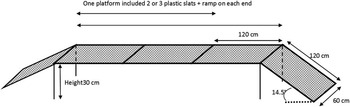
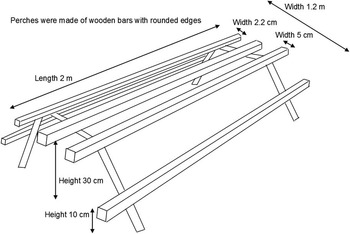
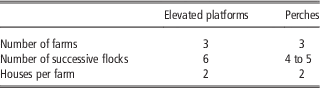
The use of elevated platforms (Figure 1) was followed throughout six successive flocks on three farms. Due to unexpectedly low use of perches (Figure 2), perches were followed for only four or five successive flocks on three farms. Each farm had at least two separate houses, enabling the comparison of furnished flocks (with platforms or perches) to control flocks during each batch. Two farms supplied four houses, making it possible to test both perches and platforms. Table 1 provides an overview of the setup. Either elevated plastic platforms covering 10% of the floor area or perches 15 cm/bird calculated for 10% of the birds were provided in one house. The amount of perch and platform space chosen was based on practical considerations. The control and furnished houses were alternated between the flocks. Chicks had access to the perches from the 1st day, and access to the platforms was offered during the 1st week, between day 3 and day 7. The equipment was removed 1 day before slaughter. At each end a ramp allowed easy access to the platform; the entire platform structure is referred as platform in this text onwards. Platforms were made of plastic slats commonly used in laying hen and breeder houses (Figure 1). The holes in the slats measured 20×25 mm, whereas the surrounding plastic grid was 8-mm wide. A perch structure included horizontal perches of two heights and two widths. The platform and perch structures were high enough (30 cm) to allow the birds also to use the floor space underneath and were evenly distributed in the house in order to give the same opportunity for all the birds to use them.
Illustration of the elevated platform structure.

Illustration of the perch structure.

Summary of perch and platform treatments on broiler farms

Measurements
Farmers were asked to note the day they saw the first birds on perches or platforms and estimate the overall usage of platforms and perches twice a week. They were instructed to assess the use in the morning from the middle of the house, after allowing birds to familiarize to the presence of observer for 2 min. Two out of four farmers followed the use of both types of equipment, adding reliability of this estimation. The use was scored with a scale: empty=only single birds using the structures, minor use ~25% of the structures used, moderate use >25% to 50% of the structures used, good use >50% to 75% of the structures used and full ~100% of the structures used. One researcher performed all other scoring. All houses on the same farm were scored on the same day.
All test and control flocks were gait scored 1 to 3 days before slaughter (age 34 to 36 days) in the winter (four to five production cycles on each farm) and at around 30 days of age (29 to 31 days) in the summer (two production cycles per farm in platform-equipped houses and their controls) to prevent possible problems caused by hot weather conditions near the slaughter age such as the risk of increased mortality due to additional handling of the birds. Gait scoring followed the protocol described in the WQ protocol applied for broiler chicken by scoring at least 150 birds/flock (Welfare Quality® Consortium, 2009). The scoring scale was from 0=normal gait to 5=unable to walk (Table 2). Birds were confined in a catching pen at five to seven different locations in dimmed light. The assessment locations always represented at least a central part of the house, the wall side and the front and rear end of the house. During the scoring light intensity was increased back to normal. As all the caught birds were scored, the final number of assessed birds was 150 to 172. All birds scored as 3 were killed by neck dislocation for TD examination. In addition, all birds with severe walking difficulties (scores 4 and 5) were culled due to ethical reasons.
Description of the scoring system for broiler gait using a six-point scale (following the Welfare Quality® protocol applied for broiler chicken)

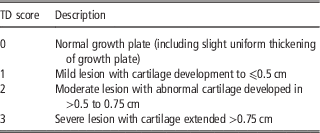
On the farms, the severity of TD was determined in all birds gait scored as 3 (18 to 71 birds/flock), and at the slaughterhouse the severity was assessed in 200 randomly collected birds/flock. The condition of the proximal growth plate of both tibias was assessed with a four-point scale (Table 3). After TD examination on the farm one femur from six randomly chosen birds per flock, without TD lesions, was removed and stored in a plastic bag in a freezer for later laboratory analysis. Bones were defleshed and randomly pooled into pairs. The ash content was determined gravimetrically after dry ashing the bone samples in 500°C±20°C overnight. For the determination of mineral elements (P and Ca), the ash was treated twice with hydrochloric acid (HCl, 6.0 and 0.24 M) and filtered into a volumetric flask. The remainders were again dry ashed in 700°C±20°C for 2 h and treated with hydrofluoric acid and HCl (0.24 M) and then filtered into a volumetric flask. The mineral elements were determined by Optical Emission Spectrometer Optima 8300 (Perkin Elmer, Shelton, CT, USA).
Description of the four-point scoring system for tibial dyschondroplasia (TD) in broilers

Statistical analysis
All statistical analyses were performed with SPSS vs 22. Due to the low use of perches the houses with perches were excluded when analysing the difference from control houses on bone content, walking ability and TD. Effects of scoring age, treatment (platform or control) and farm on mean gait score and the percentage of birds scoring 3 and 4 to 5 were analysed using separate general linear univariate models. For analysis scoring age was categorized as younger (29 to 31 days of age) and older (34 to 36 days of age). The models included scoring age, treatment and farm as fixed factors.
Effects of house size, mean bird density, mean live weight at slaughter, and mean wheat percentage in feeding on mean gait score and the percentage of birds scored as 3 and 4 to 5 were analysed using general linear multivariate model. For analysis house size was categorized as smaller ⩾500 m2 (16 flocks) and larger <500 m2 (33 flocks), mean bird density as lower ⩽39 kg/m2 (19 flocks) and higher >39 kg/m2 (30 flocks), mean live weight at slaughter as lower ⩽2.41 kg (23 flocks) and higher >2.41 kg (26 flocks), and mean wheat percentage in feeding as lower ⩽19% (22 flocks) and higher >19% (27 flocks). The cut-off point for house size, live weight and wheat percentage was based on the structure of the data, whereas the density cut-off point was based on the legislative standard. The model included house size, mean bird density, mean live weight at slaughter age and mean wheat percentage as fixed factors.
As the data of TD did not meet the assumptions of normality it was analysed with non-parametric tests. TD percentage, the number of birds with each TD score assessed at slaughter, TD percentage and the number of birds with each TD score in birds with gait score 3 were used as outcome variables. The effect of platforms on TD was analysed separately using the independent samples Mann–Whitney U test. The effect of gait scoring age (categorized as previously mentioned) on TD percentage in birds with gait score 3 was analysed with the Mann–Whitney U test. The effect of farm on the same outcomes was analysed separately with the independent samples Kruskal–Wallis test. Each bird was included into analysis according to its highest TD score. Furthermore, the effect of house size, bird density, mean live weight at slaughter and mean wheat percentage in feeding on TD was analysed separately with the Mann–Whitney U test. For analysis, house size, mean bird density, mean live weight and mean wheat percentage in feeding were categorized as mentioned earlier.
Effects of treatment and sampling age on bone ash and mineral contents were analysed using separate GLMs. Treatment and scoring age were included as fixed factors. Finally, the correlation between bone contents and mean gait score as well as the percentage of birds with gait score 3, were tested using separate linear regression models. The correlations between bone contents and TD percentage was analysed with Spearman’s rank test.
Results
According to the farmers’ bookkeeping the first broilers were detected on perches on average at 9 days of age (6 to 19 days of age). The chicks started to use the platforms immediately when access was allowed, that is between 3 and 7 days of age. Farmers estimated platform use between 50% and 100% in all flocks throughout the entire growing period. Only single birds used the perches, and perch structures were evaluated to be empty throughout all the batches.
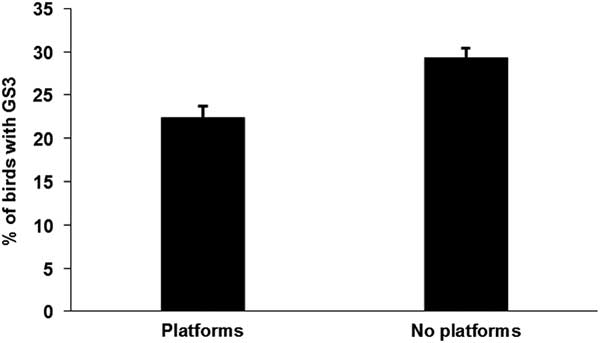
Overall, 30% of the tested birds exhibited gait score ⩾3 (18 to 71 birds/flock). Mean percentages of birds for each score were as follows: score 0: 0.03%±0.02%, score 1: 1.8%±0.2%, score 2: 68.1%±1.1%, score 3: 29.2%±1.1%, score 4: 0.5%±0.08% and score 5: 0.4%±0.08% (Supplementary Figure S1). Scoring age influenced walking ability, with younger scoring age resulting in lower mean gait scores (2.2±0.02 at younger and 2.3±0.01 at older age; P=0.001), percentages of birds scoring 3 (21%±1.6% at younger and 31%±1.0% at older age; P=0.001) and 4 to 5 (0.2%±0.3% at younger and 0.9%±0.2% at older age; P=0.009). Walking ability was enhanced in flocks with access to platforms: mean gait score was lower in birds with platforms (2.2±0.02) compared with no platforms (2.3±0.01; P=0.001). The percentage of birds scoring 3 was lower (P=0.001) in birds with platforms (Figure 3). However, no effect on the percentage of birds scoring 4 to 5 was detected. Farm affected mean gait score (P=0.049), but had no effect on the percentage of birds scoring 3 and 4 to 5. No interaction was found between any of the above variables. House size, mean bird density, mean live weight at slaughter age or mean wheat percentage did not influence mean gait scores or the percentage of birds scored as 3 and 4 to 5.
Mean percentage of broilers with gait score 3 (GS3) with and without access to elevated platforms. Gait scoring was performed following the method described in the Welfare Quality® Assessment protocol for poultry; score 3=moderate gait abnormality. Access to platforms resulted in lower percentage of birds scoring 3 (P=0.001). Error bars indicate SE.

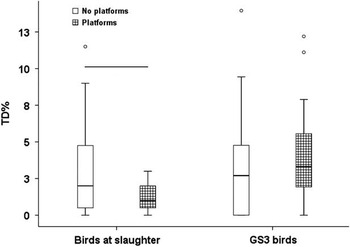
On average, 2.3%, varying between 0% and 12%, of the birds examined at slaughter were affected by TD and 43% of the affected birds had lesions in both legs. In birds with gait score 3 the overall mean occurrence of TD was 3.5%, varying between 0% and 14%. Access to platforms resulted in lower percentage of TD but did not influence TD occurrence in birds with gait score 3 (Figure 4). The severity of TD in birds evaluated at slaughter was reduced by access to platforms (Table 4). The severity of TD in birds with gait score 3 remained unaffected by platform access and scoring age. Farm influenced the occurrence of TD (P=0.001) and TD scores 0 and 1 (P=0.001, each), but not scores 2 and 3. Furthermore, the occurrence of TD as well as TD scores 0 and 1 in birds with gait score 3 differed between farms (P=0.046, P=0.046 and P=0.018, respectively). The larger house size was linked with higher TD percentage, lower proportion of TD score 0 and higher proportion of TD score 1 in birds evaluated at slaughter (P=0.006, P=0.006 and P=0.007, respectively). Likewise, TD percentage was higher in larger houses in birds with gait score 3 (P=0.011). Lower mean live weight at slaughter age was associated with lower TD percentage in birds with gait score 3 (P=0.014), but had no effect on TD examined at slaughter. Bird density or mean wheat percentage in feeding had no effect on TD. Bone ash, Ca and P contents or Ca : P ratio were unaffected by age or access to platforms (Supplementary Table S1). Mean bone Ca : P ratio was 1.83 (SD 0.3). Bone ash and mineral contents were not associated with gait scores or TD.
Median percentage and interquartile range of broilers with tibial dyschondroplasia (TD) lesions in 200 birds assessed at slaughter and of TD in birds with gait score 3 (GS3). Gait was scored at the age of 34 to 36 days of age in the winter or at 29 to 31 days of age in the summer following the method described in the Welfare Quality® Assessment protocol for poultry; score 3=moderate gait abnormality. Line over boxes indicates statistical difference (P=0.038; Mann–Whitney U test).

Median number of tibial dyschondroplasia (TD) affected (scores 1 to 3) and unaffected broilers in control and platform groups examined at slaughter from 200 birds per flock

Min=minimum; max=maximum.
* Mann–Whitney U test.
Discussion
We observed almost no use of perches, whereas platforms were used frequently. The difference was consistent throughout the entire study, during the whole growing period in all flocks. Despite the possible difficulties to accurately estimate the fullness of platforms, the difference in usage of perches and platforms was indisputable and agrees with the actual numbers of birds observed inhabiting the same perches and platforms in one farm (Norring et al., Reference Norring, Kaukonen and Valros2016). Moreover, several earlier studies have shown that the modern fast-growing broiler is reluctant to use conventional perches (Pettit-Riley and Estevez, Reference Pettit-Riley and Estevez2001; Oester et al., Reference Oester, Wiedmer and Witkowski2005). Some laying hen strains also prefer platforms over traditional wooden perches (Faure and Jones, Reference Faure and Jones1982). As the platform and perch structures were similarly distributed across the house, the distance could not have affected the difference in usage. Enlarged breast muscles that have shifted the broiler’s centre of gravity forward (Paxton et al., Reference Paxton, Daley, Corr and Hutchinson2013), and impaired gait associated with selection for fast growth (Kestin et al., Reference Kestin, Su and Sorensen1999) may cause difficulties for broilers to jump and balance on traditional perches. Therefore, we suggest that ramp access increased the acceptance of platforms, as was reported by Oester et al. (Reference Oester, Wiedmer and Witkowski2005). It is possible that if we had used ramps also with the perches, this could have increased perch usage. However, in a previous study, an angled perch, offering easy access from the floor to the perch, did not significantly increase perching (Pettit-Riley and Estevez, Reference Pettit-Riley and Estevez2001). In the present study, platforms may have provided a more pleasant place to lay down instead of balancing on a conventional perch.
Our finding of better walking ability in birds with access to platforms indicates that broilers benefited from the locomotion facilitated by the additional equipment. In fact, walking ability has been shown to be improved by any measures that increase the mobility of broilers such as increased walking distances (Reiter and Bessei, Reference Reiter and Bessei2009; Ruiz-Feria et al., Reference Ruiz-Feria, Arroyo-Villegas, Pro-Martinez, Bautista-Ortega, Cortes-Cuevas, Narciso-Gaytan, Hernandez-Cazares and Gallegos-Sanchez2014), lower stocking density (Knowles et al., Reference Knowles, Kestin, Haslam, Brown, Green, Butterworth, Pope, Pfeiffer and Nicol2008) or exercise equipment (Bizeray et al., Reference Bizeray, Estevez, Leterrier and Faure2002b). Moreover, swapping diets during the day may improve walking ability, probably due to decreased weight gain accompanied by increased activity (Bizeray et al., Reference Bizeray, Leterrier, Constantin, Picard and Faure2002c). Although increased locomotion improves broiler leg health (Bizeray et al., Reference Bizeray, Estevez, Leterrier and Faure2002b; Reiter and Bessei, Reference Reiter and Bessei2009; Ruiz-Feria et al., Reference Ruiz-Feria, Arroyo-Villegas, Pro-Martinez, Bautista-Ortega, Cortes-Cuevas, Narciso-Gaytan, Hernandez-Cazares and Gallegos-Sanchez2014), the positive effect of perching on walking ability has not been obvious in a number of earlier studies (Su et al., Reference Su, Sorensen and Kestin2000; Hongchao et al., Reference Hongchao, Jiang, Song, Zhao, Wang and Lin2014), presumably because perching has been too scarce. In this study, broilers probably walked longer distances to reach the platforms, offering them additional exercise compared with control flocks, even if the birds aimed to go up to the platforms simply to rest. As fast-growing broilers spend excessive times lying down (Weeks et al., Reference Weeks, Danbury, Davies, Hunt and Kestin2000) even slightly increased movement may be sufficient to enhance agility. In addition, access to platforms offered a variety of locomotion: walking forward, up and down, grasping the platform by feet, as well as occasionally jumping or flying. Equipment that encourages versatile exercise triggers changes in both breast and leg muscles (Sandusky and Heath, Reference Sandusky and Heath1988). Alterations in muscles could influence the way broilers walk (Paxton et al., Reference Paxton, Daley, Corr and Hutchinson2013), thus explain the improved walking ability. We suggest that the difference in the results of our and previous studies arises from the use of offered equipment; hence, the enhanced walking ability probably was attributed to the wide use of platforms in this study.
Access to platforms also resulted in a reduced occurrence and severity of TD, contravening several former studies using perches (Bizeray et al., Reference Bizeray, Estevez, Leterrier and Faure2002b; Tablante et al., Reference Tablante, Estevez and Russek-Cohen2003). Again, we could argue that due to the low usage of perches, previous studies may have failed to show an improvement in leg health. Apparently, more space alone is not enough to increase broiler mobility sufficiently to promote improved gait (Sherlock et al., Reference Sherlock, Demmers, Goodship, McCarthy and Wathes2010). On the contrary, extra equipment occupying the floor space, when not used, might increase stocking density on the floor, possibly leading to decreased activity (Tablante et al., Reference Tablante, Estevez and Russek-Cohen2003). We intended to avoid this negative effect by providing platforms high enough to allow birds to use the floor space underneath the structures. Furthermore, diverse locomotion might affect bone characteristics (Bizeray et al., Reference Bizeray, Estevez, Leterrier and Faure2002b); supporting leg health, hence, we can hypothesize that several movement patterns, stimulated by platforms, could have contributed to the lower prevalence and severity of TD in the present study.
In this study, the number of birds with gait scores 0 and 1 was extremely low. In previous field studies, 10% (Kestin et al., Reference Kestin, Knowles, Tinch and Gregory1992) and 25% (Sanotra et al., Reference Sanotra, Lund and Vestergaard2003) of the tested birds have demonstrated normal gait. Moreover, in a large survey performed in the United Kingdom found 29% of the birds exhibited gait scores 0 and 1 (Knowles et al., Reference Knowles, Kestin, Haslam, Brown, Green, Butterworth, Pope, Pfeiffer and Nicol2008). The low number of birds with scores 0 and 1 in the present study could be due to the subjectivity of the gait scoring method, but, alternatively, this could be caused by constant genetic progress in growth rate and size of breast muscles leading to the deterioration of the broiler’s gait (Kestin et al., Reference Kestin, Su and Sorensen1999), thus making comparison with older studies debateable.
On average, 30% of the tested birds had a gait score ⩾3, with the majority of birds scoring 2 or 3. This result is in agreement with several other studies (Kestin et al., Reference Kestin, Knowles, Tinch and Gregory1992; Knowles et al., Reference Knowles, Kestin, Haslam, Brown, Green, Butterworth, Pope, Pfeiffer and Nicol2008). The difference between scores 2 and 3 is partly based on the birds’ manoeuvrability; birds that score 2 do not face difficulties in moving around, whereas this is compromised with birds scoring 3 (Kestin et al., Reference Kestin, Knowles, Tinch and Gregory1992; Welfare Quality® Consortium, 2009), suggesting impaired welfare of the latter group (Kestin et al., Reference Kestin, Knowles, Tinch and Gregory1992; Danbury et al., Reference Danbury, Weeks, Chambers, Waterman-Pearson and Kestin2000). Therefore, our observation of a lower percentage of birds with gait score 3 in platform-equipped houses indicates better welfare in these flocks compared with control flocks.
Not surprisingly, access to platforms had no effect on the percentage of birds scoring 4 and 5. These birds probably suffer from serious leg pathologies (Kestin et al., Reference Kestin, Knowles, Tinch and Gregory1992), reducing their movement in general (Weeks et al., Reference Weeks, Danbury, Davies, Hunt and Kestin2000), thus lessening their interest in using the equipment. The number of birds scoring 4 and 5 is presumably underestimated, as recommended common practice is to cull lame birds (Kestin et al., Reference Kestin, Knowles, Tinch and Gregory1992; Knowles et al., Reference Knowles, Kestin, Haslam, Brown, Green, Butterworth, Pope, Pfeiffer and Nicol2008).
Age has been proven to have a clear effect on the way broilers walk (Vestergaard and Sanotra, Reference Vestergaard and Sanotra1999; Bassler et al., Reference Bassler, Arnould, Butterworth, Colin, De Jong, Ferrante, Ferrari, Haslam, Wemelsfelder and Blokhuis2013), thus our result of better walking ability at younger scoring age was expected. According to several studies, this could also be due to increases in BW with age (Kestin et al., Reference Kestin, Knowles, Tinch and Gregory1992; Sanotra et al., Reference Sanotra, Lawson, Vestergaard and Thomsen2001). We did not weigh the assessed birds, but at flock level, the mean live weight at slaughter age had no effect on walking ability. As we scored the birds at a younger age in the summer, we cannot fully exclude that our result is partly affected by the season. In that case, however, our result contradicts the finding of an earlier investigation that showed better gait in the winter and early spring and worst in late summer (Knowles et al., Reference Knowles, Kestin, Haslam, Brown, Green, Butterworth, Pope, Pfeiffer and Nicol2008).
Overall, the prevalence of TD was fairly moderate in this study compared with several previous studies on commercially reared broilers (Sanotra et al., Reference Sanotra, Lund and Vestergaard2003; Dinev et al., Reference Dinev, Denev and Edens2012). However, comparison with older studies might be irrelevant, as the incidence of TD has been reduced by genetic selection over decades (Kapell et al., Reference Kapell, Hill, Neeteson, McAdam, Koerhuis and Avendano2012). Moreover, the prevalence of TD varies depending on the country of origin (Thorp and Waddington, Reference Thorp and Waddington1997; Sanotra et al., Reference Sanotra, Lund and Vestergaard2003), which could be due to nutritional variation (Thorp and Waddington, Reference Thorp and Waddington1997). Dietary variations might also explain the differences between farms in our study.
We noticed an association between lower mean live weight at slaughter age and lower incidence of TD in birds with gait score 3, which we assume, was linked with lower growth rate. Higher BW (Kestin et al., Reference Kestin, Su and Sorensen1999; Sanotra et al., Reference Sanotra, Lawson, Vestergaard and Thomsen2001) and faster growth rate (Lynch et al., Reference Lynch, Thorp and Whitehead1992) also increase the prevalence of TD, which can be reduced with a restricted diet (Su et al., Reference Su, Sorensen and Kestin1999). Whole wheat in the diet has the potential to improve broiler walking ability (Knowles et al., Reference Knowles, Kestin, Haslam, Brown, Green, Butterworth, Pope, Pfeiffer and Nicol2008). In this study, whole wheat was added to the diet in all farms; however, the study yielded no effect of wheat percentage on leg health.
Some studies show an association between impaired gait and TD (Vestergaard and Sanotra, Reference Vestergaard and Sanotra1999; Sanotra et al., Reference Sanotra, Berg and Lund2002), whereas other studies reveal no correlation (Lynch et al., Reference Lynch, Thorp and Whitehead1992; Garner et al., Reference Garner, Falcone, Wakenell, Martin and Mench2002). However, due to fairly low TD incidence in these birds, we can conclude that TD was not a major cause for impaired walking ability in birds with gait score 3 but evidently other factors are also involved. Our suggestion is in line with previous studies (Garner et al., Reference Garner, Falcone, Wakenell, Martin and Mench2002; Paxton et al., Reference Paxton, Daley, Corr and Hutchinson2013).
As a summary, broilers used the platforms frequently, whereas the perches used in this study remained mostly unused. We assume that access to platforms enables more versatile movement such as walking forward, up and down, grasping by feet and jumping that could have positively impacted walking ability, and contributed to less and milder TD lesions. From our results we conclude that, instead of conventional perches, elevated platforms with ramp access could serve as an appropriate substitute for perches in commercial broiler farms. Adding attractive equipment to broilers’ environment may promote their gait and leg health.
Acknowledgements
Ministry of Agriculture and Forestry, Finland, Finnish broiler industry and Finnish Veterinary Foundation are acknowledged for financing the study. The farmers are thanked for their commitment to this experiment.
Supplementary material
To view supplementary material for this article, please visit https://doi.org/10.1017/S1751731116002160