Adolescents engage in numerous risk behaviors that compromise their health and well-being, including substance use, risky sexual activity, and delinquency. These risk behaviors frequently co-occur (Hair, Park, Ling, & Moore, Reference Hair, Park, Ling and Moore2009; Wu, Witkiewitz, McMahon, & Dodge, Reference Wu, Witkiewitz, McMahon and Dodge2010), and engagement in multiple forms of risk behavior has been found to have an additive influence on poor health and suboptimal development in young adulthood (Hair et al., Reference Hair, Park, Ling and Moore2009; Mason et al., Reference Mason, Hitch, Kosterman, McCarty, Herrenkohl and Hawkins2010). The present study focuses on risk behaviors reported by African American youth living in resource-poor communities in the rural South. Historically, rural residence protected youth from engagement in many risk behaviors. Recent data indicate, however, that rural youth engage in risk behavior at rates that equal or exceed those of urban youth (Kogan, Berkel, Chen, Brody, & Murry, Reference Kogan, Berkel, Chen, Brody and Murry2006; Milhausen et al., Reference Milhausen, Crosby, Yarber, DiClemente, Wingood and Ding2003). For African Americans, studies reveal that involvement in risk behaviors during adolescence disproportionately affects their education, employment, involvement with the criminal justice system, mental health, and physical health (Brook et al., Reference Brook, Adams, Balka, Whiteman, Zhang and Sugerman2004; Chatterji, Reference Chatterji2006; Massoglia, Reference Massoglia2008).
In the ecological-systems perspective, adolescents are viewed as developing within a set of embedded social contexts (Bronfenbrenner, Reference Bronfenbrenner1986). For example, adolescents develop within families, and families select into and are influenced by community contexts. The bioecological model further emphasizes that individual-level biological factors can interact with a broad array of multiple-level contexts to affect human development (Bronfenbrenner & Ceci, Reference Bronfenbrenner and Ceci1994). Despite calls for inclusion of the intricate interplay among multiple levels of social contexts and personal biological characteristics, including genotype (Ellis, Boyce, Belsky, Bakermans-Kranenburg, & van IJzendoorn, Reference Bakermans-Kranenburg and van IJzendoorn2011), little research has considered this complexity.
The present study investigates genetic moderation processes in the development of rural African American youth's risk behavior. It responds to the need for increasing sophistication in the characterization of Gene × Environment interaction (G × E) processes by investigating pathways linking multiple contextual levels and multiple family members’ genotypes (Mills-Koonce et al., Reference Mills-Koonce, Propper, Gariepy, Blair, Garrett-Peters and Cox2007; Rutter, Moffitt, & Caspi, Reference Rutter, Moffitt and Caspi2006). Consistent with bioecological theory focusing on the interaction of individuals and their proximal contexts (Bronfenbrenner & Morris, Reference Bronfenbrenner, Morris, Damon and Lerner2006), we hypothesized that, among rural African American families, disadvantaged community environments would interact with parental genotype to predict parenting behavior. Parenting behavior was hypothesized to interact with youth genotype to affect youth's outlook on the future, which in turn would predict risk behavior. We further hypothesized that community disadvantage would influence youth risk behavior indirectly via this series of G × E interactions.
Environmental Influences on Rural African American Youth's Risk Behavior
Risk behaviors such as substance use, sexual risk, and delinquency pose significant concurrent and downstream threats to adolescents’ psychosocial and physical well-being (D'Amico, Ellickson, Collins, Martino, & Klein, Reference D'Amico, Ellickson, Collins, Martino and Klein2005; Hair et al., Reference Hair, Park, Ling and Moore2009; Oesterle et al., Reference Oesterle, Hill, Hawkins, Guo, Catalano and Abbott2004). These risk behaviors frequently co-occur, particularly in early adolescence (Biglan, Brennan, Foster, & Holder, Reference Biglan, Brennan, Foster and Holder2004; Krueger, Markon, Patrick, Benning, & Kramer, Reference Krueger, Markon, Patrick, Benning and Kramer2007); however, substance use, sexual risk, and delinquency remain strongly associated throughout the high school years (Hair et al., Reference Hair, Park, Ling and Moore2009; Mustanski et al., Reference Mustanski, Byck, Dymnicki, Sterrett, Henry and Bolland2013; Wu et al., Reference Wu, Witkiewitz, McMahon and Dodge2010). Moreover, recent research indicates that engagement in multiple forms of risk behavior may have a particularly deleterious effect, forecasting increases in physical and mental health problems as well as poor academic and employment outcomes in young adulthood (Hair et al., Reference Hair, Park, Ling and Moore2009).
A substantial body of research documents the influence of community environments on youth's involvement in substance use (Brooks, Magnusson, Spencer, & Morgan, Reference Brooks, Magnusson, Spencer and Morgan2012; Lambert, Brown, Philips, & Ialongo, Reference Lambert, Brown, Phillips and Ialongo2004), risky sex (Browning, Burrington, Leventhal, & Brooks-Gunn, Reference Browning, Burrington, Leventhal and Brooks-Gunn2008), and delinquency (Leventhal & Brooks-Gunn, Reference Leventhal and Brooks-Gunn2000; Sampson, Morenoff, & Gannon-Rowley, Reference Sampson, Morenoff and Gannon-Rowley2002). African American families disproportionately reside in disadvantaged communities, characterized by racial segregation, an important driver of multiple institutional disadvantages (Williams & Collins, Reference Williams and Collins2001). This is true in the rural South, where many African American communities are characterized by elevated proportions of single-parent households, receipt of public assistance, and low household income (Boatright, Reference Boatright2009; Sampson, Reference Sampson2012; Williams & Collins, Reference Williams and Collins2001; Wilson, Reference Wilson2012). Community disadvantage potentially affects youth risk behavior via a range of pathways, including peer group influence, risk behavior opportunities, educational quality, and access to structured, after-school leisure activities (Chuang, Ennett, Bauman, & Foshee, Reference Chuang, Ennett, Bauman and Foshee2005; Wallace & Muroff, Reference Wallace and Muroff2002).
Studies of rural African American families suggest that a key pathway linking community disadvantage to youth risk behavior involves community effects on parenting practices (Brody et al., Reference Brody, Murry, Kogan, Gerrad, Gibbons and Molgaard2006; Kogan et al., Reference Kogan, Brody and Chen2011, Reference Kogan, Cho, Allen, Lei, Beach and Gibbons2013). For many African American parents, the daily stress associated with living in a disadvantaged community undermines their ability to engage in a set of risk-reducing protective parenting practices that include high levels of parental monitoring, involvement with youth's academic activities, consistent discipline, and high levels of nurturance (Brody et al., Reference Brody, Ge, Conger, Gibbons, McBride Murry and Gerrard2001; Kogan et al., Reference Kogan, Cho, Allen, Lei, Beach and Gibbons2013; Mrug & Windle, Reference Mrug and Windle2009). This constellation of parenting practices has been linked to African American youth's avoidance of substance use (Brody et al., Reference Brody, Beach, Philibert, Chen, Lei and Murry2009, Reference Brody, Chen, Beach, Kogan, Yu and Diclemente2014), sexual risk (Kogan et al., Reference Kogan, Brody and Chen2011), and conduct problems (Brody, Kogan, Chen, & Murry, Reference Brody, Kogan, Chen and Murry2008). Conversely, youth who experience low levels of protective parenting are at elevated risk for engagement in multiple risk behaviors (Brody, Chen, & Kogan, Reference Brody, Chen and Kogan2010).
Direct effects of protective parenting on risk behavior are evident particularly in early and midadolescence (East, Khoo, & Reyes, Reference East, Khoo and Reyes2006; Farmer et al., Reference Farmer, Price, O'Neal, Leung, Goforth and Cairns2004). As youth exhibit greater autonomy in late adolescence, however, attitudes and self-regulatory competencies internalized through interactions with parents become increasingly important (Brook & Brook, Reference Brook, Brook, McCoy, Metsch and Inciardi1996; Brook, Brook, Gordon, Whiteman, & Cohen, Reference Brook, Brook, Gordon, Whiteman and Cohen1990; Kogan et al., Reference Kogan, Brody and Chen2011). A planful future orientation is one such intrapersonal mechanism hypothesized to link protective parenting practices to risk behavior among rural African American youth during the high school years. A planful future orientation combines positive expectations about the future with an orientation toward setting goals and persisting in their accomplishment (Aronowitz, Reference Aronowitz2005; Brody et al., Reference Brody, Murry, Gerrard, Gibbons, Molgaard and McNair2004; Kogan, Brody, & Chen, Reference Kogan, Brody, Gibbons, Chen, Grange and Simons2011; Wills, Sandy, & Yaeger, Reference Wills, Sandy and Yaeger2001). A planful future orientation locates adolescents’ primary set of psychological influences beyond their current circumstances, which renders them more attentive to the lasting consequences of their behaviors, enhancing their goal setting and persistence (Routledge & Arndt, Reference Routledge, Arndt, Strathman and Joireman2005). In contrast, youth who lack a planful future orientation are influenced more by immediate situational factors and are less likely to inhibit emotional responses to negative environments. Investigations of planful future orientations among African American youth in rural and urban contexts reveal negative associations with substance use (Li et al., Reference Li, Stanton, Cottrell, Burns, Pack and Kaliee2001; Wills et al., Reference Wills, Sandy and Yaeger2001), sexual risk behaviors (Bolland, Reference Bolland2003; Kogan et al., Reference Kogan, Brody, Chen, Grange, Slater and DiClemente2010; Li et al., Reference Li, Stanton, Cottrell, Burns, Pack and Kaliee2001), and delinquency (Bolland et al., Reference Bolland, Bryant, Lian, McCallum, Vazsonyi and Barth2007; Caldwell, Wieber, & Cleveland, Reference Caldwell, Wieber and Cleveland2006; Kerpelman, Eryigit, & Stephens, Reference Kerpelman, Eryigit and Stephens2008).
Disadvantaged communities have been hypothesized to affect rural African American youth's risk behavior by undermining protective parenting, which in turn influences youth's development of a planful future orientation (Kogan et al., Reference Kogan, Cho, Allen, Lei, Beach and Gibbons2013). Prior research suggests that harsh environmental conditions lead youth to perceive their futures as unpredictable, undermining their development of a planful future orientation. This is a proximal risk factor for risk behavior (see Ellis, Figueredo, Brumbach, & Sclomer, Reference Ellis, Figueredo, Brumbach and Schlomer2009; Hill, Ross, & Low, Reference Hill, Ross and Low1997). Studies indicate that adolescents hold more optimistic views about their futures when they receive parental support (Dubow, Arnett, Smith, & Ippolito, Reference Dubow, Arnett, Smith and Ippolito2001; Kenny, Blustein, Chaves, Grossman, & Gallagher, Reference Kenny, Blustein, Chaves, Grossman and Gallagher2003; McCabe & Barnett, Reference McCabe and Barnett2000), and that close relationships with parents are positively related to youth future orientation (Nurmi & Pulliainen, Reference Nurmi and Pulliainen1991; Seginer, Vermulst, & Shoyer, Reference Seginer, Vermulst and Shoyer2004). A planful future orientation may be particularly important for African American youth living in disadvantaged rural environments because they are exposed to few educational and vocational opportunities within their communities (Gore & Aseltine, Reference Gore and Aseltine2003; Sum et al., Reference Sum, Khatiwada, Pond, Trubsky, Fogg and Palma2002).
Dopamine Receptor D4 (DRD4) Polymorphism and Susceptibility to Environmental Factors
Recent studies indicate that both parents and youth vary considerably in the extent to which proximal environmental factors such as community disadvantage and protective parenting practices affect their behavior (Beach et al., Reference Beach, Lei, Brody, Simons, Cutrona and Philibert2012; Belsky & Pluess, Reference Belsky and Pluess2009). A number of candidate genes that affect neurotransmitter activity are thought to modulate the influence of environmental input on individual behavior. Interactions between specific polymorphisms and family environments have been detected for youth substance use (Brody et al., Reference Brody, Beach, Philibert, Chen, Lei and Murry2009, Reference Brody, Chen, Beach, Kogan, Yu and Diclemente2014), sexual risk behavior (Guo, Tong, & Cai, Reference Guo, Tong and Cai2008), and delinquent behavior (Caspi et al., Reference Caspi, McClay, Moffitt, Mill, Martin and Craig2002; Simons et al., Reference Simons, Lei, Beach, Brody, Philibert and Gibbons2011, Reference Simons, Lei, Stewart, Beach, Brody and Philibert2012). A more modest literature suggests that genetic status may interact with aspects of parents’ proximal environments to affect their parenting behavior (Beach et al., Reference Beach, Lei, Brody, Simons, Cutrona and Philibert2012; van IJzendoorn, Bakermans-Kranenburg, & Mesman, Reference van IJzendoorn, Bakermans-Kranenburg and Mesman2008).
The majority of G × E studies investigating youth risk behavior conceptualize the interaction effect from a diathesis–stress perspective. This perspective focuses on the extent to which particular alleles confer vulnerability to adverse social conditions. In contrast, Belsky and Pluess (Reference Belsky and Pluess2009) suggested that some alleles may act to amplify both positive and negative environmental input. From this differential susceptibility perspective, persons who are more vulnerable to adverse social environments also benefit more from positive environments (Belsky, Bakermans-Kranenburg, & van IJzendoorn, Reference Bakermans-Kranenburg and van IJzendoorn2007; Belsky & Pluess, Reference Belsky and Pluess2009; Ellis et al., Reference Ellis, Boyce, Belsky, Bakermans-Kranenburg and van IJzendoorn2011).
The DRD4 polymorphism is associated with neurocognitive systems that regulate risk and reward (Spear, Reference Spear2011). Evidence is accumulating that supports the possibility that the DRD4 gene confers differential susceptibility to the environment (Bakermans-Kranenburg & van IJzendoorn, Reference Bakermans-Kranenburg and van IJzendoorn2007, Reference Bakermans-Kranenburg and van IJzendoorn2011). DRD4 is a variable nucleotide tandem repeat (VNTR) polymorphism composed of 16 amino acid (48 base pairs) repeat polymorphisms that range from 2 to 11 repeats. The 2-, 3-, 4-, and 7-repeat versions account for about 98% of allelic variability (Lichter et al., Reference Lichter, Barr, Kennedy, Van Tol, Kidd and Livak1993). Studies characterize DRD4 alleles as either short or long, with the short category defined as having 6 or fewer repeats and the long category as having 7 or more repeats (Beach et al., Reference Beach, Lei, Brody, Simons, Cutrona and Philibert2012; Brody, Chen, et al., Reference Brody, Kogan and Chen2012; Eisenberg et al., Reference Eisenberg, MacKillop, Modi, Beauchemin, Dang and Lisman2007; Laucht, Becker, Blomeyer, & Schmidt, Reference Laucht, Becker, Blomeyer and Schmidt2007; McGeary, Reference McGeary2009). DRD4 long alleles appear to function in a way that yields a protein structure that produces less reactive D4 receptors in both in vitro and in vivo tests of responsiveness, resulting in weaker transmission of intracellular signals for those with at least one long allele versus two short alleles (Asghari et al., Reference Asghari, Sanyal, Buchwaldt, Paterson, Jovanovic and Van Tol1995; Levitan et al., Reference Levitan, Masellis, Lam, Kaplan, Davis and Tharmalingam2006).
Dopamine regulation is a promising focus for understanding youth risk behavior. Dopamine is released in response to rewarding stimuli, including sexual activity and stimulant drugs. Reward signals initiate a phasic burst of midbrain dopamine neurons, which induce positive emotional states and organize the learning of cues that predict future rewards (Spear, Reference Spear2000a). The dopaminergic system is thus engaged in attentional, motivational, and reward mechanisms (Robbins & Everitt, Reference Robbins, Everitt and Zigmond1999). Reduced dopaminergic signaling impedes learning based on negative feedback (Klein et al., Reference Klein, Neumann, Reuter, Hennig, von Cramon and Ullsperger2007), which in turn may lead to a relative insensitivity to environmental cues and rewarding stimuli (Spear, Reference Spear2000b). This results in a strong preference for immediate reinforcement from the environment and elevated reactivity to high-intensity environmental cues (Tripp & Wickens, Reference Tripp and Wickens2008).
Multiple studies support the hypothesis that DRD4 long alleles confer differential sensitivity to environmental input. For example, Beach, Brody, Lei, and Philibert (Reference Beach, Brody, Lei and Philibert2010) found that African American youth carrying DRD4 long alleles were more responsive to the effects of protective parenting practices, which included child management skills and nurturant-involved parenting practices, on diminished substance use than were those with the short allele. Additional evidence is summarized in a recent review and meta-analysis by Bakermans-Kranenburg and van IJzendoorn (Reference Bakermans-Kranenburg and van IJzendoorn2011). In the present study, we hypothesized that G × E effects involving DRD4 status would demonstrate a pattern conforming to differential susceptibility effects.
Indirect Effects of Community Disadvantage on Risk Behavior via Multilevel G × E Interactions
To date, most G × E research on youth development and risk behavior has focused on the ways in which proximal family environments interact with youth genotype. Far fewer studies, however, have considered the interaction of parental genotype with the environment in affecting the kind of parenting to which youth are exposed in the family system (for exceptions see Beach et al., Reference Beach, Lei, Brody, Simons, Cutrona and Philibert2012; Mills-Koonce et al., Reference Mills-Koonce, Propper, Gariepy, Blair, Garrett-Peters and Cox2007; van IJzendoorn et al., Reference van IJzendoorn, Bakermans-Kranenburg and Mesman2008). In the present investigation, we extended the research base on G × E interactions by linking multilevel contextual factors, such as community disadvantage and protective parenting practices, to both parental and youth genotypes. Our hypotheses are summarized in Figure 1.
Conceptual model.

We expected community disadvantage to influence youth risk behavior via a series of indirect effects involving protective parenting and youth's planful future orientations when both parents’ and youth's DRD4 status were considered. We predicted that community disadvantage would interact with parental DRD4 status to forecast their engagement in protective parenting practices. Protective parenting, in turn, was hypothesized to interact with youth DRD4 status to predict changes in youth's planful future orientations, which would affect changes in risk behavior. In each case, we also determined whether specific G × E interactions would be best characterized as differential susceptibility or diathesis–stress models.
Methods
Participants
Study hypotheses were tested with 361 African American youth (159 male and 202 female) and their primary caregivers who resided in six counties in Georgia selected on the basis of their rurality (>50% of census tracts designated rural) and the proportion of the population that was African American (>20%). The communities are representative of the Southern “Black Belt” (Wimberly & Morris, Reference Wimberly and Morris1997), a geographic concentration of rural poverty characterized by the nation's worst economic and child health disparities by race (Hartley, Reference Hartley2004). Families were recruited randomly from lists that public schools provided. Data were collected within the context of a family-based prevention study at intervals timed to evaluate the prevention program. Because the present study hypotheses were not focused on intervention efficacy, random assignment to the intervention program or to an attention control program was controlled. Three waves of data spanning 3 years were obtained in 2006, 2008, and 2009. Youth's mean ages were 16 years at Time 1 (T1; SD = 0.56), 17.5 years at Time 2 (T2; SD = 0.54), and 18.6 years at Time 3 (T3; SD = 0.56).
The families’ demographic characteristics were representative of the areas in which they lived (Boatright, Reference Boatright2009). Of the primary caregivers, 88.5% were the youth's biological mothers, 33.8% of whom were married at baseline. The remaining caregivers were grandparents (7%), aunts/uncles (2%), siblings (0.6%), and other adults (1.9%). The caregivers’ mean age was 43 years (SD = 8.29) at T1, and their educational backgrounds ranged from less than a high school diploma (25%) to a bachelor's or graduate degree (6%); the modal education level (69%) was a high school diploma or GED. Mean family income was $1,761 per month.
Procedures
Families were contacted and enrolled in the study by African American community liaisons who resided in the counties where the participants lived. The community liaisons were selected on the basis of their social contacts and standing in the community; they worked with the researchers on participant recruitment and retention. At all data collection points, parents gave written consent to minor youth's participation, and youth gave written assent or consent to their own participation. During each assessment, one home visit lasting 2 hr was made to each family. At the visits, self-report questionnaires were administered to the primary caregiver and target youth via audio computer-assisted self-interviewing technology on laptop computers. Caregivers were paid $100 and youth were paid $50 at each assessment.
Measures
Community disadvantage
Community disadvantage was assessed using the 2006 census tract data from the American Community Survey. Participants’ residential addresses at T1 were geocoded and matched to census tracts. Census tracts generally include 1,500 to 8,000 residents and are designed to be as homogenous as possible regarding population characteristics, living conditions, and economic status (US Bureau of the Census, 2000). Tract boundaries reflect significant physical (e.g., roads, rivers, and railroads) and demographic (e.g., ethnic composition) features of neighborhoods, which are delineated with the advice of local community members. A total of 36 census tracts were identified in this study; the number of participants residing in a tract ranged from 1 to 41. Median household income in these census tracts ranged from $13,018 to $60,417; median income across the 36 tracts was $29,918. Consistent with prior research (Leventhal & Brooks-Gunn, Reference Leventhal and Brooks-Gunn2000; Sampson, Raudenbush, & Earls, Reference Sampson, Raudenbush and Earls1997; Simons, Simons, Burt, Brody, & Cutrona, Reference Simons, Simons, Burt, Brody and Cutrona2005), we developed a community disadvantage index using four indicators: percentage of female-headed households, percentage of households receiving Temporary Assistance for Needy Families (TANF), per capita annual income, and the proportion of African American families residing in the community. On the basis of studies of both physical morbidity and psychological dysfunction that support the basic concept of cumulative socioeconomic status risk (see Brody et al., Reference Brody, Yu, Chen, Kogan, Evans and Beach2013, Reference Brody, Chen, Beach, Kogan, Yu and Diclemente2014), an index of cumulative community disadvantage was developed. Risk factor thresholds were set at the first quartile for percentages of female-headed households, receipt of TANF, and African American families, and at the fourth quartile for per capita annual income. Each indicator was coded dichotomously (0 = absent, 1 = present). Scores were summed to indicate the extent of community disadvantage, yielding an index that ranged from 0 to 4 (M = 1.27, SD = 1.38).
Protective parenting
At T1, parents completed a 14-item scale about three aspects of protective parenting practices that have been linked with adolescent adjustment and risk behavior in previous research (Brody et al., Reference Brody, Chen, Beach, Kogan, Yu and Diclemente2014; Cleveland, Gibbons, Gerrard, Pomery, & Brody, Reference Cleveland, Gibbons, Gerrard, Pomery and Brody2005). The measure included items about parental monitoring (4 items; e.g., “How often do you know when your teen gets in trouble at school or someplace else away from home?” and “How often do you know who your teen is with when he/she is away from home?”), nurturant parenting (5 items; e.g., “How often does your teen talk to you about things that bother him/her?” and “How often do you ask your teen what he/she thinks before making decisions that affect him/her?”), and parental academic involvement (5 items; e.g., “How often do you talk about the importance of finishing high school?” and “How often do you discuss going to college with your teen?”). The response set for parental monitoring and nurturant parenting ranged from 1 (never) to 4 (always); the items for parental academic involvement were rated on a scale ranging from 1 (never) to 6 (4 or more times per week). The items were standardized and summed to form the protective parenting scale (M = 0.00, SD = 2.18, α = 0.78).
Planful future orientation
At T1 and T2, youth reported their planful future orientation using the Perceived Life Chances Scale and the State Hope Scale. The Perceived Life Chances scale (Jessor, Donovan, & Costa, Reference Jessor, Donovan, Costa, Hurrelmann and Hamilton1996) includes 10 items that measure one's estimation of achieving certain adaptive life goals, on a 5-point scale (1 = very low, 5 = really high). Items assessed perceived chances of outcomes such as going to college, having a job that I enjoy doing, having a job that pays well, and having a happy family life. The Cronbach α was 0.93. The State Hope Scale (Snyder et al., Reference Snyder, Sympson, Ybasco, Borders, Babyak and Higgins1996) included 6 items that addressed youth's beliefs in their capacity to initiate actions and to generate routes for reaching goals. Example items include “At this time, I am meeting the goals that I have set for myself” and “I can think of many ways to reach my current goals.” The response set ranged from 1 (really false) to 5 (really true); the Cronbach α was 0.87. The measures were standardized and summed to form the planful future orientation construct (α = 0.78). The mean scores for the planful future orientation variable were 0.00 (SD = 1.73) for T1 and 0.00 (SD = 1.74) for T2.
Risk behavior
We assessed youth's risk behavior at T1 and T3 using self-reports of substance use, delinquent behavior, and sexual risk. A three-item scale was used to assess substance use per prior research with African American youth (Brody, Kogan, & Chen, Reference Brody, Chen, Yu, Beach, Kogan and Simons2012; Brody et al., Reference Brody, Chen, Beach, Kogan, Yu and Diclemente2014). Youth indicated the number of times during the past 3 months they had used alcoholic beverages (beer, wine, wine cooler, or other liquor), drunk a lot of alcohol at one time, and used marijuana. The response set ranged from 0 (none) to 6 (more than 30 times); Cronbach α was 0.69. Delinquent behavior was measured using eight questions from the National Youth Survey (Elliott, Huizinga, & Ageton, Reference Elliott, Huizinga and Ageton1985). The scale indicated how many times during the past 6 months youth committed acts such as theft, truancy, fighting, and vandalism, and how many times they were suspended from school; the Cronbach α was 0.69. Youth's sexual risk behavior was assessed using three items for which youth provided specific numbers: “In the past 3 months, how many people have you had sex with?”; “In the past 3 months, how many times have you had sex?”; and “In the past 3 months, out of the times you have had sex, how many times did you have sex while high on alcohol or drugs?” Items were standardized and then summed to produce the sexual risk behavior index. The Cronbach α was 0.78. Confirmatory factor analysis of the three indicators of risk behavior indicated a single factor with loadings that ranged from 0.62 for delinquent behavior to 0.78 for substance use at T1 and T3. We subsequently used the factor score to form a global assessment of youth's risk behavior.
Genotyping
Participants’ DNA was obtained using Oragen DNA kits (DNA Genotek, Kanata, Ontario). Parents and youth rinsed their mouths with tap water and then deposited 4 ml of saliva in the Oragene sample vial. The vial was sealed, inverted, and shipped via courier to a central laboratory in Iowa City, Iowa, where samples were prepared according to the manufacturer's specifications. The genotype at DRD4 was determined for each participant using the primers F-GGCGTTGCCGCTCTGAATGC and R-GAGGGACTGAGCTGGACAACCAC, standard Taq polymerase and buffer, and standard deoxynucleotide triphosphates with the addition of 100 mM 7-deaza GTP and 10% DMSO (Bradley, Dodelzon, Sandhu, & Philibert, Reference Bradley, Dodelzon, Sandhu and Philibert2005). The resulting polymerase chain reaction products were electrophoresed on a 6% nondenaturing polyacrylamide gel, and the products were visualized using silver staining. The genotype was then called by two individuals blind to the study hypotheses and other information about the participants. For tests of the G × E hypotheses, DRD4 status was dummy coded; participants with at least one long allele were assigned a code of 1 (43.8% of parents; 47.4% of target youths), and participants who were homozygous for the short allele were assigned a code of 0 (56.2% of parents; 52.6% of target youths). Using the Hardy–Weinberg equilibrium test, the observed distribution of DRD4 did not differ significantly from that predicted on the basis of simple Mendelian inheritance.
Control variables
Three variables were controlled that might have influenced the relations among study variables. Consistent with our past research (Brody et al., Reference Brody, Chen, Beach, Kogan, Yu and Diclemente2014; Kogan et al., Reference Kogan, Yu, Brody, Chen, DiClemente and Wingood2012), an index of family socioeconomic status was developed using five dichotomous variables: family poverty based on federal guidelines, caregiver unemployment, receipt of TANF, female-headed households, and caregiver education level less than high school graduation. Each indicator was coded dichotomously (0 = absent, 1 = present), and the scores were summed to form an index that ranged from 0 to 5 (M = 1.83, SD = 1.22). Youth gender (0 = female, 1 = male) was controlled. Finally, in all analyses, we controlled for intervention program assignment in the randomized prevention trial. Families were assigned to one of two family-centered, five-session programs. A dichotomous variable was specified (1 = treatment, 0 = attention control).
Analysis plan
The hypotheses for the present study were tested using structural equation modeling with complex designs as implemented in Mplus (Muthén & Muthén, Reference Muthén and Muthén1998–2010). Because respondents were clustered within census tracts, the error terms of regression models were not independent, leading to an underestimation of standard errors. To avoid this problem, we used the complex analysis to adjust parameter standard errors for interdependence in the data. Interaction terms were used to test the G × E pathways. To produce a common scale, standardized regression weights were used in which all study variables were standardized (a mean of 0 and a standard deviation of 1) before the interaction terms were calculated. Benefits of standardized weights in the interaction model include making coefficients easier to interpret, reducing multicollinearity, and making the simple slope easier to test (Dawson & Richter, Reference Dawson and Richter2006). We conducted post hoc analyses of significant interaction terms using the Johnson–Neyman (J-N) technique (Hayes & Matthes, Reference Hayes and Matthes2009). This procedure identifies regions of significance for interactions between continuous (i.e., community disadvantage and protective parenting) and categorical (i.e., genotypes) variables. We tested the conditional indirect effects of community disadvantage on youth's risk behavior when both parent and youth have DRD4 long allele using Monte Carlo integration methods (Hayes, Reference Hayes2013; Preacher, Rucker, & Hayes, Reference Preacher, Rucker and Hayes2007). This approach can estimate the power of a test for each individual parameter of the model and account for specific data characteristics when a sampling design includes multiple levels (Thoemmes, MacKinnon, & Reiser, Reference Thoemmes, MacKinnon and Reiser2010).
To assess goodness of fit, we used root mean square error of approximation (RMSEA; Browne & Cudeck, Reference Browne and Cudeck1992), comparative fit index (Bentler, Reference Bentler1990), and chi-square divided by its degrees of freedom (fit ratio). The comparative fit index was truncated to range from 0 to 1; values close to 1 indicated a very good fit (Bentler, Reference Bentler1990). An RMSEA smaller than 0.05 indicates a close fit; an RMSEA between 0.05 and 0.08 suggests a reasonable fit (Browne & Cudeck, Reference Browne and Cudeck1992).
Results
Preliminary analyses
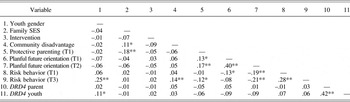
Attrition analyses were conducted to evaluate predictors of nonparticipation based on project attrition and refusal to provide DNA. The original sample at T1 comprised 502 youth and their parents. At T3, the 464 youth and their parents remaining in the study were asked to provide DNA. Study hypotheses were tested with the 361 youth and their parents who agreed to provide DNA. We investigated differences on all study variables at T1 between retained participants and those who left the study by T3, and between participants at T3 who agreed or refused to provide DNA. No differences were detected. We next checked for evidence of gene–environment correlations (rGE), a nonrandom distribution of environments among people with different genotypes. Prior research has showed that rGE likely confounds G × E effects (Caspi & Moffitt, Reference Caspi and Moffitt2006). Table 1 presents zero-order correlations for the study variables; no associations of parent or youth genotype with the study variables were significant, ruling out potential rGE effects. Finally, we assessed racial admixture using the Structure program version 2.3.4 (Falush, Stephens, & Pritchard, Reference Falush, Stephens and Pritchard2007) with a panel of 24 ancestrally informative markers to infer the number of ancestral populations and to estimate an ancestry proportion for each participant. Including the racial admixture variable as a covariate did not change any results; we thus report our findings without ancestry controlled.
Correlations among the study variables (N = 361)
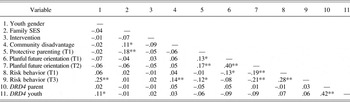
Note: SES, Socioeceonomic status; T1, Time 1; T2, Time 2; T3, Time 3; DRD4, dopamine receptor D4 gene.
*p < .05. **p < .01.
Multilevel G × E interaction processes predicting changes in risk behavior
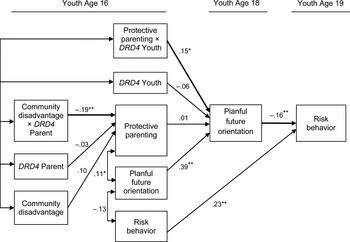
Figure 2 presents the structural equation modeling for hypothesized indirect pathways. In the sections that follow, we describe the portion of the model representing the interaction of community characteristics and parental genotype on protective parenting. Then, we focus on the interaction effect of protective parenting and youth genotype on a planful future orientation, an outcome proximal to risk behavior. After this, we present the results of indirect effect tests.
Test of study hypotheses (χ2 = 54.73, df = 47, p = .20, root mean square error of approximation = 0.03, comparative fit index = 0.98, N = 361). Standardized coefficients are shown. Family socioeconomic status, target gender, and program intervention effects were controlled. *p < .05. **p < .01.

Community Disadvantage × Parent's DRD4 effects on protective parenting
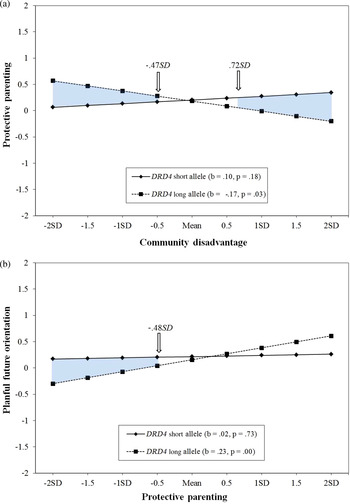
The results presented in Figure 2 indicate that the parameter representing the interaction between community disadvantage and parent's DRD4 status significantly predicted protective parenting (β = –0.19, p < .01). Figure 3a depicts the effect of parent's DRD4 on protective parenting for levels of community disadvantage ranging from –2 to +2 SD from the mean. The slope indexing the effect of community disadvantage on protective parenting for parents carrying DRD4 long allele was significantly different from zero (b = –0.17, p < .05), whereas the slope for parents carrying only DRD4 short allele was not significantly different from zero (b = 0.10, p = .18). Thus, the effect of community disadvantage on protective parenting emerged only for parents carrying DRD4 long allele.
(Color online) (a) Community Disadvantage × Parental DRD4 effects on protective parenting and (b) Protective Parenting × Youth DRD4 effects on a planful future orientation.

The graph of the interaction depicted in Figure 3a demonstrated the crossover pattern that suggests a differential susceptibility effect. The J-N technique (Preacher et al., Reference Preacher, Rucker and Hayes2007) was used to assess regions of significant difference attributable to different alleles of DRD4. A differential susceptibility model produces relatively equal regions of significance on both sides of the graph. The shaded areas in Figure 3a represent the regions of significant difference for the G × E interaction effect. The J-N technique yields an index that addresses the equality of the regions of significance, called the proportion of the interaction areas (PoI); scores near 0.50 indicate relatively equal significance on both sides of the interaction. The PoI in this case was 0.58, which is within the range consistent with differential susceptibility effects (Roisman et al., Reference Roisman, Newman, Fraley, Haltigan, Groh and Haydon2012).
Protective Parenting × Youth DRD4 effects on a planful future orientation
Consistent with our hypotheses, the data presented in Figure 2 demonstrated that the interaction term between protective parenting and youth genotype at DRD4 was associated significantly with increases in planful future orientation (β = 0.15, p < .05), which, in turn, was associated with youth risk behavior at age 19 (β = –0.16, p < .01). Analyses of the simple slopes (see Figure 3b) indicated that protective parenting enhanced a planful future orientation only for youth with a DRD4 long allele (DRD4 long allele, b = 0.23, p < .01; DRD4 short allele, b = 0.02, p = .73). The J-N technique identified a region of significant difference confined to one side of the interaction effect. This indicated that DRD4 conferred vulnerability to low levels of protective parenting when protective parenting was less than –0.48 SD below the sample mean; however, high levels of protective parenting for DRD4 long allele youth did not result in increases in planful future orientation. In this case, the G × E interaction was more consistent with a diathesis–stress model than a differential susceptibility model (PoI = 0.25).
Indirect effects linking community disadvantage to youth risk behavior
Table 2 presents the conditional indirect effects linking multilevel G × E processes to youth's planful future orientation and subsequent changes in youth risk behavior. A significant indirect effect linked community disadvantage to changes in youth's planful future orientation via protective parenting when both parent and youth carried DRD4 long allele; β = –0.03, 95% confidence interval (CI) = (–0.060, –0.008). A significant indirect effect also linked protective parenting to changes in risk behavior through planful future orientation when youth carried DRD4 long allele; β = –0.03, 95% CI = (–0.063, –0.007). Finally, the indirect effect of community disadvantage on risk behavior via protective parenting and planful future orientation was significant only when DRD4 status of both parents and youth are considered; β = 0.01, 95% CI = (0.003, 0.015).
Conditional indirect effects on youth risk behavior in a condition of parent and youth dopamine receptor D4 long allele status

Discussion
Drawing on bioecological (Bronfenbrenner & Ceci, Reference Bronfenbrenner and Ceci1994) and differential susceptibility (Belsky et al., Reference Belsky, Bakermans-Kranenburg and van IJzendoorn2007; Belsky & Pluess, Reference Belsky and Pluess2009) perspectives, we tested a series of multilevel G × E hypotheses predicting African American youth's risk behavior from ages 16 to 19. Consistent with our hypotheses, the effects of community disadvantage on protective parenting and the effects of protective parenting on youth's planful future orientation were moderated by parent and youth DRD4 status. Specifically, parents’ exposure to community disadvantage predicted their provision of protective parenting practices only when parents carried DRD4 long allele. Protective parenting in turn predicted youth's development of a planful future orientation, a proximal predictor of risk behavior, when youth carried DRD4 long allel. We subsequently tested the hypothesis that the pathway linking community disadvantage to youth risk behavior via protective parenting and planful future orientation would be evident only when both parents’ and youth's DRD4 status was considered. The indirect effect analysis supported this hypothesis.
Informed by research on differential susceptibility to environmental exposures, we also examined the possibility that parent and youth DRD4 operated to increase environmental sensitivity in a “for better and for worse” manner or conferred vulnerability to negative environments. Results were mixed for parent and youth genotypes. For the interaction effect of community disadvantage and parents’ DRD4 on protective parenting, this association emerged as a differential susceptibility effect. For the effect of protective parenting on increases in youth's planful future orientation, however, the evidence was consistent with the diathesis–stress perspective.
Most research on G × E interaction effects on youth development has focused on a range of proximal environments interacting with youth genotypes. In this study, we extended this literature by examining the ways in which community environments interacted with parental genotype at DRD4 to forecast parenting behavior. We found that exposure to community disadvantage did not predict parenting behavior among parents who did not carry DRD4 long allele. In contrast, among parents who carried one or two copies of the long allele, community disadvantage predicted diminished protective parenting characterized by monitoring, nurturance, and academic involvement. We are aware of two other studies that have examined Parent Genotype × Environment interaction effects on parenting behavior. Van IJzendoorn et al. (Reference van IJzendoorn, Bakermans-Kranenburg and Mesman2008) found that, among parents of infants, dopamine-related genes moderated the influence of daily hassles on parenting behavior. Similar to the present study, parents displayed less sensitivity to their children's needs when they were stressed by daily hassles, but only in the group of parents who had the DRD4 long allele and catechol-O-methyltransferase (COMT)-valine alleles. Beach et al. (Reference Beach, Lei, Brody, Simons, Cutrona and Philibert2012) found that parents with DRD4 long allele who were exposed to community stress developed patterns of negative emotionality that affected their relationships with their children. Taken together, these studies, in which different sources and methods were used, suggest that DRD4 genotype may interact with contextual circumstances to affect parenting behavior.
Our finding that youth's DRD4 status moderated the influence of protective parenting on planful future orientation is consistent with a number of studies investigating youth DRD4 and family environments. Most of this research, however, has focused on the interaction effects of youth DRD4 Genotypes × Family Environments on risk behaviors without consideration of intermediate phenotypes such as planful future orientations (Bakermans-Kranenburg & van IJzendoorn, Reference Bakermans-Kranenburg and van IJzendoorn2006; Bakermans-Kranenburg & van IJzendoorn, Reference Bakermans-Kranenburg and van IJzendoorn2007; Beach et al., Reference Beach, Brody, Lei and Philibert2010; Propper, Willoughby, Halpern, Carbone, & Cox, Reference Propper, Willoughby, Halpern, Carbone and Cox2007). Our focus on the intermediate phenotype, planful future orientation, is a response to recent requests for investigations of intermediate mechanisms that account more precisely for G × E interactions. For example, Brody et al. (Reference Brody, Chen, Yu, Beach, Kogan and Simons2012) found the effect of DRD4 × Life Stress on substance use was mediated by changes in substance use vulnerability cognitions and increases in affiliations with substance-using peers. Our findings suggest that a planful future orientation is a plausible intermediate mechanism linking DRD4 × Rearing Environment to youth risk behavior.
We also sought to determine whether the G × E effects were consistent with the diathesis–stress or the differential susceptibility perspective. The Parent Genotype × Community Disadvantage interaction effect on protective parenting was consistent with the differential susceptibility perspective. Protective parenting among parents carrying DRD4 long allele was undermined in highly disadvantaged community environments but was enhanced in favorable environments. This finding is consistent with Beach et al. (Reference Beach, Lei, Brody, Simons, Cutrona and Philibert2012), who documented a “for better and for worse” effect for DRD4 × Community Context in predicting parents’ negative arousal, a proximal determinant of parenting behaviors. Van IJzendoorn et al. (Reference van IJzendoorn, Bakermans-Kranenburg and Mesman2008) reported that combinations of COMT and DRD4 moderated the influence of daily hassles on maternal sensitivity; however, evidence for differential susceptibility is unclear (Belsky, Reference Belsky, Booth, McHale and Landale2011). Additional research involving parenting behaviors is needed to clarify further the role of DRD4 in conferring differential susceptibility.
The effects of protective parenting on youth's planful future orientations were moderated by youth DRD4 in a “for worse” manner indicative of a diathesis–stress effect. Youth with the DRD4 long allele who received little protective parenting reported diminished planful future orientations. There was, however, no evidence for a “for better” effect in which heightened protective parenting led to significant enhancement of planful future orientation among youth with the DRD4 long allele. Relatively few studies, however, investigate intermediate phenotypes, and among those we aware of, only two tested for differential sensitivity. Simons et al. (Reference Simons, Lei, Beach, Brody, Philibert and Gibbons2011) found that a combined assessment of community and family environments interacted with youth's cumulative gene index to predict youth hostility in a manner consistent with differential susceptibility. Similarly, Belsky and Beaver (Reference Belsky and Beaver2011) found differential susceptibility effects of parenting practices and a cumulative gene index on male adolescents’ self-regulation. Contradictory findings in our study may be the result of prior studies using a cumulative gene index rather than a single genotype. However, given the paucity of G × E studies on intermediate phenotypes, additional research is warranted to determine the specific environmental conditions under which various kinds of measures detect differentially sensitive effects for DRD4 long allele.
To date, little research has considered the joint effects of parent and youth genotypes interacting with environmental factors to forecast youth behavior. Our analyses suggested that community environments affected youth risk behavior indirectly via a series of indirect effects involving protective parenting and youth's planful future orientations when the DRD4 statuses of both parents and youth are considered. Significant indirect effects were detected across the pathways linking Community Disadvantage × Parental DRD4 Status effects on protective parenting to Protective Parenting × Youth DRD4 Status effects on planful future orientation (linking parent G × E processes to youth G × E processes). The indirect effects model, operating through both parental and youth G × E processes, underscores the need to document the pathways through which members of a family system with varying genotypes shape the environment in which others’ development and behavior take place.
Several methodological strengths in the present study are noteworthy. We used multiple-informant and multimethod assessments gathered from the US Census, parents, and youth. Census tract data were used to obtain an objective assessment of community disadvantage. We also used both parent and youth reports and alternated these reports to minimize self-report bias in the links between parenting and planful future orientation. Both planful future orientation and risk behavior were assessed by youth report, producing the potential for self-report bias to inflate the association of these factors. This concern was mitigated somewhat by the evaluation of these variables at different time points and the use of a baseline control. Some limitations of the research also should be noted. Only one genetic polymorphism was examined in this study. A number of genetic variants are under investigation that may alter risk or environmental sensitivity, although DRD4 is among the best documented and characterized polymorphisms (Bakermans-Kranenburg & van IJzendoorn, Reference Bakermans-Kranenburg and van IJzendoorn2006; Brody et al., Reference Brody, Chen, Yu, Beach, Kogan and Simons2012; Propper et al., Reference Propper, Willoughby, Halpern, Carbone and Cox2007). It also should be noted that, although we coded DRD4 alleles as six or fewer repeats versus seven or more repeats, some studies focus on the four-repeat allele versus the seven-repeat allele (Beach et al., Reference Beach, Brody, Lei and Philibert2010) or on the seven-repeat allele versus all others (Bakermans-Kranenburg & van IJzendoorn, Reference Bakermans-Kranenburg and van IJzendoorn2006). In addition, the findings focused on rural community contexts; thus, the results may not generalize to other settings. These limitations notwithstanding, the present study demonstrates the ways in which community disadvantage, protective parenting, and both parents’ and youth's DRD4 status combine to influence youth risk behavior via a planful future orientation. The results suggest a continued need for studies that integrate transactional developmental perspectives and G × E research. Such research expands the focus of individual differences to include exposure to environmental characteristics in accounting for complex transactions among family members and communities over time.