Background
Involuntary admissions to psychiatric hospitals are becoming increasingly more common in Canada (Lebenbaum, Chiu, Vigod, & Kurdyak, Reference Lebenbaum, Chiu, Vigod and Kurdyak2018) and several European countries, including the UK, France, and Germany (Priebe et al., Reference Priebe, Badesconyi, Fioritti, Hansson, Kilian, Torres-Gonzales and Wiersma2005; Salize & Dressing, Reference Salize and Dressing2004). While involuntarily admitting patients may sometimes be required to protect the safety of the patient and others, these decisions need to be carefully considered by the clinical team given that they limit patient autonomy. Prior studies suggest that involuntary admissions may negatively affect the patients' perceptions of their care both during and after the admission (Kallert, Glöckner, & Schützwohl, Reference Kallert, Glöckner and Schützwohl2008; Priebe et al., Reference Priebe, Katsakou, Glöckner, Dembinskas, Fiorillo, Karastergiou and Raboch2010). Furthermore, involuntary admissions are controversial since beyond impacts on the patient experience, there are other negative impacts on patients such as possible increased risks of further involuntary admissions (Kallert et al., Reference Kallert, Glöckner and Schützwohl2008) and links to strong emotional reactions such as shame and self-contempt (Rüsch et al., Reference Rüsch, Müller, Lay, Corrigan, Zahn, Schönenberger and Rössler2014). While the link between patient characteristics including severity and socio-demographic characteristics and the likelihood of involuntary admissions is strong and well characterized (Morgan et al., Reference Morgan, Mallett, Hutchinson, Bagalkote, Morgan, Fearon and Murray2005; Mulder, Koopmans, & Selten, Reference Mulder, Koopmans and Selten2006; Van Der Post et al., Reference Van Der Post, Mulder, Bernardt, Schoevers, Beekman and Dekker2009), a significant amount of the variance in involuntary admissions remains unexplained and there is substantial variation at the ecological level (Weich et al., Reference Weich, McBride, Twigg, Duncan, Keown, Crepaz-Keay and Bhui2017). Relatively few studies have been conducted on how the organizational aspects of the health care system influence the risk of these admissions (Weich et al., Reference Weich, McBride, Twigg, Duncan, Keown, Crepaz-Keay and Bhui2017).
Despite widespread changes of financial incentives and payment models in primary care and hospital care and numerous studies on the evaluation of these changes in Canada, UK, and USA, relatively little research has examined how financial payments affect the delivery of mental health care (Chaix-Couturier, Durand-Zaleski, Jolly, & Durieux, Reference Chaix-Couturier, Durand-Zaleski, Jolly and Durieux2000; Eijkenaar, Emmert, Scheppach, & Schoffski, Reference Eijkenaar, Emmert, Scheppach and Schoffski2013; Mehrotra, Damberg, Sorbero, & Teleki, Reference Mehrotra, Damberg, Sorbero and Teleki2009; Rudoler, De Oliveira, Cheng, & Kurdyak, Reference Rudoler, De Oliveira, Cheng and Kurdyak2017). In Ontario and British Columbia, physicians can be compensated a top-up for completing the paperwork associated with initiating an involuntary hospitalization (i.e. a K623 payment in Ontario), in addition to receiving payment for the clinical assessment that led to the involuntary admission. A recent news investigation into payments for involuntary admissions demonstrated variation across several Canadian hospitals in Canada's largest urban center (Glauser, Reference Glauser2018). How this varies across the entire system and the influence it has on patient outcomes is unknown. To our knowledge, no prior study has examined how physician payments or payment mechanisms may influence the likelihood of involuntary admissions.
We investigated the association between physician payment for completing forms to declare an involuntary status and the likelihood of involuntary admissions using a large population-based North American sample covering the entire province of Ontario, Canada (population ~14 million) and multi-level models with extensive control for patient characteristics. We hypothesized that patients at EDs with greater receipt of payments for completing an involuntary status form would be at an increased likelihood of involuntary admission.
Methods
Setting
Ontario's health care system is a universal health care system which is funded through a tax system that all residents contribute to. Physician and hospital services are covered with no payments required by patients at the point of care. In the emergency department (ED), there is a mix of different payment methods including partial and 100% fee for service (FFS) payments, paying for shifts, by hour, and other payments. Although EDs have discretion over the overall funding model for the ED, EDs do not have discretion over individual fee codes, the existence and value of which are determined by the centralized Ministry of Health for Ontario. This includes the fee code for completing a Form 1.
Population
The inclusion criteria for this population-based cross-sectional study included patients who were Ontario residents admitted to a mental health bed between 1 April 2009 and 31 March 2015, between the ages of 18 and 105 years at the index date (i.e. admission date), had a valid health card number required for data linkage, and had a hospitalization preceded by an ED visit, given the decision regarding involuntary hospitalizations typically happens in the ED visit preceding the hospitalization. We excluded any hospitalizations deemed forensic or informal because the decision regarding involuntary status for these admissions does not apply, hospitalizations with contradictory legal status across records, and hospitalizations preceded by a medical hospitalization of >30 days duration following the ED visit because the relationship between involuntary status upon entry to the psychiatric hospitalization and decisions made during the ED visit regarding involuntary status may no longer have been related. We excluded hospitalizations with possible data quality issues including those without health care eligibility a year prior to index and those with a death date prior to index. We kept one random admission per patient during the study period. Finally, we also excluded hospitalizations that occurred in settings where patients were not able to be involuntarily hospitalized, rural hospitals due to many EDs having a small number of admissions per ED which would be excluded by privacy restrictions or result in unstable estimates and differences in ED characteristics across rural/urban ED. We also excluded small EDs with <30 admissions over the study period to result in more stable estimates and those with fewer than six involuntary hospitalizations over the 5-year period to comply with internal privacy policy regarding public reporting.
Data sources
We used the Ontario Mental Health Reporting System (OMHRS) database which captures all admissions to mental health beds. This database uses a standardized assessment instrument, the Resident Assessment Instrument–Mental Health (RAI-MH) to capture socio-demographic, clinical assessments, and psychiatric diagnoses according to the Diagnostic and Statistical Manual 4th edition. The RAI-MH was developed by the interRAI organization. We linked the OMHRS database to other administrative databases including the Canadian Institute for Health Information hospital Discharge Abstract Database to obtain data on admissions to non-mental health hospital beds; the Ontario Health Insurance Program physician claims database; the National Ambulatory Care Reporting System database to ascertain ED visits; the Registered Persons Database to determine socio-demographic characteristics; and the Immigration Refugees and Citizenship Canada Permanent Resident Database. These datasets were linked using unique encoded identifiers and analyzed at ICES. Approximately 25% of mental health and addiction admissions (source: ICES unpublished data) in Ontario are to non-mental health beds captured in the Discharge Abstract Database which includes suicide attempts treated in intensive care units and overflow admissions to medical beds. These admissions were not included in the sample given the RAI-MH is not implemented in this database resulting in many variables being missing.
Outcome
Our binary outcome was whether the patient was admitted involuntarily or voluntarily. A status of Form 1 or Form 3 at admission was considered involuntary. A Form 1 is an involuntary hold for assessment of up to 72 h and is how the vast majority of involuntary admissions begin in Ontario (Ontario Hospital Association., 2012). After the psychiatric assessment is complete, the patient will become voluntary in status, unless a Form 3 is completed that initiates an involuntary hospitalization of up to 2 weeks. A Form 3 can also be completed at admission. Patients cannot appeal Form 1 but do have the right to appeal a Form 3.
Primary exposure
The main exposure was the payment pattern for Form 1s of each ED. We measured the payment patterns at the ED level as the proportion of involuntary admissions at each ED where a physician received payment for completing a Form 1, which is referred to as a ‘physician K623 payment’. Using involuntary admissions as the denominator enabled isolating the independent effect of payment, while using all admissions as the denominator would just indicate that an involuntary admission occurred. We assessed physician K623 payment during the period between ED entry and the hospital admission date and assessed it over the 5-year period in order to obtain stable estimates for smaller EDs. There are variations in the level of billings for K623s across EDs that are related to the type of hospital (i.e. teaching hospitals have psychiatry residents that do not bill for their visits) and to the general patterns of payment for physician services at an ED.
Covariates
Patient-level covariates that have previously been found to be the predictors of involuntary admissions in Ontario and international studies were included for adjustment. This includes variables measuring socio-demographic characteristics, the pathway to care, prior mental health service use, and clinical need (Lebenbaum et al., Reference Lebenbaum, Chiu, Vigod and Kurdyak2018; Walker et al., Reference Walker, Mackay, Barnett, Rains, Leverton, Dalton-Locke and Johnson2019). We also included system resource factors that may be related to billing choices.
Socio-demographic characteristics included age, sex, living in the lowest two low-income neighborhood quintiles, and whether the individual was an immigrant or a long-term resident (non-immigrant or immigrant migrating prior to 1985).
To assess the pathway to care, we determined whether the patient arrived at the ED in an ambulance, had a medical bed admission lasting <30 days preceding the mental health bed admission, and if in the past week the patient had any outpatient visit to a psychiatrist, family physician for a mental health reason (Steele, Glazier, Lin, & Evans, Reference Steele, Glazier, Lin and Evans2004), or contact with police.
Prior mental health service use included whether during the period from a week to a year prior to the index date, they had a mental health admission, mental health ED visit, visit to a psychiatrist, and visit to a family physician for mental health reasons (Steele et al., Reference Steele, Glazier, Lin and Evans2004). We also assessed whether in the past 5 years, they had an involuntary detainment (i.e. a physician billed a K623 payment) or admission.
From the index hospital record, we determined whether their primary diagnosis was for one of schizophrenia/psychosis, a mood disorder, anxiety disorder, dementia, or other disorder. We only included an indicator for schizophrenia/psychosis in the regression model because of our past findings demonstrating all other diagnoses having a similar association with involuntary admissions relative to schizophrenia/psychosis (Lebenbaum et al., Reference Lebenbaum, Chiu, Vigod and Kurdyak2018). We assessed whether there was any indication based on diagnostic codes in the current admission that the patient had a substance abuse issue or personality disorder. We also assessed their index ED record whether there was a code for self-harm in any diagnostic position. Nurses rated the triage status of the patient on a five-point scale in the ED, which was combined into low (suicidal/depressed or other milder psychiatric complaints and are not agitated), medium (acute psychosis and/or are suicidal), and high triage (patients experiencing acute psychosis/extreme agitation) (Atzema et al., Reference Atzema, Schull, Kurdyak, Menezes, Wilton, Vermuelen and Austin2012). We used a number of interRAI clinical rating scales including the Risk of Harm to Others (RHO), Severity of Self-Harm (SOS), Self-Care Index (SCI), Positive Symptoms Scale (PSS), Mania Scale (MS), and Depression Rating Scale (DRS) (Chiu, Lebenbaum, Newman, Zaheer, & Kurdyak, Reference Chiu, Lebenbaum, Newman, Zaheer and Kurdyak2016; InterRAI, 2017; Lebenbaum et al., Reference Lebenbaum, Chiu, Vigod and Kurdyak2018; Vigod et al., Reference Vigod, Kurdyak, Seitz, Herrmann, Fung, Lin and Gruneir2015). The specific diagnostic codes for each of these conditions and the symptoms and point ranges for each scale have previously been published (Lebenbaum et al., Reference Lebenbaum, Chiu, Vigod and Kurdyak2018).
We also assessed system resource factors such as admission during the morning (1:00–9:00 h), day (9:00–17:00 h) or night (17:00–1:00 h), admission during the week (i.e. Monday to 17:00 h on Friday) or weekend, whether the ED had teaching status, and the supply of psychiatric resources available in the region of residence. These factors may influence the availability of psychiatric consults and other health care resources. Health Care Regional Authorities in Ontario have variable levels of psychiatric resources (Kurdyak et al., Reference Kurdyak, Stukel, Goldbloom, Kopp, Zagorski and Mulsant2014). We combined the 14 regional authorities [i.e. the Local Health Integration Networks (LHINs)] into three groups with high (Toronto Central or Champlain), medium (South West, South East, and Hamilton), or low (remaining nine) resources based on the supply of psychiatrists (Kurdyak et al., Reference Kurdyak, Stukel, Goldbloom, Kopp, Zagorski and Mulsant2014). The supply of psychiatric hospital beds follows a similar pattern across regions to the supply of psychiatrists (Kurdyak et al., Reference Kurdyak, Stukel, Goldbloom, Kopp, Zagorski and Mulsant2014; Ontario Ministry of Health & Long-Term Care, 2012).
Statistical methods
We descriptively assessed the proportion of admissions that were involuntary across all EDs and the variability across EDs in the proportion of involuntary admissions from each ED where there was a physician K623 payment. We ranked all EDs into quintiles of physician K623 payment by the proportion of involuntary admissions accompanied by physician K623 payment, balancing the number of EDs across the groups instead of the number of patients. We examined the distribution of covariates across quintiles of physician K623 payment. We used multilevel logistic regression to determine the unadjusted and fully adjusted (i.e. all covariates were included in the model) association between ED levels of physician K623 payment and involuntary admissions with physician K623 payment measured continuously (i.e. linear association) and as quintiles (Q1 = EDs among the lowest fifth of physician K623 payment). We included a random intercept for each ED to take into account clustering within EDs. We calculated the Variance Partition Coefficient (VPC), which is equivalent to the Intra-class Correlation Coefficient, using the latent response formulation for a null model with only a random intercept and no other coefficients and for the fully adjusted models (Austin & Merlo, Reference Austin and Merlo2017). All clinical scales were added into the model as continuous variables. Patients with missing data were excluded from analyses. All analyses were conducted in SAS version Enterprise Guide 6.1.
The use of data in this project was authorized under section 45 of Ontario's Personal Health Information Protection Act, which does not require review by a Research Ethics Board or patient consent to access data.
Results
A total of 255 201 records met the inclusion criteria. After excluding 10 174 records with contradictory or ineligible legal statuses, 2850 records with possible data quality issues, 104 698 records that were multiples for the same individual, and 14 628 records that were to ineligible/small EDs/hospitals, a total of 122 851 records remained and were included in the final sample with 15 374–30 603 records among each quintile of physician K623 payments.
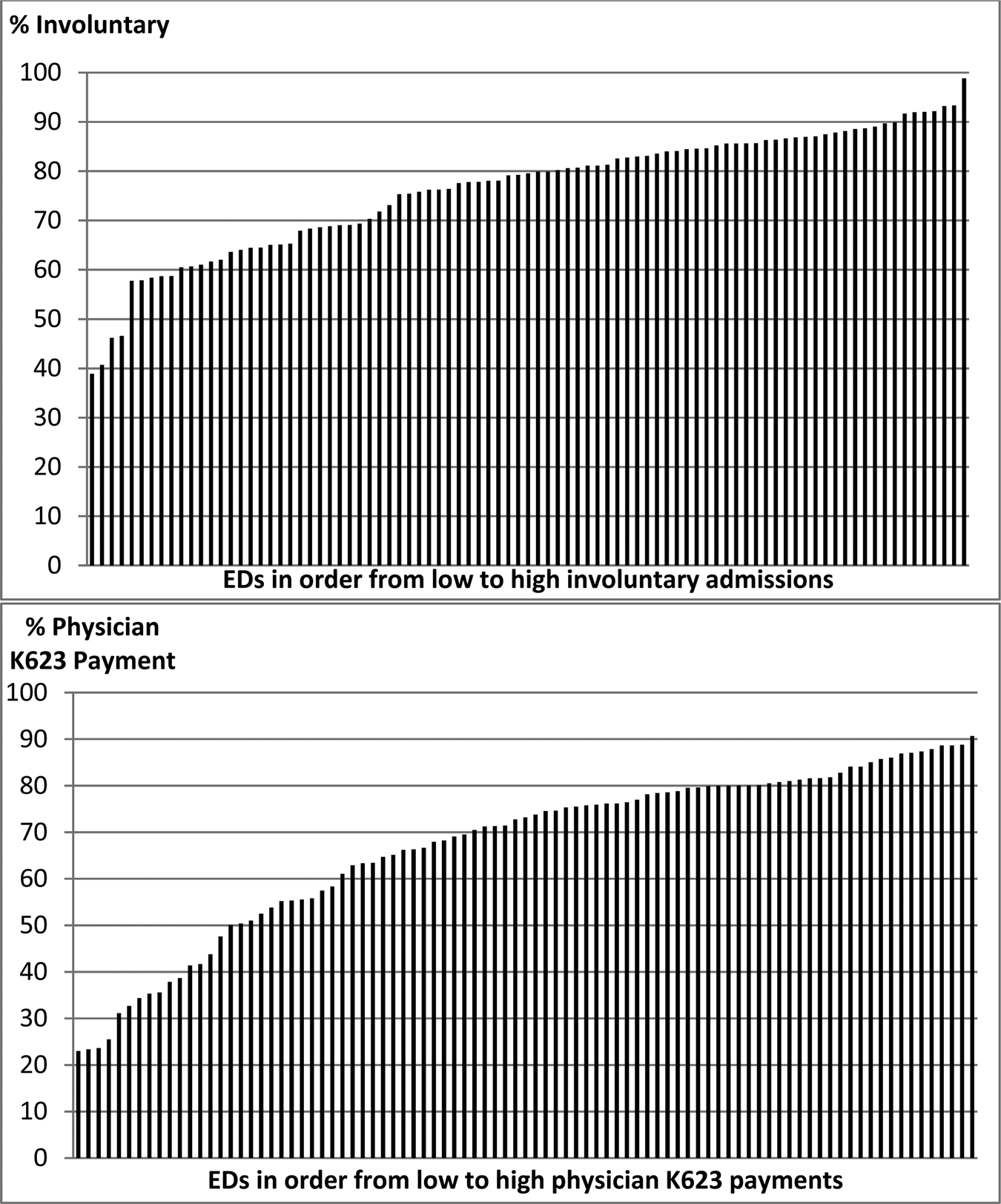
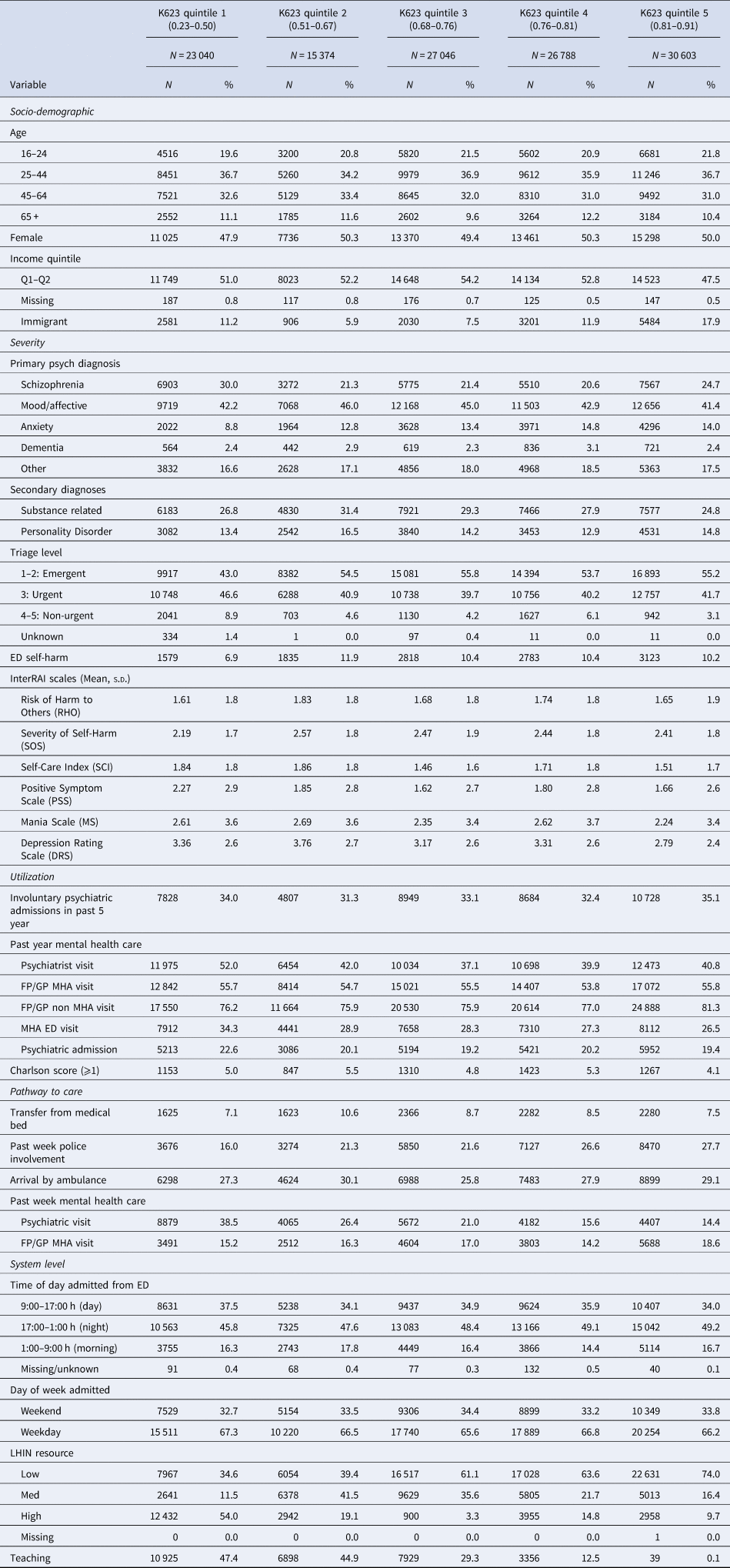
There was considerable variation across EDs in the proportion of all admissions that were involuntary (Fig. 1a) and the proportion of involuntary admissions with a physician K623 payment (Fig. 1b). Across EDs, the proportion of involuntary admissions varied from a minimum of 38.9% to a maximum of 98.8% while the proportion of involuntary admissions with a physician K623 payment ranged from a minimum of 23.0% to a maximum of 90.7%. Descriptive characteristics of the sample across quintiles of ED-level physician K623 payment are shown in Table 1 (Q1: lowest K623 payment). There was a high year-to-year correlation in ED-level physician K623 payment (i.e. r > 0.7 for all 89 EDs; r > 0.9 for 62 EDs with N > 30 admissions in all years).
(a)Proportion of involuntary admissions across EDs among a cohort of patients admitted from 89 Ontario EDs during period 1 April 2009–31 March 2015 (top). (b) Proportion of involuntary admissions with a physician K623 payment across EDs (bottom)*. *Each bar represents the value for a distinct ED.

Baseline characteristics by each quintile of ED-level physician K623 payment as a proportion of involuntary admissions for a cohort of patients admitted between April 2009 and 31 March 2015

ED, emergency department; Q, quintile; MHA, mental health and addictions; FP/GP, family physician or general practitioner; LHIN, Local Health Integration Network.
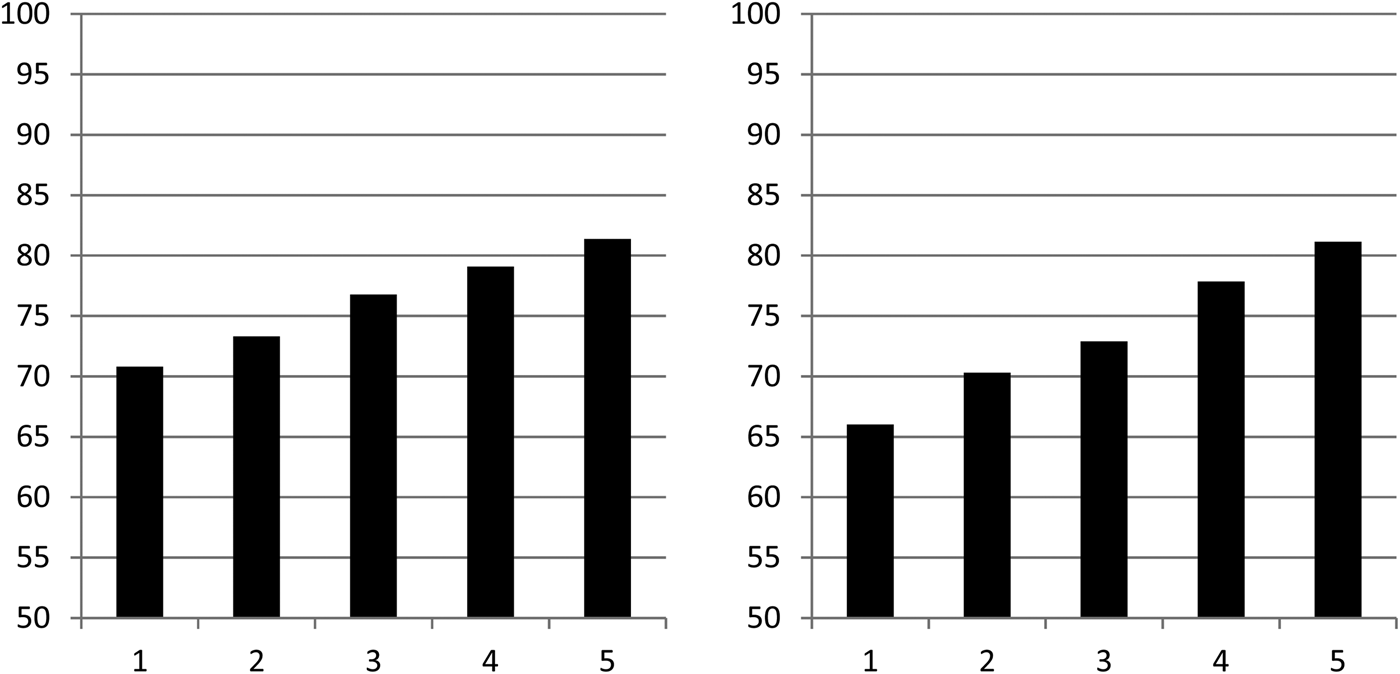
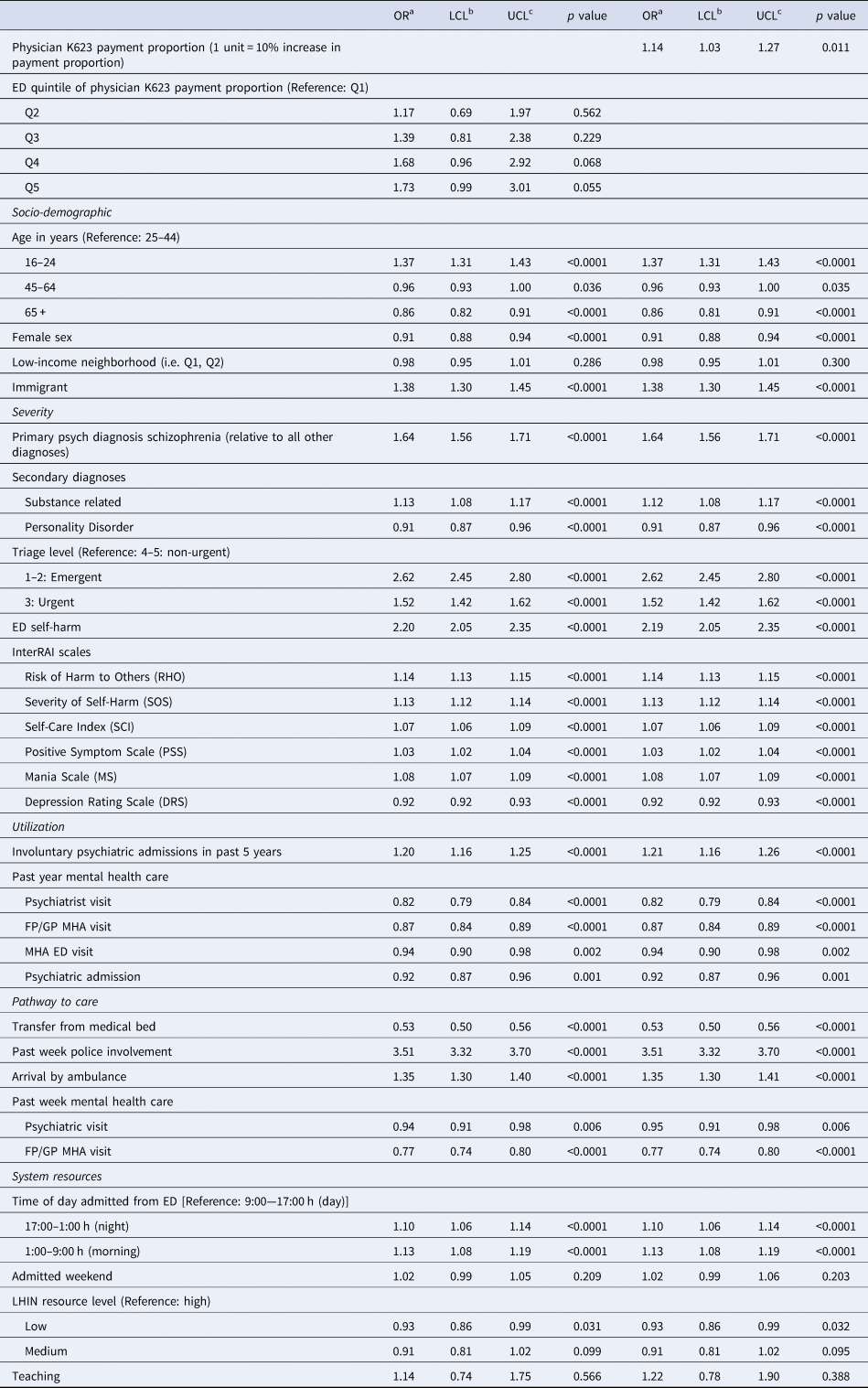
The VPC was 0.116, 0.147 and 0.147 for the null model containing only a random intercept, the fully adjusted model with quintile K623, and the fully adjusted model with continuous K623, respectively. This demonstrates 11.6% of the variation and 14.7% of the residual variation after adjustment for other characteristics in the propensity to be involuntarily admitted is due to systematic differences between EDs. The proportion of admissions that were involuntary increased linearly across increasing quintiles of physician K623 payment when measured at the aggregate level (i.e. unweighted mean across EDs in each quintile) (Fig. 2a) and at the individual level (i.e. mean across patients in each quintile) (Fig. 2b) with a >10% absolute difference between EDs in the highest and lowest quintiles of payment. In unadjusted multi-level models, ED-level K623 payment modeled continuously (increasing by 10% increments) was also significantly associated with involuntary admissions [odds ratio (OR) 1.13 per 10% absolute increase; p = 0.003]. Without adjustment, there was a graded effect with increasing odds of involuntary admissions with increasing quintile of ED-level physician K623 payment, with Quintile 4 (OR 1.64; p = 0.031) and 5 (OR 1.75; p = 0.014) having significantly higher odds of involuntary admission compared to Quintile 1. In fully adjusted models, the graded effect with increasing odds of involuntary admission with increasing quintiles of ED-level physician K623 payment remained, with an association with Quintile 5 of physician K623 payment (OR 1.73; p = 0.055) (Table 2) and a significant relationship with physician K623 payment modeled continuously (OR 1.14; p = 0.011). Quartile 4 of physician K623 payments was trending toward significance but not significant at p < 0.05 (OR 1.68; p = 0.068).
Proportion of involuntary admissions across quintiles of physician K623 payment measured at the level of the emergency department (left) and patient (right).

Multi-level logistic regression of the association between involuntary admissions and quintiles and continuous assessment of physician K623 payments

aOR, odds ratio; bLCL, lower confidence limit; cUCL, upper confidence limit; ED, emergency department; Q, quintile; MHA, mental health and addictions; FP/GP, family physician or general practitioner; LHIN, Local Health Integration Network.
Discussion
Among 122 851 psychiatric hospitalizations between 1 April 2009 and 31 March 2015, a 10% increase in the absolute level of physician payment for completing forms to declare an involuntary status (i.e. physician K623 payments) was associated with a 14% increase in the odds of an involuntary hospitalization. Although significant, our results show that the association between physician compensation and involuntary admissions is relatively modest. The associations between ED-level physician K623 payments and involuntary admissions, when payments were treated continuously and when EDs were grouped into quintiles, were not attenuated in the presence of adjustment across five conceptual domains including system resource characteristics such as regional psychiatric resources and hospital teaching status. We also controlled for a comprehensive list of individual-level risk factors including prior psychiatric care in the past week and year, prior involuntary admissions, pathway to care including police and ambulance contact, and severity variables related to the criteria of involuntary admissions. Although we cannot completely rule out other factors given the observational and cross-sectional design, given our extensive control for patient characteristics, our results strongly suggest that physician payments for completing forms for initiating involuntary admissions may increase the likelihood of involuntary hospitalization. To our knowledge, this is the first study to explore whether payments or payment methods are associated with the use of involuntary admissions. Furthermore, high levels of involuntary admissions overall, and especially at some EDs, suggest that mental health beds are a scarce resource reserved for those most acutely ill.
Strengths and limitations
With the use of the OMHRS's standardized clinical assessment tool (RAI-MH) (Hirdes et al., Reference Hirdes, Smith, Rabinowitz, Yamauchi, Pérez, Telegdi and Fries2002) and linkages with other administrative databases, this study was comprehensive in its assessment of patient-level characteristics. This included control for socio-demographic, utilization-related, pathway to care, and clinical severity characteristics. Furthermore, the study also controlled for other system resource factors and used multilevel models with random intercepts to account for clustering within EDs. The use of a population-based sample collected from 89 EDs enhances the generalizability of the study.
This study has several limitations that should be taken into consideration. First, this study cannot claim causality since it used a cross-sectional design which assessed variation across EDs to identify variation in payments. Second, payments for involuntary admissions were an average during the entire study period since involuntary admissions were not recorded at admission prior to 2009 and the need to pool multiple years to have stable estimates for smaller EDs. However, there was a very high year-to-year correlation in ED-level physician K623 payment suggesting EDs have long-term payment patterns likely pre-dating the study period and minimal variation within EDs to examine. Future studies should examine the effect of payments using alternative designs such as quasi-experimental studies investigating the effects of the introduction or removal of a payment. Third, the OMHRS database does not record the admitting physician. Therefore, the levels of payment were assessed at the level of the ED, leading to less variation than if assessed at the level of the physician, and prohibited the control of admitting physician characteristics. Future studies should examine variation in the use of payments for involuntary admissions across physicians and account for physician characteristics in the analysis. Fourth, given we do not have symptom measures during the time of the ED visit and do not have the completed Form 1s, we are unable to determine the appropriateness of the involuntary admissions. Fifth, we lack information on the patient's level of social support, which we do not expect to be differential across the exposure group, and staffing resources at each emergency room. Therefore, residual confounding cannot be ruled out. Sixth, it is not clear what factors are the contributing causes to the variation in payment across the hospitals. Lastly, we excluded rural EDs which may limit the generalizability of the findings.
Financial payments
We found a clear relationship between greater levels of physician K623 payments for involuntary admissions and increased likelihood of involuntary admission. The value of a payment for involuntary assessment as of 2012 was $104.80. The physician K623 payment for initiating the involuntary assessment is paid in addition to the payment for the conduct of a typical clinical interview. However, most (85.2%) EDs were non-FFS where the majority of physicians receive only 25% FFS payment schedule resulting in a payment of $26.20 for each K623 payment for these EDs and a minority of physicians receive 100% FFS payment (Auditor General, 2011). At EDs with low levels of physician K623 payments, a large (~70%) proportion of patients are admitted involuntarily suggesting that payments are likely not necessary for physicians to use discretion when balancing the risk of harm to civil liberties around patient encounters. Given the impact of involuntary admissions on patients' rights, the findings of this study call into question the necessity of an additional payment for completing forms to initiate an involuntary admission. British Columbia also provides additional payment for the completion of a form for involuntary admissions (British Columbia Ministry of Health, 2017), suggesting this practice may not be restricted to just Ontario and that our findings may be generalizable to other jurisdictions.
Conclusions
To our knowledge, this is the first study to examine the association between payments to physicians for executing the process leading to an involuntary hospitalization and the likelihood a patient will be admitted involuntarily for a psychiatric hospitalization. This study identified a novel factor, variation in payments to physicians for completing forms initiating an involuntary admission, associated with the use of involuntary admissions. In ED settings where physicians were getting paid less often for completing these forms, the rate of involuntary hospitalizations was still quite high suggesting that physician payment for completing forms is not necessary for physicians to assess risk and act accordingly. Future studies should investigate whether financial compensation of admissions procedures in other jurisdictions is associated with admission outcomes. The finding of an increased likelihood of involuntary hospitalization associated with greater ED levels of physician payment for completing these forms puts into question the need for extra payment for completing these forms.
Data
The dataset from this study is held securely in the coded form at ICES. While data sharing agreements prohibit ICES from making the dataset publicly available, access may be granted to those who meet pre-specified criteria for confidential access, available at http://www.ices.on.ca/DAS. The full dataset creation plan and underlying analytic code are available from the authors upon request, understanding that the computer programs may rely upon coding templates or macros that are unique to ICES and are therefore either inaccessible or may require modification.
Acknowledgements
This study was supported by ICES, which is funded by an annual grant from the Ontario Ministry of Health and Long-Term Care (MOHLTC). The analyses, conclusions, opinions and statements expressed herein are solely those of the authors and do not reflect those of the funding or data sources. No endorsement by ICES or the Ontario MOHLTC is intended or should be inferred. All data sets used in the study were held securely and analyzed at ICES. Parts of this material are based on data and/or information compiled and provided by CIHI and Immigration, Refugees and Citizenship Canada (IRCC). However, the analyses, conclusions, opinions, and statements expressed in the material are those of the author(s), and not necessarily those of CIHI or IRCC. No endorsement by the funding or data sources is intended or should be inferred.
Author contributions
PK was the Principal Investigator and conceived the study. ML wrote the methods protocol, prepared the first draft and addressed edits of the manuscript. LH conducted the analysis. All authors interpreted the data, critically revised the manuscript for important intellectual content, and approved the final version of the manuscript. LH had full access to all the data in the study and takes responsibility for the integrity of the data and the accuracy of the data analysis.
Financial support
This study was conducted using funding entirely from public sources. This project was funded by a MOHLTC Mental Health and Addiction Scorecard and Evaluation Framework grant. Dr Kurdyak has received operational support by an Ontario Ministry of Health and Long-Term Care (MOHLTC) Health Services Research Fund Capacity Award to support this project. The Institute for Clinical Evaluative Sciences (ICES) is funded by the Ontario MOHLTC. The study results and conclusions are those of the authors, and should not be attributed to any of the funding agencies or sponsoring agencies. No endorsement by ICES or the Ontario MOHLTC is intended or should be inferred. All decisions regarding study design, publication, and data analysis were made independent of the funding agencies. Michael Lebenbaum is supported by a Vanier Canadian Graduate Scholarship (CGS).
Conflict of interest
Dr Vigod reports other from UpToDate Inc, outside the submitted work (i.e. Royalties for chapters about depression and pregnancy); all other authors report nothing to disclose. There is no support from any organization for the submitted work; no financial relationships with any organizations that might have an interest in the submitted work in the previous 3 years, no other relationships or activities that could appear to have influenced the submitted work.