1. Introduction
Twenty years ago, philosopher Alan Rosenbaum published a volume of essays entitled Is the Holocaust Unique? Footnote 1 Two decades and two editions later, the intense cross-disciplinary debate kindled by this question has slackened. By slightly modifying Rosenbaum's title, however, we can generate another question worthy of consideration. This is the question: Are Holocaust museums unique?
In this paper I shall argue that they are not. I shall argue, that is, that Holocaust museums are fully eligible for the sorts of inquiries philosophers have lately launched into art museums, natural history museums, and museums of other kinds. These include inquiries into the ontology and taxonomy, the epistemology and teleology, and the ethics and aesthetics of museums.Footnote 2 I shall suggest, further, that by studying Holocaust museums according to these established lines of inquiry, we can improve our understanding of core features of museums more generally.
My analysis of Holocaust museums in this paper will focus on questions belonging to three of the six categories listed above. These are:
-
1. An ontological question, concerning the grounds of the educational value of objects exhibited in Holocaust museums, i.e. their power to reliably enhance the knowledge of ordinary museum visitors;
-
2. An epistemological question, concerning the connection between the original scholarly research conducted in Holocaust museums and the objects, images, and documents displayed in them; and
-
3. A taxonomic question, concerning the continuing relevance of traditional strategies for distinguishing museums according ‘type’, ‘kind’, or ‘purpose’.
In what follows I consider these questions sequentially, taking care to highlight points of interconnection. My discussion is based on personal observations in four different Holocaust museums: three in the United States, and one in the United Kingdom.Footnote 3 My analysis also draws on the small but growing scholarly literature on Holocaust museums, as well as the much larger philosophical and historical literature on museums of other kinds.
One question I do not take up in the body of this paper concerns the putative ethical function of Holocaust museums. Some readers may find it surprising, even irresponsible, for a philosophical study of Holocaust museums to eschew ethical issues. I do not take this view. I am aware, however, that the ontological, epistemic, and taxonomic features of Holocaust museums I describe may have significant implications for our understanding of the ethical function(s) of such museums. In my conclusion, I briefly consider what some of these implications might be.
2. Objects and the Ontology of ‘Educational Value’ in Holocaust Museums
In a paper prepared for the first annual meeting of the American Association of Museums in 1906, Brooklyn Museum director F.A. Lucas proposed a simple criterion for determining what items merit inclusion in museum collections and displays. ‘[T]he object of the collections’ of public museums, Lucas writes, is ‘to interest and instruct’.Footnote 4 Lucas allows that interest may take precedence, since ‘if you cannot arouse the interest of visitors you cannot instruct them’.Footnote 5 He insists, however, that interest alone is not sufficient to justify an item's acquisition or exhibition. Noting that the two most sought after items in the Smithsonian's collections had for some time been the body of President James Garfield's assassin and a pair of boots made from human skin, Lucas asserts that it is only an ‘attraction of repulsion, a morbid curiosity, that makes many, if not most of us, wish to see’ such items.Footnote 6 Insofar as such items lack ‘intrinsic educational value’, they ought not to be accessioned or displayed.Footnote 7
It will be readily agreed that many of the objects and images exhibited in Holocaust museums are capable of exerting just such an ‘attraction of repulsion’, of inducing just such a ‘morbid curiosity’. This is why Holocaust museums are equipped with signs warning parents of materials unfit for children. It is equally the basis for some of the most stringent criticisms that commentators have levelled at Holocaust museums in recent years.Footnote 8 Were Lucas correct in suggesting that the educational value of museum objects has an intrinsic basis, such considerations might move us to reassess the objects displayed in Holocaust museums for such value, and withdraw those objects found wanting. However, Lucas is not correct. The educational valueFootnote 9 of museum objects is not grounded in intrinsic properties of those objects, but rather in the extrinsic relations in which such objects stand vis-à-vis other objects, images, and documents.Footnote 10 At any rate, this is the claim I defend in this section.
I begin by briefly situating Holocaust museums within the wider museums context. Next, I analyse one iconic object commonly found in Holocaust museums, namely the Second World War railway boxcar. Finally, drawing on this analysis, I argue that the educational value of objects in Holocaust museums does not have an intrinsic basis, but depends instead on the extrinsic relations into which these objects are placed with other objects, images, documents, and media.
2.1 Holocaust Museums in Context
In the first place, Holocaust museums are history museums.Footnote 11 Certainly, as scholars like Steven Conn have argued, Holocaust museums differ in important ways from more traditional history museums.Footnote 12 Unlike traditional history museums Holocaust museums are not dedicated to charting the broad history and development of a particular nation, people, or locale; rather, Holocaust museums tell the story of a geographically and temporally specific event, about which new facts continue emerging, but which, we must hope, is itself closed, never to be repeated.Footnote 13
The purposes for which actions and events are recounted in Holocaust museums are also distinct. The aim is as much to memorialize those events as to elucidate them.Footnote 14 There is in fact a complex story to be told about the relationship between Holocaust museums and Holocaust memorials.Footnote 15 On the one hand, the display of artefacts and entire structures obtained from former ghettos and camps turns such museums into ‘quasi-authentic site[s] of the Holocaust’.Footnote 16 On the other hand, the construction of statues, memorials, and dedicated spaces of reflection far away from the original sites of destruction indicates patterns of immigration and resettlement that are themselves part of the history that Holocaust museums relate.
For all this, I believe the differences between Holocaust museums and other kinds of history museums are not categorical. I believe, that is, that one can analyse – and criticize – Holocaust museums using the same historiographical and museological tools with which one might scrutinize museums dedicated to the history of nations, peoples, or locales.Footnote 17
Although they are primarily history museums, Holocaust museums also share certain features with anthropology museums and museums of technology. This reflects the structure of the Nazi genocide, which picked out its victims largely on ethnic or quasi-racial grounds, and which was perpetrated via the large-scale deployment of both familiar and unimaginable technologies. Many of the most intractable problems facing curators of Holocaust museums concern the depth of coverage due to non-Jewish victims of National Socialism, including Roma and Sinti, Christian Polish Intellectuals, Seventh Day Adventists, and so on. In order to complete the story of the persecution of these groups, it would likely be necessary for Holocaust museums to treat in detail the conditions of their life in Europe prior to the rise of National Socialism, as well as the changes in circumstances encountered by surviving members after the war's end. While there is currently a trend towards increasing coverage of non-Jewish victim groups in Holocaust museums, few museum curators and staffs can claim detailed ethnographic knowledge about all, or even most, of these groups.Footnote 18
In addition to situating Holocaust museums alongside other kinds of museums, it would also be necessary, in a comprehensive study, to consider more closely the differences between Holocaust museums and other Holocaust-related sites, including, most importantly, the sites of the genocide themselves. Numerous discussions of the organisation of, and patterns of visitation to, concentration camps and other Holocaust sites can be found in the growing literature on ‘dark tourism’.Footnote 19 It is certainly appropriate to include Holocaust museums, as well as sites, in discussions of this trend in tourism, but this is not the point at issue in this paper.
2.2 Exhibiting Objects in Holocaust Museums
Having argued that Holocaust museums are primarily history museums, I now want to consider more closely one particular object commonly found in Holocaust museums, and to analyse the grounds of that object's educational value. The particular object I have in mind is the Second World War railway boxcar.
The acquisition and display of period railway boxcars by Holocaust museums in the US, Britain, Israel, and elsewhere has previously been discussed by a number of scholars, though never, so far as I know, by philosophers.Footnote 20 One of the most perceptive analyses appears in an article by religious scholar Oren Baruch Stier.Footnote 21 Stier discusses boxcars displayed in four different Holocaust museums, three in the US, and one in Jerusalem.Footnote 22 He argues that each museum follows a different strategy of ‘spatial emplacement and association’ in exhibiting its boxcar, and suggests that these different strategies reflect different ‘ideologies of Holocaust remembrance’.Footnote 23
Here I will focus on one particular exhibition strategy Stier describes, namely, the ‘strategy of integration’. Stier ascribes this strategy to the United States Holocaust Memorial Museum (USHMM) in Washington, DC. At the USHMM, Stier reports, there was ‘from the start […] a meticulous concern […] for historical accuracy and for the manner in which the railway car would be integrated into the museum narrative’.Footnote 24 Regarding historical accuracy, Stier points to a series of exchanges in which USHMM curators attempted (ultimately without success) to verify that the boxcar acquired by the museum had in fact been used to deport Jews during the Holocaust.Footnote 25 Regarding the integration, or assimilation, of this exceptional artefact into the general flow of the museum's displays, Stier observes that the USHMM's boxcar is ‘placed in the midst of the museum's chronological narrative’, and thus ‘integrate[d] […] within the Holocaust's dominant historiography’.Footnote 26
The careful integration of the Washington museum's boxcar within that museum's permanent exhibition reflects certain ideas about how such an object can be used to educate museum visitors. The same general ideas – and the same integrative strategy – can be found at the Illinois Holocaust Museum and Education Center and at the Imperial War Museum London. At the same time, certain differences in the particular display choices made by the designers of these other museums can be used to fill out and deepen Stier's notion of an integrative strategy for emplacing museum objects, and to show that this strategy depends on the extrinsic basis of the educational value of objects exhibited in Holocaust museums.
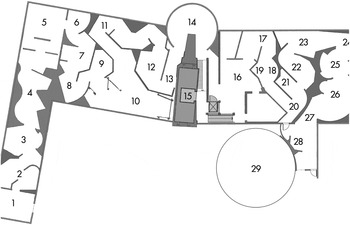
The Illinois Holocaust Museum and Education Center opened to the public in April 2009. Institutionally descended from the Holocaust Memorial Foundation of Illinois, the museum is located in Skokie, Illinois – the same northern Chicago suburb in which, in 1977, the National Socialist Party of America attempted (unsuccessfully) to stage a march. Like the four museums discussed in Stier's study, the IHMEC prominently features a Second World War era boxcar. In this case, the museum building was actually constructed around this iconic object, as publicity photos posted on the museum's website make clear.Footnote 27 The railcar stands at the midpoint of the museum's permanent exhibition (see Figure 1). It is immediately preceded by video testimonies from survivors describing their deportation experiences, and followed by a display of artefacts associated with the camps. A written description of the museum's permanent exhibition describes the boxcar as the museum's ‘anchor artifact’, and notes that it stands in the space formed by the building's hinge.Footnote 28
Floor Plan of Permanent Exhibition, Illinois Holocaust Museum and Education Center. Courtesy of the Illinois Holocaust Museum & Education Center.

These features of the emplacement of the IHMEC's boxcar can be usefully compared with the boxcar exhibited in the Holocaust section of the Imperial War Museum (IWM) London. First opened in June 2000, the IWM's Holocaust exhibit is also chronologically arranged, and spreads across two floors, one devoted to the pre-1939 development of anti-Jewish policies in Germany, the other devoted to the war years.Footnote 29 The IWM's boxcar, like that of the IHMEC and the USHMM, is placed between displays on the formation of the deportation policies, and displays on life and death in the camps. Unlike the USHMM and the IHMEC, however, the London museum's boxcar has not been preserved intact, but instead is cut away at the top, with the roof of the car overhanging the passageway that museum visitors walk along. Nor can visitors walk into the boxcar, as they are encouraged to do in the Washington and Illinois museums – though during my visit I did see other museum patrons touch the side of the car cautiously.
Despite the differences in the ways in which they display their boxcars, both the IHMEC and the IWM employ the kind of integrative strategy Stier ascribes to USHMM. Both museums situate their boxcars within an unfolding chronological narrative detailing the changing patterns and intensity of persecution of Jews and other peoples targeted for destruction; both surround their boxcars with related materials associated with the deportation process such as luggage, railway signs, and railway maps. Such an emplacement illustrates my claim concerning the extrinsic basis of the educational value of museum objects. Museums employing this strategy acknowledge that direct visual inspection of artefacts such as the boxcars cannot by itself suffice to instruct visitors as to the role of such ‘objects’ in the prosecution of the Final Solution. Rather, the educational value that the boxcars take on in Holocaust museums is directly a function of the images, objects, and documents displayed alongside them. To support this claim, consider the very different lessons visitors might take away if the same boxcar were exhibited in a museum of transportation, or of science and industry. In such contexts, surrounded by steam and diesel engines, or by maps of rail networks indicating tonnages of various goods shipped to various ports and centres of manufacture, the grim function performed by these boxcars during a comparatively short historical period in the 1940s would elude museum visitors entirely, even as their contribution to national GDP growth or to international market connectivity would be clarified.
I do not mean to deny that these boxcars serve other, non-educational purposes. Clearly, these artefacts also function symbolically, representing in one physical object an enormous infrastructure of violence.Footnote 30 Nor do I wish to deny the significance of the physical properties of these objects – their status as physical objects with a certain characteristic look, size, smell, and feel.Footnote 31 Nevertheless, insofar as these boxcars are supposed to enhance the knowledge of ordinary visitors concerning the Shoah, I believe the key point to consider is their extrinsic relations with the other objects, artefacts, and documents displayed around them.Footnote 32 Ultimately, the claim I am arguing for has the form of a conditional: if the chief goal of Holocaust museums is to educate visitors concerning the Holocaust, then we can say that what Stier calls the ‘integrative strategy’ for emplacing objects in such museums is particularly well suited for this purpose.Footnote 33
I believe my claim concerning the extrinsic basis of the educational value of objects exhibited in Holocaust museums extends to museums of other kinds. It explains the diversity of effective exhibition strategies employed by different museums devoted to a common field of inquiry. It also supports recent calls, by philosophers, historians, and other museum scholars, for rethinking traditional ways of conceiving those fields of inquiry, and the museums organized around them. At the same time, it stops short of the more radical claim that the very identity of museum objects is determined by their ideal relations with other objects – a claim which has been criticized for discounting the significance of material features of such objects.Footnote 34
It might be objected that my claim entails that any and every assemblage of museum objects is capable of educating visitors, rendering ‘educational value’ useless as a principle for determining what objects should, and should not, be exhibited. This objection is misplaced. Not every organisational scheme renders museum objects capable of reliably enhancing the knowledge of visitors; some organisational schemes rest on false premises. Indeed, philosophers have lately criticized so-called ‘universal’, ‘encyclopaedic’, or ‘world’ museums on precisely this basis, objecting that at least some of the claims on which such organisational schemes are grounded are false.Footnote 35 Furthermore, this objection fails to recognize that ‘educational value’ admits of degrees. Different organisational schemes create different educational benefits; these differences are salient to decisions about which scheme to adopt. Educational value can also be weighed against other kinds of considerations for or against the adoption of a particular organisational scheme, including moral and legal considerations.Footnote 36 In the world of Holocaust museums, such considerations frequently factor into decisions about whether human remains, such as hair or teeth, ought to be displayed.Footnote 37 Similar considerations factor into decisions about the use of museum collections by scholars seeking to produce new knowledge about the Holocaust; and those scholarly activities can themselves transform the ways in which collection items are publicly displayed in Holocaust museums, as I shall now show.
3. Holocaust Museums and ‘Document-Based’ Epistemology
If the educational value of the objects, exhibits, and collections of Holocaust museums consists in their power to reliably enhance the knowledge of ordinary visitors, the epistemic value of those objects, exhibits, and collections consists in their power to stimulate the production of entirely new knowledge via scholarship. In this section, I address the epistemic function of Holocaust museums. Along the way, I introduce and develop the notion of a ‘document-based epistemology’ – by which I mean an approach to reconstructing historical events, circumstances, and attitudes in which documents are integral both to determining the outlines of the reconstruction and to determining the relevance of other types of materials within this reconstruction. Such a document-based epistemology is, I argue, foundational for Holocaust museums as they currently exist, though it is not clear that this epistemology will remain foundational for such museums in the decades to come.
The section proceeds as follows. I first offer a brief gloss on Holocaust historiography. I then explain several ways in which Holocaust museums serve as centres for the production of new knowledge about this historical genocide. Finally, I show how these research activities are reflected in the public exhibitions and displays within Holocaust museums.
3.1 A Primer on Holocaust Historiography
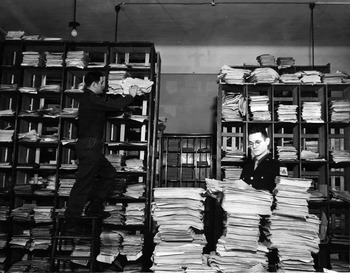
When the International Military Tribunal convened in Nuremberg in 1945 to try 22 major German war criminals, it faced for the first time a problem that has confronted Holocaust historians, and museums, ever since: the problem of constructing a coherent, comprehensive, and fully corroborated account of the atrocities committed by the German National Socialist party and its affiliates.Footnote 38 In order to meet this challenge, Allied prosecutors at the IMT and at the various successor trials built their cases primarily upon documents – particularly, documents produced by the defendants themselves.Footnote 39 An image from the archive at the Truman Library offers some idea of the sheer quantity of materials assembled for the trials (see Figure 2).
The Document Room at the Nuremberg Trials. Photo courtesy of the Office of the United States Chief of Counsel, Courtesy of Harry S. Truman Library.

This image also indicates the principal mode of Holocaust historiography in the first two generations following the Nazi crimes. The first example of a comprehensive Holocaust history, Raul Hilberg's The Destruction of the European Jews (1961), was based entirely on primary documents – including telegrams, bureaucratic forms and circulars, letters, and so on.Footnote 40 Subsequent generations of Holocaust historians have since broadened the scope of materials consulted for their researches, including not only material objects, print images, and films but also memoirs, diaries, and oral testimonies. Nevertheless, even in the most recent and prominent works, a major focus remains on such official and quasi-official pre-war and wartime documents.Footnote 41
Several factors have contributed to this historiographical emphasis on documents. One factor is that new documentary materials continue to come to light. This is especially true of materials that, for a long time, remained inaccessible in archives in various countries of the Soviet Union – some of which have only recently begun to open up.Footnote 42 A second factor is that trials of Holocaust perpetrators (and Holocaust deniers) continue to take place, and continue to centre on the evidence afforded by wartime documents.Footnote 43
Both of these reasons for the emphasis on documents in Holocaust historiography are likely to become less relevant in coming years, as the last archives are opened, and the last perpetrators pass away. It is interesting to speculate as to whether these changes may someday force an alteration in what might be called the document-based epistemology that currently prevails amongst Holocaust historians. Rather than engaging in such speculation, however, I want to turn to consider more closely what this document-based epistemology consists in, and how it is reflected in the exhibition strategies of Holocaust museums.
3.2 Document-Based Epistemology and Research in Holocaust Museums
Scholarly research is a major function of the largest American, European, and Israeli Holocaust museums. Here I can only briefly describe some of the research activities supported by the USHMM in Washington. Unbeknownst to many, if not most, of the million-plus visitors who pass through the USHMM each year, this museum hosts a major research center and library on its top floor, the Mandel Center for Advanced Holocaust Studies.Footnote 44 The Center hosts regular short-term scholarly seminars on chosen topics, sponsors visiting research fellowships for individual scholars, and also employs a sizable number of staff researchers working on volumes in the Center's several publications – including the Encyclopedia of Camps and Ghettos the book series Jewish Responses to Oppression, and the scholarly journal Holocaust and Genocide Studies.
About a third of the floor space in the CAHS library is taken up by computer terminals and microfilm and microform readers, used by scholars to study items from the museum's large collections of digital and miniaturized newspapers, documents, and manuscripts. Other researchers read, photograph, and scan hard copies of archival materials stored in the museum's basement, or off-site in a warehouse in Maryland. During my time as a visiting scholar at the Center, several of my colleagues commented that it was significantly easier to access documents held in the various German state archives electronically from the museum in Washington than to access them in person in Germany. As noted above, staff historians leading the USHMM-sponsored publication projects typically had extensive prior experience in archival research, and many regularly gave scholarly presentations in the museum and at area colleges.Footnote 45
I do not wish to dismiss the non-document-based research activities sponsored by the CAHS, such as the ongoing collection of oral histories, and the extensive photo and video archives. Building these collections is a major enterprise, and the standard orientation at the Center includes appointments with the staff who manage them. Nevertheless, most of the visiting scholars and staff researchers with whom I interacted during my term at the museum worked primarily with documents, and used those documents to provide insights that might someday find their way into the museum's public exhibitions. Exactly how such public exhibitions reflect the document-based epistemology central to Holocaust historiography, and to the research conducted in Holocaust museums, is the subject I take up in the next section.
3.3 Document-Based Epistemology and Public Exhibits in Holocaust Museums
In the first place, there are plenty of actual documents on display in Holocaust museums. So for example, the Maltz Museum of Jewish Heritage in Cleveland, Ohio houses a relatively small display on the Holocaust, but features prominently within that display identification documents issued to Jews remaining in Germany during the 1930s, as well as to those seeking to emigrate. Similarly, at the Illinois Holocaust Museum near Chicago a display on the Wannsee Conference, the meeting at which the Final Solution was decided on, features reproductions of the invitations issued to participants.
Perhaps the most remarkable display of documents I have encountered in a Holocaust museum appears in the display entitled The Final Solution at the Imperial War Museum London. Here, on a table by itself, sits a typewriter once owned by Arthur Seyss-Inquart, governor of the Netherlands during the German occupation and director of the deportation of thousands of Dutch Jews. Engraved in the glass walls of this room is a diagram of the command structure of the extermination apparatus, along with reproductions of the following six documents:
-
(1) A secret order to German troops on the Eastern Front, instructing them to be ‘merciless’ in their treatment of captured Soviet commissars;
-
(2) An order ending legal Jewish emigration from Germany;
-
(3) An order from Herman Göring to Reinhard Heydrich, authorising Heydrich to organize a final solution [Endlösung] of the Jewish question;
-
(4) A page from the protocol of the Wannsee Conference;
-
(5) An order from Heinrich Himmler commanding that the Generalgouvernement [i.e. occupied Poland] be cleared of Jews;
-
(6) A copy of the secrecy pledge that members of the Operation Reinhard killing operation had to sign.
This exhibit at the Imperial War Museum London exemplifies one way in which the documents underlying current historiography on the Holocaust can themselves be used to convey historical narratives to a general public.Footnote 46 Even where there are no actual documents on display, however, Holocaust museums manifest a document-based epistemology.Footnote 47 To return briefly to the case of period railway boxcars, Oren Stier remarks that ‘trains are some of the most significant and recurring symbols of the Holocaust, for they represent a turning point in the destruction of European Jewry’.Footnote 48 The ability of such objects to symbolize such a turning point depends on the document-based research of historians such as Raul Hilberg, amongst others, who first assembled the evidence for the current historiographical consensus that ‘deportation via railway marked a systemic shift from mobile murderers and stationary victims to stationary murderers and mobile victims’.Footnote 49
It might be objected that, in emphasising the central place of documents in the organisation and contents of public exhibits in Holocaust museums, I have neglected some of the most significant items contained in those exhibits, including videos of survivors telling their stories, as well as artefacts representative of the everyday life of Jews and other persecuted groups. I hardly mean to deny the significance of such materials. My argument is simply that, just as these materials have been used to supplement, rather than radically reshape, the historiography of the Holocaust, so they have been used in Holocaust museums to supplement and make more immediate to visitors a basic narrative still grounded on the reams of documents assembled at Nuremberg and assiduously studied by historians during the subsequent half-century.
4. Holocaust Museums and Museum Taxonomy
In the previous section I examined the epistemic functions of Holocaust museums. In this last substantive section of my paper I want to address questions of museum taxonomy.
Two different approaches to museum taxonomy have long characterized research in museum studies. The first approach, briefly canvassed in Section 2.1 above, categorizes museums according to field of inquiry, and distinguishes amongst art museums, history museums, and so forth. The second approach categorizes museums according to ‘type’, ‘kind’, or ‘purpose’, and distinguishes amongst local museums, national museums, college museums, and so forth.
Recently, the first of these two approaches has come under considerable critical scrutiny. Philosophers, historians, and other scholars have shown that the fields of inquiry recognized and enshrined by nineteenth-century museum theorists hardly fit the museum landscape of today.Footnote 50 One clear example of this obsolescence is the breakdown of the distinction between objects held in anthropology museums and objects displayed in art museums.
Neither philosophers nor other researchers have paid much attention to the second traditional approach to museum taxonomy – the approach focusing on variations in the nature and purposes of the institutions to which museums are tied.Footnote 51 Here I shall argue that this second approach to museum taxonomy remains largely sound, while acknowledging that only some of the categories set out under this taxonomy commonly find instantiation in Holocaust museums.
4.1 National, Regional, and Local Holocaust Museums
Although I have said that the second major approach to museum taxonomy speaks in terms of museum ‘types’, ‘kinds’, or ‘purposes’, the categories set out under this taxonomy are also closely tied to geographical and institutional considerations. So for instance, late nineteenth-century Smithsonian Museum director George Brown Goode, in his influential paper ‘The Principles of Museum Administration’, outlines a ‘purpose’-based museum taxonomy comprising five categories: national museums; local, provincial, or city museums; college and school museums; professional or class museums; and private museums or cabinets.Footnote 52 Similarly, Joseph Henry, founding secretary of the Smithsonian Institution, recognizes three ‘kinds of museums’, including local museums, large central museums, and museums of a ‘mixed’ variety.Footnote 53 Rather than examining all of these proposed taxonomical categories, I will restrict myself to considering where the four Holocaust museums I examined for this paper fit within Goode's taxonomy.
The United States Holocaust Memorial Museum in Washington and the Holocaust Exhibit at the Imperial War Museum London belong to the category of national museums. The USHMM is clearly a national museum, as indicated by its location just off the National Mall, by its membership in the Smithsonian museum system, and by its claims, in promotional materials, to be ‘America's Holocaust Museum’.Footnote 54 To be sure, not all of the features Goode ascribes to national museums are in evidence at USHMM. It is not quite appropriate to say of this museum, for example, that it ‘contain[s] the treasures belonging to National Governments’ – though if the term ‘treasures’ is interpreted loosely to mean the rarest and most precious artefacts of the process of destruction then this description seems apt.Footnote 55 On the other hand it is certainly true that the USHMM enjoys ‘opportunities which are not often shared by those under state control’, as the discussions in previous sections of this paper attest.Footnote 56
It may be more contentious to categorize the Holocaust Exhibit at the Imperial War Museum London as a national museum. Nevertheless I believe this classification is correct. The IWM exhibit is, as a reviewer from The Guardian observed in 2000, less self-consciously nationalistic than the USHMM in Washington.Footnote 57 Nevertheless, it does contain a variety of features and sections specifically devoted to covering connections between the United Kingdom as a whole and the Holocaust. So for example, the museum describes the experience of ‘enemy aliens’ detained on the Isle of Man during the war; it discusses the experience of children saved on the Kindertransports in Cambridge and elsewhere; and it describes, in a series of panels with the heading ‘News Reaches Britain’, the gradual infiltration of news about the Final Solution into the British government and media. These features, along with the location of the Holocaust exhibit within the leading British museum dedicated to war and armed conflict, seem to justify classifying this exhibit as a national museum.
The third museum I examined, the Illinois Holocaust Museum, offers a good example of what Goode would call a provincial or city museum. This museum principally serves Chicago, but also attracts many visitors from the broader region. It differs from the national museum in Washington, in part, by incorporating many Chicago-area artefacts, narratives, and testimonies into its exhibits – including luggage from survivors who immigrated to Chicago after the war, as well as images and artefacts related to the planned neo-Nazi march in Skokie.Footnote 58 In this way, the museum satisfies Goode's requirement of ‘preserving all that which is characteristic of the region or city in which they are located’.Footnote 59
The final museum I visited during my research for this paper, the Maltz Museum of Jewish Heritage in Cleveland, Ohio, also belongs to the class of local, provincial, or city museums, but, as it is markedly smaller than the Illinois Museum, should probably be classed as a local museum. Indeed, it requires some justification to call this museum a Holocaust museum at all. The first third of the Maltz Museum's permanent exhibition is concerned with conveying a straightforward nineteenth-century immigration narrative.Footnote 60 On the other hand, both the special exhibition featured at the time of my visit, and the high school essay contest on the theme ‘Stop the Hate’ which the museum was then sponsoring, clearly focused on the Holocaust, and so it is, I think, appropriate to refer to this as a local Holocaust museum.
What of the other three categories listed under Goode's taxonomy of museums by ‘type’ or ‘purpose’? I do not know of any colleges in the United States that maintain full-scale Holocaust museums, or that collect widely in its artefacts – though many colleges collect and participate in various ways in the production of memoirs, oral histories, and other documentary materials from Holocaust survivors. As for ‘professional museums’, the Leo Baeck Institute in New York, though primarily identifying as a research library, also collects and exhibits works of art by Jewish and non-Jewish artists, and so may qualify.Footnote 61 Finally, with respect to private collections, political scientist Kristen Renwick Monroe reports that one of the interview subjects for her book Ethics in an Age of Terror and Genocide maintained a collection of National Socialist ephemera, but does not mention any materials specifically relating to the persecution and murder of Jews and other victims of the Nazi genocide.Footnote 62 As this brief discussion suggests, these three taxonomic categories are least less commonly instantiated by Holocaust museums than by museums of other kinds.
4.2 Museum Categories and Museum Networks
The various taxonomic categories discussed above allow us to distinguish between museums operating at different geographic and institutional levels. They also provide insights into points of complementarity between museums at those different levels. These connections manifest themselves in networks of museum professionals and museum artefacts, and in parallels in the basic intellectual framework under which Holocaust museums are conceived and constructed.
Both professionals and ‘artefactual’ networks are evident in the four Holocaust museums that I have examined in this paper. All of the museums I have discussed are closely linked to each other and to the wider museum universe, by networks of scholars and curators, designers and architects. The Illinois Holocaust Museum, for example, had for its ‘interior and exhibition conceptual developers’ two individuals, both of whom had prior experience at national Holocaust museums (one at the USHMM in Washington, the other at Yad Vashem in Israel).Footnote 63 The former director of the Maltz Museum in Cleveland, for her part, served previously as deputy director of the local Cleveland Museum of Contemporary Art. All three of the American museums belong to the Council of American Jewish Museums and to the American Alliance of Museums – organisations that foster developments across museums through annual conferences, publications, and so forth. Across the Atlantic, the ‘Holocaust Exhibition Advisory Group’ at the IWM London included the late David Cesarani, a prominent British historian in Holocaust and genocide studies.
In the second place, these four museums are connected through the artefacts and exhibits they contain. Numerous images, videos, and objects displayed at the Illinois museum during my visit, for example, credited the USHMM collections. At the Maltz Museum, the special exhibition, ‘Spots of Light: To Be a Woman in the Holocaust’, came from Yad Vashem; it was filled out by artefacts (such as women's camp uniforms) on loan from the Illinois museum. Sometimes, similarities in the organisation of particular displays were strong enough to suggest a connection, even where none was directly reported. For example, the USHMM and the IWM London contained nearly identical displays on the exploitation of prisoners for slave labour in the stone quarries at the Austrian camp of Mauthausen, including the same arrangement of quarry stones and the same (or very nearly the same) photograph of prisoners struggling up the quarry's infamous ‘stairs of death’. It is worth pointing out that this exhibit appeared in two national museums, which generally had the most resources and the most elaborate displays.
A final connection between these four museums consists in their general intellectual orientation or framework. One significant parallel was already discussed in the previous section, concerning the document-based epistemology underlying the public exhibits in all four museums. A second parallel, first raised to my attention by the director of the Maltz Museum, concerned the ways in which each of these four museums have to incorporate two narratives into their sections on the post-war era: one narrative about domestic immigration of survivors (whether to the US or to the UK), the other a narrative about the creation and development of the state of Israel.Footnote 64 A final parallel, which I shall discuss briefly in my conclusion, concerned the way in which each of these museums fore-grounded ethical questions and issues.
By creating connections between Holocaust museums at the local, regional, and national levels, networks of professionals and artefacts illustrate what Goode calls ‘a system of co-operation between museums’.Footnote 65 The common intellectual framework adopted by the four museums examined here furnishes the basic aims that such cooperative exchanges serve. Ultimately, this analysis of Holocaust museums demonstrates the continuing relevance of an approach to museum taxonomy that distinguishes museums according to the locales and institutions that they serve. There is no reason to suppose that the enduring relevance of this purpose-based approach to museum taxonomy is limited to the sphere of Holocaust museums. It is if anything more relevant to museums devoted to other fields of inquiry.
5. Conclusion
I have argued that Holocaust museums are not unique, in the sense of being exempt from the kind of philosophical queries increasingly directed at museums of other kinds. I have highlighted features and issues specific to Holocaust museums, while using an analysis of such museums to address ontological, epistemological, and taxonomic questions applicable to museums generally. My analysis of Holocaust museums has not been exhaustive, geographically or institutionally. Nor have I directly addressed the ethical function of Holocaust museums, which some may consider the most salient point of difference between Holocaust museums and museums of other kinds. I end with some concluding remarks about what the wider significance of this last point might be.
On my view, we do best to regard the ethical questions that confront directors, designers, curators, and volunteers in Holocaust museums as closely related to, and capable of illuminating, ethical questions associated with museums more generally. Whether the issue is the dignity due to human remains,Footnote 66 the propriety of impersonating historical individuals in museum displays or social media campaigns,Footnote 67 or the limits that should be placed on museum visitors’ efforts to imaginatively recreate the worlds of those persons whose lives and works are exhibited,Footnote 68 Holocaust museums confront ethical dilemmas continuous with, rather than radically distinct from, those encountered in art museums, anthropology museums, and museums of other kinds. The major advantage Holocaust museums have over some – but not all – other museums in this regard is that questions of ethics are at the very core of the educational and scholarly programs hosted by Holocaust museums. Holocaust museums self-consciously seek to promote moral principles, such as toleration and respect for life, and to promote moral behaviours, such as altruism and resistance to injustices. Along with this advantage, I believe, comes an obligation to confront such ethical dilemmas as do arise directly and, whenever possible, publicly. Such an obligation is not unique to Holocaust museums. Given how frequently museums of other kinds have failed to address their ethical implications in an open and public manner, however, there seems to be an excellent opportunity for Holocaust museums to lead the way. By doing so Holocaust museums may display their distinctive features to advantage, while at the same time demonstrating how much they have in common with the wider museum community.Footnote 69