Introduction
Over the last few decades, scholars have shown increasing interest in organizational decline due to intense global competition in many markets. Scott (Reference Scott1974) and Whetten (Reference Whetten1980, Reference Whetten1987) pointed out that most organizational theories are based on the assumption of organizational growth. Consequently, they argued, researchers have been preoccupied with studying growth, including its antecedents and consequences. However, corporations are like human beings, experiencing birth, life, aging, senescence, and death. In addition, organizational decline and turbulence may result in low morale, conflict, withdrawal of leader credibility, fragmented pluralism of employees, absence of long-term planning, and turnover of top-management (Cameron, Whetten, & Kim, Reference Cameron, Whetten and Kim1987a, Reference Cameron, Kim and Whetten1987b). Therefore, organizational decline has become a pressing issue in researching competitiveness (Trahms, Ndofor, & Sirmon, Reference Trahms, Ndofor and Sirmon2013).
Population ecology provides powerful explanations for the phenomena of organizational founding, decline, and evolution. The current study focuses on the salience of the environment for determining organizational survival, which a central issue for population ecology (Betton & Dess, Reference Betton and Dess1985). Population ecology is a prominent paradigm in organizational survival research. This paradigm compares the fluctuations of animal populations to those of organizations. The target of observation are populations of organizations rather than individual organizations. Environments in a biological sense are not objective phenomena but are a function of organizations inhabiting the environment due to resource dependence. Population ecology assumes that the environment determines the distribution and form of the organizations through selection. Moreover, following the population ecology paradigm, environmental turbulence has an impact on organizational existence and predestination (Carroll & Delacroix, Reference Carroll and Delacroix1982; Delacroix & Carroll, Reference Delacroix and Carroll1983; Lumpkin & Dess, Reference Lumpkin and Dess2001; Wang, Jiang, Yuan, & Yi, Reference Wang, Jiang, Yuan and Yi2013). Therefore, previous research has examined external causes of organizational decline by focusing on changes in industry and general environment factors (Short, Ketchen, Palmer, & Hult, Reference Short, Ketchen, Palmer and Hult2007) that argue highly competitive environments may force a firm into organizational decline (Grinyer & McKiernan, Reference Grinyer and McKiernan1990; van Witteloostuijn, Reference van Witteloostuijn1998).
Building on previous approaches, this paper uses an ecological perspective that focuses on the adaptive capability of individual organizations in preventing organizational decline and improving organizational growth. Adaptation is a core competency of an organization, acquired through the transformation of its intangible assets, including employee knowledge, experience, and networking. According to the resource-based view (RBV), resources that are valuable, unique, and difficult to imitate can provide the basis for a firm’s competitive advantage (Barney, Reference Barney1991). Human capital (e.g., knowledge, experience) and social capital (e.g., networking) belong to this category of resources. They have also been reported to affect firm performance (Pfeffer, Reference Pfeffer1994; Huselid, Reference Huselid1995; Wright, Smart, & McMahan, Reference Wright, Smart and McMahan1995; Finkelstein & Hambrick, Reference Finkelstein and Hambrick1996; Mahsud, Yukl, & Prussia, Reference Mahsud, Yukl and Prussia2011), innovation (Tsai & Ghoshal, Reference Tsai and Ghoshal1998; Subramaniam & Youndt, Reference Subramaniam and Youndt2005; Cabello-Medina, Lopez-Cabrales, & Valle-Cabrera, Reference Cabello-Medina, Lopez-Cabrales and Valle-Cabrera2011), and dissolution (Pennings, Lee, & Witteloostuijn, Reference Pennings, Lee and Witteloostuijn1998).
Despite the growing interest in organizational decline, studies from the perspective of intangible assets are relatively underdeveloped. Although previous studies have examined the influence of human capital and social capital on survival (Fertala, Reference Fertala2007), these studies used more simple measurement approaches and did not incorporate environmental factors. A company’s surroundings offer it opportunities while simultaneously confronting it with challenges. This study argues that appropriate human capital and social capital help a company to navigate around such uncertainty, and in doing so can not only support its growth but also prevent its decline. In the era of the knowledge economy that is heavily reliant on intangible assets, a study that incorporates environmental factors will enrich the literature. Therefore, this study brings together external environmental factors and internal organizational capability to examine the interaction of the above variables and organizational effectiveness and decline. In other words, this study bridges the competitive perspective of population ecology and the adaptation perspective of the RBV to understand how to use intangible assets to strengthen organizational effectiveness and reduce decline.
The purpose of this study is to test a model that examines the relationship between environmental factors and organizational effectiveness and decline as well as the moderating effect of human capital and social capital on the above relationship based on a 4-year panel data collected in Taiwan. A longitudinal dataset collected from multiple sources and time frame adds robustness to our analysis. Specifically, the study objectives are to: (1) investigate the relationships between environmental pressure and organizational effectiveness and decline, (2) examine the direct effects of two intangible asset variables, human capital and social capital, on organizational effectiveness and decline, and (3) examine human capital and social capital as moderators of the relationships between environmental pressure and organizational effectiveness and decline.
THEORETICAL BACKGROUND AND HYPOTHESES
Definitions of organizational decline are diverse. For example, organizational decline has been defined as stagnation or cutback (Whetten, Reference Whetten1980), a decrease in the number of organizational employees (Ford, Reference Ford1980), maladaptation to the environment (Greenhalgh, Reference Greenhalgh1983; Weitzel & Johnson, Reference Weitzel and Johnson1989), and a downturn in organizational size or performance (McKinley, Reference McKinley1987). Since reducing the number of employees is not necessarily bad and maladaptation is an antecedent rather than the symptom of decline, this paper, following McKinley (Reference McKinley1987), regards organizational decline as a downturn in organizational performance.
According to ecological theory, the life of an organization is subject to a strong influence of the external environment for the following reasons. First, organizations undoubtedly are dependent on the availability of external resources as they must compete for limited resources with other competitors. Second, environmental change leads to a natural selection process (Brittain & Freeman, Reference Brittain and Freeman1980; Freeman & Hannan, Reference Freeman and Hannan1983; Carroll, Reference Carroll1984), a view reminiscent of Darwinism in biology. Third, organizations may possess an inherent capability to adapt to the environmental change, we which call ‘organizational adaptation’ (Chakravarthy, Reference Chakravarthy1982). Paulino (Reference Paulino2009) proposes that selection and adaptation are complementary perspectives for understanding organizational change and the effect when organizations face a changing environment.
Environmental pressure, organizational effectiveness, and decline
Environmental pressures is a concept from ecology that refers to factors that affect how a plant or animal lives or reproduces (Elton, Reference Elton1927). From the perspective of organizations, the shortage of external resources and intensity of competition threaten their existence and lead to operational failure and mortality (Hannan & Freeman, Reference Hannan and Freeman1989). More specifically, the definition of environmental pressures in this study is ‘the external factors that affect how an organization lives and survives.’
An organization cannot insulate itself from environmental changes. As environmental pressure is inevitable during an organization’s growth, potential threats come from the general and the task environments (Short et al., Reference Short, Ketchen, Palmer and Hult2007). In the general environment, a variation in the macro-economic situation may affect organizational mortality (Hawley, Reference Hawley1978). For example, it is easier for a company to acquire necessary resources in a booming economy (Stinchcombe, Reference Stinchcombe1965). Therefore, labor and material costs, the unemployment ratio, and gross domestic product are known to be related to organizational founding (Hannan & Freeman, Reference Hannan and Freeman1987). In addition, in a better economy, the reduced time and money spent seeking external resources greatly reduces management costs to result in greater competitiveness in global markets. When measuring the relationship between founding and failing, Delacroix, Swaminathan and Solt (Reference Delacroix, Swaminathan and Solt1989) included market conditions such as gross natural product and personal consumption expenditures as market conditions as control variables. This shows that when examining the influence of the environment on organizational survival, the factors of task environment and general environment should also be considered (Short et al., Reference Short, Ketchen, Palmer and Hult2007).
For the task environment, companies are more likely to survive in a higher organization–environment fit situation (Brittain & Freeman, Reference Brittain and Freeman1980; Freeman & Hannan, Reference Freeman and Hannan1983; Carroll, Reference Carroll1987; Hannan & Freeman, Reference Hannan and Freeman1989). When the coping fit measures prove to be successful, other organizations will copy the same model. If more and more homotype organisms (organizations) in the same population (industries) join the game, the loading of the environment will reach saturation (Hannan & Freeman, Reference Hannan and Freeman1989). When environmental uncertainty increases (Lam & Yeung, Reference Lam and Yeung2010), environmental munificence decreases (Park & Mezias, Reference Park and Mezias2005), competition intensifies (Dess & Beard, Reference Dess and Beard1984; Singh, House, & Tucker, Reference Singh, House and Tucker1986), leading to the withdrawal of external resources and the decline of the firms with the least slack. Since large amounts of environmental resources are essential, organizations must extract such resources from the outside even against external resistance. Therefore, higher population density may result in poor organizational effectiveness and decline. Some ecologists have conceptualized environmental pressures in cognitive terms, assessing it at the population level using density as a proxy (Carroll & Hannan, Reference Carroll and Hannan1989). Competitive pressures from other firms in the industry that result in more intense rivalry (Grinyer & McKiernan, Reference Grinyer and McKiernan1990) affect the survival of organizations.
In addition, many important external resource markets are controlled by a few large companies when the industry is in the high industrial concentration situation. Weiss (Reference Weiss1974) indicated that industrial concentration is the most validated correlate of industry profitability in his review of about 80 studies. Since industrial concentration may influence the survival of companies in the same environment due to competition for resources, we hypothesize:
Hypothesis 1: Environmental pressure is negatively related to organizational effectiveness and positively related to organizational decline.
Intangible resources, organizational effectiveness, and decline
This study employs the resource perspective to extend previous organizational ecology research about the impact of the environment on organizational effectiveness and decline. That is, an organization may increase the likelihood of its survival by exploiting organizational resources, especially intangible resources. Although several scholars argue that selection processes are more important than adaptation (e.g., Hannan & Freeman, Reference Hannan and Freeman1977; Miller, Reference Miller1982), we believe that organizational endeavors to increase its adaptive capability benefit its ability to survive.
Organizational ecologists propose that organizations are able to resist environmental turbulence by developing their internal adaptive capability. Therefore, in addition to resource exploration, adaptive capability is a key to sustaining organizational competitiveness (McKinley, Latham, & Braun, Reference McKinley, Latham and Braun2014). According to the RBV perspective, performance differences across firms can be attributed to the variance in unique and difficult to imitate firm-specific resources and capabilities, which provide the basis for a firms’ competitive advantage (Barney, Reference Barney1991).
The human capital of an organization is defined as the knowledge and skills of its employees that can be used to produce professional services and products (Pennings, Lee, & Witteloostuijn, Reference Pennings, Lee and Witteloostuijn1998). In organizational studies, aside from discussing the experiences and abilities of employees as a whole, many human capital-related studies focus on the top managers’ human capital since the success of organizations are reflections of their top managers’ experience and ability (Hambrick & Mason, Reference Hambrick and Mason1984; Hitt, Bierman, Shimizu, & Kochhar, Reference Hitt, Bierman, Shimizu and Kochhar2001). There are often strategic values embedded in human capital. The strategic value of human capital refers to its potential to improve the efficiency and effectiveness of the firm, exploit market opportunities, and neutralize potential threats (Barney, Reference Barney1991; Ulrich & Lake, Reference Ulrich and Lake1991). Pennings, Lee and Witteloostuijn (Reference Pennings, Lee and Witteloostuijn1998) indicated that firm-level human capital may well explain the prevention of firm dissolution based on a longitudinal data of professional service firms.
The quality of human resources constitutes a major part of an organization’s adaptive capability. For instance, employees with entrepreneurship facilitate the success of new businesses (Bates, Reference Bates1985; Evans & Jovanovic, Reference Evans and Jovanovic1989; Campbell, Reference Campbell1995). Previous empirical studies have shown that employees’ knowledge, skills, and experience can be transformed into valuable assets that offer economic benefits and eventually contribute to firm performance (Becker, Reference Becker1964; Snell & Dean, Reference Snell and Dean1992; Huselid, Reference Huselid1995; Wright, Smart, & McMahan, Reference Wright, Smart and McMahan1995; Finkelstein & Hambrick, Reference Finkelstein and Hambrick1996; Gimeno, Folta, Cooper, & Woo, Reference Gimeno, Folta, Cooper and Woo1997; Pennings, Lee, & Witteloostuijn, Reference Pennings, Lee and Witteloostuijn1998). In addition, the decision quality (Carmeli & Schaubreock, Reference Carmeli and Schaubreock2006), and leadership characteristics (Carmeli & Sheaffer, Reference Carmeli and Sheaffer2009) of top managers may affect organizational decline. Gimeno, Folta, Cooper, and Woo (Reference Gimeno, Folta, Cooper and Woo1997) also concluded that human capital, represented by job tenure and educational background, is not only related to a company’s economic outcome but also its survival (D’Aveni, Reference D’Aveni1990). A recent meta-analysis confirmed the argument (Crook, Todd, Combs, Woehr, & Ketchen, Reference Crook, Todd, Combs, Woehr and Ketchen2011). Thus, we hypothesize that:
Hypothesis 2: Human capital is positively related to organizational effectiveness and negatively related to organizational decline.
Social capital has been regarded as a critical component of competitive advantage (Uzzi, Reference Uzzi1996; Nahapiet & Ghoshal, Reference Nahapiet and Ghoshal1998). Social capital is the sum of the connections between organizations and external entities. It can only be acquired by interacting with members of other organizations (Nahapiet & Ghoshal, Reference Nahapiet and Ghoshal1998) and may generate a great deal of value (Li, Chen, Liu, & Peng, Reference Li, Chen, Liu and Peng2014). The value is derived from the intangible resources embedded in the community (Seibert, Kraimer, & Liden, Reference Seibert, Kraimer and Liden2001).
In its early stages, social capital theory was used to examine the interaction of family members and neighborhoods (Jacobs, Reference Jacobs1961). Gradually, this theory has been adopted to interpret the relationship between social networks and survival in different fields, including sociology (Dominguez & Watkins, Reference Dominguez and Watkins2003), and biology (Silk, Beehner, Bergman, Crockford, Engh, & Moscovice, Reference Silk, Beehner, Bergman, Crockford, Engh, Moscovice, Witting, Seyfarth and Cheney2009). Managerial researchers have been engaged in investigating the relationship between social capital and corporate performance for several decades. Richardson (Reference Richardson1987) and Boyd (Reference Boyd1990) indicated that social capital is positively related to sales and assets growth, especially in an environment with great uncertainty. Several researches also showed the relationship between social capital and organizational survival (Edwards & McCarthy, Reference Edwards and McCarthy2004; Kalnins & Chung, Reference Kalnins and Chung2006; Oertal & Walgenbach, Reference Oertal and Walgenbach2012). Consequently, the greater the social capital, the more likely it is that organizations can maintain their effectiveness by acquiring significant external resources and prevent from declining. Thus, we hypothesize that,
Hypothesis 3: Social capital is positively related to organizational effectiveness and negatively related to organizational decline.
Moderating effects of human capital and social capital
Since human capital and social capital are valuable organizational resources, possessing these two types of capital should increase organizational adaptive capacity and attenuate the negative impact of environmental pressure on organizational decline. For instance, qualified employees can easily find methods to resolve the problems they encounter. Subramaniam and Youndt (Reference Subramaniam and Youndt2005) showed that greater human capital can produce incremental and radical innovative capabilities. In addition, researchers argue that people with good education and abundant experience are more likely to be aware of creative and efficient methods to pursue organizational survival (Wiersema & Bantel, Reference Wiersema and Bantel1992; Bantel & Jackson, Reference Bantel and Jackson1989).
From the social capital perspective, Kraatz (Reference Kraatz1998) indicates that the network connections can lower uncertainty, obtain external information and resources, and then improve organizational competency. In addition, several research indicated that economic behavior is embedded in ongoing systems of social and resource exchange networks (Granovetter, Reference Granovetter1985; Burt, Reference Burt1992) and it is influenced by networks of relations between and among organizations and individuals (Granovetter, Reference Granovetter1985; Portes & Sensenbrenner, Reference Portes and Sensenbrenner1993; Romo & Schwartz, Reference Romo and Schwartz1995; Uzzi, Reference Uzzi1996). I argue that social capital can help moderate threatening situations because these networks or ties become conduits to privileged resources and information that can help organizations adapt to problems (Uzzi & Kellogg, Reference Uzzi and Kellogg1997; Wu & Chen, Reference Wu and Chen2012; Xu, Huang, & Gao, Reference Xu, Huang and Gao2012; Li et al., Reference Li, Chen, Liu and Peng2014). Therefore, organizations are less likely to be damaged in turbulent environments when they possess more human and social capital. Thus, we hypothesize that:
Hypothesis 4a: Human capital moderates the relationship between environmental pressure and organizational effectiveness (decline) in such a way that the negative (positive) relationship between environmental pressure and organizational effectiveness (decline) will be weaker in organizations with high human capital than in those with low human capital.
Hypothesis 4b: Social capital moderates the relationship between environmental pressure and organizational effectiveness (decline) in such a way that the negative (positive) relationship between environmental pressure and organizational effectiveness (decline) will be weaker in organizations with high social capital than in those with low social capital.
Methods
Sample and data collection
To investigate organizational effectiveness from the ecological perspective, using longitudinal data is better than using cross-sectional data. A wide range of data is collected from various data sources in order to achieve robust proxy variables, maximize the research sample and industrial diversity, and increase the generalizability of the findings. Data sources include the department of statistics in Ministry of Economic Affair, Taiwan Economic Journal (TEJ) Data Bank, Directorate-General of Budget, Accounting and Statistics, and CEO Directory in Taiwan.
Data from a total of 398 companies were included in this study. Companies with incomplete data or which have not yet entered a public market are excluded. After filtering based on these criteria, our data consist of 1,553 observations from 15 industries spanning four years. A time lag of 2 years is implemented, meaning independent variable data of the first year was matched with dependent variable of the second year (t1) and the third year (t2) and so on.
Measurement
Organizational decline
This study uses McKinley’s (Reference McKinley1987) definition of organizational decline as a downturn in organizational performance. Tobin’s Q has considerable macroeconomic significance and usefulness as the nexus between financial markets and markets for goods and services. It captures a much broader range of intangible assets than other indicators (Villalonga, Reference Villalonga2004), and is thus very helpful for examining the value of intangible assets. Under that definition, organizations experiencing a lower Tobin’s Q than the previous year are classified as declining (coded −1) while those experiencing a higher Tobin’s Q than the previous year are classified as growing (coded +1). Based on this definition, 46.5% observations for t+1 and 45.4% observations for t+2 were defined as declining.
Organizational effectiveness
Following prior studies (Huselid, Jackson, & Schuler, Reference Huselid, Jackson and Schuler1997; Kor & Leblebici, Reference Kor and Leblebici2005), Tobin’s Q was used for the measurement of organizational effectiveness. We calculated Tobin’s Q by dividing the market value of the book value of a firm to represent a future-oriented and risk-adjusted capital-market measure for its performance and to reflect its total managerial effectiveness.
Environmental pressure
The first set of independent variables is environmental pressure, which contains both general and task environmental pressure (Bain & Elsheikh, Reference Bain and Elsheikh1976; Hannan & Freeman, Reference Hannan and Freeman1977; Ramaswamy & Renforth, Reference Ramaswamy and Renforth1996). The general economic situation is represented by Per Capita Gross Domestic Product (GDP) and Consumer Price Indexes (CPI) which were collected from the department of statistics in Ministry of Economic Affairs. Higher per capita GDP is taken to mean a better economic situation, whereas higher CPI implies higher environmental pressure due to increased operating costs. Task environmental pressure is defined as the industrial competitive intensity, which contains population density and concentration ratio of the top four firms (CR4). The former is measured by the number of organizations in each industry while the latter is measured by the sum of the top four firms’ market share in each industry. These variables are commonly used in relevant studies (Dess & Beard, Reference Dess and Beard1984).
Human capital
Four variables, the market value of the human resources, employee’s firm tenure, CEO education, and CEO age are used to measure human capital. First, we use the average of employee compensation to represent the employee market value in each organization (Tallman & Wang, Reference Tallman and Wang1994). Second, assuming longer tenure represents better skills and job experience and reflects firm-specific intangible assets, we use average employee firm tenure as one of four human capital indicators. In addition, D’Aveni (Reference D’Aveni1990) also indicated that a firm’s top managers enhance its human capital. CEO is the major decision maker in a company and the human capital of CEO can represent a portion of the human capital in a company. Therefore, we use CEO education and age as the remaining two indicators of our human capital measure. CEO education is measured by a 3-point scale on which education below college level is coded as ‘0’, a 4-year degree or less as ‘1’, and a graduate degree and above as ‘2’. Finally, CEO age is the age, in years, of the CEO of the target firm. CEO age is used since CEO tenure is not recorded in any database in Taiwan. Since research reports a high correlation between CEO/top manager’s age and tenure (e.g., Wiersema & Bantel, Reference Wiersema and Bantel1992; Buchholtz, Ribbens, & Houle, Reference Buchholtz, Ribbens and Houle2003; Fischer & Pollock, Reference Fischer and Pollock2004), CEO age was used as a proxy variable of human capital in this study. All four indicators represent greater human capital if the number is higher because of the assumed presence of greater experience, skill and knowledge in the workforce of the organization. Following Hitt, Bierman, Shimizu, and Kochhar (Reference Hitt, Bierman, Shimizu and Kochhar2001), we treat human capital as a composite latent construct measured with formative indicators and calculate the standardized score for each indicator and the sum of the four scores. We also followed the suggestion of MacKenzie, Podsakoff, and Jarvis (Reference MacKenzie, Podsakoff and Jarvis2005) to correlate individual indicators with an alternative measure of the same specific aspect of the construct’s domain to create an index of reliability of formative indicators. The results show significant correlation coefficients representing the acceptable reliability of human capital.
Social capital
Social capital is also measured by four indicators. First, the number of affiliated enterprises reflects the capability of directly and indirectly obtaining significant market information and/or external resources. Affiliated enterprises are better able to resist environmental pressure than independent ventures are (Bruggeman, Grunow, Leenders, Vermeulen, & Kuilman, Reference Bruggeman, Grunow, Leenders, Vermeulen and Kuilman2012), because they benefit from resource advantages through other affiliated enterprises. Second, the number of financial institutions invested represents the value of the connection with potential financial resource providers (Hanley & Wilhelm, Reference Hanley and Wilhelm1995). The last two indicators are CEO’s network and president’s network. These are measured by the number of corporations in which the CEO and president also carries an official position title. A higher number means that the CEO’s organization can acquire more valuable external information and resources. We found that these indicators loaded on one factor with a high eigenvalue. In addition, the alternative measure correlation analysis demonstrates high reliability. The four indicators are standardized and calculated as a single score for presenting social capital in this study.
Control variable
Firm size, the logarithm of firm sales from the government’s public data, is used as control variable in this study. The rationale for including this control variable is that some studies conclude that larger firms are more bureaucratic, which leads to inertia and decline (Hannan & Freeman, Reference Hannan and Freeman1989; Kelly & Amburgey, Reference Kelly and Amburgey1991); whereas others claim that larger firms have more resources to sustain competitiveness (Haveman, Reference Haveman1993). We also include density squared and CR4 squared as the control variables in the analysis to test whether there is a curvilinear effect for task environmental pressure factors (Hannan & Freeman, Reference Hannan and Freeman1987; Lomi, Reference Lomi1995).
Data analysis
The nature of this dataset consists of both cross-sectional (firms) and time series (years) data, therefore we use a panel data methodology to test our hypotheses. Using Limdep software, we conduct a regression analysis across three different models (fixed effects, random effects, and ordinary least square) in order to choose the optimal model based on the Hausman (Reference Hausman1978) test.
Results
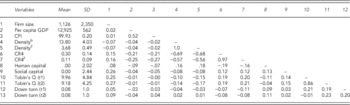
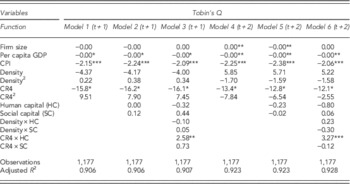
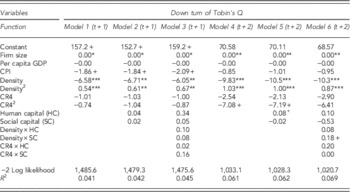
Table 1 shows the descriptive statistics and correlations among all variables in this study. Table 2 presents the results of the regression analyses with fixed effect models, based on the suggestion of Hausman (Reference Hausman1978). The regression results using t+1 Tobin’s Q as the dependent variable are exhibited in Models 1, 2, and 3, whereas t+2 is exhibited in Models 4, 5, and 6 of Table 2. In addition, we used logistic regression analysis to test the decline Hypotheses. The regression results are presented in Table 3. Before hypotheses testing, we tested the construct validities of human capital and social capital as a confirmatory factor analysis using structural equation modeling. The result of the two-factor model of first year data shows an acceptable model fit (χ2=97.125, CFI=0.88, RMSEA=0.08). In addition, confidence intervals of the ϕ values had a value of one. These results warranted further analyses of variables in terms of the discriminant validity. We also checked for multicollinearity by examining variance inflation factors for all the variables. All variance inflation factor values were lower than 2, thus well below the recommended cut off of 10, confirming that multicollinearity is not a problem in our results.
Means, standard deviations, and correlationsFootnote a

Notes. CPI=Consumer Price Indexes; CR=concentration ratio.
a Absolute value of correlation coefficients ≧0.07 are significant at 0.05, ≧0.08 are significant at 0.01.
b Variables are logarithm.
Results of regression analysis of human and social capital on organizational effectiveness

Notes. CPI= Consumer Price Indexes; CR=concentration ratio.
*p<.05; **p<.01; ***p<.001.
Results of logistic regression analysis of human and social capital on organizational decline as a downturn of Tobin’s QFootnote a

Notes. CPI= Consumer Price Indexes; CR=concentration ratio.
a CPI was excluded automatically when we put all variables in the logistic regression model.
+p<.1; *p<.05; **p<.01; ***p<.001.
Hypothesis 1 proposes a negative relationship between environmental pressure and organizational effectiveness, and a positive relationship between environmental pressure and organizational decline. In models 3 and 6 of Table 2, we find that some general and task environmental factors significantly predict Tobin’s Q. For general environmental pressure variables, per capita GDP is negatively related to Tobin’s Q (β=−0.00, p<.05, Model 3 of Table 2; β=0.00, p<.01, Model 6 of Table 2) and CPI is negatively related to Tobin’s Q (β=−2.09, p<.001, Model 3 of Table 2; β=−2.06, p<.001, Model 6 of Table 2). In terms of task environmental pressure variables, CR4 also exhibits a negative relationship with Tobin’s Q (β=−16.1, p<.05, Model 3 of Table 2; β=−12.1, p<.05, Model 6 of Table 2). The logistic regression results of Table 3 show that there is a U-shaped relationship between density and downturn of Tobin’s Q. This interesting result will be discussed in the next section. Overall, Hypothesis 1 was partially supported.
We added human capital and social capital in the regression to test Hypotheses 2 and 3. Hypotheses 2 and 3 propose positive relationships between human capital and social capital, respectively, and organizational effectiveness, and negative relationships with decline. Since the coefficients of human capital and social capital are not significant in Models 3 and 6 of both Tables 2 and 3, Hypotheses 2 and 3 were not supported.
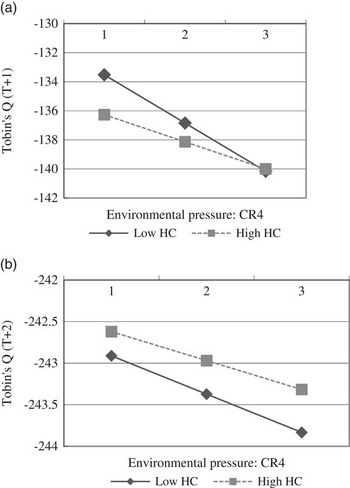
In Models 3 and 6 of Tables 2 and 3, we added the interaction terms to test Hypotheses 4a and 4b. Hypotheses 4a and 4b propose moderating effects for human and social capital on the relationship between environmental pressure and organizational effectiveness and decline. As reported in Models 3 and 6 of Table 2, the results show a significant interaction between environmental pressure and human capital in predicting organizational effectiveness. We find that the interaction effect of CR4 and human capital on Tobin’s Q is statistically significant at the 0.05 level in both the t+1 (β=2.58, p<.01) and t+2 (β=3.27, p<.001) analyses. These results provide partial support for Hypothesis 4a, but not for Hypothesis 4b. A graphical presentation of the interactions is given in Figure 1. Figures 1a and 1b both show that companies with higher human capital have a relatively flatter downward slope than those with lower human capital in explaining not only t+1 Tobin’s Q but also t+2 Tobin’s Q. In other words, companies with higher human capital generate better Tobin’s Q than those with lower human capital when they also display higher CR4 conditions.
Hypothesized environmental pressure and human capital interaction plot

DISCUSSION AND CONCLUSION
The purpose of this study is to examine the effects of environmental pressure, human capital, and social capital on organizational effectiveness and decline, as well as explore the moderating effect of human capital and social capital on the relationship between environmental pressure and effectiveness and decline. As expected, the results indicate that both general environmental pressure and task environmental pressure have an effect on organizational effectiveness and decline. However, our data analysis does not support the expected main effects of human capital and social capital on organizational effectiveness and decline. Lastly, human capital moderates the relationship between task environmental pressure and organizational effectiveness.
Environmental pressure does matter
Our research findings are consistent with previous studies that show environmental pressure explains organizational effectiveness and decline (e.g., Bain & Elsheikh, Reference Bain and Elsheikh1976; Hannan & Freeman, Reference Hannan and Freeman1987). In our study, per capital GDP, consumer price index, and industrial concentration ratio can predict organizational effectiveness. In addition, industrial density can predict decline. From the resource dependence perspective, organizational growth is restricted by the limited resources embedded in external environments. Companies incur greater operating costs when economic conditions are poorer. Contrary to expectations, per capita GDP is negatively related to organizational effectiveness in our study. One possible explanation is that growing per capita GDP may bring not only potential markets but also higher labor costs and consumer price levels. Thus, per capita GDP is a hidden indicator for predicting lower organizational effectiveness. The highly positive relationship between per capita GDP and CPI in the correlation table in our study shows that these two indicators are both good proxies of general environmental pressure.
Moreover, greater industrial concentration will lead to unfavorable task environment. That is, when the specific industry is controlled by only a few companies, the intense competition in the industry poses a threat to the growth of organizations. Interestingly, we find that there was a U-shaped relationship between industrial density and decline, meaning that the stronger density will prevent organizations from declining in the beginning but will bring about decline when the number of organizations in a certain industry exceeds a critical threshold. Although the curvilinear relationship was not an expected result, these findings echo the organizational ecology perspective, and show that the growth and decline of an organization will be influenced by external environment.
The moderating role of human capital and social capital on organizational effectiveness
Surprisingly, data analysis does not support our hypotheses that human and social capital improve organizational effectiveness or speed decline. Nevertheless, the results of this study support the argument that human capital plays a moderating role in explaining the relationship between environmental pressure and organizational effectiveness.
The findings that human capital and social capital did not affect organizational effectiveness or decline may have three explanations. First, it could be that a longer time is necessary to manifest the effects of human and social capital on organizational effectiveness. Second, the measures of human capital and social capital might not include all latent indicators. For a panel data research design, it is not easy to collect all the indicators that completely reflect the constructs. Third, human capital may be a situational factor instead of predictor of organizational effectiveness and decline. The current study in fact appears to demonstrate this.
The existence of the moderating effects of human capital on the relationship between environmental pressure and organizational effectiveness is consistent with the fundamental logic of RBV. The viewpoint that resources can be transformed into capabilities (Grant, Reference Grant1991) is the basis of strategy formulation. Therefore, more and better resources should help organizations adjust to changing external environments. Human capital thus appears to help reduce environmental threats.
Counter to intuition, social capital has neither a main effect nor moderating effect on organizational effectiveness and decline. Our research design assumes that companies with greater networking are more likely to obtain critical information that enables them to prevent organizational decline and improve organizational effectiveness. Taiwan is small and the critical industrial information is fairly transparent. Major reasons for this include the advancement of information technology along with the existence of business associations in Taiwan that facilitate rapid information flow. Consequently, the anticipated effect of networking may not be that important in Taiwan. This finding suggests directions for future researchers to follow in the study of adaptation, especially in an Asian context.
Managerial implications
According to the research results, human capital is imperative during a recession than during periods of stability. Human capital may not be a highly valued asset when organizations face low-intensity competition in the external environment. This is because when the economy is performing well or there is little competition in the market, companies can easily earn profits and human capital is unlikely to make a significant difference to production value. However, when a company faces external pressures, human capital will turn into a critical factor for organizational effectiveness. In other words, human capital is a situational factor that explains why a firm can succeed in a competitive environment. Consequently, organizations should create and accumulate human capital for potential and uncertain needs.
Overall, business operations continue to face a challenging environment. Therefore, enterprises should always attach importance to the accumulation of and investment in human capital. Employees produce long-term competitive advantage, especially in tough economic times, and organizations that fail to continue to invest in their people and processes will jeopardize their survival. In addition, the accumulation of human capital takes time. Therefore, the development of a long-term human resource development strategy is important for organizational survival. For instance, enterprises should develop systems and culture to retain talent, giving the firm-specific human capital accumulated by employees the opportunity to be applied fully.
Regardless of firm performance or the market situation, the world’s leading consumer electronics company, Samsung, has spared no expense in recruiting outstanding technical talent and has developed long-term, large scale training programs for technical personnel. Since 1993, Samsung’s Human Resource Development Center has offered 64 courses to 53,400 employees. Human resource investment is often carried out during economic downturns to prepare adequately for business recovery and has allowed Samsung to become today’s industry leader. Samsung is a good example of the arguments put forward in this study.
Theoretical implications
Furthermore, a theoretical contribution of this study is the use of RBV in explaining the relationship between environmental pressure and organizational effectiveness. In an era when intangible assets are assuming an increasingly important role in building organizational competitiveness, a different perspective may open a new research stream in a well developed research field. In addition, the investigation of the two intangible resources, human capital and social capital, may also add another perspective.
Another value of this study is its longitudinal research design. By collecting 4-year panel data, we are able to conduct the model estimation more accurately than using a cross-sectional method. A major benefit of this approach is its avoidance of critical methodological flaws such as common method bias and the possibility of spurious causality between the independent variables and outcome variables.
Limitation and future directions
In interpreting the results of this study, several limitations should be kept in mind. First, although the use of panel data can ameliorate the weakness of cross-sectional data and prevent inflation of relationship estimates, such use is restricted by available indicators. Future research should focus greater attention on the latent indicators, especially for human capital and social capital measurement. Second, given the nature of this topic, 4 years of data may be insufficient. Future research can strengthen the sample collection with a longer run of firm years and more observations. Finally, our data may be culture-bound. Replication in other countries, or studies spanning multiple countries, should be undertaken.
For future research, organizational adaptation to environmental pressure is definitely a promising field of study, especially in an Asian context. The search for valid indicators of human capital and social capital in an Asian society should also contribute to the enrichment of management research. In addition, this study shows that the sources of environmental pressure that influence organizational effectiveness and decline are varied. This might encourage future researchers to conduct more in-depth studies to enable a better understanding of organizational ecology theory. Finally, variables that help prevent, delay, or ameliorate organizational decline could be actively tested across a variety of academic disciplines.
In conclusion, this study bridges the RBV and ecological perspectives to test a model of the relationships among environmental pressure, human capital, social capital, organizational effectiveness, and decline. Research results that do not agree with this expectation leave ample room for future researchers to explore. That environmental pressure does affect organizational effectiveness and decline indicates the value of organizational adaptation research, especially in the current environment of intense global competition in many markets.
Acknowledgement
The authors would like to acknowledge the financial support provided by the Ministry of Science and Technology in Taiwan to enable us to present our earlier version at the annual meeting of the Academy of Management in Philadelphia. The authors would also like to thank the participants at the conference for their suggestions and ideas.