1. Introduction
Based on spoken data, this paper explores contrastive meaning in testimonials on Obsessive Compulsive Disorder (OCD). Contrast is a conceptual relation of opposition that is mediated through comparative construal. The study examines a number of constructions (form–meaning pairings) with contrastive use potential: conditional constructions (if, unless, and what if) that evoke alternative incompatible scenarios, and antonymous uses of lexical items (e.g., bad–good, guilt–innocence) that signal contrast relative to domains such as morality and responsibility. Conditional reasoning – as expressed through constructions such as if I don’t do it something bad will happen – is significant to OCD (Knapton, Reference Knapton2016b; Obsessive Compulsive Cognitions Working Group (OCCWG), 1997; O’Connor, 2002; O’Connor, Aardema, & Pélissier, 2005). Doubt and catastrophizing – as evoked through expressions such as what if I am crazy and what if I hurt someone – are likewise central to this disorder (Abramowitz, Reference Abramowitz2006; Nikodijevic, Moulding, Anglim, Aardema, & Nedeljkovic, Reference Nikodijevic, Moulding, Anglim, Aardema and Nedeljkovic2015; OCCWG, 1997; O’Connor et al., Reference O’Connor, Aardema and Pélissier2005; Shafran, Reference Shafran, Abramowitz and Houts2005; Van Schalkwyk, Bhalla, Griepp, Kelmendi, Davidson, & Pittenger, Reference Van Schalkwyk, Bhalla, Griepp, Kelmendi, Davidson and Pittenger2016). Unlike conditional language, antonyms have not been a focus of OCD research. In the data, antonymous lexical items establish experiential dichotomies (e.g., good – bad, guilt – innocence, cause – prevent) that reinforce and specify the nature of evoked contrast.
Meaning construction is approached in the study from a cognitive semantic perspective (e.g., Croft & Cruse, Reference Croft and Cruse2004; Gärdenfors, Reference Gärdenfors2014; Langacker, Reference Langacker1987; Talmy, Reference Talmy2000), and is accounted for by means of conceptual structures and construal (Lexical meaning as Ontologies and Construals (LOC), Paradis, Reference Paradis2005). The study also makes use of Chilton’s (2014) Deictic Space Theory (DST), which captures conceptualization in language use through a three-dimensional abstract space. One question is central:
-
1. What conceptual structures (ontologies) and processes (construals) facilitate meanings of contrast in the data?
Contrastive meaning making in the data, I propose, relies on boundary, a conceptual structure realized through comparative construal according to bundles of quality dimensions (Gärdenfors, Reference Gärdenfors2014; Paradis, Reference Paradis, Haß and Storjohann2015) such as modality, morality, and emotion. These dimensions are integrated to make up contrastive conceptions of reality (R), e.g., R: real, moral, calming vs. R’: unreal, immoral, scary. Tied to contrast in the data is also the notion of balance. OCD compulsions are often described in terms of neutralizing behavior (e.g., OCCWG, 1997; Taylor, Reference Taylor, Frost and Steketee2002) and contrast is considered here alongside the force-dynamic actions experienced as effecting such balance. A combination of the cognitive semantic model LOC (Paradis, Reference Paradis2005) and DST (Chilton, Reference Chilton2005, Reference Chilton2014) facilitates description and explanation of contrastive meaning. LOC has been used to account for a range of linguistic–conceptual phenomena, including antonymy, which is defined as a conceptual “Relation by Contrast” (Murphy, Reference Murphy2003, p. 44; also Jones, Murphy, Paradis, & Willners, Reference Jones, Murphy, Paradis and Willners2012). DST accounts for perspectivization through its deictic grounding and its transformation operations, which capture specific modes of comparative construal.
The first question is linguistic–conceptual in nature but its answers have implications for research on OCD. For this reason the study considers its findings in relation to proposals made and issues raised in such research. An ancillary question is therefore:
-
2. How are the study’s findings with regard to contrastive meaning relevant to research on OCD?
Section 2 introduces OCD and the cognitive models that seek to account for the disorder. Section 3 describes the data and methods used for the study, and Sections 4 and 5 present LOC and DST. Section 6 considers the notion of reality as it relates to OCD in preparation for the discussion in Section 7 of contrastive construal in the data. Section 8 offers concluding remarks.
2. Obsessive Compulsive Disorder
OCD is characterized by the presence of obsessions and/or compulsions (DSM-5; American Psychiatric Association, 2013). Obsessions are “[u]nwanted and distressing intrusive thoughts” in the form of “senseless ideas, images, urges, and doubts” (Abramowitz & Jacoby, Reference Abramowitz and Jacoby2014, p. 221). They are highly variable in content and are felt to be difficult or impossible to control. The content of an obsession is often experienced as inconsistent with the individual’s character or beliefs, i.e., ego-dystonic (Salkovskis, Reference Salkovskis1985, p. 578), and is therefore a source of guilt and shame. Compulsions are generally considered to be means of subduing, canceling out, or otherwise countering the intrusive thoughts or ideas. They take a variety of ritualistic forms in response to the content of the obsessions, for example “washing or cleaning, checking, or seeking reassurance from others, repeating a routine activity until ‘it feels right,’ ordering and arranging items, and performing mental rituals (e.g., saying a phrase or prayer to oneself)” (Abramowitz & Jacoby, Reference Abramowitz and Jacoby2014, p. 222). OCD is a highly heterogeneous disorder that can manifest as a range of obsessions and compulsions (Bloch, Landeros-Weisenberger, Rosario, Pittenger, & Leckman, Reference Bloch, Landeros-Weisenberger, Rosario, Pittenger and Leckman2008; Calamari et al., Reference Calamari, Wiegartz, Riemann, Cohen, Greer, Jacobi, Jahn and Carmin2004; McKay et al., Reference McKay, Abramowitz, Calamari, Kyrios, Radomsky, Sookman, Taylor and Wilhelm2004; Van Schalkwyk et al., Reference Van Schalkwyk, Bhalla, Griepp, Kelmendi, Davidson and Pittenger2016).
2.1. cognitive approaches to OCD
The Cognitive-Behavioral Model (CBM; Salkovskis, Reference Salkovskis1985) is the most recognized approach to cognition in OCD. CBM maintains that intrusive thoughts are widely experienced also by by people without OCD (OCCWG, 1997; Rachman & de Silva, Reference Rachman and de Silva1978; Salkovskis, Reference Salkovskis1989), and that what sets individuals with OCD apart is their appraisal of such intrusions. According to CBM, obsessions and compulsions result from dysfunctional beliefs. The OCCWG proposes that six belief domains are central to OCD and that these influence the individuals’ appraisal of intrusive thoughts: inflated responsibility, “the idea that one has power which is pivotal to bring about or prevent subjectively crucial negative outcomes” (1997, p. 677); overimportance of thoughts, “the belief that the mere presence of a thought indicates that it is important” (1997, p. 678); the importance of controlling one’s thoughts, the notion that it is “possible and desirable” to control thoughts (1997, p. 678); overestimation of threat, the exaggerated belief that harm is very likely; intolerance to uncertainty, a belief that certainty is necessary and change/ambiguity can be very difficult to manage (1997, p. 678); and perfectionism, the idea that “there is a perfect solution to every problem” and that this solution must be found (1997, p. 678). CBM has been substantiated through clinical and experimental research and the model has also yielded successful approaches to the treatment of OCD.
Proponents of a more recent cognitive model of OCD, the Inference-Based Approach (IBA), argue that some of CBM’s cognitive belief domains “are more reminiscent of process variables or biases rather than particular beliefs” (O’Connor et al., Reference O’Connor, Aardema and Pélissier2005, p. 7). IBA focuses on ‘patterns in reasoning’ (cognitive processes) as opposed to the ‘mental content’ upon which such processes operate (2005, p. 9). It is argued that “process variables operate independently from specific mental content, and may apply to a wide variety of mental contents” (2005, p. 7). In line with IBA, this study maintains that distinguishing between cognitive operations and the conceptual content upon which they operate facilitates more nuanced descriptions and explanations of conceptualization. A principled distinction is made in this study between cognitive processes (construal) and conceptual structures (LOC; Paradis, Reference Paradis2005). This allows for nuanced descriptions of meanings that involve systematic matching of different types of conceptual structure (configurations and content structures) and their mapping to language through construal (Section 4).
3. The study
Spoken testimonials by English-speaking adults with OCD constitute the data for this study. The testimonials were accessed through YouTube, to which they had been uploaded without restrictions on access such as passwords or subscriptions. The data are thus considered published (Berger, Reference Berger2012, discusses YouTube as a data source). Footnote 1 Twelve testimonials were selected based on similarities in subject matter and structure: the testimonials describe the onset of OCD, primarily in childhood or adolescence; they account for personal experiences and specific episodes tied to OCD; and they describe the relevance of these experiences to the speaker’s present situation as an adult. Eleven out of the twelve speakers are women. The majority of the OCD testimonials found on YouTube featured female speakers. The speakers describe having different OCD subtypes, e.g., contamination OCD, harm OCD, relationship OCD, and ‘pure-O’ OCD. Subtype labels used correspond to the speakers’ own classifications. Various but similar reasons for making the testimonials public are provided: to spread awareness of OCD; to offer support to others living with OCD; and to put an end to the stigma surrounding OCD. Some of the testimonials are featured on YouTube channels that focus specifically on OCD and others on channels that follow an individual and cover a range of topics.
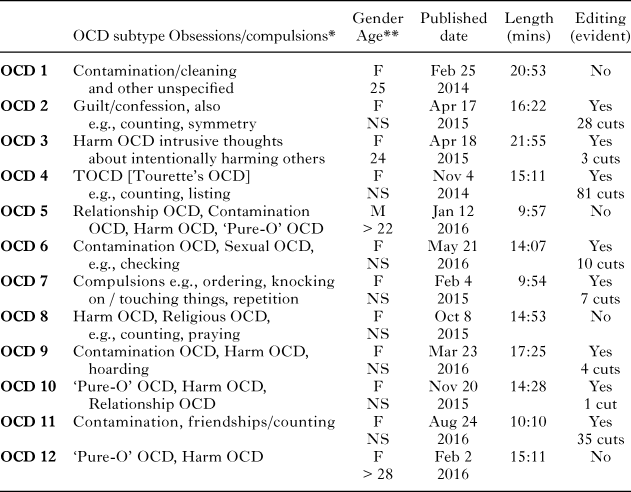
In examples from the data, words started but not finished are indicated by a hyphen (e.g., hurt him an- and hit him). Capitals are used to indicate significant emphasis on the word level, but emphasis is not represented in detail, neither is intonation. Longer pauses (over 1 second) are indicated as … without specification of length. Gestures – waving, pointing, facial expressions – are indicated when clear and in view using double parentheses ((shrugs)). This level of transcription detail captures features of relevance to the discussion. The transcribed data were compiled and tagged for parts of speech in a corpus using Sketch Engine (Kilgariff et al., Reference Kilgariff, Baisa, Bušta, Kovář, Michelfeit, Rychlý and Suchomel2014). Table 1 offers an overview of the data used for the study.
Overview of the OCD testimonials

notes: * Obsessions/compulsions as described by the speakers (Ss). In some cases Ss offer a subtype, e.g., Harm OCD. ** All speakers are adults (over 18). NS = age not specified, but testimonial makes clear that S is over 18, e.g., by discussing past events at earlier ages.
Research on OCD has been based primarily on quantitative analyses, but a number of researchers have argued in favor of qualitative approaches to OCD (Fennell & Liberato, Reference Fennell and Liberato2007; Knapton Reference Knapton2016a, Reference Knapton2016b; Murphy & Perera-Delcourt, Reference Murphy and Perera-Delcourt2014; O’Neill, Reference O’Neill1999; Van Schalkwyk et al., Reference Van Schalkwyk, Bhalla, Griepp, Kelmendi, Davidson and Pittenger2016). These researchers emphasize the value in considering patients’ own stories to better understand lived experiences of OCD. Knapton (Reference Knapton2016b) argues for a qualitative cognitive linguistic approach in her work on OCD. She maintains that such an approach provides the tools necessary to capture the dynamic nature of perspective shifts and conceptualization in OCD narratives. She applies image schemas (Johnson, Reference Johnson1987; Lakoff, Reference Lakoff1987) along with insights from DST (Chilton, Reference Chilton2014) to consider ‘dynamic conceptualizations of threat’ in OCD narratives drawn from interviews. In a similar vein, I maintain in this paper that a cognitive linguistic perspective offers valuable insight into experiences of OCD.
There are clear advantages to considering testimonials about OCD – in particular they describe authentic lived experiences of the disorder – but there are also some limitations to the approach taken in this study. The data sample is small, which limits potential for generalizability. In addition, data selection was not random; it was based on the content/structure of the testimonials. Also, the data do not constitute a balanced sample of OCD subtypes (most of the speakers report suffering from more than one OCD subtype) and include only one male speaker. The study can, however, provide a basis for further and larger-scale qualitative and quantitative investigations.
3.1. conditional constructions and ocd
Conditional language and hypothetical reasoning (e.g., if P then Q and what if P) have been described as features of OCD. For instance, Shafran notes that people with OCD use “a ‘what if … ?’ questioning style to potential problematic features of their life” (2005, p. 237, italics added). If conditionals are also used to describe features of OCD, as when Abramowitz and Jacoby write that “motivation to resist [an obsession] is activated by the fear that if action is not taken, disastrous consequences will likely occur” (2014, p. 222, italics added). In the OCCWG’s discussion of cognitive assessment of OCD an if construction is likewise used to suggest that “it may be possible to include sentence fragments with portions of the sentence to be completed by the respondent (e.g., ‘If I have the thought that _____ and don’t do _____ then _____ will happen’)” (1997, pp. 674–5). The data sample includes 156 instances of if. The testimonial with the most instances (OCD 3) contains 26 uses of if and the one with the fewest (OCD 7) includes 6 instances. What if appears 20 times in the data and in 5 of the testimonials. The testimonial with the most instances of what if contains 8 (OCD 3). Unless appears 8 times in the data and 7 of those instances are in one testimonial (OCD 11).
If constructions have broad use potential that overlaps with other constructions, and expression of conditionality is not limited to if constructions. Dancygier and Sweetser (Reference Dancygier and Sweetser2005) provide an in-depth treatment of conditionality in English in which they adopt a mental space approach (Fauconnier, Reference Fauconnier1994). They write that the construction of conditional meaning “involves setting up a mental space (in the case of if-conditionals, this is the job of the if-clause), and requesting construal of something (in if-conditionals, the then clause or main clause) within that space” (Dancygier & Sweetser, Reference Dancygier and Sweetser2005, p. 18). DST offers a compatible account wherein the if-clause is described as setting up a deictic space through transformation of S’s base reality space, according to which the then-clause / main clause can be construed (Section 5). While if itself is treated in the literature as a ‘space builder’ (e.g., Fauconnier, Reference Fauconnier1994, Reference Fauconnier1997) and as a ‘cognitive operator’ (Chilton, Reference Chilton2014), it is acknowledged that if does not effect conditional construal on its own. The meanings evoked by if constructions are contingent on, among other things, “the meaning of if, the tense of the verb, the semantics of the particular verb, expected intentions of the speaker and other contextual factors” (Chilton, Reference Chilton2014, p. 160). Tense in particular plays a significant role in the evocation of conditional meaning (Dancygier, Reference Dancygier1998; Dancygier & Sweetser, Reference Dancygier and Sweetser2005; Fauconnier, Reference Fauconnier1994).
4. Lexical meaning as Ontologies and Construals (LOC)
LOC (Paradis, Reference Paradis2005, Reference Paradis, Haß and Storjohann2015) accounts for meaning making by means of processes of construal that operate on conceptual structures of two types: content and configurations. These structures are “pre-meanings” that “serve as the raw material for the development of meanings in actual communication” (Paradis, Löhndorf, van de Weijer & Willners, Reference Paradis, Löhndorf, van de Weijer and Willners2015, p. 159). They are “conceptual in nature and mirror our perception of the world” (Paradis, Reference Paradis2008, p. 319). Content structures pertain to “meaning proper” (Paradis & Willners, Reference Paradis and Willners2011, p. 374), knowledge relating to concrete and abstract phenomena, as well as events, states, and processes. They include varied knowledge domains such as time, modality, quality, and length. Configurations are schematic templates (e.g., path and part–whole) akin to image schemas (Johnson, Reference Johnson1987; Lakoff, Reference Lakoff1987), but are generally simpler and constitutive of such schemas (e.g., boundary and scale). Construal operations, such as comparison, profiling, and metaphorization, offer means of realizing conceptual structures in language use.
LOC has been used to account for antonymous uses of lexical items (e.g., good–bad, life–death, admire–despise, up–down) (Jones et al., Reference Jones, Murphy, Paradis and Willners2012; Paradis, Reference Paradis, Haß and Storjohann2015). In their treatment of lexical opposition Jones et al. define antonymy as “a conceptual relation” with “semantic–pragmatic underpinnings” (2012, p. 127) that entails “a Relation–by–Contrast on the basis of minimal difference and maximal comparability in a given context” (2012, p. 134). The present study is guided by this assumption, namely that construed contrast invariably involves foregrounded opposition according to a content domain. For example, in I want to be good a desired state (‘to be good’) is contrasted with an implicit state (‘to not be good’). These two states are oppositional relative to morality (good–bad) and modality (real–unreal). All meanings of contrast foreground such “communicatively motivated binary opposition” whereby a boundary bisects a content domain (2012, p. 134).
5. Deictic Space Theory (DST)
DST provides a geometrical approach to representing conceptualization that draws upon mathematical formalism (Chilton, Reference Chilton2014). In conjunction with LOC, DST illuminates salient features of language use and conceptualization in the OCD data, and from the vantage point of psychology and neuroscience, DST can potentially provide a valuable heuristic tool to facilitate indirect formulation of hypotheses relevant to OCD.
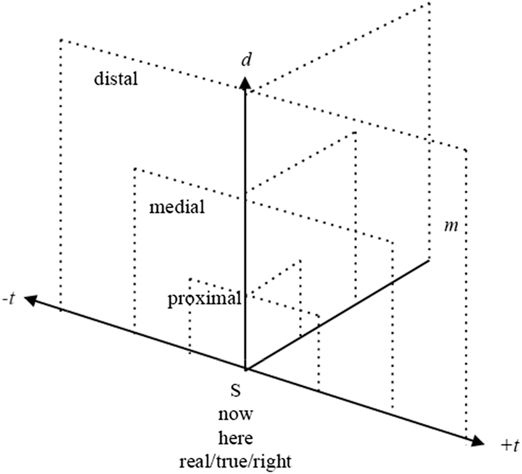
DST’s abstract three-dimensional space (Figure 1) is deictically grounded: its geometric origin is “understood as the S (Speaker, Self and Subject)” (Chilton, Reference Chilton2014, p. 29). Direction, distance, and forces are represented within the deictic space. Its three axes are labeled d, t, and m, representing attentional distance, time, and modality, respectively. The d axis is “the distancing (and also proximising) axis in the general sense of cognitive attention to cognised entities and their foreground–background relationship” (2014, p. 33). The d axis integrates distance in the sense of both “perceptual–conceptual accessibility” and “importance for the communicative interaction initiated by S” (2014, p. 33). Distance on d does not necessarily correspond to spatial distance. To exemplify, over here is closer to S on the d axis than over there (spatial distance) and the man is closer to S on d than a man (conceptual distance/accessibility). The t axis captures temporal distance from S in two directions: past and future relative to S. The m axis corresponds to an epistemic scale that “can be thought of as metaphorically spatial, in the sense that realis representations are positioned at S’s known reality; what S considers irrealis is ‘distant’ from S, or ‘remote’, ‘located’ at degrees of distance, with a limiting point that is counter to fact, i.e. ‘opposite’ to S’s known reality” (2014, p. 38). All three axes capture distance and direction tied to S’s perspective (i.e., conceptualizations are subjective). Vectors are used to model conceptualization in DST, which utilizes force vectors, position vectors, and displacement/movement vectors (for details on the use of vectors, see Chilton, Reference Chilton2014).
The fundamental deictic space from Chilton (2014, p. 41; slightly simplified).

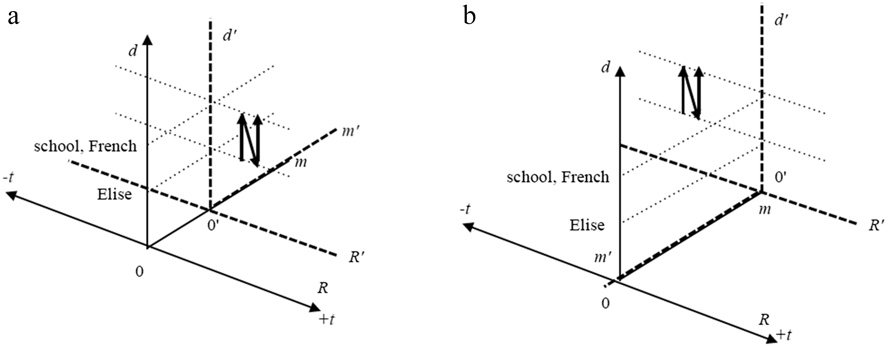
The geometry of DST allows representation of transformations of the deictic space. Such transformations are useful in representing multiple or shifting perspectives. Two transformations are relevant to the discussion of the OCD data: translation (Figure 2a) and reflection (Figure 2b) of the deictic axes. Through transformation of the axes of R (S’s base reality space), an image of the axes results. This new space is labeled R’. The constructed examples (1) and (2) illustrate such transformations.
-
(1) If Elise goes to school, she will learn French.
-
(2) If Elise had gone to school, she would have learned French.
The if construction in (1) sets up a translation of R, with a separate deictic origin, 0’. This translated space (R’) is somewhat distant on the m axis (uncertain). Figure 2a illustrates example (1) for future meaning. The discourse referents, Elise, school, and French, carry their coordinates from the d axis of the base space (R) to the translated space. Considered in terms of LOC, translation constitutes a scalar reconstrual of S’s deictic space: the translated space is shifted along one or more dimensions, in Figure 2a along the modal axis (m).
DSM for example (1) in 2a and example (2) in 2b.

The if construction in (2) likewise sets up a separate space, but does so through reflection of S’s base reality space (R) across the m axis (Figure 2b). The meaning of (2) is counterfactual; in S’s reality space (R), Elise did not go to school and consequently did not learn French. In the reflected space (R’), however, Elise went to school and learned French. The reflected “space R’ interlocks with the base space R,” so that “0’ coincides with the limit of m and the limit of m’ coincides with 0” (Chilton, Reference Chilton2014, p. 174). The counterfactual construal of (2) depends on both these reflected spaces. In terms of LOC, reflection constitutes a boundary construal across the modal axis (m).
LOC and DST are used jointly in this study. LOC accounts for a wide range of both contentful and configurational meaning structures along with modes of construal. DST is primarily configurational and includes three fundamental dimensions. It provides a deictically oriented space that situates the speaker vis-à-vis its constitutive dimensions in terms of distance and this opens up to deictic consideration of additional content dimensions. The present study extends the use of DSMs, which in Chilton (Reference Chilton2014) in most cases represent one clause each, to accommodate slightly more complex conceptualizations.
6. Reality and OCD
In IBA (O’Connor et al., Reference O’Connor, Aardema and Pélissier2005), reality is accessed via perception and sensory information. It is contrasted with imagination, which manifests as absorption in a narrative based on faulty reasoning/inferential confusion.
Although there is only one world or ‘reality structure’, our meta-cognitive ability permits us to be absorbed in several possible worlds at the same time, and to experience a sense of reality in relation to worlds which do not (and which we sometimes know do not) exist but which nonetheless, by their non-existence, inform perception. (O’Connor et al., Reference O’Connor, Aardema and Pélissier2005, p. 78)
O’Connor, Koszegi, Aardema, van Niekerk, and Taillon write that people with OCD do not have problems perceiving reality, but they come to “doubt their initial sense information” (2009, p. 422) due to “an investment in remote (often imaginary) possibilities in preference to reality” (2009, p. 420). According to IBA, reality is to some extent objective, a ‘world’ that is accessible through sensory perception.
In DST, reality is subjective and tied to the speaker (S); the deictic origin (0) for S’s ‘base reality space’ (Chilton, Reference Chilton2014, p. 169) is S’s now–here–real (Figure 1). S’s reality is not necessarily real in an absolute sense. Additional spaces can also be evoked relative to and dependent on S’s base reality. In a similar vein, Dancygier and Sweetser write that there can be no “fully elaborated world picture” or reality that is shared by everyone. Instead, “each speaker has some privileged set of mental-space structures which she understands as corresponding to her actual experience and/or to situations which she believes actually prevail or took place in the past (2005, p. 31; ‘base space’ in Fauconnier, Reference Fauconnier1994). A speaker’s reality thus corresponds to what s/he construes as real, true, or factual.
As will be illustrated in Section 7, the OCD data constructs highly mutable realities. Sookman and Steketee discuss a patient with OCD who is reported as saying: “I can see what you mean that just saying something can’t make it happen. But when I get this thought about it in my head, it feels so real, I can’t take the risk” (2007, p. 11). The patient accounts for the risk involved in uttering the thought out loud: “I think it 50%, I feel it 95%” (2007, p. 11). This example indicates a need for considering speakers’ construed realities according to different dimensions. In DST, distance to the speaker is represented relative to three axes: d, t, and m. However, distance can also be accounted for relative to other dimensions, such as emotive and perceptual ones. Proximity relative to one dimension can also be associated with distance vis-à-vis another. When a scenario feels so real [but is not real], it is emotively and/or perceptually proximal, but modally distant to S. When the patient reported on by Sookman and Steketee says, “I think it 50%, I feel it 95%”, these dimensions are afforded different distances to S. To account for contrastive construal in the OCD data, content dimensions in addition to DST’s three axes are needed (e.g., emotive, perceptual, and moral dimensions).
7. Contrastive construal in the OCD testimonials
Contrast is significant to a number of observed features of OCD such as conditional reasoning and doubt. Tackling the data in terms of contrast potentially consolidates features of OCD on conceptual grounds. Sections 7.1 and 7.2 explore counterfactual and predictive uses of if constructions. Section 7.3 deals with exceptive conditionality through uses of unless. What if is discussed in Section 7.4 for meanings of doubt and catastrophizing, and Section 7.5 considers antonymous uses of lexical items (e.g., bad–good, inappropriate–appropriate, wrong–right) that reinforce contrast relative to particular quality dimensions.
7.1. counterfactual conditionals
Counterfactual conditionals evoke contrast between a scenario construed by S as real (modally proximal) and another one construed as not real (modally distant). Consider the constructed examples (3) and (4).
-
(3) If [I had not met Mira’s father P], [she would not be here Q].
-
(4) If [I were a cat P], [I would sleep all day Q].
Example (3) considers a consequence (Q) of a hypothetical scenario (P) construed as counter to S’s reality. The speaker did meet Mira’s father. In example (4) an imaginary scenario (P) along with the possibilities that it would offer are entertained. In line with Dancygier and Sweetser, counterfactual is used here only for “specific interpretations involving a construed contradiction with [the speaker’s] ‘reality’” (2005, p. 58). Counterfactual conditionals about past events, as in (3), feature “both past-tense marking (the referent situation is in the past) and epistemic distance, hence past-perfect forms are used, with two morphological layers of marking” (2005, p. 57). Conditional if constructions with counterfactual meanings are not common in the data (4 instances). Footnote 2 In (5), if I’d told my mom we could’ve saved him illustrates the instability of the speaker’s reality and the interaction and overlap between S’s reality and other non-realities (Figure 3).
-
(5) I kept getting visions ((gestures to head)) of eh like a tarantula or a spider ((gestures spider-like movements with hand)) crawling in biting my dad it being venomous and him dying and me feeling guilty ((gestures to chest)) because I was having these premonitions ((air quotation marks)) and I didn’t tell my mom and maybe if I’d told my mom we could’ve saved him (OCD 5)
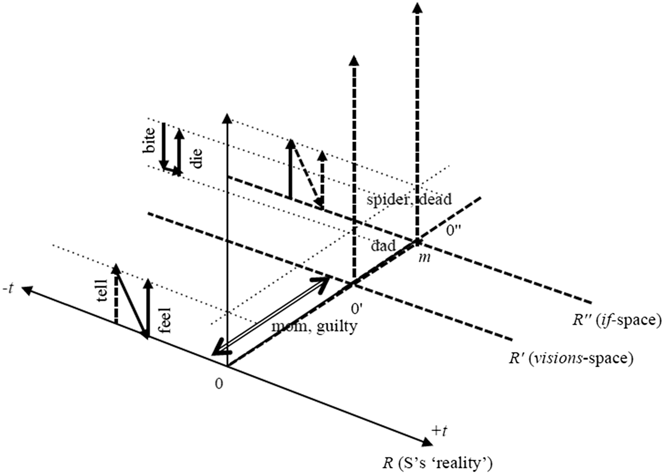
In Figure 3 the experienced guilt is represented in R (S’s reality space) along with not telling mom about the premonitions. The dotted line for ‘tell’ in R indicates negation (didn’t tell). I kept getting visions sets up a space for the visions: R’. This space shifts S’s deictic origin through (scalar) translation along the m axis.
Simplified DSM for example (5).

From the perspective of S as an adult, R’ is distant on the m axis; the use of visions is epistemically distancing (visions are typically not real). In addition, air quotation marks in conjunction with premonitions indicate a negative epistemic stance. From the perspective of seven-year-old S, the epistemic status of R’ is uncertain. Are the premonitions real or not? The visions clearly have emotive consequences to S in R; seven-year-old S feels guilty and considers whether he should tell his mom about the spider biting his dad. The modal instability of R’ is represented in Figure 3 by a double-lined arrow along the m axis. Within the space for the visions (R’) at a point in S’s past (–t on the temporal axis) is a causative chain: spider crawling in, spider biting dad, spider venomous, dad dying. In the figure, this causative chain is represented in simplified form by three vectors. A compelling feature of R’ is the use of the nonfinite –ing forms to describe this chain of events; they construe the events and states of the visions as dynamic (e.g., it being venomous), and akin to the progressive form these nonfinite forms evoke “a sense of being closer to [S’s] personal experience” (Chilton, Reference Chilton2014, p. 129). At the same time, these forms provide little anchoring to the t and m axes, something that is in line with their construed status as epistemically uncertain and temporally unmoored. The use of because ties S’s experienced guilt to the events in R’ and thereby conflates R’ with R (construes the visions as real). Not telling S’s mom about the visions can only cause S’s dad to die if the events of the visions are real. Another space (R’’) is evoked by the admission maybe if I’d told my mom we could’ve saved him. R’’ is a modal reflection of R (i.e., across the m axis). The if-space is predicated on the visions being real; in R’’ (the if-space), S told his mom about the premonitions and his dad could be saved.
The OCCWG write that “the occurrence of an intrusive thought about a possible future harm is appraised by the person with OCD as indicating that he or she is responsible for preventing the harm” (1997, p. 672). Emotions like guilt and shame, and also hope, anticipation, and relief, rely on counterfactual reasoning (Byrne, Reference Byrne2007, p. 9). The guilt expressed in (5) depends on the construal of the scenario evoked by maybe if I’d told my mom we could’ve saved him, essentially “a comparison between how the event actually turned out and how it could have or should have turned out differently” (Byrne, Reference Byrne2007, p. 9). The emotion of guilt has been accounted for in the literature on OCD (Rachman, Reference Rachman1993; Shafran, Watkins, & Charman, Reference Shafran, Watkins and Charman1996; Tilghman-Osborne, Cole, & Felton, Reference Tilghman-Osborne, Cole and Felton2010) and features prominently in the data for this study.
7.2. predictive conditionals
The most common function of if constructions in the data is prediction (68 instances). Example (6) predicts (with some uncertainty as expressed by could) that if S does not wash her hands, a number of scenarios linked to contamination may occur.
-
(6) if [I don’t wash my hands P] [I could do this Q] [this could happen Q] [I could pass it on to someone else Q] [they could die Q] [I could die Q] (OCD 9)
Dancygier and Sweetser write that “prediction is a central sense of the conditional construction (2005, p. 42; also Dancygier, Reference Dancygier1998). It involves “setting up a hypothetical (typically future) mental space and attempting to predict its consequences based on knowledge of typical cause–effect chains and general world-knowledge” (Dancygier & Sweetser, Reference Dancygier and Sweetser2005, p. 122). Prediction is not only central to conditional constructions, but is essential to reasoning and decision-making in general. Dancygier and Sweetser argue that “[w]ithout engaging in prediction – in the construction of (and commitment to) some future scenarios as more likely than others – we could never make decisions or take action at all” (2005, p. 31). Because the testimonials primarily describe past experiences tied to OCD, most of the predictive conditionals in the data predict (future) consequences of past events, as in if I didn’t do it, someone in my family would die (OCD 5). In addition to describing past events, the past tense in conditionals can signal “epistemic distance” (2005), as in (constructed with future meaning) If he was found guilty, he would be sentenced to life in prison. In the data, however, the past tense is not used primarily to signal negative epistemic stance, but to describe conditional scenarios in the speaker’s past.
Normally, predictive conditionals “construct not just one single space involving P and Q, but also an alternative space involving ∼P and ∼Q” (Dancygier & Sweetser, Reference Dancygier and Sweetser2005, p. 35).
… a space is built wherein some P holds, and a prediction of Q is made within that space. Attendant inferences are drawn about an alternative space where ∼P and ∼Q hold; and this placing of the prediction in the context of an alternative space permits, in its turn, further inferences about desirability of one space or the other, and possible courses of action. (Dancygier & Sweetser, Reference Dancygier and Sweetser2005, p. 36)
These alternative spaces are “incompatible” and “are both construed in context as subsequent causal and temporal developments from the same base or reference space, for the same portion of the timeline” (2005, p. 35). In connection to OCD, O’Connor et al. argue that “thinking of alternative scenarios can help us arrive at a sense of reality” but can also “increase doubt rather than certainty” and “[u]nder certain conditions people with OCD seem more susceptible to this doubting effect” (2005, p. 69).
Predictive if conditionals in the data foreground negative consequences. In (7), predictive if not P, then Q and if P then Q make salient negative outcomes: I was going to die and I would get the disease.
-
(7) I felt like if I didn’t look back ((looks over shoulder)) like six times or something ehm … that I was going to die, or ((sighs)) I felt like the number … like if I inhaled when I was looking at someone that … with like a disease then I would get the disease (OCD 2)
Dancygier and Sweetser write that “[t]he space directly mentioned in a conditional prediction is set up more saliently and directly than its implicit alternative” (2005, p. 36). Example (7) illustrates something significant to the OCD data: the space construed by S as undesirable/negative is foregrounded and explicit, whereas a desirable/positive space is evoked implicitly and is derivative of the negative space. Only in a few instances in the data are positive outcomes mentioned explicitly, e.g., if you complete these rituals to your like satisfaction that … it will ease the anxious feeling that you have (OCD 7).
The if-clause in (8) sets up a scenario, or “a model of some situation in the world” (Dancygier & Sweetser, Reference Dancygier and Sweetser2005, p. 29). In terms of DST, the if-clause evokes a deictic space and a consequence is predicted based on this space. In addition, a contrastive scenario (not doing anything wrong) along with its emotive consequence (not feeling guilt) is implicitly evoked.
-
(8) the guilt would eat at me if I did something that I felt was wrong (OCD 2)
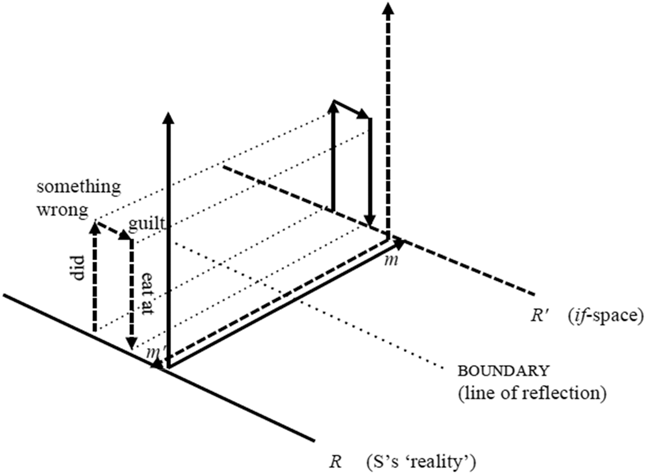
How can construal of these alternative/contrastive spaces be accounted for? I suggest that this type of contrast can be represented as two reflected spaces in a DSM. Chilton (Reference Chilton2014) uses the transformation of reflection to account for true counterfactual meanings, as in: The guilt would have eaten at me if I had done something wrong [but I didn’t] (Section 7.1). The use of reflection to account for the evoked construal of (8) is an extension of this use of reflection. S’s reality space (R) corresponds to the implicit scenario of (8): ‘the guilt would not eat at me if I didn’t do something I felt was wrong’. In the extended context of (8) the speaker says that she never broke a single rule (example 9), so S’s actions are in line with the implicit scenario where S does nothing wrong (S’s reality space R). While not strictly counter to fact, the foregrounded if-space (R’) constitutes a reflection of R at the limiting point of the modal axis. The circumstances of R are reversed in R’. Figure 4 provides a DSM for example (8).
DSM for example (8) illustrating reflection across the modal axis.

Reflection bisects the m axis according to a boundary (line of reflection) and construes R and R’ as being in opposition (as incompatible alternatives). The dashed lines in the speaker’s reality space (R) indicate negation. Footnote 3 The avoidance of R’ guides S’s actions and makes her follow every rule. Doing something wrong is represented as causing the guilt to eat at S (indicated by a force vector in the DSM).
Predictive conditionals in the data evoke causative construal. In (8) doing something wrong causes the guilt. Causative meaning can also be cued by the lexical items because and so, as in (9).
-
(9) I was always the kid to follow the rules perfectly because if I didn’t I would feel this really bad shame and guilt and so I never broke a single rule (OCD 2)
Similar causative meaning is also evoked in the data by because and or in combination with have to, as in I have to do X because if I don’t Y will happen and I have to do X or Y will happen.
7.3. exceptive conditionals
Similar to predictive if conditionals, unless constructions can be used to foreground negative scenarios that may come to fruition if compulsions are not carried out (Dancygier, Reference Dancygier2002; Dancygier & Sweetser, Reference Dancygier and Sweetser2005, ch. 7; Declerck & Reed, 2001, ch. 13). Unless conditionals are less common in the data (8 instances) than if conditionals.
-
(10) for me my thought was you’re going to be sick or your friend’s going to fall out with you … UNLESS you do this unless you text your friend five times unless you … go unless you stop walking on all the pa- the cracks in the pavement unless you … ehm choose different cutlery to eat your food with unless you eh walk back and forth five times (OCD 11)
In (10), two scenarios (Qs) are evoked by the expression you’re going to be sick or your friend’s going to fall out with you. These scenarios are foregrounded by S (explicit and construed as the default). The subsequent unless-clauses (Ps) cue a number of ‘exceptive’ scenarios (Dancygier & Sweetser, Reference Dancygier and Sweetser2005) to yield the meaning: Q; [(not Q) if P] (Dancygier, Reference Dancygier2002; Dancygier & Sweetser, Reference Dancygier and Sweetser2005, p. 184). Example (10) “states Q as a basic default situation and then adds the If P, ∼Q scenario as an exceptional alternative” (Dancygier & Sweetser, Reference Dancygier and Sweetser2005, p. 187). The unless construction in (10) allows S to foreground two negative scenarios that will happen unless exceptive measures are taken. The use of you in (10) instead of I introduces a degree of distance between S and the thoughts and potentially indicates that the thoughts are construed as having a source external to S, a type of disassociation between OCD and the self (Fennell & Liberato, Reference Fennell and Liberato2007, pp. 322–323).
Much like if constructions, unless constructions evoke contrastive meaning (alternativity) between “mutually exclusive scenarios” (Dancygier & Sweetser, Reference Dancygier and Sweetser2005, p. 187). In the data, as we have seen for previous examples, scenarios considered immoral, scary, or unreal are explicit, whereas their alternatives are implicit. The default state for the speaker of (11) is discomfort, and obsessive worry is described as the only way around this sensation.
-
(11) I don’t feel comfortable unless I’ve got something to obsess about which sounds ridiculous because like … the only way for ME to get rid of a particular worry is to then find something else to worry about so I will … sit and wait look for more dangers (OCD 9)
In (11), unless is used to convey that only worrying about more dangers can alleviate the discomfort of worrying, which is described as S’s default experience.
7.4. reduced-q conditionals
Doubt and catastrophizing are features of OCD that can be expressed through what-if constructions (Abramowitz, Reference Abramowitz2006; Nikodijevic et al., Reference Nikodijevic, Moulding, Anglim, Aardema and Nedeljkovic2015; OCCWG, 1997; O’Connor et al., Reference O’Connor, Aardema and Pélissier2005; Shafran, Reference Shafran, Abramowitz and Houts2005; Van Schalkwyk et al., Reference Van Schalkwyk, Bhalla, Griepp, Kelmendi, Davidson and Pittenger2016). Doubt and catastrophizing are related; doubt can concern the past, the present, or the future (What if I did … ? What if I am … ? What if I will do … ?) and catastrophizing generally concerns the relevance of the past/present to future events: “Catastrophizing is the tendency of individuals to apply a ‘what if…?’ questioning style to potential problematic features of their life and, in worriers, this usually results in the consideration of worse and worse outcomes” (Shafran, Reference Shafran, Abramowitz and Houts2005, p. 237). The use of what if evokes a new deictic space through transformation of S’s base reality space. A what-if space can be constructed through translation (scalar repositioning on the modal axis) for meanings involving an uncertain future, as in (12), in which the use of maybe reinforces a scalar construal.
-
(12) oh I’ve trod in dog poo ah that means like maybe next year I’ll go blind and maybe the year after that I’ll want to kill myself … oh my god and what if (OCD 1)
Uses of what if can also evoke deictic spaces through reflection across the modal axis for contrastive meaning, as in (13), which evokes doubt (what if I AM crazy) and catastrophizing (what if I go crazy and this happens).
-
(13) everything is a what if everything becomes for me what if I AM crazy what if I am … you know… what if I DO want to hurt these people what if I DO want to do whatever what if I go crazy and this happens (OCD 3)
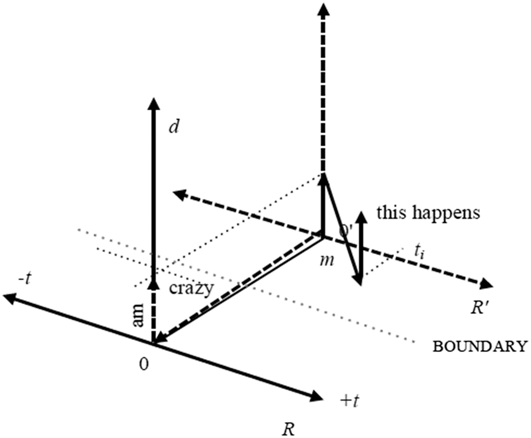
Emphasis is placed on the words AM and DO in a manner that evokes their opposites as the default. They cue construction of contrastive spaces, as in Figure 5. The use of what if I AM crazy cues the conception of ‘I am not crazy’ in R (dashed line), along with its modal reflection ‘I am crazy’ in R’ (solid line) through a comparative construal that balances on a modal mid-boundary. Being crazy (and then going crazy) causes something to happen, an event represented in R’ (Figure 5) in simplified form as a vector at a time t i in the future of R’. A number of content dimensions are aligned with the modal axis for contrastive construal: control (‘control’ vs. ‘no control’), mental state (‘crazy’ vs. ‘not crazy’), desire to hurt people (‘want to’ vs. ‘do not want to’).
Partial DSM for example (13) what if I am crazy … and this happens.

Unlike predictive if constructions, what-if constructions leave Q implicit. Declerck and Reed refer to what-if constructions as “reduced-Q conditionals” (2001, pp. 390–391) and write that in what-if constructions “what can represent various Q-clauses (What shall we do?, How will we react?, etc.)” and can “be short for something like ‘what are the implications?’” (2001, p. 391). They also suggest that what if can be used to consider an “alternative” to some idea as in “… What if the murder was committed with a different knife” (2001, p. 391). In (14), S realizes that she checked on her rabbits only five minutes ago and that most likely nothing has changed since then, but the evoked alternative scenarios (what if they just died what if they just did this or what if they’re sick) make her initiate her checking routine again.
-
(14) if I hear a noise or I hear something like I don’t know the rabbit like ran or jumped or something I start obsessing what if they just died what if they just did this or what if they’re sick and even though I just checked on them five minutes ago I have to get out of bed go downstairs and do the whole thing over again (OCD 6)
What-if constructions illustrate “intolerance to uncertainty” (OCCWG, 1997), a feature of OCD that is closely linked to doubt (Section 2.1).
7.5. antonyms
Conditional constructions are used in the literature on OCD to exemplify patterns of reasoning and to suggest screening and assessment. Antonyms, on the other hand, are much less common in such accounts, if they are considered at all. This is noteworthy because antonymous uses of lexical items reinforce and specify the (contentful) nature of the construals evoked by conditional constructions. In accordance with LOC, antonymy is regarded here as “a conceptual relation” of contrast (Jones et al., Reference Jones, Murphy, Paradis and Willners2012, p. 127). Through antonymous uses of lexical items an “underlying contentful meaning structure is divided into two parts” (2012, p. 134) that are construed as being in opposition. In the OCD data, antonymous lexical items evoke contrast according to a range of content dimensions. Modal, moral, emotive, and perceptual dimensions are prominent, as are dimensions tied to actions and control.
-
(15) it would be like looking back on past past incidents where they weren’t really anything but my brain would now layer stories overtop and say you did this despicable thing to this person you hurt this person when in reality none of that’s true but my brain would force me to buy into it and and it was really nasty and I’d be ruminating about that for days because you know I don’t I don’t want to be a bad person ((points to chest with both hands)) I don’t think I’m a bad person and my brain was trying to TELL me I was a bad person and anyone with OCD knows … how kind of painful that is and hurtful and scary because it’s completely opposite of what you want it’s ego-dystonic which is why OCD is so painful (OCD 3)
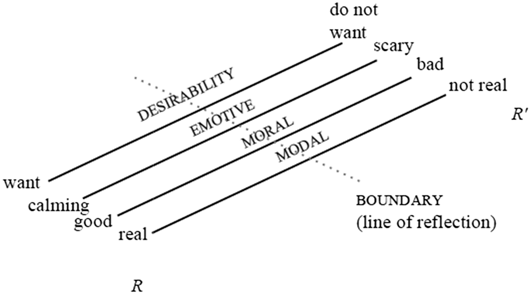
Example (15) contrasts what is subjectively real (R) to what is experienced as a forced counterfactual reality (R’) through expressions like layer stories overtop and in reality none of that’s true. R’ is explicit but (15) also evokes R, a space in which S did nothing despicable to hurt another person. These two spaces (R and R’) are reflections across the modal axis: what is real in R is not real in R’ and vice versa (Figure 6). A number of lexical items establish and reinforce this contrast. The use of a bad person, especially in the context of negation (don’t think I’m, don’t want to be) reinforces the modal contrast (real vs. not real) by aligning it with a moral contrast and a contrast for desirability. The modal, moral, and desirability dimensions are also integrated with an emotive one through uses of painful, hurtful, and scary to create a joint contrastive construal through integration of these quality dimensions. The contrastive boundary construal is further reinforced by the use of the adjectives opposite and ego-dystonic.
Integrated dimensions for contrastive construal in example (15).

The ‘do not want–scary–bad–false’ scenario of R’ is explicit and foregrounded by S. The ‘want–calming–good–true’ scenario of R is only represented implicitly and mainly through negation (I don’t want to be a bad person).
Contrast can also evoke balance through force-dynamic construal. In the data, compulsions are described in terms of symmetry and counterforce (Rachman, Reference Rachman1993; Salkovskis Reference Salkovskis1989; Taylor, Reference Taylor, Frost and Steketee2002). Alongside force, balance relies on boundary construal and oppositeness. In (16) ‘hitting my left hand’ establishes sensory balance.
-
(16) I did have weird compulsions too like I would have to … if I like hit my hand on something my right hand I would have to hit my left hand on it so it felt the same way (OCD 2)
Balance is reinforced in (16) through the use of antonymous right and left and through the description of a resulting sensation: so it felt the same way. The use of so cues a causative relation between action and result. In example (17) from the same testimonial, a number of dimensions are integrated for contrastive construal and antonymous uses of lexical items establish and reinforce contrast.
-
(17) some of my intrusive thoughts were … ehm … I’m just going to be straight up with you guys … were around like inappropriate images and things that … ehm … I felt were really wrong for me to be thinking about at a young age not only were they inappropriate in like taboo ways but they were also sometimes really scary thoughts like I would think things like my family … like I would over and over in my head something would play like … ehm … like someone I love would get shot but then in my head to make myself feel better I would like imagine myself taking the bullet for that person so that I wouldn’t feel guilty for picturing someone I love getting shot … you guys it sounds insane and it kind of is (OCD 2)
The use of inappropriate, wrong, and taboo establish contrast for morality. Note that, as for (16), their opposites (appropriate, right, and acceptable) are implicit and not foregrounded. The moral contrast is aligned with an emotive one through scary.
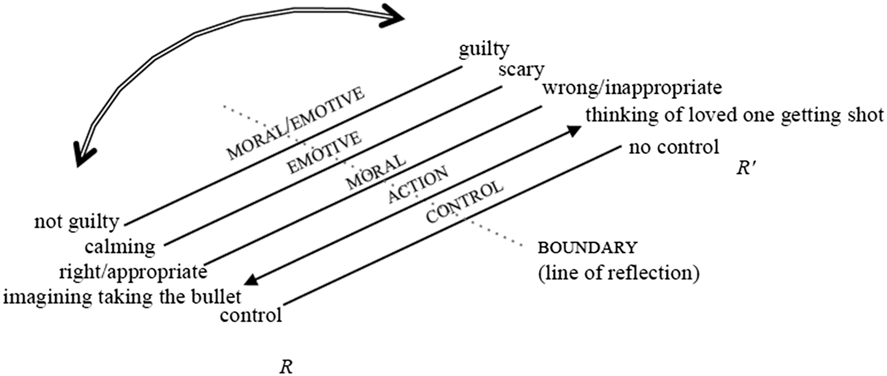
Two imagined actions are balanced: picturing someone I love getting shot and imagining myself taking the bullet for that person. The former action is intrusive / not controlled, whereas the latter is controlled and aimed at establishing balance relative to a moral/emotive dimension introduced by guilty. These dimensions are integrated and construed as incompatible alternatives according to a single boundary (Figure 7). A force dynamic is introduced through the action of imagining myself taking the bullet for that person; causation is expressed by so that I wouldn’t feel guilty and to make myself feel better, which present desired results. Unlike (15), example (17) does not explicitly evoke a modal contrast (real/unreal) through words like reality or true but, as in (15), emotions like fear and guilt are construed as proximal to S. The intrusions in (17) are emotively ‘real’ and yet the speaker suggests that her experience is ‘not real’ when she says that it sounds insane and it kind of is. A double-lined arrow in Figure 7 indicates that S’s deictic origin is in flux and shifts between R and R’. Similar to the expression it feels so real [but I know it is not], emotive proximity is contrasted with modal proximity (Section 6). The intrusions are modally distant (insane) but emotively proximal (scary and guilt-inducing).
Integrated dimensions for contrastive construal in example (17).

Research on OCD has accounted for the neutralizing function of compulsions (Salkovskis, Reference Salkovskis1989). Taylor writes that “[c]ompulsions can be overt (e.g., cleaning) or covert (e.g., thinking a ‘good’ thought to undo or replace a ‘bad’ thought)” (2002, p. 1). In (17), the thought of taking a bullet for a loved one serves to ‘undo’ the scary intrusive image and achieving balance is predicated on a relevant contrast according to morality along with an action (the thought) with potential for influencing this contrast. In (16), the balancing action is hitting my left hand and balance is tied to sensory perception (hitting my left foot means I have to also hit my right foot) (Hartman, Reference Hartman2017, for force construal and Tourette Syndrome). In (18), two thoughts are construed as opposites: oh my God you’re gonna stab her and you’re so lucky to have her. The action of balancing these thoughts is described as ‘rhyming’, and balance is sought according to morality. Similar to previous examples, (18) evokes two spaces reflected across the modal axis.
-
(18) I developed a weird compulsion ((makes circles with hands toward body)) where I would rhyme so like I would get scary words or phrases in my head constantly … and I’d have to rhyme it with a POSITIVE thought so like for example if I was cutting something up ((gestures cutting)) and I was thinking oh my God you’re gonna stab her oh my God you’re gonna stab her I would have to rhyme it with … you’re so lucky to have her oh my gosh you’re so lucky to- like and I would just DO it ((makes fast circles with hands)) and it became … very automatic to me (OCD 12)
Uses of, for instance, the adjectives scary, positive, and lucky reinforce the construed contrast. The admission I’d have to rhyme it indicates that the positive thought (you’re so lucky to have her) neutralizes or cancels out the negative thought (oh my God you’re gonna stab her).
Antonymous uses of lexical items as in (15)–(18) illustrate the speakers’ preoccupation with, and linguistic–conceptual foregrounding of, only one end of a number of integrated meaning structures. Insight into the kinds of construal reflected in (15)–(18) can be valuable in responses to and treatment of OCD. Contrastive (boundary) construal constitutes a mode of configuring conceptual content that leaves little room for inferences and actions of a gradual or incremental nature. Also, the integrated nature of the dimensions potentially influences the conceptualizing person’s capacity to single out and reconsider any one of these dimensions in isolation. For instance, targeting an action, such as a compulsion, for reconsideration and/or change may require also adequately addressing any links between the action and interrelated dimensions, e.g., moral, emotive ones (see Murphy & Perera-Delcourt, Reference Murphy and Perera-Delcourt2014, for the relation between a qualitative approach and treatment of OCD). The mutability and multidimensional character of the speakers’ conceptions of reality indicate a need for careful consideration of diverse types of experiential proximity to the conceptualizer above and beyond modality (e.g., emotion, morality, control).
8. Conclusion
Cognitive models of OCD aim to delineate the cognitive foundations of the disorder. This study contributes by accounting for the nature of contrastive language and conceptualization in OCD testimonials and by outlining a cognitive semantic approach to language in use with potential utility to descriptions of this disorder. The language used to account for experiences of OCD in the data illustrates both patterns of reasoning (If P then Q; Q unless P; What if P?) and mental content (e.g., modality, morality, emotion) central to the speakers’ conflicting conceptions of reality. Experiential content is construed in terms of dichotomies (real–unreal, good–bad, calm–scared) grounded in integrated quality dimensions (modality–morality–emotion). A modal dimension (real–unreal) alone is not sufficient to account for the speakers’ conceptions of reality. Instead, their realities are construed according to bundles of quality dimensions. They describe continuous negotiation of their experiences relative to incompatible realities. As one speaker puts it, the main piece of advice that I would give you is your OCD isn’t real … that’s something that the whole time I had OCD nobody said that to me (OCD 11).
In the OCD data, conditional constructions (if, what if, and unless) evoke contrastive construal that foregrounds a modal dimension (real vs. not real) integrated with various other content dimensions, prominently moral and emotive ones. Speakers with OCD conceptualize these dimensions as bisected through boundary construal. Alternative and incompatible realities are constructed through reflection across the modal axis of the speakers’ deictic space. Relative to a speaker’s base reality space (R), an image is evoked (R’) in which features of R are reversed: what is real in R is not real in R’, good is bad, moral is immoral, calming is scary, and control is chaos. Deictic spaces tied to irreality, lack of control, immorality, and negative emotions are foregrounded and explicit. Their reflected spaces featuring control, morality, and positive emotions are backgrounded and generally implicit. The speakers’ perspectives (deictic origins) shift between alternative incompatible conceptions of reality. The dynamics of negotiating such realities constitutes a significant feature of the OCD testimonials. emotive proximity to speakers (it feels so real) is linked to modal distance (but it isn’t real). Compulsions are often described through force-dynamic expressions that introduce construals of balance and neutralization relative to some dimension (left–right, positive–negative), as when perceptual balance is achieved by intentionally hurting the left hand when the right is accidentally hurt (example (17)), or when emotive balance is realized by ‘rhyming’ positive thoughts with negative ones (example (19)).
Antonymous uses of lexical items construct, reinforce, and specify the nature of contrastive construal in the data. As outlined in this study, conflicting realities are evoked through uses of conditionals in combination with (antonymous) descriptions of incompatible modal, moral, and emotive properties (bad–good, scared–calm, unreal–real) and associated force-dynamic actions (picturing a loved one getting shot–imagining taking the bullet for the loved one). The findings in this study suggest that investigation of antonymous lexical items of various kinds provide fruitful ground for further research on cognition in OCD and can potentially offer clinicians new insight into experiences of this disorder.