




Non-technical Summary
This study investigates a group of tiny marine fossils made of calcium carbonate called the Eoconusphaeraceae, including the genera Eoconusphaera and Conusphaera. These organisms lived in the oceans during the Late Triassic (~208–201 million years ago) and Late Jurassic (~148–120 million years ago). Their biological origin has long remained uncertain, making them difficult to classify. Using high-resolution microscopy, this study shows that these fossils were most likely produced by early coccolithophores, a group of single-celled algae that form small calcium carbonate plates around their cells. Newly discovered fossil clusters demonstrate that the species Eoconusphaera zlambachensis formed spherical coverings composed of calcium carbonate cones surrounding a central cell, similar to modern coccolithophore algae. Comparable structures have already been illustrated in the Jurassic genus Conusphaera, supporting the interpretation that both genera belong to the same broader group of calcareous plankton. The study also shows that many structural details of these fossils can be modified due to calcium carbonate dissolution during fossils deposition and the rock formation process. The repeated appearance of cone-shaped forms in Triassic and Jurassic oceans suggests that these morphologies represent successful adaptations to particular environmental conditions. However, it remains unclear whether similarities between Eoconusphaera, Conusphaera, and other Mesozoic conical forms reflect evolutionary relationships or repeated development of similar morphologies in separate groups. Overall, these results improve our understanding of the early evolution of marine plankton that produced calcium carbonate and play an important role in ocean ecosystems and the global carbon cycle.
Introduction
The diversification of calcareous nannoplankton during the Late Triassic marks an important phase in the early evolution of marine phytoplankton. Among the earliest calcareous nannofossils are a few genera characterized by elevated or conical morphologies, including Eoconusphaera Jafar, Reference Jafar1983 from the Upper Triassic and Conusphaera Trejo, Reference Trejo1969 from the Upper Jurassic. These taxa, which differ primarily in their stratigraphic ranges and subtle variations in their internal ultrastructure, were assigned to the family Eoconusphaeraceae by Kristan-Tollmann (Reference Kristan-Tollmann1988). However, both genera have traditionally been regarded as nannoliths of uncertain affinity.
Although Conusphaera mexicana Trejo, Reference Trejo1969 was originally illustrated within partial coccospheres by Trejo (Reference Trejo1969), later publications frequently reported both Conusphaera and Eoconusphaera as calcareous nannofossils of uncertain affinity (e.g., Moshkovitz, Reference Moshkovitz1982; Roth et al., Reference Roth, Medd and Watkins1983; Posch and Stradner, Reference Posch and Stradner1987; Bown and Cooper, Reference Bown, Cooper, Crux and van Heck1989; Bralower et al., Reference Bralower, Monechi and Thierstein1989; Bown, Reference Bown and Bown1998; Varol and Bowman, Reference Varol and Bowman2019; Demangel et al., Reference Demangel, Kovács, Richoz, Gardin, Krystyn, Baldermann and Piller2020). In contrast, Perch-Nielsen (Reference Perch-Nielsen and Bolli1985) classified these taxa among coccoliths within the Crepidolithaceae (= Parhabdolithaceae), implicitly recognizing coccolithophore affinities. Demangel et al. (Reference Demangel, Howe, Gardin and Richoz2021) later suggested a similar affinity, arguing that members of the Eoconusphaeraceae exhibit some morphological similarities with Jurassic coccolithophores of the family Parhabdolithaceae, particularly the genus Mitrolithus Deflandre and Fert, Reference Deflandre and Fert1954. These similarities comprise truncated cone shapes, vertical outer plates, and domed cores.
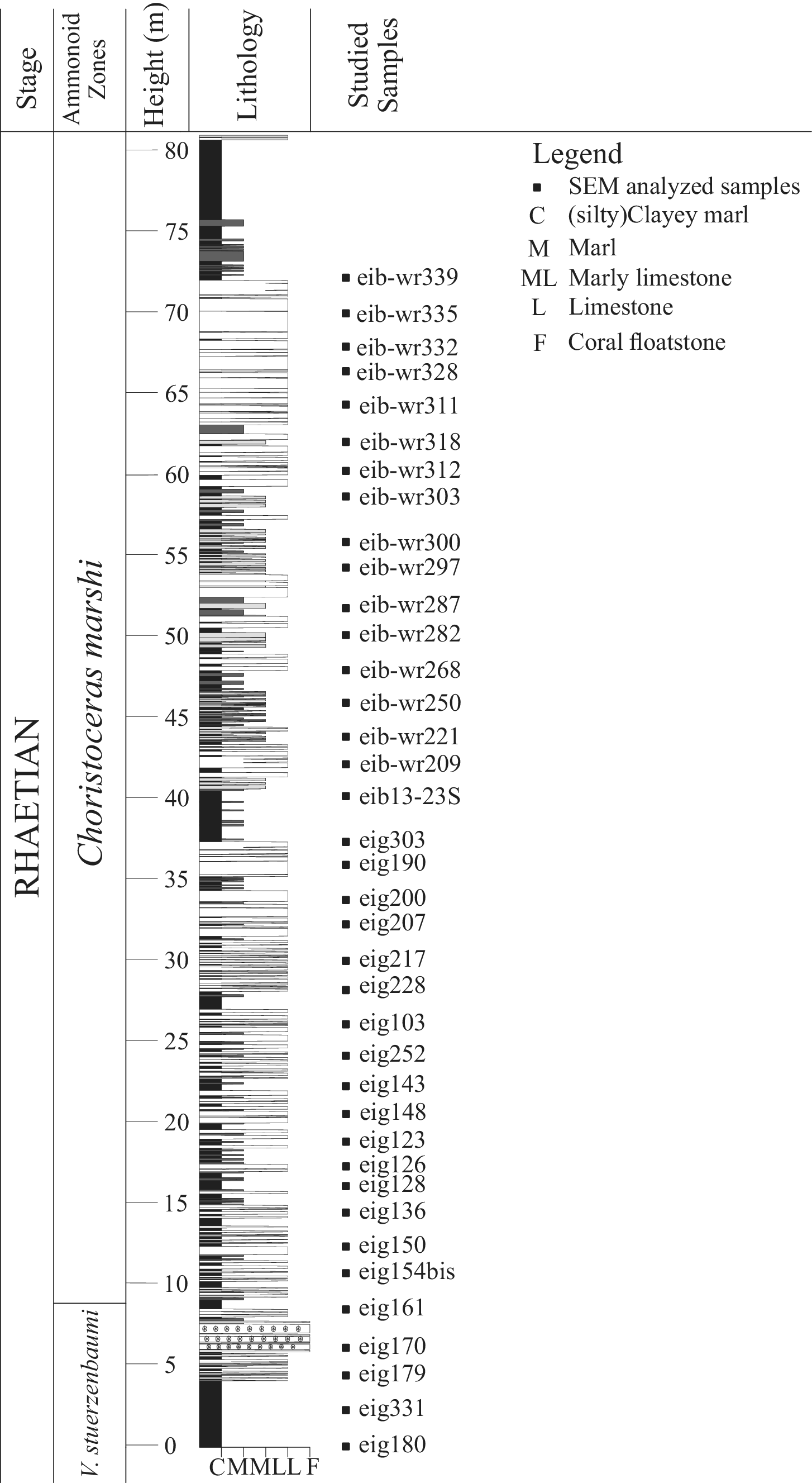
Recent observations from the Eiberg section (upper Rhaetian, Choristoceras marshi Ammonoid Biozone; Fig. 1) of the Northern Calcareous Alps (NCA), Austria, revealed an articulated coccosphere composed of at least 10 Eoconusphaera zlambachensis (Moshkovitz, Reference Moshkovitz1982) Jafar, Reference Jafar1983 coccoliths (Fig. 2). These are arranged with their proximal sides (narrow cone bases) oriented toward a central, bowl-shaped cavity ~ 3.7 μm in diameter, interpreted as the algal cell position. This finding provides strong support for interpreting Eoconusphaera as an early coccolithophore.
Stratigraphic log of the Eiberg section (Northern Calcareous Alps, Austria) showing the ammonoid zones and sample positions.

Figure 1. Long description
The stratigraphic column is organized into five vertical columns from left to right.
1. Stage: The entire section belongs to the Rhaetian stage.
2. Ammonoid Zones: The lower section from 0 to approximately 9 meters is the V. stuerzenbaumi zone. The remainder of the column up to 80 meters is the Choristoceras marshi zone.
3. Height (m): A vertical scale from 0 at the base to 80 at the top.
4. Lithology: A visual representation of rock layers. The x-axis at the base of this column is labeled C, M, M L, L, and F. According to the legend, these represent (silty) Clayey marl, Marl, Marly limestone, Limestone, and Coral floatstone. The lithology shows a high frequency of alternating thin beds of marl and limestone. A distinct layer of Coral floatstone (F) with a circular pattern is visible between 6 and 8 meters.
5. Studied Samples: Black squares indicate sample positions. Samples are labeled with prefixes ‘eig’ and ‘eib-wr’.
* From 0 to 10 meters: eig180, eig331, eig179, eig170, eig161.
* From 10 to 20 meters: eig154bis, eig150, eig136, eig128, eig126, eig123.
* From 20 to 30 meters: eig148, eig143, eig252, eig103, eig228, eig217.
* From 30 to 40 meters: eig207, eig200, eig190, eig303, eib13-23S.
* From 40 to 60 meters: eib-wr209, eib-wr221, eib-wr250, eib-wr268, eib-wr282, eib-wr287, eib-wr297, eib-wr300.
* From 60 to 75 meters: eib-wr303, eib-wr312, eib-wr318, eib-wr311, eib-wr328, eib-wr332, eib-wr335, eib-wr339.
The legend in the top right specifies that black squares represent S E M analyzed samples.
Scanning electron micrograph showing: (1) an articulated coccosphere with 10 individual coccoliths of Eoconusphaera zlambachensis (Moshkovitz, Reference Moshkovitz1982) Jafar, Reference Jafar1983, with three highlighted in yellow (sample EIB128; Choristoceras marshi Ammonoid Zone; upper Rhaetian; Upper Triassic); (2) close-up of one E. zlambachensis specimen forming part of the articulated coccosphere; (3) E. zlambachensis specimen from sample EIB-WR268 (Choristoceras marshi Ammonoid Zone; upper Rhaetian; Upper Triassic).

Figure 2. Long description
Panel 1 is a large S E M micrograph of an articulated coccosphere. At the center is a dark circular void. Surrounding this void is a ring of approximately 10 individual coccoliths. Three of these coccoliths are highlighted in yellow to show their orientation and structure within the sphere. A white scale bar at the bottom right indicates 5 micrometers. Panel 2 is a close-up inset located at the top right, connected by lines to one of the yellow-highlighted coccoliths in panel 1. It reveals the fine, layered, and fibrous texture of the E. zlambachensis specimen. Panel 3 is a separate micrograph at the bottom right showing a different E. zlambachensis specimen embedded in a rocky matrix. This specimen has a conical or cylindrical shape with distinct vertical striations. A white scale bar at the bottom right of this panel also indicates 5 micrometers.
The aim of this study is to reassess the affinity of the Eoconusphaeraceae and morphology of Eoconusphaera zlambachensis using new observations from Upper Triassic deposits. Based on our findings, this study revises the systematic placement of the genera Conusphaera and Eoconusphaera as true coccolithophores belonging to the family Parhabdolithaceae. Revised diagnoses are provided using coccolithophore-specific terminology, and new observations on the preservational state of E. zlambachensis are also included (Fig. 3).
Representation of the five dissolution stages of Eoconusphaera zlambachensis including schematic views and scanning electron micrographs from the Vandaites stuerzenbaumi Ammonoid Biozone: (1) sample Zl 51,8669 (Demangel et al., Reference Demangel, Kovács, Gardin, Krystyn, Piller, Baldermann and Richoz2023, fig. 6B) and Choristoceras marshi Ammonoid Zone; (2, 3) sample EIB WR209, 42.19 m; (4) sample EIB WR297, 54.13 m; (5) sample EIB WR268, 48.02 m; (6) sample EIB WR297, 54.13 m; (7) sample EIB WR303, 58.46 m; (8) sample EIG 200, 33.76 m; (9) sample EIB WR318, 61.93 m; (10) sample EIB WR287, 51.63 m; (11) sample EIB WR297, 54.13 m; (12, 13) sample EIB WR311, 64.15 m; (14, 15) sample EIB WR282, 50.06 m.

Figure 3. Long description
The image consists of 15 S E M micrographs and 5 schematic diagrams arranged in a 5-row by 4-column grid. A scale bar at the bottom right indicates 2 micrometers.
* Row 1: STAGE 1 Rim and core preserved. Panels 1, 2, and 3 show intact, cylindrical microfossils with smooth surfaces. The schematic shows a solid green and blue tapered cylinder with a flat top divided into radial segments.
* Row 2: STAGE 2 Partial etching of the rim. Panels 4, 5, and 6 show microfossils with visible vertical striations and slight surface pitting. The schematic shows the outer green segments beginning to separate or thin.
* Row 3: STAGE 3 Complete etching of the rim. Panels 7, 8, and 9 show fossils where the outer layer is heavily weathered, revealing a bundle of internal laths. The schematic shows the cylinder composed entirely of thin, multi-colored radial laths.
* Row 4: STAGE 4 Etching of some bundle and sulcus formation on laths. Panels 10, 11, and 12 show the internal structure breaking down into a cross-hatched or rhombohedral pattern. The schematic shows a longitudinal cross-section of the cylinder with a chevron-like internal arrangement of laths.
* Row 5: STAGE 5 Division of the core laths in rhombohedra. Panels 13, 14, and 15 show highly fragmented fossils where only small patches of the rhombohedral lattice remain visible among rock matrix debris. The schematic shows the chevron pattern fully subdivided into small individual rhombohedral blocks.
Geological setting
During the Late Triassic, the Northern Calcareous Alps of Austria were situated along the western margin of the Neo-Tethys Ocean at ~25°N (Gallet et al., Reference Gallet, Krystyn and Besse1998). Extensive carbonate platforms developed in this region, including the Dachstein Platform and associated intraplatform basins, e.g., the Eiberg Basin (Mandl, Reference Mandl2000; Richoz and Krystyn, Reference Richoz and Krystyn2015). The Eiberg Basin formed an east-west-oriented intraplatform basin connected to the open Neo-Tethys, allowing exchange with open-marine faunas (Krystyn et al., Reference Krystyn, Böhm, Kürschner and Delegat2005; Korte et al., Reference Korte, Thibault, Ullmann, Clémence, Mette, Olsen, Rizzi and Ruhl2017). The studied Eiberg section, located near Kufstein (Tyrol, Austria), exposes one of the most complete upper Rhaetian successions of the Kössen Formation in the NCA (Fig. 1). The studied interval belongs to the Choristoceras marshi Ammonoid Zone and consists predominantly of marls and bedded limestones deposited in outer-platform to basinal environments (Golebiowski, Reference Golebiowski1989, Reference Golebiowski, Nagel and Rabeder1991; Mette et al., Reference Mette, Elsler and Korte2012). The upper Kössen Formation records relatively deep neritic conditions prior to the end-Triassic mass extinction.
Material and methods
Marls and limestones from the upper Rhaetian Choristoceras marshi Ammonoid Zone of the Eiberg Basin (NCA, Austria) were analyzed using a TESCAN MIRA 3 scanning electron microscope (SEM) at Lund University (Fig. 1). SEM samples were prepared using the procedure described by Demangel et al. (Reference Demangel, Kovács, Richoz, Gardin, Krystyn, Baldermann and Piller2020).
Repository and institutional abbreviation
Illustrated specimens examined in this study are deposited in the Biological Museum, Lund University, Lund, Sweden.
Results
Morphology of Eoconusphaera
A partially articulated coccosphere composed of at least 10 coccoliths of Eoconusphaera zlambachensis (Fig. 2) was identified in sample EIB128 from the Choristoceras marshi Ammonoid Zone (Fig. 1). The coccoliths are arranged with their proximal sides directed toward a central bowl-shaped cavity ~3.7 μm in diameter. The coccoliths are tightly associated and preserve a coherent spherical arrangement. Several additional clusters of closely associated coccoliths were observed on the rock surface, suggesting that partial coccosphere preservation is relatively common within the assemblage.
Specimens of Eoconusphaera are elliptical to subcircular and possess a conical morphology defined by a high tapering rim and a differentiated central structure. The rim consists of vertically arranged elements forming a protolith-type murolith. The central structure is composed of radially arranged laths organized either vertically or in bundles of inclined elements. Under crossed-polarized light, the rim commonly appears darker, whereas the central structure is brighter.
Diagenesis and preservation
The Eiberg section exhibits widespread dissolution affecting the calcareous nannofossil assemblages throughout most of the studied interval. Accordingly, Eoconusphaera zlambachensis shows progressively poorer preservation up-section, as observed under both light microscopy and SEM. Several stages of dissolution-related etching can be distinguished (Fig. 3). Stage 1 corresponds to the best-preserved specimens, with intact rims and central structures. In Stage 2, the vertical rim elements begin to show etching, expressed as dissolution pits, rounded edges, or partially to completely removed elements. In Stage 3, the rim is entirely etched, and minor dissolution affects the central structure, which displays rounded edges. During Stage 4, dissolution progresses across the surfaces of the laths from the outer margins inward, producing rhombohedral patterns. In Stage 5, most laths of the central structure are dissolved, and continued dissolution of the remaining elements results in isolated rhombohedral blocks.
Discussion
Coccolithophore affinity of the Eoconusphaeraceae
A key outcome of this study concerns the biological affinity of the genus Eoconusphaera, including E. zlambachensis and E. hallstattensis Demangel et al., Reference Demangel, Howe, Gardin and Richoz2021. Previous work by Demangel et al. (Reference Demangel, Howe, Gardin and Richoz2021) already suggested that Eoconusphaera species represent coccoliths rather than nannoliths of uncertain affinity, based on their morphology and similarity to early Mesozoic coccolithophores. Observations from the Eiberg section provide additional evidence supporting this interpretation and allow for further evaluation of coccolithophore affinity. Because the Eoconusphaeraceae are exclusively known from the fossil record, such assessments rely on morphological, crystallographic, and paleoecological criteria.
The strongest evidence is the discovery of an articulated coccosphere, monomorphic and monothecate, composed of 10 Eoconusphaera zlambachensis coccoliths arranged with their proximal sides facing a central cavity interpreted as the former cell position. Based on the diameter of this cavity, the algal cell is estimated to have been ~4 μm across. In addition, the frequent occurrence of closely associated or clustered specimens observed under SEM further supports their original arrangement as coccospheres prior to deposition on the sea floor and subsequent partial disarticulation during settling or early diagenesis. This mode of organization is a defining characteristic of coccolithophores and is difficult to reconcile with alternative biological affinities.
Further, as reported by Demangel et al. (Reference Demangel, Howe, Gardin and Richoz2021), observations under crossed-polarized light indicate a high degree of biological control over crystal orientation. The coccolith architecture of Eoconusphaera hallstattensis and E. zlambachensis provides strong evidence for V/R-mode calcification corresponding to a heterococcolith-type feature. The coccoliths themselves are elliptical to subcircular and conical, with a high, tapering, protolith-type murolith and a clearly differentiated central structure composed of radially arranged elements organized vertically or in bundles of inclined laths with constant inclination, further suggesting biological control over biomineralization.
The morphology of Eoconusphaera closely resembles that of other early protolith-type coccoliths, particularly Crucirhabdus Rood, Hay, and Barnard, Reference Rood, Hay and Barnard1973, which co-occurs in Rhaetian assemblages and is widely interpreted as an ancestral coccolithophore lineage. As shown by Demangel et al. (Reference Demangel, Kovács, Gardin, Krystyn, Piller, Baldermann and Richoz2023), specimens of Eoconusphaera display considerable variability in coccolith height, ranging from low forms only slightly elevated above the central area to highly conical morphologies with heights > 5 μm. The presence of both low-walled and elevated forms could suggest that conical coccoliths evolved from low-walled protolith muroliths.
The affinity of Conusphaera has also long been debated. Although commonly regarded as incertae sedis, the original description of Conusphaera mexicana by Trejo (Reference Trejo1969) illustrated several articulated coccospheres, indicating that the genus was initially interpreted as coccolithophore rather than as nannoliths. The coccolith structure of Conusphaera, characterized by a high conical wall surrounding a central structure composed of radially arranged elements, closely resembles that of Eoconusphaera and other protolith-type coccoliths. These similarities led Perch-Nielsen (Reference Perch-Nielsen and Bolli1985) to place both genera within the Parhabdolithaceae, although subsequent authors often retained them among nannoliths of uncertain affinity.
The paleoecological and paleogeographic distribution of the Eoconusphaera and Conusphaera further suggests interpretation of the genera as planktonic calcareous nannoplankton. Species of Eoconusphaera occur across several depositional settings and different paleo-oceans (Demangel et al., Reference Demangel, Kovács, Richoz, Gardin, Krystyn, Baldermann and Piller2020, Reference Demangel, Howe, Gardin and Richoz2021, Reference Demangel, Kovács, Gardin, Krystyn, Piller, Baldermann and Richoz2023). Conusphaera is characterized as a warm, oligotrophic, surface-water genus (Tremolada et al., Reference Tremolada, Bornemann, Bralower, Koeberl and van de Schootbrugge2006). In general, both genera are consistently associated with pelagic calcareous nannofossil assemblages, supporting interpretation of the two genera as marine planktonic organisms comparable to coccolithophores.
Placement of the genera Conusphaera and Eoconusphaera within the Parhabdolithaceae is preferred here because this family currently provides the closest morphological similarity among early protolith-type coccoliths. One contradiction is that the Parhabdolithaceae are characterized by bicyclic murolith rims, whereas this characteristic is not observed in Eoconusphaera. However, other Jurassic conical taxa already placed within the Parhabdolithaceae, e.g., some species of Mitrolithus, also show weak or no development of the inner cycle, suggesting that expression of this feature could be variable within the Parhabdolithaceae. The overall coccolith structure of Eoconusphaera, including the high protolith-type murolith rim and differentiated central structure, is more consistent with the Parhabdolithaceae than with other early coccolith families. An alternative placement within the Stephanolithiaceae could also be considered because that family includes protolith-type murolith rim coccoliths. However, the Stephanolithiaceae are typically characterized by weakly developed or vestigial rims with central areas spanned by transverse bars, which differs substantially from the robust, highly elevated conical morphology observed in Eoconusphaera and Conusphaera. For these reasons, the Parhabdolithaceae is considered here as the most appropriate placement.
Taken together, coccosphere organization, crystallographic control, coccolith ultrastructure, and similarities with established protolith coccoliths strongly suggest that the Eoconusphaeraceae share key features with the calcihaptophyte algae.
Evolution of Mesozoic conical coccoliths
Recognition of Conusphaera and Eoconusphaera as coccolithophores expands the diversity of known Late Triassic calcihaptophytes and indicates that coccolithophores were more abundant and morphologically diverse before the end-Triassic extinction than previously assumed.
Triassic and Jurassic conical coccoliths, including Eoconusphaera, Mitrolithus, and Conusphaera, could represent a group of morphologically related taxa characterized by elevated protolith rims and conical coccolith architectures. However, several observations complicate the interpretation of these taxa as a single continuous lineage. Significant stratigraphic gaps separate their occurrences. Eoconusphaera is restricted to the Late Triassic, whereas Mitrolithus first appeared in the Early Jurassic, and Conusphaera evolved during the Late Jurassic following a prolonged interval lacking conical forms. In addition, their central-area ultrastructures differ. Mitrolithus possesses a massive spine or boss, whereas Eoconusphaera and Conusphaera exhibit a central area filled with a mass of radially arranged elements.
Abdi et al. (Reference Abdi, Mattioli and Badenas2022) similarly recognized the recurrence of conical morphologies in those Jurassic conical forms and the gaps between their stratigraphic ranges. Those authors suggested that comparable morphologies might have developed independently in response to similar ecological pressures.
The repeated occurrence of heavily calcified conical morphologies through the Mesozoic, including in unrelated groups, e.g., nannoconids and some braarudosphaerids, suggests that these forms reflect recurring adaptive responses to particular paleoenvironmental conditions. Whether the similarities among Triassic and Jurassic conical coccoliths indicate direct evolutionary relationships or repeated development of comparable morphologies in separate lineages remains difficult to determine because of preservation limits and major stratigraphic gaps. At present, both interpretations remain plausible.
Conclusions
New observations from upper Rhaetian deposits of the Eiberg section (NCA, Austria) show Eoconusphaera and Conusphaera to have key characteristics defining heterococcolith-producing coccolithophores, challenging their treatment as nannoliths of uncertain affinity. The discovery of an articulated coccosphere of Eoconusphaera zlambachensis together with a coccosphere illustrated in the original description of Conusphaera (Trejo, Reference Trejo1969), along with the coccolith morphology and crystallographic organization indicating biologically controlled calcification, are all significant in representing key features in coccolithophores. Morphological similarities with Triassic and Jurassic taxa of the Parhabdolithaceae support placement of Eoconusphaera and Conusphaera within this coccolithophore family. In addition, increasing dissolution documented along the Eiberg section illustrates that diagenesis can significantly obscure primary coccolith ultrastructure and potentially alter taxonomic interpretation.
It remains uncertain whether the several conical coccolith occurrences in the Triassic and Jurassic represent a single phylogenetic lineage or result from iterative morphological evolution. These findings nevertheless suggest that coccolithophores were already morphologically diverse and abundant during the Late Triassic, and highlight the importance of Eoconusphaera for understanding the early evolution of protolith-type coccoliths.
Acknowledgments
This research was funded by the Swedish Research Council (2022-04969 to S. Richoz) and the European Research Council under the European Union’s Horizon 2020 Research and Innovation Program (833454 DEVOCEAN to D. Conley). The SEM analyses were financially supported by the Royal Physiographic Society of Lund (grant to I. Demangel). We sincerely thank P. Ahlberg, J. Young, and P. Bown for their valuable help in the taxonomic aspect of this study. We also thank the editors, R. Howe, and an anonymous reviewer for their reviews and comments that helped improve the manuscript.
Author contributions
ID: conceptualization, funding acquisition, methodology, visualization, supervision, writing (original draft). FB: investigation, writing (original draft). NT: sample collection, writing (review and editing). SR: conceptualization, funding acquisition, project administration, supervision, writing (review and editing).
Competing interests
The authors declare none.


 Open access

