The development and adoption of new electronic technologies has altered traditional mechanisms of communication between members of Congress and constituents. Beginning with the widespread use of e-mail in the mid-1990s and the subsequent development of congressional websites, many members now use blogs, virtual town hall meetings, YouTube channels, and social-media websites to communicate with their constituents—technologies that either did not exist or were used only by a small proportion of the general public several years ago. These technological advances arguably augment members' ability to communicate with their constituents (Porro and Ascher Reference Porro and Ascher1974, 280–81).
A small, but growing, literature reveals social media as an emerging form of political communication. Overall, studies of social media usage have primarily examined general trends or the use of a specific platform, such as Twitter or YouTube. Studies of general trends tend to focus on the use of social media as a constituent-relations tool. For example, Norton (Reference Norton2007) examines how members of the British Parliament (MPs) utilize the Internet. He finds that MPs generally rely on Internet technology—regardless of platform—to promote both their own causes and the cause of their party as an extension of existing media strategies.
Similarly, Jackson (Reference Jackson2008) conducted a study of the impact and success of MPs e-newsletters on recipients' voting behavior in the 2005 general election. Jackson found that reaching constituents using a subscriber e-mail newsletter may bolster future electoral success. Jackson cautions, however, that those who subscribed to a MP's newsletter are likely not typical constituents. Instead, they “are more likely to have an interest in politics; for example, they have already contacted the MP or read their promotional materials” (496).
Studies that focus on specific social-media platforms are generally less-developed than the broader-based studies. Platform-specific research focuses on demographic trends and has not examined reasons for technology adoption or the advantages and disadvantages of using a particular medium. Part of the reason for this development is the rapidly changing dynamic and sophistication of interactive social-media platforms.
Existing studies of social-media usage by government officials are largely platform specific and provide general usage characteristics, including categorizing posts. The platforms examined include the basic use of websites (Gulati and Williams Reference Gulati and Williams2007); online video services, including YouTube (Davisson Reference Davisson2009; Duman and Locher Reference Duman and Locher2008; Gulati and Williams Reference Gulati and Williams2010); and Facebook (Dalsgaard Reference Dalsgaard2008; Johnson and Perlmutter Reference Johnson and Perlmutter2010; Robertson, Vatrapu, and Medina Reference Robertson, Vatrapu and Medina2010; Williams and Gulati Reference Williams and Gulati2009). While each of these studies augment social-media literature, they also focus on how political campaigns, not incumbent politicians, use these tools.
The exception to the campaign emphasis on social-media usage exists in the study of Twitter. Studies of Twitter have almost universally examined elite-level use in a number of national legislatures, including analysis of basic demographic trends and the categorization of tweets. These include the use of Twitter in the US Congress (Glassman, Straus, and Shogan Reference Glassman, Straus and Shogan2010; Golbeck, Grimes, and Rogers Reference Golbeck, Grimes and Rogers2010; Senak Reference Senak2010), the British Parliament (Jackson and Lilleker Reference Jackson and Lilleker2011; University of Plymouth 2009; Williamson Reference Williamson2010), the Australian Parliament (Missingham Reference Missingham2010), and the Chilean National Congress (Biblioteca del Congreso National de Chile 2010).
Although many of these efforts comprehensively examine Twitter use by legislative members, none consider reasons for adoption or use by legislators as a new mechanism for communication. To examine this type of social-media use, we outline the basic tenets of political communication and formulate an empirical model of Twitter adoption to determine why members of Congress might adopt the technology as a political communication tool. Both the relevant political communication literature and our empirical model help explain why Twitter has become such a popular tool for members of Congress.
SOCIAL MEDIA IN POLITICAL COMMUNICATION
We rely on a developed literature in congressional political communication and media to explore why some members of Congress chose to adopt Twitter in the 111th Congress (2009–2010). It is well established that the national media focuses on congressional leaders and committee chairs when looking for coverage of the legislative process (Cook Reference Cook1989; Hess Reference Hess1986). Despite this challenge, press coverage remains a key strategy for promoting the policy goals, future electoral success, and political ambitions of all members of Congress. Members devote considerable resources to such goals. Recent findings suggest that during a time of budget cuts, the fastest growing staff position in the House of Representatives is “communications director” (Drutman Reference Drutman2012).
Despite most members' efforts, only a few senators and representatives receive national coverage for their congressional activities (Kuklinski and Sigelman Reference Kuklinski and Sigelman1992). Research suggests that senators who want to increase the volume of their media coverage can make their events less scripted and choose to share the limelight with fellow senators (Sellers and Schaffner Reference Sellers and Schaffner2007). House members may have to rely on hometown coverage, but the push for local media can be considerably affected by whether a member's district overlaps with a newspaper's market or if the paper is owned by a chain or conglomerate (Schaffner and Sellers Reference Schaffner and Sellers2003). Furthermore, members of Congress from nonwhite racial groups may also see their coverage filtered through a stereotypical lens that focuses disproportionately on race rather than the substance of potential legislative accomplishments (Schaffner and Gadson Reference Schaffner and Gadson2004).
Relying on conventional media outlets is not an optimal mechanism for most members of Congress to advocate their ideas or positions to a wide audience. Even the frequency of local coverage can depend on variables completely outside the control of a member. Additionally, news coverage can fall on deaf ears and may not always provide information to a member's most crucial audience, the “attentive public” concerned with a specific issue area (Arnold Reference Arnold1990). Social media provides a new avenue for members of Congress who want to control their public message, reach a national audience, or develop routine contact with an attentive public.
Reaching a national audience might not translate into the same goal for all members. Some members might truly want to generate the largest possible group of followers, perhaps in an effort to raise money or generate support for higher office. Other members might have more modest goals, such as developing a targeted national following based on political ideology or a specific policy interest. Others may want to focus on establishing surrogate representation, perhaps to speak for those looking for a national representative willing to lead on race, gender, or sexual orientation (Mansbridge Reference Mansbridge2003).
Choosing to adopt Twitter, or other social media platforms, has many inherent advantages to members of Congress. These include the lack of financial commitment (currently, there is no user fee to “tweet,” for example) and the relatively small start-up costs (all members and staff have computers, smartphones, and Internet access). Of course, all of these stated benefits are amplified if members believe that those people they are trying to reach are likely to use Twitter.
The decision for a member to engage in a form of social media, such as Twitter, however, does not come without costs. First, social media is relatively new technology, which can introduce uncertainty. Many members have established protocols in their offices for communication strategies, and introducing a new technology into the mix can cause confusion about priorities. Without careful coordination, a member's social-media message could diverge from the image projected in more traditional media. Second, staff resources are scarce and are diminishing as the legislative branch faces budget cuts. Although Twitter requires only 140 characters per entry, it takes time to strategize how to communicate a member's message in such a short, restricted format. Staff members also must monitor the account and respond to inquiries from followers (who may or may not be constituents). Failing to respond to such inquiries, such as replies to tweets, exposes members to the risk of seeming “out of touch” or “unresponsive.” Third, while many members may believe that the possibility of creating a national following is a benefit of social media, the spotlight likewise has the potential to invite unwanted trouble. Any comment that is tweeted can be easily “retweeted” and, therefore, be scrutinized by millions, including the national media, which often closely follow member Twitter accounts. Although considerable precautions can be taken, accounts can be hacked, and unwanted messages could be sent in the member's name. Finally, few specific institutional rules exist concerning the use of social media in both houses of Congress, which may cause members to think twice before engaging in these outlets.
Consequently, members must carefully weigh both the costs and benefits before adopting social-media platforms. Members possessing different district and demographic characteristics, as well as varying political ideologies, may look at the decision calculus in divergent ways. Depending on these characteristics, we hypothesize that some members will decide using Twitter is worth the potential costs; others will come to a different strategic conclusion. We examine member adoption of Twitter in the 111th Congress, a critical time for social-media adoption since the technology remained a relatively novel approach for political communication. In our model, we examine a variety of variables that may influence a member's decision about whether to pursue a social-media presence.
DATA AND METHODOLOGY
In December 2010, data was compiled on the adoption of Twitter by members of the 111th Congress. The data collected includes information on the 547 individuals who served during the 111th Congress. Of these 547 total members, 313 were registered with Twitter, including 62 senators and 251 representatives. To compile the data, official member webpages were consulted and a search was conducted for member Twitter accounts through the Twitter search engine. Using Google, the results were then crosschecked to verify that the correct and most current Twitter feed was captured.
The demographic characteristics of members' districts may influence their decision concerning Twitter adoption. Again, we theorize that members should be more likely to believe the benefits of social media outweigh the costs if they perceive that their target audience will also participate. We include measures such as district wealth (median household income), district education (the proportion of district residents who are high school and college graduates), and urbanization (the proportion of the district considered to be “urban”).Footnote 1 To test the influence of reelection pressures, we include the proportion of the total vote a member received in his or her last election. Finally, to test whether Twitter may serve as a way to keep in touch with constituents during long work periods in which travel back to the state or district might be difficult or impossible, we also include a measure of the log distance from Washington, DC, to the member's home state.Footnote 2
As stated previously, social media may serve as an outlet for members who want to appeal to a national constituency, or a specific subpopulation that transcends district or state boundaries. To test whether members may adopt Twitter to create a national constituency based on certain demographic characteristics, we include dummy variables for the member's race and gender. Likewise, given that a minority party member or a member with an extreme ideological position may also adopt Twitter to engage with a broader political constituency that matches his or her beliefs, we include a dummy variable for party membership in model 1.Footnote 3 Although the member's party may provide some insight into the relationship between a member's ideology and Twitter registration, it is a blunt measure at best. To better measure ideological extremeness, we include a direct measure of ideology in model 2. Ideology is measured as the member's common space DW-NOMINATE score for the 111th Congress; ideological extremeness is calculated as the square of ideology.Footnote 4
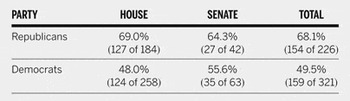
Table 1 presents the chamber and party affiliation of the 313 members registered with Twitter. Eighty percent of those registered were representatives, and registration rates in the Senate (59.1%) were slightly higher than in the House (56.8%). As illustrated in table 1, a much higher percentage of total Republican members created a Twitter account (68.1%) than total Democratic members (49.5%).
Percentage of Members of the 111th Congress Registered with Twitter, by Chamber and Party

Numbers do not add to 535 because of members who served only part of the 111th Congress.
Given that Democrats were the majority party in the House during the 111th Congress, one might expect a disproportionate number of Democrats comprising the total number of members with Twitter accounts. However, this is not the case. Of those registered, 50.1% were Democrats and 49.2% were Republicans. This difference suggests that Republicans, as members of the minority party, are more likely to create Twitter accounts than Democrats, providing some initial support for the theory that members adopt Twitter to reach a broader constituency.
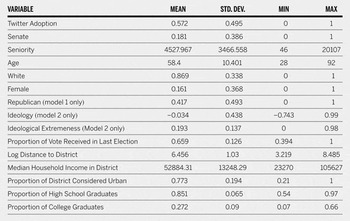
The relationship between these variables and a member's decision to register a Twitter accountFootnote 5 was estimated using two logit models, using robust standard errors clustered on state.Footnote 6 Summary statistics for the data used to estimate these models is in table 2.
Summary Statistics of Data Used to Estimate Models 1 and 2 (N = 540)

ANALYSIS
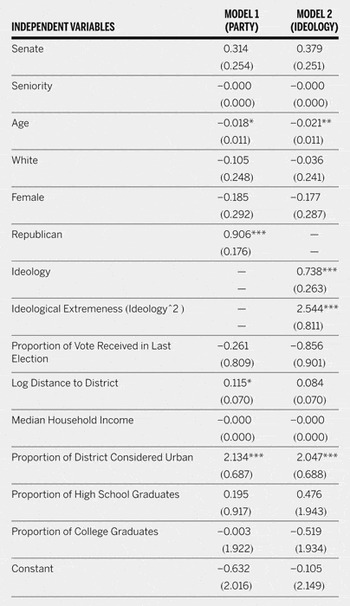
In model 1 and model 2 (table 3), we find support for the theory that members adopt Twitter to represent a broader constituency, with some limited support for the theory that adoption is a reflection of district characteristics. Additionally, we found no evidence that Twitter adoption was associated with previous reelection percentages.
Estimating Member Adoption of Twitter as of December 31, 2010

Significance in a two-tailed test:
*** p < 0.01,
** p < 0.05,
* p < 0.1;
robust standard errors, clustered on state, in parentheses. N = 540.
In both models, we find that the more urban a member's district or state, the more likely that member is to adopt Twitter. This suggests that members adopt Twitter when they believe that Twitter usage is widespread among their constituency, providing some limited support for the theory that members adopt Twitter to gauge district opinions and policy preferences. All else being equal,Footnote 7 a member who represents a district or state where 35% of the land area is considered to be urban has a 0.09 lower probabilityFootnote 8 of having a Twitter account than a member who represents a district or state in which 55% of the land area is considered to be urban and a 0.32 lower probability than a member representing an entirely urban district (100%).Footnote 9 This theory is also supported by the significance of log distance to district, although this variable is only statistically significant in model 1.Footnote 10
Stronger support for an alternate theory of Twitter adoption, the desire to represent a broader constituency, is found in both models. Although a member's race and gender are not significant predictors of Twitter adoption, party affiliation, political ideology, and ideological extremeness are all significant. In model 1, the party of the member was the most influential factor in predicting whether that member would register an account with Twitter. As predicted by the “broader constituency” theory, those in the minority party (Republicans) were much more likely to have adopted Twitter than their Democratic counterparts. All else being equal, Republican members had a 0.21 higher probability of having a Twitter account than Democratic members.
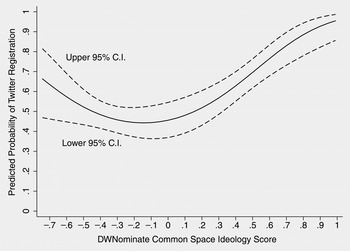
In model 2, we find that ideology and ideological extremeness have a statistically and substantively significant positive effect on the probability that a member will adopt Twitter.Footnote 11 Given that one variable (ideological extremeness) is the square of the other (ideology), the two cannot be interpreted separately. Figure 1 illustrates changes in the predicted probability of having a Twitter account over the range of ideology scores found in the model. The solid black line indicates the predicted probability of having a registered Twitter account as of December 31, 2010. The dashed black lines indicate the 95% confidence intervals for the predicted probability across the range of ideology scores.
Predicted Probability of Twitter Registration across Ideology

Specifically, figure 1 demonstrates that members with extremely conservative ideology scores are the most likely to have registered a Twitter account. For example, the model predicted that, holding all else equal, the average Republican member (ideology = 0.447) has a 0.30 probability of adopting Twitter. The most conservative member (ideology = 0.99) has a 0.78 probability of adopting Twitter, a difference of 0.48. This same extremely conservative member has a 0.62 higher probability of adopting Twitter than the most moderate member (ideology = 0).
Figure 1 additionally indicates that members with extremely liberal scores are more likely to use Twitter than members with less extreme liberal scores. For example, holding all else equal, the average Democratic member (ideology = −0.378) has a 0.14 lower probability of adopting Twitter as a communication tool than a member with the most extreme liberal score in the data (ideology = −0.743). This same extremely liberal member has a 0.15 lower probability of adopting Twitter than a member with the most moderate ideology score (ideology = 0).
As expected, the age of the member was also found to be significant in both models. Unsurprisingly, the older the member or senator, the less likely he or she is to have a Twitter account. For example, a 65-year-old member has a 0.04 lower probability of having a Twitter account than a member 10 years his or her junior and a 0.09 lower probability of having a Twitter account than a member 20 years his or her junior. Lastly, seniority is not a good predictor of Twitter adoption. This is in keeping with previous studies on congressional political communication strategies, which show that more senior members of Congress have greater access to traditional press coverage than those with less tenure.
CONCLUSION AND FUTURE DIRECTIONS
The analysis presented here suggests that members' decisions to register Twitter accounts are driven by their desire to ensure delivery of their message to a wider audience. Although a member's race and gender were not found to be statistically significant, it is clear from the evidence that supposition of a relationship between a member's ideology and use of social media (Klein Reference Klein2011) has merit. The most conservative and liberal members of Congress were more likely, all else equal, to use Twitter as a communication mechanism than members with less-extreme policy preferences.
Members whose constituents are more likely to adopt Twitter may be more likely to adopt Twitter themselves, although other factors that may predict Twitter adoption in a district (such as household wealth or education) were found to significantly influence members' Twitter adoption. While Twitter is relatively costless to adopt and use, some members may feel that the perception of low Twitter adoption within their own district would not justify the investment of time. Or, some members might not prioritize the ability to reach constituents beyond their electoral boundaries.
The decision of members to adopt Twitter may go beyond these demographic predictors. Members adopting Twitter, and presumably other social media platforms, use the technology to ensure their message reaches the broadest possible audience. The literature suggests that certain groups of members have difficulty expressing their legislative opinions or accomplishments and activities through the mainstream media (Herbst Reference Herbst1996). Twitter provides a platform that allows members to directly speak to target audiences and media outlets. Additionally, members' decision to adopt Twitter may indicate that they perceive their constituency as beyond their district or state and that their ideas represent a broader cross-section of the American public.
Beyond using social media as a political communication tool, it is possible that members of Congress also use social media as a representational tool. Traditionally, when discussing representation, scholars assume that members want to directly contact—and hear back from (Brown Reference Brown2000, 100)—their geographic constituents (Fenno Reference Fenno1978) and that this communication directly serves the member's reelection prospects (Mayhew Reference Mayhew1975). This continues to be true, although previous studies have found no evidence for the 111th Congress that Twitter is used by members to solicit opinions from followers (Glassman, Straus, and Shogan Reference Glassman, Straus and Shogan2010). Instead, members seem to use Twitter as an extension of existing outreach efforts, almost as a supplement to press releases.
As part of many member's communication strategies, social media inevitably is included as an additional tool for contacting the geographic constituency, but is also used to reach groups outside of their official jurisdiction who share their ideological goals and priorities. Social media, for the first time, makes this realistic and possible. Sites like Twitter, by their nature, are inclusive mediums that allow members to garner a national constituency that was rarely available previously.
The representation literature provides interesting theories about the potential relevance of broader constituencies and emphasizes the interactive and iterative nature of representation. Mansbridge (Reference Mansbridge2003) and Rehfeld (Reference Rehfeld2006; Reference Rehfeld2009) build on Pitkin's trustee/delegate dichotomy (Reference Pitkin1967) by adding new classifications of representation and its functions. These categories shed light on choices concerning constituent communications.
Of these new classifications, Mansbridge's concept of surrogate representation or “representation by a representative with whom one has no electoral relationship” (522) accurately describes the potential relationship between members of Congress and their Twitter followers. For example, some female members of Congress may view themselves as representatives of all women and focus more attention on policy issues perceived as “women's issues” (Swers Reference Swers2002; Thomas Reference Thomas1991). Although Mansbridge correctly observes that a power relationship does not exist between a surrogate representative and constituent, a deliberative relationship certainly can exist (523). Social-media usage may illustrate this type of representative relationship. For example, a minority House leader who is critical of majority and administration policies may generate a large following on Twitter, although he or she may not have an electoral relationship with many of his or her “followers.” In the past, surrogate representation, deviating significantly from democratic standards, suffered from selecting only the “best financed ideas and interests” (Mansbridge Reference Mansbridge2003, 524). Given the lack of cost associated with social media, it is possible that sites such as Twitter could minimize this concern and potentially widen the range of possibility for different types of surrogate representation. Additional research on social media is needed to investigate changing norms of representation.
No matter what reason members choose to adopt Twitter or other social media as a communications tool, the use of these mediums has generated institutional apprehension. Existing law and chamber regulations, which monitor traditional forms of communication, such as the franking privilege, have proven difficult to apply to the new forms of electronic correspondence and communication (US Congress 1998).Footnote 12 Centralized chamber regulations and oversight committees, which monitor franked mail and paper newsletters, cannot provide the same level of scrutiny with electronic correspondence and social networking. In addition, new electronic media resources help members establish and maintain regular contact with people living outside their district, state, or even country. Using traditional forms of communication, such as the franking privilege, to communicate with nonconstituents is unconstitutional. How court rulings and chamber regulations on nonconstituent communication might be applied to Twitter or other social media is an open question.Footnote 13
In conclusion, Twitter is an important repository for congressional scholars and observers. As a streaming source of data providing individual reflections about representation, constituent relationships, policy priorities, and member activity, it supplies congressional scholars with new information on a consistent basis. We encourage others to examine this rich resource for understanding Congress and the motivations of its members.
ACKNOWLEDGMENTS
This paper reflects the views of the authors and does not necessarily reflect the views of the Congressional Research Service or the Library of Congress. A previous version of this paper was presented at the 2010 annual meeting of the Midwest Political Science Association. The authors would like to thank Jessica C. Gerrity and the anonymous reviewers for their helpful comments.