In a pioneering article “A Tale of Japanese Technological Diffusion in the Meiji Period” published in This Journal in 1974, the late Gary R. Saxonhouse told a story of Japan's Meiji-era cotton spinning industry that is so remarkable that it fully deserves being called a tale. He recounted the initial steps in the process that led the first Asian nation to successfully industrialize. At the heart of this story of “the first completely successful instance of Asian assimilation of modern Western manufacturing techniques” lies a remarkable and not fully understood episode of technology diffusion (Saxonhouse Reference Saxonhouse1974, p. 150). As Nathan Rosenberg (Reference Rosenberg1972, p. 3) pointed out in a contemporaneous article: “The rate at which new techniques are adopted and incorporated into the productive process is, without doubt, one of the central questions of economic growth.” Being the first instance of its kind, the success of the Japanese cotton spinning industry deserves to be closely examined.
Based on a finer-grained database on early Japanese cotton spinning firms, we revisit Saxonhouse's tale. We argue that Saxonhouse overstated both the ease and speed with which best technology diffused in this industry, as well as the extent and impact of Japanese producers “slavishly” imitating each other. By stressing the high degree of intra-industry cooperation in facilitating the rapid diffusion of best practices, Saxonhouse may have inadvertently directed attention away from other important forces, including those allowing the right kind of human capital to expand while driving out underperforming firms. As Saxonhouse knew, the Meiji government's promotion policies failed on these counts. But even after Osaka Spinning––an independent entrant whose importance Saxonhouse correctly identified––created the right kind of a blueprint, diffusion of best practices in Japan was uneven. As the government withdrew and private firms entered, such practice spread as strong competition in output, input, and asset markets reallocated activity from low-capability imitative firms to industry-leading innovators.
SAXONHOUSE'S TALE
“A Tale” was Saxonhouse's first published article in what became an illustrious career cut all-too-short in 2006.Footnote 1 He continued to work on the Meiji-era Japanese cotton spinning industry well beyond 1974. Gustav Ranis and Saxonhouse (Reference Ranis, Saxonhouse, Ohkawa and Ranis1985a, Reference Ranis, Saxonhouse, Ohkawa and Ranis1985b) placed international differences in technology choice in a general context. In several joint papers, Saxonhouse and Gavin Wright (Reference Saxonhouse, Wright, Saxonhouse and Wright1984a, Reference Saxonhouse and Wright1984b, Reference Saxonhouse and Wright1987, Reference Saxonhouse and Wright2010) used British archival data on machine orders by mills from various countries to examine the issue of ring spinning adoption in international perspective, critically re-assessing extant views about why mule technology persisted long after the advantages of rings became apparent.
The enduring part of “A Tale” is its argument about the importance of a particular institution, an association of firms named Dai Nihon Bōseki Rengōkai (All Japan Cotton Spinners Association) and more commonly known by its acronym Bōren. This association actively spread information about and advocated the adoption of British textile technology. For Saxonhouse, its activities explained almost completely why state-of-the art machinery and know-now diffused rapidly in the nascent Japanese cotton spinning industry. Despite its highly competitive structure, the industry enjoyed “the unique institutional arrangements which facilitated such [rapid] diffusion (p. 150).” Bōren lowered transaction costs, specifically the “costs associated with acquiring information about new technologies (p. 159).” Regarding the Japanese choice of technique, Saxonhouse stated: “There do not appear to be any great technological puzzles which demand rationalization. Seemingly inferior techniques do not continue to be embodied in the industry's new investment. Older techniques… do not remain unscrapped (p. 153).” He concluded “A Tale” by echoing Rosenberg (Reference Rosenberg1972): “While the study of technological diffusion has surely been pursued with great vigor in the last fifteen years[,] attention could still be profitably focused on the nature of the institutions which gather and transmit technological information (p. 165).”
The emphasis that Saxonhouse placed on the role of institutions in technology transfer was ahead of its time. The term institutions, as Gavin Wright recently noted, “had not yet shaken off its negative connotations (‘institutional’ analysis meant descriptive work that did not draw upon economic analysis, the kind of thing Old Economic Historians did).”Footnote 2 The importance of institutions in economic development is now widely recognized (see, for example, North Reference North, Harriss, Hunter and Lewis1995; Haussmann and Rodrik Reference Hausmann and Rodrik2003). Today, we know that Japanese cotton spinning firms were by no means unique in their culture of technical cooperation (see Bessen and Nuvolari Reference Bessen and Nuvolari2011). Many historical examples of “collective search” have since been uncovered, including the Cleveland Steel District (Allen Reference Allen1983) and the Cornish steam engine (Nuvolari Reference Nuvolari2004) at the dawn of the industrial revolution; the Austrian bentwood furniture industry (Kiriazidou and Pesendorfer Reference Kiriazidou and Pesendorfer1999) in the late nineteenth century; and the U.S. semiconductor industry (Tilton Reference Tilton1971), Chilean salmon industry (Pietrobelli and Rabellotti Reference Pietrobelli and Rabellotti2004), and the early personal computer industry (Meyer Reference Meyer2003) in the more recent period. Several theories have been developed to explain these phenomena, from game-theoretic models of cooperative research agreements with imperfect competition in product markets (Katz Reference Katz1986; Kamien, Muller, and Zang Reference Kamien, Muller and Zang1992) to models that allow such cooperation under perfect competition, as openness to global trade renders local sharing of technical knowledge advantageous without threatening rent dissipation (Braguinsky and Rose Reference Braguinsky and Rose2009).
Although we have richer knowledge, both theoretical and empirical, about important instances of rapid technological diffusion through cooperative arrangements, the factors that allow such arrangements to emerge and operate efficiently in some but not in other contexts are still not well understood. The detailed records available on Meiji-era Japanese cotton spinning industry allow us to investigate these factors in greater depth. This helps reveal the actual mechanisms behind the remarkable rate of technological diffusion in this industry and, in the process, to generate lessons of broader applicability.
The historical data used in this article have been compiled from a multitude of primary sources and archival materials. Some of these data, especially the Bōren monthly bulletins, duplicate those gathered by Saxonhouse. But he either overlooked or ignored a large trove of other Bōren- and Japanese government-related records that provide far more complete firm- and establishment-level data. This evidence allows greater understanding of intra-industry dynamics, including differences in firm performance, such as productivity and profitability, and firm entry and exit.
Our first data source is firm-level monthly data on inputs and outputs in physical units for all firms that participated in Bōren. It appears that Saxonhouse had only data starting from July 1889, when Bōren, already revamped into an association of independent producers, started publishing its monthly bulletins (“Geppō”). Bōren, however, had been founded under government auspices in 1882 and had been publishing similar data in the Official Gazette (“Kampō”) since June 1883. Evidence from these early years yields novel insights into the industry's initial struggles to adopt British technology, what (and who) was the driving force behind finding the most productive technological path, and how the resulting innovations diffused. We supplement these firm-level monthly data with annual plant-level data collected from governmental statistics (Nōshōkōmu Tōkei Nempō) and statistical yearbooks from various Japanese prefectures.
The second data source is semi-annual company shareholders’ reports, which contain balance sheets, profit-loss statements, as well as lists of shareholders and executives. Financial information and other data about companies without available reports were obtained, whenever possible, from Geppō and from the semi-annual publication “Menshi Bōseki Jijō Sankōsho” (Reference Materials on the State of the Cotton Spinning Industry, hereafter, “Sankōsho”) started in 1903. Technology data on the characteristics of machinery ordered by different firms in the 1880s and 1890s come from the file compiled by Gary Saxonhouse and Patrick McGuire and archived at Inter-university Consortium for Political and Social Research (Wright Reference Wright2011).
Finally, we have consulted narratives published in Geppō, the detailed seven-volume industry history by Taiichi Kinugawa (Reference Kinugawa1964), as well as various company and industry accounts (most notably, Takamura Reference Takamura1971).
EARLY STRUGGLES UNDER GOVERNMENT PROMOTION POLICY
Saxonhouse (p. 150) began “A Tale” by recounting the start of operations by Osaka Spinning Company in 1883. Osaka Spinning “combine[d] what came to be the ingredients of a successful cotton enterprise in Japan.” This included a comparatively large scale (many spindles), up-to-date British spinning equipment laid out by British engineers, adequate and reliable steam power, double labor shifts made possible by the installation of electric lighting, and a Japanese chief engineer trained in British practices. These five characteristics, together with one that Saxonhouse left out––its organization as a joint stock company––marked Osaka as the industry leader. Saxonhouse asserted: “The records available on the Japanese cotton spinning industry are so complete that it can be stated unequivocally that every mill subsequently established, and many were established, mimicked the leader.” As we demonstrate later, Saxonhouse actually overstated his case when he wrote about “every mill subsequently established.”
An important nuance is that Osaka Spinning's position as a widely-copied leader was not a bestowed set of capabilities and resources. Rather, it was an acquired condition that marked a significant departure from what had gone before. In fact, the Japanese government had anointed two of its own cotton spinning mills as “model plants” in the late 1870s. The government established Bōren in 1882 and provided direct assistance to numerous mills before Osaka Spinning's birth and during its early years. As Saxonhouse rightly points out (p. 151), the subsequent “super-fast” diffusion of the best practices owed nothing to those government-sponsored mills and everything to the innovations pioneered by Osaka Spinning Company.
But if success in the industry required only “slavish” imitation of the British techniques and their rapid diffusion through Bōren's collaborative institutional arrangement, an obvious question is: What prevented the transfer from occurring earlier, that is, before the late 1880s? After all, the government-sponsored mills had also imported machinery from Britain, and Bōren had full government support to encourage its diffusion. And there was a six-year lag between the commencement of operation at Osaka Spinning (in early 1883) and that of any other newly-established private mill (in early 1889).
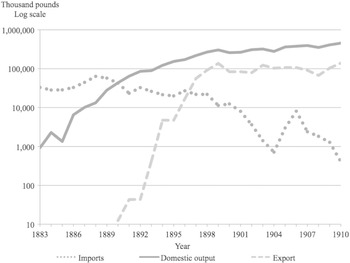
DOMESTIC OUTPUT, IMPORT AND EXPORT OF COTTON YARN (1883–1910)

Figure 1 presents data on domestic output, imports and exports of cotton yarn in Japan from 1883 to 1910. The series are in physical units (thousands of pounds) and taken from “Nihon Chōki Tōkei Sōran” (Sōran), historical statistics compiled by the Japanese Statistical Association under the supervision from the government Statistics Bureau (Sōran Reference Nihon and Sōran1987). The time series for domestic output in the Sōran starts in 1887; for 1883–1886, we use information on the totals for all firms listed in Kampō.Footnote 3 Figure 1 shows a clear break in the late 1880s. Domestic output jumped by almost three times in 1889 and increased by more than ten times over the following decade. Imports, which comprised over 80 percent of domestic consumption as late as in 1888, rapidly declined. Exports took off and surpassed imports in 1897. The takeoff of the industry in the late 1880s stands in stark contrast to what had happened before.
Although attempts to establish mechanized cotton spinning industry in Japan date back to the 1860s, the process started in earnest in the late 1870s. The Meiji government had become deeply concerned about the growing outflows of specie to pay for British textile goods. Externally-imposed treaties (i.e., the “opening-up of Japan”) prohibited raising protective tariffs. Instead the government sought to promote a domestic textile industry by creating “model plants” and subsidizing about a dozen more by providing British spinning machinery at below-market prices and on easy credit. Early Western studies asserted these measures helped the industry to overcome the initial difficulties of industrialization (Smith Reference Smith1955, p. 63). The government “model mills,” although commercially unsuccessful, “showed the way” for the industry to adopt Western technology (Landes Reference Landes and Lockwood1965). Archival data clearly refute such notions.
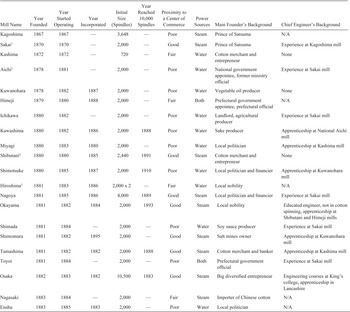
Among many factors behind the failure of government efforts, the most important appears to be low human capital endowment of the industry's early leadership, entrepreneurs and engineers alike. Table 1 presents details of the backgrounds of founders and engineers and other characteristics at 21 early mills. Only two mills (Kashima and Osaka) entered without government assistance. Among the 19 government-promoted mills, five were led by national or regional government officials and six more by owners selected from among local (former) nobility and politicians. In the remaining eight mills run by individuals from the private sector, the founder had previous experience in a related industry (defined as handling cotton and cotton yarn, including purchases and sales thereof) in only two cases.
The technology backgrounds of the industry leaders were also meager. Only one of the government-promoted mills was run by an individual with an engineering background: Tomonao Ishiguro of Okayama mill. His education was in metallurgy, not in cotton spinning. The most experience that other “chief engineers” could boast was working or apprenticing at earlier Japanese mills. The process of selecting entrepreneurs to lead the government-sponsored firms was often bizarre. For example, a family that produced vegetable oil established the Kuwanohara mill after a younger son, swept up in patriotic fervor at a lecture by a government minister, promised to start the project. Overcoming its initial horror, the family decided to honor the son's pledge, even if it meant committing “seppuku” (Japanese ritual suicide; Kinugawa Reference Kinugawa1964, II: 215). The mill required four years to start operating and never succeeded.
EARLY MILLS CHARACTERISTICS AT THE START OF OPERATIONS

Notes:
(1) Sakai mill was the spinoff of the Kagoshima mill, acquired by the Meiji government in 1872 and turned into government “model mill.” (2) Aichi (National Aichi Cotton Mill) was constructed by the government to serve as an explicit “model mill.” (3) Hiroshima mill had two 2,000-spindle mills in separate locations. (4) Shibutani mill reached the 10,000-spindle capacity in 1891 under new ownership and was renamed Dōjima Spinning at that time. In the “Chief Engineer's Background” column “None” means that the engineer's identity is known but he does not have any record of training or past experience; “N/A” means that the chief engineer's identity itself is unknown.
Source:
Enkakukiji, Kinugawa (Reference Kinugawa1964), companies’ shareholder reports, and other sources described in the main text and in the online appendix.
At a Bōren gathering in 1885, Kokufuku Kan, manager of Miyagi mill, summarized the dire state of the industry:
Lacking capital and educated knowledge, and guided only by reckless small-town quasi-patriotic feeling because we felt bad about spending 7 million yen per year on imported cotton yarn, we unbecomingly planned a great enterprise, letting government officials dictate things, not gauging our own ability, and almost completely failed to deliver any progress up until this very day. (cited in Nawa Reference Nawa1937, p. 98)
The government reduced competitive pressure by relieving the sponsored mills from the burden of repaying subsidized loans. As an example, the owner of the Kawashima mill won approval for six separate petitions to restructure the mill's debts between 1883 and 1886.
The early mills relied entirely on technology choices made by the chief government technician, Masatatsu Ishikawa. He also wielded huge influence in early Bōren activities. Ishikawa had no formal engineering background; all of his technical knowledge was acquired through his experience in early technologically-backward Japanese spinning mills (see, for example, Takamura Reference Takamura1971, I: 42). But he was the most “senior” figure in Japanese mechanized cotton spinning at the time, something the government bureaucracy chose to respect. It did not fully avail itself of the talents of the small pool of locally-educated engineers. In this period, the government kept Shin'ichirō Arakawa, who graduated with the first cohort from the College of Engineering (Kōbu Daigakkō) in 1879 (Teikoku Daigaku Yōran Reference Yōran1912), at a desk job in the ministry. Other graduates of the College of Engineering, Shun'ichi Hattori (1881) and Tsunezō Saitō (1882), would later play important roles in the industry, but only after the end of government promotion.
Ishikawa pushed for what proved to be flawed technologies. For example, he insisted on the use of waterpower. Mills that followed his recommendations were, consequently, set up in remote, often mountainous, areas, creating serious logistical problems. Given Japan's climate, Ishikawa's selection exposed mills to both chronic seasonal flooding and power shortages. Archival records show that his advice misled even Osaka Spinning, whose leadership spent over a year on a futile search for a suitable waterpower site before adopting steam power. Use of steam power allowed not only radically less variation in power available to turn machinery, but also the freedom to locate near major commercial centers.
The Kagoshima mill, where Ishikawa started to work, had used machinery from Platt Brothers of Oldham. Yet he chose another British manufacturer, William Higgins & Sons Co., to supply both the Sakai and National Aichi mills and all the machines resold to government-subsidized mills. This was another poor choice. Equipped with drafting rollers designed for longer-stapled U.S. cotton, the Higgins’ machines were much less effective with short-stapled domestic Japanese cotton (Tamagawa Reference Tamagawa1995, p. 13). Ishikawa and his team refused to avail themselves of vital tacit knowledge that British manufacturers provided for a fee. Instead, they handled the layout, specifications, and installation of the new National Aichi Mill on their own. As a result, the mill's operation was delayed until 1881, three years after construction began.
The government's decision to promote the use of Japanese-grown cotton was also misguided. With a staple length of just 5/8 inch (Saxonhouse and Wright Reference Saxonhouse and Wright2010, p. 562), Japanese-grown cotton was too short to be effectively transformed into quality yarn using Western machinery. Archival materials leave no doubt that the problems were recognized by both the British (who had tried using Japanese-grown cotton in Lancashire mills in the early 1860s) and by the Japanese themselves.Footnote 4 Government desires to couple industrial policy and agricultural policy, rather than ignorance of the technical difficulties, were to blame. The objective of using locally-sourced cotton also led authorities to promote the construction of numerous small-scale (2,000-spindle) mills scattered all over the country, hampering industry development (Takamura Reference Takamura1971, 1: 45).
This account paints a picture clearly at odds with that of a government-promoted industry easily adopting standardized technologies from Britain and then rapidly diffusing them through a collaborative institutional arrangement. Bōren's much-lauded function of promoting knowledge exchange and technology diffusion also departs from the record; the human capital to take advantage of it was lacking, and the knowledge it promoted and the technology it diffused were severely lacking too.
The failure of government-led efforts to jump-start the industry should come as no surprise to us today (for current examples, see Easterly Reference Easterley2001). What is notable is that an industry initially mired in technological backwardness eventually found a way to succeed. Many valuable lessons emerge from an in-depth examination of the complex process of searching for the winning combination of the right technology and market, something that has been aptly called the “self-discovery” process (Hausmann and Rodrik Reference Hausmann and Rodrik2003).
OSAKA SPINNING
Against this historical backdrop, the emergence of Osaka Spinning looks almost like divine intervention; this single firm provided a new blueprint for the entire industry. We know the background of individuals behind the firm's success and how it became so superior to industry's incumbents. The company was officially incorporated in 1882, although it had been planned since at least 1879. The vision of its founder, Eiichi Shibusawa, was also shaped by fervent belief that Japan needed to develop domestic cotton spinning to check the outward flow of specie (Geppō Sept. 1921, pp. 31–32; Hirschmeier Reference Hirschmeier and Lockwood1965). But Shibusawa was better prepared for the task than the government bureaucrats and politically-selected entrepreneurs running Japan's other mills.
Shibusawa's stint at the Ministry of Finance gave him first-hand knowledge of the limitations of Japan's bureaucratic system and its access to human capital (Shibusawa Reference Shibusawa and Craig1994, Chapter 5). To obtain his own technologically-sophisticated human capital, he decided to invest in educating a 26-year-old acquaintance, Takeo Yamanobe, in England. Yamanobe first studied mechanical engineering at Kings College, Cambridge and then sought practical skills at Rose Hill Mill in Blackburn, Lancashire by working regular shifts in the spinning rooms. With introductions from the Rose Hill Mill's owner, he also toured other mills in the region, learning all aspects of the business, from handling raw cotton to packaging the finished product (see, for example, Abe Reference Abe2004). Shibusawa sent Yamanobe a stipend worth tens of thousands dollars in today's money to cover living and educational expenses, including 150 pounds paid to Rose Hill Mill.Footnote 5 Yamanobe proved a prodigious student. He concluded that no successful British spinning mill operated less than 10,000 spindles, five times the size of the Japanese government's “model” mill.
Establishing a large-scale mill in Japan was a major challenge, not least from a financial vantage point. Shibusawa deliberately eschewed government support and instead organized the firm as a private joint stock company. Leveraging his clout with the business community, he raised capital from a broad and diverse array of private investors.Footnote 6 The initial list of Osaka Spinning shareholders included 95 individuals, the largest of whom (Shibusawa himself) owned just 12 percent of the total. Corporate capitalization allowed the company to start on an entirely different scale from all previous firms. When Osaka Spinning's first mill began operating in 1883, it ran 10,500 steam-powered spindles. Its two-story brick building was also the first private facility in Japan to install electric lighting in 1886. Public interest was so great that the company opened the mill for tours for three days, attracting over 50,000 night-time visitors (Toyo Boseki Reference Hyakunenshi1986, p. 34).Footnote 7
Saxonhouse correctly argued that Yamanobe was not yet ready for a fully independent role since he had spent only a few months studying at Cambridge and less than a year working at Rose Hill Mill. But he was able to do two important things for Osaka Spinning that differed from the prevailing wisdom in Bōren. First, he worked with Platt Brothers to customize their machines to handle domestically-grown cotton better (Farnie and Abe Reference Farnie, Abe, Farnie, Nakaoka, Jeremy, Wilson and Abe2000). Second, he formed a long-term partnership with the Oldham-based firm, something that Saxonhouse legitimately puts at the center of the industry's subsequent success. William Nield, a veteran Platt Brothers engineer and millwright, traveled to Osaka to assist Yamanobe's team with assembly, set-up, and initial operation of the machines in the new mill.Footnote 8
THE BEGINNING OF THE PRIVATE INDUSTRY
Despite Osaka Spinning's impressive achievements, the real takeoff of the industry occurred only after the government's exit. In 1886, the government withdrew its support and privatized its mills. In June 1888, Bōren was reorganized into an association of independent producers, with Osaka Spinning's Yamanobe at the helm. The bird's eye view of the industry's subsequent evolution presented in “A Tale” is no doubt true in its main contours. Delving more deeply into the historical record yields important insights. In 1887, the industry was comprised of 21 mills, with an average size of 4,021 spindles, and an average daily employment of 137 operatives. There were two very different parts. One part consisted of the 20 formerly government-affiliated firms, two of which were idle in that year. On average, the operating mills employed 2,334 spindles and 99 operatives. The other part consisted of Osaka Spinning, operating 28,153 spindles, employing 756 workers, and producing almost one-half of the total output. Osaka Spinning's labor productivity (output in physical units divided by total work-hours of factory floor workers) was more than twice the average of all other firms; the productivity of its spindles, conditional on operating (output in physical units divided by the total spindle-hours in operation), was 35.1 percent higher.
The challenges created by Osaka Spinning left the industry's incumbents with the tasks of increasing size, substituting steam for waterpower, and reorganizing their business structures. Subsequent developments, such as the importation of Indian and U.S. cotton and adoption of ring spinning, also required revamping their outdated capital stock. The responses to these challenges varied markedly across those firms, despite similar starting conditions.
Adopting the joint stock company form––to raise the capital needed to expand scale––became the order of the day. Dōjima (Shibutani) Spinning and Tamashima Spinning were among the first to incorporate. The influence of Osaka Spinning is clearly evident for Dōjima Spinning; Jūtarō Matsumoto, one of Osaka Spinning's top shareholders, bought Dōjima and incorporated the firm in 1885. Tamashima Spinning had incorporated in 1882 but continued to languish until rescued by a Kyushu-area capitalist in 1884. With the direct assistance of Shibusawa, Mie (Kawashima) Spinning became a joint stock company in 1886–1887. By 1889, ten of the 20 incumbents had incorporated (see Table 2).
A second task was to acquire technical expertise. In 1884 Tamashima Spinning petitioned the government for the services of the civil-servant engineer Shin'ichirō Arakawa. Arakawa would become a full-time advisor to the company in the 1890s and oversee several expansions of the mill. Dōjima Spinning hired Takeo Yamanobe as a supervisor. Since Dōjima was located in Osaka, Yamanobe could manage both firms’ operations. Mie Spinning, upon the advice of Shibusawa and Yamanobe, hired Tsunezō Saitō. (Saitō had participated in the installation of the first Osaka Spinning mill in 1882 as an observer, and was then noticed by Yamanobe, which led directly to this appointment four years later.)
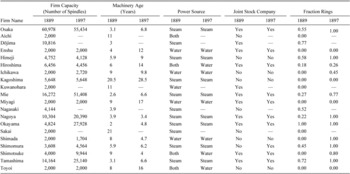
SOME CHARACTERISTICS OF FORMER GOVERNMENT-SPONSORED MILLS

Note:
Osaka Spinning lost one-half of its capacity (the older part) to fire in December 1892. Shimada Spinning lost all its mule machinery capacity to fire in 1895. Shimotsuke Spinning's expansion continued on its second, centrally located and steam engine-powered plant. Mie Spinning's expansion came from continued expansion of its second, steam engine-powered plant and from a third plant constructed and powered by steam engine in 1895.
Source:
Enkakukiji, Kinugawa (Reference Kinugawa1964), companies’ shareholder reports, and other sources described in the main text and in the online appendix.
As shown in Table 2, by 1889, ring spinning had been fully or partially introduced in nine of the 20 firms, and steam engines (as a sole source of power) had been adopted in ten of the 20 firms. Notably, only four of the 20 firms (the mentioned Dōjima, Tamashima, and Mie, and also Nagoya Spinning) had a capacity of 10,000 spindles or more.
Data for the same firms for 1897 (Table 2) show that three of the four mills that had a head start in 1889 continued to expand and modernize. (The fourth firm, Dōjima, burned down in 1896.) Mie Spinning caught up almost completely with Osaka Spinning (which had suffered a setback in 1892 when fire destroyed half of its capacity). In addition to these, Okayama Spinning transformed into a joint stock company and started modernizing under the guidance of Shin'ichirō Arakawa. It was located in the same geographical area as Tamashima Spinning and could thus easily tap Arakawa's expertise. Most other incumbents remained in a low-productivity rut a decade after privatization, retaining old technology. Indeed, five mills were already out of business. These developments show that technology diffusion is a much more complex process than simply emulating a leader, even when there are no trade secrets and a collaborative institutional arrangement is firmly in place. With the notable exception of Mie Spinning, no long-term success emerged from the ranks of formerly government-promoted mills.
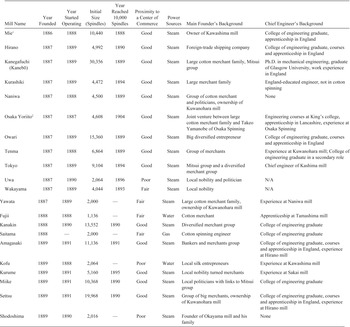
The termination of the government promotion policies in 1886 also coincided with a wave of entry by private firms. Saxonhouse describes this entry as systematic mimicking of Osaka Spinning. The reality is more complicated, with many new entrants being unwilling or unable to adopt the industry's best practices. Twenty-one new firms were founded over the 1886–1889 period (Table 3). This total includes Mie Spinning Company, which originated from government-aided Kawashima mill. In designating Mie as a new entrant we follow an established practice, dating back to “Enkakukiji,” an unpublished but highly influential article on the early industry history written by a government source in the early twentieth century. As mentioned, it used Shibusawa's help to raise capital, and proceeded to build an entirely new, centrally located modern mill. All these new entrants were incorporated. But only seven started with an initial capacity of 9,500 spindles or more. Excluding borderline case, more than one-half of the new private entrants started below minimum-efficient scale, and five never reached it. Seven firms chose mules for part of their new machinery. New entrants neither universally purchased Platt Brothers machines nor relied universally on steam power.
CHARACTERISTICS OF 1886–1889 PRIVATE ENTRANTS AT THE START OF OPERATIONS

Note:
(1) Mie mill represents a re-entry by the Kawashima mill (founded in 1880, see Table 1), based on incorporation and construction of an entirely new mill in a different location (with the previous Kawashima mill continuing to operate as well). We treat it as new entry, following “Enkakukiji.” See the main text for a detailed discussion. (2) Osaka Yoriito's mill reached 10,000 spindles in 1904 after losing independence and becoming a subsidiary of Naigaiwata (a large cotton trading company that had been one of its largest shareholders). In the “Chief Engineer's Background” column “None” means that the engineer's identity is known but he does not have any record of training or past experience; “N/A” means that the chief engineer's identity itself is unknown.
Source:
Enkakukiji, Kinugawa (Reference Kinugawa1964), companies’ shareholder reports, and other sources described in the main text and in the online appendix.
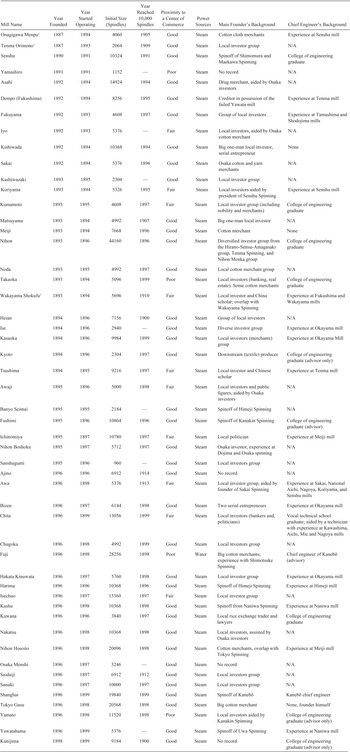
The backgrounds of founders and chief engineers of the new entrants (see Table 3) are striking. Thirteen out of the 21 new firms were created by entrepreneurs from related industries; several had previous experience in cotton spinning. Eleven had educated engineers at the helm of their technology teams. The pool of educated Japanese engineers was still very shallow.Footnote 9 Three firms (Hirano, Settsu, and Amagasaki) shared the services of the same engineer (Kyōzō Kikuchi). Osaka Spinning's Yamanobe also supervised three different firms (including the reborn Shibutani-Dōjima mill). That eventual industry leaders (Mie, Hirano, Kanebō, Settsu, and Amagasaki mills) were all members of this entry cohort, and all had founders from related industries and educated engineers at the helm is telling.
In the late 1880s, three technological breakthroughs––the adoption of ring spinning, the use of imported cotton, and the development of staple–mixing––transformed the industry. The introduction of ring spinning is widely attributed to almost simultaneous decisions taken by Saitō, Kikuchi, and Hattori (all College of Engineering graduates; see, for example, Kinugawa Reference Kinugawa1964, Vol II). Tamagawa (Reference Tamagawa1997) points out, however, that they all may have actually all followed the advice of Senjirō Watanabe, who was head of Mitsui Trading's London office at the time and worked closely with Platt Brothers. The transition from mules to rings in Japan was the fastest in the world.
Saxonhouse did not mention foreign imports in “A Tale,” but he and Wright (Reference Saxonhouse, Wright, Saxonhouse and Wright1984a, p. 290) later correctly emphasized the importance of importing cotton from India, the United States, and other countries for subsequent developments. Japanese firms first sought foreign supplies from China, but the staple length of Chinese cotton varied little from domestically-grown cotton (Rawski Reference Rawski1974). The firms then shifted to medium-staple cottons from India and the United States. Adoption of longer-staple cotton can be credited to a specific initiative of Bōren, now functioning under Osaka Spinning's auspices. The firm financed a mission to India to explore importing its longer-staple cotton. Led by a Japanese ambassador, the mission included a representative of Mie Spinning. Once the experiments proved successful, samples were distributed to all member firms in line with Bōren's tradition (Toyo Boseki Hyakunenshi Reference Hyakunenshi1986, I: 69). The use of Indian cotton grew rapidly, reaching 19 percent of total consumption in 1890 and 48 percent by 1892 (Toyo Boseki Hyakunenshi Reference Hyakunenshi1986, I: 69–70). A related change was the development of the cotton-blending technology. But counter to Bōren's custom of sharing best practices, exact recipes for and methods of cotton staple-blending were a proprietary development of each firm. Saxonhouse and Wright (Reference Saxonhouse and Wright2010) consider this practice the most important original technological innovation to come out from the Japanese cotton spinning industry and argue it played a major role in the industry's success.
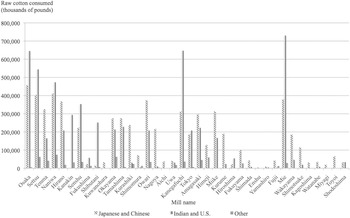
The earliest data about the types of cotton used by mills come from 1893. We present these newly mined data in Figure 2. The data show that penetration of imported cotton, especially Indian and U.S. fibers, varied significantly. Several mills, including Osaka and Mie, principally consumed higher-quality Indian and U.S. cotton. But other firms, mostly older incumbents, still used low-quality Japanese and/or Chinese cotton. Even though the opportunity to use higher-quality cotton was available to all firms, adoption was uneven.
As Saxonhouse and Wright (Reference Saxonhouse, Wright, Saxonhouse and Wright1984a, Reference Saxonhouse and Wrightb) and Tamagawa (Reference Tamagawa1995 and Reference Tamagawa1997) note, Indian and U.S. cotton worked best with ring spinning frames. Our novel dataset allows us to investigate the connection between the use of longer-staple cotton and the adoption of ring technology at the individual mill level. We first examine how adoption of ring technology (the fraction of rings in a mill's overall capacity) and mill size (total number of spindles installed) were related to the importance of higher-quality cotton and cotton-mixing by the mill in 1893. We construct a “quality” index, measured as the fraction of Indian and U.S. cotton in the mill's total consumption. We also construct a “diversity” index for each mill by adding up the number of types of cotton that accounted for 5 percent or more of a mill's total consumption. For example, Osaka mill used 41.3 percent Chinese cotton and 54.3 percent Indian cotton in 1893, while other types constituted less than 5 percent of its total consumption, so its “diversity” index was 2.
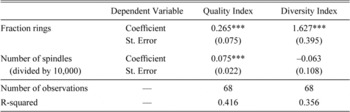
Table 4 presents the results of regressions where the “quality” and “diversity” indexes are regressed on the fraction of rings and mill size in 1891–1892. Both the fraction of rings and mill size are economically and statistically significantly associated with the 1893 quality index. Firms that operated at a large scale and used rings consumed a higher fraction of Indian and U.S. cotton. The “diversity” index is affected only by use of rings but not mill size.
INDIVIDUAL MILLS’ RAW COTTON CONSUMPTION BY COUNTRIES OF ORIGIN IN 1893

INDIAN AND U.S. COTTON USAGE AND COTTON MIXING IN 1893, AND FIRM SIZE AND FRACTION OF RING SPINDLES IN 1891–1892

* = Significant at the 10 percent level.
** = Significant at the 5 percent level.
*** = Significant at the 1 percent level.
Notes:
pooled OLS on years 1891–1892. Robust standard errors clustered at the firm level in parentheses. “Quality index” is the fraction of Indian and U.S. cotton in the mill's total consumption of raw cotton. “Diversity index” is the sum of the number of types of cotton that accounted for 5 percent or more of the total consumption. See the main text for details.
Source:
Our estimates.
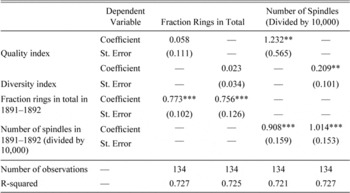
We examine the relationship from a forward perspective by regressing ring diffusion and mill expansion over the 1894–1897 period on the 1893 “quality” and “diversity” indexes. (We control for the 1891–1892 fraction of rings and mill size, respectively, implying the estimated coefficients capture post-1893 changes.) We wish to gauge whether mills that were faster in adopting high-quality cotton or engaged in more cotton mixing were also more likely to expand their size and use of rings. The results presented in Table 5 indicate that higher 1893 quality and diversity indexes were positively associated with subsequent increases in mill size but had no impact on further ring diffusion. It thus appears that firms that utilized more higher-quality cotton and engaged in more cotton mixing in 1893 had largely completed their transition to rings. These practices, moreover, allowed those firms to expand relative to their peers in subsequent years.
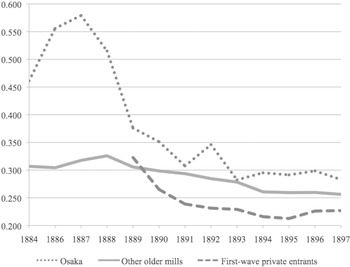
Two other important technological changes have been associated with the diffusion of ring spinning in Japan. These are a steep decline in the capital-labor ratio (as the number of workers per spindle, including those employed in preparatory stages grew) and a shift towards a lower fraction of male operatives in total (Saxonhouse and Wright Reference Saxonhouse, Wright, Saxonhouse and Wright1984a, Reference Saxonhouse and Wright2010). Based on data from Osaka Spinning in 1884 and industry-wide data in 1891, Saxonhouse and Wright conclude that although “the highly profitable mule-using Osaka Spinning Mill operated in 1884 with an equivalent number of male and female operatives, the largely ring-using industry by 1891 had a labor force which was better than 80 percent female” (ibid. p. 290). Mill-level data allow us to examine how general these two technological patterns were. As Figure 3 demonstrates, Osaka Spinning was actually an exception rather than the rule until 1888; the sharp decline in its male share at the end of the 1880s simply brought it close to where other mills had been all along. First-wave private entrants had a male share even lower than the incumbents. An industry-wide trend toward a lower male share set in during the mid-1890s. Industry-wide convergence of capital-labor ratios dated to the mid-1890s as well.
FIRM SIZE AND FRACTION OF RING SPINDLES IN 1894–1897 AND INDIAN AND U.S. COTTON USAGE IN 1893

* = Significant at the 10 percent level.
** = Significant at the 5 percent level.
*** = Significant at the 1 percent level.
Notes:
pooled OLS on years 1894-1897. Robust standard errors clustered at the firm level in parentheses. “Quality index” is the fraction of Indian and U.S. cotton in the mill's total consumption of raw cotton. “Diversity index” is the sum of the number of types of cotton that accounted for 5 percent or more of the total consumption. See the main text for details.
Source:
Our estimates.
SECOND ENTRY WAVE AND INDUSTRY CONSOLIDATION
The adoption of best technologies by the leading firms and their diffusion through Bōren finally unlocked the “winning combination” of rings, cotton-mixing, and reliance on labor-intensive, female-dominated production process in the mid-1890s. A second wave of entry followed. While only two firms were founded in 1890–1891, 22 mills came into existence in the 1892–1894 period and another 27 entered in the 1895–1898 period. Output increased by almost five times between 1891 and 1898 (see Figure 1).
FRACTION OF MALE OPERATORS IN TOTAL NUMBER OF OPERATORS, 1884; 1886–1897

Firms in the mid-1890s wave were more homogenous than those in the late-1880s wave. All entrants (except Nihon Spinning) chose ring spinning. Four-out-of-five bought their machines from the Platt Brothers. All but one firm employed steam power. The 1890s entrants also had capital-labor and male-female operative ratios that were almost identical in the mid-1890s to those of first-wave private entrants. Still, less than one-half of new entrants started with 10,000 spindles or more (see Table 6). We conjecture that this limitation came from the founders’ inability to raise capital, and the data on those founders’ (and chief engineers’) backgrounds presented in Table 6 indeed show that they were in many cases inferior to first-wave entrants on this dimension. In the mid-1890s there was still scope for import substitution in the Japanese yarn market, and exports were just beginning to boom. With no apparent limitations from the demand side and with best practices by now widely understood and promoted by Bōren, barriers to entry were significantly lower than had been the case for Osaka Spinning or even the first-wave entrants.
CHARACTERISTICS OF THE 1890S PRIVATE ENTRANTS AT THE START OF OPERATIONS

Note:
(1) initially founded as a weaving-only firm, entry years assigned based on the year started cotton yarn spinning operations. In the “Chief Engineer's Background” column “None” means that the engineer's identity is known but he does not have any record of training or past experience; “N/A” means that the chief engineer's identity itself is unknown.
Source:
Enkakukiji, Kinugawa (Reference Kinugawa1964), companies’ shareholder reports, and other sources described in the main text and in the online appendix.
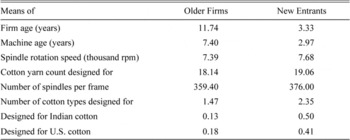
By using longer-staple cottons, the mid-1890s entrants were able to order machines of greater versatility and higher quality than their older counterparts (Saxonhouse and Wright, Reference Saxonhouse and Wright2010, p. 550–51). In 1898, more than 50 percent of cotton consumed by all new entrants was Indian (Geppō, No. 79, p. 12). Use of longer-staple cotton allowed not only improved staple-mixing, but also adoption of machines with more spindles per frame and use of faster speeds due to reduced breakage. By matching Saxonhouse's data on machine orders (Wright Reference Wright2011) with the annual data on new machine installations (and replacement) by individual Japanese firms, we obtain a measure of the technological differences between the capital stock of the mid-1890s entrants and their predecessors.Footnote 10
Table 7 shows the difference in several machine characteristics between new entrants and older firms. Note that the gap in machine age between older and newer firms is 4.4 years, compared to the 8.4 year gap in firm ages. This difference reflects older firms’ investments to upgrade their capital stock by purchasing new and scrapping older machinery. But older firms did not match newer entrants’ machine vintages. For example, the average rotation speed of spindles in machines installed by new entrants was about 4 percent higher than in older mills; the number of spindles per frame was 4.6 percent higher.Footnote 11 Machines installed by new entrants were designed to produce more valuable high-counts yarns and were more versatile. More than 90 percent of machines at the new entrants’ mills were designed to spin Indian or U.S. cottons, compared to just 31 percent at older firms.
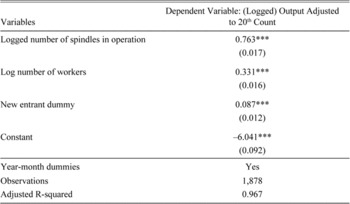
Not surprisingly, better machine quality made new entrants’ mills more productive than older mills. Table 8 presents the results of a standard production function estimation using monthly output data on capital and labor inputs in physical units (and year-month fixed effects) for the 1895–1897 period. The indicator variable “New entrant” equals one if the firm entered after 1889 and zero otherwise. The results indicate that the new entrants outperformed older firms by about 9 percent [exp(0.087) − 1].
AVERAGE MACHINE CHARACTERISTICS OF NEW ENTRANTS AND OLDER FIRMS IN 1895–1897

Source:
Our calculations using Wright (Reference Wright2011) data. “Older firms” are those that entered the industry in 1889 and earlier. “New entrants” are firms that entered after 1889. All means differences are statistically significant at least at the 1 percent level, using double sided t-test with unequal variance.
CONSOLIDATION PHASE
Following rapid growth of the 1890s, the industry entered a new phase. During this phase we see clear evidence that knowledge and experience mattered most for taking full advantage of the state-of-the-art technology. Figure 1 above shows that after peaking in 1899, Japanese output of cotton yarn and exports fell sharply in 1900. They then grew slower over the next decade. This pattern stemmed largely from the industry's own success. During the first half of the 1890s, the industry drove imports out of the domestic market. In the second half of the decade, exports to China burgeoned. But the Boxer Rebellion in China (effectively late 1899 through early September 1900) temporarily closed the Chinese market, leading to a set of severe market demand perturbations. The industry entered a consolidation phase.
There was almost no new entry and many exits during the first decade of the twentieth century. Among 85 firms that operated in 1897–1899, 64 exited by 1912 (see Table A1 in the online Appendix). Thirteen shut down their mills, typically small outdated facilities. For the other 51 firms, the mills were acquired by new owners and continued operating (in most cases almost without interruption). More than one-half of the industry's capacity changed hands between 1898 and 1911. Thirty-six of 51 acquired firms were second-wave entrants. And in almost one-half of all acquisitions (22), the acquiring firm was one of the five established leaders that had entered before 1890 (Osaka, Mie, Kanebō, Hirano, and Settsu).Footnote 12 Our reading suggests that a combination of superior entrepreneurial vision and engineering talent allowed the established leaders to survive while the younger competitors, even those with better machines and newer mills, could not.
PRODUCTIVITY OF NEW ENTRANTS AND OLDER FIRMS IN 1895–1897

* = Significant at the 10 percent level.
** = Significant at the 5 percent level.
*** = Significant at the 1 percent level.
Notes:
New entrants are firms that entered after 1889. Pooled ordinary least square over years 1895–1897 using monthly input-output data. Robust standard errors in parentheses.
Source:
Our estimates.
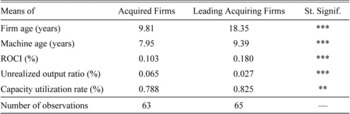
We use annual establishment-level production data matched with the ownership data to show how acquisitions by industry leaders helped acquired plants realize their full potential.Footnote 13 Table 9 compares performance measures at the established leaders and the acquired mills during the three years preceding the acquisition (20 cases in total over the 1898–1911 period). The to-be-acquired firms entered on average 8.5 years later than the acquiring firm. The gap in the vintage age of their machinery is less than 2.5 years, indicating that leading acquiring firms were more aggressive in updating their machine stock. Table 9 also compares the differences in mean profit rates, unrealized output ratios, and spindle capacity utilization rates. Profit rates are measured as annualized net revenue from firms’ profit-loss statements divided by the year-end value of the sum of capital invested by shareholders and interest-bearing debt from the balance sheets. “Unrealized output,” measuring the efficiency of the firms’ sales operations, is calculated as combined year-end values of the stock of produced yarn and of payments accruable divided by the annual value of output (the physical volume of yarn produced times the plant-specific price).Footnote 14 “Spindle capacity utilization rates” are calculated as the number of spindle-days in operation divided by the total number of spindles installed times 365 days. As Table 9 shows, leading acquiring firms performed better than the firms they acquired by each of these measures.Footnote 15
SOME PRE-ACQUISITION PERFORMANCE MEASURES

Notes:
The data are averages of three years immediately preceding an acquisition. ROCI is return on capital invested, equal to net revenue, divided by the sum of shareholders’ paid in equity capital and the firm's interest-bearing debt. Unrealized output ratio is the ratio of the end-year value of unsold yarn and payments accruable to the value of output produced during the year. Capacity utilization rate is measured as the total number of spindle-days in operation, divided by spindle capacity, multiplied by 365. *** and ** indicate that the corresponding mean differentials are statistically significant at the 1 percent and 5 percent levels, respectively, using double-sided t-test.
Source:
Our estimates.
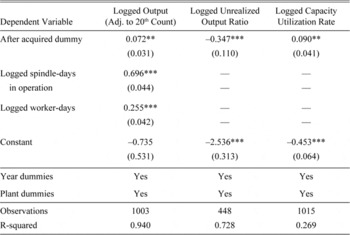
We next look at post-acquisition performance. The unique nature of the physical input and output data available at the establishment level allows us to conduct estimates in terms of physical productivity.
The estimations equation is:

where y it is the (logged) output of plant i in year t (measured in physical units), k it is the (logged) number of spindle-days the plant operated in year t, l it is the (logged) number of workers in year t,Footnote 16 D it is the dummy equal to 1 for plant i if year t is a post-acquisition year, h i is a plant fixed effect, µ t is a year fixed effect, and ε it is the error term. Thus, the coefficient on post-acquisition period dummy D it captures within-plant differences in productivity, after controlling for factor inputs and for any systematic changes over the sampling period. Note also that since we measure capital (labor) input as spindle- (worker-) days in operation, our estimates capture changes in productivity conditional on the plant operating, separately from any improvements in capacity utilization rates. The estimates are carried out using all available observations on all productive establishments that changed ownership between 1898 and 1911. To see the role played by the inclusion of acquired plants in the acquirers’ management system, we also estimated regressions similar to (1) with outcome variables being (logged) ratios of unrealized output and (logged) plant-level capacity utilization rates.
The estimation results are presented in Table 10. After acquisition, establishments improve productivity on average by about 7.5 percent.Footnote 17 They experience a 30 percent decrease in the unrealized output ratios and a 9.4 percent increase in the spindle capacity utilization rates. These indicate that (relatively) low productivity prior to acquisition could be due to previous owners’ inability to market output. Owners with inferior demand management ability have lower capacity utilization rates, higher unwanted inventories, and lower physical plant productivity––all of which improve after they are acquired by the established leaders with better management.
WITHIN-ACQUIRED ESTABLISHMENTS CHANGES

* = Significant at the 10 percent level.
** = Significant at the 5 percent level.
*** = Significant at the 1 percent level.
Notes:
“After acquired dummy” is equal to one for years after the acquisition event. The omitted category is years before acquisition and the year of acquisition itself. All usable observations on all acquisitions that happened between 1898 and 1911 are employed. Robust standard errors clustered at the plant level in parentheses.
Source:
Our estimates.
THE ROLES OF SUPERIOR HUMAN CAPITAL AND TACIT KNOWLEDGE
Improvement of physical productivity of newer plants after they were acquired, especially by industry-leading firms, serves as a reminder of the importance of tacit knowledge, industry experience, and managerial talent. This was true even in a setting, which, as in the Meiji-era Japanese cotton-spinning industry, had almost no barriers to technology diffusion. We have already discussed one such case at the dawn of the industry, when William Nield, whose arrival in Osaka occurred because of Yamanobe's contacts while in England, helped to start up Osaka Spinning's first mill. An almost accidental encounter at that time led to the birth of another great firm, Mie Spinning. A graduate of Japan's College of Engineering, Tsunezō Saitō, showed up at the original Osaka Spinning mill merely as an informal observer to learn plant engineering from Nield just as the latter was installing machines at the mill. Saitō discovered an error in the installation manual provided by the manufacturer of the steam engine and was able to correct it, impressing both the British millwright and Yamanobe with his engineering skills (Toyo Boseki Hyakunenshi Reference Hyakunenshi1986). A few years later, Yamanobe remembered this episode when he recommended Saitō for the position of chief engineer at Mie Spinning, which was trying to rebuild after years of dismal performance (recall that Mie had been founded in 1880 as one of the government-sponsored 2,000-spindle mills). Once hired, Saitō was immediately sent by the company to study cotton spinning in England (another example of Osaka Spinning's influence). In the end, this appointment, along with financial assistance provided by Shibusawa, put Mie Spinning in the same league as Osaka Spinning itself.Footnote 18
Another cluster of early leading firms, Hirano, Settsu, and Amagasaki Spinning, was founded around 1887 in the Osaka area and with some overlapping investment interests. The group was propelled to success by Kyōzō Kikuchi, whom, as already mentioned, Hirano Spinning had sent to England for training (see also Hunter Reference Hunter, Cortazzi and Daniels1991). Upon Kikuchi's return to Japan, Hirano appointed him to the position of chief engineer and later agreed to share his services with Settsu and Amagasaki. All three firms quickly rose to prominence in the industry; then, the story took another twist. Kikuchi expected to be elected to the board of directors. But Hirano's directors failed to oblige. Such a position was, however, offered to him in 1893 by Amagasaki Spinning, and then in 1897 by Settsu Spinning, and Kikuchi severed his relationship with Hirano a year later. Hirano's fortunes started declining soon after, and in 1902 it was acquired by Settsu Spinning, now led by Kikuchi.Footnote 19
Sanji Mutō and Kanebō present yet another instructive case. In contrast to Yamanobe, Saitō, and Kikuchi, Mutō was not an engineer but a professional manager with experience working in the United States. In 1894 he was put in charge of starting Kanebō's second plant in Hyōgo area (close to Osaka). (Kanebō's first plant and its headquarters were located in Tokyo.) Mutō believed in motivating workers by providing them with a better living, which started with paying them higher wages. The idea was not welcomed by other firms operating in the area, which included several industry leaders (Osaka, Hirano, Settsu, and Amagasaki). When Mutō started hiring workers for Kanebō's new plant and offering higher wages than those paid by other firms,Footnote 20 he was accused of worker poaching. Other firms reportedly pressured merchants to boycott Kanebō's products, recruited organized crime to kidnap and bring back “poached” workers, and even promised a 300 yen reward to anyone who would physically hurt Mutō (Kinugawa Reference Kinugawa1964).
Backed by the powerful Mitsui group, however, Mutō and Kanebō refused to back down, and the conflict was settled through mediation by the Chairman of the Bank of Japan. Kanebō's new mill became the company's flagship plant, and many of the labor management practices pioneered there by Mutō were then implemented throughout the Kanebō empire and eventually also industry-wide.
To sum up, having access to the best available technology and knowledge dissemination through cooperative institutional arrangements were by no means guarantees of long-term success. Most firms that entered in the mid-1890s wave proved unable to take full advantage of the newly available technological paradigm. As they lost in competition to established leaders, these firms exited; their production facilities were acquired by the leaders, whose managers then improved the mills’ profitability and physical productivity. Thus, successful technological adoption and eventual uniformity of practices had to happen through mediation by the market mechanism that allowed exceptionally talented entrepreneurs and managers to greatly expand their span of control.
CONCLUSION
In “A Tale” Saxonhouse presented a picture of technological diffusion in Japan's Meiji-era cotton spinning industry as that of an almost frictionless process, powered by imitation of the British and rapid dissemination of the best practices through the institutional arrangement of Bōren. Although Saxonhouse was certainly correct when he emphasized both how extremely rare and historically rapid the rise of this industry to global competitiveness was, our in-depth investigation has shown that the process was by no means as simple as a casual reader of “A Tale” might imagine. Instead of early firms’ simply adopting a British blueprint and subsequent entrants’ “slavishly imitating” them, we saw a lot of confusion at the initial stage, especially under the Meiji government's model-mill and machinery subsidization programs, followed by the failure of most firms, both older ones and later entrants, to either adopt or fully exploit the new technological opportunities presented to them. Throughout this process, the industry's trade organization Bōren indeed disseminated knowledge—including substandard knowledge in the government-promotion era—and tried to assist its members in a variety of ways, but it was left to a few exceptional firms to propel the industry to global competitiveness.
All this does not make the lessons that can be learned from the Meiji-era Japanese cotton spinning industry about technology diffusion processes in general any less important. On the contrary, only through close examination of the details can we learn the key lessons summarized below.
First, successful adoption and diffusion of technology seem to require the presence of a leading firm (or a set of firms), which pioneers new technologies and then plays a crucial role in establishing an effective culture or institution to promote their diffusion. In Meiji-era Japanese cotton spinning this role was played by Osaka Spinning (and a handful of others) and the reformed trade organization Bōren. The government deserves credit for creating Bōren, but only after the government abandoned efforts to control and subsidize the industry did Bōren become an effective institution.
Second, technology diffusion, even with technical cooperation, seems to thrive best under relentless market competition. Japanese adoption of ring spinning frames and development of cotton-mixing technology in the 1890s were truly spectacular, but this was far from a uniform process driven by a large, cooperative decision-making unit. In fact, the rapid diffusion was driven by fostering of superior human capital, whose better ideas prevailed through strong competition in both input and output markets.
Third, one underappreciated aspect of the success of the Meiji-era Japanese cotton spinning industry was the relative ease with which ownership could be transferred due to the joint stock company organization of most firms. As a result, mergers and acquisitions allowed best production facilities to be constantly matched (and re-matched, if necessary) to the best human capital to manage them—something that is nearly impossible in many other similar contexts because of the lack of institutional trust outside of immediate family members (see, for example, Bloom and Van Reenen Reference Bloom and Van Reenen2010).
Finally, the experience of technology diffusion in Meiji-era Japanese cotton spinning underscores the critical importance of embodied (tacit) knowledge in effective technology adoption and diffusion. The institutional environment that allowed the development of vigorous markets not just for assets but also for human capital was a key to the success of the Japanese cotton spinning industry. What happened in Japanese cotton spinning accords with what we know about the long-term innovativeness and vitality of other cases, including Detroit's auto industry in the U.S. economy of the early twentieth century and Silicon Valley in the U.S. economy of the last four decades of the twentieth century and the opening years of the current century (Klepper Reference Klepper2002; Saxenian Reference Saxenian1994; Cheyre, Klepper, and Veloso forthcoming). The parallels across the globe and across historical periods are remarkably striking.