Almost everyone believes that testimony can transmit knowledge from speaker to hearer. What some philosophers mean by this is ordinary and pedestrian – they mean only that, in at least some cases, a speaker S knows that p, S testifies that p to a hearer H, and H comes to know that p as a result of believing S's testimony. There is disagreement about how this occurs, but that it does occur is sufficient for the transmission of knowledge in the intended sense. On this understanding of transmission, the natural questions are these: (1) What conditions, in addition to speaker knowledge and speaker testimony, are sufficient for the hearer to gain testimonial knowledge?; and (2) Is speaker knowledge always necessary for testimonial knowledge? That is: Is all testimonial knowledge transmitted knowledge?Footnote 1
Other philosophers, however, use the term “transmission” more narrowly. They use the label to mark a more particular phenomenon, and one that they think has been largely neglected in epistemology. Moreover, they think, this more particular phenomenon is essential for understanding what makes testimonial knowledge interesting and special.Footnote 2 In this more narrow sense of the term, there is no widespread agreement that “transmission” exists. On the contrary, many will deny that testimonial knowledge is special in the ways that these philosophers insist.
Here we can see an analogy to considerations about free will. On the one hand, almost everyone agrees that there is free will in some sense of the term. Compatibilists think that such freedom can be fully understood in terms of familiar causal, psychological categories. They also think that this is the only kind of freedom there is. Libertarians are happy to acknowledge the same distinctions that compatibilists make in these causal-psychological terms. But they think that there is something more. That is, they think that there is a special kind of freedom that humans enjoy, and that cannot be fully understood in terms of these categories. Let's call this “libertarian freedom.”
In one sense of the term, then, everyone agrees that freedom exists, but they disagree about its nature. In another sense of the term, libertarians think that freedom exists and compatibilists deny that it does. Moreover, it is this latter kind of freedom that libertarians think is interesting and important, or at least more interesting and important than anything that compatibilists can explain by means of their ordinary categories.
Now consider the debate over knowledge transmission. Again, almost everyone agrees that there is knowledge transmission in some sense of the term. Some theorists think that such transmission can be fully understood in terms of familiar epistemic categories, such as evidence, reliability, etc. They also think that this is the only kind of transmission there is. Other theorists think that there is something more. That is, they think that there is a special kind of knowledge transmission that occurs in at least some testimonial exchanges, and that it cannot be understood in terms of these familiar epistemic categories. Let's call this “special transmission,” or transmission*.
In one sense of the term, then, everyone agrees that transmission exists, but they disagree about its nature. In another sense of the term, some theorists think that transmission exists and others deny that it does. Moreover, it is this latter kind of transmission that special transmission theorists think is interesting and important, or at least more interesting and important than anything that “ordinary” transmission theorists explain by means of their preferred categories.
For example, some philosophers argue that transmission* of knowledge through testimony requires interpersonal and/or moral relations between the speaker and hearer, that such relations are epistemically significant, and that this is a distinctive feature of at least some testimonial knowledge.Footnote 3 Other philosophers have argued that transmission* involves a distinctive distribution of epistemic responsibilities between speaker and hearer; again, distinctive from the kinds of responsibility required for other kinds of knowledge.Footnote 4 Importantly, other philosophers argue that no such phenomenon exists. That is, they have argued that interpersonal relations such as trust do not have epistemological significance, and that testimony does not relieve the hearer of the usual epistemic responsibilities. Put differently, they argue that transmission* does not exist.Footnote 5
The remainder of this paper will focus on the nature and possibility of transmission*. That is, we will focus on the kind of transmission that is supposed to be special in the following sense: it requires us to go outside the usual epistemological categories for understanding non-testimonial knowledge, and it explains why at least some kinds of testimonial knowledge are special and important. Accordingly, we are putting our focus on “anti-reductionist” notions of knowledge transmission. In one important sense, reductionism in the epistemology of testimony is the position that testimonial knowledge can be reduced to some other kind of knowledge, such as inductive knowledge. That is, testimonial knowledge can be understood as a species of some other familiar kind. If knowledge transmission* exists, then reductionism about testimonial knowledge is false.
Part One of the paper locates our target phenomenon by looking at cases and considering what some philosophers have said about testimony and transmission. Part Two looks at some recent attempts to characterize knowledge transmission, and argues that none serve as an adequate characterization of transmission*. Part Three considers some constraints on an adequate epistemology of transmission*, and briefly discusses our two broad theoretical options.
In this last respect, the relevant question is this: Can transmission* be adequately explained by traditional epistemological theories such as process reliabilism, deontological theories, evidentialism, or virtue reliabilism? One possibility is that some theories better account for transmission* than others, and so this is a consideration for adjudicating among them. Part Three considers a more radical theoretical option: that there can be no adequate account of transmission* by traditional epistemological theories. In that case, traditional epistemological theories are best conceived as explaining knowledge generation rather than knowledge transmission*.
1. LOCATING THE TARGET
We begin by attempting to clearly identify our target phenomenon. A standard methodology in philosophy is to identify clear cases. Another is to look at what philosophers have said about the phenomenon, and, in particular, look at what they agree about. That is, we would like some clear cases of knowledge transmission*, and some uncontroversial claims about transmission*, that we can then use to direct further, substantive analysis. Our task is complicated, however, by a lack of consensus about our subject matter. Accordingly, we will have to be satisfied with purported cases of knowledge transmission*, and some characteristic claims.
1.1 Some characteristic claims about knowledge transmission*
We may begin to locate our target phenomenon by considering what some philosophers have said about knowledge transmission, that is, about what I am calling transmission*. Remember, at this stage we are merely trying to locate a phenomenon of potential theoretical interest. In that respect, it will be helpful to consider what some philosophers have claimed about the phenomenon, and why they have thought it interesting.
First off, it is common to assign knowledge transmission* a special role in the economy of knowledge. Whereas perception, introspection, reasoning and the like serve to generate or produce knowledge, testimony (at least sometimes) serves a different role, and one that cannot be assimilated to the first. This special role motivates the “speaker knowledge” condition on transmission. That is, one cannot transmit what one does not have, and so those who occupy the transmission role must have knowledge to transmit.
A second common theme is that knowledge transmission* serves to relieve the hearer of the usual burdens associated with non-testimonial knowledge. Thus testimony “transmits” knowledge, rather than generates it, in the sense that hearers need not “do the usual work” involved in coming to know “for oneself.”Footnote 6 A related idea is that transmission* allows for epistemic dependence of a distinctive and important sort, and a further related idea is that transmission* allows for an epistemic division of labor.Footnote 7
A fourth common theme is that some such phenomenon is necessary to account for the extent of our knowledge. That is, we need something like knowledge transmission*, and the epistemic dependence and division of labor that it allows, to account for all the knowledge that we have. Indeed, one of the strongest motivations for endorsing transmission* has been to avoid unwelcome skeptical results.Footnote 8
1.2 “Paradigmatic” cases of knowledge transmission*
Next let's look at some paradigmatic cases. They are paradigmatic in the sense that, if knowledge transmission* exists at all, it exists in these cases. (Recall the analogy to libertarian freedom.) In these cases, assuming that the speaker knows what she is telling, the hearer comes to know by being told. This is not to say, necessarily, that the speaker comes to know merely by being told. One can endorse transmission* without endorsing the idea that transmission* requires no epistemic work at all on the part of the hearer. Nevertheless, it is plausible that, in these cases, the hearer depends on the speaker for her knowledge in some significant way. In some important sense (allegedly), the speaker manages to “pass on” or “hand down” her knowledge to the hearer, and in such a way that relieves the hearer of the usual burdens associated with non-testimonial knowledge.
Case 1. A second-grade social studies teacher points to the map and tells his students that the United States is in North America. On that basis his students come to believe that this is the case.
Case 2. A mother tells her three-year-old son that there is milk in the refrigerator, and he believes her.
Case 3. An accountant tells her client that the tax laws for 2015 have changed, and that as a result some previous deductions are no longer allowed. The client believes her and acts accordingly.
Case 4. A doctor tells her patient that his lab results have come back negative. He believes her and is relieved.
Case 5. A city clerk tells a resident that plastic bottles can be left at the transfer station for recycling. The resident believes her and heads for the transfer station.
Again, in each of these cases, the hearer comes to know by being told, and seemingly in a way that relieves the hearer of the usual burdens involved in coming to know in non-testimonial ways. How should we understand this latter notion? The idea is not that the hearer's resources are merely redirected, so that they “go through” the speaker and her testimony, rather than being aimed directly at the question at issue. Rather, the idea is that the hearer is relieved of at least some of the usual work. For example, if one is an evidentialist, one might think that the hearer need not fulfill the usual evidential burdens. If one is a reliabilist, one might think that the hearer need not herself be the seat of knowledge-level reliability.
Plausibly, this phenomenon is not present in all testimonial exchanges. For example, consider the following cases.
Case 6. A used car salesman tells a customer that the car has had one previous owner, and has never been in an accident. The customer believes him and happily buys the car on that basis.
Case 7. A police officer asks a suspect whether he was at the scene of the crime, and the suspect tells him no. The officer believes him and goes on to question someone else.
Case 8. A personnel director interviewing a job applicant asks her if she has relevant experience, and she assures him that she does. The director believes her and hires her on that basis.
In these cases, even if the speaker is telling the truth, and knows what she tells, the hearer does not come to know thereby. In these cases, plausibly, the hearer does have to fulfill the usual burdens before coming to know. Accordingly, even theorists who endorse transmission* should not hold that all testimonial exchanges transmit* knowledge, and not even in all cases where the hearer comes to know. The better idea is that transmission* is special even within the category of testimonial knowledge.Footnote 9
By way of summary, we have been trying to locate a phenomenon of special epistemological interest, a phenomenon that we have labeled transmission*. By way of doing so, we have pointed to some (alleged) paradigmatic cases, and we have looked at some things that are commonly said. Specifically, knowledge transmission* is something opposed to knowledge generation, and not reducible to knowledge generation. Moreover, in cases of knowledge transmission*, the hearer depends on the speaker in a way that allows the hearer to know, but without incurring the usual epistemic burdens, or doing the usual epistemic work, associated with non-testimonial knowledge. In this sense, a division of epistemic labor is achieved, allowing the hearer to know more while doing less. On the other hand, we should recognize that not all testimonial exchanges manage to transmit* knowledge. Even in cases where the speaker has knowledge, the hearer sometimes must do considerable epistemic work to gain knowledge from testimony.
2. HOW TO CHARACTERIZE KNOWLEDGE TRANSMISSION*
Part One tried to identify a phenomenon of potential epistemological interest. Part Two tries to characterize that phenomenon in a principled way. That is, Part Two tries to say what knowledge transmission* is. First, I will survey some recent accounts and say why I think they are inadequate for present purposes. Then I will offer my own account.
2.1 Some transmission principles
In the epistemology of testimony literature, transmission is often understood in terms of “transmission principles,” or principles stating either necessary or sufficient conditions for transmission. As noted above, this is the natural way to address questions about transmission in the ordinary or pedestrian sense. Here are two formulations by Lackey. (Lackey rejects the principles, but attributes them to Burge and Welbourne, among others.)
For every speaker S and hearer H, if H comes to know that p via S's testifying that p, then S must know that p. (Lackey Reference Lackey1999: 473)
For every speaker, A, and hearer, B, B's belief that p is warranted (justified, known) on the basis of A's testimony that p only if A's belief that p is warranted (justified, known). (Lackey Reference Lackey, Lackey and Sosa2006: 6)
It should be clear that the above formulations are meant to address transmission in the ordinary or pedestrian sense rather than transmission*, and for that reason are not adequate for present purposes. For one, they do not accommodate the idea that knowledge transmission is something special, or of special epistemological interest. In this regard, and as Lackey notes, they make transmission consistent with both reductionist and non-reductionist accounts of testimonial knowledge. Likewise, they fail to imply that, in cases of transmission, the hearer is relieved of the usual epistemic burdens associated with non-testimonial knowledge, or that the hearer depends on the speaker in an epistemically interesting way. To capture these stronger ideas, we need a different characterization.
We may note that the above principles are not only too weak for present purposes, but also too strong. They are too strong because they are about all knowledge (justification, warrant) based on testimony. But as we saw above, transmission* theorist should hold that transmitted* knowledge is a special class even within knowledge based on testimony. Accordingly, transmission* theorists need not accept, and should not accept, as the above principles imply, that speaker knowledge is a necessary condition on testimonial knowledge in general. It is open to the transmission* theorist, then, to deny that all knowledge based on testimony involves transmitted* knowledge, and so open to her to deny the above principles, which are about knowledge through testimony in general.
Sometimes transmission is understood in terms of a sufficient condition for testimonial knowledge, and here we get closer to the idea that transmission is special. Thus Adler describes the following “principle for the transmission of knowledge by testimony,” and ascribes it to Welbourne and Craig, among others:
If S knows that p and S asserts that p to H, and H accepts p on the basis of S's testimony, then H knows that p.
That formulation appears in a Stanford Encyclopedia of Philosophy article where Adler is describing the position.Footnote 10 Here is Adler endorsing the position:
'if someone who knows that p tells me that p, I myself then know that p' … Knowledge is successfully transmitted merely through a knower telling another of what he knows, and the other party accepting it. (Reference Adler1996: 106–7)
These characterizations of transmission do make the phenomenon special, and in ways that we have emphasized. Thus in cases where the speaker knows, they make a testimonial exchange (i.e. an exchange in which testimony is both asserted and accepted) sufficient by itself to transmit knowledge. This certainly relieves the hearer of the usual burdens associated with non-testimonial knowledge. The principles also allow for a strong version of epistemic dependence and a strong division of epistemic labor. The problem with these formulations is that they make transmission too easy, requiring nothing at all on the part of the hearer (other than acceptance) for transmission to be successful. But a commitment to transmission* – i.e. a commitment to transmission in the special sense that we are after – should not force commitment to such a radical position. Consider an analogous position regarding knowledge preservation. Thus one might hold that, in cases where S knows that p originally, simply remembering that p is sufficient for memory knowledge. This is a possible position, but one might be committed to the idea that memory preserves knowledge without endorsing it. One might insist that S's memory must be minimally reliable, for example.
Lackey gives a generous interpretation to such formulations by adding a no-defeater condition:
For every speaker, A, and hearer, B, if (1) A's belief that p is warranted (justified, known), (2) B comes to believe that p on the basis of the content of A's testimony, and (3) B has no undefeated defeaters for believing that p, then B's belief that p is warranted (justified, known). (Lackey Reference Lackey, Lackey and Sosa2006: 6)
But the resulting characterization is still too weak for present purposes. One might endorse knowledge transmission* without accepting a “default-justification” or “default-knowledge” framework.
2.2 Welbourne on transmission: a case study
We have been trying to locate and characterize a phenomenon of special theoretical interest, what we have called “transmission*”. We adopted that label, in part, by way of deferring to what is now standard usage in the literature, on which “transmission” need not imply anything special or interesting to epistemology. Long before that usage became standard, however, Michael Welbourne used the unqualified term to point to our target phenomenon.Footnote 11 In point of fact, I don't think that what Welbourne says in these earlier works is adequate as a characterization of transmission*, but I do think that what he says is instructive for two reasons. First, his discussion displays some of the ambiguity about “transmission” that our distinction resolves. Second, I think that what he says does set us up for an adequate characterization of transmission*.
Welbourne begins “The Transmission of Knowledge” by citing J. L. Austin, who he says, “describes the process I am concerned with”:
Among the cases where we give our reasons for knowing things, a special and important class is formed by those where we cite authorities. If asked “How do you know the election is today?”, I am apt to reply “I read it in The Times”, and if asked “How do you know the Persians were defeated at Marathon?”, I am apt to reply “Herodotus expressly states that they were”. In these cases ‘know’ is correctly used: we know “at second hand” when we can cite an authority who was in a position to know (possibly himself only at second hand). The statement of an authority makes me aware of something, enables me to know something, which I shouldn't otherwise have known. It is a source of knowledge. (Welbourne Reference Welbourne1979: 1)
Welbourne then comments,
This doctrine – in effect that knowledge can be transmitted down a chain of authorities – may strike people in opposite ways. To many it may seem so obvious as to be practically banal while to others it may seem quite shocking, since it seems to make knowledge – or at any rate some knowledge – far too easy … For all that, I think Austin is right. Knowledge can be and often is transmitted by mere say-so. (Welbourne Reference Welbourne1979: 1)
The first thing to note is that the passage by Austin does not force a radical account of transmission – one on which a hearer can come to know “by mere say-so.” On the contrary, it is possible to read the passage as endorsing what is no more than a platitude – that testimony sometimes grounds knowledge. Thus we don't have to read Austin as agreeing with Adler and others, as saying that speaker knowledge together with hearer acceptance is sufficient for knowledge transmission.
Shortly thereafter, in fact, Welbourne seems not to take Austin that way. Thus he goes on to write,
We seem to be committed to the idea that knowledge is transmissible, communicable, in, for example, the manner described by Austin. What, then, are the mechanisms which are involved? What are the conditions for a successful transmission? (Welbourne Reference Welbourne1979: 3)
Here Welbourne treats the question as neutral. In other words, it is for him an open question what the conditions of successful transmission are, and this is the substantive issue that Welbourne means to investigate.
Now once that substantive issue is on the table, Welbourne does go on to endorse the radical view:
The mechanism by which knowledge is transmitted is belief. More precisely, in the simplest kind of case where you address me directly, it is sufficient and necessary for the transmission of your knowledge that p to me that I believe you when, speaking (or writing) from knowledge, you tell me that p. (Welbourne Reference Welbourne1979: 3)
And again toward the end of the paper:
My contention has been that in this process of communicating knowledge the “uptake condition” is believing the speaker, so that it is sufficient for the transmission of your knowledge to me that I believe you. (Welbourne Reference Welbourne1979: 7)
But between pages 3 and 7, Welbourne backs away from the radical view.
In a perfectly simple case, where all goes smoothly, you speaking from knowledge assert that p; I believe you and thus begin to know that p myself. Not all cases are simple and things do not always go smoothly. There are in fact many ways in which the process of transmission can go awry or give rise to confusion. This subject really demands the elaboration of a whole doctrine of what Austin would have called “the infelicities”. (Welbourne Reference Welbourne1979: 5–6)
Here is the most important kind of case for our purposes. It is here that Welbourne makes the remarks that I will take as suggestive.
Suppose that I enter a competition to guess the weight of a cake. I say “It's 5 lb 4 oz” … even if it were true you would be wrong to believe me when I say it. To believe me would be to misunderstand me in a very important way, it would be to misunderstand the game I was playing. Believing me is not the right response in this game. You would not necessarily have misunderstood what I said, but you would have misunderstood what I was up to when I said it. (Welbourne Reference Welbourne1979: 4–5)
Welbourne elaborates on the point relevant for our purposes, which is that not all assertions, not even all known assertions, are apt for transmitting knowledge. In his words, not all assertions take place in “that kind of game.”
You would be guilty of the same mistake if you were to believe me now. It is a mistake which first year students not yet conversant with the conventions surrounding philosophical papers not uncommonly make … Success in the game I am playing is when I get you to see things my way because the arguments are cogent and the claims compelling. It is not when you accept my pronouncements because I have made them, when you accept them on the basis of my authority by virtue of believing me. The reason is that I am not now in the business of disseminating knowledge but of arguing for a view. (Welbourne Reference Welbourne1979: 5) [my italics]
By now it should be clear where this is tending. Believing someone is par excellence the appropriate response when, and only when, the “game” is the transmission of knowledge. (Welbourne Reference Welbourne1979: 5) [my italics]
Welbourne has now gone back on the radical view that he said he was defending – that “in this process of communicating knowledge the ‘uptake condition’ is believing the speaker, so that it is sufficient for the transmission of your knowledge to me that I believe you.” Now he is saying that this is only sometimes true – “when, and only when, the ‘game’ is the transmission of knowledge”; only when one is “in the business of disseminating knowledge.”
And how are we to characterize that game, that business? How is that game or business to be distinguished from other assertions or testimonies, where we are not in the business of transmitting knowledge? That is what we would have to know in order to have an account of the phenomenon that Welbourne is after. But here his remarks are of limited use. His main point in “The Transmission of Knowledge” is to make a distinction between (a) believing the speaker and (b) believing what the speaker says (Welbourne Reference Welbourne1979: 9). For reasons that will come out below, I don't think that this distinction cuts at the joints we are after. Certainly it is not enough, all by itself, to give us an adequate account of transmission*.
In “The Community of Knowledge,” Welbourne makes a similar distinction: that between (a) taking it on trust from S that p, and (b) taking S's assertion that p as evidence (Welbourne Reference Welbourne1981: 312). But it is Welbourne's idea of a “community of knowledge” that I think is more helpful.
This idea [of transmitting knowledge] is closely connected with the idea of a community of knowledge. It is only to the extent that we think of ourselves as belonging to such a community that we can engage in acts of transmitting and receiving knowledge, acts which themselves may enlarge and cement the community … Indeed, part of what it is to be a member of a community of knowledge is to be able to rely on largely unspoken, unarticulated assumptions about other people's knowledge. (Welbourne Reference Welbourne1981: 303)
Here Welbourne does not go very far in saying just what a community of knowledge is. He develops the idea in a later book, but in a direction that is not helpful for present purposes.Footnote 12 In the next section, however, I will run with the general idea of a “community of knowledge,” or as I will call it, an “epistemic community.”
2.3 A positive proposalFootnote 13
We want a characterization of knowledge transmission* that accommodates four related features.
-
a. First off, in cases of transmission* the speaker “transmits” knowledge in an ordinary sense. That is, the speaker “passes on,” “hands down,” or “gives” her knowledge to the hearer. Accordingly, in such cases the speaker must have the relevant knowledge to give.
-
b. In cases of transmission*, the hearer depends on the speaker in an epistemically interesting way.
-
c. In cases of transmission*, the hearer is relieved of the usual burdens associated with non-testimonial knowledge. Depending on one's account of knowledge, these burdens will be understood in terms of evidence, epistemic responsibility, reliability, etc. But in some important sense, cases of transmission* relieve the epistemic burdens on the hearer that are associated with coming to know in other ways.
-
d. Transmission* allows for an epistemic division of labor, so that the hearer gains knowledge without having to do “all the work herself.”
But we also want to accommodate the following ideas:
-
e. Transmission* occurs in a variety of settings, possibly including, but not limited to, interpersonal relationships.
-
f. Transmission* does not occur in all testimonial settings. Specifically, there can be cases where the speaker has knowledge, and the hearer comes to know on the basis of the speaker's testimony, but where that testimony fails to transmit* knowledge from speaker to hearer. Plausibly, this is what happens in the car salesman case and the police suspect case, but also in Welbourne's “not speaking from knowledge” cases.
So, what is transmission*? I begin by noting that, on the level of individual knowers, it is hard to draw a meaningful distinction between knowledge transmission and knowledge generation. In both cases, the hearer comes to know something that she did not know before. And testimony is often called a source of knowledge, along with perception, reasoning, etc.Footnote 14 But if we “go social,” the distinction becomes superficially apparent, or so I will argue.
The proposal I will defend exploits the notion of an epistemic community, defined (loosely) as a collection of cognitive agents, joined in relationships of cooperation, with respect to one or more information-dependent practical tasks. By a “practical task” I mean a task that requires action, so in this sense practical tasks are not being juxtaposed to theoretical tasks, such as solving theoretical problems or answering questions. On the contrary, theoretical tasks can be practical tasks.
A paradigmatic example of an epistemic community, in the sense intended, is a scientific research team. But epistemic communities also take the form of universities, private corporations, work details, governments, government agencies, families, and circles of friends. All of these involve collections of persons cooperating in information-dependent tasks, and as such, all involve cognitive agents in various relations of epistemic cooperation and epistemic dependence. Accordingly, each of us is a member of several epistemic communities at once, such communities can overlap, and often epistemic communities are nested.
Epistemic communities, in the sense intended, are characterized by cooperative action with respect to shared, information-dependent tasks. A weak form of such cooperation occurs when members of the community share the same task qua individuals. For example, each of us needs to eat, and so each of us requires information about the location of food. We may cooperate by sharing such information, even if each of us gathers food only individually and for her own use. A stronger kind of cooperation occurs when we coordinate our action in some form of teamwork; that is, when we cooperate so as to accomplish some task together. For example, we might cooperate in this way to hunt large prey, or to win a football game. Both kinds of cooperation are directed at shared, information-dependent practical tasks, and hence give rise to epistemic communities in the sense here characterized.
Epistemic communities, so understood, are in the business of sharing information. But more than this, they are in the business of sharing quality information, or information that is actionable. We may suppose that quality has at least three dimensions in this context. First, quality information is accurate information. Second, quality information is relevant information, i.e. relevant to the task in question. Third, quality information has these features reliably – information is actionable only if it is no accident that it is accurate and relevant. On the present picture, then, epistemic communities will have standards or norms pertaining to information sharing. We may consider this another defining characteristic of epistemic communities – they are constituted not just by (1) some set of shared practical tasks, but also (2) some set of shared standards or norms regarding when information is of sufficient quality to be actionable and thus sharable.
The next point to note is this: The sharing of quality information within an epistemic community involves two kinds of activities. First, there are activities concerned with acquiring or gathering information, or getting information into the social system in the first place. For example, visual perception serves to acquire information about observable physical objects in the environment, while various kinds of inductive reasoning serve to acquire information about unobserved and unobservable objects, etc. Second, there are activities concerned with distributing information throughout the community; that is, there are mechanisms for distributing information that is already in the social system. For example, teaching in the classroom, testifying in court, and reporting in the boardroom all serve this distributing function. In sum, in any epistemic community there will be activities that get information into the system in the first place, and activities that keep that information flowing. Let's call the first acquisition activities and the second distribution activities.
The norms governing acquisition play a “gatekeeping” function – they exert quality control so as to admit only high quality information into the social system.Footnote 15 The norms governing distributing activities, on the other hand, answer to a distributing function – they allow high quality information already in the system to be distributed as needed throughout the community of knowers. Insofar as testimony plays this distributing function, it serves to make information already in the system available to those who need it.
And now an important point for our purposes is this: It is reasonable that the norms governing the acquisition of information should be different from the norms governing the distribution of information. Suppose we were writing the norms, or setting the standards, for these two kinds of activity. We should make it harder to get information into the system than we make it to distribute that information, once in. Again, that is because the dominant concern governing the acquisition function is quality control – we want a strong gatekeeping mechanism here, so as to make sure that only high quality information gets into the community of information sharers. But the dominant concern governing the distributing function will be easy access – we want information that has already passed the quality control test to be easily and efficiently available to those who need it. That is not to say that the norms governing distribution should be completely lax, requiring nothing at all of the hearer. After all, we will want to exert some quality control even in the distribution setting. Nevertheless, different norms or standards are appropriate to these distinct functions.Footnote 16
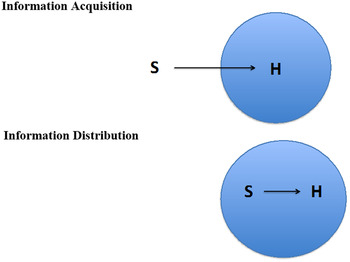
We are now in a position to make a further suggestion, also important for our characterization of knowledge transmission*. Namely, that testimonial exchanges can serve either function. In other words, it is plausible that testimonial exchanges sometimes serve the distribution function of epistemic communities, and sometimes the acquisition function. The distributing function gives us the paradigmatic cases, and gives us the most plausible treatment of Cases 1–5. But it is also plausible that testimony sometimes serves an acquisition function, bringing actionable information into a community for the first time. This is the best treatment of Cases 6–8.
The present proposal explains why a student or a child, when in appropriate circumstances, can believe straight away (or almost straight away) what a teacher or a parent tells her, and also explains why an investigator or interviewer cannot. In short, different norms govern the different kinds of testimonial exchange, some of which are at the service of information distribution within an epistemic community, others of which are at the service of information uptake for first use in an epistemic community (see Figure 1).
Two kinds of Testimonial Exchange

And now, of course, the proposal is this: knowledge transmission* is to be understood in term of information distribution. S transmits* knowledge that p to H just in case (i) S knows that p, (ii) H believes that p on the basis of S's testimony, and (iii) S and H satisfy the relevant norms governing information distribution. In other cases of testimonial knowledge, S's testimony generates knowledge for H. S's testimony that p generates knowledge for H just in case (i) H believes that p on the basis of S's testimony, and (ii) H satisfies relevant norms governing information acquisition.Footnote 17
We may briefly note that the present account of knowledge transmission* satisfies our desiderata a–f.
-
a. First, we retain the governing idea that, in cases of transmission*, the speaker “passes on” or “hands down” her knowledge to the hearer, and so must have the relevant knowledge to give.
-
b. In cases of transmission*, the hearer depends on the speaker in an epistemically interesting way. That way is brought out further in c. and d.
-
c. In cases of transmission*, the hearer is relieved of the usual burdens associated with non-testimonial knowledge. That is because transmission serves information distribution, and the latter is governed by different norms and standards than information acquisition.
-
d. Our “information economy” model also accommodates the division of labor idea in obvious ways, again by invoking the distinction between information acquisition and information distribution.
-
e. Transmission* occurs in a variety of settings, possibly including, but not limited to, interpersonal relationships. Thus our model allows that transmission* can be underwritten by interpersonal relations (for example, familial and friendship relations), social norms (for example, when a stranger asks for directions) and institutional rules (for example, when a doctor gives advice to her patient).
-
f. Transmission* does not occur in all testimonial settings. This is because some testimonial exchanges serve the purpose of information acquisition rather than information distribution. Accordingly, some testimonial exchanges generate knowledge rather than transmit it.
2.4. An objection
One might accept our idea of an “information economy” but deny that this constitutes a “knowledge economy.” That is, one might accept the idea that communities acquire and distribute information for the purposes of action, but reject the idea that these activities should be equated with knowledge generation and knowledge transmission*.
In this regard, a growing number of authors have argued that knowledge is “the norm” for practical reasoning and action.Footnote 18 This is a strong claim, and of course it has been contested.Footnote 19 But few would deny a weaker characterization of the knowledge-action relation: knowledge (often enough, and properly so) provides premises for practical reason, and action (often enough, and properly so) is based on knowledge. Accordingly, a very weak “knowledge norm” would underwrite a strong knowledge-action connection:
Almost always, if you know that p then you can act on p.
Alternatively:
Barring exceptional cases, if you know that p then you can act on p.
But even these weak versions of the knowledge norm are enough to underwrite the connection (if not equation) between information distribution and knowledge transmission. That is, often enough, and properly so, information distribution takes the form of knowledge transmission.
3. THE EPISTEMOLOGY OF KNOWLEDGE TRANSMISSION*
Parts One and Two give us a fruitful characterization of knowledge transmission*, one that accommodates a range of testimonial cases, while also accommodating the idea that knowledge transmission* involves epistemic dependency and a division of epistemic labor. But what is the epistemology of knowledge transmission*? In Part Three, I argue that the present account constrains an epistemology of transmission* in interesting ways. I end by considering two broad theoretical options regarding how an epistemology of transmission* might proceed.
3.1 Some constraints on the epistemology of transmission*
Suppose that the characterization of knowledge transmission* given in Part Two is correct. This suggests that an epistemology of transmission* should be anti-reductionist, externalist, and anti-individualist.
3.1.1 Anti-reductionism
Anti-reductionism may be characterized as the view that testimonial knowledge cannot be reduced to some other kind of knowledge. Sometimes the idea is put in terms of epistemic norms: the norms governing the reception of testimony, and hence giving rise to testimonial knowledge, cannot be reduced to the norms governing perception, introspection, inductive reasoning, and the like. Other times the idea is put in terms of the standards for knowledge: the standards for testimonial knowledge are distinct from the standards for other kinds of knowledge.
On either formulation, the present account entails anti-reductionism with respect to testimonial knowledge. That is because the norms governing information distribution, and hence giving rise to knowledge transmission*, are different from those governing information acquisition and knowledge generation. But since perception, introspection, and reasoning go into the knowledge generation category, the norms governing knowledge transmission* will be different from the norms governing those. Likewise, for the standards associated with testimonial and non-testimonial knowledge.
3.1.2 Externalism
Externalism is the view that positive epistemic standing is not merely a function of factors internal to the believer. Alternatively, positive epistemic standing does not supervene only on what is internal to the believer. “Internal” can be interpreted in terms of privileged access (A state of affairs F is internal to S iff S has some relevant form of privileged access to F), or in terms of what is physically internal, or “inside the skin.”
Either way, the present account entails that knowledge transmission* is an externalist phenomenon. This should not be surprising, since almost all would agree that knowledge in general requires an externalist treatment. But analogous views regarding the transmission of justification will yield externalist treatments of justification. This is because the present view makes testimonial knowledge (justification) depend on both the speaker's and hearer's social location, and these are factors that are neither inside the skin nor open to privileged access. Another way to make the point is to say that the present view makes S's epistemic standing (knowledge, justification) depend on S's social environment and S's relations to her social environment. But S's social environment is external to S in the same relevant senses that S's physical environment is.
3.1.3 Anti-individualism
Anti-individualism in epistemology can be variously formulated, but the central idea is that an individual's epistemic standing at least sometimes depends on other people's epistemic standings. Thus, Sanford Goldberg characterizes the position this way:
epistemic anti-individualism [is] a version of epistemic externalism, in that it entails that not all of the materials that make for epistemic justification can be discerned through the subject's searching reflection; but it is a novel, anti-individualistic sort of epistemic externalism, in that it regards the epistemic justification of a subject's (testimony based) beliefs as depending on features of the cognitive and linguistic acts of the subject's social peers. (Goldberg Reference Goldberg2007: 2)
Alternatively,
the ascription of justification and knowledge to a subject S sometimes depends on factors pertaining to the cognitive lives of subjects other than S. (Goldberg Reference Goldberg2007: 134) Footnote 20
First, any view that endorses a speaker-knowledge requirement on testimonial knowledge will entail anti-individualism so understood. This is because, on any such view, whether a hearer knows on the basis of testimony will partly depend on whether the speaker knows. On the present account specifically, there will be cases where testimony is at the service of the information distribution function. Whether transmission* occurs, and thus whether the hearer knows, will in those cases (partly) depend on whether the speaker knows. And that is enough to entail anti-individualism as understood above.
More generally, on the present view two persons might hear the very same testimony, and be equally disposed to receive it, but occupy different social locations with respect to the speaker. This being the case, the testimonial exchange involving one of the hearers might come under the norms and standards appropriate to knowledge distribution, while the testimonial exchange involving the other hearer comes under the norms and standards appropriate to information acquisition. That being the case, the one speaker might come to know by means of the exchange while the other does not. For this reason as well, the present view counts as anti-individualist.
3.2 Two theoretical options
Let us suppose that knowledge transmission* is real and that any adequate epistemology must explain how knowledge by transmission* is possible. In that case, there are two broad theoretical options for epistemology in general.
One broad option is to give a unified account of knowledge transmission* and knowledge generation. That is, we should try to understand both in terms of the same theoretical framework, perhaps a reliabilist framework, or an evidentialist one. Taking this approach might even help us to adjudicate among competing theories of knowledge, since not all of them, plausibly, will handle transmission* equally well. For example, if evidentialist theories do poorly explaining how knowledge is transmitted*, then that will count against them as a theory of knowledge in general. Likewise, if reliabilist theories do well explaining how knowledge is transmitted*, that will count in their favor.
A second broad theoretical option, more radical, is to argue that no unified account of knowledge is possible. On this view, knowledge transmission* resists analysis in terms of our familiar epistemological theories. At best, those theories give us an account of knowledge generation, but knowledge transmission* requires its own, distinctive treatment. This latter option will be attractive to those who think that understanding testimonial knowledge, and perhaps the social dimensions of knowledge more generally, forces a radical reconceptualization of the field. From this point of view, traditional epistemology has been narrowly focused on knowledge generation, and even knowledge generation of a particular, individualistic sort. Likewise, testimonial knowledge and knowledge transmission* have been off the traditional radar screen, and so it is no surprise that traditional theories cannot give an adequate account of them.Footnote 21
Here we should distinguish between a unified account and a reductionist account. Any unified theory of knowledge will claim that there are common epistemic features of testimonial and non-testimonial knowledge at some level of abstraction – it will make both species of a common epistemic genus. For example, a unified reliabilist account will hold that all knowledge is the product of appropriately reliable processes, and hold that both testimonial and non-testimonial knowledge can be understood in such terms. A reductionist account of testimonial knowledge makes the testimonial species reduce to some other species within the genus. For example, Hume thought that testimonial knowledge was just a sub-species of inductive knowledge. An anti-reductionist account denies that species/sub-species relation. This means that all non-unified theories are anti-reductionist, but unified theories can be reductionist or anti-reductionist. Accordingly, a non-unified position in epistemology is far more radical than mere anti-reductionism. In effect, it says that testimonial knowledge and non-testimonial knowledge cannot be understood as species of a broader epistemic genus. It says that testimonial knowledge and non-testimonial knowledge are fundamentally different kinds of epistemic phenomena.
From the point of view of traditional epistemology, this last would be the nuclear option. In effect, it would blow up the field as we know it. Some will be happy with that option, and think that it has been a long time coming. Others will try to accommodate knowledge transmission* within some familiar epistemological framework such as process reliabilism or virtue reliabilism. Still others will deny that knowledge transmission* exists, arguing that their preferred traditional framework already explains everything that needs explaining.Footnote 22