As a true litterateur of his time, Shaykh Husayn al-Marsafi composed his 1881 treatise The Eight Words as an elucidation of “the words that are constantly on the tongues of the people.”Footnote 1 After commenting on the weighty political concepts of nation, community, government, justice, injustice, politics, and freedom, al-Marsafi ends his work with a lengthy discussion on tarbiya (education). Just months before the ʿUrabi Revolt, education occupied a vital place alongside concerns about government, authority, and politics. Marsafi's choice of “words” simply articulated a long-standing belief that roughly a decade and a half of educational reforms brought to the fore: “Once tarbiya is made perfect, everything else is also made perfect.”Footnote 2
Restructuring education was one, if not the most, important initiative to come out of Khedive Isma ʿil's rule, from 1863 to 1879. Considered the first “real” overhaul of Egyptian education, the reforms of Isma ʿil's era marked the beginning of a long and torturous search, which continues to this day, for an educational system that will make “everything perfect.”Footnote 3 Almost every faction calling for change—bureaucrats, modernists, reformists, colonialists, Islamists, traditionalists, and so forth—looked to education as a means of transformation, reform, or revolution. Historians, in turn, have depicted the educational transformations of the late 19th century as the center of a host of social and political changes, most notably the creation of “the first intelligentsia of modern Egypt.”Footnote 4 Government schools established under Isma ʿil created this “new elite,” the educated strata who then populated the narratives of history as the burgeoning middle class, academics, stalwarts of domesticity, nationalists, and the supporters of revolution.Footnote 5 Egypt was not alone; educational projects came to occupy a central position in the modernization and nationalist movements across most of the Muslim world, from the Middle East through Central Asia to India.Footnote 6 Education in the late 19th century, what it stood for and what it achieved, cannot be divorced from the historical changes that Egypt, among many other nations, underwent at the turn of the 20th century.
The comprehensive attempt at school reform undertaken in Egypt between 1870 and 1877 represents a crucial first step in redefining and expanding education at the intellectual and structural levels. This period is often depicted as part of a larger process of reform whereby “new” notions of education were irrevocably parting ways with the “old,” creating the outlines of a bifurcated system of education that pitted new modern/secular/government schools against the traditional/religious/Islamic schools of Egypt's past.Footnote 7 However, a closer look at this era and the works in Egypt's first educational journal, Rawdat al-Madaris (The Garden of the Schools),Footnote 8 highlights a very different picture of reform. Far from a clean break or clear progression, in the late 19th century concepts of education were still fluid, unbounded, and expanding even as the state was seeking to exert more institutional and bureaucratic control.
Rawdat al-Madaris's unique position, as an active participant and product of this 1870s discourse on education, makes it a useful lens through which to examine crucial changes under way. Rather than seeing the path of educational reform necessarily diverging from older modes of teaching and learning, writers, reformers, and bureaucrats of the time were actively engaged in a twofold process: a conscious expansion of what education and knowledge entailed, and a series of less overt, but nevertheless significant, institutional shifts. In other words, even as these writers were cultivating inclusive ideas about knowledge in this “Garden of the Schools,” they were shifting the ground upon which education stood.
Taking these two developments together, the story of educational reform in the 1870s was not one of complete ideological separation between two sides of a bifurcated system of education, with government schools gaining ground and replacing indigenous ones and a “new” elite displacing the “old.” Rather, government schools relied heavily, both academically and structurally, upon indigenous education for manpower, input, and intellectual sustenance.Footnote 9 Shaykhs, effendis, government schools, and kuttābs (elementary Qurʾanic schools) certainly existed as separate designations. However, there is little evidence that the implications they hold for us today, as some more “modern” and others more “traditional,” were true for the 1870s. In this study of this particular late 19th-century context, references to the collective of “Azhari shaykhs” or “government bureaucrats” or “indigenous/traditional” sciences or “new/modern” subjects are not meant to be essentialist or oppositional. Rather, these designations serve to highlight the moment before they became relevant as categories. Although the 1870s saw the beginnings of institutional tensions that ultimately marginalized one system of education at the expense of the other, writers, thinkers, and scholars of the time hardly recognized the dichotomies that define much of the scholarly literature surrounding this era. A revaluation of these dichotomies is perhaps overdue, for these thinkers were simply interested in the one “word that was on every tongue”: education.
BACKGROUND
Muhammad ʿAli's earliest initiatives to bring private endowments (waqf, pl. awqāf) under state control, experiment with Western educational techniques, and import a cadre of “European experts” were limited in scope. Under his reign, education was important insofar as it produced bureaucrats, engineers, and doctors—the drivers of his governmental and military expansions. Among the unintended consequences of these narrow reforms, however, was a generation of students fluent in the languages, culture, and ideologies of Europe—a new class of intelligentsia.Footnote 10 For many historians, the duality of the system Muhammad ʿAli created was paramount: modern, Western, secular education for the elite versus old “Qurʾanic” education for the masses.Footnote 11
A more comprehensive, influential educational policy awaited Ismaʿil's rule.Footnote 12 Ismaʿil embarked on unprecedented reorganization of the physical and structural fabric of the government and the country, building new quarters in Cairo, completing the Suez Canal, and commissioning new ministries and expanding their responsibilities. On 26 January 1863, he reinstituted the Diwan al-Madaris (Education Ministry) and put governmental/khedival schools under its supervision. Initially, much like Muhammad ʿAli, he was interested in training bureaucrats and technical experts; a host of new professional schools in translation, medicine, engineering, and the like were opened and/or expanded. In addition, with the ambitious “Organic Law” of 1867, the government expanded its authority to oversee established and functioning kuttābs that had, up until then, served as the only “public” education available to most Egyptians. With the Organic Law's stringent requirements on teachers, testing, and curricula, “learning in every detail had very suddenly become the state's active and extensive concern.”Footnote 13 Coupled with Ismaʿil's renewed school building, the 1870s saw the early beginnings of a widespread public education system.Footnote 14 Whether by creating upholders of a middle-class culture, key players in the ʿUrabi Revolt of 1882, articulators of the political ideal of domesticity, or developers of an emerging nationalism,Footnote 15 all historians of the era seem to agree on one point: “the impact of the new schools must not be underestimated.”Footnote 16
Yet, at the center of this elegant formulation—education reform leading to class development and ending with wide social impact—lies the assumption that a strict dichotomy existed between “new,” modern, Western schools and “old,” traditional, indigenous education. In light of this “inevitable” split, historians have portrayed government education and reform as a direct threat to indigenous education and a challenge to its cultural and social import. Some authors suggest this challenge was ideological, with reform, modernization, westernization, and secularization virtually synonymous with the “new” government initiatives,Footnote 17 and as such, in opposition to everything that the prior, indigenous education represented. Other writers emphasize the economic, political, and social threat that government schools posed to the traditional elites of indigenous institutions—eliciting a defensive response from the ʿulamaʾ.Footnote 18 One is left with the specter of a dichotomous, bifurcated system of education with two sides that were (for ideological or pragmatic reasons) necessarily antagonistic. While government schools went merrily down the path of modernization, secularization, and Westernization, the response of religious educators alternated between flat-out opposition and passive-aggressive withdrawal.Footnote 19 Cast in civilizational terms, an inherent ideological animosity between indigenous/religious/Egyptian schools and government/secular/Western ones seems part of an ongoing, impassable conflict.Footnote 20 Under this paradigm, the attempt, but ultimate failure, to integrate the two educational systems caused “the dualism of traditional and modern culture dominating different social strata.”Footnote 21
Appearing at this juncture in history, when a fundamental divergence supposedly took root, Rawdat al-Madaris provides a nuanced counterexample. In content and structure, the journal embraced an expansive concept of education and ʿilm (knowledge), one that had room for botany, geography, history, and so forth, as well as the already established “traditional” sciences. Rawdat al-Madaris writers saw no reason to view the various types of ʿilm available to them (European, indigenous, old, and new) in strictly separate categories, let alone oppositional ones. This eclectic mix was reflected in the backgrounds of its contributors—figures who would reappear as ʿUrabi revolters, leading poets and writers of the late 19th-century nahḍa, and even future rectors of al-Azhar University.Footnote 22 At the same time, the structure of Rawdat al-Madaris as a printed, bureaucratic, space of knowledge reproduction highlights important institutional shifts happening in Egypt during this time. While the sphere of ʿilm was expanding theoretically and intellectually, the actual structures of knowledge reproduction introduced during this era reinforced a particular paradigm within which a government-controlled and government-ordered system of education enjoyed a privileged status over indigenous models of education. The result was not only a marginalization of indigenous education but also its reappropriation within a new circle of intellectuals: the government-educated students.
THE GROWING OF ʿILM
At the heart of the educational mission embodied by Rawdat al-Madaris, its editors, and its contributors lay mostly unarticulated notions about ʿilm, epistemology, and reform. Within this shared understanding, an eclectic mix of ideas and approaches coexisted without contradiction, a coexistence unfathomable to later scholarly debates about traditional versus modern and reactionary versus reformist intellectual trends. Open to European influence and yet deeply infused with indigenous models, Rawdat al-Madaris’s educational philosophy, if it can be referred to as such, included more than it excluded, expanding and integrating new forms of knowledge into already well-defined indigenous understandings of what education entailed.
Under the direction of the energetic and dynamic ʿAli Mubarak Pasha, Rifaʾa al-Tahtawi, then director of the Translation Bureau, and al-Tahtawi's son, ʿAli Fahmi Rifaʿah, Rawdat al-Madaris’s scope was ambitious. According to ʿAli Fahmi's introduction, the magazine gathered “any intellectual subject from among the precious subject matters that provides multifold benefits,” particularly showing interest in works that “unveiled for the commoners the greenery of ʿilm, illuminating with its light all those of sound minds and upright natures.”Footnote 23 Amid these broad intellectual interests, there was a particular focus on all things European. Ismaʿil had redoubled educational missions to Europe and drafted foreign experts to oversee some of his most critical reforms, particularly in the field of education.Footnote 24 Although few articles were tagged as direct translations, many on astronomy, agriculture, botany, and the like were produced by first- or second-generation mission-educated Egyptians who were quick to cite their European credentials. This influx of outside/new/foreign sciences undoubtedly had an effect on the intellectual climate of Egypt and more specifically on Rawdat al-Madaris. These new sciences did not enter an intellectual vacuum, however; they were incorporated into an already vibrant understanding of knowledge, science, and learning.
A Question of ʿIlm
Displayed prominently on the cover of every issue of Rawdat al-Madaris, the motto “Learn ʿilm and read . . .” highlighted the publication's educational bent. However, what exactly did ʿilm mean for Rawdat al-Madaris’s founders, contributors, and readers? A word that designates “that which is known” and is often translated as “knowledge” or “science” wreaks havoc on any sort of strict conceptual categorization of “sciences” as either soft or hard, European or Egyptian, secular or religious; in 19th-century Egyptian thought, the word ʿilm would have straddled all of these dichotomies.Footnote 25 Furthermore, using it prolifically in articles and chapters throughout Rawdat al-Madaris, few authors found it necessary to define the ʿilm they were seeking to gather, expound upon, or disseminate. It was simply understood.Footnote 26 However, these same writers did spend time explaining what it is that ʿilm can and should do for the human condition, whether as a social endeavor, a civilizing project, or a means to spiritual fulfillment.
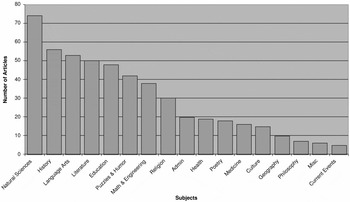
The notion of ʿilm that emerged provided an expansive view of what an “educational” or “ʿilmī” magazine like Rawdat al-Madaris was to include. The pursuit of ʿilm necessarily extended beyond merely the study of science and literature; as a concept, ʿilm represented society's highest ideals, an overwhelmingly positive force that was absolutely necessary to cultivate and propagate. As seen in Figure 1, this eclectic and open-ended definition of ʿilm was reflected in the subject matter dealt with in Rawdat al-Madaris. Although certain subjects did appear more frequently, the overall distribution covered a diverse set of topics covering everything from natural sciences, literature, poetry, fatwas (legal opinions), math, and engineering to jokes and puzzles.Footnote 27 For example, the seventy-four articles on the natural sciences (which included agriculture, astronomy, botany, chemistry, oceanography, and so forth) represent little more than one-eighth of the total articles sampled. For Rawdat al-Madaris’s editors and contributors, the broader the net cast for relevant “educational” material, the better.
Subjects represented in Rawdat al-Madaris. Samples were taken all of the first year (1287), the second half of 1288, the first half of 1290 and 1292, as well as the entire year 1294 (the last issue was published in Shaʿban of that year). Gregorian dates: April 1870–March 1871, August 1871–March 1872, March–August 1873, February–August 1875, and January–August 1877. [A color version of this figure can be viewed online at www.journals.cambridge.org]

Epistemological Legacies
Although the new types of knowledge imported from Europe were well represented,Footnote 28 the very process of categorizing article topics, although useful, tends to belie the impact of a pervasive traditional epistemology that was evident throughout Rawdat al-Madaris, regardless of what “type” of work was being produced. The intellectuals of Rawdat al-Madaris were developing their own “authenticity of knowledge,”Footnote 29 one that did not negate the past, as newer subjects were integrated into already existing models of thought. This “authenticity” was evident on three levels: regular references to the equal importance of naqlī (transmitted) and ʿaqlī (rational) sciences, traditional categorizations of ʿilm within which religious sciences still held a privileged place, and the very form of some articles. These factors all point to a traditional epistemology that was still very much alive and well in the 1870s, one that was impacting the way imported sciences were understood perhaps more than it was being impacted by them.
First, for the founders and many of the contributors of Rawdat al-Madaris, a truly comprehensive education necessarily depended upon the presence of both naqlī and
ʿaqlī knowledge; one could not thrive exclusive of the other. Far from advocating a shift away from a naqlī/stagnant past to a more ʿaqlī/dynamic future, writers referred to both not only as categorical groupings but also as the basis for an intellectual ideal. According to ʿAli Fahmi, Rawdat al-Madaris’s educational mission was meant to “widen the naqlī and ʿaqlī realms of the students.”Footnote 30 Meanwhile, al-Tahtawi cited traditional scholars who abhorred the “half-rationalist”; by contrast, he described the perfected intellectual as one who “gathers between two virtues: that which is acquired by the rational and that which is acquired by transmission.”Footnote 31
Second, the influence of an indigenous epistemology was also pervasive in the classifications of ʿilm that were utilized by various writers in Rawdat al-Madaris. One prominent example is Shaykh Ahmad Marwan, an Arabic teacher at a government preparatory school, who, in his discussion of Aristotle's ten classical categories,Footnote 32 distinguishes among three types of ontologies: philosophical, which was not connected to outward or mental existence; natural, relating to both the outward and mental worlds; and mathematical, which has a meaning in an outward existence only.Footnote 33 In this classification, “philosophy” includes not only the rational sciences, but also theological and spiritual matters because they all deal with “what is behind the natural world.”Footnote 34 Meanwhile, Shaykh Marwan separates natural sciences from more human-centered “mathematics,” which he defines as subjects ranging from engineering to music.Footnote 35 This kind of grand ontological scheme served a purpose in providing a distinct place for very different types of ʿilm, providing a very wide array of subject matters, each of which could be treated as legitimate educational pursuits. Within this model, the rational, spiritual, natural, and artistic all had an equally valid presence. This ethos pervaded much of Rawdat al-Madaris’s intellectual inclusion.Footnote 36
Third, authors frequently borrowed and reused indigenous sources and models of expression, appealing to Arabic, Turkish, and Persian sources, the Qurʾan, Prophetic example, classical poetry, and the like throughout Rawdat al-Madaris. On topics ranging from health to astronomy to botany, articles regularly began with a discussion of a religious imperative or a Qurʾanic verse, which furthered the importance of their work.Footnote 37 Likewise, classical poetic compositions (as stand-alone works or interspersed within the prose of an article) proved a popular means not only of expressing linguistic dexterity, but also of conveying ideas, concepts, and information. Even technical poetry such as matns appeared as teaching tools and mnemonic devices for rhetoric, grammar, and tawhīd—the same function they had served for centuries in the classical madrasa system.Footnote 38 Meanwhile, contributors like al-Tahtawi, ʿAli Fahmi, and court translator Muhammad Fanni made use of the tarjama Footnote 39 style of biography to highlight examples of historical figures who they evidently felt were relevant role models for their day and age: orthodox scholars who excelled in ijtihād,Footnote 40 philosophers of classical Islam,Footnote 41 and notable literary figures of the past.Footnote 42 Like the majority of authors featured in Rawdat al-Madaris, they expressed their views using traditional epistemologies, frameworks, and literary forms.
The Place of Reform and Tajdīd
The dependence on indigenous forms of understanding and thinking had profound implications for reform during the 1870s. The intellectual expansion thus far described, although innovative and flexible, was still quite different from a wide-scale, self-conscious reform or shift. Although some scholars contend that there existed a “Rawdat al-Madaris school” of intellectuals united by “a strong reformist instinct and the belief that freedom, culture, training, and education were the basis for cultural and spiritual change,”Footnote 43 I argue that the label “reformist” needs qualification. These writers were certainly dedicated to improving their societies; however, their vision was more evolutionary than revolutionary.
Indeed, many writers displayed a striking sense of historical consciousness constructed around a glorious past, a period of decline, and finally, the historical present: a moment of great promise to which they were contributing. This same narrative was echoed in nearly every introduction, with refrains about “Egypt in this era of hope”Footnote 44 or how finally “the sun of knowledge has risen in our time.”Footnote 45 These writers seemed to be responding to the changes around them in the most direct way possible—seeing changes not as harbingers of necessary structural or fundamental reforms, but rather as opportunities that merely needed to be seized upon and incorporated properly. In the view of one writer, if the amazing new technology of gas lighting could be installed to illuminate the streets of Cairo and restore its luster, then it is not “strange that ideas could produce something like this light”Footnote 46 that could illuminate the dusty corners of Egyptian intellectual life.
In fact, the intelligentsia of the 1870s, as represented in Rawdat al-Madaris, hardly seemed aware that any wholesale reform, reconciliation, or compromise was necessary in their drive for societal and personal improvement through education.Footnote 47 They tended to see their roles in the changes that were occurring in a tajdīdī (revivalist/renewal) light that differs significantly from what is usually associated with “reform.” Far from positivist, ʿAli Fahmi's view of history was more common: “Fate lifts a nation at times then brings it low at others, giving it peace in some eras, and hardships in others, and we know God has a wisdom in this.”Footnote 48 The concept of tajdīd that many Rawdat al-Madaris writers implicitly appealed to was cyclical rather than linear (albeit one that had a definitive ending). They were not dispensing with an irrelevant past in their move forward, but rather reclaiming and renewing what had been lost. In this scheme, the past and, in this case, its indigenous education took on new and important meanings. Far from recasting or eliding indigenous modes of thought and education in the face of unprecedented global changes, intellectuals embraced these same older models as the basis of future glory.
In this vein, al-Tahtawi prefaced an article that was essentially about tajdīd with a discussion on posterity,Footnote 49 an unlikely starting point unless we understand the cyclical nature of his historical framework. For al-Tahtawi, being remembered well (ḥusn al-dhikr) was the destiny not only of prophets, but also of all those who strove to embody the prophetic spiritual and intellectual legacy.Footnote 50 By attaining the highest levels of ʿilm (in both naqlī and ʿaqlī realms), one reaches perfection and attains a reputation that is eternal—forever beneficial and praised.Footnote 51 Lest his readers forget history's continued relevance, after providing a biography of the mujtahid Imam al-Subki,Footnote 52 al-Tahtawi reminds them of the Prophetic tradition: “God sends every one hundred years a mujaddid [renewer] for the Muslim umma and its religion.”Footnote 53 In the cyclical rise and fall of nations, the past provided an outline for the future. All that 19th-century Egyptian intellectuals had to do was retrace the steps of indigenous religious learning within the new expanded sphere of ʿilm.
The broadening ʿilmī categories, based on traditional epistemologies and meshed with tajdīdī expectations, produced works in Rawdat al-Madaris that drew upon all the intellectual resources available to contributors—articles that often defied the categories of traditional versus modern, old versus new, or foreign versus local that are too often used to define eras of change and flux.
From Medical Mujtahids to Fiqh Engineering
Describing a Cairo medical student, ʿAli Fahmi mentions with pride that in addition to studying traditional religious sciences (fiqh, logic, Arabic, and so forth) the young man will also reach the highest level of ijtihād muṭlaq [absolute ijtihād] in medical matters.”Footnote 54 Fahmi's equation of a medical student to a fiqh mujtahid is not meant to be provocative, clever, or ironic. Within his conceptual framework, a term that implies absolute authoritative interpretation could apply equally to experts in medical or religious sciences. Likewise, the well-balanced, skilled, and cultured individual could utilize ʿilm in all its capacities: scientific and expressive, as well as religious. That these types of studies “should” represent separate, disconnected categories of knowledge probably did not occur to Fahmi. In much the same way, the authors of Rawdat al-Madaris, in their choice and treatment of topics, were crossing disciplinary and ideological boundaries that simply did not yet exist in the 1870s.
Rawdat al-Madaris contributors, regardless of their backgrounds, showed no hesitation in expounding upon a wide breadth of subject matters. Although shaykhs generally avoided technical topics for which their training would have left them ill prepared (astronomy, botany, and the like), a shaykh would just as likely have produced a love story,Footnote 55 a literary piece, or cultural commentaryFootnote 56 as a religious treatise. (If anything, shaykhs showed a particular interest in puzzles and jokes.Footnote 57) Moral or religious issues were not strictly the dominion of the religiously trained. The new “intelligentsia,” as represented by efendis and various teachers, wrote parables,Footnote 58 articles on forbearance,Footnote 59 and social commentary (masked often as social science) about the importance of producing graduates of upright moral character.Footnote 60
Furthermore, treatments of issues reflected a propensity for fusing seemingly disparate (by modern standards) topics. In one case, a principal of the engineering school, Ismaʿil Muhammad, authored an article seeking the fiqhī cubit equivalent in various other standards of measurement, ending with the metric system (he concludes that 1 fiqhī cubit = 0.461 m).Footnote 61 In another, Yaʿqub Sabri tackles the standardization of the amount of water with which one can perform ritual purification, a question “which would be difficult for someone who does not know the details of engineering.”Footnote 62 The quantification of religious obligations fell well within the purview of Rawdat al-Madaris, with its “willingness to present the complete realm of knowledge.”Footnote 63 Meanwhile, just as “modern” sciences were used to answer fiqhī inquiries, religious sciences were employed to serve secular sciences. For example, ʿAbdullah Fikri's work on heliocentricity presents the arguments as a religious debate between a faqīh and an astronomer.Footnote 64 At first serving as the foil to heliocentric arguments, the faqīh by the end consents to a basic compromise that is in line with both the shariʿa and science: what appears in the Qurʾan and Prophetic Sunna to contradict heliocentricity is open to other interpretations (taʾwīl) in the face of absolute empirical proof.Footnote 65 The figure of the faqīh facilitates the reconciliation between various religious texts and the science of astronomy—a reconciliation that made the treatise, in the opinion of ʿAli Fahmi, remarkable for its ability to “remove all the rust of ambiguity and make the morning clear to those who have sight.”Footnote 66
Whether dealing with medical faqīhs or fiqhī engineers, the amalgamations made possible by the intellectual expansion occurring at the time provided a unique space within which ʿilm, in its most inclusive meaning, had free rein to be applied and reapplied across a wide spectrum of thought. Neither secular versus religious nor modern versus traditional dichotomies applied. Indigenous modes of thinking navigated the sea of new sciences that were inundating Egypt, oblivious of any contradiction or conflict.
SHIFTING GROUND: INSTITUTIONAL TENSIONS
With an initial press run of 350 copies (eventually reaching 700),Footnote 67Rawdat al-Madaris did not have an exceptionally large readership, particularly given its stated role of “illuminating with its light all those of sound minds and upright natures.”Footnote 68 In its distribution process, it remained true to a more modest and immediate concern: “the children of the schools,”Footnote 69 narrowly defined as pupils in government schools that fell under the direct supervision of Diwan al-Madaris.Footnote 70Rawdat al-Madaris was distributed to all government schools; the top three students of each class received it for free.Footnote 71 In addition, teachers were practically required to purchase the journal, as were all Diwan al-Madaris employees who earned over 150 piasters a month.Footnote 72Rawdat al-Madaris, in its public life, was most definitely a government initiative.
Yet, perhaps due to its intellectual breadth and openness, commentators tend to deemphasize its bureaucratic connection, focusing instead on the journal's “Egyptian” character or its relative editorial independence.Footnote 73 However, nowhere is the bureaucratic connection more relevant than in the systemic shifts that Rawdat al-Madaris embodied during this period. While espousing an inclusive definition of ʿilm, it was simultaneously reinforcing institutional realities that profoundly impacted how, where, and ultimately at whose hands this ʿilm would be imparted.
Ordering Schools
In his chapter “An Appearance of Order,” Timothy Mitchell convincingly argues that a new type of modern “schooling” evolved between the 1860s and World War I, informed by a process of systematic categorizing, disciplining, ordering, and surveillance.Footnote 74 ʿAli Mubarak inaugurated this process with his educational reforms, and, in Mitchell's depiction, a rash of “precise methods,” “comprehensive plans,” “government instructions,” and “acts of inspection”Footnote 75 ensued. Although not as overtly invasive, this same concern with tanẓīm (organization) and tartīb (ordering) was reinforced throughout Rawdat al-Madaris, extending to the very heart of its mission as an educational magazine. Achieving the lofty goals of cultural, scientific, and religious excellence was often paralleled with understanding and creating order in the societal, natural, or spiritual worlds.Footnote 76 Once the “natural” order of the universe was understood, its practical reapplication to human life was the natural extension of the ʿilmī project, with “everything that has happened in Egypt in terms of the light of organization, planning, and apportioning, coming from [the intellect's] light.”Footnote 77 In every case, correct placement of an element—linguistic, moral, or physical—was equated with perfection.Footnote 78
This ideal of orderliness was unsurprisingly reflected in Rawdat al-Madaris's depictions of instructional methods, as the journal highlighted the best examples of educational discipline and organization. Of the forty-seven articles (see Figure 1) that dealt with education, thirty-five were “observational” works that reported on schools, their testing, speeches, and so forth.Footnote 79 Cognizant of the goal of establishing models for emulation, ʿAli Fahmi did not hesitate to delve into even the most mundane details of testing procedures: organization of the lecture hall, how students sat in the “stands with the utmost orderliness,” and the time various notables entered the hall.Footnote 80 Even the application process for future teachers in Dar al-ʿUlum was praised for its “utmost organization,” in hopes that it would set a “good example for all those who were seeking workers.”Footnote 81
Kuttābs were not excluded in toto from these reports and attempts at systematization.Footnote 82 Their inclusion was in marked contrast to European assessments of the old system of education as inherently haphazard, disorderly, and chaotic: “The apparent noise and the disorder . . . result from the pedagogical method.”Footnote 83 By contrast, Rawdat al-Madaris reported on kuttāb openings, patrons, finances, and speeches given at exams, without perceiving any sort of pedagogical contradiction.Footnote 84 In one case, ʿAli Fahmi provided a detailed account of an awards ceremony for kuttāb students, replete with notables of all stripes and even a processional through the streets (with music blaring).Footnote 85 In addition, one of Rawdat al-Madaris’s important editorial board members, ʿAbdullah Fikri, became minister of the Makatib al-Ahliyya during the second year of the journal's publication. These schools were, after all, part of the same educational mission, one that did not categorically distinguish between “secular” and “religious” education.
Although kuttābs, as a category, were not excluded for reasons of perceived difference, nevertheless, the vast majority of kuttābs fell beyond the tanẓīm that was being undertaken by Diwan al-Madaris under the new reform laws of 1867.Footnote 86 Reflecting the administrative nightmare of bringing kuttābs under state control, one report expressed Diwan al-Madaris's deep concern for “the some 10,000 children who regularly attend the kuttābs. Due to the lack of any yearly assessment, as happens in the state [mīrī] schools, their level of progress and the benefits of their education are unknown.”Footnote 87 As a whole, kuttābs presented a logistical problem. All kuttābs were technically considered “primary” schools, but just a handful of primary schools came under the guardianship (and funding) of Diwan al-Madaris.Footnote 88 Only these kuttābs that maintained the “administrative and educational principle”Footnote 89 laid out by Diwan al-Madaris—properly “ordered” within the governmental sphere—could justifiably be represented in Rawdat al-Madaris. Even when the journal mentioned testing at the kuttābs at large, only twenty-five students appeared in the account, the few who were able to attend the “central” testing on Darb al-Gamamiz.Footnote 90 Results for the rest, tested at their respective schools, were not reported in Rawdat al-Madaris. After all, what was noteworthy about a school, deserving of praise and emulation, was how well it adhered to the organization being implemented by the ministry. Rawdat al-Madaris ignored the majority of kuttābs not because of essentialist exclusion (as too “traditional”), but because of institutional inadequacy (as too “unorganized”).
Education Spaces
The minister of schools, the boundless ʿAli Mubarak, also served as minister of public works and oversaw some of Cairo's most extensive transformations in centuries. The transformation of space along European, and particularly Hausmannian, lines took on new importance under Mubarak. It was just behind Khedive Ismaʿil's new royal residence in ʿAbdin, on Darb al-Gamamiz, that Mubarak chose an older palace to serve as the heart of his educational and governmental projects, which included a preparatory school and the new schools of administration and languages, engineering/polytechnic, surveying and accountancy, and Egyptology.Footnote 91 By 1870, in the first issue of Rawdat al-Madaris, ʿAli Mubarak was singing the praises of the newly opened Dar al-Kutub on Darb al-Gamamiz, which was to be used in particular by “the students of the schools” who “need books of all kinds to practice their trade.”Footnote 92 The new lecture hall was described for the Rawdat al-Madaris audience as a “large hall, which is especially prepared for such grand yearly proceedings and amazing events, known as the ‘Amphitheater’ and that is located at the palace on Dar al-Gamamiz.” The hall hosted yearly testing for schools and the very popular Arabic-literature lectures of Shaykh Husayn al-Marsafi (published regularly in Rawdat al-Madaris), along with other public talks on astronomy, fiqh, Qurʾanic exegesis, hadith, physics, chemistry, railways, architecture, mechanics, botany, and history. Darb al-Gamamiz quickly became a true “cultural centre.”Footnote 93
The pull of this educational center was undeniable for Rawdat al-Madaris, produced and printed within yards of these schools, in Darb al-Gamamiz. Location and proximity affected the types of students who contributed to the journal. Of the thirty-nine piecesFootnote 94 authored by students that appeared in Rawdat al-Madaris over more than a three-year sample period, at least thirty were written by students who went to school in Darb al-Gamamiz.Footnote 95 Institutionally, organizationally, and spatially marginalized, not one of the “some 10,000” kuttāb students ever wrote for Rawdat al-Madaris over the same period.
Beyond physical proximities and places, Rawdat al-Madaris inaugurated a new “space” for education and pedagogy: the press. When Rawdat al-Madaris began publishing in 1870, it was the first journal (except for a short-lived medical-research periodical) to deal explicitly with educational issues. However, Rawdat al-Madaris was not the only new publication. Under Ismaʿil's rule, Egypt saw an explosion of activity in the political press.Footnote 96 Particularly in the turbulent times that led to Ismaʿil's deposition in 1879 and the ʿUrabi Revolt of 1882,Footnote 97 the press, as an oppositional force, evokes Jürgen Habermas's concept of a “public sphere”—a space of contestation, opinion, and critical reasoning.Footnote 98 In this model, the press serves as the instrument by which a burgeoning middle class makes its ideas “public” to a wider audience that can then engage in debate, deliberation, and, ultimately, change. In turn, this dynamism explains the press's natural anathema for the status quo, and in the case of education, for its “traditional” or indigenous forms. Behind this supposed mutual animosity are an amalgamation of several ideas: Islamic education's reliance on oral versus textual authority,Footnote 99 print's natural affinity for the exactness of secular science,Footnote 100 and/or institutional opposition from the likes of al-Azhar and its conservative ʿulamaʾ.Footnote 101 In this framework, Rawdat al-Madaris, as a printed, government-sponsored, European-oriented journal, seemed the perfect space for contesting all that was “traditional” in education. Except that it did not.
Rawdat al-Madaris did indeed create a new space for education—an inside that included various models of education without contradiction and an outside that remained marginalized. What determined the boundaries of this space, however, was not orality versus textuality, religion versus science, or tradition versus modernity. Instead, this new space was characterized by a bureaucratic/institutional network that was both intensely personal and institutional, and above all, self-reproducing.
Inside and Outside: Educational Networks
Articles in Rawdat al-Madaris frequently begin with statements like “ʿAli Mubarak Pasha asked me to collect the most beneficial information on . . .” or “ʿAli Mubarak requested that I write, and feeling it a service to the nation, I have complied. . . .” The blatant name-dropping of one of Egypt's most powerful ministers provides a glimpse of daily interactions at Rawdat al-Madaris. In the journal's relatively small community (one author describes it as a “constellation”),Footnote 102 regular contributors undoubtedly all knew or knew of each other.Footnote 103 Personal contact no doubt played a crucial role in securing contributions (from the editorial side) or publication (from the writers’ side), as well as provided a host of other benefits, both material and otherwise. The lubricant in this system was not only the prestige and praise that often accompanied a byline in Rawdat al-Madaris, but also the type and intensity of relationships that connected various members of this network.
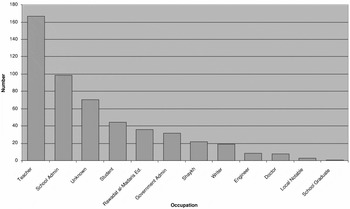
Although some of these relationships were filial (as in the cases of al-Tahtawi and Fahmi or Abdullah Fikri and Muhammad Amin Fikri), the majority of the connections centered around the axis of the new educational bureaucracy. If we look at the professions represented in Rawdat al-Madaris (Figure 2), the educational bent of the authors is obvious. Fifty-two percent of the articles were written by authors who were part of Diwan al-Madaris's bureaucratic extension into Egyptian education.
Occupations represented in Rawdat al-Madaris contributors. Samples were taken all of the first year (1287), the second half of 1288, the first half of 1290 and 1292, as well as the entire year 1294 (the last issue was published in Shaʿban of that year). Gregorian dates: April 1870–March 1871, August 1871–March 1872, March–August 1873, February–August 1875, and January–August 1877. Note: The figure shows the frequency a given profession was used to describe an author of an article, not the number of unique contributors of a given profession. [A color version of this figure can be viewed online at www.journals.cambridge.org]

These authors certainly regularly interacted with each other. For one thing, like the student contributors, many of them were located in the proximity of Darb al-Gamamiz, as they were teachers in the area's many schools or administrators in ʿAli Mubarak's educational ministries. All those members of Rawdat al-Madaris’s editorial board who regularly contributed to the journal had at one time or another served in the schools. ʿAbdullah Fikri, for example, had served as minister of al-Makatib al-Ahliyya, Heinrich Brugsch as principal of the Egyptology school, Shaykh Uthman Maduh as a teacher of Arabic at the surveying and accountancy school, ʿAbdullah Abu Saʿud as a teacher of history at Dar al-ʿUlum, and Ismaʿil Muhammad al-Falaki as the head of the engineering school. Among this group, Shaykh ʿUthman Maduh and ʿAbdullah Fikri exchanged letters and jokes at each other's expense.Footnote 104 Likewise, a personal link to the new bureaucracy of education encouraged contributions from other government officials. In one instance, Shaykh ʿAli Muhammad al-Bablawi, who wrote an article on the Qurʾan, was at the time serving as the librarian and organizer of Dar al-Kutub.
Aside from simply knowing or working with each other, many of these writers were connected in a more profound and rather telling way: they were students of one another. Thus, the prolific Sayyid Salih Majdi, the future journalist Mikail abu al-Sayyid, and the influential law architect Muhammad Qadri were all students of al-Tahtawi. Of Shaykh Husayn al-Marasafi's many students, Shaykh Muhammad Diyab wrote for
Rawdat al-Madaris for a period of time. Meanwhile, Muhammad Ridwan (who wrote a poem on rhetorical devices) was the Arabic student of Shaykh Husayn Wali. These connections undoubtedly helped graduates land government positions. ʿAbd al-Hameed Thabit's career path was probably typical: he first appeared in Rawdat al-Madaris as a recent graduate of the surveying and accountancy school and a newly hired bureaucrat in Diwan al-Madaris; later, he became a teacher at his alma mater. Likewise, Yusuf Salah al-Din, originally a student in the languages and administration school, went on to work as a translator in the Ministry of Public Works, another of Mubarak's charges. The students, teachers, administrators, and graduates of government schools created a tight-knit educational network, a new space that produced Rawdat al-Madaris.
Where does indigenous education fit into this model? Shaykhs who were standard products of the past era's indigenous education were certainly well represented among the journal's contributors. Although only 22 of the total 512 articles sampled were written by people whose primary profession was shaykh, 63 of the 167 articles by teachers in government schools were written by “shaykhs” with an Azhari educational background. Although these shaykh–teachers were well integrated into this network, two structural tensions privileged the new government system (where these shaykh–teachers now worked) over the system of education that had produced them.
First, shaykhs were primarily students in Dar al-ʿUlum (the teachers’ college) or teachers of Arabic.Footnote 105 In order to find qualified Arabic teachers, Diwan al-Madaris needed (as at other times of educational reform) to draw upon Azharis, the few truly learned people in a sea of general illiteracy.Footnote 106 With the notable exception of Shaykh Hasuna al-Nawawi (who taught fiqh and theology), almost every other teacher–shaykh who wrote for Rawdat al-Madaris was connected to language arts. Despite Rawdat al-Madaris’s wide range of topics, indigenous education increasingly provided only one type of educated person—a well-read individual, who knew proper Arabic. The myriad other types of ʿilm (natural sciences, engineering, agriculture, medicine, geography, etc.) remained firmly outside the grasp of the indigenously trained. Second, and perhaps most profoundly for future generations, the students of shaykhs rarely became shaykhs themselves. Although this may seem natural to our current sensibilities (why would government schools turn out shaykhs?), it nevertheless represents a significant displacement. By incorporating Azharis (particularly in Dar al-ʿUlum), an institutional bridgeFootnote 107 was created that allowed resources from indigenous schools—the best teachers and the top students—to be funneled into the government system. Thus, al-Tahtawi taught future journalists, writers, and lawyers, and Shaykh Husayn al-Marsafi's students became some of the early 20th century's most influential writers and poets.Footnote 108 This shift from indigenous education can be seen among the student contributors: only three of the roughly forty student articles in the sample were written by Azharis. In the end, government schools marginalized indigenous education, tapping individuals’ specialized expertise but offering little in return to the indigenous system as a whole.Footnote 109
The results of this shift are evident in the example of Muhammad Efendi Ridwan. Ridwan's work for Rawdat al-Madaris—a poem in praise of the Prophet Muhammad to demonstrate various Arabic rhetorical devices—was perhaps unremarkable in its content and style, drawing heavily from indigenous traditions.Footnote 110 The significance of this work was not what the poem contained, but rather how and by whom it was transmitted. Ridwan was a self-described nonspecialist in the Arabic language who nevertheless drew heavily from the indigenous matn tradition of transmission, extolled the virtues of his teacher Shaykh Husayn Wali, and even asserted the primacy of orality (“Knowledge is in the hearts, not on the pages”).Footnote 111 Yet ultimately Ridwan was publishing a teaching aid in a magazine distributed to government schools, using the new educational spaces of transmission for the benefit of a generation of schoolchildren who never set foot in an indigenous school.
The ground beneath education had shifted. In another era, a “traditionally” trained scholar and litterateur like Shaykh Husayn al-Marsafi would have expounded on his literary criticism in the halls of al-Azhar. His lectures would have been written out by hand and repeated mouth to mouth by students, firmly keeping the reproduction of this knowledge within the confines of indigenous institutions like al-Azhar. In this new age, this venerable, blind scholar traveled to Darb al-Gamamiz, delivered his lecture in the new state of the art amphitheater, and had his words transcribed and printed every two weeks in Rawdat al-Madaris for distribution to students who almost never became shaykhs. Even while drawing seamlessly from indigenous sources of ʿilm, the outlines of institutional, spatial, and structural marginalization of indigenous education were set.
CONCLUSION
On 30 August 1877 Rawdat al-Madaris abruptly ceased publication. No written announcement or commentary appeared in the journal before its sudden disappearance. Like many of Ismaʿil's initiatives, Rawdat al-Madaris fell victim to the khedive's hubris and fiscal overextension. Nevertheless, by the end of Ismaʿil's rule in 1879, his government had overseen a more than tenfold increase in educational spending, and the schools under government funding had swelled from 185 to 4,817.Footnote 112
Perhaps as expected, this part of the budget was one of the first targets of the British-controlled government after 1882. Uninterested in expanding educational options for a widening elite, let alone the masses, Lord Cromer in particular maintained that students valued only education for which they had paid. Under his rule, government education saw virtually no growth.Footnote 113
Against this backdrop, critiques of indigenous education also grew more vociferous. In the last two decades of the 19th century, intellectual leaders became more vocal about the need for widespread schooling, education well beyond the limited offerings at institutions like al-Azhar.Footnote 114 The showdown between the forces of reform and “traditional” education reached a pitched level that has been depicted in oppositional and antagonistic terms ever since. The very direction of Egyptian education was at stake with “the reformers and the ʿulamaʾ, each representing a completely different system of values, norms, and beliefs.”Footnote 115 It would seem that the inevitable clash of educational systems, sown in the modernization attempts of Ismaʿil, had arrived by the end of the century.Footnote 116
It is precisely this point of divergence that this article has sought to address. By looking at the period of 1870–77 through the lens of Egypt's first educational magazine, we can paint a more nuanced picture, one of intellectual expansions coupled with institutional tensions. Reform in the 1870s did not proceed in an educational milieu cleaved along lines of new and old or modern and traditional. Government-funded schools and largely independent indigenous schools did not represent two necessarily opposite sides of the ideological, modernization, and/or Westernization spectrum. In the end, the same intellectual currents seemed to flow through all parts of the system, albeit unevenly at times.
As the first publication of its kind, Rawdat al-Madaris provided a forum for a bureaucratic, Egyptian elite to express their ideas about education. Drawing from indigenous concepts of knowledge, or ʿilm, they incorporated many different strands of thought into their works: classical Islamic epistemologies, literary forms, and worldviews existed side by side with European translations, scientific ideas, and theories. The purpose of ʿilm was, ultimately, the betterment of the human condition, and these writers saw no reason to limit their quest to the rigid categories of East/West, Christian/Muslim, Egyptian/European, or authentic/inauthentic. Instead, the process of renewal and revival that they envisioned for Egypt required an expansive view of education, knowledge, and learning—a milieu that took in more than it kept out.
At the same time, the increasingly bureaucratic and systematized educational system these administrators were creating shifted the center of learning—schools, teachers, and technology—away from traditional carriers of indigenous education. Whether by highlighting “innovative” educational methods or creating new “spaces” for knowledge reproduction, the intellectual inclusion of the 1870s, while discursively (and emphatically) embracing indigenous models, was also creating new realities that excluded the “older” educational system from the production and reproduction of knowledge. Built on a network of bureaucratic, personal, and mentoring relationships, the tight-knit educational circle of the 1870s incorporated shaykh–teachers and al-Azhar graduates but was nevertheless structured to eventually displace the educational system from which these indigenously trained elites had emerged.
By closely examining this early era of educational reform, this article has sought to reassess the inevitability of a cultural, ideological, or fundamental split between government and indigenous education. A process of intellectual and institutional shifts and consolidations was certainly under way. However, the new elites who dedicated their efforts to the fledgling educational reform agenda did not see themselves as anything other than thinkers, bureaucrats, and teachers negotiating the stream of incoming information and influences. They seamlessly incorporated what they needed, added what they wanted, and ultimately created new spaces in which their educational vision could flourish.
Rawdat al-Madaris writers engaged a fundamental issue of their—and our—time: the ongoing project to create a relevant and effective educational system for a changing society. Disputed, contested, and controversial, the questions of how to define education, what role it has in society, and what form it ought to take challenge every society. In 1881, Shaykh Husayn al-Marsafi underscored this point when he added to his list of nation, community, government, justice, injustice, politics, and freedom, an equally contentious word: education.