Research has demonstrated the effects of socioeconomic status (SES) on children's language and cognitive development. Children from low-income backgrounds lag behind their middle-class peers in vocabulary and cognitive skills (Brooks-Gunn & Duncan, Reference Brooks-Gunn and Duncan1997; Shonkoff & Phillips, Reference Shonkoff and Phillips2000). However, substantial variability exists in the development and experiences of children from low-income backgrounds. A number of studies point to parental (especially maternal) language as an influential factor in child variability (e.g., Hart & Risley, Reference Hart and Risley1995), but also recognize that children play an active role in their own experiences (Sameroff, Reference Sameroff2010). Indeed, parents modify their behaviors (and language) in response to children's developing skills (e.g., Snow, Reference Snow1972), which highlights the bi-directional process of early language and cognitive development. In this study, we examined reciprocal associations between maternal language and children's language and cognitive development in dyads from low-income households.
Maternal language and children's language and cognitive development
Abundant research has demonstrated associations between maternal language and children's development, with most studies focusing on children's early lexical development (e.g., Hart & Risley, Reference Hart and Risley1995; Hoff, Reference Hoff2003; Huttenlocher, Haight, Bryk, Seltzer & Lyons, Reference Huttenlocher, Haight, Bryk, Seltzer and Lyons1991; Huttenlocher, Waterfall, Vasilyeva, Vevea & Hedges, Reference Huttenlocher, Waterfall, Vasilyeva, Vevea and Hedges2010; Pan, Rowe, Singer & Snow, Reference Pan, Rowe, Singer and Snow2005; Rowe, Reference Rowe2008). For example, when following toddlers' vocabulary production from one to three years in low-income families, researchers found large variation in growth across children, which was related to maternal lexical input (Pan et al., Reference Pan, Rowe, Singer and Snow2005). Another study on a group of Spanish-learning children from low-income backgrounds found that the amount of maternal talk at age 1;6 was positively related to children's gains in vocabulary and speech processing from 1;6 to 2;0 (Hurtado, Marchman & Fernald, Reference Hurtado, Marchman and Fernald2008). Furthermore, studies have shown that maternal language mediates associations between SES and children's language skills (e.g., Hoff, Reference Hoff2003; Huttenlocher et al., Reference Huttenlocher, Waterfall, Vasilyeva, Vevea and Hedges2010; Rowe, Reference Rowe2008). That is, although SES predicts variation in children's vocabulary, associations attenuate when the amount and/or quality of maternal language is controlled (Hoff, Reference Hoff2003; Rowe, Reference Rowe2008).
Most previous studies have examined the mother–child associations within the language domain. Yet language and cognition are intimately linked. Early concepts provide the referents onto which early words can be mapped, and words in turn influence how young children organize and consolidate their knowledge about kinds and relations (Clark, Reference Clark2004; Göksun, Hirsh-Pasek & Golinkoff, Reference Göksun, Hirsh-Pasek and Golinkoff2010; McDonough, Choi & Mandler, Reference McDonough, Choi and Mandler2003). Indeed, studies have documented strong correlations between language and cognitive abilities in children (Nazzi & Gopnik, Reference Nazzi and Gopnik2001; Raikes et al., Reference Raikes, Luze, Brooks-Gunn, Raikes, Pan, Tamis-LeMonda, Constantine, Tarullo and Rodriguez2006; Xu, Reference Xu2002).
From a socio-cultural perspective, language plays a crucial role in children's cognitive growth, as it not only offers the means for children to communicate to and learn from others through dialogue, but also allows adults to provide scaffolding that facilitates and promotes learning and development (Landry, Miller-Loncar, Smith & Swank, Reference Landry, Miller-Loncar, Smith and Swank2002; Vygotsky, Reference Vygotsky1978). Therefore, examining language and cognitive development together deepens and augments an understanding of mother–child associations.
A number of studies have examined the effects of maternal behaviors on children's language and cognitive outcomes (e.g., Bornstein & Tamis-LeMonda, Reference Bornstein and Tamis-LeMonda1989; Landry et al., Reference Landry, Miller-Loncar, Smith and Swank2002; Lugo-Gil & Tamis-LeMonda, Reference Lugo-Gil and Tamis-LeMonda2008; Murray & Hornbaker, Reference Murray and Hornbaker1997; Raikes et al., Reference Raikes, Luze, Brooks-Gunn, Raikes, Pan, Tamis-LeMonda, Constantine, Tarullo and Rodriguez2006; Tamis-LeMonda, Bornstein, Baumwell & Damast, Reference Tamis-LeMonda, Bornstein, Baumwell, Damast and Tamis-LeMonda1996; Tamis-LeMonda, Shannon, Cabrera & Lamb, Reference Tamis-LeMonda, Shannon, Cabrera and Lamb2004). These studies typically derive ratings or scores of maternal behaviors based on videotaped mother–child interactions. Although each study focuses on somewhat different types of maternal behaviors, a general finding is that maternal behaviors that demonstrate sensitivity, responsiveness, elaborativeness, and cognitive stimulation are positively associated with children's language and cognitive skills. Many of these behaviors involve or relate to language, but are not language behaviors per se. Therefore, the relationship between maternal language and children's cognitive development is unclear.
However, some of these studies looked at maternal language more specifically. For example, one study defined responsiveness as mothers' contingent and appropriate verbal prompts and replies to changes in children's verbal and exploratory behaviors (Tamis-LeMonda et al., Reference Tamis-LeMonda, Bornstein, Baumwell, Damast and Tamis-LeMonda1996). It found that at child ages 1;1 and 1;8, maternal verbal responses to children's vocalizations were positively associated with children's language, whereas maternal verbal responses to children's play behaviors were positively associated with the sophistication of children's play. Another study looked at a particular type of maternal stimulation – verbal scaffolding, which referred to mothers' verbalizations that provided conceptual links between objects, persons, activities, or functions (Landry et al., Reference Landry, Miller-Loncar, Smith and Swank2002). Results showed that mothers' verbal scaffolding to three-year-olds related to children's executive processing skills (search retrieval and independent goal-directed play) at six years.
These findings suggest that maternal language might support children's cognitive development by encouraging exploration and scaffolding learning activities. However, it is unclear whether the quantity and lexical diversity of maternal language, which strongly relate to children's language skills, also relate to children's cognitive development. Words are symbols of objects and events in the real world. Building a lexicon extends beyond language to the construction of a conceptual system that enables children to understand the world and learn new skills. Thus, we expected to see associations between the amount and/or lexical diversity of maternal language and children's language and cognitive development.
Underlying mechanisms
Several possible mechanisms might explain the associations between maternal language and children's language and cognitive development. First, maternal language may promote children's language and cognitive development by providing children with necessary ‘data’ for learning about the world, thereby playing a causal role in children's language and cognitive development. Second, mother–child interactions might be due to child effects (Sameroff, Reference Sameroff2010). Children who are precocious in their language and cognitive skills early on might elicit more input from mothers, driving the variability and change in mothers. Finally, associations between maternal language and children's development might be explained by shared biology, rather than by causal relations between the two.
Given that it is difficult, if not impossible, to manipulate maternal language in an experimental design to determine its causal effect on children, longitudinal studies permit a test of lagged associations from mothers to children as well as the reverse. Using this method, researchers have found evidence that provides tentative support for the causal influence of maternal language on child language. For example, in one study caregiver and child language was observed every four months from 2;2 to 3;10 (Huttenlocher et al., Reference Huttenlocher, Waterfall, Vasilyeva, Vevea and Hedges2010). Caregivers' syntactic diversity at earlier ages predicted children's syntactic diversity at later ages, whereas the reverse associations were not found.
However, there is also evidence that children's early emerging skills influence their later experiences. One study that looked at the relation between mother–child book-reading and child language in low-income families found that infants' vocabulary at 1;2 predicted the frequency of maternal book-reading to the infants at 2;0, suggesting that linguistically more advanced children encouraged mothers' engagement in book-reading (Raikes et al., Reference Raikes, Luze, Brooks-Gunn, Raikes, Pan, Tamis-LeMonda, Constantine, Tarullo and Rodriguez2006). Moreover, this study found robust concurrent associations between book-reading and child vocabulary at 1;2 and 2;0. The authors suggest that early exposure to reading supports early vocabulary gains that, in turn, result in more reading and vocabulary growth, showing a snowball effect (Raikes et al., Reference Raikes, Luze, Brooks-Gunn, Raikes, Pan, Tamis-LeMonda, Constantine, Tarullo and Rodriguez2006). In another study, children's cognitive status exerted lagged influence on mothers' supportiveness (Lugo-Gil & Tamis-LeMonda, Reference Lugo-Gil and Tamis-LeMonda2008). That is, children who were more advanced at earlier ages had mothers who were later more supportive after controlling for mothers' earlier behaviors.
Associations between mother language and child language and cognitive development might also be due to biological relatedness. That is, shared genetics or other biological features may account for the high or low levels of skills in mothers and children. In fact, twin and adoption studies indicate that variance in children's language skills is attributable to both genetic factors and environmental influence (see Stromswold, Reference Stromswold2001, for a review). Although some studies indicate a greater influence of environment than genetic factors (Forget-Dubois, Dionne, Lemelin, Pérusse, Tremblay & Boivin, Reference Forget-Dubois, Dionne, Lemelin, Pérusse, Tremblay and Boivin2009; Harlaar, Hayiou-Thomas, Dale & Plomin, Reference Harlaar, Hayiou-Thomas, Dale and Plomin2008), others find a strong biological trajectory for communication and vocabulary development (Reilly et al., Reference Reilly, Wake, Bavin, Prior, Williams, Bretherton, Eadie, Barrett and Ukoumunne2007).
In a longitudinal lagged design, a higher correlation between maternal language at Time 1 and child language and cognitive skills at Time 2 compared to the reverse would suggest that maternal language affects children's development above and beyond genetics. Alternatively, if a bi-directional relation is found, all three possible mechanisms – i.e., maternal language driving children's development, or children's development influencing maternal language, or maternal language and children's development being related due to shared genetics – may be at play.
Language and cognitive development in children from low-income households
Understanding the nature of mother–child associations and the effect of environment on child development in the early years is particularly important for helping children in poverty. As a group, children from low-income households develop lexicons at a slower rate relative to children from higher income homes (e.g., Arriaga, Fenson, Cronan & Pethick, Reference Arriaga, Fenson, Cronan and Pethick1998; Champion, Hyter, McCabe & Bland-Stewart, Reference Champion, Hyter, McCabe and Bland-Stewart2003; Fenson, Dale, Reznick, Bates, Thal & Pethick, Reference Fenson, Dale, Reznick, Bates, Thal and Pethick1994; Hart & Risley, Reference Hart and Risley1995) and often display delays in cognitive development that place them at risk for academic performance (e.g., Black, Hess & Berenson-Howard, Reference Black, Hess and Berenson-Howard2000; Burchinal, Campbell, Bryant, Wasik & Ramey, Reference Burchinal, Campbell, Bryant, Wasik and Ramey1997; Fuller et al., Reference Fuller, Bridges, Bein, Jang, Jung, Rabe-Hesketh, Halfon and Kuo2009; Ramey & Ramey, Reference Ramey and Ramey2004).
However, despite mean level delays, children living in poverty display substantial within-group variation in their vocabulary, sentence complexity scores (Arriaga et al., Reference Arriaga, Fenson, Cronan and Pethick1998; Champion et al., Reference Champion, Hyter, McCabe and Bland-Stewart2003; Roberts, Burchinal & Durham, Reference Roberts, Burchinal and Durham1999), and number of different words expressed during mother–child interactions (Pan et al., Reference Pan, Rowe, Singer and Snow2005). Similarly, studies of the cognitive development of children in low-income households indicate large variability (Black et al., Reference Black, Hess and Berenson-Howard2000; Fuller et al., Reference Fuller, Bridges, Bein, Jang, Jung, Rabe-Hesketh, Halfon and Kuo2009). For example, a study of children's development in Madagascar (where 68% of the population lived below the internationally defined poverty line) found a step-wise increment in scores of children's working memory, visual spatial processing, and sustained attention with each increasing wealth category, despite the overall low-income status of the families (Fernald, Weber, Galasso & Ratsifandrihamanana, Reference Fernald, Weber, Galasso and Ratsifandrihamanana2011).
Current study
In the current longitudinal study, we documented variability in multiple measures of child language and cognition in a low-income sample, and examined bi-directional associations between mothers and children over time. The multiple measures in children included observed quantity and diversity of words, assessed receptive vocabulary, and cognitive skills. Measures of maternal language included quantity and diversity of words directed to children during mother–child interactions. We expected to observe substantial variations in mothers' and children's language use and in children's receptive language and cognitive skills in this low-income sample, similar to those reported by previous studies (e.g., Arriaga et al., Reference Arriaga, Fenson, Cronan and Pethick1998; Pan et al., Reference Pan, Rowe, Singer and Snow2005; Song, Tamis-LeMonda, Yoshikawa, Kahana-Kalman & Wu, Reference Song, Tamis-LeMonda, Yoshikawa, Kahana-Kalman and Wu2012). We also expected mothers' language use to predict children's lexical and cognitive development at and between the child ages of 2;0 and 3;0, based on associations between maternal language and child language and cognitive skills found by earlier studies (e.g., Hart & Risley, Reference Hart and Risley1995; Hoff, Reference Hoff2003; Hurtado et al., Reference Hurtado, Marchman and Fernald2008; Huttenlocher et al., Reference Huttenlocher, Haight, Bryk, Seltzer and Lyons1991, Reference Huttenlocher, Waterfall, Vasilyeva, Vevea and Hedges2010; Landry et al., Reference Landry, Miller-Loncar, Smith and Swank2002; Pan et al., Reference Pan, Rowe, Singer and Snow2005; Rowe, Reference Rowe2008; Tamis-LeMonda et al., Reference Tamis-LeMonda, Bornstein, Baumwell, Damast and Tamis-LeMonda1996). Finally, based on findings on children's influence on mothers (e.g., Lugo-Gil & Tamis-LeMonda, Reference Lugo-Gil and Tamis-LeMonda2008), we expected children's language and cognitive scores to be significantly associated with subsequent maternal language, revealing a reciprocal relation between mother and child.
METHOD
Participants
Participants were seventy mother–infant pairs (55·7% males) drawn from a larger, national study of low-income families. Families were recruited from three sites in an urban area of the northeastern United States where parents had applied for Early Head Start services when their children were less than one year of age. At enrollment, all families met income guidelines for public assistance, whether or not they actually received such assistance.
Families had to meet five additional criteria to participate: (1) mothers were fluent in English; (2) children were identified as English-dominant by their mothers; (3) mother and child participated in assessments at both child ages 2;0 and 3;0; (4) the child resided with his/her mother throughout the study; and (5) the child had no known developmental disabilities, based on parental report.
Mothers ranged in age from fourteen to forty-three years at the birth of the participating children (M = 20;6, SD = 6;5), and almost half (n = 30, 42·9%) gave birth prior to their eighteenth birthdays. Forty-five (64·3%) of the mothers identified themselves as Black, non-Latino, twenty-two (31·4%) as Latino, and three (4·3%) as of mixed or other ancestry. At the time of their children's second birthday, about half of the mothers (n = 36, 51·4%) did not yet have a high school diploma or equivalent degree, 12 (17·1%) had a high school diploma only, and the remaining twenty-two (31·4%) had attended at least some college or technical training.
Most children (n = 50, 71·4%) were first-born or only children. Twenty (28·6%) of the children were from English–Spanish bilingual homes, and the remaining from English-only homes. All were identified by their mothers as English-dominant at both assessments.
Procedures
Interviewing procedures
All interviewing procedures were conducted within the constraints of the larger, national study from which the sample was drawn. Each mother–child pair was assessed when children were aged 2;0 (M = 2;0·7, SD = 0;1·6), and again when they were aged 3;0 (M = 3;0·9, SD = 0;1·23). Demographic data were collected at both assessments. A trained researcher administered the Mental Development Index (MDI) of the Bayley Scales of Infant Development (MDI hereafter; Bayley, Reference Bayley1993) at both assessments. The MDI provided a standardized measure of children's cognitive development. At Time 2, children also completed the Peabody Picture Vocabulary Test (PPVT; Dunn & Dunn, Reference Dunn and Dunn1997), a widely used, standardized test of receptive vocabulary.
Videotaping procedures
Mother–child dyads were videotaped during a 10-minute, semi-structured play session at both assessments. For each session, mothers were provided with three bags of age-appropriate toys, and asked to interact with their children as they normally would. Mothers were free to determine how to divide the time among the three bags. Mothers were instructed not to involve other household members, and to try to ignore the researchers to the extent possible. At both assessments, the first bag of toys contained the book The Very Hungry Caterpillar (Carle, Reference Carle1994). At Time 1, the second bag contained a toy cooking set, and the third contained a Noah's ark set. At Time 2, the second bag contained a toy grocery shopping set, and the third bag held a set of fifty interlocking plastic blocks.
Language transcription
Mothers' and children's language in the play sessions was transcribed using a standardized format, Codes for the Human Analysis of Transcripts (CHAT), and analyzed with the assistance of programs available through the Child Language Data Exchange System (CHILDES; MacWhinney, Reference MacWhinney2000). Utterances directed at others by the mother or child, such as other family members, were not included in the transcripts. Any utterances in Spanish were included in transcriptions and language measures to reflect the overall language use of mothers and children who spoke both English and Spanish. Each transcript was verified for accuracy at least two weeks after the initial transcription, by either the same or a different transcriber who reviewed the initial transcript while viewing the videotape again. Agreements were above 90% for all transcripts.
Measures of language use
The FREQ program within CHILDES was used to generate word types (or total number of unique words) and word tokens (or total number of all words) spoken by the mother and by the child in each transcript. Word types and tokens were counted at the whole-word level. The VOCD program within CHILDES was used to calculate the lexical diversity of mother and child speech. This program operates by taking random samples of word tokens from a specified speaker within a transcript, and comparing the resulting curve of type–token ratios against theoretical curves derived from probability theory; this then arrives at an index of lexical diversity, D. Higher D-values reflect more diverse speech (McKee, Malvern & Richard, Reference McKee, Malvern and Richards2000). At Time 1, twenty of the seventy children did not attain the minimum of fifty word tokens required to calculate a D-value. At Time 2, all children had a valid D-value. Even though D-value was not obtained for all children at Time 1, we decided to keep it as a child variable as it showed robust correlations both with other child cognitive and language measures and with mothers' language use at both ages. Word types, tokens, and D-value are the three measures of mothers' and children's language use.
Analysis plan
Analyses began with examination of descriptives and patterns of covariation among variables. Next, we examined the directionality of associations between mother and child measures at two levels of analyses. First, we examined concurrent and lagged bivariate associations, providing bases for subsequent regression analyses. Second, we tested lagged and reverse lagged regression models of maternal language and child variables.
RESULTS
Descriptives
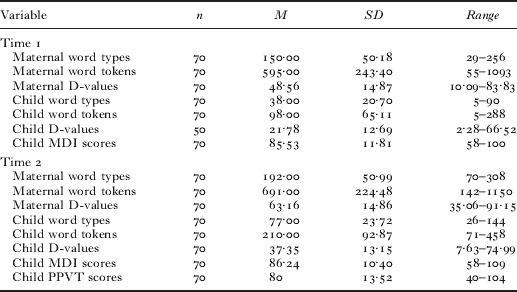
As expected, we observed large variations in mother and child variables at both ages (see Table 1). In terms of language use, children varied so much that some children at age 2;0 exceeded other children at age 3;0 in their word types and tokens. At Time 1, the difference between the highest and lowest counts of word types was eight-fold for mothers and eighteen-fold for children. At Time 2, the difference was four-fold for mothers and five-fold for children.
Descriptive statistics for maternal and child language, children's PPVT, and MDI scores

Children's cognitive and receptive vocabulary skills also showed large variability. Children's MDI scores ranged from the 1st percentile to the 75th percentile of national norms. Fifty percent of the children at age 2;0 and 44·3% at age 3;0 scored in the delayed range; 38·6% at age 2;0 and 28·6% at age 3·0 received scores below the 10th percentile. Children's PPVT scores also varied considerably, from the 1st percentile to 61st percentile of national norms. About a third (37·7%) of the children scored within normal limits. The remainder scored in the delayed range, and almost half (49·3%) scored below the 10th percentile.
We assessed the correlations among the three language variables – word types, word tokens, and D-values – for both mothers and children. Within each age, the three language measures covaried strongly in mothers (rs ranged from 0·45 to 0·88) and children (rs ranged from 0·34 to 0·91), except for the relation between word tokens and D-values for children at Time 2 (r = 0·21). We therefore combined the three maternal variables into a single factor when testing lagged regressions. All three maternal language measures loaded on a single factor with appreciable loadings (0·99, 0·89, and 0·85 for maternal word types, tokens, and D-values respectively), and the factor accounted for 83% of the variance.
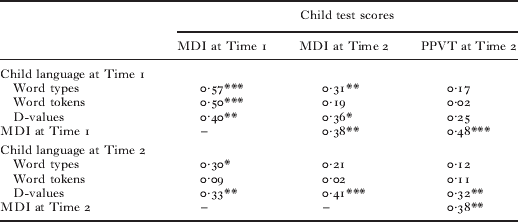
In line with the notion that language and cognitive skills are related, we assessed the concurrent and lagged associations among children's language production measures, MDI, and PPVT scores (see Table 2). All measures of children's language production related to their MDI scores at Time 1. At Time 2, children's D-values, but not word types or tokens, were related to their MDI and PPVT scores. At Time 2, children's MDI scores were related to their PPVT scores. For lagged associations, children's word types and D-values, but not word tokens, at Time 1 were significantly related to their MDI at Time 2, but no language production measures at Time 1 related to PPVT scores at Time 2. Time 1 MDI scores predicted Time 2 word types, D-values, and PPVT scores but not word tokens. These results indicate that children's cognitive skills (MDI) were related to both their productive vocabulary (i.e., word types and D-values) and receptive vocabulary (PPVT) concurrently and across time, suggesting a close relation between cognitive and language skills.
Correlations among child language measures and child test scores
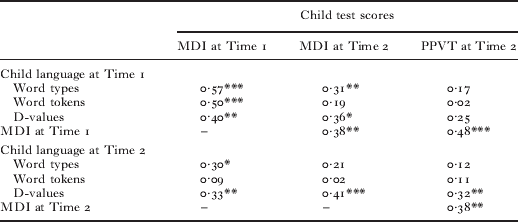
* p < .05, ** p < .01, *** p < .001.
Mothers were stable on all language measures (rs ranged from 0·50 to 0·77), as were children (rs ranged from 0·32 to 0·47). Children's MDI scores were also stable from Time 1 to Time 2 (r = 0·38).
Associations between maternal language and child variables
Mother–child associations were examined first at the bivariate level and then in regression models. At the bivariate level, we looked at both concurrent and lagged associations between mothers and children. Regression models focused on lagged association to further examine directionality while controlling for demographic and Time 1 variables.
Bivariate associations
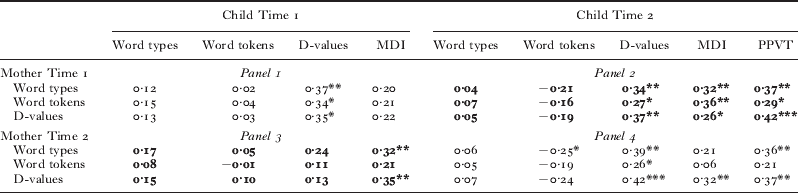
First, we looked at concurrent associations at each time (see Panels 1 and 4 of Table 3). At Time 1, maternal language measures were unrelated to child word types or tokens or MDI scores, but were significantly related to child D-values. At Time 2, again all maternal language measures were related to child D-values. Mothers' D-values were also positively correlated with children's MDI and PPVT scores. And mothers' word types were positively correlated with children's PPVT scores, but negatively correlated with children's word tokens.
Concurrent and lagged correlations between maternal language and child variables
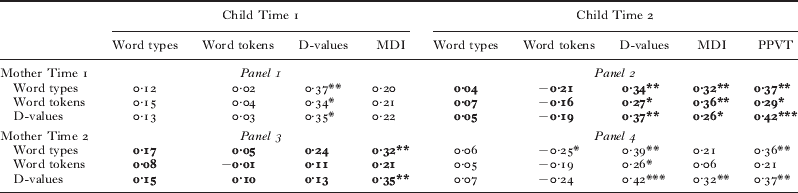
* p < .05, ** p < .01, *** p < .001.
note: Lagged associations are in boldface.
Second, we examined lagged associations and found different patterns of associations between mothers and children for language and cognition. Maternal language use at Time 1 was positively associated with children's D-values at Time 2 (Panel 2 of Table 3). However, children's D-values at Time 1 were unrelated to maternal language measures at Time 2 (Panel 3 of Table 3). This unidirectional relation provides tentative evidence that maternal language may influence the lexical diversity of children's speech, rather than the other way around. Maternal language at Time 1 also predicted children's PPVT scores at Time 2 (Panel 2 of Table 3). However, because PPVT scores were only obtained at Time 2, reverse lagged associations could not be examined.
In contrast to the unidirectional relation between mothers' and children's language, we found a reciprocal relation between maternal language and children's cognitive skills. Maternal language at Time 1 was associated with children's MDI scores at Time 2 (Panel 2 of Table 3). Additionally, children's MDI scores at Time 1 were associated with mothers' word types and D-values at Time 2 (Panel 2 of Table 3).
Regression analyses
We next examined mother-to-child and child-to-mother lagged associations in hierarchical regression models for child and mother variables that were correlated at the bivariate level.
In Step 1 of all models, we entered four demographic variables – mother age, child birth order, mother education, and child gender. These demographic variables have been found to relate to mother and child language (see Hoff, Reference Hoff2006, for a review). A series of bivariate correlations also confirmed their relations with the variables in this study. Specifically, mother age was positively related to maternal word tokens at Time 2 (r = 0·33, p < .01). Mother age showed stronger associations with maternal language than seen in other studies because the current sample included both teenage and older mothers who tended to differ in their language use (e.g., Keown, Woodward & Field, Reference Keown, Woodward and Field2001). Child birth order (first-born vs. later-born) was negatively associated with maternal word tokens at Time 2 (r = − 0·29, p < .05), with mothers of later-borns producing more word tokens than mothers of first-borns (M = 794·25, SD = 214·97 versus M = 649·10, SD = 216·56, t(68) = 2·54, p < .05). However, this correlation became insignificant (r = − 0·06, p > .62) after controlling for mother age in a partial correlation. Mother education (less than high school diploma, high school diploma, or college/technical) was positively associated with children's MDI scores at Time 1 (r = 0·29, p < .05). Finally, boys had higher MDI score (M = 88·15, SD = 11·25) than girls (M = 82·23, SD = 10·35, t(68) = 2·27, p < .05) at Time 1, although this gender difference disappeared at Time 2 (t(68) = 0·22, n.s.). None of these four demographic controls were significant in final models of the regression analyses and thus their coefficients were not presented.
In the three mother-to-child models, we used the factor score of maternal language at Time 1 as the independent variable. The three child measures – child D-values, MDI scores, and PPVT scores – at Time 2 that were significantly associated with maternal language use at Time 1 were examined as outcomes. Because child word types and tokens at Time 2 were unrelated to maternal language use at Time 1, they were not tested.
Additionally, regressions controlled for children's stability in Step 2. That is, child D-values and MDI scores at Time 1 were entered in the models predicting child D-values and MDI scores at Time 2 respectively. Because children were not assessed on the PPVT at Time 1 and no child language production measures at Time 1 were associated with children's PPVT scores at Time 2, children's MDI scores at Time 1, which did relate to PPVT scores, was entered as a stability control for PPVT scores. By controlling for child stability, we asked whether earlier maternal language was associated with the change or growth in children's skills over the one-year period.
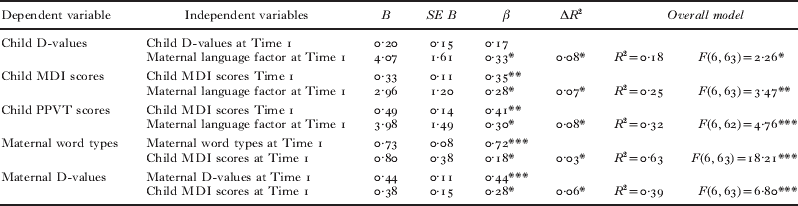
Consistent with the bivariate associations, the Maternal Language Factor at Time 1 significantly predicted child D-values above child stability (see Table 4). Child stability was significant in Step 2 (B = 0·33, SE B = 0·15, p < .05) but was no longer significant in Step 3 (final step) after the Maternal Language Factor at Time 1 was entered. Maternal Language Factor at Time 1 was also a significant predictor of children's MDI and PPVT scores at Time 2 above child stability (i.e., MDI scores at Time 1), which remained as a significant predictor in both regressions after the Maternal Language Factor at Time 1 was entered.
Lagged regression models (final step) predicting child and maternal variables at Time 2
* p < .05, ** p < .01, *** p < .001.
note: Coefficients are presented for the final step inclusive of demographic controls.
Next, we examined child-to-mother associations in hierarchical regression models. At the bivariate level, only children's MDI scores at Time 1 were associated with maternal word types and D-values. Therefore, two regression models were constructed, in which children's MDI scores at Time 1 served as the independent variable, while maternal word types and D-values at Time 2 were the outcome variable in each model. As in the mother-to-child models, demographic measures were entered in Step 1, and mothers' stability (i.e., maternal word types and D-values at Time 1 respectively) in Step 2.
Consistent with the bivariate results, in the model predicting maternal word types at Time 2, children's MDI scores were a significant positive predictor after controlling for demographics and maternal word types at Time 1 (see Table 4). Moreover, maternal word types were stable from Time 1 to Time 2 after controlling for demographics and child cognitive skills, as indicated by the significant coefficient of maternal word types at Time 1 in the final step of the regression model. Similarly, in the model predicting maternal D-values at Time 2, both maternal D-values at Time 1 and child MDI scores at Time 1 were significant predictors in the final step, suggesting both a strong child-to-mother lagged relation and a robust stability in maternal D-values. Thus, children with higher cognitive scores at age 2;0 had mothers who increased in their word types and lexical diversity from child age 2;0 to 3;0.
To summarize, maternal language at age 2;0 was associated with developmental change in child D-values, MDI, and PPVT scores from age 2;0 to 3;0, and child MDI scores at age 2;0 was associated with changes in maternal word types and D-values between the two ages. These models provided more stringent tests of the lagged associations by controlling for demographic variables and child and mother stability. The results demonstrated how mothers and children were associated with the change or growth in each other in a lagged relation.
DISCUSSION
In a longitudinal study, we examined lagged reciprocal associations between mothers' language use and children's language and cognitive skills in low-income homes. Our findings highlight the large variability that characterizes children's language experiences and development as well as cognitive skills, and indicate the ways in which children and mothers relate to one another over developmental time. Specifically, findings on mother-to-child and child-to-mother lagged associations shed light on three alternative mechanisms that have been put forth in studies of parenting and child development.
First, maternal language use could be a primary source for children's language and cognitive growth (e.g., Hoff, Reference Hoff2003; Huttenlocher et al., Reference Huttenlocher, Waterfall, Vasilyeva, Vevea and Hedges2010; Landry et al., Reference Landry, Miller-Loncar, Smith and Swank2002). The more words and different words mothers produce, the more words children will hear and thus learn; the amount and lexical diversity of maternal language also index the cognitive stimulation provided to children that may drive their cognitive development. Second, children might be influencing their own experiences broadly, and the language their mothers use more specifically; mothers have been shown to adapt their speech to accommodate their children's language and cognitive skills, and individual differences among children are found to affect their experiences (e.g., Lugo-Gil & Tamis-LeMonda, Reference Lugo-Gil and Tamis-LeMonda2008; Sameroff, Reference Sameroff2010; Snow, Reference Snow1977). Finally, the biological similarity between the mother and the child might explain the association between mothers and children. Maternal language use might relate to children's language and/or cognitive development due to their shared genetic material, consistent with previous findings that genetic or biological factors are significant predictors of children's language development (e.g., Reilly et al., Reference Reilly, Wake, Bavin, Prior, Williams, Bretherton, Eadie, Barrett and Ukoumunne2007; Stromswold, Reference Stromswold2001).
Although the current findings cannot definitively adjudicate among these possibilities, they suggest that maternal language influences children's language production between 2;0 and 3;0, whereas children's cognitive abilities may both affect and benefit from mothers' language use in a reciprocal fashion. We discuss these findings in turn.
Relations between maternal language use and children's language development
In lagged associations, maternal language use was associated with children's language production and comprehension across time. Although all three mechanisms outlined above are possible, our results favor the possibility that mothers more strongly influence their children's language development rather than the reverse. Mothers who talked more and used more diverse speech at age 2;0 had children who displayed higher PPVT scores at age 3;0 after controlling for earlier child cognitive status. Additionally, maternal language use at age 2;0 was positively related to the growth in children's D-values (lexical diversity, or the density of word types to tokens) from age 2;0 to 3;0. That is, mothers' word types, tokens, and D-values at age 2;0 predicted children's D-values at age 3;0 after controlling for D-values at 2;0 (note though that D-values could not be calculated at Time 1 for 20 children). On the other hand, child language production at age 2;0 was not related to maternal language use at age 3;0. This unidirectional pattern of lagged associations between mother and child suggests that mothers' language use – at least at the ages studied here – is a primary, and critical, source of input for children's language development in both comprehension and production (Hoff, Reference Hoff2003, Reference Hoff2006; Huttenlocher et al., Reference Huttenlocher, Haight, Bryk, Seltzer and Lyons1991, Reference Huttenlocher, Vasilyeva, Cymerman and Levine2002).
The finding that maternal language was related to children's lexical diversity specifically is noteworthy. Although quantity of child speech can be affected by child temperament or context of conversation, lexical diversity reflects the number of unique words a child produces relative to overall speech, and may therefore provide a more meaningful observational measure of child language skill than sheer amount of talk (word tokens).
However, despite the unidirectional lagged associations, it might also be the case that biological factors interact with environmental factors. That is, more complex maternal language will be more likely to affect the language development of children who are more capable of benefiting from the input. On the other hand, children who are genetically at risk for developing language disorder may be particularly sensitive to subtly impoverished linguistic environments (Stromswold, Reference Stromswold2001). Furthermore, genetic and environmental factors may also interact such that genetically at-risk children are more likely to have relatives who are language impaired and therefore to be reared in linguistically impoverished environments than are children without such genetic risks (Stromswold, Reference Stromswold2001).
It is also possible that the effects of children's language on mothers' language use become stronger as children's language reaches a certain level – for example, when children are older and/or have more advanced language skills. In fact, a study of parent–child interactions from child age 1;2 to 3;10 found a bi-directional relation in the diversity of words mothers and children produced (Huttenlocher et al., Reference Huttenlocher, Waterfall, Vasilyeva, Vevea and Hedges2010). Children in that study were from a wide spectrum of SES backgrounds, and the children from relatively affluent homes may have had larger vocabularies and elicited more language from their mothers.
Relations between maternal language use and children's cognitive development
In contrast to the above patterns, we found a bi-directional, lagged association between maternal language use and children's cognitive development. Specifically, mothers' language use at age 2;0 was associated with the growth of children's cognitive abilities from age 2;0 to 3;0; and children's cognitive status at age 2;0 was related to the change in mothers' language use from age 2;0 to 3;0. How might these reciprocal associations be interpreted?
As one possibility, reciprocity might be the result of biological factors, such as shared genetics. Genetics might account for higher (or lower) cognitive status of children, as well as mothers' use of rich (or impoverished) language. Indeed, a twenty-year adoption study found that children increasingly resembled their biological, rather than adoptive, parents in cognitive abilities from infancy through adolescence and this increasing resemblance was due to genetic factors (Plomin, Fulker, Corley & DeFries, Reference Plomin, Fulker, Corley and DeFries1997). Nevertheless, this study also showed that children resembled their adoptive parents somewhat in early childhood.
Alternatively, reciprocal associations may reflect transactional influences between mother and child. In terms of child effects, mothers may be attuning to their children's non-linguistic behaviors, and modifying their language accordingly. The Bayley Scales of Infant Development (used here) tap skills spanning a number of cognitive domains from basic perception (e.g., identifying objects in photograph) and fine motor skills (e.g., placing pegs in holes) to more complex problem solving (e.g., matching pictures and completing puzzles), as well as language skills – all of which might be reflected in children's everyday engagements with their environments. Perhaps mothers key into children's advanced play, exploration, or other ways of engaging with their worlds and communicating. In a recent investigation of mothers' verbal responses to infant bids, mothers used less sophisticated language when infants bid from stationary positions (e.g., sitting on the floor and holding up an object to give or show mother) than when infants moved across the room to share the object (Karasik, Celano, Tamis-LeMonda & Adolph, Reference Karasik, Celano, Tamis-LeMonda and Adolph2012). In this regard, children are ‘constructing’ their experiences and playing an active role in their own development (Sameroff, Reference Sameroff2010). This idea is further supported by the stability we observed in children over time, which aligns with the findings of others. In one large-scale longitudinal study, the strongest predictor of children's age 2;0 vocabulary was infant skills at 1;0 (Reilly et al., Reference Reilly, Wake, Bavin, Prior, Williams, Bretherton, Eadie, Barrett and Ukoumunne2007).
In terms of mother effects, mothers' language use may provide stimulation for children's cognitive gains. For example, during everyday interactions, such as play with toys, one mother might use language to direct or prohibit child's behavior (e.g., ‘Put it here.’ ‘Don't throw it!’), whereas another mother might take the opportunity to ask about and label items (e.g., ‘What is that?’ ‘That's an apple.’). Yet another mother might engage her child in more elaborate conversations (e.g., ‘Is tomato a fruit or a vegetable?’ ‘Why do we say “An apple a day keeps doctor away”?’). Mothers who provide richer language not only model how words are used and how sentences are constructed, but also supply abundant conceptual knowledge regarding categories, cause and effect, and relations that supports children's cognitive development. Indeed, a recent study suggests that parental language input may be related to children's cognitive development through children's own language gains (Pruden, Levine & Huttenlocher, Reference Pruden, Levine and Huttenlocher2011). Specifically, between one and four years of age, observed parent spatial tokens such as shape terms (e.g., circle), dimensional adjectives (e.g., big), and spatial features terms (e.g., corner) during parent–child interactions predicted children's spatial transformation and spatial analogies. Moreover, this association was mediated by children's own spatial tokens (Pruden et al., Reference Pruden, Levine and Huttenlocher2011).
Of course, it is impossible to conclusively interpret correlational data in the absence of an experimental design. However, experimental work suggests that changes to parenting can yield changes to children's cognitive status. For example, in one randomized experimental study, pediatricians used videotaped mother–child interactions as a way to promote positive parenting (with focus on mothers' language use) with mothers from low-income backgrounds during well-child visits (Mendelsohn et al., Reference Mendelsohn, Valdez, Flynn, Foley, Berkule, Tomopoulos, Fierman, Tineo and Dreyer2007). Children whose mothers received the intervention demonstrated a 5·5-point advantage in their MDI scores compared to control children when assessed at 2;9. Thus, changes in mothers' interactions with and input to their children might lead to gains in children's cognitive and language development.
Limitations and future directions
The current study has several limitations. First, the study remains correlational. Thus, despite the promising findings from lagged analyses, our ability to draw conclusions regarding the direction of effects and the role of social (versus genetic) influences is limited. Second, compared to speech samples used in other studies, the 10-minute sample of productive speech in the current study was brief. However, in this regard, it is somewhat remarkable that significant mother–child associations were found, and that individual differences – based on such a brief observation – were stable and predictive over time. Third, although a sample size of seventy mother–child pairs is relatively large from the perspective of child language research, we are still limited in our ability to generalize to low-income families more broadly. Children from other ethnic backgrounds, those living in rural rather than urban areas, or those from bilingual households may have early language experiences that are qualitatively different from the children in this sample. Finally, we focused on mothers' language to children only. Fathers, siblings, grandparents, and teachers, are central communicative partners of children. Although a few studies have examined fathers' and teachers' influences on children's language and cognitive development, more research is needed to better understand the influences of other individuals than mothers on children's development, especially in low-income families (e.g., Huttenlocher et al., Reference Huttenlocher, Vasilyeva, Cymerman and Levine2002; Pancsofar & Vernon-Feagans, Reference Pancsofar and Vernon-Feagans2010; Shannon, Tamis-LeMonda, London, & Cabrera, Reference Shannon, Tamis-LeMonda, London and Cabrera2002; Tamis-LeMonda et al., Reference Tamis-LeMonda, Shannon, Cabrera and Lamb2004).
CONCLUSIONS
Consistent with previous studies, we found that many children from low-income homes were at substantial risk for poor developmental outcomes, but some were developing within normal limits. The current research adds to our understanding of the relation between maternal language use and children's development. By using cross-lagged hierarchical regressions, we demonstrated that maternal language use at children's age 2;0 was related to children's gains in language skills from 2;0 to 3;0, whereas maternal language use and children's cognitive development at these two ages showed a reciprocal relation. These reciprocal child-to-mother effects may present a double-edged sword for children at cognitive risk. Children who started off with lower cognitive scores relative to other children in the sample were those whose mothers in turn showed less increase in the amount and diversity of their language over time. These findings suggest that children may be affecting their own environments in ways that can benefit or impede their subsequent developmental trajectories. Already by age 2;0, there is a snowball effect that may evolve into marked disparities in children's language and cognition. Nevertheless, these results do not discount the importance of biology, as some children may be more capable of benefiting from rich language than others. That is, environmental and biological factors interact.
The reciprocity between maternal language use and children's cognitive development highlights the need to move beyond child language as the only driver of mothers' changing language. Given that these findings come from children and mothers living in poverty, they offer further empirical support for the socio-cultural theories of development and have potential practical implications for intervention.