





Impact statement
Task-sharing models involving the training of non-specialist providers (NSPs) to deliver mental healthcare have emerged as an important, evidence-based strategy to narrow the treatment gap for common conditions such as depression and anxiety. However, delivering psychosocial interventions at scale requires sustained supervision and quality assurance, which remain major implementation challenges across routine health systems globally. These challenges are especially pronounced in low-resource settings, where there is a significant shortage of specialists to supervise NSPs and where in-person approaches are resource-intensive and difficult to scale. This multi-methods study, implemented across two diverse geographies in India, aimed to evaluate the feasibility and acceptability of a digital platform. PEERS (Promoting Effective mEntal health care through peeR Supervision) app – a novel smartphone app that aims to facilitate registering and scheduling patients, collecting patient outcomes, rating therapy quality and assessing supervision quality among NSPs delivering psychosocial treatment for depression. NSPs reported that the PEERS app simplified the workflow, reduced paperwork, eased rescheduling counselling sessions and facilitated effective supervision sessions. Together, these findings highlight the potential of digital supervision platforms to enhance the quality and reach of task-shared mental health care in low-resource settings.
Introduction
Task-sharing in mental healthcare, whereby non-specialist providers (NSPs) such as community health workers and lay counsellors are trained to deliver manualized psychological interventions, has emerged as a promising, evidence-based strategy to address the treatment gap for depression and anxiety globally (Singla et al., Reference Singla, Kohrt, Murray, Anand, Chorpita and Patel2017; Barbui et al., Reference Barbui, Purgato, Abdulmalik, Acarturk, Eaton, Gastaldon, Gureje, Hanlon, Jordans, Lund, Nosè, Ostuzzi, Papola, Tedeschi, Tol, Turrini, Patel and Thornicroft2020). Integrating task-shared psychological interventions into existing healthcare systems is a pragmatic solution to expand access to care (Patel et al., Reference Patel, Weobong, Weiss, Anand, Bhat, Katti, Dimidjian, Araya, Hollon, King, Vijayakumar, Park, McDaid, Wilson, Velleman, Kirkwood and Fairburn2017). This is especially true in India, where common mental disorders such as depression and anxiety affect nearly 10% of the Indian population, yet 85% do not receive any treatment (Gautham et al., Reference Gautham, Gururaj, Varghese, Benegal, Rao, Kokane, Chavan, Dalal, Ram, Pathak, Lenin Singh, Singh, Sharma, Saha, Ramasubramanian, Mehta, Shibukumar, Deuri, Krishnatreya, Gogoi, Sobhana, Sengupta, Banerjee, Sharma, Giri, Kavishvar, Dave, Chauhan, Sinha, Goyal, Thavody, Anish, Bina, Pakhare, Mittal, Ray, Chatterji, Akoijam, Singh, Gojendro, Kayina, Singh, das, Puri, Garg, Kashyap, Satija, Gaur, Sharma, Sathish, Selvi, Krishnaraj, Singh, Agarwal, Sharma, Kar, Misra, Neogi, Sinha, Saha, Halder, Aravind, Amudhan, Banandur, Subbakrishna, Marimuthu, Kumar, Jain, Reddy, Jagadisha, Sivakumar, Chand, Muralidharan, Reddi, Kumar, Prasad, Jaisoorya, Janardhanan, Sharma, Suman, Paulomi, Kumar, Sharma, Manjula, Bhola, Roopesh, Kishore, Veena, Mary, Anand, Srinath, Girimaji, Vijayasagar, Kasi, Muralidhar, Pandian, Hamza, Janardhana, Raj and Majhi2020).
Supervision is important to facilitate quality-assured psychological interventions, particularly in the context of task-sharing (Singla et al., Reference Singla, Kohrt, Murray, Anand, Chorpita and Patel2017; Singla et al., Reference Singla, Ratjen, Krishna, Fuhr and Patel2020; Triplett et al., Reference Triplett, Johnson, Kiche, Dastrup, Nguyen, Daniels, Mbwayo, Amanya, Munson, Collins, Weiner and Dorsey2023). Supervision, which typically involves meeting individually or in groups whereby an expert monitors and offers novice clinicians constructive feedback while supporting their skill acquisition, ethical practice and quality assurance, has been shown to improve therapy quality (Schreyer et al., Reference Schreyer, Leithner, Eilers, Gossmann and Rosner2025) and foster professional development (Andrejek et al., Reference Andrejek, Ravitz, Mikelsteins, La Porte, Kim, Schiller, Reyes-Rodríguez, Barker, Dennis, Silver, Meltzer-Brody and Singla2025). Different supervision models have been developed and tested among NSPs specifically (Andrejek et al., Reference Andrejek, Ravitz, Mikelsteins, La Porte, Kim, Schiller, Reyes-Rodríguez, Barker, Dennis, Silver, Meltzer-Brody and Singla2025). For example, practice -based supervision (PBS) focuses on strengthening counselling competencies through skills-based training methods, including role-plays, peer feedback and ongoing guided practice, supporting continuous professional development and fidelity to evidence-based interventions (Joshua and Becker, Reference Joshua and Becker2021; Singla et al., Reference Singla, Fernandes, Savel, Shah, Agrawal, Bhan, Nadkarni, Sharma, Khan, Lahiri, Tugnawat, Lesh, Patel and Naslund2024). Another example is measurement-based supervision (MBS), which involves the systematic assessment of the quality of audio-recorded therapy sessions using standardised tools with detailed feedback exchanged among peers (fellow NSPs) and expert supervisors (Singla et al., Reference Singla, Fernandes, Savel, Shah, Agrawal, Bhan, Nadkarni, Sharma, Khan, Lahiri, Tugnawat, Lesh, Patel and Naslund2024; Andrejek et al., Reference Andrejek, Ravitz, Mikelsteins, La Porte, Kim, Schiller, Reyes-Rodríguez, Barker, Dennis, Silver, Meltzer-Brody and Singla2025).
While beneficial and acceptable among diverse cadres of treatment providers (Andrejek et al., Reference Andrejek, Ravitz, Mikelsteins, La Porte, Kim, Schiller, Reyes-Rodríguez, Barker, Dennis, Silver, Meltzer-Brody and Singla2025; Singla et al., Reference Singla, Weobong, Nadkarni, Chowdhary, Shinde, Anand, Fairburn, Dimijdan, Velleman, Weiss and Patel2014; Schreyer et al., Reference Schreyer, Leithner, Eilers, Gossmann and Rosner2025) most supervision models are resource-intensive and are difficult to scale where expert clinicians are limited (Fairburn and Patel, Reference Fairburn and Patel2014; Singla et al., Reference Singla, Ratjen, Krishna, Fuhr and Patel2020). To address these challenges, digital tools are being deployed to support treatment providers (German et al., Reference German, Kengia, Mwanyika, Makaranga, Werner, Benadotte, Kisanga, Macha, Weja, Mugeta, Kinyenje, Marandu, Mwaisengela, Ilomo, Seiff, Kapologwe, Hokororo, Eliakimu, Sirili, Settle and Rashid2024), with added benefits such as scalability, flexible scheduling and time efficiency (Fairburn and Patel, Reference Fairburn and Patel2014; Singla et al., Reference Singla, Ratjen, Krishna, Fuhr and Patel2020). Moreover, storing data digitally on secure servers allows for easy retrieval and review (Juan et al., Reference Juan, Gennaro, Jutla and Rabin2000; Gupta et al., Reference Gupta, Kumar, Chung-Nan and Rajkumar2022). Nonetheless, challenges in digital supervision persist, including inconsistent internet access, varying levels of digital literacy and the possible loss of interpersonal connection (Ravi et al., Reference Ravi, Arul-Raj, Navin, Chong and Ambica2016). Issues with internet access can be mitigated by developing a mobile application (app) that functions both offline and online, with automated data synchronisation when network connectivity is established. Moreover, features such as intuitive navigation and local language translation can further help overcome digital literacy barriers among users.
To address these barriers, we have developed the Promoting Effective mEntal health-care through peeR Supervision (PEERS) digital platform. The mobile platform was developed to empower NSPs (in this case, community healthcare workers [CHWs]) to register, schedule patient sessions, collect patient outcome data using the Patient Health Questionnaire (PHQ)-9 (Kroenke et al., Reference Kroenke, Spitzer and Williams2001) and to audio-record therapy sessions through a user-friendly administrative interface (Singla et al., Reference Singla, Fernandes, Savel, Shah, Agrawal, Bhan, Nadkarni, Sharma, Khan, Lahiri, Tugnawat, Lesh, Patel and Naslund2024). Additionally, the PEERS platform permits providers and supervisors to rate and receive feedback about their treatment and supervision sessions using structured questionnaires. The PEERS platform is hosted on the CommCare platform, an open-source platform developed and maintained by Dimagi, a global social enterprise empowering frontline workers through digital solutions and services across 130 countries.
The current study examined the feasibility and acceptability of the PEERS platform in two distinct and ongoing community-based implementation programmes in Madhya Pradesh (MP) and Goa, India. Both programmes trained NSPs to deliver a brief, six to eight session of evidence-based psychological treatment based on behavioural activation for depression known as the Healthy Activity Program (Patel et al., Reference Patel, Weobong, Weiss, Anand, Bhat, Katti, Dimidjian, Araya, Hollon, King, Vijayakumar, Park, McDaid, Wilson, Velleman, Kirkwood and Fairburn2017) and engaged in peer supervision. While the PEERS platform offers multiple functions, the current article focuses primarily on the feasibility and acceptability of digital supervision components. These components were based on the implementation science framework in which feasibility is conceptualised as the extent to which an innovation is successfully integrated within a programme setting, whereas acceptability refers to stakeholders’ perceptions of the innovation, including the degree to which it is perceived as appropriate, useful and satisfactory (Proctor et al., Reference Proctor, Silmere, Raghavan, Hovmand, Aarons, Bunger, Griffey and Hensley2011). The primary objectives of the current study were to:
-
1) Examine the feasibility of the PEERS platform by assessing its use for psychosocial intervention delivery, participation in supervision sessions and session ratings by both NSPs and expert supervisors; and
-
2) Assess the acceptability of the PEERS platform by exploring NSPs’ perceived barriers and facilitators in usage, digital supervision from supervisors and session ratings.
In doing so, this study aimed to generate insights about scalable approaches to facilitate supervision and ensure quality delivery of evidence-based brief psychosocial interventions for depression, key requirements for the scale-up of task-sharing models in low-resource settings.
Methods
To assess the feasibility and acceptability of the PEERS platform, we used a multi-methods approach drawing on both quantitative (feasibility) and qualitative (acceptability) indicators. These indicators were based on an established implementation science framework (Proctor et al., Reference Proctor, Silmere, Raghavan, Hovmand, Aarons, Bunger, Griffey and Hensley2011), with feasibility conceptualised as the extent to which the PEERS platform was successfully integrated and utilised within programme settings, whereas acceptability examined NSPs’ perceived experiences with the platform, including the degree to which it was perceived as appropriate, useful and satisfactory for integration into routine clinical practice. The study was conducted in Madhya Pradesh and Goa, India, between October 2022 and December 2025. Trained research assistants obtained written informed consent from all eligible participants before they participated in the PEERS platform training.
Study setting
The PEERS study was embedded within two programmes: (1) EMPOWER, a large-scale implementation programme that aimed to build the capacity of an NSP’s workforce within routine public sector health services, including community settings, to deliver evidence-based psychosocial intervention for depression, Healthy Activity Program (Agrawal et al., Reference Agrawal, Sood, Patel, Sharma, Yadav, Kaur, Kumari, Sharma, Shukla, Tripathi, Dongare, Narasimhamurti, Bhan, Tiwari, Sakalle and Patel2025), in Madhya Pradesh. It is a predominantly rural state in central India where access to health services is limited; and (2) IMPRESS (IMPlementation of evidence-based facility and community interventions to reduce the treatment gap for depRESSion) is a hybrid type 2 cluster randomised trial evaluating the scale-up of the Healthy Activity Program (HAP) for depression across 30 primary and secondary health centres (Nadkarni et al., Reference Nadkarni, Gandhi, Fernandes, Mirchandani, Kamat, Weiss, Singla, Velleman, Lu, Bhatia, Biswal, Sequeira, D’souza, Raikar and Patel2024) in Goa. Goa is a smaller, more urbanised state located on the west coast of India. As mentioned above, both programmes reflect diverse and pragmatic healthcare and community settings that employ trained NSPs from the public health sector of India, aimed to implement and evaluate the scale up of the Healthy Activity Program (HAP) – a brief behavioural activation treatment that has been found to be effective in treating moderate to severe depressive symptoms (Patel et al., Reference Patel, Weobong, Weiss, Anand, Bhat, Katti, Dimidjian, Araya, Hollon, King, Vijayakumar, Park, McDaid, Wilson, Velleman, Kirkwood and Fairburn2017).
Participants
Non-specialist providers
NSPs were eligible to participate in the study if they: (1) had received training in HAP as part of the EMPOWER or IMPRESS programmes; and (2) in Madhya Pradesh only, were willing to remain in the study area throughout the study duration.
In Madhya Pradesh, the EMPOWER programme trained Accredited Social Health Activists (ASHA). ASHAs are community-level female health workers deployed under India’s National Rural Health Mission preferably in the age group of 25–45 years. They are residents of the villages they serve and are deployed at a ratio of ~1 ASHA per 1,000 individuals. They serve as a bridge between the community and the health system, typically holding 8–10 years of formal education, and receive task-specific training to deliver basic health promotion and preventive care services in their villages (Shrivastava and and Shrivastava, Reference Shrivastava and Shrivastava2012). A cohort of ASHAs was trained in HAP between March 2021 and March 2022. From this trained group, a subset of ASHAs was invited to participate in the present study and underwent additional training on the use of the PEERS mobile application between October 2022 and December 2023. They were selected through purposive sampling based on their availability, access to a smartphone and digital literacy. Following this training, ASHAs began delivering HAP, supported by the PEERS platform, to consented individuals with depressive symptoms, defined as having a score on the PHQ-9 ≥ 10 (Kroenke et al., Reference Kroenke, Spitzer and Williams2001).
Goa Health System does not have ASHA cadres; thus, the IMPRESS programme trained existing primary healthcare staff from the public health care system. NSPs were nominated by the Health Officer or self-nominated with Health Officer consent at each Health Centre and constituted different cadres, such as Ayurveda, Yoga and Naturopathy, Unani, Siddha and Homoeopathy (AYUSH) workers, Reproductive, Maternal, Newborn, and Child Health (RMNCH+A) workers and Medical Officers, among others. These NSPs had prior training in other health-related fields but no formal mental health training. Between September 2022 and December 2024, the primary healthcare staff underwent a 5-day training on HAP and the PEERS platform. The training was delivered across four in-person cohorts and subsequently through an online e-course to facilitate more rapid onboarding of newly nominated staff. In addition, NSPs were trained in established protocols for managing mental health emergencies, including risk of suicide or harm to others, which included conducting suicide risk assessments. In the event of a high-risk presentation, participants were instructed to refer to available options within the public health system where this programme was embedded, including community health and medical officers at the health centres and a psychiatrist at the district hospital. In line with the larger IMPRESS trial (Nadkarni et al., Reference Nadkarni, Gandhi, Fernandes, Mirchandani, Kamat, Weiss, Singla, Velleman, Lu, Bhatia, Biswal, Sequeira, D’souza, Raikar and Patel2024), patient recruitment, session delivery and expert supervisor-led supervision began in January 2023.
Peer supervisors
Peer supervisors were NSPs who were credentialed after treating ≥4 patients and scoring an average ≥2.5 (ranging between adequate and good) on the therapy quality tool known as Behaviour Activation Quality Scale (BAQ-S, Supplementary Appendix 1), adapted from the Q-HAP (Singla et al., Reference Singla, Weobong, Nadkarni, Chowdhary, Shinde, Anand, Fairburn, Dimijdan, Velleman, Weiss and Patel2014) and a supervision quality tool known as the EMPOWERS scale (Supplementary Appendix 2) which are detailed below (see outcomes). Peer supervisors used the PEERS platform to record counselling sessions, review and rate their own and peers’ sessions, provide structured feedback, and support ongoing skill development of NSPs under the oversight of expert supervisors.
Expert supervisors
Expert supervisors were professional clinicians with a Master’s degree or higher qualification in psychology or a related field. They were trained in and achieved competency in delivering HAP, and delivered HAP under supervision to at least four patients. Supervision was conducted weekly by the expert supervisors in groups with five to six NSPs (see below for details).
The PEERS platform
Figure 1 describes the app architecture, schematics of data flow and the peer supervisor credentialing process. The PEERS platform comprised two interconnected interfaces. Data from all interfaces was stored on secure servers in India. The first was a mobile application (app) for NSPs and peer supervisors (see Figure 1). The second was a web-based dashboard for expert supervisors. The mobile app allowed counsellors to record, store and upload therapy sessions, enter patient data and rate therapy quality using the BAQ-S and rate supervision quality using the EMPOWERS tool (Singla et al., Reference Singla, Fernandes, Savel, Shah, Agrawal, Bhan, Nadkarni, Sharma, Khan, Lahiri, Tugnawat, Lesh, Patel and Naslund2024). Peer supervisors used a separate login to schedule and document group supervision (see Figure 1 for a detailed schematic of the PEERS application). The web dashboard enabled expert supervisors to monitor NSP performance, schedule supervision and review quality metrics such as EMPOWERS and BAQ-S scores.
PEERS app-architecture, schematics of data flow and the peer supervisor credentialing process.
Note: NSPs were credentialed as PEER supervisor who treated ≥4 patients and scored ≥2.5 therapy quality tool (BAQ-S).

Figure 1. Long description
The main diagram shows three primary user groups and their digital interfaces.
At the top left, Expert Supervisors connect to the Expert Supervisor’s dashboard. An arrow indicates they register and deliver H A P sessions to patients. The dashboard features include peer supervision sessions, rating sessions using B A Q-S and share H A P sessions, E M P O W E R S rating using E M P O W E R S rating scale, and viewing N S P s performance.
Below this, N S P s in Phase 1 use the Counsellor’s app to register and deliver H A P sessions. Bidirectional arrows between the Expert Supervisor’s dashboard and the Counsellor’s app show the flow of Recorded H A P sessions upward and Scheduled supervision sessions downward.
In the center, N S P s in Phase 3 act as intermediaries. They exchange Scheduled supervision sessions and Recorded H A P sessions with the Counsellor’s app. To their right, they connect to the Peer Supervisor’s app to schedule sessions and provide ratings over B A Q-s. The Peer Supervisor’s app includes features for supervision sessions, rating and sharing H A P sessions, E M P O W E R S ratings, and viewing performance.
A separate box in the top right details the Credentialing Process in three phases.
* Phase 1: H A P Counsellor internship phase where N S P s deliver H A P to patients with depression under expert supervision.
* Phase 2: Peers Supervisors internship phase, reached after completing H A P treatment with at least 4 patients. N S P s facilitate group supervisions and continue delivering H A P.
* Phase 3: Peers Supervisors, reached after achieving an average score of greater than or equal to 2.5 on B A Q-S and E M P O W E R S. They schedule and facilitate supervision for peer N S P s.
Supervision model
NSPs were offered both group and individual supervision (see Figure 2). There were two types of group supervision: measurement-based supervision (MBS) and practice-based supervision (PBS). A detailed description of each supervision type has been previously published (Singla et al., Reference Singla, Weobong, Nadkarni, Chowdhary, Shinde, Anand, Fairburn, Dimijdan, Velleman, Weiss and Patel2014; Singla et al., Reference Singla, Fernandes, Savel, Shah, Agrawal, Bhan, Nadkarni, Sharma, Khan, Lahiri, Tugnawat, Lesh, Patel and Naslund2024) and briefly described in the introduction section. Following each group supervision session, expert and peer supervisors received structured ratings of their supervision quality using the eight-item EMPOWERS scale. Individual supervision constituted one-to-one supervision between the provider and their expert supervisor, and focused on an individual provider’s caseload and skill development. The cadence of this supervision was monthly in Goa and scheduled as needed in Madhya Pradesh.
Supervision models.

Outcome measures
In alignment with our study objective and implementation science framework (Proctor et al., Reference Proctor, Silmere, Raghavan, Hovmand, Aarons, Bunger, Griffey and Hensley2011), feasibility indicators (see Table 1) included NSPs’ engagement (i.e., app usage) with the PEERS platform, therapy quality and supervision. These metrics were used as pragmatic indicators of operational uptake and integration of app into routine practice. The therapy quality and supervision were evaluated by the BAQ-S and the EMPOWERS tools, respectively, as described below.
Quantitative outcome measures

Table 1. Long description
The table consists of two columns: Metrics and Outcome.
* Row 1: Metrics is P E E R S app usage by N S P s. Outcome includes the percentage of HAP trained individuals who used the app at least once in rating therapy and supervision quality, the number of treatment sessions delivered and recorded by N S P s, and the percentage and number of supervision sessions attended by N S P s.
* Row 2: Metrics is Therapy quality (B A Q- s). Outcome is the assessment of therapy quality to ensure therapy delivered via B A follows quality standards, covering treatment-specific behavioral activation skills and general therapeutic competence.
* Row 3: Metrics is Supervision type and quality (E M P O W E R S tool). Outcome includes the type of supervision sessions scheduled by expert and peer supervisors, and the use of the E M P O W E R S tool to measure the quality of supervision and individual competency.
The Behavioural Activation Quality Scale (Supplementary Appendix 1), adapted from the Q-HAP (Singla et al., Reference Singla, Weobong, Nadkarni, Chowdhary, Shinde, Anand, Fairburn, Dimijdan, Velleman, Weiss and Patel2014), assessed therapy quality using two domains of 10 ‘treatment-specific skills’ specific to behavioural activation (e.g., scheduling a session and mood monitoring) and ‘general skills’ that cut across treatment modalities (e.g., collaboration and empathy). Each item was rated on a scale ranging from 0 (inadequate) to 4 (excellent). This study presented mean BAQ-S scores.
The EMPOWERS supervision ratings (Supplementary Appendix 2) were completed by both the NSP and the supervision facilitator following each supervision. Supervision-specific skills such as degree of organisation, collaboration and being non-judgemental were rated on a scale ranging from 0 (inadequate) to 4 (excellent) to produce a total EMPOWERS score for both group and self-ratings.
Acceptability indicators were derived from qualitative data and explored the experiences of NSPs who used the PEERS platform in terms of relevant perceived facilitators and barriers. We adopted this framework because it offers a structured, stakeholder-informed perspective on the factors that enable or hinder the scale-up of task-sharing mental health interventions, facilitating a systematic evaluation of feasibility, acceptability and readiness for implementation (Singla and Kumbakumba, Reference Singla and Kumbakumba2015).
Data collection
Quantitative data were collected between October 2022 and December 2024 in Madhya Pradesh and between January 2023 and March 2025 in Goa, through the CommCare platform and stored on secure servers. Qualitative data were collected from September 2023 to July 2024 through focus group discussions (FGDs) in Madhya Pradesh, conducted in Hindi, and through in-depth interviews (IDIs) in Goa, conducted in Konkani, Marathi, Hindi and English, across three progressive phases (see Figure 1). All qualitative data were audio-recorded following informed consent. IDIs were used in Goa instead of focus group discussions (FGDs), as it was not feasible for NSPs from different facilities to meet in person at the same time and due to power and hierarchy-related challenges, which would limit the participants from sharing openly. A semi-structured interview guide was designed for FGDs and IDIs in English (Supplementary Appendix 3), which was translated (where needed) and used in both formats to facilitate consistency in data collection methods. Major topics included the experience of delivering brief psychological treatment, the effectiveness and usability of the mobile versions of the PEERS platform, and the perceived experience of supervision. In Madhya Pradesh, the audio-recordings of the FGDs were first transcribed verbatim in Hindi and subsequently translated into English. In Goa, interviews were translated and transcribed directly from the local language into English.
Data analysis
Quantitative data at both sites were analysed by exporting relevant variables such as the number of NSPs who used the platform post-training, therapy quality rating scores and supervision quality rating scores from the CommCare platform. Descriptive statistics (means, percentages and standard deviations) were calculated using Excel’s built-in functions and R version 4.4.2.
Mean scores were generated separately for the supervisor (self-assessment) and the NSP group. The percentage of supervision session quality ratings was determined by dividing the number of supervision sessions rated using the EMPOWERS scale by the total number of scheduled group supervision sessions. The percentage of therapy quality ratings using BAQ-S was calculated by dividing the number of sessions rated using BAQ-S by the total number of therapy sessions recorded. In this study, statistical comparisons were not conducted across sites due to substantial differences in NSP profiles, education levels and service delivery settings, making cross-site comparisons unreliable.
Transcripts of audio-recorded files of the qualitative data were imported and coded using MAXQDA (2022 version) in Madhya Pradesh, and NVivo 12 in Goa. In Madhya Pradesh, MG coded all nine FGDs, and AR double-coded three of nine FGDs retrospectively. Data from MP was analysed separately for phase 1, phase 2 and phase 3 (see Figure 1). In Goa, data from 14 IDIs were coded independently by LF, while data from 6 IDIs were coded by YG and MGP. Data from Goa were analysed separately for the two phases (phase 1 and phase 3) (see Figure 1), as each involved different versions of the platform and distinct supervisory structures. We applied a thematic analysis approach (Braun and Clarke, Reference Braun and Clarke2006) across both sites, involving iterative cycles of coding to examine relevant barriers and facilitators by at least two research assistants in Goa and by one research assistant in MP (MG in Madhya Pradesh; MGP and YG in Goa). For counsellor interviews in Goa, a combination of inductive and deductive coding approaches was used. The coding team met twice during analysis to iteratively develop and refine the codebook, and codes were subsequently organised into broader themes and sub-themes.
Data triangulation was employed to ensure alignment and convergence of themes and sub-themes within sites. Throughout the analysis, we compared inductively coded segments, examined relationships between codes and subcodes and maintained rigour and trustworthiness. Following completion of coding at both sites, the final codebooks were reviewed and compared by AS and LF to support integration of findings across sites.
Results
Feasibility
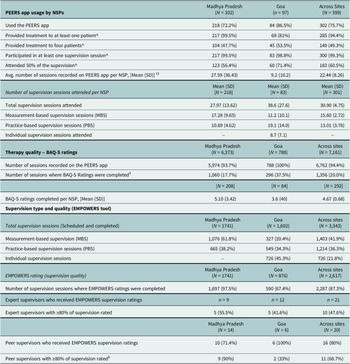
A total of 399 NSPs (302 in MP and 97 in Goa) were trained in the HAP intervention and included in the current study. On average, NSPs in Madhya Pradesh were 38 years old (range: 36–39) with 12 years of education, whereas the mean age of NSPs in Goa was 33 years (range: 22–55) and 16 years of education. During the study, 20 NSPs (Madhya Pradesh = 14; Goa = 6) were credentialed as peer supervisors. Relevant feasibility characteristics such as PEERS app usage by NSPs, number of recorded sessions in the app, attendance in various supervision sessions, therapy and supervision quality ratings conducted via the app are detailed in Table 2.
Feasibility Indicators, n%, unless otherwise stated

Table 2. Long description
The table is divided into four primary sections.
1. P E E R S app usage by N S P s:
- Used the P E E R S app: Madhya Pradesh 218 (72.2 percent), Goa 84 (86.5 percent), Across Sites 302 (75.7 percent).
- Provided treatment to at least one patient: Madhya Pradesh 217 (99.5 percent), Goa 68 (81 percent), Across Sites 285 (94.4 percent).
- Provided treatment to four patients: Madhya Pradesh 104 (47.7 percent), Goa 45 (53.5 percent), Across Sites 149 (49.3 percent).
- Participated in at least one supervision session: Madhya Pradesh 217 (99.5 percent), Goa 83 (98.8 percent), Across Sites 300 (99.3 percent).
- Attended 50 percent of the supervision: Madhya Pradesh 123 (56.4 percent), Goa 60 (71.4 percent), Across Sites 183 (60.5 percent).
- Average number of sessions recorded on P E E R S app per N S P [Mean (S D)]: Madhya Pradesh 27.59 (36.43), Goa 9.2 (10.2), Across Sites 22.44 (8.26).
2. Number of supervision sessions attended per N S P [Mean (S D)]:
- Total supervision sessions attended: Madhya Pradesh 27.97 (13.62), Goa 38.6 (27.6), Across Sites 30.90 (4.75).
- Measurement-based supervision sessions (M B S): Madhya Pradesh 17.28 (9.65), Goa 11.2 (10.1), Across Sites 15.60 (2.72).
- Practice-based supervision sessions (P B S): Madhya Pradesh 10.69 (4.62), Goa 19.1 (14.0), Across Sites 13.01 (3.76).
- Individual supervision sessions attended: Goa 8.7 (7.1).
3. Therapy quality - B A Q-S ratings:
- Number of sessions recorded on the P E E R S app: Madhya Pradesh 5,974 (93.7 percent), Goa 788 (100 percent), Across Sites 6,762 (94.4 percent).
- Number of sessions where B A Q-S Ratings were completed: Madhya Pradesh 1,060 (17.7 percent), Goa 296 (37.5 percent), Across Sites 1,356 (20.0 percent).
- B A Q-S ratings completed per N S P [Mean (S D)]: Madhya Pradesh 5.10 (3.42), Goa 3.6 (40), Across Sites 4.67 (0.68).
4. Supervision type and quality (E M P O W E R S tool):
- Measurement-based supervision (M B S): Madhya Pradesh 1,076 (61.8 percent), Goa 327 (20.4 percent), Across Sites 1,403 (41.9 percent).
- Practice-based supervision sessions (P B S): Madhya Pradesh 665 (38.2 percent), Goa 549 (34.3 percent), Across Sites 1,214 (36.3 percent).
- Individual supervision sessions: Goa 726 (45.3 percent), Across Sites 726 (21.8 percent).
- Number of supervision sessions where E M P O W E R S ratings were completed: Madhya Pradesh 1,697 (97.5 percent), Goa 590 (67.4 percent), Across Sites 2,287 (87.3 percent).
- Expert supervisors with greater than or equal to 80 percent of supervision rated: Madhya Pradesh 5 (55.5 percent), Goa 5 (41.6 percent), Across Sites 10 (47.6 percent).
- Peer supervisors who received E M P O W E R S supervision ratings: Madhya Pradesh 10 (71.4 percent), Goa 6 (100 percent), Across Sites 16 (80 percent).
- Peer supervisors with greater than or equal to 80 percent of supervision rated: Madhya Pradesh 9 (90 percent), Goa 2 (33 percent), Across Sites 11 (68.7 percent).
Note: Percentages are calculated using column denominators unless otherwise indicated by symbols: ^ Across sites: 302; MP: 218; Goa: 84, Ω Across sites: 300; MP: 216; Goa: 84, ¥ Across sites: 6,762; MP: 5,974; Goa: 788, § Across sites: 16; MP: 10; Goa: 6.
The bolded values in this table represent the three main quantitative metrics described in Table 1: PEERS app usage, therapy quality, and supervision type and quality. These headings have been bolded because each includes multiple subsections, and the sample sizes (ns) differ across these metrics.
Across sites, the wide majority of treatment providers who were trained in HAP used the PEERS app (n = 302/399 or 75.7%); provided treatment to at least one patient (n = 285/302; 94.4%); and attended at least one supervision session (n = 300/302; 99.3%). Out of the total 7,161 therapy sessions conducted, 6,762 (94.4%) were recorded on the PEERS app. On average, each individual NSP recorded 22.44 sessions, of which approximately one-fifth (4.67/22.44) were rated for therapy quality (BAQ-S). On average, NSPs attended 30.90 supervision sessions. In addition, a total of 3,343 supervision sessions were facilitated on PEERS, with 41.9% MBS, 36.3% PBS and 21.8% individual supervision sessions. Of the 2,617 group supervision sessions, the vast majority, 2,287 (87.3%), were rated for supervision quality using the EMPOWERS scale.
By site, a majority of providers delivered care to at least one patient in Madhya Pradesh (MP = 99.5%) and in Goa (Goa = 81%). For each NSP, the average number of therapy sessions recorded on the PEERS app was 27.59 in MP and 9.20 in Goa. The average number of BAQ-S ratings completed per NSP was 5.10 in MP and 3.60 in Goa. MBS sessions constituted 61.8% of supervision sessions in MP and 20.4% in Goa. The proportion of supervision sessions rated for quality in MP was 97.47% and 67.35% in Goa, with an average number of attended supervision sessions by NSPs of 27.97 and 38.60, respectively.
Acceptability
Qualitative data were collected through 9 FGDs involving 63 NSPs in Madhya Pradesh, and 20 IDIs conducted with NSPs in Goa. Table 3 summarises the facilitators and barriers, highlighting key themes and subthemes, accompanied by illustrative quotes.
Endorsement of barriers and facilitators of PEERS platform in Madhya Pradesh (MP; n = 63 NSPs) and Goa (n = 20 NSPs) (Acceptability)

Table 3. Long description
The table is structured into three main thematic rows.
Theme 1: Experiences with the P E E R S platform.
* Facilitators (Both sites): Patient registration, real-time information, ease in conducting counselling, record keeping, and ability to record H A P sessions. (Site-specific): Ease in rescheduling H A P sessions in Goa.
* Barriers (Both sites): Lengthy registration, disrupted audio, and audio-recording sessions. (Site-specific): Scheduling supervision in M P, frequent app updates and internet issues in Goa.
* Suggested modifications: Combine treatment provider and supervisor user I Ds (Both sites); streamline app interface in M P; integrate supervision-specific features in Goa.
Theme 2: Experiences with supervision.
* Facilitators (Both sites): Learnings from B A Q-S self and peer ratings, discussion of ratings, and expert supervisor accessibility. (Site-specific): Rating expert supervisors, remote supervision convenience, technical support, and Q-H A P rating guidance in M P.
* Barriers (Both sites): Anxiety regarding getting own sessions rated.
* Suggested modifications (Site-specific): Incentives for attending supervisions and seeing patients in Goa.
Theme 3: Experiences being a peer supervisor.
* Facilitators (Both sites): Experience facilitating supervision, learning curve for app operation, boost in self-confidence, and improved communication. (Site-specific): Delivering H A P sessions and clarity in M P; application of skills beyond counselling and self-help strategies in Goa.
* Barriers (Site-specific): Availability of peer counsellors in M P; difficulty understanding the peer supervisor app in Goa.
* Suggested modifications: None listed.
Facilitators of the PEERS platform
Across sites, the NSPs and peer supervisors reported several facilitators related to the use of the PEERS app. Facilitators were primarily linked to the app’s functionality, the supervision process and the enhancement of provider skills. Participants appreciated the app’s features for patient registration, real-time information access and the ability to conduct and record the HAP sessions. The app’s record-keeping capabilities and overall usability were also valued, as they facilitated routine workflow and reduced administrative burden. NSPs described learning from rating their own and peers’ therapy sessions, discussing ratings during supervision and receiving guidance from peer supervisors, which enhanced both their understanding of the intervention and their confidence in delivering it. Peer supervisors also noted that facilitating supervision allowed them to develop skills and navigate the app more effectively. Supervision experiences further reinforced these positive perceptions; several NSPs reported increased self-efficacy, including greater clarity in conducting sessions, improved communication skills and the ability to apply HAP strategies beyond the immediate counselling context. The accessibility and support provided by expert supervisors were cited as important facilitators, particularly in providing technical guidance and clarifying rating procedures.
Barriers of the PEERS platform
Despite the identified facilitators, participants reported several barriers to using the PEERS app. Technical challenges, including glitches during session recording or playback, were commonly reported. NSPs also expressed patients’ hesitation in recording sessions, expressing concerns that family members might overhear the recordings, which could limit their ability to participate. The NSPs expressed discomfort with self-rating their sessions, citing apprehension and uncertainty about their performance, particularly whether they had asked all relevant questions or had dominated the conversation. The Peer supervisors reported difficulties related to the use of multiple user IDs, with separate logins required for the PEERS and the counsellor interface. Managing multiple credentials was described as burdensome, and participants suggested that a single unified login would improve usability.
Site-specific challenges were also observed. In Madhya Pradesh, user experience issues, particularly a lengthy patient registration process involving multiple sequential screens, were identified as a major barrier. In Goa, frequent app updates and intermittent internet connectivity were reported as limiting factors. Some PEERS supervisors also indicated difficulties in understanding app functionality, including uncertainty about the purpose of specific features and challenges in identifying session numbers, which were displayed as composite codes combining participant identifiers and session information.
Discussion
This multi-methods study demonstrates the feasibility and acceptability of implementing a digital-implementation, supervision and quality assurance system to support delivery of psychotherapy interventions by non-specialist providers (NSPs) across two distinct Indian states in real-world settings. High levels of app usage, therapy delivery, effective clinical workflow, therapy session recording and supervision participation across both Madhya Pradesh and Goa provide reliable evidence that technology-assisted task-sharing and supervision models can support the scale-up of psychological interventions in low-resource settings.
The promise of digital platforms
The majority of NSPs used the PEERS app in both sites to deliver care, streamline patient registration and data collection, record therapy audio and attended at least one supervision session. These findings are consistent with prior evidence indicating that digital tools can enhance the scalability and sustainability of task-sharing models by supporting monitoring of therapy quality, supervision and provider engagement (Fairburn and Patel, Reference Fairburn and Patel2017; Shields-Zeeman et al., Reference Shields-Zeeman, Pathare, Walters, Kapadia-Kundu and Joag2017). NSPs reported high satisfaction with the app, noting reductions in paperwork burden, improvements in workflow efficiency and facilitation of session scheduling and rescheduling. In addition, despite intermittent technical glitches, more than 93% of therapy sessions were successfully recorded. These findings are notable given others have highlighted challenges such as user engagement issues and privacy breach concerns, limiting usage (Koh et al., Reference Koh, Tng and Hartanto2022). The near-universal attendance to at least one supervision session across both sites (>98%) suggests that remote digital supervision may help to overcome a key barrier identified in the task-sharing literature, where limited access to ongoing supervision has been shown to compromise intervention quality in both low- and middle-income countries (LMICs; Hanlon et al., Reference Hanlon, Wondimagegn and Alem2010) and high-income countries (HICs; Borges do Borges do Nascimento et al., Reference Borges do Nascimento, Abdulazeem, Vasanthan, Martinez, Zucoloto, Østengaard, Azzopardi-Muscat, Zapata and Novillo-Ortiz2023). These findings suggest that digitally-facilitated supervision may help overcome geographic and resource constraints that often limit specialist availability in LMICs.
The role of diverse supervision models
The PEERS app facilitated the implementation of diverse supervision models. The higher proportion of MBS sessions and EMPOWERS-rated supervision sessions in Madhya Pradesh suggest greater reliance on structured, expert-led supervision among community healthcare workers in an implementation initiative, compared to the randomised controlled trial setting in Goa. These findings suggest that the supervision model offered may depend on the context, with differential benefits for different cadres (Andrejek et al., Reference Andrejek, Ravitz, Mikelsteins, La Porte, Kim, Schiller, Reyes-Rodríguez, Barker, Dennis, Silver, Meltzer-Brody and Singla2025). While researchers have suggested the promising findings of peer-led supervision through structured tools and expert oversight (Singla et al., Reference Singla, Ratjen, Krishna, Fuhr and Patel2020; Pallikkuth et al., Reference Pallikkuth, Manoj Kumar, Dictus and Bunders-Aelen2024), future studies are required to examine the relations between supervision type and patient outcomes. Further, while other studies have demonstrated the promise of measurement-based protocols in LMICs and HICs, there is a need to evaluate the potential role of artificial intelligence (AI) in facilitating supervision and quality assurance platforms (Cioffi et al., Reference Cioffi, Ragozzino, Mosca, Moretto, Tortora, Acocella, Montanari, Ferrara, Crispino, Gigante, Lommatzsch, Pizzimenti, Temporin, Barlacchi, Billi, Salonia and Sperandeo2025; Shafran et al., Reference Shafran, Bond, Carlbring, Cohen, Creed, Davey, Egan, Freeman, Hollon, Jacobson, Johnson, Kaysen, McGuinness, Patel, Pozuelo, Santos, Singla, Wiltsey Stirman, Taylor and Wade2026).
Integration of quantitative and qualitative findings
Qualitative findings contextualised the feasibility aims derived from quantitative data. NSPs’ appreciation of the app’s functionality, session recording features and supervision processes aligns with high app usage and recording rates observed quantitatively. Reported gains in confidence, clarity in session delivery and skill development are consistent with prior research demonstrating that structured supervision and feedback improve NSP competence and self-efficacy (Beidas et al., Reference Beidas, Edmunds, Marcus and Kendall2012). At the same time, reported barriers, including technical glitches, patient hesitancy towards recording, discomfort with self-rating and challenges managing multiple logins, may help to explain the observed variability in therapy and supervision quality ratings across sites. Similar barriers have been reported in other digital mental health implementations (Mohr et al., Reference Mohr, Lyon, Lattie, Reddy and Schueller2017), emphasising the importance of regular implementation-focused improvements to support consistent uptake across sites. In addition, streamlining access through a single-login system may reduce workflow burden and enhance sustained clinician engagement. Continuous information technology (IT) support is essential to promptly address technical issues that can disrupt recording and supervision practices. Future studies are required to prioritise the development of sustainability-oriented algorithms to monitor engagement and adapt support over time. Integrating these elements may reduce site-level variability and strengthen long-term implementation fidelity.
Limitations
Despite notable strengths including the examination of digitally-enabled supervision in two diverse contexts and mixed methods approach, we acknowledge several limitations. First, the qualitative analysis involved different coding configurations across sites. While this approach may support generalisability across diverse settings, future studies may benefit from more uniform coding strategies to further enhance analytic consistency. Second, while the PEERS app incorporated rating tools and audio recording features, it lacked a built-in calling feature to support supervision attendance, necessitating reliance on regular phone calls. Third, the feasibility metrics collected within the context of research evaluations may overestimate real-world uptake (Nilsen et al., Reference Nilsen, Kirk, Gunnarsson and Thomas2025), because of the added training, support and monitoring that may inflate engagement compared to routine implementation (Fleming et al., Reference Fleming, Bavin, Lucassen, Stasiak, Hopkins and Merry2018). Future studies in routine settings are required to examine the real-world implementation of the PEERS app.
Conclusion
Our findings suggest that digitally-enabled platforms can facilitate the delivery and supervision of task-sharing strategies in underserved community and healthcare settings. Despite technological challenges, the high engagement and consistent facilitators across two diverse settings in India suggest the overall acceptability and feasibility of the PEERS platform. Future research should explore cost-effectiveness, system integration and long-term sustainability to inform national and global efforts to scale up quality-assured mental health services.
Open peer review
To view the open peer review materials for this article, please visit http://doi.org/10.1017/gmh.2026.10266.
Supplementary material
The supplementary material for this article can be found at http://doi.org/10.1017/gmh.2026.10266.
Data availability statement
De-identified data will be made available upon reasonable request, subject to approval by the relevant ethics committees. However, data originating from the Goa study site form part of an ongoing randomised controlled trial and will be made available after publication of the primary findings.
Acknowledgements
The authors would like to thank Nidhi Joshi, Sandhya Pillai, Deepali Vishwakarma, Phool Singh Gaur, Sweta Dubey, Ritesh Dubey, Fehmeeda Begum, Radhika Tak and Gaurav Shrivastava from the Bhopal Hub, Sangath, India, and Subhash Pednekar, Pranali Kundaikar, Ankita Hoble, Seema Sambari, Megan Lopes, Utkarsha Naik, Anisah Fernandes, Anika Gaonkar, Rakshanda Paimapari, Sabina Bepari, Shreya Prabhu Khandolkar, Fabina Diniz and Navisha Naik from Sangath Goa, India, for their dedicated support in assisting non-specialist providers (NSPs) with understanding and using the PEERS app, facilitating supervision activities and collecting qualitative data. We are also deeply grateful to all participating NSPs across sites for their cooperation, engagement and commitment throughout the study.
Author contribution
RediT authorship contribution statement: Ankita Shah: Conceptualization, writing – original draft, data curation, methodology, visualisation, project administration and investigation. Sandeep Shelly: Visualisation, methodology and writing – review and editing. Luanna Fernandes: Conceptualization, writing – review and editing, data curation, formal analysis, investigation and project administration. Namdeo Dangare: Data curation, formal analysis and writing – review and editing. Anant Bhan, Abhijit Nadkarni, Julia R Pozuelo, John A. Naslund, Yashi Gandhi and Vikram Patel: Writing – review and editing. Mrinmoy Ghosh, Sayukta Kesarkar and Marimilha Grace Pacheco: Data curation and writing – review and editing. Ravindra N. Agrawal: Methodology, supervision and writing – review and editing. Daisy R. Singla: Conceptualization, writing – original draft, methodology and supervision. All authors have critically reviewed this manuscript and provided consent for publication.
Competing interests
The authors have no conflicts of interest to disclose.
Ethics and approvals
The study was approved by the Institutional Review Boards of the implementation partner, Sangath (Sangath IRB Approval: DS_2021_70), Sinai Health System (CTO 3614) and Harvard Medical School (IRB21–0992).
Financial support
This work was primarily supported by Grand Challenges Canada under grant number TTS-2109-47,591. The current study was embedded in EMPOWER (Corporate Social Responsibility from Johnson and Johnson) and the IMPRESS trial (supported by National Institute of Mental Health, United States, R01MH115504). We report additional support from the National Institute of Mental Health, United States, 1U19MH113211.




 Open access


Comments
Dr. Judy Bass
Chief Editor, Cambridge Prisms: Global Mental Health
Dear Dr. Bass.
We are pleased to submit our original research article entitled, “Digital supervision of nonspecialist providers delivering psychosocial interventions for depression in India: A feasibility and acceptability study” for consideration in Cambridge Prisms, Global Mental Health.
This manuscript reports findings of the PEERS (Promoting Effective mEntal health care through peeR Supervision) app, a digital implementation platform designed to support non-specialist providers (NSPs) in delivering evidence-based psychotherapy within task-sharing mental health care models. The PEERS app was developed to address persistent implementation barriers in scaling evidence-based psychological treatments, including administrative burden, variability in therapy fidelity, and limited access to ongoing supervision for NSPs. In this study, we evaluated feasibility and acceptability through quantitative indicators of app use, therapy delivery, and supervision engagement, alongside qualitative data capturing NSP perceptions of the feasibility, and perceived usefulness.
Our findings demonstrate high feasibility and acceptability of the PEERS platform. NSPs used the app consistently across multiple functions, including session documentation, therapy delivery support, and supervision. Qualitative findings further highlight that the PEERS app reduced paperwork burden, improved organization and scheduling, and supported NSP confidence and fidelity. Together, these results suggest that digital implementation tools such as PEERS can meaningfully strengthen task-sharing models by enhancing provider experience and supporting quality assurance at scale. Implementation research is critical to closing the gap between evidence-based psychological treatments and real-world delivery, particularly in low-resource and global health contexts. By focusing on the feasibility and acceptability of a pragmatic digital platform embedded within routine care, this study provides actionable insights for the design and scale-up of technology-enabled mental health interventions.
We believe this study aligns closely with the mission of Cambridge Prisms: Global Mental Health to publish interdisciplinary research with clear implications for health systems, equity, and global implementation. We selected Cambridge Prisms: Global Mental Health because of its emphasis on innovative, applied research that advances scalable solutions to global mental health challenges, including an earlier study on PEERS platform. We believe our findings will be of interest to researchers, implementers, and policymakers seeking to strengthen task-shared care through digital health innovations.
This manuscript is original, has not been published elsewhere, and is not under consideration by another journal. All authors have approved the manuscript. Thank you sincerely for your consideration.
Warmest regards,
Daisy R. Singla, PhD, C. Psych, PI