INTRODUCTION
Stalk strength is one of most important traits in maize (Zea mays L.) that influences grain yield, stalk lodging and quality (Peiffer et al. Reference Peiffer, Flint-Garcia, De Leon, McMullen, Kaeppler and Buckler2013). Strong stalks reduce lodging and increase harvestable yield. Stalk lodging is one of the major problems in maize production worldwide, leading to annual grain yield losses of 5–25% (Kang et al. Reference Kang, Din, Zhang and Magari1999). Pellerin et al. (Reference Pellerin, Trendel and Duparque1990) reported that stalk lodging could increase harvest costs and reduce grain quality. Complete or partial stalk lodging, i.e. stalks that are broken or lean at ⩾30° from the vertical (Esechie et al. Reference Esechie, Rodriguez and Al-Asmi2004), commonly occurs when bending or breaking of the 3rd to 5th basal elongation internodes takes place (Gou et al. Reference Gou, Huang, Zhang, Li, Sun and Zhao2007; Cheng et al. Reference Cheng, Du, Liu, Jin and Cui2011). This suggests that basal internode strength has a close relationship with lodging and may play an important role in improving lodging resistance.
Stalk strength traits, such as morphological traits that include plant height (measured from ground level to tassel tip), ear height (ground level to ear node attachment, Edwards et al. Reference Edwards, Stuber and Wendel1987), diameter and length of basal internode, stalk breaking strength and internode weight are essential in determining stalk strength in maize (Hondroyianni et al. Reference Hondroyianni, Papakosta, Gagianas and Tsatsarelis2000; Islam et al. Reference Islam, Peng, Visperas, Ereful, Bhuiya and Julfiquar2007; Zhu et al. Reference Zhu, Chen, Li, Zhang, Huang, Zhao, Song and Liu2013). From anatomical analyses, stalks with superior strength have more vascular bundles, greater rind-parenchyma interlumen thickness, and higher proportion of the hypodermal cell-wall area (Berzonsky et al. Reference Berzonsky, Hawk and Pizzolato1986). In addition, compositional analysis has revealed the influence of cellulose and lignin on maize stalk strength (Bosch et al. Reference Bosch, Mayer, Cookson and Donnison2011). Esechie et al. (Reference Esechie, Rodriguez and Al-Asmi2004) reported that stalk lodging is negatively correlated with grain yield, stalk breaking strength, stalk lignin and total non-structural carbohydrate content, but positively correlated with ear height.
Stalk strength in maize is controlled by both internal and external factors (Baker et al. Reference Baker, Berry, Spink, Sylvester-Bradley, Griffin, Scott and Clare1998); therefore, improving stalk strength is regarded as one of the most important breeding objectives (Tian & Yang Reference Tian and Yang2005). Although maize breeders have made great efforts to develop varieties of maize with superior stalk strength for solving the stalk lodging problem, agronomic practices and field environmental factors impact upon the amount of natural stalk lodging. Nitrogen (N) fertilization is one of most important agronomic practices for maize production to obtain high yield under low or high N soil environment (Sattelmacher et al. Reference Sattelmacher, Horst and Becker1994). However, N mismanagement generally gives rise to weak stalk strength, resulting in lodging.
Higher rates of N application at planting can increase lodging due to rapid plant growth (Rajkumara Reference Rajkumara2008). Increasing N enhances the length of basal internodes and reduces the strength of the stalk base (Zhang et al. Reference Zhang, Li, Yang, Li, Zhang, Liu, Wang, Tang and Ding2014). Decreasing N reduces stalk crude protein, ash content and lignin content; however, cellulose content decreases with N overuse (Li et al. Reference Li, Li, Wegenast, Longin, Xu, Melchinger and Chen2010). In general, low cellulose content is the main cause of stalk lodging; cellulose content and lignin content both play important roles in maize stalk strength and structural support (Boerjan et al. Reference Boerjan, Ralph and Baucher2003). Therefore, the proper application of N fertilizer is a vital consideration to prevent stalk lodging.
Ethephon, 2-chloroethyl phosphonic acid, is a synthetic plant growth regulator favourably absorbed by the green parts thereby releasing ethylene directly into plant tissues. It has been most successful and is used worldwide to control plant canopy size in maize production (Wiersma et al. Reference Wiersma, Dai and Durgan2011). Application of ethephon leads to a compact plant as a result of shortened internode length, increased stalk diameter and weight per unit length, and reduced plant height and crop growth rate (Shekoofa & Emam Reference Shekoofa and Emam2008). In addition, ethephon can increase crushing strength and breaking force, which may contribute to enhanced lodging resistance (Hondroyianni et al. Reference Hondroyianni, Papakosta, Gagianas and Tsatsarelis2000). However, the effect of ethephon on grain yield varies considerably. Increasing the rate of ethephon can lead to a linear decrease in harvestable grain yield (Norberg et al. Reference Norberg, Mason and Lowry1988; Tripathi et al. Reference Tripathi, Sayre, Kaul and Narang2004): only a low rate (140 g/ha) of ethephon can increase grain yield of maize (Langan & Oplinger Reference Langan and Oplinger1987). Moreover, several studies have indicated that ethephon is an effective anti-lodging agent and increases yield when lodging occurs (Simmons et al. Reference Simmons, Oelke, Wiersma, Lueschen and Warnes1988; Moes & Stobbe Reference Moes and Stobbe1991).
The North China Plain is one of the main food-production areas and supplies over half of the wheat and one-third of the maize production in China (Kendy et al. Reference Kendy, Gerard-Marchant, Walter, Zhang, Liu and Steenhuis2003). The dominant cropping system is a double-cropping system comprising of winter wheat (mid-October to early June) and summer maize (early June to late September) in this region. Due to a summer monsoon climate in the North China Plain, 0·70–0·80 of the mean annual rainfall (550 mm) occurs in the summer maize growing season (July–September). High temperature, humidity and rain increase the plant growth rate in the summer maize, and then local farmers generally apply the entire N supply at maize sowing, which promotes basal internode elongation and results in the increased risk of stalk lodging.
Nitrogen fertilization is an important agronomic practice to increase maize grain yield, and ethephon is widely used to control plant canopy size in maize production. However, there is little information available regarding the mechanism of ethephon and influence of N fertilizer rates on maize yield and stalk strength related to lodging resistance in the North China Plain. The objectives of the present study were to determine the interactive effects of ethephon and N on maize basal internode morphological and chemical characteristics, yield and yield components, and to identify the key morphological and chemical traits associated with stalk strength for lodging resistance of maize.
MATERIALSAND METHODS
Site description
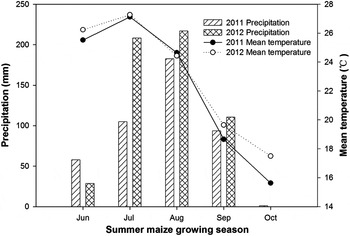
A field study was conducted in the 2011 and 2012 growing seasons at the Wuqiao Experimental Station (37° 41′N, 116° 37′E, 18–21 m a.s.l.) of China Agricultural University at Cangzhou, Hebei Province, China. The climate is temperate semi-arid monsoon with mean annual temperature of 12·9 °C, mean annual precipitation of 562 mm, where 0·56 of the precipitation occurs between July and August. The soil is sandy clay loam (CalcaricFluvisol, FAO 1988). Chemical properties of the soil (0–20 cm depth) were: pH 8·6, organic matter 11·2 g/kg, total N 0·78 g/kg, Olsen phosphorus (P) 30·5 mg/kg and available potassium (K) 143·2 mg/kg. The monthly precipitation distribution and mean temperature during the summer maize-growing seasons of 2011 and 2012 are presented in Fig. 1. During the two growing seasons, the mean temperature was 22·3 and 23·0 °C and the total precipitation was 440·0 and 564·5 mm in 2011 and 2012, respectively.
Monthly precipitation and mean temperature for the summer maize-growing season in 2011 and 2012.

Experiment design and crop management
The experiment was a factorial randomized complete block design with eight treatments (two × four): each treatment was replicated four times. The first factor included two rates of ethephon (0 and 180 g/ha) and the other factor included four rates of N fertilization (0, 75, 150 and 225 kg N/ha). The plot dimensions were 6×6 m and they remained in the same positions during 2011 and 2012.
Winter wheat and summer maize was the main crop rotation in the present study. Summer maize (variety: Zhengdan 958) was planted by hand on 21 June 2011 and 22 June 2012, and harvested in early October of each year. The row spacing was 0·6 m and plant-to-plant spacing was 0·27 m. Maize was irrigated with 50 mm of water before sowing in both growing seasons to provide adequate moisture during maize establishment and thereafter was rainfed. Ethephon (180 g/ha of 400 mg/l concentration) was applied once during the growing season as a foliar application with an agricultural manual sprayer at the 8-leaf growth stage (GS) where leaf collars were visible (V 8 according to Abendroth et al. Reference Abendroth, Elmore, Boyer and Marlay2011), on 24 July 2011 (205 Julian days) and on 19 July 2012 (201 Julian days), respectively. The N source was urea, while P (90 kg P2O5/ha) and K (90 kg K2O/ha) sources were calcium superphosphate and potassium sulphate, respectively. Nitrogen, P and K were applied in one application as base fertilizer in both years. Each plot received the same N rate in 2012 as it had in 2011, i.e. the N0 treatment in 2011 also received 0 kg N/ha in 2012 and so on. All fertilizers were broadcast by hand and then incorporated into the soil with a rotary tiller (1GKN-250, Yungang Xuangeng Machinery Co. Ltd., Lianyungang, Jiangsu, China), and wheat residues were incorporated at rate of c. 6400 kg/ha (dry shoot matter). Winter wheat was sown in early October and harvested in the middle of June the following year. During the winter wheat-growing season, no ethephon or fertilizers were applied: other field management practices were applied according to local recommendations.
Plant sampling and measurements
At maturity, three maize plants from each plot were cut at ground level to determine plant and ear height. Each plant was divided into grain, stalks and leaves, dry weight was determined after oven drying at 80 °C to constant weight, and the above-ground biomass was the total dry weight of grain, stalks and leaves. Harvest index was calculated as the ratio of grain dry weight to the above-ground biomass. Grains were harvested using the middle two rows of maize from each plot, yield components including ears/ha, grain number/ear and 1000-grain weight were determined from these samples. Grains were separated from the cob by hand and oven-dried at 80 °C to determine grain yield at 14% moisture content. Lodging proportion was surveyed at maturity and lodging was identified according to White (Reference White1991) when the stalk inclined at <45° from the horizontal or the basal internodes were broken.
The 9th internode (internode subtending the 9th leaf, corresponded to the 3rd basal internode aboveground level) (Nemoto et al. Reference Nemoto, Nagano, Hogetsu and Miyamoto2004) was cut at GS V 14 for determining internode morphological characteristics. Diameter and length of the 9th internode were measured with a 3 V lithium-ion electric digital vernier calliper (Guilin Guanglu Measuring Instrument Co. Ltd., Guilin, Guangxi, China). The breaking resistance of the 9th internode without the leaf sheath was measured as the force required to snap or break the internode, using a stalk strength tester (YYD-1, Zhejiang Top Instrument Co. Ltd., Hangzhou, Zhejiang, China). The distance between fulcra of the tester was set at 4 cm and the centre of the internode was aligned horizontally with the middle point between the two fulcra. Subsequently, dry weight was determined after oven drying at 80 °C to constant weight. The ratio of dry weight to internode length was then calculated. At harvest time, maximum diameter and length of 7th to 14th internodes also were measured with a 3 V lithium-ion electric digital vernier calliper.
The 9th internode was cut at GS V 11 (1 August 2011 and 26 July 2012, respectively), V 14 (7 August 2011 and 1 August 2012, respectively), silking (16 August 2011 and 10 August 2012, respectively) and harvest (9 October 2011 and 7 October 2012, respectively) to determine internode chemical traits. These samples were oven-dried at 80 °C to constant weight, and then ground with a Jiaoyi mill (Zhejiang Shangyu Gonglu Instrument Plant, Shangyu, Zhejiang, China) to pass through a 0·25 mm mesh for determination of total N content and a 1 mm mesh for determination of cellulose and hemicellulose contents. Nitrogen content in the 9th internode was measured by the standard micro-Kjeldahl procedure (Bremner & Mulvaney Reference Bremner, Mulvaney, Page and Miller1982). Cellulose and hemicellulose contents in the 9th internode were determined according to the detergent system procedure (Van Soest et al. Reference Van Soest, Robertson and Lewis1991).
Statistical analysis
Ethephon and N main effects and their interactions were analysed using the analysis of variance (ANOVA). The POLYANOVA routine within GenStat 17th edition (VSN international Ltd., Hemel Hempsted, UK) permitted an assessment of N rate by partitioning variance into linear (L) and non-linear (quadratic, Q) contrasts. Least significant difference (LSD) test at P ⩽ 0·05 was performed to compare significant difference among treatment means. The relationships among the variables were assessed by the Pearson correlation analysis.
RESULTS
Plant and ear heights and internode properties
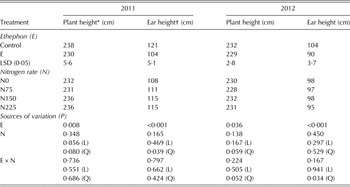
Ethephon significantly (P < 0·05) decreased plant and ear heights compared with the control in 2011 and 2012 (Table 1). However, N fertilizer rate had no effect on plant and ear heights. Ethephon × N interaction effects were not significant on plant and ear heights during either growing season.
Effect of ethephon and nitrogen rate on plant and ear heights of maize in 2011 and 2012

* Plant height was measured from the ground level to tassel tip.
† Ear height was measured from the ground level to ear node attachment (i.e. to the base of the maize ear).
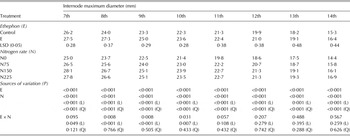
Ethephon significantly (P < 0·001) increased the maximum diameters of the 7th–14th internodes compared with the control in 2012 (Table 2). Assessment of linear and non-linear contrasts demonstrated linear (P < 0·001) and quadratic (P < 0·001) responses of the maximum diameter of the 7th–14th internode to N rate (except for the 13th internode). The maximum diameter of the basal internode increased with the increasing N rate in 2012. Analysis of variance indicated that the maximum diameters of basal internodes were significantly (P < 0·001) affected by ethephon, N fertilizer and ethephon × N interaction effects were significant (P < 0·05) for the maximum diameters of the 8th–10th internodes.
Effect of ethephon and nitrogen rate on 7th–14th internode maximum diameter of maize in 2012

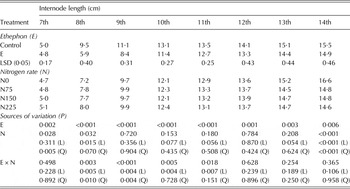
Ethephon significantly (P < 0·01) decreased the lengths of the 7th–14th internodes compared with the corresponding control (Table 3). Establishing linear and non-linear contrasts indicated that the effect of N was significant for the 7th internode length (P ⩽ 0·005, quadratic), the 8th internode length (P < 0·05, linear) and the 14th internode length (P < 0·001, linear and quadratic). However, there was no linear or quadratic response for the lengths of 9th to 13th internodes. The lengths of the 8th–11th internodes were antagonistically affected by ethephon × N interaction.
Effect of ethephon and nitrogen rate on 7th–14th internode length of maize in 2012

Morphological traits of basal internodes
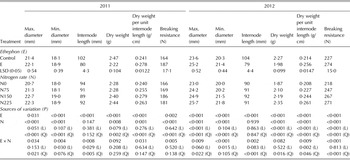
As the application of ethephon at GS V 8 caused marked reduction in the length of 8th–10th internodes under different N rates, the 9th internode was selected to explore the effect of ethephon on the morphological traits of the basal internodes. Ethephon increased the maximum and minimum diameter of the 9th basal internode significantly (P < 0·05), but decreased the internode length and dry weight during both growing seasons (Table 4). Dry weight per unit internode length and breaking resistance of ethephon-treated plants were 15·4 and 14·0% greater, respectively, in 2011 and 19·6 and 20·7% greater in 2012 than those of plants under the control treatment. There was a non-linear effect of the N rate on the maximum diameter (P < 0·001, quadratic), minimum diameter (P < 0·001, quadratic), dry weight (P < 0·01, quadratic), dry weight per unit internode length (P < 0·001, quadratic) and breaking resistance (P < 0·001, quadratic) in 2011. However, highly significant linear and quadratic responses (both P < 0·001) to N were seen for the maximum diameter, dry weight, dry weight per unit internode length and breaking resistance in 2012. The values of the maximum and minimum diameters, dry weight, dry weight per unit internode length and breaking resistance showed an increase as the rate of N increased in both growing seasons, but N application did not significantly affect the basal internode length.
Effect of ethephon and nitrogen rate on the 9th internode morphology-related characteristics of maize at the V 1 4 stage

Morphological traits of the 9th basal internode were significantly influenced by ethephon and N fertilizer, except for the internode length. Thus, significant ethephon × N interactions were observed for the internode diameter, internode length, dry weight per unit internode length and breaking resistance.
Chemical characteristics of the 9th basal internode
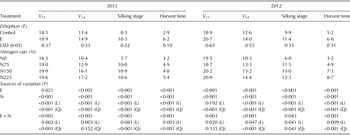
Nitrogen content of the basal internode (9th internode) showed a decreased trend from GS V 11 through to harvest, with increasing variation as ethephon application increased (Table 5). Nitrogen content at 0 kg N/ha was lower than that at high N rates from GS V 14 through to harvest in 2011 and 2012. Moreover, N content of the 9th internode was increased with increasing N fertilizer rate at different stages and confirmed by significant linear (P < 0·001) and quadratic (P < 0·001) responses (except for GS V 11 in 2012). There were significant (P < 0·05) ethephon × N interaction effects for N content of the 9th internode at different stages in both seasons.
Effect of ethephon and nitrogen rate on nitrogen content (mg/g) of the 9th internode of maize during different stages

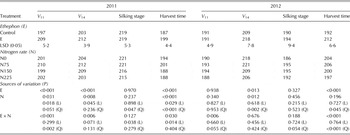
Ethephon significantly (P < 0·001) increased hemicellulose content in the basal internode at GS V 11, GS V 14 and at harvest compared with the control in 2011. Thus, the hemicellulose content of the basal internode was enhanced by ethephon at GS V 14 and harvest compared with the corresponding control in 2012 (Table 6). However, hemicellulose content in the basal 9th internode showed a decline with the increasing N rate during both growing seasons. Also, there was a significant linear (P < 0·05) response for hemicellulose content in the basal 9th internode at GS V 11, GS V 14 and harvest in 2011, but a quadratic response (P < 0·05) at GS V 14 and harvest in 2012. The hemicellulose content in the basal internode was significantly (P < 0·05) influenced by ethephon × N interaction effects at GS V 11, GS V 14 and harvest in 2011 and at GS V 11 and harvest in 2012.
Effect of ethephon and nitrogen rate on hemicellulose content (mg/g) of the 9th internode of maize during different stages

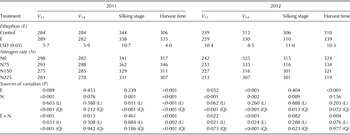
Ethephon increased the cellulose content of the basal 9th internode compared with the control treatment at harvest in 2011 and at GS V 14 and harvest in 2012 (Table 7). Cellulose content of the basal internode showed a decrease as the N rate increased in both growing seasons revealing significant linear and quadratic (both P < 0·05) responses for the cellulose content of the basal 9th internode at silking and harvest stages in 2011 but a significant quadratic (P < 0·05) response at GS V 11, GS V 14 and silking in 2012. The cellulose content of the basal internode was influenced by ethephon × N interaction at GS V 11, GS V 14 and harvest in 2011 and 2012.
Effect of ethephon and nitrogen rate on cellulose content (mg/g) of the 9th internode of maize during different stages

Correlation between breaking resistance and morphologic and chemical traits of the 9th basal internode
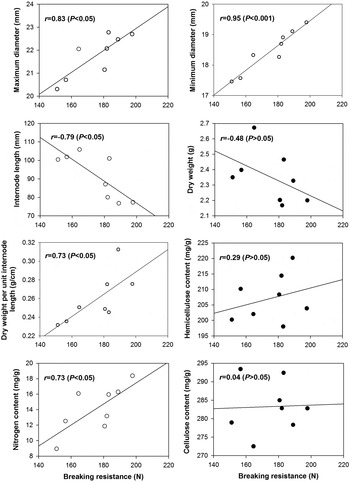
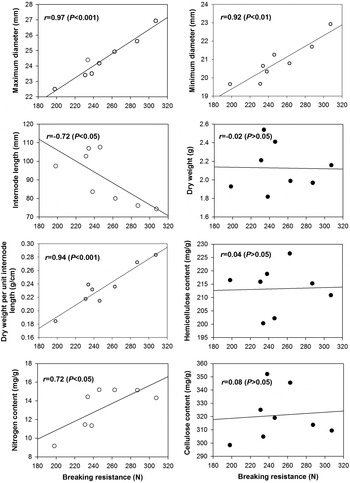
The correlation between breaking resistance and morphologic and chemical traits of the 9th basal internode are presented in Figs 2 and 3. Breaking resistance showed significant correlations with maximum diameter (r = 0·83, P < 0·05), minimum diameter (r = 0·95, P < 0·001), internode length (r = −0·79, P < 0·05), dry weight per unit internode length (r = 0·73, P < 0·05) and N content (r = 0·73, P < 0·05) in 2011. However, there was no significant correlation between breaking resistance and dry weight, hemicellulose or cellulose content. Similar relationships between breaking resistance and morphological and chemical traits of the basal internode were also found in 2012. Breaking resistance showed significant correlation with maximum diameter (r = 0·97, P < 0·001), minimum diameter (r = 0·92, P < 0·01), internode length (r = –0·72, P < 0·05), dry weight per unit internode length (r = 0·94, P < 0·001) and N content (r = 0·72, P < 0·05).
Relationships between breaking resistance and internode characteristics at GS V 14 in 2011.

Relationships between breaking resistance and internode characteristics at GS V 14 in 2012.

Grain yield, above-ground biomass, harvest index and lodging
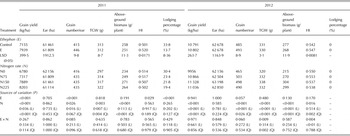
Ethephon caused a significant (P < 0·001) increase in grain yield and grain number/ear compared with the control in 2011, but there was no significant difference in grain yield and grain number/ear between the ethephon and control treatments in 2012 (Table 8). Ethephon did not improve the above-ground biomass, but did increase harvest index in 2011. However, neither the above-ground biomass nor the harvest index was affected by ethephon in 2012. Ethephon decreased the proportion of maize lodging considerably in 2011. However, no lodging was observed in 2012, which contributed to high yield. Nitrogen fertilizer application increased maize yield and 1000-grain weight in both growing seasons, showing significant linear and quadratic responses (P < 0·05). There was a significant linear (P < 0·05) response for grain number/ear under different N rates and a significant quadratic (P < 0·001) response for the above-ground biomass in 2011 and 2012. In addition, N application increased the grain number/ear and above-ground biomass. Harvest index reduced as N rate increased via a quadratic (P < 0·01) response. The 1000-grain weight and harvest index were influenced significantly (P < 0·01) by ethephon × nitrogen interaction effects in 2012.
Maize yield, yield components, above-ground biomass, harvest index and lodging percentage in response to ethephon and nitrogen rate

TGW, thousand grain weight; HI, harvest index.
DISCUSSION
The lodging of cereal crops is of considerable significance worldwide, resulting in vast economic losses and yield reductions (Baker et al. Reference Baker, Sterling and Berry2014). For example, stalk lodging accounts for 5–25% of the annual maize yield loss (Kang et al. Reference Kang, Din, Zhang and Magari1999), with increasing plant height a major contributor to lodging. Maize cultivars with high-yield potential are often tall, and high N application for improving yield contributes towards the increase in plant height, which generally leads to lodging (Rajkumara Reference Rajkumara2008). Many studies have shown that ethephon application can shorten internode elongation, reduce plant height, and increase stalk diameter of maize (Shekoofa & Emam Reference Shekoofa and Emam2008). In the present study, ethephon application decreased plant and ear heights significantly while application of N fertilizer had no effect on plant height. Similar results were observed in barley by Ramburan & Greenfield (Reference Ramburan and Greenfield2007). The canopy height and height at the centre of gravity are important plant characteristics for evaluating stem lodging potential (Berry et al. Reference Berry, Spink, Gay and Craigon2003, Reference Berry, Sylvester-Bradley and Berry2007; Baker et al. Reference Baker, Sterling and Berry2014). The results of the present study suggested that ethephon-treated plants had lower plant and ear heights, which could lead to lower stalk lodging under different N rates.
Stronger basal internodes are an important plant characteristic for evaluation of stem lodging in cereals (Berry et al. Reference Berry, Griffin, Sylvester-Bradley, Scott, Spink, Baker and Clare2000). In the present study, Ethephon significantly increased the maximum diameter of the 7th–14th internodes and the maximum diameter of the basal internodes increased with increasing N rate, confirmed by linear and quadratic responses. Nitrogen application had no significant effect on internode length for most basal internodes. However, ethephon significantly decreased the length of the 7th–14th internodes. The Berry et al. (Reference Berry, Griffin, Sylvester-Bradley, Scott, Spink, Baker and Clare2000) model for crop stem lodging predicts stem lodging when the base bending moment of a shoot (calculated from the height at centre of gravity, etc.) exceeds the failure moment of the stem base (calculated from the diameter, wall width and material strength of the stem wall) (Berry et al. Reference Berry, Spink, Gay and Craigon2003, Reference Berry, Sylvester-Bradley and Berry2007; Baker et al. Reference Baker, Sterling and Berry2014). The results of the present study indicated that ethephon and N fertilizer demonstrated a synergistic effect on the internode diameter and an antagonistic effect on the internode length, which led to better morphology of the basal internode to improve lodging resistance in maize.
Stalk lodging often occurs when the 3rd–5th basal elongation internodes are bent or broken (Gou et al. Reference Gou, Huang, Zhang, Li, Sun and Zhao2007; Cheng et al. Reference Cheng, Du, Liu, Jin and Cui2011), which indicates that the strength of these internodes is one of the most important factors for controlling stalk lodging. Thus, the 9th internode (corresponding to the 3rd basal elongation internode) was selected to investigate the effect of ethephon and N fertilizer on the morphological and chemical traits of basal internodes in the present study. Several studies have reported that the determination of stalk strength is expressed by morphological characteristics, including diameter and length of basal internode, dry weight per unit internode length and stalk-breaking strength (Hondroyianni et al. Reference Hondroyianni, Papakosta, Gagianas and Tsatsarelis2000; Islam et al. Reference Islam, Peng, Visperas, Ereful, Bhuiya and Julfiquar2007; Zhu et al. Reference Zhu, Chen, Li, Zhang, Huang, Zhao, Song and Liu2013). Morphological traits of the basal internode, such as internode diameter, dry weight, dry weight per unit internode length and breaking resistance improved as N rate increased. The diameter, dry weight per unit internode length and breaking resistance of the basal internode were higher under N application, confirmed by a quadratic response. Moreover, ethephon had a positive significant effect on morphological traits of the basal internode. These results suggested that ethephon and N fertilizer had synergistic effects on the basal internode morphological characteristics.
Breaking resistance has a significant negative correlation with lodging and has been regarded as an indicator to evaluate crop lodging resistance (Hondroyianni et al. Reference Hondroyianni, Papakosta, Gagianas and Tsatsarelis2000; Esechie et al. Reference Esechie, Rodriguez and Al-Asmi2004; Islam et al. Reference Islam, Peng, Visperas, Ereful, Bhuiya and Julfiquar2007). In the present study, the maximum and minimum diameters were positively correlated with breaking resistance in both years. Tripathi et al. (Reference Tripathi, Sayre, Kaul and Narang2003) and Islam et al. (Reference Islam, Peng, Visperas, Ereful, Bhuiya and Julfiquar2007) also reported that the basal internode diameter was positively correlated with lodging resistance. In addition, dry weight per unit internode length had a significant correlation with breaking resistance. This was consistent with a report on barley by White (Reference White1991), who found that dry weight per unit internode length ranged from 0·235 mg/cm in the strongest barley cultivar to 0·175 mg/cm in the weakest. These findings suggested that thicker and shorter basal internodes were indicators of better lodging resistance.
Ethephon significantly increased N content of the 9th basal internode during both growing seasons, and N content of the 9th internode enhanced by N fertilizers showed a significant linear and quadratic responses. In addition, N content of the basal internode had a significant relationship with breaking resistance. These findings were consistent with results by Esechie (Reference Esechie1985) and Liu et al. (Reference Liu, Qi, Zhang, Zhang, Li, Song, Yu and Wu2013). Cellulose and hemicellulose contents have been reported to be positively correlated with lodging resistance (Yang et al. Reference Yang, Xie, Zheng, Li and Yuan2009; Wang et al. Reference Wang, Dai, Shi, Wang, Chen and He2012). The results of the present study showed that cellulose and hemicellulose contents decreased as the rate of N application increased, confirmed by a quadratic response, and the increase of cellulose and hemicellulose contents of the basal internode with ethephon application were evident. However, the correlations between cellulose and hemicellulose contents and lodging resistance were weak. Several other studies also found that there was no relationship between cellulose and hemicellulose contents and lodging resistance (Hondroyianni et al. Reference Hondroyianni, Papakosta, Gagianas and Tsatsarelis2000; Kong et al. Reference Kong, Liu, Guo, Yang, Sun, Li, Zhan, Cui, Lin and Zhang2013). Lodging resistance may not be associated with changes in contents of structural carbohydrates (Knapp et al. Reference Knapp, Harms and Volenec1987), but the total non-structural carbohydrate content may be an important factor in explaining breaking resistance (Esechie et al. Reference Esechie, Rodriguez and Al-Asmi2004).
In the present study, maize grain yield in 2011 was lower than that in 2012. This may be due to the lower precipitation and reduced lodging in 2011 (Guan et al. Reference Guan, Al-Kaisi, Zhang, Duan, Tan, Zhang and Li2014). Maize yield is negatively correlated with lodging (Hondroyianni et al. Reference Hondroyianni, Papakosta, Gagianas and Tsatsarelis2000) and the largest yield is found in locations with relatively high precipitation (Andresen et al. Reference Andresen, Alagarswamy, Rotz, Ritchie and LeBaron2001). Ethephon increased grain yield and harvest index significantly in 2011, but not in 2012. This was partly because lodging happened in 2011. Many studies have confirmed that ethephon can control maize lodging and maintain or increase maize grain yield due to the increase in grain number/ear (Langan & Oplinger Reference Langan and Oplinger1987; Shekoofa & Emam Reference Shekoofa and Emam2008). Nitrogen fertilization is used to obtain high yield under low or high N environments for maize production (Sattelmacher et al. Reference Sattelmacher, Horst and Becker1994). With the increase of N rate application, grain yield and above-ground biomass were improved in both growing seasons revealing significant linear and quadratic responses. The association between increasing N rate, increasing lodging and decreasing yield could be eliminated using ethephon to control lodging at higher N rate. However, there were no significant interactive effects between the ethephon and N rate on maize grain yield and above-ground biomass. These observations coincided with a report by Ramburan & Greenfield (Reference Ramburan and Greenfield2007), who found that application of ethephon controls lodging at higher N rates, while there was no significant ethephon and N interaction on barley yield.
CONCLUSIONS
Ethephon significantly increased the maximum diameter of the 7th–14th internodes and decreased the internode lengths, which led to decreasing plant and ear heights. The ethephon × N interactions were observed at the diameter and length of the 8th–10th basal internodes. The morphological traits of basal internodes such as internode diameter, dry weight, dry weight per unit internode length, and breaking resistance were significantly influenced by ethephon or N fertilizer. Ethephon significantly increased N, cellulose and hemicellulose contents of the basal internode, but cellulose and hemicellulose contents decreased as the rate of N application increased confirmed by a quadratic response. Moreover, N, cellulose and hemicellulose contents of the basal internode were significantly influenced by ethephon × N interactions. The internode diameter, dry weight per unit internode length, and N content of the basal internode were positively correlated with breaking resistance. Ethephon caused significant increase in the grain yield and harvest index only in 2011. Grain yield and above-ground biomass were increased by N in both seasons revealing significant linear and quadratic responses. These results suggested that ethephon could increase stalk strength by improving the morphological and chemical characteristics of basal internode and maintain high yield and biomass under high N rate.
This work was supported by the Introduction of International Advanced Agricultural Science and Technology Programme of Ministry of Agriculture (948 Programme, 2011-G19), National Nature Science Foundation of China (grant no. 31425017) and National Science and Technology Supporting Program (grant no. 2011BAD16B15).