INTRODUCTION
Fungicidal seed treatments are the easiest and most economical methods of protecting important seeds (Anaso et al. Reference Anaso, Tyagi, Emechebe and Manzo1989) and young vulnerable seedlings (Rane & Ruhl Reference Rane and Ruhl2002). Seed treatments that use insecticides can protect seeds from insect damage (Chen & Burris Reference Chen and Burris1993) and those seeds that are mechanically damaged at harvesting (Kommedahl & Windels Reference Kommedahl, Windels and Jeffs1986). Commercially produced maize (Zea mays L.) seed is almost universally treated with a fungicide prior to sale, to protect the seed from fungal infection after planting (Kommedahl & Windels Reference Kommedahl, Windels and Jeffs1986; Munkvold & O'Mara Reference Munkvold and O'Mara2002).
Protection of seed against pathogens and pests should not come at the expense of seed quality (Abba & Lovato Reference Abba and Lovato1999). Viability is measured by germination tests under a standardized ideal set of conditions (International Seed Testing Association 2011). In contrast, seed vigour assesses the ability to emerge under a wide range of environmental conditions (Shah et al. Reference Shah, Watson and Cabrera2002). Unlike standard germination, vigour is not a single measurable property of physiological and physical quality. It is derived from several characteristics associated with seed lot performance (Hampton Reference Hampton and Basra1995; Copeland & McDonald Reference Copeland and Mcdonald2001). Seed vigour may be assessed using the tetrazolium test, a cold test, or by measuring conductivity, among other techniques. It is important that the pesticides that are used to protect seeds, do not interfere with the viability or vigour of the seeds, no matter under what stress conditions the seeds are grown. Csinos (Reference Csinos2004) revealed that tobacco (Nicotiana tabacum L.) seeds treated with mefenoxam against the disease blackshank (Phytophthora nicotianae Breda de Haan) maintained the highest vigour, whereas seeds treated with metalaxyl had the lowest vigour. Results obtained with the cold test give an indication as to how seeds will emerge under conditions of increased pathogen density, the cold test being a reliable vigour test for maize (Lovato et al. Reference Lovato, Noli and Lovato2005). When conducting the cold test on maize seeds, Pinto (Reference Pinto1997) reported that Thiram increased germination and emergence when compared with untreated seeds. Subjecting treated seed to vigour tests gives an indication as to how specific treatments can indirectly affect emergence (Nijënstein & Kruse Reference Nijënstein and Kruse2000; Noli et al. Reference Noli, Casarini, Urso and Conti2008).
Four pesticides were used in the present study to treat maize seed. The first product, Apron® Star 42 WS, is a combination of three active ingredients, thiamethoxam, metalaxyl-m and difenoconazole (Anon 2010). The active ingredient, thiamethoxam, is a new chemical having wide spectrum neonicotinoid insecticidal properties (Maienfisch et al. Reference Maienfisch, Angst, Brandl, Fischer, Hofer, Kayser, Kobel, Rindlisbacher, Senn, Steinemann and Widmer2001; Anon 2010). The second product, Apron® XL, is a systemic fungicide with mefenoxam (metalaxyl-m) as the active ingredient, and is approved by the USA Environmental Protection Agency (EPA; www.epa.gov) for treating seeds of at least 30 crops including maize (Anaso et al. Reference Anaso, Tyagi, Emechebe and Manzo1989). The third product, Celest® XL, includes two active ingredients, fludioxonil and mefenoxam (Anon 2010). The fungicide, fludioxonil, is used as a seed treatment providing protection during germination and early growth stages of seedling development. The fourth product used was Thiram, an organic sulphur protectant fungicide, classified as a dimethyl dithiocarbamate (Agrios Reference Agrios2005). The products Celest® XL and Thiram are currently registered in South Africa as maize fungicidal seed treatments.
The aim of the present study was, therefore, to treat maize seeds with pesticides (Apron® XL, Apron® Star 42 WS, Thiram and Celest® XL) and to assess the effects these treatments had on seed viability and vigour. Although the aim was not to evaluate the efficacy of the pesticides, their effect on seedling emergence and vigour in the presence of a maize pathogen, Fusarium graminearum Schw., in the greenhouse was evaluated and compared with seed germination and vigour as determined in the laboratory. Infection by F. graminearum after planting is a serious threat to maize causing seed rot, seedling blight, root rot, stalk rot and ear rot (Shurtleff Reference Shurtleff1980).
MATERIALS AND METHODS
Treatment of the seed
Untreated maize seeds, cultivar Maverick (batch number D 14 H) of predetermined medium vigour, were supplied by Agricol (Pty) Ltd, Silverton, Pretoria, South Africa. All the products (1) Celest® XL [fludioxonil (25 g ai/l)+mefenoxam (10 g ai/l); dosage rate 100 ml/100 kg seed]; (2) Apron® Star 42 WS [thiamethoxam (200 g/kg)+metalaxyl-m (200 g/kg)+difenoconazole (20 g/kg); dosage rate 500 ml/100 kg seed]; (3) Apron® XL [metalaxyl-m (350 g ai/l); dosage rate 50 ml/100 kg seed] and (4) Thiram [thiram (500 g/kg); dosage rate 30 g/25 kg seed] were supplied by Syngenta South Africa (Pty) Ltd, Midrand, South Africa. Seeds (1000 g) were placed in a flat-bottomed bowl and the recommended amount of pesticide and water were added to the seeds. The seeds were mixed thoroughly with the pesticide for 5 min, ensuring that all the seeds were covered with the pesticide. The control was treated in the same manner using water. After treatment, the seeds were left on paper towels in a laminar flow cabinet until air dried to remove surface moisture.
Moisture content
Prior to proceeding with the rest of the tests, the moisture content of two replicates of 10 g ground, treated seeds was determined using the high-temperature oven method (International Seed Testing Association 2011).
Standard germination test
Standard germination tests were conducted for all samples according to the between-paper (BP) method of the ISTA rules (International Seed Testing Association 2011). Two hundred (four replicates of 50) maize seeds were randomly chosen from each sample and were placed equidistantly on the moistened germination paper (comprising four sheets of germination paper and one sheet of paper towel; Anchor Paper 540×300 mm, Agricol (Pty) Ltd, South Africa). Paper towels were rolled up and placed individually in polythene bags, which were sealed with elastic bands. They were incubated in an upright position at 25±1 °C in glass beakers. The germination percentage (percentage being used here in accordance with ISTA rules) was determined as the percentage of seeds that produced normal seedlings at 11 days after incubation. Seeds were visually assessed according to the ISTA rules (International Seed Testing Association 2011).
Vigour tests
Conductivity
Treated and untreated seeds were placed in rolled paper towels moistened with distilled water for 40 h at 25±1 °C, after which they were removed and individually placed in 4 ml of distilled water in an ice tray for 6 h at 25±1 °C in the dark. The conductivity was measured using an E215 Conductivity meter (Hanna Instruments, Johannesburg, South Africa). Four replicates of 24 seeds were used per treatment. The conductivity of the pesticide solutions in the absence of seeds was also recorded.
Imbibition
Seeds were subjected to slow and rapid imbibition. Seeds were weighed individually prior to imbibition. Four replicates of 24 seeds per treatment were used for both tests. The seeds subjected to fast imbibition were individually soaked in 4 ml of distilled water contained in ice cube trays for 6, 24 and 40 h. They were removed, air-dried, reweighed and the 40 h treatment was submitted to the germination test at 25±1 °C. Monitoring of germinated and ungerminated seeds was performed after 7 days. For the slow imbibition, seeds were placed directly in rolled paper towels moistened with 150 ml of distilled water, for 6, 24 and 40 h after which they were removed and air-dried. They were then reweighed and assessed as described above.
Cold test
Soil was obtained from a maize field at the University of Pretoria experimental farm (26° 22′ S; 27° 53′ E; 1631 m asl), Pretoria, South Africa. Germination paper was prepared as per the standard germination test except that the soil was placed on the moistened paper and seeds were placed on the soil. Paper towels were rolled up and placed individually in polythene bags. They were incubated in an upright position in a glass beaker at 5±1 °C for 7 days and then at 25±1 °C for a further 11 days when the percentage germination of normal seedlings was determined. Four replicates of 50 seeds were used. Seeds were visually assessed according to the ISTA rules (International Seed Testing Association 2011).
Greenhouse trial
Preparation of the pathogen
F. graminearum (CAMS 1256) isolated from maize was obtained from the culture collection of the Forestry and Agricultural Biotechnology Institute (FABI) at the University of Pretoria, Pretoria, South Africa. The pathogen was cultured on potato dextrose agar (PDA) and incubated at 25±1 °C under fluorescent light and dark for 12 h periods, respectively, for 7 days.
Inoculation of pasteurized soil
Polystyrene (styrofoam) seedling trays (670×340 mm) having 128 cells (60 mm deep) each were filled with pasteurized soil (Braaks, Pretoria) and drenched with tap water to run-off a day before inoculation. Using a 5 mm cork borer, mycelial plugs were taken from the growing fungal cultures and inoculated into the soil at a depth of 20 mm (two equidistant mycelial plugs in each cell of the seedling tray). One day after inoculation, pesticide treated and untreated maize seeds were sown in the space between the two fungal plugs at a depth of 20 mm. Each treatment consisted of four replicates of 25 seeds each. To avoid cross-contamination of uninoculated material, the replicates were placed on two different tables 1·5 m apart, one with seedling trays containing the soil inoculated with F. graminearum and the other table having the seedling trays with uninoculated soil, serving as the uninoculated control. The seedling trays were arranged in a randomized block design in a greenhouse and watered daily with tap water until seedling harvesting 3 weeks later. Plants were maintained at temperatures between 22 and 25 °C with daylight of 13 h. The trial was repeated twice.
Data collection
Maize seedlings were harvested 21 days after sowing. The percentage of emerged seedlings per replicate and per treatment was recorded. The seedlings were removed from the trays and washed with tap water to remove soil attached to the roots prior to further observation recording the proportion of healthy and diseased (with brown, often water-soaked, lesions on the roots and lower shoots) seedlings. The roots were separated from the shoots and placed separately per replicate in labelled paper bags. They were then dried for 48 h at 65 °C at the Department of Plant Science, University of Pretoria. After drying, the dry masses of roots and shoots per replicate were recorded.
Statistical analysis
Two-way analysis of variance (ANOVA) was performed on all data and least significant differences (P<0·05) were determined according to the Student's t-test using the SYSTAT 12.0 statistical program (SYSTAT 1990).
RESULTS
Moisture content
The average moisture content of two replicates of each treatment including the control ranged from 110 to 115 mg water/g fresh weight. All the seed samples were within the tolerance (<±0·3%) for maize as stipulated according to ISTA (International Seed Testing Association 2011).
Standard germination test
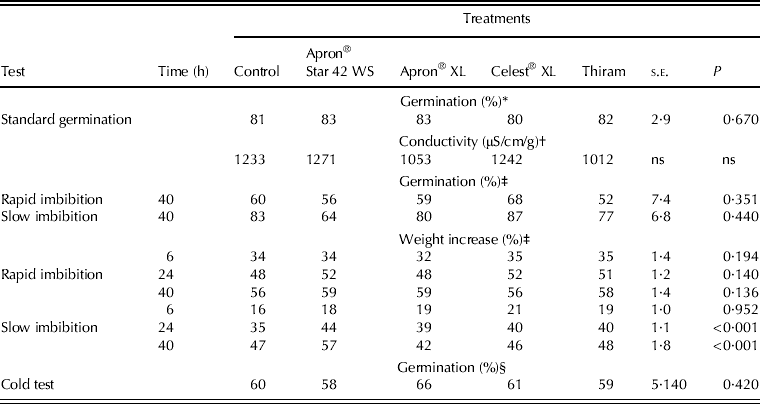
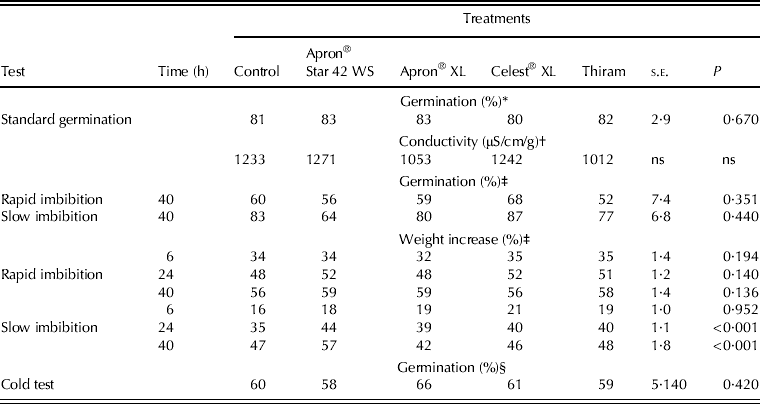
Germination of all treated seeds was >79% and did not differ significantly either from the control or between treatments (Table 1).
The conductivity and percentage germination and weight increase following imbibition, and the cold test, of pesticide treated and untreated maize seeds
* Each value is a mean percentage of four replicates of 50 seeds.
† Each value is a mean of 24 seeds.
‡ Each value is a mean response of four replicates of 24 seeds.
§ Each value is a mean response of four replicates of 25 seeds.
Vigour tests
Conductivity test
The conductivity of the pesticide solutions did not differ from the water control. There was no significant difference in electrolyte leakage from the treated seeds (measured as conductivity) among the various pesticide treatments (Table 1).
Imbibition
The germination of seeds, which had been rapidly or slowly imbibed for 40 h, was higher after slow imbibition than after rapid imbibition, with the exception of seeds treated with Apron® Star 42 WS (56 and 64%, respectively) (Table 1). There were no significant differences in germination among treatments after rapid imbibition. However, after slow imbibition seeds treated with Apron® Star 42 WS showed significantly lower germination (64%) than the control and other treatments, with the exception of seeds treated with Thiram.
There was no significant increase in seed weight among treatments following rapid imbibition for 6, 24 or 40 h (Table 1). However, after slow imbibition for 24 and 40 h, seeds treated with Apron® Star 42 WS showed a significantly higher increase in weight when compared with the control: this was associated with significantly lower germination than the control after slow imbibition. Within a treatment when comparing relative weight increase between rapid and slow imbibition at each individual time, seeds of all treatments had lower weight increases after 6, 24 or 40 h slow imbibition than 6, 24 or 40 h rapid imbibition, respectively, with the exception of those treated with Apron® Star 42 WS after 40 h rapid and slow imbibition (59 and 57%, respectively).
Cold test
Less than 70% of seeds germinated following the cold test and the germination of the fungicide-treated seeds did not differ from each other or from the untreated control (Table 1).
Greenhouse trial
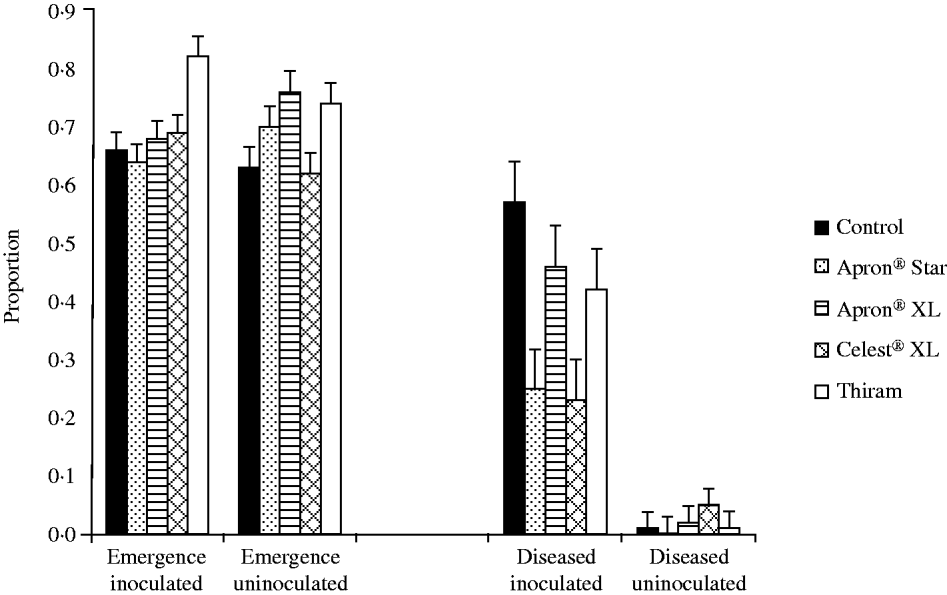
The seedling emergence in F. graminearum-inoculated soil showed that three of the treatments were not significantly different from the untreated control, the exception being after seed treatment with Thiram, where significantly higher emergence occurred (Fig. 1). In the uninoculated soil, the emergences of seedlings from all the seed treatments, except Celest® XL, were significantly higher than the untreated control (Fig. 1). There were no statistically significant differences in emergence between the inoculated and the uninoculated soil within a treatment.
The proportion of seeds emerging and the proportion of diseased seedlings from uninoculated and F. graminearum inoculated soil planted with maize seed treated with Apron® Star 42 WS, Apron® XL, Celest® XL and Thiram. T bars represent s.e.d., n=25.
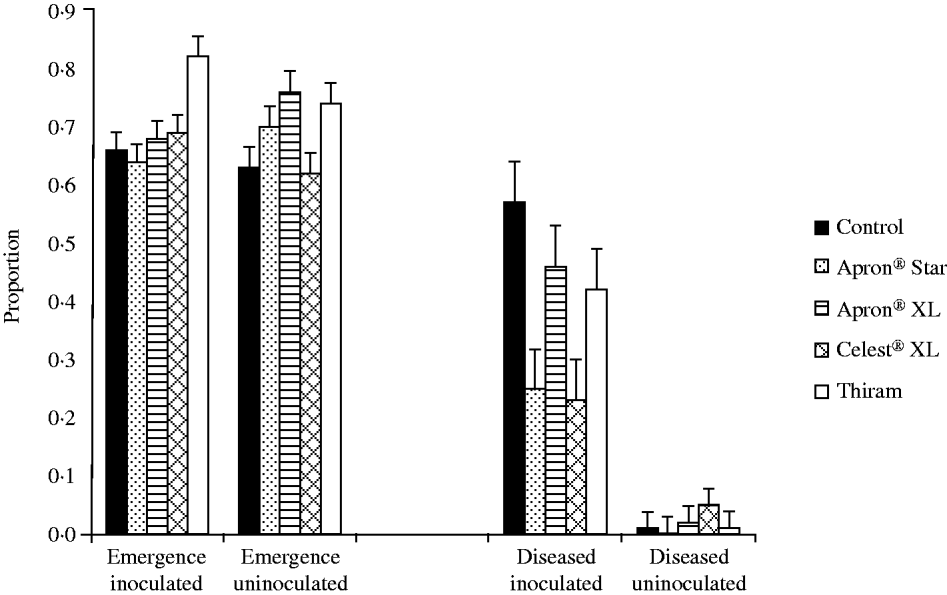
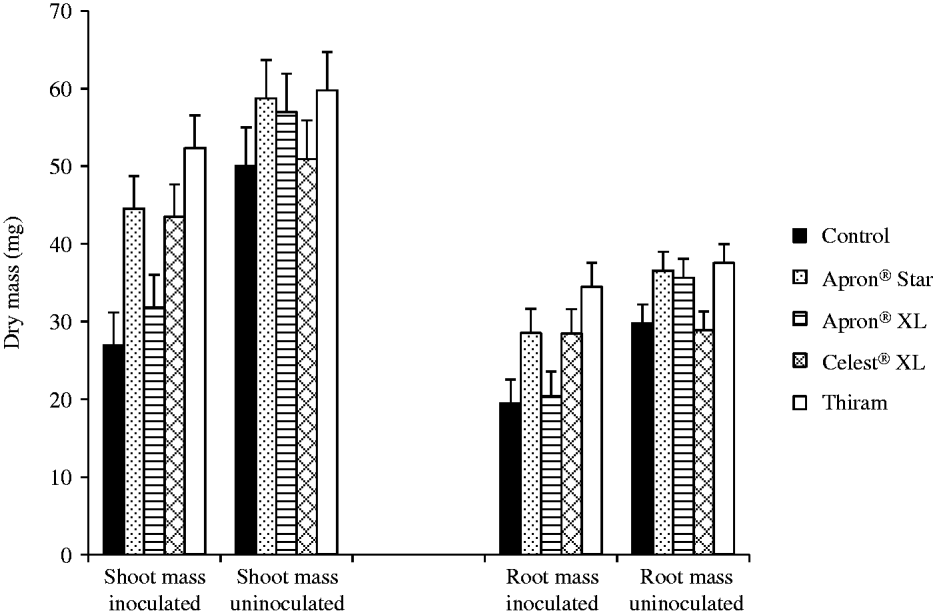
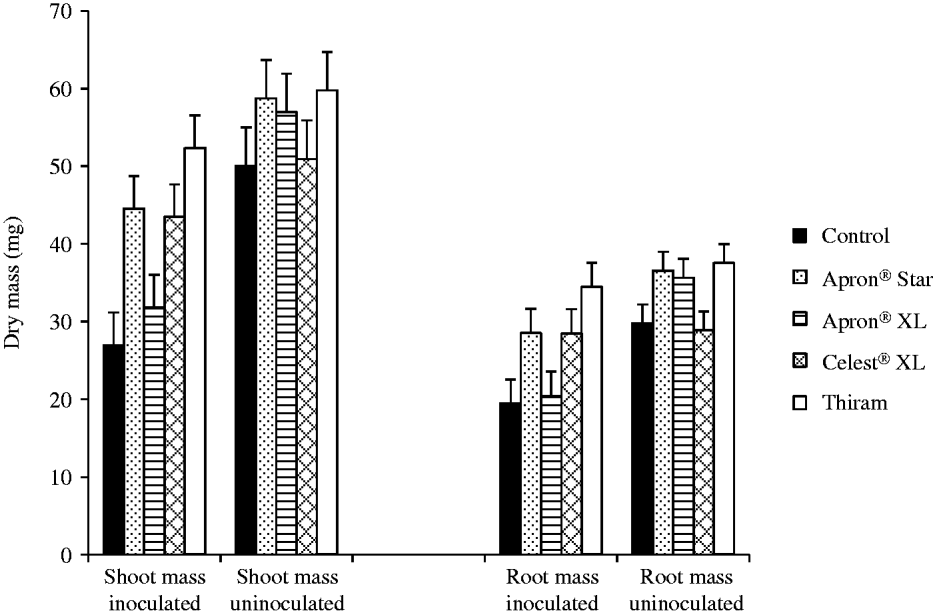
The proportion of diseased plants harvested from F. graminearum-inoculated soil was significantly reduced by Apron® Star 42 WS and Celest® XL when compared with the inoculated untreated control (Fig. 1). Diseased plants exhibited seedling blight symptoms. With the exception of Apron® XL all the fungicides significantly increased the shoot and root dry mass of plants in the inoculated soil when compared with those of the untreated control (Fig. 2). The results obtained from the uninoculated soil showed that there were no differences in dry shoot mass among treatments. However, seed treatment with Celest® XL was the only treatment that did not give significantly higher dry root mass than the uninoculated treated control (Fig. 2).
Dry shoot and root mass of uninoculated and F. graminearum inoculated soil planted with maize seed treated with Apron® Star 42 WS, Apron® XL, Celest® XL and Thiram. T bars represent s.e.d., n=25.
DISCUSSION
In the present study, none of the pesticides tested reduced the standard germination under laboratory conditions and none had any effect on the leachate conductivity or moisture content of the seeds. Emergence in the greenhouse was 7–18% lower than in the standard germination test. This was to be expected as indicated by the vigour tests, viz. germination ranging from 52 to 67% after rapid imbibition, and the cold test, respectively, and mirroring the emergence in the greenhouse. However, treatment with pesticides resulted in equal or increased (7–13% higher) emergence compared with that of the untreated control. These results are in agreement with a study conducted by Smith (Reference Smith1969), where the effect of fungicides tested on the germination and emergence of maize showed that all those tested increased germination from 5 to 6%. Another study confirmed the treatment with Thiram did not negatively affect germination of maize as long as it was used at the recommended dosage (Tort et al. Reference Tort, Dereboylu and Turkyilmaz2006).
Zhang & Hampton (Reference Zhang and Hampton1999) tested the effects of three systemic-fungicide-based products on peas and legumes. Thiram and Apron TZ were among the fungicides tested. As found in the present study, at the recommended dosage, the leachate conductivity from the treated seeds did not differ from the untreated control (Zhang & Hampton Reference Zhang and Hampton1999), indicating that the treatments had no adverse effects on membranes. Similar results were obtained when maize seeds were treated with three fungicides and two insecticides (Marchi & Cicero Reference Marchi and Cicero2003), including the fungicides Thiram and fludioxonil, which are two of the active ingredients found in the fungicides tested in the present study. Treating the maize seeds did not affect conductivity of the leachate from those seeds (Marchi & Cicero Reference Marchi and Cicero2003) and seeds treated with fludioxonil had longer radicles (Munkvold & O'Mara Reference Munkvold and O'Mara2002).
The different treatments applied in the present study also had no effect on germination or weight increase among treatments after rapid imbibition. It is not known why seed treatment with Apron® Star 42 WS reduced germination or how it was associated with an increase in seed weight after slow imbibition, noting that this trend was not evident in any of the other tests. This illustrates that it is essential to do more than one test when determining vigour of seeds. For example, DeVries & Goggi (Reference Devries and Goggi2006) reported that the tetrazolium test is a valuable tool in seed testing only when it is correlated with either the standard germination test or a vigour test such as the cold test. Germination following the cold test gave a true indication of the expected emergence results in the greenhouse trial in the present study. Nijënstein & Kruse (Reference Nijënstein and Kruse2000) reported that despite the problems associated with standardizing the cold test, it remains a test that has been used on maize to simulate field conditions and to predict field behaviour. This was confirmed by Noli et al. (Reference Noli, Casarini, Urso and Conti2008), who found that the cold test was the most accurate vigour test to predict field performance as long as the temperature conditions for the laboratory test were kept low and the soil microflora was similar to that of the field. Pereira et al. (Reference Pereira, Vieira, Panizzi and Gotrado2008) also used the cold test to compare maize cultivars with different levels of seed vigour and found that the use of seed treatments (which included fludioxinil and metalaxyl among others) significantly improved field emergence of cultivars with lower vigour.
Although there was no difference between treatments in the proportional emergence of seeds planted in inoculated or uninoculated soil, there were differences in the proportion of diseased plants. It is possible that F. graminearum did not cause seed rot, but only seedling blight symptoms on the emerging seedlings. Use of pesticides was associated with increased shoot and root biomass of plants in the presence of the pathogen, except when seeds had been treated with Apron® XL, but had no effect on dry mass of shoots in absence of the pathogen. Apron® XL is used as a seed treatment to control Oomycetes and may not be as effective in controlling Fusarium spp. (Ascomycetes), resulting in less vigorous seedlings.
The results from the present study suggest that treating maize seeds with the tested pesticides will not affect germination and the functioning of the seed in terms of seedling establishment. The vigour tests indicated that none of the pesticides tested negatively affected the seeds. Furthermore, plant biomass in the presence of the pathogen, F. graminearum, was increased after the application of the pesticides to the seeds. Further studies are required to determine whether the seed treatments presently applied would continue to sustain viability and vigour of maize seeds when they are subjected to conventional storage and storage under stress conditions.
We thank the National Research Foundation, South Africa and Syngenta South Africa (Pty) Ltd for funding.