The menopause transition (MT) is a period of vulnerability to unipolar major depression (MD) (Bromberger et al., Reference Bromberger, Kravitz, Chang, Cyranowski, Brown and Matthews2011, Reference Bromberger, Schott, Kravitz and Joffe2015; Freeman et al., Reference Freeman, Sammel, Liu, Gracia, Nelson and Hollander2004; Soares, Reference Soares2017; see Maki et al., Reference Maki, Kornstein, Joffe, Bromberger, Freeman, Athappilly and Soares2018 for a review). The prevalence of major depressive episodes (MDEs) during the transition is 2–4 times higher than prior to it (Bromberger et al., Reference Bromberger, Kravitz, Chang, Cyranowski, Brown and Matthews2011). Yet, most menopausal women do not report levels of depressive symptoms or impairment sufficient to be diagnosed with an MDE. Although it has been hypothesized that alterations of reproductive hormones during the MT account for susceptibility to an MDE, studies indicate this is not the case (Schmidt, Murphy, Haq, Danaceau, & St, Reference Schmidt, Murphy, Haq, Danaceau and St2002). It may be that vulnerable women are sensitive to the ‘normal’ changes in the hormonal milieu that occur during the MT (Soares, Reference Soares2017). The question then is: what renders a woman vulnerable to depression during the MT? This is an important question as depression can be a debilitating illness.
Many psychosocial, health, and life course factors are associated with risk for depression in women during their lives. A particularly toxic risk factor for depression throughout the life span is stress, in the form of discrete life events or chronic and ongoing negative situations (Harkness, Reference Harkness, Dobson and Dozois2008; Kessler, Reference Kessler2003). Hormonal changes of the MT are hypothesized to increase a woman's sensitivity to stress (Parry, Reference Parry2016), suggesting that exposure to stressful events during the MT may confer increased vulnerability to depression. We extend this work by examining longitudinally whether community women exposed to stressful events would be more likely to experience MDE during the MT or early postmenopause than during premenopause.
The stress literature has focused primarily on stressors proximate or concurrent with the MT. Nevertheless, numerous studies have shown a relationship between childhood maltreatment (CM), such as child abuse or neglect, and later mental health (Comijs et al., Reference Comijs, van, van der Mast, Paauw, Oude and Stek2013; Wise, Zierler, Krieger, & Harlow, Reference Wise, Zierler, Krieger and Harlow2001), and one study reported that CM was associated with the risk of depression during the MT (Epperson et al., Reference Epperson, Sammel, Bale, Kim, Conlin, Scalice and Freeman2017). Therefore, we also examined the impact of CM on risk for depression during the MT and compared whether current or childhood stressors would be more likely to be associated with midlife depression. We also evaluated whether CM would predict depression particularly when other stressors in adulthood are occurring (Comijs et al., Reference Comijs, Beekman, Smit, Bremmer, van and Deeg2007; Korkeila et al., Reference Korkeila, Korkeila, Vahtera, Kivimaki, Kivela, Sillanmaki and Koskenvuo2005). Such information about the contribution of past and current psychosocial exposures to the occurrence of clinical depression during the MT may help to identify vulnerable women.
The risk for an MDE in midlife is much greater for women with a major depressive disorder (MDD) history which is the most robust predictor of later depression (Bromberger et al., Reference Bromberger, Kravitz, Chang, Cyranowski, Brown and Matthews2011) and must be accounted for when assessing MDE risk factors in a group of women with and without prior MDD. Furthermore, we previously found in the current sample that at study entry women with prior MDD compared to women without an MDD history, reported fewer close friends, more health problems, a history of psychiatric disorders other than MDD, and greater trait anxiety (Bromberger, Schott, Kravitz, & Joffe, Reference Bromberger, Schott, Kravitz and Joffe2015). Therefore, because exposures and characteristics may vary in women with a history of MDD and those without such a history, we addressed the study objectives separately for the two groups.
The objectives of the present study were threefold. The primary aim was to test the hypothesis that women who experienced current (stressful events that occurred within the previous year, chronic events that lasted 12 months or longer) or past stressful circumstances, i.e. CM, would be more likely to experience MDE during the MT or early postmenopause than during premenopause. Second, we assessed the relative effect of current v. childhood stressors. Third, we evaluated whether CM would predict MDE particularly when other stressors in adulthood are occurring.
Methods
Sample and procedures
The current report is based on data collected at the Pittsburgh site of a large multi-site, multi-racial/-ethnic community-based study of the MT and aging, the Study of Women's Health Across the Nation (SWAN), and an ancillary study, the Mental Health Study (MHS). In SWAN, each site recruited White women and a predetermined minority group (Black at the Pittsburgh site). Eligibility criteria included being aged 42–52 years, having an intact uterus and at least one ovary, having had at least one menstrual period, no use of reproductive hormones, and not pregnant or breastfeeding/lactating in the previous 3 months. The Pittsburgh site enrolled 162 Black and 301 White women using random digit dialing and a voter's registration list. Of these 463 women enrolled, 443 participated in the SWAN ancillary MHS, which began concurrently with the SWAN parent study in 1996. The 443 MHS participants (95.7%) and the 20 non-participants (4.3%) did not differ significantly on sociodemographic variables or percentage with the Center of Epidemiological Studies Depression Scale (CES-D; Radloff, Reference Radloff1977) scores ⩾16, which has been typically used to distinguish potentially clinically significant depressive symptoms (Boyd, Weissman, Thompson, & Myers, Reference Boyd, Weissman, Thompson and Myers1982). Written informed consent was obtained from all participants in accordance with the University of Pittsburgh Institutional Review Board guidelines.
Women were evaluated at study entry and approximately annually with similar protocols. Women provided extensive health, psychosocial, lifestyle, and psychological symptom and biologic data for the Core SWAN. As part of the MHS, the Structured Clinical Interview for the Diagnosis of DSM-IV Axis I Disorders (SCID) was conducted 2–9 months after the SWAN baseline assessment and within 3 months of each follow-up core SWAN visit. The current analyses used the Core SWAN and the MHS psychiatric diagnostic data collected at baseline and at annual follow-up assessments. Because the current analyses were based on unipolar depression, 14 women with a diagnosis of bipolar disorder prior to study entry or during the course of SWAN MHS were excluded, as were 27 women with only one SCID assessment, for a total of 402 participants. Of these 402 participants, the analytic sample is comprised of 333 women who also completed the Childhood Trauma Questionnaire (CTQ).
Measures
With the exception of information about CM (obtained at follow-up 7 or 8 and 15) and the baseline data for race and paying for basics, we used time-varying independent and covariate variables from baseline through visit 12.
Assessment of psychiatric disorders
The SCID (Spitzer, Williams, Gibbon, & First, Reference Spitzer, Williams, Gibbon and First1992) is a semi-structured psychiatric interview for which we (Bromberger et al., Reference Bromberger, Kravitz, Chang, Cyranowski, Brown and Matthews2011) and others (Williams et al., Reference Williams, Gibbon, First, Spitzer, Davies, Borus and Wittchen1992) have found substantial reliability for depressive disorders (κ = 0.81–0.82). SCID interviews for diagnoses of lifetime MDD (American Psychiatric Association, 1994), and other psychiatric disorders were conducted at study entry by trained mental health clinicians. Current and past year disorders occurring in the intervening year were diagnosed at each follow-up assessment.
Measures of stress
Stressful events experienced in the previous 12 months were assessed with a checklist of 18 life events from the Psychiatric Epidemiology Research Interview scale (Bromberger et al., Reference Bromberger, Kravitz, Chang, Cyranowski, Brown and Matthews2011), modified to include events relevant to midlife women or those living in low socioeconomic environments. Women checked the life event(s) they experienced since the last study visit and rated them according to how upsetting each was with four-level responses: not at all, somewhat, or very upsetting. Life events rated as ‘very upsetting’ were totaled and categorized as one or more very upsetting event v. none (Bromberger et al., Reference Bromberger, Kravitz, Chang, Cyranowski, Brown and Matthews2011).
Ongoing problems were assessed using a questionnaire (Bromberger & Matthews, Reference Bromberger and Matthews1996) asking participants whether they had experienced any of the following chronic problems for 12 months or longer: your own health problems, health problems with partner or child, substance abuse in a family member, work difficulties, financial strain, housing problems, problem with a close relationship, helping sick family member or friend on a regular basis, any other ongoing problem. An endorsed problem was rated by participants as not upsetting, somewhat upsetting, or very upsetting. Ongoing problems were coded as at least one very upsetting ongoing problem v. none.
Childhood maltreatment was determined by the CTQ (Bernstein et al., Reference Bernstein, Stein, Newcomb, Walker, Pogge, Ahluvalia and Zule2003) which was administered at the seventh or eighth visit and in visit 15. The CTQ is a 28-item self-report instrument that assesses five types of maltreatment experienced during childhood. Participants rate items from each of five subscales (emotional abuse, physical abuse, emotional neglect, physical neglect, and sexual abuse) from 1 (never) to 5 (very often true); subscale scores range from 5 to 25. Validated clinical cutoff points have sensitivity and specificity at 0.85 relative to clinical interview (therapists’ ratings of CM) (Bernstein et al., Reference Bernstein, Stein, Newcomb, Walker, Pogge, Ahluvalia and Zule2003; Walker et al., Reference Walker, Gelfand, Katon, Koss, Von, Bernstein and Russo1999). Scores for each subscale that were at or above these thresholds were classified as positive. If subscale scores were all below cutoff points, an individual was classified as not exposed to abuse or neglect. The CTQ has strong test-retest reliability and convergent validity with clinical interview and therapist ratings (Bernstein et al., Reference Bernstein, Fink, Handelsman, Foote, Lovejoy, Wenzel and Ruggiero1994). Responses from SWAN participants showed that the CTQ had strong internal consistency, Cronbach's α ranged from 0.80 to 0.94 for the subscales in this investigation. Intraclass correlations across visits 7 or 8 and 15 for the 241 Pittsburgh women who had completed the questionnaire at both time points were 0.82 for emotional, 0.85 for physical, and 0.86 for sexual abuse.
Menopausal status
Menopausal status was based on menstrual bleeding patterns in the previous 12 months. Similar to World Health Organization recommended classifications (World Health Organization, 1996), ‘premenopause’ was defined as no change in menstrual bleeding regularity and ‘perimenopause’ as menses in the preceding 3 months with an increase in bleeding irregularity or no menses in the past 3–11 months. ‘Postmenopause’ was defined as no menstrual period for at least 12 months or a hysterectomy and bilateral salpingectomy (BSO). Eight women had a hysterectomy without BSO. All hysterectomies took place before women had a final menstrual period.
Covariates
Covariates included from baseline, race, and paying for basics (very or somewhat hard v. not very hard, indicating the presence/absence of financial strain) and lifetime MDD at study entry in analyses of the total sample. Time-varying covariates were self-reports of use of medications for nervous conditions in the past 3 months, vasomotor symptoms (VMS; hot flashes/flushes, cold sweats, and/or night sweats) in the past 2 weeks, and hormone therapy use at least two times per week for the last month.
Statistical analyses
Distributions of baseline variables were examined using means (standard deviations) and crosstabs as appropriate and of time-varying variables including menopausal status at each visit. We also examined the distribution of MDEs for each stressor according to menopausal visit status. We tested interactions between stressors and lifetime history of MDD (yes/no) at study entry among all women to determine whether the effect of stressors on the occurrence of MDEs differed significantly according to this history. Subsequent analyses were conducted on the entire sample and also stratified by history of MDD at study entry. As noted above, we report here primarily the results for the two separate samples. If a woman reported having had a hysterectomy without an oophorectomy, her data were censored from that visit forward. Women who had an oophorectomy were retained in the analyses and were grouped with the postmenopausal women at the relevant follow-up(s). Bivariate associations of each independent variable (stressor) and then each potential covariate with MDE from follow-up 1 through follow-up 12 were conducted. Covariates that were significant at p < 0.10 were included in initial multivariable analyses, General Estimating Equations (GEE models). In the multivariable GEE model building, a covariate with a p value >0.10 was removed and the model was run again in order to identify the main effects in the most parsimonious model as the sample was relatively small for testing subsequent interactions. Repeated-measures logistic regression GEEs were conducted to test the hypothesized interactions between a stressor and menopausal status. These analyses included covariates from the initial repeated logistic regression models and the interaction of age and stressor to account for the potential variation of the effect of the stressor on the odds of an MDE by age. Significant interactions of menopausal status and each stressor were followed by analyses of the stressor in separate models for premenopause, perimenopause, and postmenopause/BSO women with relevant covariates. The final analyses examined the relative importance of a current stressor and a CM type by including both together as main effects and the interaction of the two. The latter was considered to determine if the multiplicative effect of a current and early childhood stressor was greater than each individually.
Results
Characteristics of sample
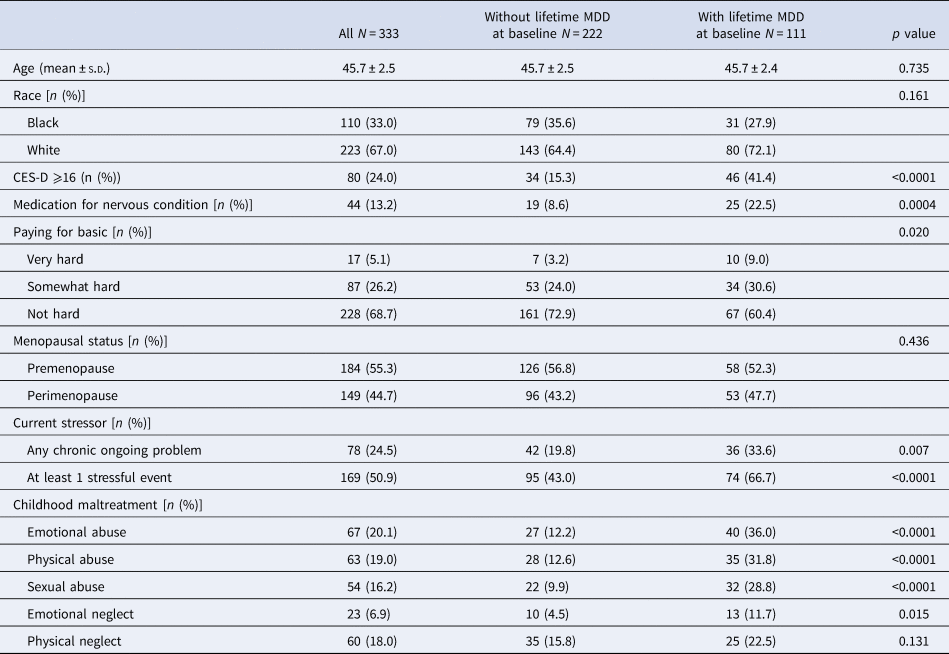
Table 1 shows the baseline and CM characteristics of the total sample and those without (n = 222) and with (n = 111) lifetime MDD at study entry. Those who had a previous MDD had a higher proportion of women with an elevated CES-D (score >16: 41.4%), a very hard time paying for basics, a chronic ongoing problem, a very upsetting life event in the past year, and all types of CM. Over the course of the study, a total of 129 women met the criteria for a new MDE: 58 (26.1%) among women without lifetime MDD and 71 (64%) with lifetime MDD. Multiple episodes were experienced by 41.4% of the former and 71.8% of the latter (see Supplementary Table S1 for details.)
Sample characteristics at baseline

CES-D, Center for Epidemiologic Studies of Depression Scale.
Initial statistical tests of the interactions between stressors and lifetime history of MDD (yes/no) at study entry on the odds of an MDE over the study visits among all women were all non-significant. These data indicate that stressors did not vary significantly in their association with MDE according to lifetime MDD history.
The unadjusted distribution of visits with an MDE by stressor and menopausal status within each group showed that among women without lifetime MDD at baseline, those with a chronic problem had a higher prevalence of MDE when they were perimenopausal (16.7%) or postmenopausal (19.0%) than premenopausal (4.35%). This was also the case for women reporting physical abuse: 4.1% had MDE when premenopausal, 10.5% when perimenopausal, and 11.4% when postmenopausal. There were no cases of MDE during premenopause among women with emotional abuse, sexual abuse, or emotional or physical neglect.
Among women with lifetime MDD at baseline, those with a chronic problem had a higher prevalence of an MDE during perimenopausal (33.3%) and postmenopausal visits (38.5%) than during premenopausal visits (21.4%). Among women with CM, the prevalence of MDEs during premenopause and perimenopause was similar for women with emotional (11/53, 20.8%; 35/155, 22.6%, respectively) or physical abuse (10/37, 27.0%; 49/67, 29.3%, respectively) and emotional (6/24, 25.0%; 15/49, 30.6%, respectively) or physical neglect (9/40, 22.5%; 25/96, 26.0, respectively). The prevalence of MDEs during postmenopause was much higher for these types of maltreatment (emotional abuse: 76/242, 31.4%; physical abuse: 70/185, 37.8%; emotional neglect: 35/58, 60.3%; physical neglect: 53/134, 39.6%). For sexual abuse, the prevalence of MDs was similar during all three stages of the transition (premenopause: 13/40, 32.5%; perimenopause: 40/148, 27.0%; postmenopause: 48/158, 30.4%).
Influence of stress or menopausal status on risk for an MDE among women with and without lifetime history of MDD at study entry
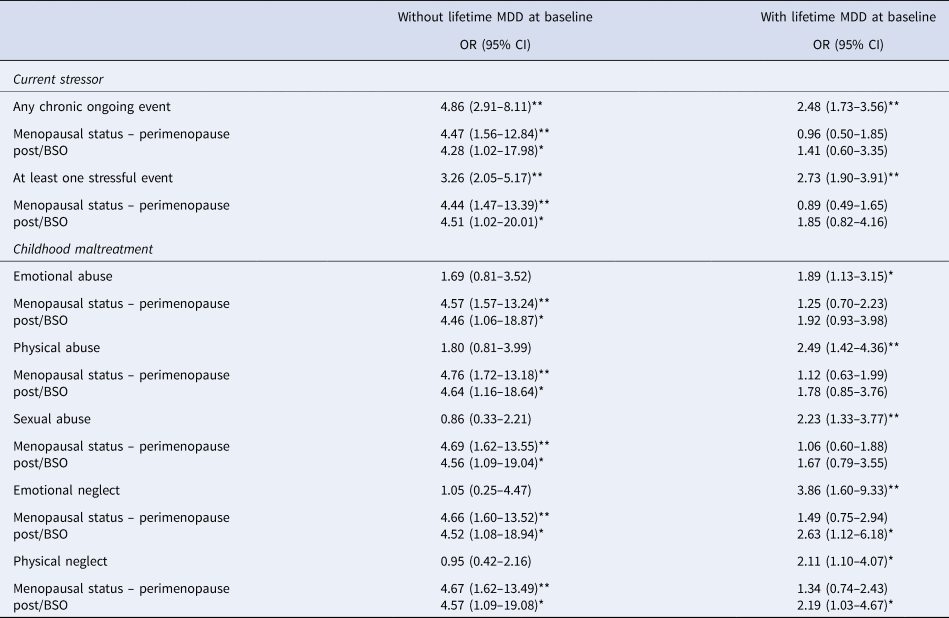
Table 2 displays the results of the initial main effects models adjusted for relevant covariates (see footnotes). In the group of women without lifetime MDD at baseline, a stressful chronic ongoing problem and at least one stressful event in midlife, each quadrupled or more than tripled the odds of MDE in separate analyses. None of the CM types was significant. In general, their odds of an MDE were greater when they were perimenopausal and postmenopausal compared to when they were premenopausal.
Association of stress (current stressor and childhood maltreatment) with MDE, in separate analyses, stratified by individuals with and without lifetime MDD at baseline

Premenopause is the reference for perimenopause and postmenopause/bilateral salpingectomy.
Covariates included age, race, medication for nervous condition.
Among those with lifetime MDD at baseline, the following covariates were also included in the model.
Any chronic ongoing event, sexual abuse.
At least one stressful event – paying for basic, HT use.
*p < 0.05, **p < 0.01.
In contrast, among women with lifetime MDD at baseline, all seven stressors were significant predictors, at least doubling the odds of an MDE during the study. However, when compared to premenopause, perimenopause status was not significant and postmenopause status was significant only in the analyses with emotional or physical neglect in childhood (ORs = 2.63 and 2.19, respectively.)
Varying impact of stress by menopause status
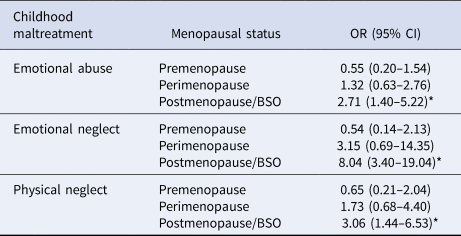
Among women without lifetime MDD at baseline, there were no significant interactions between a stressor and menopausal status. However, interaction analyses of status with emotional or sexual abuse or with emotional or physical neglect could not be conducted due to zero events in some cells. Among women with lifetime MDD at baseline, three interactions with menopausal status were significant: emotional abuse (p = 0.022), emotional neglect (p = 0.002), and physical neglect (p = 0.038). Follow-up analyses showed that each of these three types of maltreatments more than doubled the odds of an MDE when women were postmenopausal/BSO but not when they were pre- or perimenopausal (Table 3).
Odds ratio stratified by menopausal status; separate analyses for odds ratio for type of childhood maltreatment in analyses for each menopausal status – follow-up of interaction analyses participants: women with lifetime MDD at baseline

Covariates were age, race, medication for nervous condition.
*p < 0.01.
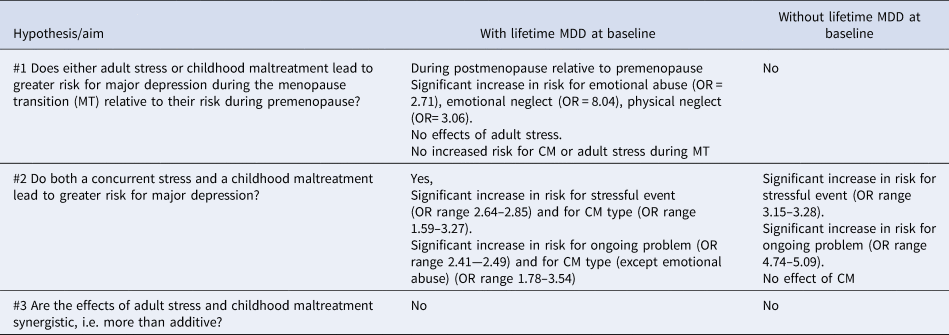
Results of analyses of three aims

CM, childhood maltreatment.
Relative effects of current v. childhood stressor
A series of analyses included various combinations of a current midlife stressor (stressful event or stressful chronic ongoing problem) with a type of CM. Among women without lifetime MDD, a current stressor was consistently significant, tripling or quadrupling the odds of MDE (p's <0.01) whereas no type of CM was significant possibly due to small numbers in CM cells. Additionally, compared to premenopause, perimenopause consistently significantly increased the odds of an MDE by approximately four times (see Supplementary Table S2a).
Among women with lifetime MDD at baseline, in all analyses, a current stressor was significant, more than doubling or tripling the odds of MDE and with the exception of emotional abuse, all types of CM were also significant. None of the analyses that assessed the interaction of a current stressor with a type of CM was significant, suggesting the effects of current adult stressors and specific types of childhood abuse/neglect were additive (see Supplementary Table S2b and eSee Table 4 for a summary of results).
Discussion
We addressed three sets of hypotheses in a community sample of black and white women. First, we evaluated the hypothesis that current and childhood stressors would each interact with menopausal status to increase the risk for MDE across 15 years of approximately annually collected data. Results showed that among the women with lifetime MDD at study entry, the experience of CM significantly increased the risk for MDE during the postmenopause, not during the MT as we had hypothesized. Specifically, in this group, women reporting childhood emotional abuse, emotional neglect, or physical neglect had a significantly greater likelihood of experiencing an MDE when postmenopausal than when pre- or perimenopausal, accounting for age, race/ethnicity, and when relevant, financial strain, psychotropic medications, VMS, or hormone use. These unexpected results indicate that among the SWAN midlife women with a history of MDD, the perturbations of the MT had no greater effect on risk for MDE for women with childhood emotional or physical neglect or emotional abuse than those without such experiences. Rather, these adverse childhood exposures increased risk for recurrent MDE after the MT (i.e. postmenopause) and into older age. This suggests that early CM may be a particularly toxic risk factor for MDE during older ages in women who have experienced MDD in young or middle adulthood prior to the MT. Among women without lifetime MDD, adult stress leads to increased MDE risk irrespective of MT stage.
Our results do not support the hypothesis that the MT increases sensitivity to current or past stressful experiences and, thereby, increases risk for depression during the MT. Limited evidence for the hypothesis was reported by Epperson et al. (Reference Epperson, Sammel, Bale, Kim, Conlin, Scalice and Freeman2017) who found that midlife women with two or more adverse childhood experiences (included abuse, neglect, and household dysfunction) were more than twice as likely as those without such exposures to have incident MDE during the MT. However, current stressors were not assessed and the analyses were based on a subsample of premenopausal women (n = 232) followed for 14 years who had not reported a history of depression prior to study entry or who had prior depression and depression during follow-up. Women with prior depression but no episodes during follow-up were excluded. This approach limited conclusions about the relative impact of CM on women with or without MDD prior to the MT and the effect of concurrent stress on risk for depression.
Results for the association between various types of CM and later depression are consistent with previous studies (Bifulco, Brown, Moran, Ball, & Campbell, Reference Bifulco, Brown, Moran, Ball and Campbell1998; Danese et al., Reference Danese, Moffitt, Harrington, Milne, Polanczyk, Pariante and Caspi2009; Hovens et al., Reference Hovens, Wiersma, Giltay, van, Spinhoven, Penninx and Zitman2010), demonstrating the long-lasting effects on mental health throughout an individual's life (Jones, Nurius, Song, & Fleming, Reference Jones, Nurius, Song and Fleming2018; Kendler et al., Reference Kendler, Bulik, Silberg, Hettema, Myers and Prescott2000; Kessler, Reference Kessler1997; Wise et al., Reference Wise, Zierler, Krieger and Harlow2001) but only among women with earlier MDD. Indeed, CM is considered one of the strongest risk factors for MD (Lancet; Li, D'Arcy, & Meng, Reference Li, D'Arcy and Meng2016; Opel et al., Reference Opel, Redlich, Dohm, Zaremba, Goltermann, Repple and Dannlowski2019). We found that among women with lifetime MDD, emotional abuse, physical abuse, sexual abuse, emotional or physical neglect individually increased the odds of MDE. However, among women without lifetime MDD, as noted above, no type of CM was a risk factor for incident MDE.
We also found that when a current stressor and a type of CM were simultaneously included in analyses as main effects, only the current stressor was a significant predictor of MDE among women without lifetime MDD. Among women with lifetime MDD, both current stressors and CM types were significant. These findings are consistent with data from the National Comorbidity Survey Replication I (Green et al., Reference Green, McLaughlin, Berglund, Gruber, Sampson, Zaslavsky and Kessler2010) and II (McLaughlin et al., Reference McLaughlin, Green, Gruber, Sampson, Zaslavsky and Kessler2010) which showed that childhood physical and sexual abuse and neglect were more strongly associated with early MDE onsets than later ones. A study of participants in the Netherlands Study of Depression in Older Persons found that childhood abuse was most strongly associated with early-onset clinical depression (OR = 13.73) and less so with middle age-onset (OR = 5.36) and late-onset (OR = 4.74) (Comijs et al., Reference Comijs, van, van der Mast, Paauw, Oude and Stek2013), although the risk for later depression remained substantial in this study. These studies suggest that CM may be directly associated with early depression which may be an important link between maltreatment and later MDE.
CM may exert its effects through numerous pathways including via psychological vulnerabilities of helplessness and low self-esteem and experiences of adversity in adulthood, including economic disadvantage, low-quality social support, and accumulation of adult stresses (Kessler, Reference Kessler2003). In addition, numerous and varied studies have shown that many neurobiological mechanisms may explain how stress generally and CM in particular influence early brain development and alterations that may contribute to the development of depression (Li et al., Reference Li, D'Arcy and Meng2016; Lupien, McEwen, Gunnar, & Heim, Reference Lupien, McEwen, Gunnar and Heim2009; Opel et al., Reference Opel, Redlich, Dohm, Zaremba, Goltermann, Repple and Dannlowski2019). For example, childhood trauma (child abuse and neglect) has been associated with long-lasting dysregulation of the hypothalamic–pituitary–adrenal (HPA) axis, reductions in cortical surface areas in the hippocampus and the prefrontal cortex (Opel et al., Reference Opel, Redlich, Dohm, Zaremba, Goltermann, Repple and Dannlowski2019) and in hippocampal volume (Rao et al., Reference Rao, Chen, Bidesi, Shad, Thomas and Hammen2010).
This study has several limitations. CM is self-reported retrospectively, raising questions about misclassification due to recall bias. Duration and severity of maltreatment which potentially can influence recall and associations with outcomes are unknown. Information on lifetime MDD is retrospectively reported. However, the SCID has been shown to have substantial reliability for depressive disorders (Williams et al., Reference Williams, Gibbon, First, Spitzer, Davies, Borus and Wittchen1992) and in the current study (κ = 0.81–0.82; Bromberger et al., Reference Bromberger, Kravitz, Chang, Cyranowski, Brown and Matthews2011). Also, only a small number of women without lifetime MDD reported CM, limiting the ability to conduct a number of interaction analyses and, thus, to reach any conclusions about the impact of CM on the risk for MDE during the MT or after in women who experience an incident MDE during the MT or postmenopause. The study sample size was small relative to that needed for detecting significant three-way interactions, i.e. history of MDD by menopausal stage by risk factor. Therefore, we relied on stratified results based on the history of MDD for our primary conclusions even though interactions between lifetime MDD and each stressor on the occurrence of MDEs over the 12 follow-ups were not significant. Finally, we could not examine the variability of E2 because bioassay measures of E2 were only collected annually and during postmenopause, due to limited funding, we only obtained E2 data on 50% of women. To our knowledge,this is the first community study of midlife women to longitudinally evaluate whether a CM or current stressor interacted with menopausal status to increase the risk for MD during the MT or early postmenopause. Furthermore, this is the first study of midlife women to examine the longitudinal impact of both CM and a current stressor, separately and together in the same analyses, on risk for a n MDE during the MT. Finally, no study has considered depressive disorders prior to the MT as potentially influencing the impact of early or recent stress on vulnerability to depression during or after the MT. The current study has additional strengths including the collection of data over a 15-year period, psychiatric diagnostic data, and detailed information on the MT.
While a clinician should always be watchful for a recurrence among midlife patients with an MDD history, the increased risk of a recurrence for women with CM during postmenopause suggests that a clinician increases vigilance after the final menstrual period. Being watchful involves monitoring patients for signs of depression, including changes in mood and behavior/activities, and for exposures to stressful situations. Numerous screening tools such as the CES-D (Radloff, Reference Radloff1977) and the Patient Health Questionnaire (PHQ-9; Kroenkeet al, Reference Kroenke, Spitzer and Williams2001) are available to quickly screen for depressive symptoms. Importantly, we recently found that anxiety is a predictor of MDE (Kravitzet al, Reference Kravitz, Schott, Joffe, Cyranowski and Bromberger2014) and can be screened with the General Anxiety Disorder-7 (GAD-7; Spitzeret al, Reference Spitzer, Kroenke, Williams and Lowe2006). A positive screen indicates the presence of depressive symptoms (or anxiety) and warrants an evaluation for clinical depression and treatment.
For women with no history of MDD, the risk for MDE is lower than that for those with prior MDD. However, risk does increase even for these women when they become perimenopausal suggesting that clinicians should pay more attention to signs and symptoms of depression as women progress through the MT. Optimal clinical care would include obtaining information about current stressful events (in the previous 12 months) and ongoing chronic situations (lasting longer than 12 months) as such stressors substantially increase the risk for a first onset depression. Screening instruments as described above can be used to evaluate the level of depression and anxiety symptoms. Such information could be used to determine whether a referral to other health care providers or to supportive services is appropriate. The latter may be able to assist with practical matters that are the source of stress.
In conclusion, the study presents a complex picture of the interrelationships among MDD prior to midlife, the MT, current stressors, early CM, and incident and recurrent MDD during midlife. CM is a consistent predictor of MDE in women with prior MDD even after accounting for a concurrent stressor, but especially postmenopausally. However, among women without lifetime MDD, current stressors are strong predictors of MDE whereas CM is not. These findings highlight the importance of obtaining knowledge of a woman's psychiatric and early childhood history during her midlife health visits. Such information may help health care providers identify the relative risk of women for MDE or depressive symptoms that impair functioning.
Acknowledgements and financial support
The Study of Women's Health Across the Nation (SWAN) has grant support from the National Institutes of Health (NIH), DHHS, through the National Institute on Aging (NIA), the National Institute of Nursing Research (NINR) and the NIH Office of Research on Women's Health (ORWH) (Grants U01NR004061; U01AG012505, U01AG012535, U01AG012531, U01AG012539, U01AG012546, U01AG012553, U01AG012554, U01AG012495). Grant support from The National Institute of Mental Health (NIMH; R01MH59689) is also gratefully acknowledged. The content of this manuscript is solely the responsibility of the authors and does not necessarily represent the official views of the NIA, NINR, ORWH, NIMH, or the NIH.
Clinical centers
University of Michigan, Ann Arbor – Siobán Harlow, PI 2011–present, MaryFran Sowers, PI 1994–2011; Massachusetts General Hospital, Boston, MA – Joel Finkelstein, PI 1999–present; Robert Neer, PI 1994–1999; Rush University, Rush University Medical Center, Chicago, IL – Howard Kravitz, PI 2009–present; Lynda Powell, PI 1994–2009; University of California, Davis/Kaiser – Ellen Gold, PI; University of California, Los Angeles – Gail Greendale, PI; Albert Einstein College of Medicine, Bronx, NY – Carol Derby, PI 2011–present, Rachel Wildman, PI 2010–2011; Nanette Santoro, PI 2004–2010; University of Medicine and Dentistry – New Jersey Medical School, Newark – Gerson Weiss, PI 1994–2004; and the University of Pittsburgh, Pittsburgh, PA – Karen Matthews, PI.
NIH program office
National Institute on Aging, Bethesda, MD – Chhanda Dutta 2016–present; Winifred Rossi 2012–2016; Sherry Sherman 1994–2012; Marcia Ory 1994–2001; National Institute of Nursing Research, Bethesda, MD – Program Officers.
Central laboratory
University of Michigan, Ann Arbor – Daniel McConnell (Central Ligand Assay Satellite Services).
Coordinating center
University of Pittsburgh, Pittsburgh, PA – Maria Mori Brooks, PI 2012–present; Kim Sutton-Tyrrell, PI 2001–2012; New England Research Institutes, Watertown, MA – Sonja McKinlay, PI 1995–2001.
Steering committee
Susan Johnson, Current Chair; Chris Gallagher, Former Chair. We thank the study staff at each site and all the women who participated in SWAN.
Supplementary material
The supplementary material for this article can be found at https://doi.org/10.1017/S0033291720004456