Implications
In pasture-based systems beef cows’ postpartum rebreeding is a problem, especially for the primiparous cows. The development of managements that attend this problem, such as combination of strategic feeding and early permanent or temporary separation of the cow–calf dyad, need to consider issues such as the welfare, health and physiology of the cows and their offspring. In this study, greater responses to early weaning, including hematological and behavioral changes, were found in multiparous and primiparous cows. This needs to be considered during management of the herds. Furthermore, this highlights the need to understand the consequences for the offspring of multiparous or primiparous cows that are submitted to early weaning or regrouping, in order to adapt the management to each category.
Introduction
Prolonged postpartum anestrus in suckled beef cows is one of the main restrictions in extensive productive systems. This problem is greater in primiparous than multiparous cows, as postpartum anestrous is longer in the former (Yavas and Walton, Reference Yavas and Walton2000), resulting in lower pregnancy rates if specific strategies are not applied (Arthington and Kalmbacher, Reference Arthington and Kalmbacher2003). According to Short et al. (Reference Short, Bellows, Staigmiller, Berardinelli and Custer1990), prolonged suckling, nutritional deficiencies, climatic stress, parity, time of the year and management practices are the main determinants of the long calving interval. As suckling is one of the most important factors causing anestrus (Randel, Reference Randel1990; Short et al., Reference Short, Bellows, Staigmiller, Berardinelli and Custer1990), early weaning induces an earlier postpartum rebreeding (Quintans et al., Reference Quintans, Vázquez and Weigel2009), with greater impact in primiparous cows (Galindo-Gonzalez et al., Reference Galindo-Gonzalez, Arthington, Yelich, Hansen, Lamb and De Vries2007).
Although weaning allows to improve reproductive results, it triggers a stress response in calves (Bueno et al., Reference Bueno, Rasby and Clemens2003; Blanco et al., Reference Blanco, Casasús and Palacio2009; Enríquez et al., Reference Enríquez, Ungerfeld, Quintans, Guidoni and Hötzel2010) and cows (Lefcourt and Elsasser, Reference Lefcourt and Elsasser1995; Haley, Reference Haley2006), affecting the welfare of both members of the dyad. The cow–calf bond is established since birth and it is maintained throughout nursing (Hudson and Mullord, Reference Hudson and Mullord1977). For example, in rodents, sheep, goats and primates the mother–offspring bond becomes strengthened with parity, as shown by differences in behavior and in the response to challenges (Numan et al., Reference Numan, Fleming and Levy2006; Poindron et al., Reference Poindron, Terrazas, Navarro Montes de Oca, Serafín and Hernández2007; Dwyer, Reference Dwyer2008). For example, primiparous ewes are more affected by parturition and have more difficulties in accepting their lambs, which may be due to differences in neuroendocrine systems (for review see: Numan et al., Reference Numan, Fleming and Levy2006). Several neuroendocrine mechanisms influenced by previous maternal experience have been described in some species including ungulates (for review see: Fleming, Reference Fleming2006). However, information linking parity and dam–calf bond or weaning behavior in cattle is scarce.
Le Neindre and D'Hour (Reference Le Neindre and D'Hour1989) observed that primiparous beef cows displayed less active maternal behavior than multiparous cows. In dairy cows, Edwards and Broom (Reference Edwards and Broom1982) reported a higher incidence of maternal aggressive behavior and rejection of the calf during the first hours after parturition in primiparous cows. Price et al. (Reference Price, Smith, Thos and Anderson1986) reported a stronger behavioral response to brief temporary calf separation and upon reunion by multiparous than primiparous beef cows during the first week after parturition. As suckling restriction managements such as early weaning have high impact in reproductive performance in primiparous cows (Quintans et al., Reference Quintans, Vázquez and Weigel2009), it would be important to determine if the stress response of this category of dams differs from than that of multiparous cows. The aim of the experiment was to compare the hematological and behavioral changes in response to early weaning in multiparous and primiparous cows.
Material and methods
Location and animals
This experiment was conducted at Palo a Pique Experimental Unit of the National Institute for Agriculture Research (INIA), Treinta y Tres, Uruguay (33°S, 56°W). The experiment was conducted in accordance with the Experimental Unit Directive concerning the use of animals for experimentation.
Animal management
A total of 25 crossbred Aberdeen Angus × Hereford cows were managed together on native pastures from 25 days before calving and until day −7 (day 71 postpartum = day 0). At day −7 they were all assigned to two experimental groups according to their parity: (i) primiparous cows (n = 14) and (ii) multiparous cows with one previous experience of rearing a calf (n = 11), allocated in separated 6-ha paddocks. On day 0, calves were taken to another paddock far enough to avoid auditive interaction with the dams.
Body weight (BW) and body condition (BC)
Cow's BW and BC were recorded at 25 days before calving, at calving and every 28 days thereafter. Calves were weighed within 72 h of birth and when they were 35, 60 and 71 days old.
Milk production and composition
Milk production was assessed 40 and 65 days after birth as described in Quintans et al. (Reference Quintans, Banchero, Carriquiry, López-Mazz and Baldi2010). Briefly, cows were separated from calves, injected with oxytocin and milked. Calves were fitted with strong nose plates and were joined again with their dams. Approximately 13 h later, cows were milked again with the same protocol. Milk obtained was weighed, nose plates were removed after milking and cows and calves returned to the paddock.
Blood sampling
Cows were bled via jugular venipuncture on days −4, 5, 10 and 17. Samples were collected in tubes with ethylenediaminetetraacetic acid or sodium of fluorure and iodine acetate, and were maintained refrigerated until hematological analysis was performed.
Hematological measurements
White blood cell numbers were manually counted, and the basophil/neutrophil relationship was calculated. Total protein and albumin concentrations were measured in a clinical chemistry analyzer (Wiener lab., Metrolab 1600 DR, Buenos Aires, Argentina), using commercial kits (BioSystems, Barcelona, Spain).
Cow–calf distance
The distance between each cow and its calf considered in cows body length (BL; <1 BL, 1 to 5 BL, 5 to 10 BL, >10 BL) was estimated simultaneously with behavior recording (see following subsection ‘Behavior recordings’) before weaning.
Behavior recordings
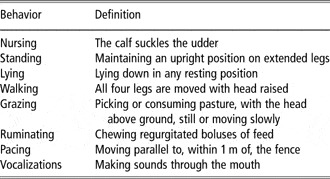
Behaviors of individual cows were recorded using instantaneous sampling performed by the same observers in each group using 10 min scan sampling. The cows were tagged, and big numbers were painted on both sides of the body. Data were recorded 38 times/day, during two observation periods from 0800 to 1100 and 1600 to 1900 h. Recordings were carried out daily from day −2 to day 3. The behaviors observed are described in Table 1. Vocalizations were recorded for a 15 s period every 10 min using 0/1 sampling (Lehner, Reference Lehner1996).
List of behaviors observed and their respective descriptions

Data analysis
BWs, BC, milk yield, hematological parameters, frequency of the behaviors and cow–calf distances were compared with an ANOVA for repeated measurements. The model considered the group (multiparous or primiparous), gender and the time, as well as the interaction between treatments and time as fixed effects, and the calf into each group as a random effect. Post-hoc comparisons were done with LSD. Frequency of recordings in which cow and calves were at each distance range before weaning was compared with a two-way ANOVA, considering the group and the calf gender.
Frequencies for each behavioral event are expressed as percentages, and presented as mean ± s.e.m. Differences were considered significant at α = 0.05.
Results
BW, BC and milk yield
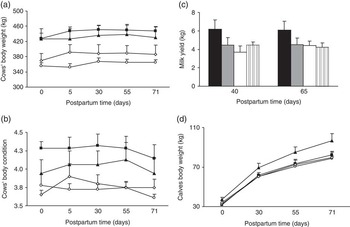
BW and BC were greater in multiparous than in primiparous cows (P < 0.0001 for both variables), and changed with time (P < 0.0001 for both variables; Figure 1a and b, respectively). There was an interaction between parity and gender of the calf for BW (P = 0.004) and BC (P = 0.007). Both BW and BC were greater in multiparous than primiparous cows, but multiparous cows with female calves had greater BW and BC than those that calved males (P < 0.001 for both variables).
(a) Cows’ body weight (BW), (b) cows’ body condition, (c) cows’ milk yield and (d) calves BW. In figures (a), (b) and (d), symbols correspond to: multiparous cows-male calves: —▴—; multiparous cows-female calves: —▪—; primiparous cows-male calves: —◊—; primiparous cows-female calves: —○—. In figure (c): multiparous cows-male calves: black bars; multiparous cows-female calves: gray bars; primiparous cows-male calves: white bars; primiparous cows-female calves: bars with vertical lines. See statistical details in text.

Milk yield was greater in multiparous than in primiparous cows (P = 0.02), in cows that calved males than females (P = 0.02), and there was an interaction, with greatest milk yield in multiparous cows that calved males (P = 0.02; Figure 1c).
Calves’ BW increased with time (P < 0.0001), and was greater in males than females (P < 0.0001). There was a significant interaction between cow's parity and gender of the calf for BW (Figure 1d): male calves from multiparous cows were heavier than female calves from multiparous cows, without differences in relation to gender in primiparous cows. That difference became significant from day 30 until the end of the experiment.
Hematology
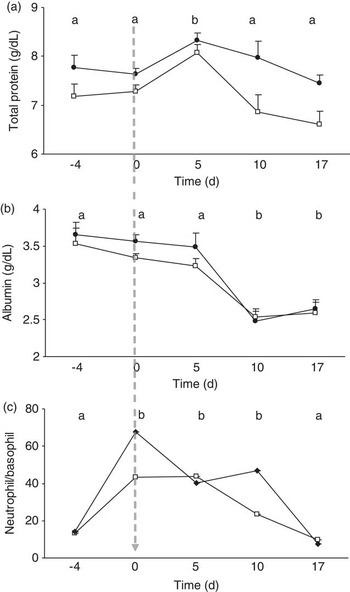
Total protein concentration was affected by parity (P = 0.025) and time (P < 0.0001), but no interaction was observed (Figure 2a). Protein concentration was greater in multiparous cows (P = 0.04). On day 5 protein concentration was greater than in all other days (P < 0.002). Albumin concentration profiles were similar in both parities, but decreased by day 10 and remained low on day 17 (P < 0.0001; Figure 2b). Basophil/neutrophil relationship was not affected by parity. This relationship increased the day of weaning and remained high until day 10 (P < 0.05; Figure 2c).
Total protein (a) and albumin (b) concentration and (c) neutrophil/basophil relationship in multiparous (—●—) and primiparous (—□—) cows weaned 71 days postpartum (arrow). (a) v. (b): differences between points in relation to time.

Cow–calf distance
Frequency of observations in which cow–calf were at each distance are presented in Table 2. Frequencies of recordings in which distance was less than 1 BL tended to be influenced by the interaction of parity and calf gender. Multiparous cows were between 1 and 5 BL more frequently than primiparous cows. A significant interaction between parity and calf gender was observed in the frequency in which distance was between 5 and 10 BL, and no effect was observed for frequencies in which calves were more than 10 BL from the dam.
Distances between cows and calves: influence of P, G of the calf and interaction of both factors

P = parity; G = gender.
Behaviors
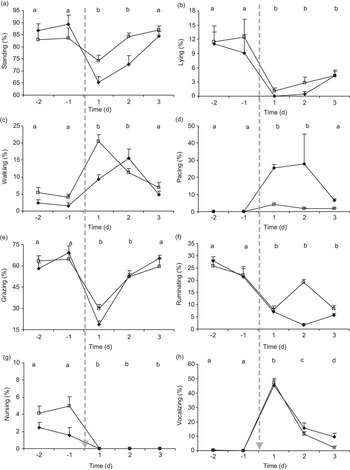
Frequency of standing, which is shown in Figure 3a, decreased in the 2 days after weaning (P < 0.0001), and there was an interaction between time and parity (P = 0.01), with a greater decrease in multiparous than in primiparous cows. Frequency of observations during which cows were lying decreased after weaning (P < 0.0001), in similar amounts in both groups (Figure 3b). Observations during which cows walked increased with time (P < 0.0001), was greater in primiparous cows (P = 0.008), and there was an interaction, as the increase in primiparous cows was observed earlier (P < 0.0001; Figure 3c). Pacing increased after weaning (P = 0.001), but increased significantly more in multiparous cows (P = 0.006), with a significant time by parity interaction (P = 0.01), reflected in greater frequencies of pacing in multiparous cows in the 2 days after weaning (Figure 3d). Grazing was affected only by weaning, with the lowest frequency observed on the first day after weaning, and a return to pre-weaning levels only on day 3 (Figure 3e). Ruminating, which was less frequent in multiparous cows (P = 0.014), decreased and remained low in the 3 days following weaning (P < 0.0001), but there was a significant time by parity interaction (P < 0.0001), as there was a transient increase the 2nd day after weaning in primiparous cows (Figure 3f). Nursing before weaning was more frequently observed in primiparous cows (Figure 3g). The frequency of vocalizations increased dramatically after weaning (P < 0.0001), and was greater in multiparous cows (P = 0.006), which had a slower decrease during in the 2nd and 3rd day after weaning compared to primiparous cows (P = 0.005; Figure 3h).
Behaviors recorded before and after weaning in multiparous (—⧫—) and primiparous (—□—) cows. Arrows show the day of weaning. Different letters show significant differences between the recordings of those days.

Discussion
Weaning resulted in a significant stress response in both multiparous and primiparous cows. Greater changes in behaviors such as pacing and vocalizing indicate a stronger stress response in multiparous cows. The reduction in standing and ruminating frequencies were also more marked in multiparous than in primiparous cows, and multiparous cows remained closer to their calves before weaning. Altogether, it can be concluded that the welfare of multiparous cows was more affected than that of nulliparous cows as a consequence of a more intense mother-offspring bond. Although in other species, as sheep (Dwyer, Reference Dwyer2008), a greater bond towards offspring in experienced mothers has also been reported, according to our knowledge available information in beef cattle was restricted to the first days after postpartum (Le Neindre and D'Hour, Reference Le Neindre and D'Hour1989; Vandenheede et al., Reference Vandenheede, Nicks, Désiron and Canart2001). Considering that in our experiment multiparous cows were all in their second parturition, it may be speculated that differences may be at least similar, or possibly greater with longer maternal experience.
According to our knowledge this is the first behavioral and hematological characterization of post-weaning stress in beef cows. The behavioral stress response was short-lived, as 3 days after weaning most behaviors had returned or were returning to basal frequencies. Although hematological changes lasted longer, this may be related to the normal delay in the response recorded in these parameters (Trevisi and Bertoni, Reference Trevisi and Bertoni2009). This suggests that the stress response to weaning is not relevant for cows’ welfare in a medium or long-time perspective, irrespective of previous maternal experience.
Hematological responses were not affected by parity. Although multiparous cows had greater protein concentration, that difference was unrelated to weaning. Therefore, it is interesting to speculate how similar physiological responses may trigger different behavioral responses according to previous maternal experience. It seems that the behavioral response is more sensible than the hematological response to weaning in experienced cows. Therefore, it should be considered that although hematological parameters are reliable indicators of stress (Lynch et al., Reference Lynch, Earley, McGee and Doyle2010), experimental results that do not include other physiological or behavioral variables should be carefully considered if comparisons of stress responses are the aim. This interpretation agrees with Bath (Reference Bath1998), who considered that stress responses should be studied by multiple approaches, since chemical changes, behavior or performance provide only partial information. Therefore, in agreement with Moberg (Reference Moberg2000), who considered that different indicators may not be appropriate for all types of stressors, it is necessary to determine specifically which responses are clear indicators of weaning stress in cattle.
It has been previously reported that calves from multiparous cows are heavier than those of primiparous cows (Kolkman et al., Reference Kolkman, Opsomer, Aerts, Hoflack, Laevens and Lips2010). Although we did not observe differences related to gender at birth, overall differences related to cows’ parity could be seen in male calves from multiparous cows. It is interesting that calves’ weight differences were related to differences in their mother's milk production, as milk yield from multiparous cows was also greater only among those rearing males. Similarly, wild red deer hinds rearing male calves produce more milk (Clutton-Brock et al., Reference Clutton-Brock, Guinnes and Albon1982). Considering that picture, it was surprising that calf gender did not affect in any way the cows’ stress response to weaning stress. A possible explanation is that previous maternal experience triggers the maximum stress response in each cow's parity, so calf gender and/or milk yield cannot further affect the response.
In conclusion, behavioral changes induced by weaning were greater in multiparous than in primiparous cows. This difference should be considered for application of weaning managements to promote reproductive results, as first-calving cows is the category in which its development and application have greater potential impact on reproduction.
Acknowledgments
Authors acknowledge Cecilia Castro and Carolina Briano for help with animal management and lab analysis. We also thank the staff of Palo a Pique Experimental Unit for animal care. MJH and RU received funding from the Programa de Movilidad Académica ‘Escala Docente’ of the Asociación de Universidades Grupo Montevideo.