Introduction
Feed is a substantial part of poultry production and it can represent 80% of the total costs of production (Longe, Reference LONGE2006). Costs of feedstuffs has been found to be one of the main factors limiting the development and expansion of the poultry industry (Emenalom, Reference EMENALOM2004). Recent research has looked into various alternative and cheaper feedstuffs in order to broaden sources of ingredients for poultry feed industry (Annongu et al., Reference ANNONGU, BELEWU and JOSEPH2010). Various studies have been done using different plants and their products such as extracts, oils and powders as feed supplements in different animal species (Ashour et al., Reference ASHOUR, ALAGAWANY, REDA and EL-HACK2014; Saeed et al., Reference SAEED, BALOCH, WANG, SOOMRO, BALOCH, BUX, ARIAN, FARAZ and ZAKRIYA2015; Abd El-Hack et al., Reference ABD EL-HACK, ALAGAWANY, FARAG, TIWARI, KARTHIK, DHAMA, ZORRIEHZAHRA and ADEL2016; Saeed et al., Reference SAEED, ABD ELHACK, ARIF, ELHINDAWY, ATTIA, MAHROSE, BASHIR, SIYAL, ARAIN and FAZLANI2017a; Reference SAEED, NAVEED, ARAIN, ARIF, EL-HACK, ALAGAWANY, SIYAL, SOOMRO and SUN2017b; Reference SAEED, ABD EL-HACK, ALAGAWANY, ARAIN, ARIF, MIRZA, NAVEED, SARWAR, SAYAB, DHAMA and CHAO2017c; Reference SAEED, YATAO, UR REHMAN, ASIF ARAIN, NAWAZ SOOM, ABD EL-HAC, AHMED BHUT, ABBASI, DHAMA, SARWAR and CHAO2017d). Jatropha (Jatropha curcas) is one seed that may have the potential for both nutritional and medicinal uses. The utilisation of non-conventional feedstuffs, such as jatropha seed meal, would help to decrease the cost of poultry feeds with subsequent reduction in the cost of production. Jatropha belongs to Euphorbiaceae family (Saetae et al., 2010; Barros et al., Reference BARROS, RODRIGUES, NUNES, KASUYA, DALUZ, ALVES, FERREIRA, PINHEIRO and MOURAO2015) and is cultivated primarily for biofuel production. The meal is a by-product of biofuel processing, with each ton of jatropha's seed is producing about 200-300 litres of biofuel and 700-800 kg of meal (Brodjonegoro et al., Reference BRODJONEGORO, REKSOWARDJOJO, TATANG and SOERAWIDJAJ2005). In addition, jatropha is being sold in aqueous extracts or tincture forms for various health applications. The use of raw JM in animal nutrition has problems with anti-nutritional factors, including lectin, tannin, saponin, phytate, phorbol esters and trypsin inhibitors (Makkar and Becker, Reference MAKKAR and BECKER1999). These components can be removed or negated by either physical and chemical methods (Belewu and Sam, Reference BELEWU and SAM2010). Pasaribu et al. (Reference PASARIBU, WINA, TANGENDJAJA and ISKANDAR2010) and Abd El-Hack et al. (Reference ABD EL-HACK, ALAGAWANY, EL-SAYED and FOWLER2017) showed that productive performance of birds was improved with heat treated JM. However, chickens fed diets containing JM had decreased in feed consumption and liver damage resulting from detoxification of compounds like phorbol ester (Sumiati et al., 2011). However, feeding trials using defatted meals in poultry diet is scarce in the literature, thus the aim of this review was to compile the available information about jatropha plant and its uses in poultry feed.
Jatropha production
Currently, there is around 330,000 km2 of land cultivated across the world producing of jatropha seeds (Devappa et al., Reference DEVAPPA, MAKKAR and BECKER2010). Jatropha is a promising oilseed plant which has more advantages in comparison with other oilseed plants (e.g., Pongamia pinnata, Simarouba glauca, Ricinus communis, and Azadirachta indica) because of it can be grown under various climatic conditions, e.g., drought areas, adverse soil conditions, arid areas and land with thin soil cover (Rao et al., Reference RAO, RAO and REDDY2008). Jatropha is a multi-purpose drought-resistant plant with numerous attributes, considerable potential as a biofuel crop and was first cultivated in Central America, but now can be found throughout the tropics, including Africa and Asia. It is a tall bush or small tree about up to 6 m in height. The lifespan of this perennial bush is more than fifty years, and it can grow even where soil has low nutrient content (Openshaw, Reference OPENSHAW2000).
Composition of jatropha
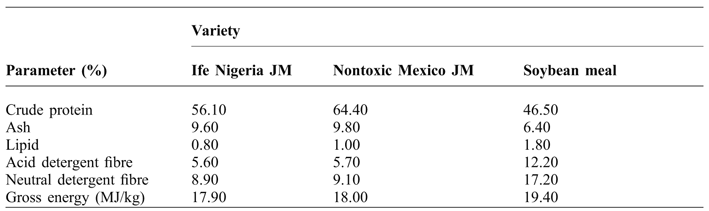
Jatropha seeds contain about 35-50% crude protein (Aslani et al., Reference ASLANI, MALEKI, MOHRI, SHARIFI, NAJJAR- NEZHAD and AFSHARI2007), 60% oil and is rich in essential amino acids and minerals (Makkar et al., Reference MAKKAR, FRANCIS and BECKER2008). The composition of kernel, husk and shell of jatropha is shown in Table 1 . Jatropha kernel is generally composed of protein and lipids with little ash and moisture. There are considerable differences in crude protein (CP) in the kernel that range between 22.2-27.2%. The low moisture content of shell (<10%) and kernel (<6%) is considered important for the non-deterioration for the seed over a long period of time. In comparison, soybean meal contains lower CP than JM (JM). The JM contains 10% ash, which is higher than that in soybean meal (6.4%), and gross energy is similar. This indicates that JM may be comparable to soybean meal in its usefulness in poultry diets (Makkar et al., Reference MAKKAR, BECKER, GARLAND and BARR1998).
Chemical properties, (DM %) of jatropha and soybean meal.

Sources: (Trabi, Reference TRABI1998; Makkar et al., Reference MAKKAR, BECKER, SPORER and WINK1997).
Amino acid composition of jatropha
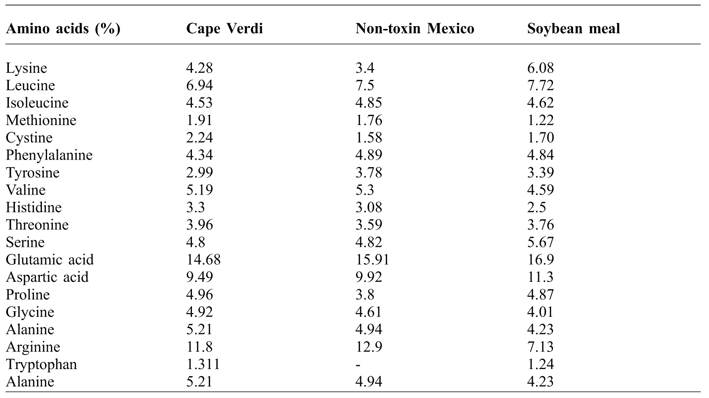
The differences between the composition of amino acids in jatropha and soybean meal are given in Table 2 . The amino acids in jatropha and soybean meal are very similar, except for lysine and glutamic acid which are lower in JM in comparison with soybean, and vice versa for arginine content. Makkar et al. (Reference MAKKAR, BECKER, GARLAND and BARR1998) found that the amino acids composition was improved in detoxified JM. The contents of essential amino acids in jatropha seed meal are higher than the standards of FAO references protein for a growing animal which indicates that JM could be a suitable substitute for growing animals (Makkar et al., Reference MAKKAR, FRANCIS and BECKER2008).
Amino acid composition of Jatropha curcas (cape Verdi, non-toxin Mexico) variety, and soybean.

Source (Makkar et al., 1998; Bau et al., Reference BAU, VILLAUME, LIN, EVRARD, QUEMENER, NICOLAS and MÉJEAN1994).
Medicinal uses of jatropha
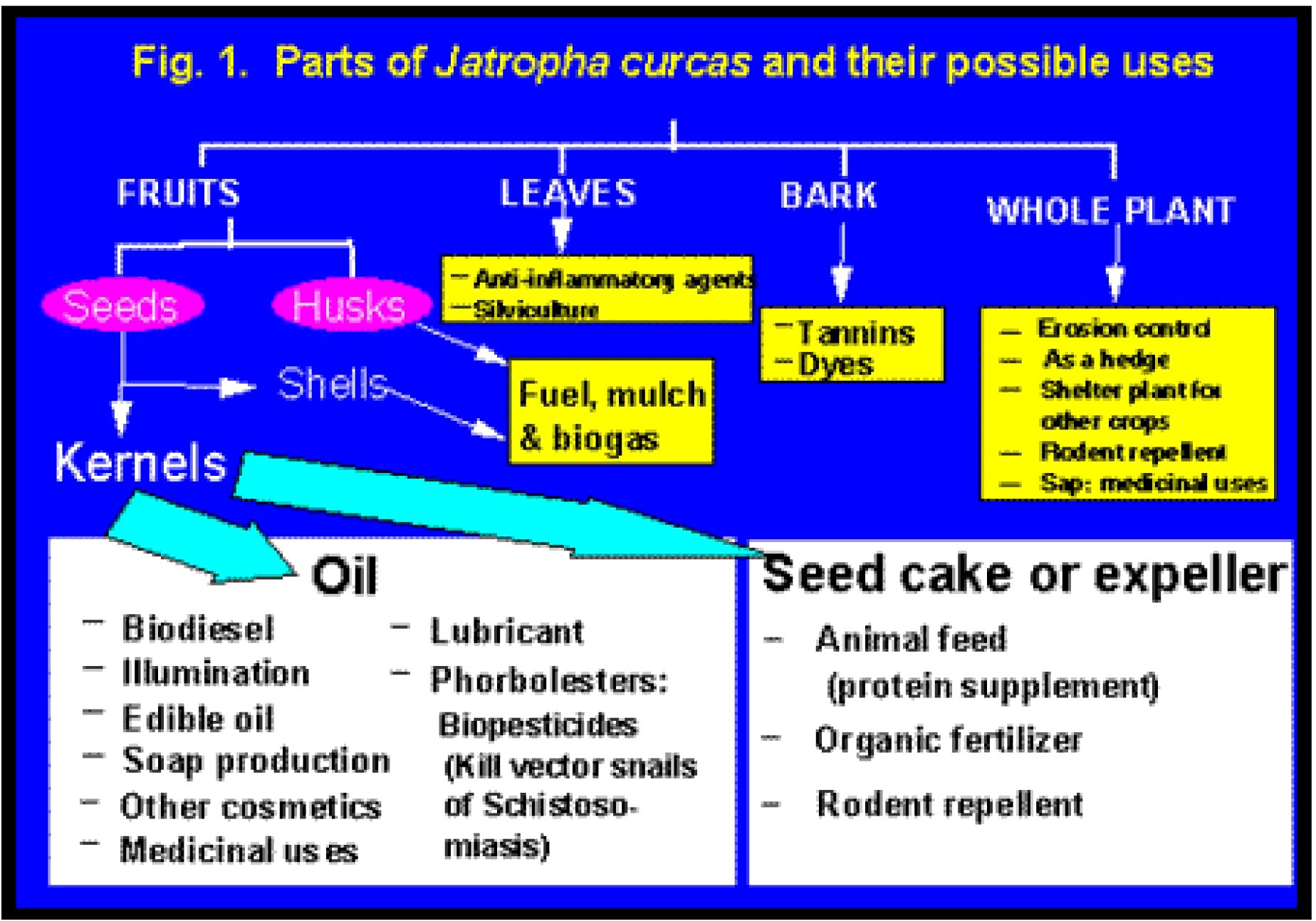
Preparations of all parts of this plant, including leaves, seeds, and bark, are used in traditional medicine and for veterinary purposes (Duke, Reference DUKE1988; Asuk et al., Reference ASUK, AGIANG, DASOFUNJO and WILLIE2015). The methanol extract of jatropha leaves showed cardiovascular benefits in animals. The sap flowing from jatropha's stem can be used to control the bleeding of wounds. The latex of jatropha contains alkaloids including jatrophine, curcain and jatropham which play an important role as anti-cancerous agents (Thomas et al., Reference THOMAS, SAH and SHARMA2008), and the roots are reportedly used as an antidote for snakebites. Jatropha oil has been widely used to treat various skin diseases (Marroquin et al., Reference MARROQUIN, BLANCO, GRANADOS, CACERES and MORALES1997). The 36% linoleic acid (C18:2) content of jatropha kernel oil is of interest for use in skincare. The phytochemical content of this plant is highest in the leaves and lowest in the roots, irrespective of the solvents used. All the parts of J. curcas (leaf, stem bark and shell) especially the leaf strongly exhibited flavonoids and polyphenols, and these phytochemicals are known to exercise anti-oxidative activities, protection against allergies, platelet aggregation, inflammation, hepatic toxicity microbes, ulcers, viruses and tumours (Gutierrez-Orozco et al., 2013; Syed et al., Reference SYED, CHAMCHEU, ADHAMI and MUKHTAR2013). Certain diterpenoids from J. curcas possess therapeutic potential as antihypertensive, antiretroviral, anti-inflammatory and antibacterial drugs. In addition to, these activities and compounds may function as hallucinogens, antioxidant and sweeteners (Kumari et al., Reference KUMARI, ARAVIND, BALACHANDRAN, GANESH, DEVI, RAJAN, MALATHI and RAVIKUMAR2003). When processed as a cottage industry, the meal retains 11% of its oil and has 58 to 60% crude protein and 53 to 55% true protein content (Islam et al., Reference ISLAM, YAAKOB and ANUAR2011; Figure 1 ).
Uses of various parts of jatropha plant.

Anti-nutritional factors in jatropha plant
Plants produce a variety of toxins, such as alkaloids terpenoids, tannins, saponins, cyanogenic, glycosides and toxic amino acids, and these generally limit their ingestion by animals (Cheeke, Reference CHEEKE1998). Jatropha curcas meal contains negligible amounts of total phenols in the range of 0.2-0.4% and 0.02-0.04% tannins. The condensed tannins are unable to detect in the jatropha kernel meal (Makkar et al., Reference MAKKAR, BECKER, GARLAND and BARR1998) and tannin contents in the stem bark are very low (outer dark bark: tannins 0.7% and condensed tannins 0.2%; inner green bark: tannins 3.1% and condensed tannins 1.7%; with tannins expressed as tannic acid equivalent and condensed tannins as leucocyanidin equivalent; Makkar et al., Reference MAKKAR, FRANCIS and BECKER2008).
The saponin content in JM from different locations ranged between 1.8-3.4%, and are non-haemolytic. These substances can be inactivated by processing methods such as sun drying or oven baking, boiling or steaming or grinding prior to heat treatment (Adewolu, Reference ADEWOLU2008).
Jatropha detoxification
The presence of anti-nutritional and toxic components in jatropha restricts its use in poultry rations, where raw jatropha seeds or oil showed certain toxicities in different animal species. Jatropha seeds are toxic to broiler chickens (Pasaribu et al., Reference PASARIBU, WINA, TANGENDJAJA and ISKANDAR2010; Ojo et al., Reference OJO, OGUCHE, KUBE and UDZER2013) and quail (Agboola et al., 2015). Reduction of anti-nutritive and toxic components of JM is necessary before its use a source of nutrients for animal and poultry diets (Annongu et al., Reference ANNONGU, BELEWU and JOSEPH2010; Agboola et al., 2015). The protein or meal isolates acquired from the non-toxic genotypes after heat treatment could be an excellent protein-rich ingredient in the diet of monogastric animals (Makkar et al., 1999). Decreases in the levels of anti-nutritional factors to safe limits may be achieved by thermal degradation, germination, soaking in distilled water and extraction of methanol (Magdi, Reference MAGDI2007; Yasmin et al., Reference YASMIN, ZEB, KHALIL, PARACHA and KHATTAK2008), lye treatment, hot water treatment and fermentation (Akande et al., Reference AKANDE, ODUNSI and ADEDEJI2011).
The nutritional value of the non-toxic JM is good after heat treatment which eliminates anti-nutritional factors like trypsin inhibitor and lectins, which can also decrease phorbol ester content by 97.9%. A study by Sumiati et al. (Reference SUMIATI, SUDARMAN, HIDAYAH and SANTOSO2007) reported that various treatments such as a combination of chemical plus physical and biological methods to detoxify JM as poultry feed. The treatments used in this experiment were: (a) heat treatment using autoclave at 121°C for 30 min.; (b) addition of NaOH at 4%, followed by autoclaving at 121°C during 30 min.; (c) fermentation with Rhizopus oligosporous. The results showed that these treatments decreased the curcin and lectin effects and increased protein utilisation efficiency, retention of phosphorus, calcium and metabolisable energy values of the meal. Fermentation using Rhizopus oligosporous was the best method to detoxify the meal and increase the nutritive value for poultry. However, when JM used above 10% in the diet, it could cause higher mortality in birds (Agboola and Adenuga, Reference AGBOOLA and ADENUGA2015).
Uses of jatropha in poultry nutrition
Pasaribu et al. (Reference PASARIBU, WINA, TANGENDJAJA and ISKANDAR2010) found that use of 4% raw JM in broilers caused negative impacts on weight gain, compared to using 4% chemically and physically treated JM, which showed an improvement (P>0.05) in live body weight. Abd El-Hack et al. (Reference ABD EL-HACK, ALAGAWANY, EL-SAYED and FOWLER2017) divided laying Japanese quail into four treatment groups: control (0% JM); 3.5% raw JM; 3.5% JM heated in an oven at 100°C for 24 h (JM24); and 3.5% JM heated in oven at 100°C for 48 h (JM48). The authors concluded that heat treatment of JM is essential to eliminate its nephrotoxic and hepatotoxic compounds and, when properly heat-treated, can be used in laying Japanese quail diets without detrimental effects on production, reproductive performance or health status.
Barros et al. (Reference BARROS, RODRIGUES, NUNES, KASUYA, DALUZ, ALVES, FERREIRA, PINHEIRO and MOURAO2015) showed that the use of raw JM (25, 50, or 100 g/kg of diet) in broiler diets had adverse impacts on digestibility, internal organs and development of the gut. Sumiati et al. (2011) studied the impact of JM on broilers. Treatments were: R0 (diet without JM), R1 (3% fermented JM), R2 (6% fermented JM) and R3 (9% fermented JM). Results showed that feeding JM at the level of 9% (R3) reduced (P<0.01) feed consumption, body weight and body weight gain and increased (P>0.05) mortality. Fermentation of JM using R. oligosporus had no effective detoxification in relation to the improvement of broiler performances. Raw jatropha seed meal (JSM) contains high crude protein (56%), as compared with soybean meal (44 to 48%). However, during the oil extraction process, the shell is not completely removed. Therefore, the by-product JM contains a high content of crude fibre in its fractionations such as lignin (Makkar and Becker, Reference MAKKAR and BECKER1999). Moreover, its anti-nutritional content (Makkar et al., Reference MAKKAR, BECKER, GARLAND and BARR1998; Rakshit et al., Reference RAKSHIT, DARUKESHWARA, RATHINA RAJ, NARASIMHAMURTHY, SAIBABA and BHAGYA2008) can have negative effects on feed utilisation and bird performance. Use of 5% heat-treated JM was considered the safest level for growing quail, while the viability rate was decreased with increasing levels above 10% (Agboola and Adenuga, Reference AGBOOLA and ADENUGA2015). Moreover, Gross et al. (Reference GROSS, FOIDL and FOIDL1997) showed that the use of raw JM in a diet caused 100% mortality and chemically treated JM was able to reduce mortality rate to 8%.
Conclusions
Jatropha is an interesting plant with beneficial applications, particularly as biofuel, and by-product meal has been characterised as a potentially useful feedstuff due to its high content of crude protein, essential amino acids and minerals, but this plant contains some anti-nutritional factors and toxic compounds. Thus, when we need to use this plant as a safe and healthy product, it should be exposed to some treatments. Since, after physical or chemical treatment, a jatropha seed meal can be used as growth booster, immunomodulant, antioxidants, hypocholestermic, antihypertensive, hepatoprotectant, antiretroviral, anti-inflammatory, analgesic and antibacterial agents.
Conflict of interests
The authors declared that they have no conflict of interests.
Acknowledgment
All the authors of the manuscript thank and acknowledge their respective Universities and Institutes.