Introduction
Before the 21st century, many ventures were made in neonatal and paediatric health services in just about all countries worldwide; however, not much emphasis was given to exploring adolescents’ health needs (Weiss, Sullivan, & Tull, Reference Weiss, Sullivan and Tull2015). In recent times, researchers have shown keen interest in studying physiological, psychological, and social or environmental factors potentially related to risky behaviours such as drug abuse, self-harm, unsafe sexual behaviour, violence, bullying, self-sabotaging behaviours, and sedentary lifestyles. Adolescence is an intermediate period between childhood and adulthood, during which youth experience physiological, neurological, and psychosocial transformations (Janssen, Weerman, & Eichelsheim, Reference Janssen, Weerman and Eichelsheim2017; Moretti & Peled, Reference Moretti and Peled2004; Zimmermann, Richardson, & Baker, Reference Zimmermann, Richardson and Baker2019). Poor adaptability to these changes and resulting mental state may drive youth to engage in multiple forms of HRBs. The HRBs which are more likely to begin in adolescence are addictive behaviours (e.g., alcohol consumption, cigarette smoking), risky sexual activities (e.g., unprotected intercourse), externalising behaviours (e.g., aggression, rule-breaking, impulsivity, self-harm), and sedentary lifestyle (e.g., unhealthy dietary behaviours and physical inactivity) (Centre for Disease Control and Prevention, 2019; Underwood et al., Reference Underwood, Brener, Thornton, Harris, Bryan, Shanklin and Dittus2020).
Recent data suggest that, in 2019, over 1.5 million adolescents and young adults within the age range of 10–24 years old died, primarily due to engagement in Health-Risk Behaviours (HRBs), such as violence, injuries, mental health issues, alcohol, drug abuse, undernutrition, obesity, HIV/AIDS, tobacco use, and physical inactivity (World Health Organization, 2021). HRB-related causes of death has become one of the leading causes of mortality among adolescents in developing countries also (Weiss & Ferrand, Reference Weiss and Ferrand2019). Furthermore, these risky behaviours are associated with a variety of detrimental societal costs also, such as disease, criminal justice system costs, injury, and healthcare usage, academic achievements; and employee performance (Cawley & Ruhm, Reference Cawley and Ruhm2011; Estévez et al., Reference Estévez, Jáuregui, Lopez-Gonzalez, Mena-Moreno, Lozano-Madrid, Macia and Jiménez-Murcia2020; Weiss et al., Reference Weiss, Sullivan and Tull2015). Thus, it is necessary to give full attention to HRBs during adolescence and take steps to protect young people's health. These will have broader benefits for health and the economy.
Researchers claimed that adolescents do not learn these unhealthy behaviours within a vacuum, and various risk and protective factors, both personal and contextual, affect the development of unhealthy behaviours (Bailey et al., Reference Bailey, Regan, Bartlem, Wiggers, Wye and Bowman2019; Bozzini, Bauer, Maruyama, Simões, & Matijasevich, Reference Bozzini, Bauer, Maruyama, Simões and Matijasevich2020). Hagger, Cameron, Hamilton, Hankonen, and Lintunen (Reference Hagger, Cameron, Hamilton, Hankonen and Lintunen2020) covered 17 approaches describing behavioural determinants and implicitly suggesting interventions for behaviour change. Among these approaches, the social cognition approach is a key perspective (e.g., Ajzen, Reference Ajzen1991; Bandura, Reference Bandura1985; Leventhal, Meyer, & Nerenz, Reference Leventhal, Meyer, Nerenz and Rachman1980; Rogers, Reference Rogers1975; Rosenstock, Reference Rosenstock1974), which considers attitudes and beliefs as the main determinants of behaviour development. Another perspective views behaviour development as a function of internal motivational and regulatory processes (e.g., Carver & Scheier, Reference Carver and Scheier1982; Ryan & Deci, Reference Ryan and Deci2018). The present study can be marginally related to the perspective offered by integrative self-control theory (Kotabe & Hofmann, Reference Kotabe and Hofmann2015), which proposes that behaviour development and change are influenced by the ability to regulate emotions or impulses and refrain from impulsive behaviour. As suggested by the existing theories, understanding and exploring the associations between the potential factors and health behaviours is a prerequisite for developing effective interventions to alter health-related behaviours.
While considering the significance of understanding HRBs, several researchers explored the potential factors associated with HRBs (Hartley & Somerville, Reference Hartley and Somerville2015; Roditis, Delucchi, Cash, & Halpern-Felsher, Reference Roditis, Delucchi, Cash and Halpern-Felsher2016). Among other factors, recent research findings have emphasised that HRBs may be associated with deficits in emotion regulation (Gross, Reference Gross2015). Behaviour is a product of a sophisticated interaction among various human systems, and emotion is one of such systems. Emotion trajectory starts when a scenario is perceived as important to one's goals. These emotions coordinate a bodily response that produces or inhibits behavioural reactions in order to achieve the desired goal (Gross, Reference Gross, Pervin and John1999). Thus, emotions initiate and guide our behaviour, including HRBs; therefore, its understanding and subsequent regulation may modify the tendency of the youth to engage in HRBs.
Emotion regulation is a process of shaping which emotions one has and how one expresses these emotions to achieve the desired goal (De Berardis et al., Reference De Berardis, Fornaro, Orsolini, Ventriglio, Vellante and Di Giannantonio2020; Gross, Reference Gross2015; Thompson, Reference Thompson1994). It comprises multiple skills like using strategies for modulating one's emotional response, recognising emotions in others and recognising one's emotional state. Inadequate skills or inability to use the available skills may render emotions ineffective, and instead of promoting adaptive behaviour, it may direct individuals towards HRBs. Modification in emotional experiences can affect health outcomes as it may influence underlying psychological or physical states.
Self-regulation to govern the emotion system may include indulging in or avoiding certain behaviours that are directly related to health. Many times, HRBs, for example, unhealthy eating (Sim & Zeman, Reference Sim and Zeman2005), inflicting self-harm (Horne & Csipke, Reference Horne and Csipke2009), excessive alcohol consumption (Sher & Grekin, Reference Sher, Grekin and Gross2007), and other impulsive behaviours in conflicting situations (Cooper, Flanagan, Talley, & Micheas, Reference Cooper, Flanagan, Talley, Micheas, Snyder, Simpson and Hughes2006), are an attempt to modify negative emotional experiences (Berking, Orth, Wupperman, Meier, & Caspar, Reference Berking, Orth, Wupperman, Meier and Caspar2008). For instance, eating has been considered an attempt to improve their emotional state (Macht, Reference Macht2008), and similarly, self-harm behaviours have also been considered attempts to release negative emotions (Horne & Csipke, Reference Horne and Csipke2009).
One evidence-based model explaining the association between HRBs and emotional dysregulation (Webb, Miles, & Sheeran, Reference Webb, Miles and Sheeran2012) is Gross’ process model of emotion regulation (Gross, Reference Gross2015). It is based on three aspects of emotion regulation: emotion regulation goal, the strategy used by an individual, and the outcome. The model includes five families of emotion regulation strategies, namely situation selection (altering the probability of getting in an emotion-inducing situation), situation modification (altering a few aspects of the situation to change its impact), attentional deployment (directing attention towards non-emotional aspects of the situation), cognitive change (rephrasing a problem to alter its significance in one's life), and response modulation (engaging in a behaviour to change experimental or behavioural parts of the emotional experience). These strategies are believed to alter the emotional experience that successively influences an individual's behaviour (Gross, Reference Gross2015). The model also suggests that individuals unable to alter their emotional trajectory and achieve the desired goal will experience more unpleasant emotional experiences. Such negative experiences may predispose them for HRBs (Fu et al., Reference Fu, Wang, Zhao, Xie, Chen, Nie and Lei2020; Garofalo & Velotti, Reference Garofalo and Velotti2017; Lansing, Plante, Golshan, Fennema-Notestine, & Thuret, Reference Lansing, Plante, Golshan, Fennema-Notestine and Thuret2019; Ram, George, & Gowdappa, Reference Ram, George and Gowdappa2018; Weiss et al., Reference Weiss, Sullivan and Tull2015; Zafar, Debowska, & Boduszek, Reference Zafar, Debowska and Boduszek2021).
One way of operationalising emotion regulation is to explore specific kinds of difficulties that individuals may experience in executing emotion regulation skills effectively. In this regard, Gratz and Roemer (Reference Gratz and Roemer2004) proposed a model of difficulties in emotion regulation in which they identified a few specific areas, namely understanding and acceptance of emotions, capacity to avoid impulsive behaviours once confronted with negative emotions, ability to control the intensity and temporal characteristics of emotional experience, and ability to use effective emotion regulation strategies. According to the model, difficulties in these areas may cause emotion dysregulation, and individuals may experience dysfunctional emotions. In order to deal with these dysfunctional emotions, individuals may engage in health-compromising behaviours, such as substance abuse, self-harming behaviours, and violence (Gratz & Roemer, Reference Gratz and Roemer2004).
In the literature, studies are available that linked emotional dysregulation to the development of adolescents’ HRBs (Lozano-Madrid et al., Reference Lozano-Madrid, Clark Bryan, Granero, Sánchez, Riesco, Mallorquí-Bagué and Fernández-Aranda2020; McLaughlin, Hatzenbuehler, Mennin, & Nolen-Hoeksema, Reference McLaughlin, Hatzenbuehler, Mennin and Nolen-Hoeksema2011); however, most studies have taken emotional dysregulation as a unitary latent construct, not as a multidimensional construct and have not tried to explore the relationship between its multifaceted dimensions and HRBs. Besides, most studies mainly investigated more problematic HRBs such as substance abuse and unsafe sexual relationships. A few studies investigated less severe but more prevalent HRBs such as self-harming behaviour, risky-driving, unhealthy dietary behaviours, and medical examination or compliance. Moreover, the studies’ samples were mainly drawn from western, educated, industrialised, rich, and democratic societies (Nielsen, Haun, Kärtner, & Legare, Reference Nielsen, Haun, Kärtner and Legare2017). Substantial research has supported the notion that the expression and acceptance of emotional expression vary from one culture to another. In a collectivistic culture like India, expressing negative emotions is less appreciated, and conformity is much appreciated, which affect children's emotional development (Chadda & Deb, Reference Chadda and Deb2013; Hapunda, Mahama, Mesurado, Verma, & Koller, Reference Hapunda, Mahama, Mesurado, Verma and Koller2019; Šeibokaitė, Endriulaitienė, Sullman, Markšaitytė, & Žardeckaitė-Matulaitienė, Reference Šeibokaitė, Endriulaitienė, Sullman, Markšaitytė and Žardeckaitė-Matulaitienė2017).
Thus, prior research has indicated that emotion regulation difficulties may influence HRBs among adolescents. However, more empirical research exploring the inter-construct mechanism of emotion regulation and HRBs is needed (Lozano-Madrid et al., Reference Lozano-Madrid, Clark Bryan, Granero, Sánchez, Riesco, Mallorquí-Bagué and Fernández-Aranda2020). The present study aimed to explore the role of six dimensions of emotion regulation difficulties, namely lack of emotional clarity, limited access to effective emotion regulation strategies, lack of emotional awareness, difficulties engaging in goal-directed behaviour, impulse control difficulties, and non-acceptance of emotional responses in six types of HRBs, self-harming behaviour, risky-driving, unhealthy dietary behaviour, violence, inadequate physical activity, and lack of medication adherence. Based on the literature review, it was expected that the mentioned specific emotion regulation difficulties would be related to adolescents’ engagement in various specific HRBs.
Method
Sample
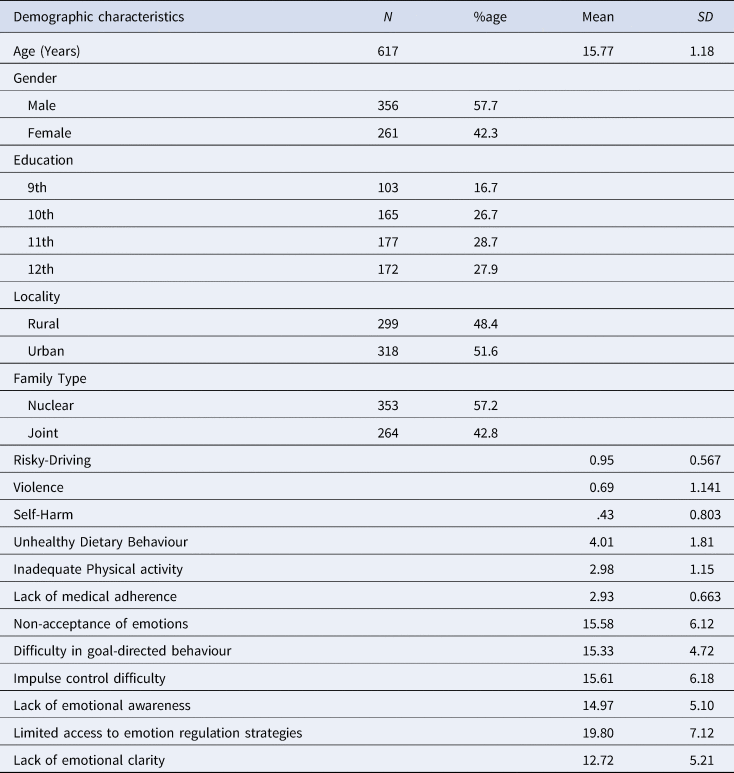
The sample of the study comprised of 617 (Males = 356) participants in the age range of 15–18 years (Mean age = 15.77, SD = 1.18) which were selected using multi-stage stratified random sampling. The participants were studying in 9th to 12th standards at various schools spread over five districts of Punjab state of India and belonged to both rural and urban areas. More specifically, four schools were chosen from each selected district of Punjab, and then 40 students from each school participated in the study. After taking participants’ assent and their parents’ informed consent, the assessment was done. Due to the COVID-19 pandemic, the responses were collected through online forms. Out of 800 selected respondents, only 617 responses could be used in the analysis because of incomplete responses, over or under-age and non-receipt of parental consent. The demographic details of the sample are presented in Table 1.
Demographic Characteristics of the Sample and Descriptive Statistics

Measures
Youth Risk Behaviour Survey Questionnaire
The Youth Risk Behaviour Survey (Centre for Disease Control and Prevention, 2019) is a part of the Youth Risk Behaviour Surveillance System, an annual assessment initiated by the Centre for Disease Control and Prevention. This questionnaire assesses a few HRBs such as risky-driving, self-harm behaviours, violence, unhealthy dietary behaviours, and physical inactivity. It contained 89 questions; however, only 37 were used in the current study to assess the presence and severity of HRBs. Other items were discarded because either those were related to domains other than our interest or were not suitable for the Indian culture (as suggested by the Institute Ethics Committee). The behaviours included in the study were violence, risky-driving, self-harming behaviour, unhealthy dietary behaviours, physical inactivity, and poor medication adherence. A higher score on each subscale indicates higher engagement in the related behaviour. Psychometric properties of this questionnaire have been found satisfactory (Lima, Maia, Brito, Pinho, & Silveira, Reference Lima, Maia, Brito, Pinho and Silveira2020); Cronbach's alpha reported was around 0.77, and the intraclass correlation coefficients between different HRBs were around 0.75. In the present study, Cronbach alphas ranged from 0.69 to 0.78 for studied HRBs. Some of the items are: ‘During the past 30 days, how many times did you drive/ride a car/scooter or another vehicle faster than the prescribed speed limit?’; ‘During the past seven days, on how many days were you physically active for a total of at least 60 min per day?’; ‘During the past seven days, on how many days did you eat meals on time?’
Difficulties in emotion regulation questionnaire
This questionnaire was developed by Gratz and Roemer (Reference Gratz and Roemer2004). It has 36 items that measure six kinds of difficulties associated with emotion regulation, namely lack of emotional awareness, non-acceptance of emotional responses, difficulties engaging in goal-directed behaviours, difficulties controlling impulsive behaviours, limited access to emotion regulation strategies, and lack of emotional clarity. Respondents are required to report ‘how often the statements apply to them’ on a 5-point scale (‘almost never’ to ‘almost always’). A higher score on this questionnaire indicates more emotion regulation difficulties. In the previous research, the Cronbach alphas for the six types of difficulties were found to be satisfactory; for instance, Hallion, Steinman, Tolin, and Diefenbach (Reference Hallion, Steinman, Tolin and Diefenbach2018) observed the coefficient values ranged from 0.82 to 0.95. In the current study, the Cronbach alpha for all 36 items was 0.91, and for subscales, it ranges from 0.79 to 0.91.
Procedure
After finalising the design and methodology, the research proposal was got approved by the Institute Ethics Committee (Human). The required sample size was calculated, keeping alpha at .01, power at 0.80, and considering a small effect size. The statistical power analysis suggested a sample size of a minimum of 645 participants; thus, the present study's sample size (N = 617) can be considered adequate (Cohen, Reference Cohen1992). For data collection, five districts of Punjab were selected randomly. Furthermore, around 100 schools of selected districts were contacted and informed about the project. Many schools refused to participate, and among the schools that permitted us to collect data, a total of 20 schools (four schools from each district) were shortlisted. Contact details of students studying in 9th to 12th grades were obtained from each school. As the participants were minors, parents’ consent was obtained before collecting data from the participants. Once the parents gave their consent, participants provided relevant information on the questionnaires. Out of 800 participants, only 617 responses could be used for the statistical analysis as a few parents did not give their consent or the participants did not provide the complete information; therefore, they were removed from the final analysis. Once the targeted responses were received from a particular school, several webinars were conducted for the students by trained psychologists as compensation for their participation.
Statistical Analysis
Descriptive statistics were calculated; correlation and regression analysis were applied to test the proposed hypotheses. In regression analysis, predictability of six facets of emotion regulation difficulties was explored for risky-driving, self-harming behaviour, violence, unhealthy dietary behaviour, inadequate physical activity, and lack of medication adherence.
Results
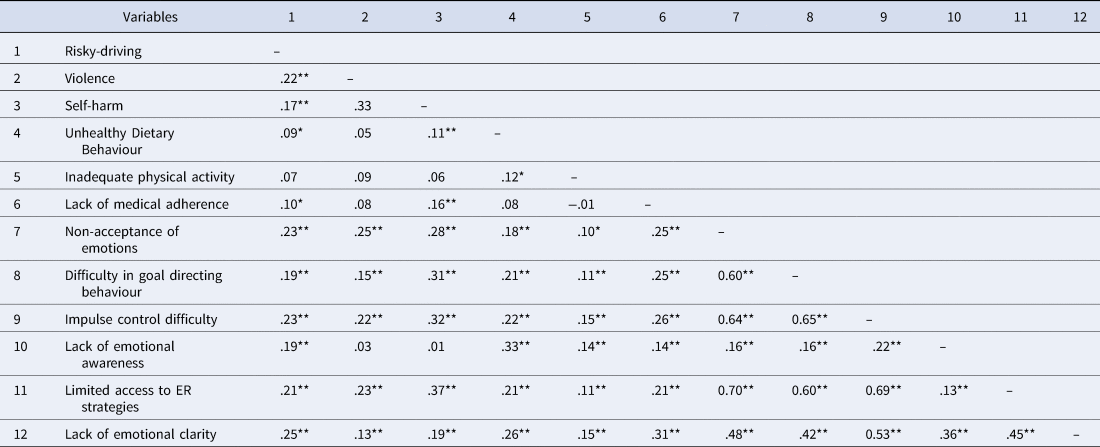
The findings of the study are given in Tables 1–8. Table 1 shows the descriptive statistics. Apart from the sample's demographic characteristics, the means and SD scores of all the subscales are also presented. The observed mean scores of the emotion regulation difficulties were similar to the previous studies (e.g., Hallion et al., Reference Hallion, Steinman, Tolin and Diefenbach2018). In the present study, the means scores on difficulties engaging in goal-directed behaviours, non-acceptance of emotional responses, lack of emotional awareness, difficulties controlling impulsive behaviours, lack of emotional clarity, and limited access to emotion regulation strategies were found to be 15.33, 15.58, 14.97, 15.61, 12.80, and 19.80, respectively. Hallion et al. (Reference Hallion, Steinman, Tolin and Diefenbach2018) observed these values as 14.67, 15.42, 12.58, 15.55, 19.67, and 12.01; more or less, the values are similar to the present study's findings. As far as HRBs are concerned, participants in the current study reported less engagement in a few HRBs, such as violence and inadequate physical activity, as compared to other samples studied previously (e.g., Lima et al., Reference Lima, Maia, Brito, Pinho and Silveira2020). As shown in Table 2, all specific emotion regulation difficulties are significantly correlated (p < .01) with all specific HRBs, that is, risky-driving, violence, self-harm, unhealthy dietary, inadequate physical activity, and lack of medication adherence.
Correlation Coefficients among Six Types of Emotion Regulation Difficulties Six Types of Health-Risk Behaviours

Note: N = 617, *p < .05, **p < .01.
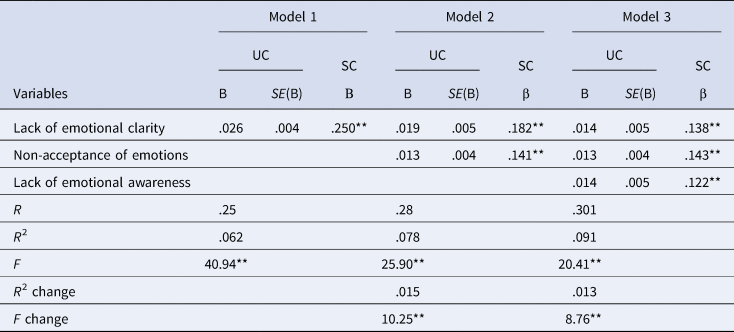
Table 3 shows that out of all facets of emotional dysregulation, lack of emotional clarity, non-acceptance of emotions, and lack of emotional awareness emerged as the significant predictor of risky-driving. Risky-driving scores were significantly predicted by lack of emotional clarity, β = .138, t(613) = 2.97, p < .001, non-acceptance of emotions, β = .143, t(613) = 3.25, p < .001, and lack of emotional awareness, β = .143, t(613) = 2.96, p < .001. These predictors also explained a significant portion of variance in risky-driving behaviour scores, R 2 = .09, F(3, 613) = 20.41, p < .001.
Stepwise Regression Analysis Summary for Risky-Driving (Criterion Variable) and Emotion Regulation Difficulties (Predictor Variables)

Note: N = 617, UC = Unstandardized Coefficient; SC = Standardised Coefficient.
** p < .01.
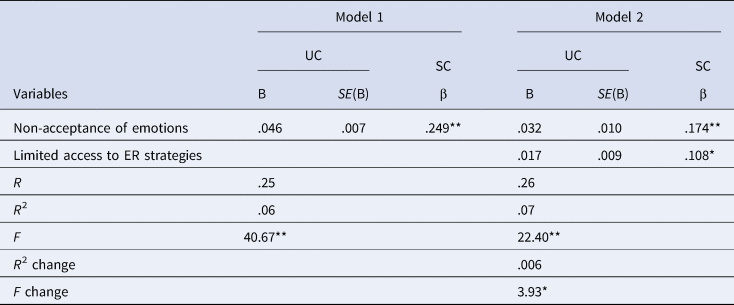
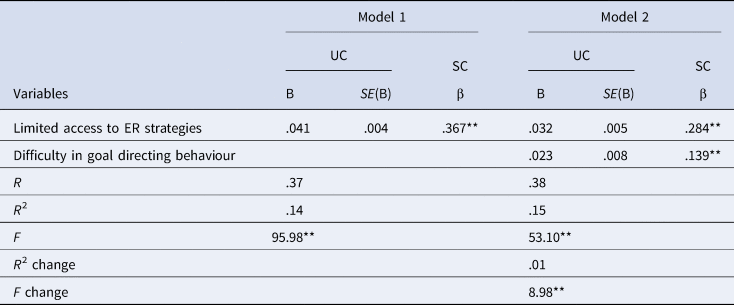
As given in Table 4, among all types of difficulties, non-acceptance of emotions and limited access to emotion regulation strategies were emerged as the significant predictor of violence. Violence scores were significantly predicted by non-acceptance of emotions, β = .174, t(614) = 3.20, p < .001 and limited access to emotion regulation strategies, β = .108, t(614) = 1.98, p < .005. These predictors also explained a significant proportion of variance in violence scores, R 2 = .07, F(2, 614) = 22.40, p < .001. Table 5 shows that limited access to emotion regulation strategies and difficulty in goal-directed behaviour are significant predictor of self-harm. Self-harm scores were significantly predicted by limited access to emotion regulation strategies, β = .284, t(614) = 6.10, p < .001 and difficulty on emotion regulation strategies, β = .139, t(614) = 2.99, p < .005. These predictors also explained a significant portion of variance in self-harm scores, R 2 = .15, F(2, 614) = 53.10, p < .001.
Stepwise Regression Analysis Summary for Violence (Criterion Variable) and Emotion Regulation Difficulties (Predictor Variables)

Note: N = 617, UC = Unstandardized Coefficient; SC = Standardised Coefficient.
*p < .05, **p < .01.
Stepwise Regression Analysis Summary for Self-Harm Behaviours (Criterion Variable) and Emotion Regulation Difficulties (Predictor Variables)

Note: N = 617, UC = Unstandardized Coefficient; SC = Standardised Coefficient.
** p < .01.
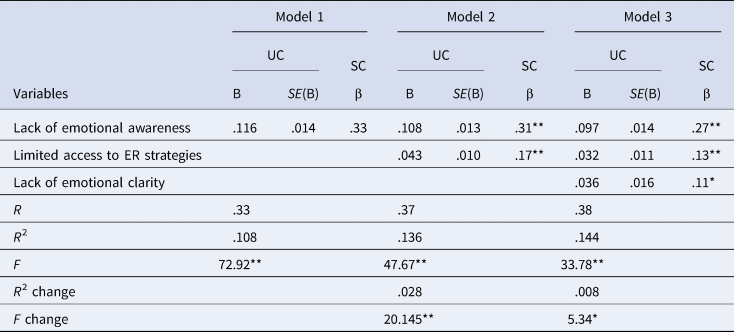
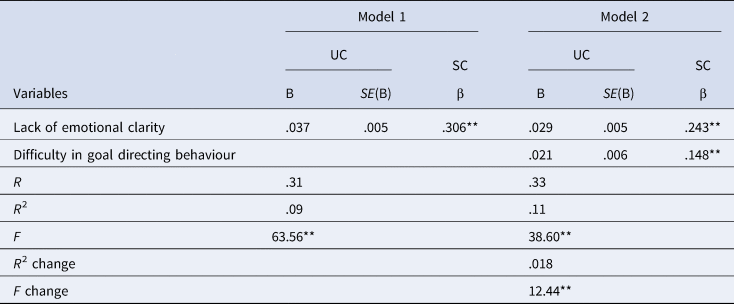
Table 6 shows finding related to unhealthy dietary behaviour. Among all types of difficulties, lack of emotional awareness, β = .27, t(613) = 6.74, p < .001, limited access to emotion regulation strategies, β = .13, t(613) = 3.01, p = .003, and lack of emotional clarity, β = .110, t(613) = 2.31, p = .02 emerged as the significant predictor. These predictors explained a significant portion of variance in unhealthy dietary behaviour, R 2 = .144, F(3, 613) = 33.78, p < .001. Table 7 shows finding related to inadequate physical activity. Among all types of difficulties, lack of emotional clarity, β = .109, t(613) = 2.56, p = .011 and limited access to emotion regulation strategies, β = .096, t(613) = 2.26, p = .024 emerged as the significant predictor. These predictors explained a significant proportion of variance in the inadequate physical activity scores, R 2 = .17, F(3, 613) = 9.17, p < .001. Findings about medical adherence are given in Table 8. As shown, lack of medical adherence is significantly predicted by lack of emotional clarity, β = .243, t(614) = 5.80, p < .001 and difficulty in goal-directed behaviour, β = .148, t(614) = 3.52, p < .001. These predictors explained a significant portion of variance in the criterion variable, R 2 = .11, F(3, 613) = 38.60, p < .001.
Stepwise Regression Analysis Summary for Unhealthy Dietary Behaviours (Criterion Variable) and Emotion Regulation Difficulties (Predictor Variables)

Note: N = 617, UC = Unstandardized Coefficient; SC = Standardised Coefficient.
*p < .05, **p < .01.
Stepwise Regression Analysis Summary for Inadequate Physical Activity (Criterion Variable) and Emotion Regulation Difficulties (Predictor Variables)

Note: N = 617, UC = Unstandardized Coefficient; SC = Standardised Coefficient.
*p < .05, **p < .01.
Stepwise Regression Analysis Summary for Lack of Medication Adherence (Criterion Variable) and Emotion Regulation Difficulties (Predictor Variables)

Note: N = 617, UC = Unstandardized Coefficient; SC = Standardised Coefficient.
** p < .01.
Discussion
The current study explored the relationship between emotion regulation difficulties and HRBs among adolescents. As hypothesised, emotion regulation difficulties emerged as significant predictors of one or the other HRBs. The findings align with previous research supporting a significant association between emotional dysregulation and HRBs (Fu et al., Reference Fu, Wang, Zhao, Xie, Chen, Nie and Lei2020; Garofalo & Velotti, Reference Garofalo and Velotti2017; Kolar et al., Reference Kolar, Neumayr, Roth, Voderholzer, Perthes and Schlegl2019; Weiss et al., Reference Weiss, Sullivan and Tull2015; Zafar et al., Reference Zafar, Debowska and Boduszek2021). Thus, the findings support the association of emotion dysregulation with HRBs and highlight the significance of specific emotion regulation difficulties in predisposing individuals to engage in specific HRBs.
For risky-driving behaviours, lack of emotional awareness, lack of emotional clarity, and non-acceptance of emotions are found to be significant predictors. Similar findings were observed in previous research also (e.g., Arnau-Sabatés, Sala-Roca, & Jariot-Garcia, Reference Arnau-Sabatés, Sala-Roca and Jariot-Garcia2012; Šeibokaitė et al., Reference Šeibokaitė, Endriulaitienė, Sullman, Markšaitytė and Žardeckaitė-Matulaitienė2017; Trógolo, Melchior, & Medrano, Reference Trógolo, Melchior and Medrano2014; Žardeckaitė-Matulaitienė, Endriulaitienė, Šeibokaitė, Markšaitytė, & Slavinskienė, Reference Žardeckaitė-Matulaitienė, Endriulaitienė, Šeibokaitė, Markšaitytė and Slavinskienė2020). Individuals with difficulties in regulating emotions are likely to experience more intense negative emotion and behave aggressively (Denson, DeWall, & Finkel, Reference Denson, DeWall and Finkel2012; Pond et al., Reference Pond, Kashdan, DeWall, Savostyanova, Lambert and Fincham2012; Rivers et al., Reference Rivers, Brackett, Omori, Sickler, Bertoli and Salovey2013), which may subsequently lead to risky-driving (King & Parker, Reference King and Parker2008; González-Iglesias, Gómez-Fraguela, & Luengo-Martín, Reference González-Iglesias, Gómez-Fraguela and Luengo-Martín2012).
Specific emotion regulatory factors, for example, awareness about the dynamics of emotion trajectory and acceptance, help modulate emotions to achieve the desired goal. Inadequate awareness and acceptance may result in poor emotional control and subsequent risk-taking behaviours (Gratz & Roemer, Reference Gratz and Roemer2004). The thrill-seeking behaviour can serve as a coping mechanism for people to control intense emotions. This explanation was supported by a model of emotional intelligence in which Mayer, Salovey, Caruso, and Sitarenios (Reference Mayer, Salovey, Caruso and Sitarenios2003) suggested that inadequate skills pertaining to perceiving emotion, understanding emotions, and managing may contribute to risky-driving behaviours (Hayley, de Ridder, Stough, Ford, & Downey, Reference Hayley, de Ridder, Stough, Ford and Downey2017).
The findings have theoretical and practical implications as these indicate that some specific emotion regulation difficulties are more important than others for risky-driving behaviours. As observed, all three types of difficulties, found significant in the present study, are related to the initial processing of maladaptive emotions. The other three, not significant types, are related to the execution of planned behaviour. It suggests that the awareness and acceptance of emotions may be more important; however, more replications and experimental or longitudinal studies are required to establish the link. Once established, these specific difficulties can be targeted to regulate risky-driving behaviours of adolescents. Previous studies have supported the acceptability of emotion regulation interventions in altering varied HRBs (Bjureberg et al., Reference Bjureberg, Sahlin, Hellner, Hedman-Lagerlöf, Gratz, Bjärehed and Ljótsson2017).
In the case of violence, two types of emotion regulation difficulties, namely non-acceptance of emotions and limited access to emotion regulation strategies, emerged as the most significant predictors among adolescents. These findings align with previous findings (Gratz, Levy, & Tull, Reference Gratz, Levy and Tull2012; Garofalo, Neumann, Kosson, & Velotti, Reference Garofalo, Neumann, Kosson and Velotti2020; Shorey, McNulty, Moore, & Stuart, Reference Shorey, McNulty, Moore and Stuart2015; Stappenbeck, Davis, Cherf, Gulati, & Kajumulo, Reference Stappenbeck, Davis, Cherf, Gulati and Kajumulo2016). Willingness to experience both positive and negative emotions is required for effective emotion regulation (Whelton, Reference Whelton2004); however, due to associated social rejection or embarrassment in the past. Individuals may learn that some emotions are unacceptable, for example, fear. When emotion acceptance is difficult, individuals tend to rely on other means, for example, aggression, to repair or terminate difficult emotion experiences (Chambers, Gullone, & Allen, Reference Chambers, Gullone and Allen2009). It was also observed that individuals who are not trained in accepting emotions might feel guilt and shame, which further feeds the loop of negative emotions. To deal with such emotions, individuals may again engage in aggressive and violent behaviours (Miles et al., Reference Miles, Sharp, Tharp, Stanford, Stanley, Thompson and Kent2017; Roberton, Daffern, & Bucks, Reference Roberton, Daffern and Bucks2014).
Non-acceptance of one's emotion in any perceived provocative scenario may guide individuals to modify the unacceptable emotion; however, limited access to effective emotion regulation strategies predisposes individuals to act on the impulses or according to the situation's perceived nature. For instance, in a negative social situation, the individual may retaliate with impulsive aggression if his/her repository of strategies is not adequate or he/she cannot access other effective strategies to deal with the situation. Several researchers have also propounded that the individual with inadequate emotion regulation strategies and difficulty controlling one's emotions under high emotional arousal may indulge in violent or aggressive acts to immediately release negative emotions (Miles et al., Reference Miles, Sharp, Tharp, Stanford, Stanley, Thompson and Kent2017). Inaccessibility to appropriate regulation strategies may lead to difficulties in down-regulating unpleasant emotional experiences, resulting in under-regulated emotions and maladaptive behaviours (Roberton, Daffern, & Bucks, Reference Roberton, Daffern and Bucks2012). The findings can also be explained in terms of the I-Cubed model of violent behaviour (Finkel & Hall, Reference Finkel and Hall2018), which considers emotion dysregulation an impelling factor that drives a person to act at the instant of instigation.
The present study observed a significant association of self-sabotaging behaviours, for example, self-harm, lack of medication adherence, inadequate physical activities, and poor dietary behaviours, with emotion regulation difficulties, like difficulties engaging in goal-directed behaviour and lack of access to emotion regulation strategies. The findings align with the previous studies that observed a significant relationship between the use of dysfunctional and functional emotion regulation strategies and self-harming behaviours (Ghorbani, Kameneh, Motahedy, & Alipour, Reference Ghorbani, Kameneh, Motahedy and Alipour2020; Gratz et al., Reference Gratz, Levy and Tull2012; Gratz, Bardeen, Levy, Dixon-Gordon, & Tull, Reference Gratz, Bardeen, Levy, Dixon-Gordon and Tull2015; Klonsky, Reference Klonsky2007).
In a recent meta-analysis, Wolff et al. (Reference Wolff, Thompson, Thomas, Nesi, Bettis, Ransford and Liu2019) maintained that emotion dysregulation is related to engagement in self-harming behaviours across settings. The analysis also revealed that the dimensions of emotion dysregulation, for example, limited access to emotion regulation strategies, may have implications for self-harming behaviours (Wolff et al., Reference Wolff, Thompson, Thomas, Nesi, Bettis, Ransford and Liu2019). In one of the studies on an adult sample, the limited access to emotion regulation strategies was associated with self-harming behaviour, suggesting that self-harm may be used as a strategy to deal with the perceived deficit in emotion regulation skills (Turner, Chapman, & Layden, Reference Turner, Chapman and Layden2012). The emotional cascade model suggested that maladaptive strategies, for example, rumination, intensify emotional experiences, predisposing individuals to engage in any behaviours as a temporary distraction from the negative emotion (Selby & Joiner, Reference Selby and Joiner2009).
Theoretically and empirically, self-harming behaviours were identified as both a result of poor emotion regulation (Perez, Venta, Garnaat, & Sharp, Reference Perez, Venta, Garnaat and Sharp2012) and a dysfunctional strategy for regulating affect (Nock, Reference Nock2010). People who indulge in self-harming behaviour often report that their self-harming behaviour is associated with reductions in negative emotions (Klonsky, Reference Klonsky2009; Laye-Gindhu & Schonert-Reichl, Reference Laye-Gindhu and Schonert-Reichl2005). Difficulties in emotion regulation result in under-regulated emotions, which may be unpleasant in a context, and according to Linehan's biosocial theory (Reference Linehan1993), self-harm could be a learned mechanism for dealing with acute emotional suffering creating this unpleasantness. The argument that self-harming behaviour assists individuals avoid or escaping unwanted emotional arousal was proposed in the experiential avoidance model of self-harming behaviour (Klonsky, Reference Klonsky2007).
The present study extends the scope of the existing models explaining the relationship between emotion dysregulation and self-harming behaviours by providing evidence for the relationship between emotion regulation and medication adherence, another form of self-harming behaviour that has not been explored much among adolescents. Although it is considered a milder form of self-sabotaging behaviours, it may be lethal (e.g., immediate hospitalisation because of prolonged neglect) (Gratz et al., Reference Gratz, Bardeen, Levy, Dixon-Gordon and Tull2015).
Furthermore, the present study highlighted the significance of deficits in emotion regulation for inadequate physical activity and unhealthy dietary behaviour among adolescents. Out of six facets of emotion regulation difficulties, three facets emerged as significant predictors of indulgence in unhealthy dietary behaviour, and two facets emerged as significant predictors of inadequate physical activity. Previous studies have also shown that individuals with emotion regulation difficulties are likely to be physically inactive and engage in unhealthy dietary behaviour (Al-Musharaf, Reference Al-Musharaf2020; Espeland, Small, & Stoeckel, Reference Espeland, Small and Stoeckel2018).
Concerning unhealthy dietary behaviour, Haynos and Fruzzetti (Reference Haynos and Fruzzetti2011) devised a transactional emotional dysregulation model, which states that individuals who face difficulty managing their emotions tend to indulge in disordered eating behaviours like binge eating in order to decrease their emotional arousal. All similar models of unhealthy dietary behaviours share the assumption that individuals indulging in unhealthy dietary behaviours experience more intense negative affect that they cannot effectively regulate, motivating them to employ any accessible strategy (Wiser & Telch, Reference Wiser and Telch1999). Effective emotion regulation has been associated with healthy dietary choices, and a lower likelihood of losing control concerning food intake (Kerin, Webb, & Zimmer-gembeck, Reference Kerin, Webb and Zimmer-gembeck2018), and emotional dysregulation was found to be a risk factor for binge eating behaviours (Crockett, Myhre, & Rokke, Reference Crockett, Myhre and Rokke2015; Zysberg & Rubanov, Reference Zysberg and Rubanov2010). In a recent study using imaging data, Morawetz, Steyrl, Berboth, Heekeren, and Bode (Reference Morawetz, Steyrl, Berboth, Heekeren and Bode2020) observed that regulating negative emotions affected choices for healthy foods, the ongoing emotional state was a significant predictor of food preferences, and emotion regulation moderated decision-related activation in associated brain regions, that is, the ventral striatum and ventromedial prefrontal cortex. The study indicated that individuals’ food choices could be influenced by increasing their emotion regulation ability.
Concerning inadequate physical activities, lack of emotional clarity and poor access to emotion regulation strategies were found significant. There were very few studies exploring the association between emotion dysregulation and physical inactivity; however, in the existing studies, the relation was found to be positive (Rhodes & Kates, Reference Rhodes and Kates2015). Reviews and meta-analyses of available studies revealed that the mechanism underlying the relationship between emotion regulation and physical activities are not well understood (Jekauc & Brand, Reference Jekauc and Brand2017; Rhodes, Fiala, & Conner, Reference Rhodes, Fiala and Conner2009). In a review, Liao, Shonkoff, and Dunton (Reference Liao, Shonkoff and Dunton2015) observed that physical activity was associated with positive affective states; however, no significant association was observed with negative affective states. However, a few other studies found that negative affect decreased subsequent physical activity (e.g., Niermann, Herrmann, von Haaren, van Kann, & Woll, Reference Niermann, Herrmann, von Haaren, van Kann and Woll2016). Thus, as the difficulties in emotion regulation result in more negative and less positive emotional states, inadequate physical activities can be expected from individuals with more emotion regulation difficulties (Nock, Reference Nock2010).
The present study highlighted the significance of specific emotion regulation difficulties for various forms of HRBs among adolescents of Punjab. These results indicate the importance of addressing the various specific facets of emotional dysregulation in preventing HRBs among adolescents. The findings imply that a comprehensive understanding of these difficulties and management of the same might assist individuals to manage emotionally competent stimuli and their reactions to those stimuli. Educational institutions may have some programmes to sensitise students about the effect of their emotion regulation styles on their physical and mental health. Students should be taught a range of effective emotion regulation strategies in the programme. Enriching available emotion regulation strategies, enhancing emotional awareness, clarity, healthy expression, and acceptance of emotions might help individuals deal with emotional situations. A few interventional studies have found the support for acceptability of emotion regulation therapy for curbing a few types of HRBs (Bjureberg et al., Reference Bjureberg, Sahlin, Hellner, Hedman-Lagerlöf, Gratz, Bjärehed and Ljótsson2017); more such studies are required to establish the efficacy of emotion regulatory mechanisms in preventing HRBs among adolescents. To sum up, the present study extends the scope of existing models explaining the relationship between emotion regulation and HRBs by adding empirical evidence about the role of different facets of emotional dysregulation related to HRBs. Such understanding may help future researchers devise prevention and intervention programmes targeting HRBs.
Limitations
The findings of this study should be generalised cautiously due to some inherent limitations. First, the findings indicate the associations among tested variables, which is the first step in establishing causal relationships. More studies using the experimental method are required for understanding the causal efficacy of difficulties in emotion regulation for HRBs. Second, as data are based on self-report measures, socially desirable responses might have distorted the true findings. However, the self-report technique can be more useful as individuals can state their emotional experiences and behavioural reactions better than the external observers (Raine et al., Reference Raine, Dodge, Loeber, Gatzke-Kopp, Lynam, Reynolds and Liu2006). The multi-layered analysis involving more individual level and contextual predictors might have facilitated a better understanding of HRBs.
Funding
The work was supported by the Indian Council of Medical Research, New Delhi (India) through Grant no. Adhoc/136/2019/HSR.
Conflicts of Interest
The authors declare none.
Ethical Standards
The authors assert that all procedures contributing to this work comply with the ethical standards of the relevant national and institutional committees on human experimentation and with the Helsinki Declaration of 1975, as revised in 2008.
Availability of Data and Material
The data that support the findings of this study are available from the corresponding author upon reasonable request.
Ethics Approval
The research reported in the manuscript was conducted in accordance with general ethical guidelines in psychology. Ethics clearance was provided by the Institute's Ethics Committee (Human), through letter no. IEC/11/2019.
Consent to Participate
Informed consent was obtained from all individual participants and their Parents included in the study.
Consent for Publication
No identifying information is included in the manuscript.