INTRODUCTION
Epigraphic evidence indicates the steady growth of a Christian presence in the Peloponnese throughout the fourth century (Foschia Reference Foschia2009), but the monumentalisation of Christianity here is comparatively late. The relative delay is seen in contrast with other places in the Empire, where, for example, churches were built in the early fourth century in RomeFootnote 1 and Palestine.Footnote 2 It might be argued that the slightly later timing may be in part a consequence of the polytheistic agenda of Praetextatus, the fourth century governor of Achaea under Julian the Apostate. However, Foschia (Reference Foschia2009) has argued convincingly that the lateness of the church construction had little to do with Praetextatus. Saradi and Eliopoulos (Reference Saradi and Eliopoulos2011, 263) suggest that paganism was more steadfast in the Greek provinces because of the combination of a number of factors, such as respect for cultural traditions (particularly in Athens), the presence of the philosophical schools in Athens, the lack of monasteries (with the exception of Thessaloniki), and a supposedly restricted role played by Athens and the Greek provinces in the Empire's network. Network connections are certainly important, and on the basis of the topographic analysis it will be argued here that Christianisation took place in three phases and that networks were the conduits by which this process occurred, as well as providing the overall connective framework.
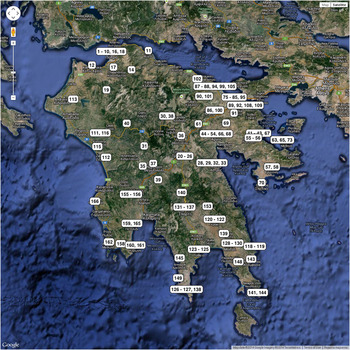
The foundation of Christian churches in the fifth century was a visible result of the impact of Christianisation in the Peloponnese (Appendix). This was followed by the construction of over 160 churches during the following two centuries. By the end of the seventh century, almost every corner of the Peloponnese had a church, and the longest distance between any two churches was only 50 km, which is the distance between Chotousa and Leontion and also between Leontion and Panariti (Fig. 1:30,14,101). The reason for these particular gaps is the presence of the imposing Kyllini Mountains in between. The significant numbers of excavated Late Antique churches in the Peloponnese provide a means of being able to establish a good understanding of the processes of Christianisation.Footnote 3 Church construction not only marks a significant change in terms of religion and conversion but also reflects a range of choices made by different groups. Because Christianisation methods had to be adaptable to existing communities in different topographical contexts, a variety of processes was logical. These processes were not necessarily tied to specific chronological boundaries. Instead, they could be sequential, and changes could also take place in parallel, depending on prevailing circumstances. The variety of conversions according to time, space and place was further diversified through the approaches used. Methods of Christianisation ranged from the subtle use of memory or social hierarchies to the more blatant promise of eternal salvation (Sweetman Reference Sweetman, Christie and Augenti2012). The practicalities of such conversion also depended to some degree on the already established communication links that existed in fourth century communities (discussed in more detail below). Given the evidence for the continuation of polytheistic cult during the construction of the earliest churches, as well as the evidence for phased Christianisation (Sweetman Reference Sweetman2010; Foschia Reference Foschia2009),Footnote 4 the focus here is on understanding the diversity of the Christianisation process throughout the Peloponnese.
Map of the Peloponnese showing the locations of Late Antique churches (see <http://arts.st-andrews.ac.uk/greekbasilicas/article/> accessed February 2015).
KEY (NB – where churches listed below are not included on the map it means that their precise location has not been identified):
Achaea. Patras: 1. Patras Botsi Street. 2. Patras Harado. 3. Patras Kanakari Street 124–6. 4. Patras Kanakari Street 46–52. 5. Patras Korinthos Street. 6. Patras Midilogli. 7. Patras Rofou. 8. Patras Terpsithea. 9. Patras Zarouchleika. 10. Patras, Agios Andreas. Other basilicas in Achaea: 11. Aigion. 12. Kato Achaea. 13. Kato Roitika. 14. Leontion. 15. Olena. 16. Patras Vlachou. 17. Platanovrysi. 18. Skioessa. 19. Tritaia.
Arcadia. Tegea: 20. Pallantion, Agios Christoforos. 21. Pallantion, Agios Georgios. 22. Tegea Agora. 23. Tegea Agora Thyrsou. 24. Tegea Provatinou. 25. Tegea Temple Alea. 26. Tegea Theatre. Other basilicas in Arcadia: 27. Agios Ioannis. 28. Astros. 29. Astros Villa Loukou. 30. Chotousa. 31. Gortys. 32. Kato Doliana. 33. Kato Meligous Kastraki. 34. Kato Meligous, Agios Georgios. 35. Lykosoura. 36. Mantinea City and Theatre. 37. Megalopolis, east of Theatre. 38. Orchomenos. 39. Phalaisai (Lianou). 40. Thelpoussa.
Argolid. Ano Epidavros: 41. Ano Epidavros Panagitsa (Gephyraki). 42. Ano Epidavros, Agia Marina. 43. Ano Epidavros, Agia Paraskevi. Argos: 44. Argos Chatzi. 45. Argos Danaos Street. 46. Argos Danaos and Seferis Street. 47. Argos Messenias Street. 48. Argos Palaiopyrgo. 49. Argos Parados Theatrou. 50. Argos Sanctuary Apollo (Aspis). 51. Argos Strongili Alika. 52. Argos Baths A. 53. Argos Town. 54. Kephalari.
Epidavros: 55. Epidavros Sanctuary Apollo Maleatas. 56. Epidavros Sanctuary of Asklepios Propylon. Other basilicas in Argolid: 57. Hermione. 58. Hermione Promontory. 59. Kleonai. 60. Limenes Argolid. 61. Lyrkeia (Kato Belesi). 62. Methana Megalochori. 63. Methana North East Acropolis. 64. Methana North of Palaiokastro. 65. Methana, Agios Nikolaos. 66. New Tiryns. 67. Palaia Epidavros. 68. Panariti (Medea). 69. Prosymna. 70. Spetses Evangelistria. 71. Spetses Mill Vroutsi. 72. Tiryns Acropolis. 73. Troizen Lakkomata. 74. Troizen site Αgia Soteira.
Corinthia. Corinth: 75. Acrocorinth. 76. Corinth Diabaiki. 77. Corinth East of Agora. 78. Corinth Julian Basilica. 79. Corinth Kraneion. 80. Corinth Lerna Spring (Asklepion). 81. Corinth North Cemetery, Kodratos. 82. Corinth North-East Temple Apollo. 83. Corinth Property of Dima. 84. Corinth Skoutela. 85. Corinth, Agia Paraskevi. Nemea: 86. Nemea.
Sikyon: 87. Sikyon Agora. 88. Sikyon Temple. Other basilicas in Corinthia: 89. Almyri. 90. Bozikas. 91. Chiliomodi. 92. Kenchreai. 93. Kenchreai Cemetery. 94. Kiato. 95. Lechaion. 96. Lechaion near harbour. 97. Lechaion, Agios Gerasimos. 98. Limenes Korinthia. 99. Melissi. 100. Nemea Evangelistria Hill. 101. Panariti. 102. Pellene Zougra. 103. Sikyon (Agios Demetrios). 104. Sikyon (Panagitsa). 105. Sikyon Lalioti, Agia Soteira. 106. Sikyon Poulitsa Litharia tou Rakka. 107. Sikyon Poulitsa Patima. 108. Sophikon East. 109. Sophikon Taxiarches. 110. Zougra Senterina.
Elis. Olympia: 111. Olympia. Other basilicas in Elis: 112. Anilion. 113. Elis. 114. Pyrgos. 115. Samikio. 116. Skyllountia. 117. Stavrouli (Ancient Phigaleia).
Laconia. Gerakas: 118. Gerakas Acropolis. 119. Gerakas Agios Pavlos. Geraki: 120. Geraki Kastro. 121. Geraki Krini. 122. Geraki, Agia Sozonda. Gytheion: 123. Gytheion Acropolis. 124. Gytheion Property Andrianakou. 125. Gytheion Town. Kainopolis-Kyparissos: 126. Kainopolis-Kyparissos Monastiri. 127. Kainopolis-Kyparissos, Agios Petros. Molaoi: 128. Molaoi A. 129. Molaoi B. 130. Molaoi C. Sparta: 131. Sparta Acropolis. 132. Sparta Cemetery. 133. Sparta Kirkiris Plot. 134. Sparta Kleombrotou. 135. Sparta Sanctuary Aphrodite Morpho or Discouri. 136. Sparta Triconch Basilica. 137. Sparta Varvitsiotis Plot.
Other basilicas in Laconia: 138. Alika, Agios Andreas. 139. Apidea. 140. Konditsa. 141. Korakas (Profitis Ilias). 142. Ktirakia. 143. Monemvasia. 144. Neapoli. 145. Oitylo. 146. Phlomochori. 147. Phoinikon. 148. Talanta. 149. Tigani. 150. Tsoukala. 151. Vathi. 152. Vromantas. 153. Zaraphona. 154. Zarax.
Messenia. Messene: 155. Messene North East Odeion. 156. Messene South East Theatre.
Other basilicas in Messenia: 157. Alagonia. 158. Chryssokelaria. 159. Korone (Petalidi). 160. Korone Agia Sofia. 161. Longa. 162. Methone. 163. Methone Drakakis Plot. 164. Methone East, Agios Ilias. 165. Nichoria. 166. Philiatra.

Sociological studies have identified two key contexts for religious or social change: tension or strategic. It is generally agreed that Christianity and polytheism coexisted (Gregory Reference Gregory1986), but even so, elements of Christianisation have, in the past, been seen in terms of change coming about through overcoming unrest resulting from such factors as urban decline, sanctuary closure and even earthquakes.Footnote 5 While some of the few surviving historical sources for the period may generally imply this, many of these had an agenda of proselytising through stories of victory over evil. Conversely, the archaeological evidence indicates more of a strategic pattern of Christianisation which could be deliberate and/or emergent, with the construction of churches occurring while polytheistic cult appeared to continue.
There is limited evidence for the extensive unrest that would provide a context for change through tension. In recent years, work has shown that the extent of urban decline in the Late Antique period has been somewhat exaggerated and that evidence of destruction and damage has been attributed far too quickly to earthquakes.Footnote 6 Rothaus (Reference Rothaus1996) notes literary and archaeological evidence for three likely earthquakes in the second half of the fourth century, but it is difficult to be precise about the extent of urban damage in any of these cases. Furthermore, some, such as Gregory (Reference Gregory1986, 233), argue that, with the exception of Athens (Frantz Reference Frantz1965), pagan and Christian communities actually had little to do with each other. In the past, the fact that the Late Antique period was caught between the highs of the Roman and the glories of the Byzantine empires meant that scholars also viewed this period through a lens of depressing decline rather than seeing it as a period of vibrant change.Footnote 7 Rather than decline, in many cases it is more likely that the topography or even location of the city may have changed, often in positive ways (Sweetman Reference Sweetman2004b, using Knossos as an example). Moreover, in the context of a fresh understanding of the Late Antique period,Footnote 8 it is possible to read the archaeological evidence in terms of strategic change and, more specifically, emergent change through experimentation and progress, while not denying elements of tension. The irony is that the more peaceful emergent view was less exceptional and therefore of little interest to contemporary historians of the period, and would not necessarily have been recorded.
While recent work has focused on the persistence of paganism (Deligiannakis Reference Deligiannakis2011; Saradi and Eliopoulos Reference Saradi and Eliopoulos2011; Foschia Reference Foschia2009; Brown, A. Reference Brown and Drake2006), here, through the application of sociological theory and network analysis to the topography of the churches, some new theories regarding the Christianisation of the Peloponnese are provided. The location of a church reflects choices made by, and constraints on, a variety of groups acting within the community. By examining the evidence for continuation of cult in various locations around the Peloponnese in conjunction with an analysis of the topography of the churches, a case will be made for a three-phased process of Christianisation based on theories of strategic change.
ALTERNATIVE PERSPECTIVE: CONVERSION AS STRATEGIC CHANGE
Strategic change
If change is not born out of tension, within organisational and social structures change is implemented through deliberate or emergent strategies (Mintzberg and Waters Reference Mintzberg and Waters1985). Deliberate strategies are formed, implemented and realised through the intentions and purposeful agency of actors, normally from the top down, with a view to gaining a preconceived set of results. Deliberate strategies are linear and assume no significant disruption once they are implemented. Emergent strategies, by contrast, are those which are realised in the absence of the deliberate intentions or purposeful agency of actors (Mintzberg and Waters Reference Mintzberg and Waters1985, 257). There is normally a process of interplay among a range of individuals and variables. It normally works from the bottom up and is non-linear and, while there are disruptions and unpredictable events, it is also more creative and there are often unintended outcomes (Mintzberg and Waters Reference Mintzberg and Waters1985; Mintzberg and Westley Reference Mintzberg and Westley1992). Crucially, Mintzberg and Waters (Reference Mintzberg and Waters1985, 257) note that either purely deliberate or purely emergent strategies are rare; both processes contain elements of emergence and intention.
As the two strategies are not mutually exclusive it is possible to have a combination of deliberate and emergent strategies, or unconnected strategies. For example, actors within a larger structure may follow emergent patterns simply because they do not necessarily have to explain their actions (Mintzberg and Waters Reference Mintzberg and Waters1985, 257). This is a crucial point when it comes to the study of the Christianisation of the Peloponnese, which had to be a fluid process. As Hunt (Reference Hunt1993, 143) notes, while there may have been laws from the Imperial centres, the way in which these laws were interpreted or the extent to which they were adhered to was as multifarious as there were individuals. For example, Theodosius may have decreed a ban on sacrifice in ad 381 and the closure of temples in ad 393, but it is clear from epigraphic evidence that cultic practice persisted in many locations in the Peloponnese, including Epidavros (Sweetman Reference Sweetman2010; Foschia Reference Foschia2009). In the Peloponnese, it is evident that there was no singularly structured, top-down organised process, but rather a combination of both strategies. Essentially, the fluidity seen in the conversion of the Peloponnese can be understood in terms of interplay between deliberate and emergent change.
In strategic change, different environments and processes are identifiable, including complexity, social movement and the presence of a ‘tipping point’. In many respects these three aspects are interlinked. Complexity is defined as having elements of self-organisation and set agendas, and is ‘the domain between linearly determined order and indeterminate chaos’ (Byrne Reference Byrne1998, 1). Anderson (Reference Anderson1999, 216) also notes the combined elements of order and chaos evolution in complexity theory. Complex organisations are made up of groups of diverse formation which are well networked. Complexity theory identifies a process of sharing ideas used to initiate change, which is manifested through adaptive behaviour where the change is quickly taken on. Change in complex groups is manifested quickly, in part because of the multiple contacts complex groups have, but also because they are used to sharing ideas. Complex groups will have both external and internal connections acting as conduits for change. Complexity includes elements of deliberate change and therefore may have elements of top-down organisation. Once change has taken place in these complex groups it can then spread, through processes such as social movement and ‘tipping point’. Diani and Bison (Reference Diani and Bison2004, 282) define social movement as ‘networks of informal interactions between a plurality of individuals, groups, or associations, engaged in a political or cultural conflict, on the basis of a shared collective identity’. Social movement represents a second phase because the sharing of ideas is based on common groups/associations rather than the more diverse make-up of groups associated with complexity. Social movements try to identify with elements that are culturally meaningful, like existing symbols. Change as a result of ‘tipping point’ can occur only once other processes have already taken hold. ‘Tipping point’ refers to a situation in which something new and irreversible takes hold when there was little prior sign of that phenomenon. It is therefore indicative of a change that is more laboured and is dependent on already having a critical mass of change in proximate groups. In more detail, these three phases can be elucidated within an overall concept of an incremental and multidirectional conversion process.
Networks are the vehicle by which social movement evolves; they are defined through shared information and ideas, and can be understood in multiple ways (Castells Reference Castells1996). In contemporary studies they can be naturally arising or engineered, and may be virtual or biological (D'Souza et al. Reference D'Souza, Borgs, Chayes, Berger and Kleinberg2007). For the purposes of this study, concentration is on social networks, including information and commercial connections. Van Dijk (Reference Van Dijk2005) argues that networks shape a society's organisation, and can be mediated by individuals, groups or organisations. In this respect, it is possible to see how the three different phases of Christianisation may have spread through networks of different groups or individuals. For example, the first phase of deliberate change probably came from outside the Peloponnese, as part of an organised process. Highly connected loci are known as hubs, and they are not always the large cities that we already know exerted power; they can be religious centres or even regions such as the north-east Peloponnese (Castells Reference Castells1996). Underpinning networks is the idea that wide-scale communication between hubs or nodes will create further nodes, this process being known as phase transition (Chen and D'Souza Reference Chen and D'Souza2011, 1). While work on network analysis in the disciplines of mathematics and physics continues and is constantly being refined, particularly in terms of understanding the behaviour of elements and factors within networks such as giant components and phase transition, it is only recently that the theory has begun to be applied to the study of archaeology (Brughmans Reference Brughmans2010; Knappett Reference Knappett2011) and more specifically of religion (Collar Reference Collar2013). Furthermore, there is still some development needed in refining empirical evidence for network analysis in respect of evidence from areas such as the social sciences (Filkov et al. Reference Filkov, Saul, Roy, D'Souza and Devanbu2009). While this is acknowledged, in the case of religious change in antiquity Collar (Reference Collar and Malkin2009), Bowden, H. (Reference Bowden and Malkin2009) and Rutherford (Reference Rutherford and Malkin2009) have successfully shown how network analysis can be applied to the spread of religious ideas and practices of different periods in the Greco-Roman world. In the case of present society, Berryman (Reference Berryman1999) has applied network theory to religion in Latin America to explain the prevalence of Pentecostal, to the detriment of Catholic, churches. For the Late Antique period, network analysis allows us to further understand how deliberate and emergent strategies work, revealing phases of Christianisation in which people and places play a range of roles. The three processes of change outlined above can be recognised in the different topographic contexts of the Late Antique churches, which help to elucidate the phased Christianisation of the Peloponnese, despite problems of evidence, such as limitations on the types of archaeological data or issues with dates for both church foundations and temple abandonments.
PROBLEMS OF EVIDENCE
There is a dearth of literary sources relating directly to the Late Antique Peloponnese, and textual evidence comes from brief references to the area in general historical accounts, for example by non-Christians such as Libanius and Zosimus, and secular historians such as Procopius, as well as by Christian historians and chroniclers such as Eusebius and Theophanes.Footnote 9 Other data focuses on issues of territory and diocese as discussed in Hierokles' sixth century Synekdemos and the Acts of the Ecumenical Councils,Footnote 10 as well as, of course, the Theodosian Code (Hunt Reference Hunt1993).
In terms of material indications, while religious architecture and graves still make up most of the physical evidence, finds of domestic material are increasing significantly, with a focus on urban contexts but with rural data also on the rise. In terms of the urban material, the continuing excavations at Argos, for example at Kallergi Street and in particular at Papanikoli Street (Morgan Reference Morgan2009–10, 30–1), have revealed extensive evidence for the Late Antique city, and some good analysis of domestic material has been undertaken by Oikonomou-Laniado (Reference Oikonomou-Laniado2003, 59–75). Work at Messene has allowed detailed discussion of the Late Antique city and its hinterland (see Themelis Reference Themelis2002a; Reference Themelis2010). In Sparta, the excavations at Alcman and Lysander streets have also revealed pockets of the Late Antique city (Morgan Reference Morgan2009–10, 44–5).Footnote 11 When many of the more recent excavations and surveys are fully published, they should significantly enhance the study of the Late Antique Peloponnese. This has certainly been the case with the Palestinian material as discussed by Bar (Reference Bar and Hahn2008). He has noted that it was commonly believed that Palestine underwent swift Christianisation and that everyone had converted by the mid-fifth century. However, with more urban and rural excavations it has become clear that these views have to be revised to allow for a much more nuanced process. While domestic evidence will be referred to here, the focus will be on churches and associated features.
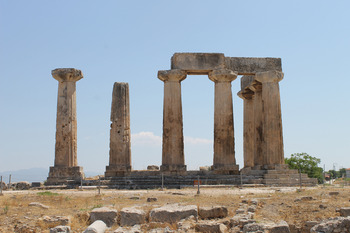
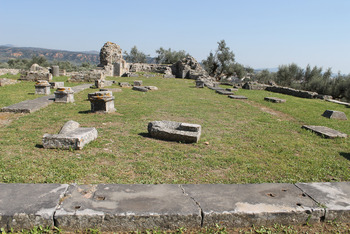
Another difficulty in understanding Christianisation arises from a lack of secure dating, in particular dates for when temples go out of use and for the foundation of many of the Peloponnesian churches. Evidence for temples becoming disused and suffering from natural decay, particularly as the focus of investment changed, is extremely difficult to identify and date archaeologically in the Greek provinces (Saradi and Eliopoulos Reference Saradi and Eliopoulos2011, 264). Identifiable fourth century destructions have often been attributed to historical events (general and specific), such as Christian demolition, seismic activity or Gothic invasions (Saradi and Eliopoulos Reference Saradi and Eliopoulos2011, 264; Rothaus Reference Rothaus1996). While pockets of isolated attacks by particularly zealous communities or individuals cannot be ruled out, in many cases temples or shrines may already have been abandoned for decades prior to the Christians, or even to the Goths, just as they may have continued to be used during the early periods of the Christianisation of Greece. For example, the temples of Zeus at Olympia, the Temple of Athena Alea, the Temple of Apollo at Corinth (Fig. 2) and that of Asklepios at Epidavros are likely still to have been standing in the sixth century ad, when their superstructures were brought down, supposedly by earthquakes (Spawforth Reference Spawforth2006, 154, 160, 162, 165). Furthermore, the long-held belief that temples were often automatically converted into Christian churches has been successfully challenged for provinces such as Egypt and Achaea (Dijkstra Reference Dijkstra2011, 392; Gregory Reference Gregory1986; Foschia Reference Foschia2009; Sweetman Reference Sweetman2010). Saradi (Reference Saradi and Hahn2008, 113) suggests that there were some temple destructions, some temple conversions and some level of continuation of pre-Christian religions. Yet, from the analysis of the data presented here, it seems that when temple conversion did occur, it was part of a particular phase of the Christianisation process undertaken once the earliest churches had already been constructed.
Temple Hill and Apollo Temple, Corinth.

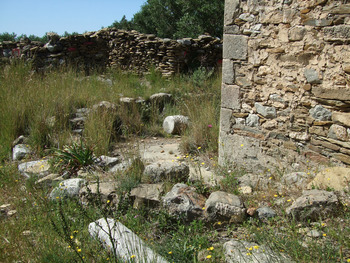
Of the 160 known churches, 90 have proposed dates. Of the 70 undated ones, many are identified only through evidence of reused architectural remains or through survey, or remain unexcavated. In the case of the 90 dated churches, their chronologies for the most part are not very secure (although broad dates are possible). This is in part due to the nature of their survival, often under more recent constructions (for example, Agios Andreas in Alika in the Mani: Fig. 3), or because of difficult excavation circumstances, such as rescue excavation. Where dates are postulated, this is regularly done on the basis of associated material culture, primarily sculptural elements, mosaics or, less often, lamps. Some churches have been dated on the basis of stylistic form, in terms of the layout or architectural style of the church: for example, the polygonal form of the exterior of the apse of the church on the Sanctuary of Apollo on the Aspis in Argos, dated to the sixth century (Oikonomou-Laniado Reference Oikonomou-Laniado2003, 11). Others may be dated through material found in associated mortuary contexts, such as coins or belt buckles: for example, Agia Mariana in Ano Epidavros (possibly seventh or eighth century) (Oikonomou Reference Oikonomou1989a). With increasing focus on the re-evaluation of the material and excavations and continuing study of Late Antique pottery chronologies,Footnote 12 it is hoped that church chronologies may be better defined in the future.
Alika, Mani.

Persistence of paganism
Notions of ‘persistence of paganism’ are often seen in terms of opposition to the apparently unidirectional and uncompromising forces of Christian conversion. This is understandable in view of the nature of many of the surviving sources, which record events from a Christian perspective, and often in a specifically Christian ideological manner in order to promote the new religion (Bagnall Reference Bagnall1988, 25–32; Kuznetsova Reference Kuznetsova2000). From the Christian viewpoint, it was better to record stories of success, particularly in the face of opposition, rather than produce straightforward records of the conversion process (Ricoeur Reference Ricoeur and Kelbley2007, 81–2). It was essential for the Christians to create a history where elements of Christian eschatology, such as hope, could work. There are problems with this notion of a clear-cut replacement of pagan cult practice with Christianity, and, while there were many enthusiasts, the adoption of Christianity was not always the result of a conscious or welcome choice (Fowden Reference Fowden and Sakellariou1990, 344–5). Some suggest that the placement of a church close to existing sanctuaries was a challenge to pagan communities (Gregory Reference Gregory1986, 237). This can also be read not necessarily in terms of pressure, but in some cases as subtle encouragement (Sweetman forthcoming).
The tenacity of paganism in Achaea is well known, with evidence from a range of sources, public and private: from epigraphy, cult buildings, statuary and funerary forms (Rothaus Reference Rothaus2000, 32–8; Foschia Reference Foschia2009; Saradi and Eliopoulos Reference Saradi and Eliopoulos2011). It is seen at all social levels, from the Emperor Julian and Praetextatus and his wife Paulina being initiated into the Eleusinian mysteries to the retention of pre-Christian burial practices across the social spectrum. Even after Valentinian and Valens had succeeded Jovian (who followed Julian), Praetextatus continued to be able to exert some influence in favour of pagan rites when he successfully appealed to Valentinian to have an exemption so that Achaea could persist with nocturnal sacrifices even after they were prohibited in 364 (Saradi and Eliopoulos Reference Saradi and Eliopoulos2011, 282). Such retention of pre-Christian practices may be due in some respects to practicalities and, therefore, may not be so unusual; and perhaps an especially pagan governor may not have made a key difference. Something similar is also seen outside Achaea in the Aegean Islands (Deligiannakis Reference Deligiannakis2011), as well as in provinces such as North Africa (Sears Reference Sears2011). Various situations have been observed in Anatolia where there seems to have been a change in the way pre-Christian religious practice was undertaken in terms of a move from public (temple) to private (domestic) contexts, and this can also be seen in Egypt (Talloen and Vercauteren Reference Talloen and Vercauteren2011; Bagnall Reference Bagnall1988). Bar (Reference Bar and Hahn2008) argues that, because most of Palestine's population was located in rural rather than urban areas, the processes of Christianisation took significantly longer here and were more varied than in the cities.
It is possible to see that there was a continuation of pre-Christian religious elements in private life, for example in personal jewellery and lamps.Footnote 13 In certain contexts there was a pragmatism involved in the use of certain types of object. The continued use of jewellery with pagan imagery is understandable in terms of the value of the object. Saradi and Eliopoulos (Reference Saradi and Eliopoulos2011, 287) have noted the evidence from the Cave at Vari where Christian lamps were found in the context of pagan worship, which they believe simply indicates availability rather than a religious statement. Stirling's work (Reference Stirling2008) on the nine statuettes depicting a variety of Olympian gods in a Corinthian house is indicative of the perpetuation of pre-Christian cult practice in private contexts during the Late Antique period, and a similar situation has been identified in the excavations of the large fourth century urban domus in Messene (Themelis Reference Themelis2010, 100–1). As for burial practices, in some cases Christian and non-Christian burial customs are found together, for example in Corinth's North Cemetery (Sanders Reference Sanders2005, 1 n. 1; Saradi and Eliopoulos Reference Saradi and Eliopoulos2011). There are also mixed epigraphic habits, such as the Christian cross with a curse, of which there are several examples from Corinth and Argos.Footnote 14
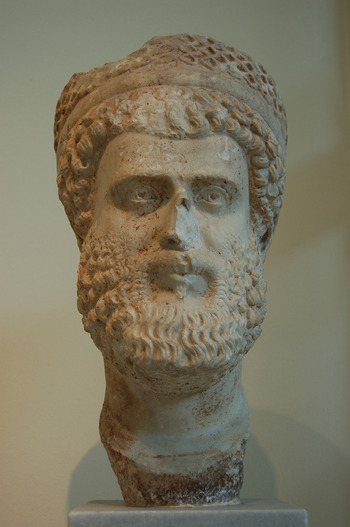
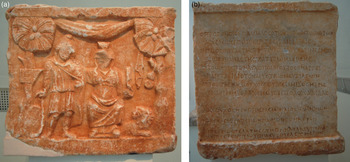
In the public realm, a portrait head found on the Athenian Acropolis slopes is depicted in a priestly form with a tall diadem and strophion and has been dated to the late fourth century (Fig. 4), and there are two taurobolic altars from Attica in the National Museum which have been dated to the end of the fourth century (ad 360–70 and ad 387) (Fig. 5a–b ). Both these altars indicate that the taurobolium was still performed in Athens until at least the end of the fourth century. The altar dedicated by Archelaus notes that he was resident in Argos, where he had been initiated into local cults (Saradi and Eliopoulos Reference Saradi and Eliopoulos2011, 287). Epigraphic data reveals strong evidence for continuation of polytheistic cult (Foschia Reference Foschia2009, 215–17). As well as concern for the upkeep of existing sanctuary sites, inscriptions indicate continued cult practice in various forms at different sanctuaries, such as Kenchreai and Corinth, and also at international sanctuaries like Epidavros and Olympia (Nilsson Reference Nilsson1945; Foschia Reference Foschia2009, 215–17; Sweetman Reference Sweetman2010, 208–9). Although more difficult to assess, it is likely that many smaller shrines and sanctuaries, particularly in rural contexts, would also have continued in parallel with the foundation of the earliest churches.Footnote 15 This certainly seems to be the case in Palestine, where a more even focus of archaeological work in urban and rural areas has been undertaken (Bar Reference Bar and Hahn2008, 276). To expand on what Caseau (Reference Caseau, Bowden, Lavan and Machado2004, 105–6) has noted, the roots of Christianity were in rural areas but they are the last to show physical manifestations of this. While it is argued below that this is in part to do with religious and more general conservatism, it is also a result of processes of strategic change.
Portrait head from the Acropolis slopes, Athens.

Two taurobolic altars, National Archaeological Museum, Athens.

Although cultural developments are often understood in terms of a linear sequence, this is not always the case, because multiple kinds of change occurring in diverse locations at different rates and with discrete outcomes are common.Footnote 16 This is clearly seen in the various burial traditions and mixed contexts for pagan and Christian personal objects. Even a reading of the Edict of Theodosius suggests only some closures, and some investment continuing in sanctuary sites (Hunt Reference Hunt1993, 144; Sweetman Reference Sweetman2010, 209). Analysis of the churches and the Christianisation process indicates a cultural lag, in which processes of change were not synchronised with one another (Ogburn and Nimkoff Reference Ogburn and Nimkoff1947). In this respect, individuals and groups form their own histories, in which the timings of changes, hiatuses or continuations do not correspond (Ricoeur Reference Ricoeur and Kelbley2007, 186). While, on the one hand, there was a proselytising state religion, on the other the strength of centuries of religious practice and respect for cultural tradition had to be accommodated. On a simple level this may be seen in the adoption of architectural and artistic forms that were already meaningful. For example, images of Orpheus became interpreted as the good shepherd in Christian contexts, or the general image of bounty (xenia) became an image of paradise in life after death, particularly in a mortuary context (Kourkoutidou-Nicolaidou Reference Kourkoutidou-Nicolaidou1997, 130–1). There are, as noted above, some elements of practicality too, since artistic knowledge, skill and tools cannot be made obsolete overnight. Invariably, there would be continuation of craftspeople and particular elements, but it is how they were used by an individual that made them meaningful. An enduring example of this may be the inclusion of coins with the corpse, often on the mouth or chest, a pre-Christian tradition, which provided the deceased with the means of paying Charon, sustained into the sixth century (Kourkoutidou-Nicolaidou Reference Kourkoutidou-Nicolaidou1997, 130–1). The multiple actors with roles in the Christianisation process, from the state to the proletariat and with clergy and elite in between, meant that, even without introducing other variables such as location and period, degrees of Christianisation were bound to be distinctive across the Empire and within provinces. While there were clearly elements of resistance at certain times and in certain locations, when viewed from another perspective it is possible to see that the Christianisation process was adapted according to a variety of existing situations, periods and driving forces.
Rather than viewing Christianisation in the more traditional light of a top-down or imperial, sometimes violent and unilateral process of conversion, as is indicated to some extent in the written sources, through the archaeological evidence it is possible to see an organic and somewhat relaxed process, which emerged incrementally over 150 years after the churches were constructed. There is much more evidence for continuity, religious coexistence at single sites and regionalism than previously assumed. This view is contrary to the more sensationalist one of destruction and disruption, which was of far more interest to historians in Late Antiquity and indeed the contemporary public (Lavan Reference Lavan2011, xv). To explain the alternative view we can draw on theories of strategic change, which means that the extent of phasing and regionalisation is not obscured by the difficulties of not yet having a firm range of absolute dates for the foundation of many of the churches.
THE LATE ANTIQUE PELOPONNESE: TOPOGRAPHY OF THE CHURCHES
Topography of the Late Antique churches
The form, function and chronology of churches have been discussed in the light of the use of space in the church by Varalis (Reference Varalis2001), Caraher (Reference Caraher2003) and Sweetman (Reference Sweetman2010), and these data will not be revisited in detail here. The focus of evidence will be on the topography. While the dates of the churches are difficult to define closely, broad chronologies (fifth, sixth or seventh centuries) allow the elaboration of the application of sociological conversion theories (Appendix). As has already been noted, the earliest churches (mostly fifth century) are found in the ports of the north-eastern part of the Peloponnese (Kenchreai, Kiato and Hermione),Footnote 17 and at the sanctuaries of Epidavros, Nemea and Olympia. The Lechaion basilica was also originally thought to date to the mid-fifth century (Pallas Reference Pallas1959; Reference Pallas1966, 159, 166–7), but more recent work on the ceramics indicates a later date, probably in the sixth century for the foundation of the church (G. Sanders, pers. comm.). The majority of churches are dated to the sixth century (Sikyon Temple, Scoutela in Corinth, Geraki Krini and Philiatra). The latest basilica-type churches have been identified at Agia Marina (Ano Epidavros), Provatinou (Tegea) and Skyllountia and may date to the seventh century.Footnote 18 These are all triple-apsed churches and may be related to other triple-apsed churches: for example, the Acropolis Basilica at Sparta (Fig. 6), Tigani and Agia Sofia at Korone.
Acropolis Basilica, Sparta.

The overall distribution shows a widespread occupation of the Peloponnese with a strong inclination for coastal locations (Pallas Reference Pallas1977, 5) (Fig. 1). It is difficult to be precise about the change in occupation of the area from the Roman to Late Antique period because of inconsistency in the evidence, and because of problems in assessing just when pre-Christian cult sites went out of use in rural contexts. While there may have been depopulation of some of the Hellenistic urban spaces in the Roman period, there is still good evidence from Pausanias to suggest continuation of cult at some locations, for example at Zarax (Gerakas) and Gortys (Alcock Reference Alcock1993, 207–8). Moreover, it does seem likely that there was a wider occupation of the Peloponnese in the Late Antique period than there had been in the Roman; and this is particularly marked in the return to Hellenistic sites, such as Kiato and Longa, which had gone out of use in the Roman period.Footnote 19 Although many of the churches were constructed in cities or sanctuaries that had been in continuous use throughout the Roman period, and in several cases earlier, a few of the churches, for example Nemea Evangelistria, Panariti (Corinthia), Sophikon and Tiryns, were constructed in locations where there is no evidence, as yet, for previous Roman use (Sweetman Reference Sweetman2010).
In terms of the topographic contexts, the Late Antique churches of the Peloponnese can be divided according to those that appear in five different, although not necessarily mutually exclusive, types of location (Appendix). These are: ports (24), towns (14), sanctuaries (14), mountain tops (20, which include six by water) and by water (14, nine of which are on a low hill). Altogether 20 churches are located by water.
By applying theories of strategic change to the topographic data of the Late Antique churches, it is possible to illustrate three phases of conversion in the Peloponnese, the mechanics of which are in turn visible through network analysis. The data are presented within groups according to the seven regions of the Peloponnese, in order to show how the three phases work on a micro level. However, it is important to remember that these are modern political boundaries, and communication links may just as easily have been with cities or ports in other regions and provinces. The analysis of the findings at a macro level is presented following the discussion of the six regions.
Corinthia
Some 35 churches are known from the Corinthia, and 10 of these come from the city of Corinth itself, with a second concentration around Sikyon. At Corinth it is possible to see an incremental spread of the churches from the suburbs, cemeteries and sanctuaries to within the old city walls. The Late Antique wall that surrounded Corinth was considerably smaller than its Classical predecessor, and it did not enclose the Amphitheatre on the east or the Anaploga Villa on the west (Gregory Reference Gregory1979, 278). Gregory (Reference Gregory and Hohlfelder1982, 52) has observed that, from the Roman to Late Antique period, activity increased on the east of the city and decreased on the west. There was some continuation of use of Roman cemeteries, for example at the North Cemetery and its Late Antique section to the south at Cheliotoumilou, and at Kodratos to the east of it (Sanders Reference Sanders2005, fig. 16.1). The first churches built at Corinth, probably in the early sixth century, were in the areas of the Roman cemeteries (Kodratos) (Stikas Reference Stikas1962) and the suburbs Kraneion (Pallas Reference Pallas1976) and Skoutelas (Pallas Reference Pallas1955), and were located well outside the city walls.Footnote 20 Gregory (Reference Gregory and Hohlfelder1982, 53) has suggested that there were no burials within the Late Antique walls until the sixth or seventh century, and Sanders (Reference Sanders2005, 428) has noted the evidence for sub-adult burials in Gaza amphorae dating to the sixth or seventh century in the Panagia field. Only one basilica constructed within the city walls has definitely been identified, and it is located to the north-east of the Apollo Temple on Temple Hill (Fig. 2) and is dated stratigraphically to the late sixth century (Robinson Reference Robinson1976, 222). If Sanders (Reference Sanders2005, fig. 16.1) is correct in his reconstruction of the Late Antique city wall as running to the east of the Agora, this would mean that there were no churches within the city walls at Corinth.
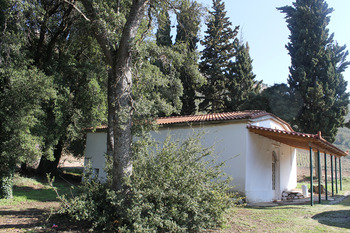
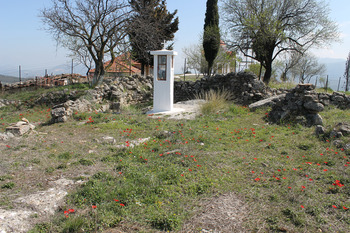
The evidence is not quite as clear for Sikyon, although with continuing work there is great promise for the future. Here, in addition to the church overlying the temple, a second city-centre church has been identified through geophysical survey.Footnote 21 Although the dates for both these churches are difficult to define, it is likely that the church at Sikyon's port, Kiato, predates both of them (Orlandos Reference Orlandos1954). Many of the churches were constructed in already thriving towns like Kenchreai and Kleonai (Scranton, Shaw and Ibrahim Reference Scranton, Shaw and Ibrahim1978; Morgan Reference Morgan2007–8, 19–23); and others were built in areas located close to a town, though not directly in a pre-existing Roman town. For example, the hilltop church at Almyri is likely to have been constructed on the Hellenistic site rather than on the Roman site which occupied the coastal plain (Wiseman Reference Wiseman1978, 58). The church at Tenea, visible on a hilltop, is likely to have been located near or in the cemetery area of the Roman town, although more work on the area is needed before the topography of the Roman town can be defined (Wiseman Reference Wiseman1978, 93). More work is also needed at other sites, such as Sofiko, where there are tantalising remains of fortification walls on Mount Tsalikas to the north-east of the modern town (Wiseman Reference Wiseman1978, 127). Although two churches have been identified, much less is known about the preceding period, apart from the walls and graves in the area around Agia Paraskevi. While the two Sofiko churches are visible on a hill and on a likely coastal route, their precise relationship to the Roman town is impossible to tell. The church at Kenchreai, which may be of late fourth century date, incorporates the Sanctuary of Isis and is situated along at least one Roman road that runs from north-east to south-west along the shore line (Scranton, Shaw and Ibrahim Reference Scranton, Shaw and Ibrahim1978, plans B and C, fig. 25). The location of this early church, in a highly visible location in a busy port, is well within expectations in terms of the Christianisation of the Peloponnese. However, the reuse of the pre-existing temple is a feature that is seen more commonly in later stages of Christianisation in the Peloponnese, at least once a significant number of churches, for example Kleonai, had already been built. The late fifth–sixth century basilica at Kleonai is located on an earlier temple in the centre of the Classical–Hellenistic town on an important route, according to the excavators (Stewart Reference Stewart2010–11, 51; see also Morgan Reference Morgan2011). Continuing survey and excavation work there is clarifying the diachronic nature of the urban core and hinterland, including locating parts of the city wall in the north and in the east, and remains indicating Late Antique and Early Byzantine farms (Morgan Reference Morgan2009–10, 25–6). In terms of rural sites, survey work in the area around Sikyon has revealed a significant number of churches (for example at Poulitsa Litharia tou Rakka, Poulitsa Patima, Lalioti and Panariti (Fig. 7) (Lolos Reference Lolos2011, 419–548 SP-30, SP-31, SP-22, HS-95). Other churches in the area include Nemea Evangelistria (Fig. 8) (Miller Reference Miller1990), Panagitsa, Pellene Zougra and Zougra Senterina (Orlandos Reference Orlandos1931), Bozikas and Melissi (Lolos Reference Lolos2011 , 419–548 SP-26 and HS-143), but they are all more difficult to discuss in terms of their pre-Christian context because of lack of archaeological excavation to date. In all cases, however, it is clear that they are in highly visible locations (for example, Melissi by the coast, Pellene high in the Kyllini Mountains, and Panariti in an area of great natural beauty). The church at Panariti may, in fact, be on the site of an earlier temple, but this is by no means certain (Lolos Reference Lolos2011, 479).
Panariti, Corinthia.

Evangelistria Nemea, Corinthia.

Overall, in the Corinthia the earliest churches (Kenchreai and Kiato) are located in coastal locations and are likely hubs (Kenchreai and Kiato).Footnote 22 Given its location within the sanctuary, the fifth century church at Nemea is also likely to have been constructed at a hub. The topographic evidence indicates, therefore, that these churches were constructed as part of the complexity process and probably included elements of deliberate strategy, and belong to the earliest conversion phase in this region and probably the Peloponnese. The location of churches in the suburbs of Corinth and Sikyon indicates construction through social movement, orchestrated through their network connections with the port and sanctuary hubs, and thus the second Christianisation phase. The construction of churches in the centre of towns like Corinth and Kleonai on top of existing temples is part of the second phase of urban Christianisation, and, as already noted, can be equated more with the ‘tipping point’ process. ‘Tipping point’ also helps explain the location of the rural and, in some cases, village churches of Almyri, Sophikon East, Chilimodi, Bozikas, Lalioti, Panariti, Pellene and Nemea Evangelistria.
Argolid
Some 34 churches have been identified in the Argolid; 11 of the churches are located in Argos (Oikonomou-Laniado Reference Oikonomou-Laniado2003, 11–25). There is a second concentration in the area of Ano Epidavros (Oikonomou Reference Oikonomou1989a). The earliest churches here have been identified at the port of Hermione (late fourth–fifth century) and the sanctuary of Asklepios at Epidavros (fifth century) (Stikas Reference Stikas1956; Asimakopoulou-Atzaka Reference Asimakopoulou-Atzaka1987, no. 10) and Lakomata at Troizen (late fifth century). These are then followed by the majority of churches in suburban or urban locations, such as Argos, Ano Epidavros, Methana (Mee and Forbes Reference Mee and Forbes1997), Hermione (promontory), Palaia Epidavros (Gregory Reference Gregory and Hohlfelder1982, 53) and Spetses (Sotiriou Reference Sotiriou1937), as well as at other sanctuary sites such as Troizen (Agia Soteira) and Apollo Maleatas (Epidavros). Finally, there is a small number of rural examples at Methana, New Tiryns (Oikonomou Reference Oikonomou1989b), Lyrkeia (Asimakopoulou-Atzaka Reference Asimakopoulou-Atzaka1987, no. 15) and Kephalari (Oikonomou-Laniado Reference Oikonomou-Laniado2003, 15), which are located on mountains or beside water (Fig. 9). It is clear that a city wall was constructed around Argos in the Late Antique period, but its date and line are not yet known (Banaka-Dimaki, Panagiotopoulou and Oikonomou-Laniado Reference Banaka-Dimaki, Panagiotopoulou and Oikonomou-Laniado1998, 330). It has been postulated that the southern extent is now marked by the line of the modern Messenias–Arkadias road; the west side would have run just below the line of the Larissa, and the north side to the west of the Aspis. The eastern extent is not as clear, although some would suggest that this followed the line of the Kserias river (I. Varalis, pers. comm.). As with other cities, there are two phases of church construction seen in Argos as a result of social movement and then ‘tipping point’. The earliest churches are probably those in the suburbs, particularly at major routes (such as the Messenias Street church and the church on Danaos Street, which is likely to be beside the Eileithyian Gate) and in existing cemeteries such as Alika in the north and Palaiopyrgo (if it is a church) in the south (Banaka-Dimaki, Panagiotopoulou and Oikonomou-Laniado Reference Banaka-Dimaki, Panagiotopoulou and Oikonomou-Laniado1998, 333). These highly visible locations would have had a range of network connections. Once a number of these churches were in use a critical mass would have been reached, whereby change in the city centre would have been the next natural process. This is marked by the construction of the church in Baths A to the east of the Agora.Footnote 23 Oikonomou-Laniadou (Reference Oikonomou-Laniado2003) suggests that three churches were constructed in the late fifth to early sixth century, with the Apollo Sanctuary Basilica, Alika and the Baths A Basilica all being built later. Varalis, however, suggests that, of these three churches at Danaos (Lymberi Plot), Danaos and Seferis (Gargassoula Plot) and Messenias (Florou Plot) Streets, only the Messenias Street one can be as early as the late fifth century, with the other two dating to the sixth century (Varalis Reference Varalis2001, nos. 57, 56, 55 respectively). It is interesting to note that the earliest of the churches (at Messenias Street) has an associated baptistery, and is likely to have been just to the north of a major route into the city.
Kephalari Church and water source (Argolid).

The church at Troizen (Lakomata) may be early in the church construction sequence with a late fifth century date, as it is possible that, at over 1 km away from the ancient city centre, it was located on the outskirts of the city; there also appear to have been some Roman graves found in this area. The only example of a direct reuse of a temple is found at the Sanctuary of Apollo in Argos (sixth century), and possibly at the promontory at Hermione. At Argos, the example of temple reuse is typical of a later phase of urban Christianisation.
In the Argolid, the choice of location for the earliest churches at Epidavros and the port of Hermione, both hubs, indicate evidence for Christianisation through processes of complexity. Change then occurs in the most visible areas of suburban locations through social movement, and later in the town centres and rural areas through ‘tipping point’. Thus far, not enough work has been done in the environs of Ano Epidavros to assess the nature of the city, and only one of the churches, Agia Marina, has been the focus of in-depth excavation (Oikonomou Reference Oikonomou1989a). It is argued below, however, that its development may relate to its location on a route.
Arcadia
Both the Argolid and Corinthia have been the focus of intensive archaeological work, including survey work, which has certainly helped to swell the figures in rural or less accessible areas. Although the Asea survey (Forsén and Forsén Reference Forsén and Forsén2003) has made a significant contribution, the publication of the Megalopolis survey and several excavations in key areas, such as TegeaFootnote 24 and areas around Orchomenos, will help provide more detail concerning Roman to Late Antique occupation in the region. The largest Arcadian cities were Tegea and Mantinea, with Megalopolis a smaller, secondary-level city (Roy Reference Roy2010).Footnote 25 Of the 17 churches identified in Arcadia, the only significant concentration is at Tegea, with four or five (Asimakopoulou-Atzaka Reference Asimakopoulou-Atzaka1987, nos. 15, 20, 21).Footnote 26 The identification of the church at Alea is still doubtful, and there are a further two mid-sixth century churches at the nearby site of Pallantion (Østby Reference Østby1983 and De Franciscis Reference De Franciscis1990–1). The churches in the other large cities of Megalopolis and Mantinea are not securely identified (Konti Reference Konti1985, 107–10). Other urban churches have been excavated at Chotousa (Kaphyai) (late fifth/early sixth century) (Konti Reference Konti1985, 118) and Orchomenos (unpublished); as with Tegea and Pallantion, they are likely to have been founded originally partly through network links with locations in the Corinthia and Argolid. In fact, it is likely in the Late Antique period that Arcadia continued to be quite prosperous and self-sufficient and, in some respects, despite its central location, relatively isolated, as it had been in the Roman period (Roy Reference Roy2010).Footnote 27 It is not surprising, given the lack of external network connections, that there is little evidence of churches being constructed through processes of deliberate strategies in Arcadia.Footnote 28 This shows a general topographic progression, as the coastline of Arcadia is not well connected with the interior and there are no panhellenic sanctuaries in the region. Instead the churches at Tegea and other urban locations are likely to have been constructed through processes of social movement as a result of network connections with other hubs of the Peloponnese, such as sanctuaries and other towns. Settlement patterns in the Roman period were dominated by a system of 14 large poleis and three smaller ones (Aliphera, Lykosoura and Pallantion), and there was very little opportunity to break away from this system (Roy Reference Roy2010, 60). The small number of Late Antique rural churches that have been found in Arcadia may indicate the persistence of such settlement patterns; and many of the poleis have evidence for churches, including those at Lykosoura (Leonardos Reference Leonardos1896) and Pallantion. A number of poleis which were well occupied in the Roman period, such as Aliphera, Kynaitha, Psophis or Alea, have not yet provided evidence for Late Antique churches. Late Antique rural churches have been identified at Phalasai, Kato Doliana and Astros Moni Loukou (the latter two sites both unpublished). In all cases the churches are located in stunning places, on heights (for example Agios Ioannis [Moutsopoulou Reference Moutsopoulou1956], Kastraki Kato Meligous and Moni Loukou), or beside water (like Kato Doliana and Thelpoussa [Mousopoulou Reference Moutsopoulou1956]). Unfortunately, in all of these cases, as the sites have been identified through the reuse of Late Antique architectural fragments, it is difficult to define their chronology, even in relative terms. As yet, it is not possible to identify the urban development of churches in Tegea, although given the work of Bakke and the Norwegian team (Bakke Reference Bakke2009), it seems tantalisingly close. The dates of the Agora church and that of Thyrsou are possibly fifth or sixth century (Asimakopoulou-Atzaka Reference Asimakopoulou-Atzaka1987, nos. 20 and 21). The church identified at the Agora in Tegea may have been close to a sanctuary of Apollo, but publication of the excavations is needed to confirm this. Furthermore, the debate about whether or not there was a Late Antique church above the Temple of Athena Alea continues (Østby Reference Østby1983). The church at the lower Sanctuary of Asklepios at Gortys is constructed on the edge of the sanctuary (Metzger Reference Metzger1951, 132). Although little is known about it, its busy location would indicate that it was founded relatively early in the process of Christianisation in Arcadia, through complexity processes. As Chotousa has been excavated relatively recently, there is good evidence for an earlier temple below the church (Jost Reference Jost1985, 109–13).
Laconia
Thus far some 27 churches are known from the Laconia region, and coastal locations were most popular. Concentrations of churches are found at Sparta (Raftopoulou Reference Raftopoulou1998), Gerakas (Wace and Hasluck Reference Wace and Hasluck1908–9), Geraki (Xyngopoulos Reference Xyngopoulos1937), Gytheion (Asimakopoulou-Atzaka Reference Asimakopoulou-Atzaka1987, no. 44; Bakourou Reference Bakourou1983, 98) and Kyparissos (Drandakis, Gioles and Konstantinidi Reference Drandakis, Gioles and Konstantinidi1979). Some are as little as 50 m apart, for example three sixth century churches at Molaoi (Etzeoglou Reference Etzeoglou and Ahrweiler1988). While it is possible that some earlier churches may be identified at Sparta or Gytheion, the earliest known church from the Laconia region is Agios Petros at Kyparissos-Kainopolis (mid–late fifth century). The next earliest seems to be one from Sparta town, at Odos Kleombrotou (fifth–sixth century), which lies outside the walls in a cemetery area (Raftopoulou Reference Raftopoulou1998, 125 n. 4). Like Argos, Sparta seems to have flourished in the fourth century, with evidence now for an abundance of mosaics from the third and fourth centuries, as well as bath houses and repairs to the theatre (Panagiotopoulou Reference Panagiotopoulou1998). Five Late Antique churches are now known. Thus far only one Late Antique church, the Acropolis Basilica (Fig. 6), has been identified with certainty from within the walls which surrounded the Acropolis (Sweetman Reference Sweetman and Cavanagh2008). The Acropolis Basilica is likely to have been constructed in the sixth century (Sweetman and Katsara Reference Sweetman and Katsara2002). There are indications of at least three other churches in the suburbs, one of which is in the area of the Roman cemetery (Triakosion Street), which runs along the southern base of the Acropolis. Other Roman cemeteries have been identified on the edge of the urban space in the area of Magoulitsa in the south-west, which also contained Late Antique period burials, and Mousga in the north (Raftopoulou Reference Raftopoulou1998, 136). The church at Kleombrotou also has a Late Antique cemetery associated with it, while more recent work in the nearby street of Gortsologou has indicated evidence for an earlier Roman cemetery (Blackman Reference Blackman1997–8, 37; Whitley Reference Whitley2004–5, 28–9; Whitley et al. Reference Whitley, Germanidou, Urem-Kotsou, Dimoula, Nikolakopoulou, Karnava and Hatzaki2005–6, 37–8).
The majority of churches, from the urban Spartan examples to the rural Tigani, are traditionally dated to the sixth century. In comparison with some in the north-east Peloponnese this is relatively late, but the earliest evidence for a bishop is no earlier than the middle of the fifth century (Cartledge and Spawforth Reference Cartledge and Spawforth2002, 213). In the ports of Neapolis, Vromontas and Kyparissos (Drandakis, Gioles and Konstantinidi Reference Drandakis, Gioles and Konstantinidi1979), the churches are visible from land as well as sea. In towns such as Sparta, the churches are located either on the acropolis, in a cemetery, or by an earlier sanctuary (for example by the temples of the Dioskouroi or Aphrodite Morpho, in both cases also on hills). A relatively gentle, phased approach, mediated through use of memory, is indicated by the lack of encroachment on sanctuaries (such as Artemis Orthia or Apollo at Amyclae).Footnote 29 Chronological indications are that ports were the earliest to have churches and then the suburbs of Sparta. Gytheion, however, is problematic in this respect as the churches excavated there appear to date to the sixth century. This may simply reflect an archaeological bias, or perhaps networks were operating in a different way at this point. Prompt building of churches in the ports suggests that church construction in this region was instigated externally and deliberately, rather than emerging from within the Peloponnese. The constructions at Geraki, Molaoi, and Alika represent a more emergent phase defined by social movement. Further emergence is seen in the third phase, when rural examples, such as Apidea (sixth century) (Etzeoglou Reference Etzeoglou and Ahrweiler1988), Konditsa (Etzeoglou Reference Etzeoglou1973) and Zaraphona were constructed as a consequence of ‘tipping point’. In rural areas, as expected, the churches' locations are highly connected. Apidea, Konditsa and Zaraphona are located beside water. Other than the possible Spartan examples, only two sanctuaries in Laconia have been identified as having Late Antique churches built either on or immediately beside temples: Kyparissos and Phoiniki. The church has not been excavated at Phoiniki, and the cult has not been identified at Kyparissos, but it is interesting that the cult at the Sanctuary of Apollo Hyperteleatas at Phoiniki continued up to ad 395. The date of the church remains tantalisingly unknown. It is possible that the Sanctuary of the Mother of the Gods at ancient Akriai (Kokkinia Kastraki) continued in use into the Christian period, but there is no evidence for a church there. There are several sanctuary sites which do not have a later church presence.
Messenia
Some 12 churches have been identified in Messenia. A small concentration (two) is known from Messene (Themelis Reference Themelis2002b), but otherwise the main cluster is in the southern tip of the peninsula around Korone and Methone (Stampoltzis Reference Stampoltzis1976–8; Asimakopoulou-Atzaka Reference Asimakopoulou-Atzaka1987, no. 52). At Messene, the church to the south-east of the theatre has been excavated, is dated to the late sixth century and is constructed on top of an earlier building (Themelis Reference Themelis2007, 40–1; Reference Themelis2008, 28–34). However, as N. Tsivikis (pers. comm.) has pointed out, there was a significant amount of destruction debris on which the foundations of the church were built. The church at Messene also lies outside the proposed line of the west stoa, which is likely to have bordered the Messene temple on the west (Themelis Reference Themelis2007, fig. 1). While the churches at Methone have not survived well, nor have they been well dated, the church at Agia Sofia at Korone is likely to date to the sixth century, based on close parallels with the Acropolis Basilica, Sparta (Sweetman Reference Sweetman and Cavanagh2008, 340) (Fig. 6). Also in the peninsula, the location of Chryssokelaria (Papathanasopoulos Reference Papathanasopoulos1969, 145) is indicative of a hub, and the church may therefore belong to the complexity phase and thus be relatively early in Messenia. The evidence of imported material suggests that the region of Messenia was quite prosperous in the Roman period and well connected, particularly through the port of Kyparissos (Themelis Reference Themelis2010). As yet, there is no evidence for churches located at Kyparissos, but there is a church just to the south of Philiatra at Agia Kyriake, which may have become a busier port in the Late Antique period (Asimakopoulou-Atzaka Reference Asimakopoulou-Atzaka1987, no. 53); and this, too, is thus likely to belong the first and deliberate phase of Christianisation in the area. The churches at Messene and Korone are likely to be part of the second phase because of their urban context (and this is also supported by the later, sixth century, date of Agia Sofia, Korone). Because it occupies the same site as the Temple of Apollo Korythos, the Longa basilica (Lambropoulou Reference Lambropoulou and Belke2000) is likely to belong to a later phase of Christianisation. Few rural churches in Messenia have been identified as yet, which is probably a reflection of the archaeological focus thus far in the region. Based on a study of the routes, the concentration of churches around the east and south coast of the Messenian peninsula is understandable. It is peculiar that, as yet, a Late Antique church has not been identified at Pylos or along the coast to the north.
Elis
Seven churches have so far been identified in the Elis region, and there are no examples of multiple churches at single locations. The example at Olympia appears to be the only church whose building can be defined through deliberate processes, particularly given its location on the edge of the sanctuary (Adler et al. Reference Adler, Curtius, Dörpfeld, Graef, Partsch and Weil1897). The churches at Elis (if it is actually a church) (Yialouris Reference Yialouris1965) and Phigaleia (which is currently being excavated) may be the result of social movement; and the rural churches, such as at Skyllountia (Lambropoulou Reference Lambropoulou and Belke2000)Footnote 30 and Anilion (Yialouris Reference Yialouris1964), are clearly visible on their hilltop locations and, in the case of Anilion, in proximity to water. The church at Skyllountia has a triple-apse arrangement on the east, and Dr Athanasoulis (pers. comm.) suggests this may actually be a feature of churches belonging to the seventh or even eighth century, with further examples at Agia Marina and Provatinou (Tegea).
Achaea
Some 19 churches have been recognised in the Achaea region, 11 of which are located in Patras or its suburbs (Moutzali Reference Moutzali and Rizakis1991). There are no other significant concentrations of churches in the region. It is likely that the churches at Aigion (Asimakopoulou-Atzaka Reference Asimakopoulou-Atzaka1987, no. 22), Kato Roitika (Asimakopoulou-Atzaka Reference Asimakopoulou-Atzaka1987, no. 29), Skioessa (Pantelidou Reference Pantelidou1982) and Tritaia (Mastrokostas Reference Mastrokostas1976–8) are a result of network contacts with Patras and Kato Achaea (Moutzali Reference Moutzali1990). Change in these areas can be defined as social movement and belonging to the second phase. At Tritaia, the only definite Achaean example of the construction of the church on or near a templeFootnote 31 is likely to be part of a later Christianisation phase and it is dated to the sixth–seventh century. The church at Agios Andreas in Patras is located just to the north-east of the oracular fountain of Demeter and has been dated to the sixth century. The church at Leontion (Fig. 10) (Mastrokostas Reference Mastrokostas1976–8) marks a position of high visibility, but is also certainly located in what was urban space, although the occupation dates of the earlier settlement are not yet known. The church at Platanovrysi (Moutzali Reference Moutzali1987) may mark the location of a route through Achaea.
Leontion, Achaea.

The nature of the topographic change in the city of Patras from the Roman to Late Antique is difficult to define with great detail, although Moutzali (Reference Moutzali and Rizakis1991, 259) indicates that there was little change between the location of the Roman and Late Antique cities. To judge by the Roman cemeteries on the south and north, the churches are all found well within these areas, and it is possible that the Late Antique city occupied the upper parts of the modern city rather than the lower coastal side of the modern city centre, which was covered by swamps.Footnote 32 Dekoulakou (Reference Dekoulakou1976, 102–3) excavated the remains of a late third century Christian cemetery in the centre of the older Roman town, which indicates that the topography and extent of the city was already changing at this point (Lambropoulou Reference Lambropoulou and Belke2000, 97). Application of the theory of strategic change indicates that the churches identified in the area of the lower town, in some cases just along the city wall (e.g. Vlachou), are likely to be the earliest churches in the construction sequence at Patras.
STRATEGIC CHANGE AND NETWORKS IN THE PELOPONNESE
The value of the application of strategic change theory is that it explains the diversity of archaeological evidence, allowing an interpretation of a very fluid Christianisation in terms of the processes undertaken on and by various elements of the population at a range of different times and in a multiplicity of places. Christianisation must have been adaptable, drawing on the familiar in terms of location, architecture, art and indeed community memory and tradition, for it to work.
Complexity
The different groups that made up complex communities would not necessarily have had a shared identity but they would have been familiar with, and open to, new ideas, and would normally have been found in highly accessible and connected areas. Hubs such as busy ports and edges of sanctuaries fulfil these criteria, particularly as both types of location would have been highly networked with places both inside and outside the Peloponnese, which would have enabled sharing of ideas. The ports of Corinth, Kenchreai and Kiato and the sanctuaries of Epidavros and Olympia were among the most active in Greece and in the international milieu of the Mediterranean. It is likely that this, the earliest phase of conversion, would have had a sizeable input from higher church and state officials, and would have entailed planning and deliberate strategies. The decision to construct churches in these locations was successful in promoting Christianity because the regular circulation of people would have enabled and spread the change. As expected of change in complex groups, there are clear elements of emergent patterns, and at each of these early locations there is evidence for continuation of pre-Christian cult and little sign of the rampant destruction of sites indicated in the sources. The choice of locations drew on shared traditions of use, which was also part of the emergent process. The non-intrusive positioning of churches outside the temenos walls of sanctuaries, along with the evidence for continued cult, is a clear indication of the contemporary practice of both religions at these sites. Altogether, this is indicative of the desire to subtly encourage visitors, by siting churches in visible locations, for example by the propylon of the sanctuary at Epidavros, and also by making the architecture impressive and a matter of curiosity in the first instance. The location of churches in highly visible areas, particularly at sanctuaries, was also a statement of confidence on the part of Christians, which is further emphasised by the absence of evidence of wide-scale temple destruction. With the exception of Olympia, these earliest churches all have baptisteries associated with them, which is to be expected in view of their founding role in the conversion process. In the case of Olympia, given the location of the church so close to the river Kladeos, it is tempting to suggest that baptism may also have taken place here. Furthermore, since these early churches are located in the north-eastern part of the Peloponnese, it can also be assumed that pre-Christian cult continued in sanctuaries in other areas of the Peloponnese.
Social Movement
The evidence of the topography of the Peloponnesian churches indicates that the second phase of Christianisation can be seen in the construction of churches in the suburbs of major cities, particularly those close to ports or sanctuaries where churches were already present. Following the initial deliberate strategy, the topography of the churches indicates that the emergent process took hold. Through processes of social movement, the next churches that were built were in locations that had shared network connections with the original church locations and, importantly, shared community identities with some of the groups in complex communities. For example, church building spread from Kenchreai (and possibly Lechaion) to Corinth, from Kiato to Sikyon, and from Epidavros to Ano Epidavros. In the south, once Gytheion and Philiatra had their first churches, they were joined by towns such as Molaoi, Sparta and Messene (see Appendix). This shows that ideas spread, as one would have expected, from the original sites as a result of their network connections and shared cultural elements. In many respects, this phase saw the most activity on the part of provincial populations rather than the top tier, as discussed above. Word spread fast, and through the machinations of a networked society there was an urban swell of demand to be connected with the religion, which was clearly accompanied by political and financial success. It is worth stressing that in most, if not all, urban centres in the Peloponnese, the churches located in the centre of the urban spaces were not part of this second phase process (as discussed in more detail below).
As Talloen and Vercauteren (Reference Talloen and Vercauteren2011, 352) point out, the sacred landscape was fundamental for social order and, as such, when Christianity became the state religion there was a sense that this would also provide social structure. Furthermore, Fowden (Reference Fowden and Sakellariou1990, 344) suggests that society as constituted would work ‘catalytically’ on its emergent religious systems. Relevant factors in social movement include such aspects as striving to have what others already have, and this can be seen in the evidence of the church buildings themselves. In many respects, investment in church buildings was a return to what the elites of the Roman past had already been very familiar with, and in this way it was drawing on a shared cultural past. Such investment may have allowed privileges of position in public processions, as it had in the past, as well as within church structures. The church at this point was solidifying its connection with power and money, in part through inheritance of land from the faithful but also through the appropriation of sanctuary land (Angold and Whitby Reference Angold, Whitby and Jeffreys2008). There are much broader issues relating to consolidation of the power of the church and individuals, such as the roles of bishops and urban elites. A range of religious events, such as the promotion of miracles and the promise of everlasting life, would have secured the interest of the population in the church (Brown, P. 1992). In terms of more direct involvement in secular social structures, the church used the creation of laws,Footnote 33 control of networks, patronage, benevolence towards the lower echelons of society and more general philanthropy (Brown, P. 1992, 152; Miller Reference Miller and Jeffreys2008). A further factor may have been promotion of the ‘Good Life’, as noted by Maguire (Reference Maguire and Bowersock1999, 253–4), through images of abundance among the living and the dead both in the secular realm and in the church. All of this is perceptible, and articulated through the processes of social movement. Church officials may have particularly sought conversions of the elite, not just because of the potential for land and investment, but also because this is likely to have inspired others to want to belong. In this respect, a range of investments, in churches, buildings, mosaics and other interior decor, may have become more available to wider society (Bowden, W. Reference Bowden and Lavan2001, 62; Sweetman forthcoming). There were still other ways in which the church was able to maintain social order. Elites may have been enticed through preferential treatment in church space, in life and in death (in terms of the locations of burials in relation to church buildings). Examples of this may be seen in the Knossos Medical Faculty basilica at Knossos, where large tombs were located within the temenos along the east–west axis of the church in line with the entrance (Sweetman Reference Sweetman2005, 367, fig. 3). Visitors could not help but associate these tombs and their individuals with the church. Regarding encouragement to participate, many of these elements can be read as forms of social exclusivity, whereby those who had standing in the public sphere already belonged, and those who did not now wanted to belong. It is likely that the church would have pandered to this desire through the use of tiered space within churches for elite and connected groups (McCutcheon Reference McCutcheon1999, 4–12). To a degree, the overall design of the church building would have helped facilitate this (for example, in the Acropolis Basilica, Sparta – Fig. 6) (Sweetman and Katsara Reference Sweetman and Katsara2002). On the inside, different levels of proximity to the clergy and ritual performance might have been one way to enable an expression of social stratification (Sweetman Reference Sweetman2010). Presumably, the same can also be said for sight lines, where uninterrupted views might have carried more merit (Yasin Reference Yasin2012). This is interesting in terms of the interior layouts of churches where, when reconstructed, sight lines become much more obvious. This evidence shows, somewhat counter-intuitively, that views of the bema from the galleries and narthexes appear to be better than those from the side aisles. For some of the catechumens in the narthex, particularly if it had a tribelon, it seems there would have been rather privileged views, which might be more indicative of social than of religious status.Footnote 34 The church building overall would have been an impressive, imposing and highly visible building, decorated for the most part with lavish interior decor; yet the absence of interior visibility from outside would have intensified a sense of secrecy, and would have stimulated the kind of interest on the part of those as yet uninvolved in the church's activities that is indicated in processes of social movement.
Change evolves through social movement processes by tapping into existing elements that are culturally meaningful in the past and present. New churches were constructed in locations that had a visceral connection because the location, art, architecture and activities associated with the church were already intrinsically significant. As with the first phase, the choice of church locations, which in the second phase were in pre-existing cemeteries and on major routes, is also indicative of the drive to make the churches and all that they offered visible and part of daily life, while not being too overt or forceful. Their importance may have been articulated by means of processions (mentioned above), which would have further exploited the concept of exclusivity, thereby encouraging members of the community to participate. The choice of a mortuary context may be seen as drawing upon ancestral memory in the community, so as to legitimise the new religious practice. This in itself was a problematic issue in the early years of construction of monumental churches, when there was a tension between the church's location in a supposedly polluted space and the location of burials in intramural churches (Saradi Reference Saradi2006, 433–4). Moreover, social stratification within the context of the church continued even in death wherever Christian cemeteries became established around churches and where those deemed most holy were given prime space in the church, with the social elite buried close by (Saradi Reference Saradi2006, 434). The location of a church at a martyr's tomb, or at the site of a miracle, would also have ensured a large number of visitors and a certain level of curiosity about the area. It may have been the case in some churches, such as the Acropolis Basilica at Sparta, that viewing locations and platforms were constructed to allow visitors to view the martyr's grave from the interior of the church only.Footnote 35
‘Tipping Point’
The third phase – ‘tipping point’ – is brought about through the realisation of a critical mass, whereby the use of landscape, location and networks in the establishment of a social movement, as in the case of Christianisation, enables it to evolve into a dominant, culturally meaningful movement. This was brought about in the Peloponnese through a critical mass of churches in urban, suburban, coastal and sanctuary contexts. Once critical mass was reached, a certain natural momentum accumulated (‘tipping point’), whereby the numbers of churches being built overshadowed any existing religion, and groups began to identify with the new churches. Change as a result of ‘tipping point’ is also an emergent process and is seen in the most conservative of populations; and it is likely that this explains the later foundation of many of the rural churches in the Peloponnese. In most, if not all, cases examined, the rural churches identified as having been built as a result of this process were constructed in locations (such as Nemea Evangelistria [Fig. 8], Talanta and Konditsa) that do not necessarily have evidence of pre-existing cult. The church at Panariti identified by Lolos (Reference Lolos2011) is also a rural site (Fig. 7). There is some suggestion of evidence for earlier cult on this site, but, in the case of most churches, there is little sign of prior Christian or even religious presence at their locations. Collar (Reference Collar and Malkin2009) notes the importance of phase transition, particularly in terms of understanding the part that networks play in the spread of a new religion. She emphasises that, when significant change takes place either within an existing network or with the creation of a new network (phase transition), this is caused not by one process but by multiple players and is deemed an emergent process (Collar Reference Collar and Malkin2009). However, in order for communication to occur across a network a cluster of groups (a giant component) is necessary. If there is no giant component, any change will happen in isolation (Collar Reference Collar and Malkin2009, 145). This situation may be equated with ‘tipping point’, and the foundation of rural churches such as Konditsa and Panariti. The topography of these churches clearly reveals the importance of visibility and memory manipulation. The churches are all located on mountaintops, and would have been clearly visible, dominating the landscape and functioning as symbols of land ownership. Elevation would also have encouraged awe, in terms of proximity to God, but also admiration for the arduousness of construction. Their elevation and location beside water sources or places of natural beauty naturalised these increasingly ubiquitous churches.
While it is not precisely the same development, there are elements of the ‘tipping point’ process identifiable in the way in which the Christianisation of the urban sphere was undertaken. In the first phase of Christianisation of the urban sphere, churches were constructed in the suburbs, and only once a number of churches had been built was the city centre occupied by a church. Thus far, the incremental spread of construction of churches from the outskirts (on routes) to cemeteries to intramural constructions is seen in Argos, Corinth and Sparta; and this is also likely to be the case for Patras and Tegea. It is usually just a single church at the centre, and often located on or near an earlier cult site (for example on Temple Hill in Corinth [Fig. 2] and in the case of the Acropolis Basilica in Sparta [Fig. 6]). Outside the Peloponnese the same phenomenon is seen in Athens (Saradi Reference Saradi2006; Frantz Reference Frantz1965), Knossos and Gortyn (Sweetman Reference Sweetman2004b, 325–8). In urban areas, therefore, the application of the sociological evidence is not necessarily exclusive to particular areas. Save for the presence of earlier cult, it is arguable that the same ‘tipping point’ process that takes hold in the Peloponnese is visible on a miniature scale in the urban context.
The multiple processes occurring simultaneously throughout the Peloponnese and even within individual towns are explicable by the emergent nature of Christianisation and also by cultural lag. For example, while rural areas of the north-east Peloponnese have churches which were constructed as a result of ‘tipping point’, at the same time churches in the suburbs of Sparta might be built as a result of social movement. Furthermore, the processes were not location exclusive, since ‘tipping point’ was the reason for rural as well as some central urban constructions.
The analysis of church topography and Christianisation aids in an understanding of the various roles that locations played at different points within local, regional and international networks. Networks were the means through which the three phases of change occurred in the Christianisation of the Peloponnese. In terms of strategic change as a considered process, it makes sense for the earliest churches to have been constructed in hubs: highly connected places such as the panhellenic sanctuaries, like Epidavros, and ports such as Kenchreai. These hubs would have helped mediate connections between the Peloponnese and the outside world. The contact between hubs and nodes would have stimulated the construction of churches in the spaces between them, creating further nodes (phase transition) (Chen and D'Souza Reference Chen and D'Souza2011, 1). It is possible to see this on the location plan of the Peloponnesian churches (Fig. 1). In the Peloponnese, it is likely that Molaoi and Geraki were two nodes, while the construction of the church at Apidea indicates the creation of a new node. The same may apply to the foundation of the church at Talanta in between Molaoi and Neapoli, and the churches at Chilimodi and Prosymna in between Argos and Kenchreai. In the case of Palaia Epidavros and the Asklepion at Epidavros, it may be that the churches at Ano Epidavros were initially constructed as a new node, but this region subsequently began to surpass that of Palaia Epidavros in terms of the number of churches constructed there. It is clear that the churches in Arcadia were founded as a result of emergent processes belonging to the second and third phases of social movement and ‘tipping point’, which reflect their locations situated in an area between nodes.
Current scholarship on network analysis favours the idea that increasing levels of connectivity can be achieved with fewer connections (Chen and D'Souza Reference Chen and D'Souza2011). When applied to the Late Antique evidence, it is useful to see how it can further support the identification of the three phases and the classification of ports/sanctuaries, towns and cities, and rural spaces between. It is possible to see how Christianity spread through established networks, and how in part this was a self-perpetuating process, in that it also helped create new networks. This in turn helps to explain why conversion of the urban spaces occurred after many of the sanctuaries already had churches established in them. For example, ports and sanctuaries may be identified as hubs in the early part of the Late Antique period, and then major towns became hubs, which, when clustered together, formed a giant component, out of which came the spread of conversion into rural areas. This helps to explain why the churches in Sparta, for example, appear to be later than some of those on the Laconian coast. It also seems that Sparta may have been less connected to other urban spaces in the Peloponnese than were its own coastal towns. While scholars note that there are naturally arising networks, recent research has shown growth by preferential attachment is more about local engineering than simply relative location (D'Souza et al. Reference D'Souza, Borgs, Chayes, Berger and Kleinberg2007). This emphasises the importance of the roles of individuals, groups and organisations within networks, and indicates that changes do not just occur in isolation.
On a macro-scale (the Peloponnese) and micro-scale (urban contexts), the three processes are identifiable; and it is clear that visibility and uses of memory and tradition played a central role in the success of the conversion process. While these points are a matter for more detailed discussion in another article, it is worth noting here how topography is used as a basis for successful Christianisation through the incorporation of the use of the church in everyday life.
In the Peloponnese it is clear that, once the initial deliberate strategies had been used by the state to establish churches at key locations for successful conversion (ports and sanctuaries), the later emergent approaches to conversion were subtle and, in many cases, community-led. Even within the deliberate strategic phase, quite a relaxed approach was taken in which the location of churches on the peripheries of sanctuaries was arguably a manipulation of memories in order to encourage new community cohesion centred on the church (Sweetman forthcoming). In terms of the topography, the location of churches in earlier cemeteries (for example at Kodratos in Corinth) and the use of church lands for burial connected the new communities of Christians with their ancestors. This served multiple purposes. It further legitimised the new religion through past memories, and provided a community focus through shared use (Sweetman Reference Sweetman2010, 224). The same may be seen to apply to sanctuary space, particularly in the cases of Epidavros, Nemea and Olympia. While the direct ancestors of a community may not have been present, the same sense of ownership and community would have been, particularly since, in some cases, there is evidence of continuing cult practice into the fifth century. In most of these cases, the new church was highly visibly located, while not forcefully eclipsing earlier buildings. In fact, it is only really in the second (with the examples of Kleonai and the Sanctuary of Apollo at Argos) and primarily the third (e.g. Lykosoura) phases of Christianisation that the direct reuse of earlier cult buildings is found. Rural areas and sanctuaries do not tend to have multiple churches. This further helps to define the different phases of conversion, but also emphasises the importance of visibility in the conversion process. Arguably, once the church was visible and used, there was no need to provide further churches in less densely populated locations.
Mountain-top visibility is related to the ‘tipping point’ scenario for the Christianisation of rural areas. But memory here was used in terms of identifying with gods (i.e. on heights), and also in terms of ancestral rights over land. The settings of churches on the edges of communities or in difficult-to-reach locations symbolically defined the region for others to see, but it gave communities a shared identity tied to ownership of the landscape, particularly as they moved through it. Acknowledgement of the community's territory or urban extent emphasised the exclusivity of the population, as well as subconsciously connecting the church with ownership of that land and its wealth. Likewise, the pattern that existed in the case of churches on acropolis sites that had intervisibility with urban centres in the valley below may be a wider-scale version of the same construct. This is well illustrated by the examples of Corinth and Acrocorinth (Fig. 11), and Argos and the Sanctuary of Apollo. As can be seen from the Appendix, the positioning of a church beside water was also closely related to the third Christianisation phase. It is arguable that the location of churches beside water sources in rural areas could have been for baptismal purposes. Thus far, those that are so located do not have evidence for formal baptisteries (for example Gortys or Agios Ioannis in Arcadia [Fig. 12]), but this does not obviate the fact that they were gathering-points. There is likely to have been as much variation in the agents that activated the spread of Christianity as there were in processes and timescales, which becomes particularly understandable when the Late Antique Peloponnese is seen in terms of its role within a networked Mediterranean society. While use of memory and tradition may have helped to stimulate the use of churches in the conversion process, as is clear from above the spread of Christianity could only have happened through network connections.
View of Corinth from Acrocorinth.

Church of Agios Andreas, Gortys, Arcadia.

The analysis of the evidence shows that, in most cases, there were few linear developments, and that certain locations with multiple churches, such as Corinth, Argos or Sparta, may have had a series of construction dates, some even in parallel. This is expected in emergent processes. Identifying external origins for the earliest churches in the Peloponnese is more difficult. Although this phase has more structured, deliberate elements and therefore linear developments, it is extremely difficult to make connections between places on the basis of shared architectural form. It is therefore useful to examine the evidence for network connections more broadly.
As Saradi and Eliopoulos (Reference Saradi and Eliopoulos2011, 263) have argued, there is a range of reasons for the retention of pre-Christian cult in the Greek provinces, which includes the tenacity of Athenian traditions and of the philosophical schools, as well as, more generally, limited networks of connections. It may be the case that Athens is the key difference here, with the earliest church thought to have been constructed in the city in the mid-fifth century, which, according to Krautheimer (Reference Krautheimer1986, 118), was a reflection of the power of the University of Athens. Evidence from the Cycladic islands indicates the construction of churches starting in the mid- to late fourth century, which is somewhat earlier than on the Greek mainland and which would make sense in terms of the impact of network connections. In other cities and sanctuaries of the Greek provinces, such as Knossos, Corinth, Nea Anchialos and Epidavros, churches had already been constructed in the late fourth or early fifth century. This suggests that some places at least were well connected to certain networks.
The methodology developed here is not without flaws, which for the moment concern issues both of chronology and of bias in the focus of archaeological work undertaken. For example, the regions that show the highest concentrations of rural churches are those regions for which surveys have been published: Laconia, Sikyon (Corinthia) and Methana (Argolid).
As is indicated through the application of sociological and network analyses, conversion of the Peloponnese to Christianity is likely to have been multidirectional. Different groups, such as church leaders, priests, local elite and broader swathes of the population, would have steered the process at different times. Existing spaces would have been manipulated somewhat organically through the situation of a church, but active processes that created places through use would have maintained the strength of community identity, without the risk of tensions created by conversion, through new social memories and foci. The process was not clear cut. It was not just about religion and place, but also about power and the past. In sanctuary contexts, attention was primarily on the subtle transformation of emphasis brought about by the new churches, while in some cases pre-Christian practices continued at the temples. In the later phase, which was not just concerned with the widespread occupation of rural spaces, the question arises as to whether the conversion of Roman temples may be seen as a more aggressive manifestation of Christianisation, or simply reflects the need for space. This question, as well as queries relating to the types of buildings and the nature of pre-existing cult, is examined elsewhere (Sweetman forthcoming).
Within the framework of strategic change, a number of different factors can be seen to have activated the change. This makes sense, particularly when religious ideology came from the top down while religious practice was being undertaken on a much wider scale, which allowed for a greater range of differences. Such an approach allows for an overall aim of conversion, but without the traditional understanding of a linear chronological development or a flattened, single response. This also makes it possible for Christianity and polytheism to have coexisted on a wide scale within the Peloponnese and on a narrow scale even within a sanctuary area such as Epidavros. Instances of church construction can be seen as elements within a process which may have been different according to geographic location even if the chronology was the same. This is somewhat at odds with the Christian philosophy which views historical process as linear, with a clear beginning and end and without repetition, in part because it is ordained by God. The avoidance of direct causation allows for a variety of agents, be they institutional or individual, in accordance with different phases, locations or roles within networks. In order to allow social change to be successful the message had to be understood and the networks had to be in place, which is why there was a need for locations, architecture, iconography and even elements of practice to be familiar as well as having memorable features. In all, application of the theories of strategic change allows the evidence of the topography of the Peloponnesian churches to be understood in terms of incremental Christianisation, through a range of agents and methods.
ACKNOWLEDGEMENTS
The fieldwork and research for this work was undertaken thanks to the support of an Arts and Humanities Research Council Fellowship as well a Royal Society of Edinburgh Caledonian Research Fund European Visiting Research Fellowship and a grant from the Memoria Romana Project. I would like to thank all the fieldwork assistants: the Browns, Leburns, MacKays and Sweetmans. Dr Yannis Varalis, Dr Nikos Tsivikis, Dr Guy Sanders and Dr Bill Caraher have been most kind in discussing this work and they also provided helpful details. All photographs were taken by the author. I am very grateful to Swithun Crowe, Birgit Plietzsch, Carol Evans and Mary Woodcock Kroble for their work on the image database and production of the map of sites.
APPENDIX
Currently accepted datesFootnote 36
5th century

Late 5th to early 6th century

6th century

7th century

Church location
Ports

Towns

Sanctuaries

Mountains

Water source