


Attention-deficit hyperactivity disorder (ADHD), bipolar disorder and schizophrenia are highly heritable psychiatric disorders that sometimes co-occur. Reference Galanter and Leibenluft1-Reference Ryden, Thase, Straht, Aberg-Wistedt, Bejerot and Landen4 The extent to which ADHD shares aetiological factors with bipolar disorder and/or schizophrenia has important implications for both clinical practice and research. Studies suggest shared genetic susceptibility loci as well as genetic deletions and duplications (i.e. copy number variants, CNVs) that overlap between these disorders. Reference Miller, Shen, Weiss, Korn, Anselm and Bridgemohan5,Reference Williams, Zaharieva, Martin, Langley, Mantripragada and Fossdal6 However, no adequately sized family study has explored the degree to which ADHD shares familial risk factors with bipolar disorder and schizophrenia, and prior family studies of ADHD and bipolar disorder indicate that the co-occurrence of the two disorders represents a familially distinct syndrome. Reference Faraone, Biederman and Monuteaux7,Reference Faraone, Biederman, Mennin, Wozniak and Spencer8 Hence, we aimed to explore the extent to which ADHD shares genetic and environmental risk factors with bipolar disorder and schizophrenia. To this end we conducted a total population study in Sweden of people with ADHD (n = 61 187) and a control group. We estimated the occurrence of bipolar disorder and schizophrenia not only in the ADHD proband and control groups, but also in the relatives of these individuals. To study the effect of shared genetic and environmental factors specifically, we adjusted for the potential existence of aetiologically distinct subsyndromes (e.g. an ADHD plus bipolar disorder subtype) by excluding from the proband and control groups people with schizophrenia or bipolar disorder, and by excluding relatives of probands or controls with ADHD. Reference Szatmari, White and Merikangas9
Method
The study was based on data from Swedish longitudinal national registers held by the National Board of Health and Welfare and Statistics Sweden, which were linked through each individual's unique personal identification number. The Patient Register has nationwide coverage for psychiatric in-patient care since 1973 and information on psychiatric out-patient care (not provided by a general practitioner) since 2001. Every record has a discharge date, a primary discharge diagnosis and secondary diagnoses assigned by the treating medical doctor according to the World Health Organization's International Statistical Classification of Diseases and Related Health Problems: ICD-8 for 1969-1986, ICD-9 for 1987-1996 and ICD-10 from 1997. 10-12
The Swedish Prescribed Drug Register is a national healthcare register with data on prescribed and dispensed pharmaceuticals. Information regarding drug identity according to the Anatomical Therapeutic Chemical classification system (ATC code), quantity and dosage of the prescribed drug, and date of prescription/dispensing has been registered since July 2005 along with specific patient information (gender, age and residential area). The register covers the entire population of Sweden, and the identity of the patients is available for over 99.7% of the population. Reference Wettermark, Hammar, Fored, Leimanis, Otterblad Olausson and Bergman13
From the Total Population Register we obtained information on gender, birth year and migrant status for the entire Swedish population. At the time of the construction of our database, this register covered all persons born up to 2009 and all migration events during 1969-2009. Information on vital status (a registered death date) was taken from the Cause of Death Register. At the time of the analyses this register covered essentially all deaths from 1952 to 2009. The Multi-Generation Register includes personal identification numbers of index persons and their biological and adoptive parents and was used to identify parents, children, full siblings and half-siblings of index persons. Index persons were individuals born 1932-2009 and registered as living in Sweden at any time during 1961-2009 or who migrated here together with one or both parents and obtained permanent citizenship before age 18 years.
Classifications of ADHD
Patients obtaining a diagnosis of ADHD between 1987 and 2009 were identified in the patient register (ICD-9 code 314; ICD-10 code F90). All discharges and physician appointments (other than with general practitioners) with a psychiatric diagnosis were included and no distinction was made between primary and secondary diagnoses. Patients treated with stimulant or non-stimulant medication for ADHD - methylphenidate (N06BA04), atomoxetine (N06BA09), amfetamine (N06BA01) or dexamfetamine (N06BA02) - at any time between July 2005 and December 2009 were identified via the Prescribed Drug Register and assigned to the ADHD proband group. In our study patients aged 3-65 years at the time of their first ADHD diagnosis (or first prescription of stimulant or non-stimulant medication for ADHD) were included as probands. National guidelines for medication of ADHD, issued by the Swedish National Board of Health and Welfare in 2002, state that pharmacological treatment should be reserved for cases in which other supportive interventions have failed. This indicates that individuals with ADHD drug prescriptions represent more severe cases of the disorder. The authority to prescribe ADHD drugs in Sweden is restricted to specialist physicians familiar with the treatment of this disorder.
We used psychiatric symptom data from 20 000 twins (born 1992-2001) from the Swedish Twin Register to explore the validity of the register-based ADHD diagnosis. Symptoms of ADHD in twins were assessed using the Autism - Tics, ADHD and Other Comorbidities inventory (A-TAC), which covers 96 specific child neuropsychiatric symptoms. Reference Hansson, Svanström Röjvall, Rastam, Gillberg, Gillberg and Anckarsäter14 One study with extensive psychometric analyses found excellent validity for the A-TAC ADHD measures. Reference Hansson, Svanström Röjvall, Rastam, Gillberg, Gillberg and Anckarsäter14 The mean ADHD score of twins who also had at least one register-based ADHD diagnosis or medication prescription according to our definition (mean score 9.05, s.d. = 5.32) was substantially higher (Cohen's d = 1.74) than in the total sample (mean 1.73, s.d. = 2.68). In addition, about 70% of twins with a register-based ADHD diagnosis were also screen-positive for parent-rated ADHD. Similar results were obtained when these validity checks were restricted either to ADHD cases identified through ICD diagnoses (obtained from the Patient Register) or to pharmacological ADHD treatment (obtained from the Prescribed Drug Register).
Classification of bipolar disorder and schizophrenia
Bipolar disorder was defined as at least one discharge diagnosis of the disorder (ICD-8 codes 296.1, 296.3, 296.8; ICD-9 codes 296A/C/D/E/W; ICD-10 codes F30-F31). Individuals with bipolar disorder who had ever been diagnosed with schizoaffective disorder (ICD-8 code 295.7, ICD-9 code 295H or ICD-10 code F25) or schizophrenia (see below) during 1973-2009 were excluded. Similarly, we defined schizophrenia as at least one schizophrenia diagnosis (ICD-8 codes 295.0-295.4, 295.6, 295.8-295.9; ICD-9 codes 295A-295E, 295G, 295W, 295X; ICD-10 code F20). Individuals with schizophrenia who also had a diagnosis of bipolar disorder or schizoaffective disorder (for criteria, see above) during 1973-2009 were excluded. All psychiatric discharges were included in this study and no distinction was made between primary and secondary diagnoses.
Statistical analysis
The statistical analyses were performed using nested case-cohort designs. First, we explored the associations between ADHD and bipolar disorder or schizophrenia, by comparing ADHD probands with controls. Second, we addressed the familial overlap between ADHD and bipolar disorder or schizophrenia by comparing relatives of the ADHD proband group with relatives of the control group (parents, offspring, full siblings, and maternal and paternal half-siblings).
Probands v. controls
We initially compared the risk of bipolar disorder and schizophrenia in the ADHD proband group with that among matched controls. For each case, we randomly selected 10 control group members matched by birth year and gender. In line with well-established procedures for nested case-cohort designs, Reference Lichtenstein, Yip, Bjork, Pawitan, Cannon and Sullivan3,Reference Lichtenstein, Bjork, Hultman, Scolnick, Sklar and Sullivan15,Reference Kyaga, Lichtenstein, Boman, Hultman, Långström and Landén16 control group participants were alive and living in Sweden and not diagnosed with ADHD at the time of the first ADHD diagnosis of the proband.
Relatives of probands v. relatives of controls
A family design was used to study the genetic and environmental sources of overlap between the disorders. We compared the risk of bipolar disorder and schizophrenia in relatives of probands with ADHD with risk in relatives of matched controls. To each proband-relative pair, ten randomly selected control-relative pairs were matched by birth year and gender of both proband and relative. This method avoids bias introduced by individuals in the population registries entering the study at different times (left truncation) and allows equal follow-up periods of the relatives to the probands and controls. Reference Lichtenstein, Yip, Bjork, Pawitan, Cannon and Sullivan3 Further, to study specifically the effect of shared genetic and environmental factors, we adjusted for the potential existence of aetiologically distinct subsyndromes (e.g. an ADHD plus bipolar disorder subtype) by excluding from the proband and control groups anyone with schizophrenia or bipolar disorder, and by excluding relatives of probands or controls with ADHD. Shared familial (genetic and environmental) risk factors are indicated when probands with the index disorder have relatives with the other two disorders but not the index disorder. Reference Szatmari, White and Merikangas9 We analysed first-degree and second-degree relatives separately to assess whether the observed familial association was due to genetic and/or shared environmental influences. This set of analyses were based on the following assumptions: first-degree relatives (who share 50% of their co-segregating genes) are more similar genetically than second-degree relatives (who share 25% of their co-segregating genes), and maternal half-siblings are more similar with regard to shared environmental exposures than paternal half-siblings because children continue to live predominantly with their mother following parental separation. Reference Lichtenstein, Yip, Bjork, Pawitan, Cannon and Sullivan3
To describe associations, we used odds ratios (ORs) with 95% confidence intervals obtained from conditional logistic regression models in PROC PHREG in SAS version 9.3 on Unix. When studying associations within families, confidence intervals were obtained with a robust sandwich estimator function to adjust for non-independence (PROC PHREG, covsandwich option).
Results
In total we identified 61 187 individuals with ADHD according to study criteria, of whom 41 603 (68%) were male.
Bipolar disorder and schizophrenia in proband group
Among members of the ADHD proband group without schizophrenia (n = 60 655), 4.9% had a co-occurring bipolar disorder diagnosis. In contrast, 0.2% of the control group had a bipolar disorder diagnosis. Hence, the proband group were 24 times more likely to be diagnosed with bipolar disorder compared with the control group (Table 1). Of those in the ADHD proband group without bipolar disorder (n = 58 133), 0.8% were also diagnosed with schizophrenia compared with 0.1% of the control group, corresponding to a substantially increased risk of schizophrenia (OR = 6.7; Table 1).
Risk of bipolar disorder and schizophrenia in the attention-deficit hyperactivity disorder (proband) group (cases) and the control group matched for birth year and gender

| Cases n (%) |
Controls n (%) |
OR (95% CI) | |
|---|---|---|---|
| Bipolar disorderFootnote a | 2989 (4.9) | 1363 (0.2) | 24.0 (22.5-25.7) |
| SchizophreniaFootnote b | 467 (0.8) | 715 (0.1) | 6.7 (5.9-7.5) |
a. Proband sample n = 60 655 for analysis of bipolar disorder risk.
b. Proband sample n = 58 133 for analysis of schizophrenia risk.
Bipolar disorder and schizophrenia in proband group relatives
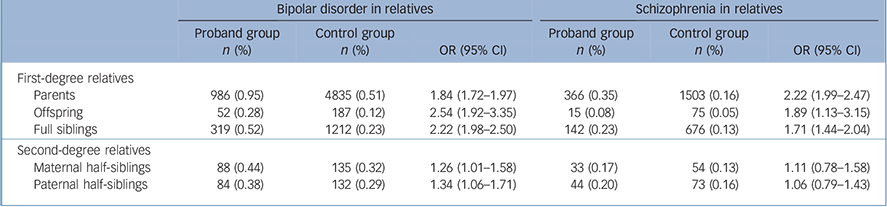
First-degree relatives of those in the ADHD proband group were more likely to have been diagnosed with bipolar disorder than first-degree relatives of control group participants (OR = 1.84-2.54; Table 2), supporting familial influences for the overlap between ADHD and bipolar disorder. Second-degree relatives of those in the ADHD group were also more likely to have been diagnosed with bipolar disorder than the relatives of controls. The risk of bipolar disorder was statistically significant and similar in magnitude among maternal (OR = 1.26) and paternal (OR = 1.34) half-siblings, but substantially lower than for full siblings. Further, first-degree relatives of probands with ADHD were more likely to have schizophrenia than relatives of controls (OR = 1.71-2.22; Table 2). The risk of schizophrenia was similar among maternal (OR = 1.11) and paternal (OR = 1.06) half-siblings and substantially lower than for full siblings.
Discussion
We conducted a large-scale nationwide family study to elucidate whether ADHD shares genetic and environmental risk factors with bipolar disorder and schizophrenia. The results suggested increased risks of both bipolar disorder and schizophrenia in relatives of the proband group. Moreover, risks among half-siblings were considerably lower than in full siblings, but similar in maternal and paternal half-siblings. This pattern indicates that these disorders share genetic rather than environmental risk factors, consistent with prior twin study results for ADHD, bipolar disorder and schizophrenia, suggesting substantial heritability and a limited role of shared environmental effects. Reference Faraone, Perlis, Doyle, Smoller, Goralnick and Holmgren17-Reference Sullivan, Kendler and Neale19
Risks of bipolar disorder and schizophrenia in relatives of the attention-deficit hyperactivity disorder (proband) group and relatives of controls matched on birth year and gender
| Bipolar disorder in relatives | Schizophrenia in relatives | |||||
|---|---|---|---|---|---|---|
| Proband group n (%) |
Control group n (%) |
OR (95% CI) | Proband group n (%) |
Control group n (%) |
OR (95% CI) | |
| First-degree relatives | ||||||
| Parents | 986 (0.95) | 4835 (0.51) | 1.84 (1.72-1.97) | 366 (0.35) | 1503 (0.16) | 2.22 (1.99-2.47) |
| Offspring | 52 (0.28) | 187 (0.12) | 2.54 (1.92-3.35) | 15 (0.08) | 75 (0.05) | 1.89 (1.13-3.15) |
| Full siblings | 319 (0.52) | 1212 (0.23) | 2.22 (1.98-2.50) | 142 (0.23) | 676 (0.13) | 1.71 (1.44-2.04) |
| Second-degree relatives | ||||||
| Maternal half-siblings | 88 (0.44) | 135 (0.32) | 1.26 (1.01-1.58) | 33 (0.17) | 54 (0.13) | 1.11 (0.78-1.58) |
| Paternal half-siblings | 84 (0.38) | 132 (0.29) | 1.34 (1.06-1.71) | 44 (0.20) | 73 (0.16) | 1.06 (0.79-1.43) |
Prior family studies have indicated that relatives of people with ADHD and co-occurring bipolar disorder have an increased risk of bipolar disorder, whereas relatives of people with ADHD only do not. Reference Faraone, Biederman and Monuteaux7,Reference Faraone, Biederman, Mennin, Wozniak and Spencer8 One interpretation of those results is that the two disorders are transmitted together in families, representing a familially distinct syndrome. At odds with this notion, however, is our finding that pure ADHD in probands actually predicted pure bipolar disorder in relatives. A potential explanation of these conflicting results is that the previous studies were insufficiently powered to detect a familial association between pure ADHD and bipolar disorder. The comorbidity of ADHD and schizophrenia has received less attention in prior research and no study has addressed the occurrence of schizophrenia in relatives of people with ADHD. Our results extend prior findings of comorbid ADHD in childhood-onset schizophrenia (84% prevalence), Reference Ross, Heinlein and Tregellas20 and also findings from high-risk samples, suggesting that ADHD is overrepresented in offspring of people with schizophrenia (20-35% prevalence). Reference Keshavan, Montrose, Rajarethinam, Diwadkar, Prasad and Sweeney21,Reference De la Serna, Baeza, Toro, Andres, Puig and Sanchez-Guistau22
Altogether, and in line with previous research, Reference Stahlberg, Soderstrom, Rastam and Gillberg23,Reference Kessler, Adler, Barkley, Biederman, Conners and Demler24 we found a higher risk of co-occurring bipolar disorder than schizophrenia in individuals with ADHD, which might at least partly reflect that ADHD shares more symptoms with bipolar disorder than with schizophrenia. Reference Wingo and Ghaemi25 However, familial aggregation patterns of ADHD and bipolar disorder were similar to those of ADHD and schizophrenia. These results are not consistent with a completely aetiologically distinct ADHD plus bipolar disorder subtype, although the finding that the overlap between ADHD and bipolar disorder is due to shared genetic factors does not exclude the possibility that ADHD plus bipolar disorder might differ pathophysiologically from the pure forms of the respective disorders, Reference Faraone, Biederman and Monuteaux7,Reference Faraone, Biederman, Mennin, Wozniak and Spencer8,Reference Ryden, Johansson, Blennow and Landen26 nor does it exclude specific aetiological factors for each disorder. Nevertheless, the pattern of familial aggregation in our study suggests pleiotropic genetic effects across the disorders. This interpretation is in line with CNV findings suggesting genetic overlaps between ADHD, autism and schizophrenia, Reference Miller, Shen, Weiss, Korn, Anselm and Bridgemohan5,Reference Williams, Zaharieva, Martin, Langley, Mantripragada and Fossdal6 and also the neurocognitive deficit overlap between ADHD, bipolar disorder and schizophrenia. Reference Barch27-Reference Bora, Yucel and Pantelis29 Notably, however, studies of CNVs indicate that disorder-specific variants are also involved. Reference Grozeva, Kirov, Ivanov, Jones, Jones and Green30 Our findings lend support to comparative studies investigating common genetic and neurocognitive factors across these disorders.
Strengths and limitations
The main strength of this study was our ability to address the risk of bipolar disorder and schizophrenia primarily in first-degree and second-degree relatives of a proband group with pure ADHD and a control group. Second, the study was powered to yield robust, unambiguous results. One potential limitation is that the out-patient register is relatively new (started in 2001). Also, as already mentioned, individuals enter and leave the registers at different ages. Both these features, inherent in using registers for research, mean that the percentage of individuals with a disorder does not equal the true lifetime prevalence. However, associations between ADHD and bipolar disorder or schizophrenia are not biased, as the nested case-cohort method allows equal follow-up periods of the proband and control groups as well as of their relatives. Another limitation is the non-standardised register diagnoses. However, validity studies of bipolar disorder and schizophrenia, Reference Sellgren, Landen, Lichtenstein, Hultman and Langstrom31,Reference Ekholm, Ekholm, Adolfsson, Vares, Osby and Sedvall32 as well as our own validity checks of ADHD using data from the Swedish twin register, support high specificity for the register-based diagnosis. Specifically, bipolar disorder diagnoses based on the Swedish in-patient register showed 92% agreement when compared with reassessed diagnostic status based on patients' medical records, Reference Sellgren, Landen, Lichtenstein, Hultman and Langstrom31 whereas in-patient schizophrenia diagnoses indicated 94% agreement when compared with research diagnoses based on semi-structured interviews and medical records. Reference Ekholm, Ekholm, Adolfsson, Vares, Osby and Sedvall32
Funding
Financial support was provided through the regional agreement on medical training and clinical research (ALF 20100305) between Stockholm County Council and the Karolinska Institute, and through grants from the Swedish Medical Research Council (K2010-61X-21569-01-1, K2010-61P-21568-01-4 and 2010-3184) and National Institute of Child Health and Human Development (HD061817).




eLetters
No eLetters have been published for this article.