Introduction
Marine education is a great tool to increase the understanding of and interest in our oceans. It is also an opportunity to promote the delivery of economic and social benefits related to the ocean that are efficient, equitable and sustainable (herein referred to as the “blue economy”; National Marine Science Committee, 2015). In 2010, ocean resources were estimated to provide US$1.5 trillion to the global economy, and this value is expected to increase to US$3 trillion by 2030 (Bennett et al., Reference Bennett, Cisneros-Montemayor and Blythe2019). While this economic growth is important, it also creates increasing pressure on the ocean. There is a need to adopt an integrated approach of managing the ocean by fostering collaboration between the marine industry and marine science to develop innovative solutions to achieve a blue economy (Organisation for Economic Co-operation and Development, 2016). Australia took steps towards this initiative by releasing the National Marine Science Plan in 2015, which outlines the challenges Australia faces in reaching a sustainable blue economy and provides recommendations on how to achieve this (National Marine Science Committee, 2015).
One of the key recommendations of the National Marine Science Plan was the need to build on our existing pool of marine scientists and attract, train and retain the next generation (National Marine Science Committee, 2015). The Australian Government is invested in increasing our science, technology, engineering and mathematics (STEM) skill base through the implementation of the National STEM strategy. However, marine education is limited to Foundation through to Year 10 in the current Australian Curriculum (Gough, Reference Gough2017). References to marine education only appear in Year 2 Humanities and Social Sciences curriculum and again in Year 10 for Earth and Space Sciences understanding (Gough, Reference Gough2020). Despite Australia’s reliance on the surrounding ocean to provide economic, social and environmental wealth, we are yet to see marine education embedded into the curriculum, to align with both the National STEM strategy and the recommendations outlined in the National Marine Science Plan. Part of the solution to the underrepresentation of marine science teaching and learning in Australian primary and secondary education is to offer schools/educators creative ways where ocean concepts can be taught within the Australian curriculum context, using familiar and easily accessible resources. One such resource is children’s literature, in the form of picture books.
Theoretical Framework: Children’s Literature to Teach Science Concepts
Children’s literature offers educators a mode through which to promote teaching and learning about science and the natural world. As a long-standing connection between this branch of creative practice and the classroom (Gruner, Reference Gruner, Nel and Paul2011), children’s literature can be an important vehicle for science-based education as it offers children the opportunity to contextualise facts in relation to meaningful stories to which they can relate, and as a mechanism for problem-solving and applied learning (Butzow & Butzow, Reference Butzow and Butzow2000). Such texts are familiar instructional tools that embed scientific information within the context of meaningful story-scapes and can help students understand and remember concepts more than they would with a traditional science textbook (Ansberry & Morgan, Reference Ansberry and Morgan2010). Furthermore, using children’s literature to introduce science concepts to children offers educators a familiar instructional tool (Saçkes, Trundle, & Flevares, Reference Saçkes, Trundle and Flevares2009) and may therefore assist with the present challenges educators find teaching science (Appleton & Kindt, Reference Appleton and Kindt1999, Reference Appleton and Kindt2002).
There have been several reviews published that recommend children’s literature that would best support science concepts in the classroom (Ansberry & Morgan, Reference Ansberry and Morgan2010; Butzow & Butzow, Reference Butzow and Butzow2000; Fralick, Reference Fralick1999; Mayer, Reference Mayer1995; Saçkes, Trundle, & Flevares, Reference Saçkes, Trundle and Flevares2009; Wells & Zeece, Reference Wells and Zeece2007). Additionally, there are several reviews that focus on children’s literature supporting environmental education (Babb, McBurnie & Miller, Reference Babb, McBurnie and Miller2017; Kirk & Karbon, Reference Kirk and Karbon1986; Pringle & Lamme, Reference Pringle and Lamme2005); however, ocean-based picture books represent only a tiny fraction of the resources discussed in these studies. Through preliminary research using the global WorldCat database, we found more than 30,000 juvenile fiction and non-fiction books when using the search term “sea”. This suggests there is ample supply of picture books related to the ocean; however, there is no large-scale survey and review of marine science children’s books. More specifically, there is no guide or reference point that studies how such resources present ideas about oceans, and how it relates to the Australian curriculum.
Research Context
Our aim here is to provide an insightful reference for teachers to weave ocean concepts into the Australian Curriculum using children’s literature and, consequently, contribute to improving ocean literacy in Australia. This study reviews ocean-themed picture books to gain an understanding of the scope and significance of this branch of children’s literature. We investigate how ideas about marine science are communicated in the texts, to provide a stepping-stone for teachers interested in using them for a range of marine education-based activities. Specifically, we seek to answer the following questions:
-
What are the main marine science concepts addressed in the picture books?
-
What are the main marine environment settings used in the picture books and do they represent Australian marine environments?
-
To what degree do the picture books align with Australian Curriculum science key learning area for Foundation through to Year 6?
-
Are ocean-themed books largely produced by publishing companies from one location and do the authors have a scientific background or collaborate with scientists?
Materials and Methods
A sample of ocean-themed picture books (fiction and non-fiction) relating to marine science was reviewed to identify whether these texts were appropriate for supporting learning of marine science concepts. The themes identified in the selected picture books were then analysed to determine the degree to which they support the Australian Curriculum standards for science (Foundation–Year 6) and to ascertain gaps where marine science concepts are not covered in the list of books.
The initial phase of research began with a survey of the WorldCat database to determine the scale of children’s literature resources relating to marine science. This involved catalogue searches using keywords such as ‘ocean’, ‘sea’, ‘marine’ and ‘marine science’. This database was chosen as it offered the researchers a global snapshot of a range of fiction and non-fiction texts aimed at young people. Across the searches conducted, results consistently returned tens of thousands of resources, stretching back across the past one hundred years. More refined and targeted searches using WorldCat revealed that hundreds of books are published each year that relate, in some manner, to themes relating to marine environments. WorldCat does not, however, allow for the disaggregation of picture books, or to isolate those which might be said to be most popular, especially within an Australian context. Therefore, we used other sources to identify picture books which were most likely to be accessed and used as educational resources.
We obtained our sample using the search terms ‘ocean’ and ‘sea’ in two online bookstore catalogues (Book Depository and Booktopia). We then applied further ‘children’s literature’ and ‘picture book’ filters on the results to narrow the search. The resultant sample size from this list was extensive (>5000 picture books) and beyond the scope of this review. We therefore selected the first 250 books from this list, as these were considered the ‘most popular’ from the databases searched. In this context, ‘most popular’ is defined as the books with the highest sales totals (confirmed by both online catalogues). As such, we may assume that these books are an accessible resource to educators in Australia. This review entailed the close reading and analysis of every text by the research team. This meant that obtaining >250 books was beyond the scope of this study. With this in mind, the list was further refined by cross-referencing the list with two local council libraries, one higher education library and 11 primary school libraries: all within the researchers’ coastal communities. Cross-referencing involved obtaining the frequency of the book being present in the 14 library catalogues. This system provided us with a sample of 100 picture books from the top 250 books in the database search. A bibliographic list of all the picture book texts used in this study is provided as Appendix A.
Each book was read by the research team, and specific, detailed information in the text was analysed. For every book, there were four coding elements: 1) marine science disciplines, 2) type of marine environment setting, 3) alignment with the Australian science curriculum and 4) publication details. Each element contained further sub-categories where specific coding methods were conducted for each element and these are described in each section below.
Marine science disciplines
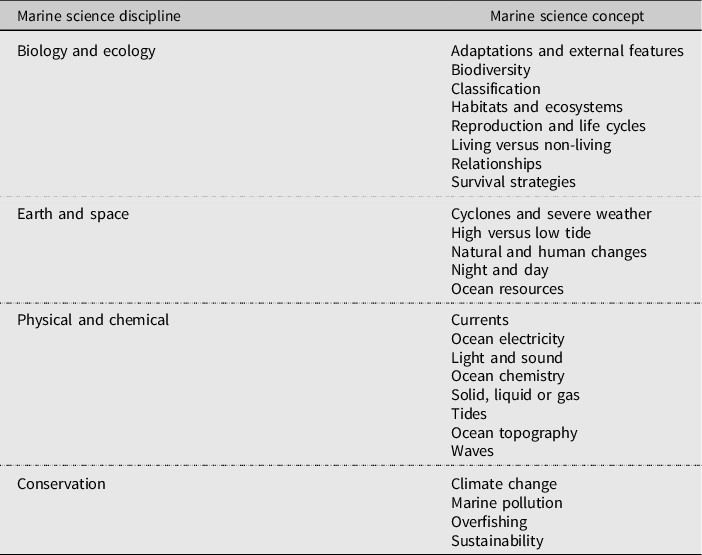
After consultation with marine science textbooks and resources (Kennish, Reference Kennish2001; Levinton, Reference Levinton2018), four main marine science disciplines were developed: marine biology, earth and space, physics and chemistry, and marine conservation. Each discipline had further marine science concepts identified (see Table 1 for the full list). We acknowledge that this is a snapshot of the diverse range of concepts that may have been included for study. However, these disciplines reflect the major science streams present in the Australian Science Curriculum (ACARA, 2019) with the addition of marine conservation.
List of marine science disciplines and the concepts used to code presence data for the 100 picture books

The text of the 100 picture books was read and coded for presence or absence of the marine concepts listed in Table 1. Each concept did not have mutually exclusive coding. For example, a book may have discussed life cycles as a strategy for survival.
Marine environment setting
All picture books were analysed to categorise the text and illustrations on the type of marine environment portrayed in the book. There were 10 marine environments identified (coral reefs, sandy beaches, open oceans, intertidal and subtidal rocky reefs, polar habitats, deep sea, kelp forest, seagrass meadows and estuaries) with a further two sub-categories of ‘not specified’ and ‘mixed environment’. Books that were categorised in the ‘not specified’ section implied that the text was broadly set in a marine environment with no clear habitat identified. Each category was mutually exclusive, unless the picture book referred to more than one habitat in the list and was thereby coded as a ‘mixed environment’.
Australian Science Curriculum links
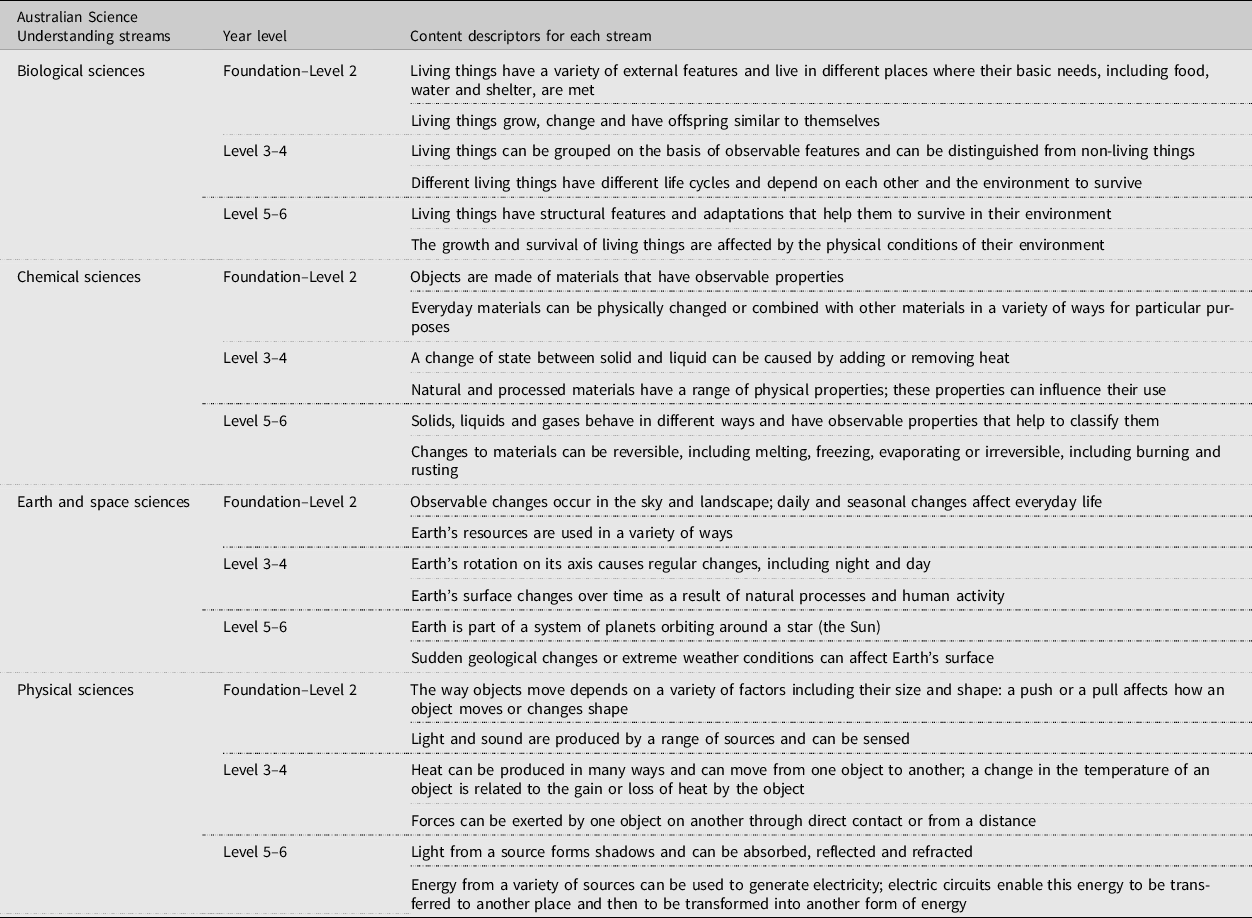
The Australian Science Curriculum was sourced via the Australian Curriculum, Assessment and Reporting Authority (ACARA) website. The content descriptors for the major streams (ACARA, 2019) were to be matched against the text or themes present in the 100 picture books. There were four main science streams (biological sciences, chemical sciences, earth and space sciences and physical sciences) along with 24 science content descriptors in the year levels, Foundation through to Year 6 (see Table 2). Text from the picture books was read, and counts and list of books were compiled against these 24 content descriptors. Each content descriptor did not have mutually exclusive coding. For example, text for one book may have not only discussed a concept from the biological sciences stream but also discussed the tidal movement of the ocean (earth and space sciences).
List of the Australian Science Curriculum streams and their year level content descriptors for Foundation–Year 6 that were used to match text or themes from the 100 ocean-themed picture books

Publication analysis
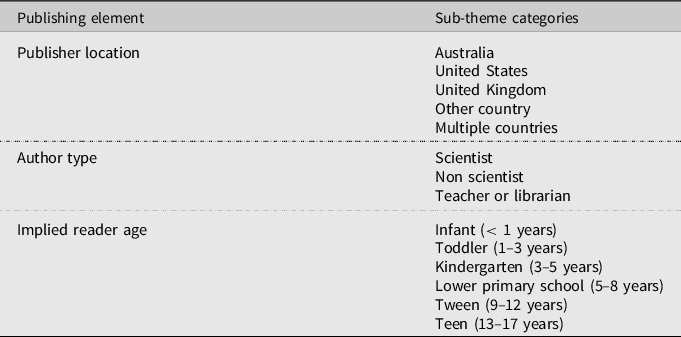
Publication information was taken from the imprint pages of the individual texts or from library databases when the information was not available in hard copy. There were three main coding elements analysed for the publication analysis: 1) publisher location, 2) author type and 3) age of implied reader. Each element had separate sub-themes that the 100 picture books were coded to (see Table 3).
List of the three publishing elements that were analysed for the 100 picture books and the sub-themes for each

Data analysis
Counts and list of books were coded against all the elements above using NVivo v12 coding software. The presence of the coding elements was recorded as either total counts or as a percentage of the sample size (n = 100).
Results
Marine science disciplines
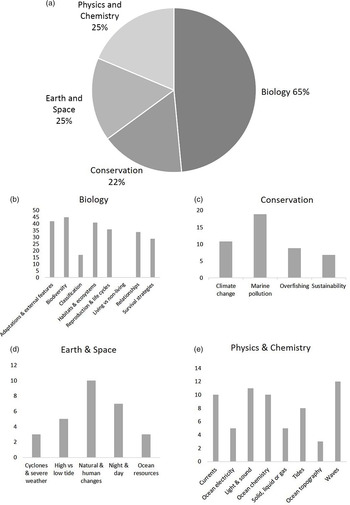
We identified 25 marine science concepts within the four broad science disciplines (biology, earth and space, physics and chemistry and marine conservation) and of these 25 concepts, we were able to match at least one of the picture books to the concept. There were 81 out of 100 books that were able to be matched against marine science concepts, with biology proving to be the most common discipline (65% of the books coded to this discipline with concepts such as adaptations, external features, biodiversity, marine habitats and ecosystems being the most referenced; Figure 1a and 1b). The other three disciplines had relatively similar percentage representations with physics and chemistry having 25% of books referencing this discipline and only 22% of the sample showed references to earth and space and marine conservation disciplines (Figure 1a). The top concepts for each of these three marine science disciplines were waves (12 books), natural and human changes (10 books) and marine pollution (19 books), respectively (see Figure 1c–e).
Ocean-themed picture books portraying the four main marine science disciplines in the text of the books (n = 100) where (a) is the total percentage book count for each marine science discipline present in the text of the books. The total book counts (y-axis) for each of the 25 marine science concepts present within the four main marine science disciplines are presented in (b) through to (e).

Marine environment setting
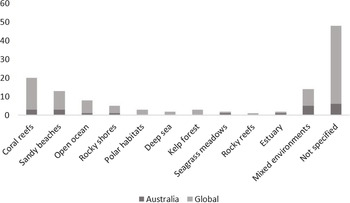
All 100 books were analysed to identify marine environment settings. The 10 different marine environments were represented in 58 books and 42 books did not provide a marine environment setting (Figure 2). Tropical marine environments, such as coral reefs, were the most represented marine environment setting (17 books), and the least representative marine environment settings were seagrass meadows, subtidal rocky reefs and estuaries, with only one book each representing these environments (Figure 2). We further analysed the marine environment settings in just the Australian published picture book samples (n = 21) to assess whether the story focused on temperate or tropical habitats within Australia. It was found that 43% of the books focused their story on tropical zones [e.g. the Great Barrier Reef (GBR)], whereas only 19% focused on temperate habitats (e.g. the Derwent Estuary in Tasmania). Sandy beaches and coral reefs were the most represented marine habitats in the ocean-themed picture books published in Australia (Figure 2).
Total number of ocean-themed picture books (y-axis) displaying a type of marine environment setting (x-axis) in either the text or illustration (light grey shaded bars; n = 100) and in the Australian context (dark grey bars; n = 21).

Australian Science Curriculum links
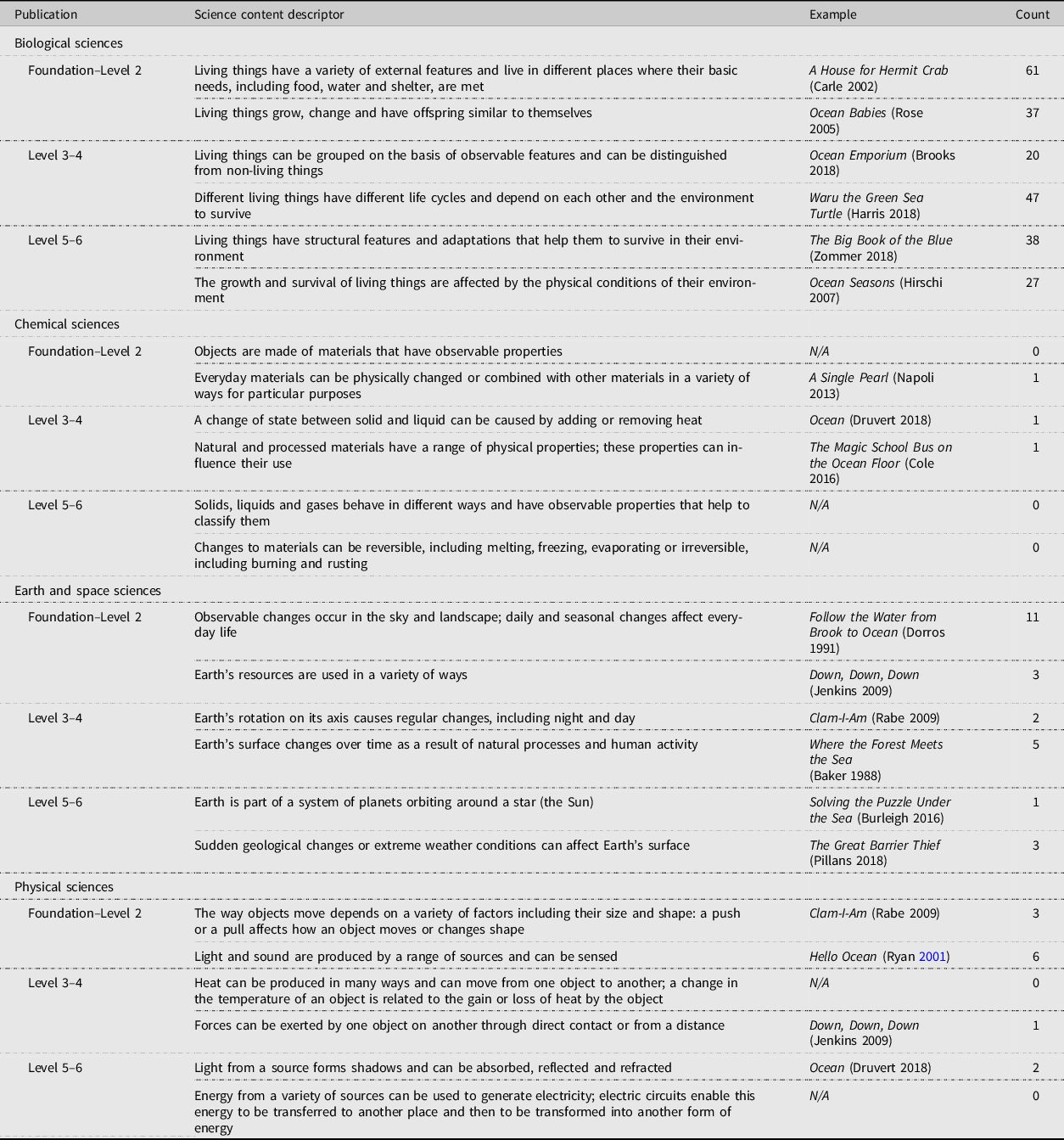
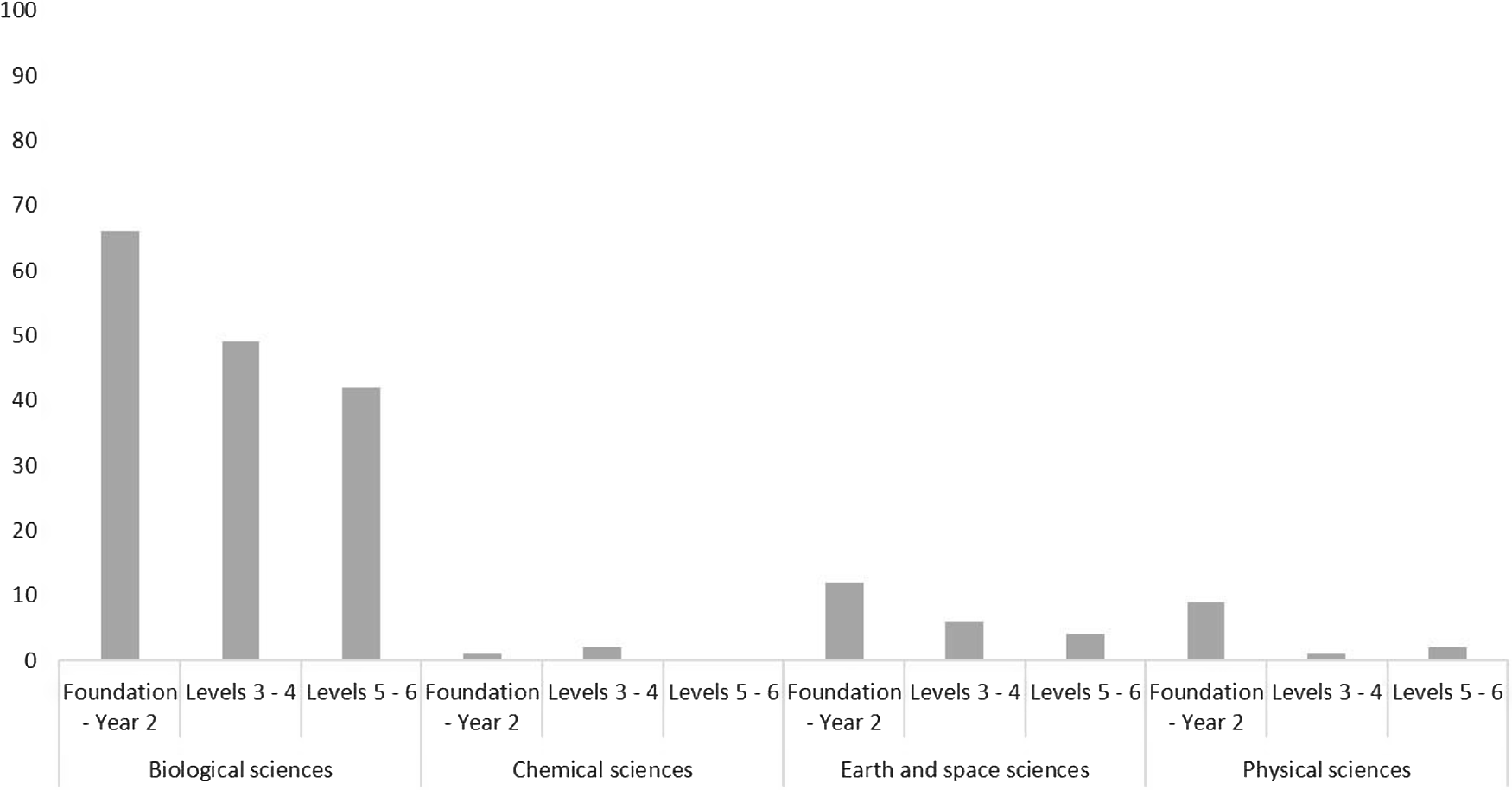
We were able to align 19 of the 24 science content descriptors present in the Australian Science Curriculum (Foundation–Year 6) from the reviewed books. We have provided an example picture book that connects with each of the 19 content descriptors, examples which educators may wish to use in their classrooms (see Table 4). We also found that 91 out of the 100 picture books aligned with the Australian Science Understanding Curriculum across all the 3-year level groupings: Foundation–Year 2; Year 3–4 and Year 5–6. We found that the Foundation–Year 2 levels had a slightly more representative sample of picture books than the other 2-year level groups for three out of the four science streams (biological sciences: 66 books; earth and space sciences: 12 books and physical sciences: 9 books; Figure 3).
Total number of ocean-themed picture books that the text aligned with the content descriptors of the Science Understanding stream of the Australian Curriculum (n = 100). An example of one of the reviewed books is provided for each descriptor if applicable

Total number of ocean-themed picture books where the text from the book aligned with one of the four science understanding streams of the Australian Curriculum across the Foundation through to Level 6.

The biological sciences stream of the Australian Curriculum was the most common standard that the ocean-themed books aligned with across the year levels (Table 3; Figure 3). Notably, the Foundation–Year 2 biological sciences descriptor, Living things have a variety of external features and live in different places where their basic needs, including food, water and shelter, are met, was the most represented content descriptor across our 100 sample of books (Table 3). Less prevalent were connections between the examples and science streams relating to earth, space and physical science concepts (Table 3).
Publication analysis
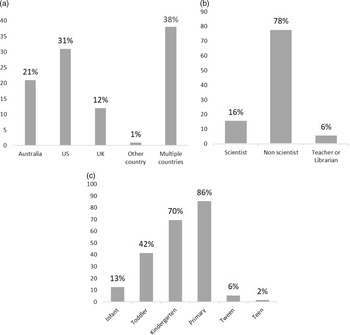
Only a small proportion of the reviewed books were published in Australia (21%), making the US and publishing companies with multiple locations (e.g. the UK and USA) the main publishing locations (Figure 4a). Author biographies online and via the hard copy of each book were analysed to ascertain whether scientists were the main author type writing the texts relating to the ocean and the data revealed only 16% of the books analysed were written by scientists (Figure 4b). The most dominant author type did not have a scientific background (78%); however, this percentage included some authors consulting with scientists (20%) or authors having an interest in nature (16%) (Figure 4b). Most of the picture books analysed recommended the text for either Kindergarten-aged children (70% of the sampled books) or children who are in primary school (85% of the sampled books) (Figure 4c).
Total percentage counts of the ocean-themed picture books coded for (a) publisher location, (b) author type and (c) implied reader (n = 100).

Discussion
This review highlights that children’s literature in the form of picture books is a space where marine science concepts are developed and can be shared with young readers. Many of the examples reviewed in this paper intersect with the key themes in the Australian science curriculum for primary school students. Specifically, we found that most of the 100 books reviewed (91 books) were able to be linked to one of the science standards within the Australian Curriculum, despite marine science not being featured in the Curriculum itself. This result implies that ocean-themed picture books can be a useful resource for teachers to integrate marine education into their classroom without having to deviate from the overcrowded science curriculum.
One such example is A House for Hermit Crab by Eric Carle (2002) where it can be used to teach the Foundation–Year 2 biological science understanding that ‘Living things have a variety of external features and live in different places where their basic needs, including food, water and shelter, are met’ (ACARA, 2019). Carle takes the reader on a journey where the crab is on a mission to decorate its new shell. To do so, the crab collects a variety of marine organisms along the way such as a sea anemone and a sea star. This story may be used in the classroom to introduce students to variety of external features in marine life such as a hard exoskeleton found in the hermit crab or the spikes shown on the sea urchin. Discussions can be had as to why these features may benefit the animal. Furthermore, life in the water can be explored through the text where comparisons between marine and terrestrial plants and animals can be investigated further.
A House for Hermit Crab, among others, is a good example for educators to incorporate biological science concepts into the classroom; however, for concepts such as earth, space, physics and chemistry, the choice is somewhat limited. We found ocean-based biological concepts to be the most representative discipline in our sample (65%), whereas concepts relating to earth, space, physics and chemistry were less common. We found these examples often did not focus on these concepts but were rather a small snippet in the text where it may not be an obvious theme for educators to use in the classroom. An example here is Hello Ocean by Pam Muñoz Ryan (Reference Ryan2001) where the story is about a child exploring a sandy beach using the five senses of sight, taste, smell, hearing and feeling. We recommended this book for drawing out concepts from the Australian Curriculum Science Understanding in the Year 1 Physical Sciences content descriptor of ‘Light and sound are produced by a range of sources and can be sensed’ (ACARA, 2019). One way in which educators may choose to use this book is as either a pre- or post-educational supplement on senses following a visit to their local beach.
The bias towards concepts linked to life sciences have been well documented as being the dominant field in the market for children’s science books (Ford, Reference Ford2006; Rawson & McCool, Reference Rawson and McCool2014; Kelly, Reference Kelly2018). These reviews also noted that physical science was underrepresented in science picture books (varying from 0% to 9% of books analysed; Ford, Reference Ford2006; Brunner & Abd-El-Khalick, Reference Brunner, Abd-El-Khalick, McDonald and Abd-El-Khalick2017; Kelly, Reference Kelly2018) and that there is a need for the publishing industry to move away from life sciences to better represent science as a whole (Kelly, Reference Kelly2018). While our study also showed a low representation of physical sciences in the ocean-themed picture books, our proportion was higher (25%) than previous reviews which may suggest ocean-themed picture books could be a useful platform to incorporate physical science concepts.
Marine conservation themes such as marine pollution or climate change were also surprisingly underrepresented in our sample of ocean-themed picture books (19 and 11 out of 100 books, respectively) which may have been a result of the key terms used in the book recruitment process. Alternatively, this low representation may be a result of publishers avoiding books that include environmental issues to avoid ‘ecophobia’ in children. The term ‘ecophobia’ is often used when children feel hopeless and disempowered from learning about environmental threats (McKnight, Reference McKnight2010) and evidence suggests children express fear, sadness and anger when discussing their feelings about environmental problems (Strife, 2011). These are emotions that are not typically expressed when reading a picture book and to avoid ‘ecophobia’, Swain (Reference Swain2020) suggests that picture books that educate about environmental threats should also inspire hope, empowerment and the possibility of recovery. Swain (Reference Swain2020) highlights the need for optimistic stories such as the picture book about women who have made big and small actions against climate change (Fantastically Great Women Who Saved the Planet by Kate Pankhurst, Reference Pankhurst2020). A similar example was found in our review where the narrative focusses on the career of a female shark biologist, Eugenie Clark, who overcomes the challenges of being a female scientist during a time dominated by male scientists (Shark Lady by Jess Keating, 2017).
It was of no surprise that tropical marine environments were the most popular picture book setting from the picture books that provided the environment setting. In the instance of the Australian picture books, the overrepresentation of tropical marine environments is likely due to the international profile of Australia’s tropical north, and the GBR in particular. The GBR is generally associated with colourful marine life and is a prominent tourist attraction (Great Barrier Reef Marine Park Authority, 2019). It has also been subject to multiple media reports about coral bleaching and the effects of global warming and climate change (Foxwell-Norton & Lester, Reference Foxwell-Norton and Lester2019). Furthermore, visitor data recorded over a year have shown higher rates in tropical climatic zones compared to temperate climatic zones in Australia (Hadwen, Arthington, Boon, Taylor & Fellows, Reference Hadwen, Arthington, Boon, Taylor and Fellows2011). The higher profile and visitor numbers seen in such environments may increase familiarity for potential readers, and therefore make this subject attractive to authors, illustrators and publishers. Indeed, the visitation rate of the GBR is over 2 million people per annum (Great Barrier Reef Marine Park Authority, 2019), which includes many international visitors, and this may create a marketable opportunity for publishers to promote picture books focused on the GBR as a tourist souvenir.
It is possible to argue that marine science picture books consumed in Australia tend to focus on marine environments that do not reflect the environmental contexts of many of their readers. This idea is backed up by the data that show the greatest number of books in the dataset are best described as ‘multinational’ or published solely in the USA, so far as they are published by international imprints/presses and included material that is not location specific. It was interesting, and disappointing, to note that very few examples we looked at (three picture books; Welcome Home by Christina Booth, 2013, The Hidden Forest by Jeannie Baker, 2005 and Rock Pool Secrets by Narelle Oliver, 2017) represented the temperate environments of southern Australia. The temperate marine environment in Australia, often referred as the Great Southern Reef (GSR), covers over 8000 km of coastline across five Australian States (Bennett et al., Reference Bennett, Wernberg, Connell, Hobday, Johnson and Poloczanska2015). It is a hotspot for marine biodiversity and contributes AU$10 billion to the Australian economy per annum (Bennett et al., Reference Bennett, Wernberg, Connell, Hobday, Johnson and Poloczanska2015) which is more than the AU$6.4 billion per annum that the GBR contributes to the economy (Great Barrier Reef Marine Park Authority, 2019). Despite the social, ecological and economic importance of the GSR, public perceptions of it in Australia are low compared to the GBR (Bennett et al., Reference Bennett, Wernberg, Connell, Hobday, Johnson and Poloczanska2015). In fact, it has been shown that 81–99% of newspaper reports published in the temperate states of Tasmania, Victoria or South Australia are focused on coral or coral reefs (Bennett et al., Reference Bennett, Wernberg, Connell, Hobday, Johnson and Poloczanska2015). This is rather interesting considering approximately 67% of the Australian population lives within 50 km of the GSR (Bennet et al., Reference Bennett, Wernberg, Connell, Hobday, Johnson and Poloczanska2015) and further highlights that the lower representations of picture books focusing on Australian temperate marine environments are likely due to lowered public awareness and marketability.
The impact of this low representation of marine environments such as the GSR may inhibit the ability to capture place-based learning for children. Place-based learning occurs when children gain a heightened understanding and appreciation of the natural environment or places where they live and interact on a regular basis (Wells & Zeece, Reference Wells and Zeece2007). Kriesberg (Reference Kriesberg1999) suggests environmental education is best taught in the place where the child lives so they can connect to that place. This can also be complemented by incorporating literature such as picture books relating to the environment being taught and allowing children to make connections to the real world through books and stories (Wells & Zeece, Reference Wells and Zeece2007). Using picture books with a tropical focus in areas of southern Australia is restricting Australian children residing in this area, the opportunity to draw connections with their local marine environment.
Surprisingly, relatively few of the examples (five out of 100) were produced by publishers whose sole focus is science-based materials. Of the 21 of books that were published in Australia, four books were authored by someone who had a science background. It is not the aim of this study to evaluate the scientific accuracy of the dataset and correlate that to the degree to which scientists, let alone marine scientists, are or are not involved in producing children’s literature about the ocean. However, it is reasonable to suggest that specialist marine scientists and educators could play a more significant role in the production of marine science picture books. How that might translate into better marine science literacy outcomes for children remains a potentially fruitful subject for further inquiry.
Conclusions, limitations and further research
In addition to the 100 books included in our study sample, as well as the thousands of marine science picture books noted at the outset of this paper, we acknowledge that this branch of literature for children continues to grow. For example, after the review of the 100 books had concluded, additional picture books related to the GSR were published (e.g. The Underwater Forest by Rebecca Morris, Reference Morris2020; The Way of the Weedy Seadragon by Anne Morgan, Reference Morgan2021 and Hold On! Saving the Spotted Handfish by Gina Newton, Reference Newton2020). In addition, members of this research team have produced a picture book of their own – Professor Seaweed and the Great Southern Reef – due for publication by CSIRO Publishing in 2022. This publication aims to showcase, through practice-led research, the conventions of this genre and the impact that it might have on its implied readership.
While this study does not provide the solution to the inclusion of marine education in schools, it does, however, demonstrate that ocean-themed picture books regularly align with mainstream science concepts and identify in which specific examples might be used to help teachers overcome current barriers and inhibitors for marine education inclusion. This initial research points to further work in this area, to explore ways to effectively use children’s literature to teach marine science concepts in school and to develop comprehensive resources for teachers, such as lesson plans and professional development around using marine science children’s literature resource in the classroom.
Acknowledgements
We thank M. O’Brien for assistance with coding the marine science concepts.
Financial Support
This work was funded by Deakin University.
Conflicts of Interest
No potential conflict of interest was reported by the authors and this manuscript is original work that has not been submitted or published anywhere else.
APPENDIX A
List of Children’s Literature Analysed
-
1. Adams, Jennifer (2013) Moby Dick: An Ocean Primer, Gibbs Smith, Utah, United States of America, 22 pp.
-
2. Andreae, Giles (1998) Commotion in the Ocean, Orchard Books, London, United Kingdom, 26 pp.
-
3. Babin, Stéphanie (2014) Touch and Explore the Ocean, Twirl, Montrouge, France, 12 pp.
-
4. Bailey, Ella (2016) One Day on our Blue Planet…in the Antarctic, Flying Eye Books, London, United Kingdom, 32 pp.
-
5. Bailey, Ella (2018) One Day on our Blue Planet…in the Ocean, Flying Eye Books, London, United Kingdom, 32 pp.
-
6. Baker, Jeannie (1988) Where the Forest Meets the Sea, Walker Books Ltd, London, United Kingdom, 32 pp.
-
7. Baker, Jeannie (2005) The Hidden Forest, Walker Books Ltd, London, United Kingdom, 40 pp.
-
8. Barnard, Bryn (2017) The New Ocean: The Fate of Life in a Changing Sea, Alfred A. Knopf, New York, United States of America, 40 pp.
-
9. Barr, Catherine (2017) 10 Reasons to Love a Turtle, Frances Lincoln Children’s Books, London, United Kingdom, 24 pp.
-
10. Barroux (2016) Where’s the Starfish?, Egmont UK Ltd, London, United Kingdom, 32 pp.
-
11. Base, Graeme (2003) The Sign of the Seahorse, Penguin Books Australia, Hawthorn, Australia, 44 pp.
-
12. Bently, Peter (2008) The Shark in the Dark, Macmillan Children’s Books, London, United Kingdom, 32 pp.
-
13. Berkes, Marianne (2004) Over in the Ocean: In a Coral Reef, Dawn Publications, Nevada City, United States of America, 32 pp.
-
14. Berne, Jennifer (2015) Manfish: A story of Jacques Cousteau, First Chronicle Books LLC, San Francisco, United States of America, 38 pp.
-
15. Blanchette, Carol and Dugan, Jenifer (2018) The Golden Forest: Exploring a Coastal California Ecosystem, Muddy Boots Press, United States of America, 32 pp.
-
16. Booth, Christina (2013) Welcome Home, Ford Street Publishing Pty Ltd, Australia, 32 pp.
-
17. Brooks, Susie (2018) Ocean Emporium, Egmont UK Ltd, London, United Kingdom, 64 pp.
-
18. Brown, Alan (2002) Turtle’s Song, University of Queensland Press, St Lucia, Australia, 32 pp.
-
19. Burleigh, Robert (2016) Solving the Puzzle Under the Sea: Marie Tharp Maps the Ocean Floor, Simon & Schuster Books for Young Readers, New York, United States of America, 40 pp.
-
20. Burns, Loree Griffin (2010) Tracking Trash: Flotsam, Jetsam, and the Science of Ocean Motion, Houghton Mifflin, Boston, United States of America, 64 pp.
-
21. Carle, Eric (2002) A House for Hermit Crab, Simon & Schuster, New York, United States of America, 32 pp.
-
22. Carle, Eric (2006) Mister Seahorse, Penguin Books Ltd, London, United Kingdom, 40 pp.
-
23. Cartwheel Books (2018) Baby Shark Doo Doo Doo Doo Doo Doo, Cartwheel Books, New York, United States of America, 24 pp.
-
24. Cole, Joanna (2016) The Magic School Bus on the Ocean Floor, Scholastic US, New York, United States of America, 48 pp.
-
25. Collard III, Sneed B (2006) One Night in the Coral Sea, Charlesbridge, Watertown, United States of America, 32 pp.
-
26. Corpus, Terrizita (2017) The Grumpy Lighthouse Keeper, Magabala Books, Broome, Australia, 32 pp.
-
27. Cortés, Ricardo (2018) Sea Creatures from the Sky, Akashic Books, New York, United States of America, 48 pp.
-
28. Cuevas, Michelle (2016) The Uncorker of Ocean Bottles, Dial Books for Young Readers, New York, United States of America, 34 pp.
-
29. Davey, Owen (2016) Smart About Sharks, Flying Eye Books, London, United Kingdom, 40 pp.
-
30. Davies, Nicola (2015) Big Blue Whale, Walker Books Ltd, London, United Kingdom, 32 pp.
-
31. Davies, Nicola (2015) One Tiny Turtle, Walker Books Ltd, London, United Kingdom, 32 pp.
-
32. Desmond, Jenni (2015) The Blue Whale, Enchanted Lion Books, New York, United States of America, 48 pp.
-
33. Diesen, Deborah (2019) The Pout-Pout Fish Cleans Up the Ocean, Farrar Straus Giroux Books for Young Readers, New York, United States of America, 32 pp.
-
34. Dodd, Emma (2010) Me…, Templar Publishing, Surrey, United Kingdom, 30 pp.
-
35. Donaldson, Julia (2004) Sharing a Shell, Macmillan Children’s Books, London, United Kingdom, 32 pp.
-
36. Donaldson, Julia (2017) Tiddler: The Story-telling Fish, Scholastic, London, United Kingdom, 32 pp.
-
37. Donaldson, Julia (2018) The Snail and the Whale, Pan MacMillan, London, United Kingdom, 36 pp.
-
38. Donnelly, Anne Helen (2018) Ori’s Clean Up, Anne Helen Donnelly, Sydney, Australia, 32 pp.
-
39. Dorros, Arthur (1991) Follow the Water from Brook to Ocean, HarperCollins Children’s Books, New York, United States of America, 32 pp.
-
40. Druvert, Hèléne (2018) Ocean. Thames and Hudson, London, United Kingdom, 40 pp.
-
41. Elliott, David (2012) In the Sea, Candlewick Press, Massachusetts, United States of America, 32 pp.
-
42. Fan, Terry and Fan, Eric (2018) Ocean Meets Sky, Simon & Schuster Books for Young Readers, New York, United States of America, 48 pp.
-
43. Fredericks, Anthony D (2002) In One Tidepool: Crabs, Snails and Salty Tails, Dawn Publications, Nevada City, United States of America, 32 pp.
-
44. Fuentes, Mariana (2012) Dhyum the Dugong, Reef & Rainforest Research Centre Limited, Cairns, Australia, 32 pp.
-
45. Garland, Michael (2011) Miss Smith Under the Ocean, Dutton Children’s Books, New York, United States of America, 32 pp.
-
46. Garward, Rhonda N. (2017) Tilly’s Reef Adventure, National Library of Australia, Canberra, Australia, 36 pp.
-
47. Gay, Marie-Louise (2010) Stella, Star of the Sea, Groundwood Books Ltd, Ontario, Canada, 32 pp.
-
48. Gibbs, May (2014) Snugglepot and Cuddlepie’s Underwater Adventure, Scholastic Australia Pty Limited, Gosford, Australia, 24 pp.
-
49. Harris, Paul Ashford (2018) Waru the Green Sea Turtle, Impact Press, Edgecliff, Australia, 16 pp.
-
50. Hart, Caryl (2019) Let’s go to the Seaside!, Walker Books Ltd, London, United Kingdom, 32 pp.
-
51. Hegarty, Patricia (2019) Sea, Little Tiger Group, London, United Kingdom, 32 pp.
-
52. Hill, David (2018) Hero of the Sea: Sir Peter Blake’s Mighty Ocean Quests, Puffin, New Zealand, 32 pp.
-
53. Hirschi, Ron (2007) Ocean Seasons, Arbordale Publishing, Mt. Pleasant, United States of America, 32 pp.
-
54. Horowitz, Ruth (2000) Crab Moon, Candlewick Press, Massachusetts, United States of America, 32 pp.
-
55. Howell, Troy (2018) Whale in a Fishbowl, Random House USA Inc, United States of America, 42 pp.
-
56. Inches, Alison (2010) I Can Save the Ocean, Little Simon, New York, United States of America, 24 pp.
-
57. Jenkins, Steve (2009) Down, Down, Down: a Journey to the Bottom of the Sea, Houghton Mifflin Books for Children, New York, United States of America, 40 pp.
-
58. Kaufmann, Carol and Kainen, Dan (2015) Ocean: A Photicular Book, Workman Publishing, New York, United States of America, 12 pp.
-
59. Keating, Jess (2017) Shark Lady: The True Story of How Eugenie Clark Became the Ocean’s Most Fearless Scientist, Sourcebooks Jabberwocky, Illinois, United States of America, 40 pp.
-
60. Laden, Nina (2018) Yellow Kayak, Simon & Schuster, New York, United States of America, 32 pp.
-
61. Lauder, Kara and Guinea, Mick Dr (2017) Monty C Turtle Learns to Swim, Coastal Herd Tales, Australia, 32 pp.
-
62. Law, Jessica (2013) A Hole in the Bottom of the Sea, Barefoot Books Ltd, Bath, United Kingdom, 24 pp.
-
63. Lester, Alison (2004) Magic Beach. Allen & Unwin, Crows Nest, Australia, 32 pp.
-
64. Lester, Alison and Godwin, Jane (2018) The Silver Sea, Affirm Press, Melbourne, Australia, 32 pp.
-
65. Lucado, Max (2013) The Boy and the Ocean, Crossway, Illinois, United States of America, 48 pp.
-
66. MacCarthy, Patricia (2019) Dance, Dolphin, Dance. A California Ocean Adventure, Otter-Barry Books, Hereford, United Kingdom, 32 pp.
-
67. Magoon, Scott (2014) Breathe, Simon & Schuster, New York, United States of America, 40 pp.
-
68. McKinlay, Meg (2017) Once Upon a Small Rhinoceros, Walker Books Australia, Newtown, Australia, 32 pp.
-
69. McLean, Simon and Häggström, Carolina (2013) The Treacherous Travels of Tasman Turtle. Peter Lik Publishing, Australia, 32 pp.
-
70. Messner, Kate (2018) The Brilliant Deep: Rebuilding the World’s Coral Reefs. Chronicle Books, San Francisco, United States of America, 48pp.
-
71. Napoli, Donna Jo (2013) A Single Pearl, Hyperion Books, New York, United States of America, 32 pp.
-
72. Nivola, Claire A. (2012) Life in the Ocean: The Story of Oceanographer Sylvia Earle, Frances Foster Books, New York, United States of America, 32 pp.
-
73. Odgers, Sally (2018) Ocean Lullaby, Scholastic Press, Gosford, Australia, 24 pp.
-
74. Oliver, Narelle (2017) Rock Pool Secrets. Walker Books Australia Pty Ltd, Newtown, Australia, 32 pp.
-
75. Pallotta, Jerry (1986) The Ocean Alphabet Book, Charlesbridge, Watertown, United States of America, 32 pp.
-
76. Pallotta, Jerry (2004) Dory Story, Charlesbridge, Watertown, United States of America, 32 pp.
-
77. Pennacchio, Marcello (2018) Somewhere in the Reef, Scholastic Australia, Lindfield, Australia, 24 pp.
-
78. Pillans, Sue (2018) The Great Barrier Thief. Little Steps Publishing, Glebe, Australia, 32 pp.
-
79. Pittau, Francesco (2014) The Open Ocean, Chronicle Books, San Francisco, United States of America, 12 pp.
-
80. Pfister, Marcus (1992) The Rainbow Fish, North-South Books, New York, United States of America, 25 pp.
-
81. Pratt, Kristin Joy (1994) A Swim Through the Sea, Dawn Publications, Nevada City, United States of America, 26 pp.
-
82. Rabe, Tish (2009) Clam-I-Am, HarperCollins Children’s Books, London, United Kingdom, 48 pp.
-
83. Ramage, Jan (2010) Stranded, Walker Books Australia, Australia, 40 pp.
-
84. Rose, Deborah Lee (2005) Ocean Babies, National Geographic Society, Washington, United States of America, 32 pp.
-
85. Rosenstock, Barb (2018) Otis and Will Discover the Deep: the Record-Setting Dive of the Bathysphere, Hachette Book Group, New York, United States of America, 48 pp.
-
86. Ryan, Pam Muñoz (2001) Hello Ocean, Charlesbridge, Watertown, United States of America, 32 pp.
-
87. Sherry, Kevin (2007) I’m the Biggest Thing in the Ocean, Dial Books for Young Readers, New York, United States of America, 28 pp.
-
88. Stead, Philip C (2017) The Only Fish in the Sea, Roaring Book Press, New Milford, United States of America, 40 pp.
-
89. Swinburne, Stephen R (2010) Ocean Soup, Charlesbridge, Watertown, United States of America, 32 pp.
-
90. Tanner, Jane (1989) There’s a Sea in My Bedroom, Penguin Books Australia, Hawthorn, Australia, 32pp.
-
91. Tanner, Lian (2019) Ella and the Ocean, Allen & Unwin, Crows Nest, Australia, 32 pp.
-
92. Temple, Kate and Temple, Jol (2019) Room on our Rock, Scholastic Australia, Gosford, Australia, 32 pp.
-
93. Tibbitts, Christiane Kump (1996) Seashells, crabs, and sea stars, NorthWord Books for Young Readers, Minnetonka, United States of America, 48 pp.
-
94. Topouzoglou, Elena (2018) Mr Pegg’s Post, New Frontier Publishing Pty Ltd, Glebe, Australia, 32 pp.
-
95. Tsurumi, Andrea (2018) Crab Cake: Turning the Tide Together, Houghton Mifflin Harcourt, New York, United States of America, 48 pp.
-
96. Wiesner, David (2012) Flotsam, Anderson Press Ltd, London, United Kingdom, 40 pp.
-
97. Wild, Margaret (2012) Leo the Littlest Seahorse, Puffin Books, Australia, 32 pp.
-
98. Wormell, Christopher (2011) One Smart Fish, Random House Children’s Publishers UK, London, United Kingdom, 32 pp.
-
99. Worth, Bonnie (2009) A Whale of a Tale. HarperCollins Children’s Books, London, United Kingdom, 45 pp.
-
100. Zommer, Yuval (2018) The Big Book of the Blue, Thames & Hudson Ltd, London, United Kingdom, 64 pp.
Prue Francis is a lecturer in science professional practice at Deakin University, Australia where she teaches employability and marine science units for the various science degrees offered at Deakin University. Prue has over 10 years’ experience as a STEM educator, having taught a host of units across all learning levels and at multiple educational institutions across Australia. P Francis is the course director of the Bachelor of Marine Science course at Deakin University and has a research interest in seaweed reproduction and cultivation and ocean literacy.
Paul Venzo is a senior lecturer in writing and literature specialising in child and young adult literature at Deakin University. His teaching focusses on critical approaches to the study of texts for young people and creative practice. Paul’s research on children’s literature has been published widely in national and international journals and books, with a particular focus on fiction and non-fiction picture books and representations of identity. He is the convener of the Reading and Writing Mates programme: a project that partners pre-service teachers with primary school students to promote literacy through immersion in children’s literature.
Alecia Bellgrove is senior lecturer in marine biology and ecology at Deakin University, leading the DeakinSeaweed Research Group that is driving research in conservation and sustainable exploitation of Australian seaweeds. Alecia has worked with various primary schools in promoting STEM education and is currently leading the Inspiring Young Marine Scientists programme with St Aloysius Primary School, Queenscliff. She is a passionate advocate for translating scientific research for multiple audiences and empowering children and young women to pursue science careers.