Background
Insomnia in cancer patients is underrecognized and inadequately managed, with close to 60% of people treated for cancer experiencing insomnia (Savard et al., Reference Savard, Ivers and Villa2011). Insomnia is a disorder characterized by a dissatisfaction with sleep quality or difficulty falling asleep, staying asleep, or waking up too early at least three times per week for the past three months (American Psychiatric Association, 2013). Insomnia in cancer patients can have significant consequences including, but not limited to, an increased risk of infections (Ruel et al., Reference Ruel, Savard and Ivers2015), decreased overall quality of life (Lis et al., Reference Lis, Gupta and Grutsch2008), higher risk of (and poorer recovery from) depression and anxiety (Irwin, Reference Irwin2013), and greater severity of other cancer-related symptoms (Stepanski et al., Reference Stepanski, Walker and Schwartzberg2009).
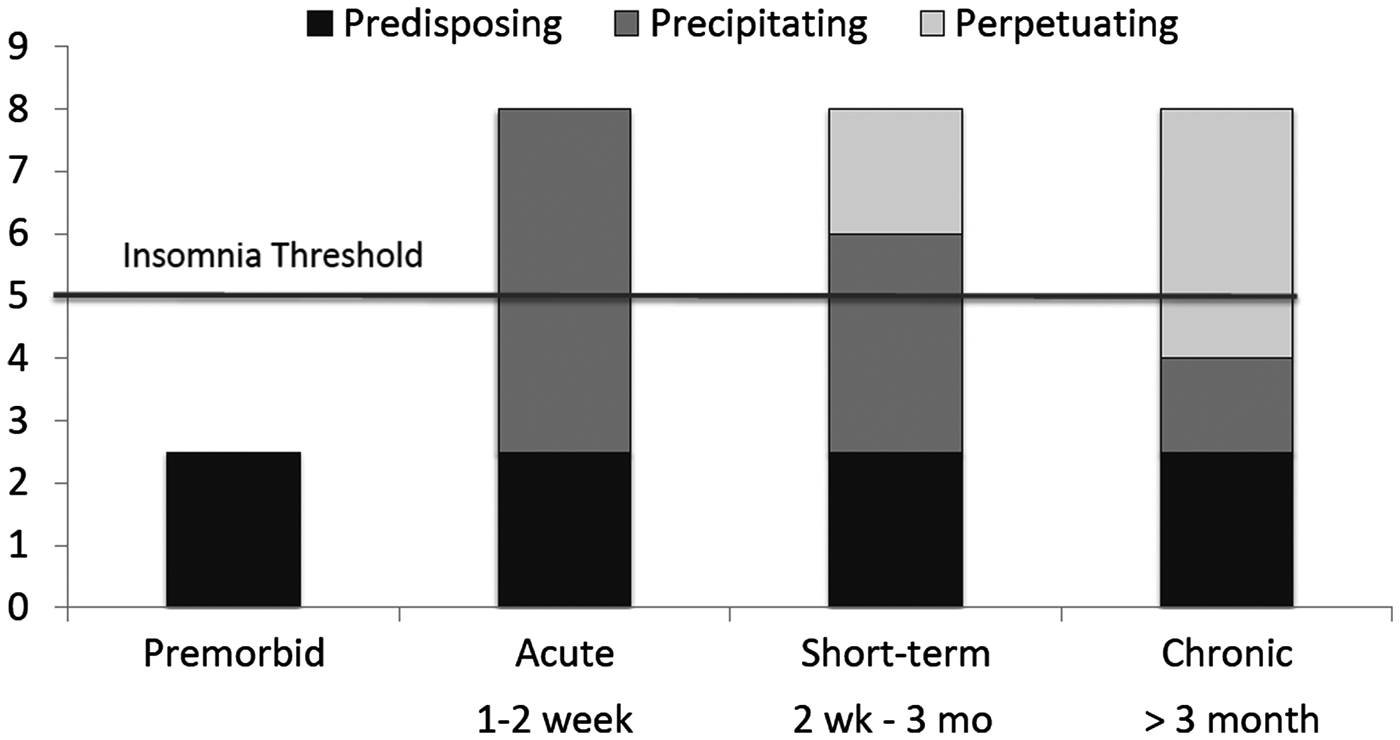
The behavioral model of insomnia, also known as Spielman's 3P model, aims to explain interactions among predisposing, precipitating, and perpetuating factors in the development of insomnia (Figure 1). Predisposing and precipitating factors explain insomnia development, whereas perpetuating factors explain the mechanisms by which insomnia can become chronic. Predisposing factors represent the underlying vulnerability to develop insomnia and comprise biological features such as genetic predisposition, age and sex, and psychological traits such as the tendency to worry and/or ruminate (Spielman et al., Reference Spielman, Caruso and Glovinsky1987). A predisposition to sleep disturbance, however, requires a sufficiently stressful precipitant, or combination of precipitants, before it is expressed. Precipitating factors are thought to be acute occurrences of a stress-related trigger. Diseases that disrupt homeostasis, including cancer, can be broadly thought of as both physical and psychological stressors (Drake & Roth, Reference Drake and Roth2006).
The 3P model of insomnia.

Perpetuating factors refer to the behaviors that an individual engages in while attempting to manage a sleep difficulty. Examples include: going to bed earlier, “trying” harder to sleep, napping during the day, engaging in activities other than sleep while in bed, worrying about the effects of poor sleep, and taking sleeping medication. These behaviors may seem to make sense for an individual who is struggling to sleep, but they actually contribute to the development of “conditioned insomnia.”
Insomnia can become conditioned when sleep-related stimuli are repeatedly paired with wakefulness, producing a classically conditioned cognitive and somatic arousal response, which can then become a perpetuating factor. Individuals develop sleep-related anxiety and will often worry about not being able to sleep earlier in the day or evening and the potential consequences the next day if they don't. This sleep anxiety and effort serves to make it even more unlikely that they will sleep and reinforces their feelings of powerlessness and frustration, creating a repetitive nightly pattern. Thus, the 3P model provides a solid explanation for how acute insomnia can develop into chronic insomnia (Perlis et al., Reference Perlis, Shaw, Can, Kryger, Roth and Dement2011).
Objective
The objective of this study was to further understand predisposing, precipitating, and perpetuating factors in the development and maintenance of insomnia in cancer survivors. This information will help to refine our treatment methods for this population.
Methods
Participants
We recruited a sample of 63 patients who consented to enroll in a comparative effectiveness trial of Cognitive Behavioral Therapy for Insomnia (CBT-I) versus acupuncture (Clinical trial registration: NCT02356575) (Garland et al., Reference Garland, Gehrman and Barg2016). Qualitative interviews took place before participants’ randomization into one of the two treatment arms. We included all interested English-speaking individuals >18 years of age with a cancer diagnosis with no restrictions placed on tumor location or stage. Because many active treatments are known to have deleterious, but temporary, effects on sleep (e.g., corticosteroid medications), participants were required to have completed active treatment (surgery, chemotherapy, and radiotherapy) at least one month before study initiation. Patients on continued hormone treatment or maintenance targeted therapies were not excluded. Participants were required to have a score >7 on the Insomnia Severity Index and meet the criteria for insomnia disorder as defined by the Diagnostic and Statistical Manual of Mental disorders, 5th Edition (DSM-5) as determined by clinical interview. Patients were screened for the following exclusionary conditions: the presence of another sleep disorder not adequately treated, previous experience with CBT or acupuncture for insomnia, the presence of another psychological disorder not in remission or adequately treated, and employment in a job requiring shift work that would impair the ability to establish a regular sleep schedule.
Procedure
Open-ended, semistructured interviews were conducted to elicit participants’ experiences with sleep problems during and after their cancer treatment. A copy of the interview guide is included in Appendix A. A trained research assistant conducted the interviews, with support from personnel at the Mixed Methods Research Lab. At the completion of each interview, the research assistant dictated field notes about his or her impressions during the interview as well as interview circumstances that may have affected the data that were recorded. Interviews were audio recorded, transcribed, deidentified, and entered into an NVivo 10 database for coding and analysis.
Analysis
We used an integrated approach to the analysis of the data (Curry et al., Reference Curry, Nembhard and Bradley2009). Two forms of codes were used: an a priori set of codes derived from the key ideas we are seeking to understand (i.e., predisposing, precipitating, perpetuating factors) and a set of codes that emerged from the data themselves. A data dictionary was developed that included all codes, their definitions, and decision rules for applying the code. Every fourth transcript was double coded and we used the interrater reliability function in NVivo to ascertain agreement between coders. Any discrepancies were resolved by consensus.
Results
Participant characteristics
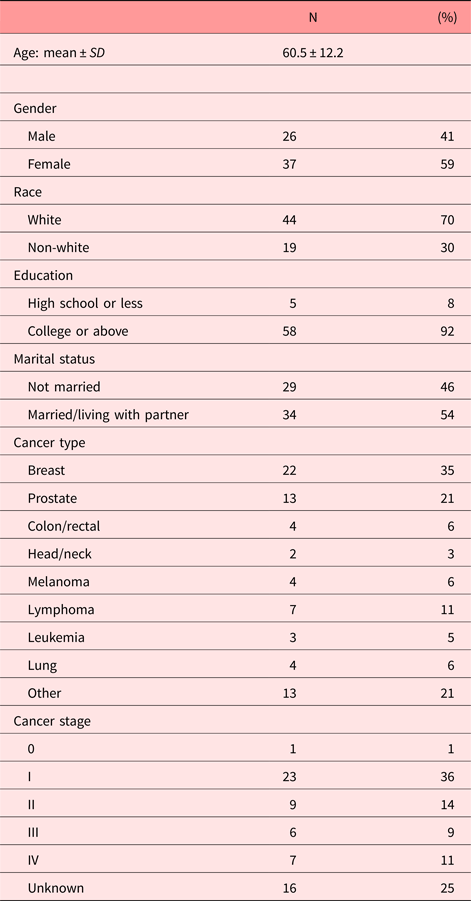
Demographics and clinical characteristics of the sample are presented in Table 1.
Demographic and clinical characteristics

Predisposing factors
Participants described a family predisposition to insomnia, anxious temperaments, and insufficient ability to relax as factors that predisposed them to insomnia. Individuals who noticed similar behavior in other family members suggested that insomnia might have been passed on to them from their parents. Attributions ranged from genetic explanations to biological tendencies and behavioral factors.
I finally had the realization when we took a family vacation and all three of my family members – everybody else was sleeping and all three of my family members were up in the middle of the night, as well as my mom. So our whole family is like up and around, walking around in the middle of the night. (female, age 54, lymphoma)
Others cited a natural tendency toward anxiety since childhood. This anxious temperament was identified as something present throughout the day that also interfered with sleep at night.
I'm a worrywart. I've always worried about my parents – if it was my parents, or my siblings – or then when I got married, my husband traveled a lot and worrying about his safety with his travels, and again, the children. (female, age 68, myelofibrosis)
Several participants discussed the experience of not knowing how to relax or being “unable to shut off their thoughts” at night. The content of this thought consisted of activities such as ruminating about past events, planning and thinking about future activities, and random, unrelated images. Although this tendency to have an active mind at night can predispose one to develop insomnia, it also works as a perpetuating factor because the bed can eventually be conditioned to elicit this mental processing after repeated pairings.
One of the things I noted is I can't shut down my thoughts. My thoughts just race through the night. So, I do a lot of thinking and processing of issues and replaying events, and my mind is too alert. It just reprocesses everything that's happened, either that day, two weeks ago, the day before. What I could've done, should've done. (female, age 52, ovarian cancer)
Precipitating factors
Respondents were split as to whether they classified their cancer diagnosis as the precipitating factor for their insomnia or whether it made a preexisting problem with sleep worse. For those that reported that cancer was the trigger for insomnia, the difficulty sleeping was mainly triggered by the emotional impact of the diagnosis, the impact of hospitalization, or treatments such as chemotherapy or radiation.
I would probably say right around the time – well, after the diagnosis. But, you know, your mind is racing at that point in time thinking about what could be and always thinking about anticipating the worst and so forth. So that was fine. That, to me, appeared to be very normal. But then, after going through the chemo and radiation and still finding that, okay, we're almost a year out and there's still this inability to go to sleep or to resort back to what the sleeping or behavior patterns were prior to. So that's when I took notice of my sleep patterns and I did talk to my primary care physician. (female, age 45, breast cancer)
Several participants acknowledged that they had difficulty sleeping before their cancer diagnosis, but that impact of stress related to the cancer diagnosis or the effects of cancer treatments made a preexisting problem worse.
Well, I think the factor is the therapy I'm getting, the hormone deprivation. Androgen depletion therapy is – I mean, that clearly is what initiated a chronic problem, as opposed to an acute situation that may have occurred every once in a great while. I'm sure aging is probably part of it, too. (male, age 64, prostate cancer)
Other people were not able to identify a precipitating factor related to the development of their insomnia. The lack of a specific trigger left them to speculate that their insomnia might be related to biological or aging factors.
My stress level is – I have nothing really to worry about. It's – I don't have to worry about a job. I don't know what could cause it. Maybe there's something internal that I don't know that's going on. I don't know if it can be medical. (male, age 58, leukemia)
Perpetuating factors
Perpetuating factors refer to the behaviors that an individual engages in while attempting to manage their sleep difficulty, which in turn actually contribute to the persistence of insomnia. In describing their experience, participants reported several behaviors that are known to interfere with sleep. These included taking naps during the day, using back-lit electronics before bed, use of sleeping medications, and poor sleep hygiene. For those people who napped during the day, there was a recognition that it affected their ability to sleep at night but they felt like they did not have better options to manage their levels of daytime fatigue.
And then the other thing is I take a nap every day. I think I told you. Most days I do. And sometimes I feel as though when I don't take a nap I sleep better at night sometimes. (Male, age 83, prostate cancer)
Some participants were aware of the connection between back-lit devices and sleep disturbance and were actively trying to reduce their pre-bed screen time, acknowledging the negative impact of the device on sleep.
Usually I sort of play something on my phone to sort of make myself sleepy since I get in bed and then you're wide awake. It's the opposite of my husband who hits the bed and is snoring. So sometimes when I do that, I get engaged in what I'm doing on the phone and then I end up staying up even later because – I don't know, then I'm not tired and all of a sudden – eventually get tired and fall asleep. And that's certainly not good because I get up about quarter to five, 4:30–5:00, every day. (female, age 57, breast cancer)
One of the most pervasive perpetuating behaviors reported by participants was the use of sleeping medication, both prescribed and over the counter. Many people reported having tried several medications or having to switch or alternate between different medications to maintain an effect. Participants also noted that they would develop tolerance for the sleep medications after a period of time and even when effective, the medication was often only helpful in the short term with decreased effectiveness as time passed.
The Ativan usually – I'll sleep pretty well when I take that as long as I don't take it multiple nights. I find that if I take it one or two, maybe three nights in a row, that usually is pretty good. But if I've been taking it more than that, I find that the impact is lessened. It's like probably a tolerance or something. The other one that I can't think of the name of – starts with an M – I can see the bottle in my medicine cabinet in the bathroom and I can't think of the name – it's really gonna bug me, but that one does help. It does usually help. (male, age 45, pancreatic cancer)
Many spoke about a reluctance to take medication but felt like they did not have other options available.
I just could not sleep until I started taking Klonopin and some other crazy drug. And they knocked me out, but – Klonopin and Trazodone. And I tried them individually, and they still wouldn't knock me out. And I remember my primary care physician – Trazodone was like horse pills. I think they were 150 mg or something. And I talked to my primary care physician, she said, [participant's name], that pill will knock out a small horse. And then so I had to take that along with Klonopin, and then that – after my treatments, the only thing – those medicines would make me sleep, but that was – I wasn't even taking them for pain. I was just taking them to sleep. But then I immediately weaned myself off of them, because I was afraid of – I've got to find out what the underlying issue is instead of just taking a pill to mask it. (male, age 43, testicular cancer)
Sleeping pills were also used by some people as a way to “catch up” on lost sleep from previous nights with insomnia with the thought that it might help break the pattern of insomnia or at least so they could function for the next couple of days.
But when I take that sleeping pill, as much as I don't like taking it, if it works that particular night, which it usually helps, it certainly helps me fall back asleep more quickly. When I take that, it – I feel like I catch up, and I usually have like a day or two then where I really feel more like myself as far as getting things done. (male, age 64, prostate cancer)
Unfortunately, participants reported that use of sleeping medications were encouraged and normalized by their doctors.
And even if I take an Ativan, which is what my oncologist encouraged me to do if I can't fall asleep, I have – I feel hungover – or some sort of feeling the next day which makes it not worth it to me. (female, age 52, breast cancer)
Many participants reported an awareness of engaging in behaviors conducive with good sleep hygiene such as not having caffeine too late in the day, keeping the bedroom dark and cool, reserving the bed for sleep and sex only, abstaining from alcohol before bed, maintaining a regular sleep and wake schedule, and so on, but several others did not realize the potential for these factors to impact their sleep.
But most of the time when it was time to go to bed I'm usually out on my computer. And I put on my computer, I have a cup of tea or something like that. So it's just a habit I guess. And so that hasn't really gone away. I still have a cup of tea late at night. And tea – I don't think the caffeine or whatever is in there prohibits me from getting sleep. It's kind of soothing. (male, age 66, prostate cancer)
Participants reported that the inability to sleep came with its own form of anxiety, compounded by watching the clock in the middle of the night and worrying about the impact of poor sleep on their ability to function the next day.
And also like if I wake up say at 2:00 and I see it's now 4:00, then that makes it worse, because I know I have to wake up soon. So that makes the anxiety – I think I can't fall asleep because then I'm becoming so anxious about not being able to wake up the next morning and being tired the following day. (female, age 46 , breast cancer)
Discussion
This is the first study to specifically assess predisposing, precipitating, and perpetuating factors related to the development and maintenance of insomnia in cancer survivors. This information is crucial to fully understand the experience of insomnia, individualize treatment in cancer survivors, and advocate for increased access to evidence based nonpharmacological therapies for insomnia. Participants described a number of factors that they felt might predispose them to insomnia including family traits, an anxious temperament, and the inability to relax. Although these may be long-standing qualities, various conventional and complementary strategies are available to reduce anxiety and promote relaxation (Greenlee et al., Reference Greenlee, Balneaves and Carlson2014), suggesting that this may be an area prime for prevention and/or intervention. Relaxation training is sometimes, but not always, included as a component of CBT-I (Riemann & Perlis, Reference Riemann and Perlis2009). This suggests that the core components of CBT-I should be supplemented with relaxation training on a case-by-case basis, should this be identified as an issue.
Consistent with previous research, a majority of the participants interviewed reported that cancer had caused (precipitated), or significantly worsened their preexisting insomnia (Kyle et al., Reference Kyle, Espie and Morgan2010). This has important implications for hospital procedures, management of treatment side effects, and physician-patient communication. Hospital procedures are notoriously disruptive to sleep. Despite an acceptance of sleep as an essential part of recovery from illness, patient sleep in hospital is frequently disrupted by modifiable environmental factors such as noise, light, unnecessary procedures, and insufficiently managed pain (Pilkington, Reference Pilkington2013).
Provider-patient communication is key to optimal patient care, yet patients are rarely asked about their sleep during initial appointments. In a qualitative study with 26 individuals treated for cancer at a Canadian institution who met the DSM-IV-TR diagnostic criteria for insomnia, patients reported that they were not asked about sleep (Davidson et al., Reference Davidson, Feldman-Stewart and Brennenstuhl2007). Some patients admitted they were reluctant to bring up their sleep concerns with their provider because they viewed sleep as less important than their cancer, or because they assumed the only treatment option provided would be medication. Patients also reported that they lacked information about how cancer and treatments might affect sleep.
Health care providers need to know about the sleep status of their patients to prevent and/or treat insomnia once it is identified. There is evidence that early intervention can be helpful for preventing the worsening of sleep disturbances during chemotherapy (Berger et al., Reference Berger, Kuhn and Farr2009); however, systematic implementation of such programs is still lacking. Importantly, participants identified a number of perpetuating behavioral factors that are common targets in CBT-I. These included taking naps during the day, using back-lit electronics before bed, and poor sleep hygiene. One of the most problematic and pervasive perpetuating factors was use of sleeping medications. In a sample of 124 women with breast cancer, 52.4% of patients discussed sleep with their provider during active chemotherapy and 32.3% were prescribed sleep aids (Costantini et al., Reference Costantini, Ale-Ali and Helsten2011). However, that number may not accurately represent the proportion of cancer patients taking sleeping medication because it focused only on oncologists’ prescribing practices, and patients may be given sleep aids by other providers as well.
Considering the prevalence, significance, and potential impact of insomnia, cancer patients require information about both nonpharmacological and pharmacological treatments to make timely and informed treatment decisions. CBT-I has demonstrated efficacy in cancer survivors and directly addresses factors identified herein (Garland et al., Reference Garland, Johnson and Savard2014). In addition to recommending routine screening for sleep-wake disturbances, guidelines put forth by the National Cancer Institute, National Comprehensive Cancer Network, and the Oncology Nursing Society, state that CBT-I has strong and consistent evidence as a first line intervention, whereas medication is only considered to be a useful short-term strategy (Berger et al., Reference Berger, Matthews and Kenkel2017). As such, it is important to make oncologists, healthcare administrators, and payers aware of the evidence for CBT-I so that it becomes more readily available to cancer survivors.
Limitations
The qualitative nature of the study allows for an exploration of the lived experience of insomnia but it also means that the researchers played an active role in analyzing and extracting themes from the data. We took several measures to minimize potential influence of the researchers, such as consulting a senior researcher and sending the codes and extracted themes to a subsample of participants for validation. We also provided quotes for each theme to ensure our interpretation was fair and transparent. These interviews also relied on participants to recall past experiences, but the narratives are nonetheless an individual's representation of their lived experiences of insomnia. Furthermore, participants recruited for this study could represent more active help-seekers, who have greater interest toward insomnia treatments.
Conclusion
This study identified specific predisposing, precipitating, and perpetuating factors that can be used to better understand, prevent, and treat insomnia in cancer survivors. Patient and provider education is needed to change individual and organizational behaviors that contribute to the development and maintenance of insomnia and increase access to evidence-based nonpharmacological interventions.
Acknowledgments
Research reported in this article was funded through a Patient-Centered Outcomes Research Institute (PCORI) Award (CER-1403-14292). This manuscript is also supported in part by a grant from the National Institutes of Health/National Cancer Institute Cancer Center (P30 CA008748). The statements presented in this article are solely the responsibility of the author(s) and do not necessarily represent the views of the Patient-Centered Outcomes Research Institute (PCORI), its Board of Governors or Methodology Committee. Sincere thanks go to the participants, interventionists, oncologists, nurse practitioners, and clinical staff for their support of this study.
Appendix A