THE PROBLEM
The World Health Organization (WHO) since June 1998 has advocated for the use of artemisinin-based combination therapies (ACTs) in countries where Plasmodium falciparum malaria is resistant to traditional antimalarial therapies such as chloroquine, sulfadoxine-pyrimethamine, and amodiaquine (19;22). In 2006, WHO released evidence-based guidelines for the treatment of malaria backed by findings from various scientific studies (21). During the period between 2002 and 2006, all the five East African states Tanzania, Kenya, Uganda, Rwanda, and Burundi changed their national antimalarial treatment policies to use ACTs as first-line treatments for uncomplicated falciparum malaria and commenced with deployment of the drugs in the state-managed health facilities (12–15). To scale up the use of ACTs in the East African region to combat malaria and speed up progress toward the sixth Millennium Development Goal, a combination of delivery, financial, and governance arrangements tailored to national or subnational contexts needs to be considered.
WHO reports show that more than 90 percent of the annual global malaria cases and deaths are reported from the African region (20). Children under the age of 5 years and pregnant mothers are the most vulnerable groups affected by the disease. Malarias’ annual contribution to deaths in under-5 year olds is as high as 39,000 in Uganda, 31,000 in Tanzania and 18,000 in Kenya (23).
Community health workers (CHWs) have successfully contributed to public health services in the fight against malaria. The CHW kits for home-based management of fever at present still contain older antimalarials in Uganda and Tanzania. Rwanda does not have a CHW network, whereas Kenya has incorporated ACTs to be used at community level by CHWs.
The private sector provides health services to a large proportion of the population in East Africa through faith-based organizations and other not-for-profit organizations, as well as for-profit facilities (Reference Goodman6). The cost of ACTs at these outlets is still quite high (between US$5 and US$15 per adult treatment course) compared with the free ACTs provided by public facilities. Samarasekera highlights the need for a stronger regulatory framework by government to oversee the private sector in provision of health-related services and products (Reference Samarasekera17).
POLICY OPTIONS
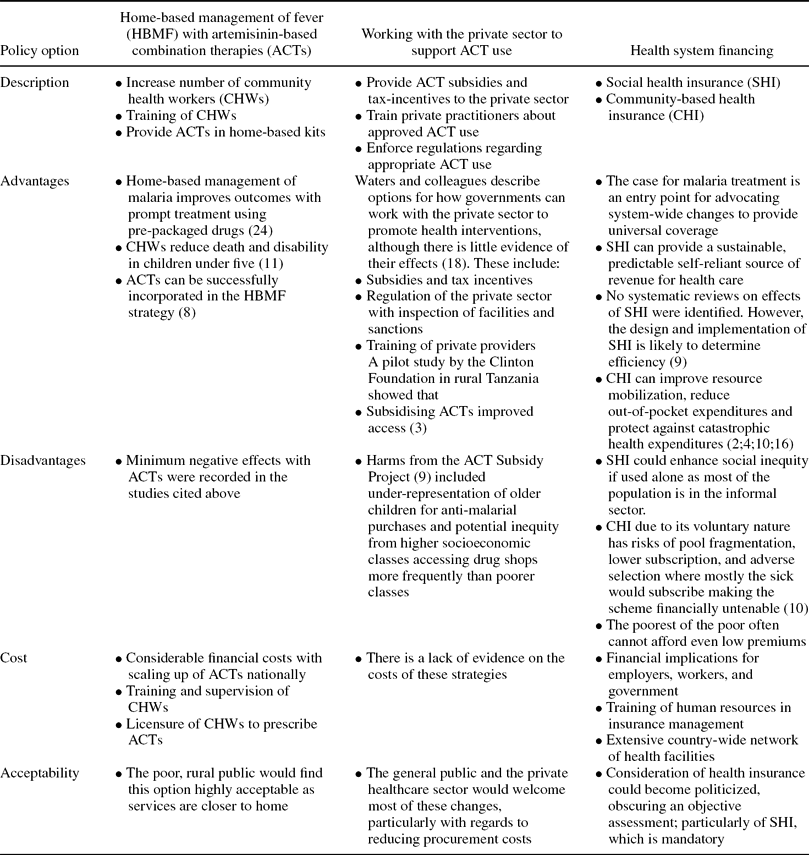
The policy options described in this policy brief are not mutually exclusive interventions; they are complementary strategies in the fight against malaria. The policy brief does not recommend any one option over another, but highlights existing research evidence in support of the included interventions. The three options are the following: (i) Include ACTs in the home-based management provided by Community Health Workers (CHWs). CHWs are normally recruited from members of the community, such as mothers, farmers, teachers, and others. CHWs are much more accessible than healthcare professionals, particularly in rural areas where there are fewer and poorly equipped healthcare facilities; (ii) Engage the private sector in distributing ACTs in accordance with standard treatment guidelines, and ban importation and prescribing of artemisinin monotherapies; (iii) Improve health sector financing and universal access to healthcare by shifting from out-of-pocket payments to prepayment and pooling of funds using a combination of social health insurance and community-based health insurance. These three options are described in Table 1.
Policy Options

IMPLEMENTATION OF THE POLICY OPTIONS
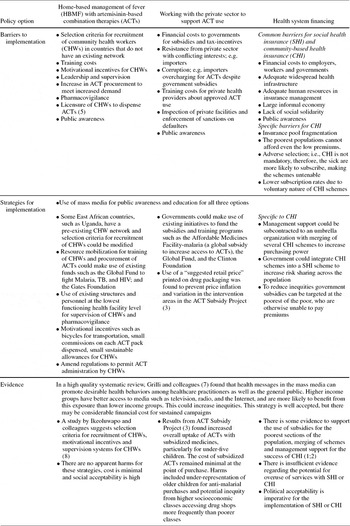
Obstacles to implementing the three policy options and strategies for addressing these are described in Table 2.
Implementation of the Policy Options

DISCUSSION
A half-day policy dialogue meeting was held by the Uganda country office of the Regional East African Community Health Policy Initiative in April 2008. Participation included researchers, policy makers, health managers, and civil society. There was general agreement about the feasibility of two of the policy options in the Ugandan context. Some delegates advocated for the inclusion of Rapid Diagnostic Kits to support use of ACTs by CHWs. It was believed that there was need for more evidence to support social health insurance. A key output was the decision by a senior policy maker to include the policy brief as one of the resource documents to develop the new National Health Policy document (2009), which provides direction for the health sector for the next 10 years.
CONTACT INFORMATION
Harriet Nabudere, MD, MPH (hnabudere@gmail.com), Project Coordinator, SURE Project, Office of the Principal, College of Health Sciences, Makerere University, Administration Building, 2nd floor, New Mulago Hospital Complex, Kampala, Uganda
Gabriel L. Upunda, MD, MMED, MPH (glupunda@gmail.com), Executive Director, Regional East African Community Health Policy Initiative, East African Community, Arusha International Conference Centre, Arusha, United Republic of Tanzania
Malick Juma, MD, MMED (malickjuma@yahoo.co.uk), Director, General Health Services, Ministry of Health, Zanzibar, P.O Box 236, Zanzibar, United Republic of Tanzania