1. Introduction
Lockdowns have been widely used as a policy response to the COVID-19 pandemic. They were both very effective in limiting new infections and very harmful for economic activity. A large literature (partly reviewed in Section 2) followed documenting empirically and theoretically the impact of lockdowns on the economy and on the pandemic path.
In this paper, we pursue the idea that not only actual lockdowns can affect economies but also noisy information about their future course does. The latter could result either from uncertainty about the pandemic or from uncertainty about the reaction of the authorities. There is plenty of mainly anecdotal evidence that in 2020 agents were confused how persistent the initial lockdown would be. Would it last just for a few weeks, or would it reoccur until a vaccine against COVID-19 is introduced? In most countries, even public authorities were quite vague about its future course. Even when the initial lockdown was gradually lifted, the uncertainty regarding another one during the second wave, expected in Fall 2020, remained widespread. In 2021 vaccination campaigns started, but again, it was far from clear how fast they would proceed and how they would impact lockdown policy in the future. To give examples of this persistent uncertainty, it is worth to quote 2 subsequent issues of the IMF World Economic Outlook:
October 2020: “the persistence of the [pandemic] shock remains uncertain and relates to factors inherently difficult to predict, including the path of the pandemic, the adjustment costs it imposes on the economy, the effectiveness of the economic policy response, and the evolution of financial sentiment.”
April 2021: “uncertainty remains regarding their [vaccines] effectiveness against new strains of the virus. Delays in inoculating all parts of the world could lead to vaccine-resistant virus mutations, new outbreaks could start anywhere and anytime, and renewed restrictions may be required to slow transmission. Uncertainty about the duration of this stop-go rhythm makes other elements difficult to predict”.
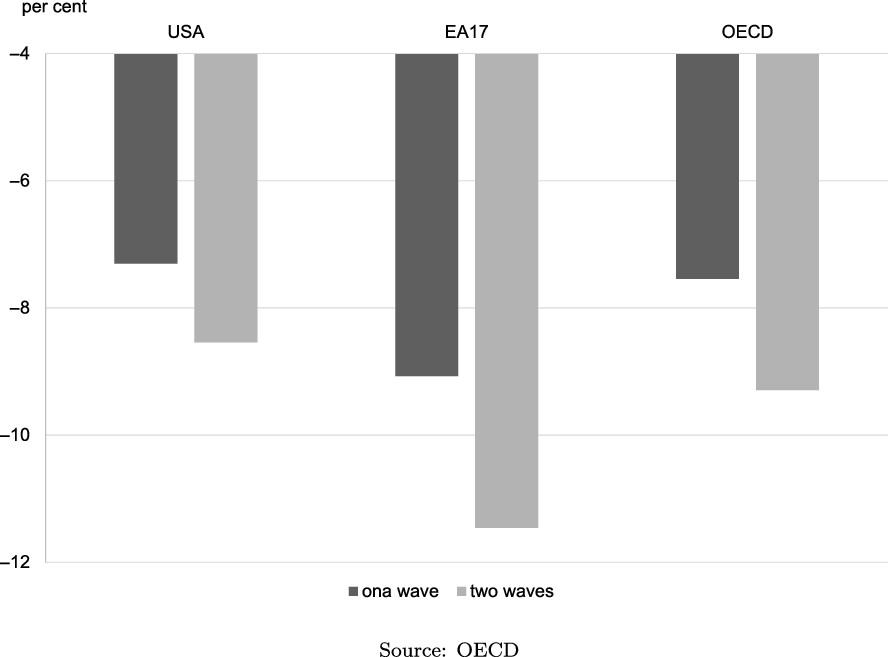
This uncertainty affected agents’ expectations concerning macroeconomic variables as reflected in macroeconomic projections of the OECD, IMF and World BankFootnote 1 (see Figure 1).
Annual GDP drop: OECD forecast conditional on the epidemic severeness.

Imperfect information could have affected agents’ economic decisions. This motive has, so far, not been given attention in the literature and we try to fill this gap.
We concentrate on the particular dimension of imperfect information about how long restrictions would last. To this end, we construct a New Keynesian (NK) model with skill accumulation as in Chang et al. (Reference Chang, Gomes and Schorfheide2002) and imperfect information as in Blanchard et al. (Reference Blanchard, L’Huillier and Lorenzoni2013). The former mechanism extends the standard DSGE framework for a wedge between working hours supplied by households and effectively utilized by companies and hysteresis on the labor market. Thus, it conveniently accommodates the nature of lockdown during which firms cannot utilize a portion of labor and agents can face skill deterioration if the restrictions are persistent. Imperfect information, in turn, refers to the signal extraction problem of the agents. They observe the current lockdown which consists of persistent and temporary components and a noisy signal about the former. Solving this problem with the Kalman filter agents infer on the future lockdown. Importantly, their judgment may be affected by a noise (false information about persistent lockdown) shock making them wrongly assess the severity of the lockdown.
We use the model to simulate how the precision of lockdown information affects the way the economy reacts to lockdown policies and to false signals about lockdowns. Our main findings are as follows. First, imperfect information can be quantitatively significant in affecting the reaction of agents to the government lockdown policy. Hence, it may render the lockdown too strong or too weak. Second, under imperfect information self-fulfilling recessions are possible when agents receive a wrong signal about lockdown persistence. These recessions can be of substantial magnitude as well. Third, improving information precision always reduces the first problem. However, if initially information is very noisy, then improving its precision may in fact render the second problem worse. In such case, only a radical improvement of information precision is successful in reducing the impact of false information on the economy.
The rest of the paper is structured as follows. Section 2 discusses the related literature.Section 3 presents the model and its calibration, and in Section 4, we explain how precision of information about the lockdown affects the economy. Section 5 presents robustness checks and Section 6 concludes.
2. Related literature
Our paper is related to two major streams in the literature. The first originates in the experience of the COVID-19 pandemic. The second relates to the notion that noisy information can be the source of business cycle fluctuations. Below we offer a brief review of these research areas.
As already mentioned, a large body of the literature emerged since the virus affected the world economy in early 2020. Given the literature is still in its infancy and the number of working papers grows enormously, we do not intend to offer an exhaustive review here. We rather refer to a small number of selected papers to show the main research directions and findings important from our perspective. This includes in particular the estimated impact of the pandemic on the economy, on expectations and inference about lockdown policies.
When the pandemic started, several studies attempted to investigate the impact of lockdowns on the economy. On the empirical side, Chudik et al. (Reference Chudik, Mohaddes, Pesaran, Raissi and Rebucci2020) used a multi-country VAR model to identify the COVID shock from the data, measure, and forecast its impact on the world economy. In particular, the authors forecasted a long-lasting recession, with a heterogeneous impact of the pandemic between countries. They predicted world GDP to be three percent below its non-pandemic counterfactual in 2021. The scenario for the US was even more grim—a 6.5% loss was expected. We limit ourselves to reporting this single finding, while noting that several other studies, both from academia and policy institutions, confirmed that the impact of the pandemic on the world economy would be unprecedented and probably long-lasting. However, it should be noted that all these studies also report high levels of uncertainty surrounding their forecasts.
From this paper’s perspective, the economic uncertainty accompanying lockdown policy is crucial. Coibion et al. (Reference Coibion, Gorodnichenko and Weber2020) analyzed survey data from US counties and documented a significant impact of COVID-19 and lockdowns on income and employment as well as expected economic activity. In particular, the paper documented a sharp and persistent increase in expected unemployment. The unemployment rate in counties affected by lockdowns was expected to rise by an average of 13 percentage points in the 12-month horizon and only slowly decline to a 2 percentage point increase in the 3–5 year horizon. Altig et al. (Reference Altig, Baker, Barrero, Bloom, Bunn, Chen, Davis, Leather, Meyer, Mihaylov, Mizen, Parker, Renault, Smietanka and Thwaites2020) considered several measures of uncertainty, including i.a. implied stock market volatility, newspaper-based economic policy uncertainty and subjective uncertainty about future business growth in the UK and US. They documented a dramatic increase in uncertainty about the pandemic and its economic impact in early 2020 with several indicators reaching all-time heights.
Some papers attempted to design optimal lockdown policies. For instance, Eichenbaum et al. (Reference Eichenbaum, Rebelo and Trabandt2020) constructed a model that merged a simple real macroeconomic model with an epidemiological SIR framework. In the model, agents have social interactions related to their economic activity (work, consumption) and thus transmit the disease. Households, being aware of these channels, lower consumption and work effort in order to minimize the risk of getting infected. This finding has found empirical support in the work of Goolsbee and Syverson (Reference Goolsbee and Syverson2021). Nevertheless, an externality exists as households do not take into account their own impact on the epidemic and the optimal policy involves a lockdown. Ferguson et al. (Reference Ferguson, Laydon, Nedjati-Gilani, Ainslie, Imai, Baguelin, Bhatia, Boonyasiri, Cucunubá, Cuomo-Dannenburg and Dighe2020) used a detailed model developed to support influenza planning in the UK and simulate the impact of various non-pharmaceutical interventions (social distancing, closures of schools, and universities etc.) on the fatality rate of COVID-19. The Authors estimated that various social distancing measures would have to be in place at least 2/3 of the time (until a medical treatment is found) in order to effectively save a large number of lives.
All in all, from the beginning of the pandemic the literature documented a huge and long-lasting economic impact on the economy and expectations as well as suggests a long period of repeated lockdowns.
On top of the macro-epidemics literature reviewed above, our paper is related to the articles that investigate the role of imperfect information and self-fulfilling beliefs in driving business cycle fluctuations. This literature includes such well-know studies as Lucas (Reference Lucas1972), Morris and Shin (Reference Morris and Shin2002), Mankiw and Reis (Reference Mankiw and Reis2002), Collard et al. (Reference Collard, Dellas and Smets2009), Angeletos and La’O (Reference Angeletos and La’O2013). Our paper is mostly related to the approach pursued i.a. in Blanchard et al. (Reference Blanchard, L’Huillier and Lorenzoni2013), Hürtgen (Reference Hürtgen2014), Chahrour and Jurado (Reference Chahrour and Jurado2018) who assume that agents face a noisy signal (and a related signal extraction problem) concerning the nature of the technological progress. In this framework, productivity consists of two parts: a persistent and a temporary one. Agents observe only aggregate productivity and receive a noisy signal about its persistent component. Our framework treats the information about lockdown in a similar vein as a noisy signal from which agents attempt to extract the true information. Failures to do so result in economic fluctuations that are at the heart of our paper.
To the best of our knowledge, these two streams in the literature have not been connected so far to discuss the impact of imperfect information about lockdown duration on the economy. The closest connection known to us is Kozlowski et al. (Reference Kozlowski, Veldkamp and Venkateswaran2020). The Authors assume that the COVID-19 crisis will result in a persistent change in the perceived probability of extreme, negative shocks. As a consequence, agents become less willing to undertake risky business projects and the pandemic can affect the economy for many years. However, in contrast to our paper this study focuses on the effects of the pandemic on risk-taking behavior—not noise resulting from imperfect information.
3. Model and calibration
The model we use merges three streams from the literature. At its core is a standard new Keynesian framework with households that derive utility from leisure and consumption and provide labor and capital services to monopolistically competitive firms. The latter use two factors to produce differentiated goods and price them under a standard Calvo scheme so that prices are sticky. Differentiated goods are then combined into a final good by perfectly competitive aggregators and are used for consumption or investment purposes (the latter being subject to an investment adjustment cost).
Upon this core structure, we impose three modifications. The first one follows Chang et al. (Reference Chang, Gomes and Schorfheide2002) and introduces hysteresis in the labor market. Briefly, when agents provide labor services, they accumulate skills that improve their effective labor quality. Conversely, when they do not work their skills deteriorate. Second, we allow for a lockdown that sets a part of labor supply idle. Third, following i.a. Blanchard et al. (Reference Blanchard, L’Huillier and Lorenzoni2013) we introduce an information friction - agents do not posses full information about the length of the lockdown. Instead, they only receive a noisy signal about it.
In order to keep the model tractable, we do not explicitly model the epidemic.Footnote 2 This has two consequences. First, lockdown is assumed to be exogenous. Hence, we miss the feedback from lockdown policies to the epidemic and back to the lockdown. This can clearly have an impact on the model dynamics. We do not, however, see a good reason why the feedback should affect the impact of imperfect information on economic developments (at least in a qualitative sense). Second, in our framework lockdown deteriorates welfare and it is pointless to speak about optimal policy here since lockdown can be optimal if one takes lives saved into account. When drawing policy conclusions, we will assume that policymakers have reasons, that go beyond our model, to introduce lockdown. We will be more specific on this assumption in Section 4.5. Although these issues put a clear limitation on our findings, we hope that nevertheless we can provide a meaningful intuition behind the role of imperfect information during the pandemic and how the communication policy can reduce it.
In what follows we describe the model in details using the convention that small letters denote real variables, capital letters—their nominal counterparts while variables without a time index stand for steady-state levels.
3.1. Households
A representative household maximizes lifetime utility:
 \begin{equation}\max_{\left\{ c_{t}\right\} ,\left\{ h_{t}\right\} ,\left\{ i_{t}\right\} ,\left\{ k_{t}\right\} ,\left\{ B_{t}\right\} }E_{0}\sum_{t=0}^{\infty}\beta^{t}\left[\frac{c_{t}^{1-\sigma}}{1-\sigma}-\frac{h_{t}^{1+\nu}}{1+\nu}\right]\end{equation}
subject to the budget constraint:
 \begin{equation}P_{t}c_{t}+P_{t}i_{t}+B_{t}+T_{t}=W_{t}^{h}h_{t}(1+\tau_{t})+R_{t}^{k}k_{t-1}+R_{t-1}B_{t-1}+Div_{t}\end{equation}
and the capital accumulation rule with investment adjustment costs:
 \begin{equation}k_{t}=(1-\delta)k_{t-1}+\left(1-S\left(\frac{i_{t}}{i_{t-1}}\right)\right)i_{t}.\end{equation}
Above,
 $P_{t}$
,
 $W_{t}^{h}$
,
 $R_{t,}^{k}$
and
 $R_{t}$
are, respectively, the price of final goods, the wage received by the household, the capital rental rate, and the interest rate on bonds. Further,
 $c_{t}$
denotes consumption,
 $B_{t}$
bond holdings,
 $k_{t}$
capital,
 $i_{t}$
investments,
 $Div_{t}$
dividends paid by imperfectly competitive intermediate goods producers,
 $T_{t}$
lump-sum taxes levied by the government,
 $\tau_{t}$
is a labor market subsidy rate chosen by the government and
 $S(\!\cdot\!)$
—a quadratic investment adjustment cost function (with
 $\left(S(\!\cdot\!)\right)^{'}>0$
and
 $\left(S(\!\cdot\!)\right)^{''}>0$
). We assume a standard quadratic cost function
 $S\left(\frac{i_{t}}{i_{t-1}}\right)=\frac{\kappa}{2}\left(\frac{i_{t}}{i_{t-1}}-1\right)^{2}$
. Finally,
 $\beta$
denotes the discount rate,
 $\delta$
the capital depreciation rate,
 $\sigma$
the inverse of the intertemporal rate of substitution, and
 $\nu$
is the inverse of the Frisch elasticity of labor supply.
3.2. Producers
Final goods
 $y_{t}$
used for consumption and investment purposes are assembled by perfectly competitive producers who buy goods
 $y_{t}(i)$
at price
 $P_{t}(i)$
and maximize profits:
 \begin{equation}P_{t}y_{t}-\int P_{t}(i)y_{t}(i)di\end{equation}
subject to the technological constraint:
 \begin{equation}y_{t}=\left(\int y_{t}(i)^{\frac{1}{\mu^{p}}}di\right)^{\mu^{p}},\end{equation}
where
 $\mu^{p}$
is the steady-state markup. The solution results in the demand function for intermediate goods:
 \begin{equation}y_{t}(i)=\left(\frac{P_{t}\left(i\right)}{P_{t}}\right)^{\frac{-\mu^{p}}{\mu^{p}-1}}y_{t}.\end{equation}
Intermediate goods producers combine labor and capital to produce differentiated goods according to technology:
 \begin{equation}y_{t}(i)=k_{t-1}^{\alpha}(i)\left(a_{t}n_{t}(i)\right)^{1-\alpha},\end{equation}
where
 $a_{t}$
is TFP process and
 $n_{t}(i)$
is the effective number of hours employed by producer i as defined below. They minimize production costs:
 \begin{equation}\min_{k_{t-1}\left(i\right),n_{t}\left(i\right)}\left[r_{t}^{k}k_{t-1}\left(i\right)+w_{t}n_{t}\left(i\right)\right].\end{equation}
Next, they solve a pricing problem, maximizing the discounted stream of profits subject to the demand function for their goods. We assume a standard Calvo pricing scheme, with probability
 $\theta$
of receiving a signal to change the price:
 \begin{equation}\max_{P_{t}^{new}\left(i\right),\left\{ y_{t+j}\left(i\right)\right\} _{j=0}^{\infty}}E_{t}\sum_{j=0}^{\infty}\left(\beta\theta\right)^{j}\Lambda_{t+j}\left(\frac{P_{t}^{new}\left(i\right)}{P_{t+j}}-mc_{t+j}\right)y_{t+j}(i).\end{equation}
Here
 $P_{t}^{new}\left(i\right)$
is the price set by the optimizing firm,
 $mc_{t}$
is the real, marginal cost of production and
 $\Lambda_{t}$
is the marginal utility of consumption of the representative household.
3.3. Skill accumulation and lockdown
Like in Chang et al. (Reference Chang, Gomes and Schorfheide2002), workers own skills
 $x_{t}$
which increase the effective hours used by producers. However, at the same time they can be forced by the lockdown (i.e. administrative supply-side measures) to set a part
 $l_{t}$
of the workforce idle:
 \begin{equation}n_{t}(i)=x_{t}(1-l_{t})h_{t}(i).\end{equation}
The way we introduce the lockdown is thus in the spirit of Guerrieri et al. (Reference Guerrieri, Lorenzoni, Straub and Werning2020) and Baqaee and Farhi (Reference Baqaee and Farhi2021). Our approach is also in line with findings of Brinca et al. (Reference Brinca, Duarte and e Castro2020) that 2/3 of labor force adjustment in the US stemmed from supply shocks. We compare our way of introducing the lockdown with using a TFP shock (an alternative method popular in the literature to model lockdown/COVID pandemic) in Appendix C.
Agents accumulate skills
 $x_{t}$
when they work:
 \begin{equation}\frac{x_{t}}{x}=\left(\frac{x_{t-1}}{x}\right)^{\phi}\left(\frac{(1-l_{t-1})h_{t-1}}{h}\right)^{\mu}.\end{equation}
Since the labor market is competitive, the real wage received by households is as follows:
 \begin{equation}w_{t}^{H}=x_{t}(1-l_{t})w_{t}.\end{equation}
3.4. Imperfect information
Agentsdo not posses full information about the persistence of the lockdown. Instead, we assume that they receive a noisy signal about its duration. To be precise, we assume that lockdown
 $l_{t}$
consists of two components—a temporary one
 $l_{t}^{T}$
and a persistent one
 $l_{t}^{P}$
:
 \begin{equation}l_{t}=l_{t}^{T}+l_{t}^{P}\end{equation}
 \begin{equation}l_{t}^{T}=\varepsilon_{t}^{T}\end{equation}
 \begin{equation}l_{t}^{P}=\rho_{Z}l_{t-1}^{P}+\varepsilon_{t}^{P},\end{equation}
where
 $0<\rho_{Z}<1$
is an autoreggresion coefficient while
 $\varepsilon_{t}^{P}$
and
 $\varepsilon_{t}^{T}$
denote persistent and temporary i.i.d. lockdown shocks, respectively. Agents observe only
 $l_{t}$
, not either of its elements. Moreover, they receive a noisy signal:
 \begin{equation}s_{t}=l_{t}^{P}+\varepsilon_{t}^{N}\end{equation}
about its persistent part, where
 $\varepsilon_{t}^{N}$
is an i.i.d. noise shock (a false information about the lockdown being persistent). Introducing a noisy signal allows to study the role of lockdown information precision. To infer whether the lockdown is persistent or temporary agents solve a Kalman filtering problem (see Appendix A).
3.5. Policymakers
The central bank stabilizes output and inflation by means of a standard Taylor rule
 \begin{equation}\frac{R_{t}}{R}=\left(\frac{R_{t-1}}{R}\right)^{\gamma_{R}}\left[\left(\frac{\pi_{t}}{\pi}\right)^{\gamma_{\pi}}\left(\frac{y_{t}}{y}\right)^{\gamma_{y}}\right]^{1-\gamma_{R}}.\end{equation}
The government runs a balanced budget. Every period it collects lump-sum taxes
 $T_{t}$
and finances the labor market subsidy
 $\tau_{t}W_{t}^{h}h_{t}$
. The subsidy rate
 $\tau_{t}$
is set so as to reimburse the fraction
 $\gamma\in<0,1>$
of wage income foregone due to the lockdown implying that:
 \begin{equation}W_{t}^{h}h_{t}(1+\tau_{t})=W_{t}x_{t}h_{t}\left(1-l_{t}\right)+\gamma W_{t}x_{t}h_{t}l_{t}.\end{equation}
This yields the following:
 \begin{equation}\tau_{t}=\frac{\gamma l_{t}}{1-l_{t}}.\end{equation}
Note that if
 $\gamma=0$
there is no subsidy, while if
 $\gamma=1$
the government fully compensates households the impact of lockdown on wages.
3.6. Market clearing
The model is closed by standard market clearing conditions. In particular, the goods market clears according to:
 \begin{equation}c_{t}+i_{t}+S\left(\frac{i_{t}}{i_{t-1}}\right)i_{t}=y_{t}.\end{equation}
3.7. Calibration
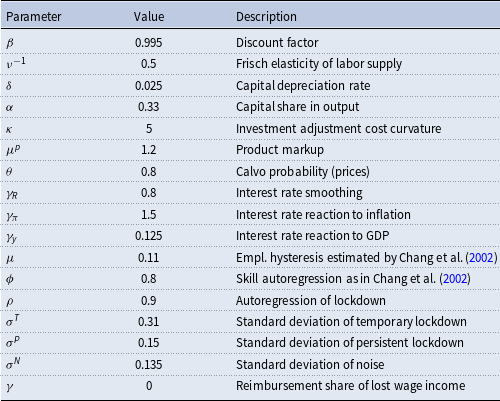
We calibrate the model to the US economy and present parameter values in Table 1. Since the new Keynesian core of the model is standard, we follow the existing literature in its calibration. In particular, we set the discount rate to
 $\beta=0.995$
to match a 2% real interest rate on annual basis. In line with standard practice, the depreciation rate
 $\delta$
is calibrated to 2.5% and the capital share
 $\alpha=0.33$
. Parameters of the monetary policy rule follow Taylor (Reference Taylor1993). The Calvo parameter of price stickiness sis set to
 $\theta=0.8$
, somewhat higher than suggested by estimates (e.g. Smets and Wouters (Reference Smets and Wouters2007)) for the US. However, to keep the model concise we consider only one nominal friction (wages are not sticky), as a consequence price stickiness needs to be set at a higher level for the model to match for example the empirical evidence on the transmission of monetary policy shocks.
Calibrated parameters

Now we move to parameters related to the less standard parts of the model. As for the skill accumulation mechanism, we closely follow the estimation presented in Chang et al. (Reference Chang, Gomes and Schorfheide2002). Accordingly, we set
 $\phi=0.8$
and
 $\mu=0.11$
, being the means of the posterior distributions in this study.
It is less obvious how to calibrate the information friction. Values of four parameters need to be set: persistent shock autoregression
 $\rho$
and the standard deviations of
 $\varepsilon_{t}^{P}$
,
 $\varepsilon_{t}^{T}$
and
 $\varepsilon_{t}^{N}$
.Footnote 3 We set
 $\rho=0.9$
to give the persistent lockdown a half-life of approximately one year. This is supposed to reflect the (relatively consistent) publicly available information in Spring/Summer 2020 that it should take between one and two years to develop and introduce a vaccine against COVID-19. The standard deviations of the lockdown shocks are chosen such that they cause a 5% drop in GDP on impact, roughly half of the cumulative decline of US GDP in the first halfof 2020.
Finally, let us concentrate on the volatility of noise. In the literature from which we draw (Blanchard et al. (Reference Blanchard, L’Huillier and Lorenzoni2013)) this is estimated from the US data. However, information there is noisy with respect to technology, something that one can claim was always present in the data. Our case is different, information about the lockdown is fairly recent and unique; hence, estimation on historical US data series would completely miss the point. Instead, we propose an alternative procedure.
First, we note that the noise about the persistent lockdown by definition causes false expectations about the future lockdown. Using Google searches in a number of countries for flights in April and in the Summer as instruments for mobility in period t and
 $t+1,$
we calculate the degree of lockdown in both periods. To this end, we compare the number of flight searches in 2020 with those in normal times (i.e. 2016–2019). The results seem to be consistent with other measures of mobility, such as those presented by Worldometers.info and data on travel restrictions presented by United Nations World Tourism Organization. In contrast to the latter two sources, our approach allows to calculate the lockdown expected in April for Summer 2020 by comparing searches about flights in Summer conducted in April 2020 with their counterparts from Aprils in previous years. Having the instrument for lockdown and expectations about it, we compute the standard deviation of the noise shock in a simplified signal extraction problem (see Appendix B for more details and formal description). This approach yields the standard deviation of the noise shock of approximately 13%. Given the stylized calibration process, we later conduct an extensive robustness check with respect to this parameter.
4. Lockdown and imperfect information
In this Section, we investigate the impact of information precision about the persistent lockdown on the economy. Our primary goals are to understand how imperfect information affects the effectiveness of lockdown policies and consequences of false lockdown information (noise) on the economy.
4.1. Temporary and persistent lockdown
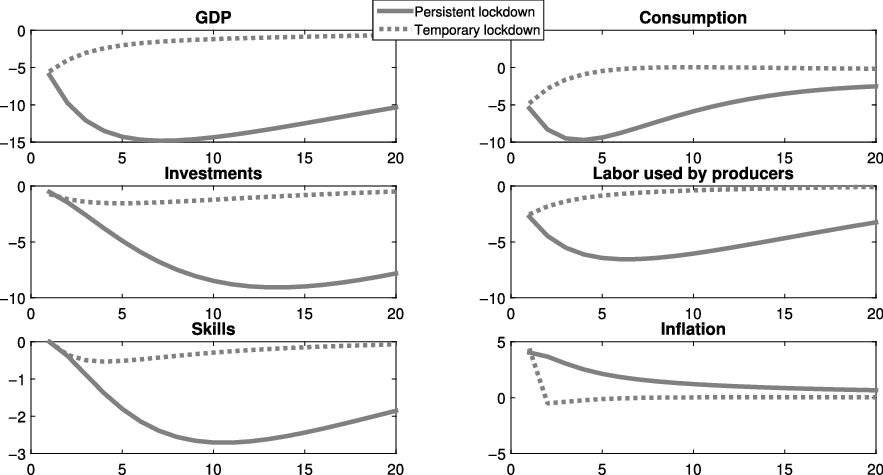
We start with simulating fundamental lockdown shocks that lower GDP by around 5% on impact. As described in Section 3, our model features two types of such shocks, a temporary and a persistent one. Figure 2 shows the reaction of GDP, consumption, investments, effective labor hours used by firms, skills, and inflation to both shocks. Not surprisingly, in a qualitative sense they work similarly. The reduction of effective labor hours drags GDP down. As income falls, so do consumption and investments. Since households work less, they loose skills. As a result, the skill accumulation mechanism aggravates the initial response widening the wedge between supplied and effective labor even further. Importantly, as the economy faces a supply shock, inflation increases. The main difference between the temporary and persistent lockdowns is quantitative. In the latter case, the scale of output fall is larger following not only an immediate drop in effective labor supply but also agents’ reaction to the expected prolonged slowdown.
Impulse responses to fundamental lockdown shocks. Note: values are expressed in percentage deviations from the steady state, with the exception of inflation expressed in percentage points. The time unit is one quarter.

4.2. Noise about persistent lockdown
Let us now move to our second point of interest—what happens when agents receive a signal that a persistent lockdown started? In what follows we will assume that the signal was false, no lockdown occurs in reality. Hence, impulse responses in this subsection present reactions to pure noise, not contaminated by any physical lockdown, whether temporary or persistent.
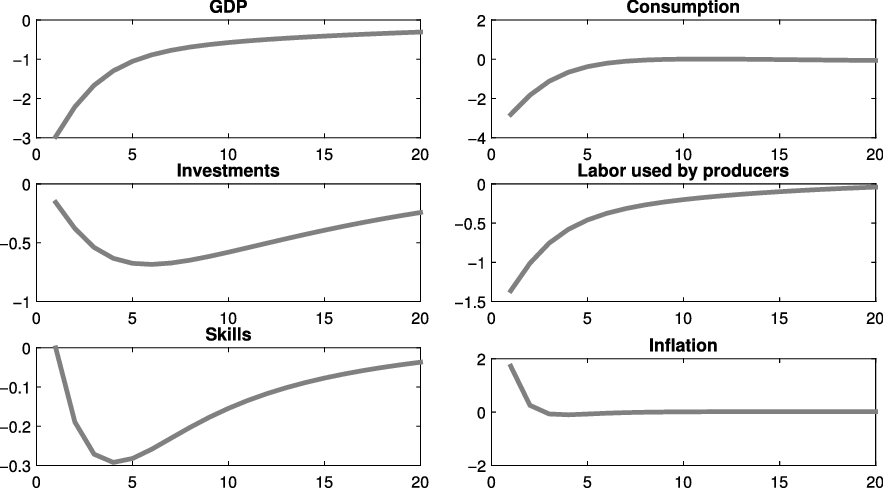
Having received the signal agents expect an economic contraction. In response, households lower consumption and investments (Figure 3). As a consequence, output declines and firms lower labor demand. The drop in labor hours translates into skill deterioration that makes the downturn last longer. Thus, the responses of macroeconomic aggregates to the noise shock resemble their counterparts in the case of fundamental shocks. Interestingly, this also holds for inflation as firms expect marginal costs to increase. Hence, in contrast to technology noise shocks studied in the earlier literature (e.g. Blanchard et al. (Reference Blanchard, L’Huillier and Lorenzoni2013), Hürtgen (Reference Hürtgen2014)), the lockdown noise shock is inflationary. Importantly, the response to the noise shock is economically significant. One standard deviation of noise shock lowers GDP on impact by more than half of the response to fundamental shocks.
Impulse responses to the noise about lockdown. Note: values are expressed in percentage deviations from the steady state, with the exception of inflation presented in percentage points. The time unit is one quarter.

It should be kept in mind that we assumed a relatively fast way of learning which, so far, seems to corresponds well with uncertainty about lockdown persistence that is rather a short-term phenomenon. However, historically some forms of imperfect information have affected macroeconomic dynamics for many years (see e.g. Suda (Reference Suda2018)). Under some negative circumstances (e.g. repeated emergence of vaccine-resistant mutations), the COVID-related uncertainty can also exert an impact on the economy that lasts much longer than our simulations suggest.
4.3. Noise and information precision
We are now ready to discuss our main point of interest—the role of information precision. In this section, we look how it affects the impact of the noise shock. The next section shows how information precision affects the transmission of fundamental lockdown shocks.
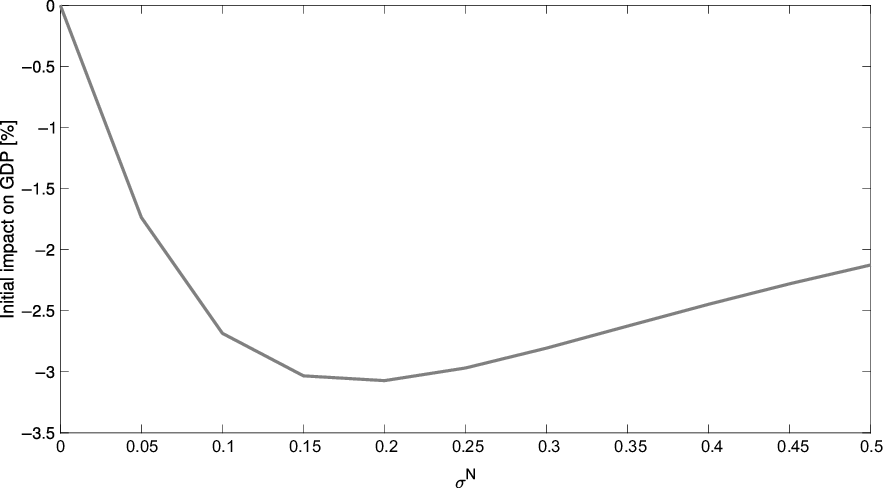
Figure 4 shows how the impact of the noise shock on GDP on impact depends on the noise volatility. Interestingly, the resulting curve is U-shaped. If the noise volatility is very small, it has little impact on macroeconomic variables since agents can tell apart persistent and temporary lockdown shocks. However, if it is very large, the signal about persistent lockdown becomes so noisy that agents attach little probability that it may convey information about fundamental lockdown. As a result, the impact of the noise shock decreases above a certain parameter value—in our case it is around 0.2, somewhat exceeding our calibration (0.135). An interesting and potentially important consequence of the U-shaped relationship can be observed when information is initially very noisy, that is we are in the right end of the figure. In this case, improving its precision only slightly may actually deepen the fall in GDP and hence be undesirable. Under such circumstances, only a radical improvement of information precision (i.e. moving to the left end of the figure) helps reduce the impact of noise on the economy. In terms of robustness check, it should be noted that, except for the case of a very precise signal, the noise has a significant impact on GDP which may be even stronger than under our baseline calibration.
Initial GDP impulse response to the noise about lockdown conditional on signal precision. Note: The figure presents the reaction on impact of GDP to a noise shock for various levels of standard deviation of noise shocks.

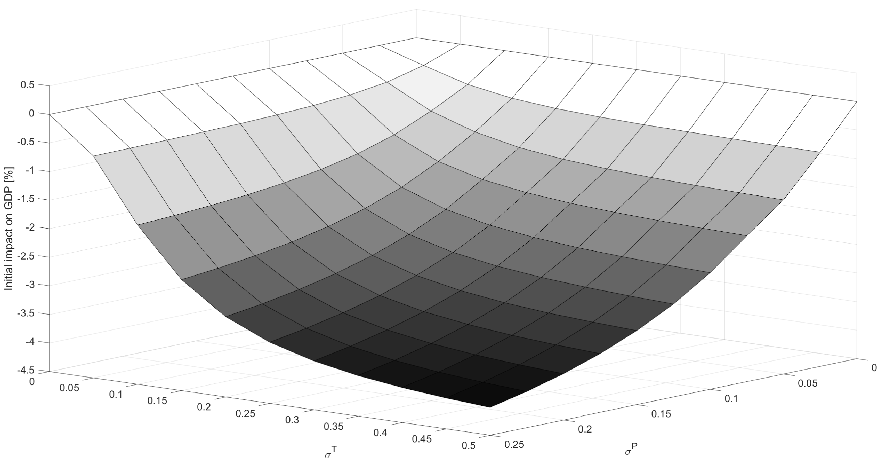
To complete the picture, we also investigate how the GDP response to the noise shock depends on the volatility of lockdown shocks. Figure 5 presents the initial (first period) GDP reaction to the noise shock as a function of volatilities of two shocks: persistent and temporary lockdown keeping constant the baseline noise volatility. Fundamental shock volatilities matter as they impact the noise to signal ratio in the filtering problem. Indeed, when either persistent or temporary volatility is zero, noise does not influence agents’ decisions. In this case, they can easily infer about fundamental shocks; thus, they ignore noise. By the same token, noise shocks are of little importance when the variance of one fundamental shock is unproportionally small compared to the other. Only when both variances are substantial, do agents find it difficult to distinguish between the two fundamental shocks. In this case, noisy signals strongly shape their expectations about the future downturn caused by the lockdown.
Initial GDP impulse responses to the noise shock conditional on
 $\sigma^{T}$
and
 $\sigma^{P}$
. Note: The figure presents the reaction on impact of GDP to a noise shock for various volatilities of fundamental lockdown shocks.

4.4. Lockdown shocks and information precision
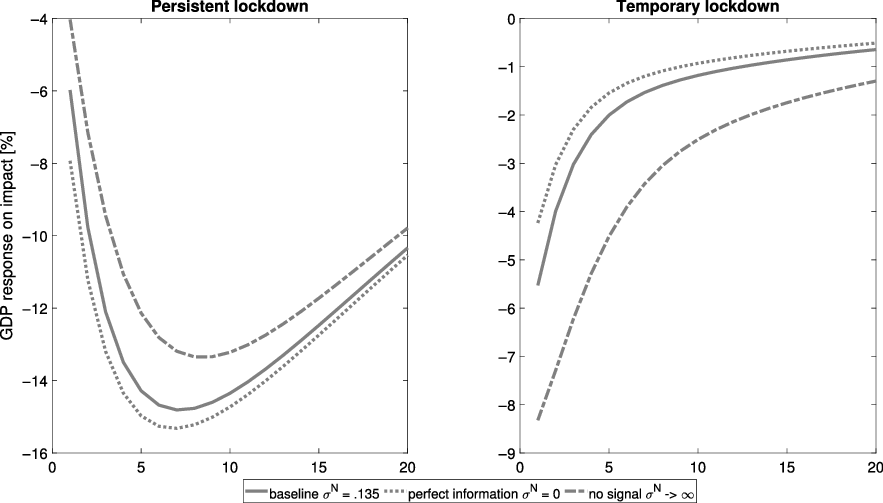
So far we have seen how the impact of the noise shock depends on the signal precision. Let us now move to our final problem—whether and how information precision affects the responses to fundamental lockdown shocks. To address this point, Figure 6 shows reaction functions of GDP to persistent and temporary lockdown shocks for three levels of information precision—perfect information (agents perfectly observe both components of lockdown, i.e.
 $\sigma^{N}=0$
), baseline calibration (
 $\sigma^{N}=0$
.135), and no signal (the signal about the persistent lockdown is uninformative
 $\sigma^{N}\rightarrow\infty$
). Under the baseline calibration, impulse responses are the same as on Figure 2. Assuming perfect information agents observe persistent and temporary lockdowns separately and hence do not confuse them. As a result, they do not react as strongly to the temporary shock (which under imperfect information they confuse with the persistent one) and react more strongly to the persistent lockdown. At the opposite extreme, when agents do not receive meaningful signal about the persistent lockdown they are highly confused and strongly overreact to the temporary shock, while underreacting to the persistent lockdown. Reactions are corrected over time, as new information allows agents to better distinguish the shocks.
GDP response to lockdown shocks conditional on signal precision. Note: The figure presents impulse responses to one standard deviation shocks. The time unit is one quarter.

Importantly, these differences are not only intuitive in a qualitative sense but also significant from the quantitative perspective. To focus attention, the GDP reaction on impact to a persistent shock is almost twice as strong under perfect information than in the no-signal case. As a mirror reflection, a temporary shock affects output in the first quarter twice as strong when no signal is provided than under perfect information.
4.5. Policy implications
So far we argued that noisy information can affect the impact of the lockdown on the economy or can itself be a source of economic fluctuations. We believe that these findings call for formulating policy conclusions. This is especially important in the context of the ongoing COVID-19 pandemic and the pressing question how public authorities should design and communicate the lockdown policy. Before addressing this question, we would like to stress that, since we do not explicitly account for the pandemic in our setup, a lockdown obviously deteriorates welfare and it is pointless to optimize policy with respect to it. Only if lockdown explicitly saved lives in the model, it could be an optimal policy.
Hence, in formulating policy conclusions we will assume that policymakers have reasons, that originate beyond our model, to introduce a lockdown. In particular, we assume that they intend to achieve a given economic slowdown (and a related fall in social interactions) that perfectly reflects the fundamental impact of the lockdown. Any further (positive or negative) macroeconomic effects related in particular to miscommunication are assumed undesired.
Noisy communication has two unwelcome effects: (i) a false (noisy) signal about a lockdown can be interpreted as a true one and cause an unwelcome contraction and (ii) a true signal can be wrongly interpreted as being false and hence weaken the effects of the lockdown that authorities wish to introduce. What are the consequences for information policy? Under the assumption formulated above, precise information is clearly in the interest of public authorities. While this conclusion may not come by surprise, our model offers further important insights.
First, a quantitative one. Both the impact of noise shocks and the way the presence of noise modifies fundamental impulse responses can be quantitatively important. To recall but one effect, as Section 4.4 documents, the initial reaction of the economy to a lockdown shock can be even twice as strong under perfect than under imperfect information. This means that information policy can indeed make a substantial difference to how the economy (and as a result the epidemic) reacts to lockdown policy.
Second, as the reaction of output to noise shocks is U-shaped in noise volatility (see Section 4.3), optimal policy conclusions are more nuanced than just a simple call for more precision. If information is very noisy, then only a radical improvement will decrease the role of noise shocks. Half-measures may in contrast prove counterproductive.
Having said this, one should remember that noisy information about the pandemic and the lockdown does not only stem from the authorities. Both the public and the private sectors face uncertainty concerning the evolution of the pandemic. Consequently, there is plenty of information concerning the future course of the pandemic and lockdowns in the public domain, some being true, some false. The public sector may have an information advantage about the lockdown policy and likely pandemic evolution. It also has the means to communicate with the public and possibly to override the cacophony and correct fake news. Our study calls for action is these areas.
5. Robustness check
Having established that imperfect information about the lockdown can affect economic activity, let us check how this finding depends on the main features of the modeled economy. To this end, this section offers robustness checks of our results. It also allows to better understand and explain how the noise shock is transmitted. We investigate how selected parameter values affect impulse responses. In particular, we focus on price stickiness whose impact on GDP and inflation reaction is non-monotonic. Appendix C complements this analysis by introducing the lockdown as a technology shock which is an alternative way of modeling the impact of the pandemic and the lockdown used previously in the literature, see for example Buera et al. (Reference Buera, Fattal-Jaef, Hopenhayn, Neumeyer and Shin2021), Kollmann (Reference Kollmann2021) and Boscá et al. (Reference Boscá, Doménech, Ferri, García and Ulloa2021). All in all, our experiments show that main results are robust to both the way we introduce the lockdown and to parameter values, at least within the standard range of the latter in New Keynesian models.
5.1. Noise and the structure of the economy
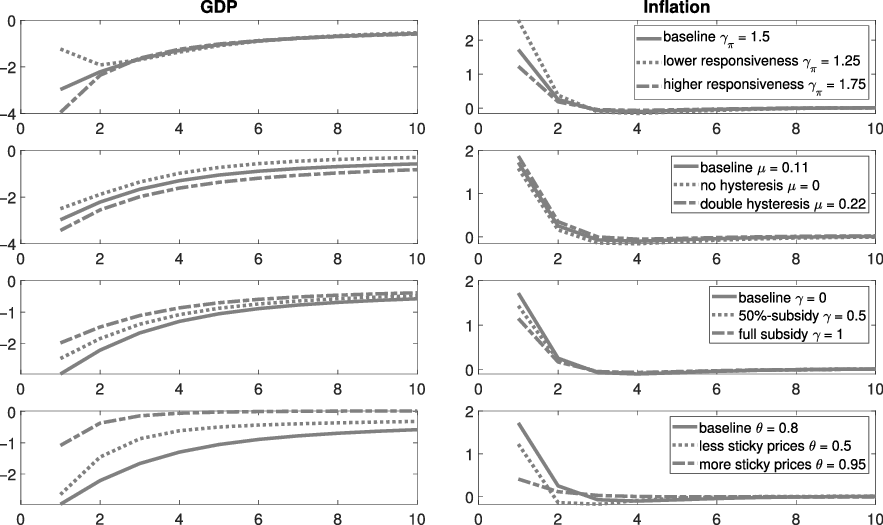
In this section, we analyze what (and to what extent) determines the impact of noise by manipulating standard parameters in the macroeconomic setup (Figure 7).
Impulse responses to the noise about lockdown depending on selected parameters. Note: GDP expressed in percentage deviations from the steady state, inflation in percentage points. The time unit is one quarter. The size of the shock is one standard deviation.

We begin with a parameter that has been shown to play an important role in the literature on noisy technology—the response to inflation in the Taylor rule. Chahrour and Jurado (Reference Chahrour and Jurado2018) show that low values of this parameter strengthen the impact of noise about productivity on output. In our model, this parameter is important as well (see first row of Figure 7). However, in contrast, in the case of lockdown noise it is a strong monetary policy response that strengthens the reaction. This happens due to the inflationary impact of noise shocks. The central bank reacts to higher inflation by raising interest rates and hence lowers output. Consequently, a weaker response to inflation (
 $\gamma_{\pi}=1.25$
) weakens the reaction of output.
Hysteresis effects seem to be of little importance for our results (second row of Figure 7). In principle, this parameter determines how strongly changes in labor supply affect workers skills. If we switch off the parameter that governs it, such impact is absent. Nevertheless, GDP and inflation reactions to the noise shock change only slightly as compared to the baseline. Similarly, we do not observe much of the impact after doubling the parameter value to reflect that the COVID-19 shock might have led to much stronger deterioration of skills than in the past.
Next, we consider the parameter that determines how the government subsidy to households responds to the lockdown.Footnote 4 In the baseline, such subsidy is absent. Here, we allow for either full or 50% reimbursement of the wage income loss (
 $\gamma=1$
or
 $\gamma=0.5$
). As the third row of Figure 7 indicates, the subsidy attenuates the impact of the noise shock as it narrows down the wedge between the wage effectively paid by firms and received by households. However, even eliminating this wedge completely does not make the impact of the noise shock disappear. This suggests that the more important wedge is the one between households labor supply and labor effectively utilized by firms. To put it differently, in our case it is more important that workers cannot work than that they do not receive the full salary.
Finally, we look at the role of price stickiness. Besides our baseline, value we consider more sticky (
 $\theta=0.95$
) and less sticky prices (
 $\theta=0.5$
). Both increasing and decreasing price stickiness lowers the impact of noise on output and inflation. Thus, interestingly and in contrast to the previously discussed parameters the reaction seems to be non-monotonic. We look further into this issue in the next section.
5.2. Is noise a demand or a supply shock?
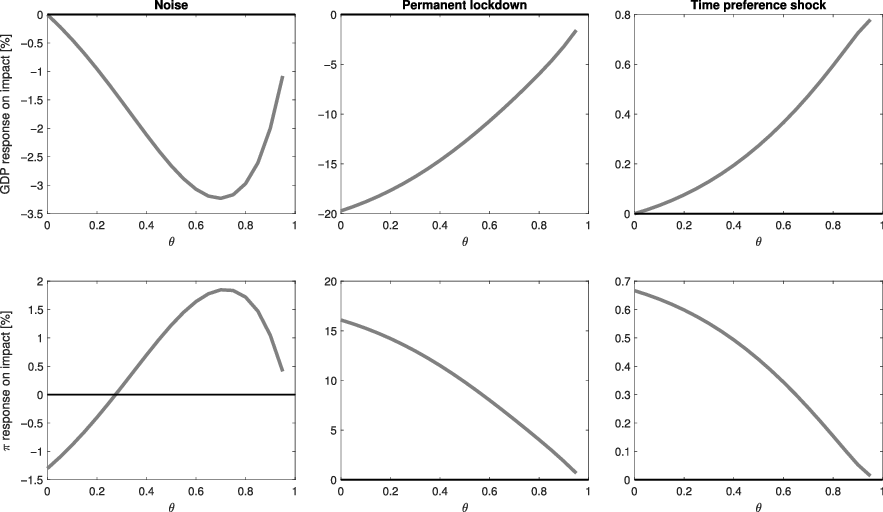
As the non-monotonic relation between price stickiness and response to the noise shock calls for more in-depth analysis, the left column of Figure 8 presents the on-impact reaction of output and inflation to the noise shock as a function of
 $\theta$
. Two interesting features emerge. First, as expected, the response of GDP and inflation is non-monotonic and reaches a minimum (maximum for inflation) at
 $\theta=0.7$
. Second, the impact on inflation is not only non-monotonic but also changes the sign. For low values of
 $\theta$
inflation declines (and hence, given the negative GDP reaction, noise behaves like a demand shock), while under higher price stickiness inflation increases (looks like a supply shock). These features seem puzzling, especially that fundamental shocks behave more predictably. In the remaining columns, we plot for comparison reactions on impact to a persistent lockdown and a time preference shock.Footnote 5 Clearly, bothfunctions are monotonic and both shocks have a well-defined supply (lockdown) or demand (preference) nature for allvalues of
 $\theta$
.
Responses of GDP to selected shocks depending on price stickiness. Note: GDP expressed in percentage deviations from the steady state, inflation in percentage points.

Let us first explain the changing demand/supply nature of the noise shock. In order to understand it better, it is useful to consider its demand and supply effects. As for the former, it affects households’ spending as they feel poorer and reduce consumption. If prices are allowed to adjust freely (low
 $\theta$
), this leads, as expected, to lower inflation. However, when prices are sticky, supply effects dominate. After receiving a noisy signal, intermediate good producers initially expect a persistent lockdown. Thus, they foresee costs to increase and hence, those who are allowed to adjust prices, raise them. This explains why under sticky prices the reaction of inflation is reversed and supply-side effects dominate.
Let us now explain why the reactions are non-monotonic in
 $\theta$
? When prices are very sticky and
 $\theta$
approaches unity, the impact of the shock on inflation becomes low again. This is not surprising. But why does the impact on GDP become low as well? We see a role for monetary policy in the explanation. Since due to price stickiness inflation hardly changes, the monetary policy trade-off between inflation and output stabilization vanishes and the central bank can set nominal interest rates to counteract the output drop. As a consequence, the reaction of output becomes small as well.
6. Conclusions
Lockdowns have contributed heavily to the sharp breakdown of economic activity during the COVID-19 pandemic. In this paper, we argue that what affects the economy is not only the lockdown as such but also imperfect information about its future course. Although lockdowns ultimately proved relatively short-lived in the first half of 2020, many agents facing information frictions have expected them to reoccur when subsequent waves of the pandemic hit. Indeed, as life has shown, lockdowns in some form returned in many countries later in 2020and 2021.
We use a relatively standard business cycle model, extended for the presence of an information friction to analyze this problem. The friction is related to information about the duration of the lockdown being imprecise (noisy). Agents face a signal extraction problem and commit mistakes since they cannot perfectly extract noise from the signal. In particular, they can treat a false signal about the persistent (reoccurring) lockdown(s) as true information expect lower wealth and reduce consumption. As a consequence, the economy contracts. Noisy information can also act in another unwelcome direction—it can decrease the intended impact of a true lockdown as agents may treat the signal about its duration as noise.
Our mechanism is somewhat stylized and the calibration of the information process prone to uncertainty. So, our quantitative findings should be interpreted with caution. Nevertheless, for a wide range of parameter values describing the precision of the signal about lockdown duration, the impact of a false signal about a lockdown is substantial. Only under very precise signals does such noise play a negligible role. Similar quantitative conclusions apply to lockdown shocks, whose impact can be significantly different, depending on how precise the lockdown information is. Last but not least, if initial information is very noisy only a radical improvement of precision is beneficial, while half-measures can in fact increase the confusion and becounterproductive.
The main policy conclusion from our paper is that public communication about lockdown duration should be made very precise if it is possible. If the lockdown is to last for long and agents should reduce their economic activity, this should be communicated openly. Otherwise, the authorities risk a limited impact on activity as agents may falsely interpret the signal as temporary. But if the government intends to apply short-term measures only, it should not be ambiguous either, as agents (if they misinterpret the signal) could react as if the measures were to stay for long. Precise information reduces the impact of pure noise shocks on the economy as well. While it is understandable that during the first lockdown phase in Spring 2020 public authorities in many countries were wandering in the dark, over time and with more experience their reaction functions should crystallize.
Acknowledgements
We would like to thank editor William A. Barnett, the associate editor, and two anonymous referees for helpful suggestions to the earlier draft. Thanks are also owed to Marcin Kolasa, Pierre De Leo, Rafał Chmura, Luisa Corrado and participants of EEA-ESEM, 24th Central Bank Macroeconomic Modeling Workshop and 11th RCEA Money, Macro and Finance conferences, Warsaw Economic Seminar and the seminar at SGH Warsaw School of Economics for useful discussions. The views presented in the paper do not represent the official position of neither of the affiliated institutions. This project was financed by the National Science Centre grant No. 2017/25/B/HS4/01429.
Appendix A. The State Space Representation and the Filtering Problem
Consumers face a signal extraction problem which they solve by running the Kalman filter. Below this problem and its solution are presented. Let
 $\boldsymbol{{X}}_{\boldsymbol{{t}}}=[\begin{matrix} l_{t}^{T} & l_{t}^{P} \end{matrix}]^{'} $
denote the state vector,
 $\boldsymbol{{S}}_{\boldsymbol{{t}}}=[\begin{matrix}l_{t} & s_{t}\end{matrix}]^{'}$
the vector of observables, and
 $\boldsymbol{\varepsilon}_{\boldsymbol{{t}}}=[\begin{matrix}\varepsilon_{t}^{T} & \varepsilon_{t}^{P} & \varepsilon_{t}^{N}\end{matrix}]^{'}$
the vector of shocks. The system of equations (13)–(16) can be presented in matrix notation as follows:
 \begin{equation}\boldsymbol{{X}}_{\boldsymbol{{t}}}=\boldsymbol{{AX}}_{\boldsymbol{{t-1}}}+\boldsymbol{{B}}\boldsymbol\varepsilon_{\boldsymbol{{t}}}\end{equation}
 \begin{equation}\boldsymbol{{S}}_{\boldsymbol{{t}}}=\boldsymbol{{CX}}_{\boldsymbol{{t}}}+\boldsymbol{{D}}\boldsymbol\varepsilon_{\boldsymbol{{t}}},\end{equation}
where
 \begin{equation*}\boldsymbol{{A}}=\left[\begin{array}{c@{\quad}c}0 & 0\\ 0 & \rho \end{array}\right],\,\,\boldsymbol{{B}}=\left[\begin{array}{c@{\quad}c@{\quad}c}1 & 0 & 0\\0 & 1 & 0\end{array}\right],\end{equation*}
 \begin{equation*}\boldsymbol{{C}}=\left[\begin{array}{c@{\quad}c}1 & 1\\0 & 1\end{array}\right],\,\,\boldsymbol{{D}}=\left[\begin{array}{c@{\quad}c@{\quad}c}0 & 0 & 0\\0 & 0 & 1\end{array}\right].\end{equation*}
The variance-covariance matrices
 $\boldsymbol{{S}}_{\textbf{1}}=E_{t}[\boldsymbol{{B}}\boldsymbol{\varepsilon}_{\boldsymbol{{t}}}\varepsilon_{\boldsymbol{{t}}}^{'}\boldsymbol{{B}}^{'}]$
and
 $\boldsymbol{{S}}_{\boldsymbol{{2}}}=E_{t}[\boldsymbol{{D}}\boldsymbol{\varepsilon}_{\boldsymbol{{t}}}\varepsilon_{\boldsymbol{{t}}}^{'}\boldsymbol{{D}}^{'}]$
are given by:
 \begin{equation*}\boldsymbol{{S}}_{\textbf{1}}=\left[\begin{array}{cc}\sigma_{T}^{2} & 0\\0 & \sigma_{P}^{2}\end{array}\right],\end{equation*}
 \begin{equation*}\boldsymbol{{S}}_{\textbf{2}}=\left[\begin{array}{cc}0 & 0\\0 & \sigma_{N}^{2}\end{array}\right].\end{equation*}
Agents form expectations based on the Kalman filter. Hence, the evolution of the expected state vector follows:
 \begin{eqnarray}\boldsymbol{{X}}_{\boldsymbol{{t}}\mid \boldsymbol{{t}}} & = & \boldsymbol{{AX}}_{\boldsymbol{{t}}-\textbf{1}\mid \boldsymbol{{t}}-\textbf{1}}+\boldsymbol{{K}}\left(\boldsymbol{{S}}_{\boldsymbol{{t}}}-\boldsymbol{{S}}_{\boldsymbol{{t}}\mid \boldsymbol{{t}}-\textbf{1}}\right),\end{eqnarray}
where
 \begin{equation}\boldsymbol{{K}}=\boldsymbol{{PC}}^{'}\left(\boldsymbol{{CPC}}^{'}+\boldsymbol{{S}}_{2}\right)^{-1}\end{equation}
is the Kalman gain matrix and
 \begin{equation}\boldsymbol{{P}}=\boldsymbol{{A}}[\boldsymbol{{P}}-\boldsymbol{{PC}}'\left(\boldsymbol{{CPC}}^{'}+\boldsymbol{{S}}_{\textbf{2}}\right)^{-\textbf{1}}\boldsymbol{{CP}}]\boldsymbol{{A}}'+\boldsymbol{{S}}_{\textbf{1}}\end{equation}
captures uncertainty of the state vector (see Hamilton (Reference Hamilton1994), p. 380 for details).
Use (A1) and (A2) to derive
 $\boldsymbol{{S}}_{\boldsymbol{{t}}\mid \boldsymbol{{t}}-\textbf{1}}=\boldsymbol{{CX}}_{\boldsymbol{{t}}\mid \boldsymbol{{t}}-\textbf{1}}=\boldsymbol{{CAX}}_{\boldsymbol{{t}}-\textbf{1}\mid \boldsymbol{{t}}-\textbf{1}}$
and substitute into (A3):
 \begin{eqnarray}\boldsymbol{{X}}_{\boldsymbol{{t}}\mid \boldsymbol{{t}}} & = & \boldsymbol{{AX}}_{\boldsymbol{{t}}-\textbf{1}\mid \boldsymbol{{t}}-\textbf{1}}+\boldsymbol{{K}}\left(\boldsymbol{{S}}_{\boldsymbol{{t}}}-\boldsymbol{{CAX}}_{\boldsymbol{{t}}-\textbf{1}\mid \boldsymbol{{t}}-\textbf{1}}\right)\nonumber \\ & = & (\boldsymbol{{A}}-\boldsymbol{{KCA}})\boldsymbol{{X}}_{\boldsymbol{{t}}-\textbf{1}\mid \boldsymbol{{t}}-\textbf{1}}+\boldsymbol{{K}}\boldsymbol{{S}}_{\boldsymbol{{t}}}.\end{eqnarray}
Then substitute for
 \begin{equation}\boldsymbol{{S}}_{\boldsymbol{{t}}}=\boldsymbol{{CX}}_{\boldsymbol{{t}}}+\boldsymbol{{D}}\varepsilon_{\boldsymbol{{t}}}=\boldsymbol{{C}}(\boldsymbol{{AX}}_{\boldsymbol{{t}}-\textbf{1}}+\boldsymbol{{B}}\varepsilon_{\boldsymbol{{t}}})+\boldsymbol{{D}}\varepsilon_{\boldsymbol{{t}}}=\boldsymbol{{CAX}}_{\boldsymbol{{t}}-\textbf{1}}+\left(\boldsymbol{{CB}}+\boldsymbol{{D}}\right)\varepsilon_{\boldsymbol{{t}}}\end{equation}
to get:
 \begin{eqnarray}\boldsymbol{{X}}_{\boldsymbol{{t}}\mid \boldsymbol{{t}}} & = & (\boldsymbol{{A}}-\boldsymbol{{KCA}})\boldsymbol{{X}}_{\boldsymbol{{t}}-\textbf{1}\mid \boldsymbol{{t}}-\textbf{1}}+\boldsymbol{{K}}\left(\boldsymbol{{CAX}}_{\boldsymbol{{t}}-\textbf{1}}+\left(\boldsymbol{{CB}}+\boldsymbol{{D}}\right)\varepsilon_{\boldsymbol{{t}}}\right).\end{eqnarray}
Agents use this equation to form expectations of the state vector.
Since in the linearized model certainty equivalence holds, agents treat these expectations like true state variables. The model solution under imperfect information is based on the same laws of motion (policy functions) as the perfect information model, whereas the unobserved state variables are replaced by their estimates from the Kalman filter (see Hamilton (Reference Hamilton1994), Hürtgen (Reference Hürtgen2014) for details).
Finally, the imperfect information model is observationally equivalent to its perfect information counterpart with correlated shocks. This result is used to obtain impulse responses presented in the paper (see Lemma 2 in Blanchard et al. (Reference Blanchard, L’Huillier and Lorenzoni2013)).
Appendix B. Calibration of Noise Volatility
This Appendix presents the simplified filtering problem of the agents as well as its application to the data on Google searches for flights that allow us to calibrate the noise shock volatility in Section 3.7.
B.1. Description of the Simplified Passive Learning
Similarly to the full Kalman filtering problem described in Appendix A, we assume that agents observe two variables:
-
1. the lockdown that is a sum of persistent and temporary (measurement error) component:
 \begin{equation*}LD_{t}=LD_{t}^{P}+LD_{t}^{T}\end{equation*}
-
2. the noisy signal about the persistent component:
(B1)
\begin{equation}S_{t}=LD_{t}^{P}+\varepsilon_{t}^{N}.\end{equation}


In order to infer on noise volatility, that is
 $\sigma^{N}$
, from the available data we focus on two periods of time: April 2020 and Summer 2020 that we associate with—respectively—period t and
 $t+1$
. We assume that expectations about lockdown in the period
 $t+1$
do not account for the temporary lockdown in this period and the persistent component is not autoregressive but instead features a unit root, that is:
 \begin{equation}\mathrm{E_{t}}\left(LD_{t+1}\right)=\mathrm{E_{t}}\left(LD_{t}^{P}\right).\end{equation}
Assuming normal distribution of
 $LD_{t}^{P}$
,
 $LD_{t}^{T}$
and
 $\varepsilon_{t}^{N}$
it follows that:
 \begin{equation*}\mathrm{E_{t}}\left(LD_{t+1}\right)=S_{t}\frac{\left(\sigma^{P}\right)^{2}}{\left(\sigma^{P}\right)^{2}+\left(\sigma^{N}\right)^{2}}\end{equation*}
that is expectations of the future lockdown depend on the signal and its precision.
B.2. Using Data on Flight Searches
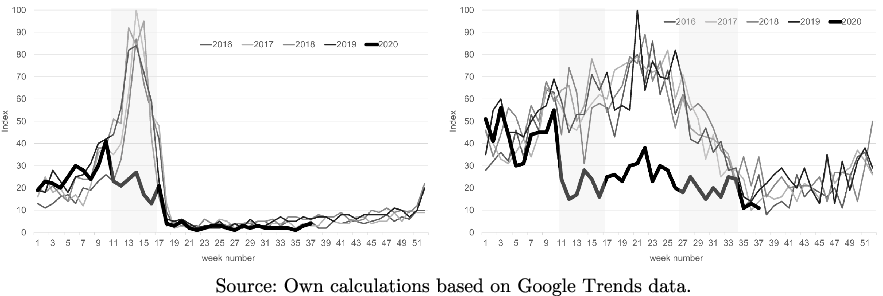
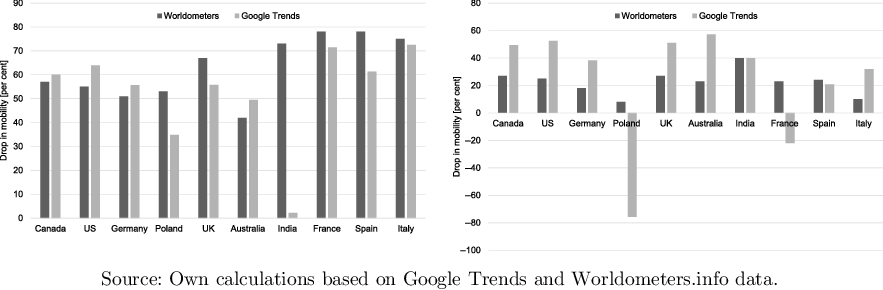
We use Google Trends tool to download numbers of searches for phrases “flights April” and “flights Summer” for a number of countries (if English is not the official language of a country we translate the phrases into the respective official language) for years 2016–2020. As Figure B.1 illustrates for the US case, there has been a consistent pattern of such searches in years 2016–2019, that is in “normal” times. The year 2020 saw a substantial drop in people’s interest in traveling. We associate its scale with the size of the lockdown assuming that if people are forced not to work, they are also unable to travel both in business and as tourists. We compare our lockdown proxy with another available measure of mobility presented by Worldometers.info in Figure B.2 and find that these two are broadly in line. B.
Google Trends searches for phrases “flights April” (left panel) and “flights Summer” (right panel) in the US. Note: shaded areas denote late March and April (week number 11–17) and Summer (week number 27–35).

Comparison of mobility measure implied from Google Trends and Worldometers.info in April (left panel) and in the Summer (right panel).

The advantage of using the proposed measure, however, is that we can proxy for the lockdown in the Summer (i.e. in period
 $t+1$
), as expected in April, (i.e. in period t). It is given by searches “flights Summer” observed in April. As Figure B.1 shows, this phrase was also searched much less in 2020 as compared to previous years. Having calculated proxies for
 $LD_{t}$
,
 $LD_{t+1}$
and
 $\mathrm{E_{t}}\left(LD_{t+1}\right)$
for a number of countries, we verify their quality by comparing them with Worldometers.info measure as well as data on travel restrictions presented by United Nations World Tourism Organization. We drop countries for which data are unreliable leaving finally seven of them: US, UK, Canada, Australia, Germany, France, and Poland. As a final step, we calculate
 $LD_{t}^{P}$
,
 $LD_{t}^{T}$
,
 $\varepsilon_{t,}^{N}$
and
 $\sigma^{N}$
using equations presented in Appendix B.1. To this end, we first use equation (B2) to infer on the persistent lockdown component based on expected lockdown in period
 $t+1$
. Next, we calculate the value of
 $\sigma^{P}$
from cross-country dispersion of
 $LD_{t}^{P}$
and guess the value of
 $\sigma^{N}$
to calculate the signal
 $S_{t}$
. Finally, we compute
 $\varepsilon_{t}^{N}$
from equation (B1) and its standard deviation using cross-country realizations of this shock. We verify whether the obtained value of
 $\sigma^{N}$
is equal to the guessed one and if not—we modify the guess until they converge.
Appendix C. Comparison of Alternative Ways of Modeling Lockdowns
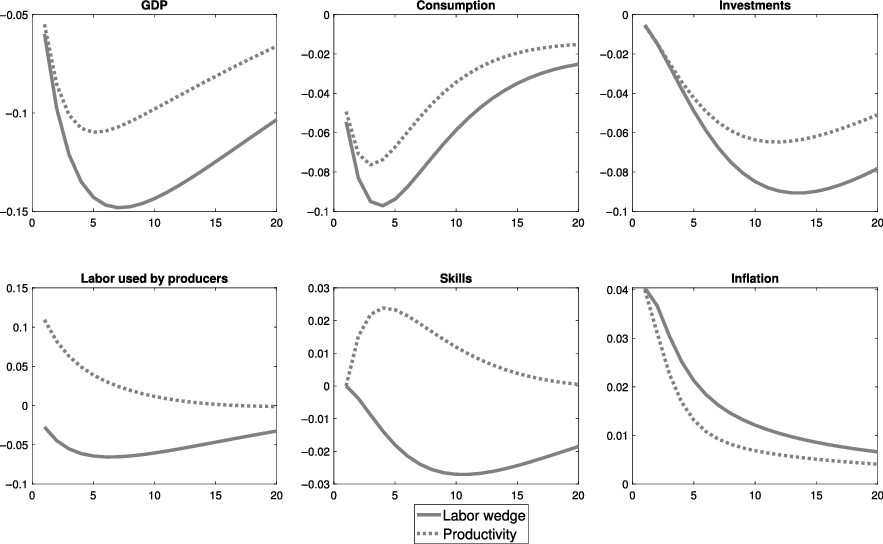
This Appendix compares the effects of lockdown modeled as a wedge in the labor market, as this paper proposes, with an alternative approach from the literature that relies on using TFP shocks to reflect a fall in production factor utilization. For example, Buera et al. (Reference Buera, Fattal-Jaef, Hopenhayn, Neumeyer and Shin2021) model their shutdown shock as a productivity shock, Kollmann (Reference Kollmann2021) models supply disturbance related to Covid as a TFP shock, while Boscá et al. (Reference Boscá, Doménech, Ferri, García and Ulloa2021) estimate TFP to be one of main drivers of GDP slowdown in Spain during the COVID pandemic. In order to provide a meaningful comparison between the two approaches, the alternative simulation assumes that productivity (TFP—variable
 $a_{t}$
in equation (7)) consists of two components: an autoregressive process (persistent shock) and a one-period disturbance (temporary shock). Agents observe only aggregate productivity and they infer on its components based on a noisy signal about the persistent part. In the alternative scenario, standard deviations of persistent and temporary shocks are calibrated such that GDP response on impact is the same as in the baseline simulation with lockdown shocks.
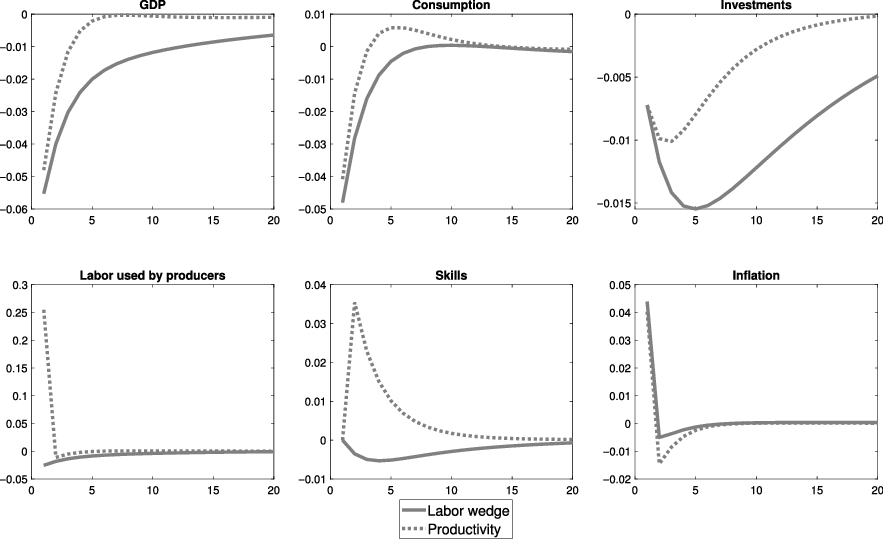
We present results for three shocks: two fundamental (persistent in Figure C.1 and temporary in Figure C.2) and noise in Figure C.3. As for the former two, responses of macrovariables (GDP, consumption, investments) are qualitatively similar, but of different magnitude. The reason is the positive reaction of labor after the negative productivity shock induced by the income effect (with income and consumption going down, households value leisure less). Consequently, GDP and its components fall less in this scenario. Given the nature of the lockdowns that set part of the labor force idle, we believe that modeling it as labor-wedge shock, as it is proposed in this paper, corresponds better to observed developments.
Impulse responses to persistent lockdown shocks. Note: The figure presents impulse responses to one standard deviation shocks.

Impulse responses to temporary lockdown shocks. Note: The figure presents impulse responses to one standard deviation shocks.

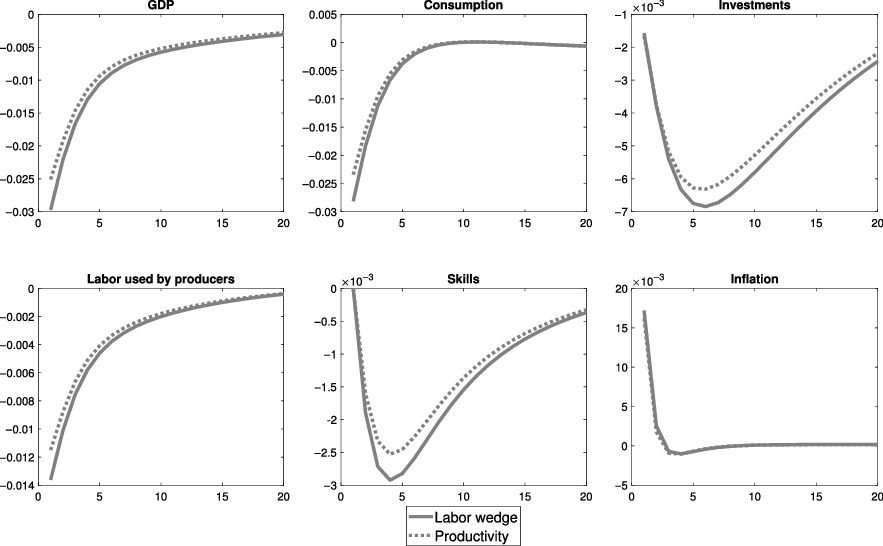
Impulse responses to noise shocks. Note: The figure presents impulse responses to one standard deviation shocks.

Interestingly, differences in responses observed for fundamental shocks do not extend to the noise shock. The reason is that no actual lockdown occurs, and therefore, the responses are driven by agents expectations of fall in income (hence declining GDP and its components) and increase in marginal costs (hence rising inflation).
To conclude, under imperfect information modeling the lockdown as a wedge in labor supply seems to be superior to interpreting it as a TFP shock. Nevertheless, the two ways of modeling lockdowns bear close resemblance when it comes to reactions to noise shocks.