INTRODUCTION
Phosphorus (P) is one of the nutrient elements required by plants in large quantities (Khasawneh et al., Reference Khasawneh, Sample and Kamprath1980). However, availability of P is a major problem in many of the highly weathered soils in the tropics including South Africa (Bainbridge et al., Reference Bainbridge, Miles, Praan and Johnston1995). The Hutton soils, which are the dominant agricultural soils in the North West Province, are severely deficient in available P due to their mineralogy and high P-fixation (Farina and Channon, Reference Farina and Channon1987). These soils have a mineralogy that is dominated by Fe and Al oxides and hydroxides and added phosphate can be adsorbed by ligand exchange to these surfaces thereby becoming not readily available to plants (Bainbridge et al., Reference Bainbridge, Miles, Praan and Johnston1995).
Observations have widely shown that cereals, especially maize, grown on resource poor farmers' fields display distinct purple coloration of leaves and subsequent soil analyses at the University Soil Testing Laboratory confirmed that P deficiency is one of the major factors limiting growth and yield of maize for small-scale farmers in South Africa. According to Mengel et al. (Reference Mengel, Kirkby, Kosegarten and Appel2001), plants suffering from P deficiency are retarded in growth and their shoot: root dry matter ratio is usually low. In cereals, tillering is particularly affected thereby depressing seed yield. Thus, not only low yields, but also poor quality fruit and seeds are obtained from P-deficient crops (FSSA, 1989; Fageria, Reference Fageria2009; Mohamed Saleem and Von Kaufmann, Reference Mohamed Saleem and Von Kaufmann1986). Phosphorus deficiency has also been shown to retard the uptake and translocation of some nutrients such as N, K, Mg, Zn, Fe and Cu (Mengel et al., Reference Mengel, Kirkby, Kosegarten and Appel2001).
In South Africa, large areas of potentially good land are agriculturally poor because of P deficiency (Linquist et al., Reference Linquist, Singleton, Cassam and Keane1996). According to the Fertilizer Society of South Africa's guide for fertilization, the levels of P that exist in some of these soils requires approximately 45 and 65 kg ha−1 of P in order to achieve maize grain yields of 3 and 4 tons ha−1 respectively (FSSA, 1989). Although P can easily be supplied to plants by using fertilizers, the high cost of chemical fertilizers makes its use unaffordable for most small-scale farmers with limited financial resources. Studies have shown that the majority (60%) small scale farmers in the North West Province are either not applying any P fertilizer to their maize or are applying insufficient amounts of fertilizer (Seobi, Reference Seobi1999).
Mkhabela and Materechera (Reference Mkhabela and Materechera2003) have suggested that chicken manure is an organic resource available in South Africa, which small-scale farmers could use to supply P to plants. The availability of chicken manure in South Africa has increased due to the existence of many intensive semi-commercial poultry production units, which have mushroomed in many rural areas since the democratic change in 1994. There are also a number of large-scale commercial poultry production companies such as Rainbow Chickens, Early Bird and Trevton that produce approximately 0.5 million tons of air-dry chicken manure annually (DoA, 2004). This manure is available for use by small-scale farmers at a very low cost. The value of chicken manure is already highly recognized elsewhere (Maldonado-Montiel et al., Reference Maldonado-Montiel, Rodriguez-Canche and Olivera-Novoa2003; Shepherd and Withers, Reference Shepherd and Withers1999; Sistani et al., Reference Sistani, Sikora and Rasnake2008). However, although chicken manure is a resource with potential for utilization as a source of plant nutrients, it has not been widely used as a nutrient source in maize production, especially under small-scale farmers' conditions of limited financial resources. The use of organic materials as P source is of considerable interest in small-scale farming systems of tropical Africa, mainly because of their potential as alternative to inorganic P fertilizers.
Although chicken manure contains nitrogen and other nutrients, this study was conducted to investigate its use as a source of P for maize production under dryland conditions of South Africa. The specific objectives were to: i) determine the response of maize to added P in a soil with very low inherent soil P levels; ii) compare the response of maize to P supplied by fertilizer and chicken manure, and iii) determine the residual effects of applying fertilizer and manure on soil P and acidity.
MATERIALS AND METHODS
Site location and climate
The study was conducted at the North West University's Research Farm located about 8 km from the city of Mafikeng in the North West Province of South Africa (25°48′ S, 25°38′ E; 1012 m asl). Mafikeng has a typical semi-arid tropical savanna climate and receives summer rainfall with an annual mean of 571 mm. The rainfall is unreliable and highly variable in both temporal (CV = 23%) and spatial (CV = 31%) distribution. About 68% of the annual precipitation falls between November and January in relatively few heavy downpours with a pronounced dry season from April to September. The mean maximum temperatures (15-year average) vary from 26.9°C in June to 37 °C in January while the mean minimum varies from 7°C to 11.4 °C. The long-term annual average evaporation at the site is 1023 mm (City Council of Mafikeng, 1999).
Soil description
The surface (0–15 cm) soil is a red sandy loam with 55.6% sand, 32.6% silt, 11.8% clay, 0.69% organic carbon (Walkley-Black), 0.47% N, 3.4 mg kg−1 available P (Bray-1), 7.2 meq 100 kg−1 CEC (ammonium acetate extracted) and a pH (1:2.5, soil: water) of 6.3 measured using methods of The Non-Affiliated Soil Analysis Working Committee (1990). It is classified as Hutton form according to the South African soil classification system (Soil Classification Working Group, 1991) and has characteristics similar to a Ferric Luvisol (FAO-ISS-ISRIC, 1998). The soil is free draining and hard-setting when it dries.
Collection and analysis of manure samples
The chicken manure used was collected from the floor of a broiler chicken (Gallus gallus domesticus) battery cage unit at the North West University Research Farm in October 2001. The manure was air-dried and passed through a 4.0 mm sieve to remove debris and stored in large (10 l) air-tight glass bottles until use. The properties and nutrient content of chicken manure were determined prior to application each season. Five sub-samples (10 g each) of the manure were oven dried at 65 °C, ground to pass a 2.0 mm screen and analysed for nutrient content after a wet digestion (Thomas et al., Reference Thomas, Sheard and Moyen1967). The manure was analyzed for ash alkalinity, CaCO3 content, organic carbon, pH (CaCl2), electrical conductivity (EC), and nutrients (N, P, K, Ca, Na, Fe, Mn, Zn, Cu, Al and Bo).
Experimental treatments and design
There were 12 treatments consisting of four levels of P application viz. 0, 20, 40 and 80 kg P ha−1 each from chicken manure (2.8% P), fertilizer (10.5% P, single super phosphate) and a combination of chicken manure and fertilizer (50:50 based on P). The treatments were replicated four times and laid out in a randomized complete block design.
Management of field plots
The experiment was conducted during the 2001/02 and 2002/03 crop growing seasons (November–May). In both seasons, the land was ploughed to a depth of 20 cm at the beginning of the cropping season (November), disk harrowed and levelled with a rotavator. Large clods were broken with a hand rake to produce a seedbed with predominantly fine (<250 mm) aggregates. The field was divided into individual plots measuring 10 m by 3.0 m separated by 0.5 m alley-ways.
Calculated amounts of chicken manure and fertilizer for each plot were applied by opening a groove 10 cm deep along the planting line with a hand hoe, spreading the required amounts into the groove and covering it with soil. Urea (46%) was applied as a source of N in all the treatments at a rate of 60 kg N ha−1 at planting. The N application in manure treatments was based on the assumption that about half of the N in manure (2.4%) is available to the crop during the year of application (Sistani et al., Reference Sistani, Sikora and Rasnake2008). A blank application of 100 kg K ha−1 as KCl (60% K2O) was made in all plots. All treatments were applied a week prior to planting. Planting was done by sowing seeds of a hybrid maize (Zea mays cv PNR 6479) 5 cm deep along the groove to avoid seeds being in direct contact with manure and fertilizer. Seeds were planted in single rows, 25 cm apart (intra-row) and 1.0 m apart (inter-row) to give a plant population equivalent of about 40 000 plants ha−1.
Atrazine was applied using a knapsack sprayer two weeks before planting at a rate of 2.0 l ha−1 to control broad-leaved weeds in all plots. Subsequently, weeds were pulled out by hand. In both seasons, the crop was sown in the second half of December and harvested in late May/June. The trial was located on different spots within the field site during the 2001/02 and 2002/03 seasons. Rainfall was recorded daily during the study period from a rain gauge installed at one end of the field. The cumulative monthly precipitation is reported in this paper.
Data collection
In each season, the total number of maize seedlings that had emerged in each treatment was counted starting one week after sowing. After two weeks, the total number of emerged seedlings in each plot was expressed as percentage of the total number (120) of seeds sown. At the beginning of the third week, all the gaps were filled by reseeding. At physiological maturity and before harvesting, plant height was measured on 50 randomly selected plants in each treatment from the base to the top of a plant using a 2 m calibrated stick. Stem diameter was measured on 20 randomly selected plants per treatment using a pair of calipers.
The number of maize plants that were lodged was counted in each plot and was divided by the total number of plants in the plot to obtain the lodging percentage. The number of maize stalks that were attacked by maize stalk borers (Buseola fusca) was counted in each treatment. This was done by examining leaves and stems of all the maize plants in a treatment for presence of holes. Percentage of attack was calculated by dividing the number of plants that were attacked by stalk borer with the total number of plants in each plot. Biomass yield of maize was determined by weighing all the stover (stalk, leaves and husks) harvested at soil level from each plot. Grain from the middle row of each plot was harvested and weighed. Grain samples were taken for moisture content determination and grain yields were adjusted to 12.5% moisture content.
In order to assess the residual effects of the treatments, topsoil (0–15 cm) samples were taken from each treatment plot at the end of each season and just before the beginning of the next (September 2001 and 2003). Ten sub-samples were randomly collected from each plot with an auger along the rows where fertilizer and manure was incorporated. The sub-samples from each plot were thoroughly mixed to form a composite sample which was analysed for pH and available P using procedures outlined by The Non-Affiliated Soil Analysis Working Committee (1990). All the operations carried out in the 2001/02 season were repeated in 2002/03 season.
Analysis of data
The data for all parameters were subjected to analysis of variance (ANOVA) using the PROC GLM routine of the SAS statistical package (SAS Institute Inc., 1991). Percentages were transformed to angular values using an arcsine function to normalize them, and analysis of variance was conducted on the transformed data (Snedecor and Cochran, Reference Snedecor and Cochran1980). However, the values of means presented are those of untransformed data. The s.e.d. was used to compare treatment means at p < 0.05. Linear correlation coefficients between measured variables were determined using the CORR program of SAS.
RESULTS
The values of chemical properties and nutrient content of the chicken manure samples analysed at the beginning of 2001/01 and 2002/03 seasons did not differ much and were therefore combined (Table 1). The chicken manure used in this study was from a caged pit system commonly used for commercial layer poultry in South Africa. Chickens under this system are fed dietary supplements such as limestone grit, salt and trace elements. Consequently, the manure had relatively high CaCO3, Ca, Na and Cu. The relatively high N and P content compared to others such as cattle manure is a characteristic of this type of manure (Nicholson et al., Reference Nicholson, Chambers and Smith1996).
Characteristics and nutrient content of chicken manure used in the 2001/02 and 2002/03 seasons.

† Values are means of two seasons, n = 10.
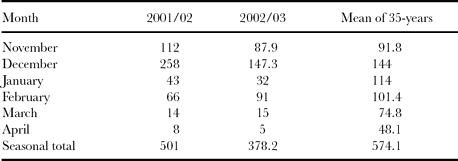
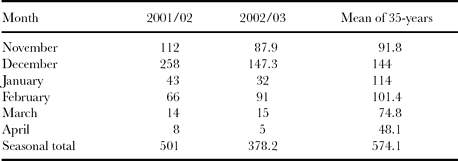
Rainfall data for the 2001/02 and 2002/03 crop seasons are compared with long-term averages in Table 2. The total rainfall for the 2002/03 season (264.2 mm) was below the long-term average (574.1 mm) with extremely dry conditions in November, January and March. The rainfall for the 2001/02 season (501.3 mm), on the other hand, was higher and close to the long-term average. Generally, the months of January, March and April had extremely low rainfall in both seasons of the study compared to the long-term average.
Rainfall (mm) at the experimental site during the 2001/02 and 2002/03 crop growing seasons.
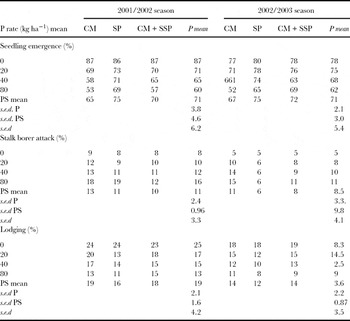
Analysis of variance showed significant differences (p < 0.05) among years and between treatments within a year. There were no significant interactions between P source and rate for any of the parameters and therefore the data are reported by year/season. The emergence of maize seedlings was significantly reduced (p < 0.05) by increasing levels of P from both manure and fertilizer in both seasons (Table 3). However, emergence was higher when P came from fertilizer than from manure. It was observed that there were many more porcupine footprints in the treatments with chicken manure (45%) than fertilizer (13%). The porcupines dug out and ate the emerging seedlings. The trend was similar in both seasons with the wetter 2001/02 season having higher emergence than the drier season.
Effects of P from chicken manure and SSP fertilizer on maize seedling emergence, lodging and stalk borer attack over two growing seasons.

CM: chicken manure; SSP: single super phosphate fertilizer; PS: phosphorous source; s.e.d: standard error of difference between means at different levels of P and PS, p<0.05; Values are means of the four replicates.
Similar results were observed for stalk borer attack on the maize where the application of increasing P from manure and fertilizer significantly increased (p < 0.05) the attack. The average increases in attack at each level of P application were, however, higher in manure (11.3%) than fertilizer (7.2%). Table 3 also indicates that there was a general decline in the lodging of maize stalks with increased P in both treatments. This indicates that P is important for root development and strengthening of the stem (Mengel et al., Reference Mengel, Kirkby, Kosegarten and Appel2001). Interestingly, the decrease in lodging at each level of P application was higher in maize treated with fertilizer than manure.
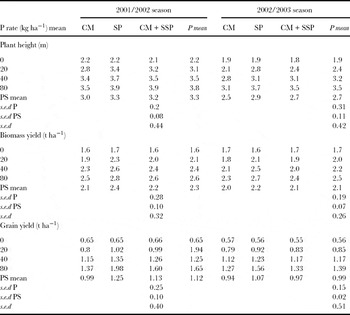
The influence of P from fertilizer and manure on height and yields of maize are shown in Table 4. Both treatments significantly increased (p < 0.05) the height of maize stalks. At each level of P application, the maize plants were significantly taller (p < 0.05) under fertilizer than manure treatment. For fertilizer, the plant height increased with each increment of P while for manure the 80 kg P ha−1 level produced almost similar heights to the 40 kg P ha−1 level. The biomass and grain yields of maize also showed a general increase with increased levels of P from both manure and fertilizer. However, the increase in biomass yield for fertilizer P was consistently (although not significant) higher than that from manure. As expected, the yields were higher in the 2001/02 than 2002/03 season because of the better rainfall pattern. Generally, the yield levels obtained in this study were much lower than the potential suggested by the FSSA (1989) mostly due to limited rainfall at the site.
Effects of P from chicken manure and fertilizer on height, biomass and grain yields.

CM: chicken manure; SP: super phosphate fertilizer; PS: phosphorous source; P: Phosphorus rate; s.e.d: standard error of difference between means at different levels of P and PS, p < 0.05; Values are means of the four replicates.
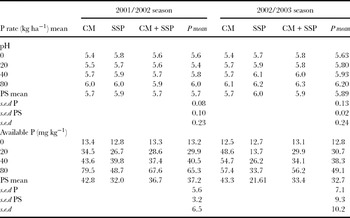
Table 5 shows that the pH and residual P of the soil was influenced by the application of both fertilizer and chicken manure. There was an increase in soil pH with increased levels of P from both treatments. However, the increase in soil pH was clearly higher in manure than inorganically fertilised soil. The superiority of chicken manure in increasing soil pH compared to in organic P fertilizer was caused by its high CaCO3 and ash alkalinity. There was higher available soil P in manure than inorganic fertilizer treatments, and the amount of available P in the soil increased with increasing levels of P application for both treatments. At each level of P, manure application had significantly higher (p < 0.05) available phosphorus than the corresponding level for fertilizer.
Effects of chicken manure and SSP fertilizer application on soil pH and residual P over two crop seasons.

CM: chicken manure; SSP: single super phosphate fertilizer; PS: phosphorous source; P: phosphorous rate; s.e.d: standard error of difference between means at different levels of P and PS, p < 0.05. Values are means of the four replicates.
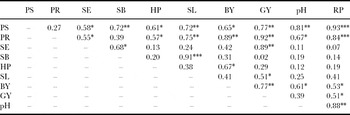
Table 6 shows significant correlations between the measured variables in the study. Interestingly, among these were the significantly strong relationship between stem borer attack and maize stalk lodging; pH and residual phosphate; grain yield and residual phosphate, and grain yield and biomass yield, which indicates the role that the manure played in the growth and development of maize. Another factor that could contribute to reduction in the emergence of maize was the presence of porcupines in manure treatments. The attack by porcupines was higher in manure treatments, perhaps because they were attracted by the smell of manure.
Pearson correlation coefficients among variables in the study (pooled data for the two seasons).

PS: phosphorus source; PR: phosphorus rate; SE: Seedling emergence; SB: Stalk borer attack; HP: Plant height; SL: stalk lodging; BY: Biomass yield; GY: Grain yield; pH; RP: Residual P; * p<0.05; ** p<0.01; p<0.001.
DISCUSSION
The greater response of maize plants to increasing rates of manure is not surprising as the manure contained significant quantities of N and P which were released during its decomposition. A number of studies have demonstrated that the addition to soil of manure and organic amendments in general can significantly increase the availability of P to plants and decrease P adsorption capacity of soils due to cumulative result of several mechanisms (Hue et al., Reference Hue, Ikawa and Adams1994; Iyamuremye and Dick, Reference Iyamuremye and Dick1996). The organic materials contain significant quantities of P some of which is mineralized during decomposition and releases orthophosphate into the soil solution. The higher residual P in soils from chicken manure treatments suggest that not all the P was released immediately.
The released phosphate is then rapidly adsorbed to soil surfaces thus increasing the proportion of adsorption sites occupied by phosphate (Sharpley et al., Reference Sharpley, Weld, Beegle, Kleinman, Gburek, Moore and Mullins2003). Consequently, the phosphate adsorption capacity of the soil is decreased in relation to subsequently added P (Iyamuremye et al., Reference Iyamuremye, Dick and Bahman1996). The organic acids and humic substances produced during the decomposition of the organic material are adsorbed onto soil surfaces and block potential phosphate adsorption sites thereby increasing the availability of P originating from the manure and P subsequently added as inorganic fertilizer (Hue, Reference Hue1991; Reference Hue1992). As a result, a number of workers have observed that the addition of chicken manure to P deficient soils has increased the availability of subsequently added P and improved crop yields (Kwabiah et al., Reference Kwabiah, Stoskop, Palm, Voroney, Rao and Gacheru2003; Nyakatawa et al., Reference Nyakatawa, Reddy and Brown2001; Teresita et al., Reference Teresita, Leticia and Miguel2003).
There are various mechanisms suggested for the elevation in soil pH following the application of chicken manure (Hoyt and Turner, Reference Hoyt and Turner1975; Hue, Reference Hue1992; Pocknee and Sumner, Reference Pocknee and Sumner1997). According to Sims and Wolf (Reference Sims and Wolf1994), labile organic N in poultry manure is largely uric acid which is rapidly hydrolyzed to urea by the enzyme uricase. The urea is further hydrolyzed by urease to form NH4+-N. Ammonification and CO2 evolution lead to an increase in soil pH. The ammonia can be volatilized especially in hot weather conditions. However, depending on the soil, there are a number of beneficial effects of such an increase in soil pH, which include decreasing the phytoxicity of Al and reducing the lime requirement of the soil (Noble et al., Reference Noble, Zenneck and Randall1996). The increased pH can also have an influence on P adsorption by conferring a greater negative charge on the P adsorption surfaces thereby reducing P adsorption and enhance its availability (Iyamuremye et al., Reference Iyamuremye, Dick and Bahman1996; Mnkeni and MacKenzie, Reference Mnkeni and MacKenzie1985).
The reduced response of maize to manure compared with inorganic fertilizer is likely because the nutrients contained in manure are largely in organic forms and therefore require mineralization before they can be available to plants (Shepherd and Withers, Reference Shepherd and Withers1999). This implies that the P in manure was released slowly over the season while the fertilizer P was released over a short time. The practical significance of this is that an understanding of the mineralization of P from chicken manure is needed in order to determine the best time to apply the manure and optimize its use efficiency. The obvious benefit of the slow P release from manure was shown by the higher residual levels in the soil at the end of the season. As Nyakatawa et al. (Reference Nyakatawa, Reddy and Brown2001) and Linquist et al. (Reference Linquist, Singleton, Cassam and Keane1996) have shown, the residual soil P could increase the yield and quality of a succeeding maize crop. It is important therefore to apply the manure at the right time so as to synchronize the release of the P with uptake by the growing plants. Applying manure with fertilizer could be another option, as the results here showed that the combination gives better results than using manure alone.
Even though this study was primarily concerned with P as a nutrient from chicken manure, it is known that manure supplies other nutrients, both macro and micro, which can help to further improve growth of crops (Shepherd and Withers, Reference Shepherd and Withers1999). For example the 4.0 Mg ha−1 used in this study to supply 80 kg P ha−1 would also supply about 85 kg N, 60 kg K, 43 kg Mg, 6.4 kg Na, 0.18 kg Cu, 0.10 kg Zn, 0.85 kg Mn and 1.28 g Fe. This confounds the comparison of the effects of manure and fertilizer on crop responses. Furthermore, on a long-term basis, manures have been shown to have a greater effect on soil organic matter and related soil physical, chemical and biological properties than fertilizers when applied at the same nutrient input (Grandy et al., Reference Grandy, Porter and Erich2002; Nyakatawa et al., Reference Nyakatawa, Reddy and Brown2001; Singh et al., Reference Singh, Singh, Maskina and Meek1996). However, Sharpley et al. (1994) have warned that the continuous application of large amounts of chicken manure relative to fertilizer can result in soils accumulating excessive levels of some nutrients particularly P, K, Ca, Mg, Cu and Zn in the topsoil, and nitrate-N, Ca and Mg in the subsoil. There is thus a possibility of nutrients reaching adjacent water bodies through leaching or runoff especially in coarse-textured soils. This affects not only the productivity and quality of the soil (Edmeades, Reference Edmeades2003) but also adversely affects the environment and animals foraging on plants grown in such a soil (Hao et al. Reference Hao, Zhou, Chen and Dong2008; Mantovi et al., Reference Mantovi, Bonazzi, Maestri and Marmiroli2003; Warman and Cooper, Reference Warman and Cooper2000).
The observation in this study of higher residual P in soils where chicken manure was applied compared to fertilizer supports this concern. Although the amounts of manure applied by the target small-scale farmers may not be as large as those reported elsewhere in Europe and America (Edmeades, Reference Edmeades2003), it is recommended that the accumulation of nutrients other than P in the soil due to application of chicken manure needs to be monitored periodically over the time of application.
CONCLUSIONS
The results strengthen the view that high maize yields can be successfully achieved in smallholder systems by using adequate amounts of chicken manure as a source of P. Although the response of maize to P at the same level of application was lower in manure than for inorganic fertilizer, the manure did have some extra benefits of raising the soil pH and had high levels of residual P. The use of chicken manure and/or its combination with inorganic fertilizer is therefore seen as a viable alternative to chemical fertilizers and an option to reduce reliance on chemical fertilizers. However, the application of chicken manure may increase stalk borer and porcupine attack on maize thereby affecting the establishment and lodging. It is recommended that the timing of manure application and the synchronization of nutrient uptake by maize from the manure should be studied further. The implication of higher residual P in soils where chicken manure was applied raises an environmental concern and so the accumulation of nutrients needs to be monitored.
Acknowledgements
The authors are grateful to Mr. B. D. Gaobepe, the Farm Manager of the University Farm for preparing the seedbeds in the field. This study was funded by the Research Committee of the Faculty of Agriculture, Science and Technology at the North-West University (Mafikeng Campus) and the National Research Foundation to whom we are indebted.