INTRODUCTION
The origin of a two-host parasitism in the Trypanosomatidae represents one of the most interesting problems of the evolution of these protozoa. Among several groups which constitute this family of the predominantly single-host (usually, an insect) parasites, 2 genera, Leishmania and Trypanosoma, stand apart by virtue of their ability to parasitize vertebrates, as well as respective haematophagous insects which serve as transmission vectors (Vickerman, 1976, 1994). It is thought that dixenous parasites of vertebrates and insects evolved from monoxenous parasites of insects when the latter had developed haematophagy, which resulted in a repeated exposure of the intestinal parasites of insects to the environment of vertebrate blood (reviewed by Lainson and Shaw, 1987 and Maslov and Simpson, 1995). Nonetheless, an accidental transmission of monoxenous trypanosomatids into a vertebrate would only extremely rarely leave surviving descendants (Simpson et al. 2006), explaining why there are only 2 aforementioned groups of dixenous parasites of vertebrates, each appearing to be monophyletic. At least with respect to Leishmania, the secondary origin of dixenous parasitism is supported by the molecular phylogenetic evidence which shows that this group emerged from monoxenous parasites relatively late in the evolution of the Trypanosomatidae (Fernandes et al. 1993; Maslov and Simpson, 1995; Maslov et al. 1996; Hollar et al. 1998; Merzlyak et al. 2001). However, additional details of this emergence, including the geographical origin and the nature of the monoxenous ancestors, have not yet been elucidated.
In the phylogenetic trees, the genus Leishmania forms a paraphyletic group. In addition to the New World and Old World species of the subgenera Viannia, Leishmania and Sauroleishmania and a group of the Neotropical species collectively referred to as Paraleishmania, the Leishmania clade also includes several isolates currently assigned to the separate genus Endotrypanum (Noyes et al. 1996, 1997, 2002; Croan et al. 1997). It is likely that this assignment is erroneous and the isolates in question actually represent one of the Paraleishmania species (Cupolillo et al. 2000). The phylogenetic tree of the entire Leishmania/Endotrypanum clade was rooted at the Paraleishmania branch (Noyes et al. 1997, 2002; Croan et al. 1997). A hypothesis has been proposed according to which the genus Leishmania originated in the Neotropics and subsequently dispersed into the Old World through the Bering Land Bridge (Noyes, 1998). However, this view has been criticized as inconsistent with some biogeographical and paleontological evidence and an alternative view has been presented in favour of the Palaearctic origin (Kerr, 2000; Kerr et al. 2000). It was also suggested that the observed root of the Leishmania tree at the long Paraleishmania branch may represent an artifact caused by the choice of an inadequate outgroup (Kerr et al. 2000).
During the ongoing survey of the trypanosomatid biodiversity in Costa Rica (Westenberger et al. 2004), we encountered an organism which, according to the genotyping and cluster analysis of the Spliced Leader RNA gene, was clearly different from other trypanosomatid species. In this work we have provided a detailed morphological and molecular phylogenetic characterization of this isolate that we have described herein as a new species of the Trypanosomatidae. Remarkably, we have found that the new species is a member of the novel phylogenetic group with a sister-clade relationship to the genus Leishmania, and thus represents a close-enough outgroup for the appropriate rooting of the Leishmania phylogenetic trees. We also describe the implications of this analysis for our understanding of the origin and evolution of Leishmania.
MATERIALS AND METHODS
Isolation of the parasites
Insect dissection, microscopical examination of the intestinal content in the field and establishment and maintenance of parasite cultures were performed as described earlier (Westenberger et al. 2004).
Light and electron microscopy
Morphological characterization of the cells in culture by light and transmission and scanning electron microscopy followed the protocols described previously (Yurchenko et al. 2006), with the exception that for scanning electron microscopy, the cells were examined using a JEOL JSM-7401F microscope.
Sources of DNA
Total cell DNA was isolated from axenic cultures of the new isolate (described below as L. costaricensis sp. n., strain 15EC) and Leptomonas podlipaevi (clonal line 5-10-2) (Yurchenko et al. 2006) by a standard phenol-chloroform procedure. The following Leishmania DNA samples were kindly provided by H. Noyes via D. A. Campbell: L. colombiensis L1245 (IGOM/PA/85/E582·34), L. deanei LV402 (MCOE/BR/XX/M808), L. enriettii L2434 (MCAV/BR/45/LV90), L. equatorensis L888 (MCHO/EC/82/Lsp1), and L. herreri LV341 (ISHA/CR/74/Sh-1).
PCR amplification, cloning and sequencing
PCR amplification of the glyceraldehyde phosphate dehydrogenase (GAPDH) genes, gel-purification, cloning and sequencing were performed as described previously (Yurchenko et al. 2006). Small subunit (SSU) rRNA genes were amplified using Expand High Fidelity PCR system (Roche, Indianapolis, IN) and the oligonucleotides SSU1 (5′-GACTTTTGCTTCCTCTA(A/T)TG) and SSU2 (5′-CATATGCTTGTTTCAAGGAC) as follows. Initial denaturation at 95 °C for 3 min followed by 30 amplification cycles (95 °C for 30 s, 55 °C for 1 min, 72 °C for 2 min 30 s), and the final extension at 72 °C for 10 min. The amplified products were sequenced either directly (for L. costaricensis) or following the cloning into a plasmid vector pGEM-T Easy (Promega, Madison, WI) (for L. podlipaevi). Internal primers for sequencing were as described previously (Maslov et al. 1996).
PCR amplification of the partial RNA polymerase II largest subunit (RPOIILS) gene was done using the oligonucleotides M172 (5′-CGACACAGCCGTCAAGACGTCCGAC) and M173 (5′-GGACGCAGCCGCACAATGCGCTGG). These oligonucleotides were designed based on the alignment of the complete sequences from Leishmania major, Leishmania donovani, Leptomonas seymouri and Trypanosoma brucei, available in the databases, to include the central 1·3 kb region of the gene that corresponds to the amplicon analysed previously (Croan et al. 1997). Amplification was performed with Taq polymerase and the following cycling profile: initial denaturation at 95 °C for 5 min, followed by 35 high-stringency cycles (95 °C for 30 s, 70 °C for 1 min, 72 °C for 2 min 30 s), and the final extension at 72 °C for 10 min. The products were gel-purified, cloned and sequenced as described earlier.
The following gene sequences of L. costaricensis sp. n. determined in this work have been deposited in GenBank™ under the following Accession numbers: GAPDH – DQ383650, SSU rRNA – DQ383648, partial RPOIILS – DQ383651. In addition, the following partial RPOIILS sequences have been deposited: L. colombiensis (DQ383652), L. deanei (DQ383653), L. enriettii (DQ383654), L. equatorensis (DQ383655), and L. herreri (DQ383656). The SSU rRNA sequence from L. podlipaevi is deposited under the Accession number DQ383649.
Phylogenetic analysis
In addition to the sequences determined in this work, the RPOIILS dataset used included the sequences determined by Croan et al. (1997). The GAPDH dataset was largely as described previously (Yurchenko et al. 2006). After primer removal, sequences in the RPOIILS and GAPDH datasets were unambiguously aligned over the entire length using CLUSTALX, version 1.81 (Thompson et al. 1997). The alignments were 1266 and 1050 nt long, respectively. A general time-reversible model (GTR+Γ) of sequence evolution was selected for the RPOIILS dataset by the hierarchical and AIC tests of MODELTEST, version 3.06 (Posada and Crandall, 1998). The proportion of invariable sites was 0, and the gamma-distribution shape parameter for variable sites was 0·3098. The respective parameters of the best-fitting model (GTR+I+Γ) selected for the GAPDH dataset were 0·2625 and 0·7971. Maximum likelihood, distance and parsimony analyses were performed using PAUP* 4.0 beta version (Swofford, 1998). Bootstrap analyses were done using 100 replicates (likelihood) or 1000 replicates (distance and parsimony).
The SSU rRNA dataset was based on the sequences included in the ‘slowly-evolving’ clade described earlier (Merzlyak et al. 2001), as well as the trypanosomatid G755 sequence (Noyes et al. 1997). After the initial alignment by CLUSTAL, the ambiguously aligned regions were manually selected and removed from the analysis using the interactive alignment editor SEAVIEW (Galtier et al. 1996). The alignment contained 1954 nt. The MODELTEST analysis yielded the TrNef+I+Γ model with the proportion of invariable sites equal to 0·7406, and the gamma-distribution shape parameter for variable sites equal to 0·5839. Maximum likelihood analysis was performed with PAUP using the MODELTEST-derived model, and also by using the GTR+I+Γ model with the tree parameters estimated by likelihood (proportion of invariable sites equal to 0·7382, and the gamma-distribution shape parameter for variable sites equal to 0·5682).
RESULTS
Isolation of the new trypanosomatid species
A low-level trypanosomatid infection was detected by light microscopy in the gut of 1 out of 12 investigated specimens of Ricolla simillima (Heteroptera, Reduviidae) collected near the western boundary of the Braulio Carrillo National Park in Costa Rica in March 2003. The trypanosomatids appeared as elongated promastigotes some of which were free-moving solitary cells and some were aggregated. The material of the gut smear was used to establish the primary culture of the parasite. The parasites grew readily in the BHI medium supplemented with hemin and an axenic culture was obtained after several passages.
Cell morphology and ultrastructure
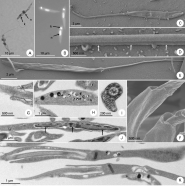
All cells in the culture are promastigotes, most of which are characterized by a prolonged shape (Fig. 1A,C,E,K). The only noticeable heterogeneity is referred to the body length which varied between 7·3 and 15·1 mm (mean±S.D.: 11·6±1·2 mm; n=55). Cells representing the length extremes are shown in Fig. 1E (a more typical elongated promastigote) and Fig. 1C (a shorter form). Cells are somewhat flattened along the entire body length to form a slightly twisted shape with the breadth not exceeding 1·5 μm. The distance between the nucleus and the posterior end ranged from 2·5 to 7·2 μm (4·9±0·8 μm), and that between the nucleus and the kinetoplast ranged from 0·9 to 3·1 μm (2·1±0·5 μm). A relatively short distance between the kinetoplast and the nucleus is apparent in the DAPI-stained cells (Fig. 1B). The promastigotes were equipped with an extended flagellum, the size of which varied between 7·4 and 12·3 μm (9·9±1·2 μm).

Fig. 1(A–K). Light (A,B), scanning (C–F) and transmission (G–K) electron microscopy of Leptomonas costaricensis sp. n. in culture. (A) Giemsa-stained promastigotes with well-visible kinetoplast, nucleus and flagellum. The positions of kinetoplast (k) and nucleus (n) are indicated. (B) DAPI-stained promastigotes with a prominent kinetoplast located close to the nucleus. The positions of kinetoplast (k) and nucleus (n) are indicated. (C) A shorter promastigote cell with a relatively short flagellum. (D) The paraflagellar rod visible along the flagellum as a thin elongated protrusion (arrows). (E) Typical slender promastigote with a long flagellum. (F) Anterior parts of a cell with a prominent flagellum at its exit from the flagellar pocket. (G) Longitudinal section of the flagellum with well-visible parallel filaments of the paraflagellar rod. (H) Part of the cell with acidocalcisomes. (I) Transverse section of a flagellum with a prominent paraflagellar rod. (J) Extremely elongated nucleus (arrows). (K) Longitudinal section of ‘squid-like’ promastigotes revealing a very deep flagellar pocket.
Examination of the cells by high resolution scanning electron microscopy revealed that the flagellum is relatively massive compared to the cell body. At its exit from the flagellar pocket the flagellum is almost as thick as the anterior end of the cell itself (Fig. 1F). The paraflagellar rod is very prominent with an elongated protrusion forming a groove visible almost along the entire length of the flagellum (Fig. 1D and I).
Transmission electron microscopy revealed that the flagellum has typically 9+2 microtubules (Fig. 1I) and that it exits from a deep flagellar pocket (Fig. 1K), and is furnished with a thick paraflagellar rod composed of parallel filaments (Fig. 1G). The kinetoplast is typically disk-shaped with DNA strands arranged in parallel to the transverse axis of the disk (Fig. 1K). The extremely thin morphology of the cells is reflected in the highly elongated shape of their nuclei (Fig. 1J). The promastigotes contain numerous usually electron-dense acidocalcisomes (Fig. 1H) and evenly spaced subpellicular microtubules (data not shown). Endosymbionts were absent.
Phylogenetic position of the new isolate
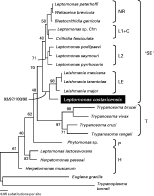
Relationships of the new isolate with the rest of the Trypanosomatidae were investigated by the phylogenetic analysis of the GAPDH and SSU rRNA gene sequences amplified from the axenically grown cells. Fig. 2 shows the best maximum likelihood tree based on GAPDH sequences representing most of the family. The new species is found in close association with the group of Leishmania sequences, and bootstrap support for this association was very high. The same result was obtained using parsimony and minimum evolution (data not shown). The topologies of the respective GAPDH trees were similar to the trees described and discussed by us previously (Yurchenko et al. 2006).

Fig. 2. Glyceraldehyde phosphate dehydrogenase (GAPDH) phylogenetic tree of the Trypanosomatidae. Clade designations are given in accordance with previous studies (Merzlyak et al. 2001; Yurchenko et al. 2006): C – endosymbiont-free Crithidia, H – endosymbiont-free Herpetomonas, L1 – Leptomonas 1, L2 – Leptomonas 2, LE – Leishmania-Endotrypanum, NR – Northern Russia, P – Phytomonas, ‘SE’ – ‘slowly-evolving’, T – trypanosomes. The GAPDH sequences were aligned over the entire length using CLUSTAL-X with gap opening weight=12 and gap extension weight=5. After exclusion of the primers the alignment was 1050 nt long. Maximum likelihood tree was inferred by a heuristic search under the GTR+I+Γ model (proportion of invariable sites was 0·2625, gamma-distribution shape parameter was 0·7971). Ln-likelihood of the tree was −8738·23926. Bootstrap values (100 replicates) shown at most nodes and the first value shown at the L. costaricensis node represent analyses performed using maximum likelihood. The remaining values at the L. costaricensis node were derived by unweighted least squares (the second value), minimal evolution (the third value) and parsimony (the fourth value) analyses (1000 replicates for each).
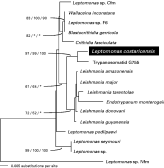
The analysis of the SSU rRNA sequences allowed us to compare the new isolate to a larger number of Leishmania species than the analysis of the GAPDH dataset. We initially performed the analysis using the dataset that included all major phylogenetic clades identified in the Trypanosomatidae (Hollar et al. 1998; Merzlyak et al. 2001). This analysis (data not shown) confirmed that the new isolate is a sister-group to the Leishmania clade. As the terminal clade internal structures are not well resolved by the cross-the-family SSU rRNA analyses, at the next step we analysed the subset of sequences representing the so-called ‘slowly evolving’ clade (Merzlyak et al. 2001) of which the organisms in question are found to be the members. The SSU rRNA tree (Fig. 3) confirmed that the new isolate represents a sister group to the Leishmania-Endotrypanum clade. Interestingly, this group includes the undescribed trypanosomatid species G755 which was also found to be closely related to Leishmania (Noyes et al. 1997).

Fig. 3. Small subunit ribosomal RNA (SSU rRNA) phylogenetic tree of the ‘slowly-evolving’ clade (Merzlyak et al. 2001) of the Trypanosomatidae. After the initial alignment by CLUSTAL, the ambiguously aligned regions were manually selected and removed from the analysis using the interactive alignment editor SEAVIEW. The alignment contained 1954 nucleotides. Maximum likelihood tree was found by a heuristic search under the GTR+I+Γ model (proportion of invariable sites was 0·738193, gamma-distribution shape parameter was 0·568177, estimated via likelihood). Ln-likelihood of the tree was −4153·39053. The tree obtained using the MODELTEST-derived parameters as described in Materials and Methods (with Ln-likelihood=−4156·86436) had the same topology as the shown tree. Bootstrap values represent results of the maximum likelihood (the first value, 100 replicates), minimum evolution (the second value, 1000 replicates) and parsimony (the third value, 1000 replicates) analyses. Asterisks indicate that a particular clade was recovered in less than 50% of cases by the respective analysis.
Leptomonas costaricensis sp. n
Higher order taxonomic summary. Phylum Euglenozoa Cavalier-Smith, 1981; class Kinetoplastea Honigberg, 1963; order Trypanosomatida (Kent, 1880) Hollande, 1952; family Trypanosomatidae Doflein, 1951.
Generic assignment. This was based on the existing taxonomic system of the Trypanosomatidae (Wallace, 1966; Hoare and Wallace, 1966), although a future revision of this status is warranted along with the revision of the genus Leptomonas itself.
Specific diagnosis. Cells are elongated promastigotes, slightly flattened and twisted. The flagellum is relatively thick with a long prominent paraflagellar rod separated from the flagellar proper by a distinct groove. The cell's anterior end is tapered forming a smooth transition between the cell body and the flagellum.
Differential diagnosis. At present there is not enough information to decide whether the morphology alone can distinguish this species from other leptomonads, including the closely related trypanosomatid G755. However, the organism is clearly distinguishable from other known trypanosomatids by the sequences of SSU rRNA, GAPDH and RPOIILS genes and the inferred phylogenetic position.
Type host. Intestine of Ricolla simillima Stål (Heteroptera, Reduviidae).
Type locality. A vicinity of El Ceibo (10 °20′N, 84 °05′W), 10 km South-East of the community La Virgen, Province Heredia, Costa Rica.
Etymology. The new species is named after the country of origin.
Type material. The xenotype (post-dissection remains of the host) is deposited in the UCR Entomology Research Museum (UCRC ENT 130967). The type culture is deposited in the American Type Collection (ATCC PRA-186).
A rooted tree of the Leishmania clade
Previously, partial sequences of the RPOIILS genes were found to be informative phylogenetic markers for resolving relationships among the Leishmania lineages (Croan and Ellis, 1996; Croan et al. 1997; Noyes et al. 2002). We have determined the respective RPOIILS sequences from the new isolate, as well as from several Leishmania species with the previously unknown (L. colombiensis, L. equatorensis) or potentially problematic phylogenetic status (L. enriettii, L. deanei, L. herreri). Initially, the phylogenetic analysis was performed using T. brucei and T. cruzi as outgroups (data not shown). The maximum likelihood tree had the topology: (outgroup taxa, (L. seymouri, (L. costaricensis, (Leishmania spp.)))), although bootstrap support for this topology was low due to the large distance between the outgroup and the ingroup taxa. The support was higher when the trypanosome sequences were omitted and the L. seymouri sequence was used as an outgroup (data not shown). The analysis confirmed that L. costaricensis n. sp. had diverged prior to the radiation within the Leishmania clade, and thus can be used as the closest outgroup for Leishmania.
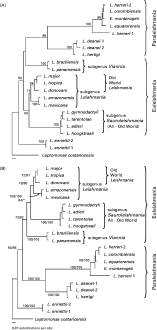
The best maximum likelihood RPOIILS tree rooted with the sequence of L. costaricensis n. sp. is shown in Fig. 4A. The tree is well supported by the bootstrap analysis except for the monophyly of the subgenus L. (Viannia) with the Paraleishmania clade. The best minimum evolution (Fig. 4B) and parsimony (data not shown) trees are congruent with the likelihood tree except that L. (Viannia) was part of the Euleishmania clade. In all cases, however, L. enriettii is the earliest separating branch. Moreover, the Old World species from the subgenera L. (Leishmania) and L. (Sauroleishmania) form a well-supported group which was found to separate early from most Neotropical species, especially with maximum likelihood (Fig. 4A). The notable exception from a clear separation of the Old World and New World species is the L. (L.) mexicana subgroup, as discussed below.

Fig. 4. Large subunit of RNA polymerase II (RPOIILS) phylogenetic trees of the Leishmania/Endotrypanum clade. The partial RPOIILS sequences were unambiguously aligned over the entire length. The alignments were 1266 nt long. The new sequences of L. deanei-2, L. herreri-2 and L. enrietti-2 are labelled as such to distinguish them from the previously determined sequences. (A) Maximum likelihood tree found by a heuristic search under the GTR+Γ model (proportion of invariable sites was 0, gamma-distribution shape parameter was 0·3098). Ln-likelihood of the tree was −5692·86354. Bootstrap analysis was performed using 100 replicates. (B) Minimum evolution distance tree inferred by a heuristic search under the same model. The tree score was 0·86383. Bootstrap values represent results of the minimum evolution (the first value) and parsimony (the second value) analyses, each done with 1000 replicates. An asterisk indicates that a clade was recovered in less than 50% of cases by the respective analysis.
DISCUSSION
The new species reported herein was found in only 1 out of 12 specimens of the reduviid host R. simillima. With the total number of the Heteroptera specimens from Costa Rica analysed so far being close to 400, this remains the only encounter of this species, albeit other trypanosomatids have been observed in R. simillima (D.A.M., unpublished observations). Phylogenetically, the new species is most closely related to the trypanosomatid isolate G755 found in a sandfly in Guatemala (Noyes et al. 1997). Both organisms form a sister clade to Leishmania, a group of dixenous parasites most of which are known (or thought) to be transmitted by sandflies. Thus, it is possible that the infection of R. simillima with L. costaricensis sp. n. might have been a result of the predation of an infected sandfly by the bug. Additional situations when an insectivorous host might have acquired the parasites of its prey were recognized and discussed previously (Carvalho and Deane, 1974; Podlipaev, 2003).
Due to the aforementioned phylogenetic affinity to Leishmania, there is an intriguing possibility that the newly discovered organism along with the isolate G755 may represent a heretofore unknown group of dixenous parasites. However, because dixenous organisms have been extensively studied, it is more likely that the novel clade represents monoxenous parasites. As L. costaricensis sp. n. descended from the recent common ancestor with Leishmania, comparative studies of these two organisms may shed light on the evolutionary transition to dixenous parasitism.
The Neotropics have been proposed as a place of origin of the genus Leishmania based on the tree topology which shows the Neotropical species branching off close to the base of the tree (Noyes et al. 1997; Croan et al. 1997). An additional support for this view may be found in a higher diversity of the Neotropical Leishmania species indicating that this region may represent the centre of origin of this group. According to the alternative views, the genus or at least some subgroups within the genus might have emerged in the Old World (Kerr, 2000; Kerr et al. 2000). The discovery of the Central American clade of monoxenous parasites closely related to Leishmania may be viewed as consistent with the idea that the initial transition to dixenous parasitism occurred in Neotropics. This notion is also supported by the phylogenetic tree which is rooted at the branch of L. enriettii, an ‘enigmatic’ Neotropical species (Lainson, 1997). The subsequent evolutionary scenario would involve the diversification of the ancestral dixenous organisms into the lineages of the New World and Old World parasites at some point. The species of the L. (L.) mexicana group would be reintroduced in the New World more recently.
An attractive hypothesis proposed more recently postulates the Neotropical origin for L. (Viannia) and Paraleishmania on one hand and the African origin of L. (Leishmania) and L. (Sauroleishmania) on the other (Momen and Cupolillo, 2000; Pratlong et al. 2001). This scenario implies an ancient separation of the respective lineages, possibly triggered by the continental split, as was proposed for the separation of the South American and African trypanosomes (Stevens et al. 1999; Stevens and Gibson, 1999). This also implies that the initial transition to dixenous parasitism predated the separation of South America and Africa. By showing a deep split between the Paraleishmania and Euleishmania (except Viannia), the RPOIILS trees presented herein are generally consistent with this scenario. The position of Viannia is resolved differently by the minimum evolution and maximum likelihood analyses, the latter fully supporting the Neotropical origin for this subgenus as proposed by Momen and Cupolillo (2000).
Finding a tree rooted at L. enriettii was unexpected because this species is currently considered a member of the subgenus L. (Leishmania). However, this species is atypical in many aspects and its wild host and vector remain unknown (Thomaz-Soccol et al. 1996; Lainson, 1997). The same applies to Leishmania sp. MAR1, initially presumed to be a monoxenic trypanosomatid (Boisseau-Garsaud et al. 2000; Garin et al. 2001) and subsequently found to branch off together with L. enriettii (Noyes et al. 2002) (D. A. Maslov, unpublished observations). Given the phylogenetic position of these species at the base of the tree, an identification of their natural hosts becomes very important for reconstruction of the initial host of the group.
It becomes increasingly clear that no single gene phylogeny is fully adequate for resolving phylogeny of the Trypanosomatidae or its subgroups (Philippe, 1998; Simpson et al. 2006). The resolution of this problem can be achieved with the aid of a detailed and reliable phylogenetic tree based on a large amount of molecular data, a comprehensive set of taxa and rooted with the closest outgroup possible. The new species described herein is particularly useful for the last purpose (with respect to phylogeny of Leishmania), as illustrated by the analyses presented in this work.
We thank C. Weirauch for the host species identification, H. Noyes and D. A. Campbell for the DNA samples and discussions, J. Longino and the project ALAS staff for assistance with organization of the field work, F. Campos and OTS for help with the permits. This research was supported by UCR Academic Senate and UCR IIGB Core Instrumentation Facility grants to D.A.M. and also in part by grant Z60220518 from the Grant Agency of the Czech Academy of Sciences and grant 6007665801 from the Ministry of Education of the Czech Republic to J.L.