Understanding who benefits from globalization, who is hurt by it, and who remains relatively unaffected is crucial for understanding how globalization shapes distributional conflicts, politics, and policy outcomes in today’s highly integrated economies. Although it is well known that globalization has strong distributional consequences and generates winners and losers, there is no consensus among political economists about exactly how globalization matters for their perceptions of labor market risk and their policy preferences. It remains particularly contested who the winners and losers of globalization are. Most research in political economy relies on one of the two classic trade models which predict clear lines of distributive conflict, either along factor-specific class lines between owners of scarce and abundant factors of production (e.g., Rogowski Reference Rogowski1989), or along sectoral lines between workers in industries with a comparative advantage and those with a comparative disadvantage (e.g., Gourevitch Reference Gourevitch1986), between workers in tradables and non-tradables industries (e.g., Frieden and Rogowski Reference Frieden and Rogowski1996), or between workers exposed to foreign direct investment and those not exposed to such investment (Scheve and Slaughter Reference Scheve and Slaughter2004). Others suggest a synthesis of both models, arguing that the factoral model is likely to dominate when factor mobility is high, and the sectoral model when factor mobility is low (Hiscox Reference Hiscox2002).
Clear conclusions from this research program remain elusive. Many micro-level studies test the implications of the two models simultaneously and frequently find some support for both sectoral and factoral lines of conflict, rather than unambiguous evidence for one type of model (e.g., Hays, Ehrlich and Peinhardt Reference Hays, Ehrlich and Peinhardt2005; Mayda and Rodrik Reference Mayda and Rodrik2005; Rehm Reference Rehm2009). The traditional International Political Economy (IPE) approaches also neglect some critical empirical regularities: although the sectoral model predicts that the effects of international trade vary by industry, empirical firm-level research has revealed substantial intra-industry variation in firms’ export orientation, productivity, and wage levels. More productive firms are more likely to export, and within the same industry, firms that export tend to employ a higher proportion of white-collar workers and to pay their workers higher wages than firms producing only for the domestic market (Bernard and Jensen Reference Bernard and Jensen2004; Bartels Reference Bartels2008, for an overview see Wagner Reference Wagner2007). Likewise, the factoral model cannot explain heterogeneity in wages and unemployment risk among workers with similar skills: for example, workers with similar skills tend to receive higher wages when they work in exporting firms (Munch and Skaksen Reference Munch and Skaksen2008) and employment in low-skilled occupations has shrunk much more strongly in tradable occupations than in non-tradable occupations (Jensen et al. Reference Jensen, Kletzer, Bernstein and Feenstra2005, table 16).
Despite the disagreement on how the distributive effects of globalization can best be identified, most scholars agree that globalization has strong effects on individual labor market risks and policy demands. There exists a large research program on the relationship between globalization and the welfare state, which argues that citizens demand to be compensated for globalization-induced labor market risks by an extension of the welfare state (e.g., Cameron Reference Cameron1978; Katzenstein Reference Katzenstein1985; for individual-level studies, see Scheve and Slaughter Reference Scheve and Slaughter2004; Walter Reference Walter2010; Wren and Rehm Reference Wren and Rehm2013). While this argument has been widely accepted in IPE research, it has been challenged by scholars coming from comparative political economy. These authors argue that globalization is a much less important determinant of labor market risks and policy preferences than deindustrialization and technological change (Iversen and Cusack Reference Iversen and Soskice2000; Pierson Reference Pierson2001; Kim Reference Kim2007; Rehm Reference Rehm2009). But even authors who do not question the importance of globalization per se have called into question whether material self-interest based on the distributional effects of globalization really is an important determinant of individual policy preferences (Hainmueller and Hiscox Reference Hainmueller and Hiscox2006; Mansfield and Mutz Reference Mansfield and Mutz2009).
Adjudicating between the view that the material implications of globalization matter for individuals, and the argument, that it does not, is important, as is determining where exactly the line of conflict runs in distributional conflicts potentially caused by globalization. This is not only because the answers to the questions whether and how globalization matters for the demand-side of politics have significant theoretical ramifications for research in international and comparative political economy, but also because they result in very different policy implications for how policies should be designed. For example, welfare state reforms that occur in response to deindustrialization are likely to look differently than reforms that are implemented to cushion the effects of globalization. “Getting the causal story right” (Iversen and Cusack Reference Iversen and Soskice2000, 316) is therefore essential for an effective design of transfers and other compensatory policies.
This paper aims to advance our understanding of these questions by drawing on new developments in trade theory. In applying the implications of this new class of models to the political science context, I will argue and show empirically that the effects of globalization are more heterogenous than the classic political economy models predict. It is neither sector-specific exposure to globalization nor skills alone that determine how globalization affects individuals’ policy preferences, but the specific combination of both. Highly skilled individuals face lower labor market risks when they are exposed to globalization, while globalization exposure increases labor market risk among low-skilled individuals. Individuals sheltered from globalization constitute an important middle category situated between these “globalization winners” and “globalization losers.”
Employing cross-national survey data from 16 advanced economies, the paper uses this more differentiated conceptualization of globalization winners and losers to assess more accurately both whether globalization matters for individuals, and how exactly this effect plays out in terms of popular policy demand. The results show that exposure to globalization affects both individuals’ perceptions of labor market risk and their social policy preferences, and that this effect is conditional on individual’s skill levels. These effects exist for a variety of sources of international competition, such as trade competition or the possibility that an individual’s job be moved abroad, and can be empirically distinguished from the effects of deindustrialization. While the latter phenomenon is an important driver of policy preferences in its own right, my results falsify claims that the material consequences of globalization have no noticeable effect on individual labor market risks and policy preferences.
Exposure to Globalization, Individual Labor Market Risk, and Policy Preferences
The Individual-Level Effects of Globalization: Insights from Modern Trade Theory
Motivated by the challenge that existing trade models cannot explain many empirical regularities regarding the relationship between globalization and the labor market, a new generation of trade models has emerged (Melitz Reference Melitz2003). These “new new trade theory” models focus on firm heterogeneity and argue that firm productivity is key to understanding the effects of trade liberalization. Because more unproductive firms cannot survive in the face of global competition, they are forced to close down, whereas highly productive firms thrive: not only can they take up part of the domestic market share vacated by the failing unproductive firms, they also increase their revenue by gaining new customers abroad. Firms with intermediate productivity continue to produce for the domestic market only, but their market share and profits decrease in the open economy because they now face import competition from foreign firms. This new generation of trade models thus predicts that rather than uniformly benefit or hurt firms in the same industry, trade liberalization brings significant benefits to some firms and substantially hurts others within the same industry based on firm productivity.Footnote 1
Helpman, Itskhoki and Redding (Reference Helpman, Itskhoki and Redding2008, Reference Helpman, Itskhoki and Redding2010) extend the Melitz model in a way that is of particular relevance for political scientists interested in the distributional effects of globalization. They analyze the consequences of trade liberalization on wage inequality and unemployment by introducing workers with varying levels of “ability” into the framework described above.Footnote 2 These authors argue that more productive firms hire workers with a higher average ability, which is assumed to be positively related to a worker’s productivity. They are more willing to invest in a costly searching and hiring process and consequently employ, on average, workers with above-average ability. Because such high-ability workers are more difficult to replace, however, they have an advantage in the wage bargaining process, so that more productive firms have to pay higher wages.
When the economy opens up to international trade, the least productive firms leave the industry and the most productive firms begin to sell their products both abroad and at home (as in the Melitz model). The most productive firms therefore receive higher revenues generated by trade, which they partly redistribute to their high-ability workforce. Workers in less productive firms in the same industry, with lower average ability levels, fare less well: their employers face stronger competition, a lower market share and lower revenues, which confronts these workers with both lower wages and a higher risk of unemployment. These labor market risks are particularly high for “low-ability” workers who do not fulfill the hiring requirements of the productive firms, and therefore cannot find employment in productive firms. The authors show that despite overall gains from trade, the distribution of wages in an internationally exposed industry is more unequal and the risk of unemployment is higher in an open economy than in autarky. This effect of trade liberalization is particularly pronounced in sectors in which only a small fraction of firms has been exporting so far.Footnote 3
The Helpman–Itskhoki–Redding model makes clear predictions about the distributional effects of trade liberalization on individual workers employed in tradables industries. Compared with autarky, international trade benefits high-ability workers employed in highly productive, export-oriented firms because they receive higher wages and their risk of job loss is low. In contrast, for tradable industry workers with lower levels of ability, trade liberalization implies stagnating or decreasing wages and a higher risk of unemployment.
But not all employees work in tradable industries. On the contrary, even in very open economies, important within-country variation exists in the level of exposure to international markets of various industries and occupations, and many individuals work in industries and professions that produce non-tradable goods and services. The professional life of these individuals is relatively sheltered from global competition: doctors, teachers, hairdressers, and bus drivers are much less affected by globalization than their counterparts in exposed industries and occupations.Footnote 4 Although the Helpman–Itskhoki–Redding model does not explicitly address the differences between workers in tradable industries and non-tradable industries, its features can be used to examine this issue. In the model, the fraction of firms that exports in each sector depends, inter alia, on the level of exporting cutoff productivity, i.e. the minimum productivity level of a firm required to make serving export markets profitable. When the fixed and variable costs of exporting are very high, only very few, or even no, firms export. Such a situation characterizes those industries well in which firms produce products or services that are very costly to trade. Even in countries that are formally open to international trade, industries exist in which no firms trade: together, they constitute the non-tradable sector. Because firms in this sector serve the domestic market only, it appears reasonable to apply the model’s insights for the case of autarky for workers employed in the non-tradables sector, especially as I am particularly interested in the differences between workers exposed to and sheltered from global competition. If one conceptualizes the non-tradables sector as a case of autarky, the Helpman et al. model suggests that wage inequality and the risk of unemployment should be lower in the non-tradables sector than in the tradables sector.
The impact of globalization on the individual thus depends on whether an individual is employed in the tradable or non-tradable sector or, more generally, whether the individual is exposed to international competition or not.Footnote 5 But whether an individual benefits from this or not depends, second, on her ability, proxied in this article by her skill level. Much research has shown that individual productivity is a function of education or skills (for an overview see Jones Reference Jones2001). Because ability and productivity are not directly observable, I distinguish between high-skilled individuals (as a proxy for high-ability workers) and low-skilled individuals (as a proxy for low-ability workers).
On the basis of this discussion, I distinguish three ideal-type categories of workers. The first category is that of “globalization winners.” Because exporting firms place a higher premium on high worker ability, highly skilled workers in the tradable industry (such as engineers or business consultants) tend to work for productive and internationally successful firms, have more bargaining power, and therefore hold well-paying and relatively secure jobs.Footnote 6 In contrast, low-skilled individuals who work in a tradable industry (such as assembly line workers) are most at risk of losing their job and receiving low wages, because they are most likely to work in firms challenged by international competition. We can therefore classify such individuals as “globalization losers.” This classification appears intuitive: consider, as an example, the textile industry in an advanced economy. Workers in textile firms with low skills (such as seamstresses) have been hurt from international trade competition, while high-quality fashion designers working in the same industry have benefited from access to global markets. A third category of workers are those sheltered from international competition. The model implies that for these workers, differences in labor market risks between high- and low-skilled workers should be less pronounced: on average, high-skilled workers in non-exposed industries (such as doctors or teachers) should receive lower wages than those working in firms exposed to international competition. At the same time, low-skilled workers in non-tradable industries (e.g., cleaning personnel) should receive higher wages and enjoy a lower unemployment risk than their counterparts in more exposed firms.
How Globalization Affects Individual Perceptions of Labor Market Risk and Policy Demands
Past research has shown that individuals’ “objective” exposure to labor market risks typically translates into subjective perceptions of personal economic insecurity and risk (Scheve and Slaughter Reference Scheve and Slaughter2004; Anderson and Pontusson Reference Anderson and Pontusson2007; Rehm Reference Rehm2009; Walter Reference Walter2010). Whereas existing studies on the individual-level effects of globalization exposure have assumed a uniform effect of such exposure across all individuals, the argument developed here predicts that this effect is in fact conditional on an individual’s skill level. The heterogenous distributional effects of globalization should translate into differentiated perceptions of individual labor market risk, i.e. the risk of receiving low wages and the risk of becoming unemployed. Globalization winners—high-skilled individuals exposed to the global economy—should feel least at risk and globalization losers—low-skilled individuals exposed to globalization, should feel most at risk. All individuals sheltered from international competition should perceive labor market risks at a level situated somewhere between these two extremes. As a result, in terms of labor market risk the globalization of production is positive for some, negative for others, and rather inconsequential for a third group individuals.
Understanding individual perceptions of labor market risk matters, because such perceptions are typically closely linked to preferences on policies with a particular salience for labor market participants.Footnote 7 Many studies show that individuals with high “objective” levels of risk exposure, for example in terms of the person’s sector of employment or level of skill specificity, are generally more likely to express a preference for policies that lower such risk exposure, such as an expansion of social insurance or redistribution (Svallfors Reference Svallfors1997; Iversen and Soskice Reference Iversen and Cusack2001). Likewise, many studies have found that individuals who are disadvantaged by international trade tend to prefer protectionist policies (e.g., Scheve and Slaughter Reference Scheve and Stasavage2001; Hays, Ehrlich and Peinhardt Reference Hays, Ehrlich and Peinhardt2005; Mayda and Rodrik Reference Mayda and Rodrik2005).
In line with this reasoning, the argument suggests that the effect of globalization exposure on individuals’ policy preferences should be conditional on their skill level. Low-skilled individuals should favor social and/or economic protection, and this support should increase when these individuals are exposed to globalization. The reverse holds for highly skilled individuals, who should have a stronger preference for welfare state retrenchment and economic liberalization when they are exposed to global competition. They benefit from globalization and therefore need to rely less on public social protection. In addition, welfare state expansion typically implies higher taxes and a less-competitive economic environment, which should lead the winners of globalization to oppose such policies (Wren and Rehm Reference Wren and Rehm2013). Importantly, individuals sheltered from foreign competition should have more moderate policy preferences than their exposed counterparts, with low-skilled individuals demanding somewhat more protection than high-skilled individuals.
Empirical Implications and Alternative Explanations
Does this new conceptualization of winners and losers of globalization improve our understanding of the distributional conflict surrounding globalization when compared with the traditional sectoral and factoral trade models? And can it challenge the argument that globalization-related material interests are irrelevant as determinants of labor market risks and related policy preferences?
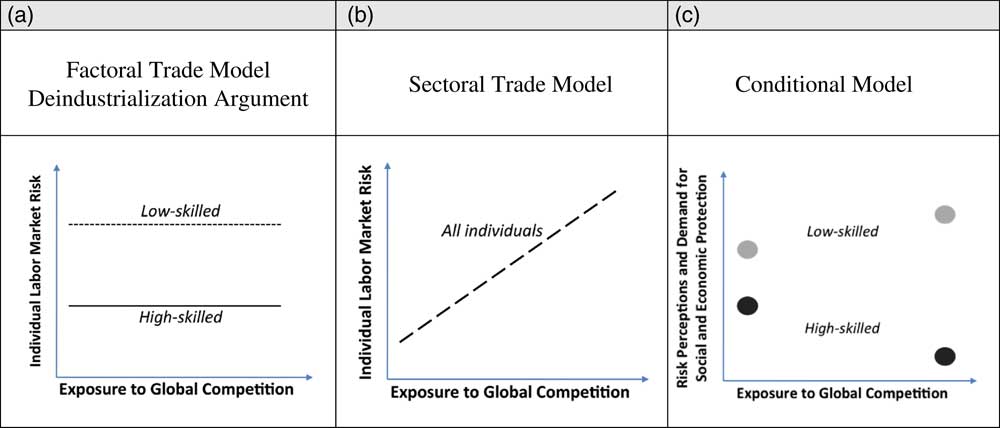
Figure 1 shows that the empirical implications of the traditional trade models differ from those of the model introduced in this article. Factoral (Stolper–Samuelson) trade models predict that in advanced economies, international trade benefits high-skilled individuals and hurts those with low levels of skills (Findlay and Kierzkowski Reference Findlay and Kierzkowski1983). Consequently, high-skilled individuals are expected to experience lower levels of labor market risk than low-skilled individuals and to form their policy preferences accordingly (e.g., Scheve and Slaughter Reference Scheve and Stasavage2001). This effect is unaffected by individuals’ exposure to the global economy (see Figure 1(a)).
Empirical implications of competing arguments
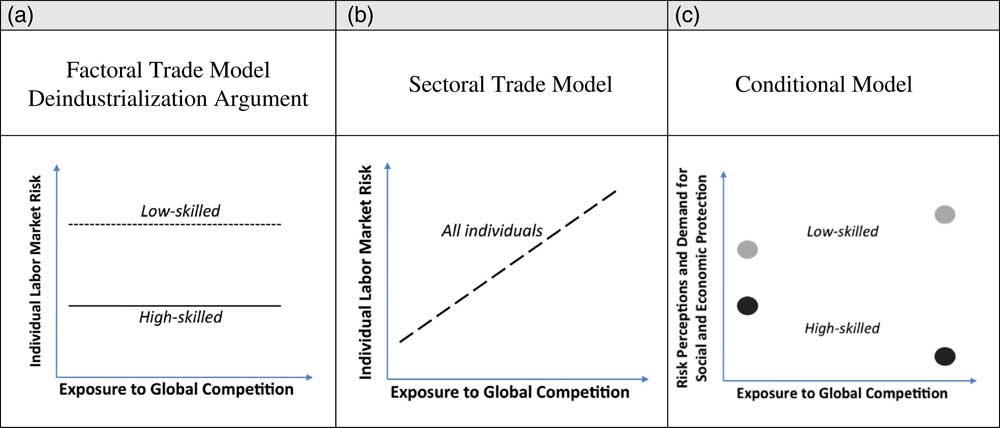
In the classic sectoral (Ricardo–Viner) model, individuals employed in export-oriented industries face much lower globalization-related labor market risks than individuals working in import-competing industries, whereas individuals working in the non-tradables sector can be found in between these two extremes. A second variant of the sectoral trade model suggests that the main divide is between exposure to and protection from global competition in general, so that all exposed individuals face much higher labor market risks—and consequently also demand policies that reduce these risks—than individuals not exposed to globalization (this variant is frequently used in individual-level analyses). This latter variant of the sectoral model predicts differences between individuals based on their exposure to the global economy, but does not predict any differences based on individuals’ skills (see Figure 1(b)).
In contrast, the argument introduced here predicts that there should be systematic differences not only between individuals with different levels of skills, but also within these groups, and that these differences should be systematically related to individuals’ exposure to the international economy. Specifically, the gap between high- and low-skilled individuals should widen as individuals become exposed to globalization. Figure 1(c) illustrates this prediction: low-skilled individuals always experience higher labor market risks and consequently prefer policies that reduce these risks than high-skilled individuals, but this difference between individuals with high and low levels of qualification becomes much more pronounced when workers are exposed to globalization.
The notion that globalization matters for the demand-side of politics has fundamentally been challenged by the argument that deindustrialization and technological change have much more pervasive effects on individual labor market risks than globalization and therefore are the main drivers of individual labor market risks and related policy preferences (Iversen and Cusack Reference Iversen and Soskice2000; Pierson Reference Pierson2001; Rehm Reference Rehm2009). Most research so far has not been very successful in testing this argument at the individual level, because it has been difficult to empirically distinguish the effects of globalization from those of deindustrialization: both processes benefit high-skilled workers and create labor market risks for low-skilled ones. As in the factoral trade models, deindustrialization and skill-biased technological change benefit these workers through the change toward service-oriented and skill-intensive industries that require more complex skills than some 40 years ago (e.g., Spitz-Oener Reference Spitz-Oener2006).
An observationally equivalent prediction emerges with regard to the effect of education on trade policy preferences, because education affects economic ideas and sociotropic concerns in ways that mimic the material interests of high- and low-skilled workers in the factoral model (Hainmueller and Hiscox Reference Hainmueller and Hiscox2006; Mansfield and Mutz Reference Mansfield and Mutz2009). The empirical implications of these arguments are thus observationally equivalent to the factoral model of international trade (Figure 1(a)): well-educated individuals benefit from globalization, have better chances on a deindustrialized labor market, and have more liberal policy preferences for non-economic reasons, and this relationship should be unaffected by individuals’ exposure to globalization.
The argument about the conditional effect of globalization can help us resolve these controversies. By conceptualizing the individual-level impact of globalization as a conditional effect, it predicts that there should be systematic differences not only between individuals with different levels of skills, but also within these groups, and that these differences should be systematically related to individuals’ exposure to the international economy. Specifically, the gap between high- and low-skilled individuals should be larger when an individual is exposed to global competition (Figure 1(c)). These predictions differ both from those of the traditional trade models, the deindustrialization argument, and the non-economic education argument. As such, my approach allows us to shed some more light on the question of whether and how exposure to the global economy affects the demand-side of politics.Footnote 8
Data and Method
To test the empirical implications of my argument, I use survey data from two consecutive waves (2002 and 2004) of the European Social Survey (ESS) for 16 West European countries to examine the determinants of individuals’ perceptions of labor market risk and policy preferences.Footnote 9 ESS is the only cross-national survey that simultaneously contains detailed information on individuals’ degree of exposure to the international economy, labor market risk perceptions and policy preferences. I focus on these first two waves, because suitable and comparable questions for labor market risk were only asked in these two survey waves.Footnote 10 To focus on a homogenous set of countries with similar factor endowments, all countries included in the sample are advanced industrialized and open economies. I restrict the sample to those individuals with paid work or actively looking for a job, because the theoretical argument applies to active labor market participants.Footnote 11
Operationalization
Dependent variables: labor market risk perceptions and policy preferences
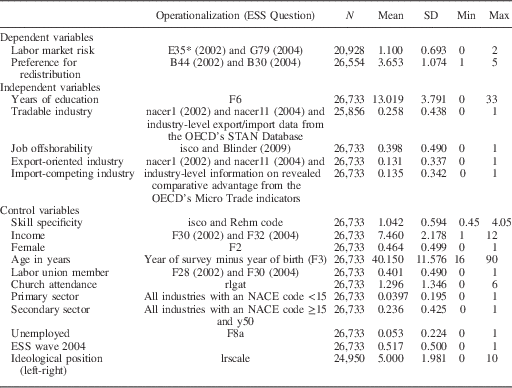
The purpose of the analysis is to examine how globalization affects individual perceptions of labor market risks and individual preferences regarding policies mitigating these risks, such as social protection. Two types of labor market risk are particularly important: wage inequality and unemployment risk. To operationalize individual perceptions of these risks, I follow previous research (Anderson and Pontusson Reference Anderson and Pontusson2007) and use a question that captures individuals’ assessment of their own marketability on-the-job market. Respondents were asked to rate their reaction to the question “How difficult or easy would it be for you to get a similar or better job with another employer if you wanted to?” on a scale from 0 “extremely easy” to 10 “extremely difficult.” I have recoded this variable into an ordinal variable with three categories, because the Brant test suggested that the parallel slopes assumption was violated in analyses using the ten-category variable.Footnote 12 Rather than focusing on one specific aspect of labor market risk, this question gauges both the ease of moving to a different employer (which arguably strongly reduces the risk of unemployment) and the ease of obtaining an equally or better paying job (which gets at the wage issue).
Because trade is almost completely liberalized within the EU and because external trade policy lies within the competencies of the European Commission rather than national governments, trade policy tends to be a low-salience issue in domestic European politics.Footnote 13 This effectively removes the option of trade protectionism for European voters, so that individuals will likely focus on policies that shelter them from the risks associated with global competition instead, especially given that most European states have sizeable welfare states. Rather than focusing on preferences for economic (especially trade) protection, I therefore focus on preferences for social protection. I use the answers to the statement “The government should take measures to reduce differences in income levels,” which are measured on a five-point scale with higher values denoting stronger agreement with this statement.Footnote 14 Reducing income inequality through government-mandated redistributive policies is a central issue in welfare politics, which is why responses to this question are frequently used to operationalize respondents’ preferences for redistribution (e.g., Svallfors Reference Svallfors1997; Wren and Rehm Reference Wren and Rehm2013). Moreover, it allows me to reexamine the results of a micro-level study which has argued that exposure to international competition has no statistically significant effect on redistributive policy preferences (Rehm Reference Rehm2009).
Independent variables: skills, exposure, and the heterogenous effects of globalization
As suggested by Figure 1, the classic trade models, the deindustrialization, and model proposed in this paper make different predictions about how globalization and skill levels influence perceived labor market risk and demand for social protection. Because my argument suggests a conditional effect of skill (Figure 1(c)), my analyses contain three independent variables: one measuring individual skill levels, a second measuring individual exposure to globalization, and third, an interaction term capturing the conditional effect of globalization exposure based on individuals’ skill level.
Skill level
Focusing on respondents’ educational background, I use the number of years during which a respondent has been educated.Footnote 15 Of course, individuals can have skills acquired through on-the-job training, and individuals with low levels of education can deliver high-quality work. Empirical research has shown, however, that higher educational achievement is positively related to higher occupational skills and higher levels of productivity (Jones Reference Jones2001; Spitz-Oener Reference Spitz-Oener2006). Years of Education therefore serves as a proxy for individuals’ skill levels.
Exposure to globalization
Individuals’ exposure to globalization is measured in three different ways. The first measure is a dummy variable that distinguishes between workers employed in the tradables sector and those working in the non-tradables sector based on information on respondents’ industry of employment. This information is matched with data from the Organization for Economic Co-Operation and Development (OECD)’s Structural Analysis (STAN) Database, which lists each industry’s volume of exports and imports for each country and year (for similar coding procedures see Mayda and Rodrik Reference Mayda and Rodrik2005; Rehm Reference Rehm2009). The variable is coded as 1 (tradables sector) if the individual works in an industry, which exports or imports any goods, and 0, if he or she works in a sector or industry that does not engage in international trade.Footnote 16
The second measure for globalization exposure builds on two insights: first, IPE research has shown that other dimensions of the globalization of production, such as foreign direct investment and the option to move production abroad, are as important for individuals as international trade (Scheve and Slaughter Reference Scheve and Slaughter2004; Walter Reference Walter2010; Margalit Reference Margalit2011). Second, research in comparative political economy has argued that individual risk perceptions and social policy preferences are shaped much more by occupational labor market risks than sector-specific risks, because it is typically more difficult for individuals to change their occupation than to change their industry of employment (Iversen and Soskice Reference Iversen and Cusack2001; Rehm Reference Rehm2009). Occupations differ with regard to the degree to which jobs in a given occupation can be substituted by jobs abroad, or offshored. Individuals with jobs that can easily be offshored—such as seamstresses or IT programmers—are much more exposed to international competition than individuals whose jobs cannot be substituted with jobs abroad, such as janitors or doctors. Non-offshorable professions are occupations in which a physical presence is required.
To measure respondents’ occupational job offshorability, I match information about respondents’ occupation contained in the ESS with information from an “offshorability index” (Blinder Reference Blinder2009). This ordinal index measures a job’s potential to be moved abroad, i.e. whether the service the job provides can theoretically be delivered over long distances with little or no degradation in quality for more than 800 occupational categories. Occupations are classified using the US Labor Department’s Standard Occupational Classification (SOC) and were adapted for the corresponding International SOC (ISCO) codes available in the ESS.Footnote 17 The index ranks each occupation’s offshorability potential on an ordinal four-point scale according to the following criteria: if workers are required to be at a specific work location in their country in order to perform their task, they are considered to have a highly non-offshorable occupation (category 1). If a worker does not have to be physically close to his or her work unit, the occupation is categorized as highly offshorable (category 4). The remaining occupations are classified as somewhat offshorable if the entire work unit has to be in the same country (category 2), and as offshorable (category 3) otherwise. I recode this variable into a binary variable that codes anyone with a potentially offshorable job into the “offshorable” category.Footnote 18
Finally, the third measure for globalization exposure differentiates between export-oriented and import-competing industries. Based on revealed comparative advantage data reported in the OECD’s Micro Trade indicators, industries with a revealed comparative advantage are coded as export-oriented and those with a revealed comparative disadvantage as import-competing. Non-tradable industries constitute the base category in these analyses. I use this operationalization in an effort to test the implications of the classic sectoral Ricardo–Viner model, which suggests that labor market risk and demand for redistribution should be highest in import-competing and lowest in export-oriented industries.
Interaction term: skills×exposure
Finally, I include an interaction term between education years and each of the three globalization exposure measures.Footnote 19 Both the factoral and sectoral trade models and the deindustrialization argument predict that the interaction term should be statistically insignificant—skills or exposure operate on their own, but their effects are not conditional on each other. In contrast, my argument predicts that the gap between high- and low-skilled individuals should be larger among individuals exposed to globalization (Figure 1(c)). This suggests that the variables on education and the interaction term should be negative and statistically significant. In contrast, the coefficient on globalization exposure should be positive and statistically significant, indicating that individuals with no education are particularly threatened by globalization.
Control variables
I include a number of variables that control for alternative explanations for variation in labor market risk perceptions and social policy preferences at the individual level. First, to account for the effects of deindustrialization, I control for employment in the primary and secondary sector, respectively, leaving individuals employed in the tertiary sector as baseline. As deindustrialization should benefit individuals in the latter category, I expect both dummy variables to carry negative coefficients. Second, income has long been recognized as one of the main determinants of risk perceptions and redistributive preferences. Individuals with high incomes have much to lose when they become unemployed (e.g., Varian Reference Varian1980) but also pay for redistributive policies (Meltzer and Richard Reference Meltzer and Richard1981). It is measured on an ordinal 12-point scale.Footnote 20 A third control variable is skill specificity, which captures how difficult it will be for an individual to find an equivalent substitute for her job and has been shown to influence social policy preferences (Iversen and Soskice Reference Iversen and Cusack2001). The measure is based on information on individuals’ occupational classification and labor force data on the occupational distribution of employment.Footnote 21 Because previous studies have found that men and women, older and younger individuals, labor union members and non-members, the unemployed and those not actively looking for a job and religious and not-religious people differ systematically with regard to their feelings of economic insecurity and social policy preferences (e.g., Iversen and Soskice Reference Iversen and Cusack2001; Scheve and Stasavage Reference Scheve and Slaughter2006; Anderson and Pontusson Reference Anderson and Pontusson2007), I additionally control for these variables. I also control for the respective survey waves.Footnote 22 Table A1 in the Appendix provides further information and the descriptive statistics for all variables used in the study.
Method
I use ordered logit models, include country dummies to account for the fact that respondents from the same country share a common context, and additionally cluster the standard errors on the country level to address the related problem of within-country correlation of errors.Footnote 23 The data are weighted by the product of the design and the population size weights.
Results
Does globalization affect individuals’ perceptions of labor market risk and policy preferences? The results presented in this section indicate that individuals exposed to various types of globalization vary in their labor market risk perceptions and policy preferences in the way predicted by my argument. High-skilled “globalization winners” feel less at risk and want less redistribution than low-skilled “globalization losers” whereas sheltered individuals find themselves between these extremes.
The Effect of Globalization Exposure on Individual Perceptions of Labor Market Risk
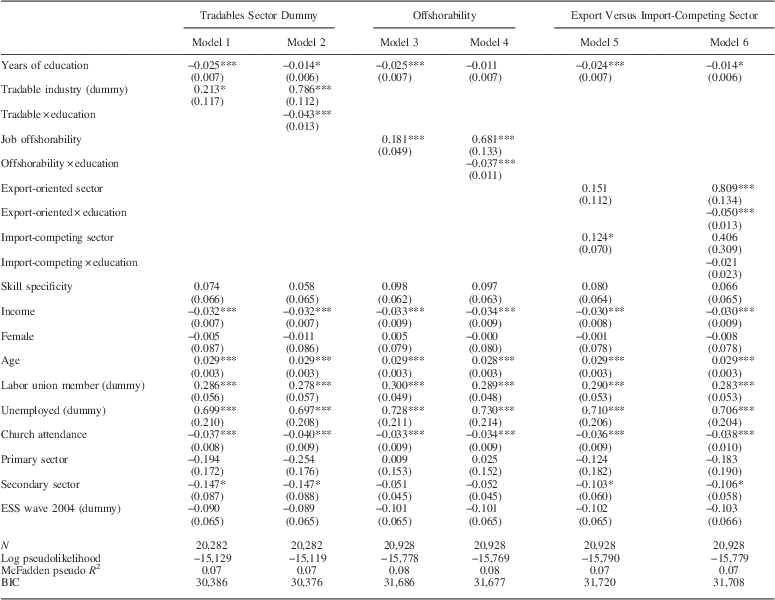
Because individual perceptions of labor market risks are key to understanding individuals’ policy preferences in a number of policy fields, the first set of analyses focuses on the question if and how globalization affects perceptions of individual labor market risks, measured as the perceived potential difficulty of finding an adequate alternative job. Models 1–6 in Table 1 estimate the probability that a respondent thinks that finding an adequate alternative job would be difficult. The first two columns use the tradables industry dummy to operationalize exposure to globalization, models 3 and 4 employ the occupation-specific offshorability dummy, and the last two columns distinguish between export-oriented and import-competing industries.
Determinants of Labor Market Risk Perceptions (Ordered Logit Analyses)

Note: Robust standard errors in parentheses, clustered on country. Cutoff points and estimates for country dummies are not reported.
ESS=European Social Survey; BIC=Bayesian information criterion.
*p≤0.1, **p≤0.05, ***p≤0.01.
For all specifications, the results for the control variables are in line with the results of other individual-level studies on the determinants of economic insecurity (Scheve and Slaughter Reference Scheve and Slaughter2004; Anderson and Pontusson Reference Anderson and Pontusson2007; Walter Reference Walter2010). Respondents with low incomes, older respondents, trade union members, the unemployed, as well women are more likely to perceive higher levels of labor market risk. Somewhat surprisingly, the variables measuring employment in the primary or the industrial sector and skill specificity are not statistically significant.
The models 1 and 3 represent the factoral trade model and the deindustrialization model, which expect that respondents’ skill endowments should unconditionally affect individual risk perceptions. The results of these analyses suggest that education significantly decreases respondents’ perceptions of labor market risk. As in many previous studies, the effect of skills dominates the effect of globalization exposure, a finding which has raised doubts about the importance of globalization as a determinant of labor market risks (e.g., Rehm Reference Rehm2009). Model 5 represents the prediction of the sectoral model that workers in export-oriented industries should be better off than those in import-competing industries. Contrary to this expectation, Table 1 shows that the coefficients for both industry dummies always go in the same (positive) direction and are not statistically significant—whether individuals work in an export-oriented, import-competing, or sheltered sector does not seem to make a big difference for their perceptions of labor market risk.
This picture changes significantly when the conditional effect of globalization exposure is properly modeled with an interaction term between education and globalization exposure (models 2, 4, and 6). As predicted by my argument, all interaction terms are negative and, with the exception of the import-competing sector interaction, statistically significant. Among low-skilled individuals, exposure to globalization significantly raises labor market risk perceptions both in substantial and statistical terms. In contrast, it has barely any or a negative effect on high-skilled individuals’ labor market risk perceptions. Model 6 additionally shows that this heterogenous effect can also be observed within both export-oriented and import-competing industries. Those working in export-oriented industries are not always better off, and those working in import-competing industries are not always worse off than those in sheltered sectors, as the sectoral model would suggest. Instead, low-skilled individuals working in the export-oriented sector feel particularly constrained on the labor market, possibly because competition in these highly productive sectors is very intense. This finding also runs counter to the expectations that can be derived from Hiscox’s (Reference Hiscox2002) argument that the prevalence of the factoral and sectoral model can change over time. For transition periods with less than perfect factor (im)mobility, this argument would suggest that high-skilled individuals in the export-oriented sector are best off, while low-skilled individuals in the import-competing sector are worst off. While my analysis does find that high-skilled workers in export-oriented sectors report the lowest level of labor market risk, it contradicts these expectations among the low-skilled workers, where those working in export-oriented sectors feel most and those working in sheltered sectors feel least vulnerable.Footnote 24
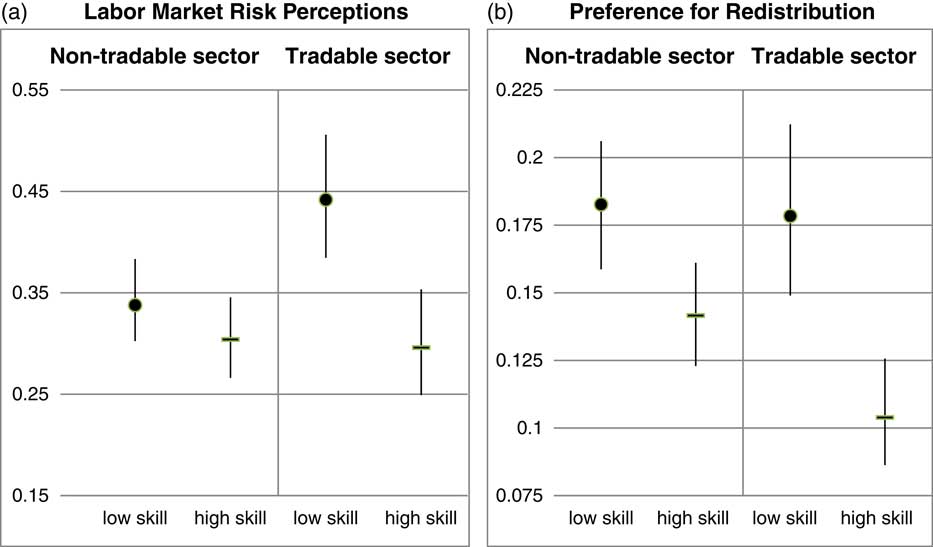
To facilitate the interpretation of the results, Figure 2(a) plots the predicted probabilities that a respondent expresses strong difficulties to find a similar or better job and the corresponding confidence intervals (model 2). The figure compares respondents who have only completed some schooling (eight years) with well-educated respondents with 19 years of education in sheltered (non-tradable) and exposed (tradable) industries, who otherwise share the same characteristics.Footnote 25 The figures highlight two key results: first, in line with much existing research, less-educated individuals always feel more insecure than better-educated individuals. Second, the gap in risk perceptions between low- and high-skilled individuals is much smaller among respondents working in sheltered sectors than among those exposed to the global economy. In the non-tradables sector, the difference in labor market risk perceptions between high- and low-skilled respondents is not statistically significant and only amounts to 3.4 percentage points. In contrast, this difference is 14.6 percentage points among individuals working in the tradables sector, a statistically significant difference.Footnote 26 Almost every second globalization loser experiences high levels of labor market risk, compared with not even every third globalization winner.
Predicted probabilities that respondent experiences job insecurity (a) Labor market risk perceptions. Predicted probability that respondent reports a high level of labor market risk (category 3) and 95 percent confidence interval (b) Preference for redistribution. Predicted probability that respondent strongly agrees with the statement that government should reduce differences in income levels (category 5) and 95 percent confidence interval Note: the predicted probabilities are calculated for the “median respondent,” i.e. an employed 40-year-old man with an average net monthly income between €2000 and €2500 and a skill specificity value of 0.81, who works in the tertiary sector, is neither a labor union member nor unemployed, and rarely attends church.
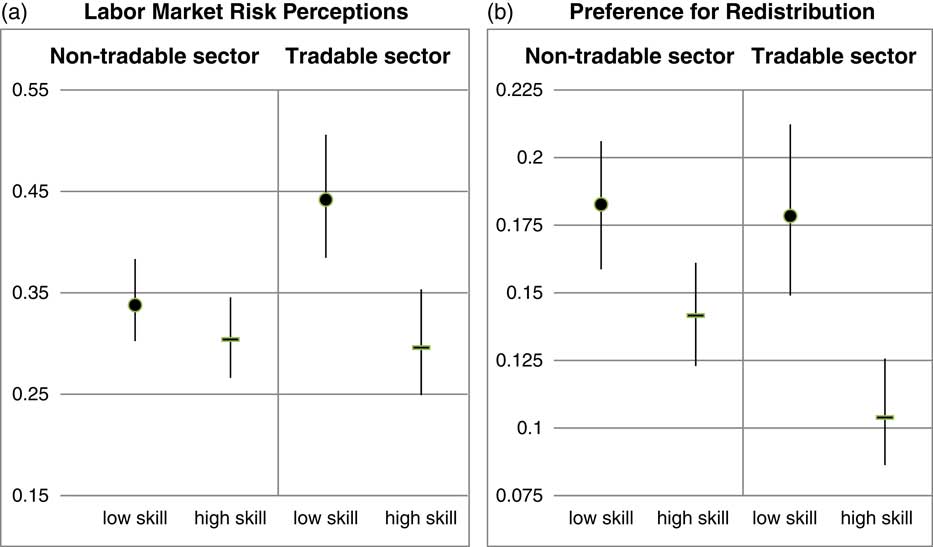
These results provide strong support for the argument that international exposure has differentiated effects and creates winners and losers.Footnote 27 The results suggest that exposure to globalization has a significant effect on perceptions of labor market risk, but that the strength and direction of this effect systematically varies with a respondent’s level of education.
The Effect of Globalization Exposure on Social Policy Preferences
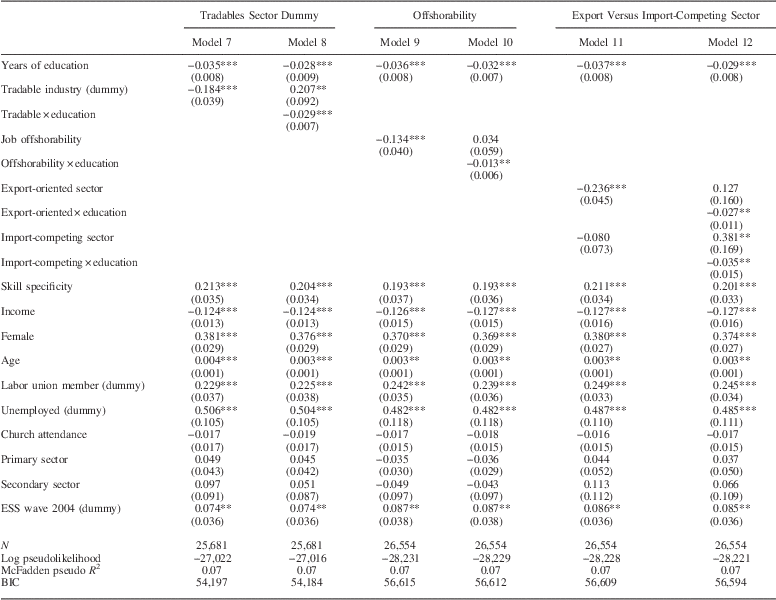
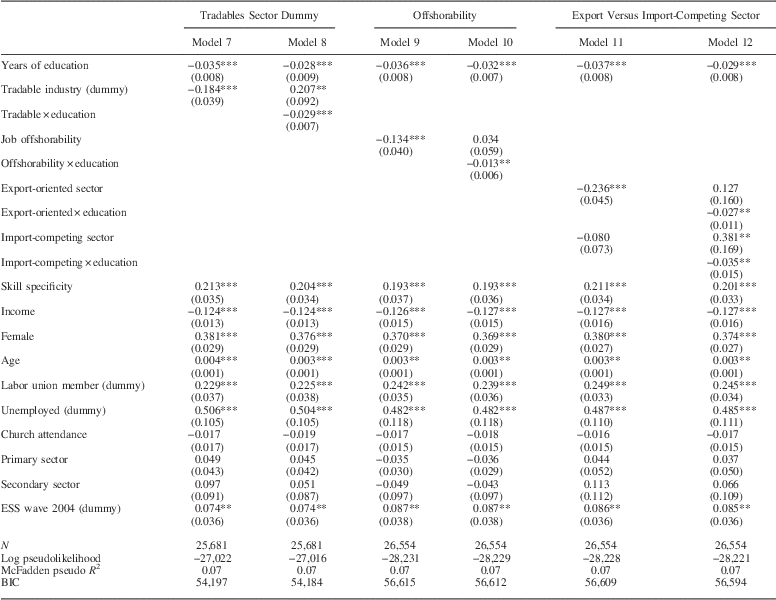
Do these differences in labor market risk perceptions translate into individuals’ preferences on policies that have the potential to mitigate or reduce these risks? Table 2 examines how exposure to globalization affects respondents’ preferences regarding government-mandated income redistribution, an important aspect of social policy.
Determinants of Preferences for Income Redistribution (Ordered Logit Analyses)
Note: robust standard errors in parentheses, clustered on country. Cutoff points and estimates for country dummies are not reported.
ESS=European Social Survey; BIC=Bayesian information criteria.
*p≤0.1, **p≤0.05, ***p≤0.01.
As before, I begin with three unconditional models (models 7, 9, 11).Footnote 28 The control variables once more largely conform to the results of other studies on determinants on social policy and redistributive preferences. Individuals with more specific skills, poorer respondents, women, union members, and the unemployed are significantly more likely to favor redistribution. As predicted by the deindustrialization argument and the factoral model, more educated respondents are less likely to support income redistribution, although surprisingly, the sector of employment is not associated with higher or lower preferences for redistribution. In contrast to the predictions of the compensation argument, which holds that individuals who are more exposed to international competition will demand an expansion of the welfare state, however, the coefficients for the variables measuring exposure to globalization are negative and statistically significant. The unconditional models thus suggest that individuals in tradables industries want less, rather than more redistribution. This is in line with previous research (Rehm Reference Rehm2009), but raises doubts about the role of globalization for social policy.
As predicted by my argument, however, this negative effect disappears once the effect of globalization on redistribution preferences is allowed to be mediated by education (models 8, 10, 12): it now turns positive for uneducated individuals and negative for well-educated individuals.Footnote 29 The gap in redistribution preferences between low- and high-skilled individuals thus increases when individuals are exposed to global competition. For example, Figure 2(b) shows that the gap in redistribution preferences between low- and high-skilled individuals is almost twice as large in the tradables sector (7.5 percentage points) than in the non-tradables sector (4.1 percentage points).Footnote 30 These results clearly contrast with the predictions of the unconditional model. For example, model 7 predicts that low-skilled individuals in tradables industries are less favorable toward redistribution (16.1 percent) than individuals in the non-tradables sector (18.8 percent), and that the preference gap between high- and low-skilled individuals is larger in (though not statistically different from) the non-tradables sector.
In contrast to the findings on labor market risk perceptions, however, the effect of globalization exposure now is stronger for well-educated individuals. For all individuals with 11 years of education or more, any type of exposure to globalization reduces their preference for government-led income redistribution at statistically significant levels, showing that these globalization winners are least supportive of income redistribution. Given that globalization losers were found to report the highest levels of perceived labor market risks, it is surprising that globalization exposure increases low-skilled individuals’ demand for more income redistribution only slightly. Yet, this finding is in line with Wren and Rehm’s (Reference Wren and Rehm2013) argument that the taxation necessary to finance the welfare state reduces competitiveness and therefore depresses the support for welfare state spending among workers in exposed sectors. This line of reasoning suggests that low-skilled individuals might feel squeezed between the need to preserve their jobs in an internationally competitive economic environment, which is likely to dampen their support for a large welfare state, and their personal perception of individual labor market risks, which is likely to increase this support. As predicted by their argument, opposition to welfare spending is particularly pronounced among high-skilled individuals exposed to globalization.
These findings corroborate the argument that low-skilled individuals react very differently to international competition than high-skilled individuals. Studies that do not take the interactive effect between education and exposure into account will therefore draw wrong inferences about the effect of globalization on risk perceptions and welfare state preferences.
Robustness
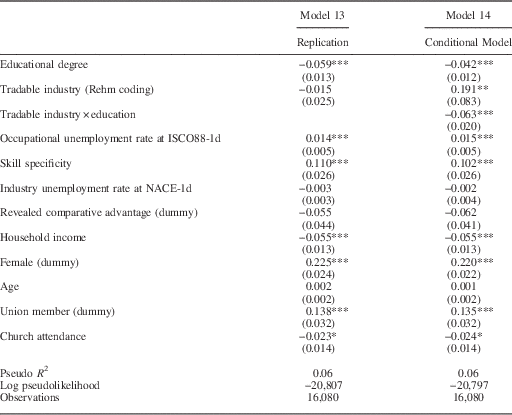
The analysis shows that exposure to globalization has a significant but heterogenous effect on risk perceptions and policy preferences, which varies with individuals’ skill level. These results are remarkably robust to a variety of modifications, such as using multi-level specifications, reestimating all models without country dummies, using education levels rather than education years as a proxy for skills, restricting the sample to respondents in the active workforce, employing a wider definition of unemployment (whether a person has ever been unemployed for more than three months), and controlling for respondents’ labor market status (such as whether they are in paid employment, disabled, a houseperson, or studying). The results are also robust to controlling for employment in the public sector (defined as individuals working in the public administration, defence, education, social work, or health), which is emphasized by some variants of the compensation hypothesis. Importantly, the results also hold when I include the relevant interaction term in the regression model on the basis of which Rehm (Reference Rehm2009) argues that free trade does not influence individuals’ preferences for redistribution (see Table 3). As suggested by my argument, low-skilled individuals in the tradables sector are in fact significantly more likely to support redistribution, while high-skilled individuals are increasingly less supportive when this interaction is adequately modeled.
Replication of Rehm (Reference Rehm2009) analysis
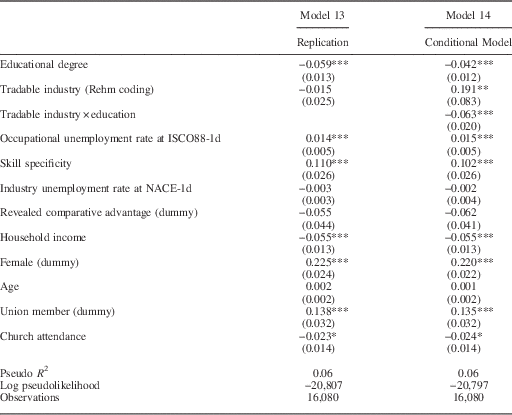
Note: Robust standard errors in parentheses, clustered on country. The non-tradable industry dummy used in Rehm’s analysis is recoded into a tradable dummy. Cutoff points and estimates for country dummies are not reported.
*p≤0.1, **p≤0.05, ***p≤0.01.
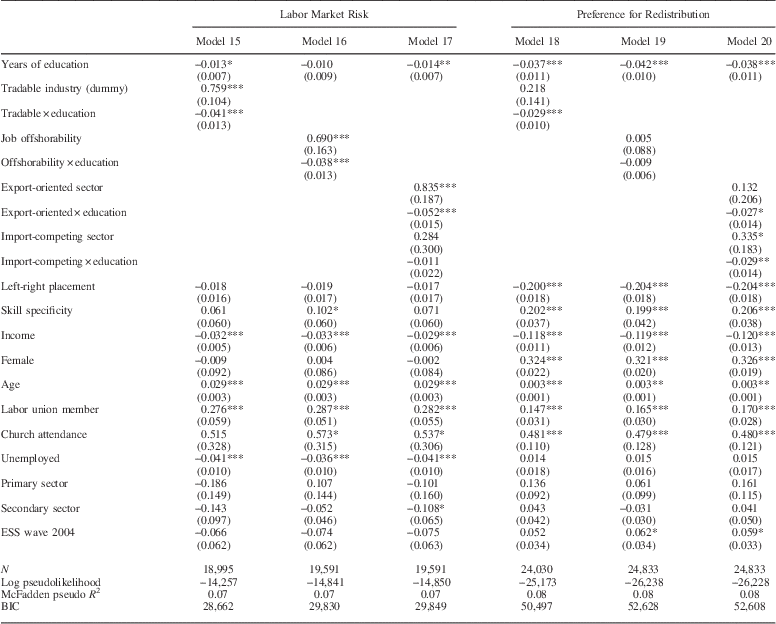
A large literature links variation in policy preferences to variation in ideology and other ideational factors (e.g., Feldman and Zaller Reference Feldman and Zaller1992; Mansfield and Mutz Reference Mansfield and Mutz2009; Margalit Reference Margalit2013). To test whether results are robust to individuals’ ideological leanings, Table 4 reestimates the main models including ideology as a control variable, measured as an individual’s self-placement on an 11-point left-right continuum, with lower values denoting a more left-leaning ideological position. The coefficients on the globalization variables do not change very much when ideology is included. Results are also robust when additional variables are included to gauge individuals’ stance toward the international environment more generally, such as trust in the United Nations or feelings about immigration.
Robustness to Including Ideology
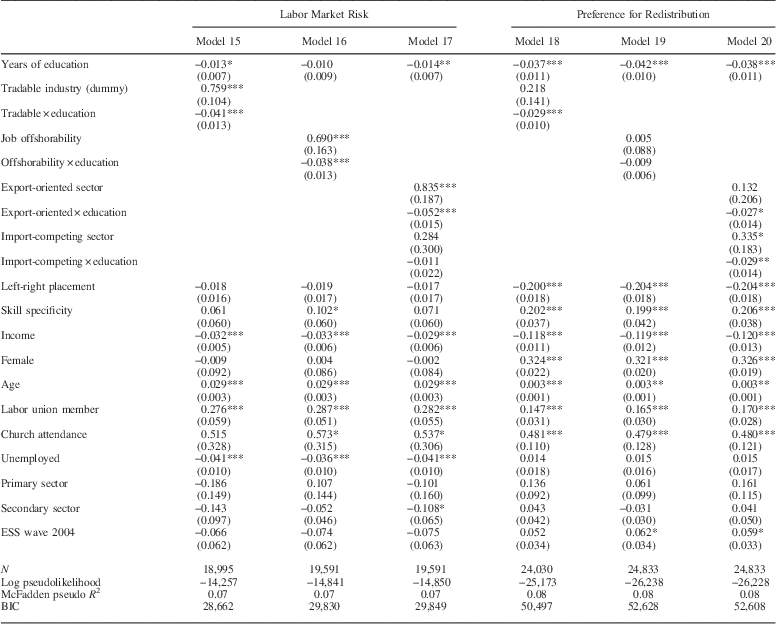
Note: Robust standard errors in parentheses, clustered on country. Cutoff points and estimates for country dummies are not reported.
ESS=European Social Survey; BIC=Bayesian information criterion.
*p≤0.1, **p≤0.05, ***p≤0.01.
Finally, echoing the argument that compared with deindustrialization, globalization does not have much of an effect on labor market risks and welfare state politics, one could object that exposure to globalization might be correlated so highly with exposure to deindustrialization that the results are an artifact of deindustrialization pressures, rather than effects of globalization. As the service sector tends to be less exposed to international competition than the manufacturing sector, many individuals employed in the services sector might be simultaneously sheltered from both globalization and deindustrialization.Footnote 31 This is a legitimate concern: in my sample, the correlations between employment in the tradable sector and the primary (0.24), secondary (0.60), and service sector (−0.66) are high, although the correlations are much lower (−0.02, 0.17, and −0.16, respectively) when job offshorability is considered. Nonetheless, the results remain relatively robust when the sample is restricted to individuals employed in the manufacturing sector or to individuals employed in the service sector only, or when I include an interaction term for respondents working in manufacturing and years of education.Footnote 32
In most of these robustness checks my argument on the conditional effect of globalization is confirmed: high-skilled workers experience less insecurity and demand less social protection when they are more exposed to globalization, whereas the effect is reversed for lower skilled individuals. Of course, this is not a falsification of the deindustrialization argument, but it does provide strong support for the argument that both globalization and deindustrialization matter for individuals’ labor market risk perception and their policy preferences.
Conclusion
This paper has shown that globalization has significant, but much more heterogenous effects on the demand-side of politics than much of the existing literature has acknowledged so far. Exposure to the global economy strongly conditions how much labor market risk individuals experience and influences whether they support or oppose policies intended to mitigate such risk. Low-skilled individuals exposed to globalization experience the highest levels of labor market risks and can therefore be characterized as globalization losers. In contrast, high-skilled individuals benefit from exposure to the global economy. As globalization winners, they experience less labor market risk and are consequently also less willing to support redistributive policies.
The paper makes two main contributions. First, it improves our understanding of the micro-level effects of globalization. By showing that the effects of globalization vary for different groups of voters, it can provide new insights for research on welfare state reform, trade policy, and labor market policies. The results imply that the distributional coalitions and the effects of globalization in these policy areas are likely to be more complex than previous research has assumed. Second, international and comparative political economy researchers have so far frequently built their arguments on very different assumptions about the main determinants of labor market risk. While comparative political economy researchers have underlined the importance of deindustrialization, skill specificity, and other domestic labor market developments such as the increasing divide between labor market insiders and outsiders, research in international political economy has predominantly focused on the effects of globalization. The findings presented here suggest that both domestic and international forces influence the demand-side of politics. For workers exposed to the international economy, globalization has strong effects, while for the large portion of workers sheltered from global competition, domestic developments are likely to be more salient. How these distributional effects play out on the macro-level remains an open question. Recent research on the political representation of the interests of poorer citizens (e.g., Bartels Reference Bartels2008; Schäfer Reference Schäfer2012) raises some doubts about the ability of globalization losers to mobilize, whereas it appears more likely that globalization winners can successfully promote their preferred policies of less protection. Future research should investigate more closely how globalization winners and losers—and their more sheltered counterparts—organize politically and succeed in getting their policy preferences heard in the political arena.
The insights of this study also have important implications for policymakers. The findings suggest that policymakers interested in buffering the effects of globalization should design policies specifically targeted at globalization losers, i.e. low-skilled workers exposed to the global economy. For example, retraining programs, wage supplements, and other support packages should be designed to predominantly benefit the low-skilled members of the workforce in exposed industries, because these workers are most likely to experience globalization-induced unemployment and wage reductions. In contrast, policies targeted at high-skilled workers who lose jobs in exposed industries should provide incentives for these individuals to quickly find employment elsewhere and to exploit the opportunities open to them. These policy issues are likely to become more salient as technological innovations increasingly turn previously sheltered service sector jobs into potentially offshorable jobs. Given that low-skilled workers are not only pressured by globalization, but also experience labor market risks originating in other developments such as deindustrialization, technological change, and immigration, however, low-skilled workers more generally will benefit from labor market policies targeted at this vulnerable group of labor market participants.