INTRODUCTION
Lyme Borreliosis (LB) is the most common arthropod-borne medical infection in the Northern Hemisphere (Kurtenbach et al. Reference Kurtenbach, Hanincová, Tsao, Margos, Fish and Ogden2006) and reported cases are increasing rapidly in some areas. For example, there has been an approximately 11-fold increase in reported cases in the past decade in Scotland (Health Protection Scotland, 2011). The causative agent of LB is the spirochaete bacterium Borrelia burgdorferi sensu lato complex that is vectored by Ixodes ticks. Currently no vaccine is available against this pathogen, so reducing disease risk is best achieved by minimizing the risk of exposure to infected tick bites, combined with the swift removal of attached ticks and early recognition and treatment of symptoms. One means of reducing the risk of exposure to infected tick bites is to have an understanding of the environmental conditions associated with high infection risk. Knowledge of the environmental determinants of Ixodes tick and B. burgdorferi s.l. abundance is also useful to estimate future pathogen distribution and prevalence under scenarios of environmental changes such as changes in climate, land use, habitat and hosts.
The transmission cycle of B. burgdorferi s.l. is complex and is dependent on the tick vector and the B. burgdorferi s.l. transmission competence of the reservoir hosts. In northern and western Europe, the primary vector of B. burgdorferi s.l. is I. ricinus, the sheep tick. Ixodes ricinus ticks spend the vast majority of their lives in the undergrowth (either questing for a passing host, in development or in diapause). However, the completion of their 3-stage life cycle (larva, nymph and adult) depends on obtaining a bloodmeal from a host for each of the life stages. The most important hosts for feeding larval and nymphal stages are birds and small mammals, while large ungulates such as sheep and deer are more important for feeding adults and are therefore considered ‘tick reproduction hosts’ (Gray, Reference Gray1998; Humair et al. Reference Humair, Rais and Gern1999). Ixodes ricinus abundance may also be influenced by climatic variables (including micro-climate induced by local vegetation characteristics). For example, adult and nymph I. ricinus ticks require temperatures above 7 °C to start questing (e.g. Randolph, Reference Randolph2004 and references therein) and can quest for longer without desiccation at higher humidities (Randolph et al. Reference Randolph, Green, Peacey and Rogers2000; Eisen et al. Reference Eisen, Eisen and Lane2002; Piesman and Gern, Reference Piesman and Gern2004).
Borrelia burgdorferi s.l. is a complex of Borrelia species, each varying in their main transmission hosts, LB symptoms and spatial distributions. In Europe, small mammals transmit B. afzelii while many bird species can competently transmit B. garinii or B. valaisiana. B. burgdorferi sensu stricto can be transmitted by mammalian, avian and reptilian hosts (e.g. Hanincová et al. Reference Hanincová, Taragelová, Koci, Schäfer, Hails, Ullmann, Piesman, Labuda and Kurtenbach2003a,Reference Hanincová, Schäfer, Etti, Sewell, Taragelová, Ziak, Labuda and Kurtenbachb). While deer are extremely important in maintaining tick populations, they are incompetent reservoirs for B. burgdorferi s.l. (Telford et al. Reference Telford, Mather, Moore, Wilson and Spielman1988; Jaenson and Tälleklint, Reference Jaenson and Tälleklint1992). In contrast to studies on I. ricinus, fewer studies have tested for associations between environmental observations and B. burgdorferi s.l. prevalence in ticks. In theory, we would predict B. burgdorferi s.l. prevalence to be influenced by the density of competent transmission hosts (Ostfeld and Keesing, Reference Ostfeld and Keesing2000). However, in practice, abundance estimates for small mammals and birds (the main competent transmission hosts in Europe) are much more difficult to acquire on a landscape scale than are other environmental variables such as climate, habitat and large mammals (the main I. ricinus reproduction hosts). Therefore, proxies for small mammals and birds are often used, so instead, for example, it could be predicted, that B. burgdorferi s.l. prevalence correlates with the amount of habitat preferred by transmission hosts (see Prusinski et al. Reference Prusinski, Chen, Drobnack, Kogut, Means, Howard, Oliver, Lukacik, Backenson and White2006). This approach is, of course, not perfect, since the main small mammal species (wood mice Apodemus sylvaticus, bank voles Myodes glareolus and common shrews Sorex araneus) may differ in their transmission efficiencies of B. burgdorferi s.l. (Kurtenbach et al. Reference Kurtenbach, Dizij, Seitz, Margos, Moter, Kramers, Wallich, Schaible and Simon1994). However, they are all considered to be competent transmission hosts and have broadly similar habitat preferences in that semi-natural mixed or deciduous woodlands that have understory vegetation are likely to harbour much larger densities of these hosts than are, say, coniferous plantations (e.g. Flowerdew, Reference Flowerdew1993).
Objectives and predictions
The maintenance of B. burgdorferi s.l. requires B. burgdorferi s.l. transmission hosts, tick reproduction hosts and ticks to occur in close spatial proximity in environmental conditions suitable for all three (as per Killilea et al. Reference Killilea, Swei, Lane, Briggs and Ostfeld2008 for B. burgdorferi s.s.). The primary aim of this study was to identify the environmental factors influencing both I. ricinus abundance and the presence of B. burgdorferi s.l. in ticks. Such information is important for informing disease mitigation strategies and predictions of future risk under scenarios of environmental change. Our approach combines data from field surveys of ticks, vegetation and large mammal dung counts with climate variables from a GIS. We conducted the study in Scotland, where I. ricinus are increasing in abundance (Kirby et al. Reference Kirby, Smith, Benton and Hudson2004), Lyme borreliosis cases have increased dramatically (11-fold) over the last decade (Health Protection Scotland, 2011), and no large-scale surveys of multiple sites have yet been conducted. We predicted that I. ricinus nymph abundance would be greater in areas that have higher large mammal abundance (tick reproduction hosts), in areas with a warmer and wetter climate (conducive to tick survival) and in habitats that both produce a micro-climate favourable to tick survival and favourable to hosts of immature ticks such as small mammals and birds (i.e. semi-natural mixed or deciduous woodland rather than commercial conifer forest). We predicted that questing I. ricinus nymphs would be more likely to be infected with B. burgdorferi s.l. in conditions favourable for competent transmission hosts (small mammals and birds), such as in mixed or deciduous (rather than coniferous) woods, or depending on ground vegetation type (see Prusinski et al. Reference Prusinski, Chen, Drobnack, Kogut, Means, Howard, Oliver, Lukacik, Backenson and White2006).
MATERIALS AND METHODS
Field surveys
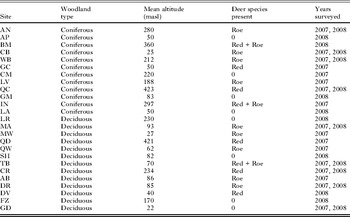
Studies were conducted in woodlands because this was the habitat type associated with the most Lyme borreliosis cases in Scotland (James, Reference James2010). Surveys were carried out in 2007 and 2008 at 25 woodland sites known to be endemic for LB across Scotland (56° 02′ N – 57° 51′ N and 2° 30′ W – 6° 12′ W), chosen for geographical spread and to provide a variety of environmental characteristics. Woodlands were categorized broadly as either semi-natural mixed/deciduous (n = 13), typically Quercus and Betula species, or coniferous (n = 12), typically Picea and Pinus species, and they also differed in altitude (1–503 metres above sea level), and deer communities (Table 1).
Woodland type, altitude, deer species and years surveyed of the 25 sites across Scotland

Surveys were conducted from April to October to cover the main questing season of I. ricinus in Scotland. A blanket drag method was used in which questing ticks were collected by dragging a 1 m2 white blanket across the ground vegetation for 10 m before inspection, counting and collection (Gray and Lohan, Reference Gray and Lohan1982; Gilbert, Reference Gilbert2010). This technique provides an estimated ‘index of relative abundance’ of ticks that are questing at the time of sampling between different areas, rather than an absolute density or abundance of ticks in an area.
The location of each blanket drag was recorded on a global positioning system (GPS) device (Garmin eTrex H, Southampton, UK), with latitude and longitude recorded for use in statistical analysis, along with the time and date (noted as Julian day for statistical analysis). Relative humidity and temperature were recorded at ground vegetation height using a temperature-humidity probe (RS212-540, RS Components, Northants, UK). For statistical analysis, values of relative humidity were averaged (per site and per am/pm). The ground vegetation height was measured at 3 points along the 10 m drag using a sward stick and the mean value per blanket drag was used for analysis (Gilbert, Reference Gilbert2010). The dominant ground vegetation was categorized into 4 classes: (1) grasses and herbaceous species, (2) ericaceous and Vaccinium species, (3) moss species and (4) bracken and ferns.
Dung of red deer Cervus elephus and roe deer Capreolus caprelus were identified (Sergeant and Morris, Reference Sergeant and Morris2003) and counts were conducted over each 1 m × 10 m blanket drag area. For statistical analysis we calculated an ‘index of relative abundance’ of roe and red deer by averaging each blanket drag's dung counts for each site (see Gilbert, Reference Gilbert2010).
Between 50 and 200 drags were performed at each site in total, each at least 50 m apart, in a semi-random way so as to sample each site in a representative manner. Sites were visited between 1 and 3 times per year over 1 or 2 years. Dragging was not performed during or just after rain when the ground vegetation was wet enough to soak the blanket, nor when the temperature was below 7 °C as ticks may not begin questing until the mean weekly max temp is above 7 °C (Randolph, Reference Randolph2004 and references therein).
Questing nymphs are the most important stage for transmitting B. burgdorferi s.l. to humans, as questing larvae do not transmit the pathogen (they are unlikely to be infected as they have not yet taken a bloodmeal and transovarial transmission is thought to be absent or rare (Hubálek and Halouzka, Reference Hubálek and Halouzka1998) and adults are far less numerous than nymphs. In addition, due to their smaller size, nymphs are less likely than adult ticks to be noticed and removed before B. burgdorferi s.l. is transmitted from the biting tick (Falco et al. Reference Falco, McKenna, Daniels, Nadelman, Nowakowski, Fish and Wormser1999). Robertson et al. (Reference Robertson, Gray and Stewart2000) estimated that 82% of human tick bites from a forested area in England were from nymphs. This study therefore focuses on the abundance of, and the B. burgdorferi s.l. infection in, questing I. ricinus nymphs. Nymphs were placed in plastic vials containing 70% ethanol for later analysis of B. burgdorferi s.l. To confirm that the ticks collected were I. ricinus, 2000 collected nymphs were randomly selected and identified to species level using a light dissecting microscope and species key (Hillyard, Reference Hillyard1996).
Borrelia burgdorferi s.l. detection
Borrelia burgdorferi s.l. detection assays were conducted on individual nymphs for those collected in 2007. Using knowledge gained from 2007 and to save time and resources, nymphs were pooled in groups of 5 for those collected in 2008 (see Supplementary Online material for further explanation and details). For analysis, 1 nymph (if collected in 2007) or a pool of 5 nymphs (if collected in 2008) were randomly selected for the B. burgdorferi s.l. assay from each of 1218 blanket drags.
DNA extraction was performed by mechanical destruction of the nymphs and ammonia extraction (Guy and Stanek, Reference Guy and Stanek1991; James et al. Reference James, Furness, Bowman, Forbes and Gilbert2011).
To identify which nymphs were infected with B. burgdorferi s.l. we used a nested polymerase chain reaction (PCR) to detect the intergenic spacer region between the 5S and 23S rRNA genes (5S-23S rRNA IGS), as described by Rijpkema et al. (Reference Rijpkema, Molkenboer, Schouls, Jongejan and Schellekens1995). For every 20 tick samples, 1 negative control (dH20), 1 negative homogenate and 1 positive control (Borrelia lusitaniae DNA; this genospecies is currently not known in northern Europe) were processed. Later, the genospecies determination of positive samples showed that none were B. lusitaniae so any contamination/false positive results were unlikely.
Identification of B. burgdorferi s.l. genospecies
The genospecies of Borrelia from 82 (all those that successfully amplified) positive nymphs was determined by multi-loci sequence typing of up to 8 genes which are diagnostic for genospecies (Margos et al. Reference Margos, Gatewood, Aanensen, Hanincová, Terekhova, Vollmer, Cornet, Piesman, Donaghy, Bormane, Hurn, Feil, Fish, Casjens, Wormser, Schwartz and Kurtenbach2008). Eight housekeeping loci were analysed; clpA, clpX, pepX, pyrG, recG, rplB and uvrA. PCRs were performed under the same conditions (cycling conditions, primer concentrations and reagents) as the B. burgdorferi s.l. PCR (i.e.5S-23S IGS). MLST products were cleaned and sequenced on an ABI automated DNA sequencer. Forward and reverse sequences were compared, aligned and trimmed using Sequence Editor (version 1.0.3, Macintosh computers). Consensus sequences were then searched on the MLST website (www.mlst.net) to determine the genospecies.
Environmental variables from GIS
Environmental variables including growing degree days (day-by-day sum of the mean number of degrees by which the air temperature is more than 5·5 °C), average annual precipitation, average mean temperature, snow-lying days, ground-frost days and growing season length were obtained for each of the 25 woodland sites from a set of 1 km and 5 km gridded climate data rasters derived from the UK Met Office 1971–2000 Long Term Average climate data (Met Office, 2009; Perry and Hollis, Reference Perry and Hollis2005). The values were extracted using the Intersect Point tool from Hawth's Analysis Tools for ArcGIS v3.27 (Beyer, Reference Beyer2004) in ArcMap v9.3 (ESRI, 2008).
Statistical analysis
Because ecological and tick count data are complex, have non-normal data distributions and many of the factors are inter-related, state-of-the-art statistical techniques were necessary. All statistical analyses were performed in R version 2.11.1 (R Development Core Team, 2010). We first explored the data for the response variable (nymph count or B. burgdorferi s.l. presence in nymphs) and explanatory variables (environmental factors) in terms of data distribution and selection of explanatory variables for initial inclusion in the models. It is essential to use a model that fits the data as well as possible, so we then constructed several types of models and selected the model family that best fit the data. Please see Online Supplementary Material for details of the variable and model selection procedures.
Both relative abundance index of questing nymphs and infection of B. burgdorferi s.l. in nymphs were analysed at the level of the individual blanket drag. For the relative abundance index of questing nymphs, the model family that we selected for use was a negative binomial hurdle model, since it best fitted the data. For infection of B. burgdorferi s.l. in nymphs, (which could either be positive or negative to B. burgdorferi s.l.), the model selected for use was binomial.
Selected explanatory variables initially entered as fixed effects into the full models for both questing nymph abundance index and B. burgdorferi s.l. presence/absence were as follows: at the spatial scale of individual blanket drags we entered time, altitude, temperature, ground vegetation height and dominant ground vegetation category. At the scale of each site we entered the following variables which were measured at the time of sampling: Julian day, forest type (coniferous or deciduous/mixed), red deer abundance index, roe deer abundance index, mean relative humidity. At the scale of each site we also entered the following climatic variables (10-year averages) from a GIS database: annual mean precipitation, annual mean temperature, growing degree days, snow-lying days, and ground-frost days. Using a backwards stepwise procedure we eliminated non-significant (P > 0·05) explanatory variables such that the final models included only significant variables.
Finally, we tested whether questing I. ricinus nymph abundance correlated with B. burgdorferi s.l. prevalence in questing nymphs in order to test whether questing nymph abundance can be used as a proxy for prevalence. At the site level, we regressed B. burgdorferi s.l. prevalence (number of nymphs testing positive/total number of nymphs tested) at each site against the mean number of nymphs counted per blanket drag at each site, using a Spearman Rank Correlation.
RESULTS
During the spring and summers of 2007 and 2008, 2397 blanket drags were conducted and 13 250 nymphs were counted and collected. A subsample of 2000 nymphs was identified to species level and all were found to be I. ricinus.
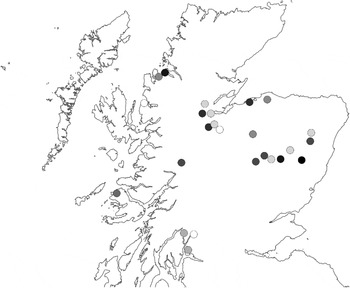
Nymph I. ricinus ticks were assayed from 1218 individual blanket drags for B. burgdorferi s.l. (we did not have the time and resources to assay nymphs from all drags, but we ensured that we assayed a minimum of 50 nymphs from each site). The prevalence of B. burgdorferi s.l. at each site was calculated as the number of positive nymphs/number of nymphs assayed per site. The overall prevalence in questing nymphs from all 25 sites was 5·6% (±1·0%, range 0·8–13·9%, Fig. 1). Of those positive samples that we successfully identified to genospecies level, 48% were B. afzelii, 36% B. garinii, 7% B. burgdorferi s.s., 8% B. valaisiana and 1% carried mixed infections of 2 or more genospecies. The number of samples successfully identified to each genospecies was not large enough for conducting meaningful statistical analyses to test for predictive environmental variables, so this was done only for B. burgdorferi s.l. prevalence as a whole, at the site level.
Prevalence of Borrelia burgdorferi s.l. in questing nymph Ixodes ricinus ticks in woodlands in Scotland. Gray scale denotes prevalence, ranging from the lowest (white) at 0·8% to the highest (black) at 13·9%.

Environmental factors influencing questing nymph abundance
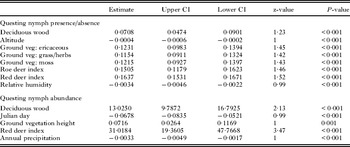
Questing nymph abundance was analysed using a negative binomial hurdle model that gives a dual output, i.e. 2 patterns are fitted to the data. In this case, the hurdle model fitted relationships for (i) nymph presence/absence (i.e. zero counts versus non-zero counts) and (ii) nymph abundance of at least 1 nymph per blanket drag (i.e. non-zero counts); see Table 2. Nymphs were more likely to be present on blanket drags conducted in areas with higher abundance indices of roe and red deer, where the ground vegetation comprised mainly ericaceous species/Vaccinium or mosses or grasses/herbaceous species (compared to bracken/ferns as the baseline), in deciduous/mixed woods (compared to coniferous as the baseline), lower relative humidity and at lower altitudes. For those blanket drags where nymphs were present, there was a very strong positive relationship between nymph abundance and red deer abundance index and deciduous/mixed woods (compared to coniferous). In addition, questing nymph abundance increased with increasing ground vegetation height, decreasing Julian day (i.e. more questing nymphs earlier in the questing season) and decreasing annual precipitation. The following variables were eliminated from the model due to non-significance during the backwards stepwise procedure: time of day, temperature at the time of sampling, growing degree days, mean annual temperature, snow-lying days, ground-frost days and growing season length and there were no significant interaction terms.
Output from the final negative binomial hurdle model describing the association between questing nymph presence/absence and abundance (counts of more than zero on blankets) and environmental variables

Environmental factors influencing B. burgdorferi s.l. infection
The environmental variables that were statistically associated with B. burgdorferi s.l. infection in questing nymphs (Table 3) had general similarities with those associated with questing nymph abundance. There was a strong positive correlation between B. burgdorferi s.l. infection and the index of relative abundance of red (but not roe) deer. Nymphs were also more likely to be infected in deciduous/mixed (compared to coniferous) woods. The likelihood of questing nymphs being infected with B. burgdorferi s.l. decreased with Julian day (i.e. nymphs were more likely to be infected later in the season), decreasing altitude, increasing ground vegetation height and increasing relative humidity (Table 3).
Output from the final binomial model describing the associations between the presence/absence of Borrelia burgdorferi s.l. infection in questing nymphs and environmental parameters

Does nymph abundance predict B. burgdorferi s.l. prevalence?
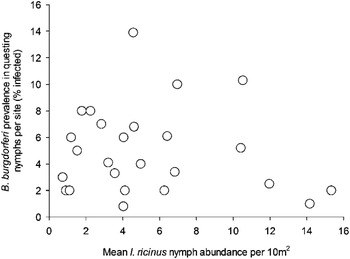
There was not a significant relationship between nymph abundance and B. burgdorferi s.l. prevalence (Fig. 2), Spearman Rank correlation ρs = −0·040, n = 25 sites within the ranges of abundances encountered.
The relationship between questing nymph abundance and Borrelia burgdorferi s.l. prevalence at the site level.

DISCUSSION
Our main aim was to identify the environmental factors influencing both questing I. ricinus abundance and the presence of B. burgdorferi s.l. in those ticks. We also used the data to test for an association between questing nymph abundance and B. burgdorferi s.l. prevalence.
Questing nymph abundance
We found a strong positive association between questing nymph abundance index (and nymph presence/absence) and the abundance indices of both red and roe deer, as we predicted. This is unsurprising, since deer (roe and red) are the primary ‘reproduction’ hosts for I. ricinus in Scotland, and many previous studies have found a correlation between tick and deer abundance (e.g. Jensen et al. Reference Jensen, Hansen and Frandsen2000; Ruiz-Fons and Gilbert, Reference Ruiz-Fons and Gilbert2010).
As predicted, we found a strong effect of woodland type, with semi-natural mixed/deciduous woodlands having more nymphs than coniferous woodland. We also found further effects of ground vegetation type (fewer nymphs in bracken/ferns) and height (more nymphs in tall ground vegetation). Several previous studies have found more I. ricinus in deciduous woodlands (e.g. Estrada-Peña, Reference Estrada-Peña2001; Guerra et al. Reference Guerra, Walker, Jones, Paskewitz, Roberto Cortinas, Ashley Stancil, Bobo and Kitron2002; Lindström and Jaenson, Reference Lindström and Jaenson2003; Brown et al. Reference Brown, Peot and Lane2006), although Walker et al. (Reference Walker, Alberdi, Urquhart and Rose2001) found more ticks in coniferous than in deciduous woods in southern Scotland. It is likely that more ticks are found in habitats with more hosts and that, for our particular study sites, tick abundance reflected areas with an understory vegetation of preference to a range of vertebrates that host immature ticks. Habitats with dense understory may also be associated with higher tick numbers because of the mild and humid micro-climate produced by the thick ground vegetation and the deep leaf litter in deciduous/mixed woodland habitats (e.g. Lindström and Jaenson, Reference Lindström and Jaenson2003).
More questing ticks were predicted in areas with a warmer climate and higher rainfall (or higher humidity) because of the temperature and humidity thresholds on tick questing behaviour and survival. We did find more questing ticks in woodlands at lower altitudes which, given that the model allowed for variance due to hosts and vegetation, is likely to be partly a climatic effect. A strong effect of climate and altitude on questing I. ricinus nymphs was recently found for open moorland areas in Scotland (Gilbert, Reference Gilbert2010). However, we found the opposite effect to that predicted for rainfall or humidity: questing nymphs were more likely to be present at times of low relative humidity and questing nymphs were more abundant in areas with lower annual rainfall. In general, previous studies have found that tick questing activity increases with increasing humidity (Randolph et al. Reference Randolph, Green, Peacey and Rogers2000; Piesman and Gern, Reference Piesman and Gern2004), but it might be that conditions can be too wet for ticks (e.g. they tend to quest less in the rain). Perhaps in regions with a cool, wet climate, such as Scotland and western Scandinavia, the drier times and drier areas may still be well within the humid conditions needed for I. ricinus nymphs to quest, while the wetter times and wetter areas may be too wet.
Borrelia burgdorferi s.l. infection in questing nymphs
We predicted that questing I. ricinus nymphs would be more likely to be infected with B. burgdorferi s.l. in conditions compatible for the presence of competent transmission hosts (small mammals and birds), such as in semi-natural mixed/deciduous (rather than coniferous plantation) woods, or depending on ground vegetation type. This prediction was upheld: nymphs were more likely to be infected with B. burgdorferi s.l. in semi-natural mixed/deciduous (compared to coniferous) woodlands and also in woodlands with higher ground vegetation (which may relate to small mammal and bird abundance, although further surveys would be needed to test this for our particular sites). While bank voles, wood mice and common shrews share broadly similar habitat preferences, such as preferring semi-natural woodland to dense coniferous plantations, they differ in their efficiency of transmitting B. burgdorferi s.l. (Kurtenbach et al. Reference Kurtenbach, Dizij, Seitz, Margos, Moter, Kramers, Wallich, Schaible and Simon1994). Therefore, the proportion of, say, wood mice to bank voles in one year might be expected to influence the infection prevalence of questing I. ricinus nymphs with B. burgdorferi s.l. in the following year. Our study merely used broad habitat type as a proxy for the likely relative abundances of transmission hosts in general, and detailed further studies would be needed to test the effect of actual host community composition on B. burgdorferi s.l. prevalence.
Interestingly, it was found that nymphs were more likely to be infected with B. burgdorferi s.l. in woodlands with higher red deer abundance indices. Deer cannot transmit B. burgdorferi s.l. and could be considered dilution hosts if more deer result in more immature ticks feeding on deer instead of on competent transmission hosts. However, what may possibly be happening at our sites could be that deer may act primarily as tick reproduction hosts (see Gray, Reference Gray1998) by feeding mainly adult ticks. Therefore, more deer would result in more immature ticks that feed primarily on the small transmission hosts, thereby increasing the likelihood of transmission occurring between infected nymphs and uninfected larvae feeding simultaneously on an individual transmission host. Indeed, a recent study in Italy found that the number of ticks feeding on rodents initially increased with deer density, reaching a peak at intermediate deer densities and then decreased as deer densities got higher (Cagnacci et al. Reference Cagnacci, Bolzoni, Rosà, Carpi, Hauffe, Valent, Tagliapietra, Kazimirova, Koci, Stanko, Lukan, Henttonen and Rizzoli2012). In accordance, models of tick-borne encephalitis virus and Louping ill virus predict an increase in tick-borne pathogen prevalence with increasing deer up to a point, and then at very high deer densities the dilution effect is predicted to occur (Bolzoni et al. Reference Bolzoni, Rosà, Cagnacci and Rizzoli2012; Gilbert et al. 2001). It is intriguing that, unlike red deer abundance indices, we found no such positive effect of roe deer on B. burgdorferi s.l. This could be a statistical artefact, e.g. if there was less statistical power due to roe deer being less abundant than red deer. Alternatively, it could be a real biological effect due to unmeasured factors, e.g. differences between roe and red deer in spatial distribution with respect to transmission host distribution within sites; or differences between red and roe deer in their burdens of different life stages of I. ricinus. Roe deer can carry large numbers of all stages of I. ricinus, particularly nymphs (Kiffner et al. Reference Kiffner, Lödige, Alings, Vor and Rühe2010; Vor et al. Reference Vor, Kiffner, Hagedorn, Niedrig and Rühe2010) while red deer in Scotland carry mainly adults (L. Gilbert, unpublished data available at http://www.macaulay.ac.uk/deerlarder/a_deer_ticks.php last accessed 13th June 2012).
It is interesting that the relationship of B. burgdorferi s.l. with Julian day was the opposite to that for questing nymph abundance, i.e. questing nymph abundance decreased over the season whereas the incidence of B. burgdorferi s.l. infection in nymphs increased over the season. One potential explanation could be that B. burgdorferi s.l. transmission hosts increase in abundance over the season, as small mammals and birds produce young over the summer. In addition, it is likely that the infection prevalence of small mammals increases over the season as they are bitten by ticks throughout the season. There is currently no available information on the timings of diapause and moulting of Scottish I. ricinus stages, but if there are earlier and later cohorts of each stage of ticks, e.g. larvae that feed later in the season become nymphs that quest later the following season, then this could be a potential mechanism explaining the above contradictory effects of questing nymphs and B. burgdorferi s.l. infection over the season. However, this is pure conjecture and further research is required on the seasonality of cohorts and the timing of diapause and moulting of larvae and nymphs in Scottish woodlands to test this idea. Previous studies have found seasonal patterns of B. burgdorferi s.l. infection in I. ricinus nymphs that differ from our finding, e.g. peaks of infection in late spring in Sweden (Tälleklint and Jaenson, Reference Tälleklint and Jaenson1996), further indicating that the biological mechanisms behind seasonal patterns in B. burgdorferi s.l. prevalence remain obscure.
Nymphs were also more likely to be infected with B. burgdorferi s.l. in surveys conducted at lower altitudes (although the effect was not strong), and this could occur if B. burgdorferi s.l. transmission hosts are more likely to be found at lower level sites than at higher, more exposed, sites. Several other studies have found this negative association between B. burgdorferi s.l. prevalence and altitude in forests, as in Switzerland (Burri et al. Reference Burri, Cadenas, Douet, Moret and Gern2007; Jouda et al. Reference Jouda, Perret and Gern2004; Cadenas et al. Reference Cadenas, Rais, Jouda, Douet, Humair, Moret and Gern2007).
Previous studies have also found associations between B. burgdorferi s.l. infection and hosts, habitat and climate. Altobelli et al. (Reference Altobelli, Boemo, Mignozzi, Bandi, Floris, Menardi and Cinco2008), using data from a GIS, found correlations between B. burgdorferi s.l. infected I. ricinus and roe deer abundance and mean annual temperature in north-eastern Italy. Eisen et al. (Reference Eisen, Eisen, Girard, Fedorova, Mun, Slikas, Leonhard, Kitron and Lane2010), also using GIS, found correlations between B. burgdorferi s.l. infected I. scapularis nymphs and spring/summer temperature, variability in water vapour and forest type in the western USA. Jensen et al. (Reference Jensen, Hansen and Frandsen2000) found positive associations between I. ricinus density and roe deer density and soil water capacity in woodland habitats, yet these factors were not associated with B. burgdorferi s.l. prevalence in those ticks. Maetzel et al. (Reference Maetzel, Maier and Kampen2005) did not find a difference in the B. burgdorferi s.l. infection prevalence between wooded and non-woodland sites.
While we did not have sufficient statistical power to analyse environmental variables with respect to each different genospecies of B. burgdorferi s.l., the fact that almost half the I. ricinus we assayed tested positive for B. afzelii is noteworthy. Previous studies of I. ricinus in other parts of the British Isles have found B. garinii and B. valaisiana to be predominant (e.g. Kurtenbach et al. Reference Kurtenbach, Peacey, Rijpkema, Hoodless, Nuttall and Randolph1998), although Vollmer et al. (Reference Vollmer, Bormane, Dinnis, Seelig, Dobson, Aanensen, James, Donaghy, Randolph, Feil, Kurtenbach and Margos2011) found B. afzelii at just over half their English sites. Ling et al. (Reference Ling, Joss, Davidson and Ho-Yen2000) analysed 12 positive I. ricinus from the Scottish Highlands and, like our study, identified that almost half of these were B. afzelii. The reasons for any difference in genospecies predominance between Scotland and the rest of the British Isles warrants further research.
Relationship between questing nymph abundance and B. burgdorferi s.l. prevalence
We found no evidence for a positive association between questing nymph abundance and B. burgdorferi s.l. prevalence at the site level within the ranges encountered. For a given density of transmission hosts, theoretically, higher tick abundance may mean more ticks feeding on the same individual transmission host while it is infectious, thereby leading to higher pathogen prevalence. However, as densities of transmission hosts vary, and the transmission efficiency of different hosts also varies, this theoretical relationship will not necessarily be realised empirically. Some authors suggest using nymph abundance as an indicator of B. burgdorferi s.l. prevalence (Jaenson et al. Reference Jaenson, Eisen, Comstedt, Mejlon, Lindgren, Bergström and Olsen2009) but this lack of an association at our sites suggests that nymph abundance cannot necessarily be used as a proxy for B. burgdorferi s.l. prevalence. However, for a given B. burgdorferi s.l. prevalence, if there are more nymphs questing, the risk of human infection will be higher. Therefore, all things being equal, more ticks may sometimes mean higher infection risk to humans. However, in reality, as the infection prevalence varies so widely (0·8–13·9% in Scottish woodlands) we caution against using questing nymph abundance as a proxy for human infection risk.
Conclusion
The mechanistic causes of B. burgdorferi s.l. infection in ticks relate to the abundance of transmission hosts and the burden of larvae, nymphs and adult ticks on transmission hosts. However, collecting such information, while possible for small numbers of sites and small areas, is very labour intensive and is rarely feasible over multiple sites over large areas. Therefore, studies such as ours and the previous studies cited are useful in predicting potential disease risk. Our study and the previous studies share some consistent findings, such as the positive association of deer with questing tick abundance and B. burgdorferi s.l. infection, and general associations with habitat (such as woodland type) that may reflect transmission host abundance, and with climate variables (that may reflect hosts and tick abundance).
In summary, we have carried out an extensive study with large sample sizes of sites, blanket drags and ticks assayed, and have identified which environmental variables are associated with questing I. ricinus nymphs and the incidence of B. burgdorferi s.l. infection in questing nymphs in Scottish woodlands. Woodland type and deer abundance were the primary determinants of both nymph abundance and B. burgdorferi s.l. infection. Ground vegetation and weather/climate variables also played a role. Most of our results supported our initial predictions which were made in accordance with tick reproduction hosts and which habitats are generally preferred by transmission hosts (small mammals and birds). These results could be used in future studies to predict which areas might have high tick abundances and B. burgdorferi s.l. prevalence based on environmental factors on a broader scale (e.g. using a country-wide GIS). In addition, it may be possible to predict what may happen to pathogen distributions under future environmental changes such as woodland expansion, deer management and climate change.
ACKNOWLEDGEMENTS
The authors are grateful for field assistance from E. Packer, A. Wiebe, J. Low, E. Stephen and J. Arthur, for laboratory assistance from K. Reay, and three anonymous reviewers for useful comments on the manuscript.
FINANCIAL SUPPORT
M.C.J. was funded by a Biotechnology and Biological Sciences Research Council (BBSRC) Doctoral Training Grant with CASE support from the Macaulay Development Trust awarded to A.S.B. and L.G., and L.G. and J.McL. were supported by the Scottish Government's Rural and Environment Science and Analytical Services Division (RESAS).